




Abstract
Comprehensively evaluating the relationship between personality and pro-environmental behaviors (e.g., speaking with friends/strangers about environmental issues, attending pro-environmental rallies, and recycling) with both broad and fine conceptualizations of personality (i.e., higher-order factor, lower-order factor, and nuance levels) while also accounting for geographically varying associations is critical for developing an understanding of why people may behave pro-environmentally in various geographical contexts. To examine this, we (1) tested the utility of the SAPA Personality Inventory-5 (SPI-5) factors, SPI-27 lower-order interstitial factors, and SPI-135 nuances/items for predicting pro-environmental behaviors and cross-validated these models, (2) evaluated how the relationship for higher-order and lower-order personality factors with pro-environmental behaviors vary across geographic locations in the United States at the ZCTA (ZIP Code Tabulation Area) level using multilevel modeling, and (3) assessed how geographically varying slopes related to average levels of pro-environmental behaviors within ZCTAs. We found an empirically identified selection of thirty SPI-135 items predicted pro-environmental behaviors better than the SPI-5 and SPI-27 collectively, and that the full SPI-135 items had the highest predictive utility. Additionally, in ZCTAs with higher average levels of pro-environmental behaviors, stronger associations between higher levels of agreeableness, extraversion, neuroticism, and openness with higher levels of pro-environmental behaviors were observed.
Plain Language Summary
Amidst the global climate change crisis, it is essential to understand the psychological underpinnings of pro-environmental behaviors (e.g., speaking with friends/strangers about environmental issues, attending pro-environmental rallies, and recycling). Evaluating personality associations with pro-environmental behaviors at different levels of personality (i.e., higher-order factor (most broad), lower-order factor (moderately broad), and item levels (most specific)) while also accounting for how personality effects on pro-environmental behaviors may vary across geographical locations can aid in revealing precise relationships between personality and pro-environmental behaviors across places. To accomplish this, (1) we tested the utility of the SAPA Personality Inventory-5 (SPI-5) factors, SPI-27 facets, and SPI-135 items for predicting pro-environmental behaviors and cross-validated these models, (2) we evaluated how the relationships for higher-order and lower-order personality factors with pro-environmental behaviors vary across geographic locations at the ZCTA (ZIP Code Tabulation Area) level, and (3) assessed if the average levels of pro-environmental behaviors within ZCTAs were associated with the unique location-specific relationships (slopes) between pro-environmental behaviors and personality indicators. We found that finer/more specific personality information (items) led to the best predictive accuracy for pro-environmental behaviors. Additionally, individuals with higher levels of Agreeableness, Extraversion, Neuroticism, and Openness than others in their ZCTA tended to conform to how pro-environmental their social context was, having higher levels of pro-environmental behaviors in contexts/ZCTAs with higher average levels of pro-environmental behaviors.
Keywords
Introduction
Climate change is an imminent threat to human civilization as we know it today. In 2020, 11,258 scientists from 153 countries published an alarming report stating that climate change has the power to “cause significant disruptions to ecosystems, society, and economies, potentially making large areas of Earth uninhabitable” (Ripple et al., 2020). Additionally, an approximate 4°C average temperature increase is projected by 2100 under the “business-as-usual” scenario (Masson-Delmotte et al., 2021); this level of climate change is conducive to significant threats to civilization and the biological world as we know it (Anderson, 2012; Steel et al., 2022). However, with appropriate changes in human behavior, these effects can be mitigated. As a result, the ongoing global climate change crisis demands a comprehensive understanding of the psychology of pro-environmental behaviors. With the current research, we present (1) how personality measured at multiple levels (i.e., higher-order factor, lower-order interstitial factor, and nuance) relates to pro-environmental behaviors, (2) how the relationships between personality indicators and pro-environmental behaviors vary across geographical locations, and (3) how local levels of pro-environmental behaviors influence the variation in these relationships. Our findings serve to provide insight into what elements of individuals’ personality constellations relate to pro-environmental behaviors under different geo-contextual conditions.
Pro-environmental behaviors
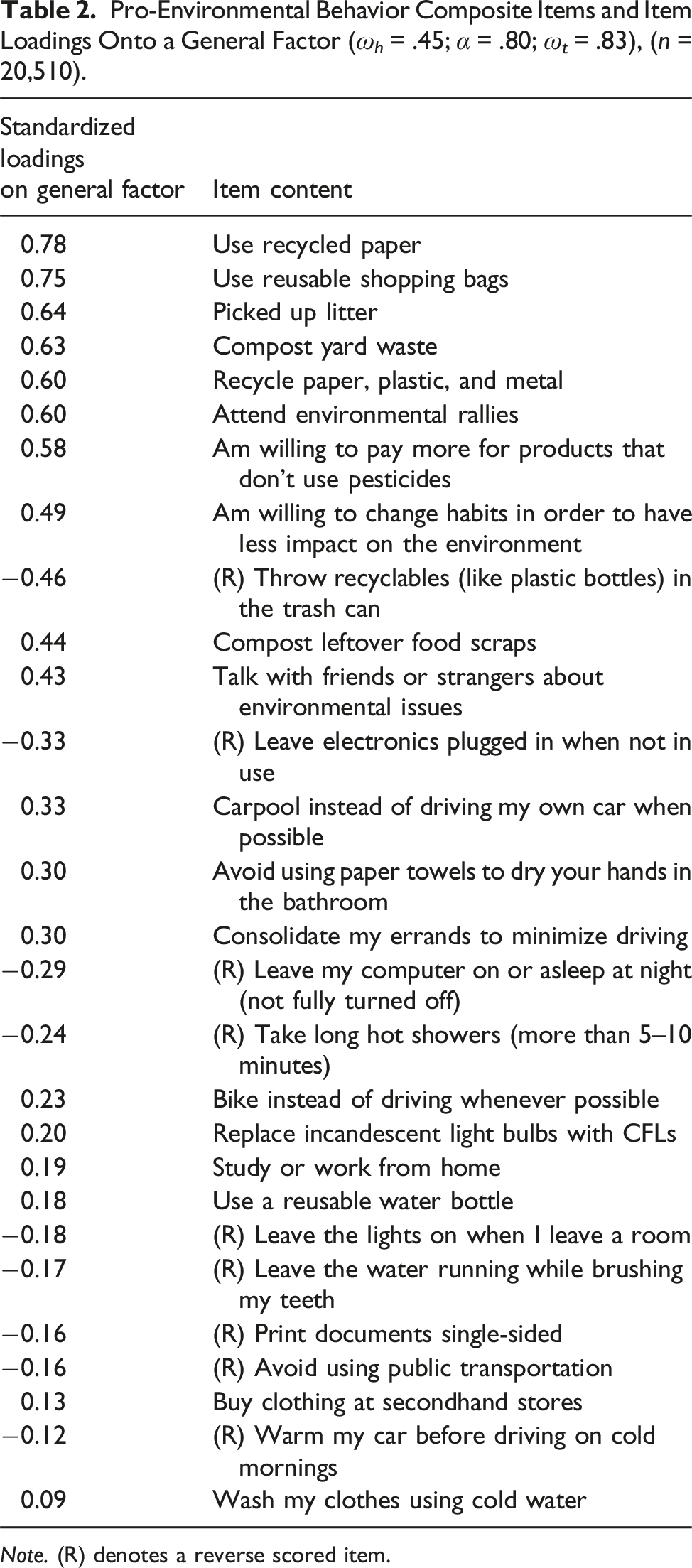
The term “pro-environmental behaviors” describes behaviors that fundamentally benefit the environment and/or assist in mitigating human impact on climate change. There are a variety of specific pro-environmental behaviors including but not limited to talking with friends or strangers about environmental issues, attending pro-environmental rallies, recycling, and using reusable shopping bags (see Table 2 for full list of the scale items for the present study). In isolation, the effects of these behaviors may seem negligible, but in the aggregate, they can contribute to significantly mitigating negative human impacts on climate change. Pro-environmental behaviors function to conserve precious natural resources, decrease CO2 emissions, and ultimately mitigate individual-level contributions to human-related causes of climate change. A variety of taxonomies have been used for classifying pro-environmental behaviors and break the construct of pro-environmental behaviors into subfactors such as conservation-, citizenship-, food-, and transportation-based pro-environmental behaviors (Markle, 2013). It is expected these subfactors have significant regional differences in how commonly they are practiced due to a variety of geographical and social-contextual factors, such as the accessibility of the type of pro-environmental behavior, physical living environment, sustainable urban planning, and education (Rajapaksa & Managi, 2018).
Consistent with the attitudes and behaviors literature (Eagly & Chaiken, 1998), pro-environmental attitudes are not always reflective of pro-environmental behaviors and vice versa, only accounting for a rather small to moderate part of the variation in one another (e.g., r = .42; 95% CI: .26 to .56) (Bamberg & Moser, 2007) with social context playing a significant role. While pro-environmental attitudes refer to ways individuals perceive the environment and the degree to which they internally value protecting it, pro-environmental behaviors refer to the actual external actions themselves.
Theoretical framing
A variety of robust psychological theories have been applied to better understand pro-environmental behaviors, including but not limited to Cultural Cognition Theory (Kahan, 2008, 2010; Kahan et al., 2010a, 2010b; Markle, 2019; Verchick, 2016). Cultural Cognition Theory draws on ideas about the defining nature of dimensions of culture and the value systems they contain to understand how individuals orient themselves within their socio-cultural worlds (Kahan, 2008, 2010; Kahan et al., 2010a, 2010b; Markle, 2019; Verchick, 2016). A critical component of the theory involves how socio-cultural orientations influence how individuals perceive norms, evidence, risk, as well as key social and political issues (Kahan, 2008, 2010; Kahan et al., 2010a, 2010b; Markle, 2019; Verchick, 2016). The socio-cultural values that occupy individuals’ unique socio-cultural contexts relate to how individuals form opinions on best solutions for a social issue (Kahan, 2010; Kahan et al., 2010a, 2010b). Place-level cultural orientations can also affect how individuals perceive science and orient themselves toward scientific evidence and guidance, which is highly relevant to pro-environmental behavior enactment. Like Hogan’s socioanalytic theory involving the “getting ahead” and “getting along” functional motivations of personality (Hogan, 1996; Hogan & Blickle, 2018; Hogan & Holland, 2003), Cultural Cognition Theory postulates that individuals form opinions and behave in a manner rooted in what is functional for their role in a socio-cultural environment. Fitting in with one’s social environment is adaptive and “people endorse whichever position reinforces their connection to others with whom they share important ties” (Kahan, 2010, p. 296). In relation to personality, what is thought to be an agreeable opinion or behavior in one social context might not be agreeable in a different socio-cultural environment. Thus, being motivated to get along well with others and motivated by social rewards (i.e., agreeableness and extraversion) may naturally result in different behavioral outcomes dependent on how much the behavior is supported or looked down upon by one’s social-cultural environment. Thus, it is critical to evaluate how individual-level determinants, like personality, interact with unique socio-cultural contexts (Cultural Cognition Theory) to illicit different pro-environmental behavior levels across individuals.
Personality and pro-environmental behaviors
A variety of papers have delved into the relationship between personality and pro-environmental behaviors at various levels of measurement (Brick & Lewis, 2016; Gibbon & Douglas, 2021; Panno et al., 2021; Soutter et al., 2020). Although personality traits are typically conceptualized under a higher-order five-factor model (Goldberg, 1992) comprising domains of Extraversion, Agreeableness, Conscientiousness, Neuroticism, and Openness, there is substantial support for finer approaches to personality measurement on the level of facets/lower-order personality factors and nuances (Elleman et al., 2020; Mõttus et al., 2017a, 2017b; Rauthmann, 2023; Soutter & Mõttus, 2021), which refer to more narrow and precise indicators of personality. Lower-order personality factors refer to lower-order latent variables of personality that conceptualize personality in a more specific and detailed manner than higher-order factors. Lower-order personality factors can be interstitial, going in-between higher-order personality factors, such as in the SAPA (Syntenic Aperture Personality Assessment) Personality Inventory 27 (SPI-27) lower-order interstitial factors (Condon, 2018). Personality nuances are the finest units of personality disposition and are assessed via individual items or small sets of items (Stewart et al., 2022). Personality nuances provide a “deep and contextualized description of the individual,” capturing the most specific components of personality (Mõttus, Kandler, et al., 2017). Long avoided as units of analysis because of long-standing traditions involving theory-based latent factors (Loevinger, 1957), personality nuances/items are a critical unit of dispositional personality because of the large amount of unique information they hold due to not undergoing data reduction (Revelle & Garner, 2024). Many personality nuances demonstrate significant rank-order stability, reliability across observers, and heritability comparable to that of higher-order personality factors. Additionally, roughly half of personality nuances can account for additive genetic variance above and beyond higher-order personality factors (Mõttus, Kandler, et al., 2017). Personality nuances are particularly useful for prediction-based approaches to personality science (Mõttus et al., 2020) and have substantive predictive validity for external outcomes (Mõttus et al., 2017; Revelle & Garner, 2024). Focusing on predictability of behavior has a variety of benefits for revealing the underlying mechanisms of certain behavior (Garner, in press; Yarkoni & Westfall, 2017) and increasing the statistical validity of scales empirically constructed to predict behavior. A greater understanding of the predictors of a given phenomenon or set of behaviors ultimately provides greater in-depth comprehension of the phenomenon or set of behaviors at interest.
With respect to higher-order personality factors, the five factor traits moderately predict pro-environmental behaviors across studies, r = .28 to .45 (Soutter et al., 2020). The strongest higher order personality-level associations with greater pro-environmental behaviors are typically observed with higher Openness, and moderate associations are commonly found with higher Agreeableness, higher Conscientiousness, and higher Extraversion (Brick & Lewis, 2016; Gibbon & Douglas, 2021; Panno et al., 2021; Soutter et al., 2020). Neuroticism typically has a weak to null relationship with pro-environmental behaviors (Soutter et al., 2020).
Furthermore, finer grain lower-order personality factors (i.e., more specific personality trait indicators) have been shown to collectively predict pro-environmental behaviors just as well as the five higher-order factors even after cross-validation (r = .29 to .42) (Soutter & Mõttus, 2021). Even though the predictive utility of pro-environmental behaviors was not quantitively strengthened through use of lower-order factors instead of higher-order factors in Soutter and Mõttus’ (2021) study in terms of effect size, the utilization of lower-order factors served to provide a more detailed illustration of the specific components of personality that contribute to individual-level pro-environmental behaviors. For instance, while a moderate association between Extraversion and pro-environmental behaviors has been found, an examination of the lower-order factor level associations revealed “social-oriented” lower-order factors of Extraversion more strongly related to pro-environmental behaviors than other lower-order factors of sensation-seeking, with the conclusion being “It might be that Extraversion is associated with pro-environmental attitudes and behaviors when these attitudes and behaviors have a more socially rewarding aspect to them or involve socially acting within the environment” (Soutter & Mõttus, 2021, p. 205).
Previous research has also demonstrated that within the neuroticism domain, the lower-order factor of anxiety strongly relates to climate change action (Pickering & Dale, 2023) while other research suggests a weaker association with anxiety and a greater association with anger (Soutter & Mõttus, 2021). Within the factor of openness, lower-order factors of intellectual curiosity and appreciation for aesthetics and beauty consistently drive the higher-order factor-level association between pro-environmental behaviors and openness (Brick & Lewis, 2016; Markowitz et al., 2012; Soutter & Mõttus, 2021). Lower-order factors of agreeableness involving compassion, sympathy, and altruism (Markowitz et al., 2012; Soutter & Mõttus, 2021), and conscientiousness lower-order factors of self-discipline and achievement striving have the strongest associations with pro-environmental behaviors within these higher-order factors (Brick & Lewis, 2016; Markowitz et al., 2012; Soutter & Mõttus, 2021).
Geographic context
Geographic context is an important element to be acknowledged in the study of personality effects because of the power that place and social-context hold in shaping individuals’ life courses, their perceptions of the world, and the ways they navigate their social environments. A growing body of literature supports the notion that individual psychological features can interact with one’s geographical environment to influence psychological development as well as outcomes (Rentfrow & Jokela, 2016). Geographical location can also influence the magnitude of association between these phenomena (Gebauer et al., 2014; Jokela et al., 2015). In other words, geo-contextual variables are highly relevant when studying personality level associations with external behaviors.
Previous literature has highlighted several specific geo-contextual influences on pro-environmental behaviors. Individuals growing up in rural areas tend to have greater pro-environmental behavior intention and affective connection with the environment (Hinds & Sparks, 2008) as well as overall greater pro-environmental behaviors than their counterparts growing up in urban areas (Berenguer et al., 2005). Time spent in nature is associated with greater appreciation for nature, which is, in turn, highly associated with pro-environmental behaviors (DeVille et al., 2021). Spending more time outdoors in childhood is associated with pro-environmental behaviors in adulthood, even though pro-environmental behaviors and attitudes in early childhood do not predict adulthood pro-environmental behaviors (Evans et al., 2018). These findings suggest that geographical context likely plays a significant role in shaping pro-environmental behaviors and operates uniquely of individual disposition and early attitudes. Moreover, the nuanced interplay between socio-geographical determinants (i.e., urban-rural geographic location, social class, social norms, setting, and proximity to climate-change-induced natural disasters) with person-level determinants (i.e., education level, semantic knowledge, self-concept, values, political views, sense of responsibility, control, cognitive bias, attachment to place, age, and gender) for eliciting pro-environmental behaviors suggest its complexity as a concept and a need for integrated approaches to predicting and understanding it (Gifford & Nilsson, 2014).
Given that person and place level determinants of pro-environmental behaviors interact to result in unique outcomes, there is logical support for the examination of geographically varying associations between personality and pro-environmental behavior. Evaluating geographically varying associations for personality is not a novel approach. For instance, geographically varying associations between personality traits and life satisfaction across postal codes have been found in the greater London area (Jokela et al., 2015). That is, variation in the strength and direction of associations between personality and life satisfaction were observed across postal codes, highlighting the importance of evaluating geographic context as a moderator for established psychological effects (Jokela et al., 2015). Given geographically varying personality associations were found within just the greater London area, we expect there is also significant geographic variation for various personality associations across an entire country, like the United States of America.
Neighborhood context is highly relevant to understanding individual perceptions and experiences of policy-relevant topics, like climate change, in the US (Michener, 2018). Although Michener (2018) wrote in the context of policy implementation and feedback, the essential notion of stark variation in individual experiences with standard systems and structures in the USA across neighborhoods is highly relevant to understanding why geo-context matters for understanding pro-environmental behavior enactment. The stark variation in how individuals perceive policies and structures in the USA is likely evident, in part, because of the deep-rooted vertical fragmentation (i.e., federal, state, county, and local) and horizontal fragmentation (i.e., executive, legislative, and judicial branches at every vertical level) inherent to governmental systems and structures within the USA (Michener, 2018). In other words, state and local authorities have tremendous power over policy implementation in the USA. As a result, individual interactions with structures, systems, and policies in the USA are incredibly disjointed and variable across places. Access to systems and structures that make pro-environmental behaviors feasible is an essential component to account for in the study of pro-environmental behaviors. Thus, examining how the effects of personality characteristics on pro-environmental behaviors vary across neighborhoods can aid psychologists wanting to make sense of the geo-contextual influences and motivational processes surrounding pro-environmental behaviors.
When studying how individual psychological features interact with one’s geographical environment/context to produce outcomes, determining the unit of analysis for geographical context/place is critical for robust research. For example, individual personality characteristics tend to cluster based on geographic region in large data sets (Elleman et al., 2020; Lanning et al., 2022; Rentfrow et al., 2008; Rentfrow & Gosling, 2021), and this clustering is seen on the level of US regions and states. Using finer units of geographic location (i.e., ZIP (Zone Improvement Plan) Code Tabulation Areas (ZCTAs) and counties) results in the most precise and accurate models for the relationship between geographical location and personality (Elleman et al., 2020). When it comes to measurement units, “smaller is better” (Elleman et al., 2020). Specifically, the variance explained in personality by geographic context increases tremendously when ZCTAs are used as the unit of analysis instead of regions or states (Elleman et al., 2020). When considering that ZCTAs are usually representative of a community and/or set of neighborhoods, it is logical that greater accuracy is achieved by being as specific as possible with the unit of analysis for geographical location.
High specificity in operationalizing units of place is also practically important because of the unique influences, values, and self-interests subsumed with places. For instance, economic self-interest can tremendously affect attitudes and behaviors. “Focusing events,” or salient events that bring significant attention to a policy-relevant issue, can elicit either societal reckoning or self-interested responses to the issue at-hand when economic variables are on the line. For example, dependency on oil drilling only significantly relates to individuals’ attitudes toward drilling in a given place after an oil spill, but not typically before. After an oil spill, pro-drilling views are increased on average among individuals who live in areas economically dependent on drilling (Bishop, 2014). There is a dynamic interplay between person and geo-contextual indicators affecting pro-environmental behaviors and thus, an importance to evaluating variation in person-level effects on pro-environmental behaviors across places.
All in all, geographic context plays a significant role in how individual differences manifest behaviorally and psychologically in different places. Given the support for socio-cultural and place-level influences on pro-environmental behaviors, it is expected that geographic context/place will moderate the effect of personality on pro-environmental behaviors. That is, we expect that personality indicators will have different types of relationships with pro-environmental behaviors in different places. Our analysis was exploratory in determining if local levels of pro-environmental behaviors moderate the relationship between personality factors and pro-environmental behaviors but was employed based on the premise that personality indicators function to aid in individuals best “getting along” and “getting ahead” in their social environments (Hogan, 1996; Hogan & Blickle, 2018; Hogan & Holland, 2003). Thus, we expected that the extent to which individuals are collectively pro-environmental in a given geographical context would influence the type of association between personality indicators and pro-environmental behaviors.
Research questions
We proposed the following research questions for our study: (1) How does personality at three levels (i.e., higher-order factor, lower-order interstitial factor, and nuance) predict pro-environmental behaviors across the USA on average and do these estimates cross-validate? (2) How does the effect of higher-order and lower-order interstitial personality factors on pro-environmental behaviors vary across geographic locations at the ZCTA level, and (3) how are these geographically varying slopes related to average levels of pro-environmental behaviors within ZCTAs?
The pre-registration and R-code for the current study can be found at https://osf.io/xvbtm/. Additional analyses to examine how ZCTA-specific slopes for personality factors and pro-environmental behaviors correlate with average levels of pro-environmental behaviors within ZCTAs were added after the initial pre-registration was submitted. As per Lanning et al. (2022), the geographical data used in the current study cannot be made publicly available because it could potentially de-anonymize participants in the current study.
Method
Participants and data
Participant data from the Synthetic Aperture Personality Assessment (SAPA) project (https://sapa-project.org) collected from 2017 to 2019 were used for this study. The SAPA project (SAPA, https://sapa-project.org) collects self-report data from participants around the globe on over 6000 items using a Massively Missing Completely at Random (MMCAR) sampling procedure (see Revelle et al., 2017), meaning participants were randomly administered only a subset of the available SAPA project items to maximize the number of participants who would complete the SAPA inventory by administering less items across more people. As a result, most analyses with the SAPA data are done using covariance matrices. Although this is less of a limitation with the non-geographical analyses outlined below (i.e., assessing how personality at three levels (higher-level factors, lower-level interstitial factors, and nuances) predicts pro-environmental behaviors across the USA generally) because of both the planned missing design and ability to use covariance matrices for the analysis, there are indeed substantive limitations to using MMCAR data for geographic analysis. On one hand, although the data are sparse, administering fewer items to participants allowed for greater geographical representation across the USA for our participant sample. However, this also means we do not have full coverage of the pro-environmental behavior scale for each participant. Participants were given an average score from the items they completed, so the conclusions to be drawn from our findings need to be considered alongside this caveat.
Subsets of the full SAPA data have been used in a variety of studies over the past 15 years. However, the research questions specific to our study have not been addressed in any previous papers with the SAPA data, nor have any of the personality and pro-environmental behavior variables been analyzed together.
The first part of the analysis assessing how personality at three levels (i.e., higher-level factors, lower-level interstitial factors, and nuances) predict pro-environmental behaviors across the USA generally, as well as the cross-validations, were done with participants who received at least one pro-environmental behavior item (i.e., Minimum items administered = 1, Maximum items administered = 5; Mean = 1.17 SD = 0.42) and reported residing in the USA (N = 41,020). Participants ranged from 18–90 years of age (Mean = 40.84, SD = 16.78, Median = 39). The sample comprised approximately 67% women (n = 27,577), 32% men (n = 13,084), and < 1% (n = 60) participants who reported “other” for sex.
For the multilevel modeling procedure, the data were restricted to participants in ZCTAs containing a total five or more SAPA participants who had a score on each of the SPI-5 higher-order factors (N = 20,567; 2,562 ZCTAs represented) and had a score on the pro-environmental behaviors scale (i.e., Minimum items administered = 1, Maximum items administered = 5; Mean = 1.17 SD = 0.42). The participant counts per ZCTA ranged from n = 5 to n = 58 (Mean = 8.03, SD = 4.07). The multilevel models with the SAPA Personality Inventory-27 (SPI-27) lower-order interstitial factors were done with participants in ZCTAs containing five or more SAPA participants who had a score on each of the SPI-27 lower-order interstitial factors (N = 19,987; 2497 ZCTAs represented) and had a score on the pro-environmental behaviors scale. The participant counts per ZCTA also ranged from n = 5 to n = 58 for the SPI-27 models (Mean = 8, SD = 4.03). Descriptive statistics (i.e., N, means, standard deviations, minimum and maximum values) for each of the measures with all four selections of the data described above can be found in the appendix (Appendix Table A1).
From the full sample (N = 41,020), select participants reported ZIP (Zone Improvement Plan) code of residence, like postal codes internationally, from which their respective ZIP Code Tabulation Areas (ZCTAs) and counties were inferred. If a ZIP code was representative of multiple counties, the participant was assigned county identification based on where most of the ZIP code was contained. For the geospatial mapping procedure, the data were limited to participants with county identifications and were also restricted to participants residing in a county with at least five SAPA participants total (N = 34,143; 959 counties represented). The participant counts per county ranged from n = 5 to n = 1089 (Mean = 35.6, SD = 69.05). Geospatial maps can be found in the appendix (Appendix Figure A1).
Measures
SAPA Personality Inventory-135 (SPI-135) nuances/items
Personality nuances refer to personality characteristics at the finest level of measurement (Condon et al., 2020; Elleman et al., 2020; Mõttus, Bates, et al., 2017), specifically, at the item level for this study. Personality nuances were studied using the SAPA Personality Inventory 135 items (SPI-135), referring to 135 personality items commonly found across robust open-source personality measures (Condon, 2018). Response options ranged from 1 to 6. For a list of the content of the items by scale and the scoring information for the SPI-5 higher-order factors and SPI-27 lower-order interstitial factors, see the help page for the spi data set within the psychTools package (Revelle, 2023b) in R (R Core Team, 2023).
SAPA Personality Inventory-27 (SPI-27) facets
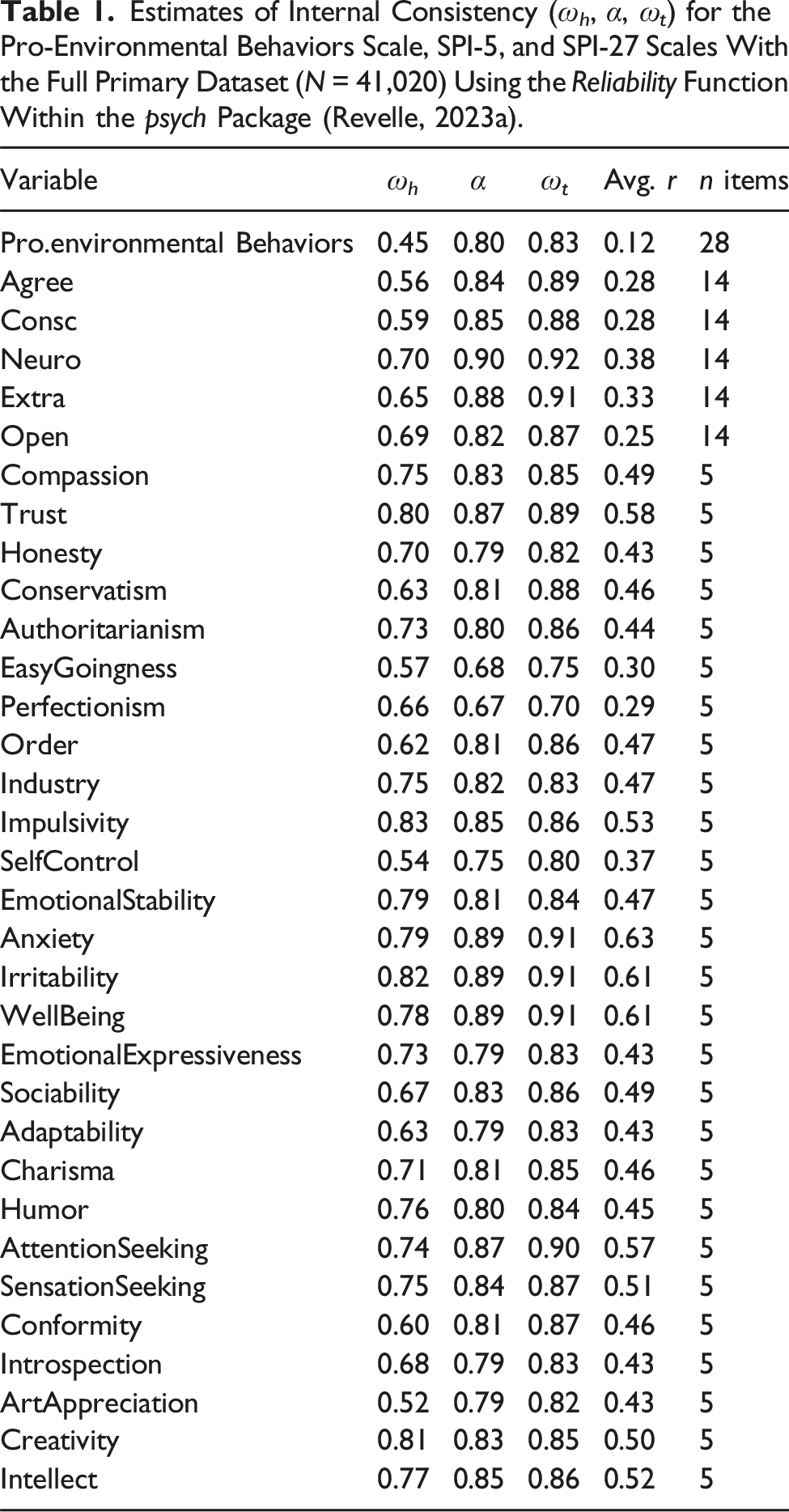
Estimates of Internal Consistency (ω h , α, ω t ) for the Pro-Environmental Behaviors Scale, SPI-5, and SPI-27 Scales With the Full Primary Dataset (N = 41,020) Using the Reliability Function Within the psych Package (Revelle, 2023a).
SAPA Personality Inventory-5 (SPI-5) factors
The SPI-5 higher-order factors (i.e., Agreeableness, Conscientiousness, Neuroticism, Extraversion, and Openness) were each evaluated using 14 of the SPI-135 items (i.e., 5 higher-order factors x 14 items per factor = 70 SPI items) (Condon, 2018). Response options ranged from 1 to 6. Reliability indices for each of the SPI-5 higher-order factors can be found in Table 1.
Pro-environmental behaviors
Pro-Environmental Behavior Composite Items and Item Loadings Onto a General Factor (ω h = .45; α = .80; ω t = .83), (n = 20,510).
Note. (R) denotes a reverse scored item.
Analytic procedure
Scale Intercorrelations for Pro-Environmental Behaviors With SPI-5 Factors and SPI-27 Facets Corrected for Item Overlap and Reliability (n = 41,020).
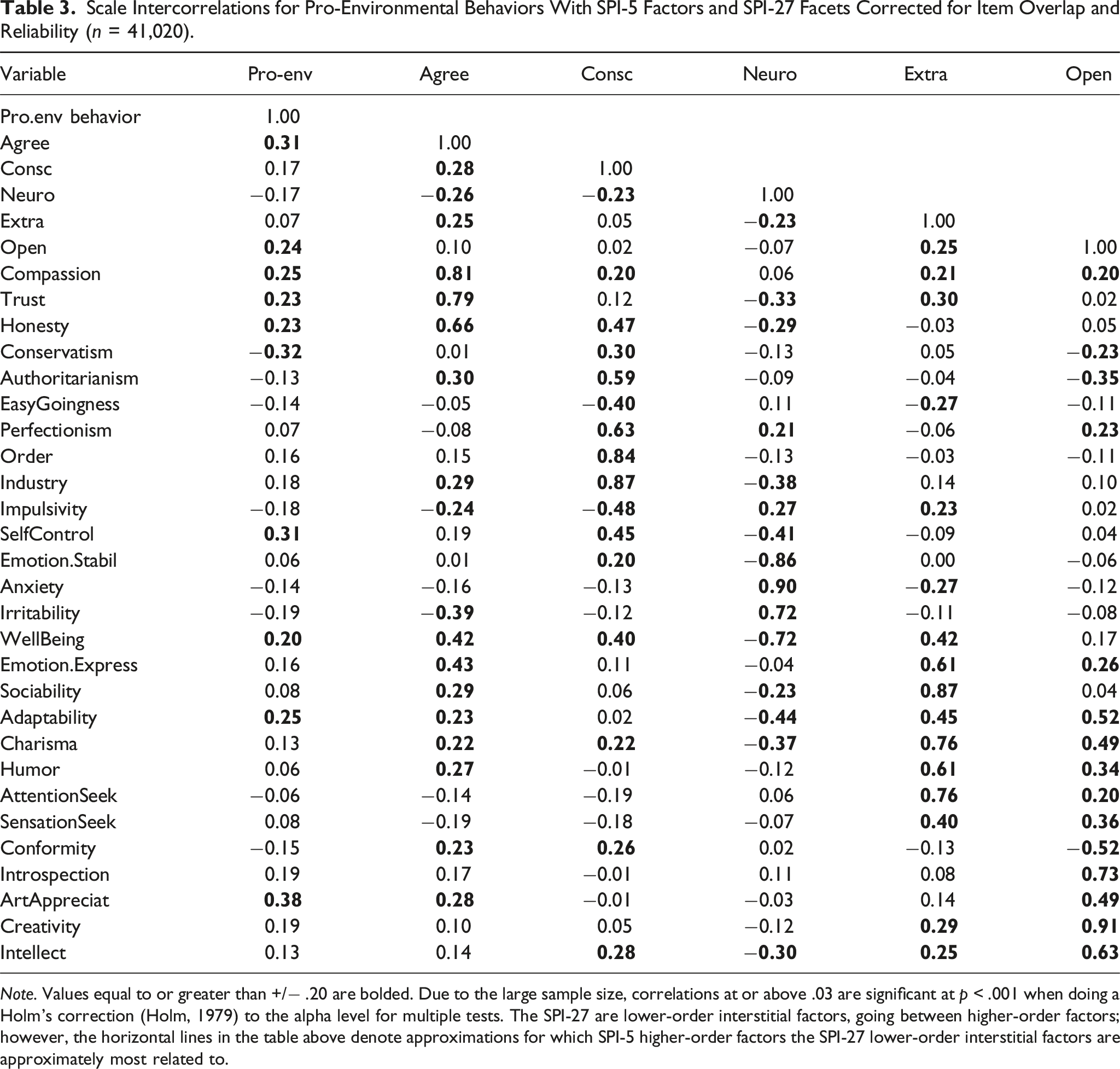
Note. Values equal to or greater than +/− .20 are bolded. Due to the large sample size, correlations at or above .03 are significant at p < .001 when doing a Holm’s correction (Holm, 1979) to the alpha level for multiple tests. The SPI-27 are lower-order interstitial factors, going between higher-order factors; however, the horizontal lines in the table above denote approximations for which SPI-5 higher-order factors the SPI-27 lower-order interstitial factors are approximately most related to.
Descriptive Statistics (i.e., Means, Standard Deviations (sd), Minimum Values, Maximum Values, and Ranges) for ZCTA-Specific Averages of Pro-Environmental Behaviors, SPI-5 Factors (n = 20,567), and SPI-27 Facets (n = 19,987) and for the SPI-5 and SPI-27 ZCTA-Specific Slopes (i.e., the Relationship of Each Personality Indicator With Pro-Environmental Behaviors Within Each ZCTA).
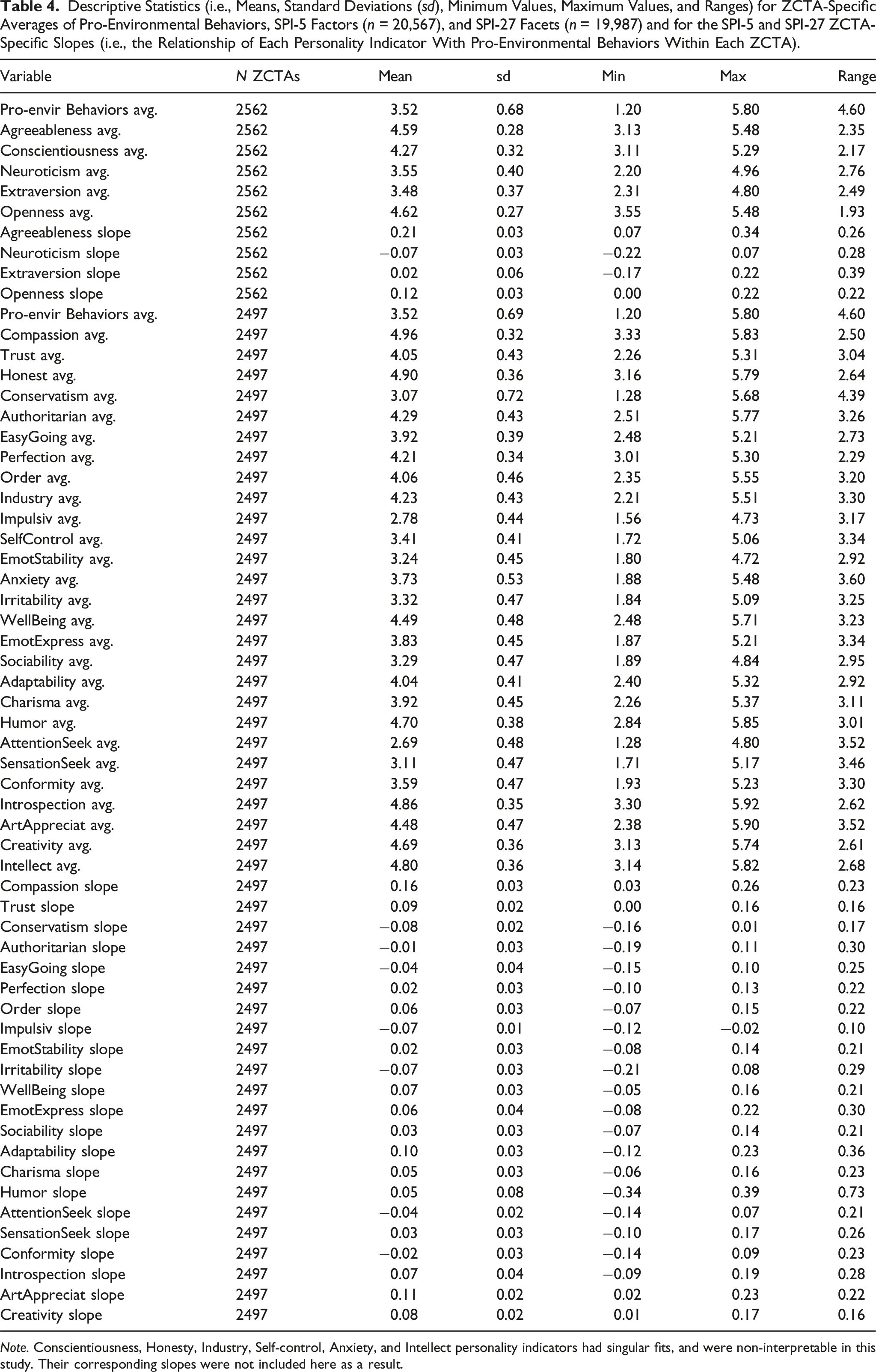
Note. Conscientiousness, Honesty, Industry, Self-control, Anxiety, and Intellect personality indicators had singular fits, and were non-interpretable in this study. Their corresponding slopes were not included here as a result.
Smoothed geospatial maps were generated for pro-environmental behaviors and the SPI-5 higher-order personality factors using county-level identification for the purpose of descriptive data visualization. Pro-environmental behavior and SPI-5 higher-order personality factor scores were zero-centered and standardized (z-scores) for the mapping procedure for ease of interpretation given our geospatial mapping procedure was dependent on ordinal comparisons between counties. To generate the “smoothed” maps displaying levels of pro-environmental behaviors and SPI-5 higher-order personality factors across US counties, spatial weights were first calculated using a logarithmic decay smoothing function (Ebert et al., 2022, 2023). Distances within approximately 47 Miles/75 Kilometers from a point in space were included for smoothing. The Ebert et al. (2023, 2022) smoothing function generated the weights based on spatial distance (i.e., the distance between one point in space and another) and participant count per county. For display purposes, counties were then assigned one of nine colors ranging from high (blue) to low (red) indicative of their respective average county scores for pro-environmental behaviors and the SPI-5 compared to the other average county scores (see Appendix Figure A1).
To allow for visualization of how the strength and direction of associations between pro-environmental behaviors and the SPI-5 higher-order factors vary across counties, we also mapped the standardized zero-centered cross product terms for pro-environmental behaviors with each of the SPI-5 higher-order factors using the same procedure to see how personality and pro-environmental behaviors uniquely interacted across counties. For instance, increasingly negative product terms were colored in red on the maps while increasingly positive product terms were colored in blue. Larger positive and larger negative product terms corresponded to the depth of the respective county color (i.e., darker blue and darker red indicate greater distance from zero). More blue counties indicate higher average levels of the higher-order personality factor coupled with higher average levels of pro-environmental behaviors or lower average levels of the higher-order personality factor coupled with lower average levels of pro-environmental behaviors (i.e., like a positive correlation). More red counties indicated lower average levels of pro-environmental behaviors coupled with higher average levels of the higher-order personality factor or higher average levels of pro-environmental behaviors coupled with lower average levels of the higher-order personality factor (i.e., like a negative correlation), with deeper reds indicating a greater distance between the two. As noted above, scores were standardized and zero-centered before calculating the cross-product term and before grouping scores by county to get descriptive statistics from the 959 county averages. Geospatial smoothing and mapping were completed using R. R packages not previously mentioned that were utilized for our analyses included: raster (Hijmans, 2022), pals (Wright, 2021), spdep (Bivand & Wong, 2018), RColorBrewer (Neuwirth, 2022), sf (Pebesma, 2018), and dplyr (Wickham et al., 2019). These geospatial maps are presented in Appendix Figure A1.
Results
Overall predictive models and cross-validations
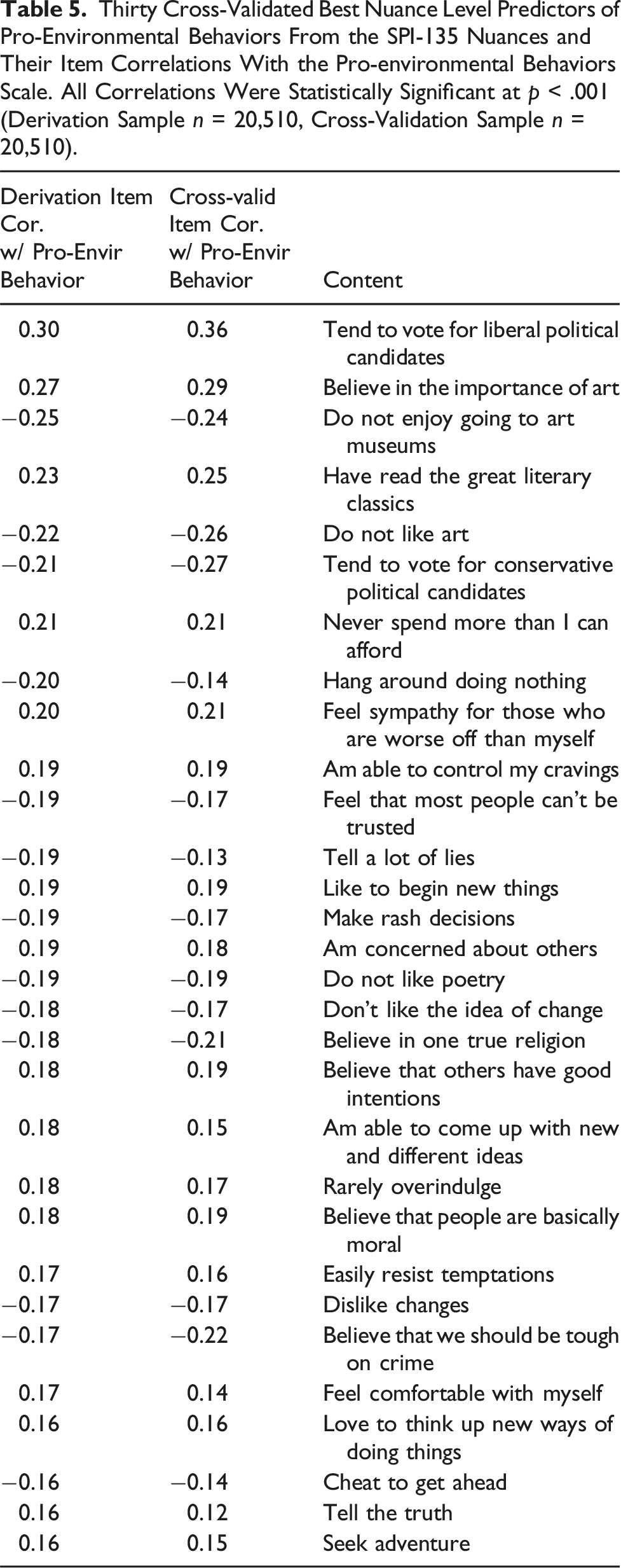
Thirty Cross-Validated Best Nuance Level Predictors of Pro-Environmental Behaviors From the SPI-135 Nuances and Their Item Correlations With the Pro-environmental Behaviors Scale. All Correlations Were Statistically Significant at p < .001 (Derivation Sample n = 20,510, Cross-Validation Sample n = 20,510).
Multiple regression models for the SPI-5 higher-order factors, SPI-27 lower-order interstitial factors, SPI-135 nuances, and bestScales identified thirty items predicting pro-environmental behaviors were employed for a randomly selected 50% of the participants (the derivation sample). The resulting models were then cross validated on the remaining 50% of participants (the holdout sample).
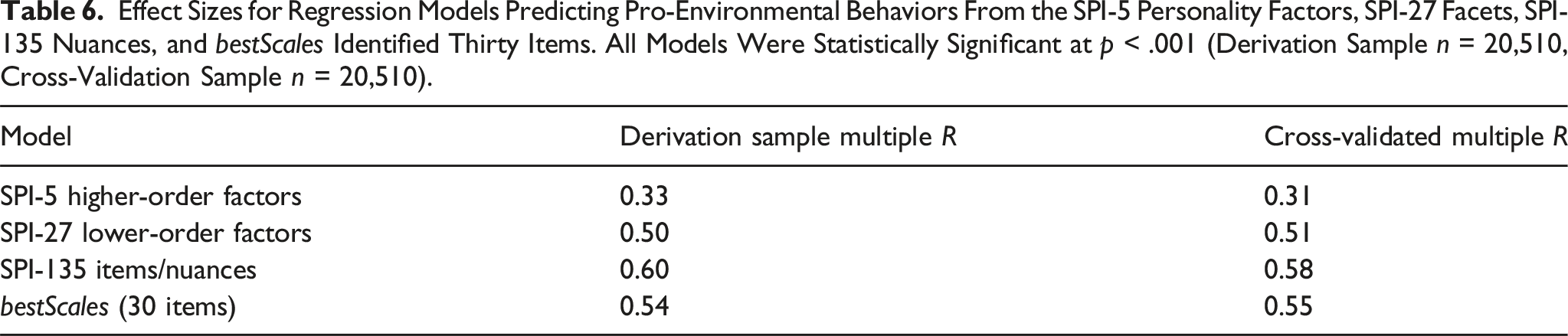
Effect Sizes for Regression Models Predicting Pro-Environmental Behaviors From the SPI-5 Personality Factors, SPI-27 Facets, SPI-135 Nuances, and bestScales Identified Thirty Items. All Models Were Statistically Significant at p < .001 (Derivation Sample n = 20,510, Cross-Validation Sample n = 20,510).
Standardized Regression Coefficients (β), 95% Confidence Intervals, and p-Values From the SPI-5 Regression Model (i.e., the SPI-5 Predicting Pro-Environmental Behaviors) and for the SPI- 27 Regression Model (i.e., the SPI-27 Predicting Pro-Environmental Behaviors) With the Derivation Sample (n = 20,510).
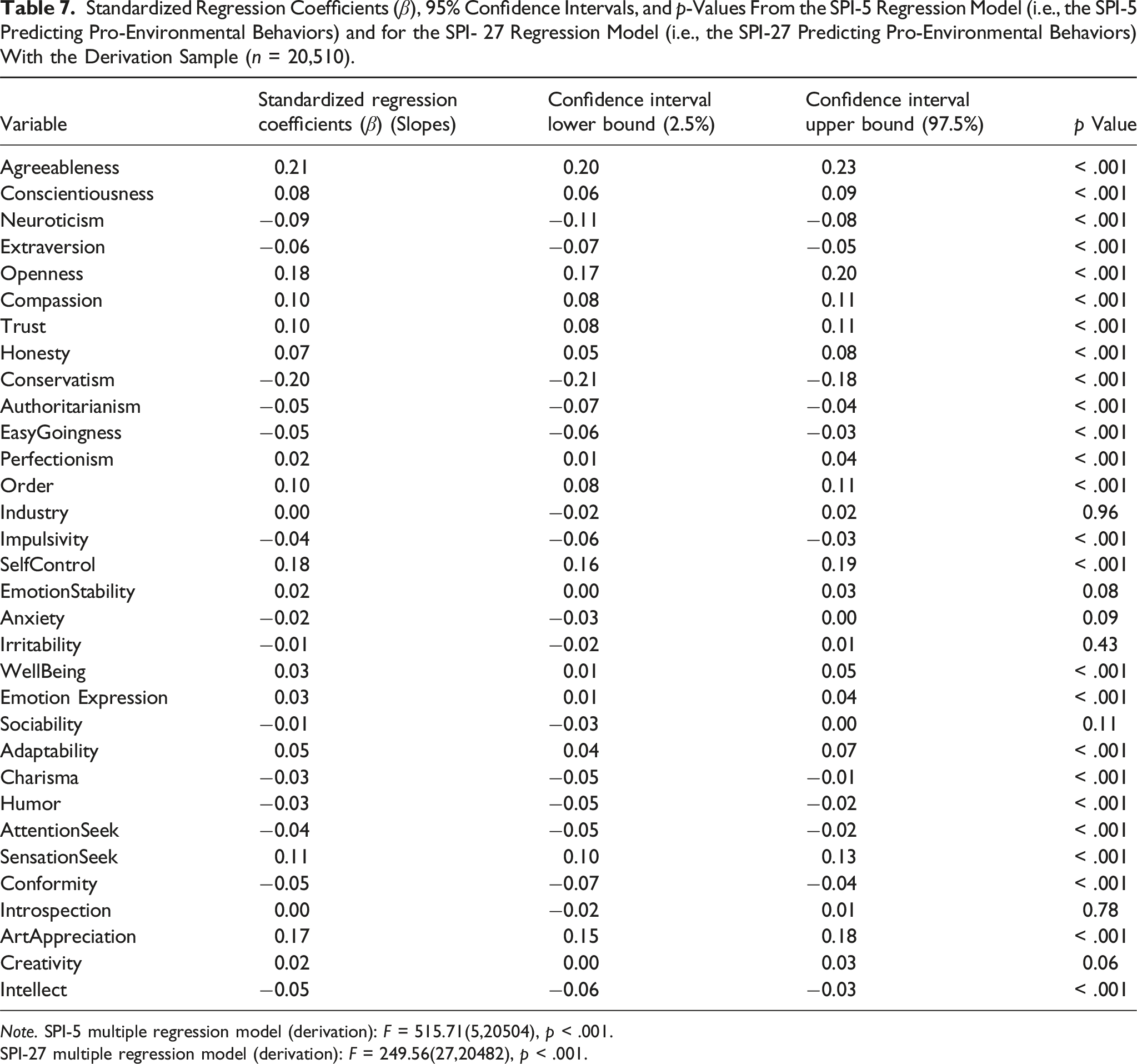
Note. SPI-5 multiple regression model (derivation): F = 515.71(5,20504), p < .001.
SPI-27 multiple regression model (derivation): F = 249.56(27,20482), p < .001.
Geographically varying effects
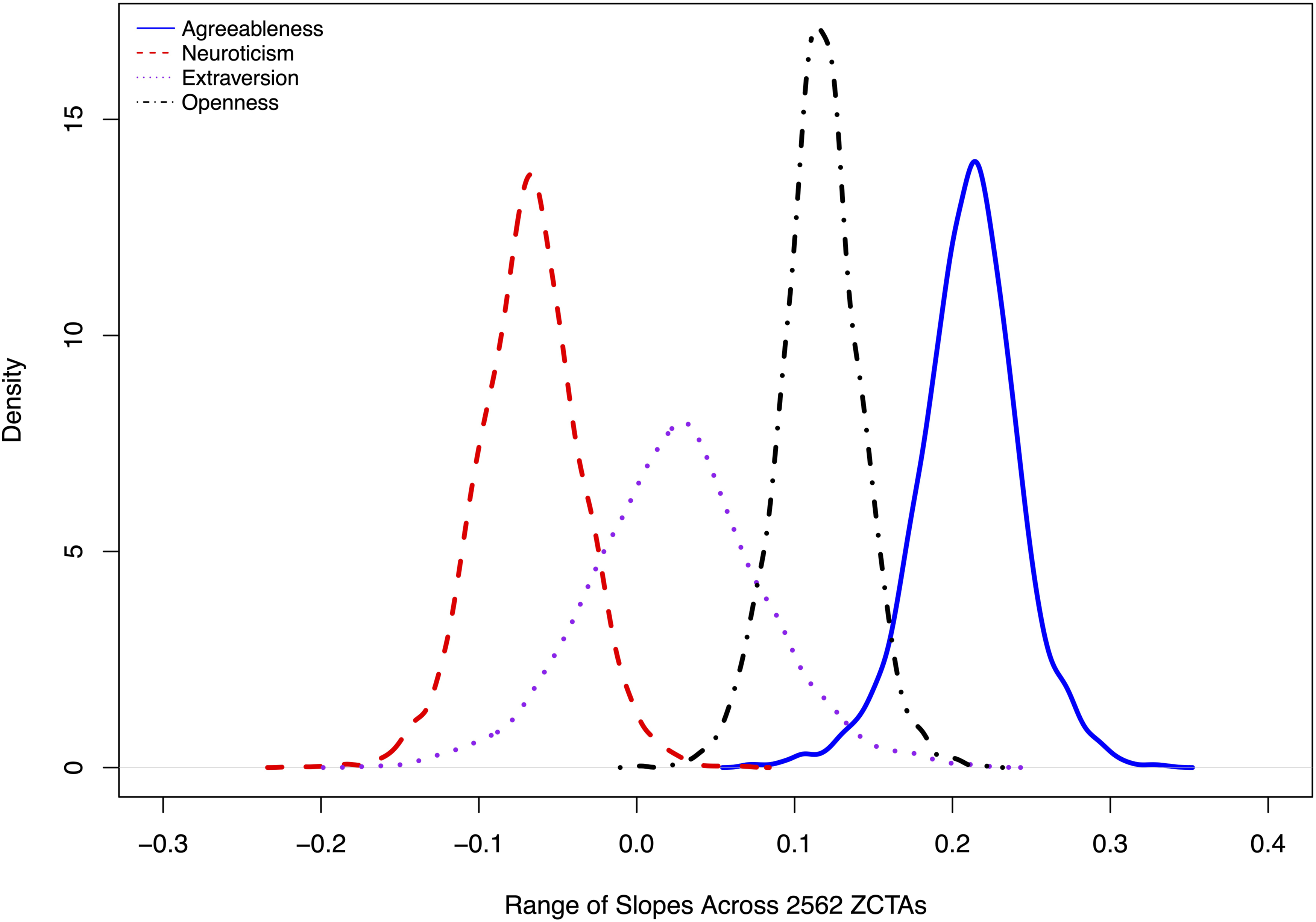
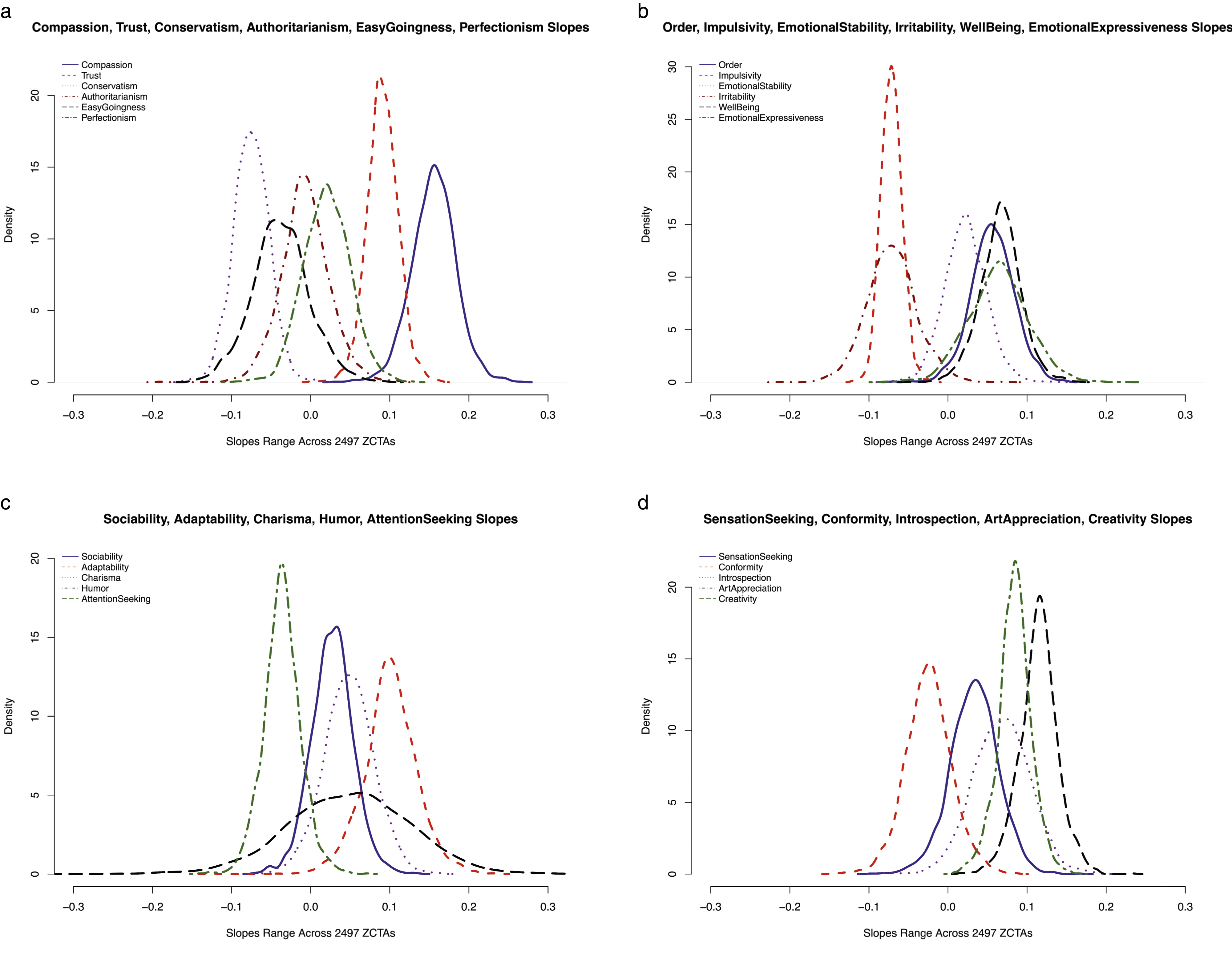
Multilevel models (MLMs) were employed to get a sense of the nature of the variation across ZCTAs for the effects of each SPI-5 higher-order factor and each SPI-27 lower-order interstitial factor on pro-environmental behaviors. The cluster mean centering of the SPI-5 higher-order factors and SPI-27 lower-order interstitial factors prior to employing the MLMs allowed us to account for potential reference group effects and interpret our findings in terms of how individuals’ scores on each of the SPI-5 higher-order factors and SPI-27 lower-order interstitial factors in comparison to others within their respective ZCTA affected pro-environmental behaviors. That is, for the MLMs, personality effects on pro-environmental behaviors were interpreted in terms of whether an individual was higher or lower on a personality indicator in comparison to others within their ZCTA, rather than the whole sample. The standardized regression coefficients (slopes) for each ZCTA were extracted from the MLMs and correlated with the ZCTA-specific pro-environmental behavior, SPI-5 higher-order factor, and SPI-27 lower-order interstitial factor averages to assess if certain personality indicators were more strongly related to pro-environmental behaviors in ZCTAs where certain personality indicators or pro-environmental behaviors were lower or higher on average. Density curves for the range of average raw scores within each ZCTA for the SPI-5 higher-order factors and pro-environmental behaviors are shown in Figure 1. Density curves were also plotted to display the range of slopes across ZCTAs, representing the range in strength and direction of the relationship between each of the SPI-5 higher-order factors (Figure 2) and SPI-27 lower-order interstitial factors (Figure 3) with pro-environmental behaviors. The means, ranges, and standard deviations for the ZCTA-specific slopes as well as the ZCTA-specific pro-environmental behavior, SPI-5 higher-order factor, and SPI-27 lower-order interstitial factor averages are also included in Table 4. Density curves for the range of average levels of each SPI-5 factor within ZCTAs on a six-point scale (n
ZCTAs
= 2562). Note. Due to a singular fit, the results involving slopes extracted from the MLMs for Conscientiousness may not be meaningful and are not presented in this paper. Density curves for the range of unique slopes across ZCTAs (i.e., the ZCTA-specific relationships for each SPI-5 higher-order factor with pro-environmental behaviors; n
ZCTAs
= 2562). Note. Due to a singular fit, the results involving slopes extracted from the MLMs for Conscientiousness may not be meaningful and are not presented in this paper. Density curves for the range of unique slopes across ZCTAs (i.e., the ZCTA-specific relationships for each SPI-27 lower-order interstitial factor with pro-environmental behaviors; n
ZCTAs
= 2497). (a) SPI27 and Pro-environmental Behavior Slope Density Curves Part A. (b) SPI27 and Pro-environmental Behavior Slope Density Curves Part B. (c) SPI27 and Pro-environmental Behavior Slope Density Curves Part C. (d) SPI27 and Pro-environmental Behavior Slope Density Curves Part D. Note. Due to singular fits, the results involving slopes extracted from the MLMs for Honesty, Industry, Self-control, Anxiety, and Intellect may not be meaningful and are not presented in this paper.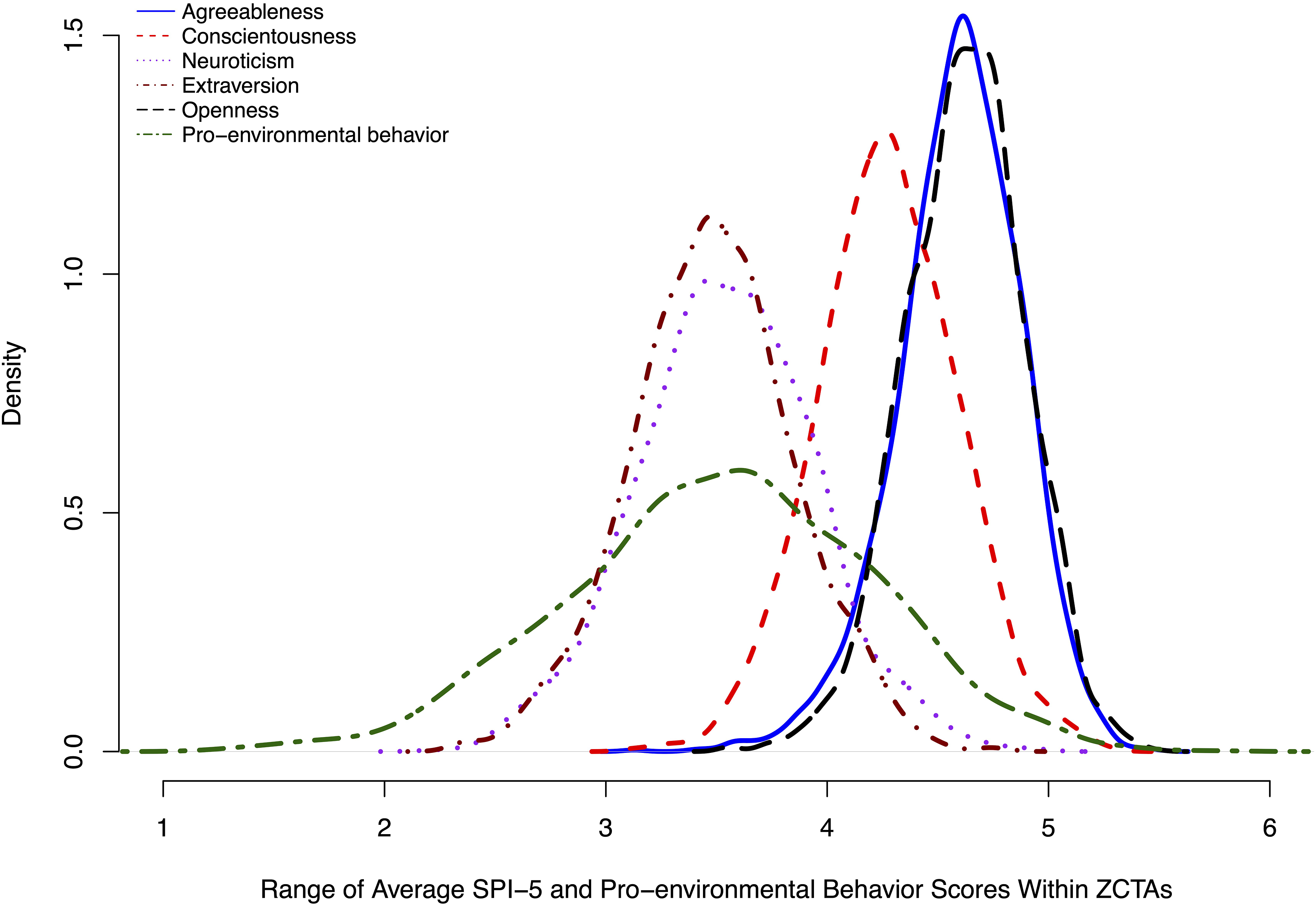
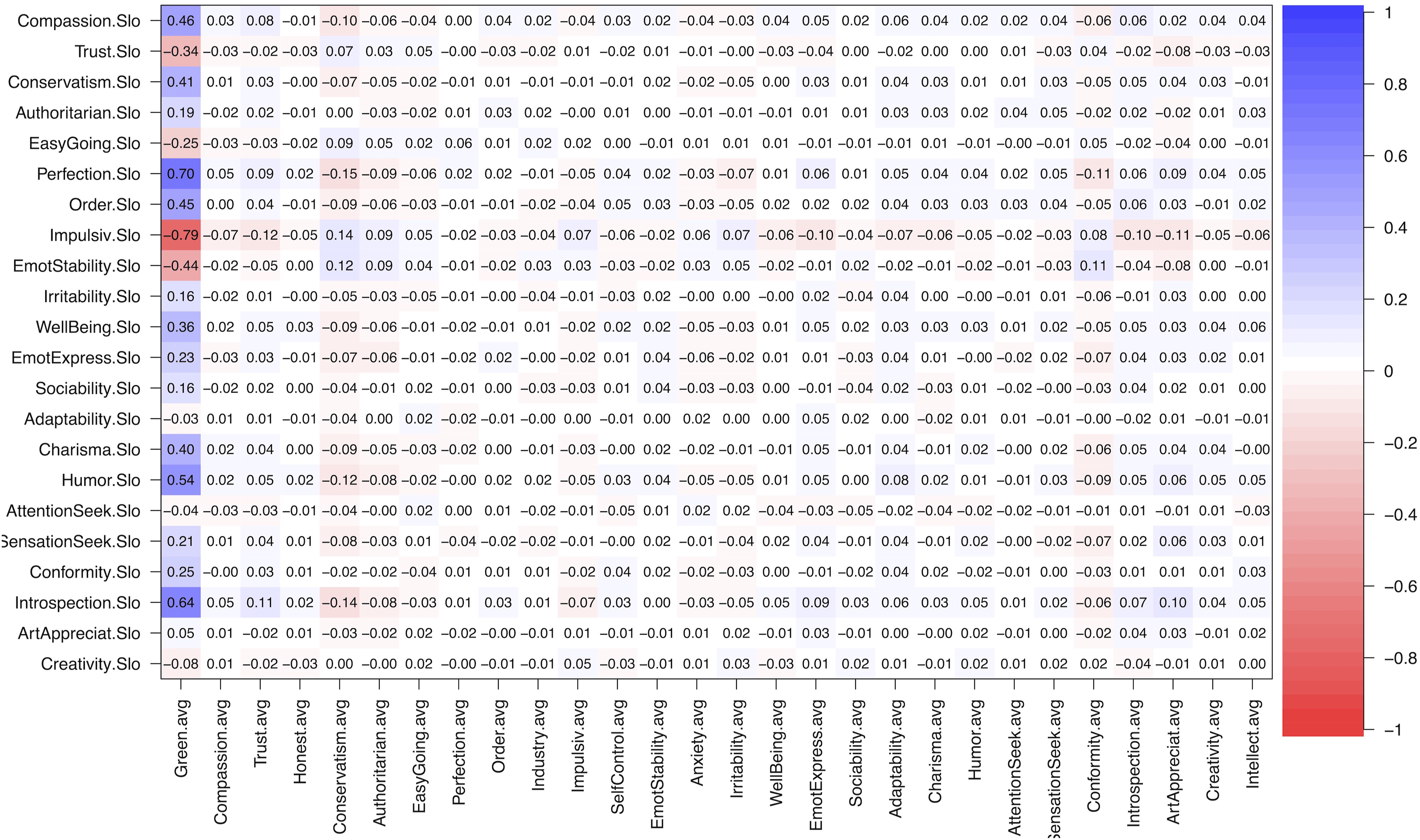
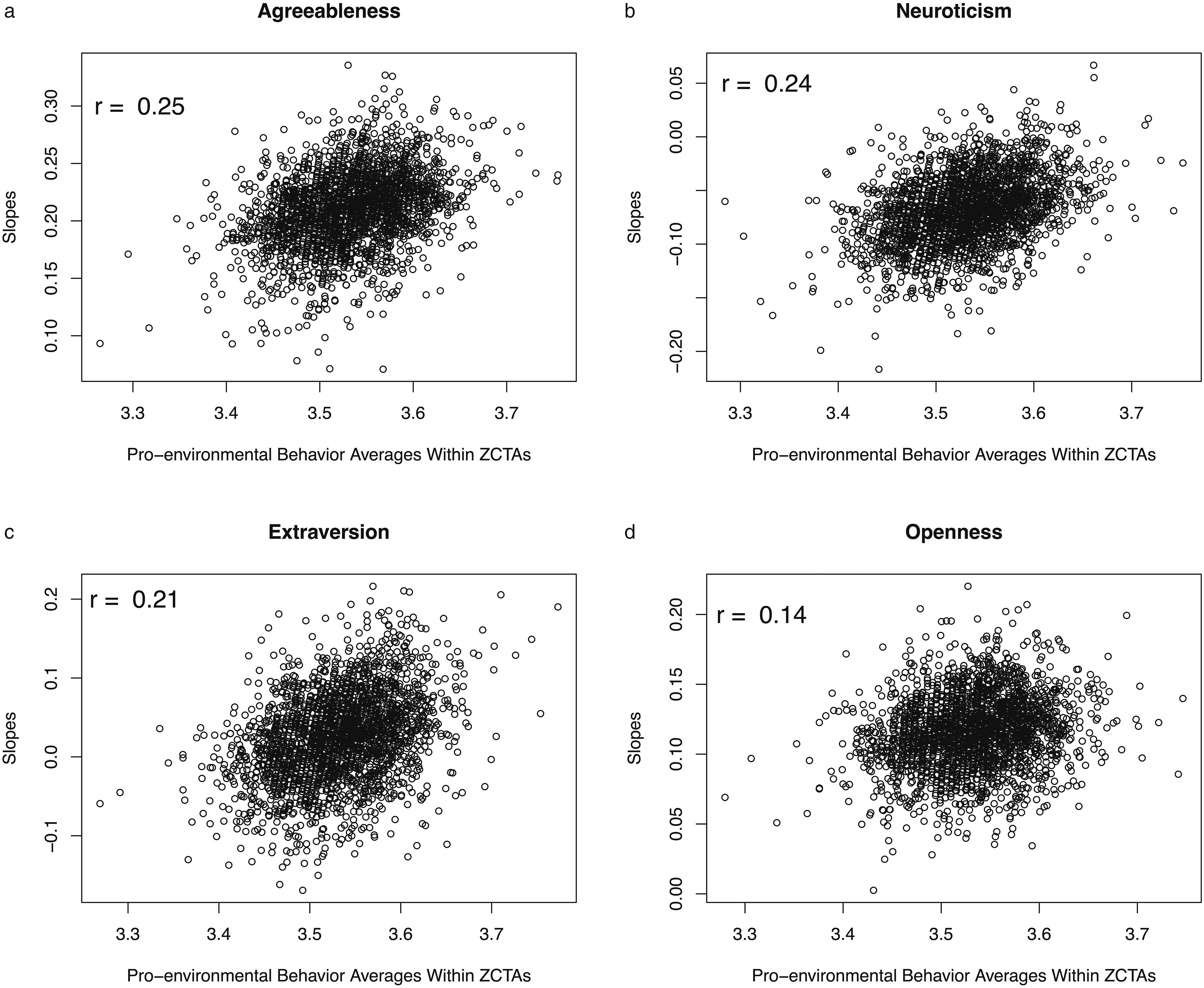
Heatmaps representing the correlational structure of these ZCTA-specific slopes with the average levels of pro-environmental behaviors, SPI-5 higher-order factors (Figure 4), and SPI-27 lower-order interstitial factors (Figure 5) within ZCTAs are also presented below, and all correlations equal to or larger than +/−.07 were significant at p < .001. These correlation coefficients functionally represent the extent to which average levels of pro-environmental behaviors or SPI higher-order factors and lower-order interstitial factors within ZCTAs moderate the effect of each of the SPI higher-order factors and lower-order interstitial factors on pro-environmental behaviors. For example, the correlations between each of the SPI-5 slopes with the average levels of pro-environmental behaviors within ZCTAs demonstrate the extent to which average levels of pro-environmental behaviors within a given place functionally moderate the effect of each SPI-5 higher-order factor on pro-environmental behaviors. Scatter plots visualizing the associations between ZCTA-level pro-environmental behavior averages and ZCTA-specific slopes for each of the SPI-5 higher-order factors are displayed in Figure 6. Heatmap of correlations for average levels of SPI-5 Factors and pro-environmental behaviors within each ZCTA with the relationship between SPI-5 Factors and pro-environmental behaviors within each ZCTA (slopes) (i.e., how much the average levels of SPI-5 higher-order factors or pro-environmental behaviors within ZCTAs functionally moderate the association between SPI-5 higher-order factors and pro-environmental behaviors across ZCTAs). All correlations equal to or larger than +/−.07 were significant at p < .001; n
ZCTAs
= 2562. Heatmap of correlations for average levels of SPI-27 facets and pro-environmental behaviors within each ZCTA with the relationship between SPI-27 facets and pro-environmental behaviors within each ZCTA (slopes) (i.e., how much the average levels of SPI-27 lower-order interstitial factors or pro-environmental behaviors within ZCTAs functionally moderate the association between SPI-27 lower-order interstitial factors and pro-environmental behaviors across ZCTAs). All correlations equal to or larger than +/−.07 were significant at p < .001; n
ZCTAs
= 2497. Scatter plots demonstrating the functional interaction between personality and geographic context for effects on pro-environmental behaviors. Specifically, ZCTA-specific slopes (y-axis; the relationship between each SPI-5 higher-order factor with pro-environmental behaviors within each ZCTA) correlated with the average level of pro-environmental behaviors within each ZCTA (x-axis); see Figure 4 for the complete correlation matrix (nZCTAs = 2562). Note. Due to a singular fit, the results involving slopes extracted from the MLMs for Conscientiousness may not be meaningful and are not presented here.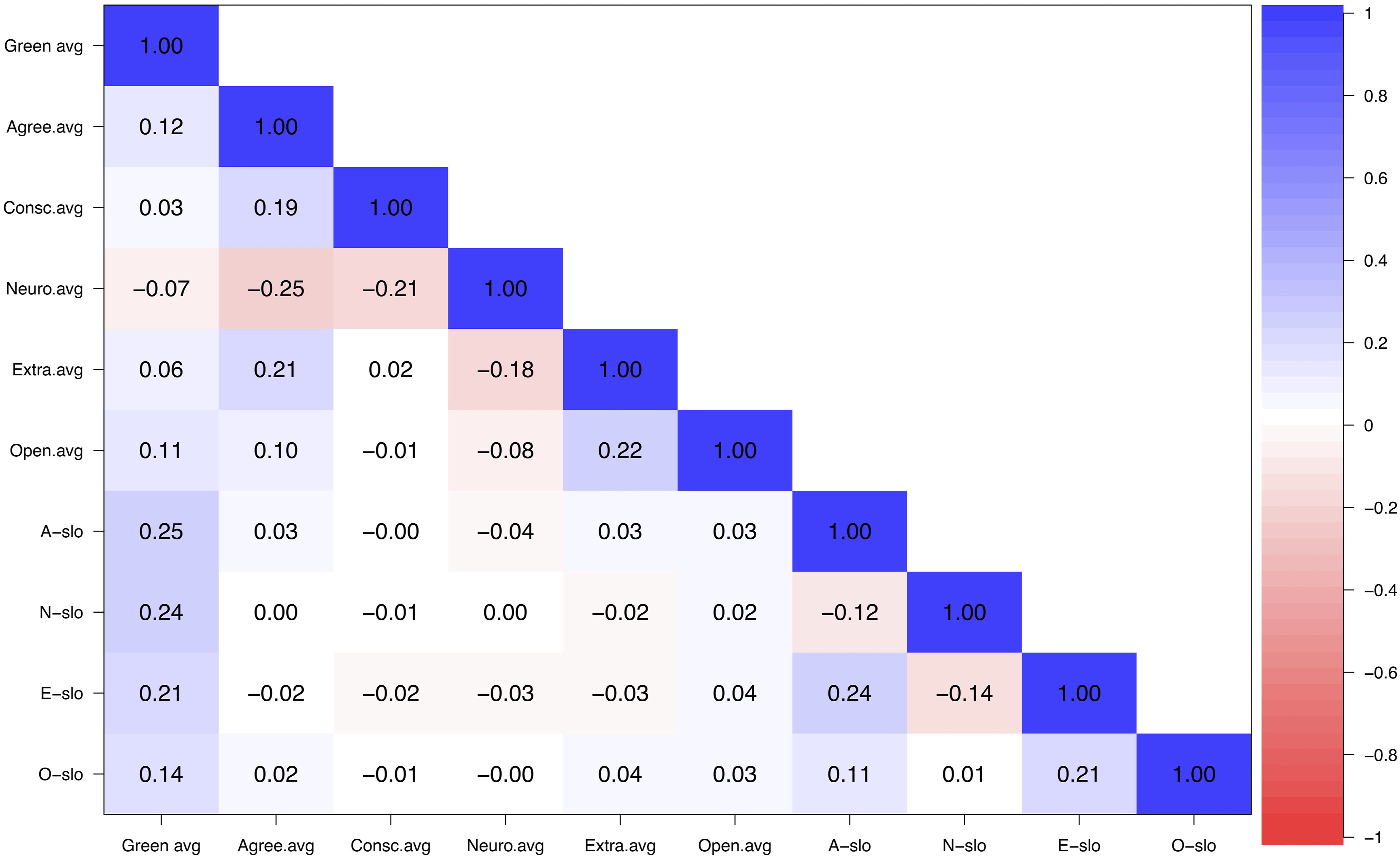
The MLMs for Conscientiousness, Honesty, Industry, Self-control, Anxiety, and Intellect were singular fitting for the current study (i.e., the correlation between the slope and intercept variance was equal to 1). The singularity was likely due to the structure of random effects being more complex than can be supported by our current data. Increasing sampling within ZCTAs might help clarify the issue of singularity in the future. However, due to the singularity found in this study, the results involving slopes extracted from the MLMs for Conscientiousness, Honesty, Industry, Self-control, Anxiety, and Intellect may not be meaningful and are not presented in this paper (i.e., not presented in the slope density curves or either of the correlation plots). The average levels of Conscientiousness, Honesty, Industry, Self-control, Anxiety, and Intellect within ZCTAs are included in the correlation plots because these averages were derived independent of the MLMs.
Notable findings for the SPI-5 higher-order factors (Figure 4) included that having higher Agreeableness, Extraversion, Neuroticism, or Openness than others within a given ZCTA was more strongly associated with higher levels of pro-environmental behaviors in ZCTAs that also had higher average levels of pro-environmental behaviors in comparison to other ZCTAs. That is, by taking the relationship between each of the SPI-5 with pro-environmental behaviors within each ZCTA (slopes) and correlating this relationship with the average level of pro-environmental behaviors within each ZCTA, we found that individuals who had higher levels of Agreeableness (.25), Extraversion (.21), Neuroticism (.24), or Openness (.14) than others within their respective ZCTA were increasingly likely to engage in pro-environmental behaviors in ZCTAs that also had higher average levels of pro-environmental behaviors. In other words, the effect of individual level Agreeableness, Extraversion, Neuroticism, and Openness on pro-environmental behaviors within a ZCTA was functionally moderated by how pro-environmental the social context of the ZCTA was that the individual resided in.
For example, the slopes for the relationship between Extraversion and pro-environmental behaviors ranged from −0.17 to 0.22 (Mean = 0.02; SD = 0.06) across ZCTAs (see Table 4 for descriptive statistics of all ZCTA-level averages and slopes). Those ZCTA-specific relationships (slopes) between Extraversion and pro-environmental behaviors were significantly associated with the average levels of pro-environmental behaviors within ZCTAs (r = .21, p < .001). Another way to interpret this is that if individuals were more extraverted than others within their ZCTA, they were increasingly likely to have higher levels of pro-environmental behaviors in ZCTAs that also had higher average levels of pro-environmental behaviors. Because the slope range also fell below zero for Extraversion, we can infer that if individuals were more extraverted than others within their ZCTA, they were increasingly likely to have lower levels of pro-environmental behaviors in ZCTAs that also had lower average levels of pro-environmental behaviors. Moreover, the slopes for the relationship between Neuroticism and pro-environmental behaviors ranged from −0.22 to 0.07 (Mean = −0.07; SD = 0.03) across ZCTAs and the slopes were significantly associated with the average levels of pro-environmental behaviors within ZCTAs (r = .24, p < .001); thus, if individuals were more neurotic than others within their ZCTA, they were increasingly likely to have lower levels of pro-environmental behaviors in ZCTAs that also had lower average levels of pro-environmental behaviors. For Agreeableness, the ZCTA-specific slopes ranged from 0.07 to 0.34 (Mean = 0.21; SD = 0.03) across ZCTAs and the slopes were significantly associated with the average levels of pro-environmental behaviors within ZCTAs (r = .25, p < .001); thus, if individuals were more agreeable than others within their ZCTA, they were increasingly likely to have higher levels of pro-environmental behaviors in ZCTAs that also had higher average levels of pro-environmental behaviors. For Openness, the ZCTA-specific slopes ranged from 0 to 0.22 (Mean = 0.12; SD = 0.03) across ZCTAs and the slopes were significantly associated with the average levels of pro-environmental behaviors within ZCTAs (r = .14, p < .001); thus, if individuals were more open than others within their ZCTA, they were increasingly likely to have higher levels of pro-environmental behaviors in ZCTAs that also had higher average levels of pro-environmental behaviors.
The same procedure was done for the SPI-27; that is, the ZCTA-specific slopes for each of the SPI-27 with pro-environmental behaviors were correlated with the SPI-27 and pro-environmental behavior averages within each ZCTA (Figure 5). As with the SPI-5, the strongest associations were observed between the SPI-27 slopes with the average levels of pro-environmental behaviors within ZCTAs. For instance, individuals who had higher levels of Compassion, Perfectionism, Order, Wellbeing, Emotional Expressiveness, Sociability, Charisma, Humor, Sensation Seeking, or Introspection than others within their respective ZCTA were increasingly likely to have higher levels pro-environmental behaviors in ZCTAs that also had higher average levels of pro-environmental behaviors (p < .001). Individuals who had higher levels of Conservatism, Authoritarianism, Irritability, or Conformity than others within their respective ZCTA were increasingly likely to report lower levels of pro-environmental behaviors in ZCTAs that also had lower average levels of pro-environmental behaviors (p < .001). Individuals who had lower levels of Trust, Emotional Stability, or Creativity than others within their respective ZCTA were increasingly likely to report lower levels of pro-environmental behaviors in ZCTAs that also had higher levels of pro-environmental behaviors on average (p < .001). Individuals who had higher levels of Easy Goingness or Impulsivity than others within their respective ZCTA were increasingly likely to report lower levels of pro-environmental behaviors in ZCTAs that also had higher average levels of pro-environmental behaviors (p < .001).
Discussion
The goal of our study was (1) to evaluate how personality at three levels (i.e., higher-order factor, lower-order interstitial factor, and nuance) predicts pro-environmental behaviors across the USA on average and cross-validate our findings, (2) to describe the nature of the variation in the effect of higher-order and interstitial lower-order personality factors on pro-environmental behaviors across fine units of geographic space (ZCTAs), and (3) determine how such variation relates to average levels of pro-environmental behaviors within ZCTAs.
Personality nuances predicted pro-environmental behaviors better than higher-order personality factors and lower-order interstitial factors. Identifying nuances most empirically predictive of pro-environmental behaviors also resulted in greater predictive accuracy for pro-environmental behaviors over and above higher-order factors and lower-order interstitial factors, even after cross-validating. Large (>.30) to very large effect sizes (>.40) (Funder & Ozer, 2019) were observed in each model (i.e., higher-order factor, lower-order interstitial factor, and nuance level). The relationship between higher-order factors and lower-order interstitial factors with pro-environmental behaviors varied across US ZCTAs, and the ZCTA-specific (within-ZCTA) relationships were related to the average levels of pro-environmental behaviors within ZCTAs for many of the personality indicators in this study. That is, the effects of personality indicators on pro-environmental behaviors were moderated by the social context in which they were observed, specifically the commonplace of pro-environmental behaviors in the social context in which they were observed. Moreover, we found individuals who were more agreeable, extraverted, neurotic, and/or open than others within their respective ZCTA were increasingly likely to report greater levels of pro-environmental behaviors if they lived in a ZCTA that had higher average levels of pro-environmental behaviors.
In sum, personality is a strong predictor of pro-environmental behaviors. Personality nuances predict pro-environmental behaviors over and above higher-order factors and lower-order interstitial factors. Personality interacts with the social-context/place a person lives in to affect pro-environmental behavior outcomes, and individuals residing in more pro-environmental places have stronger associations between higher levels of agreeableness, extraversion, neuroticism, and openness with higher levels of pro-environmental behaviors. Essentially, more agreeable, extraverted, neurotic, and/or open people are increasingly likely to be pro-environmental if the place they reported living in was more pro-environmental on average.
Overall predictive models and cross-validations
An analysis of the utility of higher-order factors (i.e., SPI-5 factors), lower-order interstitial factors (i.e., SPI-27 lower-order interstitial factors), and nuances (i.e., SPI-135 items) for predicting pro-environmental behaviors demonstrated that while higher-order factors, lower-order interstitial factors, and nuances all predicted pro-environmental behaviors well, personality nuances/items predicted pro-environmental behaviors the best (Table 6). This is likely due to personality nuances/items comprising more personality information than lower-order factors and higher-order factors because they do not undergo data reduction. Although Soutter and Mõttus (2021) expected to find lower-order personality factors predicted pro-environmental behaviors over and above higher-order personality factors by our same logic, they found a negligible difference in their study. Our cross-validated results help clarify that lower-order factors indeed predict pro-environmental behaviors over and above higher-order factors, and personality nuances/items predict pro-environmental behaviors over and above both higher-order factors and lower-order interstitial factors.
Furthermore, an empirically derived set of thirty items selected from the SPI-135 collectively predicted pro-environmental behaviors significantly better than the SPI-5 higher-order factors and SPI-27 lower-order interstitial factors. This finding is particularly notable because the SPI-5 higher-order factors were scored based on 70 items and the SPI-27 lower-order interstitial factors were scored based on 135 items. Given that the set of thirty best items predicted pro-environmental behaviors better than the SPI-5 and SPI-27, it is logical to suggest that using a shorter set of empirically selected personality items for predicting pro-environmental behaviors is more efficient because fewer items need be administered to participants. Although the best thirty items did not predict pro-environmental behaviors as well as the full set of SPI-135 personality nuances/items, this was to be expected given that the full set of SPI-135 items hold more information because there are more items. This has notable implications for future research on personality and pro-environmentalism if prediction and efficiency is a goal. In combatting the climate change crisis, understanding the broad spectrum of individual-level psychological factors, like personality, that influence how pro-environmentally individuals behave is essential for developing targeted interventions aimed at increasing pro-environmental behaviors.
Additionally, Agreeableness and Openness were the strongest higher-order factor-level predictors of pro-environmental behaviors in this study, both positively predicting pro-environmental behaviors, consistent with previous findings (Soutter et al., 2020; Soutter & Mõttus, 2021). Each of the SPI-5 significantly predicted pro-environmental behaviors when included together in the multiple regression model. At the lower-order interstitial factor level, when all SPI-27 lower-order interstitial factors were included in the model, Self-control and Art Appreciation were the strongest positive predictors of pro-environmental behaviors, followed by Sensation Seeking, Order, Trust, Compassion, and Honesty. Our findings that self-control and art/aesthetic appreciation have the strongest lower-order factor level associations with pro-environmental behaviors aligns with previous literature on such lower-order factor level associations (Brick & Lewis, 2016; Markowitz et al., 2012; Soutter & Mõttus, 2021). When examining personality nuances/items, the items involving liberalism/conservatism, valuing and appreciating the arts, frugality, and sympathy for others were most associated with pro-environmental behaviors. The item level predictors were particularly insightful because they illustrate a more detailed picture than that of lower-order factors in terms of what drives the association between personality and pro-environmental behaviors.
Geographically varying effects
The strength and direction of the relationship (slopes) between higher-order and lower-order personality factors with pro-environmental behaviors had notable variation across ZCTAs. While certain higher-order and lower-order personality factors strongly predicted pro-environmental behaviors in some ZCTAs, the effect of these same higher-order and lower-order personality factors was negligible in others. Moreover, although certain higher-order factors and lower-order interstitial factors had positive associations with pro-environmental behaviors in certain ZCTAs, the association was negative in other ZCTAs. Part of the reason for the variation in direction and strength of associations was related to the average levels of pro-environmental behaviors within ZCTAs. The largest ranges of variation in the direction and strength of associations (slopes) for SPI-5 higher-order factors were found with Extraversion (range = .39), Neuroticism (range = .28), Agreeableness (range = .26), and Openness (range = .22) (Table 7 and Figure 2), as well as for SPI-27 lower-order interstitial personality factors of (range ≥ .20) Humor, Adaptability, Authoritarianism, Emotional Expressiveness, Irritability, Introspection, Sensation Seeking, Easy Goingness, Compassion, Conformity, Charisma, Perfectionism, Order, Art Appreciation, Wellbeing, Emotional Stability, Attention Seeking, and Sociability (Table 7 and Figure 3).
Within places that people were more pro-environmental on average, SPI-5 higher-order factors of Agreeableness, Extraversion, Neuroticism, and Openness were more strongly associated with pro-environmental behaviors, which embodies the notion that personality functions in such a way where people can best socially get along and ahead in their environments (Hogan, 1996; Hogan & Blickle, 2018; Hogan & Holland, 2003). Simply put, individuals with higher levels of Agreeableness, Extraversion, Neuroticism, and Openness than others in their ZCTA tended to conform to how pro-environmental their social context was, exhibiting higher levels of pro-environmental behaviors in contexts/ZCTAs with higher average levels of pro-environmental behaviors. These findings are supported by the Cultural Cognition Theory framework because they demonstrate that individuals tend to behave in ways reflective of the socio-cultural context they are part of if it is adaptive and allows them to get along better in their social world (Kahan, 2008, 2010; Kahan et al. 2010a, 2010b; Markle, 2019; Verchick, 2016). Our findings also suggest the importance of accounting for geographically varying effects when studying personality because of the unique interplay personality can have with geographic context (Geiger et al., 2019; Lanning et al., 2022; Rentfrow & Jokela, 2016). That is, personality and geographical location have an interactive effect on pro-environmental behaviors. Similar levels of personality indicators across different individuals have different implications for pro-environmental behaviors depending on where the individual lives.
Although the multilevel models for Conscientiousness, Honesty, Industry, Self-control, Anxiety, and Intellect were found to have singular fits, increasing participant count per ZCTA in future research can assist in clarifying the random effects structure of these models. It is likely the random effects structure for each of these personality indicators was not supported by our data because of its complexity. Therefore, future research on additional samples will allow for better conclusions and interpretations of the effects for these personality indicators.
All in all, our findings are similar to those of previous psychologists (Jokela et al., 2015) who have found that personality associations with outcomes can vary across fine units of geographic space. If one of the goals of personality psychology is to better predict and understand trends in behavior, accounting for geographic location may be a necessary step in better facilitation of predictive accuracy. Moreover, our findings support the notion that psychological features (i.e., personality) may have unique implications dependent on geographic location for outcomes because of the unique ways psychological features interact with the many factors composing geographic context. Future research will involve additional evaluation of interactions between geo-contextual-level variables with personality indicators in their effects on pro-environmental behaviors. This will aid in further clarifying what aspects of geographic context are driving the variation in strength and direction of personality effects on pro-environmental behaviors across places.
Having a deeper understanding of the interplay between personality variables and aspects of social and geographic environments is critical for developing targeted interventions aimed at bolstering pro-environmentalism. Additionally, our findings support the notion that personalized, and place-specific interventions aimed at facilitating greater pro-environmental behaviors might be optimal, and future intervention-based research should explore this. We have ultimately demonstrated in this paper that motivations for behaving pro-environmentally appear to be partially rooted in individual differences for drives to get along and get ahead in one’s social world, which is key to understanding the motivational processes of human personality (Hogan, 1996; Hogan & Blickle, 2018; Hogan & Holland, 2003). However, the way that best getting along and getting ahead in a place manifests is dependent on the people and socio-cultural values that occupy that space.
Limitations
While our research findings support the usefulness of personality higher-order factors, lower-order interstitial factors, and nuances for predicting pro-environmental behaviors and demonstrates the importance of examining the relationship between personality traits and pro-environmental on a context dependent basis, there are several limitations to be considered when drawing conclusions from our findings. The data set used in our study was limited to participants residing in the US, therefore, the generalizability of our findings to other cultures and regions around the world might be limited. As previously mentioned, we expect that local levels of pro-environmental behavior moderate the relationship between higher-order personality factors and pro-environmental behaviors because local levels of pro-environmental behaviors influence how individuals can best “get along” and “get ahead” in their geographic region (Hogan, 1996; Hogan & Blickle, 2018; Hogan & Holland, 2003). However, cultural and geographic differences between countries outside the US, in terms of normalization, politization, and accessibility of pro-environmental behaviors, may not lead our findings to hold across other countries and cultures. Future research with international samples will be needed to determine generalizability of our findings. The global variation in orientations toward pro-environmental behaviors and the climate crisis may also lead to alternative patterning in the relationship of lower-order personality trait factors and nuances with pro-environmental behaviors. For instance, while items about support for liberal/conservative politics are included in the list of best nuance level predictors of pro-environmental behaviors in this study, we anticipate these nuances might not make the list in countries where climate change activism and pro-environmental behaviors are less politically controversial.
It is also important to consider the nature and structure of our data as well as the measures we used in the current study. The pro-environmental behaviors measure used in this study was self-report and focused on private individual level pro-environmental behaviors. The self-reported nature of the data leaves potential for participants to inaccurately report their behavior levels and future work should examine the associations tested in this paper with objective pro-environmental behavior measures or informant report if feasible. Additionally, the pro-environmental data from the SAPA project is relatively sparse which leaves little room for breaking up the measure into specific subfactors of pro-environmental behavior. Participants received between 1 and 5 pro-environmental behavior items (Mean = 1.17 SD = 0.42) which inhibited our ability to conduct a geographical analysis on the relationship between personality and sub factors of pro-environmental behavior. This is an important line of future research because research by Soutter and colleagues (2020, 2021), demonstrated there are some nuanced differences in the predictive power of personality for pro-environmental behaviors based on the measures used for pro-environmental behaviors. Using pro-environmental behavior subfactors in future work holds potential to provide deeper understanding into the nature of personality and pro-environmental behavior associations because subfactors are naturally more detailed and specific. A cluster analysis of our data yielded little to no meaningful clustering in our measure to form pro-environmental behavior taxonomies, which have been used in previous research studies (e.g., Markle, 2013). As a result, pro-environmental behaviors were treated as a single construct in this study. Our expectation is that understanding geographic variation in the relationship between personality and pro-environmental behaviors as a broad construct will provide an initial understanding of such kinds of geographically varying effects and drive further research that can break down pro-environmental behaviors into subfactors.
Conclusions
Understanding the complex interplay between individuals and the places they reside is critical for a comprehensive understanding of what personality means for behavioral outcomes. As the global climate change crisis continues to grow in its threat to human civilization as we know it, understanding why people may or may not behave pro-environmentally is critical. Examining how individual people interact with the geographical contexts they live in and this interaction’s implications for pro-environmental outcomes may serve to inform policy efforts aimed at targeting subgroups of individuals in the US. Given the power in local levels of pro-environmental behavior for shaping the relationship between personality indicators and pro-environmental behaviors, we suggest that future intervention-based research be personalized to the local environment and attempt to influence how individuals perceive they can best get along and get ahead in their social environments regarding their engagement with pro-environmentalism. Although personality is a strong predictor of pro-environmental behaviors, the community an individual lives in is also a powerful determinant of how individuals’ personalities manifest behaviorally regarding pro-environmentalism. Examining and disentangling the complex interactions between individuals’ personalities and their geographical contexts is a foundational step before applying psychological knowledge aimed at increasing pro-environmental behaviors across places. Additionally, evaluating how geographic context leads to unique effects of personality on behavioral outcomes is necessary for personality psychologists striving to develop precise and robust models of behavior using personality indicators. Simply put, the effects of personality of pro-environmental behaviors are not simple, and personality has unique implications for pro-environmental behaviors that are influenced by the levels of pro-environmental behaviors in the social-context in which individuals inhabit.
Supplemental Material
Supplemental Material - Geographically varying associations between personality and pro-environmental behaviors across the USA
Supplemental Material for Geographically varying associations between personality and pro-environmental behaviors across the USA by Kayla M Garner and William Revelle in European Journal of Personality.
Footnotes
Acknowledgments
The SAPA data used in this study belongs to Dr David Condon (
Declaration of conflicting interests
The author(s) declared no potential conflicts of interest with respect to the research, authorship, and/or publication of this article.
Funding
The author(s) received no financial support for the research, authorship, and/or publication of this article.
Open science statement
The pre-registration and R-code for the current study can be found at https://osf.io/xvbtm/. Additional analyses to examine how ZCTA-specific slopes for higher-order personality factor effects on pro-environmental behaviors correlate with average levels of pro-environmental behaviors and ZIP Code Tabulation Areas (ZCTAs) were added after the initial pre-registration was submitted. As per  , the geographical data used in the current study cannot be made publicly available because it could potentially de-anonymize participants in the current study.
Supplemental Material
Supplemental material for this article is available online.
References
Supplementary Material
Please find the following supplemental material available below.
For Open Access articles published under a Creative Commons License, all supplemental material carries the same license as the article it is associated with.
For non-Open Access articles published, all supplemental material carries a non-exclusive license, and permission requests for re-use of supplemental material or any part of supplemental material shall be sent directly to the copyright owner as specified in the copyright notice associated with the article.
