




Abstract
This study examined whether optimism in early adolescence predicts occupational and psychosocial outcomes in early adulthood and explored the functional form of this relation. We also investigated whether these associations continue to hold after accounting for concomitant factors and whether optimism acts as a protective factor that helps early adolescents deal with socioeconomic adversity. We followed a large sample of German seventh graders (N = 1596; 63.8% females; baseline M age = 12.9) at two measurement points over a period of 18 years and estimated latent regression models. Optimism in early adolescence predicted several adult outcomes, including occupational prestige, social integration, psychosocial symptoms, and depression. Analyses with social integration, depression, and life satisfaction revealed a nonlinear association: Optimism promoted life outcomes, but this positive association reached a plateau in above-average ranges of optimism and a minimum value in below-average optimism ranges. Moreover, optimism in early adolescence buffered the negative effects of low parental socioeconomic status on occupational prestige, job satisfaction, and psychosomatic symptoms in adulthood. The findings offer increased knowledge about the long-term significance of optimism and underscore the necessity of considering these effects from a more comprehensive and interactional point of view.
Plain language summary
This study used a large data set from Germany to examine whether being an optimist in adolescence influences whether young adults reach important life outcomes. The results showed that optimism in adolescence enhances life satisfaction and social integration in adults and prevents depression. Moreover, being an optimist in adolescence seems to help individuals to establish occupational prestige and job satisfaction and prevent them from psychosomatic symptoms despite socioeconomic adversities.
Introduction
An extensive body of research describes optimism as an individual disposition with “all-around” advantages for human experience and behavior: Optimists seem to experience lower levels of distress and higher well-being, have better interpersonal relationships and physical health, and report better occupational outcomes. Moreover, optimism helps people overcome stressful life circumstances (Carver & Connor-Smith, 2010; Carver et al., 2010; Segerstrom, 2007; Solberg Nes & Segerstrom, 2006). Although the positive effects of optimism are well established, few studies have investigated whether they persist over longer time periods and shape key life outcomes. To address this gap, this exploratory study followed a large longitudinal sample of German early adolescents over 18 years to examine whether optimism at age 12 predicts academic and psychosocial outcomes in early adulthood. Going beyond previous research, we examined the functional form of this relation by considering nonlinear associations. Then we also examined whether long-term effects are observable for all individuals or whether optimism is especially beneficial for at-risk individuals (i.e., those with lower socioeconomic resources).
Defining Dispositional Optimism
Dispositional optimism is a personality dimension that is defined as the “extent to which people hold generalized favorable expectancies for their future” (Carver et al., 2010, p. 879). Thus, optimism reflects a stable predisposition regarding whether individuals generally expect good (or bad) things to happen to them (Carver et al., 2010). Recently, Bleidorn and colleagues (2020) described an optimistic outlook on the world as one characteristic of a healthy personality. In trying to define optimism, researchers still disagree on whether optimism and pessimism represent two ends of one dimension or whether they represent two separable dimensions (Carver & Scheier, 2014; Scheier et al., 2021; VanderWeele & Kubzansky, 2021).
Optimism is thought to be part of a family of constructs representing positive expectations such as hope, self-efficacy, and attributional style (Carver & Scheier, 2014; Rand, 2018). However, whereas the other constructs primarily refer to thoughts about an individual’s capability to control future outcomes, optimism is thought to involve a broader view and to encompass positive expectations about factors that lie outside the individual’s control (Bandura, 2006; Carver & Scheier, 2014; Rand, 2009). When seeking to locate dispositional optimism in the larger web of personality factors, researchers found especially strong relations to extraversion and neuroticism but also detected relations with agreeableness and conscientiousness (Sharpe et al., 2011). Although dispositional optimism is defined as a personality trait that is inherently cognitive in nature—because it describes future expectancies—previous research has found meaningful associations with positive and negative affect (Marshall et al., 1992; Segerstrom et al., 1998).
Because of its relations with neuroticism and negative affect, some initial research has argued that the predictive power of optimism may at least partly rely on these associations (Smith et al., 1989). Although not all studies that used optimism considered its overlap with other variables, the few that did so found robust effects of optimism (Carver & Scheier, 2014).
Optimism and Life Outcomes
Among laypeople and scholars alike, there is a belief that an optimistic outlook may have widespread positive consequences for human experience and behavior. To explain these all-around advantages, scholars have proposed that optimism plays a central role in guiding human thoughts and behavior across multiple life stages and developmental contexts (Carver et al., 2010; Carver & Scheier, 1998; Purol & Chopik, 2021). Various mechanisms have been discussed: Optimists direct more of their attention toward positive stimuli and less of it toward negative stimuli, thus maintaining a positive view on situations. In pursuing their goals, they show greater persistence and take actions to minimize risks (Brown & Marshall, 2001; Carver et al., 2010; Isaacowitz, 2005; Segerstrom, 2001; Solberg Nes & Segerstrom, 2006). They maximize their chances of attaining meaningful goals by increasing their efforts to achieve high-priority goals and decreasing engagement for low priority ones (Geers et al., 2009). When confronted with challenges, optimists actively attempt to change situations (Solberg Nes & Segerstrom, 2006). They are thought to be more likely to use approaching coping strategies to help them to manage the consequences of stressors and problem-focused coping strategies to actively change or reduce stressors and demands (Solberg Nes & Segerstrom, 2006). Hence, optimists seem to be more successful in choosing how to optimally invest self-regulatory effort, which means that they invest more resources when circumstances are promising and less when they are unfavorable (Carver & Scheier, 2014; Pavlova & Silbereisen, 2013). All in all, optimists take active steps to ensure positive future outcomes and emotional states (Carver et al., 2010). Given these assumptions, it is plausible that optimism may exert a generally positive influence on individuals’ occupational and psychosocial outcomes by initiating a range of positive developmental processes. This may also apply during the transitional years from early adolescence to young adulthood. Several considerations may help to better envisage how the abovementioned general mechanisms may work during this period in life.
Adolescence is a life stage in which individuals experience extensive challenges and changes in several areas of their lives (Masten et al., 2006). At the same time, individuals must take many decisions that set their future life trajectories (Arnett, 2000). Hence, during this meaningful developmental period, the abovementioned positive effects of positive future expectancies may be long lasting and have implications for the entire lifespan. Extrapolating from assumptions about the general positive effects of optimism to this life period, we could expect optimism to facilitate positive educational developments and set the basis for adult occupational success because more optimistic people invest more in their academic and professional efforts over a longer timespan (Carver & Scheier, 2014). Hence, optimism may help adolescents to meet academic requirements in school (Tetzner & Becker, 2018), to cope more effectively with minor and major scholastic problems, and to be more persistent in pursuing their academic goals.
Similarly, more optimistic adolescents may be less prone to developing a range of mental and physical illnesses in adulthood. One mechanism may be that their focus on salient goals prompts them to be more proactive about their health (Carver & Scheier, 2014), for example, by avoiding smoking, doing more exercise, and consuming more fruit and vegetables (Boehm et al., 2013). At the same time, their greater attention to positive stimuli and the use of problem-focused instead of emotion-focused coping strategies may help them to handle the multifaceted challenges of adolescence and to maintain a more positive view of self and others. Consequently, optimists may experience lower levels of distress in everyday life (Carver et al., 1993; Jobin et al., 2014). Similarly, research shows that optimism is associated with fewer markers of later health problems, such as poor sleep quality and quantity in children (Lemola et al., 2011). When they become injured or ill, optimistic people are more able to distance mentally from the pain (Geers et al., 2008) and report less anxiety (Hirsch et al., 2012), which may make the experience subjectively less bad (Hanssen et al., 2013).
Their more positive view of self and others may also help more optimistic adolescents to develop positive social relationships. Optimism is associated with warm-dominant interpersonal styles (Smith et al., 2013). Consistent with their higher engagement in high priority tasks, optimists seem to work harder at social relationships (Carver & Scheier, 2014; Segerstrom, 2007). Moreover, optimists have larger and more diverse social networks (Andersson, 2012), seem to solve social conflicts more constructively (Neff & Geers, 2013), and handle relationship crises more successfully (Smith et al., 2013). These mechanisms may be especially useful during adolescence, when people develop more social relationships outside their families and when social relationships become an incremental part of identity development.
In sum, it is plausible that being optimistic may have enduring consequences for the entire life span, including for academic-occupational, social, and health outcomes. Likewise, optimists’ general focus on the positive things in life—and all of the accompanying positive outcomes and feelings—may enhance their overall satisfaction with life. This may also apply to the developmental period of adolescence.
In line with these assumptions, empirical studies have found associations between optimism and several positive outcomes in different developmental stages (for an overview, see Carver & Scheier, 2014). Optimists generally exhibit higher well-being and life satisfaction (e.g., Ho et al., 2010; Scheier & Carver, 1992; Wong & Lim, 2009; Wu et al., 2009), better mental and physical health (e.g. Rasmussen et al., 2009; Scheier & Carver, 2018), and more satisfying social relationships (e.g., Andersson, 2012; Smith et al., 2013); they also have better scholastic and occupational outcomes (e.g. Segerstrom, 2007; Tetzner & Becker, 2018) than less optimistic individuals.
However, much of the evidence on optimism stems from cross-sectional research. By contrast, previous longitudinal studies have reported mixed results. Segerstrom (2007) examined whether optimism in first-year law students predicted key life outcomes in several domains 10 years later. She found that optimism was associated with higher income and better mental and physical health, but it was unrelated to social network size. However, increases in the size of their social networks predicted increases in optimism. Rand and colleagues (2011) examined first-year U.S. law students and showed that optimism did not predict better academic performance but did predict greater life satisfaction 4 months later. In a recent study, Li and colleagues (2019) found reciprocal relationships between optimism and job insecurity in middle-aged participants over five waves spanning 5 years. Although they reported that increases in income fostered optimism, they found no effects of optimism on income. Solberg Nes and colleagues (2009) examined whether optimistic expectations predicted college dropout and found that higher dispositional optimism at college entrance was associated with a decreased probability of college dropout in the first year and a higher grade-point average. In a study of late adulthood, Rius-Ottenheim and colleagues (2012) found that higher optimism was prospectively associated with lower feelings of loneliness 10 years later, even after controlling for changes in depressive symptoms and social networks.
To date, few studies have sought to make predictions over longer time spans, especially in the period from adolescence to adulthood. However, Spengler and colleagues investigated whether various traits among Luxembourgish adolescents at age 12 predicted life outcomes 40 years later in middle adulthood and found that a pessimistic view of oneself predicted lower self-reported health (Spengler et al., 2016a) and higher mortality (Spengler et al., 2016b) but was not associated with occupational success (Spengler et al., 2015). Since there is still controversy about whether optimism and pessimism represent two largely distinct dimensions rather than one bipolar dimension (Carver et al., 2010; Herzberg et al., 2006) and recent evidence indicates that optimism and pessimism may be differently connected to health outcomes (Scheier et al., 2021), it is unclear whether these results are transferable to optimism. Similarly, McDade and colleagues (2011) found that adolescents’ expectations about their chances of living to middle age and attending college were associated with diverse health behaviors in young adulthood (i.e., cigarette smoking, fast food consumption, and engagement in physical activity). However, it is also unclear whether these specific expectations are transferable to dispositional optimism. In a recent study, Oh and colleagues (2022) used the Rochester Adult Longitudinal Study to examine outcomes of optimism over 25 years in adults aged 16–70. They found that more optimistic individuals reported better health and higher life satisfaction more than 2 decades later.
In summary, there are indications that optimism may enhance life outcomes in psychosocial and academic domains. To the best of our knowledge, no previous study has investigated whether dispositional optimism in adolescence predicts important life outcomes in young adulthood. However, the potential long-term effects on life outcomes may be especially relevant during this influential period, during which individuals set their course for their later lives.
Nonlinear Effects of Optimism
Another important question concerns the functional form of the association between optimism and adult outcomes. Previous research has questioned the idea that optimism exerts its influence in a linear way (Carver et al., 2010; Tennen & Affleck, 1987). One assumption is that, although optimistic expectations may be generally beneficial, they may be less impactful when they are too positive and unrealistically high (Shepperd et al., 2015; Weinstein, 1980). In this case, a possible mechanism is that overly optimistic persons have a pronounced attentional bias toward positive over negative information, which may lead them to see the world through “rose-tinted glasses” and to ignore possible threats and challenges that they cannot overcome (Isaacowitz, 2005; Segerstrom, 2001). In the long run, this selective information processing may prompt them to hold on unattainable goals and hinder them from finding new, meaningful ones (Wrosch, Scheier, Carver, & Schulz, 2003Wrosch et al., 2003). Although high levels of dispositional optimism are not equivalent with “unrealistic optimism” (Radcliffe & Klein, 2002; Scheier et al., 2021), some of these mechanisms may be also transferable to high levels of dispositional optimism and cause nonlinearity in its effects. Confirming this idea, findings from experimental studies have indicated that positive expectations can also prevent positive outcomes when they are not based on an objective standard (Dillard et al., 2009).
To the best of our knowledge, only one previous longitudinal study has investigated whether prospective associations with dispositional optimism may be nonlinear. Examining the association between optimism in adolescence and subsequent changes in academic achievement during a 6-month period in seventh grade, this study indicated that effects of optimism may be better described in a nonlinear way (Tetzner & Becker, 2018): The generally positive association reached a plateau in above-average optimism ranges and a minimum value in below-average optimism ranges. Hence, these results indicated that especially high optimism levels may have no additional benefit for academic outcomes. In the study in question, prospective associations with changes in students’ self-esteem showed a positive linear association. To the best of our knowledge, there is no available evidence on whether prospective long-term associations between optimism and later life outcomes may be nonlinear.
Optimism and Social Background
Over and above its general “all-around” advantages, optimism is often considered to play a special role for people facing risk or adversity. Specifically, optimism is thought to additionally help people cope with adverse situations and stressful life circumstances (for overviews, see Carver & Connor-Smith, 2010; Carver et al., 2010; Solberg Nes & Segerstrom, 2006). Whereas general associations between optimism and desirable outcomes are often referred to as promotive effects (i.e., main effects in statistical terms), these risk-buffering effects are referred to as protective factors (i.e., moderation or interaction effects in statistical terms; Masten, 2018). An explanation for these “additional” benefits under adverse situations may be that all the mechanisms that explain the general promotive function of optimism may be especially useful for people who face adversities. Optimists reframe adverse situations positively and find benefits even under disadvantageous conditions (Lechner et al., 2006). Optimists’ usage of adaptive coping strategies (Solberg Nes & Segerstrom, 2006) may be especially beneficial when life circumstances require them to invest greater effort to cope. Similarly, their focus on high-priority tasks (Geers et al., 2009) may be especially impactful when their situational or environmental conditions mean they have few resources to help them to follow their goals or to choose an alternative path. Hence, optimism is thought to be an individual disposition that facilitates resilience in the face of different kinds of adversity.
In line with this, studies have found associations between optimism and better adaptation to a broad range of stressful situations. There is evidence that, among people who are confronted with unemployment, higher optimism is associated with the maintenance of higher life satisfaction (Duffy et al., 2013). A study that targeted early adolescents and examined their academic achievement over 3 years found that optimism helped early adolescents to mitigate negative effects of parental separation and to overcome academic problems (Tetzner & Becker, 2015). Other studies have found comparable protective effects regarding educational transitions (Brissette et al., 2002), the death or serious illness of a spouse (Kivimäki et al., 2005), job stress (Romswinkel et al., 2018), daily stressors (Lai, 2009; Robinson & Liu, 2013; Zheng et al., 2019), or, more recently, fear of the coronavirus during the COVID-19 pandemic (Vos et al., 2021).
However, most existing studies examined these risk-buffering effects over shorter time spans, and we know of only one study that has investigated whether optimism specifically buffers the negative effects of a lower socioeconomic status. Non and colleagues (2020) examined longitudinal data of a U.S. birth cohort from 1959–1966 to predict health-related behavior in adulthood. They found that childhood social disadvantage was associated with an increased likelihood of smoking at the age of 47 and that adult optimism buffered this risk. Such associations are likely. Research has shown that low parental socioeconomic status impedes adolescents’ development in multiple domains (Benner et al., 2016; Goodman et al., 2003; McLaughlin et al., 2012). Whereas beneficial socioeconomic circumstances are associated with a multitude of environmental resources (e.g., more financial resources, more advantageous parenting styles, and communication) that may promote adaptive development, less advantageous socioeconomic conditions may mean that adolescents are deprived of useful resources. Such circumstances are associated with a broad range of stressors in adolescents’ and young adults’ environments (Hackman & Farah, 2009; Hanson & Chen, 2007; Hoff et al., 2002). Through the aforementioned mechanisms—such as the application of more advantageous coping strategies or greater goal persistence—optimism may help early adolescents cope more effectively with the multitude of challenges associated with a low socioeconomic status and to achieve greater success in multiple areas of life.
The Present Study
This study investigated the long-term effects of optimism on academic and psychosocial life outcomes by following a German large-scale longitudinal sample across two measurement points spanning a period of over 18 years. To expand previous research, we investigated a particularly long timespan within the significant developmental period from early adolescence to young adulthood. Our focus on optimism during early adolescence allowed us to investigate the long-term effects of this individual disposition at a particularly consequential developmental crossroads that has implications for the entire lifespan (Masten et al., 2006). By looking at outcomes in young adulthood (i.e., at age 30), we were able to get a first impression of more stable adult outcomes (i.e., most persons in this age group had made stable decisions to follow an occupational career, at least in the medium term) after the transitional and explorative years of emerging adulthood (Arnett, 2000). To measure life outcomes, we aimed to select measures that as broadly as possible picture the life situation of young adults by providing spotlights on different key aspects of their occupational and psychosocial status. More specifically, we examined two key occupational outcomes in young adulthood. On one hand, we investigated the established occupational prestige as a well-established and widely used measure for educational success in adulthood (Christoph et al., 2020). To add a more subjective perspective to this domain, we additionally measured job satisfaction to better picture young adults’ well-being in their work situation. As psychosocial outcomes, we addressed a broad range of measures including their overall life satisfaction, social integration as well as administered their level of depression and psychological symptoms as more health-related outcomes.
Our research had four aims. The first aim was to investigate whether optimism predicted outcomes at the occupational (occupational prestige, job satisfaction) and psychosocial (life satisfaction, social integration, depression, psychological symptoms) levels. Although previous research did not specifically investigate the exact outcomes that we examined in this study and also rarely addressed the developmental period between adolescence and young adulthood, previous findings indicated that optimism had benefits for multiple areas of life in different life stages and both in the academic and psychosocial domain (e.g., Carver et al., 2010). Hence, we expected to find positive but weak associations over the 18 years of the study. Our second aim was to explore the functional form of this association. Extrapolating from the idea that “unrealistic optimism” (Shepperd et al., 2015) had certain drawbacks and from initial evidence of nonlinearity (Tetzner & Becker, 2018), we expected to find a positive association between optimism and later life outcomes, especially for mid-ranges of optimism; by contrast, high optimism may have no additional benefits.
Also adding to previous knowledge, we explored whether these associations were still observable after accounting for other relevant adolescent predictors of adult outcomes. To evaluate more accurately whether an adult outcome may be influenced by optimism, it is vital to control for its value at earlier stages. However, one limitation of examining developmental outcomes across longer timespans and developmental stages is that not all outcomes can be assessed at earlier periods—for example, because early adolescents attend school and are not employed. Moreover, panel studies often change constructs and their operationalization across study waves. We therefore decided to control for possible “precursors” of adult outcomes in adolescence. There is broad evidence that scholastic achievement is the best predictor of later occupational success (Spinks et al., 2007), whereas social relationships with peers in adolescence are associated with adult social involvement (Roisman et al., 2004). Similarly, developing positive self-esteem during adolescence has been connected to life satisfaction and mental health in adulthood (Steiger et al., 2014). Moreover, research has shown that optimism is strongly correlated with other characteristics that are also known to promote developmental outcomes—these characteristics pertain to students themselves and their surroundings. On average, early adolescents with a more optimistic outlook on their future have more social and financial resources, better self-esteem, better social inclusion, more success at school, and more promising educational pathways (Andersson, 2012; Segerstrom, 2007; Tetzner & Becker, 2015; 2018; 2019). Consequently, it is necessary to rule out the possibility that longitudinal associations between optimism and adult outcomes could still be observable after controlling for those shared connections with other influencing factors. To address these issues, we decided to use adolescent self-esteem, academic achievement, and peer acceptance to control for the precursors of psychosocial and occupational outcomes in adulthood. We additionally controlled for gender, socioeconomic status, cognitive ability, and educational attainment.
The third aim was to examine whether optimism acts as a protective factor that helps individuals with fewer parental socioeconomic resources to achieve more satisfactory outcomes in young adulthood. Previous studies have found that optimism can help early adolescents cope with various forms of adversity (e.g., Tetzner & Becker, 2015). Hence, we also expect optimism to help adolescents cope more effectively with having fewer socioeconomic resources during the transition to adulthood and achieve higher psychosocial and academic outcomes. Since most previous studies investigated shorter time spans, we are especially interested in whether these processes are meaningful over longer periods.
As a fourth aim, we sought to confirm the robustness of our findings by using a range of strategies. We tested (a) whether results stayed the same when we used different inclusion criteria for our final sample, (b) whether controlling for variables that were previously acknowledged to have a significant conceptual overlap with optimism changed the results, and (c) whether the potential protective effect of optimism was robust to controlling for the interplay between socioeconomic status and other variables.
Method
Participants
This study used a subset of data from the German longitudinal study “Learning Processes, Educational Careers and Psychosocial Development in Adolescence and Young Adulthood” (BIJU; see Schnabel et al., 2002 for details). The BIJU study was initiated in 1991 in four German states (North Rhine-Westphalia, Mecklenburg-West Pomerania, Saxony-Anhalt, and Berlin) with a sample of early adolescents entering seventh grade and followed their educational and psychosocial development in seven waves up to young adulthood, with the last available measurement point being in 2009/10. This analysis used data from Wave 2 as the main source of the predictor variable (T1). The Wave 2 data were gathered in early 1992, when early adolescents were halfway through seventh grade (i.e., around age 12). This was the first point at which optimism was assessed. For the outcome variable (T2), we used data from Wave 7, when participants were in young adulthood around age 30. The BIJU study was approved by the responsible ministries of education and by the ethics committee of the Max Planck Institute for Human Development, Berlin, Germany. This study’s design and its analysis were not pre-registered.
The original BIJU sample was a random sample of N = 212 schools. The sample was stratified by state and school type, and students were sampled randomly in a two-stage sampling design: First, schools were randomly selected, and then two full classes (i.e., classroom units) were sampled per school. The German state of Berlin joined the study during Wave 2, yielding N = 8043 students who participated in Wave 2 (T1). As is typical for longitudinal studies, participation rates declined over the waves, and there was a concomitant increase in sample selectivity (for details, see Becker et al., 2019). In addition, the original sample was expanded in Wave 5 to include additional 12th grade students from the respective cohort, with the result that academic-track students were overrepresented. From this final sample, N = 5292 valid addresses were available at the last measurement point and N = 4130 individuals participated in Wave 7 (T2).
For our analyses, we considered participants with data at T1 (i.e., Wave 2 of the BIJU study) and T2 (i.e., Wave 7 of the BIJU study), resulting in a subsample of N = 1596 individuals (female = 63.8%). At T1, these participants attended 147 schools (68.0% in the academic, college preparatory track of Germany’s multi-track secondary education system, and 32.0% in nonacademic-track schools). Their parents had different educational backgrounds (64.7% of parents [father and/or mother] had at least a college-entry diploma [Abitur]). Compared to the full random sample at T1, these students were more likely to be female (d = .23, p < .001) and to have parents with high socioeconomic status (d = .22, p < .001). They also exhibited slightly higher scores in optimism (d = .12, p < .001), self-esteem (d = .14, p < .001), perceived social acceptance (d = .09, p < .001), and academic achievement (d = .38, p < .001). The intraclass correlation for optimism at T1 on the school level was minor (r = .066).
Instruments
Predictor Variables
Predictor variables were assessed in early adolescence (T1). Assessments of the students’ gender and their parents’ socioeconomic status were pooled across the first three measurement points of the BIJU study, spanning a time frame between the beginning and the end of the seventh grade.
Optimism
Optimism was measured on a five-point Likert scale (1 = strongly disagree, 5 = strongly agree) through self-ratings of the four items on the positively keyed subscale of the Life Orientation Test (LOT; Scheier & Carver, 1985; German translation by Wieland-Eckelmann & Carver, 1989; example item: “In uncertain times, I usually expect the best”; α = .70). The LOT mainly differs from its revised version (LOT-R; Scheier et al., 1994) by the usage of one additional item (“I’m a believer in the idea that ‘every cloud has a silver lining’”) that was omitted in the revised version.
Parental Socioeconomic Status
We measured parental socioeconomic background using the ISCO-88 classification (International Labour Organization, 1990) converted into the Treiman Index (Treiman, 1977). We coded occupational prestige for mothers and fathers based on information from students about their parents’ occupations, with higher scores indicating higher prestige (fathers: M = 47.14, SD = 13.25, range: 18.10–78.90; mothers: M = 46.84, SD = 12.51, range: 18.10–78.90). For our analyses, we used the highest socioeconomic status in the family (M = 51.46, SD = 12.30, range: 20.80–78.90).
Outcome Variables
Outcome variables were assessed in young adulthood (T2) and included data on participants’ occupational (occupational prestige, job satisfaction) and psychosocial outcomes (life satisfaction, social integration, depression, psychological symptoms).
Occupational Outcomes
To assess occupational prestige, we used the International Standard Classification of Occupations to code the occupations (ISCO, 2008; International Labor Office, 2012) and converted them into occupational prestige scores using the International Socio-Economic Index of Occupational Status (ISEI; Ganzeboom et al., 1992). The ISEI is an internationally comparable scale for measuring the socioeconomic status of various occupations (values between 10 and 90). We used self-reports of the participants’ current occupational status. Unemployed participants were instructed to report their last occupation. Participants reported an average ISEI of M = 58.44 (SD = 18.90, range: 14.21–88.96).
We used three items to assess participants’ job satisfaction from a global perspective (Westermann et al., 1996; “Overall, I am satisfied with my current job,” “My job is interesting,” “I enjoy accomplishing my work tasks”; α = .88) on a four-point Likert scale (1 = strongly disagree, 4 = strongly agree).
Psychosocial Outcomes
We measured present life satisfaction using a four-item German version of the Temporal Satisfaction with Life Scale (TSWLS; Pavot et al., 1998; German translation by Trautwein, 2004; example item: “I am satisfied with my current life”; α = .90) on a four-point Likert scale (1 = strongly disagree, 4 = strongly agree). The TSWLS is a modification of the widely used Satisfaction with Life Scale (Diener et al., 1985) and aims to measure stable cognitive aspects of life satisfaction on a global level.
Perceived social integration/isolation was identified using seven items (adapted from Fend & Georg, 2003), with four positively keyed ones (“There are a sufficient number of people I can count on when I am confronted with adversities,” “I feel connected to a sufficient number of people,” “I can always count on my friends when I need them,” “There are people in my life I can trust fully”) and three negatively keyed items (“I miss being with other people,” “I don’t have enough friends,” “Often, I feel lonely”). Scale analyses suggested reliability, as indicated by a satisfactory Cronbach’s alpha (α = .88).
To assess psychosomatic symptoms, participants were asked how often they had experienced six key physical stress symptoms (nervousness, headache, nausea or upset stomach, sleep problems, difficulty concentrating, back pain) during the last month (1 = never, hardly [1 to 3 times], 2 = sometimes [4 to 6 times], 3 = somewhat frequently [7 to 9 times], 4 = frequently [more than 10 times]; α = .74; adapted from Trautwein et al., 2007).
Depression was assessed using the 15 items of the Allgemeine Depressionsskala (Hautzinger & Bailer, 1993), which is the German-language adaptation of the short version of the Center for Epidemiologic Studies Depression Scale, or CES-D (Radloff, 1977; example item: “During the past week I felt depressed”; α = .88) on a four-point Likert scale (1 = rarely or none of the time [less than 1 day], 2 = some or a little of the time [1–2 days], 3 = occasionally or a moderate amount of time [3–4 days], 4 = all of the time [5–7 days]). The scale can be regarded as a screening tool for depression. We calculated a manifest score by averaging all 15 items and used the degree of depressive symptoms as a continuous variable in our analyses.
Control Variables
We measured self-esteem at T1 using a four-item German version (Jerusalem, 1984; e.g., “At times, I think I am not good at all”) of the Rosenberg Self-esteem Scale (Rosenberg, 1965) on a four-point Likert scale (1 = strongly agree, 4 = strongly disagree; α = .76). Previous analyses have shown high correspondence between this short version and the long German-language version of the Rosenberg scale (Trautwein, 2003). We assessed peer acceptance at T1 using a set of four items (Fend & Prester, 1986; e.g., “When the others do something together at recess, they often don’t include me”) on a four-point Likert scale (1 = strongly disagree, 4 = strongly agree; α T1 = .79). We assessed academic achievement at T1 using standardized achievement tests in mathematics, English, biology, and physics scaled on a common metric using a unidimensional Rasch model (reliabilities between α = .66 and α = .88; for further information, see Becker et al., 2012). We assessed cognitive abilities at T1 using the Figure Analogies and Verbal Intelligence subscales of the Kognitiver Fähigkeitstest (KFT 4–13+; Heller et al., 1985), a slightly adapted German version of Thorndike’s Cognitive Abilities Test (Thorndike & Hagen, 1971, for further information, see Becker et al., 2012).
Moreover, we controlled for a range of variables with a potential conceptual overlap with optimism, all of which were assessed along with our measure of optimism in adolescence. Emotional stability (Schmitz, 1993; e.g., “Sometimes, I am moody”) was measured by five items on a five-point Likert scale (1 = strongly disagree, 5 = strongly agree; α = .748). Positive affect was measured by nine items (e.g., “calm”) and negative affect by seven items (e.g., “grumpy”). Participants evaluated how adjectives applied to their overall mood on a four-point Likert scale (Thayer, 1967, German translation by Wieland-Eckelmann und Bösel, 1987, p. 1 = almost never, 4 = almost always; α positive = .852; α negative = .789). We also used eight items that assessed perceived control over scholastic success (short version of a scale by Schwarzer, 1981; e.g., “When I make an effort at school, I achieve well”) on a four-point Likert scale (1 = strongly disagree, 4 = strongly agree; α = .996).
Statistical Approach
Latent Regression Models
We estimated multivariate latent regression models to test our research questions. We evaluated the fit of our models using multiple model fit indices, namely, the root mean square error of approximation (RMSEA), comparative fit index (CFI), and standardized root mean square residual (SRMR). CFIs above .90 and RMSEAs and SRMRs below .08 typically indicate an acceptable fit with the data (Schermelleh-Engel et al., 2003). For all further analyses, we specified a structural model for life outcomes at T2 with four latent factors (i.e., life satisfaction, social integration, job satisfaction, and psychosomatic symptoms) and three manifest indicators (i.e., occupational prestige, income, and depression) and ensured its fit to the data (RMSEA = .044, CFI = .941, SRMR = .041).
To address our research questions, we successively added predictors for life outcomes at T2 to the model. First, we investigated whether optimism in early adolescence predicted adult life outcomes (Aim 1). To test whether there was a linear effect of optimism, we modelled optimism at T1 as a latent variable with four manifest indicators and added it as a predictor to the model (Model 1). All models controlled for the influence of gender and parental SES as manifest indicators. Subsequently, we investigated whether these associations continued to hold after accounting for various other development-enhancing variables. Therefore, we added academic achievement, perceived peer acceptance, self-esteem, cognitive abilities, and school track attended at T1 to the model (Model 2). We used cognitive abilities and school track as manifest indicators but modeled optimism, academic achievement, perceived peer acceptance, and self-esteem as latent variables. Second, we tested for nonlinear effects of optimism on life outcomes. To this end, we estimated latent interaction terms for quadratic and cubic terms of optimism and used them as predictors for adult outcomes. We estimated this model without (Model 3) and with controls for adolescent academic achievement, perceived peer acceptance, self-esteem, cognitive abilities, and school track (Model 4).
Third, we examined whether optimism moderated the negative effects of low socioeconomic resources (Aim 3). To do so, we estimated a latent interaction term between optimism at T1 and parental SES and included it as an additional predictor to our models (Model 5).
Fourth, we conducted a range of robustness checks (Aim 4). First, we explored whether we could replicate the results of our final model (i.e., Model 5) by using different inclusion strategies in building our sample (i.e., by including all persons who participated at T1 [N = 5703] or by including all participants that participated at T1 or T2 [N = 6547]). Second, we included a range of variables assessed at T1 that had a potential conceptual overlap with optimism (i.e., emotional stability, positive affect, negative affect, and perceived control regarding scholastic success) as additional latent predictors to the model; this allowed us to explore whether these predictors point to alternative explanations for our findings. Third, we explored whether including the latent interaction terms of concomitant factors (i.e., self-esteem, peer acceptance, emotional stability, positive affect, negative affect, and perceived control regarding scholastic success) and parental SES explained the potential protective effect of optimism.
We used the software package Mplus 7.1 (Muthen & Muthen, 1998–2013) for structural equation modeling. We accounted for the hierarchical data structure by estimating the models with robust standard errors using the analysis option type = complex (using school as a cluster variable). Since Mplus does not allow users to estimate overall model fit indices for analyses including latent interactions (e.g., Klein & Moosbrugger, 2000), we assumed that the model fit indices for these models would be comparable to those of models without latent interactions (see Specht et al., 2011).
Finally, we used the ggplot2 package (v3.3.3; Wickham, 2016) in the R software (version 4.4.0; R Core Team, 2023) to plot curves of the nonlinear associations between optimism at T1 and the different outcomes at T2.
LOESS Curves
We additionally estimated locally weighted smoothing (LOESS) curves (see Cleveland, 1979) to investigate the shape of the association between optimism and adult outcomes more thoroughly. LOESS curves are a nonparametric graphical tool and use local regression techniques to depict the shape of a bivariate association. The statistical procedure entails computing multiple regression lines by splitting the values of the independent variable (optimism) into smaller subsets; these are finally combined into a smoothed curve that can reveal complex relationships between variables (Jacoby, 2000). Hence, this graphical tool can provide important information on nonlinear relationships over and above model-based curves. We used the ggplot2 package (v3.3.3; Wickham, 2016) in the R software (version 4.4.0; R Core Team, 2023) to estimate LOESS curves. We proceeded as follows: We first estimated a graph that depicted the functional form of the bivariate association between optimism in adolescence and adult outcomes more thoroughly (Aim 1). To model this, we used manifest scores of optimism at T1 and adult outcomes at T2, obtained as factor scores from our latent regression models. We then estimated a second group of graphs to examine the moderating effect of parental SES (Aim 2). To plot this interaction effect, we divided our sample into three groups, separated by their parental SES at T1 (average = between 1 SD above and 1 SD below the average parental SES in the sample, below average = more than 1 SD below the average, above average = more than 1 SD above the average).
Results
Correlational Results
Table A1 in the Appendix provides descriptive statistics and correlations for the study variables. These correlational results revealed low-to medium-sized correlations between optimism and our control variables (r = .174–.289), which we also expected to enhance developmental outcomes. Thus, more optimistic early adolescents have parents with a higher socioeconomic status, exhibit higher self-esteem, perceive that they are more socially accepted by their peers, have higher cognitive abilities and better school achievement, and are more likely to attend an academic-track school. These results revealed no gender differences in optimism. Correlational results also confirmed considerable associations between optimism and variables that were thought to have a conceptual overlap (r = .233–.432), indicating lower levels of emotional stability, higher positive and lower negative affect, and higher perceived control regarding scholastic success in more optimistic adolescents.
Most importantly, the correlations pointed to associations between optimism in adolescence and important occupational and psychosocial outcomes 18 years later. Moreover, the correlations revealed associations between control variables at T1 (self-esteem, perceived peer acceptance, academic achievement, cognitive abilities, school track) and adult outcomes. They also gave indications that low parental SES is a risk factor for adult outcomes, that is, the results revealed small-sized associations with psychosomatic symptoms and medium-sized associations with occupational prestige; there were no statistically significant associations with any of the other outcomes. To examine these associations more comprehensively, we will report the results of regression analyses in the following sections. We present all results in standardized form relative to the standard deviations at the initial measurement point (i.e., the mean of the intercepts was set to 0, and the standard deviation was set to 1).
Findings From Latent Regression Models
Results of the Latent Regression Models.
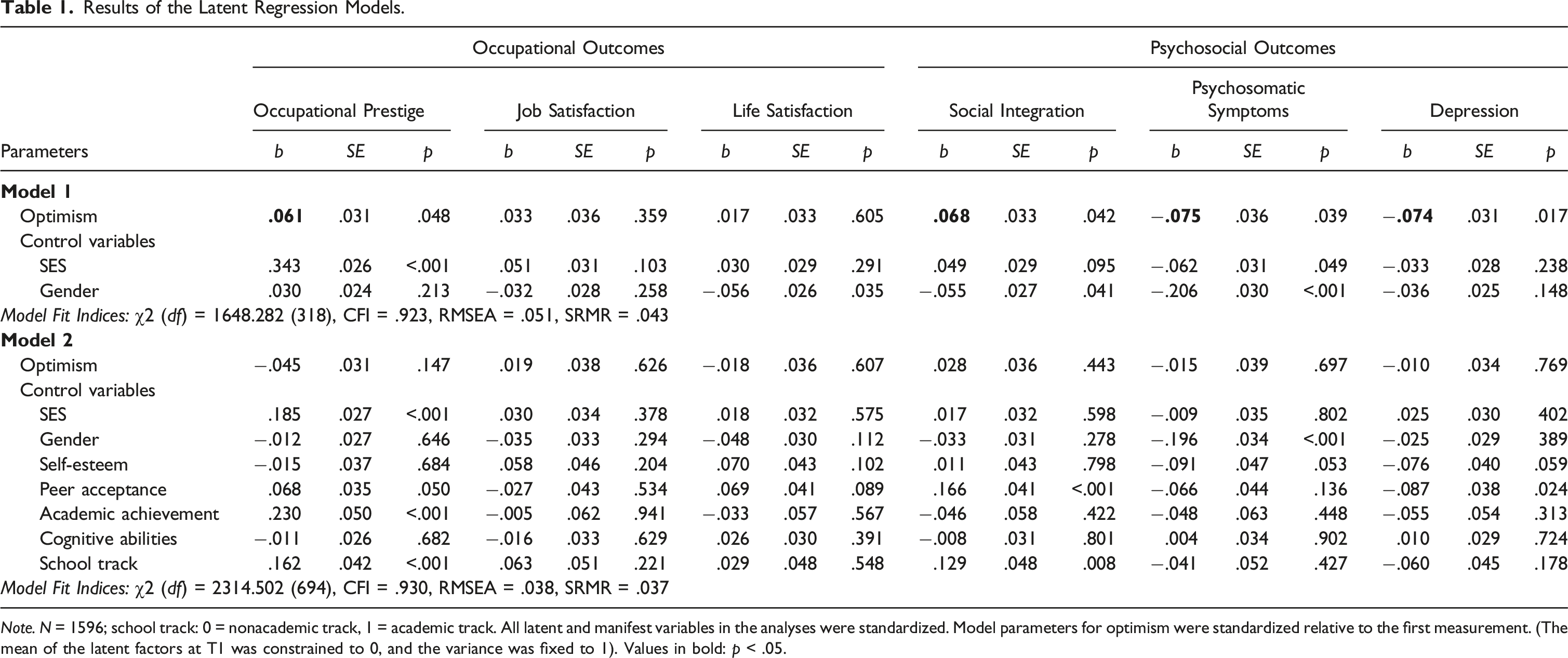
Note. N = 1596; school track: 0 = nonacademic track, 1 = academic track. All latent and manifest variables in the analyses were standardized. Model parameters for optimism were standardized relative to the first measurement. (The mean of the latent factors at T1 was constrained to 0, and the variance was fixed to 1). Values in bold: p < .05.
Results of the Latent Regression Models.
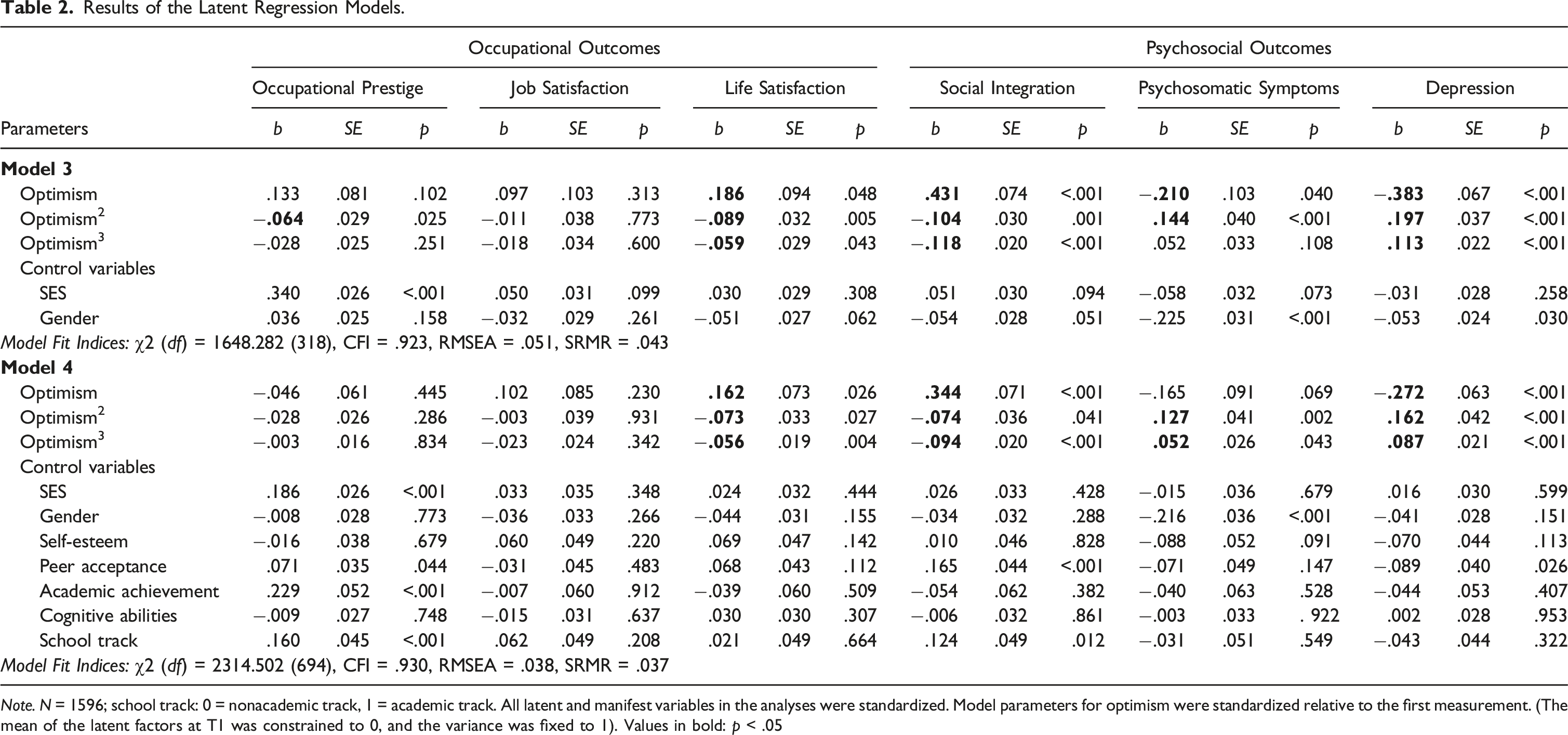
Note. N = 1596; school track: 0 = nonacademic track, 1 = academic track. All latent and manifest variables in the analyses were standardized. Model parameters for optimism were standardized relative to the first measurement. (The mean of the latent factors at T1 was constrained to 0, and the variance was fixed to 1). Values in bold: p < .05
Results of the Latent Regression Models.
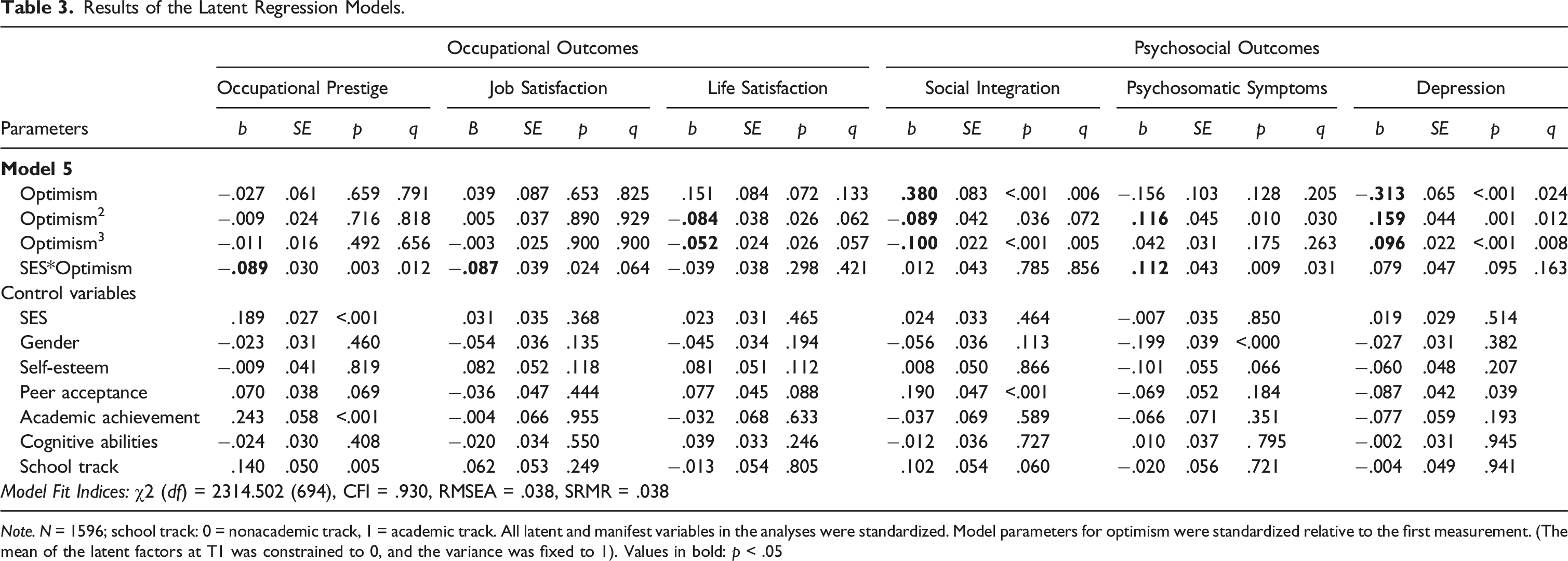
Note. N = 1596; school track: 0 = nonacademic track, 1 = academic track. All latent and manifest variables in the analyses were standardized. Model parameters for optimism were standardized relative to the first measurement. (The mean of the latent factors at T1 was constrained to 0, and the variance was fixed to 1). Values in bold: p < .05
Since our models included different independent variables across several dependent variables, the alpha error rate may be inflated (alpha inflation). We considered the issue of multiple testing by using the False Discovery Rate (FDR; Benjamini & Hochberg, 1995) to adjust p-values in our final and most complex model (see Model 5 of Table 3; parameter q comprise the adjusted p-value). Using this stricter significance level did not change the overall pattern of results: Optimism in adolescence still predicted the level of social integration and depression in adulthood in a nonlinear way. However, the long-term effects for life satisfaction were not statistically significant. Focusing on interaction effects between optimism and SES, effects for occupational prestige and psychosomatic symptoms in adulthood were still observable, whereas the interaction term no longer predicted job satisfaction statistically significantly.
Robustness Analyses
Robustness analyses confirmed the pattern of results. When we used alternative inclusion strategies to create our final sample, we found the same pattern of results (for details, see Table S1 in the Supplemental Material). Similarly, when we controlled for constructs that conceptually overlapped with optimism, the findings remained the same (for details, see Table S2 in the Supplemental Material). Finally, we conducted a series of additional analyses to test whether the protective effect of optimism in buffering negative effects of lower parental SES for several adult outcomes was still observable after accounting for possible interaction effects between parental SES and other factors in adolescence (self-esteem, peer acceptance, emotional stability, positive affect, negative affect, and perceived control regarding scholastic success). The results showed that the interaction effect of optimism with parental SES in predicting life outcomes did not change after controlling for interaction terms between other factors and parental SES (for details, see Table S3 in the Supplemental Material). More precisely, we only found few statistically significant interaction effects between the additional factors and parental SES in predicting life outcomes—for instance, for peer acceptance in predicting psychosomatic symptoms and for positive affect in predicting psychosomatic symptoms and depression. However, these interaction terms pointed in the opposite direction (i.e., Matthew effects) compared to the interaction effects between optimism and SES.
LOESS Curves
Since the latent regression models indicated curvilinear associations between optimism and some of the observed adult outcomes, we estimated LOESS curves to examine the shape of these associations more thoroughly (Aim 2).
Figure 1 plots the bivariate associations of optimism with social integration, life satisfaction, and depression (Figure S1 in the supplemental material shows associations with the other outcomes). Figure 1 also depicts model-based curves for those outcomes. In line with the results from the regression models, the LOESS curves showed curvilinear patterns for social integration, life satisfaction, and depression. In coherence with model-based curves, the LOESS curves showed that especially scores in the middle range of optimism (in the range between 1 SD below and 1 SD above the average optimism in our sample) were associated with more positive outcomes, that is, higher perceived social integration, more life satisfaction, and less depression. In the above-average ranges, the positive effects of optimism seemed to reach a plateau, but we found no indications that higher optimism values had detrimental effects. Similarly, we found no indications that especially low optimism values—that is, more than 1 SD below the average—had further effects. LOESS curves (smoothing factor = 0.5) and model-based curves for the effects of optimism in adolescence on social integration, life satisfaction, and depression in adulthood.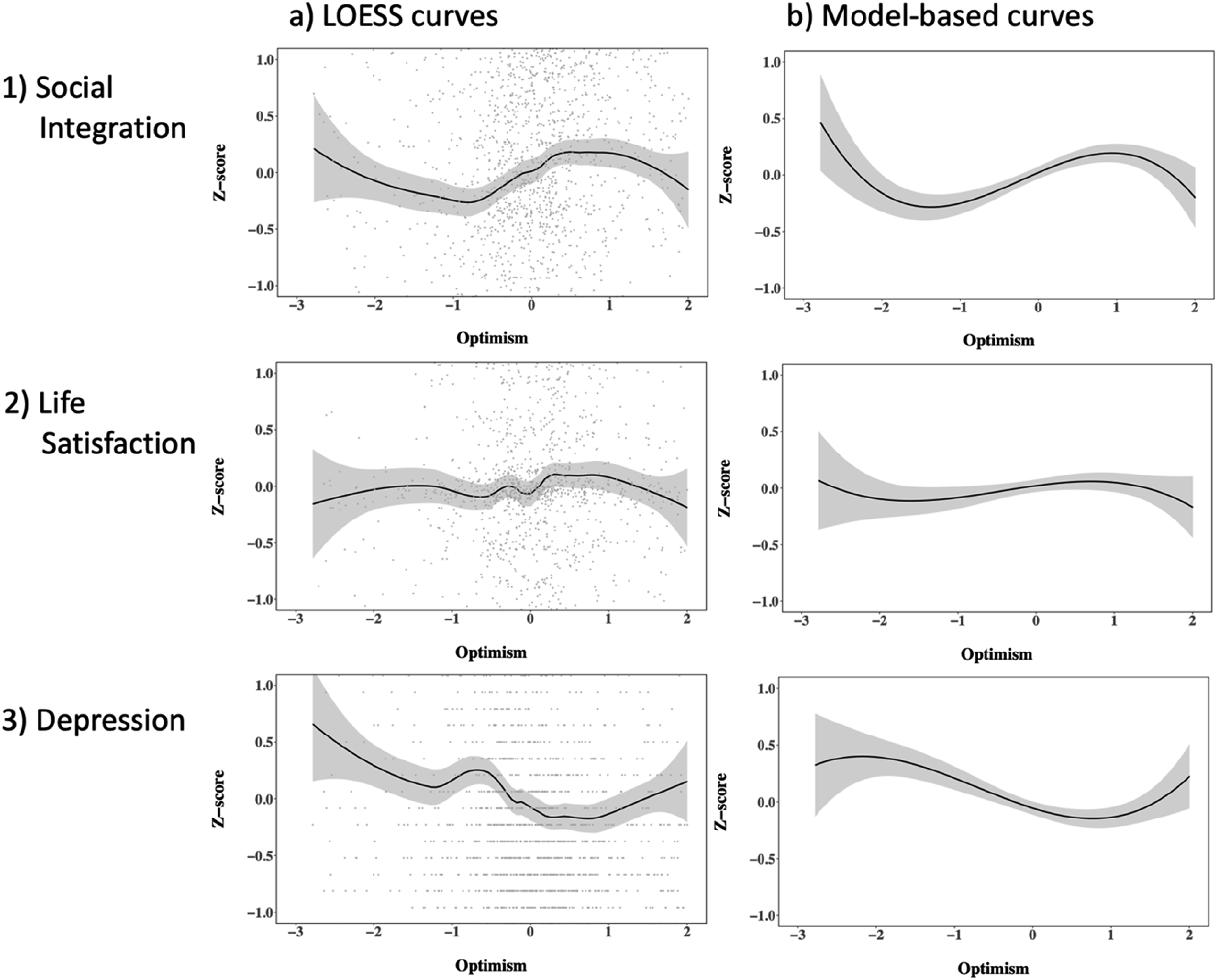
Since the latent regression model indicated interaction effects between optimism and parental SES in predicting occupational prestige, job satisfaction, and psychological symptoms in adulthood, we estimated additional LOESS curves to depict these protective effects (Aim 3). Hence, Figure 2 plots the association between optimism and these three adult outcomes by separating groups with different levels of parental SES in adolescence (average vs. below average vs. above average; Figure S2 in the supplemental material shows associations with the other outcomes). Confirming a moderating influence of optimism, the LOESS curves suggested more pronounced associations between optimism and adult occupational prestige, job satisfaction, and fewer psychological symptoms in adolescents from families with a lower SES. Adding to the information from the model-based curves, the LOESS curves more directly depict that a higher optimism seems to compensate a lower SES, whereas the level of optimism seems to be less relevant for adolescents in high SES families. LOESS curves (smoothing factor = 0.5) and model-based curves for the effects of optimism in adolescence on occupational prestige, job satisfaction, and psychosomatic symptoms in adulthood divided by different levels of parental SES.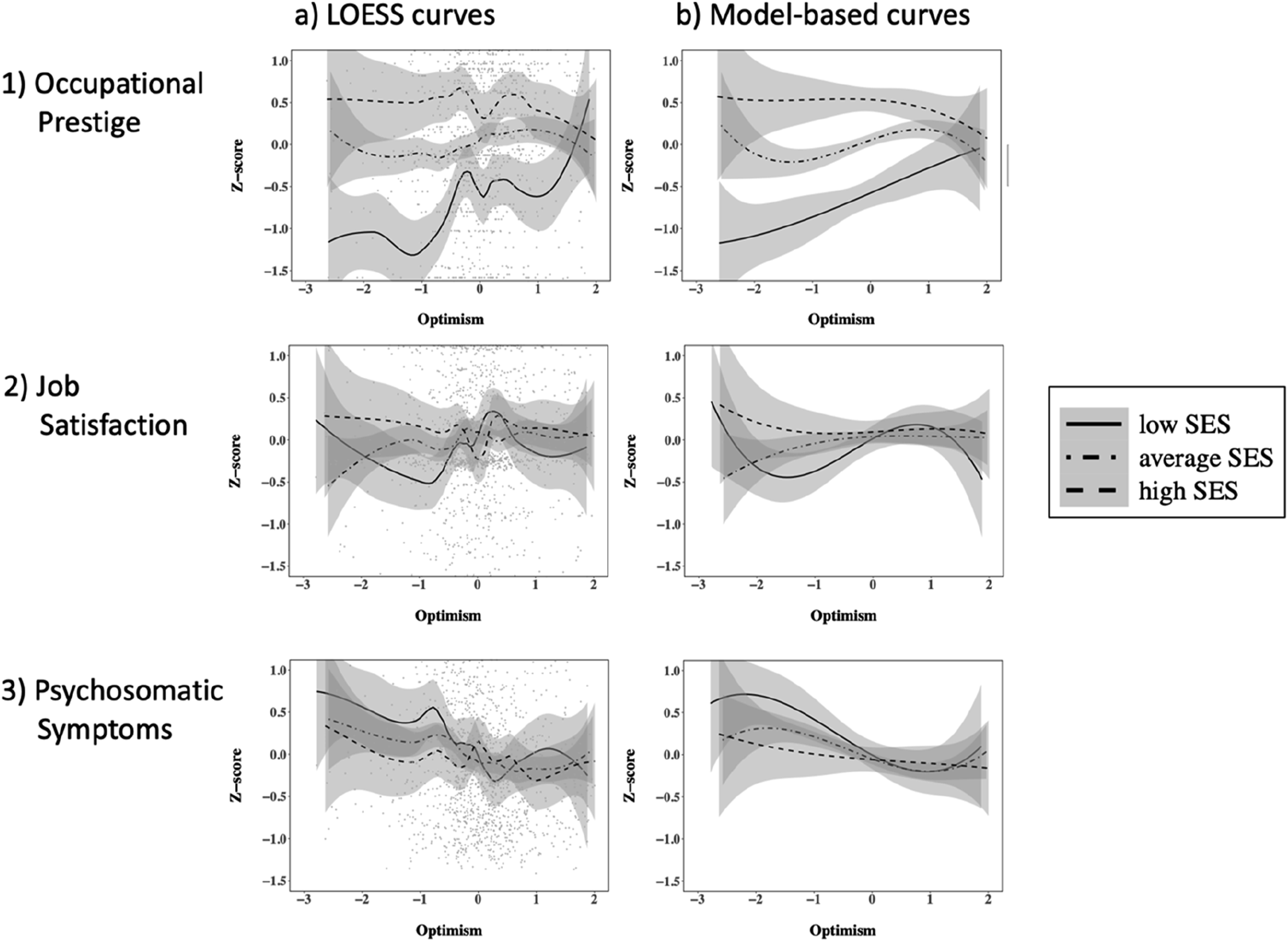
Discussion
The purpose of the present study was to examine the significance of an individual’s level of optimism for achieving important life outcomes. To this end, we investigated associations between optimism in early adolescents and their occupational and psychosocial outcomes 18 years later. More precisely, we examined associations with occupational prestige, job satisfaction, life satisfaction, social integration, psychosomatic symptoms, and depression. We also investigated whether optimism serves as a protective factor in reducing the risk effects of low parental SES. This study, which uses a large German sample, is the first to investigate these effects over a long time span from early adolescence to young adulthood by addressing several occupational and psychosocial outcomes and controlling for a broad range of concomitant predictors (i.e., self-esteem, peer acceptance, academic achievement, cognitive abilities, and academic track in adolescence).
(Nonlinear) Associations Between Optimism and Occupational and Psychosocial Outcomes
First, we investigated whether optimism in early adolescence predicts central life outcomes in young adulthood (Aim 1) and explored the functional form of this association (Aim 2). Drawing on assumptions about the powerful development-enhancing effects of optimism (Carver & Connor-Smith, 2010; Carver et al., 2010; Segerstrom, 2007; Solberg Nes & Segerstrom, 2006), we expected to find associations between early adolescents’ optimism and various life outcomes 18 years later. In line with the theoretical assumptions (Shepperd et al., 2015) and tentative empirical evidence (Tetzner & Becker, 2018), we expected to find a nonlinear prospective association between optimism and adult outcomes. More precisely, we expected to find an especially pronounced association for the mid-ranges of optimism.
The results of our structural equation modeling are consistent with these assumptions. They indicate small-sized linear associations—that is, greater optimism in early adolescence is associated with higher occupational prestige, better inclusion, and lower chances of developing psychosomatic symptoms and depression. However, structural equation modeling and LOESS curves showed that these associations follow a nonlinear path. Hence, we found medium-sized nonlinear associations between adolescent optimism with all psychosomatic outcomes 18 years later in adulthood (i.e., life satisfaction, peer acceptance, psychosomatic symptoms, and depression). Hence, this result confirms previous suggestions that the connection between dispositional optimism and subsequent developmental outcomes in different areas cannot be sufficiently captured by linear associations (Rand et al., 2011; Tetzner & Becker, 2018). Thus, the findings underscore the necessity to investigate the effects of optimism more comprehensively by considering nonlinear relations.
The results of our study emphasize the long-lasting and far-reaching significance of optimism for different areas of life. These are consistent with previous findings of such associations (e.g., Segerstrom, 2007) and are in line with theoretical assumptions about the supportive role of optimism in developmental processes (Carver et al., 2010; Carver & Scheier, 2014). Optimism may aid development in different areas of life because optimistic people show higher persistence in following high-priority goals (Geers et al., 2009), use more appropriate coping strategies (Solberg Nes & Segerstrom, 2006), and take active steps to ensure positive future outcomes and emotional states (Carver et al., 2010). Therefore, this study broadens the existing literature about the beneficial effects of optimism by providing evidence that they continue to be relevant over an especially long period of time (i.e., 18 years) and during the important transition from early adolescence to young adulthood. Although we admit that modifying developmental outcomes may be especially salient during the transitional years between early adolescence and young adulthood, we have no indications to hypothesize that those effects are unique for this developmental period or differ in direction or size from other stages in life.
The findings indicated that the beneficial effects of higher optimism are not evident over the entire optimism range. More precisely, the positive associations reached a plateau at above-average optimism levels and a minimum value at below-average optimism levels. Although our results indicated no “drawbacks” of especially high optimism—no indications that it impairs developmental outcomes—they are at least partly consistent with assumptions that overly optimistic expectations may not be exclusively positive in their effects (e.g., Isaacowitz, 2005; Shepperd et al., 2015). One relevant mechanism may be that overly optimistic people have an attentional bias that leads them to see the world through rose-tinted glasses and hence ignore failures and threats. This may hinder them from dealing with challenges and setbacks adequately (Isaacowitz, 2005). The potentially negative influence of optimism may counterbalance its generally positive effects, resulting in an unchained association at above-average optimism levels (see Tetzner & Becker, 2018, for a similar argument).
We found less pronounced associations between optimism in adolescence and occupational outcomes in adulthood. This result is consistent with research that has found no prospective associations between optimism and occupational outcomes in young adults, such as income (Li et al., 2019) or college performance (Rand et al., 2011). However, it partly contradicts evidence that connects optimism with occupational outcomes. For instance, Segerstrom (2007) reported associations between optimism in first-year law students and their incomes 10 years later. One explanation may be that effects of optimism on educational outcomes may be more indirect. Since previous studies confirmed a dynamic interplay between academic achievement and optimism in adolescents (Tetzner & Becker, 2018, 2019), it may be the case that optimistic expectations of adolescents may primarily enhance their academic performance at the same time in adolescence which, in turn, may serve as a basis for occupational success in adulthood.
Similarly, we only found a small-sized nonlinear association between life satisfaction and optimism. When using a stricter significance level, this association no longer reached statistically significance. One explanation may be that the time interval of this study is too long to detect this association more clearly. However, this result contradicts previous findings, which indicated an association between optimism and life satisfaction, partly even over more than two decades (Oh et al., 2022). Nevertheless, previous studies used other measures for optimism and life satisfaction and predominantly targeted adult development only.
Examining the developmental significance of optimism more comprehensively, we investigated whether the longitudinal associations between optimism and adult outcomes were still observable after controlling for the “precursors” of those adult outcomes in adolescence. Specifically, we examined self-esteem, peer acceptance, academic achievement, cognitive abilities, and academic-track school attendance, all of which are well-known to promote developmental processes and are meaningfully connected to an individual’s level of optimism. When controlling for these variables, the pattern of results remained the same and only the nonlinear associations between optimism in early adolescence and adult outcomes were slightly reduced.
Optimism as a Protective Factor
Our third research question concerned whether optimism in early adolescence acts as a protective factor in moderating the negative effects of low parental SES on important life outcomes in young adulthood (Aim 3). Drawing on theoretical considerations and previous research that indicated that optimism may buffer the negative effects of different forms of adversity and help individuals achieve better outcomes in multiple areas of life (e.g., Brissette et al., 2002; Tetzner & Becker, 2015), we expected to find that an optimistic outlook mitigated the negative effects of having limited socioeconomic resources and the accompanying challenges. In line with this, our findings revealed interaction effects when predicting occupational prestige and psychosomatic symptoms in adulthood. Our findings also hinted to an interaction effect when predicting job satisfaction, but this association did not reach statistical significance when using a stricter significance level.
Our findings are in line with the previous research, which also indicates that an optimistic outlook has risk-buffering effects (e.g., Brisette et al., 2002; Tetzner & Becker, 2015). One explanation is that optimists may use coping strategies that involve managing the consequences of stressors, actively changing situations, and reducing stressors and demands (Solberg Nes & Segerstrom, 2006). Most importantly, these risk-buffering effects were still observable after accounting for concomitant development-enhancing factors. Hence, our study underscores the significance of optimism in reducing the consequences of risky life circumstances. Our results therefore lend support to efforts and programs to enhance optimism among children and adolescents.
Robustness of Findings
Finally, we aimed to determine whether our results would hold across samples and after controlling for variables with a conceptual overlap. In this regard, this study indicated that the overall and protective effects of optimism cannot be explained by chained associations with other constructs, such as neuroticism, positive and negative affect, or self-esteem and thus underscores the relevance of studying dispositional optimism over and above other personality dimensions and affective states.
Strengths, Limitations, and Implications for Future Research
This study possesses many advantages over most previous research on the effects of optimism. It employs a prospective design over a period of 18 years during the important life phase from early adolescence to young adulthood. Moreover, it considers a variety of concomitant factors, including test scores assessing adolescents’ academic achievement and cognitive abilities, as well as looking at nonlinear associations and including interaction effects. It also uses broad testing against alternative constructs, offers a large sample size, uses sophisticated statistical modelling, and considers a broad range of occupational and psychosocial outcomes. However, several limitations of the study must be noted.
The first limitation concerns the generalizability of our results. Since we considered a subsample of BIJU respondents who participated at both measurement points, the data oversampled students in academic-track secondary schools, students with higher cognitive and academic abilities, students with optimistic expectations and self-esteem, students who felt more socially included, and students whose parents had a higher occupational prestige. This reduction in variability may have influenced our results. However, our results may also represent a lower bound, and the effects may be even stronger in a more representative group including more early adolescents with lower socioeconomic resources. Moreover, since our study incorporated students from the academic and nonacademic tracks of Germany’s secondary school system, we may have used a broader socioeconomic range compared to other samples in which optimism has been studied longitudinally—in such cases, the samples mostly included college or even graduate (law) school students.
Second, the BIJU study only contained the positively keyed, and not the negatively keyed, subscale of the Life Orientation Test (Scheier & Carver, 1985) to measure dispositional optimism. As there is still controversy about the separability of optimism and pessimism (Carver et al., 2010; Herzberg et al., 2006), future studies should examine whether there are differences in the effects of optimism and pessimism.
Third, although we addressed different occupational and psychosocial outcomes in adulthood, we cannot rule out the possibility that the effects are specific to the considered measures and operationalizations. Moreover, although we used a measure for occupational prestige that was scored using objective and validated criteria, we solely used self-evaluations of adult outcomes. Future studies should address these associations more comprehensively, for example, by including objective measures of social involvement.
Fourth, our study addressed the developmental period between adolescence and young adulthood to examine the overall significance of optimism for important life outcomes and its risk-buffering effects. It may be especially meaningful to show positive effects on those life outcomes in young adulthood because this life stage may set the basis for future development in adults future private and work life (Arnett, 2000). Similarly, by addressing occupational prestige, work satisfaction, life satisfaction, social integration, psychological symptoms and depression, this study investigated key outcomes of young adults personal and work life. However, our study does not test whether the shown effects of optimism on life outcomes are universal over the life span and are transferable to other outcomes. Future research may replicate our findings for other age groups and measures.
Finally, although our study indicated the presence of longitudinal and nonlinear associations, its design cannot identify the underlying mechanisms that may have produced these relations. Future studies should aim to disentangle such mechanisms.
Conclusions
This study examined whether optimism predicts important occupational and psychosocial outcomes in the transition from adolescence to adulthood. It broadens previous research by examining the functional form of the associations over a long time span and controlling for a broad set of individual and environmental factors. Optimism in early adolescence was associated with each of the six examined adult outcomes 18 years later, either by showing a nonlinear positive association (with life satisfaction, social integration, and depression) or by mitigating the negative influences of low parental SES (for occupational prestige, job satisfaction, and psychosomatic symptoms). Thus, this study highlighted the comprehensive and long-lasting relevance of optimism as a beneficial overall factor and as a protective factor against adversity. It also highlighted the necessity to consider nonlinear associations and to include such moderation effects in future research and consider the effects of optimism from a more comprehensive perspective by examining interactions on several levels.
Supplemental Material
Supplemental Material—Long-Term Advantages of Adolescent Optimism: Nonlinear Associations With Adult Outcomes and its Protective Role in Buffering Socioeconomic Risk
Supplemental Material for Long-Term Advantages of Adolescent Optimism: Nonlinear Associations With Adult Outcomes and its Protective Role in Buffering Socioeconomic Risk by Julia Tetzner and Michael Becker in European Journal of Personality
Footnotes
Declaration of Conflicting Interests
The author(s) declared no potential conflicts of interest with respect to the research, authorship, and/or publication of this article.
Funding
The author(s) received no financial support for the research, authorship, and/or publication of this article.
Open Science Statement
The statistical analysis code needed to prepare the data and reproduce our analyses are available at https://osf.io/g2jhw/?view_only=72edb23e581c4d249f703d27666f9b8f. Data presented in this study are available upon request from the principle investigators of the study ( ). We are not in a position to make data publicly available because these contain information that could compromise research participants’ privacy and consent.
Supplemental Material
Supplemental material for this article is available online.
Note
Appendix
Means, Standard Deviations, and Correlations. Note. ***p < .001, **p < .01, *p < .05; N = 1596; SES = parental socioeconomic status; perceived control = perceived control regarding scholastic success; school track: 0 = nonacademic track, 1 = academic track; gender: 0 = female, 1 = male.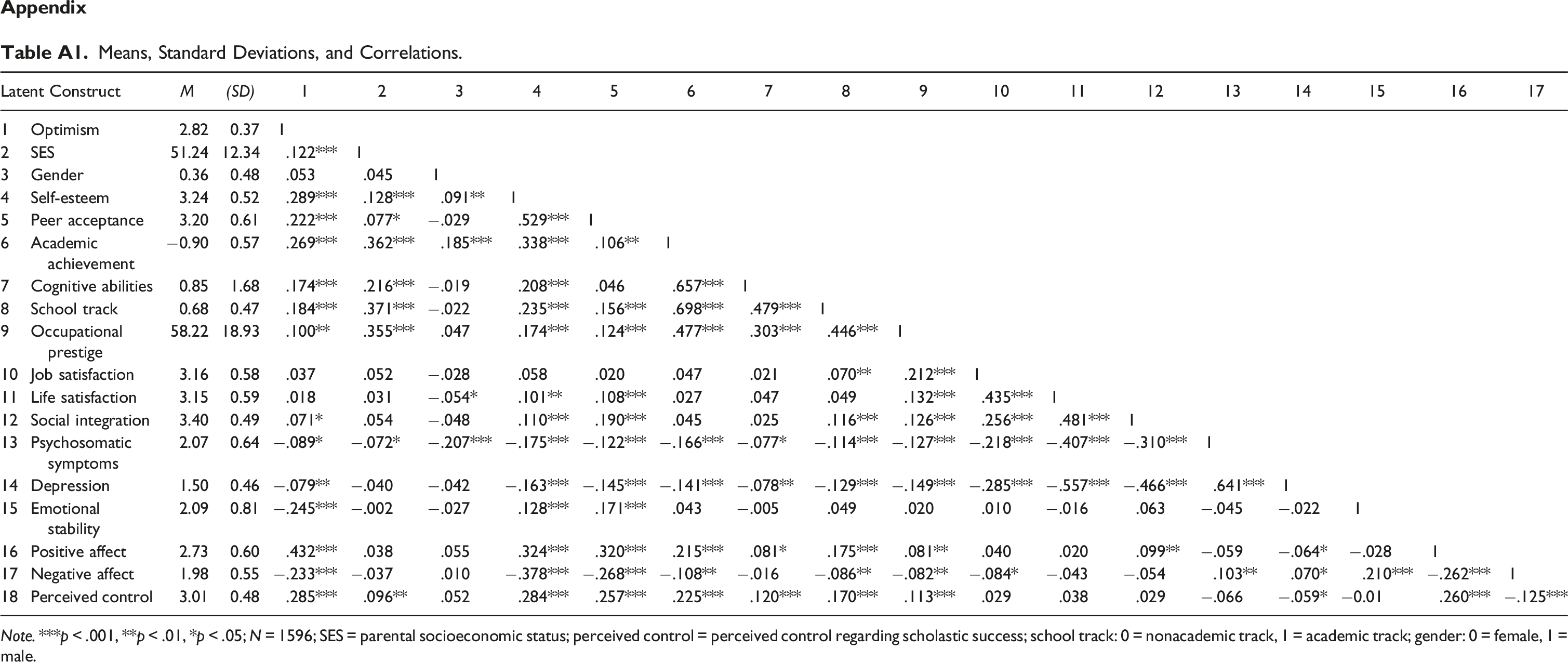
Latent Construct
M
(SD)
1
2
3
4
5
6
7
8
9
10
11
12
13
14
15
16
17
1
Optimism
2.82
0.37
1
2
SES
51.24
12.34
.122***
1
3
Gender
0.36
0.48
.053
.045
1
4
Self-esteem
3.24
0.52
.289***
.128***
.091**
1
5
Peer acceptance
3.20
0.61
.222***
.077*
−.029
.529***
1
6
Academic achievement
−0.90
0.57
.269***
.362***
.185***
.338***
.106**
1
7
Cognitive abilities
0.85
1.68
.174***
.216***
−.019
.208***
.046
.657***
1
8
School track
0.68
0.47
.184***
.371***
−.022
.235***
.156***
.698***
.479***
1
9
Occupational prestige
58.22
18.93
.100**
.355***
.047
.174***
.124***
.477***
.303***
.446***
1
10
Job satisfaction
3.16
0.58
.037
.052
−.028
.058
.020
.047
.021
.070**
.212***
1
11
Life satisfaction
3.15
0.59
.018
.031
−.054*
.101**
.108***
.027
.047
.049
.132***
.435***
1
12
Social integration
3.40
0.49
.071*
.054
−.048
.110***
.190***
.045
.025
.116***
.126***
.256***
.481***
1
13
Psychosomatic symptoms
2.07
0.64
−.089*
−.072*
−.207***
−.175***
−.122***
−.166***
−.077*
−.114***
−.127***
−.218***
−.407***
−.310***
1
14
Depression
1.50
0.46
−.079**
−.040
−.042
−.163***
−.145***
−.141***
−.078**
−.129***
−.149***
−.285***
−.557***
−.466***
.641***
1
15
Emotional stability
2.09
0.81
−.245***
−.002
−.027
.128***
.171***
.043
−.005
.049
.020
.010
−.016
.063
−.045
−.022
1
16
Positive affect
2.73
0.60
.432***
.038
.055
.324***
.320***
.215***
.081*
.175***
.081**
.040
.020
.099**
−.059
−.064*
−.028
1
17
Negative affect
1.98
0.55
−.233***
−.037
.010
−.378***
−.268***
−.108**
−.016
−.086**
−.082**
−.084*
−.043
−.054
.103**
.070*
.210***
−.262***
1
18
Perceived control
3.01
0.48
.285***
.096**
.052
.284***
.257***
.225***
.120***
.170***
.113***
.029
.038
.029
−.066
−.059*
−0.01
.260***
−.125***
References
Supplementary Material
Please find the following supplemental material available below.
For Open Access articles published under a Creative Commons License, all supplemental material carries the same license as the article it is associated with.
For non-Open Access articles published, all supplemental material carries a non-exclusive license, and permission requests for re-use of supplemental material or any part of supplemental material shall be sent directly to the copyright owner as specified in the copyright notice associated with the article.
