




Abstract
This study examined whether the six trait-like dimensions of psychological well-being (e.g., autonomy and environmental mastery) moderate the effects of unemployment on various facets of subjective well-being (i.e., life satisfaction, satisfaction with life domains, and experienced mood). Further, re-employment expectations during unemployment were investigated as a moderator in this context. The study is based on monthly panel data (Nobservations > 23,000) of two samples of initially employed German jobseekers, who either registered as jobseekers due to (i) mass layoffs or plant closures (N = 552) or (ii) other reasons (N = 988). The results indicate substantial interindividual differences in unemployment-related changes across all examined subjective well-being facets. However, dimensions of psychological well-being did generally not moderate these changes. Only in one unemployment context, environmental mastery was positively related to unemployment-related mood changes. Good re-employment expectations were related to increases in several well-being facets (e.g., leisure satisfaction) compared to being employed, whereas poor re-employment expectations were associated with particularly detrimental effects of unemployment in terms of life satisfaction. Overall, the study provides further evidence that (perceived) contextual features of unemployment seem to be particularly relevant for how individuals experience unemployment, whereas internal (coping) resources only seem to play a negligible role.
Plain language summary
Individuals differ in how their well-being levels are affected by unemployment. This study examined whether the effects of unemployment on well-being are less detrimental for people who have a high level of psychological functioning prior to their job loss. The results indicate that this generally does not seem to be the case. However, re-employment expectations during unemployment seem to be related to how people’s well-being change when they become unemployed: When re-employment expectations were poor, the effects of unemployment were found to be particularly detrimental in terms of life satisfaction. In contrast, when re-employment expectations were good, unemployment was related to increases in several well-being facets (e.g., leisure satisfaction) compared to being employed. Overall, the study provides further evidence that (perceived) contextual features of unemployment seem to be particularly relevant for how individuals experience unemployment, whereas internal (coping) resources only seem to play a negligible role.
Keywords
Introduction
Past research has indicated that individuals differ in how they react to unemployment (e.g., Doré & Bolger, 2018; Reitz et al., 2022). For example, Gielen and van Ours (2014) reported that about 50% of individuals in a representative German sample experienced declines in life satisfaction following a transition into unemployment, whereas 25% of individuals experienced increases in life satisfaction when they entered unemployment. However, although much research has been conducted on how unemployment affects life satisfaction, less is known about (interindividual differences in) the effects of unemployment on other facets of well-being. Well-being is often defined using the multi-faceted concept of subjective well-being, which consists of cognitive well-being and affective well-being (Diener, 1984). Cognitive well-being captures how people evaluate their life overall (i.e., life satisfaction) as well as certain domains of their lives (e.g., job satisfaction), whereas affective well-being is defined as experiencing positive feelings frequently and negative feelings infrequently (Diener, 1984; Larsen & Eid, 2008).
The present study has three main goals. The first goal is to document the interindividual differences in unemployment-related changes across a broad set of subjective well-being facets (i.e., life satisfaction, satisfaction with different life domains, and experienced mood). The second goal is to examine whether pre-unemployment levels of psychological well-being (Ryff, 1989), a trait-like construct consisting of six dimensions, buffer the effects of unemployment on the examined subjective well-being facets. We focus on pre-unemployment levels of the psychological well-being in order to search for characteristics that might predict which individuals are at risk for experiencing particularly detrimental effects of unemployment. The third goal is to test whether re-employment expectations during unemployment moderate the effects of unemployment on subjective well-being facets. We start this article by motivating why high levels of psychological well-being might be a protective factor during unemployment. Then, we summarize the extant literature on (interindividual differences in) the effects of unemployment on subjective well-being and provide an overview of situational and individual-level variables that have been discussed as moderator variables in the context of unemployment.
Psychological well-being as a potential buffer variable in the context of unemployment
The concept of psychological well-being is rooted in the eudaimonic perspective on well-being, which postulates that there is more to happiness than merely being satisfied with one’s life and experiencing pleasure (Ryff, 1989). For example, contributing to society, engaging in meaningful tasks, living in concordance with one’s virtues, as well as fulfilling one’s potential can also be defining features of a happy life (Deci & Ryan, 2008; Heintzelman, 2018; OECD, 2013; Ryff, 1989). Psychological well-being consists of the following six dimensions: autonomy, environmental mastery, personal growth, positive relations with others, purpose in life, and self-acceptance (Ryff, 1989). Past research has indicated that affective, cognitive, and psychological well-being facets are positively correlated with each other but capture distinct aspects of well-being (OECD, 2013; Tov, 2018). Moreover, affective, cognitive, and psychological well-being facets were found to differ in their temporal stability (Eid & Diener, 2004; Ryff et al., 2015), their relations with other variables (Lucas et al., 1996; Ryff, 1989), as well as their sensitivity to life events (Lawes et al., 2023; Luhmann et al., 2012; Schimmack et al., 2008).
Only a few studies have examined the role of psychological well-being in the context of unemployment, even though concepts that are closely related to psychological well-being play a central role in influential theories on why unemployment leads to poorer well-being (Fryer, 1986; Jahoda, 1982; Paul & Moser, 2006; Warr, 1987). For example, Jahoda’s latent deprivation model (1982) posits that, among other factors, the lack of participation in a collective purpose, social activities, and imposition of a time structure (which are closely linked to the psychological well-being dimensions purpose in life, positive relations with others, and environmental mastery) are the reasons why individuals suffer during unemployment. Empirical evidence for the latent deprivation model comes from multiple cross-sectional (e.g., Paul & Batinic, 2010; Paul et al., 2009) and longitudinal studies (e.g., Hoare & Machin, 2010; Zechmann & Paul, 2019). However, a recent study found that none of the six psychological well-being dimensions were immediately affected by unemployment (Lawes et al., 2023). This finding is consistent with empirical studies showing the high temporal stability of the six psychological well-being dimensions (Ryff et al., 2015) and underlines that the dimensions of psychological well-being are trait-like dispositions. Past research has further indicated that high levels of psychological well-being can be an important coping resource when individuals experience critical life events (e.g., Burns & Machin, 2012; Montpetit et al., 2006). Thus, high levels of psychological well-being might buffer the detrimental effects of unemployment on subjective well-being. This idea that individuals can be equipped with certain resources that help them reduce the impact of negative life events is rooted in the broader literature on resilience (Bonanno, 2004; Rutter, 1987) and psychological resources (Hobfoll, 2002; Luthans & Youssef, 2004). The few existing studies on buffering effects of psychological well-being in the context of unemployment relied on cross-sectional data and found that life satisfaction of unemployed individuals was higher when individuals maintained a structured routine and engaged in purposeful activities (Feather & Bond, 1983; Martella & Maass, 2000; Pavlova & Silbereisen, 2012). These results provide initial evidence for the potential buffering role of environmental mastery and purpose in life during unemployment. However, a comprehensive understanding of the role of psychological well-being during the experience of critical life events, particularly in the context of unemployment, is missing. Accordingly, Ryff (2014, p. 24) concluded in one of her review articles that “[m]uch future work remains to be done in probing hypotheses about how eudaimonic well-being affords protection under diverse conditions of challenge.”
Interindividual differences in unemployment-related changes in subjective well-being
Extensive research showed that entering unemployment is—on average—associated with declining life satisfaction (Clark et al., 2008; Lawes et al., 2023; Lucas et al., 2004; Luhmann et al., 2012). Moreover, unemployment was found to be related to mean-level decreases in satisfaction with one’s income (Chadi & Hetschko, 2017; Lawes et al., 2023) and social life (Powdthavee, 2012), but mean-level increases in satisfaction with one’s leisure time and family life (Chadi & Hetschko, 2017). With respect to affective well-being, research is more mixed (see Luhmann et al., 2012). Panel studies utilizing retrospective assessments of affective well-being indicate that unemployment can have detrimental effects on sadness, happiness, and anxiety (von Scheve et al., 2017) as well as mood (Hentschel et al., 2017). In contrast, studies that measured affective well-being with the experience sampling method (Hektner et al., 2007; Larson & Csikszentmihalyi, 1983) or the day reconstruction method (Kahneman et al., 2004), which are considered the gold standard assessment methods, found no systematic effects of unemployment on various affective well-being facets (Dolan et al., 2017; Hoang & Knabe, 2021; Knabe et al., 2010; Lawes et al., 2023; Wolf et al., 2022).
Past research also underlined that individuals differ in how their well-being levels are affected by unemployment (e.g., Doré & Bolger, 2018; Gielen & van Ours, 2014; Reitz et al., 2022; Winkelmann, 2009). Some studies have attempted to identify sources of these interindividual differences in unemployment-related well-being changes. Most of these studies focused on situational characteristics of unemployment. For example, positive re-employment expectations during unemployment were found to be related to less detrimental effects of unemployment on life satisfaction (Clark et al., 2010; Knabe et al., 2010). Longer unemployment spells have also been shown to be associated with stronger negative effects of unemployment on well-being (Hahn et al., 2015; McKee-Ryan et al., 2005; Paul & Moser, 2009). In addition, the availability of financial resources (e.g., alternative income or savings) has been identified as a strong protective factor during unemployment (Luo, 2020; McKee-Ryan et al., 2005; Zechmann & Paul, 2019) and unemployment has been found to have stronger detrimental effects in terms of life satisfaction in countries with less generous unemployment benefits (Kamerāde & Bennett, 2018; O’Campo et al., 2015; Voßemer et al., 2018; Wanberg et al., 2020). The type of employment before the job loss (e.g., Hetschko, 2016), general expectations about the future (e.g., Creed & Klisch, 2005) and the availability of educational opportunities for unemployed individuals (Högberg et al., 2019) have also been shown to moderate the effects of unemployment on life satisfaction. Moreover, attributing a job loss to internal factors (e.g., poor performance at work) has been shown to be negatively related to life satisfaction (e.g., Prussia et al., 1993), whereas attributing a job loss to external factors (e.g., general economic situation) has been found to be related to less detrimental effects of unemployment on life satisfaction (e.g., Clark, 2003). Lastly, men generally show stronger declines in life satisfaction after becoming unemployed than women (e.g., Clark et al., 2008; Kassenboehmer & Haisken-DeNew, 2009; van der Meer, 2014).
Some studies have also investigated whether internal (coping) resources might act as protective factors buffering the adverse effects of unemployment. An extensive body of research has examined the role of Big 5 personality traits in this context, yielding mixed results. Unemployment was found to be associated with stronger declines in life satisfaction when individuals score high on conscientiousness (Boyce et al., 2010; Hahn et al., 2015) and low on extraversion (Hahn et al., 2015), according to analyses of German panel data. In contrast, Yap et al. (2012) reported that individuals who score higher on agreeableness show significantly smaller declines in life satisfaction based on British panel data. Anusic et al. (2014) found that none of their examined personality traits moderated the effects of entering unemployment on life satisfaction, positive affect or negative affect using Australian panel data. In addition, higher overall life satisfaction levels were found to be related to less pronounced changes in life satisfaction following unemployment (e.g., Binder & Coad, 2015a). Further, spirituality and religious attendance has been found to buffer the negative impact of unemployment on life satisfaction (Kuhn & Brulé, 2019) and happiness (Hastings & Roeser, 2020). Interestingly, several studies on internal coping resources also did not find the hypothesized moderator effects in their studies on unemployment. For example, Infurna et al. (2016) found that perceived control prior to unemployment did not moderate the effect of unemployment on life satisfaction and Winkelmann (2009) reported that social capital (i.e., attending cultural events, engaging in sports, and visiting friends) did not buffer the effect of unemployment on life satisfaction.
Taken together, past research has shown that unemployment has stronger average effects on cognitive well-being facets compared to affective well-being facets. However, there are substantial interindividual differences in how unemployment affects the different subjective well-being facets. Research indicates that situational characteristics of unemployment (e.g., financial resources and re-employment expectations) seem to play a particularly important role in how unemployment affects subjective well-being, whereas internal (coping) resources that robustly buffer the effects of unemployment on subjective well-being have not yet been identified.
The present study
The present study has three main goals. The first goal is to document the extent of interindividual differences in unemployment-related changes (i.e., effect heterogeneity) across eight facets of subjective well-being (i.e., life satisfaction, four facets of satisfaction with different life domains, and three facets of experienced mood). The second goal is to examine whether pre-unemployment levels of psychological well-being moderate the effects of unemployment on the eight examined facets of subjective well-being. In particular, we hypothesize the following: The six dimensions of psychological well-being are positively related to unemployment-related changes in all examined subjective well-being facets.
In other words, we expect that high pre-unemployment levels of psychological well-being buffer the detrimental effects of unemployment and enhance the favorable effects of unemployment on subjective well-being. We tested this moderation hypothesis separately for each of the six psychological well-being dimensions in three unemployment contexts. Specifically, we differentiated between unemployment-related changes occurring across all episodes of unemployment and those that occur during unemployment episodes with high and with low re-employment expectations. We included the latter two unemployment contexts to investigate whether psychological well-being might be a particularly important internal coping resource when finding a new job is challenging (Lazarus & Folkman, 1984).
The third main goal of this study is to test whether re-employment expectations during unemployment moderate the effects of unemployment on the examined subjective well-being facets. Based on the results of previous studies (e.g., Knabe & Rätzel, 2010), we expect that unemployment is associated with more detrimental effects on subjective well-being when re-employment expectations during unemployment are low compared to when they are high. Besides these three main study goals, we investigate whether pre-unemployment levels of the subjective well-being facets are related to subsequent unemployment-related changes in these facets. Further, we examine how the six dimensions of psychological well-being are associated with the eight facets of subjective well-being.
The analyses are based on monthly panel data of initially employed German jobseekers and include a broad set of subjective well-being outcome measures. In contrast, most existing longitudinal studies on the effects of unemployment on subjective well-being have relied on yearly panel data and focused mainly on how unemployment affects life satisfaction. We conducted all analyses separately for two samples. The first sample (N = 552) consists of individuals who were at risk of losing their jobs due to mass layoffs or plant closures (i.e., external reasons). The second sample (N = 988) consists of individuals who were at risk of losing their jobs due to other reasons (e.g., expiring contract). Differentiating these two samples is important because the reason why individuals lose their jobs has been shown to be an important determinant for how individuals perceive and react to unemployment (e.g., Hetschko, 2016; Lawes et al., 2023).
The present study relied on the same dataset as results previously published in Lawes et al. (2023). The analyses in Lawes et al. (2023) focused on the immediate effects of unemployment on cognitive, affective, and eudaimonic well-being facets and examined patterns of short-term adaptation. In contrast, the present study focused on interindividual differences in unemployment-related subjective well-being changes and examined whether dimensions of psychological well-being moderate the effects of unemployment on subjective well-being facets. The present study further extends the paper by Lawes et al. (2023) by considering re-employment expectations during unemployment as a situational moderator.
Methods
Data
The analyses are based on the German Job Search Panel (GJSP; Hetschko et al., 2022), a monthly panel study of initially employed German jobseekers. The longitudinal design of the GJSP allows for tracking the well-being changes of individuals over time and relating these changes to the experienced employment transitions. The study was approved on Dec 13, 2017 by the ethics committee of the Department of Education and Psychology at Freie Universität Berlin.
Recruitment process
The German job seeking registration process was exploited to recruit participants for the GJSP. Specifically, in Germany employees have to register as jobseekers at least three months prior to their expected job loss. Individuals who find out later about the termination of their employment have to register as jobseekers within three days. Not registering as a jobseeker prior to becoming unemployed might lead to a cut-off period for unemployment benefits. Crucially, only around 60% of individuals who register as jobseekers actually become unemployed, whereas the others manage to either stay in their jobs or immediately start a new job without entering unemployment (Stephan, 2016). Between November 2017 and May 2019, 127,836 German employees aged 18 to 60 who registered as jobseekers with the German Employment Agency were invited via mail or e-mail to participate in the GJSP (Hetschko et al., 2022; Lawes, Hetschko, Sakshaug et al., 2022). In total, 79,710 of the identified jobseekers were likely to be affected by mass layoffs or plant closures and 48,126 registered as jobseekers from other companies (for details, see Hetschko et al., 2022).
A total of 4700 (3.68% of invited sample) individuals signed up for the GJSP and started filling out an online entry survey, which was used to determine the eligibility for the study. Individuals who had already entered unemployment (N = 1446) or who had been employed for less than six months (N = 216) were excluded to ensure at least one measurement occasion before respondents potentially entered unemployment as well as to ensure that participants passed their probation. One-third of all individuals (N = 950) were randomly excluded after the entry survey to investigate the role of survey participation on employment-related outcomes (i.e., Hawthorne experiment). Individuals were also excluded when they did not submit the entry survey (N = 246) or when they did not participate in the GJSP after the entry survey (N = 302). Accordingly, the final sample consisted of 1540 initially employed individuals who registered as jobseekers and either became unemployed after some time or remained employed in the same or a different job.
Although overall selection bias in the GJSP was small, analyses revealed that younger individuals, females, and highly educated individuals were particularly likely to sign up for the GJSP (for details, see Hetschko et al., 2022). Because the GJSP was conducted within a large interdisciplinary project with numerous research questions, we did not conduct a-priori power analyses for each of the research questions. The aim was rather to maximize the number of participants (given financial and time constraints) so that power would be adequate for testing all hypotheses.
Data collection
Over up to 25 months, individuals received monthly questionnaires assessing a wide range of information. Individuals could end their participation at any time. The questionnaires were presented via a specifically developed smartphone app, which ran on Android and iOS (for details on the survey app, see Ludwigs & Erdtmann, 2019). The resulting dataset contains a total of over 23,000 observations, which corresponds to an average of almost 15 monthly observations per individual. Detailed analysis on panel stability revealed no sizable effects of selective panel attrition (see Hetschko et al., 2022).
Samples
All analyses were separately run for individuals who reported that they registered as jobseekers due to (a) mass layoffs or plant closures (N = 552) and (b) other reasons (N = 988). Individuals in the mass layoff sample had little control over their situation as their potential job loss was likely involuntary and heavily depended on external factors. In contrast, in the other reason sample, the reasons why individuals entered unemployment were diverse. It is further likely that some individuals in this sample gave up their jobs voluntarily, for instance, to transition into a better job, enjoy a sabbatical, or enter early retirement. Moreover, individual characteristics are more likely to have played a role in the likelihood of entering unemployment in this group. Accordingly, the two samples likely differ in how individuals appraise and attribute their job loss. Both of these factors have been shown to be related to how individuals react to unemployment (McKee-Ryan et al., 2005).
Descriptive statistics summarizing the characteristics of the two samples at the first measurement occasion.
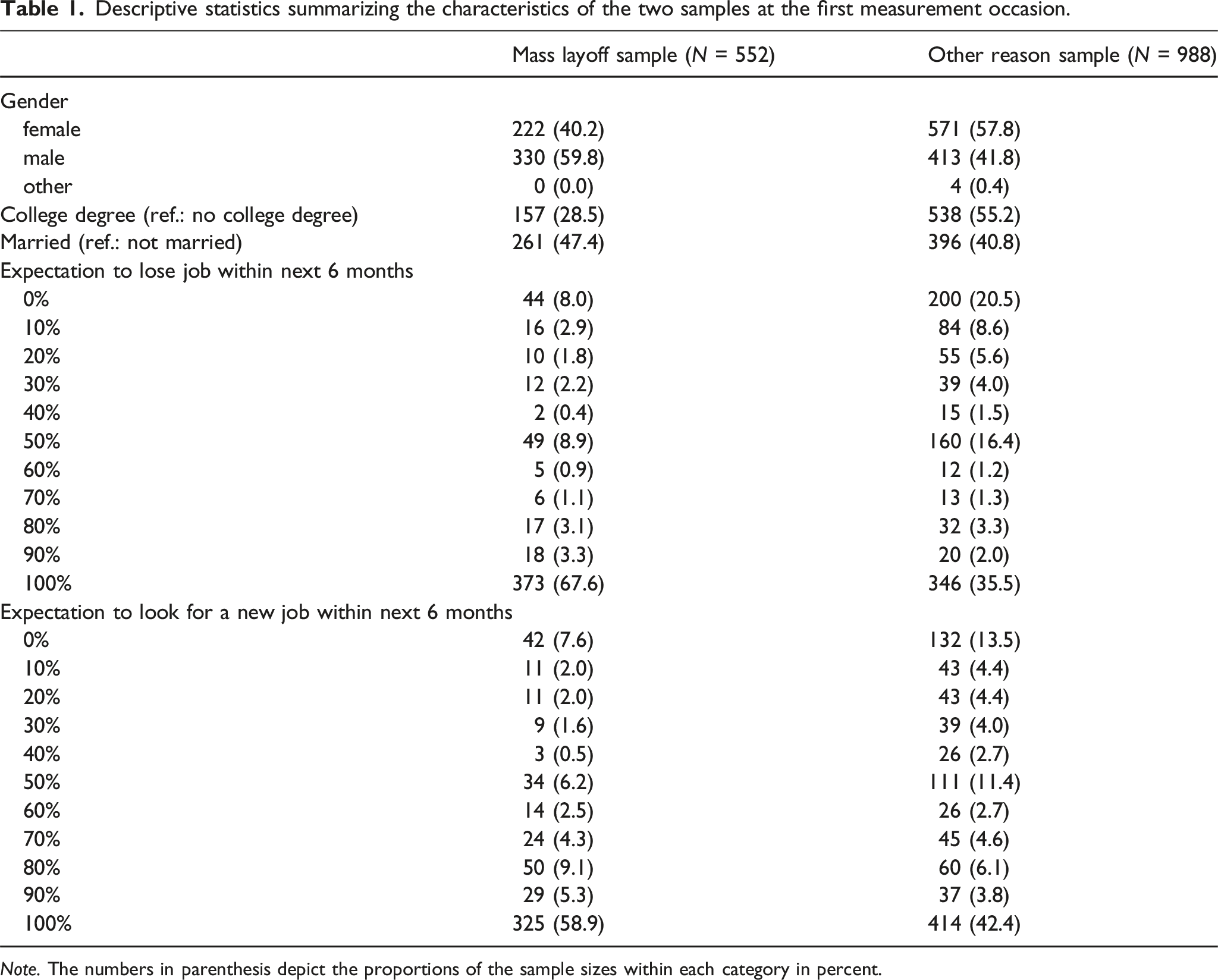
Note. The numbers in parenthesis depict the proportions of the sample sizes within each category in percent.
Measures
The wordings of all utilized questionnaire items are presented in Materials S1 in the supplementary materials. Descriptive statistics of all well-being indicators utilized in this study can be found in Table S1 and Figures S1 and S2 in the supplementary materials.
Independent variables
Employment status
During each monthly survey wave, respondents were asked about their current employment status. Individuals were categorized as being employed, when they were employed or self-employed, and as unemployed, when they were unemployed. Moreover, individuals who took part in public subsidy programs or occupational retraining were categorized as participants in active labor market policies (ALMP), and individuals who were in occupational training, school or university, unable to work (i.e., due to illness), retired or chose the category “other” in the employment question were categorized as individuals with other non-employment.
Dependent variables
Life satisfaction
Life satisfaction was measured with the Satisfaction With Life Scale (SWLS; Diener et al., 1985) at each monthly wave of the GJSP. Participants responded to the five SWLS items using a 7-point rating scale ranging from strongly disagree (1) to strongly agree (7). Only items 1, 2, and 3 of the SWLS were used in the present study because items 4 and 5 have poorer psychometric properties (Diener et al., 1985; Kjell & Diener, 2021; Pavot & Diener, 2009) and refer to longer time periods (e.g., “If I could live my life over, I would change almost nothing”). The three items used in the present study were separately analyzed. The model-implied single-item reliabilities of the first three SWLS items were computed for the full GJSP sample at the first measurement wave using confirmatory factor analysis and ranged from .70 to .86 (Lawes et al., 2023). In order to make the response scale comparable to the other subjective well-being facets, the responses to the SWLS items were transformed into percent of maximum possible scores (POMP; Cohen et al., 1999). POMP scores range from 0 to 100 and can be interpreted in terms of percentage points (p.p.), thus serving as an easily interpretable unstandardized measure of effect size.
Satisfaction with life domains
Participants rated their satisfaction with their activities in the household, household income, leisure time and family life on an 11-point rating scale ranging from completely dissatisfied (0) to completely satisfied (10). The items were based on the items used in the German Socio-Economic Panel Study (Wagner et al., 2007). Until December 2018, these items were administered quarterly, afterward monthly. Item responses were transformed into POMP scores to ensure comparability between the different subjective well-being measures.
Momentary mood
The experience sampling method (ESM; Hektner et al., 2007) was used to assess momentary mood as a measure of affective well-being. At the last day of each monthly survey wave, participants received six short ESM questionnaires at randomly chosen times throughout the day between 8 am and 9 pm. If respondents completed fewer than three ESM episodes, the ESM module was repeated two days later. At each ESM episode, six items from the Multidimensional Mood State Questionnaire (MDSQ; Steyer et al., 1994, 1997) were presented. The MDSQ is a three-dimensional measure of affective well-being and allows assessing the following mood states: happy, calm, and awake. Each affective well-being dimension was assessed with one positively worded item (e.g., “In the moment I feel happy”) and one negatively worded item (e.g., “In the moment I feel unhappy”). Individuals rated each statement on a 5-point rating scale ranging from not at all (1) to very much (5). Negatively worded items were reverse coded and all responses were transformed into POMP scores. The responses to each MDSQ item were averaged across the submitted ESM episodes of a given survey day. For respondents with fewer than three submitted ESM episodes in the initial ESM day, the MDSQ item was averaged across the day with more submitted ESM episodes. In cases where the same number of episodes was submitted on both days, the responses of the initial ESM day were used. The positively and negatively worded items of each mood state were separately analyzed. The model-implied reliabilities of the day averages of the six MDSQ items at the first measurement wave were computed for the full GJSP sample using confirmatory factor analysis and ranged from .74 to .83 (Lawes et al., 2023).
Moderator variables
Psychological well-being
Psychological well-being was assessed at each monthly survey wave using an adapted 24-item version of a German translation of the Ryff-Scale for Psychological Well-Being (Risch et al., 2005; Ryff, 1989). The 24-item short form was obtained by applying confirmatory factor analysis in combination with an ant colony optimization algorithm in a large sample of individuals who responded online to the 54-item version of the Ryff-Scale (see Schultze, 2017). Each of the six psychological well-being dimensions (i.e., self-acceptance, positive relations with others, autonomy, environmental mastery, personal growth, and purpose in life) was assessed with four items. Individuals responded on a 4-point rating scale ranging from completely disagree (1) to completely agree (4). Again, all negatively worded items were reverse-coded and the responses were transformed into POMP scores. The model-implied single-item reliabilities of selected items of the adapted Ryff-Scale were computed for the full GJSP sample during the first measurement wave and ranged from .37 to .74 (Lawes et al., 2023). In the present study, only responses from the first measurement occasion of the GJSP were used and averaged across the four items of a given psychological well-being dimension to obtain scale scores for the moderation analyses. Preliminarily analyses based on the full GJPS sample indicated that these manifest scale scores were highly stable over time for all of the six dimensions of psychological well-being with re-test correlations of .61 to .73 over 12 months and .56 to .72 over 24 months (see Table S2 in supplementary materials).
Re-employment expectations
In survey waves in which respondents indicated that they were unemployed, they were asked to respond to the question “How likely is it that you will start a paid job within the next three months?” using an 11-point rating scale ranging from 0 to 100%. The re-employment expectation variable was not normally distributed (see Figure S3 in supplementary materials) and seems to be best captured using a categorical variable. Thus, we dichotomized the variable into the following two groups: 0%–50% (i.e., low re-employment expectation) and 60–100% (i.e., high re-employment expectation). This approach allowed us to divide the unemployment episodes into two parts of similar size (see Tables S3a and S3b in the supplementary materials for a full list of sample sizes).
Analytical strategy
The data was analyzed using a mixed-effects trait-state-occasion model (ME-TSO; Castro-Alvarez et al., 2022). The ME-TSO model is ideally suited to model interindividual differences in intraindividual change as well as sources thereof. Whenever there are at least two repeatedly measured indicators available, the ME-TSO model can further separate reliable variance from measurement error. Since the ME-TSO model is a relatively novel approach, we briefly introduce its features below.
Basic variable decomposition
The ME-TSO model is rooted in latent-state-trait theory (Steyer et al., 1992, 1999, 2015). Latent-state-trait theory decomposes observed scores of an indicator i measured at time t (
It is further possible to include autoregressive effects on the level of the occasion-specific state residual variables in ME-TSO models (Castro-Alvarez et al., 2022a, 2022b). This feature permits adequate analysis of many measurement occasions with rather short time lags (Eid et al., 2017). Specifically, the latent occasion-specific state residual variable at time t is regressed on the latent occasion-specific state residual variable at t – 1:
Model specification
The ME-TSO model is formulated as a multilevel structural equation model (for an introductory chapter for personality researchers, see Sadikaj et al., 2021), where the occasion-specific state residuals and the measurement error variables are modeled at the within-person level, whereas the trait levels in the reference situation (
The ME-TSO model has three important advantages over classical manifest multilevel models for the examination of moderator effects. First, it can account for the measurement error of the observed variables if at least two indicators are available (see Cole & Preacher, 2014). Second, it clearly separates the within and between-person parts of the model and thus simplifies the model specification and parameter interpretation (see Preacher et al., 2016). Third, it can model autoregressive effects on the level of the occasion-specific state residual as well as (directed or undirected) relationships at the between-person level, which would be a cumbersome (or even impossible) to specify using manifest multilevel modeling software.
Implementation of the ME-TSO model in the present study
Within-person model
For the present study, we used the employment status of an individual as the fixed situation of interest and defined being in employment as the reference situation. We then modeled the subjective well-being trait level changes occurring between being employed and being unemployed (i.e., the non-reference situation) to obtain estimates of general unemployment-related subjective well-being changes. We did so by regressing each subjective well-being indicator on a dummy variable, which was 1 if an individual was unemployed and 0 if (s)he was employed (for a path diagram see Figure 1). The regression coefficient of this dummy variable corresponds to the unemployment-related changes in the subjective well-being indicator. Analogous to equation (1), these well-being trait changes were modeled as random effects at the between-person level in order to examine interindividual differences in intraindividual well-being changes (i.e., effect heterogeneity). In a second set of analyses, we differentiated between unemployment episodes with low re-employment expectations (i.e., expectation to start a paid job within the next 3 months of 0–50%) and unemployment episodes with high re-employment expectations (i.e., expectation to start a paid job within the next 3 months of 60–100%). In these models, we regressed the subjective well-being indicators onto two dummy situation variables indicating whether an individual was unemployed with low re-employment expectation or unemployed with high re-employment expectation (for a path diagram, see Figure S4 in the supplementary materials). Path diagram of an exemplary ME-TSO model for the overall unemployment-related changes in a subjective well-being facet measured with two indicators.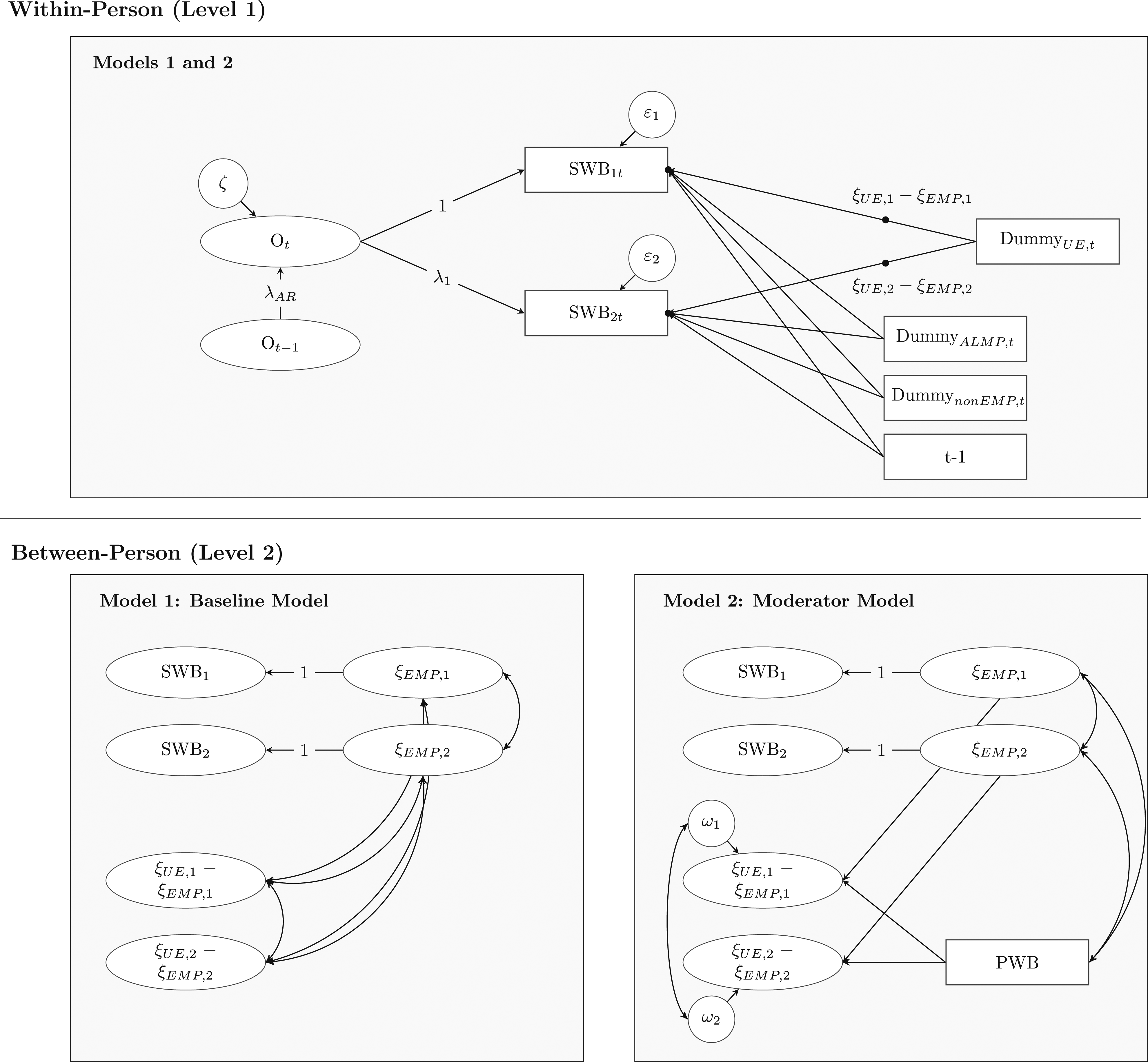
In all models, we added two further dummy variables to account for the fact that individuals could also be participating in an ALMP or were categorized as being in other non-employment at a given measurement wave. We defined the parameters of the situational dummy variables corresponding to these situations as fixed effects (i.e., set equal across individuals) because they are not of interest in this study. Given this specification, the intercepts of the subjective well-being indicators correspond to the indicator-specific trait levels during the first wave of measurement (i.e., during employment). Analogous to equation (1), these initial trait levels were also modeled as random variables at the between-person level.
Following equation (2), we further modeled an autoregressive process at the level of the occasion-specific state residuals. Because interindividual differences in this autoregressive parameter are not of interest in this study, we constrained the autoregressive effect to be equal across individuals (i.e., fixed effect). Lastly, we added a linear time trend to the within-person model by regressing the observed subjective well-being variables onto a variable containing the measurement wave minus 1 (i.e., 0 for wave 1, 1 for wave 2, etc.) in order to control for linear changes in subjective well-being that occur over time irrespective of unemployment. For the domain-specific satisfaction levels, which were all measured with one indicator only, we used a structurally identical manifest version of the ME-TSO model and specified the autoregressive effect on the level of the observed variables.
Between-person models
At the between-person level, we defined two different models: A baseline model (Model 1) and a moderation model (Model 2). In the baseline models, interindividual differences in the (i) subjective well-being trait levels at the first measurement occasion (i.e., in employment) and (ii) unemployment-related subjective well-being changes were modeled without including the psychological well-being dimensions. In these baseline models, the means of the trait change variables
In the moderation models (i.e., Model 2), we further regressed the unemployment-related subjective well-being trait changes onto the pre-unemployment levels of psychological well-being. Separate models for each combination of psychological well-being dimensions (i.e., the moderators) and subjective well-being facets (i.e., the outcomes) were specified. A statistically significant regression coefficient for a psychological well-being dimension predicting unemployment-related trait changes in a subjective well-being indicator would indicate a moderation effect. Positive regression weights would show that a psychological well-being dimension is positively related to unemployment-related subjective well-being changes (i.e., buffering effect), whereas negative regression weights would indicate an exacerbation effect. The magnitude of the regression coefficients can be interpreted as predicted changes in unemployment-related subjective well-being trait changes (in POMP score metric) for a one point change in a given psychological well-being dimension (in POMP score metric). Thus, a regression coefficient of 0.1 would indicate that two individuals who differ in a given psychological well-being level by 10 p.p. (and have otherwise identical covariate levels) are predicted to differ in their unemployment-related subjective well-being trait changes by 1 p.p.
To control for all stable characteristics that could potentially confound the moderation effects, we further regressed the unemployment-related subjective well-being changes onto the initial subjective well-being trait levels in all moderation models. In addition, the moderator models allow for examining the correlation of the pre-unemployment levels of psychological well-being and pre-unemployment trait levels of subjective well-being. Analogous to the baseline models, we specified all moderation models in two ways. First, we investigated unemployment-related subjective well-being trait changes across all unemployment episodes and second, we differentiated between unemployment episodes with high vs. low re-employment expectations. In total, we specified 96 separate moderation models (i.e., eight facets of subjective well-being x six dimensions of psychological well-being x two specifications [with and without considering re-employment expectations during unemployment]).
Computational procedure
Because the analyses cannot deal with missing values on the situational dummy variables (i.e., the employment status), we discarded all observations following the first missing value on the employment status variable for each individual. After this procedure, N = 6717 observations remained in the mass layoff sample and N = 13,094 observations remained in the other reason sample. For the analyses that take the re-employment expectations during unemployment into account, we further discarded observations occurring after unemployment episodes in which the re-employment expectation variable was missing. This reduced the sample sizes to N = 6639 observations in the mass layoff sample and N = 12,926 observations in the other reason sample. Moreover, we discarded participants with fewer than three observations on the subjective well-being indicators in order to model the well-being changes adequately. Therefore, the final sample sizes in the mass layoff sample ranged from 5449 to 5936 observations and from 10,906 to 11,623 observations in the other reason sample depending on the outcome and model (see Tables S3a and S3b in the supplementary materials for a full list of sample sizes).
We fitted all models separately for the two samples (i.e., mass layoff sample and other reason sample), which resulted in a total of 224 models. We applied a significance level of .05 for our statistical inferences and used two-tailed tests. Given the large number of moderation effects tested, we corrected the p-values for the moderation effects using the Benjamini–Hochberg procedure (Benjamini & Hochberg, 1995; Benjamini & Yekutieli, 2001). The Benjamini–Hochberg procedure controls the false discovery rate at a specified level (here
All models were fitted with Mplus (version 8.7; Muthén & Muthén, 2017) using the dynamic structural equation modeling framework (DSEM; Asparouhov et al., 2017, 2018). DSEM relies on a Bayesian estimation procedure implemented in Mplus (Asparouhov & Muthén, 2010). We used the default uninformative priors for all parameters and estimated the models using two Monte Carlo chains, each running for at least 400,000 iterations. We defined a seed for the Monte Carlo process to ensure reproducibility of the results. The posterior distribution of each parameter was based on every 20th iteration (i.e., thinning) of the second half of each chain (i.e., after the burn-in period). Thus, the parameter estimates were based on at least 10,000 posterior draws from each of the two chains. In order to ensure convergence of the Monte Carlo chains, we further set the Mplus convergence criterion to a stricter value (bconvergence = 0.025) compared to the Mplus default (bconvergence = 0.05). In addition, we visually checked the Bayesian posterior parameter trace plots and the Bayesian autocorrelation plots for several randomly chosen models. We obtained point estimates for the parameters by using the median of the posterior distribution and used the posterior quantiles to derive 95% credibility intervals for each estimate. We imported the Mplus model results to R (version 4.1.1; R Core Team, 2017) using the R-package MplusAutomation (Hallquist & Wiley, 2018). The online repository (https://osf.io/n6gsw/) contains all Mplus output files and R analysis scripts.
Model convergence
Almost all models converged based on the strict Mplus convergence criterion and our visual inspection of the Monte Carlo chains. The only models that did not initially converge were based on the other reason sample and examined life satisfaction. Specifically, the respective moderator models (i.e., Model 2) that did not account for re-employment expectations as well as the baseline model (i.e., Model 1) that took re-employment expectations into account did not converge according to the strict Mplus convergence criterion. However, if the default Mplus convergence criterion was used, these models reached convergence. Visual inspection of the Monte Carlo chains of these models also indicated convergence. Thus, all models were considered as having converged.
Results
Descriptive statistics
Frequencies of the different employment statuses
Tables S3a and S3b in the supplementary material depict descriptive results on the sample sizes and the proportions of the various employment statuses across all waves based on the baseline models. The sample sizes for the analyses of the mass layoff sample ranged from 321 (income satisfaction) to 399 (life satisfaction); the average number of measurement occasions ranged between 14.7 and 17.1. In the mass layoff sample, individuals were employed on roughly 79.5% and unemployed on roughly 12.5% of the occasions. For about 5.8% of occasions, individuals were unemployed with low re-employment expectations and in 6.7% of occasion unemployed with high re-employment expectations. On the remaining occasions, they were in an ALMP (about 4%) or were categorized as being in other non-employment (about 4%).
The sample sizes for the analyses of the other reason sample ranged from 675 (satisfaction with household activities) to 744 (life satisfaction) individuals; the average number of measurement occasions ranged between 15.5 and 16.7. In the other reason sample, individuals were employed on roughly 82% and unemployed on 10.5% of the occasions. For about 4.5% of occasions, individuals were unemployed with low re-employment expectations and in 6% of occasion unemployed with high re-employment expectations. In the remaining occasions, they were in an ALMP (about 2%) or were categorized as being in other non-employment (about 6%).
Item reliabilities and correlations of indicator-specific subjective well-being trait levels
Based on the baseline models that did not consider re-employment expectations, we derived the model-implied reliabilities of the indicators measuring life satisfaction and the three mood states as well as the trait level correlations of indicators measuring the same subjective well-being facets. The item reliabilities were high and ranged from .749 to .923 (see Table S4 in supplementary materials). The trait levels of indicators belonging to the same subjective well-being facet were highly (but not perfectly) correlated; correlations ranged from .739 to .951 (see Table S5 in supplementary materials). Thus, the different indicators of a given subjective well-being facets capture highly related, yet slightly different constructs. These results underline the importance of the indicator-specific modeling approach used in this study in contrast to collapsing the different indicators of a subjective well-being facet into one score.
Interindividual differences in unemployment-related changes in subjective well-being
Figure 2 illustrates the average unemployment-related changes and the interindividual differences in these changes for the subjective well-being facets in both samples based on the baseline models (i.e., Model 1). For the subjective well-being facets that were measured with multiple items, Figure 2 depicts the results for one selected item of each facet in order to present the results in a condensed manner. Specifically, for life satisfaction, the results are presented for the third item (“I am satisfied with my life”). For the mood states, the positively worded items (i.e., “happy,” “awake,” and “calm”) are presented. Visualizations in terms of the other items can be found in Figures S5 and S6 in the supplementary materials. Unemployment-related changes in subjective well-being facets. Moderation effects of the psychological well-being facets on the effects of unemployment on cognitive well-being facets.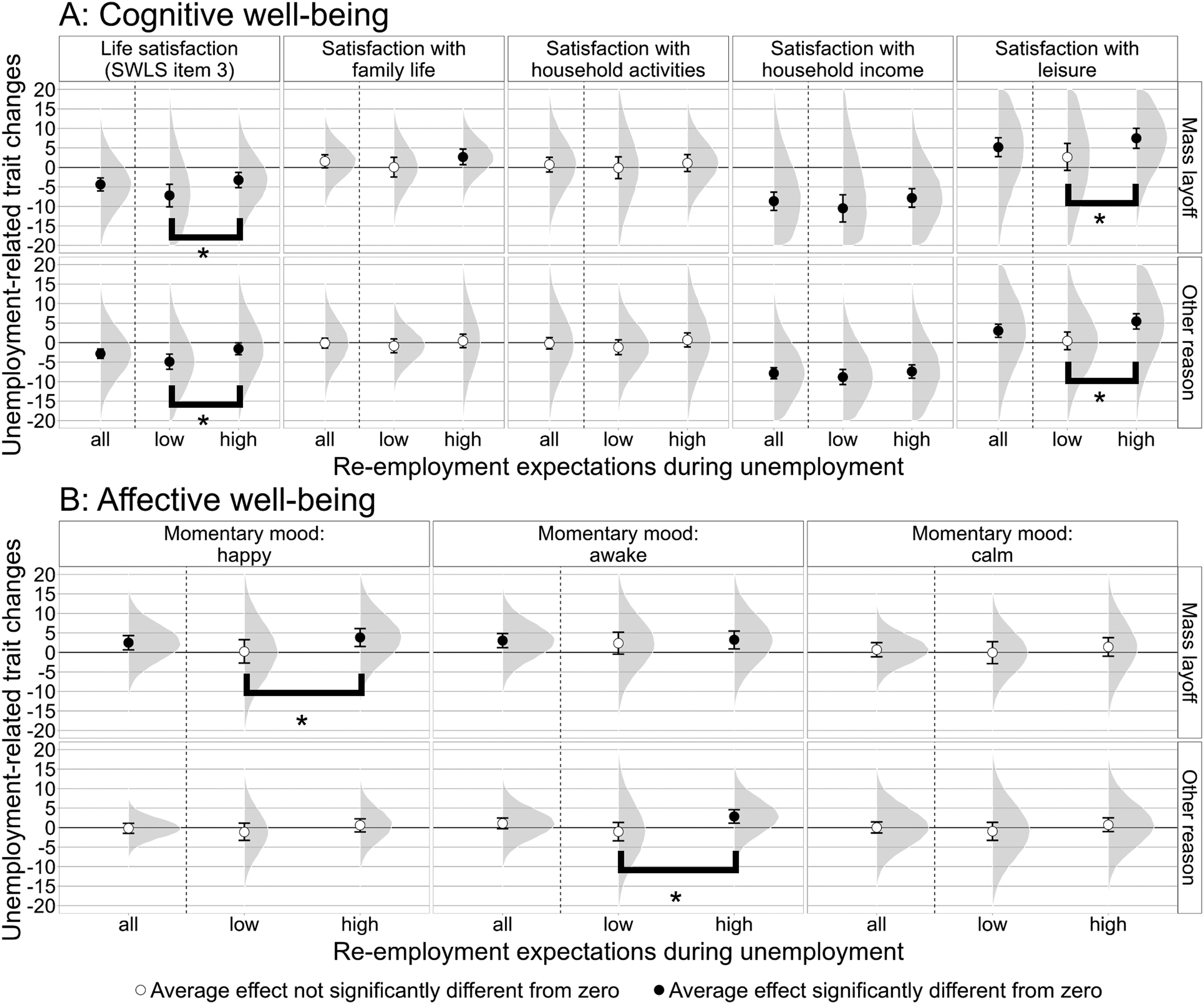
Mass layoff sample
Life satisfaction
Individuals in the mass layoff sample reported significantly lower life satisfaction during episodes of unemployment compared to episodes of employment. This effect was consistent across the three indicators of life satisfaction and ranged from −4.51 to −4.24 p.p. 1 . The average declines in life satisfaction were significantly larger when re-employment expectations were low compared to when they were high 2 . During unemployment episodes with low re-employment expectations, the average unemployment-related declines in life satisfaction were significantly different from zero, ranging from −5.99 to −7.27 p.p. In contrast, when re-employment expectations were high, the average unemployment-related declines in life satisfaction were still significantly different from zero, but only ranged from −3.24 to −3.86. The variances of the unemployment-related trait changes were significantly different from zero and meaningful in size in all models indicating substantial interindividual differences in the unemployment-related changes in life satisfaction. The correlations of the initial (i.e., pre-unemployment) trait levels of life satisfaction with the subsequent unemployment-related changes in life satisfaction were not significantly different from zero (see Table S7 in supplementary materials).
Satisfaction with life domains
Across all episodes of unemployment, individuals in the mass layoff sample were on average 8.65 p.p. (95% CI: [6.33; 11.01], p < .001) less satisfied with their income and 5.18 p.p. (95% CI: [2.77; 7.6], p < .001) more satisfied with their leisure compared to when they were employed. No such differences were found in terms of satisfaction with family life and household activities. When re-employment expectations were low during unemployment, the average unemployment-related declines in income satisfaction were (on a descriptive level) even greater (−10.47 p.p., 95% CI: [−13.98;-7.01], p < .001), whereas no unemployment-related changes in terms of satisfaction with family life, household activities, or leisure were found in this situation. During unemployment episodes with high re-employment expectations, the average unemployment-related declines in income satisfaction were not statistically different from those during unemployment episodes with low re-employment expectations (see Table S6a in supplementary materials). Individuals were significantly more satisfied with their family life (2.67 p.p., 95% CI: [0.69; 4.69], p = .008) and their leisure (7.48 p.p., 95% CI: [4.9; 10.01], p < .001) when they were unemployed with high re-employment expectations compared to when they were employed. No such differences were found in terms of satisfaction with household activities. The average unemployment-related increases in leisure satisfaction were significantly greater in unemployment episodes with high vs. with low re-employment expectations (see Table S6a in supplementary materials). Further, substantial interindividual differences in unemployment-related changes across all domain satisfaction facets were found. Pre-unemployment levels of leisure satisfaction were negatively correlated with subsequent unemployment-related changes in leisure satisfaction (r = −.24, 95% CI: [−.438;−.008], p = .042). For the other examined domain satisfaction facets, the initial trait levels were not correlated with subsequent unemployment-related changes in these facets (see Table S7 in supplementary materials).
Experienced mood
Individuals felt happier during episodes of unemployment compared to episodes of employment (2.5 p.p., 95% CI: [0.66; 4.33], p = .008). When re-employment expectations were high, this average unemployment-related increase was (on a descriptive level) even more pronounced (3.84 p.p., 95% CI: [1.53; 6.11], p = .002). In contrast, when re-employment expectations were low, unemployment was not related to mean-level changes in the first indicator of feeling happy. In terms of the second indicator of feeling happy (i.e., “unhappy”), no mean differences were found between episodes of unemployment and employment regardless of the re-employment expectations. Consistent across both indicators of momentary happiness, being unemployed with good re-employment expectations was related to significantly higher increases in feeling happy compared to being unemployed with poor re-employment expectations (see Table S6a in supplementary materials). Individuals also reported feeling more awake when unemployed compared to when employed with effects ranging from 2.37 to 3.85 p.p. Re-employment expectations during unemployment did not moderate these effects of unemployment on feeling awake. Unemployment-related changes in feeling calm were not significantly different from zero regardless of the re-employment expectations. Individuals substantially differed in their unemployment-related changes across all mood indicators. Pre-unemployment trait levels in the mood states were not correlated with subsequent unemployment-related changes in these mood states (see Table S7 in supplementary materials).
Other reason sample
Life satisfaction
Individuals in the other reason sample reported significantly lower levels of life satisfaction during episodes of unemployment compared to episodes of employment regardless of the re-employment expectations. The average effects of unemployment ranged from −1.59 to −4.98 p.p. During unemployment episodes with high re-employment expectations, unemployment-related declines in life satisfaction were significantly smaller compared to when re-employment expectations were low (see Table S6b in supplementary materials). The variances of the unemployment-related changes were significantly different from zero in all models. Further, pre-unemployment levels of the first indicator of life satisfaction were positively correlated with subsequent unemployment-related changes in that indicator (r = .21, 95% CI: [.034; .395], p = .018). For the other two indicators of life satisfaction, these correlations were not significantly different from zero (see Table S7 in supplementary materials).
Domain satisfaction
During episodes of unemployment income satisfaction was significantly lower than during episodes of employment. Mean effects of unemployment ranged from −7.4 to −8.83 p.p. Re-employment expectations during unemployment did not moderate these effects (see Table S6b in supplementary materials). Further, individuals were significantly more satisfied with their leisure during unemployment compared to being employed (3.04 p.p., 95% CI: [1.36; 4.72], p < .001). When re-employment expectations were high, this unemployment-related increase in leisure satisfaction was (on a descriptive level) even more pronounced (5.46 p.p., 95% CI: [3.47; 7.4], p < .001). In contrast, when re-employment expectations were low, unemployment was not related to mean-level changes in leisure satisfaction (0.42 p.p., 95% CI: [−1.8; 2.71], p = .71). Further, being unemployed with good re-employment expectations was related to significantly higher increases in leisure satisfaction compared to being unemployed with poor re-employment expectations (see Table S6b in supplementary materials). The unemployment-related changes in terms of satisfaction with family life and household activities were not significantly different from zero regardless of the re-employment expectations. There were substantial interindividual differences in unemployment-related changes across all domain satisfaction facets. Pre-unemployment levels of family satisfaction were negatively correlated with subsequent unemployment-related changes in family satisfaction (r = −.25, 95% CI: [−.461; −.024], p = .034). For the other examined domain satisfaction facets, initial levels were not correlated with subsequent unemployment-related changes in these facets (see Table S7 in supplementary materials).
Experienced mood
Unemployment-related changes in the mood states happy and calm were not significantly different from zero regardless of the re-employment expectations. However, during unemployment episodes with high re-employment expectations, individuals felt on average more awake compared to episodes of employment with effects of 2.86 (first indicator) and 2.17 (second indicator). These effects were not present when re-employment expectations were low. The average unemployment-related changes in feeling awake were higher during unemployment episodes with good re-employment prospects vs. episodes with poor re-employment prospects. 3 There were substantial interindividual differences in unemployment-related changes across all mood indicators but pre-unemployment mood levels in these mood states were not correlated with subsequent unemployment-related changes in these mood states (see Table S7 in supplementary materials).
Moderator analysis regarding dimensions of psychological well-being
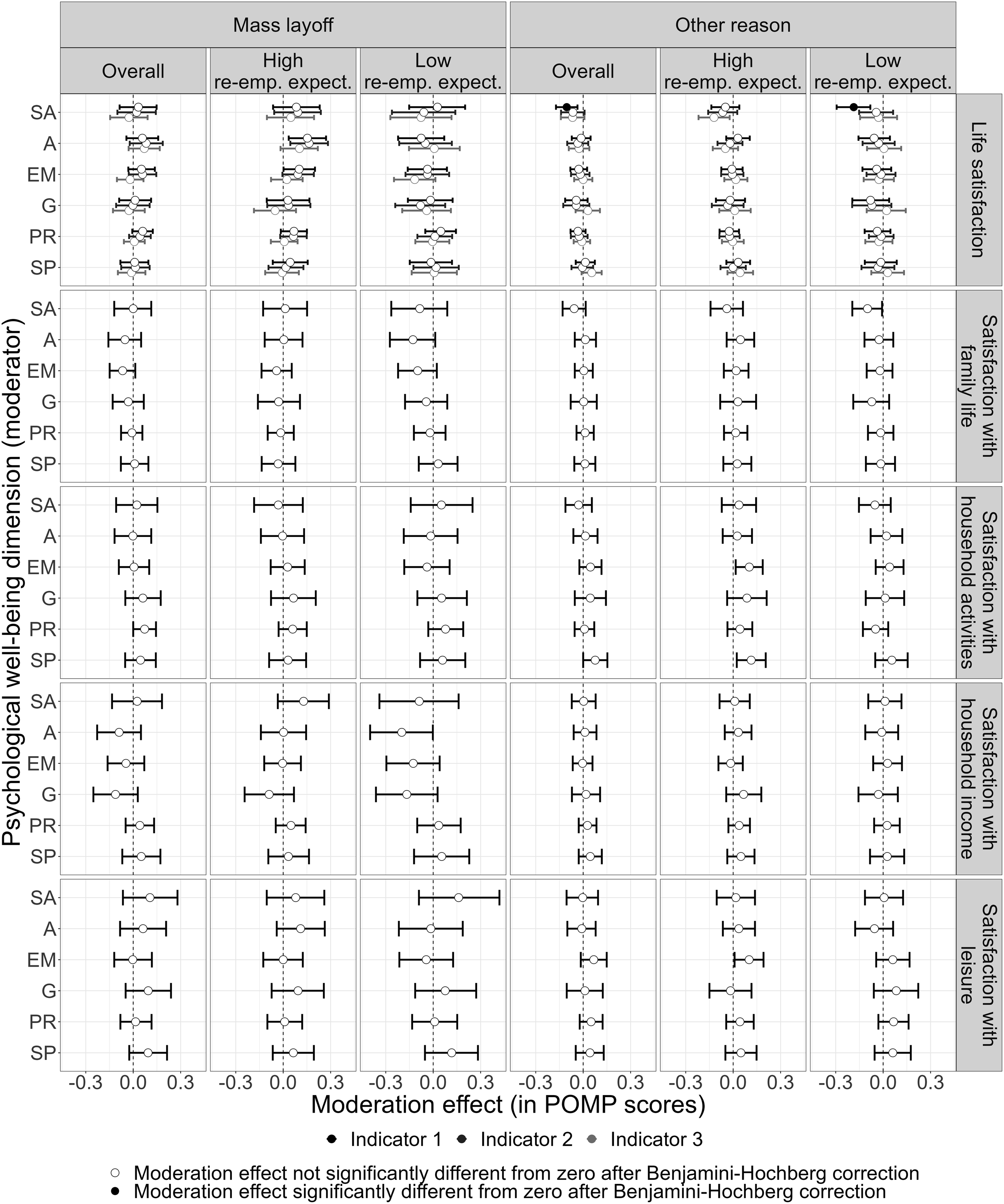
Based on the moderator models (i.e., Model 2), we tested whether the six psychological well-being dimensions moderate the effects of unemployment on the eight subjective well-being facets. Specifically, we extracted the regression coefficients of the psychological well-being dimensions predicting the trait change variables. These regression coefficients are depicted in Figure 3 (cognitive well-being) and Figure 4 (affective well-being). After applying the Benjamini-Hochberg procedure, 10 of the 468 (2.1%) regression coefficients were statistically different from zero. Strikingly, almost all of these effects (i.e., 6 out of the 10) were found for environmental mastery which positively predicted unemployment-related changes in feeling awake, calm, and happy in the other reason sample when re-employment expectations were low. The corresponding regression coefficients ranged from 0.13 (calm, first indicator) to 0.2 (awake, first indicator). Moreover, in the overall models that did not consider re-employment expectations, environmental mastery was positively related to unemployment-related changes in the first indicator of feeling awake and the second indicator of feeling calm. However, for the other indicators of these mood states, this effect was not statistically different from zero. The other two statistically significant moderation effects emerged in terms of self-acceptance moderating the effects of unemployment on the second indicator of life satisfaction in the other reason sample. These effects were found in (i) the model that did not consider the re-employment expectations and (ii) the model that did consider re-employment prospects but only when individuals reported high re-employment expectations. However, as the effects were not found for the other two indicators of life satisfaction (i.e., items 1 and 3), this finding should be interpreted cautiously. Moderation effects of the psychological well-being facets on the effects of unemployment on affective well-being facets.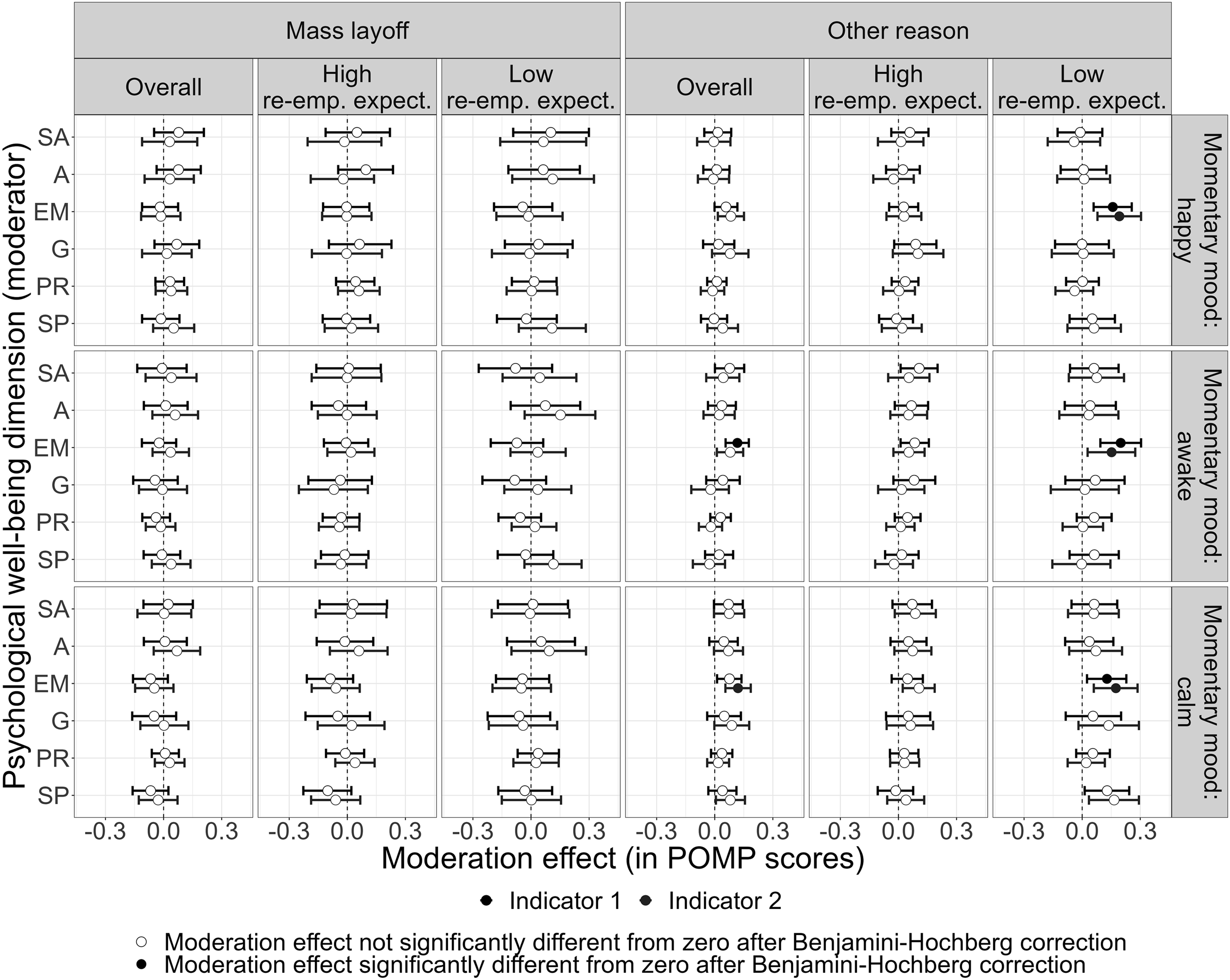
Correlations of pre-unemployment levels of subjective and psychological well-being facets
Based on the moderator models (i.e., Model 2) that did not consider re-employment expectations, we extracted the correlations of the pre-unemployment levels in psychological well-being and the initial (i.e., pre-unemployment) trait levels of the subjective well-being indicators (see Table S9a and S9b in the supplementary materials). Across both samples, almost all these correlations were positive and significantly different from zero. The only exception was the correlations of personal growth and the second indicator of feeling awake in the mass layoff sample, which was .08 (p = .18). The highest correlation was found for self-acceptance and life satisfaction in the other reason sample (r = .56). The average correlation across both samples were .29.
Discussion
The present study had three main goals. First, to document the extent of interindividual differences in unemployment-related changes across eight facets of subjective well-being (i.e., life satisfaction, satisfaction with four life domains, and three facets of experienced mood). Second, to examine whether pre-unemployment levels of psychological well-being moderate the effects of unemployment on these eight subjective well-being facets. Third, to test whether re-employment expectations during unemployment moderate the effects of unemployment on the examined subjective well-being facets. The study is based on monthly panel data collected in two samples of initially employed German jobseekers. The first sample consists of individuals who registered as jobseekers due to expected mass layoffs or plant closures, whereas the second sample consists of individuals who registered as jobseekers due to other reasons (e.g., expiring contract).
Interindividual differences in unemployment-related changes in subjective well-being
The results show substantial variance in the unemployment-related changes across all examined facets of subjective well-being. These large interindividual differences in unemployment-related changes indicate that individuals strongly differed in how their well-being levels were affected by unemployment. For example, based on our analyses, we would expect that around 31% of individuals from the mass layoff sample were less satisfied with their leisure when they were unemployment relative to when they were employed, whereas more that 50% of individuals would be expected to have experienced an increase in their leisure satisfaction of at least 5 p.p. during unemployment.
Moderation effects of psychological well-being
The six trait-like dimensions of psychological well-being were hypothesized to be internal (coping) resources that buffer the adverse effects of unemployment. However, contrary to our hypothesis, none of the six dimensions of psychological well-being consistently moderated the effects of unemployment on subjective well-being. After correcting for multiple testing, only around 2% of the moderation effects were significantly different from zero. Interestingly, almost all of the significant moderation effects were found for environmental mastery, which refers to being able to find or create an environment that suits one’s personal needs (Ryff & Singer, 2008, p. 28). In line with our hypothesis, pre-unemployment levels of environmental mastery were positively associated with more positive unemployment-related changes in feeling happy, awake, and calm. However, these moderation effects were only found for individuals who registered as jobseekers for reasons other than mass layoffs or plant closures and only for situations in which re-employment expectations were low during unemployment. This finding together with the simultaneous absence of the other moderator effects raises the question why only these moderator effects (and not others) were found. Although our study cannot give a definite answer to this question, we will offer possible explanations for this result in the following.
Why did environmental mastery and not any of the other dimensions of psychological well-being facets moderate the effects unemployment on affective well-being? A possible explanation is that environmental mastery has conceptual overlap with generalized self-efficacy (Ryff & Singer, 2008), which has been shown to be a global resilience factor during stressful life events (Bandura, 1997; Schwarzer, 2008). Thus, individuals scoring high on environmental mastery might generally be better at coping with the new challenges posed by unemployment, such as job search (see also Synard & Gazzola, 2017). In addition, high levels of environmental mastery may be associated with a more efficient and structured use of time (Bond & Feather, 1988; Feather & Bond, 1983), which has been repeatedly shown to be related to higher affective well-being during unemployment (Wanberg et al., 1997; Waters & Muller, 2003; Zechmann & Paul, 2019). Overall, the construct of environmental mastery appears to tap into different coping-related resources that play a role for how individuals experience unemployment.
Why did environmental mastery only moderate the effects of unemployment on affective well-being but not cognitive well-being facets? The detrimental effects of unemployment on life satisfaction appear to primarily stem from a loss in identity or status (Hetschko et al., 2014, 2021; Schöb, 2012) and unemployment-related changes in the satisfaction with different life domains (e.g., income satisfaction) are likely particularly driven by objective changes in these life domains (e.g., unemployment-related income loss). Thus, unemployment-related changes in cognitive well-being facets seem to be more closely related to objective circumstances, which in turn might render the role of internal coping resources less important. In contrast, unemployed and employed individuals were found to differ in (i) how they spend their time and (ii) how pleasurable they perceive their daily activities to be (Dolan et al., 2017; Knabe et al., 2010). Specifically, unemployed individuals have been found to generally spend more time in typically pleasurable activities compared to employed individuals (i.e., time composition effect). However, unemployed individuals experience less affective well-being than employed individuals when compared on the same activities (i.e., saddening effect). Both of these effects might serve as pathways through which environmental mastery moderates the effect of unemployment on affective well-being. Unemployed individuals who score high on environmental mastery might be better able to both structure their days in a way that creates more opportunities for enjoyable activities (i.e., increasing the time composition effect) and to enjoy their current activities more (i.e., reducing the saddening effect).
Why was the moderation effect of environmental mastery only found in the other reason sample? Why was it mainly present when re-employment expectations during unemployment were low? These findings could be explained by the idea that coping resources are only activated when a situation is perceived as challenging or threatening (Lazarus & Folkman, 1984). In the other reason sample, most individuals lost their jobs due to contracts with a known expiration date and thus had enough time to search for a new job while they were still employed. Therefore, many individuals who actually entered unemployment in this sample were likely unsuccessful in finding a (satisfactory) job prior entering unemployment making their unemployment situation even more challenging or threatening.
Importantly, however, in most contexts of our study psychological well-being was not related to unemployment-related changes in subjective well-being. This lack of moderation effects is in line with existing studies that also failed to find consistent evidence for buffering effects of individual (coping) resources like personality traits (e.g., see contradicting findings by Anusic et al., 2014; Hahn et al., 2015; Yap et al., 2012), perceived control (Infurna et al., 2016), or social capital (Winkelmann, 2009). The present study further found that pre-unemployment trait levels of the subjective well-being facets were not consistently correlated with subsequent unemployment-related changes in these facets. This finding contradicts the results of Binder and Coad (2015a, 2015b), who found that unemployment had less detrimental effects on selected cognitive and affective well-being facets for individuals who generally scored high on these facets. These contrasting findings likely emerged because Binder and Coad based their conclusions on the overall well-being levels during episodes of employment and unemployment. An important limitation of Binder and Coad’s approach is that individuals who show particularly strong negative effects following unemployment will also have lower overall well-being scores so that the moderator variable (i.e., overall well-being) is strongly influenced by the outcome variable (i.e., unemployment-related well-being changes). In contrast, the present study clearly disentangled the unemployment-related well-being changes (i.e., the outcome) from the pre-unemployment well-being levels (i.e., the moderator) allowing for a more straightforward interpretation of the effects.
Taken together, the results of the present study indicate that pre-unemployment levels of psychological well-being do not seem to consistently moderate the effects of unemployment on subjective well-being. Only in one very specific context of unemployment (i.e., job loss not due to mass layoffs and low re-employment expectations), pre-unemployment levels of environmental mastery consistently predicted more positive unemployment-related changes in feeling happy, awake, and calm. Overall, our study therefore adds to the literature that has shown that internal (coping) resources only seem to play a secondary role for how individuals experience unemployment.
Moderation effects of re-employment expectations during unemployment
The study results underline that re-employment expectations are an important moderator in the context of unemployment. In line with our expectations as well as previous studies that relied on yearly panel data (e.g., Clark et al., 2008; Gebel & Voßemer, 2014; Kassenboehmer & Haisken-DeNew, 2009; Lucas et al., 2004), the present study indicated that average life satisfaction levels declined when individuals entered unemployment. Crucially, unemployment-related declines in life satisfaction were significantly greater when re-employment expectations were low compared to when they were high. For example, in the mass layoff sample, the average unemployment-related declines in life satisfaction were 6–7.3 p.p. when re-employment expectations were poor compared to around 3.5 p.p. when re-employment expectations were good. Thus, the present study provides further evidence that re-employment expectations moderate how unemployment affects life satisfaction (see also Clark et al., 2010; Knabe & Rätzel, 2010).
In terms of the satisfaction with different life domains, our analyses indicate that unemployment is generally not associated with changes in one’s satisfaction with family life or household activities regardless of the re-employment expectations during unemployment. However, unemployment was related to strong decreases in income satisfaction regardless of the re-employment expectations. Further, unemployment was found to be associated with increases in leisure satisfaction but only when re-employment expectations were high. These latter findings help to contextualize previous work on the effects of unemployment on income and leisure satisfaction (e.g., Chadi & Hetschko, 2017; Lawes et al., 2023; Powdthavee, 2012). Specifically, anticipating re-employment and the associated income increases does not seem to heavily affect the current income satisfaction ratings of unemployed individuals (see also Chadi & Hetschko, 2017). Yet, unemployed individuals seem to be better able to enjoy their leisure time (that was freed up by being unemployed) when they expect to start a new job soon.
In terms of affective well-being, unemployment does not seem to be related to mean-level changes in feeling calm regardless of the re-employment expectations. However, being unemployed with good re-employment expectations was found to be related to feeling happier and more awake in contrast to being employed. This was particularly the case when individuals lost their jobs due to mass layoffs or plant closures. When re-employment expectations were poor during unemployment, average levels of feeling happy and awake were similar to those during employment. Thus, the present study indicates that re-employment expectations moderate the effects of unemployment on affective well-being, at least in terms of feeling happy and awake. This moderation effect might also explain why previous studies that did not consider re-employment expectations generally did not find any mean-level changes in experienced mood following unemployment (e.g., Dolan et al., 2017; Hoang & Knabe, 2021; Knabe et al., 2010; Lawes et al., 2023; Wolf et al., 2022).
Relationship between psychological well-being and subjective well-being
This study also provides novel insights into the relationship between psychological well-being and subjective well-being. In all models, pre-unemployment levels of the psychological well-being dimensions were positively correlated with the pre-unemployment trait levels of the subjective well-being indicators. The size of these correlations ranged from .08 to .56 with a mean of .29, which correspond to small to large effect sizes (Cohen, 1992). Thus, the psychological well-being dimensions and the subjective well-being indicators capture related, yet distinct facets of well-being. Together with the finding that unemployment differentially affects subjective well-being and psychological well-being facets (Lawes et al., 2023), these results speak against the critique that eudaimonic well-being measures are not empirically distinguishable from subjective well-being facets (Disabato et al., 2016; Kashdan et al., 2008).
Limitations and future directions
This study investigated interindividual differences in intraindividual subjective well-being changes between episodes of unemployment and employment. By applying a modern multilevel modeling approach, we aimed at statistically controlling for (i) the measurement error of the observed subjective well-being items, (ii) random situational influences, (iii) carry-over effects of neighboring measurement occasions, and (iv) general linear subjective well-being trait changes occurring over time. Our moderation analyses further controlled for all potentially confounding factors that are stable over time by regressing unemployment-related changes onto the initial trait levels of the subjective well-being indicators. Although the present study goes far toward a credible causal estimate of the effects, it is still possible that time-varying confounders might have an effect on the results (Hernán & Robins, 2023). Ideally, a between-subjects design in which selection into unemployment was either controlled (e.g., randomized experiment) or modeled (e.g., regression discontinuity design; see Mark & Mellor, 1991) would be needed. In practice, however, a clear definition of an event group (i.e., individuals who enter unemployment) and a continuously employed control group is challenging and might only achievable if the dataset is restricted to a few selected measurement waves (see Lawes et al., 2023; Lawes, Hetschko, Schöb et al., 2022). In contrast, our within-person models have the advantage of being able to incorporate the full longitudinal information available in the data.
Data collection for this study took place during an economic boom and the vast majority of individuals were able to quickly find a new job after becoming unemployed. Future studies conducted during less favorable economic times would permit examination of the potential buffering role of internal coping resources such as psychological well-being for individuals who are unemployed for longer periods. Further, the unique features of our two samples of jobseekers are important to consider, when interpreting the presented results. In particular, individuals in the mass layoff sample were likely better able to attribute their job-loss to external factors and had coworkers who also experienced a layoff. In contrast, most individuals in the other reason sample lost their jobs due to expiring contracts and thus had a rather long time to anticipate their unemployment. Lastly, only a small portion of invited jobseekers actually participated in our study so that selective participation might endanger the generalizability of the study results. Importantly, we find only few demographic differences between participants and non-participants (Hetschko et al., 2022). Thus, overall selection bias appears to be small.
A next step is to further explore sources of interindividual differences in unemployment-related changes in order to identify individuals who are at high risk of severely suffering from unemployment. In particular, it would be valuable to directly ask unemployed individuals about their thoughts on their job loss, who they blame for it, and what their employment-related goals are. One approach to gather such information would be to adapt the Event Characteristics Questionnaire (ECQ; Luhmann et al., 2021). The ECQ assesses self-perceived characteristics of life events based on the following nine dimensions: valence, impact, predictability, challenge, emotional significance, change in worldviews, social status changes, external control, and extraordinariness. Research on the ECQ indicates that the nine dimensions are differentially stable over time (Haehner et al., 2022) and that life events vary in their perceived characteristics (Kritzler et al., 2022). The ECQ has already been used to study the relationship between event characteristics and subjective well-being (Haehner et al., 2023) as well as prosociality and empathy (Fassbender et al., 2022), suggesting that it is a highly informative measure for researching life events. Analytically controlling for situational circumstances of unemployment will likely also increase the statistical power for identifying internal (coping) resources that moderate the effects of unemployment on subjective well-being.
Supplemental Material
Supplemental Material - Examining interindividual differences in unemployment-related changes in subjective well-being: The role of psychological well-being and re-employment expectations
Supplemental Material for Examining interindividual differences in unemployment-related changes in subjective well-being: The role of psychological well-being and re-employment expectations by Mario Lawes, Clemens Hetschko, Ronnie Schöb, Gesine Stephan and Michael Eid in European Journal of Personality
Footnotes
Acknowledgments
The authors are grateful to the Data and IT Management (DIM) unit of IAB for support in identifying and contacting the survey population. Moreover, we thank Stephen G. West and Kai Ludwigs for providing valuable feedback throughout the project and Ana Tomova and Felix Schwickert for their feedback on an earlier version of the manuscript. Mario Lawes played lead role in data curation, formal analysis, investigation, project administration, visualization and writing of original draft, and an equal role in the methodology. Clemens Hetschko played lead role in conceptualization and an equal role in funding acquisition, investigation, and project administration, as well as a supporting role in reviewing and editing the draft. Ronnie Schöb played a supporting role in project administration, reviewing and editing the draft, and an equal role in conceptualization and funding acquisition. Gesine Stephan played a supporting role in project administration, reviewing and editing the draft, and an equal role in conceptualization and funding acquisition. Michael Eid played the lead role in supervision and an equal role in conceptualization, funding acquisition, methodology, project administration, and reviewing and editing the draft.
Declaration of conflicting interests
The author(s) declared no potential conflicts of interest with respect to the research, authorship, and/or publication of this article.
Funding
The author(s) disclosed receipt of the following financial support for the research, authorship, and/or publication of this article: We gratefully acknowledge financial support by the German Science Foundation (grants EI 379/11-1, EI 379/11-2, SCHO 1270/5-1, SCHO 1270/5-2, STE 1424/4-1, and STE 1424/4-2) as well as from the Institute for Employment Research (IAB) through projects 3111, 3874 and 3877. Mario Lawes was a pre-doctoral fellow of the International Max Planck Research School on the Life Course (LIFE,  ).
).
Correction (June 2024):
This article has been updated to correct Figure 2.
Open science statement
This study’s design and its analyses were not preregistered. Analysis scripts and full model results are available at https://osf.io/n6gsw/. The GJSP data are not publicly available due to the data protection agreements of the GJSP. However, the data that support the findings of this study are stored on a private OSF repository and are available from the corresponding author for research purposes. A codebook containing all variables of the GJSP can be found at .
Supplemental Material
Supplemental material for this article is available online.
Notes
References
Supplementary Material
Please find the following supplemental material available below.
For Open Access articles published under a Creative Commons License, all supplemental material carries the same license as the article it is associated with.
For non-Open Access articles published, all supplemental material carries a non-exclusive license, and permission requests for re-use of supplemental material or any part of supplemental material shall be sent directly to the copyright owner as specified in the copyright notice associated with the article.
