




Abstract
Why do human beings exhibit enduring personality differences, and to what extent are these differences shaped by biological and cultural evolution? Despite ongoing efforts, a consensus framework remains elusive. This paper introduces the Diversity Advantage Theory, partially shifting the focus from how personality impacts individuals to its influence within groups. Through an evolutionary lens, connections among personality, collective cognition, and group dynamics are explored, revealing that diversity in personality traits would tend to enhance collective intelligence and foster deliberation, mitigating group biases. The framework proposes that biologically evolved psychological mechanisms underlying personality, including individual niche-finding, adapt and conform to culturally evolving heuristic personality traits. This co-evolution stabilized the Big Few personality traits in western, educated, industrialized, rich, and democratic (WEIRD) societies, addressing recurring group challenges related to engagement, closure, task, risk, and change. The Diversity Advantage Theory offers a novel explanatory framework for stable personality traits, aligning with biology and testable in contemporary group contexts. At least three novel perspectives are introduced: (1) personality trait dimensions have emerged, in part, to establish normative behavior for functional group processes; (2) normative diversity along trait dimensions enhances collective intelligence; and (3) such diversity should also promote deliberation, mitigate group biases, and improve group decision-making.
Evolutionary theories of personality such as the niche diversity hypothesis (Gurven, 2018; Lukaszewski et al., 2017; Smaldino et al., 2019) link natural/sexual/kin selection with cultural evolution (imitation, transmission/diffusion, and cultural group selection). Building on such frameworks, we propose that personality traits evolved alongside cultural-linguistic norms (e.g., Chudek & Henrich, 2011) to improve group processes and collective intelligence, shaping desired behavior. These norms, seen as socioecological inheritance (e.g., Odling-Smee & Laland, 2011), create adaptive niches along trait-like dimensions, potentially cross-stabilizing with underlying psychological mechanisms. We present a comprehensive argument for the emergence of the “Big Few” personality traits, especially the Five-Factor Model (FFM) (Costa & McCrae, 1992; Digman, 1990; Goldberg, 1993; John & Srivastava, 1999) which, despite decades of empirical research, lacks consensus for why these traits emerged from theory-free factor analysis (e.g., Baumert et al., 2017; DeYoung, 2010). The FFM substantially overlaps with the Big Five (Goldberg, 1990) and HEXACO (Ashton & Lee, 2020), and we broadly map our framework to these Big Few taxonomies.
Mõttus et al. (2020) encourage moving “Beyond the Big Few Traits,” but we suggest that a dual-inheritance approach could still render these traits generative. We do not contend one-for-one causal relationships between traits and psychological mechanisms but view traits, aspects, and facets as socio-cultural stabilizers influencing numerous complex mechanisms. Viewing personality traits in this manner—as socioecological inheritance in addition to biology—encourages higher dimensional predictive models of the underlying mechanisms, as advocated by Mõttus et al. (2020), which we also contend is consistent with an adaptationist perspective (Lukaszewski et al., 2020).
Our approach analyzes personality traits with respect to group processes, exploring the interaction between individual and collective behavior. We offer three novel perspectives: (1) personality trait dimensions partly set norms for effective group function; (2) personality diversity enhances collective intelligence; and (3) such diversity should facilitate deliberation, mitigate group biases, and improve group decision-making.
We begin with a brief review of relevant literature before detailing our framework, which relates FFM trait variations to group function. The literature review that follows assesses supporting evidence, counterarguments, and testability, covering both animal and human studies on personality, group decision-making, and collective intelligence. By connecting group processes with personality research—two seldomly linked areas (Parks, 2012)—our aim is to spur dialogue and research on the significance and function of personality traits. (For other relevant statements concerning the interface between personality and evolutionary thinking, see Boyd, 2017; Couzin, 2009; Henrich & McElreath, 2007; Garnier & Moussaïd, 2022; Jolles et al., 2020; Krause et al., 2011; Laland et al., 2016; Laland et al., 2015; Lewis & Buss, 2021; Lukaszewski et al., 2020; Penke & Jokela, 2016; Tooby & Cosmides, 2015.)
Scaffolding the framework: Personality, evolution, and culture
Recognizing that the underlying psychological mechanisms driving behavior are influenced by the group through norms, we see parametric coordinative mechanisms (Tooby & Cosmides, 2015) at the base of personality as evolving under dual-inheritance selection pressures in tandem with the language that informs behavior. Natural/sexual/kin selection might have shaped individuals whose coordinative mechanisms, aiming for successful niches, aligned with cultural trait descriptors communicating expected behavior. This congruence is likely to have stabilized the major dimensions of individual difference.
Broadening our perspective on this confluence, we agree with the viewpoint that the cultural evolution of practices, norms, and beliefs—whether through cultural group selection or intergroup diffusion (Richerson et al., 2016)–likely favors cultural traits that benefit the group. Intergroup competition puts selection pressure on cultural traits that utilize and are nested within evolved psychological mechanisms (Henrich & Henrich, 2007; Richerson & Boyd, 1999). The central argument for cross-stabilization is that cultural traits building on, aligning, and co-evolving with psychological mechanisms are likely to be more stable and potent than those in conflict with such mechanisms, though complex trade-offs are possible.
Before complex language, our primate ancestors still required coordinative mechanisms to navigate their social groups. Some of these ancient mechanisms are likely so foundational and interwoven with other coordinative mechanisms that certain heuristic personality “traits” were almost inevitably going to surface as language evolved to provide useful behavioral descriptors. Evidence of this deep-rooted anchoring can be seen in the widespread existence of observable personalities in social animals that lack complex language. We will explore this literature to lay the groundwork for the discussions that follow.
Personality across social animals
Personality-like constructs are prevalent across social animal species, including fish (Overli et al., 2005; Wilson et al., 1993), reptiles (Cote & Clobert, 2007; Sih et al., 2003), birds (Groothuis & Carere, 2005), and mammals (e.g., Koolhaas et al., 1999; Malmkvist & Hansen, 2002; Réale et al., 2000). These constructs are referred to as temperaments, coping styles, or behavioral syndromes in animal behavior studies (e.g., Koolhaas et al., 2007; Réale et al., 2007; Sih & Bell, 2008), but they almost certainly share similarities with human personality traits (Gosling & John, 1999; Stamps & Groothuis, 2010). The relevant individual differences are trait-like dimensions, and they include the shy-bold continuum, which is linked to Extraversion (Gosling & John, 1999). Other dimensions that have been observed and quantified include approach/avoidance of novelty/risk (Brick & Jakobsson, 2002; Réale et al., 2000; Wilson et al., 1994), and aggressiveness (Réale et al., 2007; Réale et al., 2010; Sih & Bell, 2008), as well as activity level and sociability (Gosling, 2001; Réale et al., 2007).
There has also been progress in understanding why there would be personality-like variations within a given species. In one analysis, Dall et al. (2004) applied a game-theoretic perspective, positing that consistent personality-like variations could arise over time through frequency-dependent selection, while Wolf and Weissing (2012) outlined numerous evolutionary and ecological consequences stemming from behavioral differentiation, pointing to the adaptability of personality variations. Even among lizards, Cote et al. (2008) argued that variation in sociability is adaptive, in this case influencing dispersal patterns.
It is also widely held that social complexity reciprocally influenced cognitive abilities and brain size (Byrne, 1996; Dunbar, 1998; Humphrey, 1976), as articulated in the social brain hypothesis (Dunbar, 1998). Honeybees make group decisions (Seeley, 2010), but their “politics” are not behaviorally complex. Primates can form sophisticated coalitions and alliances (Harcourt & de Waal, 1992) and chimpanzees exhibit complex politics (de Waal, 1998). Humans likely represent the pinnacle in terms of the number of observable personality dimensions and in terms of the nuanced ways in which these dimensions interact with situational factors and time (Fleeson, 2004; Shoda & Mischel, 2000).
Personality and human evolution
The field of human personality psychology encompasses a variety of frameworks, with the FFM having strong empirical support. Emerging from factor analyses in the absence of theory (Digman, 1990; Goldberg, 1993; McCrae & John, 1992), efforts to produce a post-hoc theoretical framework for the FFM include predominantly non-evolutionary (e.g., DeYoung, 2010; Fleeson & Jayawickreme, 2015; McCrae & Costa, 1999) and evolutionary (Lewis & Buss, 2021; Tooby & Cosmides, 2015) approaches. The FFM has been mapped to lower-order traits like facets (Costa & McCrae, 1995) or the Big Five Aspects (BFAS) (DeYoung et al., 2007), higher-order traits (DeYoung et al., 2002; Digman, 1997), and integrative theories like Cybernetic Big Five Theory (CBFT) (DeYoung, 2015) and Whole Trait Theory (Fleeson & Jayawickreme, 2015) have been proposed. Despite its applicability across languages (Goldberg, 1990; McCrae & Allik, 2002) and its links to numerous behaviors and outcomes (Hampson, 2012; Ozer & Benet-Martinez, 2006), debates persist regarding the cross-cultural and ancestral stability of the FFM, especially outside of western, educated, industrialized, rich, and democratic (WEIRD) cultures (Henrich et al., 2010).
From an evolutionary perspective, Buss (1996, 2009) suggests that the ability to perceive individual differences has been crucial for identifying allies, leaders, or adversaries within groups, contributing to survival and reproduction. Moreover, individuals display personality traits to facilitate predictive and coordinated interactions with others. Buss (1996, 2009) suggests that environmental complexity, and genetics contributing to trait heritability, resulted in the preservation of variation (individual differences) in part because there was no strong selection against such diversity. Overall, Buss’ (1996, 2009) perspective contends that personality serves as a predictive narrative that social animals develop over time to anticipate the behavior of conspecifics. Predicting a conspecific’s behavior, though, was an implicit process until metacognition and language allowed humans to become aware of their own personality, which aided in niche construction.
MacDonald (1995, 1998) and Nettle (2006) highlight the adaptive nature of personality variance, emphasizing the trade-offs associated with different levels of personality traits. Hogan (1996) and Hogan and Sherman (2020) also explore the idea of personality trade-offs in relation to social roles (e.g., among leaders vs. followers). McNamara and Leimar (2010) draw on game theory to argue that personality variation fosters cooperation, while Penke et al. (2007) and Penke and Jokela (2016) suggest that environmental variations drive the genetic basis of personality traits. The latter authors emphasize the role of personality in shaping and selecting environments, linking personality variations to the concept of niche-finding.
Despite some arguments for the Big Few’s direct link to biological evolution, we favor the adaptationist perspective (Lukaszewski et al., 2020), which posits that the traits of the Big Few are constructed descriptors and not the underlying mechanisms that were universally selected. Biological evolution may have favored underlying psychological and coordinative mechanisms (Tooby & Cosmides, 2015), such as the hypothesized Anger Programme linked to Agreeableness and Neuroticism (Lukaszewski et al., 2020), facilitating niche-finding (Penke et al., 2007; Penke & Jokela, 2016). Of note, Smaldino et al. (2019) encourage focusing on these underlying mechanisms rather than (or in addition to) focusing on statistical descriptions of trait covariance.
Our framework aligns with Smaldino et al.’s (2019) niche diversity hypothesis emphasizing the role of diverse niches in fostering personality variation. We recognize the complex interplay of biological (e.g., psychological mechanisms resulting from fluctuating optima, frequency-dependent selection, or mutation-selection balance) and cultural factors in shaping personality, emphasizing the need for a nuanced understanding of these influences, and acknowledging the ongoing challenges in disentangling the roles of nature and nurture.
Personality traits and niches
Personality traits reflect stable internal characteristics inferred from behavioral patterns (McCrae & Costa, 1999) that can be analyzed using niche theory, which explores the manner in which traits function differently across environments (Penke & Jokela, 2016), and the niche diversity hypothesis, which contends that particular environments favor particular personality profiles (Smaldino et al., 2019). As societies evolve, they foster a wider array of niches, leading to more nuanced personality profiles with reduced trait covariance. Our framework sees specific situations as temporary niches and recurring situations as long-term (trait-like) niches. In other words, we reframe the debate between person and situation (Fleeson, 2004; Shoda & Mischel, 2000) in terms of distinct niche-selection processes, either with respect to long-term trends (person) or short-term adjustments (situations).
The diversity advantage
In Figure 1, we illustrate how traits, situations, and niches interact. Norms promote a range of trait-relevant behaviors within central portions of a trait dimension, while discouraging maladaptive extremes. Temporary situations or niches, represented by vertical dotted lines and arrows, arise from shifts in group dynamics. Over time, individuals generally exhibit a characteristic expression level, or a trait-like average, along trait dimensions, though they may occasionally sway toward one end or the other (Fleeson, 2004). Personality Trait Tendencies Can Manifest Themselves Normatively (Adaptive Range) or Non-Normatively (Maladaptive Range). Culturally constructed trait dimensions for the FFM bound acceptable behavior for individuals acting in groups, allowing for a range of situational and characteristic niche seeking by individuals. Effective group performance (e.g., decision-making, problem-solving) is moderated by the avoidance of non-normative behavior and a diversity of niche-seeking normative behavior.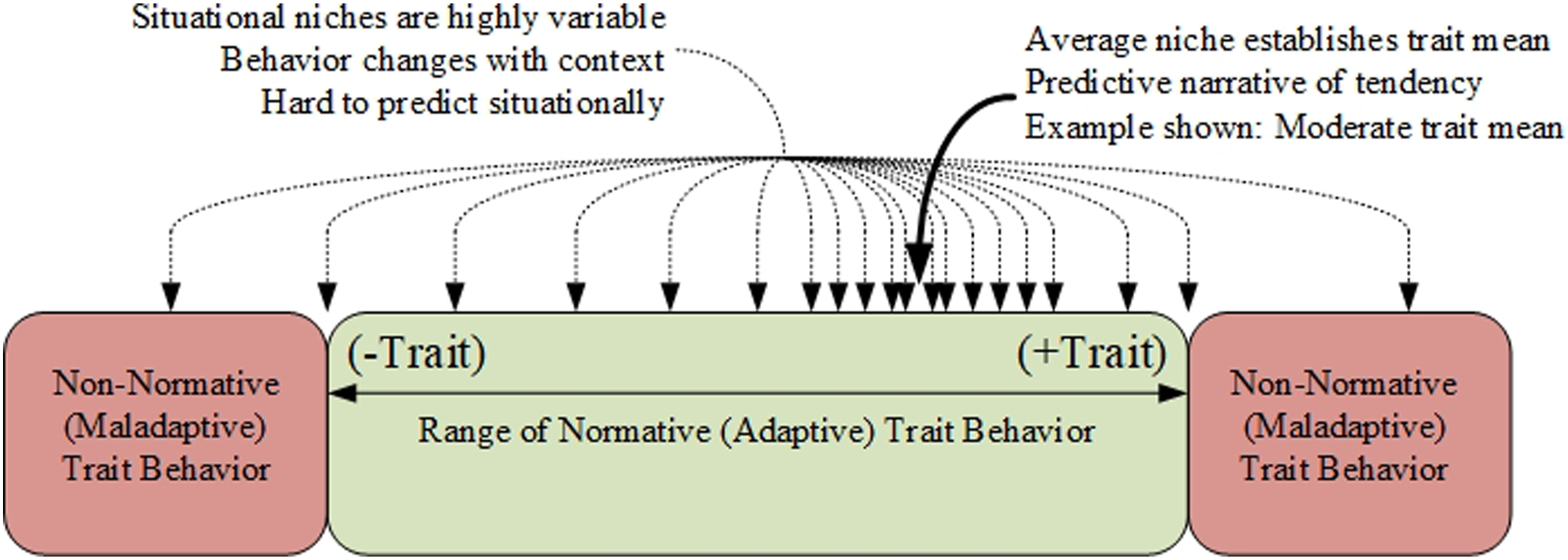
Figure 2 builds on this model, incorporating BFAS aspects (DeYoung et al., 2007), facets, and other descriptors for each FFM dimension, covering both normative (adaptive) and non-normative (maladaptive) ranges. This illustration shows how various elements of each FFM trait can influence group functioning and be maintained within normative boundaries. While we explore normative variations shortly, it is important to acknowledge existing work on the impacts of extreme Big Few traits on individuals and groups, particularly in clinical psychology (e.g., Coker et al., 2002; Widiger, 2011). Extreme Agreeableness, for example, may lead to compliance and gullibility, whereas extreme disagreeableness is linked to arrogance and suspicion. Extremely high Conscientiousness can result in rigidity, while extremely low levels may lead to recklessness. These examples of maladaptive extremes highlight the relevance of both evolutionary and cultural perspectives in understanding the functional impact of personality traits. Personality Traits of the FFM as Dimensions of Normative/Functional Behavior in Groups. Trait dimensions of the FFM appear to bound acceptable behavior for individuals acting in groups. Normative ranges of trait functioning are displayed in center boxes (green), with non-normative extremes flanking the center boxes (red). Effective group performance is facilitated by avoidance of non-normative extremes and diversity within normative ranges.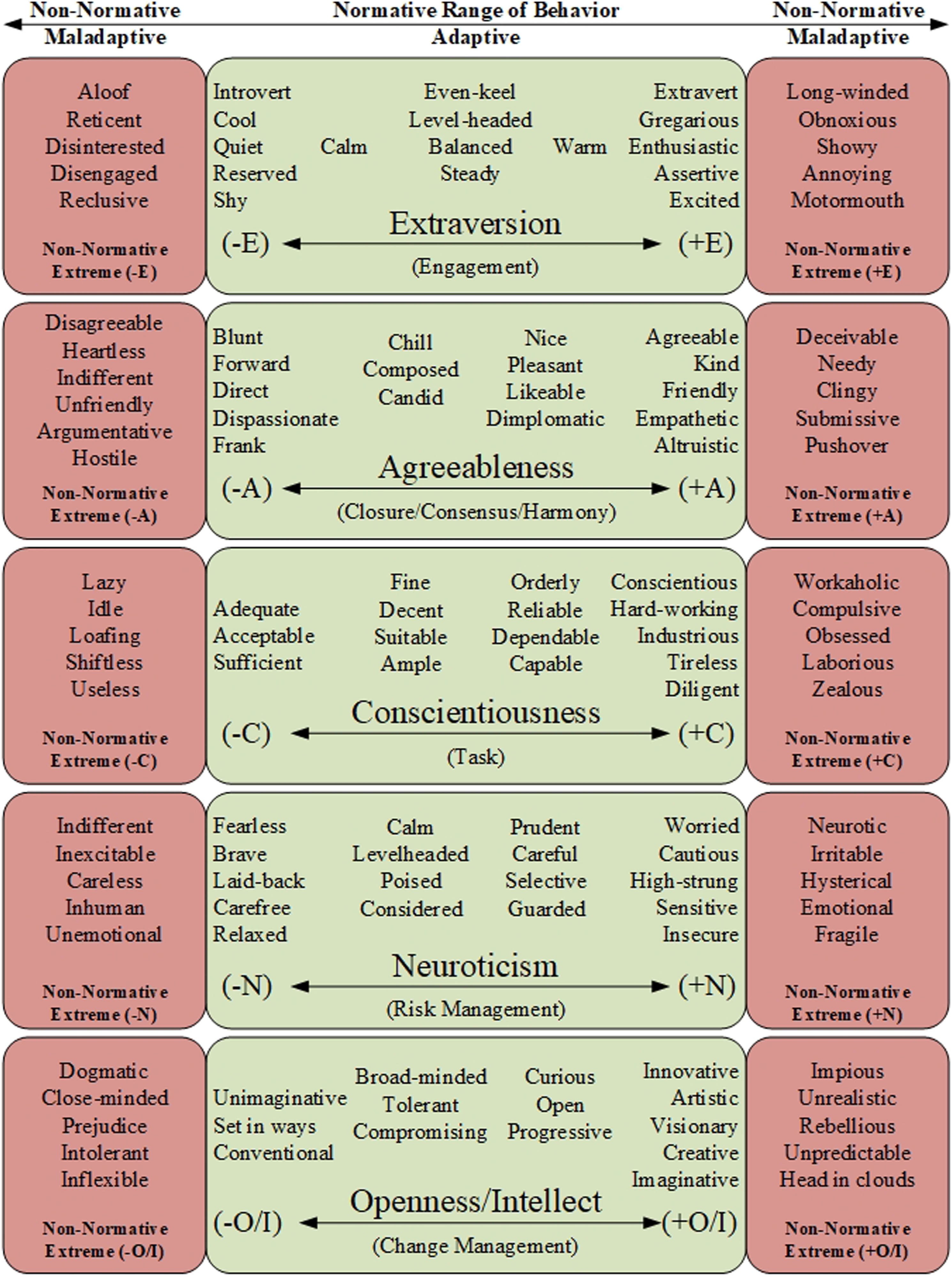
The FFM through a group lens: Engagement/closure/task/risk/change
We see each FFM dimension significantly influencing group balance, as depicted in Figure 2, aligning with key group processes. Extraversion influences group engagement; Agreeableness influences closure and harmony; Conscientiousness influences task performance and adaptability; Neuroticism influences risk management; and Openness/Intellect influences change. These dimensions (engagement, closure, task, risk, and change), it is proposed, encapsulate the FFM’s group functions, with potential for further refinement.
Figure 2 addresses why behaviors associated with FFM trait dimensions typically fall within normative bounds, and how trait dimensions influence group processes. Looking at the behavioral descriptors presented, the value of normative bounds is self-evident, as behaviors that violate norms are inherently maladaptive within the group context, while behaviors within normative bounds allow individuals to occupy functional niches. The niche diversity hypothesis (Smaldino et al., 2019) posits that societal complexity inversely correlates with trait covariation, acting to separate the traits, so to speak, to enable a diversity of niches, and we posit that normative bounds represent the trade-off between the group benefit of this diversity and group dysfunction from norm violation.
Personality diversity likely emerges through niche construction/picking/switching (short-term situational niches and long-term trait-like niches), influenced by learning and heritability, with culture establishing the normative ranges for niches. We propose an adaptive interplay between genetic and cultural (mimetic) influences. From a heritability perspective, normative ranges represent selection pressures. For instance, individuals expressing extreme disagreeableness may encounter difficulties in resource acquisition, forming alliances, or finding a mate. Culture’s ongoing evolution likely shifts normative bounds, encouraging diversity to navigate societal intricacies. Language development, describing preferred behavior, favored individuals who could adapt their traits and underlying mechanisms. Biological evolution did not select for group success; however, cultural evolution shaped the social-ecological landscape, necessitating individual adaptation and complex personality variations.
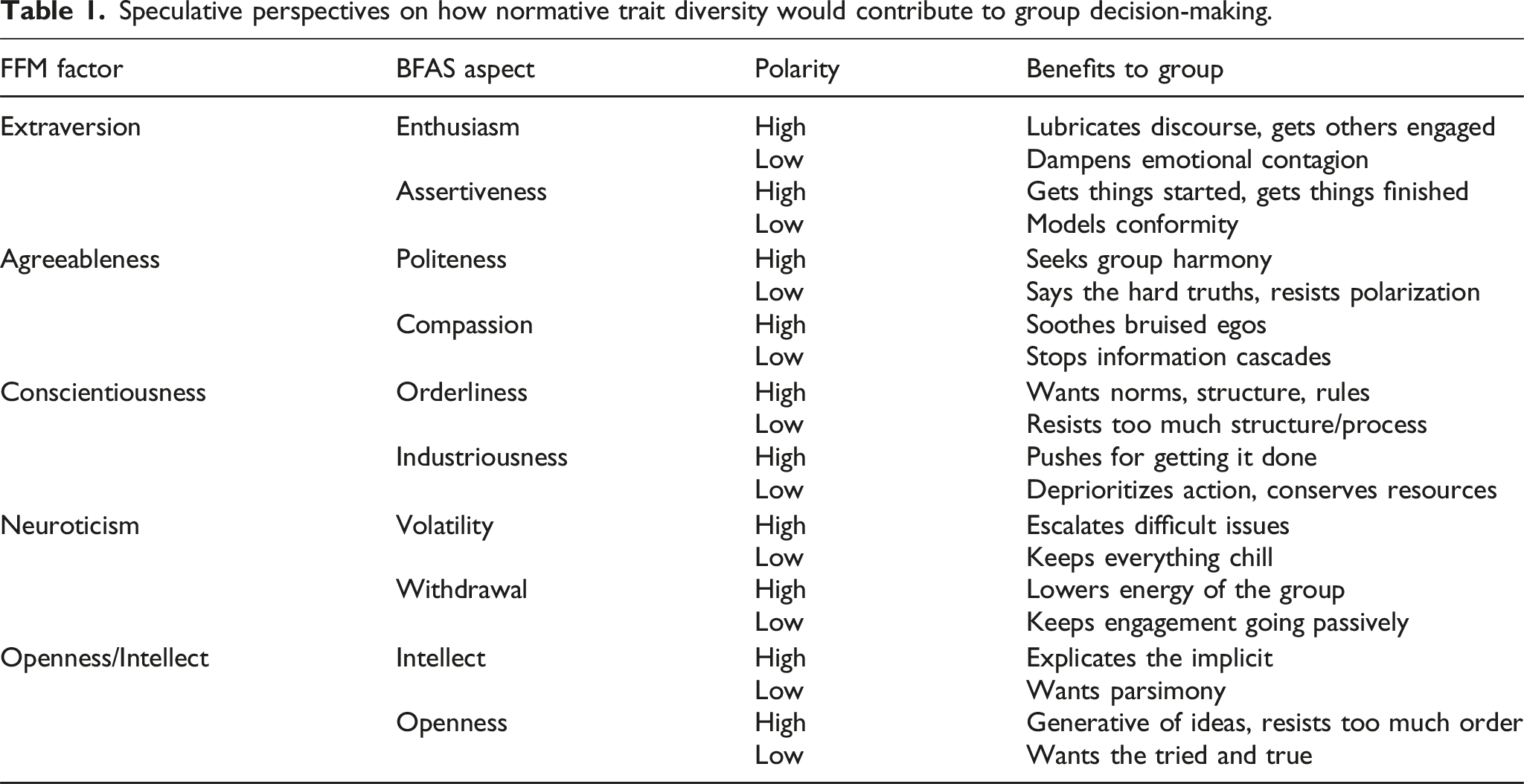
Speculative perspectives on how normative trait diversity would contribute to group decision-making.
Extraversion axis: Group engagement
Individuals high in Extraversion play a crucial role by initiating and promoting discussions, advocating for others (Mohammed & Angell, 2004; Taggar, 1997), and promoting participation and engagement (Barry & Stewart, 1997). Conversely, introverts help manage emotional contagion (Blau & Barak, 2012) and maintain order through calm and restraint. However, a group of only extraverts may become chaotic and overwhelming, whereas a group of only introverts might struggle with effective communication and engagement. Achieving a balance of engagement along the Extraversion dimension, while staying within normative boundaries, appears essential for effective group dynamics. This balance ensures that the group can respond appropriately to different challenges—with Extraversion, ambiversion, and introversion—as the situation demands.
Agreeableness axis: Group harmony and proper closure
Agreeable individuals fulfill vital affiliative roles, maintaining group cohesion (Barrick et al., 1998) and soothing hurt feelings (Barrick et al., 1998; Neuman & Wright, 1999). Conversely, normative disagreeableness provides a counterbalance, preventing information cascades, groupthink, and premature closure. Even one disagreeable member can disrupt cohesion (Barrick et al., 1998), which can be beneficial in situations like Solomon Asch’s (1956) conformity experiments. A group of only agreeable individuals might excessively praise each other’s ideas and prematurely accept suboptimal solutions. Conversely, a group of highly disagreeable members might struggle to reach closure due to persistent disagreements. Balancing Agreeableness diversity, according to our analysis, optimizes harmony and efficiency while safeguarding against premature closure, contagion, and groupthink.
Conscientiousness axis: Task and resource management, coherence, and flexibility
The trait of Conscientiousness plays a vital role in task performance and resource management within groups. Highly conscientious individuals are often industrious, leading by example and working tirelessly toward goals. They may, however, advocate for overly strict adherence to rules and established processes. On the other hand, those lower in Conscientiousness may push for quicker resolutions and more flexibility, sometimes at the expense of order and thoroughness. A balanced group will have a diversity of Conscientiousness levels, allowing for the reconsideration of inefficient processes while maintaining a level of order and initiative that prevents chaos and disorganization.
Neuroticism axis: Group risk management
Species exhibit risk management behaviors, such as arousal levels, fear thresholds, and attentiveness, that align with the risks of their environment of evolutionary adaptiveness (e.g., the vigilance of a meerkat compared to the nonchalance of a Galapagos tortoise). The Neuroticism trait is likely to play a vital role in risk management within groups. Individuals with higher levels of Neuroticism bring caution and risk-awareness to the table, helping the group to avoid potential pitfalls. However, a highly neurotic group might catastrophize to paralyzing levels of fear and anxiety. Conversely, a minimally neurotic group might be overconfident, rushing headlong into unforeseen disasters. Balancing Neuroticism within a group ensures that risks are adequately considered without preventing the group from seizing opportunities.
Openness/Intellect axis: Group change management
The choice between exploiting the known or exploring the new is a frequent dilemma for groups. The Openness/Intellect trait dimension is likely to play a crucial role in change management. Individuals high in this trait are inclined toward innovation, exploration, and embracing novel ideas, which can lead to a vibrant and dynamic group environment. However, without balance, a group of highly open individuals can result in a lack of cohesion due to divergent interests (van Vianen & De Dreu, 2001) and an abandonment of valuable traditions for novelty. Those lower in Openness/Intellect provide stability and a connection to established practices, ensuring that the group does not recklessly abandon tried-and-true methods in the pursuit of novelty. A balanced level of Openness/Intellect within a group allows for innovation while preserving valuable aspects of tradition and established practice.
Balance in higher-order dynamic traits
In Figure 3, we explore the influence of higher-order dynamics on group decision-making and demonstrate how the FFM traits influence these crucial group functions, emphasizing the importance of maintaining balance for optimal performance. Group-Process Centric View of the FFM. Group dynamics can be partially parameterized as processes linked to particular FFM traits (Extraversion/Engagement, Agreeableness/Closure, Conscientiousness/Task, Neuroticism/Risk, and Openness/Change). Looking across traits, however, broad distinctions and dynamics are apparent, and they encompass Groupthink versus Independence, Approach versus Avoidance, and Explore versus Exploit tendencies.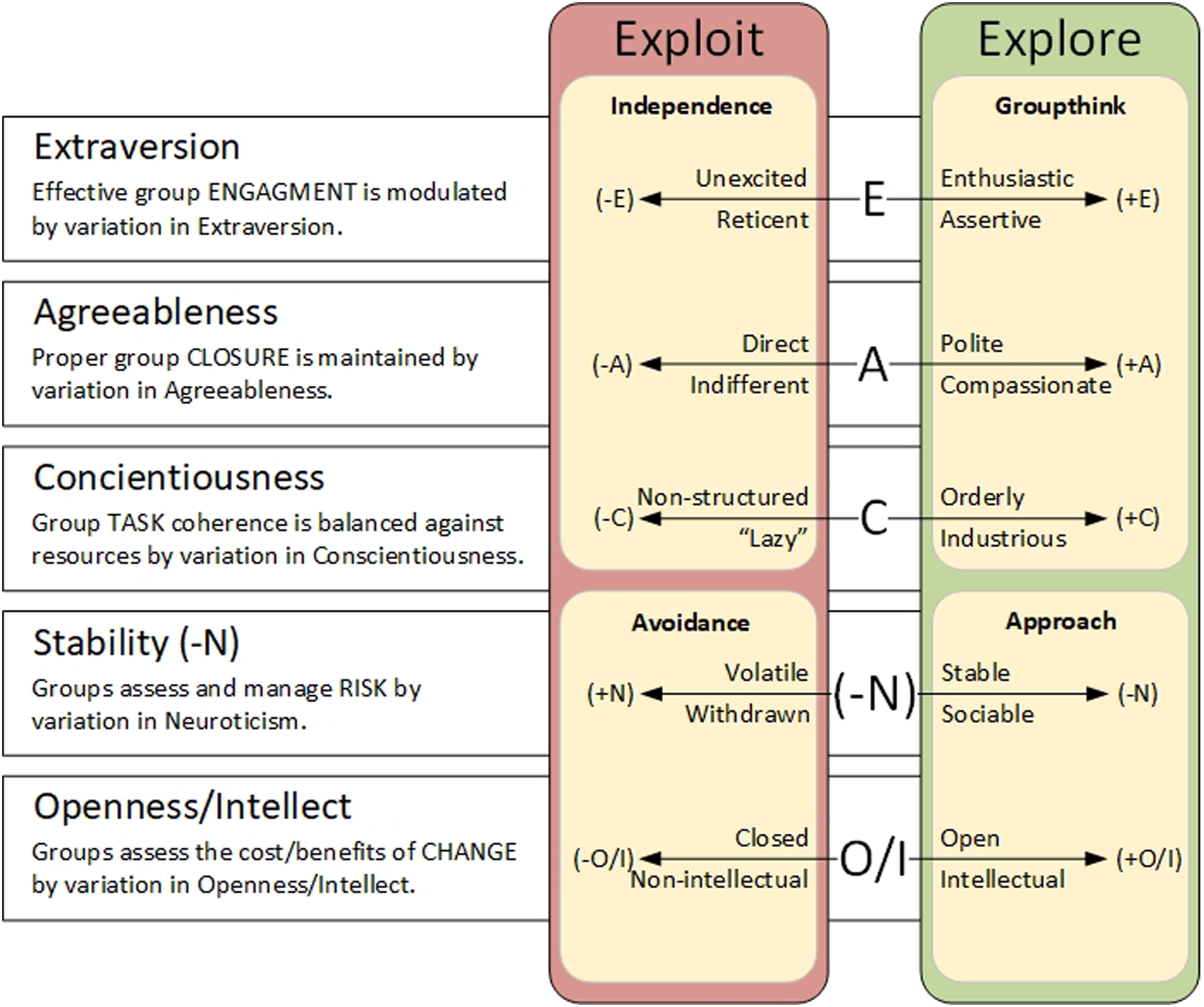
Take the example of animals deciding between staying put and exploring new territories (Pyritz et al., 2011). This situation embodies the exploit versus explore dilemma, where the correct choice might be to explore, resembling functional “groupthink.” Alternatively, if the better choice is to stay put, the group would benefit from independent thinking and resistance to persuasive pressures. A non-diverse group (whether agreeable or disagreeable, open or closed) is less likely to make well-informed decisions. Diverse personalities should foster balance in dynamics related to decisions to exploit versus explore, with respect to variations in independence versus groupthink and approach versus avoidance, giving rise to adaptable situation-specific decisions. The FFM traits play a crucial role in navigating these dynamics, as illustrated in the Figure 3.
Support for the framework
Parks (2012) noted a historical split between personality and group process research. Initial work integrated personality with group activities (e.g., Lewin, 1935, 1939, 1944; Lippitt & White, 1943; Sherif, 1948). However, the emergence of behaviorism (Skinner, 1965) and “rational actor” models (e.g., Zajonc & Smoke, 1959) led to the neglect of personality traits in group research (Steiner, 1972). This trend, which treats trait variations as errors or irrelevant, persists in contemporary group process studies. As observed by Parks (2012), a smattering of research supports personality diversity’s impact on group performance with respect to the traits of Agreeableness, Conscientiousness, and Neuroticism (e.g., Bell, 2007; Kramer et al., 2014; Ogunfowora & Schmidt, 2015; Peeters et al., 2006), but more recent and ongoing studies are revisiting this interface in the context of more definitive conclusions.
We posit that groups excel in engagement, closure, tasks, risk, and change when they minimize maladaptive FFM traits, noting that norm-violating behavior hampers functionality. Our framework, that is, predicts a curvilinear relationship between group effectiveness and specific FFM traits, depicted as an inverted U-shape in Figure 4’s top graph. This conception challenges older studies suggesting linear impacts by predicting non-linearity at extremes. Recent experiments have provided evidence for this non-linearity perspective. Diverse Personalities Result in Compositions that Should Tend to Maximize Group Effectiveness: An Analysis Based on Curvilinearity. Personality diversity results in trait-related behaviors that promote group flexibility (due to different members having different personalities) within a composition that centers on effective levels of the trait distribution. These trait distributions can be seen as “Density Distributions of States”, as described by Fleeson (2001).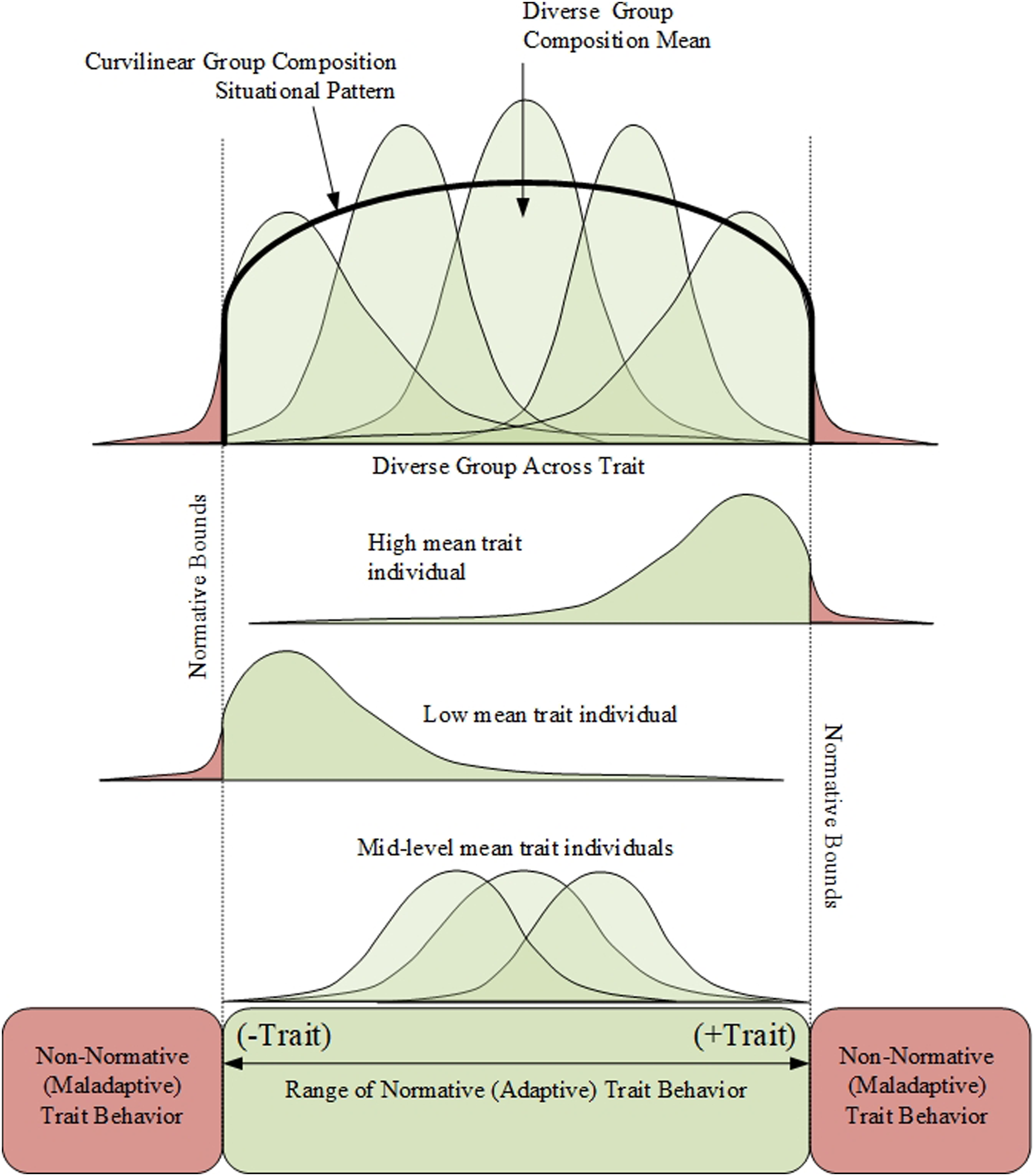
By way of introduction, Figure 4 illustrates a dialectic in group personality composition: cultural norms standardize behaviors and individual niche-seeking diversifies behavior. Norm violations, marked in red, prompt regulation in individuals with extreme trait tendencies, resulting in skewed distributions. These distributions can be viewed as “Density Distributions of States” as described by Fleeson (2001). Average level trait holders easily stay normative, while those with moderately high or low trait levels can cause problems for group interaction.
The aggregate outcome of diverse individual traits forms a curvilinear shape, guided by cultural norms that moderate behaviors (Figure 4). This illustrates a cultural trade-off, allowing a spectrum of personalities while avoiding extremes. In our framework, this balance fosters behavioral diversity, enhancing collective intelligence.
Too much of a good thing effect
Aristotle argued that too much virtue can be a vice. Grant and Schwartz (2011) as well as Pierce and Aguinis (2013) explored this “too much of a good thing effect” in positive psychology and organizational behavior, respectively. Pierce and Aguinis (2013) reviewed studies revealing curvilinear effects, often depicted as inverted U-shaped curves, in various organizational behavior domains. Figure 5 contrasts a positive linear relationship with an inverted U-shaped curve, demonstrating how the curvilinear correlation between variables shifts from positive to negative as the x-variable increases, creating a rounded hill shape. Linear Versus Curvilinear Relationships Involving Personality and Group Performance. Earlier but limited studies (for a review, see Parks, 2012) had suggested either no relationships or a predominately linear (left figure) relationship between average trait levels within the group and some performance metrics, with a smattering of studies hinting at greater complexity. Recent studies (e.g., Curşeu et al., 2019), however, seem to converge on a “too much of a good thing” effect, whereby groups perform better when their average levels of personality traits are moderate.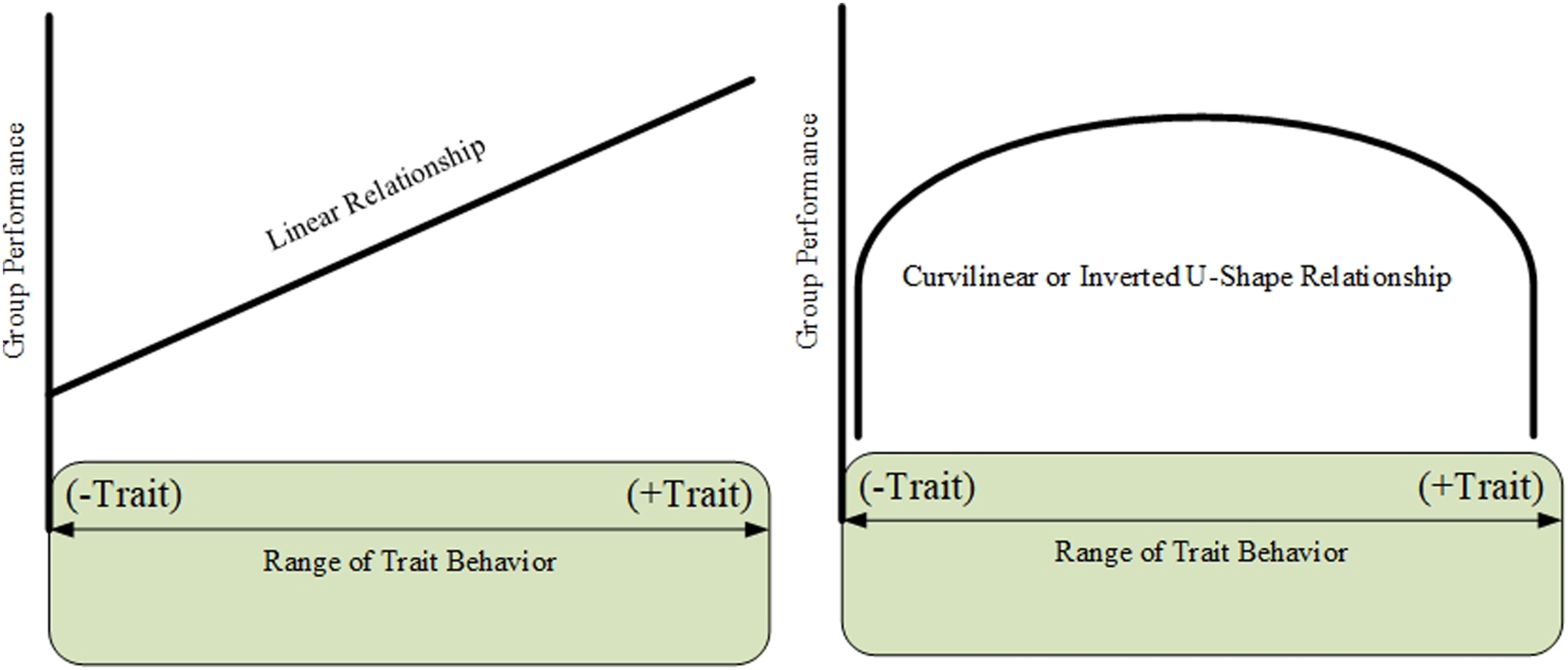
One study (Ames & Flynn, 2007) reviewed by Pierce and Aguinis (2013) found that excessive or insufficient assertiveness reduced leadership effectiveness. This curvilinear relationship was also observed by Harris and Kacmar (2006) and Peterson (1999) when studying structural aspects of leader behavior. Contrary to the notion of Conscientiousness having a solely positive connection with job performance (e.g., Barrick et al., 2001), Pierce and Aguinis (2013) cite skeptical scholars like Tett (1998) and Tett et al. (1991), along with findings from Whetzel et al. (2010), revealing an inverted U-shaped relationship between Conscientiousness and job performance in a meta-analytic review. Similarly, Le et al. (2011) explored associations between Conscientiousness and task performance, organizational citizenship behavior, and counterproductive work behavior, identifying curvilinear relationships where both low and high levels of Conscientiousness resulted in problems, relative to moderate levels.
Curşeu et al. (2019) expanded on the “too much of a good thing” perspective, investigating where inverted U effects may appear in team personality compositions. They acknowledged previous studies on personality and team performance (Bell, 2007; Peeters et al., 2006), which suggested linear relationships (e.g., Driskell et al., 2006), particularly concerning Extraversion, Agreeableness, and Conscientiousness (Driskell et al., 2006; Peeters et al., 2006; van Vianen & De Dreu, 2001). However, contrary to this older work, Curşeu et al. (2019) found strong evidence of curvilinearity.
In their study, Curşeu et al. (2019) sampled 220 participants in small teams performing creative tasks, discovering inverted U-shapes in peer-rated contributions for Extraversion, Agreeableness, and Conscientiousness. They replicated these effects (for Extraversion and Conscientiousness) in another experiment involving 314 participants in a collaborative learning exercise within small teams. Viewing these results from the perspective of our framework, peer-rated contributions to the group became less favorable as personality profiles approached norm-violating bounds. In characterizing their findings, Curşeu et al. (2019) concluded that “personality dimensions previously acclaimed as catalysts for teamwork engagement (Extraversion, Conscientiousness and Agreeableness) are only beneficial up to a point and when in excess, they have disruptive effects on contributions to teamwork” (p. 638).
Curşeu et al. (2019) focused on individual trait levels in relation to team performance rather than team average trait levels. This distinction is important because we contend that teams with balanced personality levels tend to perform better. In a relevant study by Ostenmeier et al. (2020), they discovered evidence for curvilinearity at the team level. Specifically, teams with moderate aggregate levels of negative affectivity and Conscientiousness appeared to perform better. Furthermore, Ostenmeier et al. (2020) noted that high skewness in the same personality traits, indicating an imbalance, led to groups with lower scores in psychological safety, which impacted team potency and performance. We advocate for more research in this vein, especially concerning group-based parameters that quantify variability within normative bounds.
Support for the framework: Collective cognition and group biases
Our framework introduces three novel perspectives: (1) personality trait dimensions may have emerged in part to establish normative behavior for effective group processes; (2) expressing personality diversity along these bounded dimensions is likely to enhance the collective intelligence of groups; and (3) such diversity should facilitate deliberation, mitigate group biases, and ultimately improve group decision-making. In this section, we will explore evidence from collective (or swarm) intelligence literature, highlighting diversity’s benefits and personality’s central role in this diversity. We will then extend the discussion by explaining how personality diversity would help to counteract group biases.
Diversity and swarm intelligences
Social animals enhance group decision-making through information sharing. Research by Couzin and colleagues (Couzin, 2007, 2009; Couzin et al., 2005) identified social contagion’s role in collective intelligence among non-primate animals. For example, Berdahl et al. (2013) showed that schooling shiner fish exhibit collective responses to environmental cues undetectable by individuals (e.g., the school of fish responds to light gradients that cannot be detected individually), demonstrating the benefit of sharing information for both individuals and groups (Hein et al., 2015). Importantly, swarm intelligence often requires a critical proportion of uncommitted individuals (12–15%) to prevent premature decisions in the service of finding optimal solutions, even when some individuals have strong preferences (Couzin et al., 2011). This diversity fosters adaptive decision-making, enhancing collective intelligence (Zentrum für interdisziplinäre Forschung, 2019).
Beyond fish, Strandburg-Peshkin et al. (2017) studied wild baboon movements, with factors such as dominance, sex, environmental obstructions, individual sightlines, and movement histories considered, but the primary influencing factor was olfactory trails, similar to ant navigation. This simple mechanism, when combined with other factors and social contagion, resulted in intelligent collective movements. This research shows that even intelligent mammals sometimes rely on emergent forms of collective cognition when making group decisions.
Relatedly, Theraulaz and colleagues have demonstrated that distributed behavioral systems can solve complex problems that surpass individual capabilities within a collective (Dorigo et al., 2000; Garnier et al., 2007; Moussaïd et al., 2011). In fact, recent research from this group has shown that introducing incorrect information to a subset of a group can reduce cognitive bias and improve group performance (Jayles et al., 2017, 2020). This counterintuitive effect aligns with Couzin’s work (e.g., Couzin et al., 2011), which highlights the value of uninformed or misinformed individuals in improving group decision-making.
In human decision-making, Surowiecki’s (2005) “Wisdom of Crowds” identifies a number of problem types that benefit from group decision-making, including cognitive problems, coordination problems, and cooperation problems. In all cases, there are benefits from diverse, independent, and decentralized individuals acting as groups. Galton’s (1907) ox weight estimate experiment is a classic example of crowd wisdom, but such phenomena have been replicated in many more modern studies (Krause et al., 2011). Surowiecki (2005) suggests that diverse opinions and collective decisions prevent poor outcomes, mitigating the problematic group dynamics described by MacKay (1850).
Krause et al. (2011) conducted experiments on crowd wisdom, examining how group performance accuracy could be enhanced through different individual input weighting schemes. They found that weighting individuals based on how their estimates balanced the errors of other members was superior to weighting based on individual accuracy, underlining the potential significance of opinion diversity in decision-making. Embracing diverse tendencies within a group, that is, can contribute positively to collective outcomes.
Also relevant is research by Woolley et al. (2010) who identified a “c” factor in group performance. The “c” factor, which benefited group decisions, was enhanced by social sensitivity (as measured by the Reading the Mind in the Eyes Test: Baron-Cohen et al., 2001), the proportion of females in the group, and turn-taking in discussions. The Woolley et al. (2010) findings align with Surowiecki’s (2005) analysis, who again proposed that groups excel when they allow for diversity and expression with respect to member opinions. It should be noted, however, that the Woolley et al. (2010) model has not been fully supported in subsequent research (Bates & Gupta, 2017).
Group decisions among social animals
Social animals face decisions that impact the group (Conradt & List, 2009). In small groups, simple mechanisms like taking turns resolve conflicts (Browning & Colman, 2004; Lau & Mui, 2008; Van Vugt & Kurzban, 2007), even among fish (Harcourt et al., 2010). Chimpanzees adopt a leader–follower strategy, with one individual initiating actions and others following (Bullinger et al., 2011). Lemurs synchronize their behaviors, deciding to perform an action together through mutual visual contact (Fichtel et al., 2011). Many game-theoretic concepts involving two individuals in conflict or coordination interactions can be scaled to animal groups of any size (King & Sueur, 2011).
One extensively studied animal group decision involves what researchers call “making the move” (Pyritz et al., 2011). Silverback mountain gorillas decide where the troop should move for feeding after rest periods, communicating this by squaring off and swiftly moving in the chosen direction, with the rest of the troop following suit (Watts, 2000). But when to move is decided by the group, as manifest in an increase in troop vocalizations, signifying a form of consensus that rest time has concluded (Conradt & Roper, 2005; Pyritz et al., 2011; Stewart & Harcourt, 1994). Similar readiness to move behaviors include vocalizations among some lemur species (Trillmich et al., 2004) and geese (Raveling, 1969), as well as bodily movements among swans (Black, 1988) and wolves (Mech & Boitani, 2003).
Thomas Seeley’s (2010) delightful book “Honeybee Democracy” illustrates diverse roles and consensus decision-making in selecting a new hive location. Scout bees search suitable hollow trees and report back to other scouts, communicating a potential site’s location via a waggle dance. The vigor and duration of dancing indicates the quality of the site, with more ideal sites resulting in more energetic dances, enabling the scouts to converge on the best site. As the spring swarm takes flight, the directionally informed scout bees dart at high speed through the swarm, directing it toward the new hive (Seeley, 2010). Only a small part of the new colony knows where to go, but specialization and diversity ensure the success of finding a new hive location and relocating the colony (Seeley, 2010). In honeybee colonies, this diversity in roles, including house bees, foragers, guards, male drones, scouts, and queens, contributes to the colony’s success (Moore et al., 1987; Seeley, 2010). A division of labor, resulting from role diversity, proves vital for the success of social species, from insects (Costa, 2006; Wilson, 1971) to vertebrate animals (English et al., 2015) to humans (Smith, 1776).
Human group decision-making and topologies
Surowiecki (2005) posits that diversity benefits group problem-solving by expanding available hypotheses and potential solutions during group deliberation. In this connection, personality diversity can prevent premature closure (Kruglanski et al., 2006), promoting a more deliberative or reflective approach. To appreciate why this is so, imagine group decision-making as navigating a topological landscape representing the space of all possible hypotheses or solutions. In this analogy, valleys and basins represent productive areas of discussion, plausible hypotheses, or feasible solutions. Ridgelines represent areas of unproductive discussion, dividing different plausible regions. Peaks represent implausible hypotheses or unworkable solutions. The group’s goal is to explore this landscape via communication, metaphorically comparing the depths of different basins to find the deepest one, which represents the best hypothesis or solution (i.e., the global optimum).
Inspired by Waddington’s (1957) epigenetic landscape, Figure 6 illustrates how personality diversity can facilitate finding a global optimum. Downhill paths represent the group’s movement through the hypothesis or solution space using obvious or heuristic methods. The figure reveals how relying solely on heuristics can lead to suboptimal decisions. Horizontal climbing arrows indicate a shift to more deliberative processes, scrutinizing heuristics that often lead to premature closure, increasing the probability of finding a global optimum. Modification of Waddington’s Epigenetic Landscape, Adapted to the Group Decision-Making Context. In this illustration inspired by Waddington’s (1957) drawing, we model the group decision-making space. Downhill flow represents consensus-seeking exploration of the hypothesis or solution space based on what is obvious, shared, or otherwise heuristically driven. The horizontal sideways climbs between local optima, labeled Deliberation, represents deliberative exploration by the group, driven by diversity in personality, which serves to balance polarizing forces, thereby increasing the likelihood of the group finding the global optimum.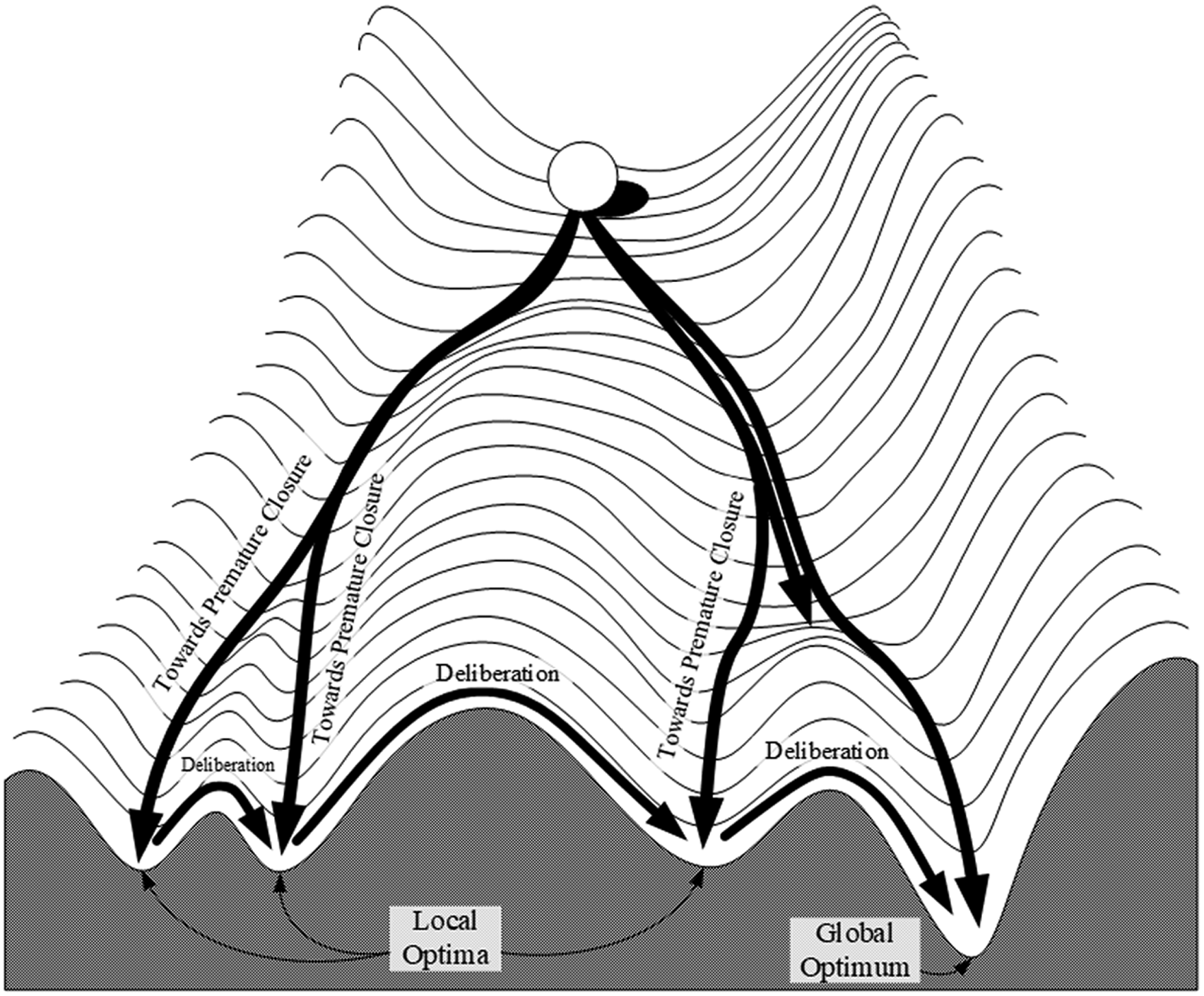
An individual dealing with a problem needs to hypothesize its source/cause and devise a solution. In this topological analogy, factors like life experiences, stimulus constraints, motivational tendencies, biases, and cognitive worldviews—many of which vary with personality traits—constrain the available topological surfaces one individual can explore. But a group, particularly a diverse one, can access a broader range of topological surfaces and can aggregate these into a collective exploratory space. When a group lacks diversity, it risks following unchecked paths of plausibility and prematurely settling in the nearest basin without much exploration (deliberation), missing out on better solutions. However, when a group is diverse and functions effectively, it can lead to more accurate problem assessments and optimal solutions. Hence, personality diversity in a group appears to be crucial for exploring a wider range of hypotheses and solutions, ultimately contributing to superior decision-making.
Examples of the diversity advantage in human group decision-making
Individuals tend to adapt their behavior based on the personalities present in a group, leading to a fluctuating blend of trait-consistent and situation-specific behaviors. This interplay creates a more adaptable and intricate environment for problem-solving, as supported by McNamara and Leimar’s (2010) game theory–based analysis suggesting that variation, including personality diversity, tends to promote cooperation and diminish conflict. More broadly, Smaldino et al. (In press) show that many group problem-solving models appear to converge on needing a diversity of potential solutions during deliberation to find global optima.
Similarly, Bang and Frith’s (2017) Bayesian analysis of decision-making contends that individuals and groups must expand the hypothesis space, assign weights to evidence based on source reliability (utilizing status and social cues), and integrate information, to make optimal choices during deliberation. According to this analysis, the collective cognitive abilities of a group often surpass the sum of individual contributions.
Hong and Page’s (2004) research on problem-solving agents reveals that functionally diverse groups outperform groups of top individuals. In other words, a person’s unique perspective is more valuable in group problem-solving than his/her/their individual abilities. This contention aligns with the understanding that personality diversity brings about diverse perspectives (McCrae & Costa, 1999), enhancing group problem-solving.
Considering ancestral challenges, such as hunting for survival, a diverse group of hunters with varying skills and strategies would likely outperform a homogeneous group, both in terms of brainstorming diverse solutions (expanding the solution space topology) and literally by pooling a larger known topographical area. Personality diversity ensures a variety of approaches, mitigating the risk of settling for suboptimal strategies.
The broader impacts of workplace diversity have been a subject of debate, with mixed findings (Bowers et al., 2000; Webber & Donahue, 2001) possibly arising from the conflation of identity diversity and functional diversity (Hong & Page, 2004). Nevertheless, some theorists argue that evidence supports the idea that diversity enhances group performance, particularly by fostering processes associated with creativity (Mannix & Neale, 2005; Roberge & van Dick, 2010).
In the topological analogy applied to group decision-making, horizontal perturbations symbolize the dynamic exchange within group discussions, vital for thoroughly exploring the topological landscape. Diverse personalities amplify this exchange. For instance, personalities characterized by prosocial, pro-stability, and affiliative tendencies (high Agreeableness, high Conscientiousness, and low Neuroticism) can encourage agreement and cluster groups around local optima. Conversely, individuals with high assertiveness, Openness/Intellect, antagonism, and Neuroticism can extend the deliberative process and steer groups toward alternative topological surfaces to find global optima. This would be done through verbal communication, modeling solutions, or even non-compliance.
We argue that contributing to a group’s decision-making does not always require presenting the best solutions or overt assistance. Simply having a disagreeable disposition, for instance, can steer a group away from premature conclusions. Sometimes, the most valuable contributions come from unique perspectives, which expand the group’s horizon of potential solutions.
Campbell et al. (2022) provide indirect support for this framework, showing, through computational models, that imitation with partial or imperfect copying improved group problem-solving over agents with full copying, which led to premature convergence on suboptimal solutions. Full copying may be analogous to what happens with groups with excessive Conscientiousness (which might give rise to too much order) or Agreeableness (which might give rise to too much following). Optimal performance seems to arise from balance among agents, with not all agents doing the same thing.
Personality and group biases
The study of group processes reveals biases in decision-making, which are influenced by individual heuristics (Kahneman, 2011) that are magnified in group settings (Forsyth, 2019). These biases include the sunk cost bias, base rate fallacy, fundamental attribution error, and the availability heuristic (Kerr et al., 1996a; Kerr et al., 1996b), alongside group-level biases like the well-replicated shared information bias or common knowledge effect (Gigone & Hastie, 1993; Stasser & Stewart, 1992; Wittenbaum et al., 2004), which leads groups to favor shared information over unique information.
Kerr and Tindale (2004) delve into the shared information bias, illustrating how groups tend to prematurely end discussions when exposed to the same information. Suggested solutions to the problem include extending discussions (Larson et al., 1994) and encouraging diverse preferences (Brodbeck et al., 2002). Of importance, increased diversity in initial preferences has been found to mitigate the confirmation bias (Schulz-Hardt et al., 2000), with minority opinions reducing premature consensus tendencies (De Dreu & De Vries, 1996; Nemeth, 1986; Nemeth & Rogers, 1996; van Swol, 2007), in part by counteracting excessive majority confidence (Schulz-Hardt et al., 2002). Personality diversity would naturally give rise to diverse initial preferences (McCrae & Costa, 1999).
Polarization and groupthink (Janis, 1982) are well-known group biases leading to extreme consensus, surpassing the initial collective will of group members. Polarization, which is a well-replicated phenomenon (e.g., Isenberg, 1986), can support riskier (Stoner, 1961, 1968) or more cautious decisions (Doise, 1969), both of which can be problematic. With groupthink, groups become excessively cohesive and focused on consensus; such groups become overconfident due to perceptions of invulnerability, limited criticism or debate, and pressure for conformity. Polarization is well replicated (e.g., Isenberg, 1986), though the validity of groupthink has been debated, but Baron (2005) and others have presented updated models such as group centrism, suggesting that groups seek cognitive closure (Kruglanski et al., 2006). From our perspective, groupthink can be mitigated when a group includes individuals with anti-conformist personality tendencies (e.g., low Conscientiousness and low Agreeableness). In fact, Barrick et al. (1998) found that a single disagreeable individual could disrupt smooth group performance, which can be advantageous when conformist decisions are flawed.
Kameda and Tindale (2006) and others (e.g., Gigerenzer & Selten, 2001) argue that some group biases, often seen as process losses (Steiner, 1972), may represent evolutionary adaptations. Kameda and Tindale (2006) specifically highlight two factors—meta-knowledge (Cannon-Bowers et al., 1993) and social sharedness (Tindale & Kameda, 2000)— as heuristics tackling coordination problems, which arise when group members struggle to determine roles or processes. Knowing what the self and others possess with respect to knowledge, skills, past roles, and so on (meta-knowledge) facilitates niche-finding and enhances group performance (Cannon-Bowers et al., 1993; Hinsz, 1995; Stewart & Stasser, 1995; Tindale et al., 2003). Group performance improves when members have meta-knowledge about the roles each member will assume, particularly (and important to our thesis) when those roles are diverse (Helmreich & Schaeefer, 1994; Helmreich, 1997).
Group members often develop general narratives or “types” to describe each other (e.g., “he’s very outspoken” or “she always works hard”). Thoughts about one’s own and others’ personalities, that is, are essential components of meta-knowledge in established groups. Additionally, groups rely on statistical cues to assess the skills and knowledge of their members (Littlepage et al., 1995). Of note, groups spend a significant amount of their unstructured time gossiping (Dunbar, 2004), acquiring broad knowledge about group members (Boyd & Richerson, 1985) and their personalities (Kameda & Tindale, 2006). Groups need to construct narratives about members to reduce coordination problems and improve performance. When the personality profiles of individual group members are distinct, meta-knowledge becomes more extensive and varied, aiding in niche-seeking and role assignment.
Kameda and Tindale (2006) propose that when meta-knowledge is lacking (e.g., in uncertain environments or among new groups), social sharedness dominates (Tindale et al., 2003; Tindale & Kameda, 2000). They redefine some “biases” as adaptations facilitating efficient group decisions (Gigerenzer & Todd, 1999), addressing coordination challenges, and exploring conformity biases and majority-based decision-making. They also posit that conformity tendencies, famously studied by Asch (1956), have been wrongly portrayed as group pathologies (e.g., Moscovici, 1976) instead of culturally evolved heuristic mechanisms (potentially rooted in individual-level psychological processes) helping groups solve problems. In essence, both fast and frugal as well as deliberative mechanisms contribute to group functioning.
Social loafing (Latané et al., 1979; Williams et al., 2003) can be prevented through mechanisms like the social compensation effect (Williams & Karau, 1991), whereby group members increase their effort to compensate for poor performers, and the Köhler effect (Hertel et al., 2000; Stroebe et al., 1996; Witte, 1989), whereby poor performers elevate their efforts. Balancing motivational gains and losses can be likened to the producer-scavenger trade-off in group decision-making (Kameda & Tindale, 2006). In this game-theoretic context (Giraldeau & Caraco, 2018), a balance is needed between foraging (searching for food) and keeping watch for threats. Foraging social animals must balance these roles, making it advantageous for some individuals to initially adopt one role or the other to prevent an overabundance of foragers or watchers. Putative coordinative mechanisms influencing Neuroticism might serve this purpose. Those with high Neuroticism (or easily activated coordinative mechanisms linked to Neuroticism-like behavior) may initially keep watch, while those with low Neuroticism might be inclined to forage first. Over time, the roles could reverse as low Neuroticism foragers become satiated, and high Neuroticism watchers become hungrier. Conscientiousness like traits (or their associated putative coordinative mechanisms) could also play a role, with high Conscientiousness individuals initially taking watcher roles (the social compensation effect), allowing low Conscientiousness individuals to free-ride for a period of time. Many game-theoretic trade-off dilemmas might be resolved by introducing personality dimensions that predispose members to assume different roles.
Other similar dynamics may operate within human groups. Consider pro-closure biases, where groups hastily settle on a particular solution (Kruglanski et al., 2006). These biases often emerge with an overabundance of individuals characterized by a “desire for predictability, preference for order and structure, discomfort with ambiguity, decisiveness, and close-mindedness” (Webster & Kruglanski, 1994, p. 1049). This description aligns with personality traits like high Conscientiousness, low Openness to experience, and possibly high Agreeableness, that latter of which could amplify pro-closure biases through conformity-seeking. These biases would naturally be counteracted when the group includes individuals who are either low in Conscientiousness and Agreeableness or high in Openness/Intellect (as discussed by Barrick et al., 1998). In essence, a sufficient range of personality traits and their associated biases and strategies would likely mitigate tendencies toward premature closure.
It is worth saying more about Openness/Intellect. Unshared information can be brought to a group’s attention by abstracting it to a shared layer, capitalizing on the shared information bias. Laughlin and Ellis (1986) demonstrated that a single person with the correct answer (unshared information) to a math problem can sway a group of incorrect members by demonstrating that the solution adheres to mathematical principles (abstracting to a shared information layer). A similar phenomenon was observed when a minority opinion about the death penalty transformed into the majority view when an individual appealed to the group’s shared religious framework (Smith et al., 2000). The ability to discern patterns across different layers of abstraction, which is associated with those high in Openness/Intellect, can help the group find global optima. Similarly, when considering the Agreeableness dimension, diversity in this trait can strike a balance between affiliation and independent thinking.
Counterarguments and testability
The obvious counterargument to our framework is the limited support for the benefits of personality diversity in group process research. Perhaps personality traits serve as a means of creating predictive narratives (Buss, 1996, 2009), without having other functional roles. However, we observe clear constructs of norm-violating behavior along these personality dimensions, indicating that the group plays a crucial role in defining acceptable behavior. What is the utility of discouraging expressions deemed volatile or indifferent, if not at least in part to prevent such behaviors from negatively impacting the group? What is the utility of words like “lazy” or “obsessed” if not at least partially to establish norms for individual contributions to the group? Although there could be countless individual differences that could, in principle, be tuned into, the utility of describing people along established personality traits dimensions becomes evident in group contexts. The fact that these trait dimensions also emerge through factor analysis, and not just from prior theories, strongly suggests to us that they have functional relevance in understanding human behavior in groups.
Another counterargument is that one could emphasize processes aside from engagement, closure, task, risk, and change. We counter that these functions emerged from the exploration of descriptive terms for each trait dimension. This naturally led to an understanding of how variations along each dimension served group functions, encompassing both normative and norm-violating behaviors. We recognize, however, that each dimension can be linked to group functions that are closely related to the ones that we have discussed. For example, Agreeableness could be linked to group functions related to closure, consensus, and harmony and Conscientiousness could encompass functions such as resource management. The exact labels for the group functions in question are worth thinking about. This is not a trivial matter because the precise words that are chosen to represent the functions could implicate at least subtly different processes. We welcome such discourse.
Critics might argue that group success hinges on factors beyond personality diversity. Personality diversity, that is, cannot be the sole, or even most potent, determinant of group success. Undoubtedly, group composition factors, such as knowledge, skills, abilities, and other characteristics (KSAOs in industrial/organization psychology parlance) can significantly impact group performance. Numerous other factors, such as resources, support, and leadership, also play pivotal roles. We do not advocate for prioritizing personality variation above other factors, but we do suggest that personality diversity should enhance niche identification and contribute functionally to group-related decision-making processes.
Cramer et al. (2012) present an alternative perspective, suggesting that personality inventory items like “I like to go to parties” and “I like people” may not be correlated because they measure a latent dimension (e.g., Extraversion) but potentially because they have causal relationships (e.g., to enjoy parties, one must like people who attend them). We believe this network perspective deserves attention. Furthermore, as we have discussed, we endorse Mõttus et al.’s (2020) viewpoint that progress in personality psychology may require dimensional models extending beyond the Big Few. Although we appreciate the generative nature of the Big Few frameworks, we recognize that these traits may not fully capture underlying psychological mechanisms. However, the Big Few are the most widely utilized models for the studies that we could draw from in speaking to our framework. Moreover, our framework sees the Big Few as cultural constructions—defining norms, niches, and predictive narratives of individuals acting in groups—entangled with mechanisms, and not as the mechanisms themselves, and we view this framing as compatible with efforts to build new models of the mechanisms that give rise to trait-like differences between people.
Continuing with this discussion, evidence casts strong doubt on a one-for-one relationship between trait constructs and underlying mechanisms (Lukaszewski et al., 2020). Even so, the correlating descriptors that congealed into the FFM through factor analysis are still lexical products of cultural evolution that describe trait-like behaviors of WEIRD humans. Our framework attempts to map these culturally evolved trait-like behaviors (as manifest in the emergent factors of the FFM) with their utility to group processes. Further, our framework attempts to explain how this cultural evolution of normative behavioral descriptors likely exerted selection pressure on individuals, resulting in at least partial coupling of the underlying mechanisms to trait-like behaviors useful to the group. The emergence of five traits is most likely not the result of five mechanisms. But personality traits in our modern WEIRD societies likely have a dual-inheritance entanglement with underlying mechanisms. The presence of potentially factorable traits different from the Big Few in non-WEIRD societies, in the context of our framework, would have the same dual-inheritance coupling, but one in which socio-cultural selection pressures resulted in different trajectories.
For additional clarity, we do not argue that cultural evolution directly created personality diversity. Personality diversity resulted from millions of years of social-biological evolution entangled with at least thousands of years of socio-cultural evolution. Genotypic and phenotypic diversity drives life, and culture emerges and evolves, sometimes harnessing this diversity and other times tempering or shifting it. We highlight cultural establishment of group behavioral norms as one way in which culture influences individual trait expression to serve group function. We drew from supporting literatures—particularly in areas like collective intelligence and group biases—to suggest that diversity within normative boundaries appears to be beneficial, aligning with the niche diversity hypothesis and our framework.
Testability and future directions
We advocate for more research in the direction of Curşeu et al. (2019) and Ostermeier et al. (2020). Researchers should explicitly examine how the personality composition of groups impacts decision-making, focusing on the extent of deliberation, information weighting, and decision quality. Some of this research should investigate dynamics related to groupthink versus independence and approach versus avoidance. In this connection, we echo a position paper by Bechtoldt et al. (2007) calling for further exploration of how personality diversity influences group outcomes. In their paper, Bechtoldt et al. (2007) argued that diversity in Extraversion and Agreeableness might be “indispensable to prevent teams from groupthink in the phase of idea evaluation” (p. 21).
We would like to see experiments comparing polarized groups (comprising only low or high target trait members) with homogeneously average groups (exclusively mid-level trait members) and diverse groups (featuring a wide range of individual trait values). Diversity along each dimension should mitigate group biases, extend decision-making time, and generally result in higher-quality decisions. For instance, in complex situations involving significant risk and reward, groups with diverse levels of Neuroticism should deliberate longer, explore more options, and achieve a higher-quality risk/reward integration. Conversely, a group primarily consisting of high Neuroticism individuals would engage in lengthy deliberations but explore fewer options, resulting in lower-quality decisions favoring low-risk options. And a group predominantly composed of low Neuroticism individuals is likely to deliberate briefly, explore fewer options, and arrive at a lower-quality risk/reward assessment biased toward high-reward options. To test these predictions, group process researchers should examine established paradigms relevant to risk and reward balance, such as those grounded in game theory or speculative markets. Similar investigations into group composition should consider mechanisms related to engagement, task focus, closure, and change/novelty.
Another intriguing area to explore is moral reasoning. The social intuitionist model suggests that individuals employ moral reasoning to construct justifications for their initial moral intuitions, and diverse perspectives within a group could be valuable by promoting discourse and effortful moral reasoning (Haidt, 2007). According to this model, group-driven social interaction should have a more significant impact on moral reasoning than an individual’s verbal reasoning or reframing efforts, primarily because contrasting viewpoints hold substantial influence in this context (Haidt, 2007). Table 1, as well as Figures 2 and 3, provides additional hypotheses that warrant systematic investigation. In the vast majority of cases we can envision, personality diversity within groups should enhance group-related processes and their resulting outcomes.
Modeling approaches also hold promise. Consider Campbell et al.’s (2022) use of computational networks to investigate collective problem-solving through collaboration. We propose incorporating agent behavior along Agreeableness and Openness dimensions. Agents with high Agreeableness might readily copy interacting agents, whereas those with low Agreeableness might require significantly higher-scoring solutions before copying. On the other hand, agents modeling high Openness might engage in more iterative steps when adopting and enhancing the solutions of others, whereas those modeling low Openness would likely simply copy. Gradients of each dimension and combinations of traits could be explored. While modeling agents along the Neuroticism, Conscientiousness, or Extraversion dimensions may not yield as many insights within this paradigm, there are other paradigms related to collective intelligence that can be explored.
Past research examining personality at the group compositional level and its impact on group performance may have been limited by the structures and constraints imposed, potentially masking curvilinear relationships and leading to incorrect conclusions. A dimensional reduction of group “processes,” that is, may have overlooked potential interactions with personality diversity. Simply put, group studies aiming for measurable outcomes like speed or accuracy of solutions (quantifiable results) may have been overly simplified or artificial, failing to capture the effects of personality diversity. Many problems faced by human groups are often entangled in complex trade-off spaces, where decision-making involves managing these trade-offs and reaching a viable compromise rather than finding a single correct (and quantifiable) answer. In group problem-solving, the true challenge often lies in discovering a solution acceptable to the entire group. We acknowledge that quantifying this complexity poses challenges for group process research, but we encourage future researchers to embrace this complexity.
Expanding on the concept of group polarization, our framework suggests that future studies could uncover new phenomena that advance the field. Classic research on group polarization primarily focused on risky (Stoner, 1961, 1968) or cautious shifts (Doise, 1969), with the directionality depending on initial preferences (Myers & Lamm, 1976). These shifts have been attributed to social influence processes such as social comparison, persuasion, and social identity (Friedkin, 1999). However, considering personality factors opens up new possibilities. Risky shifts would likely occur more frequently among groups primarily composed of individuals with low N, while cautious shifts might be more common in groups dominated by high N individuals. Balanced levels of N may counteract (and potentially eliminate) polarization. In essence, by considering the roles of personality factors in moderating group processes, investigators may uncover fresh insights into classic phenomena.
Summary and conclusions
Personality and evolutionary psychology have traditionally focused on how individual differences impact individuals rather than groups. Our framework does not preclude individual-level fitness considerations or the role of developmental trajectories in shaping personality. Our analysis does, however, offer a fresh perspective on the functional consequences of human personality diversity. Future research is needed, particularly given the dearth of studies manipulating personality diversity within groups. Nevertheless, we highlight growing evidence that diversity is a crucial component of collective intelligence and a clear linking of personality traits to strategies of significance to group decision-making. Our framework introduces three novel perspectives: (1) personality trait dimensions may have emerged, in part, to establish normative behavior for functional group processes; (2) normative diversity along trait dimensions is likely to enhance collective intelligence; and (3) such diversity should also promote deliberation, mitigate group biases, and improve group decision-making. These insights pave the way for further exploration into the interplay between personality and group dynamics.
Valuing diverse viewpoints is crucial in times of cultural and political polarization. Despite the challenges posed by polarization, our democratic processes are designed to allow diverse voices to engage in deliberations and reach solutions, albeit sometimes slowly and with difficulty. In a relevant study, Shi et al. (2019) discovered that diverse political perspectives among Wikipedia article editors led to higher-quality articles in political, social, and scientific domains. In essence, heterogeneous teams outperformed homogeneous ones. Shi et al. (2019) also found that “talk pages” associated with these articles revealed longer, more constructive, competitive, and linguistically diverse discussions. We contend that personality diversity may similarly impact groups, albeit in more nuanced ways than observed by Shi et al. (2019), who focused on political domains and political ideology. Personality is just one element of diversity, but varied personalities undoubtedly contribute to diverse perspectives.
In WEIRD, non-WEIRD, and ancestral environments, we observe the advantages of stability and adaptability, conservatism and progressivism, as well as orderliness and Openness, which are essential balancing forces to maintain effective structures and practices while allowing for improved methods. A dynamic interplay of personality diversity ensures the exploitation of known territories in combination with the exploration of new territories. The intricate web of evolved mechanisms and their interconnectedness with cultural processes produces significant complexity. Nevertheless, the present work offers an explanatory framework addressing the functions of personality dimensions and their variations and provides guidance for future research connecting individual differences to evolutionary functions and group-related processes. Personality diversity may exist, in part, because it plays fundamental roles in group decision-making and behavior.
Footnotes
Declaration of conflicting interests
The author(s) declared no potential conflicts of interest with respect to the research, authorship, and/or publication of this article.
Funding
The author(s) received no financial support for the research, authorship, and/or publication of this article.
Correction (January 2024):
This paper has been updated to correct Figure 6.
