




Abstract
The current study addresses the open question whether ideal partner preferences are linked to relationship decisions and relationship outcomes. Using a longitudinal design across 13 years, we investigated whether partner preferences are associated with perceived characteristics of actual partners (i.e. ideal-trait correlation) and whether a closer match between ideals and perceptions of a partner’s traits is associated with better relationship outcomes (i.e. ideal partner preference-matching effects). A community sample of 178 participants (90 women) reported their ideal partner preferences in 2006 (mean age at T2 M = 45.7 years, SD = 7.2). In 2019, they reported their relationship histories since then, providing ratings of 322 relationships. We found a positive association between participants’ initial ideals and partner trait perceptions. This ideal-trait correlation was stronger with current ideals, consistent with the possibility of preference adjustment towards the partner. The match between ideals and perceived partner traits was operationalised using different metrics. A closer match was associated with higher relationship commitment across all metrics, while for relationship quality, the link was not apparent for the corrected pattern metric. Evidence of matching effects for relationship length was mixed and largely absent for break-up initiation. Implications for the ideal partner preference literature are discussed.
Introduction
Humans spend considerable time and energy on finding the partner of their dreams (Fletcher et al., 2019), which is no wonder as romantic relationships exert a large impact on our life’s quality (Frost & Forrester, 2013; Holt-Lunstad et al., 2008; Miller et al., 2013; Pietromonaco & Collins, 2017). The high priority given to finding the right person is also reflected in the literature: A bulk of research has investigated what we seek in an ideal partner (e.g. Buss, 1989; Buss & Barnes, 1986; Walter et al., 2020), operating under the (sometimes implicit) assumption that these preferences will guide mate choices (Campbell & Stanton, 2014). However, Campbell & Stanton (2014) emphasised the lack of studies investigating whether stated ideals indeed matched characteristics of a future partner and called for longitudinal designs with ideals being assessed prior to entering a relationship. To our knowledge, only three studies implemented such a design. Two of these studies tracked single participants over a period of five months and found ideals to be related to characteristics of future partners (Campbell et al., 2016; Gerlach et al., 2019a). A third study (Eastwick et al., 2011) tracked single participants over a period of 27 months and found the match between ideals and a partner’s characteristics to be related to a number of relationship outcomes in some but not all of the analyses. Yet, it still remains an open question whether ideals are related to attributes of future partners over a longer period of time. With the current study, we aimed to fill this gap: Employing unique data covering 13 years, we investigated whether ideal partner preferences are related to characteristics of future partners, and whether this potential match between ideals and partner attributes is associated with a comprehensive set of relationship outcomes. For ease of exposition, we refer to the first phenomenon as ideal-trait correlation and to the second one as ideal partner preference-matching effects.
Ideal partner preferences
Studies have found that, across cultures, humans share similar preferences for a desired partner (Buss, 1989; Walter et al., 2020). An ideal partner is often described as intelligent and kind (Buss & Barnes, 1986; Li et al., 2002). Despite these seemingly universal preferences, humans also differ from one another when it comes to their ideas about the partner of their dreams. The Ideal Standards Model (ISM) describes characteristics we desire in an ideal partner, often referred to as ideal standards or ideal partner preferences (Fletcher et al., 1999), and posits that they may differ between individuals (Campbell & Fletcher, 2015). While the ISM grouped these ideals into three main categories (warmth-trustworthiness, status-resources, and vitality-attractiveness), other researchers have found additional dimensions such as confidence-humour, family orientation, or intellect (e.g. Csajbók & Berkics, 2017; Gerlach et al., 2019a; Lam et al., 2016; Schwarz & Hassebrauck, 2012). Most people highly value warmth-trustworthiness in an ideal partner, and partner ratings on warmth-trustworthiness have been shown to be tightly linked to relationship satisfaction (e.g. Fletcher et al., 1999). Further, men compared to women place less importance on a partner’s status and resources, but more on physical attractiveness (Buss, 1989), and a longitudinal study on newlyweds found that husbands’ relationship satisfaction remained higher when their wives were more physically attractive (Meltzer et al., 2014). Zeroing in on what people desire in a partner, the ISM proposes that ideal standards are constantly accessible and used to evaluate existing or potential partners and relationships by calculating a discrepancy between ideals and perceptions of partner traits (Campbell et al., 2001; Fletcher et al., 2000). Hence, a partner or relationship can be evaluated, the relationship and its dynamics (e.g. why conflicts arise) can be explained, and the relationship can be regulated, such that ideals or perceptions may be adjusted to reduce discrepancies between the two (for a detailed account, see Campbell et al., 2001; Fletcher et al., 2000).
The discrepancy between ideals and perceptions is presumed to be related to our relationship’s quality (Fletcher et al., 1999, 2000; Overall et al., 2006). It is supposed to influence whether we are committed to a relationship (Rusbult et al., 2001) and whether we stay in the relationship or not (Fletcher et al., 2000). Further, both romantic partners are affected by a discrepancy between ideals and partner trait perceptions in their feelings of relationship satisfaction (Campbell et al., 2001, 2013) and behaviours (Lackenbauer & Campbell, 2012). In sum, the ISM implies that our romantic relationships benefit from a closer match (i.e. less discrepancy) between our ideals and our partners’ traits.
Recent debates in the ideal partner preference literature
Despite its appeal, in recent years the ISM has been challenged in some of its core propositions. Questioning that individual differences in ideals guide who we select as a romantic partner, a meta-analysis found stated partner preferences and actual choices to be solely associated in hypothetical scenarios, whereas in face-to-face contexts no evidence for the predictive power of stated partner preferences was attained (Eastwick et al., 2014). The authors concluded that humans are simply not aware of what drives their mate choices and questioned the idea that individual differences in preferences are related to actual choices (Eastwick et al., 2014).
In response, Campbell & Stanton (2014) raised the concern that the studies available at that time only covered the initial stages of getting to know each other, but did not follow up on participants into longer relationships. In speed-dating studies, covering exactly these initial stages, physical attractiveness (Driebe et al., 2021; Hofer et al., 2021; Luo & Zhang, 2009; Todd et al., 2007) and characteristics easy to observe like age and height (Kurzban & Weeden, 2005) have been shown to be the main predictors of romantic interest for most participants. Similar results have been attained for mobile dating apps, with physical attractiveness again being the strongest predictor of users’ romantic interest (Chopik & Johnson, 2021). Fletcher and colleagues (2014) as well as Miller and Todd (1998) suggested that because attractiveness is by far more easy to assess compared to other characteristics, men and women alike could pay more attention to it in the very early stages of getting to know each other. These findings do not, however, necessarily negate the key ideas of the ISM, as ideals could still play a causal role at a later stage of relationship formation. Campbell and Stanton (2014) argued that, based on the knowledge at the time, it was not possible to draw a final conclusion on the predictive validity of ideal partner preferences or put differently: It remained unclear whether humans select partners who more closely match their ideals and how this match is associated with their relationships’ development. Studies that could actually speak to these issues would have to track participants over a longer period of time in which relationships are formed and assess ideals prior to entering a relationship.
In the meantime, three studies implemented such a research design and tracked single individuals over a period of five to 27 months. Campbell et al. (2016) found participants’ initial preferences to be associated with their new partners’ self-reported characteristics. These authors tracked 450 singles over a period of five months with monthly surveys. In case a participant had entered a romantic relationship, this participant was then asked to invite their partner to the study. The authors were able to recruit 38 dyads (76 individuals), with initially recruited participants having a mean age of 22.6 years (SD = 4.9) and the recruited partners having a mean age of 24.1 years (SD = 1.1). At T1, the authors assessed each participant’s and their partners’ ideal partner preferences as well as their self-evaluations on the same 38 items. In their analyses, the authors found small positive associations between partners’ self-evaluations and participants’ ideal partner preferences and vice versa (rs = .14 and .16, respectively). Similarly, Gerlach (2019a) found participants’ initial preferences to be related with the perception of their future partners. In this study, the authors tracked 763 single individuals over five months. 258 of these participants (mean age 25.6 years, SD = 5.4) entered a romantic relationship over the study period. The authors investigated the association of preferences and partner characteristics using the same 20 items across four dimensions using two approaches: First, they predicted the perception of partner characteristics dimensions at T2 from participants’ ideal partner preferences at T1, their sex and as well as their interaction. Second, the authors investigated overall and distinctive profile correlations of participants’ ideal partner preferences at T1 and their perceptions of their partners at T2. Both approaches supported the hypothesis that initially reported ideals were associated with perceived partner traits. For individual preference dimensions, effect sizes ranged from β = .12 to .31. With regard to profile analyses, effect sizes ranged from r = .29 to .47 for overall profile correlations and from r = .15 to .29 for distinctive profile correlations, on the level of items and dimensions, respectively. In a third study by Eastwick et al. (2011), 502 participants (mean age 40.9 years, SD = 9.5) signed up for a dating event and were reassessed after approximately 27 months, with 281 participants reporting to be in a romantic relationship at the time of reassessment. At T1, participants rated 48 characteristics for their importance in a romantic partner. At T2, participants who were then involved in a romantic relationship, rated how well the same items described their partner, whereas single participants rated how well the same items described the person they desired to be in a relationship. Both groups then rated their relationship towards their (desired) partner on several relationship outcomes. The authors used two analytic approaches to investigate whether the match between ideal partner preferences and perceived partner characteristics predicted relationship outcomes. The interaction between ideals and perceived traits was not associated with several relationship outcomes (β = −.11 to .12), but the within-person correlation between ideals and perceived traits was (β = .11 to .34), thus providing mixed evidence for the predictive validity of preferences.
While the first two studies are in line with the interpretation that we select partners who match our ideals, the so-called ideal-trait correlation, it still remains unclear what happens thereafter, limiting their evidence hinting at a preference driven mate choice to a relatively short period of time. The third study investigated whether the match between a person’s ideal partner preferences and (perceptions of) a partner’s traits, the ideal-trait correlation, is associated with relationship outcomes, in the literature referred to as ideal partner preference-matching 1 effects. Other studies that found a closer match between ideals and partner characteristics to be associated with relationship outcomes (e.g. the relationships’ quality, or length of the relationship) investigated the link in already established relationships (Fletcher et al., 1999, 2000). Given that these studies assessed ideals and relationship outcomes at the same time, these studies cannot rule out that ideals were adjusted towards a partner. As Gerlach et al (2019a) found that ideals are, indeed, adjusted towards a partner when this partner is short of participants’ initial ideals, the possibility remains that happier relationships are the ones where individuals are more likely to change their ideals in order to match their partners. To sum up, there is a need for longitudinal studies covering a longer time period with ideals assessed prior to individuals entering a romantic relationship and relationship outcomes thereafter.
Operationalising ideal partner preference-matching via different metrics
While there is growing recognition that investigations into preferences’ predictive validity should ideally entail preference assessment that precedes entering a relationship with a romantic partner, in recent years, a second area of debate has emerged in the ideal partner preferences literature: how to go about quantifying or operationalising the match between a set of preferences and corresponding partner traits 2 when predicting relationship outcomes.
Various approaches have been used, with these approaches broadly falling into two distinct categories: Distance metrics that use the distance between rated preferences and partner traits to quantify the degree of matching and pattern metrics that are based on within-person correlations between preferences and traits. An example for the former is the Euclidean distance (Conroy-Beam & Buss, 2017), which calculates matching by summing up the squared differences between preferences and a partner’s traits and then taking the square root of it. A strength of this metric is that multiple attributes influence this distance value at the same time (e.g. attractiveness and kindness, but also intelligence). In contrast to approaches in which only a single trait is investigated, it allows to integrate information of how far a partner deviates from one’s ideals across a variety of dimensions, which arguably is a more realistic picture of how real-world evaluations are integrated (Conroy-Beam & Buss, 2016). However, distance metrics have been critiqued for being potentially confounded with social desirability of traits and how positively we, for example, see a romantic partner (e.g. Eastwick et al., 2019; Rogers et al., 2018; Wood & Furr, 2016), which may then trickle down into those distances’ potential associations with relationship outcomes. A potential way to deal with this confounding is to statistically control for the positivity of a partner’s traits when looking at distance-outcome associations.
Similar to distance-based metrics, pattern metrics simultaneously investigate a set of preferences and partner traits. These metrics are based on within-person correlations between numerous ratings of preferences and corresponding partner traits and as such provide an index of the extent to which preferences match the profile of the partner across the same attributes (Fletcher et al., 2020). Yet, calculating within-person correlations on raw preferences and partner traits also comes with a potential drawback: If we were to observe an association between preferences and partner traits, this pattern correlation might be partly due to peoples’ preference profiles and partner traits following certain patterns that are normatively shared across a sample. For example, participants, on average, might prefer being kind and funny over having a lot of resources, and the average partner may also be (seen as) as more kind and funny than wealthy, and this shared preference pattern will then factor into the overall pattern correlation. A potential solution to this problem is to subtract normative (i.e. average) preferences and trait ratings before computing within-person correlations, and only then to relate these distinctive matching correlations to different outcomes. This approach is typically referred to as the corrected pattern metric (e.g. Eastwick et al., 2019; Lam et al., 2016). In the current study, we set out to investigate those different metrics in parallel.
The present work
With the current study, we aimed to close the gaps in the literature regarding the predictive validity of ideal partner preferences and the role of relationship experiences by testing the ISM using a longitudinal design covering a time span of 13 years. We investigate the predictive validity of ideal partner preferences using several approaches, as each can yield unique insights (see Eastwick et al., 2019; Fletcher et al., 2020). First, as an initial indicator of preferences’ predictive validity, we investigate whether ideal partner preferences reported 13 years ago are associated with attributes of later partners (i.e. the ideal-trait correlation). With attributes of later partners, we refer to participants’ perception of their current and former partners since they had reported their ideal partner preferences. As outlined earlier, a positive association between ideals as reported 13 years ago and participants’ perception of their later partners (H1) would be consistent with a preference driven mate choice. While such a positive ideal-trait correlation could still be the result of alternative explanations (e.g. a confounding third variable), a null-result would make a preference driven mate choice unlikely (Fletcher et al., 2020). Second, we investigate whether the match between ideals and a partner’s traits is related to relationship outcomes. Because, so far, there is no consensus on the best strategy except that different approaches should be combined as they complement each other (see Eastwick et al., 2019; Fletcher et al., 2020), we operationalised this match using two different sets of metrics: 1) distances and the 2) correlations between ideals and perceived partner traits. We refer to both as an ideal partner preference-match and predict that a higher ideal partner preference-match is associated with better relationship outcomes (H2). In other words, we expect to find ideal partner preference-matching effects.
The relationship outcomes investigated in the current study comprise a participant’s self-reported relationship quality, commitment, the length of a relationship, and, in case of relationships that have already ended, who initiated a break-up. We predict a closer match between ideal partner preferences and a partner’s traits to be associated with a higher relationship quality (H2.1), commitment (H2.2), and a longer relationship length (H2.3). Regarding relationship dissolution, we predict that participants are less likely to initiate a break-up when there is a closer match between preferences and partner traits (H2.4).
Method
We publicly share our preregistration, study materials, code, scripts, and data on the OSF (https://osf.io/tyc4r/).
Sample
We recruited participants of a former study that took place in 2006 (Asendorpf et al., 2011), henceforth referred to as T1. Of the 382 initial participants, 226 participated in our online study (41% dropout) that was conducted in 2019, henceforth referred to as T2. We excluded 4 participants with a homosexual orientation because it was already an exclusion criterion at T1, where participants were explicitly asked about their partner preferences for the opposite sex. As we were interested in the association between preferences and partner characteristics, participants needed to have had at least one romantic relationship which exceeded six months in duration since the initial assessment or currently be involved in a romantic relationship. Therefore, we excluded 25 participants who reported not to have been in a relationship exceeding six months since T1 (11%). However, because we believe that this subsample consisting of participants who did not have any longer-term relationships across more than a decade may yield interesting insights, we ran exploratory analyses on this subsample. These exploratory analyses are incorporated in our supplement (S2I) and briefly addressed in our discussion. The remaining participants reported an overall of 362 relationships since T1, of which we had to exclude 26 relationships because participants either gave conflicting answers (n = 5), 3 indicated that the relationship had ended because of the death of the partner (n = 2) or specified the duration of the relationship as shorter than six months (n = 19) (see S2A).
At T2, our final sample consisted of 178 participants, comprising 90 women and 88 men with a mean age of M = 45.7 years (SD = 7.2, range = 31–66 years) and a total of 322 relationships (M = 1.9 relationships, SD = 1.3, range = 1–8 relationships). The majority (85%) of participants indicated a university degree as their highest level of education, and the remaining 15% had some sort of school degree. Most participants were currently involved in a relationship (75%). Of the 322 relationships, 61% (n = 196) described former partners and 39% (n = 126) described a current partner. Former relationships had lasted on average 31.0 months (SD = 31.1 months) and current relationships so far had lasted for 99.5 months (SD = 46.8 months). On average, 87.4 months (SD = 44.8 months, range = 1–171 months) had passed between the ending of a former relationship and T2. The mean age of all partners was M = 44.3 years (SD = 8.5, range = 21–81 years) with 165 (51%) being female and 157 (49%) being male. An attrition analysis revealed that participants who participated at T2 were less conscientious (p = .049, Hedges g = −.20) and more neurotic (p = .026, Hedges g = .23) compared to participants who only participated at T1. No other significant group differences emerged (Table S2).
Because we expected to have a high dropout rate due to potentially outdated contact details, we also tried to re-contact former participants of a second study (Penke & Asendorpf, 2008). Of these 142 initial participants, we were able to recruit another 66 for participation in a re-assessment. However, we were overly optimistic in our preregistration that we would be able to combine analyses of both samples. Initial assessment of ideal partner preferences diverged considerably between the two studies, making a combined analysis of both samples impossible in the end. Because of the more comprehensive assessment of ideal partner preferences and a way larger sample of the first study, we decided to provide analyses of this second sample in our supplement and interpret results of the first sample only (see S3 and for full results https://osf.io/tyc4r/).
Procedure
In 2006, single participants took part at a speed-dating event of a study called ‘Berlin Speed Dating Study’ (BSDS). Among other measures, participants’ ideal partner preferences were assessed at the beginning of the event (for a detailed description, see Asendorpf et al., 2011).
From February 2019 to November 2019, we contacted these initial participants again and invited them to our online study. The study was implemented in the formr survey framework (formr.org; Arslan et al., 2020), with the goal of investigating participants’ romantic relationships longitudinally. As an incentive, participants received feedback on their personality and how their ideal partner preferences had changed over time. They also received a payment of 40€ when completing the study and a bonus of 10€ if they invited their peers and their partner to participate in a separate part of the study. After being introduced to the study’s goal, participants confirmed to have read the information about their data protection rights, the duration of the study and their incentive of taking part in the study and indicated their willingness to participate. Participants then filled out a short demographic questionnaire in which we assessed their age, gender and relationship status among other variables related to their personal life. Thereafter, participants reported their ideal partner preferences. As a next step, participants filled out an event history calendar (EHC) in which we asked for participants’ residences, jobs and important life events since their initial study participation (for the online implementation of the EHC, see Wieczorek et al., 2020). The calendar grid of the EHC served as a retrieval cue (Belli et al., 2001; Tully & Meyvis, 2017) to facilitate remembering all relationships since T1, with the goal to arrive at a complete reconstruction of participants’ relationship histories. While presenting participants with their personalised EHC, they were asked to fill in all relationships exceeding six months since T1 as well as their current relationships independent of the relationships’ length. We only assessed former relationships exceeding six months since we anticipated fatigue effects and a high dropout rate, if participants had to rate a large number of relationships. Afterwards, we assessed more information on the relationships listed in the calendar. These variables included a partner’s demographic information (e.g. age and gender), whether the relationship had ended and, if so, who initiated the break-up, how much the partner fulfilled certain characteristics and how committed participants were in this relationship as well as the relationships’ quality (e.g. how satisfied participants were in the relationship). Finally, participants filled out a number of personality measures, and provided further demographic information (e.g. on their professional life and living situation). Afterwards, participants had the possibility to invite up to two peers and, if applicable, their current partner to a second part of our study in which we strived to receive a self- and peer-rating of participants’ partners.
Validation of partner ratings
In the second part of our study, we aimed to validate our focal participants’ reports on their partners’ traits with their partners’ self-ratings. For participants who were currently involved in a romantic relationship and who agreed to invite their partner, we generated an anonymised link which they were asked to forward to their partners. Unfortunately, only 37 focal participants were interested in such a link and an even smaller number of partners participated. 12 partners (n = 9 women) with a mean age of 39.5 years (SD = 5.7, range = 32–51 years) rated themselves on 32 attributes. Focals’ and partners’ self-ratings were significantly associated (b = .46, 95% CI [.36; .56], p < .001 4 ). While we took this as an indicator for the validity of focals’ ratings of partner traits, due to the small sample size, these results should of course be interpreted with caution (but see Gerlach et al., 2019a, for a similar approach involving a larger sample). In a similar approach, we asked participants’ to invite up to two peers, who would be willing to rate participants’ partners on 32 attributes. Again, we received only responses from a small number of peers (n = 19), which is why we report results in the S2C.
Measures
Ideal partner preferences and perceived partner traits
Means and Standard Deviations of Ideal Partner Preferences and Perceived Partner Traits.
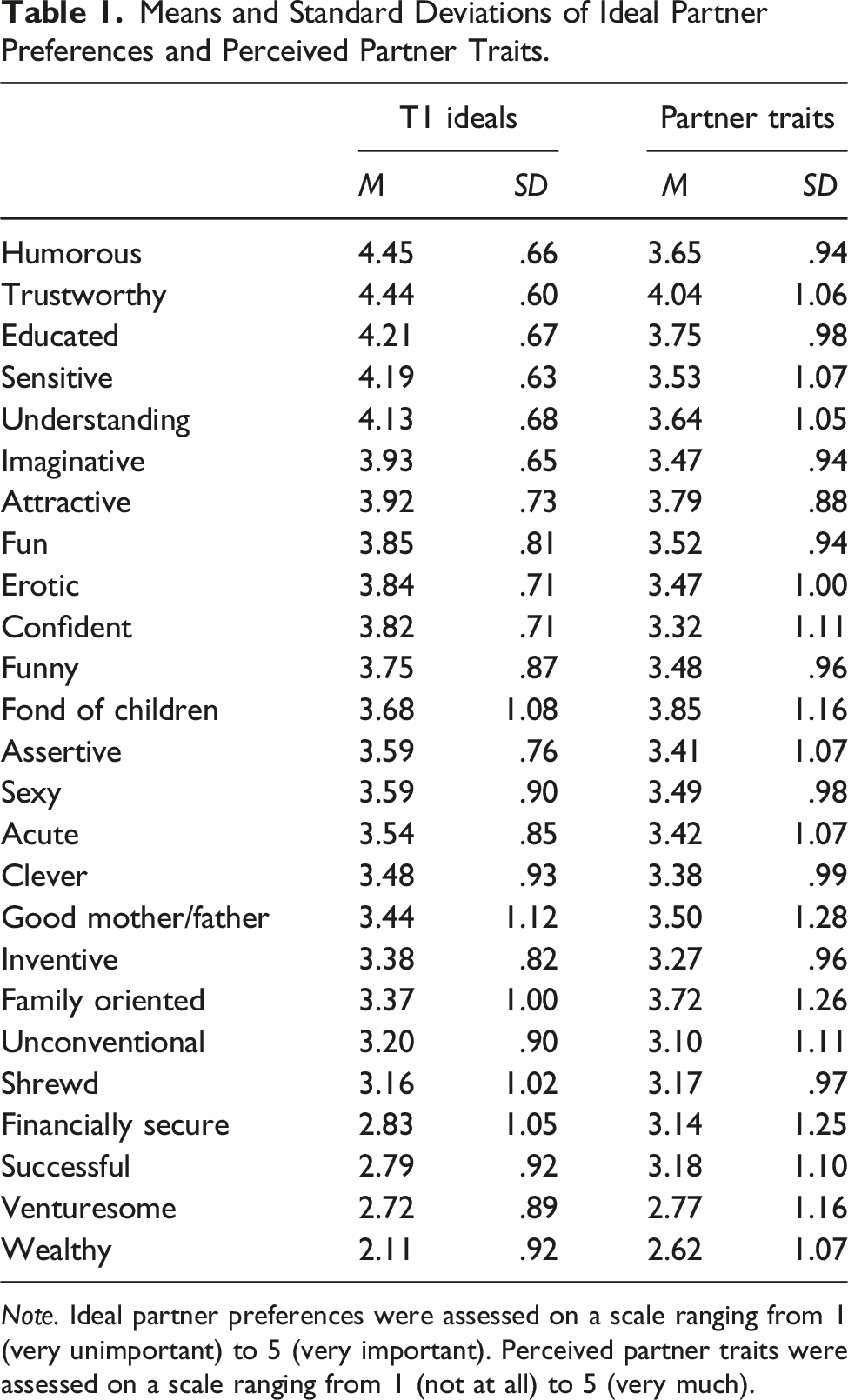
Note. Ideal partner preferences were assessed on a scale ranging from 1 (very unimportant) to 5 (very important). Perceived partner traits were assessed on a scale ranging from 1 (not at all) to 5 (very much).
We use the partner preferences as specified above and corresponding partner traits to investigate whether preferences are linked to the traits of people’s future partners (i.e. the ideal-trait correlation; H1).
Relationship outcomes
Item Content, Response Formats, Means, and Standard Deviation of Each Relationship Outcome.
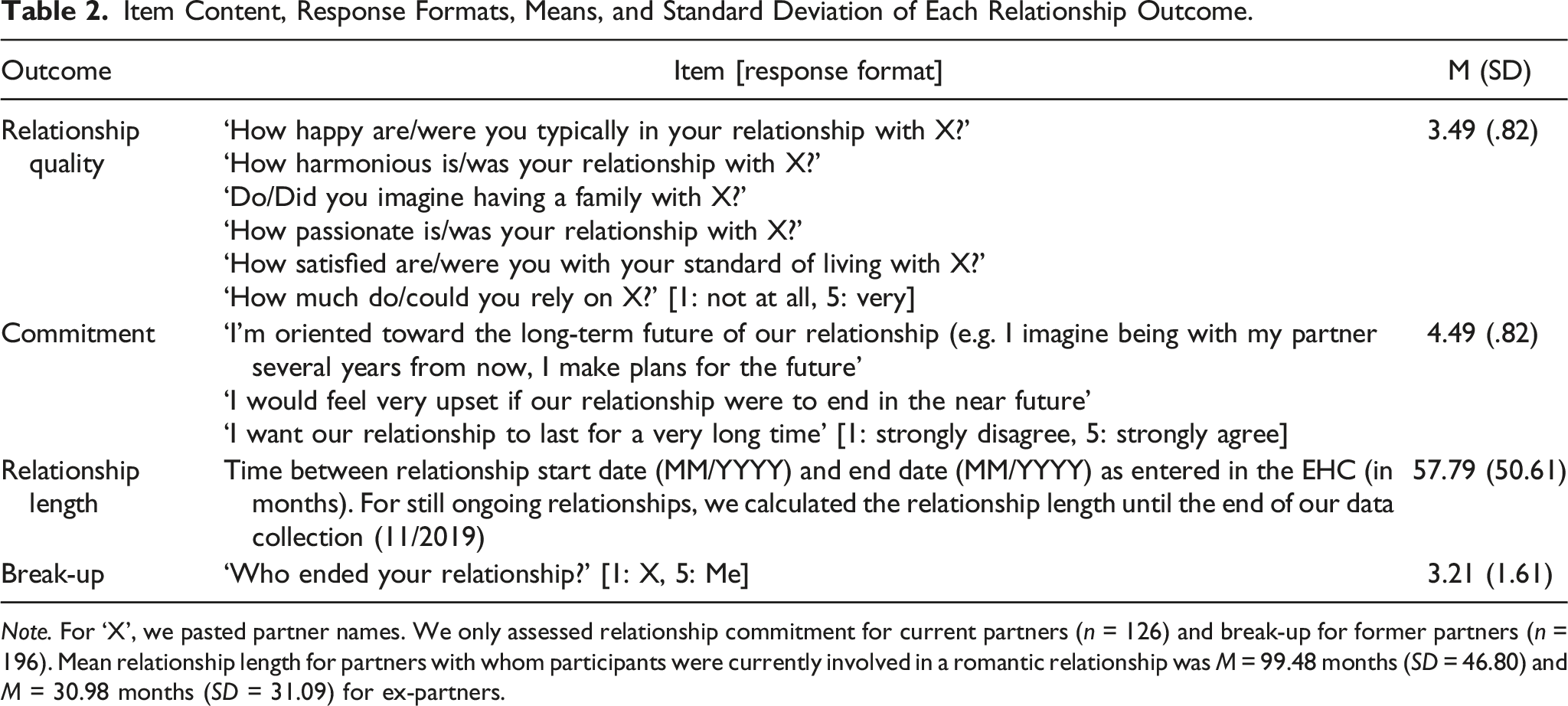
Note. For ‘X’, we pasted partner names. We only assessed relationship commitment for current partners (n = 126) and break-up for former partners (n = 196). Mean relationship length for partners with whom participants were currently involved in a romantic relationship was M = 99.48 months (SD = 46.80) and M = 30.98 months (SD = 31.09) for ex-partners.
T2 ideal partner preferences (used for robustness checks)
At T2, participants rated the same 59 5 items like at T1 assessing their ideal partner preferences on the same scale. Again, only 25 of these items were used in our robustness checks because only these items corresponded to participants’ ratings of how much they perceived their partners to fulfil these characteristics. One slight difference compared to the instructions at T1 was that at T2, we wanted to prevent ambiguities in our instructions and specified to rate a partner for a committed, long-term relationship. If participants were currently involved in a romantic relationship, it was noted to make each rating independently of one’s current partner.
(Semi-)Euclidean distance
One of our two approaches to assess the ideal partner preference-match was to calculate the Euclidean distance as proposed by Conroy-Beam and Buss (2017). For each participant, we squared the difference between reported ideals and perceptions of a partner separately for each of the 25 traits. We then calculated the square root of the sum of each squared difference. For each participant we received one value which we multiplied by minus 1 and added the maximum Euclidean distance plus one resulting in the following formula: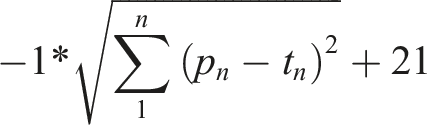
With this transformation, we receive positive values in which higher scores represent a closer match between ideals and perceived partner traits. Because discrepancies might matter only if a partner falls short but not if a partner exceeds one’s ideals (see Gerlach et al., 2019a), we also calculated the semi-Euclidean distance (Gerlach et al., 2019b). For the semi-Euclidean distance, we calculated the Euclidean distance as described above but only when the difference between traits and ideals fell below zero. Positive differences, which emerge when the perception of a partner’s trait exceeds one’s ideal, were set to zero.
Because distance metrics may be confounded with social desirability and how positive people see their partners (e.g. Rogers et al., 2018), after predicting outcomes with the respective distance metric as such, we also include a score capturing the positivity of partners’ traits in our follow-up models.
(Partly) corrected pattern metric
As a second operationalisation of the ideal partner preference-match, we calculated the corrected pattern metric (Eastwick et al., 2019). For each partner, we calculated the within-person correlation between participants’ ideals and their perception of their partner using a Pearson product-moment correlation. We calculated this within-person correlation in two ways. First, we mean-centred participants’ perceived partner ratings before correlating them with participants’ ideals by calculating the across-sample mean of the partner ratings per item and subtracting this average from participants’ corresponding perceived partner rating, which we refer to as the partly corrected pattern metric. The procedure removes the sample’s average perception of a partner, the normative profile (Wood & Furr, 2016), and leaves the distinctive profile for each partner (i.e. what distinguishes partners from the respective sample averages; Wood & Furr, 2016). The assumption underlying this procedure is that a person arrives at a perception of another person (e.g. their partner) via two processes: First, by using the knowledge of what the other person is like and second, by using the knowledge of what people (e.g. partners) are like in general (Biesanz, 2021). By subtracting the average profile of a partner before calculating the association between ideals and a partner’s traits, the second of the two processes is eliminated. The benefit of norm-correcting perceptions is that only the strength of an association between ideals and partner traits is calculated based on a person’s unique (distinctive) perception of their partner (Furr, 2008).
Second, we also mean-centred participants’ ideals following the same procedure, referred to as the corrected pattern metric (Eastwick et al., 2019; Lam et al., 2016). Next to the removal of the sample’s average perception of a partner, the sample’s average ideal is also removed. Thus, the procedure leaves the distinctive profiles for each partner and each participant’s set of ideals (i.e. what distinguishes partners and participants’ ideals from the respective sample averages; Wood & Furr, 2016). This procedure has been proposed because the correlation of ideals and the perception of the partner may be confounded with the desirability of certain characteristics. When removing the normative profiles, this confounding variable is eliminated (for a detailed explanation, see Wood & Furr, 2016).
Finally, because both what we aspire to in a romantic partner and the way we see them may be linked to age and gender, we incorporated these variables as covariates in our models.
Results
We analysed our data using R 4.0.2 (R Core Team, 2020) and the packages lmerTest 3.1-2 (Kuznetsova et al., 2017), coxme 2.2-16 (Therneau, 2020), ordinal 2019.12-10 (Christensen, 2019), sjPlot 2.8.7 (Lüdecke, 2021), and ggplot2 3.3.3 (Wickham, 2016). We ran multiple robustness checks for each of our analyses. Detailed results of these robustness checks can be found on the OSF (https://osf.io/tyc4r/).
Only our study design but not all of our analyses can be regarded as pre-registered. We deviate from our pre-registered analyses because of two reasons: First, because it was not possible to combine both initial samples 6 and second, in hindsight we do not think that all of our analyses were optimally specified in the preregistration. 7 Footnote 8 gives an example of our deviations to our pre-registered analyses, but we describe and explain all deviations to our pre-registration in more detail in our supplement (S1).
Ideal-trait correlation
Multilevel Model Predicting Perceived Partner Traits With Participant’s T1 Ideals, Controlling for Age and Sex.
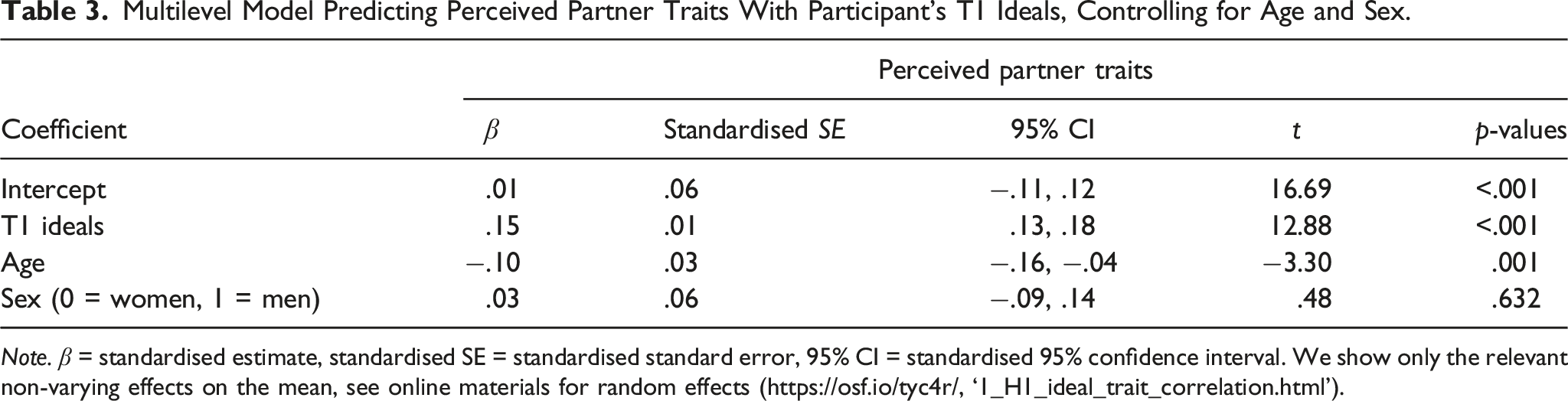
Note. β = standardised estimate, standardised SE = standardised standard error, 95% CI = standardised 95% confidence interval. We show only the relevant non-varying effects on the mean, see online materials for random effects (https://osf.io/tyc4r/, ‘1_H1_ideal_trait_correlation.html’).
Exploratorily, we then correlated each single ideal with the corresponding perceived partner trait. Descriptively, the majority of all correlations were positive, whereas the strength varied between different items. For example, there was a stronger association for attributes related to family orientation (r = .21), but a smaller association for attributes related to inventiveness (r = .03) (S2, Figure S2).
As robustness checks, we included an interaction between ideals and whether participants were currently involved in a romantic relationship with this person. Further, we fitted the same model as an ordinal model because responses are more likely to be ordinal instead of interval scaled. Results of our robustness checks can be found on the OSF (https://osf.io/tyc4r/, ‘1_H1_ideal_trait_correlation.html’). Results replicated in both models, but the association between ideals and perceived partner traits was stronger when participants were currently involved in a romantic relationship with this person as compared to an ex-partner (ideals: β = .12, 95% CI [.10; .15], p < .001; current partner: β = .40, 95% CI [.31; .49], p < .001; ideals * current partner: β = .08, 95% CI [.04; 0.11], p < .001).
In addition, we predicted T2 ideal partner preferences with perceived partner traits and found that T2 ideals were also associated with perceived partner traits (β = .23, 95% CI [.21; .25], p < .001). As indicated by the estimate and its confidence interval for T2 preferences and perceived partner traits, this association was stronger than the association of T1 ideals with perceived partner traits. In sum, our results indicated a positive ideal-trait correlation.
Ideal partner preference-matching effects
(Semi-)Euclidean distance
We fitted multilevel models in which we predicted each of the four relationship outcomes once with the Euclidean and once with the semi-Euclidean distance while again including participants’ age and gender as additional predictors and a random intercept for the participant ID. One exception is participants’ relationship length for which we used a Cox proportional hazards mixed model (also known as survival analysis) instead of a multilevel model, though using the same predictors. This model allows us to investigate whether a relationship has a higher chance of ‘survival’ with a lower distance between ideals and partner traits (see Footnote 6).
Standardised Estimates and Confidence Intervals of the (Semi)-Euclidean Distance Predicting Each Relationship Outcome.
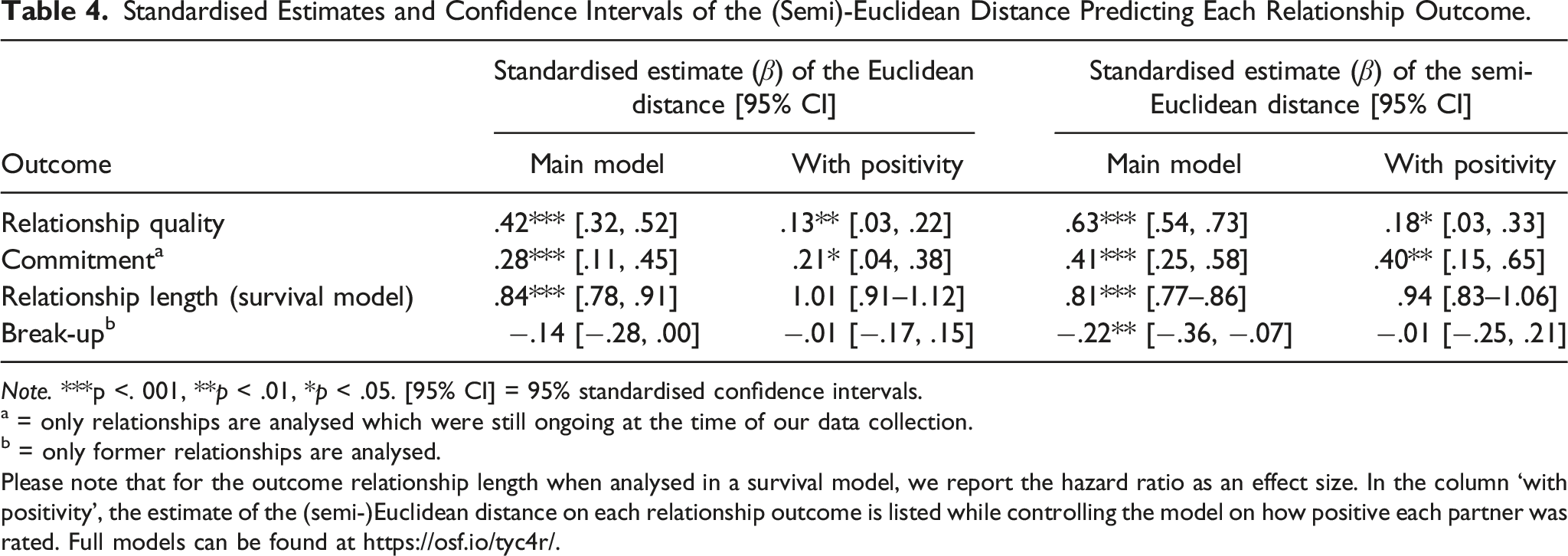
Note. ***p <. 001, **p < .01, *p < .05. [95% CI] = 95% standardised confidence intervals.
a = only relationships are analysed which were still ongoing at the time of our data collection.
b = only former relationships are analysed.
Please note that for the outcome relationship length when analysed in a survival model, we report the hazard ratio as an effect size. In the column ‘with positivity’, the estimate of the (semi-)Euclidean distance on each relationship outcome is listed while controlling the model on how positive each partner was rated. Full models can be found at https://osf.io/tyc4r/.
Our pattern of results remained robust when including a variable on whether relationships were still ongoing compared to former relationships, although current relationships were rated more positively (see https://osf.io/tyc4r/, 1_H2_(semi)_euclidean_distance.html). In addition, we determined how positive each partner was rated overall by calculating the mean perceptions of a partner’s traits across all characteristics. When including this positivity score (Table 4), the Euclidean and semi-Euclidean distance remained only significantly associated with relationship quality and commitment, but not with relationship length or who initiated the break-up.
Results support our hypothesis (H2) suggesting that a higher ideal partner preference-match (operationalised as the Euclidean and semi-Euclidean distance) is associated with more positive relationship outcomes. However, this association seems to be partly due to how positive a partner is rated as the associations between relationship outcomes and effects for our distance measures diminished when including the positivity score.
(Partly) corrected pattern metric
We then fitted multilevel models for each relationship outcome in which we predicted each outcome with the Fisher z-transformed within-person correlation as well as a random intercept for the participant ID. We did so separately for both calculated within-person correlations. When predicting the relationship length, we used a Cox proportional hazards’ mixed model (survival analysis) instead of a multilevel model, though again using the same predictors.
Standardised Estimates of the (Partly) Corrected Pattern Metric Predicting Each Relationship Outcome.
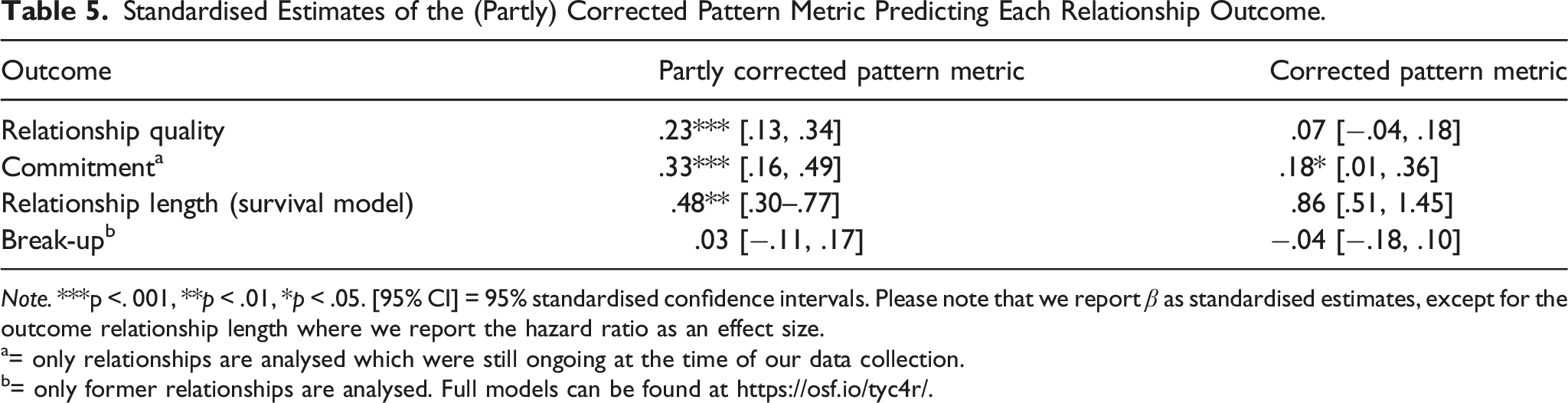
Note. ***p <. 001, **p < .01, *p < .05. [95% CI] = 95% standardised confidence intervals. Please note that we report β as standardised estimates, except for the outcome relationship length where we report the hazard ratio as an effect size.
a= only relationships are analysed which were still ongoing at the time of our data collection.
b= only former relationships are analysed. Full models can be found at https://osf.io/tyc4r/.
However, when predicting relationship outcomes with the corrected pattern metric (i.e. correlation of centred partner perceptions and centred ideals), correlation coefficients were significantly associated with only one out of four relationship outcomes: Participants commitment was related to the correlation between ideals and perceived partner traits, whereas the association diminished for relationship quality and length; the association for break-up descriptively even became negative while remaining non-significant.
In our robustness checks, we included participants’ age and sex as control variables. Further, we repeated our analyses calculating the within-person correlation as Kendall rank coefficients and fitted cumulative logit link (i.e. ordinal) mixed models because responses are more likely to be ordinal instead of interval scaled. Our previously described results remained virtually identical across all robustness checks.
Summary of Significant Effects for Relationship Outcomes Across Analyses.
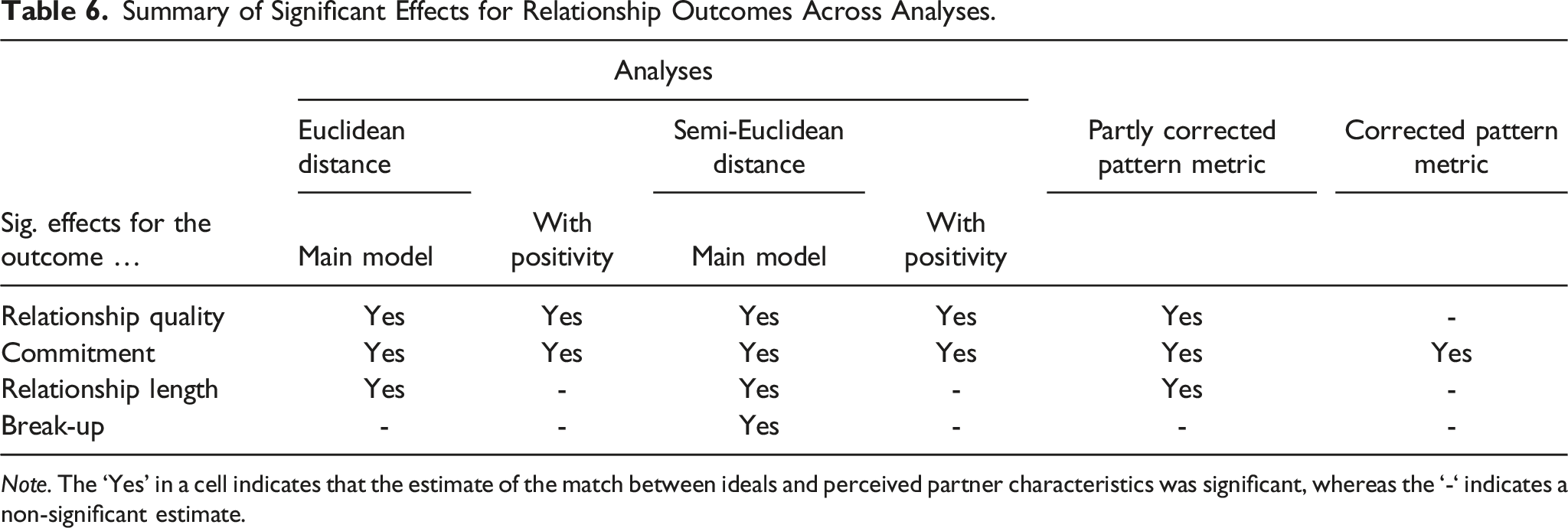
Note. The ‘Yes’ in a cell indicates that the estimate of the match between ideals and perceived partner characteristics was significant, whereas the ‘-‘ indicates a non-significant estimate.
Finally, per request of a reviewer, we also tested ideal partner preference-matching effects employing the level metric across the eight preference dimensions for all four outcomes. Consistent with previous literature where these effects typically did not tend to emerge, across the 32 analyses, we only found two significant partner traits by preference interactions. Interestingly, both of these effects emerged for the dimension family orientation. Specifically, we found significant partner trait by preference interaction effects for relationship quality (b = .11, 95% CI [.04, .18], p = .002) and relationship length (b = −.24, 95% CI [−.37, −.11], p < .001). For the outcomes relationship commitment and initiation of break-up, however, we found no interaction effects for family orientation or any of the other preference dimensions. For details, see Tables S7 and S8 in the supplement.
Discussion
In the current study, drawing on unique data across 13 years, we investigated whether participants’ ideal partner preferences were associated with perceived partner characteristics of their future partners (ideal-trait correlations) and whether a closer match between ideals and perceived partner characteristics was associated with various relationship outcomes, such as relationship quality or commitment (ideal partner preference-matching effects). We found support for a positive association between preferences and perceived partner characteristics, while results on the link between preference-partner match and relationship outcomes were more mixed and effect sizes differed between used metrics.
Supported ideal-trait correlation
Across a time span of 13 years, we found that initially reported preferences were indeed associated with participants’ perception of their future partners, supporting our first hypothesis (H1). Current ideal partner preferences showed a stronger association with the perception of a partner’s traits compared to the initially reported preferences, a pattern consistent with the idea that ideals may be somewhat malleable. In particular, it might be that ideals get adjusted to match a partner’s traits (Conroy-Beam & Buss, 2016; Fletcher et al., 2000), especially when a partner falls short of initial expectations (Gerlach et al., 2019a). As such, our results are in line with both, an account of preference driven mate choice and a post-hoc update of preferences (see Conroy-Beam & Buss, 2016). However, we cannot rule out some alternative explanations for this positive association, for example, a confounding third variable (Fletcher et al., 2020) or individuals spending their lives in environments where they encounter a number of well-matching ‘potentials’, but choice within these environments being more or less random (Gerlach et al., 2019a). Hence, the positive ideal-trait correlation obtained in the present study should not be interpreted in a causal way, even though a null-finding would have made a preference driven mate choice highly unlikely (Fletcher et al., 2020).
Mixed evidence for ideal partner preference-matching effects
We then investigated whether a closer match between ideals and preferences was associated with better relationship outcomes. Overall, results pertaining to this second hypothesis (H2) were more mixed. Across all analyses, the outcome relationship commitment (H2.2) was associated with a match between ideals and perceived partner characteristics. However, for all other relationship outcomes (H2.1, H2.3, and H2.4) results seemed to vary with our analytic choices (see Table 6). In particular, across most analyses (five out of six), the outcome relationship quality (H2.1) was associated with a closer match between ideals and perceived partner characteristics, whereas the effect was non-significant when using the corrected pattern metric, which has previously been discussed as being a superior method to the other metrics (Eastwick et al., 2019). In contrast, the results for the two other outcomes were much less consistent (see Table 6): For relationship lengths (H2.3), half of our analyses supported an ideal partner preference-matching effect. We found the weakest evidence (in only one out of six analyses) for who initiated a break-up (H2.4), suggesting that this outcome is rather unaffected by ideal partner preference-matching.
With regard to specific analytic choices, results of the Euclidean distance seemed straightforward: a smaller distance between ideals and perceptions of a partner’s traits was associated with a higher relationship quality (H2.1), higher commitment (H2.2), and longer relationships (H2.3). When we only determined the distance for characteristics where a partner fell short but not exceeded ideals (the semi-Euclidean distance), the associations were even stronger and we also found that with a smaller distance, participants were less likely to be the person who ended the relationship (H2.4). Participants being more sensitive to partners falling short compared to exceeding ideals supports previous research (Buyukcan-Tetik et al., 2017). However, these associations reduced or even disappeared in the case of relationship length and initiation of break-up when we included how positive a partner was rated in general (i.e. controlling for a potential positivity bias). One explanation could be that the unique match between ideals and traits is simply not closely related to whether a person, for example, stays in a relationship, but that seeing the partner in a positive light is more decisive of whether a relationship persists.
But why might ideal partner preference-matching effects for commitment and quality as relationship outcomes be less affected by such a general positivity effect? In contrast to the other two outcomes, the assessment of commitment and quality might simply have been more reliable, as these outcomes were not only assessed with a single item (e.g. initiation of break-up) but with three and six items, respectively.
While we sought to probe the robustness of our distance metrics results by inclusion of a partner positivity score in our study, this strategy deserves some reflection. On the one hand, it might well be that this positive view of a partner’s trait profile represents the very reason why people are in relationships with their partner – namely because they see their partner favourably. On the other hand, a positivity score might not even be necessary as our results and also previous literature suggests that participants have an accurate perception of their partners (e.g. Allik et al., 2016; Connelly & Ones, 2010; Watson et al., 2000), even when being positively biased (e.g. seeing the partner more positively than the partner might see themselves; Fletcher & Kerr, 2010).
We also investigated the match between ideals and preferences using the (partly) corrected pattern metric, a metric that has the benefit of not being confounded with mean level effects of positivity in judgements (Fletcher et al., 2000). Our pattern of results, however, remained ambiguous: The partly corrected pattern metric in which the average profile of a partner in the sample is removed suggested a positive association for most relationship outcomes (three out of four). The corrected pattern metric that additionally removes the average preference profile regarding an ideal partner, thereby essentially taking into account the normatively shared patterning of what people prioritise in a romantic partner, suggested a significant association for a minority of outcomes only (one out of four). This ambiguous pattern is similar to previous research: Studies using the simple pattern metric (i.e. neither norm-correcting ideals nor perceptions) found associations between the ideal partner preference-match and relationship outcomes (e.g. Buyukcan-Tetik et al., 2017; Eastwick & Neff, 2012; Fletcher et al., 1999; Fletcher et al., 2000). Of the three studies using the corrected pattern metric, one study found an association (Fletcher et al., 2020), one found no association (Eastwick et al., 2019), and one study found an association in a Taiwanese but not an US sample (Lam et al., 2016).
Further reflections on the different metrics
With results diverging across different metrics, the question arises which analyses are the most appropriate ones to answer our research question on ideal partner preference-matching effects. In the following, along with reiterating core features and potential drawbacks of the metrics, we like to offer some additional reflections on these different approaches.
As previously discussed, the (semi-)Euclidean distance has the benefit that it investigates several traits simultaneously. However, it may, for instance, be confounded by mean levels of positivity (Fletcher et al., 2000; Rogers et al., 2018). This is why we controlled for the positivity of partner ratings. Of note, this particular metric may suffer from the limitation that in our study we used slightly different response scales for the assessment of ideal partner preferences and perceived partner traits: For ideal partner preferences, participants rated the importance of each trait, whereas for a partner’s traits, participants rated how much each trait applies to their partner. Hence, responses are given as an importance versus level rating and as such, in a strict sense, are not commensurate. While this is common in the partner preferences literature (e.g. Buss, 1989; Fletcher et al., 1999), these diverging scales arguably introduce some ambiguity regarding the exact meaning of the resulting distances. To circumvent such ambiguities, future studies should assess ideals and a partner’s traits using the same (i.e. commensurate) response scales. For instance, in terms of preferences, researchers could directly ask participants about the trait level they desire in a romantic partner and then, in terms of partner attributes, use exactly the same level scale to elicit the partner rating.
Since pattern metrics are based on the within-person correlation across traits, it could be argued that for these metrics, the above limitation on importance versus level ratings is not as crucial (even though commensurate scales might still be more ideal here). As mentioned earlier, the partly corrected pattern metric comes with the benefit of not being confounded with mean level effects of positivity judgements (Fletcher et al., 2000). The corrected pattern metric then goes beyond that by also getting rid of the normative component in participants’ ideals. What remains is the distinctive profile of a partner and participants’ ideals, which distinguishes partners/ideals from other people (Wood & Furr, 2016). However, we believe that these metrics suffer from two limitations that deserve a more conceptual reflection. First, as Funder (2001) argued, norm-correcting perceptions removes valid variance since it is reasonable to partly form perceptions of another person based on knowledge of what an average person is like, and this also true in the case of partner ratings. Second, normativeness is calculated as the average perception of a partner in the respective sample. In our case, these partner ratings only reflect partners of participants who have been in at least one relationship in the investigated time span. Yet, 11% of our sample have not entered a long-term relationship during the 13 years that we investigated, which is comparable to the number found in previous studies (e.g. Purol et al. [2021] who found that of their 7000 participants, 8% did not enter romantic relationships during their adult lives). Hence, we ran auxiliary analyses testing whether participants who entered a long-term relationship over the investigated time span of 13 years differed from those who did not in self-reported personality traits, demographic variables, and romantic ideals (see S2I). Although our sample is too small to draw strong conclusions, our analyses suggest that the personality or demographic profiles of these participants could be different compared to participants who had been in at least one long-term relationship during the respective time span. For example, participants who entered romantic relationships reported to have a higher self-perceived mate value at T2 compared to participants who, across the entire study period, did not enter a relationship exceeding six months (see S2I). The normative profile, in other words the average profile, could therefore be not representative of a profile of an average person but only of an average relationship partner (i.e. those who at some point entered a relationship), thus not reflecting people who, for whatever reason, never enter a long-term romantic relationship. In contrast, the aim of controlling for a normative profile is to control for participants’ perceptions of what an average person, not what an average partner, is like. Hence, correcting partner perceptions using the average other rating across only participants who were in a relationship might be too conservative or even not representative.
The corrected pattern metric takes the logic of norm-correction even further, by not only getting rid of the average partner perception, but also subtracting the average preference profile in a sample. But are one’s preferences any less valid, only because my thinking of what I consider more or less important in an ideal partner is shared by other people, or even more specifically, by other people in the very same sample that is investigated? While removing the average preference profile suggests exactly this (preferences that are shared with others are less valid and thus should be ignored), we are more optimistic regarding the meaningfulness of preferences that we share with others. Indeed, we think that preferences matter even when others share them, and urge researchers to continue looking at and explicitly comparing results attained with and without norm-corrected measures. Further, we suggest that investigating the predictive power of what is normatively shared in our preference patterns is interesting in its own right (for a similar view, please see Fletcher et al., 2020). While beyond the scope of the current investigation, we encourage researchers to incorporate this thinking into future studies more thoroughly investigating the correlates and consequences of shared versus idiosyncratic preferences and partner perceptions.
On a concluding note, we believe that all metrics employed in the current study have their strengths and weaknesses. Which metric is superior to the others is still discussed among experts in the field (e.g. Eastwick et al., 2019; Fletcher et al., 2020,) and in our view, none of the metrics clearly stands out. While we encourage future studies to continue comparing different metrics, we cannot clearly say whether our results rather support or negate the notion of ideal partner preference-matching effects. We invite further conceptual and empirical work on the topic and discuss which of our findings are in line with previous research below.
Links to previous research
Overall, results across all used metrics suggest that participants have a higher commitment to their relationship when there is a closer match between their ideals and their partners’ traits. Our results are less clear for the other relationship outcomes, but also hint at a higher relationship quality with a closer match between ideals and partners’ traits (even though this link was not apparent with the corrected pattern metric). These results are in line with previous studies: For example, Overall et al. (2006) have found that participants reported a higher relationship quality on an omnibus measure that also contained commitment when they perceived a closer match between their ideals and their partners’ traits. The fact that a closer match between ideals and partner traits predicted commitment in our study underscores the predictive power of ideals, since commitment is assumed to play a pivotal role in the functioning and the maintenance of relationships, more so than other outcomes (e.g. relationship satisfaction). For example, the central importance of commitment is emphasised in Rusbult’s investment model (e.g. Rusbult et al., 2001), in which commitment promotes cognitions and behaviours aimed at maintaining the relationship. Similarly, a meta-analysis by Le et al. (2010) identified commitment as a particularly potent predictor of relationship dissolution. One potential reason why commitment had a more robust association with the match between ideals and a partner’s traits compared to relationship satisfaction in our study is that satisfaction merely is an evaluation of the relationship on a continuum from positive to negative. As such, perceptions of relationship quality or satisfaction will necessarily be more affected by controlling for how positively one sees one’s partner. Commitment, in contrast, goes beyond such an affective evaluation: At its core, it is the behavioural intention to hold on to a relationship. It can be speculated that commitment is more closely tied to how much a partner allows us to live the joint life we had desired – a judgement that may be affected by a mismatch between what we initially wanted and now got, in a way that goes well beyond a mere affective evaluation as captured by relationship satisfaction.
The diverging measurements used in previous studies can also help to explain the mixed findings for different relationship outcomes. For example, studies which directly asked participants in how far their partners matched their ideals found associations with their marital satisfaction (Campbell et al., 2013), relationship quality (Campbell et al., 2013; Overall et al., 2006), and romantic interest in a speed-dating design (Fletcher et al., 2014). This measurement is more direct; however, it has also been suggested that direct estimations of matching merely tap into participants’ perception of their partners (Eastwick et al., 2019).
Finally, it is important to note that the quality of a relationship likely depends on much more than merely the match between preferences and partners’ traits. For instance, Conroy-Beam et al. (2015) highlighted that once a relationship is entered, individuals should also track the balance between unconsidered costs and expected benefits of the relationship. Such a balance would, for example, consider the costs of a relationship dissolution or the anticipated costs of building a relationship with a new partner, with every cost estimate also coming with a degree of uncertainty. Moreover, independent of a partner’s traits, it may also be relevant how committed and invested the partner is in the relationship. Conroy-Beam et al. (2015) suggested that a person’s relationship satisfaction may serve as a regulatory variable in which all costs and benefits are integrated. Based on its evaluation, a person then decides whether to maintain, change or end this relationship. Because this integration of multiple variables may not be linear and, importantly, also not limited to a match between preferences and a partner’s traits, models such as ours that only factor in how a higher match between preferences and a partner’s traits links to higher relationship satisfaction, may be too simple. The small effect sizes found in the current study as well as previous investigations further substantiate the idea that the match between preferences and a partner’s traits may only be one of several factors contributing to the evaluation and the functioning of a relationship. Of note, while above we suggest that ideal partner preference-matching may only be one of many factors that determine our wellbeing in relationships, there is an alternative view: namely that the factors that (potentially) matter for whom we consider as a romantic partner before and when initiating romantic relationships (e.g. preferences) may be entirely different from the factors driving relationship evaluations and decisions once we are inside those relationships. 8 Importantly, the current investigation cannot disambiguate these possibilities, yet we cordially invite theoretical and conceptual work that may help to clarify these matters.
Strengths
The current study has a number of strengths that deserve mention. First, the longitudinal design, with ideals assessed when participants were still single, allowed us to rule out post-hoc updating of preferences (e.g. adjusting preferences to better match traits of the current partner) as a potential alternative explanation for our findings regarding ideal-trait correlations and preference partner-matching. Second, by employing several different statistical approaches that have been discussed in the literature, our study contributes to the ongoing scientific discourse on the predictive validity of partner preferences and the most appropriate analytical techniques to investigate it (e.g. Eastwick et al., 2019; Fletcher et al., 2020). Third we went beyond the typical college sample and investigated a relatively diverse and older community sample looking back at more than a decade of relationship experience. This increased variance might explain why we, compared to other studies (e.g. Eastwick et al., 2019; but see Fletcher et al., 2020), found evidence for the preferences being associated with partner traits and important relationship outcomes. More specifically, in an older sample gravitating towards more serious commitments and longer-term relationships, the expectations one holds regarding their partner may have more far-reaching consequences for one’s personal life. 9 Expectations in younger cohorts, in contrast, may not only be more flexible, but also more experimental and deviations less consequential in nature (Penke et al., 2007).
Limitations and future directions
Our study did not come without limitations. First, although we recruited a more diverse sample with regard to a higher age range and a more equal distribution of both sexes in comparison to previous studies, our sample is still highly educated, from a Western background and may also differ from the general population in so far as each one of our then-single participants was willing to participate in a speed-dating study 13 years ago. Thus, the generalisability of our results is potentially limited. Future studies should aim to recruit more representative samples, including participants from non-Western countries (Henrich et al., 2010). Second, despite our efforts to validate participants’ ratings of their partners with reports of others, only few peers and partners themselves participated in our study. However, the ratings of these peers and partners were correlated with our focal ratings suggesting that perceived partner ratings are valid. Future studies may overcome this problem by paying peers and partners higher incentives for their study participation. Third, although our data allows us to investigate a time span of 13 years, more than two assessments would have been preferable. As it stands, ratings of former partners had to be made retrospectively, making potential memory biases more likely. However, Wessels et al. (2020) found that knowing someone better is associated with higher, whereas liking somebody more is associated with a lower accuracy in person perceptions, suggesting that a former partner who is presumably well-known but maybe less liked might still be perceived accurately. Nevertheless, future studies would be more informative if they were designed more similarly to Eastwick et al. (2022) who tracked participants’ networks across several assessments to investigate the different stages of relationship development while also taking into account who was rejected as a partner. As suggested by our auxiliary analyses, future research should also investigate more closely what differs between people who enter versus those who do not enter romantic relationships over a long time span. Finally, we cannot pinpoint the exact mechanisms of how ideal partner preferences are integrated. In line with Conroy-Beam (2021) and Brandner et al. (2020), we encourage future research to test specific models of how preferences are integrated into relationship decisions. For example, future studies could track single individuals over a period of several years with several assessments of their preferences, as well as their relationships and potential partners they eventually reject. These studies may be able to disentangle different models of human mate choice and the role of ideal partner preferences therein (e.g. Fletcher et al., 2014; Miller & Todd, 1998). Moreover, computational modelling (e.g. Conroy-Beam, 2021; Conroy-Beam et al., 2022) may help to disentangle alternative models guiding human mate choice. Contrasting these alternative models may be able to answer the question whether participants compare a person’s characteristics to their ideals in order for this person to be considered as a potential partner, or perhaps whether a characteristic of a person needs to exceed a certain threshold in order to be considered as a potential partner, or both.
Conclusion
In conclusion, we found that ideal partner preferences are associated with the perception of a future partner’s traits (i.e. an ideal-trait correlation). Across several analytic approaches, we found that participants reported a higher commitment towards their relationship when there was a higher match between their ideals and their perceptions of their partner. For all other relationship outcomes, this ideal partner preference-matching association varied with our analytic choices: While the association was mostly apparent for the outcome of relationship quality, evidence across metrics was more mixed for relationship length and largely absent for initiation of break-up. Given these ambiguities, we invite further empirical and conceptual work into the complexities of different metrics, including but not limited to the correlates and consequences of shared versus idiosyncratic preferences and partner perceptions. Future research should ideally track single individuals over long periods of time and across relationship transitions, including several assessments of their preferences, the social networks from which they select their partners, and how their relationships develop.
Supplemental Material
Supplemental Material - Probing the predictive validity of ideal partner preferences for future partner traits and relationship outcomes across 13 years
Supplemental Material for Probing the predictive validity of ideal partner preferences for future partner traits and relationship outcomes across 13 years by Julie C. Driebe, Julia Stern, Lars Penke, and Tanja M. Gerlach in European Journal of Personality
Footnotes
Authors contributions
We thank Ruben C. Arslan, Laura J. Botzet, Cyril Tata, and Larissa Wieczorek for their assistance in implementing our online study. We also thank Silvia Bradatsch, Louisa Reins, Paula C. Tönsshoff, and Johanna Gäbe for their assistance in collecting the T2 data. We thank Ruben Arslan and Roger Mundry for their helpful statistical advice. We thank everyone involved in the Berlin Speed Dating Study for giving us the possibility to run a longitudinal study. We thank the Biological Personality Psychology lab for critically discussing and testing the final implementation of the study.
Declaration of conflicting interests
The author(s) declared no potential conflicts of interest with respect to the research, authorship, and/or publication of this article.
Funding
The author(s) disclosed receipt of the following financial support for the research, authorship, and/or publication of this article: Julie Driebe was funded by the Deutsche Forschungsgemeinschaft (DFG, German Research Foundation) – project number: 254142454/GRK 2070.
Open science statement
We publicly share our data, code and scripts at the OSF (https://osf.io/tyc4r/) as well as our pre-registration on the OSF ( ).
).
Supplemental Material
Supplemental material for this article is available online.
Notes
References
Supplementary Material
Please find the following supplemental material available below.
For Open Access articles published under a Creative Commons License, all supplemental material carries the same license as the article it is associated with.
For non-Open Access articles published, all supplemental material carries a non-exclusive license, and permission requests for re-use of supplemental material or any part of supplemental material shall be sent directly to the copyright owner as specified in the copyright notice associated with the article.
