




Abstract
The concept of differentiation describes increasing or decreasing similarities between inter-individual differences on psychological constructs, reflecting processes of specialization or adaptation. In this study, we studied age-differentiation in personality traits in (1) the trait domain and facet loadings, (2) the correlations between trait domains, and (3) trait domain, facet, and item (residual) variances. We used three large cross-sectional samples (Ns > 3000) covering 16–90 years of age with broad measures of the Big Five, Five-Factor, and HEXACO models. We examined age effects on the model parameters using local structural equation modeling. We found a high stability of the trait domain loadings, suggesting relatively stable trait domain compositions across age. Extraversion-Openness correlations increased across age for all three measures, whereas an increase in the Extraversion-Agreeableness and decrease in the absolute Neuroticism-Extraversion correlations only replicated across the five-dimensional models. Inter-individual differences in personality were similar across age in the trait domains and facets but differed substantially for item residuals. In summary, the structure and individual differences in broad personality traits is relatively stable across the adult lifespan, with most age-differences only affecting the item level.
Introduction
Do people become more differentiated or more homogeneous in their personality structure and in comparison with others as they age? Differentiation is a concept frequently examined in cognitive or intelligence research (e.g., Breit et al., 2021). It refers to increases (i.e., dedifferentiation) or decreases (i.e., differentiation) in the correlations between cognitive abilities across age (i.e., age-differentiation) or ability levels (i.e., ability differentiation). Differentiation is typically discussed in that literature as being indicative of specialization or adaptation to the environment (Zimprich & Martin, 2010), or being a result of increases in uniqueness or homogeneity in the underlying causes of abilities (Baltes et al., 1980).
In personality development research, differentiation and dedifferentiation are rarely studied. Does Conscientiousness become more heterogeneous across work life? Does the overlap between Agreeableness and Extraversion increase in old age? Do inter-individual differences in Openness remain stable across age? These questions of personality differentiation are highly relevant for a deeper understanding of the processes underlying personality development, how these change across the lifespan, and whether examinations of normative (e.g., Roberts et al., 2006) and differential change (e.g., Roberts & DelVecchio, 2000) are based on conceptually different traits at different life stages.
In this study, we thus aimed to provide a comprehensive examination of personality differentiation and dedifferentiation across the adult lifespan using measures representing three different trait taxonomies: the Big Five (Goldberg, 1990), the Five-Factor Model (FFM; Costa & McCrae, 1992), and the HEXACO model (Ashton & Lee, 2007). To maintain the continuous nature of age and locate potential differentiation patterns in specific age ranges, we used Local Structural Equation Modeling. While questions of the stability of factor loadings or (residual) variances are associated to questions of measurement invariance (i.e., whether measures are comparable across age groups), studies testing for measurement invariance of personality scales across age usually only focus on the direct trait domain—item associations with relatively short inventories. To provide a more general overview of whether trait domain compositions change across age, we focused on the trait domain—facet associations, as these would be less affected by item wording or specific age cues within the items.
Personality Trait Domains, Facets, and Nuances
Personality traits are conceptualized as hierarchical constructs with broad trait domains at the top (e.g., Conscientiousness), an intermediate facet trait level (e.g., Diligence) and items or nuances (e.g., I work hard) at the lowest level (e.g., Ashton & Lee, 2007; Costa & McCrae, 1992; McCrae, 2015; Mõttus et al., 2017; Soto & John, 2017). The Big Five (Goldberg, 1990) and the related Five-Factor Model (Costa & McCrae, 1992) provide a relatively exhaustive but parsimonious framework of individual differences in personality traits by focusing on the trait domains Extraversion (“energetic approach towards the social and material world”; definitions taken from page 120 in John et al., 2008), Agreeableness (“contrasts a prosocial and communal orientation towards others with antagonism”), Conscientiousness (“socially prescribed impulse control that facilitates task- and goal-directed behavior, such as thinking before acting, delaying gratification, following norms and rules”), Neuroticism (“contrasts emotional stability and even-temperedness with negative emotionality”), and Openness (“describes the breadth, depth, originality and complexity of an individual’s mental and experiential life”). While the trait domains were derived based on lexical analyses of personality-descriptive adjectives (see, Goldberg, 1990; John et al., 2008), facets were derived based on theoretical considerations regarding the core trait domain components, thus potentially differing between different Big Five measures and the Five-Factor Model (e.g., Roberts et al., 2014; Schwaba et al., 2020).
Facet Structures of Prominent Personality Trait Measures.
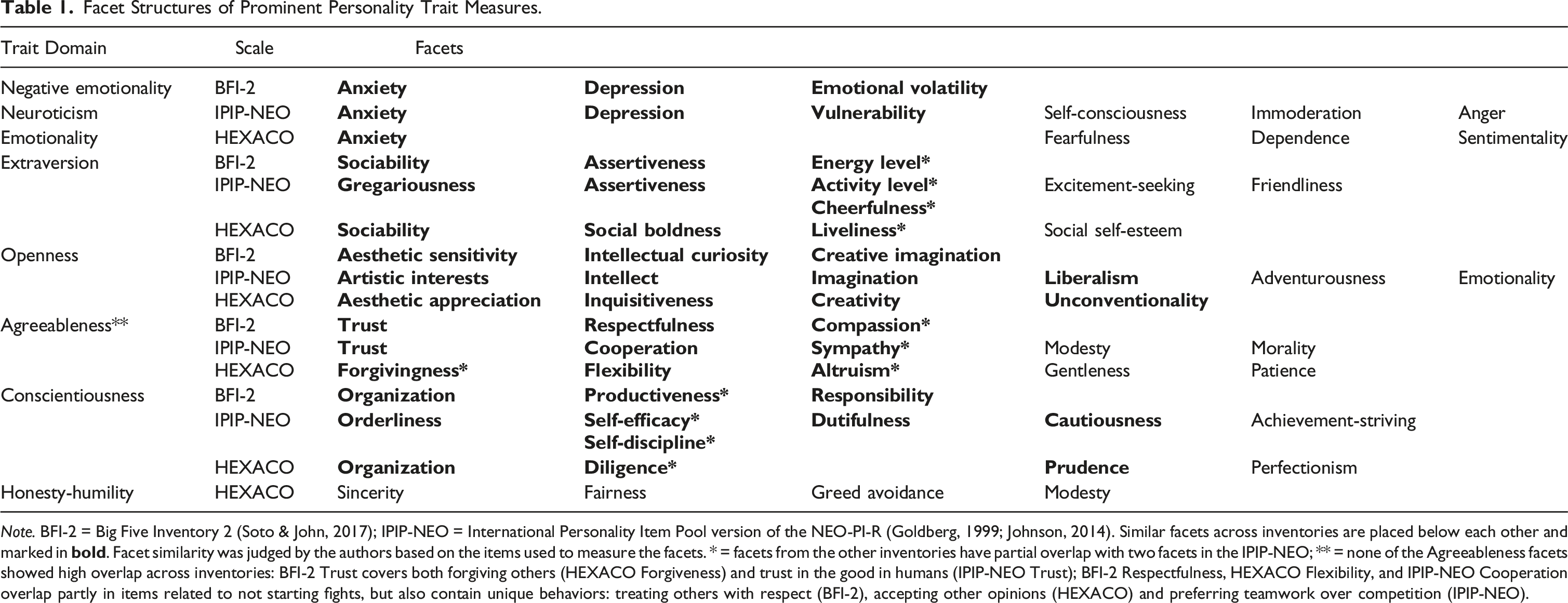
Note. BFI-2 = Big Five Inventory 2 (Soto & John, 2017); IPIP-NEO = International Personality Item Pool version of the NEO-PI-R (Goldberg, 1999; Johnson, 2014). Similar facets across inventories are placed below each other and marked in
Conceptualizing Differentiation and Dedifferentiation
Research on differentiation originated from Spearman’s (1927) observation that cognitive ability test scores correlated higher within a group of learning-disabled children compared to a group of non-disabled children, which is also commonly known as ability differentiation or Spearman’s law of diminishing returns (Spearman, 1927). Apart from its associations with ability levels, differentiation has been frequently examined from a developmental and aging perspective (e.g., Breit et al., 2021; Hartung et al., 2018; Molenaar et al., 2010). The most common assumption on age differentiation is that cognitive abilities increase in uniqueness and specialization as they develop in young age (Garrett, 1946; Tucker-Drob, 2009) to a dedifferentiation in old age (Baltes et al., 1980; Lövdén & Lindenberger, 2005). This dedifferentiation is understood to result from declines in health or neurophysiology (Craik & Bialystok, 2006) that affect several abilities simultaneously, thus increasing correlations between these abilities. In essence, the principle of differentiation refers to questions about specialization or adaptation (Zimprich & Martin, 2010), or the balance between broadly acting (e.g., biological, cultural) and specific (e.g., motivational) mechanisms or constraints (Lövdén & Lindenberger, 2005). Studying differentiation in the context of personality development can help judge to what degree traits become increasingly interconnected or distinct across age.
Analyzing Differentiation and Dedifferentiation
Personality traits and cognitive abilities are often conceptualized as hierarchical constructs with broad trait domains at the top (e.g., Conscientiousness), an intermediate facet trait level (e.g., Diligence) and items or nuances (e.g., I work hard) at the lowest level (e.g., Ashton & Lee, 2007; Costa & McCrae, 1992; McCrae, 2015; Mõttus et al., 2017; Soto & John, 2017). Molenaar and colleagues (2010) suggested five ways in which differentiation can be studied within the hierarchy of cognitive abilities (i.e., first- and second-order factor loadings, indicator and first-order factor residual variances, and second-order factor variance). In the context of hierarchical personality models, we identified six relevant parameters which can be examined in the context of differentiation (i.e., adding trait domain correlations as a sixth way). Figure 1 shows the six approaches in a simplified structural equation modeling representation of a hierarchical personality model. To exclude the effect of measurement error and item wording effects on our findings, we focused only on the trait domain loadings (Figure 1 parameter 1.1), trait domain correlations (parameter 2), and trait domain and facet (residual) variances (parameters 3.1 and 3.2) in this study (findings on the other levels are presented in the OSF). Three Types of Differentiation in a Higher-order Model of Personality Traits.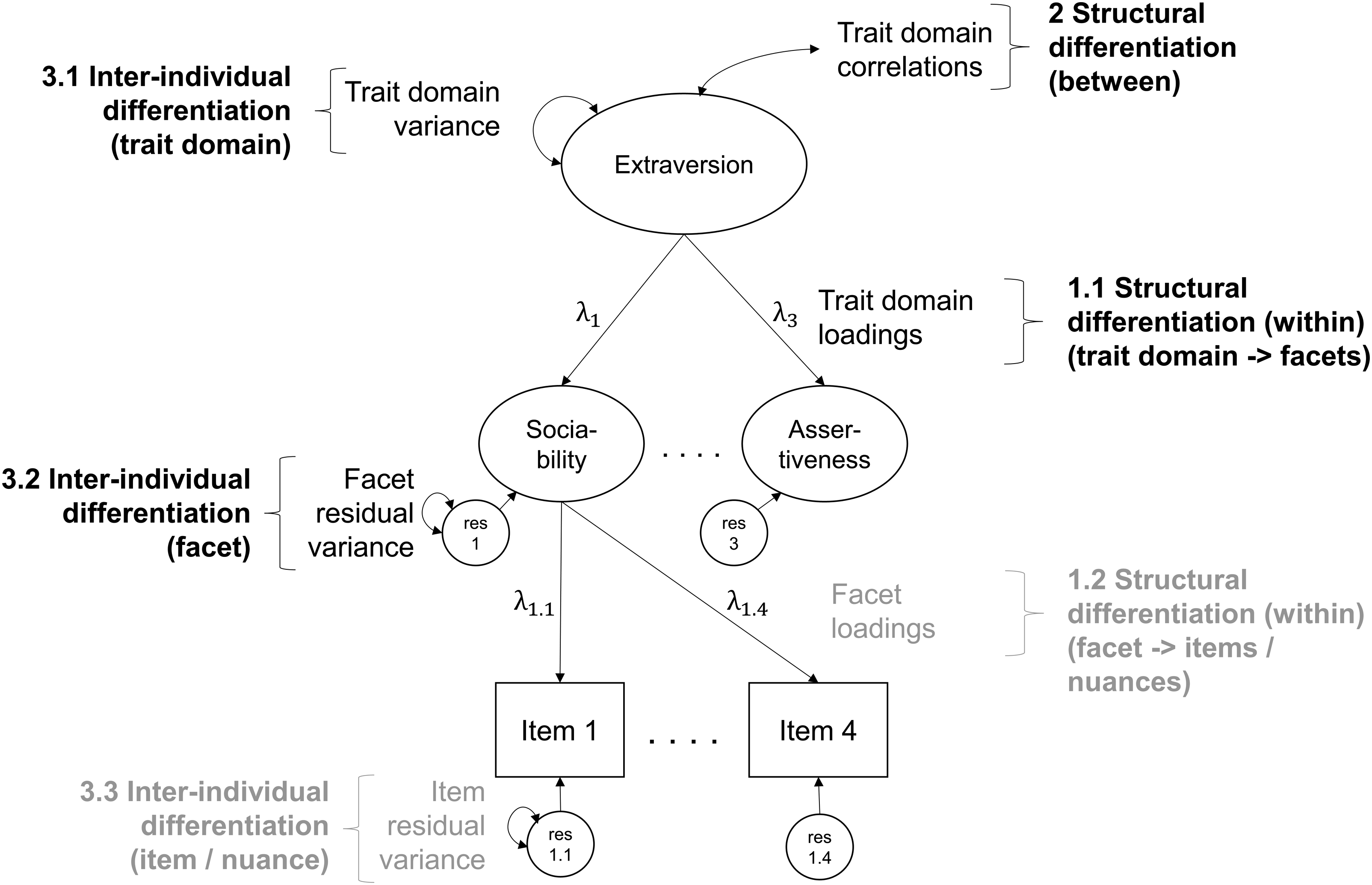
Differences in these model parameters across age are generally examined with structural equation modeling approaches that allow for parameter moderation, such as multi-group confirmatory factor analysis (e.g., te Nijenhuis & Hartmann, 2006), moderated factor analysis (e.g., Molenaar et al., 2010), nonlinear factor analysis (e.g., Tucker-Drob, 2009), or local structural equation modeling (e.g., Hülür et al., 2011). The main difference between these approaches is whether age is categorized into age groups (multi-group confirmatory factor analysis) or is included as a continuous moderator (other approaches), and whether the moderation function is parametric (e.g., curve-linear; moderated factor analysis, nonlinear factor analysis) or not (i.e., not pre-specified in form; multi-group confirmatory factor analysis, local structural equation modeling). While multi-group confirmatory factor analysis is most commonly used to study age differences in personality research, artificially categorizing age has been criticized for several reasons. For instance, broad age groups might mask within-group differences, because age cut-offs are often chosen arbitrarily and age differences within groups might be larger than across groups for participants close to the cut-offs (e.g., 29- and 30-year-old participants might be allocated to different age-decade groups) (Hildebrandt et al., 2009, 2016; MacCallum et al., 2002; Molenaar et al., 2010).
Three Types of Differentiation
Structural Differentiation Within Trait domains
Independent of which moderation approach is used, differentiation can be conceptualized in three broad types depending on which model parameter is examined (see Figure 1). The first approach, which we refer to as structural differentiation within trait domains, is examined through age-associated differences in the strength of the trait domain—facet loadings (Figure 1 parameter 1.1). In the case of intelligence, this refers to factor loadings of the general ability factor on more specific sub-abilities (e.g., Breit et al., 2021; Molenaar et al., 2010; Tucker-Drob, 2009). The underlying idea is that with increasing age, abilities or traits specialize and decrease in the association with the overarching ability or trait.
Such factor loading differences are also highly relevant from an assessment perspective. If the associations between higher- and lower-order factors (e.g., Conscientiousness and Orderliness) differ across age, the measured personality traits are not comparable across age. This is also known as the psychometric concept of measurement invariance (MI; Meade & Lautenschlager, 2004; Meredith & Teresi, 2006), with several articles discussing its relevance for personality development research (e.g., Allemand et al., 2007; Brandt et al., 2018; Nye et al., 2016), although this is generally only examined on trait domain—item loadings (but see Olaru et al., 2018). From a psychometric perspective, differences in the loadings across age (i.e. measurement non-invariance) are not desirable, as this would suggest that the comparisons of factor (or scale) means or correlations would not be based on identical constructs across age. From a theoretical perspective, this is an interesting phenomenon as it may suggest that the composition of the trait domains or effects thereof differs across the lifespan.
Structural Differentiation Between Trait Domains
The second approach, which we refer to as structural differentiation between trait domains pertains to increases or decreases in the correlations of trait domains (see Figure 1, parameter 2), which is also commonly referred to as structural change (Caspi & Roberts, 2001; Roberts et al., 2008). We distinguish between two types of structural differentiation, because the trait domains are generally assumed to be orthogonal (e.g., Goldberg, 1990; Saucier, 2002), whereas facets of a common trait domain should correlate with each other. In addition, structural differentiation within trait domains describes (a lack of) measurement invariance or differences in the measurement model, whereas structural differentiation between trait domains refers to differences in the structural model (see Figure 1). An example of this type of differentiation from intelligence research is how the correlation between fluid and crystalized intelligence (Cattell, 1971) differs across age and/or time (e.g., Hartung et al., 2018; Hülür et al., 2011).
Despite the assumption of orthogonality, correlations between the trait domains are commonly found (Park et al., 2020; Thielmann et al., 2021; Van der Linden et al., 2010), with some researchers suggesting even broader personality traits atop the Big Five trait domains (e.g., Alpha/Stability, Beta/Plasticity, general factor of personality; DeYoung et al., 2002; Digman, 1997; Van der Linden et al., 2010). Some authors argue that these super-factors are a meaningful trait level (e.g., Figueredo et al., 2006; Hofstee, 2001; Musek, 2007). For instance, the Beta or Plasticity factor encompasses Extraversion and Openness (DeYoung et al., 2002), which have both been linked to the dopaminergic system (DeYoung & Gray, 2009). Similarly, Neuroticism and Extraversion may be connected through the biological substrates of punishment and reward sensitivity (Corr, 2004). An increase in the strength of the trait domain correlations (i.e., dedifferentiation) might suggest that such meta-factors are more prominent in older age.
However, several researchers have argued the trait domain correlations solely represent response tendencies or statistical artifacts (Ashton et al., 2009; Bäckström et al., 2009). For instance, correlations between traits might emerge due to violations of unidimensionality, namely, that some items or facets represent blends of several trait domains (Ashton et al., 2009; see also Big Five circumplex; Hofstee et al., 1992). Furthermore, correlations may emerge due to self-evaluation or socially desirable responding. Accordingly, some studies showed correlations of a general factor of personality traits with self-esteem (Anusic et al., 2009) or a social desirability scale (Bäckström et al., 2009). The proposed Alpha (Anusic et al., 2009) or Stability (DeYoung et al., 2002) meta-trait is also characterized by loadings on the most evaluative Big Five trait domains (i.e., negative on Neuroticism; positive on Conscientiousness and Agreeableness). Taken together, it is still unclear what the meta-traits represent, as self-evaluation tendencies may be affected by the trait domains as well (e.g., self-esteem and Neuroticism; Robins, 2001b). For the study of personality differentiation, more systematic changes in the trait domain correlations (e.g., increasing or decreasing correlations between several evaluative trait domains) might point to age-associated changes in self-evaluation or response tendencies (e.g., due to increases in self-esteem across young and middle adulthood; Robins et al., 2002; Orth & Robins, 2014), whereas more specific age-differences in the correlations might point to age-graded changes due to environmental or biological factors.
Inter-individual Differentiation
The third approach, which we refer to as inter-individual differentiation, pertains to differentiation in terms of variance of abilities or traits (Figure 1, parameters 3.1 and 3.2). This type of differentiation is also termed “change” in divergence in the context of personality research (Allemand et al., 2007). Increases (i.e., differentiation) or decreases (i.e., dedifferentiation) in inter-individual differences reflect an increasing or decreasing heterogeneity in personality trait levels, which can also suggest specialization or adaptation processes of individuals away or towards the population average. In contrast to the previous two approaches, this perspective focuses on the specialization of individuals instead of abilities (or traits). For example, the varying onset of cognitive decline seems to increase inter-individual differences in fluid cognitive abilities in old age (e.g., Boyle et al., 2013).
In the context of personality development research, the social investment (Roberts et al., 2005) or corresponsive principle (see Roberts & Nickel, 2017) describe such inter-individual differences in developmental processes. For example, the corresponsive principle suggests that individuals seek out environments that match their traits, which further increases their trait-levels. The social investment principle refers to personality development as a reaction to life events and the investment in the new social roles (e.g., parent, work life, retirement). Inter-individual differences in the perception of the life event and the consequences thereof (e.g., Luhmann et al., 2020) should increase the differences between individuals and lead to further differentiation (e.g., unemployment and mental health issues; Jackson & Beck, 2021). However, if successful mastery of a social role requires individuals to perform at an optimal trait level (e.g., parents being highly agreeable, workers being highly conscientious), then these events should have the opposite effect and decrease inter-individual differences (see Jackson & Beck, 2021).
Previous Work on Differentiation in Personality
Structural differentiation within trait domains is often implicitly examined when testing for metric measurement invariance in multi-group confirmatory factor analysis (MGCFA) before factor means are compared across age groups or measurement occasions. In an overview of measurement invariance testing in personality development studies, Dong and Dumas (2020) reported that 13 out of 17 (76%) studies supported factor loading equivalence across age groups. However, these studies applied measurement models with only one factor level, and as such only examined differentiation in the trait domain—item associations. A study that examined measurement invariance in higher-order models of personality (Olaru et al., 2018) using the German NEO-PI-R (Ostendorf & Angleitner, 2004) supported the stability of second-order loadings (i.e., trait domain—facet associations) across 18 age groups ranging from 16 to 65 years of age using common cut-off criteria for MI testing.
There are only a small number of studies on the effect of age on trait domain correlations (i.e., structural differentiation between trait domains; Allemand et al., 2007; 2008a; Klimstra et al., 2013; Olaru & Allemand, 2021; Robins, 2001a; Small et al., 2003; Soto et al., 2008). These studies found some correlations between the Big Five or Five Factor model trait domains (see also Park et al., 2020; Thielmann et al., 2021). Findings on the stability of the trait domain correlations were mixed. For instance, Allemand and colleagues (2008a) found that constraining factor correlations to equivalence in a MGCFA across six age groups covering 16–91 years of age did not affect model fit substantially. However, two studies with similarly broad age ranges found some indication of structural change, more specifically, comparatively high trait domain correlations in old age (Klimstra et al., 2013; Olaru & Allemand, 2021). A dedifferentiation pattern in old age was also found in a study using a network approach to study differences in a 50-item personality network across age (Beck et al., 2019), with the Big Five trait domains being less distinguishable in old age (i.e., dedifferentiation). In a study focusing on young age (i.e., 10–20 years of age), Soto and colleagues (2008) found that the Big Five correlations decreased with age (i.e., differentiation between trait domains), whereas the correlations within trait-domains increased with age (i.e., dedifferentiation within trait domains). Taken together, these findings may suggest that the trait domains become more distinct during childhood and adolescence, but increasingly correlated in old age.
And finally, only a very small number of studies looked at differences in the variance of trait domains (i.e., inter-individual differentiation; Allemand et al., 2008a; 2008b; Jackson & Beck, 2021; Mõttus et al., 2016; Small et al., 2003; Zimprich et al., 2012). Across age, inter-individual differences in personality trait domains were reported to be relatively stable when tested with measurement invariance approaches (Allemand et al., 2008a, 2008b; Zimprich et al., 2012). Mõttus and colleagues (2016) also examined age-differences in the variance of the 30 facets of the Five-Factor Model, with both self- and informant reports. However, they did not find any systematic changes in the facet variance across age.
In summary, the number of studies on personality differentiation and dedifferentiation is very limited and there are three main limitations in the previous studies that we wanted to address with this study. First, previous studies on personality differentiation used short inventories that did not represent the hierarchical nature of the traits adequately. Second, the aforementioned studies focused on the Big Five or Five-Factor model. And finally, differentiation was often examined in the context of MGCFA with a small number of categorical age groups instead of continuous age.
The Present Study
In this study, we wanted to examine three types of differentiation and dedifferentiation (Figure 1) and focused on the following guiding research questions: (a) Does the strength of the association between trait domains and facets differ across age (structural differentiation within trait domains)? (b) Does the association between trait domains differ across age (structural differentiation between trait domains)? (c) Do variances in the trait domains and facets differ across age (inter-individual differentiation)? To increase the generalizability of our findings, we performed the analyses on three different measures and datasets, representing the currently most popular personality trait taxonomies: The Big Five (Goldberg, 1990), the Five-Factor Model (FFM; Costa & McCrae, 1992), and the HEXACO model (Ashton & Lee, 2007). More specifically, we used data on the Big Five Inventory 2 (BFI-2; Soto & John, 2017), the IPIP-NEO-120 (Johnson, 2014; based on the NEO-PI-R by Costa & McCrae, 1992) and the HEXACO-100 (Ashton & Lee, 2007). An overview and comparison of the facet measured in each inventory can be found Table 1. Despite similarities between the three taxonomies, the specific findings could be affected by the (number of) facets included, which facets were allocated to which trait domain, and differences in the items across measures. We thus compared the findings across the three measures to ensure that they were not taxonomy, measure, or sample specific. Each dataset contained N > 3000 participants with a broad age representation, allowing us to examine differentiation from 20 to 80 years of age.
We account for the continuous nature of age and potential non-linear differentiation patterns by using local structural equation modeling (LSEM; Hildebrandt et al., 2009; 2016; Hülür et al., 2011; Olaru et al., 2019a; 2019b). LSEM is a non-parametric method that can be used to examine the effect of continuous moderators (e.g., age) on all parameters of a structural equation model (e.g., loadings, intercepts, variances, and means). In contrast to MGCFA––where models are estimated based on artificially created age groups—LSEM estimates the model on each age point using weighted samples. At each age point, participants are weighted based on the difference in age to the target age. Participants with the target age are fully weighted, whereas participants with higher or lower age are only partially included in the estimation. This weighting kernel follows a Gaussian function around the target age (for more details see Hildebrandt et al., 2009; Olaru et al., 2019a; 2019b). The model is then estimated based on the weighted samples representing each age point (except for the extremes of the age distribution, as the symmetric weighting function requires participants on both sides of the target moderator value). LSEM can be understood as a series of SEMs with a moving weighting function, which allowed us to estimate the models across a continuous age variable and better identify critical age points at which loadings, correlations, or variances increase or decrease.
Methods
This study is a re-analysis of existing and fully anonymous datasets, and as such no additional ethical approval was obtained. Participants’ informed consent was obtained by the owners of the datasets. This study’s analysis was not pre-registered. All analyses were run in R version 4.0.4 (R Core Team, 2021) with the R packages ggplot2 (Wickham, 2016), haven (Wickham & Miller, 2020), lavaan (Rosseel, 2012), psych (Revelle, 2020) and sirt (Robitzsch, 2020). All analyses scripts are available in an OSF repository (https://osf.io/4rbuf/).
Samples and Measures
BFI-2
Sample Size Across Age Groups and LSEM Age Point.
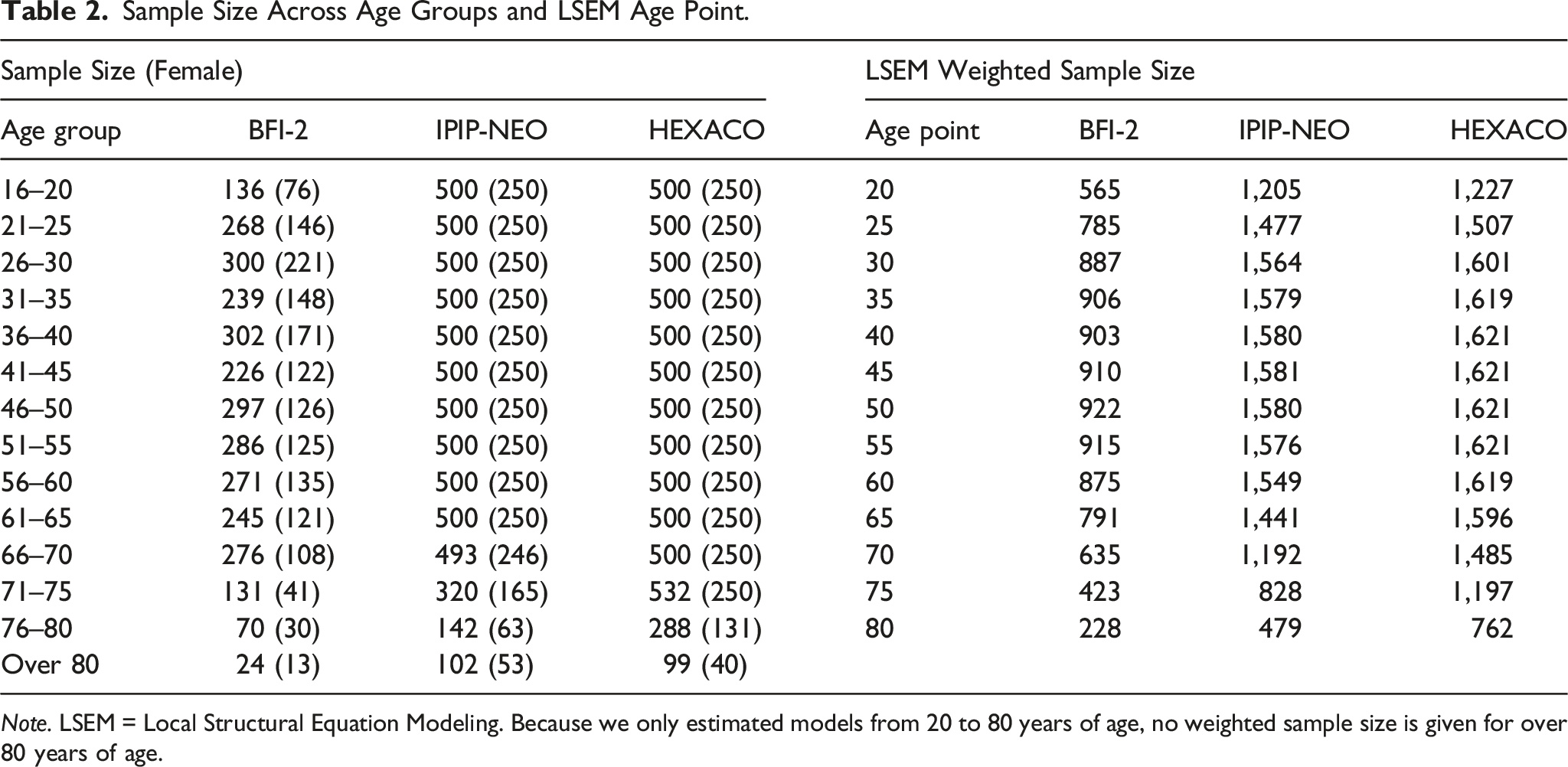
Note. LSEM = Local Structural Equation Modeling. Because we only estimated models from 20 to 80 years of age, no weighted sample size is given for over 80 years of age.
IPIP-NEO
For the assessment of a five-factor model including facets, we reanalyzed openly available IPIP-NEO 120 data (Goldberg, 1999; Johnson, 2014; https://osf.io/wxvth/). The questionnaire was administered online (http://www.personal.psu.edu/∼j5j/IPIP/). Each of the five personality trait domains––Agreeableness, Conscientiousness, Extraversion, Neuroticism, and Openness––was measured with six facets measured by four items each. Participants had to indicate their agreement with the different statements on a five-point scale (1 = very inaccurate, 2 = moderately inaccurate, 3 = neither accurate nor inaccurate, 4 = moderately accurate, 5 = very accurate).
The data cover the period from 2001 to 2011 and include a total of 619,150 participants from 239 different regions around the world. Participants completed the IPIP-NEO voluntarily and anonymously and received feedback on their personality scores. We used a subsample of the data consisting of participants from the USA for two reasons: First, among the participants, the USA makes up a clear majority (72% or 447,500 participants in total) and the USA sample covers a wide age range with sufficient participants at its extremes. Second, as we wanted to minimize the effects of cultural or language differences on our examination of MI and structural stability (Achaa-Amankwaa et al., 2021; Church et al., 2011; Dong & Dumas, 2020; Jankowsky et al., 2020), we decided against using the full data or subsets of countries.
We sampled participants aged between 16 and 90 years. In the range of 16–69 years, there were more than 100 observations per age point available, with a particularly high number of younger adults. To create a balanced age distribution within each data set and comparable data sets for all three personality measures, we randomly selected 100 of those observations for each year of age matched across gender (additionally, we included all available participants in the age range from 70 to 90 years). The resulting sample consisted of 6057 participants with a mean age of 46.07 years (SD = 17.99; see Table 2) of which 3027 (50%) were female.
HEXACO-PI-R
We reanalyzed data from the 100-item version of the HEXACO-PI-R, which were collected online at http://hexaco.org/hexaco-online. Analogous to the data collection described above for the IPIP-120, participants completed the HEXACO-PI-R anonymously and received feedback on their personality scores. The HEXACO-PI-R covers six personality trait domains––Honesty-Humility, Emotionality, Extraversion, Agreeableness, Conscientiousness, and Openness––including four facets per trait domain and four items per facet. An additional facet, namely, altruism, results in the total number of 100 items. Participants had to indicate their agreement with the different statements on a five-point scale (1 = strongly disagree, 2 = disagree, 3 = neutral, 4 = agree, 5 = strongly agree). Data were collected from 2014 to 2018. For additional information about the data set and the data cleaning procedure, please see Lee and Ashton (2018).
Again, we used the subsample from the USA. Out of 162,075 participants, we only sampled participants aged between 16 and 90 years. In the range of 16–73 years, more than 100 observations were available per year of age. In this age range, we selected 100 participants for each year of age (matched by gender), and included all participants from the age range of 74–90 years. The resulting sample consisted of 6419 participants with a mean age of 47.67 years (SD = 18.67; see Table 2) of which 3171 (49%) were female.
Statistical Analysis
Model Specification
We modeled each trait domain as a higher-order model with one second-order factor loading (i.e., trait domain) on the corresponding three (BFI-2), four (HEXACO) or six (IPIP-NEO) first-order factors (i.e., facets), which in turn loaded on the items. This resulted in five 12-item models for the BFI-2, five 24-item models for the IPIP-NEO, and six 16-item models for the HEXACO. For factor identification purposes, we constrained the first factor loading of each factor to 1 and factor means to 0. To examine differences in the trait-domain correlations across age, we estimated each pairwise combination of trait-domain models. This resulted in 10 additional models for the BFI-2 and IPIP-NEO, and 15 additional models for the HEXACO.
To account for acquiescent responding, which might increase correlations between otherwise unrelated content domains, we added a factor loading on all positively keyed items with +1 and all negatively keyed items with −1. This method factor was not allowed to correlate with the personality factors and was intended to capture inter-individual differences in the agreement to statements—independent of content.
Even though items and facets were selected in the questionnaire development process to be as unidimensional as possible, model fit issues due to cross-loadings are prevalent in models of broad personality traits (e.g., Hopwood & Donnellan, 2010; Marsh et al., 2010), which was also the case in this study. We thus modified the original unidimensional models (i.e., each trait domain model) by adding cross-loadings and residual correlations that were above a threshold of λ/r > .20 in the full sample. We chose this cut-off, because it allowed us to achieve overall acceptable model fit without compromising the parsimony of the models or core definition of the factors. We also applied this approach to the bivariate models, keeping the previously added cross-loadings and adding new ones if applicable (for an overview of all cross-loadings estimated, see OSF). We interpret these loadings as meaningful relationships between trait domains, facets, and items, and as such apply the same scrutiny when examining structural differences across age on these parameters.
Testing Age Moderation Effects Using LSEM
To study the moderation effect of age on the structural stability of the personality traits across age, we used local structural equation modeling (LSEM; Briley et al., 2015; Hildebrandt et al., 2009; 2016; Olaru et al., 2019a; 2019b) with the lsem.estimate-function in the R package sirt (Robitzsch, 2020). In line with the recommendations in the literature (Hildebrandt et al., 2016), we used a bandwidth value of h = 2. We estimated the model on each age point ranging from 20 to 80 years of age. Younger and older participants are still included in the model estimation due to the sample weighting procedure, but this ensures that enough cases are available on both sides of the weighting function around the target age point. When estimating models at the borders of the age distribution (e.g., below 20 or above 80 years of age), the symmetric weighting function will result in weighted samples that are on average older or younger than the targeted age (for an illustration see Olaru et al., 2019a; 2019b), thus potentially resulting in biased parameter estimates at the age extremes.
Testing MI Across Age
To test for measurement invariance, we used the joint estimation procedure in LSEM (Robitzsch, 2020). The joint estimation procedure corresponds to a classical MGCFA, in which each weighted age sample is treated as an independent group. Similar to MGCFA, different levels of MI can be estimated and compared. Following measurement invariance testing standards for higher-order models, we first estimated a model without constraints across age (i.e., configural invariance). We then sequentially constrained parameters across age and compared model fit to the previous less constrained model. Based on recommendations for measurement invariance testing in higher-order models (Chen et al., 2005), we included the following equality constraints across age: 1) first-order loadings, 2) second-order loadings, 3) item residuals, 4) first-order factor residuals, and 5) second-order factor variances. The first two steps are also known as metric invariance, and the third and fourth step as strict invariance (Chen et al., 2005). We did not test for item or facet intercept invariance across age (i.e., scalar invariance) because we were not interested in mean-level differences across age in this study. We compared global goodness-of-fit indices (e.g., CFI, RMSEA, and SRMR) between the nested models to evaluate the increase in misfit due to the parameter constraints. A substantial decrease in model fit between subsequently strict models (ΔCFI < −.010; ΔRMSEA >.015; ΔSRMR >.015; Chen, 2007; Cheung & Rensvold, 2002) would suggest that the parameters are not measurement invariant across age.
Testing Parameter Equivalence Across Age
In addition to the global MI testing procedure, which provides a test for equivalence across several parameters simultaneously, age effects on single parameters can also be examined. This can be done using a permutation-based procedure (Hülür et al., 2011) with the permutation test function in the sirt R-package (Robitzsch, 2020). The permutation test creates a null distribution of parameter estimates that would occur if age had no systematic effect on the model parameters. To do so, 1000 copies of the original dataset are created, in which the values of the age variable are randomly reallocated to cases. LSEMs are then estimated on all these datasets, using the same model and settings as the original estimation. This results in a distribution of 1000 estimates for each parameter at each age point. Because age was randomly assigned in these estimations, all systematic age-effects should be eliminated. The percentiles of the original estimates within this null distribution can then be interpreted as p-values for the moderation effect. We used a combination of both approaches in this study, as the global test is a more general estimate of the overall degree of structural differences, and the permutation approach provides more detailed information on which parameters are affected by age differences.
Results
Descriptive Statistics and Correlations.
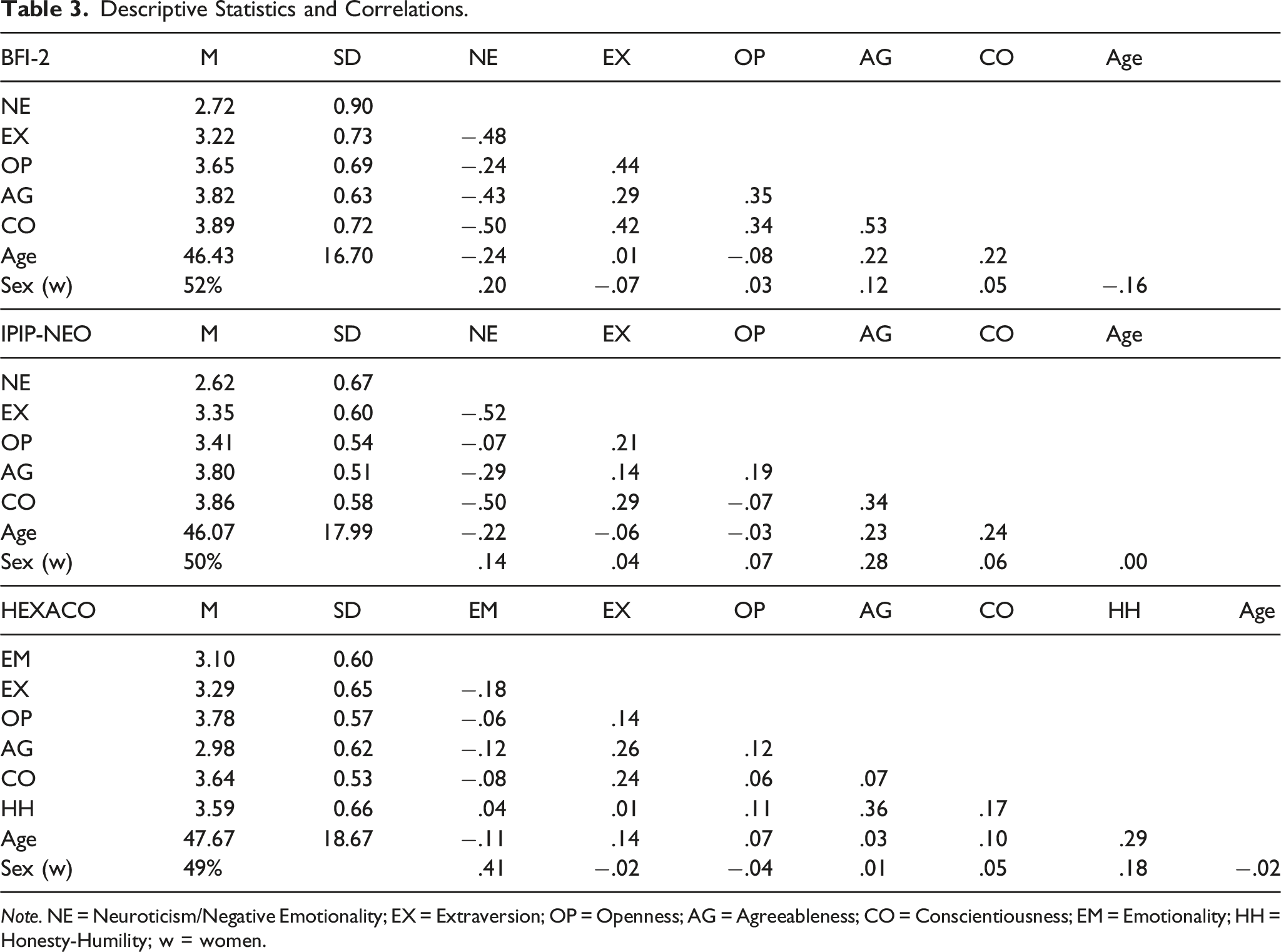
Note. NE = Neuroticism/Negative Emotionality; EX = Extraversion; OP = Openness; AG = Agreeableness; CO = Conscientiousness; EM = Emotionality; HH = Honesty-Humility; w = women.
Model Fit Across Age
Figure 2 shows the CFI and RMSEA across age for all unidimensional models examined in this study. This overview can be interpreted as an examination of configural measurement invariance, more specifically whether the assumed personality models fit at all years of age. Overall fit differences between the three measurement instruments should not be interpreted as the superiority of one model over the other, as we included a different number of cross-loadings and residual correlations in each model. In all cases except one (IPIP-NEO Openness CFI at 80 years of age), model fit was acceptable for the models including cross-loadings and residual correlations. Generally, model fit showed a U-shape, fitting worst at the age extremes, but particularly in old age. This pattern can be explained by the smaller sample size at age 20 and from age 70 to 80, as simulations have shown that this has a detrimental effect on such model fit indices (Iacobucci, 2010; Jackson, 2003; Marsh & Balla, 1994). However, the only age-associated model fit pattern that was significant at the p < .001 level (tested with the permutation test) was the close to linear decrease in HEXACO Conscientiousness CFI, which was also mirrored by a linear increase in RMSEA (p = .009), suggesting that the assumed model fits in young adulthood best. Model Fit of the Univariate Models Across Age.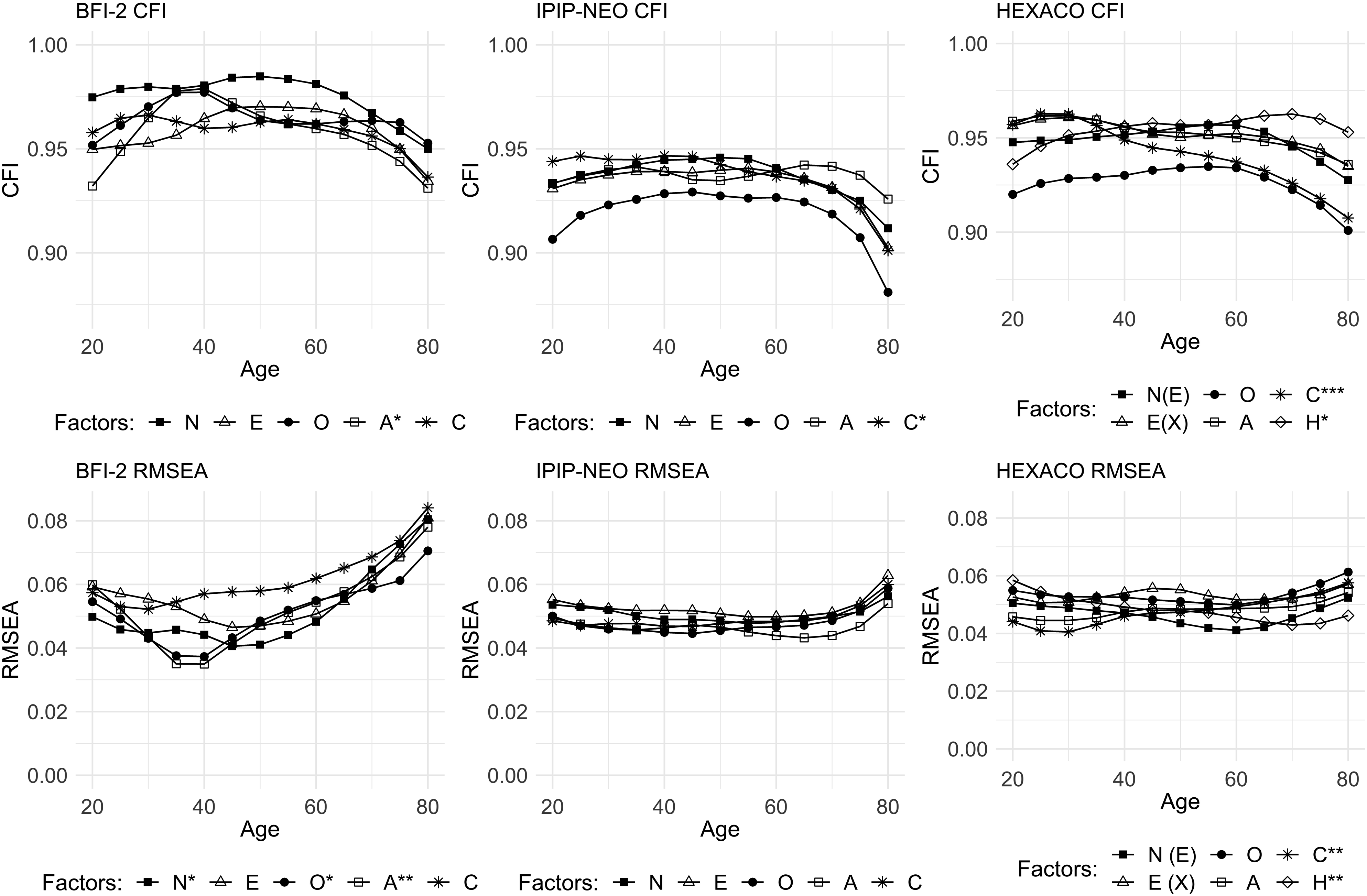
Measurement Invariance Across Age
Measurement Invariance Test with the Joint Estimation Procedure.
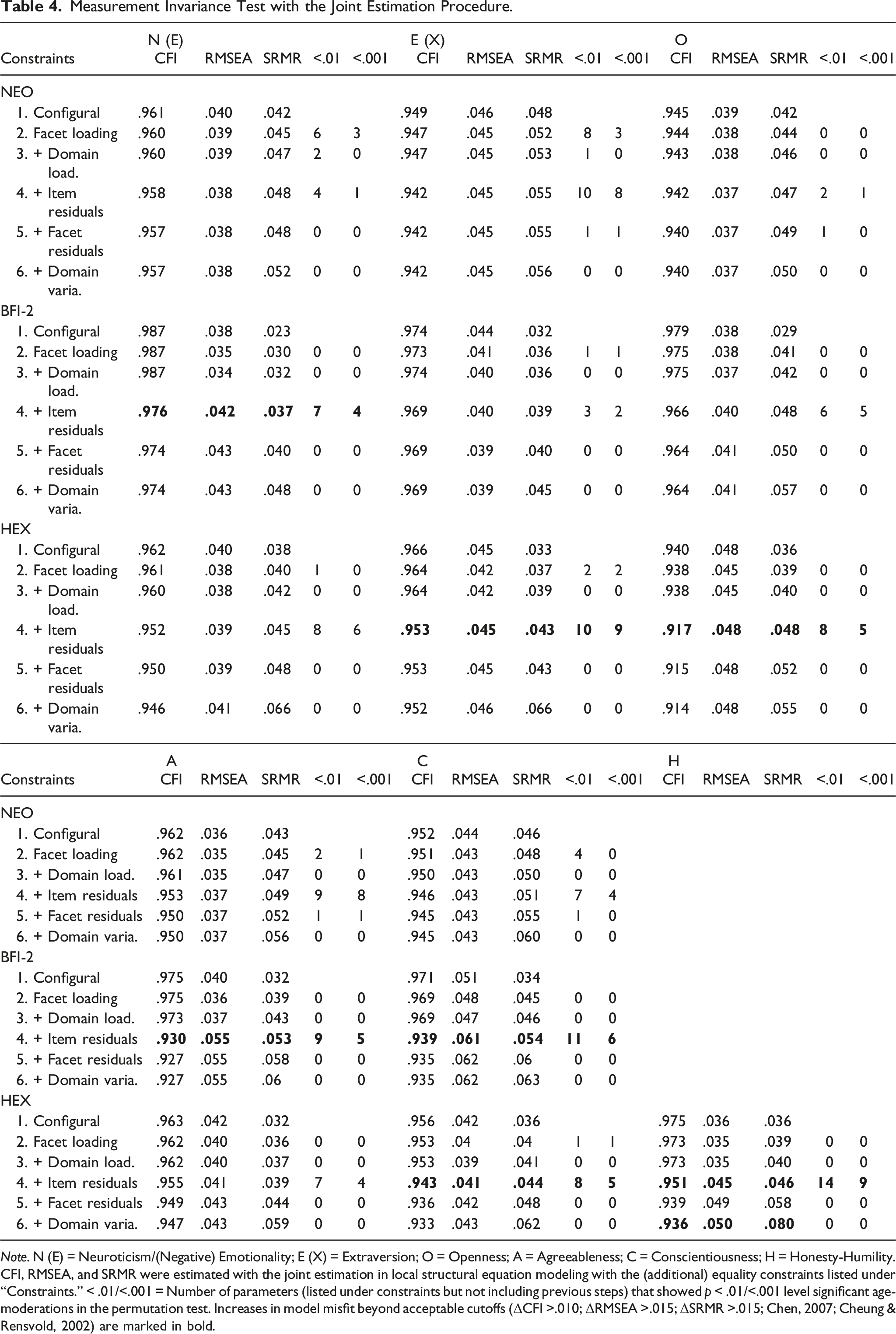
Note. N (E) = Neuroticism/(Negative) Emotionality; E (X) = Extraversion; O = Openness; A = Agreeableness; C = Conscientiousness; H = Honesty-Humility. CFI, RMSEA, and SRMR were estimated with the joint estimation in local structural equation modeling with the (additional) equality constraints listed under “Constraints.” < .01/<.001 = Number of parameters (listed under constraints but not including previous steps) that showed p < .01/<.001 level significant age-moderations in the permutation test. Increases in model misfit beyond acceptable cutoffs (ΔCFI >.010; ΔRMSEA >.015; ΔSRMR >.015; Chen, 2007; Cheung & Rensvold, 2002) are marked in bold.
First- and second-order factor loading equivalence was supported for all models by common standards (steps 1 to 3 in Table 4). Constraining item residuals increased misfit beyond acceptable levels in 7 out of 16 cases (43.75%). The only other variance constraint that increased model misfit substantially was the HEXACO Honesty-Humility second-order factor variance (ΔSRMR = .022). As such, age differentiation seems to be strongest in the item residuals, whereas the measurement invariance tests did not indicate structural differentiation or inter-individual differentiation within the higher order traits. However, the global measurement invariance test only provides an indication if age-associated differences are present, but not on which parameter or at which age point exactly. As such, we next investigated the loading and variance patterns in more detail.
Structural Differentiation Within Trait Domains
Standardized second-order factor loadings with the strongest age effects are presented in Figure 3 (see OSF Tables S2 and S3 for an overview of the first-order loadings; see OSF Table S4 for an overview of all second-order loadings). Generally, age differences were not large enough to disrupt the rank-ordering of facets within the trait domains (see Figure 3), suggesting a high stability of the trait domain structure. In addition, the significant standardized loading differences across age generally did not replicate across similar facets in other measurement instruments. For example, the decrease in the Social Boldness loading (HEXACO) from .76 to .57 (p < .001; p-values are based on the permutation test) was only mirrored by the decrease in the NEO Assertiveness loading from .52 to .38 (p = .006), but not in BFI-2 Assertiveness (p = .928). Other notable patterns, such as the increase of the HEXACO Conscientiousness loading on Prudence from .74 to .88 (p = .003) and simultaneous decrease in Perfectionism from .64 to .48 (p = .001) was not replicated by similar facets in the other models. We found the largest number of age-associated differences in the Honesty-Humility loadings, with the loading on Sincerity and Fairness increasing from .60 to .75 (p = .003) and .48 to .64 (p = .007), respectively. In contrast, the loading on Modesty decreased from .93 to .79 (p = .004), suggesting a stronger dominance of the Humility aspect in young age but increasing balance of loadings within the Honesty-Humility trait domain across age. Second-order Loadings Across Age.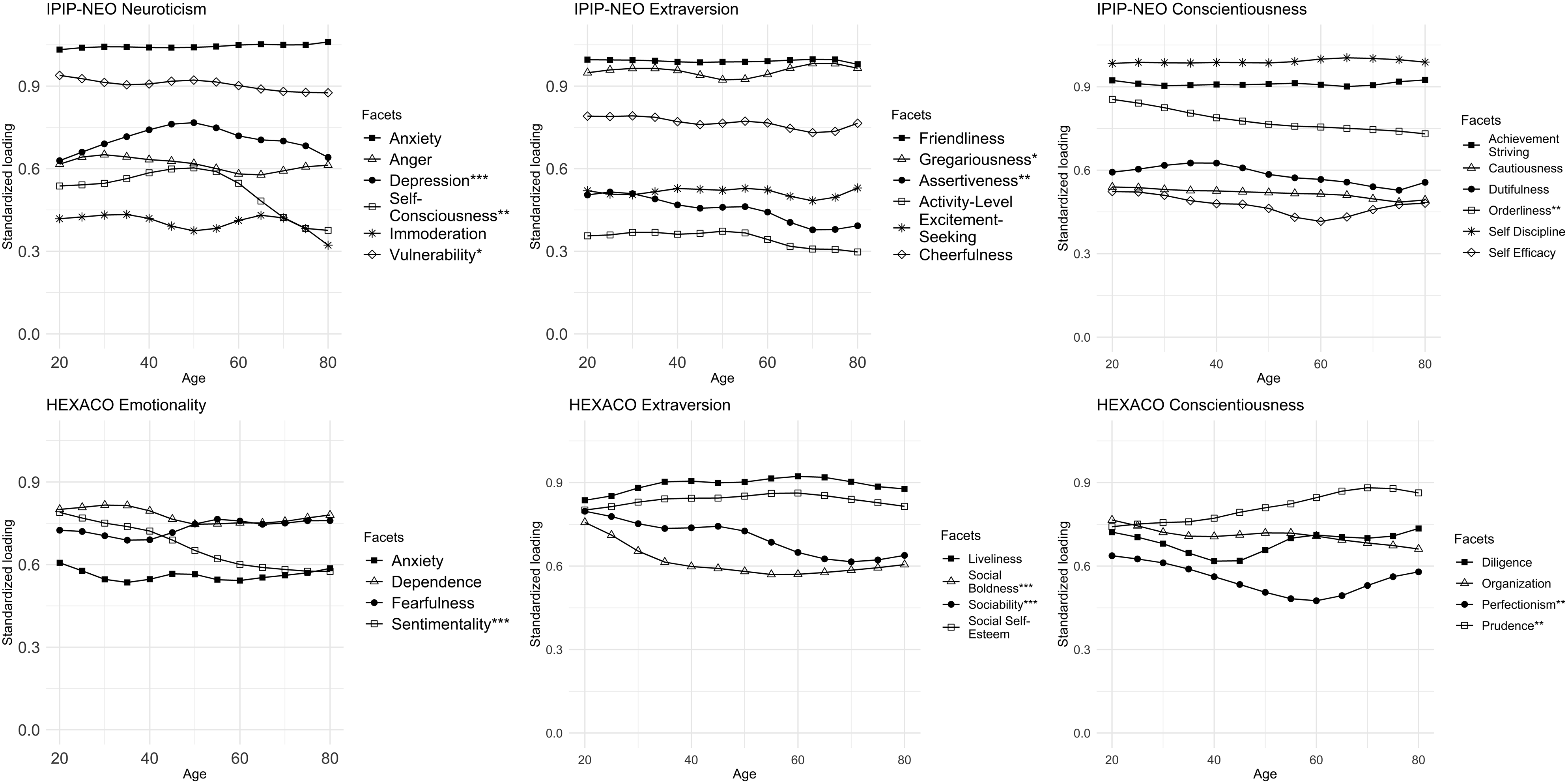
In summary, we found no strong or systematic evidence for a structural differentiation within trait domains across age. Because of no clear evidence in favor of substantial trait composition variations across age, we assume that the facet structure of trait domains is relatively stable across age.
Structural Differentiation Between Trait Domains
Next, we examined the trait domain correlations. Factor correlations across age are presented in Figure 4 (see OSF Table S5 for an overview of all factor correlations across age). Nearly all trait domain correlations were significantly different from zero. In all models, Extraversion, Openness, Agreeableness, and Conscientiousness correlated positively amongst each other, and negatively with Negative Emotionality, Neuroticism, or Emotionality. Second-order Factor Correlations Across Age.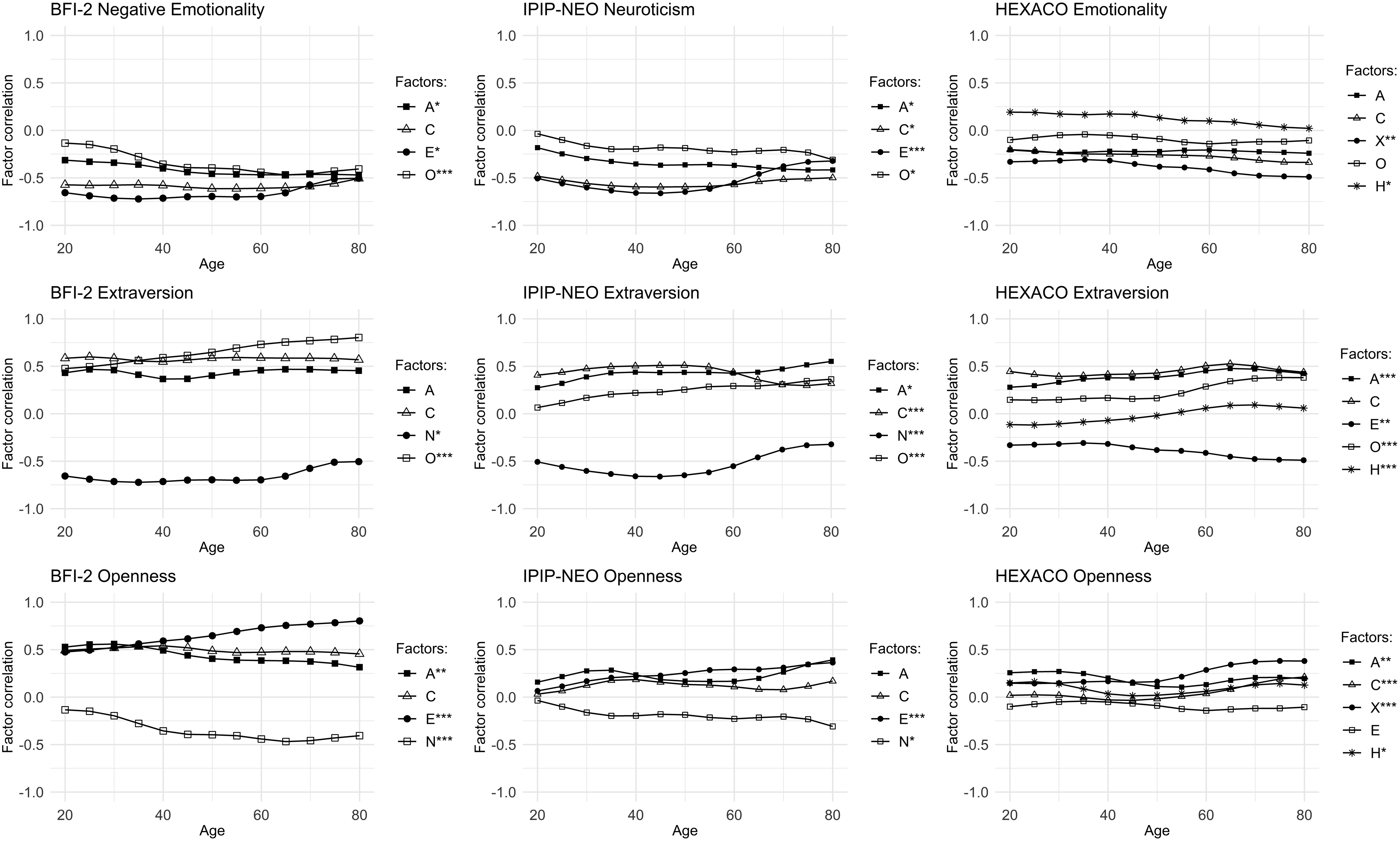
Regarding differentiation patterns in the trait domain correlations, we found the Openness-Extraversion correlation to increase across age in all three models (ps < .001; p-values are based on the permutation test): in the BFI-2 from r = .48 to r = .80, the IPIP-NEO from r = .07 to r = .36, and the HEXACO from r = .14 to r = .38. Other age patterns only partly replicated across instruments. For example, the Extraversion-Agreeableness correlation increased in the IPIP-NEO (r = .27 to .55; p = .027) and HEXACO (r = .28 to .48; p < .001), but not the BFI-2 (p = .307). The absolute correlation between Neuroticism and Openness increased in the BFI-2 (r = −.13 to −.47; p < .001) and IPIP-NEO (r = −.04 to −.31), but not the HEXACO (p = .417). Most interestingly, the absolute Neuroticism-Extraversion correlations decreased in the BFI-2 (r = −.72 to −.50; p = .013) and IPIP-NEO (r = −.66 to −.32; p < .001), whereas HEXACO Emotionality-Extraversion showed the opposite pattern from r = −.31 to r = −.49 (p = .005). In summary, we replicated previous findings on dedifferentiation between Extraversion and Openness but found no clear support for other patterns of structural differentiation between trait domains.
Inter-individual Differentiation in Personality
Finally, we investigated the second and first-order factor variance as an indicator of inter-individual differentiation. Four of the 30 IPIP-NEO facet residual variances showed significant age differences, but none for the other inventories (see Table 4). Second-order factor variances are presented in Figure 5 (see OSF Table S6 for an overview of all trait domain variances across age). These remained relatively stable across age. The only notable exception was the decrease in the HEXACO Extraversion variance (from 0.45 to 0.21; p < .001) and the HEXACO Agreeableness variance (from 0.46 to 0.30; p = .006). However, these patterns were not replicated in the other scales. In summary, we found indications of inter-individual differentiation in the personality nuances (see item residual constraints in Table 4), but not in the trait domains or facets. Second-order Factor Variance Across Age.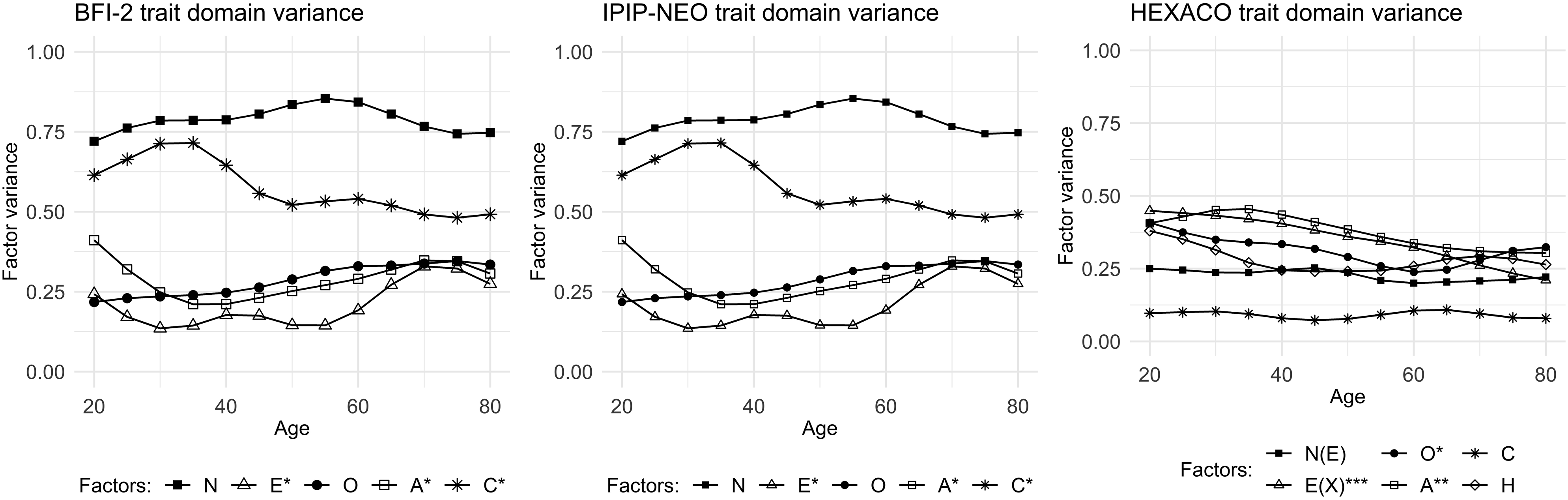
Discussion
The goal of this study was to examine three different types of personality differentiation and dedifferentiation across age. However, differentiation is frequently examined in the context of cognitive development, personality differentiation is rarely studied, despite many conceptual similarities between these fields (e.g., Briley & Tucker-Drob, 2017). Thus, we aimed to examine whether broad and unique causes would affect the personality trait structure, as well as inter-individual differences in personality traits. To do so, we used three large datasets covering three broad personality inventories and used LSEM to study non-linear moderation effects across continuous age. In the following, we will discuss our main findings on the three types of differentiation.
Structural Differentiation Within Trait Domains Depended on the Used Measures
Regarding the trait domain facet associations, we found significant age moderations for 20.3% of the second-order loadings at the p < .01 level. The affected trait domain-facet associations differed across measurement instruments. For example, the decrease in the Extraversion-Assertiveness (IPIP-NEO) and Extraversion-Social Boldness (HEXACO) loadings was not mirrored by the corresponding BFI-2 Assertiveness facet. Despite some age-effects, the stability of the-rank order of the second-order loading was remarkable. Across the 20–80 years of age examined in this study, the relative importance of facets within a trait domain was highly similar across age. While the trait domain composition differed across measurement instruments (see also Thielmann et al., 2021), age had small to no effects.
Some Evidence for Dedifferentiation Between Trait Domains Across Age
Of the 35 trait domain correlations examined in this study, 34.4% differed significantly across age at the p < .01 level. The majority increased in absolute size across age (i.e., dedifferentiation), mirroring the age patterns on trait domain correlations reported previously (e.g., Beck et al., 2023; Klimstra et al., 2013; Olaru & Allemand, 2021). This is particularly interesting as we expected the accumulation of life events, social roles, or environmental effects, as well as the increasing complexity of life from early to middle adulthood to result in a differentiation pattern. However, this assumes that these processes affect only single traits instead of several traits simultaneously. If adaptations to, for instance, social roles require individuals to increase on several nuances or facets from different trait domains in the same direction, this could result in an increase in the trait domain correlations.
The most unequivocal finding in this study was the increase in Extraversion-Openness correlations across age (see also Klimstra et al., 2013; Olaru & Allemand, 2021; Schwaba et al., 2022). We assume two processes that might have caused this increase. First, both trait domains have been linked to the dopaminergic system (DeYoung & Gray, 2009) and the tendency to explore and engage in novel activities and situations, which was described as a personal growth factor or focus (Digman, 1997; Staudinger & Kunzmann, 2005). Increases in the inter-individual differences on the underlying biological substrate or the tendency for novelty seeking across age would result in increasing similarities in inter-individual differences between both traits and such a dedifferentiation pattern. Second, in line with reinforcement (Cramer et al., 2012) or situation selection and reaction processes (Wrzus & Roberts, 2017), a desire for new experiences might become increasingly intertwined with an interest in other people. As social networks decrease with age and time spent alone increases (Wrzus et al., 2016), this “openness to people” should have a stronger impact on the time spent with non-family members. In line with this assumption, Wrzus and colleagues (2016) found that Openness was associated with more time spent with strangers. In addition, they reported that Openness was also positively associated with time spent with friends, but only in older age (i.e., above 71.7 years of age in their study).
Another noteworthy finding on differentiation between trait domains was the decrease in the size of the negative correlation between Neuroticism and Extraversion for the five-dimensional taxonomies starting around the age of 50 (IPIP-NEO) or 60 years (BFI-2). However, Extraversion in all three taxonomies includes a facet related to positive emotions (i.e., energy level, activity level, cheerfulness, liveliness; see Table 1), Neuroticism (IPIP-NEO), and Negative Emotionality (BFI-2) are much more defined by negative emotions (i.e., anxiety, depression, vulnerability, emotional volatility, anger) than the HEXACO Emotionality counterpart (i.e., anxiety, fearfulness, dependence, sentimentality; see Table 1). Arguably, these two trait domains represent a stronger juxtaposition of positive and negative emotions in the five-dimensional models. Studies on emotional experiences of older adults suggest that the co-occurrence of positive and negative emotions increases with age, whereas younger adults tend to exhibit a stronger preference for a clearer emotional response (Carstensen et al., 2000; Charles, 2005; Kim et al., 2015; Löckenhoff et al., 2008). The differentiation in Extraversion and Neuroticism (or Negative Emotionality) might be reflective of these age-differences.
More Evidence for Inter-Individual Differentiation Across Age at the Nuances Level
Finally, we investigated age-associated differences in the variance of personality traits as the third perspective on personality differentiation. Except for a decrease in inter-individual differences in HEXACO Extraversion (p < .001) and Agreeableness (p = .006) across age, we found no other significant patterns. The facet uniqueness (i.e., the facet variance not explained by the trait domains) was similarly unaffected by age differences. In contrast, the unique variance of 44.6% of the 276 measured items showed significant age moderation effects at the p < .01 level. These effects were strong enough to be detected by the measurement invariance test, with 43.8% of unidimensional models not achieving strict measurement invariance (see also Dong & Dumas, 2020). However, higher-order traits seem to be relatively resilient to age effects on the variance (see also Allemand et al., 2007, 2008a; Jackson & Beck, 2021; Small et al., 2003; Zimprich et al., 2012), the variance in the item uniqueness can be particularly prone to fluctuations.
This might not be as surprising, as the item residuals are more strongly affected by item wording effects and situational cues or other components that are not shared with the other items of the common facet. Age-associated differences in social roles, environment, social networks, physical, and cognitive fitness, as well as inter-individual differences in the adaptation to these, might be more detectable at this level (see also Hang et al., 2021; Mõttus & Rozgonjuk, 2019)—but do not transcend to the upper levels of the trait hierarchy. Examining which items are particularly affected (see e.g., Olaru et al., 2019b) is outside of the scope of this study but would be relevant to investigate from a developmental and assessment perspective.
Furthermore, it is unclear to what degree the age-associated differences were due to changes in the measurement error or item specific personality variance. Several studies have shown that item residuals are relatively stable across time and can predict relevant outcomes beyond the trait domains (e.g., Mõttus et al., 2017, Mõttus & Rozgonjuk, 2019; Stewart et al., 2022), thus not solely representing measurement error. In future studies, short-term re-test correlations of the item residuals could be compared across age to examine whether differences in the proportion of error variance can explain age-differences in the item residual variance.
Limitations and Future Directions
The current study addressed some limitations of previous studies examining the effect of age on personality structure and variance. We used large samples with broad age coverage, long, and balanced measurement inventories that allow for the modeling of trait hierarchies and the moderation of the models across a continuous age variable with LSEM. Nevertheless, we would like to point out some of the limitations of our study that may guide future research. Because of the high sample size requirements for the used models, we were only able to examine personality differentiation from 20 to 80 years of age. Younger and older participants were still included in the model estimation due to the weighting procedure used, but we were not able to estimate models specifically for these age points. Childhood, adolescence, and very old age have been argued to be the age ranges in which the personality traits undergo the most structural changes (see e.g., Soto et al., 2008 for differentiation from 10 to 20 years of age). However, in those age ranges, it is unclear whether the differences in personality structure only reflect problems in item comprehension (see e.g., Gnambs & Schroeders, 2020) for very young and very old participants. As such, the comparison with such age extremes may be particularly affected by biases unrelated to personality.
Except for the BFI-2 dataset, which used quota sampling to be approximately representative of the United States population (see Soto, 2019), the datasets we used were convenience samples collected online and participants received feedback on their personality scores for their participation. As such, these samples probably represent individuals that are more educated and have an interest in personality. We were only able to match participants based on gender, but not other characteristics, such as education, ethnicity, or income. Furthermore, each scale was measured on a different sample, which might have caused differences in the age-associated patterns across inventories. Studying age-differences in the structure and variance of even broader measures of personality that encompass facets from many different taxonomies (e.g., Synthetic Aperture Personality Assessment; Condon, 2018) would allow for a more detailed examination of potential age-related differences in the trait domains across age.
All datasets used in this study were cross-sectional and as such, the findings may reflect cohort differences. A longitudinal examination of personality differentiation would be desirable, but currently available longitudinal datasets generally only use very short measures suitable for the use in panel studies or a limited number of close measurement occasions (e.g., to examine retest correlations). Beyond methodological considerations regarding cohort differences, using longitudinal data would also allow for the examination of other types of de-differentiation, such as differences in correlated change across the lifespan (e.g., Klimstra et al., 2013; Olaru & Allemand, 2021) or potential causes of differences in the factor structure or variance of trait domains (e.g., Jackson & Beck, 2021). If data is collected across several years (e.g., 10 years or more), cohort differences could also be examined in cross-sectional data. For instance, both age at the measurement occasion and the cohort (e.g., birth year; deviation in years from the middle assessment year) could be included as moderators (for an example of LSEM with two moderators, see Hartung et al., 2018). If cohort effects were present, the moderation effect of cohort should also be significant. Alternatively, the findings could be compared across age and birth year as separate moderators, to see if they align. In the current study, the time range for the HEXACO and Big Five assessments were relatively short (i.e., 4 years or less), thus not allowing us to run these types of analyses.
We relied exclusively on self-reported personality because of the requirement of large samples with broad age coverage. We accounted for potential effects of acquiescence by incorporating it as a method factor to the models (Aichholzer, 2014), and as all scales were well balanced regarding item keying, the effect of acquiescence and extreme response styles should have been diminished. However, the negative correlations between Neuroticism and the other trait domains suggest an effect of socially desirable responding (Holden & Passey, 2010) or self-evaluation tendencies (Leising et al., 2020). These can be addressed by, for instance, including a “halo-factor” loading on all items (e.g., Anusic et al., 2009). However, we were not able to do so, because we estimated the factor correlations based on pairs of trait domains. As such, the halo-factor would have differed in content based on the combination of trait pairs, and potentially also removed meaningful shared variance between trait domains. For the current research question on age differences, it is only relevant if socially desirable responding or evaluation tendencies differ systematically across age, as this might cause differences in the correlations, loadings, and variances. For instance, stronger socially desirable responding with age should result in stronger absolute correlations between Neuroticism, Agreeableness, and Conscientiousness, as well as stronger factor loadings and smaller variances for these trait domains across age. However, we found no increasing correlations between these trait domains across age in any of the inventories used, nor decreases in the variance of these trait domains. As such, we assume the found patterns across age were not affected by this evaluation bias.
Conclusion
In this paper, we examined three types of personality differentiation and dedifferentiation across age. Namely, we examined age-associated differences in the association between trait domains and facets, in the correlations between personality trait domains, and inter-individual differences in the trait domains and facets. To increase the generalizability of the findings, we used three broad measures of hierarchical personality traits and maintained the continuous nature of age by applying LSEM. First, we found a remarkable stability of facet structures within trait domains, suggesting relatively stable trait domain compositions across age. Age-associated differences in the trait domain and facet loadings were unsystematic and differed across the three measures used. Regarding the trait domain correlations, Extraversion-Openness correlations increased substantially across age for all three measures, suggesting dedifferentiation between these two trait domains. We also found a differentiation of Neuroticism and Extraversion in the five-dimensional models in old age, whereas HEXACO Emotionality and Extraversion were increasingly opposing with age. In summary, the structure of personality trait domains and facets was relatively stable across age, with some exceptions regarding the trait domain correlations. Inter-individual differences in the traits only differed substantially across age at the nuance (i.e., item residual variance), but not trait domain or facet level. The heterogeneity of some of the findings across the measures used emphasize the need to account for scale differences in personality development research.
Footnotes
Acknowledgments
We would like to thank Christopher J. Soto, Kibeom Lee and Michael C. Ashton for sharing the data used in this study.
Declaration of Conflicting Interests
The author(s) declared no potential conflicts of interest with respect to the research, authorship, and/or publication of this article.
Funding
The author(s) received no financial support for the research, authorship, and/or publication of this article.
Data Availability
We provide all syntax files necessary to reproduce the results in an OSF repository at https://osf.io/4rbuf/. We obtained the data used for this study upon request from Christopher J. Soto, Kibeom Lee and Michael C. Ashton. The IPIP-NEO dataset has been made publicly available by John Johnson at:  .
.