




Abstract
We investigated how the dispositional sensitivity to becoming the victim of injustice (victim sensitivity) is linked to the momentary processing of injustice and how such processes predict dispositional change. In two samples (N = 149, N = 513), we combined four dispositional assessments across students’ first year at university, with intensive assessments given on a weekly (Study 1) or daily (Study 2) basis at the beginning of the first semester. We assessed how frequently injustice from a victim perspective was perceived and ruminated about (Studies 1 and 2), and how intensely anger was experienced in reaction (Study 2). These indicators of momentary processes were tested as correlates of baseline victim sensitivity and as predictors of dispositional change. The intensity of anger reactions predicted dispositional change in victim sensitivity after 4 months, but not earlier or later, and did not generalize to predict change in neuroticism. These findings are in line with recent theorizing about personality development, emphasizing the relevance of patterns of momentary processes for understanding dispositional change.
Introduction
Individuals differ systematically in how much they are concerned with matters of justice or injustice, and being dispositionally sensitive to becoming the victim of injustice (victim sensitivity) has been shown to have pervasive intra- and interpersonal consequences (Baumert & Schmitt, 2016; Gollwitzer et al., 2013, 2015). In the present research, we aimed to contribute to the understanding of how the momentary processing of injustice is related to intraindividual changes in victim sensitivity in early adulthood. In two longitudinal studies, focused on the first year at university, we combined four dispositional assessments across 1 year with an intensive phase in which we assessed momentary processes on a weekly (Study 1) or daily basis (Study 2). Specifically, we investigated three indicators of the momentary processing of injustice, namely, how frequently injustice from a victim perspective was perceived and ruminated about (Studies 1 and 2), and how intensely anger was experienced in reaction (Study 2). We expected that our indicators of the momentary processing of injustice would be predicted by baseline levels of victim sensitivity. Moreover, we tested whether the momentary processes under scrutiny here would predict intraindividual change in dispositional victim sensitivity, and we explored the timing of such change across 1 year after the transition to university.
Dispositional Justice Sensitivity from the Victim Perspective
Dispositional victim sensitivity is believed to be indicated by individuals’ readiness to perceive themselves as unjustly disadvantaged and by how strongly they react cognitively and emotionally to such perceptions of injustice (Schmitt, 1996). Research in a broad range of life contexts has revealed detrimental consequences of high levels of victim sensitivity. When put at a disadvantage, high (vs. low) victim-sensitive individuals react with anger and protest (Mohiyeddini & Schmitt, 1997), and they harbor intentions of retaliation (Schmitt et al., 2008). However, they do not seem predisposed to resolving injustices in constructive ways. At work, for instance, high (vs. low) victim-sensitive individuals have been found to be more likely to call in sick (Schmitt & Dörfel, 1999) and suffer from burnout symptoms (Pretsch et al., 2012) when they feel they have been treated unfairly. Among children and adolescents, victim sensitivity was correlated with aggression (Bondü, 2018) and ADHD symptoms (Bondü & Esser, 2015), and predicted emotional and behavioral problems (Bilgin et al., 2021; Bondü & Elsner, 2015). Moreover, victim sensitivity seems to foster self-oriented behavior aimed at preventing or compensating for one’s own disadvantages. Victim-sensitive adults have been found to discriminate against minority groups (Bondü et al., 2021), be unwilling to cooperate in social dilemma situations, and to violate fairness norms when it was enticing to do so (Gollwitzer et al., 2005; Gollwitzer & Rothmund, 2011). Importantly, victim sensitivity was nonredundant with the personality factors and facets of the Five Factor model (Schmitt et al., 2005, 2010) and predictive of relevant outcomes over and above competing dispositions (e.g., trait anger, empathy, or social trust; for a review, see Baumert & Schmitt, 2016). In sum, heightened victim sensitivity has been shown to predict antisocial tendencies and to reflect rather self-related concerns for justice. Given the substantial relevance for the personal and social functioning of individuals, it is important to understand the processes involved in the development of victim sensitivity.
So far, the first studies have addressed developmental patterns of victim sensitivity. Repeated assessments with time lags of one to two years revealed medium-level rank order stabilities among adults (Schmitt et al., 2005) and somewhat lower stabilities for adolescents and children (Bondü & Elsner, 2015; Bondü, Hannuschke, et al., 2016). Comparisons of age groups suggested mean increases in victim sensitivity across adolescence (Bondü & Elsner, 2015), and mean decreases across early and middle adulthood (Schmitt et al., 2010). As potential factors in the development of victim sensitivity, mental health problems were found to predict relative increases in victim sensitivity (Bondü et al., 2017, 2020). Addressing the impact of experiences on longer term change in victim sensitivity, one longitudinal study examined self-reported bullying and experiences of being bullied at school as predictors of rank-order changes between two measurement occasions spaced 1 year apart in three adolescent age groups (Bondü, Rothmund, & Gollwitzer, 2016). For boys, bullying behavior at T1 was a positive predictor and the experience of being bullied at T1 was a negative predictor of changes in victim sensitivity. For girls, by contrast, the experience of being bullied (but not bullying behavior) positively predicted changes in victim sensitivity.
In the reported study, Bondü and colleagues (2016) took an important first step toward addressing experiences as factors of development in victim sensitivity. However, their study design was limited by assessing bullying experiences retrospectively at the same measurement occasions as the dispositions were measured. Research on the role of memory processes in self-reports has indicated that personality-congruent responding is very likely to occur when retrospective reports of experiences are assessed with temporal distance from the relevant events (Robinson & Clore, 2002). Accordingly, simultaneous assessments of past experiences and personality dispositions might misrepresent their associations.
Momentary Processes as Predictors of Intraindividual Dispositional Change
Recent theoretical frameworks of personality development have proposed that individuals’ everyday experiences and the momentary psychological processes that they stimulate are responsible for intraindividual dispositional change (Baumert et al., 2017; Bleidorn et al., 2020; Geukes et al., 2017; Roberts, 2018; Wrzus & Roberts, 2017). Researchers have begun to study links between momentary processes and longer term personality development by combining intensive assessment phases with longitudinal personality assessments (Borghuis et al., 2018, 2020; Hutteman et al., 2015). In a 6-year longitudinal study, for instance, Borghuis et al. (2020) revealed links between adolescents’ intraindividual increases in neuroticism, measured on a yearly basis, and their daily perceived conflict with friends or mothers and their daily affect, assessed in several 5-day assessment bursts per year. Adolescents who reported more (vs. less) frequent conflict with friends in a particular year as well as adolescents for whom their experiences of conflict with their mother were connected to intense (vs. less intense) negative affect showed a greater increase in neuroticism during that year.
In the present research, we build on these insights into momentary processes involved in the development of the global personality factor neuroticism by addressing the narrower trait of victim sensitivity. Accordingly, we zoomed in on specific cognitive and emotional processes related to experiencing injustice from a victim perspective. As relevant cognitive processes, we investigated individual differences in the frequencies of perceiving and ruminating about injustice in daily life. Victim sensitivity is conceptualized as involving a readiness to perceive injustice as well as an intrusiveness of thoughts about unjust own disadvantages as its core components (Schmitt et al., 1996). Drawing on the Sensitivity to Mean Intentions (SeMI) model, it has been specified that dispositional victim sensitivity involves the ready situational activation of a schema-like suspicious mindset, consisting of attributions of mean intentions, rejection of justifications, and distrustful expectations (Gollwitzer & Rothmund, 2009). When situational cues pointing towards a threat of being exploited activate such an injustice-related schema, even ambiguous situations tend to be interpreted as unjust, and instances of having been victimized in the past should come to mind easily (Gollwitzer et al., 2013, 2015). Accordingly, individual levels in victim sensitivity should shape the momentary processes of perceiving and ruminating about injustice.
Importantly, patterns of perceiving and ruminating about injustice in daily life may play a role also in the development of victim sensitivity. In generic terms, Higgins (1996, 2012) proposed that the likelihood with which schemata become activated from memory by pertinent situational cues is shaped by how frequently they have been activated before. Notably, Gollwitzer et al. (2015) discussed as a stabilizing mechanism that high levels of victim sensitivity are retained through the consistent activation of a suspicious mindset, which in turn enhances the likelihood of feeling unjustly victimized (Bondü, Hannuschke, et al., 2016). Here, we suggest that, under certain conditions, patterns of momentary processing of injustice in daily life may also have the potential to contribute to intraindividual dispositional change.
While a stabilizing mechanism, as proposed by Gollwitzer et al. (2015), seems highly plausible when individuals live in relatively stable social circumstances (e.g., Caspi, 1998; Endler & Magnusson, 1976; Magnusson, 1990), life transitions have been emphasized as triggers of change (Bleidorn et al., 2016; Luhmann et al., 2012). Specifically, after changes in life circumstances (e.g., due to life events, changes in social roles, or transitions to new social contexts), new patterns of perceptions, thoughts, and feelings can emerge and accumulate over time, eventually leading to longer term changes in personality (Bleidorn et al., 2016; Neyer, 2004). In line with this notion, it was found that the number of positive experiences during a stay abroad or at a new workplace determined the direction and degree of trait change (Lüdtke et al., 2011; Zimmermann & Neyer, 2013). In young adulthood, entering university represents a life transition (Bleidorn & Schwaba, 2017; Lüdtke et al., 2011) that might give rise to altered patterns of perceiving and thinking about injustice. More concretely, some individuals might be confronted with more circumstances that they experience as unjust, after entering university compared to prior to the transition. However, other individuals might experience less frequent injustice at university compared to before. Such new patterns of perceiving and thinking about injustice could subsequently change individuals’ readiness to perceive injustice and the intrusiveness of thoughts about injustice. In this sense, the momentary processing of injustice right after the transition to a new social context could be predictive of intraindividual change in victim sensitivity.
Besides the cognitive processes of perceiving and ruminating about injustice, the emotional reactivity to perceived injustice is another core component of dispositional victim sensitivity (Schmitt et al., 1996). The typical emotional reaction to injustice as a victim is anger (Batson et al., 2007; Mikula et al., 1998), and dispositional victim sensitivity captures individual differences in the intensity of anger in reaction to perceived injustice (Schmitt et al., 1996). We tested whether anger reactivity is related to dispositional level and change in victim sensitivity. After the transition into a new social context, such as entering university, in order for daily injustice to trigger dispositional change, the extent to which such incidents are experienced as emotionally relevant by the individual might be decisive. Intense anger is indicative of appraisal patterns, including the high personal relevance of a target incident and the attribution of blameworthiness (e.g., Mikula, 1993; Mikula et al., 1998). Intense anger reactions to perceived injustice (compared with injustice that is experienced as less emotionally relevant) could sensitize an individual to future acts of injustice, thus enhancing the likelihood that incidents will be perceived as unjust, experienced as emotionally relevant, and ruminated about (Ray et al., 2008; Rimé et al., 1992). Over time, such change could feed into persistent intraindividual change in victim sensitivity.
The Present Research
Overview of Hypotheses and Results in Studies 1 and 2.
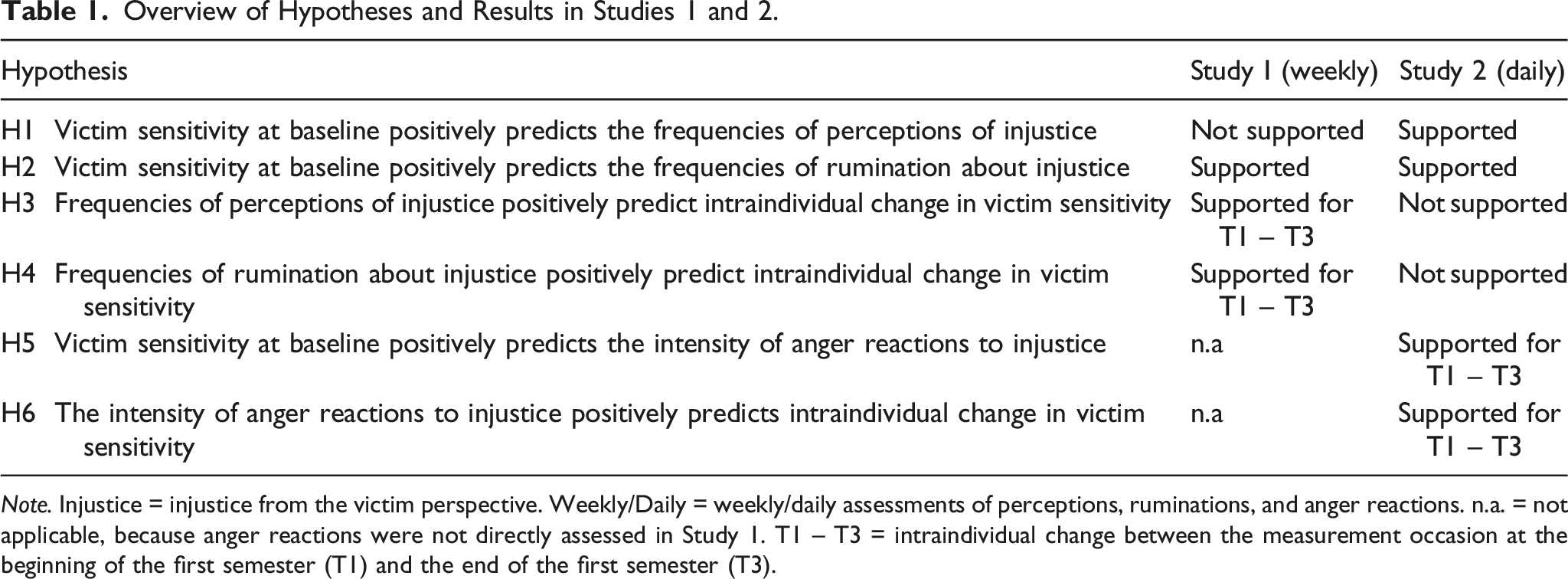
Note. Injustice = injustice from the victim perspective. Weekly/Daily = weekly/daily assessments of perceptions, ruminations, and anger reactions. n.a. = not applicable, because anger reactions were not directly assessed in Study 1. T1 – T3 = intraindividual change between the measurement occasion at the beginning of the first semester (T1) and the end of the first semester (T3).
In Study 2, we complemented the cognitive processes with an indicator of emotional reactivity. We tested whether the intensity of anger reactions to injustice would be positively predicted by dispositional levels of victim sensitivity (H5); and whether, in turn, anger reactivity would positively predict intraindividual dispositional change (H6). In Study 2, we also scrutinized the specificity of the links between momentary processes and dispositional victim sensitivity, in comparison with the broad personality factor neuroticism. We explored whether the momentary processing of injustice would also predict change in neuroticism over time; but we expected that such relations, if they exist at all, would be weaker than for the more specific dispositions of victim sensitivity. 1
In both studies, our samples consisted of young adults during their first year at university. The transition to university involves substantial contextual changes that should allow for new patterns of experiences and their cognitive and emotional processing that deviate from the patterns an individual is used to (e.g., Oswald & Clark, 2003; Wagner et al., 2014). We assessed dispositional victim sensitivity at baseline shortly after (Study 1) or before (Study 2) the start of their first semester. During the first weeks at university, we scheduled an intensive assessment phase to collect self-reports of momentary processes on a weekly (Study 1) or daily (Study 2) basis. These assessment schedules have the important advantage that they minimize memory effects that can overemphasize personality-congruence in retrospectively reported processes (Robinson & Clore, 2002). However, intensive assessments also involve the danger of triggering reactivity, for example, by making participants particularly sensitive to the topic of injustice. To rule out this threat to the validity of our findings, in Study 2, we included an experimental design in which we compared a group with an intensive assessment phase with a control group without such a phase.
Further, to explore the time scale at which patterns of momentary processing might exert their influence on dispositional change, in both studies, we assessed intraindividual change in victim sensitivity between baseline and three further measurement occasions across 1 year, namely at 2 and 4 months (i.e., middle and end of first semester) and at 12 months (start of third semester) after the baseline assessment. Theoretical frameworks concerned with the role of experiences for personality change converge in the proposition that enduring change most likely requires the repeated manifestation of corresponding states (Fleeson, 2001; Geukes et al., 2017; Wrzus & Roberts, 2017). In our case, if individuals experience new patterns of perceiving, ruminating, and being angry about injustice after transitioning to university, dispositional changes should need some time to precipitate to the global self-report of victim sensitivity.
Transparency Statement. We did not preregister our hypotheses before data collection, with the only reason that this had not been common practice at that time. Sample sizes were determined pragmatically aiming at the greatest possible samples, given time and financial restrictions. No apriori power analyses were conducted, but post-hoc power and sensitivity analyses for bivariate relationships between two (person-level) variables are reported at: https://osf.io/k493y/. Under that link, you also find the complete material, data, and scripts for both studies.
Study 1
Method
Sample and Design
In October 2012, at the beginning of the winter semester, first-year students at a German university were invited to participate in a study on “Everyday experiences.” The study involved a longitudinal design with four measurement occasions (T1 to T4) across 1 year and an intensive assessment phase with six weekly assessments between T1 and T2. A total of N = 150 students (78% women) with diverse majors completed the assessment at T1. We strictly complied with the ethical guidelines of the German Psychological Association.
As we focused on young adulthood, we excluded data from one person who was over the age of 40. Consequently, ages ranged from 18 to 32 years (M = 20.56, SD = 2.19), with only one person older than 30 years. 2 At T2, N = 135 participants returned to participate; at T3, N = 130; and at T4, N = 86. One hundred forty-six students participated in the intensive assessment phase. On average, these participants completed 5.59 out of 6 weekly assessments (SD = 1.04, Min = 1, Max = 6). Only 10 participants completed fewer than 4 weekly assessments. As explained in detail in the Supplement, their data were excluded from all analyses involving the weekly assessments. Hence, the main analyses that were based on the weekly data included 794 weekly assessments nested in 136 individuals.
Procedure
At measurement occasions T1 to T4, victim sensitivity was assessed. T1 took place in Weeks 2 and 3 of the semester. Starting at the end of the third week of the semester, 6 weekly assessments followed. During this intensive assessment phase, at the end of each week, participants were asked about their perceptions of and rumination about injustice during the previous 6 days. Assessments identical to T1 took place right before Christmas break (T2), in the week before the last week of the semester (T3), and during the first week of the winter semester 1 year after T1 (T4). All questionnaires were programmed and administered by means of the online assessment tool LimeSurvey (2015). More information on the intensive assessment schedule and the incentivization of participation is provided in the Supplement.
Dispositional Measures
Victim sensitivity. At T1, T2, T3, and T4, the Justice Sensitivity Inventory (Schmitt et al., 2010) served to measure victim sensitivity with 10 items (e.g., “It makes me angry when others are undeservingly better off than me”). Response options ranged from 0 (totally disagree) to 5 (totally agree).
Note that neuroticism was also measured in Study 1, but only at three measurement occasions and with an ultrashort 2-item scale. In data analyses, we obtained estimation problems, so we omitted neuroticism from Study 1 (see Supplement for the details.)
Weekly Measures
Perceived Injustice. Participants were instructed to think of the past 6 days and report how frequently a situation had occurred in which they were unjustly disadvantaged or treated unfairly, by means of five items (e.g., “I was treated in a less friendly manner than I deserved;” for all items see supplement). Response options ranged from 0 (never) to 4 (more than three times). For each week, we calculated the mean across the five items.
Rumination About Injustice. Items on rumination were introduced by “Sometimes our thoughts stick to a certain topic, and we keep thinking about situations we experienced. How was this for you during the last 6 days?”. Two items were employed (e.g., “I had to think of a situation where I was treated unfairly”). Response options ranged from 0 (totally disagree) to 5 (totally agree). For each weekly assessment, we calculated a mean score across the two items.
Missing Data
Testing for attrition effects (for details, see Supplement) indicated that the assumption that values were missing completely at random (MCAR) did not have to be rejected. Consequently, we used full information maximum likelihood (FIML) as an estimator in our main analyses (Enders, 2010).
Models for Data Analyses
As a preparatory step, we specified a latent state (LS) model for victim sensitivity (see Figure 1) and tested for measurement invariance (MI) over time by applying a structural equation modeling approach using Mplus 8 (Muthén & Muthén, 1998-2017). For a meaningful analysis of change, at least strong measurement invariance over time (i.e., equal loadings and intercepts over time) is needed (e.g., Widaman & Reise, 1997). As observed indicators of victim sensitivity, we used three item parcels at each measurement occasion. Parcels were constructed following the item-to-construct balancing approach (Little et al., 2002). To model indicator-specific variance over time, we defined Parcel 1 as the reference indicator and included two indicator-specific (IS) factors in the model, for Parcels 2 and 3, respectively (Geiser et al., 2010). Covariances of the IS factors with the LS factors were fixed to zero. We tested for configural, weak, and strong invariance across measurement occasions by restricting the loadings and intercepts to equality in a stepwise procedure. For model comparisons, we applied change in the CFI (ΔCFI > .01; Cheung & Rensvold, 2002; Isiordia & Ferrer, 2018) as the criterion. Latent State Model of Victim Sensitivity (VS) with Strong Measurement Invariance across Measurement Occasions. Note. Y
it
: ith parcel measured at time t. λ
i
: latent state factor loading. ε
it
: measurement error of ith parcel i at time t. For readability, most ε
it
have been omitted from the figure. IS: indicator-specific latent factor. VS: latent state factor for victim sensitivity. Intercepts are not shown in the figure.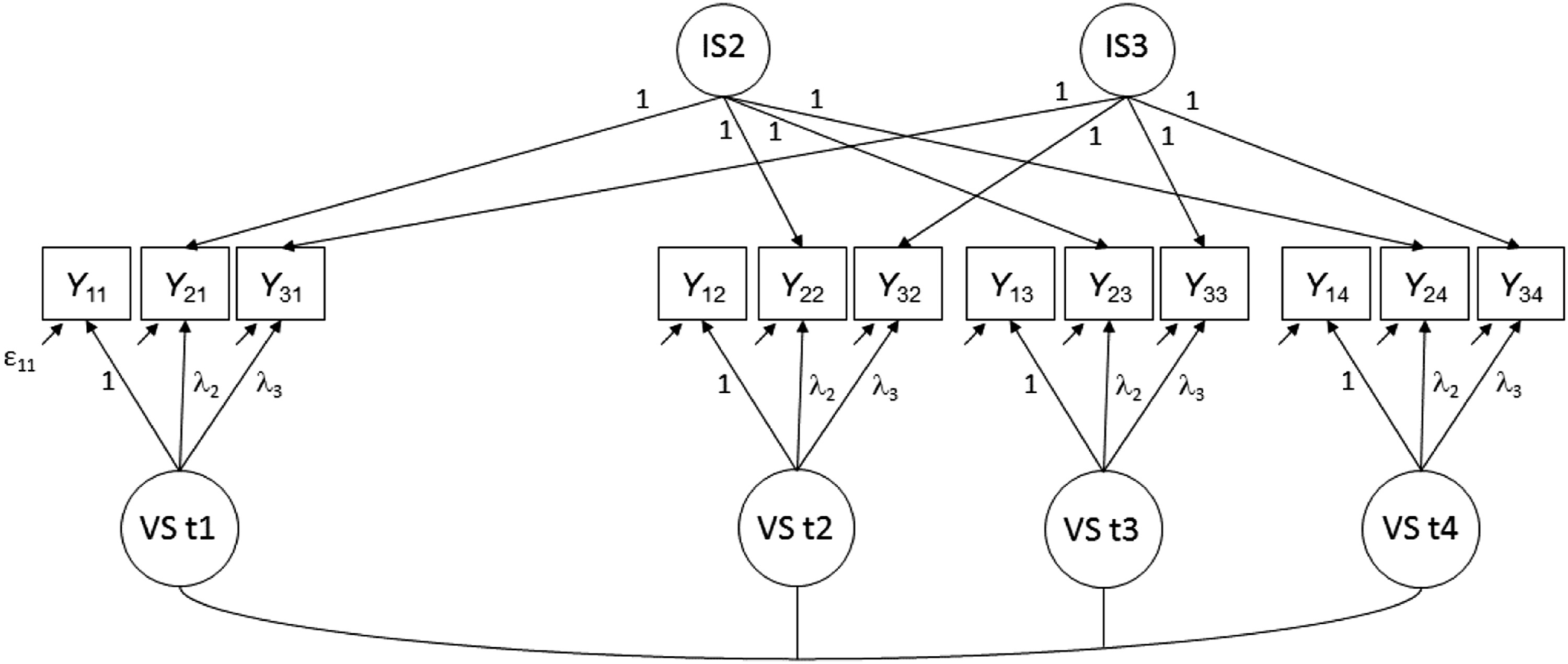
To analyze individual differences in intraindividual change in victim sensitivity, we reformulated the LS model with strong invariance across measurement occasions as latent change (LC) model (see Figure 2; Geiser et al., 2010). In this model, the LC factors represent individual differences in latent (i.e., measurement-error-free) intraindividual change in victim sensitivity between the first measurement occasion (baseline) and each of the subsequent measurement occasions (Diff21, Diff31, and Diff41). Note that by modeling separate LC factors, we could explore at what time scale interindividual differences in (latent) intraindividual change would be predicted by the momentary processes at the beginning of the first semester at college. Latent Change (LC) Model of Victim Sensitivity (VS). Note. Y
it
: ith parcel measured at time t. λ
i
: latent state factor loading. ε
it
: measurement error of ith parcel i at time t. For readability, most ε
it
have been omitted from the figure. IS: indicator-specific latent factor. VS: latent state factor for victim sensitivity. Diff: LC factors reflecting intraindividual change between baseline VS t1 and VS t2 (Diff21), VS t3 (Diff31), or VS t4 (Diff41), respectively. Correlations between LC factors and baseline VS are estimated, but not depicted in the figure.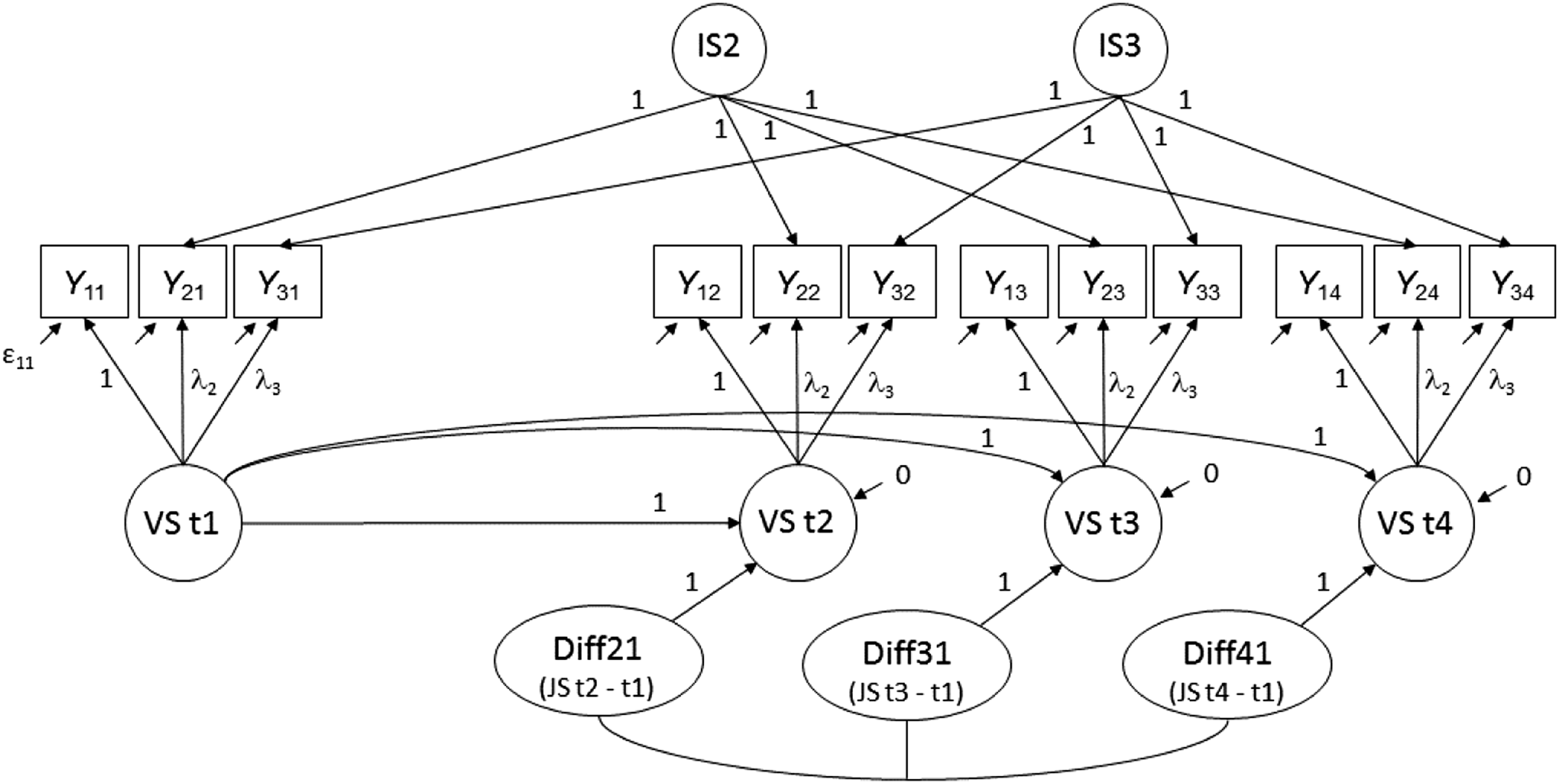
To test whether momentary processes predicted individual differences in (latent) intraindividual change in victim sensitivity, we extended the LC model to include a multilevel structure for the weekly perceptions of (or rumination about) injustice (see Figure 3). That is, we used a multilevel structural equation modeling approach (Asparouhov & Muthén, 2019). In the multilevel LC models, the LC model for change in dispositional victim sensitivity was situated on Level 2 (individuals), and the weekly perceptions of (or rumination about) injustice were modeled on both Level 1 (weeks) and Level 2 (individuals). The observed weekly variable X
mi
(where m represents weeks and i represents individuals) for perceptions of (or rumination about) injustice was decomposed into a within-person part (XW) and a between-person part (XB). The between-person part (XB) can be interpreted as the person-specific means (i.e., individuals’ average frequency of perceiving [or ruminating about] injustice) across weeks. The (uncentered) between-person variable XB served as a Level 2 covariate of baseline victim sensitivity and as a Level 2 predictor of the LC factors. To account for the nonnormal distribution of the variables of weekly assessments, we employed MLR as a robust estimator for all multilevel LC models. Multilevel Latent Change Model with Perception of (or Rumination about) Injustice as Predictor of Latent Difference Factors. Note. The observed weekly variable X
mi
(m: weeks and i: persons) is decomposed into a within-person part (XW) and a between-person part (XB). At level 2, the change in victim sensitivity (VS) is estimated using a latent change modeling approach. For simplicity, only the structural part (but not the measurement part) of the latent change model for victim sensitivity is depicted. VS t1, VS t2, VS t3, VS t4: Victim sensitivity at time point 1, time point 2, time point 3, time point 4. Diff21, Diff31, and Diff41: Latent difference factors.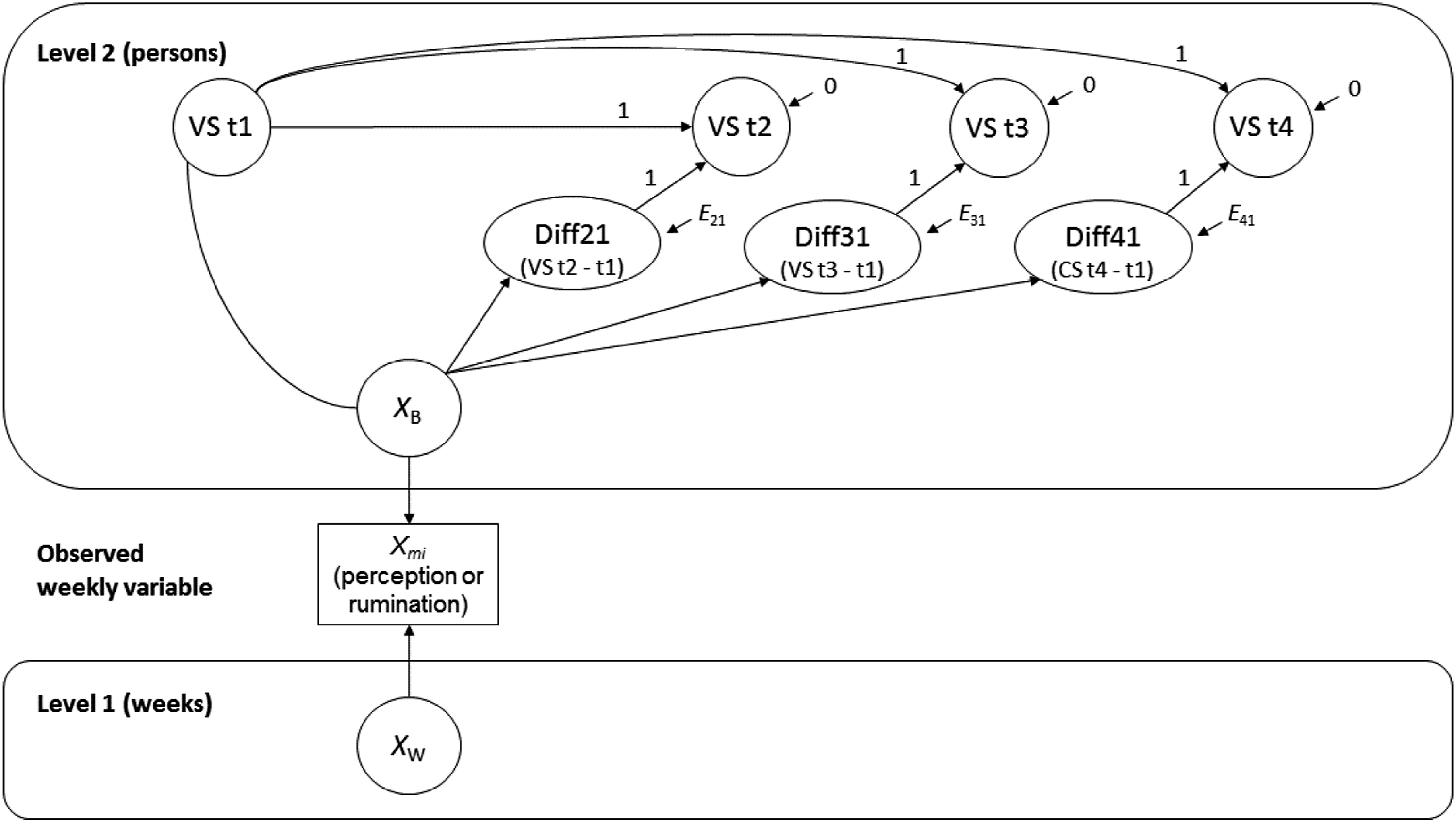
To test our directed hypotheses, we employed one-sided significance tests (Cho & Abe, 2013). For reasons of consistency, we provide two-sided p-values and 95% confidence intervals for all parameter estimates in our results tables. To account for the fact that we tested our hypotheses 3 and 4 with three significance tests each (i.e., with three LC factors Diff21, Diff31, and Diff41 to explore the time scale of effects), we corrected for multiple testing using Benjamini and Hochberg’s (1995) procedure for controlling the false-discovery rate (FDR). In this sequential procedure, a critical threshold is calculated for each ranked observed p-value using the equation (i/m)*Q, where m is the number of statistical tests, i is the assigned rank (from 1 to m), and Q is the prespecified FDR. Accordingly, for m = 3 significance tests per hypothesis and Q = .05, we compared the three ranked one-sided p-values to the critical thresholds .0166, .0333, and .05.
Results
Preparatory Analyses
Within-Person Correlations (Below Diagonal) and Between-Person Correlations (Above Diagonal) and Descriptive Statistics for Weekly Covariates in Study 1.
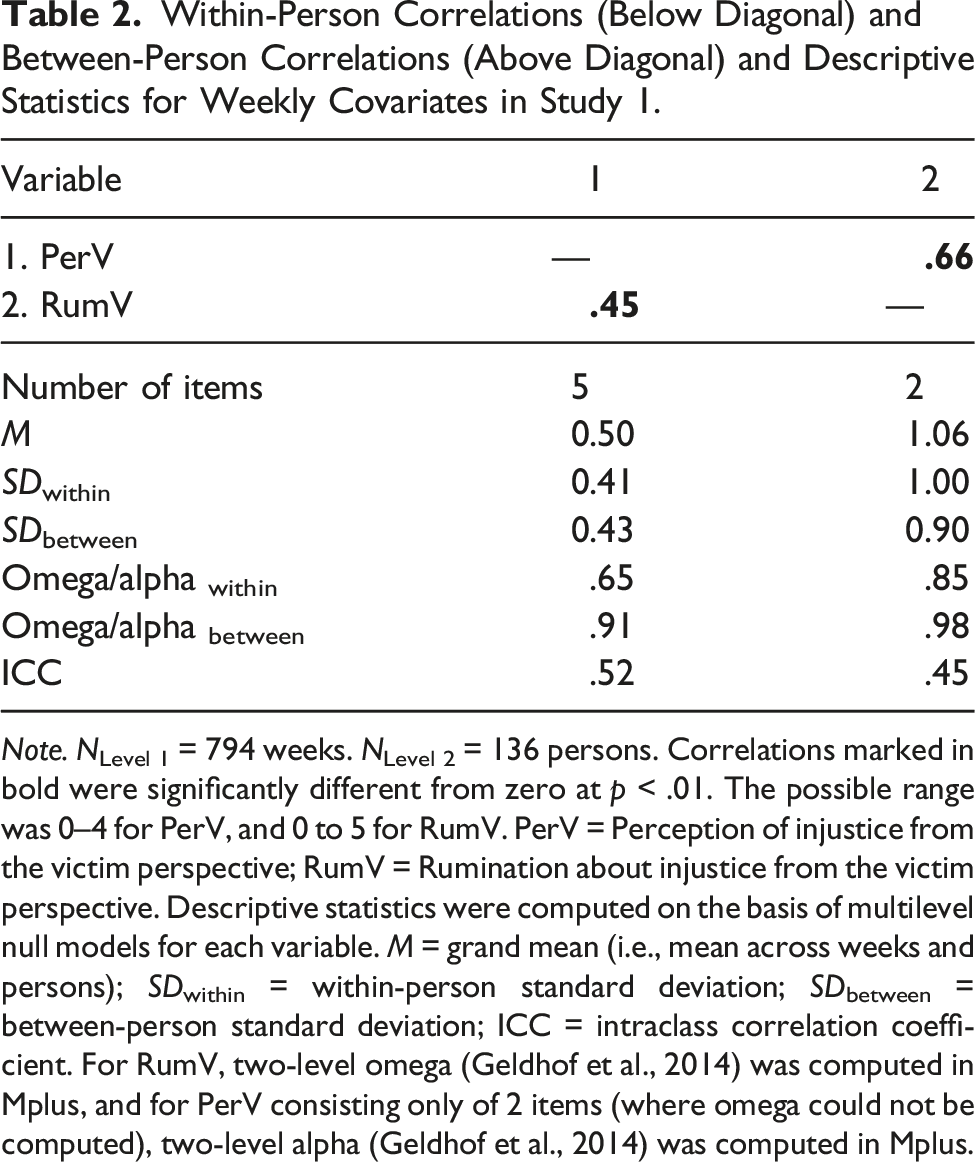
Note. NLevel 1 = 794 weeks. NLevel 2 = 136 persons. Correlations marked in bold were significantly different from zero at p < .01. The possible range was 0–4 for PerV, and 0 to 5 for RumV. PerV = Perception of injustice from the victim perspective; RumV = Rumination about injustice from the victim perspective. Descriptive statistics were computed on the basis of multilevel null models for each variable. M = grand mean (i.e., mean across weeks and persons); SDwithin = within-person standard deviation; SDbetween = between-person standard deviation; ICC = intraclass correlation coefficient. For RumV, two-level omega (Geldhof et al., 2014) was computed in Mplus, and for PerV consisting only of 2 items (where omega could not be computed), two-level alpha (Geldhof et al., 2014) was computed in Mplus.
Correlations and Descriptive Statistics for Person-Level Covariates in Study 1.
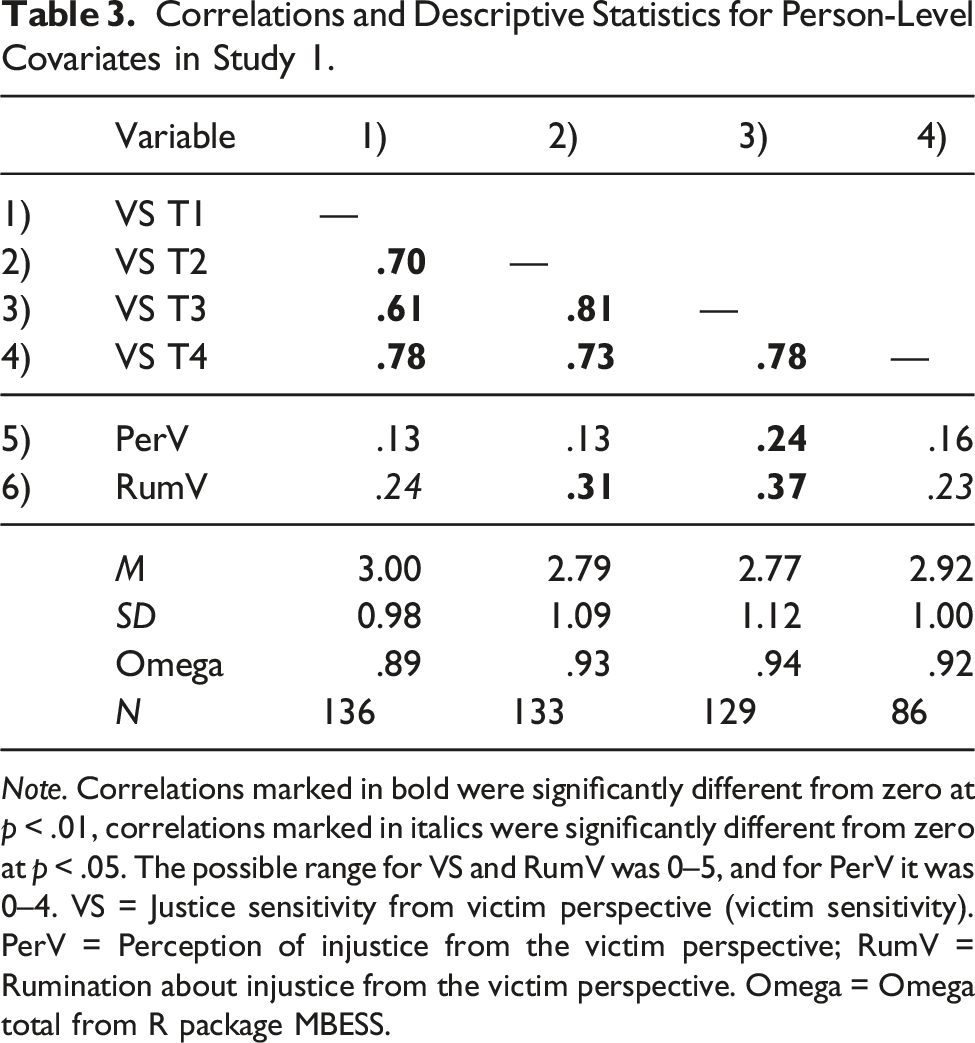
Note. Correlations marked in bold were significantly different from zero at p < .01, correlations marked in italics were significantly different from zero at p < .05. The possible range for VS and RumV was 0–5, and for PerV it was 0–4. VS = Justice sensitivity from victim perspective (victim sensitivity). PerV = Perception of injustice from the victim perspective; RumV = Rumination about injustice from the victim perspective. Omega = Omega total from R package MBESS.
Model Fit Indices for Latent State Models with Different Degrees of Measurement Invariance (MI) in Study 1 (Upper Part) and Study 2 (Lower Part).
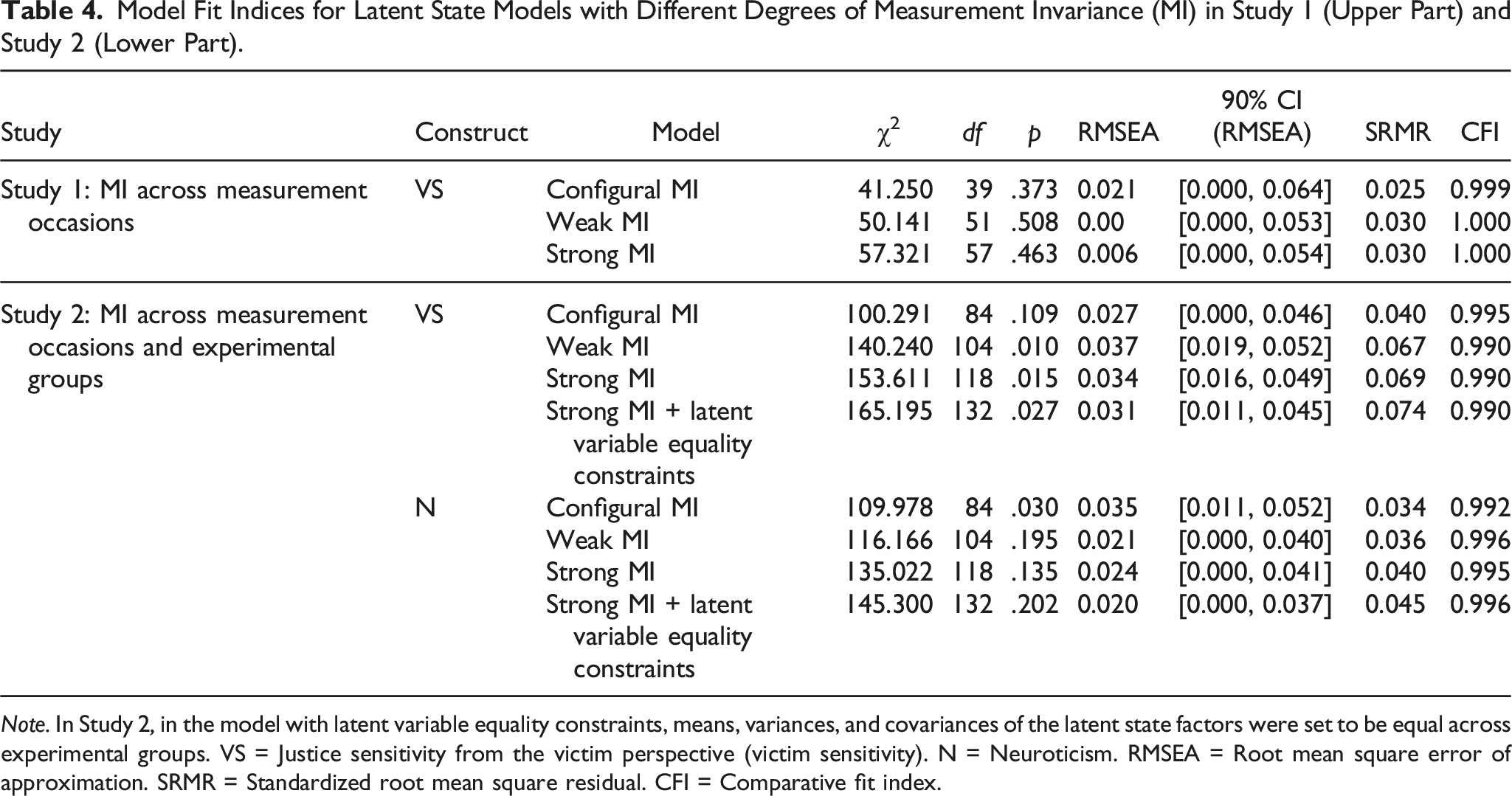
Note. In Study 2, in the model with latent variable equality constraints, means, variances, and covariances of the latent state factors were set to be equal across experimental groups. VS = Justice sensitivity from the victim perspective (victim sensitivity). N = Neuroticism. RMSEA = Root mean square error of approximation. SRMR = Standardized root mean square residual. CFI = Comparative fit index.
Latent Means of Latent Change (LC) Factors in Study 1 (Upper Part) and Study 2 (Lower Part).
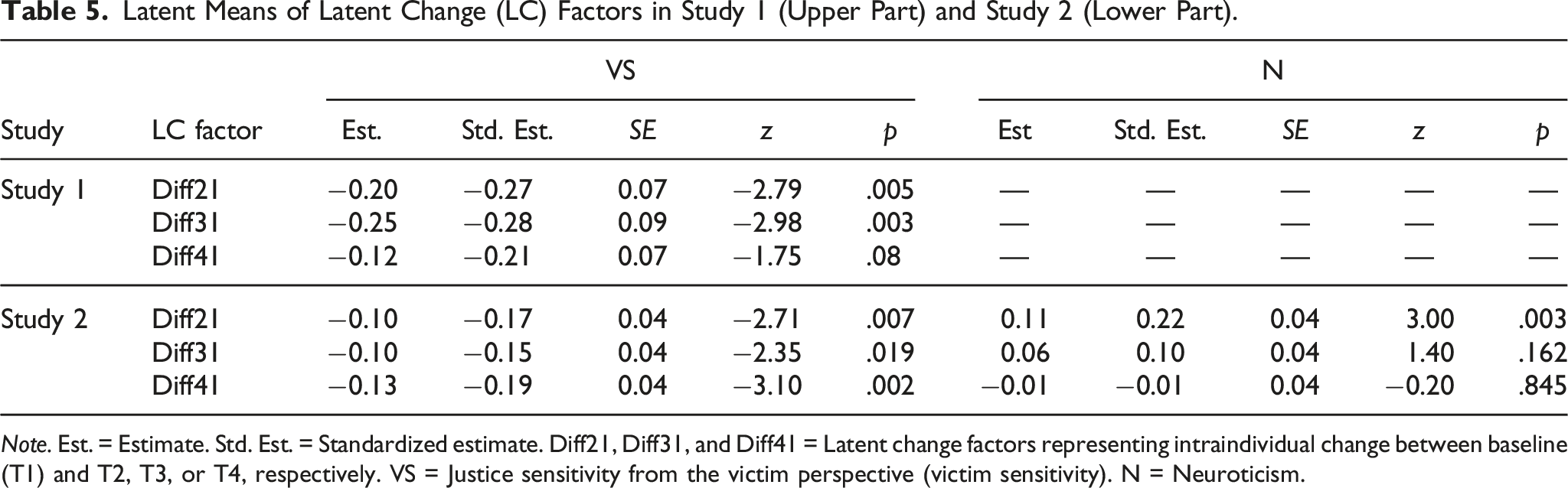
Note. Est. = Estimate. Std. Est. = Standardized estimate. Diff21, Diff31, and Diff41 = Latent change factors representing intraindividual change between baseline (T1) and T2, T3, or T4, respectively. VS = Justice sensitivity from the victim perspective (victim sensitivity). N = Neuroticism.
Hypothesis Testing
Parameter Estimates for the Level 2 Person Mean of Weekly Perceptions of Injustice (Model 1) or Weekly Rumination about Injustice (Model 2) as a Covariate of Baseline Victim Sensitivity and as a Predictor of the Victim Sensitivity Latent Change Factors in Study 1.
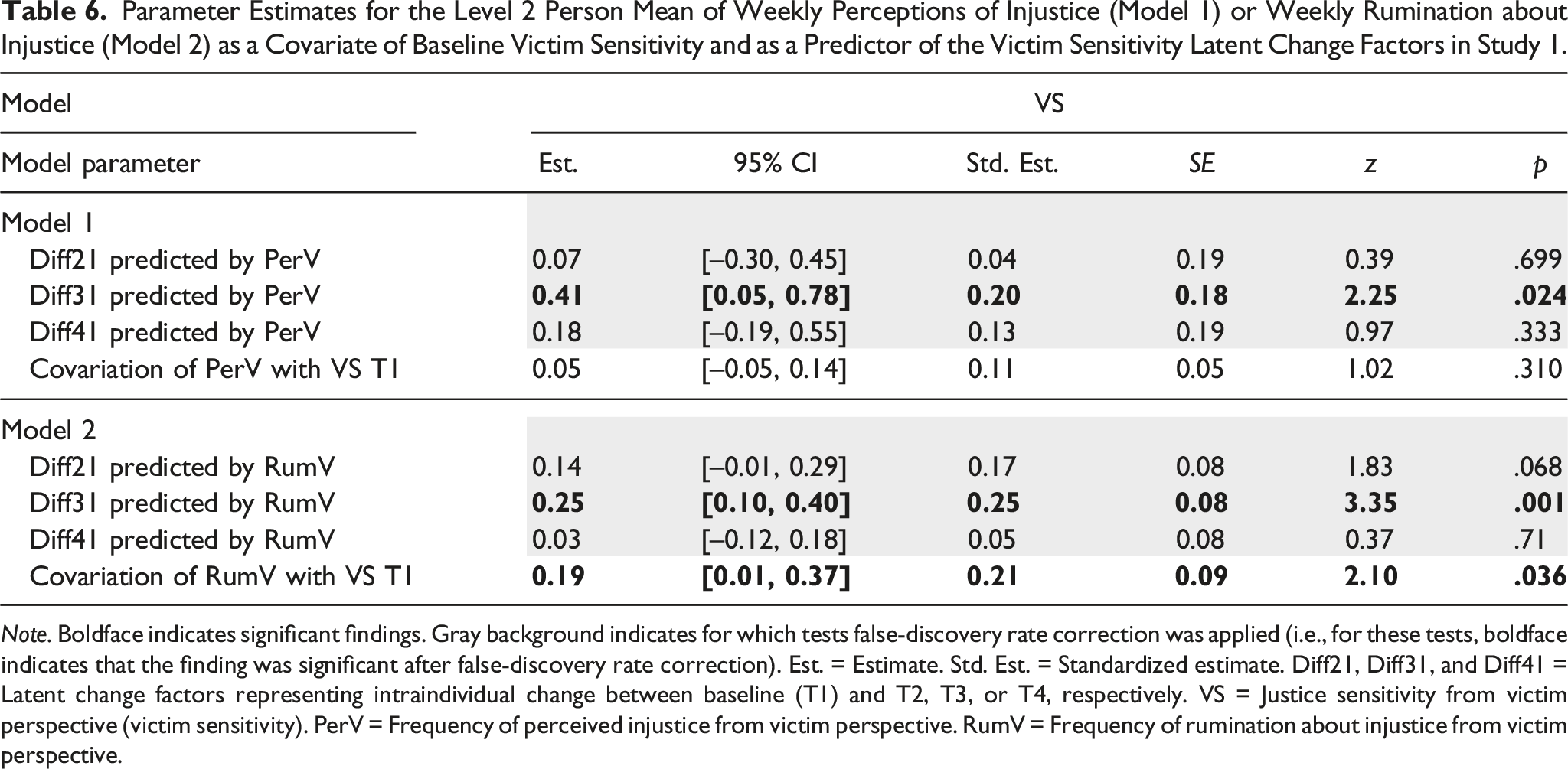
Note. Boldface indicates significant findings. Gray background indicates for which tests false-discovery rate correction was applied (i.e., for these tests, boldface indicates that the finding was significant after false-discovery rate correction). Est. = Estimate. Std. Est. = Standardized estimate. Diff21, Diff31, and Diff41 = Latent change factors representing intraindividual change between baseline (T1) and T2, T3, or T4, respectively. VS = Justice sensitivity from victim perspective (victim sensitivity). PerV = Frequency of perceived injustice from victim perspective. RumV = Frequency of rumination about injustice from victim perspective.
With regard to dispositional change, perceiving injustice at a higher frequency positively predicted change in dispositional victim sensitivity between baseline and T3 (consistent with H3). Also (consistent with H4), more rumination about injustice positively predicted change in victim sensitivity between baseline and T3.
When interpreting these results, it has to be kept in mind that on average, victim sensitivity declined over time. For participants who reported frequently perceiving injustice, the intraindividual decline in victim sensitivity was significantly less steep than for those who reported fewer perceptions of injustice. To exemplify this pattern more concretely, for participants at 1 SD above the mean of perceived injustice (perception score of 0.93), the predicted LC factor score for Diff31 was −0.07, and for participants at 1 SD below the mean of perceived injustice (perception score of 0.07), the predicted LC factor score for Diff31 was −0.42.
Discussion
By investigating the momentary processing of experienced injustice in students during their first weeks of transitioning to university, we aimed to illuminate how victim sensitivity shapes the processing of day-to-day experiences and how these processes in turn might be involved in dispositional change.
We found evidence for one of the hypothesized links between baseline levels in victim sensitivity and momentary processes. Victim sensitivity at T1 positively predicted how often individuals reported thinking about injustice they had experienced in daily life, but not how often they reported to have perceived such injustice. This resonates with findings that had emerged during the construction phase of the Justice Sensitivity Inventory, namely that items measuring the frequency of perceived injustice in retrospect correlated only weakly with items measuring rumination and emotional reactivity indicators of justice sensitivity (Schmitt, 1996).
Turning to the revealed predictors of dispositional change in victim sensitivity, these emphasize the relevance of perceptual and ruminative processes. Medium term change in victim sensitivity was predicted by the frequency of perceiving injustice and the frequency of ruminating about it in daily life. In light of the general downward trend in victim sensitivity that we observed in our sample across this time, this means that frequent perceptions or rumination seemed to have buffered a decline in victim sensitivity. In sum, Study 1 provided important first insights into the momentary cognitive processes involved in victim sensitivity and its development.
Study 2
With Study 2, we aimed to test again our hypotheses on the links between the momentary cognitive processing of suffered injustice and levels and change in victim sensitivity (H1–H4, see Table 1). Complementing the cognitive processes, in Study 2, participants were asked to report the intensity of experienced anger in response to perceived injustice. We tested whether baseline levels of victim sensitivity would be linked to stronger anger reactivity to perceived injustice (H5), and whether anger reactivity would positively predict intraindividual changes in victim sensitivity across time (H6). Besides dispositional victim sensitivity, we measured neuroticism with a well-established questionnaire at the four measurement occasions across 1 year to test whether links between momentary processes and victim sensitivity would generalize to the global personality factor of neuroticism. Victim sensitivity has been shown to correlate with neuroticism (r ≈ .30; Schmitt et al., 2005), and previous developmental studies have found that intraindividual change in neuroticism was related to experiences of social conflict and negative affect in response to conflict (Borghuis et al., 2020). So, it is possible that the momentary processing of injustice could also predict change in neuroticism over time. Yet, victim sensitivity is nonredundant with neuroticism and its facets (Schmitt et al., 2010), and should capture individual differences related specifically to perceiving and reacting (cognitively and emotionally) to potential injustice, whereas at the high level of aggregation represented by the personality factor neuroticism, psychological processes are collapsed across very different contexts and contents (Asendorpf, 2016; Baumert et al., 2017; Mõttus et al., 2020; Wood et al., 2015). Therefore, we expected that relations with the momentary processing of injustice, if they exist at all, would be weaker for neuroticism than for the more specific disposition of victim sensitivity.
Furthermore, in Study 2, we aimed to optimize the intensive assessment phase. The weekly assessments of momentary processes in Study 1 could have been a potential methodological limitation. Whereas arguably the impact of memory processes should be reduced compared with assessments that are spaced further apart (e.g., yearly assessments), reports of perceived injustice and rumination might still be distorted in recollection, for example, by the emotional relevance of experiences. To overcome these limitations, in Study 2, we used daily assessments instead of weekly assessments of momentary processes, and, as stated above, we included a measure of momentary emotional processing of injustice, namely intensity of anger reactions. Importantly, to rule out potential reactivity effects from the daily assessments (Barta et al., 2012), we used an experimental design and included a control group that did not participate in an intensive assessment phase. This allowed us to compare dispositional change between the experimental group (with daily assessments) and the control group (without daily assessments).
Method
Sample and Design
In September and October of 2014, before the winter semester began, first-year university students across Germany were invited to participate in a study titled “How do your studies change you?” via mass e-mails and social networks. Like Study 1, Study 2 consisted of four assessments (T1, T2, T3, and T4) of dispositional victim sensitivity, as well as neuroticism across 1 year. Participants were randomly assigned to one of two groups: Part of the sample completed a 3-week intensive assessment phase between T1 and T2 with daily assessments that served to measure the momentary processing of injustice (daily assessment group); the other part of the sample did not have these daily assessments (control group). Among the students who registered to participate, every fourth one was invited into the control group; all others were invited into the daily assessment group. Our research was approved by the university’s Institutional Review Board.
At T1, 514 students (83% female; n = 365 in the daily assessment group; n = 149 in the control group) completed the assessment. Due to our focus on young adulthood, we excluded the data of one person who was over 40 years of age at that time (e.g., Helson et al., 2006). Consequently, the ages ranged from 16 to 36 years (M = 19.54, SD = 2.13), with only 3 persons older than 30 years. The universities that participants attended were distributed across all federal states of Germany. The majority of participants (67.3%) reported that they had moved to pursue their studies. At T2, n = 333 (daily assessment group: 240/control group: 93) returned to participate, at T3, n = 305 (224/81), and at T4, n = 316 (233/83).
Out of the 365 partipants who had been assigned to the daily assessment group, 28 participants did not provide any daily data, either because they did not respond to the invitations or due to technical problems. Participants who took part in the intensive assessment phase completed 15.82 out of 21 daily assessments on average (SD = 5.88, Range: 1–21). Eighty percent of participants completed at least 7 of the 21 daily assessments. Their data (5185 daily assessments nested in 292 individuals) were employed for the main analyses involving measures of momentary processes (for details on data exclusion, see Supplement).
Procedure
T1 took place before the semester began. T2 took place in the middle of the winter semester (i.e., 2 months after T1), and T3 at the end of the winter semester (i.e., 4 months after T1). Finally, T4 was scheduled 1 year after T1, before the beginning of the third semester. For the daily assessment group, the intensive assessment phase took place during Weeks 3–5 of the winter semester. During this phase, every evening at 5 p.m., participants received an email containing a link to a daily survey that had to be completed by 6 a.m. the next day. After this, the link expired.
The assessments at T1, T2, T3, and T4 were programmed with Inquisit Millisecond Software (2015) and administered via a web license. The daily assessments were administered by means of the SoSci Survey online assessment tool (Leiner, 2014), and took 5 min per assessment to complete. Participants were asked to report on injustice they had perceived during the day, their emotional reactions to perceived injustice, and whether they had ruminated about injustice (for details on incentivization, see Supplement).
Dispositional Measures
Victim sensitivity. As in Study 1, the Justice Sensitivity Inventory (Schmitt et al., 2010) was employed to measure victim sensitivity with 10 items. Response options ranged from 0 (totally disagree) to 5 (totally agree).
Neuroticism. The NEO-FFI (Borkenau & Ostendorf, 1993) served to assess the broad personality factor of neuroticism with 12 items (e.g., “I don’t get nervous easily,” recoded). Response options ranged from 0 (totally disagree) to 5 (totally agree).
Daily Measures
Perceived Injustice
Participants were instructed to think of the present day since the last daily assessment and to respond yes (1) or no (0) to three items asking whether they had experienced injustice from the victim perspective (i.e., two items tapping into distributional and interpersonal injustice were adopted from Study 1, and “In a decision process, my opinions were disregarded” was added as a third item tapping into procedural injustice). For each day, we combined responses to the three items by coding whether participants had responded “yes” to any of the three items (i.e., 1 = injustice perceived) versus whether participants had responded “no” to all of the three items (i.e., 0 = no injustice perceived).
Intensity of Anger Reactions to Injustice
If individuals reported that they had perceived injustice during the day, they were further asked how they felt when they thought about the respective situation. Two items assessed anger reactions (“angry,” “outraged”), with response options ranging from 1 = not at all to 4 = very strongly, and were aggregated for a measure of anger reactivity (for details on data exclusions, see supplement).
Rumination About Injustice
One item served to measure rumination (“During the day, I had to think of a situation where I was treated unfairly”). The response format was dichotomous (1 = yes vs. 0 = no).
Missing Data
Testing for attrition effects (see Supplement) indicated that the assumption that values were missing completely at random (MCAR) did not have to be rejected. So we used full information maximum likelihood (FIML) as an estimator in our main analyses.
Models for Data Analyses
As a preparatory step, we tested for strong MI across measurement occasions and across experimental conditions (control group vs. daily assessment group). For victim sensitivity, we specified a multigroup extension of the LS model as depicted in Figure 1 (for the daily assessment group and the control group) and restricted the loadings and intercepts to equality across time points and experimental groups in a stepwise procedure.
To scrutinize whether the daily assessments resulted in reactivity effects (i.e., whether the assessment method itself led to changes in victim sensitivity), we reformulated the multigroup LS model, which had strong MI over time and groups, as a multigroup LC model. By restricting the LC factor means, variances, and covariances to equality across the experimental groups, we tested whether the daily assessment group differed from the control group in the degree of intraindividual change in victim sensitivity over time (and individual differences therein).
Next, using the data from the daily assessment group, we tested our hypotheses about the associations between momentary cognitive and emotional processes and (change in) victim sensitivity over time. Analogously to Study 1, we specified a LC model with strong MI over time, and extended it to include a multilevel structure for the daily assessments nested in participants (similar to the model depicted in Figure 3, but with daily assessments at Level 1). The observed daily variable X mi (where m represents days in this study and i represents individuals) for perceptions of (respectively rumination or anger about) injustice was decomposed into a within-person part (XW) and a between-person part (XB). For perception (rumination, respectively), the between-person part XB (i.e., the person-specific means) can be interpreted as the proportion of days on which individuals reported having perceived (ruminated about, respectively) injustice. For anger reactivity, the person-specific means represent individuals’ average intensity of anger across all days on which injustice was perceived. We tested whether the person-specific means for perception (or rumination or anger reactivity, respectively) at Level 2 (person level) were related to baseline dispositional victim sensitivity, and whether these (uncentered) person-specific means predicted individual differences in intraindividual change in dispositional victim sensitivity over time (i.e., LC factors). Finally, we explored the specificity of our findings. We specified a (multilevel) LC model for neuroticism and tested, in separate models, whether the (uncentered) person-specific means for perceptions (or rumination or anger reactivity, respectively) covaried with baseline levels of neuroticism and whether they predicted change in neuroticism over time.
We used a robust estimator (MLR) for the multilevel LC models. To test our directed predictions, we used one-sided significance tests and corrected for multiple testing (Benjamini & Hochberg, 1995) as in Study 1.
Results
Within-Person Correlations (Below Diagonal) and Between-Person Correlations (Above Diagonal) and Descriptive Statistics for Daily Covariates in Study 2.
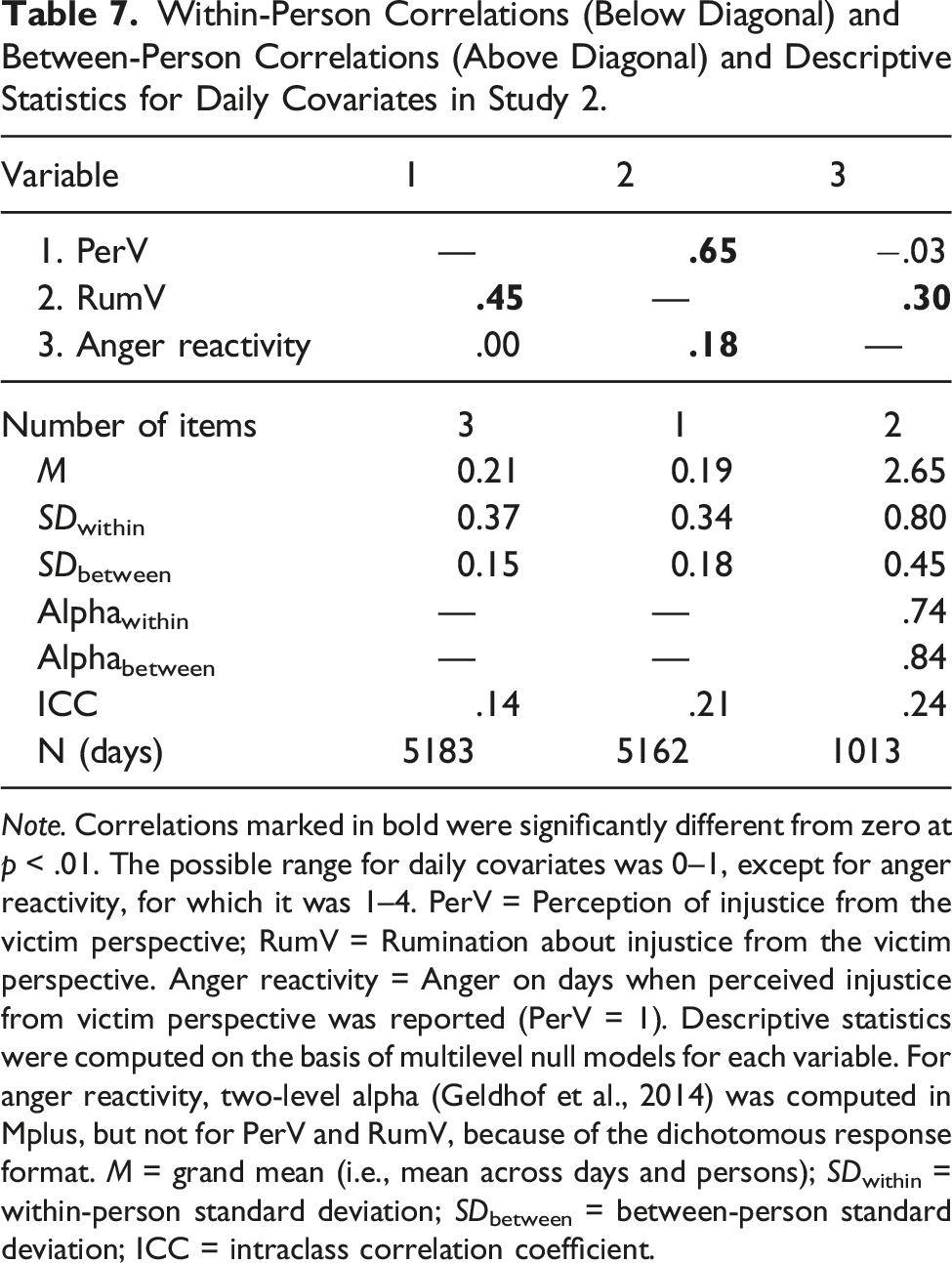
Note. Correlations marked in bold were significantly different from zero at p < .01. The possible range for daily covariates was 0–1, except for anger reactivity, for which it was 1–4. PerV = Perception of injustice from the victim perspective; RumV = Rumination about injustice from the victim perspective. Anger reactivity = Anger on days when perceived injustice from victim perspective was reported (PerV = 1). Descriptive statistics were computed on the basis of multilevel null models for each variable. For anger reactivity, two-level alpha (Geldhof et al., 2014) was computed in Mplus, but not for PerV and RumV, because of the dichotomous response format. M = grand mean (i.e., mean across days and persons); SDwithin = within-person standard deviation; SDbetween = between-person standard deviation; ICC = intraclass correlation coefficient.
Between-Person Correlations and Descriptive Statistics for Person-Level Covariates in Study 2, for Daily Assessment Group and Control Group.
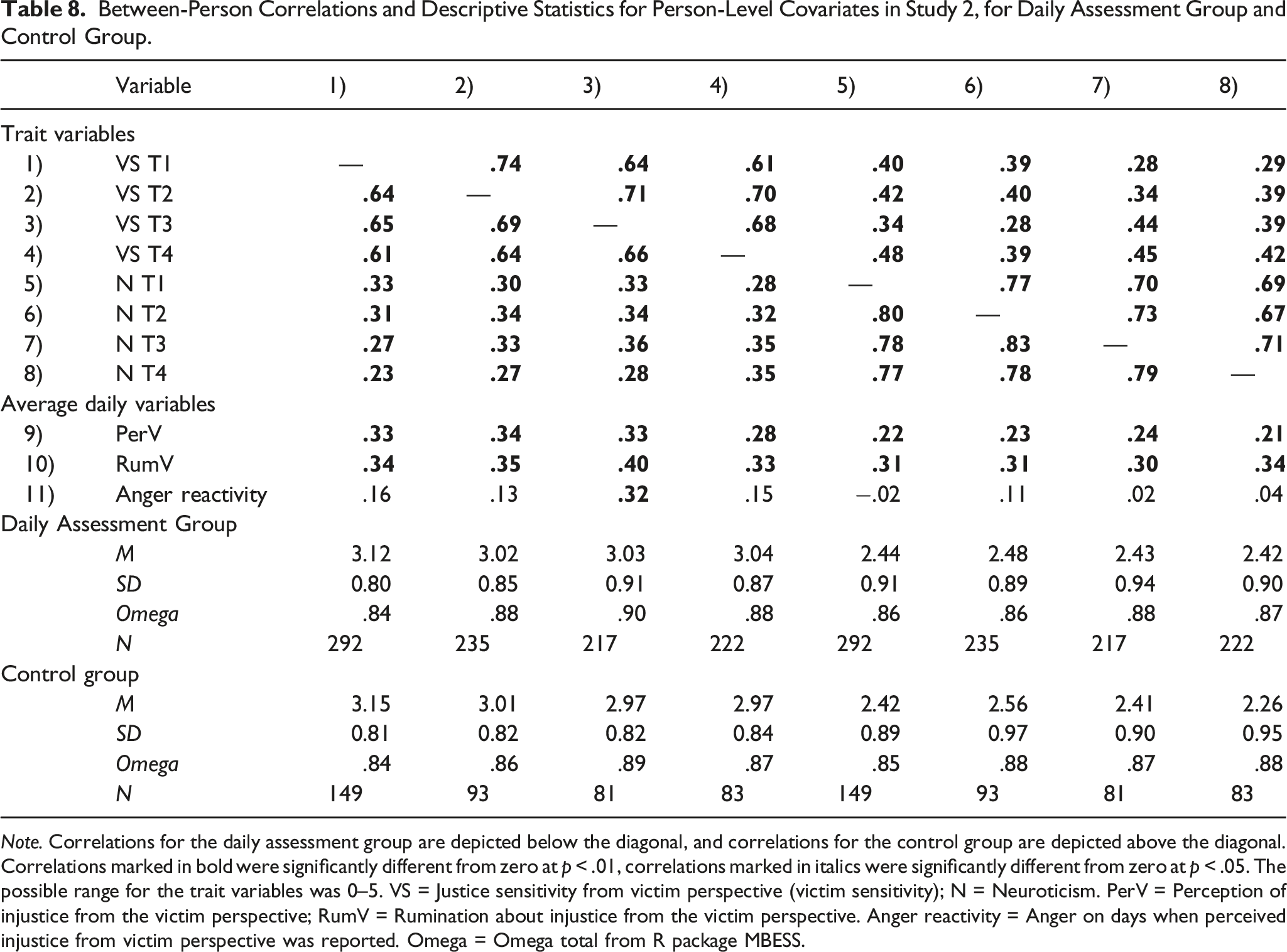
Note. Correlations for the daily assessment group are depicted below the diagonal, and correlations for the control group are depicted above the diagonal. Correlations marked in bold were significantly different from zero at p < .01, correlations marked in italics were significantly different from zero at p < .05. The possible range for the trait variables was 0–5. VS = Justice sensitivity from victim perspective (victim sensitivity); N = Neuroticism. PerV = Perception of injustice from the victim perspective; RumV = Rumination about injustice from the victim perspective. Anger reactivity = Anger on days when perceived injustice from victim perspective was reported. Omega = Omega total from R package MBESS.
Preparatory Analyses
MI Across Measurement Occasions and Experimental Groups
Model fit indices for the multigroup LS analyses with stepwise increasing restrictions are provided in Table 4 (lower part). Strong invariance (with loadings and item intercepts restricted to equality across measurement occasions and experimental groups) could be assumed for victim sensitivity and for neuroticism.
LC Models
We reformulated the multigroup LS models that had strong MI as multigroup LC models (see Figure 2; which are data-equivalent to the multigroup LS models with strong MI, and thus have identical fit indices). To scrutinize whether the intensive assessment phase had induced change in dispositional victim sensitivity, we compared the two experimental groups in terms of the latent means, latent variances, and latent covariances of the LC factors (see Table 4, lower part). Results indicated that the daily assessment group did not differ from the control group in average intraindividual change in victim sensitivity or in the degree of individual differences in intraindividual change, χ2 (14) = 11.58, p = .640. Across the experimental groups, the estimated means of the LC factors showed that, on average, victim sensitivity declined from T1 to T4 (see Table 5, lower part). Interestingly, we did not observe a parallel decline in neuroticism across time. Variance estimates for the LC factors were significantly different from zero for victim sensitivity (zs > 9.15, ps < .001) and for neuroticism (zs > 6.41, ps < .001), indicating that individuals differed in their intraindividual change over time.
Hypothesis Testing
Parameter Estimates for the Level 2 Person Means of Daily Perceptions of Injustice (Model 1), Rumination (Model 2), or Anger Reactivity (Model 3) as a Covariate of Baseline Victim Sensitivity and as a Predictor of the Victim Sensitivity Latent Change Factors in Study 2.
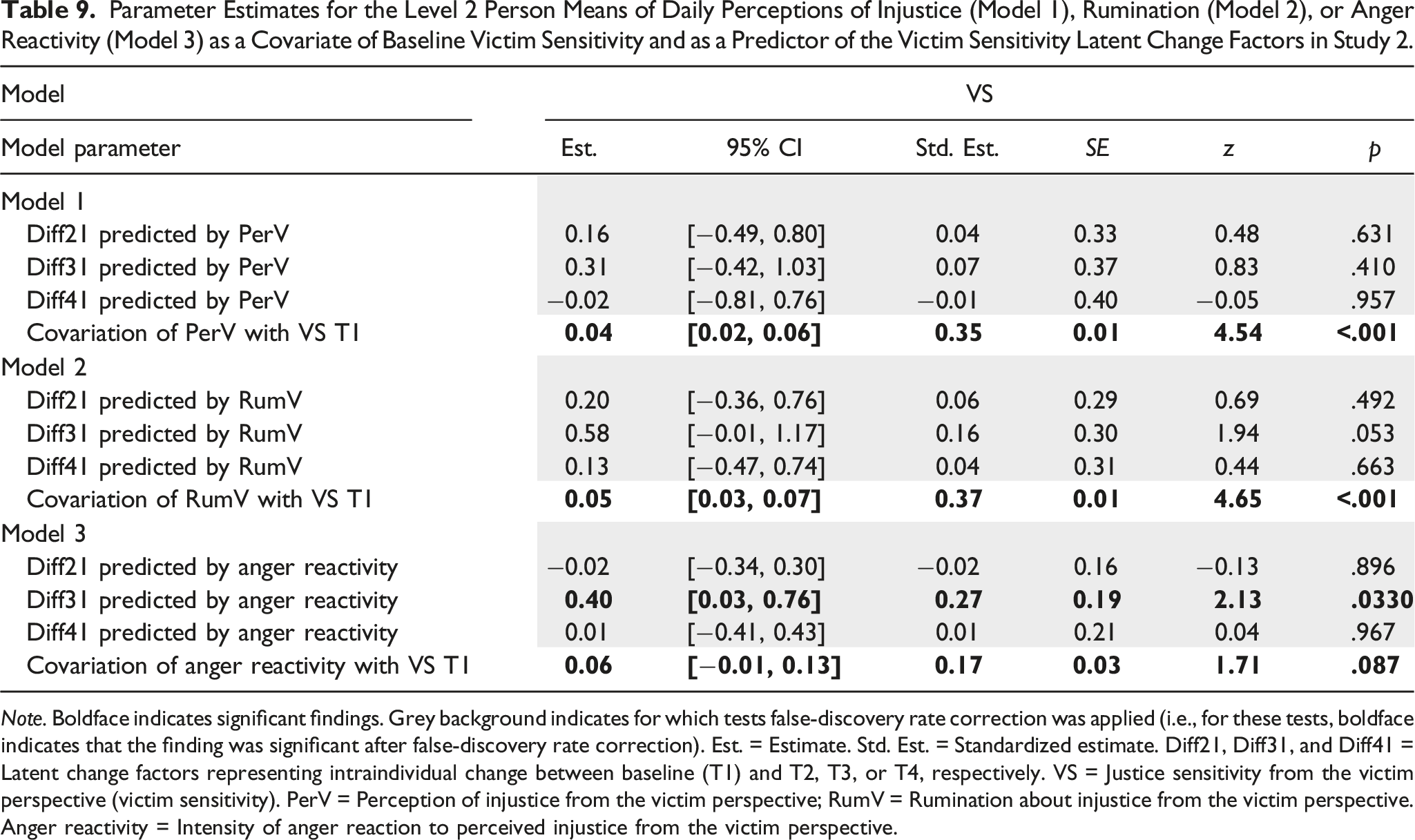
Note. Boldface indicates significant findings. Grey background indicates for which tests false-discovery rate correction was applied (i.e., for these tests, boldface indicates that the finding was significant after false-discovery rate correction). Est. = Estimate. Std. Est. = Standardized estimate. Diff21, Diff31, and Diff41 = Latent change factors representing intraindividual change between baseline (T1) and T2, T3, or T4, respectively. VS = Justice sensitivity from the victim perspective (victim sensitivity). PerV = Perception of injustice from the victim perspective; RumV = Rumination about injustice from the victim perspective. Anger reactivity = Intensity of anger reaction to perceived injustice from the victim perspective.
Regarding anger reactivity, as hypothesized (H5), baseline victim sensitivity was positively related to the intensity of daily anger reactions to injustice. Moreover, anger reactivity predicted intraindividual change in victim sensitivity between baseline and T3 (consistent with H6). Along with the average decline in victim sensitivity over time, this means that more intense anger reactions to injustice buffered a decline. For participants with low anger reactivity (1 SD below the mean in anger reactivity: 2.19), the predicted intraindividual change in victim sensitivity (Diff31 factor score) was −0.26, and for participants with high anger reactivity (1 SD above the mean in anger reactivity: 3.10), it was 0.11.
Exploring Specificity
Parameter Estimates for the Level 2 Intercept of Daily Perceptions of Injustice (Model 1), Daily Rumination about Injustice (Model 2), and Daily Anger Reactivity (Model 3) as Covariates of Baseline Neuroticism and as Predictor of the Neuroticism Latent Change Factors in Study 2.
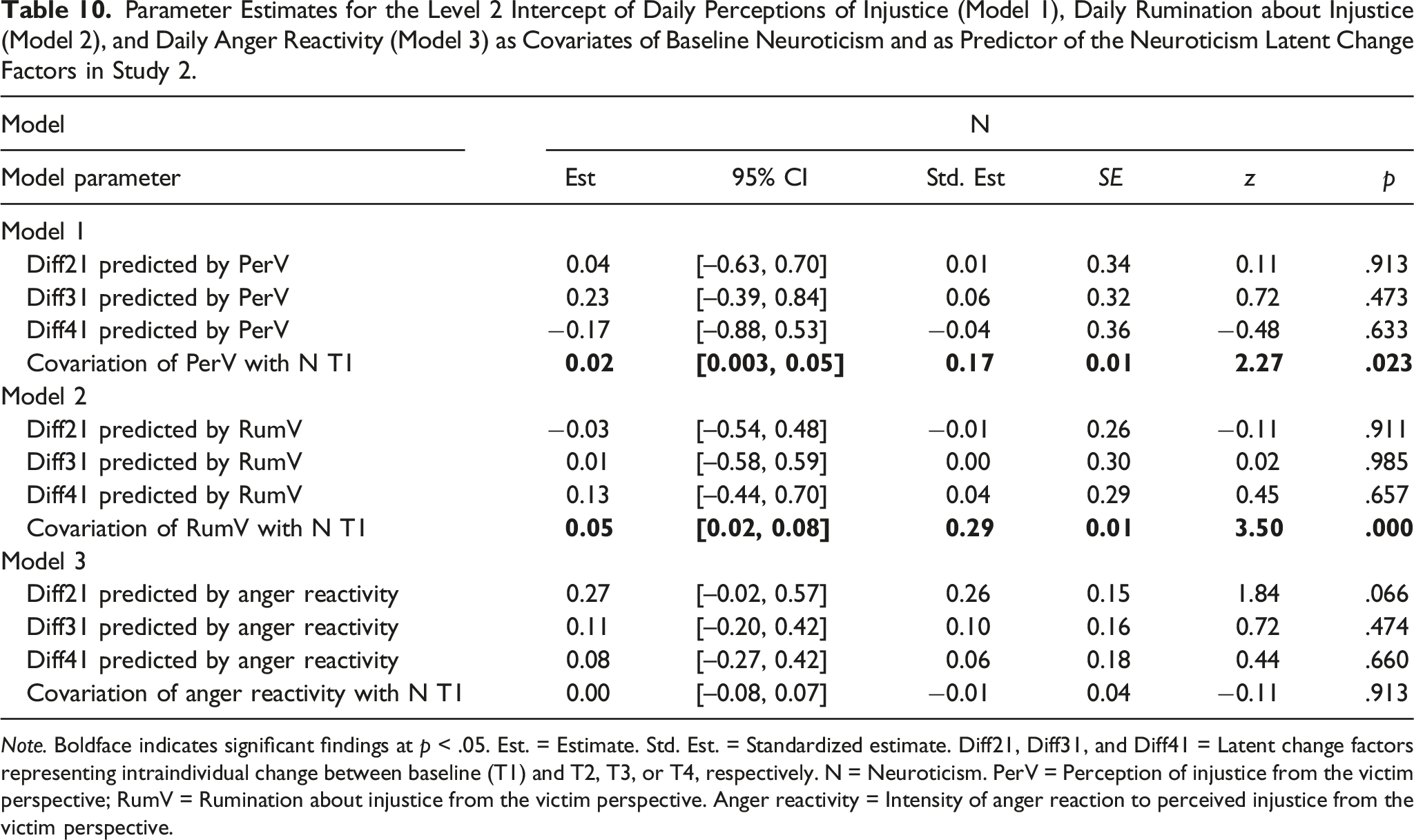
Note. Boldface indicates significant findings at p < .05. Est. = Estimate. Std. Est. = Standardized estimate. Diff21, Diff31, and Diff41 = Latent change factors representing intraindividual change between baseline (T1) and T2, T3, or T4, respectively. N = Neuroticism. PerV = Perception of injustice from the victim perspective; RumV = Rumination about injustice from the victim perspective. Anger reactivity = Intensity of anger reaction to perceived injustice from the victim perspective.
Discussion
With daily assessments of the cognitive and emotional processing of injustice, in Study 2 we found that baseline levels of victim sensitivity positively covaried with the frequency of perceptions of injustice (H1), rumination about injustice (H2), and the intensity of anger reactions to perceived injustice (H5). Finding these links in everyday life supports the notion that perceptual readiness for injustice, intrusiveness of thoughts, and anger reactivity are indeed core components of dispositional victim sensitivity (Schmitt et al., 2010).
Furthermore, we found that intraindividual change in victim sensitivity between the beginning (T1) and the end of the first semester at university (T3) was predicted by anger reactivity (consistent with H6), but not by the frequency of perceptions of or rumination about injustice (contrary to H3 and H4). Importantly, by using the control group design in Study 2, we were able to show that the levels of victim sensitivity of the participants in the daily assessment group did not change in a way that was different from that of the participants in the control group who did not receive intensive assessments. This finding raises our confidence that the association between anger reactivity, on the one hand, and dispositional change in victim sensitivity, on the other hand, is a substantive finding and not a methodological artefact due to measurement reactivity triggered by intensive assessments (Barta et al., 2012).
Speaking for the specificity of developmental links of momentary processes and change in victim sensitivity, change in neuroticism was not predicted by any indicator of the momentary processing of injustice. However, baseline neuroticism was correlated in meaningful ways with momentary processes. Similar to patterns revealed in research on other types of negative experiences (e.g., conflict, Borghuis et al., 2020), higher neuroticism at baseline went along with more frequent perceptions of and rumination about injustice, but not with more intense anger in reaction to suffered injustice. This pattern resonates with the conceptualization of neuroticism as involving internalizing tendencies rather than externalizing reactions such as anger (e.g., Griffith et al., 2010). Critically, the momentary processing of injustice did not feed back into the development of neuroticism. At the high level of aggregation represented by the personality factor neuroticism, it is plausible that a broad range of psychological processes across very different contents, rather than injustice-specific processing, have to be considered in concert to understand personality change (Asendorpf, 2016; Baumert et al., 2017; Mõttus et al., 2020; Wood et al., 2015). Regarding victim sensitivity, this finding underlines the specificity of the involved processes.
General Discussion
Past research has revealed important correlates of dispositional victim sensitivity. In a nutshell, victim sensitivity seems to reflect a rather self-oriented concern for justice, distrustful expectations of being disadvantaged, and the legitimization of one’s own selfish behavior (Baumert & Schmitt, 2016; Gollwitzer et al., 2013, 2015). Insight into these consequential implications has sparked scientific interest in patterns and processes of dispositional change in victim sensitivity across the life span (e.g., Bondü, Hannuschke, et al., 2016). As emphasized by recent theorizing in personality development, it is important to understand the momentary processing of experiences and how they shape longer term intraindividual change.
With two longitudinal studies, we shed light on the momentary processing of injustice experienced from the victim perspective, and we gained the first insight into how these processes are linked to dispositional change in victim sensitivity subsequent to the transition to university. While, under stable life circumstances, the ready perception of injustice, repeated thoughts, and intense anger reactions to injustice have been theorized to be involved in stabilizing interindividual differences in victim sensitivity (Bondü, Hannuschke, et al., 2016; Gollwitzer et al., 2015), we proposed that shortly after transitions into a new social context, such as starting at university, patterns of momentary processing of injustice might have the potential to trigger intraindividual dispositional change. Indeed, our results indicate that the processing of injustice during the first weeks at university could positively predict changes in victim sensitivity across the first semester.
In Study 1, with weekly assessments, the reported frequency of perceiving and ruminating about injustice were relevant predictors of change. However, this was not the case in Study 2 with daily assessments. Here, instead of the cognitive momentary processes, the intensity of anger reactions to perceived injustice emerged as a relevant predictor of change in victim sensitivity. The different assessment schedules employed in our studies might provide an explanation to this pattern of results. The weekly reports of the momentary processing of injustice, in Study 1, relied on memory processes, and research has demonstrated that these can be shaped by emotional experiences at encoding and retrieval (e.g., Kihlstrom et al., 1999; Philippot & Schaefer, 2001). Therefore, it seems plausible that the indicators of perceptions of and rumination about injustice in Study 1 could have been confounded with the intensity of emotional reactions to incidents of injustice. In Study 2, the daily reports of the momentary processing of injustice arguably still required memory processes, but the temporal proximity to the events allowed for retrieval from episodic memory (Robinson & Clore, 2002), and might have helped disentangle the cognitive and emotional processing of injustice.
Accordingly, our findings suggest that the intensity of emotional reactions to injustice might be particularly relevant for understanding the development of victim sensitivity. The more intense anger individuals experienced in reaction to injustice during the first weeks at university, the more their dispositional victim sensitivity increased or was retained at high levels, rather than declining across the first semester. With new social relationships and new tasks and roles for students after the transition to university (Oswald & Clark, 2003; Wagner et al., 2014), new affordances for experiences of injustice might arise, and our findings suggest that their emotional processing could determine the extent and direction of dispositional change in victim sensitivity. If perceived injustices are appraised as highly emotionally relevant, eliciting strong anger reactions, these experiences could come to mind more frequently (Ray et al., 2008; Rimé et al., 1992) and shape the processing and anticipation of future experiences, eventually feeding into change in dispositional victim sensitivity. Clearly, our correlational design precludes any strong, causal conclusions, but our results are consistent with the notion that patterns of emotional processing of injustice might help to explain intraindividual change in victim sensitivity after a transition to university. Future research could build on our findings and further detail the angry appraisal and coping patterns, together with their contextual antecedents, that feed into relative increases in victim sensitivity. Detailed insights into these developmental processes will afford important opportunities to facilitate intraindividual decreases in victim sensitivity after the transition to university and possibly other transitions, thus mitigating potential personal and social problems connected to heightened levels in victim sensitivity (Baumert & Schmitt, 2016). Our results also highlight that research on the development of victim sensitivity will profit greatly from fine-grained longitudinal assessments of its factors and processes.
With four dispositional assessments across the first year at university, we had designed our studies with the goal to explore the timing of change predicted by patterns of momentary processing of injustice. Interestingly, the momentary processing of injustice, assessed during the first weeks of the first semester predicted dispositional change in victim sensitivity that occurred between baseline (T1) at the beginning of the first semester, and the third dispositional assessment (T3) 4 months later, but not earlier (T2). In other words, the momentary processes did not appear to be linked to simultaneous change in victim sensitivity. Rather, it seemed that those intraindividual changes that might have been triggered by the momentary processing of injustice, required some time before they became integrated into the self-concept. Generally, it is plausible that for self-report trait measures to reflect intraindividual change, individuals need time and opportunities to experience and observe their changed inclinations and tendencies (Wrzus & Roberts, 2017). Besides the possibility that, generally, time delay might be required for the manifestation of dispositional change, we can also speculate that the end of the first semester could hold specific justice-related affordances, for example, due to anticipation of the subsequent exam period, thereby facilitating an “update” of the self-concept of dispositional victim sensitivity. Importantly, given the delay in prediction, it seems unlikely that change in victim sensitivity actually preceded our momentary assessments, and thus, we believe that reversed causality is less plausible as an alternative explanation.
As a further interesting pattern in our findings, the momentary processing of injustice predicted intraindividual change across 4 months (T1 to T3), but not anymore after 1 year (T1 to T4). In line with the basic proposition that repeated states can contribute to shaping trait levels (Baumert et al., 2017; Bleidorn et al., 2020; Geukes et al., 2017; Roberts, 2018; Wrzus & Roberts, 2017), experiences of injustice and their processing that occurred after our intensive assessment period could have overwritten the predictive relevance of the patterns of momentary processing that we assessed at the beginning of the first semester. In other words, students might have encountered further changes to patterns of their momentary processing of injustice across their first year at college (e.g., when first taking exams, when committing to an internship, when entering new courses in the second semester, etc.), that potentially continued to contribute to dispositional change in victim sensitivity. Future research could fruitfully extend our daily assessment schedule and include several assessment bursts across the first year at university (or even longer) in order to explore whether the momentary processing of injustice, in particular anger reactivity, that occurs in temporal distance from the transition still retains the potential to predict dispositional change in victim sensitivity. Theorizing on personality-congruent transactions generally (Magnusson, 1990), and on victim sensitivity specifically (Bondü, Hannuschke, et al., 2016; Gollwitzer et al., 2015), suggests that stabilizing transactions between momentary processing patterns and victim sensitivity should come to dominate when individuals get more and more acquainted with their social context. We would hypothesize that in greater temporal distance after the transition to university, mainly extraordinary experiences might retain the potential to trigger dispositional change (Jayawickreme et al., 2021), while everyday experiences contribute to stability.
Notably, our studies revealed an overall downward trend in victim sensitivity across the first year at university. This pattern is consistent with previous comparisons of age groups in early and middle adulthood that had revealed lower victim sensitivity with higher ages (Schmitt et al., 2010). A downward trend in young adults resonates with the maturity principle of personality development (Roberts et al., 2018), expressing that across cultures most individuals tend to change their personalities in the direction of greater social adjustment, with mean-level declines in socially problematic traits (e.g., neuroticism), and increases in socially desirable traits (e.g., agreeableness and conscientiousness; e.g., Bleidorn, 2016). Given the problematic personal and social implications of victim sensitivity that previous research had revealed, maturation plausibly also takes place at the more specific personality level of victim sensitivity.
Interestingly, in our Study 2, the downward trend in victim sensitivity was not paralleled by a decrease in neuroticism. While some studies with young adults found decreases in neuroticism across the first semesters at university (Hannuschke, Gollwitzer, Geukes, Nestler, & Back, 2020), others have pointed out that “emerging adulthood,” the late teens and early 20s, might be characterized by distinctive patterns of personality development (Bleidorn & Schwaba, 2017). Specifically for victim sensitivity, we speculate that entering university, which coincides with moving out of the parental home for most people, implies greater freedom from imposed rules as sources of experienced injustice and intense anger reactions. This could explain a gradual decline in victim sensitivity. Alternatively, victim sensitivity could have been (temporarily) heightened during the start at university (at our baseline measurements). We could speculate that in anticipation of entering a new social context, potential injustices might become particularly relevant for individuals (causing a peak in victim sensitivity at the moment of transition) and might become less relevant in the process of getting acquainted with the social context across time. Again, repeated intensive assessment phases before and after the transition as well as for time periods that are temporally distant from the transition could shed light on the overall patterns of experienced injustice that accompany a life transition.
Limitations and Future Research
Despite the important findings that our studies yielded, the present research is naturally limited in several regards. First, our studies focused on young adulthood, the processing of injustice during the first few weeks at university, and dispositional change across the first year at university. We deliberately chose this phase of life because young adulthood is arguably a time of personality plasticity (Roberts & Davis, 2016), and experiences after the transition into a new social context might be particularly potent for stimulating dispositional change (Bleidorn et al., 2020; Neyer, 2004). However, we have yet to empirically test whether our findings generalize to other age groups, the phases that follow other life transitions (e.g., entering the workforce, moving abroad, and moving into a retirement home), or whether temporal proximity to a life transition is even a necessary boundary condition.
Second, a potential limitation lies in our measurement of the indicators of the momentary processing of injustice. Due to the intensive repeated measurement schedules, we aimed to minimize burden on participants, by employing very few items with simplified response options (Mehl & Conner, 2012). In Study 2, we used dichotomous response formats (No/Yes) for the daily occurrence of perceived injustice and rumination. Consequently, one might ask whether variance in frequencies of perceived injustice and rumination was artificially restricted, thus limiting the predictive power of these measures for dispositional change in Study 2. Based on the results from Study 1 (where our participants reported on average less than one incidence of experienced injustice per week), we saw a limited basis for such concerns. Also, in Study 2 the frequencies of perceived injustice and rumination covaried in meaningful ways with baseline victim sensitivity. Accordingly, potentially restricted variance in the frequency variables seems less plausible as an account for why we did not find evidence for them as predictors of dispositional change.
Clearly, for future studies, it will be advantageous to improve the measurement of momentary processing of injustice. Critically, in our studies we addressed only three indicators of momentary processing of injustice. The frequency of perceptions of and rumination about injustice and the intensity of anger reactions to injustice could be fruitfully complemented, for example, by more detailed appraisals and coping processes that follow experiences of injustice (Mikula, 1993; Montada, 1991). Ideally, future research could target the psychological processing that occurs within distinct timeframes, providing insights into how immediate and more distal cognitive and emotional processes can link together and interact to shape dispositional change in victim sensitivity.
Third, we would be keen to know more about objective properties of experiences of injustice in order to tease these properties apart from their subjective processing. For example, in the present data, we do not know about the nature and severity of the reported experiences. Accordingly, we were unable to test whether victim-sensitive (compared with less victim-sensitive) people tended to report, ruminate, or feel angry about (objectively) less severe instances of suffered injustice. In future studies, participants could provide open-ended descriptions of their experiences, which in turn could be coded with regard to the severity of suffered injustice.
Conclusion
With two longitudinal studies, we shed light on the momentary processing of injustice involved in dispositional victim sensitivity, and its development across time. Overall, our findings highlight that the intensity of anger reactions to perceived injustice might be key for predicting dispositional change in victim sensitivity. Our findings are in line with recent theorizing on personality development, emphasizing the relevance of patterns of momentary processes as well as their gradual accumulation for understanding dispositional change (Baumert et al., 2017; Bleidorn et al., 2020; Geukes et al., 2017; Roberts, 2018; Wrzus & Roberts, 2017). In light of the psychological implications of victim sensitivity, future research can build on our studies to deepen the understanding of the developmental processes involved in this relevant disposition.
Supplemental Material
Supplemental Material - Linking the Momentary Processing of Injustice to Intraindividual Change in Dispositional Victim Sensitivity
Supplemental Material for Linking the Momentary Processing of Injustice to Intraindividual Change in Dispositional Victim Sensitivity by Anna Baumert, Simona Maltese, and Tanja Lischetzke in European Journal of Personality
Footnotes
Acknowledgments
We thank Cornelia Wrzus, Brent Roberts, Manfred Schmitt, Brian Cooper, and Jane Zagorski for valuable feedback, Nita Buchholz, David Izydorczyk, Chiara Thamer, Anne Melanie Wagner, and Janna Schmidt for their support in collecting the data, and Silja Petrig for helping to prepare the tables.
Author Note
Anna Baumert, School of Human and Social Sciences, Bergische University Wuppertal, Germany, and Max Planck Institute for Research on Collective Goods, Bonn, Germany;
Simona Maltese, Central Institute of Mental Health, Mannheim, Germany;
Tanja Lischetzke, Department of Psychology, University of Kaiserslautern-Landau, Germany
Declaration of Conflicting Interests
The author(s) declared no potential conflicts of interest with respect to the research, authorship, and/or publication of this article.
Funding
The author(s) disclosed receipt of the following financial support for the research, authorship, and/or publication of this article: This work was supported by the Deutsche Forschungsgemeinschaft (BA3883/4-1) as well as by a small grant from the University of Koblenz-Landau.
Data Accessibility Statement

Supplemental Material
Supplemental material for this article is available online.
Notes
References
Supplementary Material
Please find the following supplemental material available below.
For Open Access articles published under a Creative Commons License, all supplemental material carries the same license as the article it is associated with.
For non-Open Access articles published, all supplemental material carries a non-exclusive license, and permission requests for re-use of supplemental material or any part of supplemental material shall be sent directly to the copyright owner as specified in the copyright notice associated with the article.
