




Abstract
Cognitive ability is the most powerful predictor of academic achievement. However, increasing attention is being paid to the role of personality traits in students’ academic achievement. Results indicate incremental effects beyond cognitive ability, especially for conscientiousness. Investigating the interplay of conscientiousness and cognitive ability can increase understanding of students’ academic achievement and learning. This study examined whether there are interaction effects of a synergistic or compensatory nature. We applied the approach of integrative data analysis, using four highly powered data sets with a total of 18,637 upper secondary school students in Germany to investigate this research question across four different achievement measures and three educational domains (i.e., school subjects). We used an integrative approach and pooled the results across the four samples to obtain an average estimate of the hypothesized interaction effects. Findings support a small synergistic interaction, indicating that conscientiousness moderates the association between cognitive ability and achievement. This means conscientiousness can enhance the positive effects of cognitive ability. In conclusion, results highlight the role of the type of academic measure used and the domain investigated in understanding how personality and achievement are related, providing evidence of the interplay between effort-related traits such as conscientiousness and cognitive ability.
• We replicated findings on the main effects of personality traits on academic achievement. • Our results support the measure- and domain-specificity of the effects of conscientiousness and openness. • We found small synergistic effects of cognitive ability and conscientiousness on academic achievement across measures and domains, indicating that the positive effects of cognitive ability can be enhanced by high conscientiousness and vice versa.Key Findings
Different scholars have pointed out how personality traits capture the willingness aspect necessary for students to perform well in academic domains, whereas cognitive prerequisites capture the ability aspect (Chamorro-Premuzic & Furnham, 2006; Di Domenico & Fournier, 2015; Zhang & Ziegler, 2015). Accordingly, both cognitive ability and personality traits, especially conscientiousness, are important predictors of academic achievement (e.g., Noftle & Robins, 2007; Poropat, 2009). Previous research has shown differential effects of cognitive ability and personality traits depending on the academic measures used (e.g., grades and standardized test scores; e.g., Lechner et al., 2017) and academic domains examined (e.g., mathematics, first and second language; e.g., Spengler et al., 2013). Therefore, both measures and domains need to be taken into account to systematically investigate how personality traits, cognitive ability, and their interaction are associated with academic achievement.
Having the ability to complete a particular academic task does not necessarily imply that an individual will do so (Di Domenico & Fournier, 2015). Investigating the interplay of conscientiousness, as the most powerful personality predictor of achievement, with cognitive ability can provide important insights into how personality is related to achievement, that is, how one might affect the impact of the other (see also Ackerman et al., 2011).
In this paper, we have two main goals. First, we take a more general perspective, focusing on the main effects of personality traits on academic achievement, considering the role of academic measures and domains, and mainly replicating findings from prior research. Second, we focus specifically on conscientiousness, investigating possible interaction effects with cognitive ability in the prediction of achievement. Again, we consider the role of achievement measures and domains. To do this, we applied an integrative approach (see Curran & Hussong, 2009), analyzing four large-scale data sets of upper secondary school students in Germany and then pooling the results to gain an estimate of the average effect sizes. Such an integrative approach is a way of dealing with incidental findings that can also be seen as a way of cross-validating the findings and looking at replicability. Using this integrative approach, we address the question of whether cognitive ability is sufficient to be successful academically or whether conscientiousness, as the most important personality trait in academic settings, should be highlighted, not only for its additive effects but also for the specific role it plays in successful academic careers.
Associations of Personality With Achievement: Prior Research on Openness, Agreeableness, Extraversion, and Neuroticism and the Role of Measure and Domain
Overview of Characteristics of Different Achievement Measures.
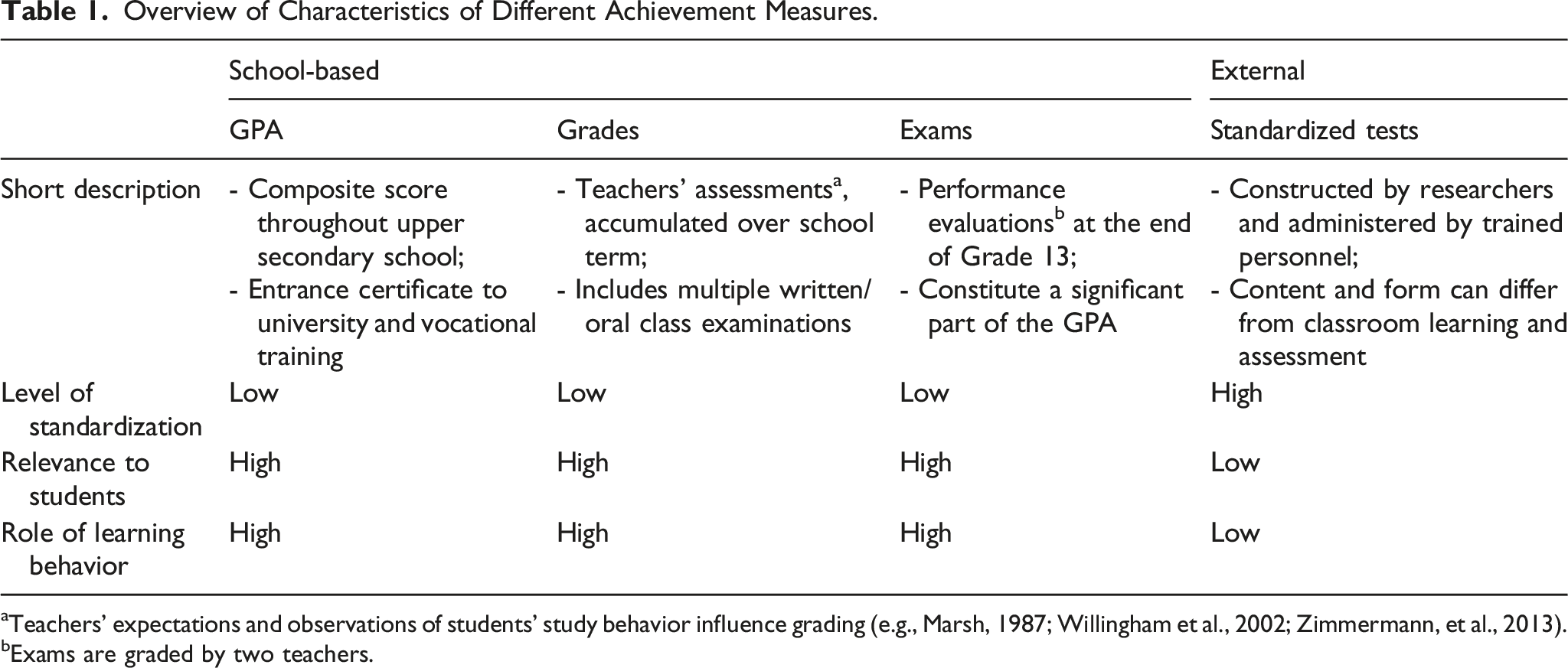
aTeachers’ expectations and observations of students’ study behavior influence grading (e.g., Marsh, 1987; Willingham et al., 2002; Zimmermann, et al., 2013).
bExams are graded by two teachers.
Taking these specific characteristics that are associated with different achievement measures into account makes it possible to investigate associations between personality traits and achievement in more detail, enhancing understanding of these associations. Differential associations have been hypothesized and found in prior research (Lüdtke et al., 2004; Meyer et al., 2019; Hübner et al., 2022; Spengler et al., 2013). For some traits, there is also evidence of a domain-specificity in the associations with achievement. We will now briefly summarize the evidence of both domain- and measure-specific effects.
Openness predicts performance in standardized tests in particular (see Lüdtke et al., 2004; Meyer et al., 2019). Further, associations of openness with achievement have been shown to be domain-specific, with substantial effects found in language domains but not in mathematics or science (Spengler et al., 2013; Meyer et al., 2019). Because of this specific pattern, it is relevant to additionally consider the domain and the achievement measure separately. The specific effects of openness on achievement in standardized language tests might be hidden if the domain (i.e., language) and the measure are considered as a composite score.
Findings on agreeableness and extraversion have been less consistent so far. However, these socially relevant traits (MacIntyre & Charos, 1996) might be observed by teachers and included in the grading process, reflecting positive effects of being socially outgoing or friendly in the learning environment (see Israel et al., 2021; Israel et al., 2019). However, such effects would not be expected for standardized test scores as they are more objective measures. Examining the domain as a potential moderator could explain some of the heterogeneity in the previously found effect sizes.
Similarly, for neuroticism, previous research yielded rather inconsistent patterns of results regarding associations with achievement (Poropat, 2009). The roles of the measure and domain as potential moderators of associations with achievement (i.e., the association between neuroticism and achievement varies across different achievement measures and/or different domains) have not yet been thoroughly investigated. Differential associations between neuroticism and achievement can be hypothesized depending on the achievement measure, but the direction of the effects is less clear: students who score high in neuroticism might take their schoolwork seriously to prevent mistakes and might strive for perfectionism (Smith et al., 2019). However, neuroticism is also closely related to anxiety, which can have negative effects especially in testing situations where students feel pressure (Byrne et al., 2015). Accordingly, the negative effects of high neuroticism could be especially reflected in standardized tests and final exams. Furthermore, it is possible that such processes are more pronounced in mathematics as it is a domain in which many students feel anxious regarding their performance (Barroso et al., 2021); this highlights the role of the domain as another moderator.
Cognitive Ability, Conscientiousness, and Academic Achievement
In this section, we focus in more detail on conscientiousness and on why an interaction with cognitive ability can be hypothesized. Cognitive ability in a Western context is defined as reasoning ability in new and complex situations (Neisser et al., 1996; for a discussion, see Sternberg & Grigorenko, 2005; Ford, 2004). Various studies have shown the relationship between cognitive ability and academic achievement, with strong associations found across different measures and domains for all ages and on all educational levels (e.g., r = .32 – .76; Lechner et al., 2017; see also Kuncel et al., 2004; Deary et al., 2007). Conscientiousness as described in the FFM (e.g., McCrae & Costa, 1987) is defined as “socially prescribed impulse control that facilitates task- and goal-directed behavior, such as thinking before acting, delaying gratification, following norms and rules and planning, organizing, and prioritizing tasks” (John et al., 2008, p. 120). A variety of empirical studies found conscientiousness to predict academic achievement across different domains, with meta-analytic effect sizes on grades of ρ = .23 obtained when controlling for cognitive ability (Poropat, 2009). The positive relationship between conscientiousness and academic achievement can be explained by the associations of conscientiousness with the willingness to achieve, to set goals, and to regulate effort (see Barrick et al., 1993; Bidjerano & Dai, 2007), all of which play a role in academic outcomes (Steel, 2007). Conscientiousness is closely related to traits and types of behavior known to be crucial for successful school performance, such as self-discipline, ambition, persistence, diligence, dutifulness, and grit (Credé et al., 2017; Dumfart & Neubauer, 2016; Ivcevic & Brackett, 2014; Schmidt et al., 2017).
As specific aspects of academic achievement are captured with different measures, previous research has shown differential findings considering the effects of conscientiousness and cognitive ability. The effects of cognitive ability on achievement in standardized tests were found to be stronger than the effects of cognitive ability on grades (e.g., Lechner et al., 2017; Spengler et al., 2013). However, previous research has shown contrasting patterns for conscientiousness, with larger effect sizes found for grades than for standardized test scores. In general, findings have shown moderate effects of conscientiousness on grades, which were consistent across domains (Spengler et al., 2013; Steinmayr & Spinath, 2007). In turn, more persistent study behavior is strongly associated with conscientiousness (e.g., Credé et al., 2017; Dumfart & Neubauer, 2016; Ivcevic & Brackett, 2014; Schmidt et al., 2017). Beyond these measure-specific effects, the associations of conscientiousness and cognitive ability with achievement vary for different academic domains. Previous studies found stronger associations of both conscientiousness and cognitive ability with achievement in nonverbal compared to verbal domains (e.g., Lechner et al., 2017; Spengler et al., 2013).
The Interaction Term: Cognitive Ability x Conscientiousness
Despite the importance of both conscientiousness and cognitive ability as predictors of achievement, their interplay has not yet been investigated comprehensively. As noted above, being able to do something does not necessarily mean that it is done: cognitive ability constitutes a potential for the ability needed to excel academically and conscientiousness constitutes the willingness aspect that is needed to transform this potential into actual behavior (e.g., Di Domenico & Fournier, 2015; Zhang & Ziegler, 2015; see also Chamorro-Premuzic & Furnham, 2006). To understand how conscientiousness and cognitive ability interact in the prediction of achievement, we considered the role of academic learning behavior to explain how conscientiousness is reflected in behavior and why this is helpful for students to succeed. Succeeding academically requires students to engage in behavior related to efficient studying, for example, revising material for a test, completing their homework, and working through the material using different learning strategies. Overall, they are required to put in sufficient study time and mental effort, which can be challenging. It has been theoretically assumed and empirically shown that such academic learning behavior, often called academic effort, mediates the relationship between conscientiousness and academic achievement (e.g., Trautwein et al., 2019), thereby explaining why conscientiousness is related to academic achievement. In other words, conscientious students are more likely to put in the effort that is needed to excel academically as they are willing to engage in this learning behavior.
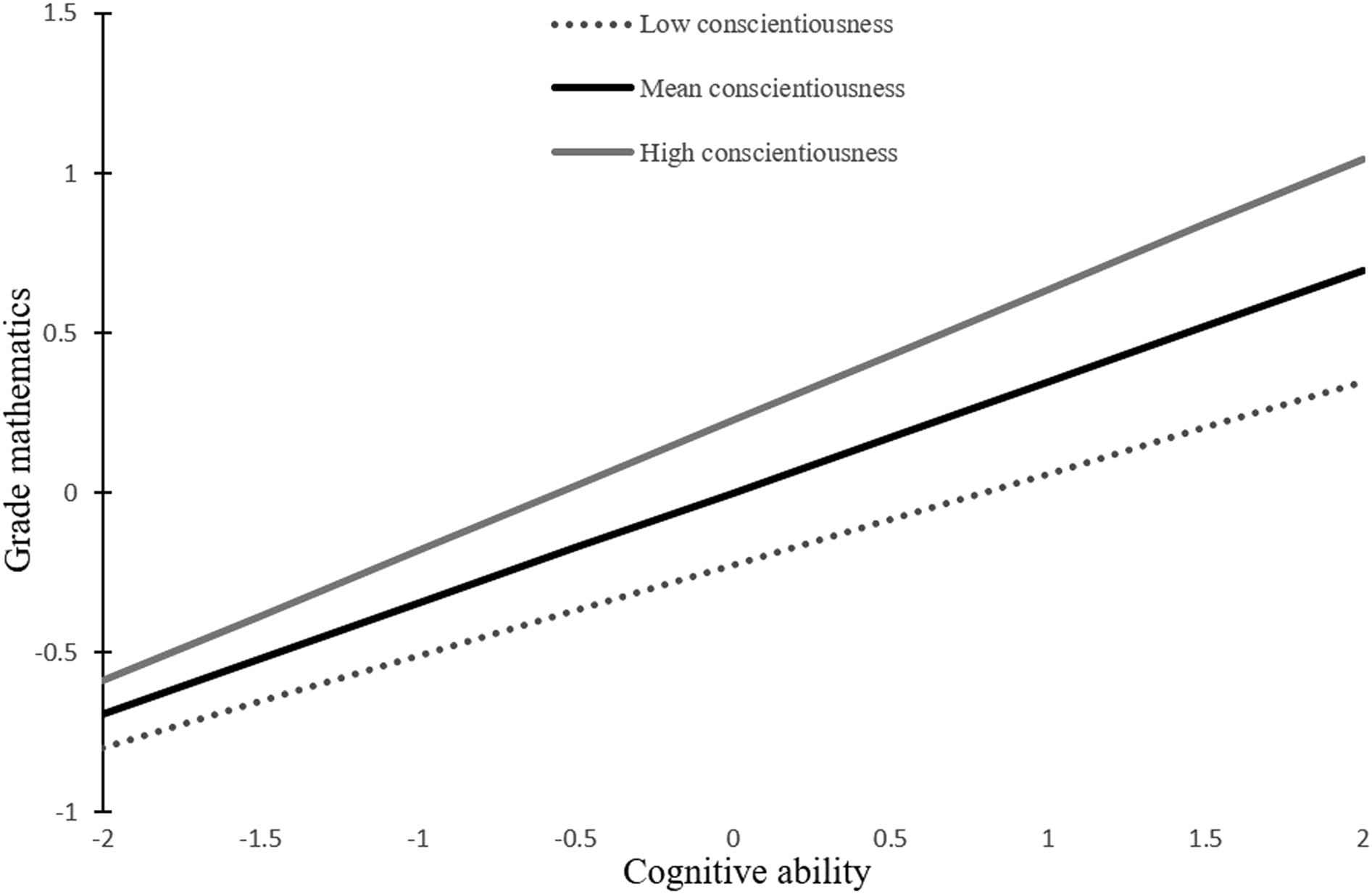
Considering the interplay of conscientiousness with cognitive ability, on the basis of these processes, we can assume either synergistic or compensatory interaction effects of cognitive ability and conscientiousness (Cohen et al., 2003; see Figure 1 for an illustration). We describe why both assumptions are plausible theoretically and then test for the interaction, based on these assumptions, in an exploratory way. On the one hand, there are reasons to hypothesize that the effects of academic effort (i.e., learning behavior) on academic achievement are enhanced by intelligent behavior (i.e., synergistic effects). Students might be able to address problems differently because of their intellectual potential and, thus, might tackle them more easily and successfully, resulting not only in more successful learning but also in an increase in this successful behavior by applying more effort. In other words, conscientiousness leads students to exert more effort, and cognitive ability increases the quality of that effort. Thus, it is not just the number of attempts (effort), but the quality of the attempts that matters (i.e., number of attempts x quality). As this example illustrates, the role of academic effort might explain how conscientiousness and cognitive ability interact in predicting academic achievement. In summary, synergistic effects would imply that cognitive ability and conscientiousness interact in such a way that conscientiousness enhances the effects of cognitive ability and vice versa. This means that by exhibiting conscientious study behavior, students can make full use of their cognitive potential, thereby applying their abilities more successfully to enhance their academic achievement. Vice versa, a synergistic interaction would mean that more intelligent students can use their learning time more efficiently, thus enhancing the effects of conscientiousness. In our models, the interaction term in the case of a synergistic interaction between conscientiousness and cognitive ability would be positive. Examples to illustrate synergistic and compensatory interaction effects of conscientiousness and cognitive ability on achievement. Graphical illustration of the interaction effect on mathematics grade with the mean of the four studies.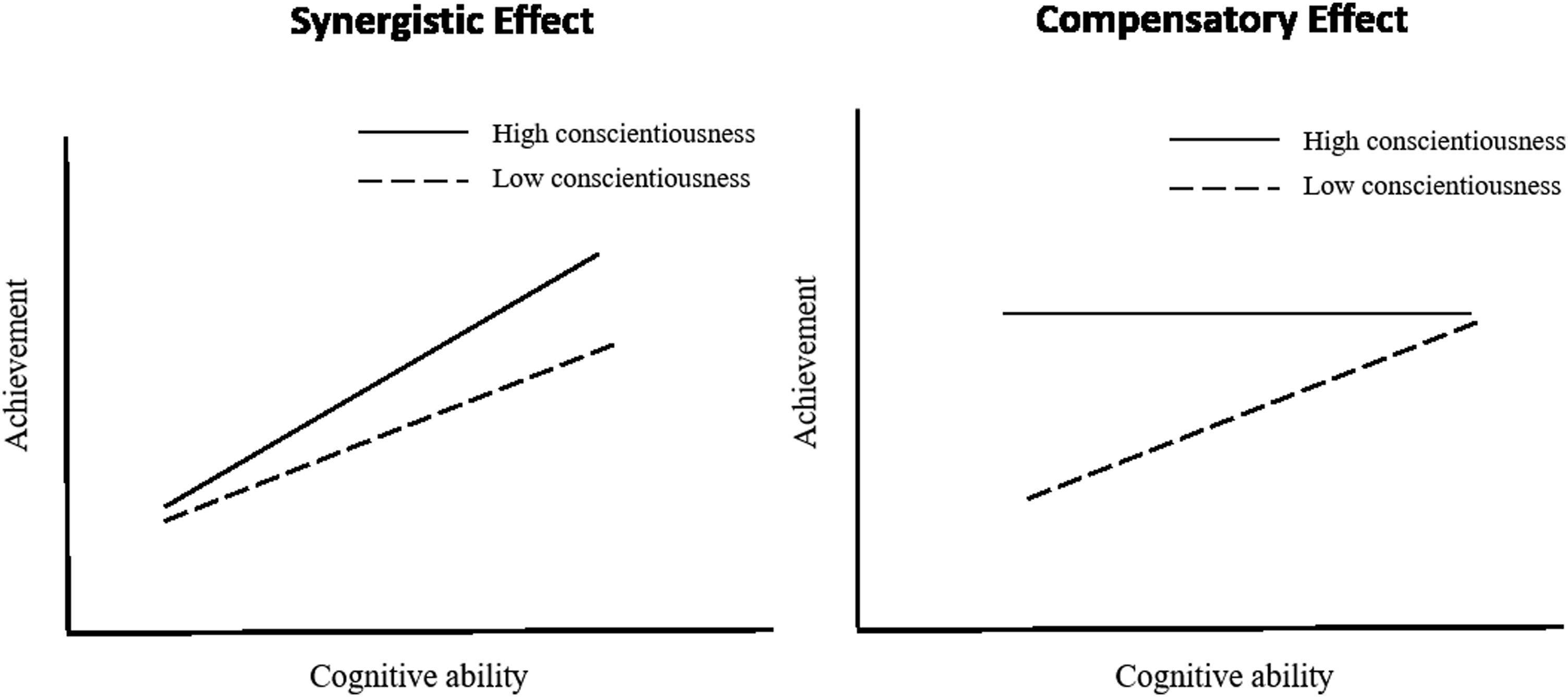
On the other hand, one could argue that a compensatory interaction between conscientiousness and cognitive ability is plausible. Compensatory interaction effects (or buffering effects) would imply that students can use their high levels of conscientiousness to compensate for lower levels of cognitive ability and vice versa. In other words, this means that students could make up for low cognitive ability by showing conscientious study habits and putting in more effort and time. Conversely, students high in cognitive ability could compensate for their low conscientiousness, which could make solving new and complex tasks—and thus learning—easier for them. Put into more technical terms, in our models, we would find a negative interaction term in the case of a compensatory interaction between conscientiousness and cognitive ability.
Despite these hypothesized mechanisms concerning the interactions between conscientiousness and cognitive ability, most studies have considered these constructs only additively (Hübner et al., 2022; Lüdtke et al., 2004; Meyer et al., 2019; Spengler et al., 2013). The few studies that have considered the interaction term obtained largely inconclusive results and used mostly small sample sizes from students in tertiary education. For example, Di Domenico and Fournier (2015) found significant synergistic effects of conscientiousness and cognitive ability on academic achievement in undergraduate students in college (N = 271). Ziegler et al. (2009; N = 271) found synergistic interaction effects for high school GPA in a college sample. Matching these results, Bergold and Steinmayr (2018) found support for a synergistic effect on high school GPA in two studies (Study 1: N = 421; Study 2: N = 243). However, this pattern could not be replicated by Zhang and Ziegler (2015; N = 836). Also, when splitting the sample into high- and low-performing students, Ziegler et al. (2009) found a compensatory effect in the sample of high-performing students (see Ziegler et al., 2009, for achievement striving as a facet of conscientiousness). In summary, the empirical evidence on the interaction effects of conscientiousness and cognitive ability is not yet conclusive.
The Present Investigation
In the present research, we investigated the domain- and measure-specific effects of the FFM personality traits and of the interplay between cognitive ability and conscientiousness on the prediction of academic achievement. We addressed these research questions systematically, considering four different achievement measures (i.e., grades, final exams, standardized tests, and GPA) and three domains (i.e., mathematics, German as first language, and English as foreign language) to take into account a broad spectrum of academic achievement. Previous research has often focused on grades and standardized test scores as the most common measures of achievement. However, final exams are an important achievement measure, given that they combine aspects of both grades and standardized test scores. They are high-stakes outcomes for students and are graded by teachers similar to grades but, at the same, they are administered in a testing situation that might be closer to standardized tests. Also, the grading process is more standardized compared to grades, as final exams are graded by two different teachers instead of just the teacher regularly teaching the class. For more descriptive information on the measures in our samples, see Table 3.
We investigated two main research questions. Research Question 1 concerned the main effects of personality traits on academic achievement, in association with the measure used and the domain investigated. We investigated this research question in order to replicate patterns from previous research with regard to the domain and measure specificity of the effects. We considered measure-specific effects within domains. This is important because, for some of the traits, a moderating role of the measure and domain can be hypothesized. For example, previous research has shown that openness is associated with language achievement, especially in standardized tests. However, prior research has rarely systematically investigated whether such effects result from the achievement measure used in language domains or the domain in which standardized tests were assessed. For example, a study investigating mathematics achievement using standardized tests might find a different pattern of results regarding associations with openness than a study investigating achievement in English as a foreign language. This emphasizes that if domains and measures are not compared systematically, we cannot disentangle how openness is related to the different aspects of achievement.
Overview of Research Questions and Hypotheses.
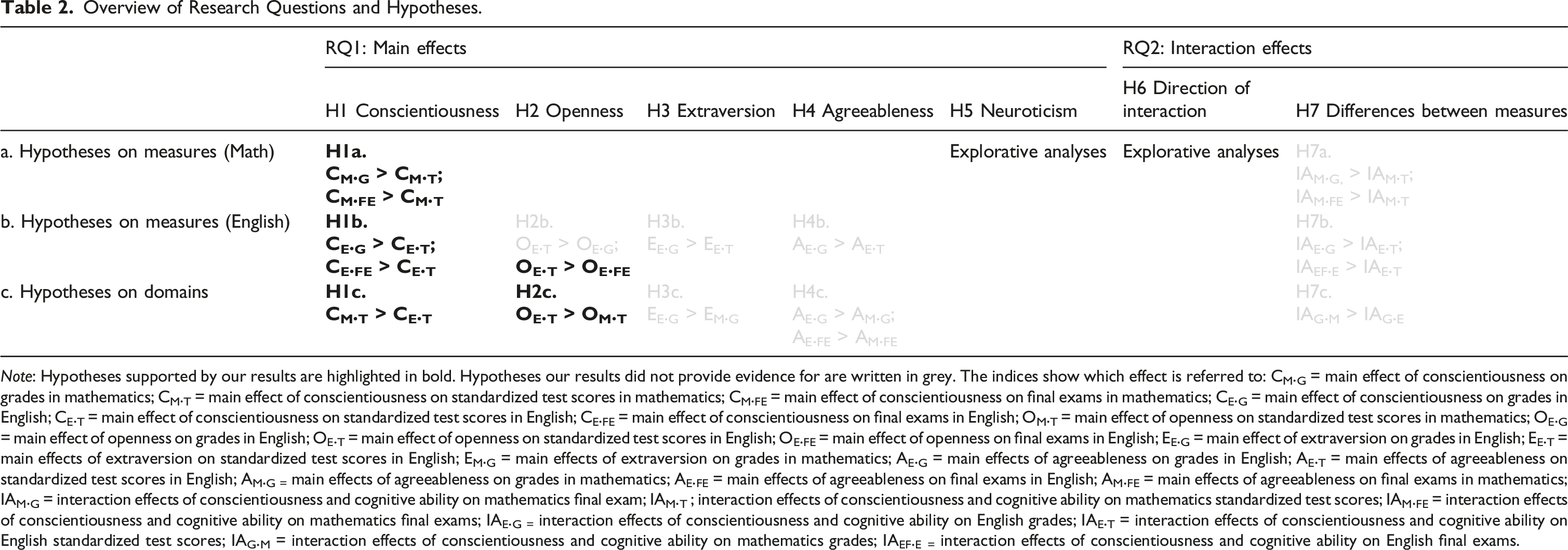
Note: Hypotheses supported by our results are highlighted in bold. Hypotheses our results did not provide evidence for are written in grey. The indices show which effect is referred to: CM.G = main effect of conscientiousness on grades in mathematics; CM.T = main effect of conscientiousness on standardized test scores in mathematics; CM.FE = main effect of conscientiousness on final exams in mathematics; CE.G = main effect of conscientiousness on grades in English; CE.T = main effect of conscientiousness on standardized test scores in English; CE.FE = main effect of conscientiousness on final exams in English; OM.T = main effect of openness on standardized test scores in mathematics; OE.G = main effect of openness on grades in English; OE.T = main effect of openness on standardized test scores in English; OE.FE = main effect of openness on final exams in English; EE.G = main effect of extraversion on grades in English; EE.T = main effects of extraversion on standardized test scores in English; EM.G = main effects of extraversion on grades in mathematics; AE.G = main effects of agreeableness on grades in English; AE.T = main effects of agreeableness on standardized test scores in English; AM.G = main effects of agreeableness on grades in mathematics; AE.FE = main effects of agreeableness on final exams in English; AM.FE = main effects of agreeableness on final exams in mathematics; IAM.G = interaction effects of conscientiousness and cognitive ability on mathematics final exam; IAM.T ; interaction effects of conscientiousness and cognitive ability on mathematics standardized test scores; IAM.FE = interaction effects of conscientiousness and cognitive ability on mathematics final exams; IAE.G = interaction effects of conscientiousness and cognitive ability on English grades; IAE.T = interaction effects of conscientiousness and cognitive ability on English standardized test scores; IAG.M = interaction effects of conscientiousness and cognitive ability on mathematics grades; IAEF.E = interaction effects of conscientiousness and cognitive ability on English final exams.
For conscientiousness, we expected to find larger effects on grades and exams compared to standardized tests in both mathematics (H1a) and English (H1b). Further, we expected to find larger associations for standardized tests in mathematics compared to English (H1c).
For openness, we hypothesized larger effects on standardized tests in English compared to English grades and exams (H2b) and larger effects on standardized tests in English compared to standardized tests in mathematics (H2c).
For extraversion, we expected to find larger effects on verbal grades and exams compared to mathematics grades and exams (H3b) and larger effects on English grades compared to standardized tests in English (H3c).
For agreeableness, we expected to find domain-specific differences for grades and exams, with larger effects in verbal compared to nonverbal domains (H4b). We also expected to find larger effects on English grades compared to standardized tests in English (H4c).
For neuroticism, we tested for differences between effects, comparing grades and standardized tests, and verbal and nonverbal domains in an exploratory way (H5) because no clear hypothesis could be derived from the literature. Students who score high in neuroticism can be perfectionistic and study hard, which can result in them achieving good grades and exam results, but they might also suffer from anxiety, especially in testing situations.
Research Question 2 investigated the direction of the interaction effect between conscientiousness and cognitive ability (compensatory vs. synergistic effects). Given the inconclusive findings of previous studies and theoretical reasons to argue for both a compensatory and synergistic interaction, we investigated the direction of the interaction effects in an exploratory manner (H6).
However, we had specific hypotheses for the different achievement measures and domains parallel to the hypotheses on conscientiousness described in H1a and H1b: We expected the interaction effects to be larger for grades and final exams compared to standardized tests in both mathematics (H7a) and English (H7b) and larger for grades in nonverbal compared to verbal academic domains (H7c).
Methods
Ethics Statement and Transparency
The Ministry of Education Youth and Sports of the State of Baden-Württemberg (where the different surveys of the TOSCA study were conducted) reviewed the data collections of the first two studies used in this article (TOSCA 2002 and TOSCA 2006). At the time, the ministry took sole responsibility for reviewing research ethics and privacy issues in all statewide research studies that took place in schools. The third data set comprised the LAU data; the Ministry for Schools and Vocational Training of the Free and Hanseatic City of Hamburg took responsibility for reviewing research ethics and privacy issues. The fourth data set (LISA) was reviewed by the Ministry of Education, Science and Cultural Affairs in Schleswig-Holstein. The data sets were made available for researchers to reanalyze. Each study was carried out in accordance with the ethical guidelines for research with human participants as proposed by the American Psychological Association (APA), including the protection and anonymity of the collected data. The study materials and procedures were approved by the ministries responsible in the respective federal states. Participation in the questionnaires was voluntary for students. We did not preregister our hypotheses, study design, or analyses. A list of prior research with the data sets can be found in Supplement N.
Data Sets: Samples and Instruments
Overview of the Four Studies: Characteristics of Samples and Instrumentation.
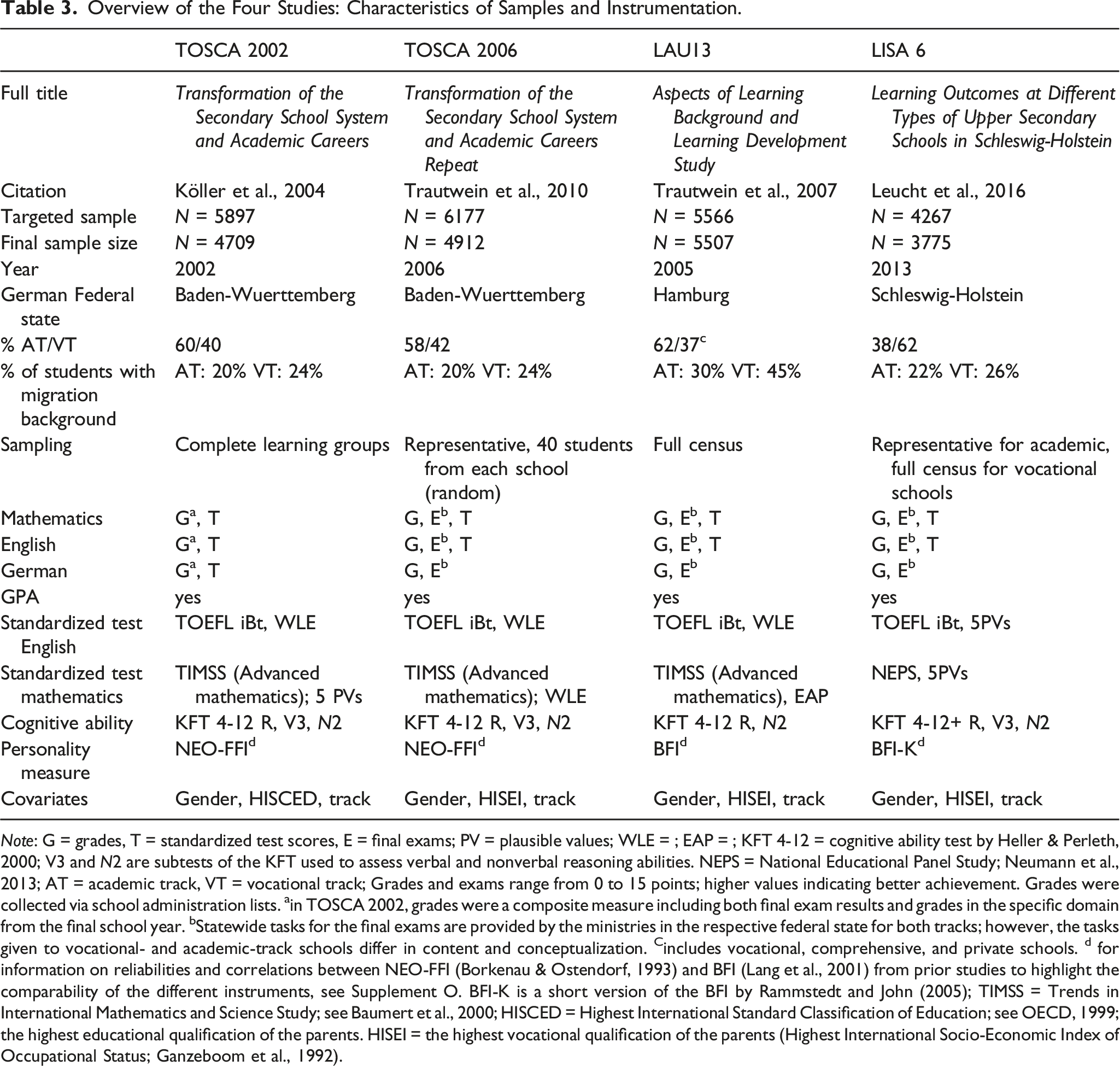
Note: G = grades, T = standardized test scores, E = final exams; PV = plausible values; WLE = ; EAP = ; KFT 4-12 = cognitive ability test by Heller & Perleth, 2000; V3 and N2 are subtests of the KFT used to assess verbal and nonverbal reasoning abilities. NEPS = National Educational Panel Study; Neumann et al., 2013; AT = academic track, VT = vocational track; Grades and exams range from 0 to 15 points; higher values indicating better achievement. Grades were collected via school administration lists. ain TOSCA 2002, grades were a composite measure including both final exam results and grades in the specific domain from the final school year. bStatewide tasks for the final exams are provided by the ministries in the respective federal state for both tracks; however, the tasks given to vocational- and academic-track schools differ in content and conceptualization. Cincludes vocational, comprehensive, and private schools. d for information on reliabilities and correlations between NEO-FFI (Borkenau & Ostendorf, 1993) and BFI (Lang et al., 2001) from prior studies to highlight the comparability of the different instruments, see Supplement O. BFI-K is a short version of the BFI by Rammstedt and John (2005); TIMSS = Trends in International Mathematics and Science Study; see Baumert et al., 2000; HISCED = Highest International Standard Classification of Education; see OECD, 1999; the highest educational qualification of the parents. HISEI = the highest vocational qualification of the parents (Highest International Socio-Economic Index of Occupational Status; Ganzeboom et al., 1992).
The model fit can be found in Supplement K. The model fit for the five traits (using parceling) was largely satisfactory. However, model fit was worst in TOSCA 2006, compared to the other studies in which we used parceling strategies. In LISA 6, we used a well-established short scale, which is why parceling strategies were not feasible.
Statistical Analyses
We conducted our analyses in two steps: First, we analyzed the four individual data sets. Second, we pooled the results across the four data sets to gain more precise estimates of the effects. Because of the heterogeneous personality measures used in the four studies, we used a single indicator approach to correct for measurement error on the predictor variables in all studies (Hayduk & Littvay, 2012; Savalei, 2019). In the single indicator approach, the latent variable is measured by a composite indicator, and the error variance is fixed to the measurement error variance. More specifically, we set the loading of the composite indicator to one and fixed the measurement error variance to s2(1 − rel), where s2 is the observed variance of the indicator and rel is an estimate of the composite score’s reliability. Note that we used an internal consistency measure of reliability (i.e., Cronbach’s alpha).
For all subsequent analyses, we applied path analysis in a structural equation modeling framework using Mplus (Version 8; Muthén & Muthén, 1998-2018–2018). We used the R package MplusAutomation to run models (Hallquist & Wiley, 2018). All variables (except for dichotomous covariates, i.e., gender and school track) were standardized prior to the analysis to enhance interpretability. We use the unstandardized coefficients computed by Mplus. All models were based on maximum likelihood estimation with robust standard errors, using a numerical integration algorithm.
To model the latent interactions, we applied the latent moderated structural equation (LMS) approach to correct for measurement error of latent constructs and to provide unbiased interaction effects (Klein & Moosbrugger, 2000). To estimate the size of the interaction effects, we computed the incrementally explained variance (ΔR2). To compute ΔR2, we calculated R2 in the model without an interaction term and in the model with an interaction term, and to compare them, we calculated the difference as ΔR2. We also computed the ΔR2 of the main effects of conscientiousness and cognitive ability to provide a frame of reference to assess the effect size of the interaction term. In all analyses, we simultaneously included the four other personality traits, gender, school track, and socioeconomic status (SES) to predict GPA and the domain-specific measures of achievement (mathematics, English as a foreign language, and German as a first language). Because of the hierarchical data structure with students clustered in schools, it was necessary to control for dependencies in the data. Thus, we used the type is complex option to correct the standard errors of the model parameters (see Muthén & Satorra, 1995).
The full information maximum likelihood approach (FIML) implemented in Mplus 8 was used to deal with missing values (see Enders, 2010). The highest number of missing values was on the questionnaire, ranging from 6% to 74% for some of the personality items. We performed selectivity analyses, comparing students who responded to the conscientiousness questionnaire and those who did not. The results can be found in Supplement H. Student characteristics differed systematically between the school types, with academic-track students showing higher academic achievement as well as higher SES and cognitive ability compared to vocational-track students (e.g., Leucht et al., 2016; Trautwein et al., 2010). We took these differences into account by using school track as a dummy-coded covariate.
Part of the missing values was due to planned missingness, explaining the high number of missing values in some studies. In TOSCA 2006, there was planned missingness for 50% of the students on the personality instruments and, in LAU, there was planned missingness for the standardized tests in English for one third of the students. The range of missing values for the relevant variables in each study is provided in Supplement B. After performing the analyses on each data set separately, we pooled the results using a univariate meta-analytic approach with the package metafor (Viechtbauer, 2010) in R with fixed effects estimation. We used the confidence intervals from these analyses to test for significant differences between the meta-analytic coefficients: if the confidence intervals did not overlap, we interpreted this as representing statistically significant differences.
Results
Bivariate Correlations
In TOSCA 2002, LAU13, and LISA 6, no significant correlation was found between cognitive ability and conscientiousness. This is in line with more recent research that showed that conscientiousness and cognitive ability are uncorrelated (for a discussion, see Murray et al., 2014). In TOSCA 2006, we found a weak but significant negative correlation between cognitive ability and conscientiousness (r = −.07). Correlations between achievement measures in all studies were moderate to large, ranging from r = .22 to r = .77 (more detailed information can be found in Supplement A). This pattern of findings underlines the importance of taking the different measures and domains into account when investigating academic achievement, as their correlations are moderate to large. Overall, the results on the bivariate correlations support findings from previous research, for example, on the domain-specific effects of cognitive ability on standardized tests, with higher correlations found between cognitive ability and standardized tests in mathematics compared to standardized tests in English. Also, we found consistent positive associations of openness with achievement in verbal domains. The complete information on the bivariate correlations in the four samples can be found in Supplement A.
RQ1. Main Effects of Personality Traits
Pooled Results in Mathematics Using a Fixed Effects Meta-Analytic Approach.
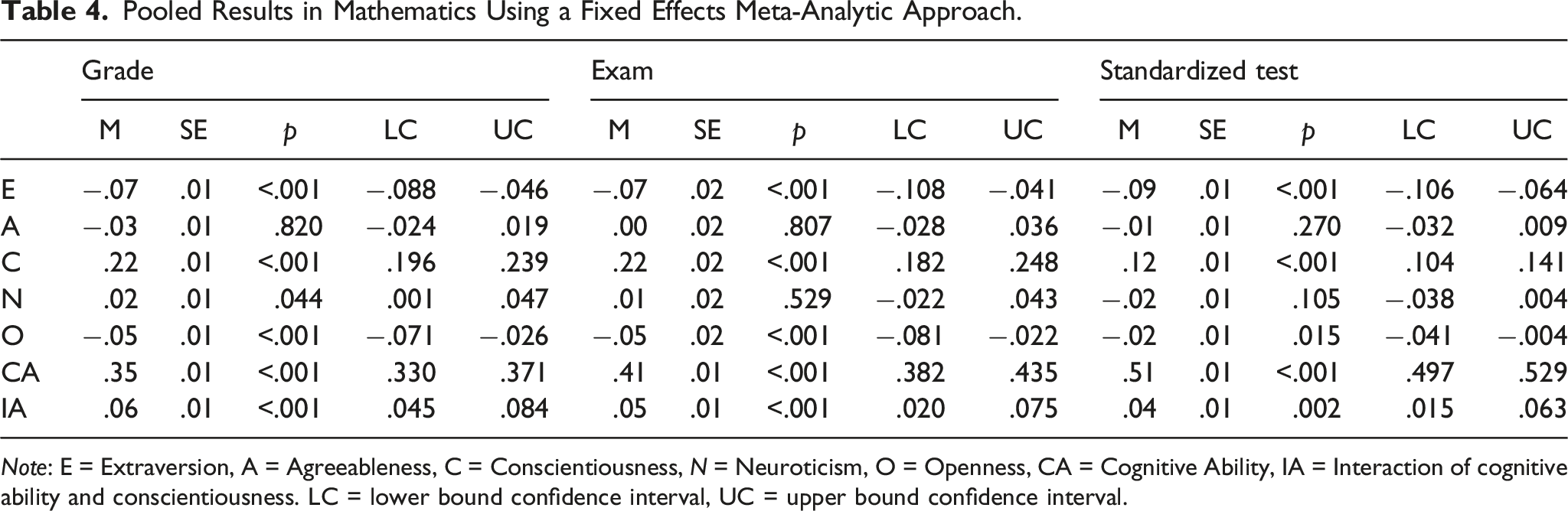
Note: E = Extraversion, A = Agreeableness, C = Conscientiousness, N = Neuroticism, O = Openness, CA = Cognitive Ability, IA = Interaction of cognitive ability and conscientiousness. LC = lower bound confidence interval, UC = upper bound confidence interval.
Pooled Results in English Using a Fixed Effects Meta-Analytic Approach.
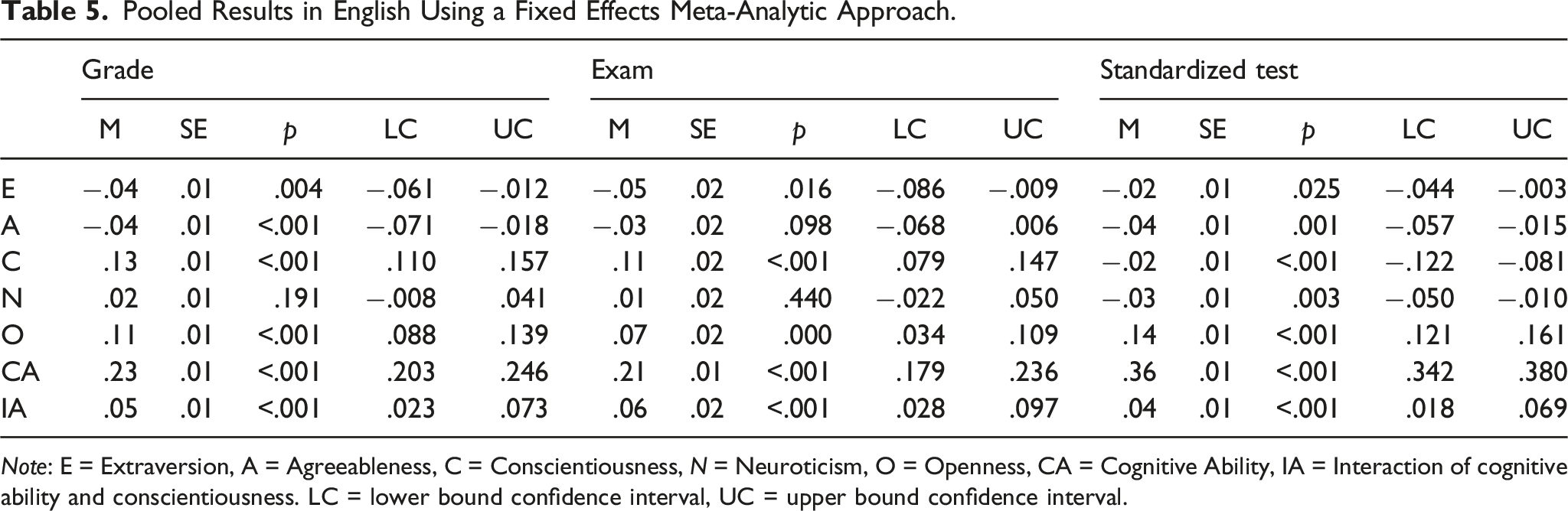
Note: E = Extraversion, A = Agreeableness, C = Conscientiousness, N = Neuroticism, O = Openness, CA = Cognitive Ability, IA = Interaction of cognitive ability and conscientiousness. LC = lower bound confidence interval, UC = upper bound confidence interval.
Pooled Results in German and for GPA Using a Fixed Effects Meta-Analytic Approach.
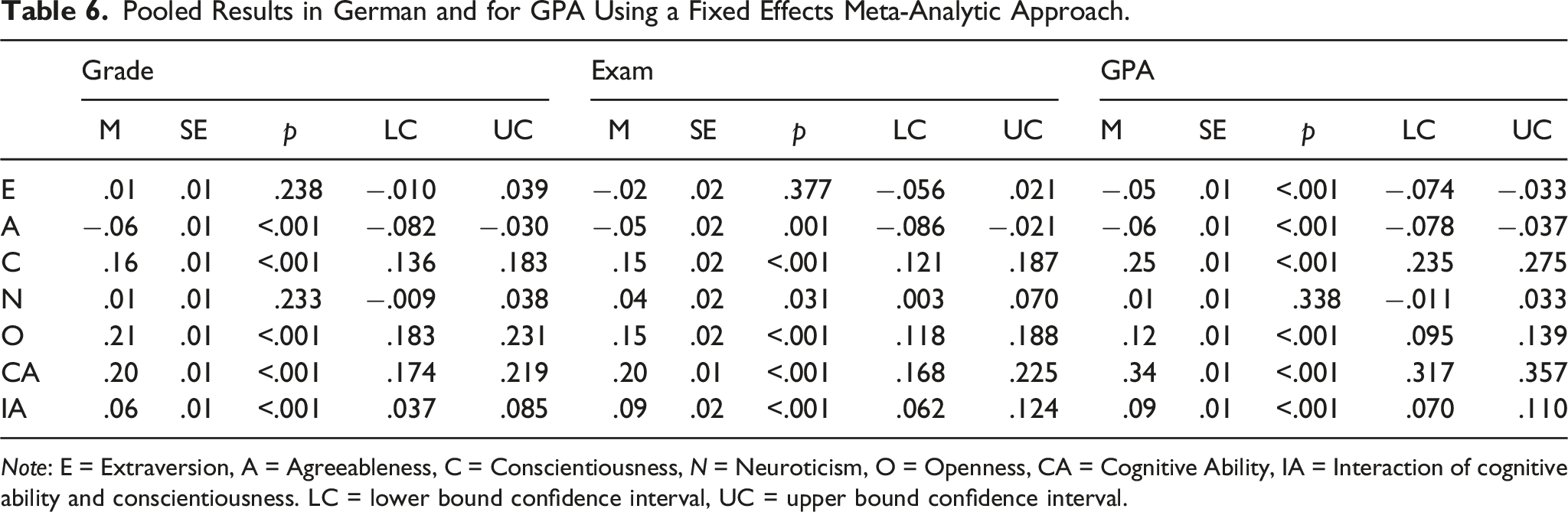
Note: E = Extraversion, A = Agreeableness, C = Conscientiousness, N = Neuroticism, O = Openness, CA = Cognitive Ability, IA = Interaction of cognitive ability and conscientiousness. LC = lower bound confidence interval, UC = upper bound confidence interval.
The general pattern of results can be described as follows. For extraversion, we found negative associations with mathematics and English across all measures. We did not find any significant associations with German. For agreeableness, we found small negative associations with mathematics across all measures. The associations were largely nonsignificant in the language domains. For conscientiousness, the results showed a consistent and positive association across all measures and domains. For neuroticism, we largely found nonsignificant associations with all measures, but we found a small negative association with standardized tests in English and a small positive association with mathematics grades and German exams. For openness, we found consistently positive associations with both language domains and small negative effects on mathematics across all measures. Table 6 also shows the results for the GPA. For the GPA, we found a moderate positive association with conscientiousness, a small positive association with openness, and a small negative association with extraversion and agreeableness.
To test our specific hypotheses on differential effects for different measures and domains, we calculated the confidence intervals for all (pooled) coefficients in the meta-analytic integration. This allowed us to implement a more direct test of our specific hypotheses: If the confidence intervals of different coefficients did not overlap, we interpreted the difference as statistically significant.
We found support for H1a; conscientiousness had larger effects on grades and final exams in mathematics compared to standardized tests in math. Supporting H1b, we found significantly larger effects of conscientiousness on English grades and English exams compared to standardized tests in English. The results also supported H1c, with larger effects of conscientiousness on mathematics standardized test scores compared to standardized tests in English. Moreover, we found partial support for H2b as we found significantly larger effects of openness on final exams in English compared to standardized tests in English. However, the differences between the effects on grades and on standardized tests in English were nonsignificant. Further, our results supported H2c, with larger effects of openness found on standardized tests in English compared to standardized tests in mathematics. For all other hypotheses, we did not find any significant differences. In the Supplements, we show all of the comparisons we conducted to test our hypotheses (see Supplement L).
RQ2. Interaction of Conscientiousness and Cognitive Ability
RQ2 investigated the direction of the interaction effect of conscientiousness and cognitive ability. We found consistent evidence for synergistic interaction effects for composite results considering GPA, grades, exams, and standardized tests across domains, as well as for math, English, and German across achievement measures (see Tables 4, 5, and 6). A graphical illustration of the direction of effects can be found in Figure 2.
The specific hypotheses regarding the interaction effects across measures and domains are summarized in Table 6. We had expected the interaction effects to be larger for grades and final exams as school-based measures, compared to standardized tests (H7a and H7b) and also to be larger for grades in nonverbal compared to verbal academic domains (H7c). However, we did not find any significant differences. Accordingly, our results did not support these domain- and measure-specific hypotheses. The full results of the individual comparisons can be found in Supplement N.
Size of the Interaction Effects
ΔR2 for the Interaction Effect and the Main Effects of Conscientiousness and Cognitive Ability on the Different Achievement Measures.
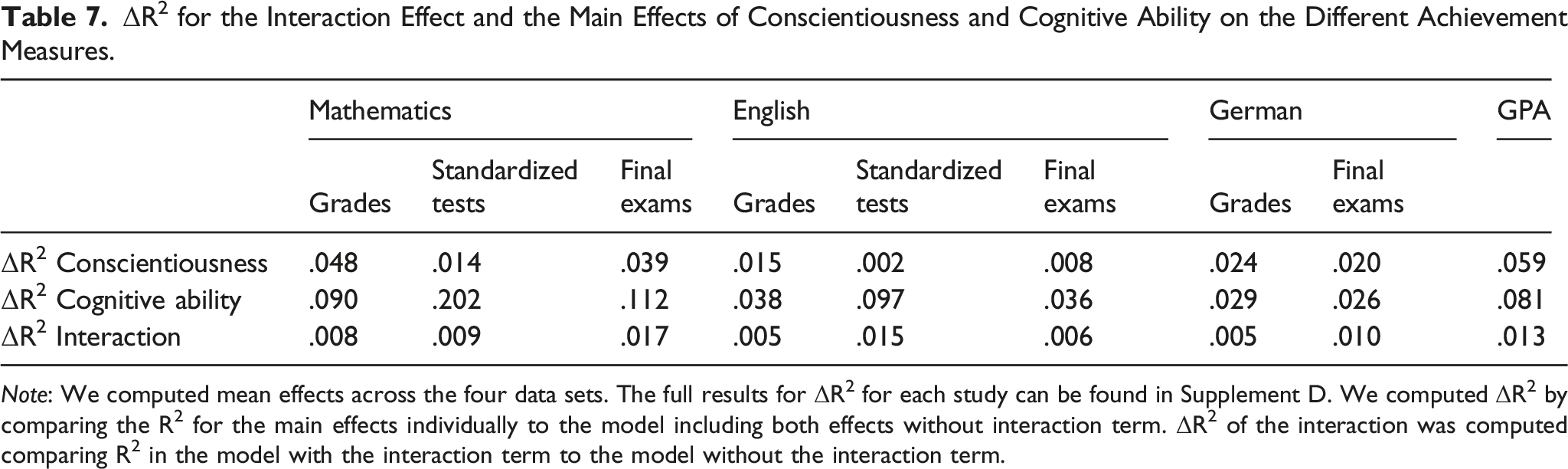
Note: We computed mean effects across the four data sets. The full results for ΔR2 for each study can be found in Supplement D. We computed ΔR2 by comparing the R2 for the main effects individually to the model including both effects without interaction term. ΔR2 of the interaction was computed comparing R2 in the model with the interaction term to the model without the interaction term.
Robustness Checks
We performed a series of robustness checks to test for the stability of our results (see Roisman et al., 2012). The results of the robustness checks can be found in the supplements. First, we tested whether the results were robust across school tracks (academic vs. vocational track). The full results can be found in Supplement F. Multigroup models showed that the findings were largely robust regarding the interaction terms, with three significant differences found between school tracks out of 33 comparisons (see Supplement G). Second, we performed robustness checks by including the quadratic terms of both cognitive ability and conscientiousness in the models. This did not affect the results regarding the interaction of cognitive ability and conscientiousness. Detailed results can be found in Supplement C.
Discussion
This study had two main research objectives. First, we aimed to replicate results from previous research on the main effects of the five personality traits on academic achievement, systematically considering different measures and domains. Second, we aimed to provide a comprehensive and systematic investigation of the hypothesis that conscientiousness and cognitive ability interact synergistically when predicting academic achievement, considering different achievement measures in the domains of languages and mathematics. To pursue these research objectives, we used an integrative data-analysis approach, capitalizing on four large-scale data sets of upper secondary school students from different federal states in Germany. The results for the individual data sets were then pooled using a meta-analytic approach to provide a more precise estimate of the interaction effect. This is especially important given the usually small effect size found for interaction effects in field studies (see McClelland & Judd, 1993). Overall, our results on the main effects of the five personality traits on academic achievement support findings from prior research that show the importance of considering measure- and domain-specific effects to thoroughly understand why personality traits, especially conscientiousness and openness, predict academic achievement.
RQ 1. Main Effects of Personality Traits on Academic Achievement
Matching prior research, we found that conscientiousness is an important predictor of school achievement, with positive associations found in all domains. However, comparing the size of the associations, and regarding the role of the measures, we found evidence of larger associations with school-based measures (i.e., grades, final exams, and GPA) compared to standardized tests in both domains. This pattern of findings highlights the importance of conscientiousness for school-based measures. Such a measure-specific pattern is also in line with prior research, where the role of conscientious study behavior on both learning and teacher evaluations has been discussed to explain why conscientiousness in particular is associated with these school-based measures (see Hübner et al., 2022).
We also found larger associations between conscientiousness and final exams compared to standardized test scores. This could indicate the relevance of conscientiousness for study behavior in particular, as final exams are high-stakes outcomes for students and they thus put in a lot of effort to study for them and, in comparison to grades, teacher evaluation effects should be of less importance. Given the similarities between grades and final exams, we had expected conscientiousness to be more strongly related to both of these school-based measures compared with standardized tests. Our results also provide evidence of the role played by the domain-moderating associations between conscientiousness and achievement: we found larger, positive effects on standardized test scores in mathematics compared to standardized test scores in English, where the associations were negative.
Our results on openness were also largely in line with prior research. Considering the pattern across measures for English and German, we consistently found positive associations between openness and grades, exams, and standardized test scores. This is in line with prior research that found that openness had effects on language even in non-school-based measures such as standardized tests (e.g., Spengler et al., 2013). In mathematics, the effects were small and only significant in the case of grades. Such negative associations between openness and mathematics have also been observed in other studies (e.g., Lipnevich et al., 2016), but more evidence is needed on the robustness of this effect.
Regarding the differential effects of openness, we found significantly larger effects on final exams in English compared to standardized test scores in English. We did not find this pattern for grades; therefore, this finding provided only partial evidence of the measure specificity of openness. Also, this result does not match the general assumption we described above that final exams share more features with standardized tests than with grades. However, it might indicate that grades share the features of standardized tests in languages that are related to openness and that these features differ in final exams. More research that systematically varies the characteristics of the achievement measures is needed to investigate which of these features relate to openness in particular. However, when interpreting this finding, it must be noted that considering the overlap of the confidence intervals of the pooled coefficients can be considered a conservative way of testing for statistical significance as the dependency of the estimated regression coefficients is not taken into account (i.e., compared coefficients are based on the same sample). Although this approach could be justified given the large number of tests we conducted here, it is possible that we were unable to detect small differential effects. Because of these limitations, we can speak of significant differences for the comparisons where the confidence intervals did not overlap, but the results of the comparisons for which the confidence intervals did overlap do not necessarily imply that there was no significant difference.
Further research with more data sets or a review of the literature using a meta-analytical approach is needed to enhance the robustness of these results and to further investigate whether both the domain and the measure moderate associations between personality traits and achievement.
Regarding extraversion, we found a pattern indicating that extraversion generally seemed to have negative effects on achievement in upper secondary school. Considering the age and educational level of the students in our samples, this is in line with previous research (see O’Connor & Paunonen, 2007) that assumed that the effect of extraversion depends on the educational level; in elementary school, being extraverted is advantageous for children as they might be noticed more in the classroom, and active participation is both valued by the teachers and beneficial to the children’s learning progress. However, in upper secondary school, learning becomes more of an autonomous and self-reliant activity. Thus, extraverted behavior in the classroom might not be rewarded with better grades but, instead, the increased need for social interaction might get in the way of individual study time. More extraverted students might be tempted to hang out with friends instead of studying, which can be detrimental to their school success in upper secondary education (see Poropat, 2009; De Raad & Schouwenburg, 1996).
For agreeableness, the pattern of results showed small negative associations with achievement in language domains and nonsignificant associations in mathematics, with no significant differences found across measures or domains. This pattern is consistent with prior research that showed very small and often inconsistent findings regarding agreeableness (Poropat, 2009). Although future research is needed on these aspects, our findings suggest that the heterogeneity of effects between studies investigating the associations of agreeableness with achievement might not be explained by the achievement measure or domain.
Regarding neuroticism, our hypotheses were mostly exploratory due to the contrary assumptions and results from prior research. Our findings were in line with prior research in the sense that we found a similarly inconsistent pattern: the associations of neuroticism were mostly nonsignificant but we found a small negative association with standardized tests in English and a small positive association with mathematics grade and final exams in German. Thus, for neuroticism, we did not find any pattern that showed that differences depended on the domain or measure, so we still cannot make any conclusions on why the pattern of neuroticism is so inconsistent across studies.
RQ2: Interaction of Conscientiousness and Cognitive Ability
Addressing our second research question and taking a closer look at the interplay of conscientiousness and cognitive ability, our findings showed consistent synergistic interaction effects between cognitive ability and conscientiousness that predicted academic achievement across measures and domains, including GPA as a composite measure of academic achievement. The effect size of the interaction effects was small. Although there was no evidence of a compensatory interaction effect between cognitive ability and conscientiousness on academic achievement, the main effects of conscientiousness and cognitive ability can be interpreted as compensatory effects in the sense that students can achieve a similar level of achievement with different combinations of ability and conscientiousness. However, beyond these additive effects, conscientiousness can enhance the positive effects of cognitive ability.
Transferring our systematic approach of considering the role of measure and domain to the interaction effects based on the findings for the main effects of personality and cognitive ability, we tested whether there were domain- and measure-specific differences regarding the predictive validity of the interaction effect. However, we did not find significant differences between domains and achievement measures. In fact, this indicates a certain stability of the synergistic interaction effect for different measures and across academic domains. However, the limitation described above also applies here: our test of statistical significant differences tends to be conservative as we considered the overlap of confidence intervals. Thus, it is important to carefully interpret the nonsignificant results.
It should be noted that even though the amount of explained variance was small, as is common for significant interaction effects, this should not be used as an argument against the theoretical importance of the interaction (Nagengast et al., 2013; see also Funder & Ozer, 2019). Instead, in our opinion, even small interaction effects provide important theoretical information about the interplay between cognitive ability and conscientiousness and how they predict relevant achievement outcomes.
Limitations
First, our study was limited to one age group in one country. Whether the insights we gained apply to other age groups and populations needs to be considered in future research; our results are valid only for upper secondary school students in a rather selective sample. The role of measures and domains might be more pronounced in more diverse contexts, for example, for lower secondary and elementary school students, or in less selective samples where the learning context is less focused on achievement and more on social interactions.
Second, we had a substantial number of missing values on the outcome measures. As not all students participated in all final examinations, there was a significant number of missing values on these variables. Further, the number of missing values on the personality questionnaire was high in three out of four studies (for detailed information, see Supplement B). We handled these missing values using FIML. As we used a variety of covariates, FIML was based on a strong database. Given that covariates associated with missing values are included in the model, FIML estimation provides reliable estimates for population parameters that are comparable to parameters estimated using multiple imputation (see Graham et al., 2007). This was important as previous analyses from the study reports showed that missing values on the questionnaire were associated with lower cognitive ability and lower GPA (see also Supplement K).
Third, the measures we used to assess personality traits require further discussion. Previous research has shown that different scales conceptualize and assess the same personality traits differently (Roberts et al., 2005). In particular, short scales do not represent the broadly faceted nature of conscientiousness comprehensively. It has been shown that some facets of the conscientiousness domain are more strongly related to academic achievement than others (e.g., productiveness; Schmidt et al., 2020) and the choice of scales within different studies may affect the findings regarding the interaction. However, our study did not differentiate between different facets of conscientiousness. Also, different instruments were used to assess conscientiousness across the studies we included in the present investigation. These instruments might assess somewhat varying aspects of conscientiousness and, in turn, might account for the differences between the samples. However, while the use of short scales can be viewed as a robust measurement of personality traits (see Lang et al., 2011), it might lead to a decrease in internal consistency. We addressed this problem by using latent variable modeling in all four studies. Further, in our study, we were limited to the use of self-report measures. In future research, it might be interesting to validate our findings using other types of reports, for example, from peers, parents, or teachers.
Fourth, the data sets came from different student populations. Although there is no reason to assume that the true associations vary between German federal states, it should be noted that the school systems vary across federal states. School systems are important factors in explaining why achievement varies across countries (e.g., Woessmann, 2016). Also, differences in school systems can result in differential grading practices; in some federal states, receiving better grades is associated with lower performance in standardized tests than in others (see Braun & Dwenger, 2009; Hübner et al., 2020). Similarly, in our study, the samples differed to some degree in their population characteristics, for example, in Hamburg, the percentage of students with a migration background was (at the time of data collection) higher than in Schleswig-Holstein or Baden-Württemberg.
On a related note, the scaling of the measures varied between studies. As we performed secondary data analyses, we used the parameters provided in the data sets, for example, for the cognitive ability estimate and the standardized achievement tests. Thus, there were some differences between the data sets, which could be related to the results varying between studies. We accounted for this problem by using a correction of measurement error for cognitive ability measures, as issues of reliability are more serious for independent variables. However, we did not correct for measurement error on the dependent variables.
Finally, our study does not provide a developmental perspective. A longitudinal design would allow for the investigation of incremental effects and underlying processes, addressing the interplay of the different constructs considered here (cognitive ability, effort, conscientiousness, and achievement).
Implications
Our findings have three main implications. First, the finding that the main associations between personality traits and achievement showed differential patterns for different domains and different measures underlines the fact that a separate investigation of different measures of achievement and different domains can help us understand how personality and achievement are related. The specificity of these findings has implications for future research focusing on how personality relates to achievement. These findings raise questions about the mechanisms between personality and achievement-related behavior in the different domains. Future research needs to investigate these patterns in more detail in follow-up studies in order to understand the mechanisms behind these associations. For example, we found a clear domain-specific pattern for openness, with positive associations in language domains and negative associations in mathematics. However, the role of the achievement measure in moderating how openness was related to achievement was less clear. Openness was related similarly to grades and standardized tests but differentially to final exams, suggesting that grades and standardized tests might share features that are important to show how openness relates to achievement and that are not shared by, or might be more pronounced in, final exams. However, we cannot disentangle the features that relate to these findings. Accordingly, more research that systematically varies the characteristics of achievement measures within the respective domains is needed to investigate which features of achievement measures relate to openness in particular. Similarly, even though the pattern was clearer for conscientiousness, future studies are needed to disentangle why conscientiousness predicts achievement measures with differential effects. Such future studies could consider a broader number of achievement measures with specific characteristics.
Second, considering interaction effects is helpful in fostering our understanding of the bigger picture of cognitive and noncognitive personality constructs and their association with academic achievement. Moreover, these findings present a new perspective in the prominent discussion on the relative importance of cognitive and noncognitive constructs: if personality traits such as conscientiousness are needed to make full use of a student’s cognitive ability, the debate on the relative importance of personality and cognitive ability might shift to a more integrative view. Given the results obtained in this study, it can be concluded that the interplay between effort-related traits such as conscientiousness, which play an important role in academic behavior, and cognitive ability is important and that the relationship should not be considered in a purely additive manner.
The third implication concerns the practical implications of the synergistic interaction found in our study. The malleability of the personality has been discussed in the recent literature (see Roberts et al., 2017; Magidson et al., 2014) and some evidence has been found on the effectiveness of possible interventions to enhance conscientiousness. These kinds of interventions become even more interesting and important when the enhancement of conscientiousness and conscientious behavior might allow students to use their full cognitive potential, thereby influencing their academic achievement. Overall, this further highlights the importance of conscientiousness for school- and achievement-related behavior. Our results indicate that fostering students’ conscientiousness and effort-related traits can be even more beneficial due to the interactions that enhance the effects of cognitive ability. Specifically, by definition, cognitive ability is especially important for performance outcomes when tasks are novel, unstructured, and difficult (see Neisser et al., 1996). We investigated different types of achievement measures; it could also be useful to consider different types of school assignments (e.g., essays, mathematics problems) to gain a more detailed understanding of the synergistic interaction between conscientiousness and cognitive ability. It can be argued that the nature of the interaction depends on the type of assignment, with some types of assignment being more strongly affected by this interaction effect than others. Thus, in future research, more specific tasks that make it possible to evaluate students’ achievement in a more fine-grained manner could enhance the understanding of the interaction effect. As argued above, the interaction might be stronger for tasks that require higher cognitive effort, more work, and more time spent on the respective learning behavior, that is, more elaborative tasks such as writing an essay or solving a complex mathematics problem.
Conclusion
This study conducted a systematic and powerful investigation of the main effects of the five personality traits on academic achievement while considering the role of the academic measure and domain. Our findings highlight the importance of considering how achievement measures capture different aspects of achievement that relate to personality traits. They show that some personality traits, especially openness, have differential associations depending on the domain. Taking this comprehensive perspective can help us understand how personality traits relate to academic behavior. Notably, we found no evidence of a compensatory interaction between cognitive ability and conscientiousness; instead, our findings support a small synergistic interaction between cognitive ability and conscientiousness when predicting academic achievement. However, based on the main effects of conscientiousness and cognitive ability, we conclude that students can achieve a similar level of achievement with different combinations of cognitive ability and conscientiousness and that, beyond these additive effects, conscientiousness can enhance the positive effects of cognitive ability (i.e., as shown by the synergistic interaction). Still, more studies are needed to replicate our findings and investigate the domain- and measure-specific effects of personality traits on academic achievement as well as the interaction between conscientiousness and cognitive ability.
Supplemental Material
Supplemental Material - Conscientiousness and Cognitive Ability as Predictors of Academic Achievement: Evidence of Synergistic Effects From Integrative Data Analysis
Supplemental Material for Conscientiousness and Cognitive Ability as Predictors of Academic Achievement: Evidence of Synergistic Effects From Integrative Data Analysis by Jennifer Meyer, Oliver Lüdtke, Fabian T. C. Schmidt, Johanna Fleckenstein, Ulrich Trautwein and Olaf Köller in European Journal of Personality
Footnotes
Acknowledgments
We would like to thank Gráinne Newcombe for her editorial support during preparation of this article.
Author’s Notes
This paper uses data from the LAU study. The data were generated by the Free and Hanseatic City of Hamburg through the Ministry of Schools and Vocational Training between 1995 and 2005 and have been provided to the MILES scientific consortium (Methodological Issues in Longitudinal Educational Studies) for a limited period with the aim of conducting in-depth examinations of scientific questions. MILES is coordinated by the Leibniz Institute for Science and Mathematics Education (IPN).
Declaration of Conflicting Interests
The author(s) declared no potential conflicts of interest with respect to the research, authorship, and/or publication of this article.
Funding
This research was funded in part by the state government of Baden- Württemberg (Az: 33-7532.20/735) and Free and Hanseatic City of Hamburg through the Ministry of Schools and Vocational Training (MILES).
Data Accessibility Statement
The data used in Study 1 and 2 can be accessed at  . Data on ID and cluster ID (i.e., information that would make it possible to identify individual students in combination with other data) will not be made available due to data protection regulations.
The data used in Study 3 and 4 were made publically available and can be accessed upon request at the FDZ (Research Data Centre). The FDZ is jointly headed by the Centre for International Student Assessment (ZIB) and the Institute for Educational Quality Improvement (IQB) and is based at the IQB in Berlin.
Supplemental material
Supplement material for this article is available online.
References
Supplementary Material
Please find the following supplemental material available below.
For Open Access articles published under a Creative Commons License, all supplemental material carries the same license as the article it is associated with.
For non-Open Access articles published, all supplemental material carries a non-exclusive license, and permission requests for re-use of supplemental material or any part of supplemental material shall be sent directly to the copyright owner as specified in the copyright notice associated with the article.
