




Abstract
Although previous research has shown that both trait and state conscientiousness are positively associated with a wide range of positive life and work outcomes, some studies indicate that acting in a conscientious way is effortful, and that behaving outside one’s conscientiousness related comfort zone (i.e., acting counterhabitual) may lead to cognitive or affective cost. Because these costs are not likely to be evident immediately, we examine how within-person fluctuations in conscientiousness relate to within-person fluctuations in emotional exhaustion, resource depletion, and negative affect, not only concurrently, but also in a delayed fashion and cumulated over time. In two experience sampling studies, we found that higher levels of conscientiousness are concurrently related to lower levels of emotional exhaustion, resource depletion, and negative affect. When looking at delayed effects, no conclusive evidence was found for affective or cognitive costs of (counterhabitual) conscientiousness. Finally, analyzing cumulative effects revealed that repeated negative deviations from one’s typical level of conscientiousness were positively associated to exhaustion, depletion, and negative affect, while repeated positive deviations were negatively associated with depletion and unrelated to exhaustion and negative affect. Altogether, our findings suggest that self-rated conscientious behavior is generally beneficial, even if this behavior goes against one’s typical behavior.
Keywords
It has been increasingly recognized that personality is an important predictor of a broad range of outcomes (Barrick & Mount, 1991; Denissen et al., 2018). Conscientiousness in particular has often been identified as the personality dimension that is predictive of health behaviors (Deary et al., 2010) and academic (Noftle & Robins, 2007) and work success (Judge & Kammeyer-Mueller, 2007). Individuals high in conscientiousness behave responsibly, are motivated and persistent, and do so even when tasks are challenging (Wanberg et al., 2000). Because of these reasons, conscientiousness is typically considered a desirable personality trait, and this is particularly true in work settings (Pickett, 2019). Moreover, research shows that conscientiousness can be increased, even without the use of interventions (Lyubomirsky et al., 2005; Tasselli et al., 2018). This raises the question of why we do not uniformly invest in becoming more conscientious. One reason might be that the seemingly beneficial between-person relationships might not straightforwardly translate to the within-person level and that there are also costs associated with acting conscientiously (Leikas & Ilmarinen, 2017).
Although several studies indicate that both trait (e.g., Alarcon et al., 2009; Dudley et al., 2006; Frieder et al., 2018) and state conscientiousness (e.g., Huan & Ryan, 2011; Debusscher et al., 2017) are positively related to desirable life and work outcomes, there are indeed studies that suggest that conscientiousness might be a double-edged sword. For example, Stephens (2020) and Armon et al. (2012) found that trait conscientiousness positively predicted emotional exhaustion, while Leikas and Ilmarinen (2017) showed that conscientious behaviors were related to increased levels of fatigue 3 hours later. Furthermore, in everyday life people are not always able to sustain their typical level of conscientiousness and are often pressed into working at a higher, or sometimes even lower, state of conscientiousness (Pickett et al., 2019). This might, for example, happen when they need to complete a complex task very quickly or when they are required to work very meticulously. Although the Behavioral Concordance Model (BCM, Moskowitz & Coté, 1995) posits that such modifications—when they are discordant to one’s habitual behavior—trigger negative affect, previous research on the effects of counterhabitual behavior yielded inconsistent results. Whereas some studies provided support for the notion that counterhabitual behavior is associated with cognitive (e.g., Gallagher et al., 2011; Zelenski et al., 2012) and affective costs (e.g., Pickett et al., 2019; Pickett et al., 2020), others failed to find such negative effects, or did even find beneficial effects (e.g., Fleeson et al., 2002; Fleeson & Wilt, 2010).
One of the reasons for these mixed findings is that the possible depleting effect of (counterhabitual) conscientious behaviors might not become evident immediately. Although in the moment behaving in a conscientious way may bring out positive feelings (Pickett et al., 2019), in the long run this initial boost in happiness might fade, and the depleting effects may take the upper hand. Moreover, not only delayed effects but also cumulative effects over time may give additional information on how combined results of the past can impact the individual to a different extent than only isolated effects of the past (Luhmann et al., 2014). In the present paper, we therefore examine how within-person fluctuations in conscientiousness relate to within-person fluctuations in emotional exhaustion, resource depletion, and negative affect, not only concurrently but also in a delayed fashion and cumulated over time. By doing this, we explicitly consider that the effects might (a) build over time and (b) need some time to “sink in”, thereby examining how the effects of conscientiousness materialize over time.
Is more conscientiousness better?
People high in trait conscientiousness generally desire order, obtain satisfaction from achieving goals, and are well-organized (Boyce et al., 2010; Costa & McCrae, 1992). Research shows that trait conscientiousness is a positive predictor of life satisfaction (Heller et al., 2004), overall subjective wellbeing (Soto, 2015), and positive affect (DeNeve & Cooper, 1998; Fayard et al., 2012; Leikas, 2020). According to the instrumental causal path model by Costa and McCrae (1992), core characteristics of conscientious individuals, such as being more responsible, focused, and determined, are helpful because they for example facilitate efficient work behaviors. Because meeting norms and satisfying expectations is highly valued in society, such behaviors can also lead to higher levels of positive affect (Pickett et al., 2019). Consistent with findings at the trait-level, also at the momentary state level, research shows that conscientious behavior is related to higher levels of positive affect (Nater et al., 2010), positive mood (Leikas & Ilmarinen, 2017), and lower levels of negative affect (Smith et al., 2013).
However, besides those positive effects, there are also reasons to expect that conscientious behavior could be taxing. People usually display high levels of conscientiousness when working or studying, and working in a productive, responsible, and industrious manner typically causes tiredness and depletion (Leikas & Ilmarinen, 2017). For example, studying for an exam, or working intensively on a task can leave you weary, and it is plausible that maintaining the effort to work hard may lead to depletion. This idea was supported by Stephens (2020), who found that trait conscientiousness positively predicted emotional exhaustion, and by Armon et al. (2012), who showed that trait conscientiousness was positively associated with the emotional facets of burnout. In addition, Leikas and Ilmarinen (2017) demonstrated that after a three-hour delay conscientious behaviors were related to higher fatigue, suggesting that in the long run conscientious behavior might be depleting.
Thus, although several studies show that working in a conscientious manner generally brings out positive feelings (Pickett et al., 2019), there are also studies that indicate that conscientious behavior is effortful (e.g., Armon et al., 2012). However, most of these studies have looked at either between-person differences in people’s typical level of conscientiousness or within-person variation in the momentary level of state conscientiousness, and by doing so they fail to consider that the extent to which one deviates from one’s habitual behavior (or the extent of counterhabitual conscientiousness) might also play a role.
The potential costs of counterhabitual conscientiousness
According to the Personality Dynamics (PersDyn) model, personality can be conceptualized as a dynamic system in which one’s personality baseline functions as a stable set point (or attractor) around which one’s personality states fluctuate (Sosnowska et al., 2019). Counterhabitual behavior then refers to the enactment of behavior in which one deviates from this baseline, or away from the attractor (Little, 2008). Indeed, because people behave differently in different situations, or from one moment to the next, they frequently behave away from this attractor (Whelan, 2014). Such deviations can go in two different directions, with people performing either at a higher or a lower level relative to their baseline. An example of the former is someone typically low in conscientiousness who is confronted with a task that requires high levels of meticulousness and attention to details. An example of the latter is someone who is typically high in conscientiousness but who needs to rush a task due to an unexpectedly tight deadline.
Moskowitz and Coté (1995) posit that behaving away from one’s baseline is associated with affective costs (i.e., higher levels of negative affect and lower levels of positive affect), while acting according to one’s baseline produces short-term pleasure and rewards. A similar point was made by Little (2000), arguing that such deviations induce strain, which at first might involve psychological discomfort but can later on even result in declines in health and physical wellbeing. In terms of the PersDyn model, deviating from one’s baseline is depleting because the baseline acts as an attractor, exerting a pulling force that requires one to spend energy to move away from it. Discrepancies between the baseline and the momentary state level are therefore believed to be depleting, entailing cognitive (e.g., Gallagher et al., 2011) and affective (e.g., McNiel & Fleeson, 2006) costs. Importantly, the PersDyn model also implies that not all counterhabitual behaviors are alike, with behaviors that deviate more strongly from one’s typical level of behavior requiring more effort to enact and maintain than behaviors closer to one’s typical level of behavior (Gallagher et al., 2011). 1
Another line of research that tries to explain why counterhabitual behavior might be costly points in the direction of inauthenticity (Kuijpers et al., 2021). Classic views on authenticity hold the implicit assumption that people feel the most authentic when behaving consistent with their personality baseline, while deviations from this baseline would result in feelings of inauthenticity. This reasoning is reflected in the trait consistency hypothesis, which is referred to by Fleeson and Wilt (2010). Although research has shown that self-reported authenticity is linked with positive life outcomes (e.g., van Allen & Zelenski, 2018), Jongman-Sereno and Leary (2019) argue that there are problems with the conceptualization and measurement of authenticity. They argue that the link between authenticity and positive outcomes may stem from “social pressures to be genuine, consistent, and honest in one’s dealings with other people rather than from to the degree to which people behave congruently with their personal characteristics, attitudes, beliefs, values, motives, or true self” (p. 139). Nevertheless, the subjective feelings that people interpret as authentic seem to be psychologically important, and people do strive to be authentic and experience negative emotions when they believe that they are not. Thus, although existing conceptualizations of authenticity might be problematic, this does not negate the reality of that experience (Jongman-Sereno & Leary, 2019).
It is important to stress, however, that not all scholars agree that counterhabitual behavior is costly. For example, DeYoung (2015) suggest that in specific situations, goals become activated (e.g., talking to others at a party) and that fulfilling these goals leads to positive outcomes, indicating that deviating from one’s baseline is often purposeful. In the same vein, McCabe and Fleeson (2016) posit that people’s short-term goals (e.g., finishing a work task) exert a causal influence on people’s personality states (e.g., working hard), which can help with goal attainment.
When reviewing the empirical evidence on counterhabitual behavior, it is fair to say that it is mixed. For example, Pickett et al. (2019) examined how counterhabitual conscientiousness related to positive and negative affect and found that wellbeing was lower (i.e., higher negative affect, lower positive affect) when people behaved less conscientiously than they normally do, while there was no effect on wellbeing when behaving beyond one’s typical conscientiousness level. Furthermore, Leikas (2020) showed that acting in a more conscientious way related to higher levels of positive affect and to lower levels of negative affect and lower fatigue. However, she also found that acting above (i.e., acting more conscientious) and below (i.e., acting less conscientious) one’s typical level of conscientiousness was associated with an increased level of self-control. For extraversion, Jacques-Hamilton et al. (2019) found that introverted participants who acted extroverted experienced increased negative affect and tiredness, and decreased feelings of authenticity, while Gallagher et al. (2011) showed that extraverted people who acted in an introverted manner reported their behaviors as more effortful, and that this effect grew stronger over time.
Concurrent, lagged, and cumulative effects of conscientiousness behavior
An important issue with previous research on conscientiousness is that it has paid little attention to temporal differentiation, or the differential role of time. Such lack of temporal differentiation is problematic because the effect of within-person variation in conscientiousness might be different when looking at this phenomenon through different temporal lenses or for different time frames (Leikas & Ilmarinen, 2017; Pickett et al., 2020). Because short-term positive effects of behaving conscientiously might be overruled or even turn negative over time—if such behaviors are depleting—it is crucial to not only study the effects of conscientious behavior in the moment, but to also examine how it might impact the individual later on. In the current study, we explicitly address this issue by not only studying concurrent, but also lagged and cumulative effects of (counterhabitual) conscientiousness on emotional exhaustion, negative affect, and resource depletion. Our focus on emotional exhaustion and resource depletion is inspired by the fact that it taps into the feelings of being psychologically and emotionally “drained”, capturing a chronic state of physical and emotional depletion (Wright & Cropanzano, 1998), and the depletion of resources (Oertig et al., 2013), respectively. In addition, we focus on negative affect to capture affective costs because it subsumes a wide variety of negative emotions.
At the concurrent level, conscientious behavior may be associated with positive affective outcomes because goal-directed behaviors and being in personal control are important for wellbeing (Tanksale, 2015). Thus, the pleasant consequences that follow from being conscientious, such as upholding interpersonal responsibilities and achieving goals, most probably lead individuals to experience positively valanced feelings (Fayard et al., 2012), even if those behaviors require effort. This reasoning is reflected in the state-content significance hypothesis (Fleeson & Wilt, 2010), according to which the content of the behavior, rather than consistency with the self, is relevant to intrapsychological outcomes.
However, working in a productive, responsible, and industrious manner can also be depleting, and veering from one’s typical behavior can come at cost. Because the pleasant consequences associated with conscientious behavior might temporarily overshadow the potential costs, depleting effects will only show when the initial affective boost has faded (Leikas & Ilmarinen, 2017). A similar finding was reported by Pickett et al. (2020), who found that fluctuations in state extraversion related to lower levels of vitality an hour later.
Finally, we will test how cumulative instances of conscientious behavior play out over time. Following the BCM, veering from one’s typical behavior is taxing to some extent, and one may wonder how repeated taxations unfold over time. Central to this idea is the notion that individual effects may compound and collectively impact the individual to a different extent than isolated effects from the past (Slavich & Shields, 2018). It is therefore essential to look beyond isolated effects and include a cumulative effects assessment. One study that explored cumulative effects of counterhabitual behavior revealed that cumulative negative deviations from one’s baseline (i.e., acting less extraverted than usual) related negatively to positive feelings, while cumulative positive deviations (i.e., acting more extraverted than usual) were positively related to positive feelings (Kuijpers et al., 2021). It remains an open question, however, whether similar effects hold for conscientiousness.
The present study
To the best of our knowledge, this is the first study to investigate concurrent, delayed, and cumulative effects of (counterhabitual) conscientiousness, which is essential for understanding how the effects of conscientious behaviors materialize over time. For this purpose, we rely on two intensive repeated measures datasets (i.e., four measurement moments a day across a five-day period in Study 1 and three measurement moments a day across a 12-day period in Study 2). Such intense longitudinal data provide us with the opportunity to examine the concurrent, delayed, and cumulative effects of conscientious behavior on emotional exhaustion and negative affect (Study 1) and resource depletion (Study 2).
Study 1
Method
Participants
The sample consisted of 157 Belgian participants, of which 44.6% were female. Participants’ age ranged from 19 to 62 years, with the average age being 34 years (SD = 10.9). Average job tenure was 9 years (SD = 9.5) and the occupations that were held by the participants were diverse, ranging from construction workers to doctors. Participation was on a voluntary basis and each participant was personally informed about the content and the confidentiality of the study. Ethical approval for the study was granted by the ethical committee of the host university, and hypotheses were not pre-registered. All measures, conditions, and data exclusions are reported.
Procedure
Data were collected over a period of five consecutive workdays. Before filling out the first questionnaire that measured demographics, participants were informed about the aim of the study and were provided with the opportunity to raise concerns to the researchers. An informed consent form was attached to the first questionnaire and had to be signed online before the participants could partake in the study. The online questionnaires were sent via email and participants who requested this received a reminder on their smartphone.
Participants received the questionnaire four times a day, on random moments throughout their workday, and they had to report on their level of emotional exhaustion, negative affect, and state conscientiousness. To avoid memory disturbance, each round of questions needed to be answered within 30 minutes after receiving the notification, and after opening the questionnaire, participants had 30 minutes to complete the questionnaire. We excluded observations for which the time between consecutive measurement moments was less than 10 minutes (355 observations were removed). In addition, given that the time window from signal to response was longer than 10 minutes, we removed another five observations because they were not ascending in time. The average time between consecutive observations was 3 hours (M = 2:53, SD = 2:00) and the maximum time between consecutive measurements was 20 hours (99% of the observations fell within 10 hours). 2 After having participated for 5 days, participants were thanked for their efforts and they were debriefed. After cleaning of the data (e.g., removing individuals who participated for only 1 day), we retained N = 1,699 observations from 157 participants, which corresponds to a response rate of 53.6%.
Measures
Conscientiousness. Conscientiousness was measured with the Dutch translation of Saucier’s (1994) Mini-Markers scale. The scale consisted of eight items, of which four are reverse scored. Respondents were asked to indicate to what extent the given items characterized them at that particular moment using a seven-point Likert scale ranging from 1 = extremely inaccurate to 7 = extremely accurate. Example items are “At this moment I am organized” and “At this moment I am inefficient.” These behavioral markers have been shown to reliably assess personality, and this list has been successfully used in various tests of the density distribution model (Fleeson, 2001; Fleeson et al., 2002; Fleeson & Gallagher, 2009). To estimate the reliability of our state conscientiousness measures, we relied on the multilevel confirmatory factor analysis approach of Geldhof et al. (2014), which we implemented in Mplus 8.4 (Muthén & Muthén, 2010). In this approach, an omega reliability coefficient is calculated at the within-person level and at the between-person level separately. At the within-person level, the omega coefficients was ω = .84, while the between-person omega coefficients was ω = .97.
Emotional Exhaustion. Emotional exhaustion was measured with the emotional exhaustion subscale of the Dutch version of the Maslach Burnout Inventory (MBI-NL; Schaufeli & Van Dierendonck, 1994). The scale consists of 20 items of which eight items capture emotional exhaustion. An example item from the emotional exhaustion subscale is “I feel emotionally drained because of my work.” Three items were deleted from the scale since they could not easily be transformed into a momentary measurement (e.g., ‘at the end of the day, I feel empty’). The other five items were adapted by adding “In this moment I feel …” before the original item and respondents were asked to what extent these five statements characterized them at that particular moment. Responses were given using a seven-point Likert scale ranging from: from 1 = extremely inaccurate to 7 = extremely accurate. The omega coefficients were ω = .76 (within-person level) and ω = .97 (between-person level).
Negative affect. Negative affect was measured with a Dutch translation of the PANAS-SF scale (Thompson, 2007). The scale consists of 10 items in total, with 5 items measuring negative affect. An example item is “In this moment, I feel hostile.” Respondents were asked to what extent each of the statements described them on that particular moment using response categories ranging from 1 extremely inaccurate to 7 extremely accurate. On the within-person level, the omega coefficient was
Sample size considerations
We determined our sample size based on previous research. For the concurrent and lagged effects, Pickett et al. (2020) showed in a sample of 1,664 repeated measures from 67 employees that extraverted behaviors not congruent with the trait level resulted in high levels of vitality concurrently, but decreased levels of vitality 1 hour later. In the current study, sample size in terms of the number of repeated measurements was similar with N = 1,699 repeated measures from 157 participants. For cumulative effects, Kuijpers et al. (2021) collected 347 cumulative (weekly) observations from 83 individuals (in their Study 1), showing that when people repeatedly behave more extraverted than they typically do, they experience more positive feelings. Our sample size was again similar with 344 cumulative (daily) observations from 117 individuals.
Of course, neither the study of Pickett et al. (2020), nor the study of Kuijpers et al. (2021) analyzed the data using Dynamic Structural Equation Model (DSEM). Specifically for DSEM, Schultzberg and Muthén (2018) showed that the means of the random coefficients (i.e., the fixed effects) in a DSEM similar to ours (see below) perform well in terms of parameter bias with N > 15 and T ≥ 10. For the variances of the random coefficients (i.e., the random effects), N and T need to be larger than 50. In the present study, we have an effective sample size of 157 individuals and 1,699 observations, which means that we have on average 10.82 observations per individual. Hence, particularly for the fixed effects, parameter estimates will be relatively unbiased. Moreover, Schultzberg and Muthén (2018) also showed that increasing the number of participants reduces the relative bias of the parameters more than increasing the number of repeated measurements per participant, which is true in our case as the number of participants in the current study is higher than suggested.
For evaluating cumulative effects, we aggregated our data to the daily level and therefore the effective sample sizes for these analyses are somewhat smaller, 117 individuals and 344 daily observations. Based on the power calculations by Arend and Schäfer (2019), such sample sizes allow detecting small effects for our level-1 fixed effects. For an ICC ≥ .50 and a target level of power ≥ .80, the minimum detectable effect size (γstd) is .17. Generally speaking, this means that we achieved necessary power to detect small to medium effects.
Results
Descriptive statistics and correlational analyses
Descriptive statistics, intra-class correlation coefficients (ICCs) and zero-order correlations for all study variables. Within-person correlations are above and between-person correlations are below the diagonal study 1.

Note. ***p<.001.
Concurrent and lagged effects
To test concurrent and lagged associations between counterhabitual conscientiousness, emotional exhaustion, and negative affect, we first calculated per participant the mean state conscientiousness score across all measurement occasions. Because this index reflects how conscientious the person behaves on average, it serves as an indicator of one’s habitual level of conscientiousness. Subsequently, we computed an index of counterhabitual conscientiousness by subtracting the person’s average conscientiousness score from their state conscientiousness scores. These person-centered scores then represent the extent to which people momentarily deviated from the habitual level of conscientiousness. Positive scores index that the momentary level of conscientiousness exceeded their habitual level, while negative scores imply that someone behaved less conscientious than they typically do.
Next, we squared the person-centered conscientiousness scores, and we again person-centered these scores to remove all between-person variability from the quadratic component (Snijders & Bosker, 2012). Including both the linear and squared effects in our model allows testing nonlinearity in the association between deviations from one’s habitual level of conscientiousness and emotional exhaustion/negative affect. Testing such nonlinearity is crucial because the Behavioral Concordance Model implies an inverted U-shaped relationship between emotional exhaustion/negative affect and counterhabitual conscientiousness, with the lowest level of emotional exhaustion/negative affect being associated with the point where people behave according to their habitual level (i.e., a person-centered score of zero), while deviations from habitual level in both directions should be associated with higher levels of emotional exhaustion/negative affect.
We then performed Dynamic Structural Equation Modeling (DSEM) analyses in Mplus 8.4 (McNeish & Hamaker, 2020). DSEM has been specifically developed for intensive longitudinal data and one of its key advantages is its ability to deal with unequally spaced measurement occasions due to missing data and random sampling with unequal time intervals between measurements. To deal with these issues, DSEM allows the user to specify a lag (using the TINTERVAL statement in MPlus), after which a new time variable is created that uses this lag as the time metric. In our case, we specified a lag of 1 hour, which means that the new time variable uses increments of 1 hour. This strategy allows all observations to be used in the analysis, while at the same time allowing for a meaningful interpretation of lagged relations (McNeish & Hamaker, 2020).
3
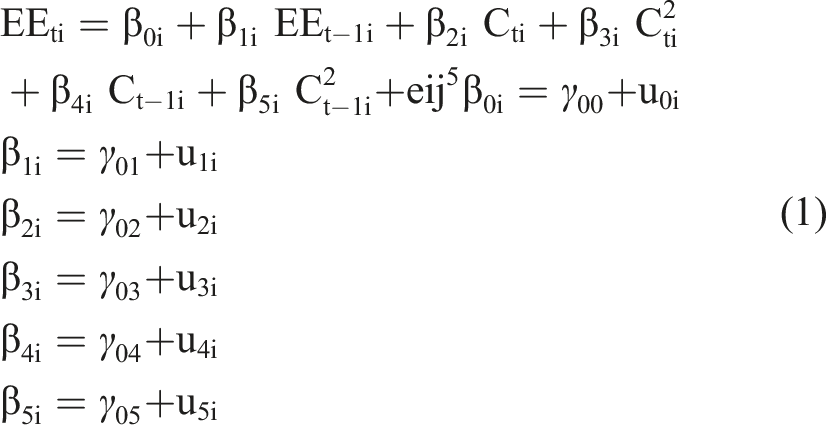
Concurrent and lagged associations between (counterhabitual) conscientiousness and emotional exhaustion were tested using the following DSEM model
4
Dynamic structural equation modeling (DSEM) analysis predicting emotional exhaustion, concurrent and delayed effects study 1.
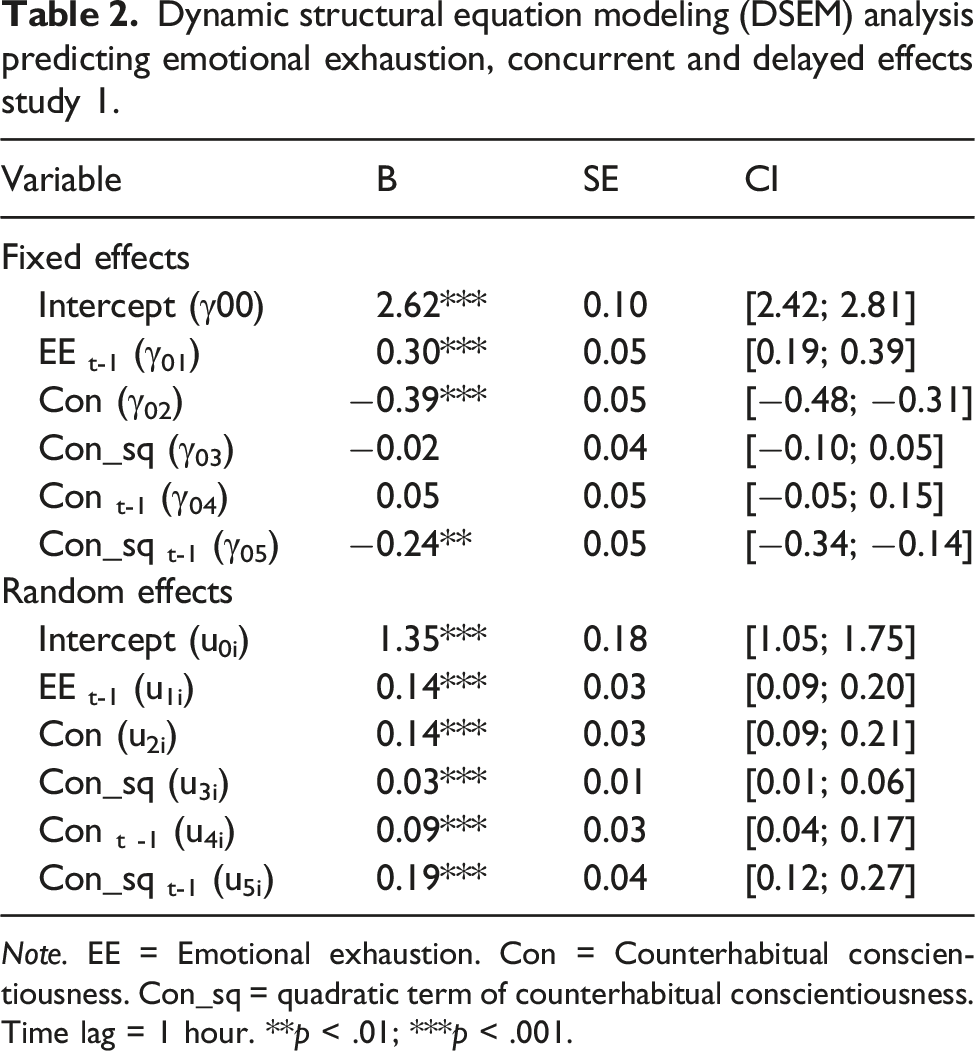
Note. EE = Emotional exhaustion. Con = Counterhabitual conscientiousness. Con_sq = quadratic term of counterhabitual conscientiousness. Time lag = 1 hour. **p < .01; ***p < .001.
Dynamic structural equation modeling (DSEM) analysis predicting negative affect, concurrent and delayed effects study 1.
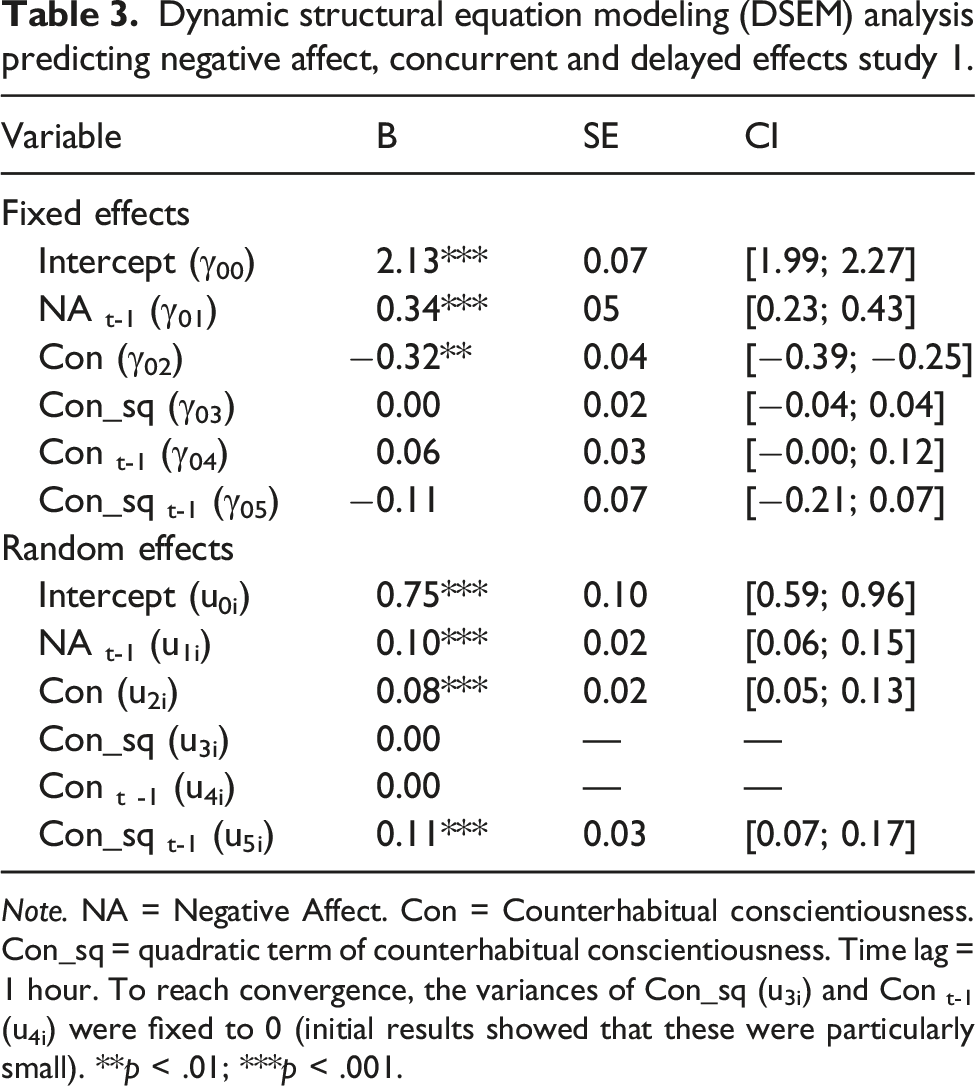
Note. NA = Negative Affect. Con = Counterhabitual conscientiousness. Con_sq = quadratic term of counterhabitual conscientiousness. Time lag = 1 hour. To reach convergence, the variances of Con_sq (u3i) and Con t-1 (u4i) were fixed to 0 (initial results showed that these were particularly small). **p < .01; ***p < .001.
For the lagged effects (see Table 2), we found the quadratic effect (γ05 = −0.24, 95% CI = [−0.34; −0.14]) but not the linear one (γ04 = 0.05, 95% CI = [−0.05; 0.15]) to be associated with emotional exhaustion. The negative sign of the quadratic component implies an inverse U-shaped relationship rather than a U-shaped one, which is counter to our expectations. 7 Moreover, as with the concurrent effects, we found between-person differences in the strength of these associations (Var(u4i) = 0.09, 95% CI = [0.04; 0.17] and Var(u5i) = 0.19, 95% CI = [0.12; 0.27]). Moreover, we found that neither the linear (γ05 = 0.06, 95% CI = [−0.00; 0.12]) nor the quadratic effect (γ04 = −0.11, 95% CI = [−0.21; 0.07]) to be associated with negative affect (see Table 3). Again, there were between-person differences in the strength of the quadratic association (Var(u5i) = 0.11, 95% CI = [0.07; 0.17]).
Cumulative effects
Next, to test how acting above and below one’s habitual level of conscientiousness relates to emotional exhaustion and negative affect, we calculated separate indices of cumulative positive and negative counterhabitual conscientiousness (see also Kuijpers et al., 2021). The positive index was calculated by computing per observation for which the state level exceeded the baseline level, the squared difference between the conscientiousness state score and the person’s mean conscientiousness score. Subsequently, we averaged these squared differences across all measurements of that day. Likewise, the negative index was calculated in the same way for those instances where the state level was below the baseline level. As such, these indices capture the extent to which the individual acts more (i.e., positive index) versus less (i.e., negative index) conscientious than habitually on that particular day. Note that these indices are high when people deviate often from their average conscientiousness level (i.e., frequency) and/or when they deviate more strongly from their average conscientiousness level (i.e., deviation).
These indices were then person-centered to make sure that we only retained within-person variability in those scores. Next, end-of-day emotional exhaustion/negative affect 8 was regressed on the person-centered cumulative positive and negative index, while controlling for (person-centered) emotional exhaustion/negative affect at the beginning of the day (i.e., before 12:00 a.m.) using multilevel regression analysis. 9
Regarding cumulative negative deviations from one’s baseline, we found a positive relation with emotional exhaustion (β = 0.46, p = 0.004, 95% CI [0.17, 0.74]) and negative affect (β = 0.45, p = 0.001, 95% CI [0.20, 0.71]). In terms of effect size, a comparison of the residual variances of the model including only emotional exhaustion at the beginning of the day and the model including emotional exhaustion at the beginning of the day and daily negative cumulative counterhabitual conscientiousness showed that 25.2% of the variance in emotional exhaustion and 33% of the variance in negative affect was uniquely predicted by daily negative counterhabitual conscientiousness. For the cumulative positive deviations from one’s baseline, we found a negative relationship with emotional exhaustion (β = −0.68, p = 0.023; 95% CI [−1.23, −0.13]; accounting for 16.3% of the variance), while there was no relationship with negative affect (β = −0.11, p = 0.461; 95% CI [−0.41, 0.18]). When including both predictors simultaneously in the model, negative counterhabitual conscientiousness remained a significant predictor of emotional exhaustion (β = 0.42, p = 0.003, 95% CI [0.13, 0.73]) and negative affect (β = 0.52, p < .001, 95% CI [0.26, 0.79]), while the effect of positive counterhabitual conscientiousness on emotional exhaustion was no longer statistically significant (β = −0.33, p = 0.236, 95% CI [−0.86, 0.21]), and the effect on negative affect remained statistically nonsignificant (β = 0.23, p = 0.138, 95% CI [−0.07, 0.55]). 10 See Tables 4 and 5 together, both predictors accounted for 33.5% of the within-person variance in emotional exhaustion and 33.7% in negative affect. 11
Discussion
Findings of the first study revealed that, concurrently, higher levels of conscientiousness relate to lower levels of emotional exhaustion and negative affect. When looking at delayed effects, results showed that higher levels of conscientiousness related to lower levels of emotional exhaustion 1 hour later. Nevertheless, because this effect turned nonsignificant when removing the concurrent effects, we are reluctant to overinterpret this finding. Finally, we found that repeated negative deviations from one’s typical level of conscientiousness were positively associated to emotional exhaustion and negative affect, while repeated positive deviations were unrelated to exhaustion and negative affect. All in all, this suggests that higher levels of conscientiousness tend to be associated to positive wellbeing outcomes, both in the moment, 1 hour later, and cumulated over time. Moreover, analyses of the cumulative effects revealed that it is particularly impactful when someone behaves less conscientious than they typically do (i.e., repeated negative deviations from one’s typical level of conscientiousness).
Because this study was fairly exploratory, we performed a replication-plus study (Bonett, 2012) in which we used an alternative sampling scheme (measuring participants three times a day for a 12-day period) and studied an alternative outcome measure that taps into the feelings of being psychologically and emotionally “drained” (Wright & Cropanzano, 1998). Similarly to Study 1, we again considered concurrent, delayed, and cumulative effects.
Study 2
Method
Participants
The total sample consisted of 96 participants of which 53.6% were female. The age of the participants ranged from 23 to 62 years and the average age was 35 years (SD = 12.9). 84.5% of the participants were Belgian and 15.5% were Dutch, and the occupations that were held by the participants were diverse. Participation was on a voluntary basis and each participant was personally informed about the content and the confidentiality of the study. Hypotheses were not pre-registered, and all measures, conditions, and data exclusions are reported.
Procedure
Data were collected over a period of 12 days, excluding weekends. Before filling out the first questionnaire that measured demographics, an informed consent form had to be signed online. All questionnaires were sent via email and participants received the questionnaire three times a day, on fixed moments (i.e., 9:30 am, 1:30 pm, and 5:30 pm). Participants had to report on their level of resource depletion and state conscientiousness, 12 and to avoid memory disturbance each round of questions needed to be answered within 1 hour after receiving the notification. In the full dataset, we obtained N = 2,151 observations from 96 participants, which corresponds to a response rate of 62.2%. For our aggregated dataset (for assessing cumulative effects), we set a minimum of three observations per day (removing 828 observations and 11 participants) and we removed individuals who participated for 1 day only (removing another 12 participants). 13
Measures
State conscientiousness. The measure of state conscientiousness was identical to the one used in Study 1 (Mini-Markers scale; Saucier, 1994), with the sole exception that response categories ranged from 1 extremely inaccurate to 9 extremely accurate. At the within-person level, the omega coefficient was ω = .60, while the between-person omega coefficient was ω = 0.95.
Resource depletion. Resource depletion was measured with a Dutch translation of the four-item Resource Depletion scale by Oertig et al. (2013). Each item focused on a different resource (i.e., self-discipline, concentration, stress-resistance, and physical energy) and participants were asked to indicate how much of these resources they possessed on that moment, compared to how much they usually possess. Answer categories ranged from 1 much below normal to 7 much above normal and after the data collection these were reverse-coded in such a way that higher scores were indicative of higher levels of depletion. The within-person omega coefficient was ω = 0.82 and the between omega coefficient was ω = 0.91.
Sample size considerations
In this study, we have an effective sample size of 97 individuals and 2,151 observations, which means that we have on average 22 observations per individual. The study of Schultzberg and Muthén (2018) shows that fixed effects parameter estimates will be relatively unbiased when using N > 15 and T > 10. For the variances of the random coefficients, N and T need to be larger than 50, however, increasing the number of participants reduces the relative bias of the parameters more than increasing the number of repeated measurements per participant, which is true in our case (Schultzberg & Muthén, 2018).
Multilevel regression parameters relating counterhabitual conscientiousness to end-of-day emotional exhaustion, cumulative effects study 1.
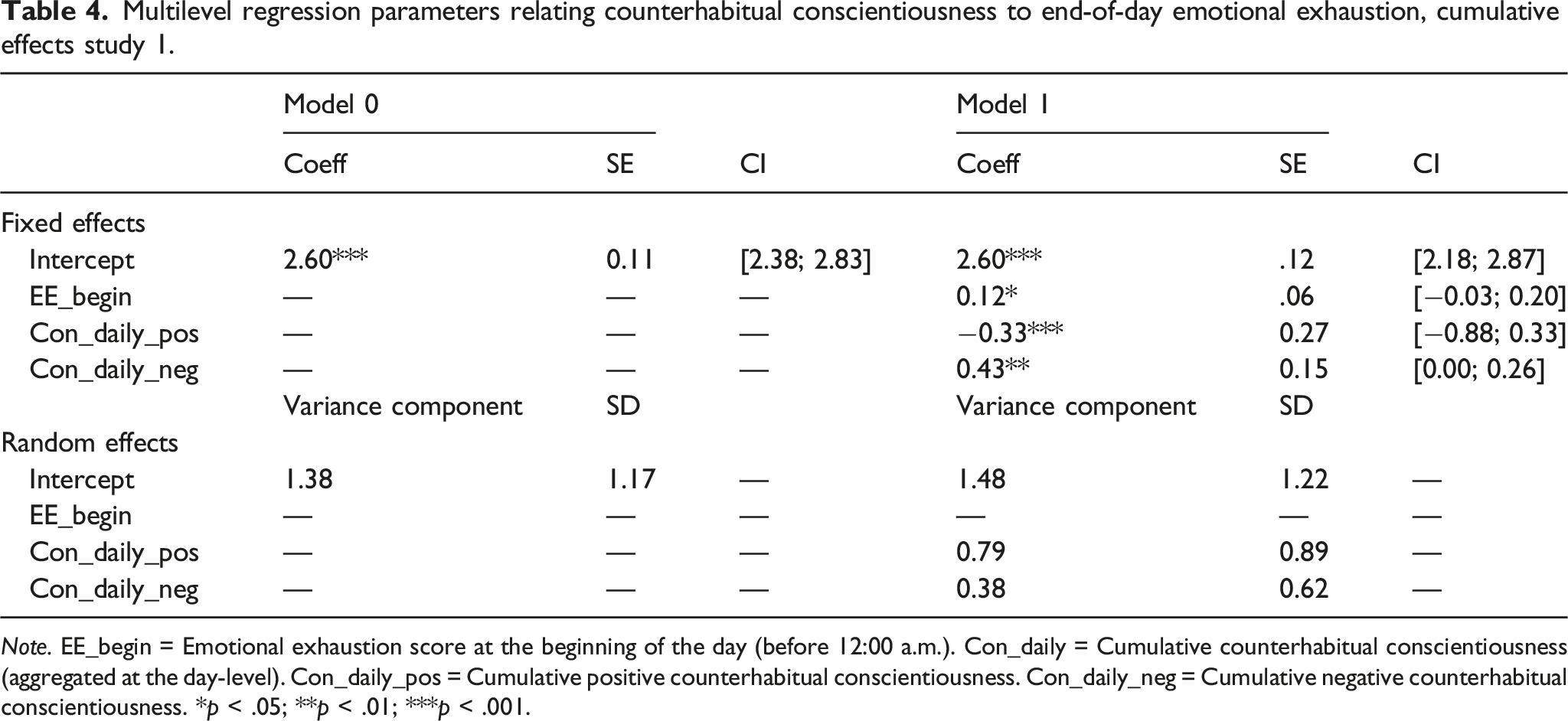
Note. EE_begin = Emotional exhaustion score at the beginning of the day (before 12:00 a.m.). Con_daily = Cumulative counterhabitual conscientiousness (aggregated at the day-level). Con_daily_pos = Cumulative positive counterhabitual conscientiousness. Con_daily_neg = Cumulative negative counterhabitual conscientiousness. *p < .05; **p < .01; ***p < .001.
Multilevel regression parameters relating counterhabitual conscientiousness to negative affect, cumulative effects study 1.
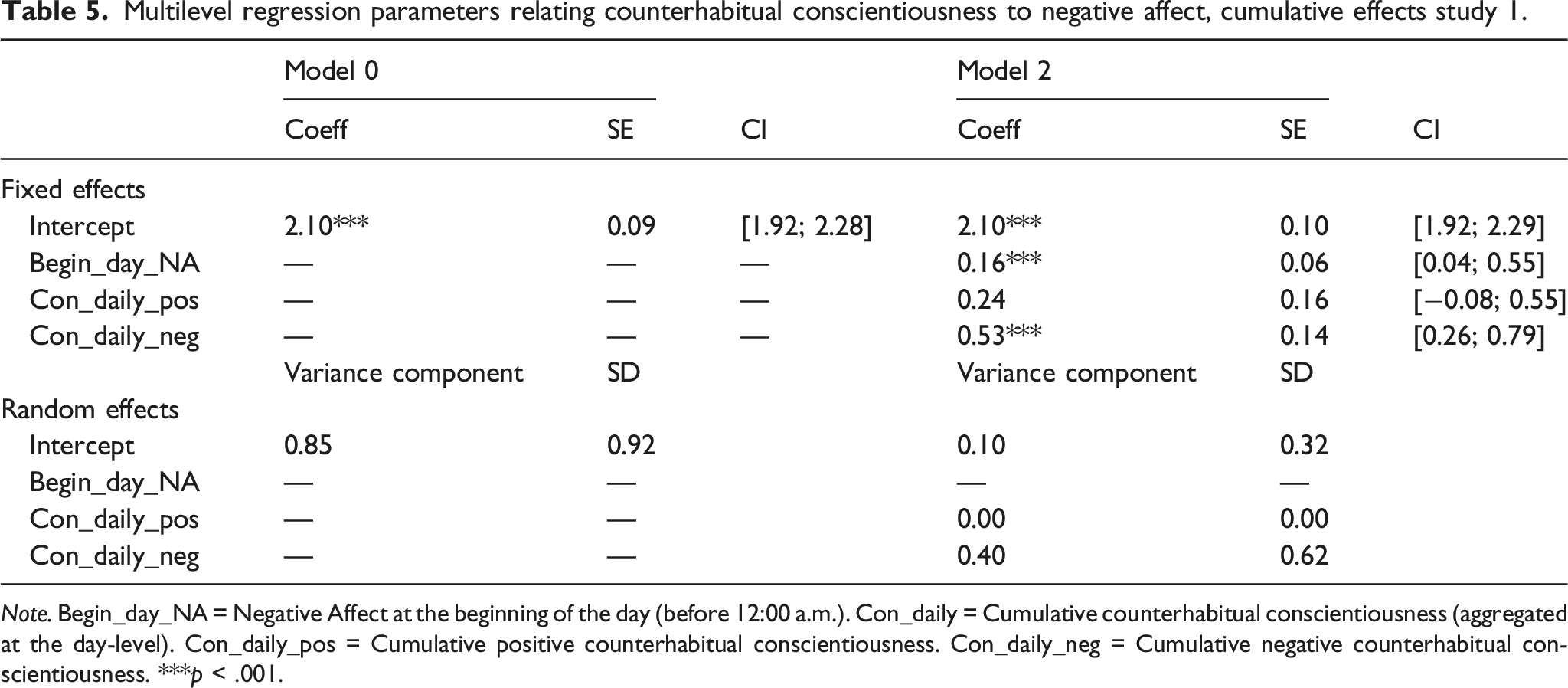
Note. Begin_day_NA = Negative Affect at the beginning of the day (before 12:00 a.m.). Con_daily = Cumulative counterhabitual conscientiousness (aggregated at the day-level). Con_daily_pos = Cumulative positive counterhabitual conscientiousness. Con_daily_neg = Cumulative negative counterhabitual conscientiousness. ***p < .001.
Results
Descriptive statistics and correlational analyses
Descriptive statistics, intra-class correlation coefficients (ICCs) and zero-order correlations for study variables study 2. Within-person correlations are above the diagonal and between-person correlations are below the diagonal study 2.

Note. ***p < .001.
Concurrent and lagged effects
The computation of our index of counterhabitual conscientiousness and the subsequent analyses paralleled those of study 1. In our DSEM model, we specified a lag of 3 hours 14 and random slopes were allowed to correlate. Further details on model specification, convergence, computation time, etc., can be found on the OSF page.
Dynamic structural equation modeling (DSEM) analysis predicting resource depletion, concurrent and delayed effects study 2.
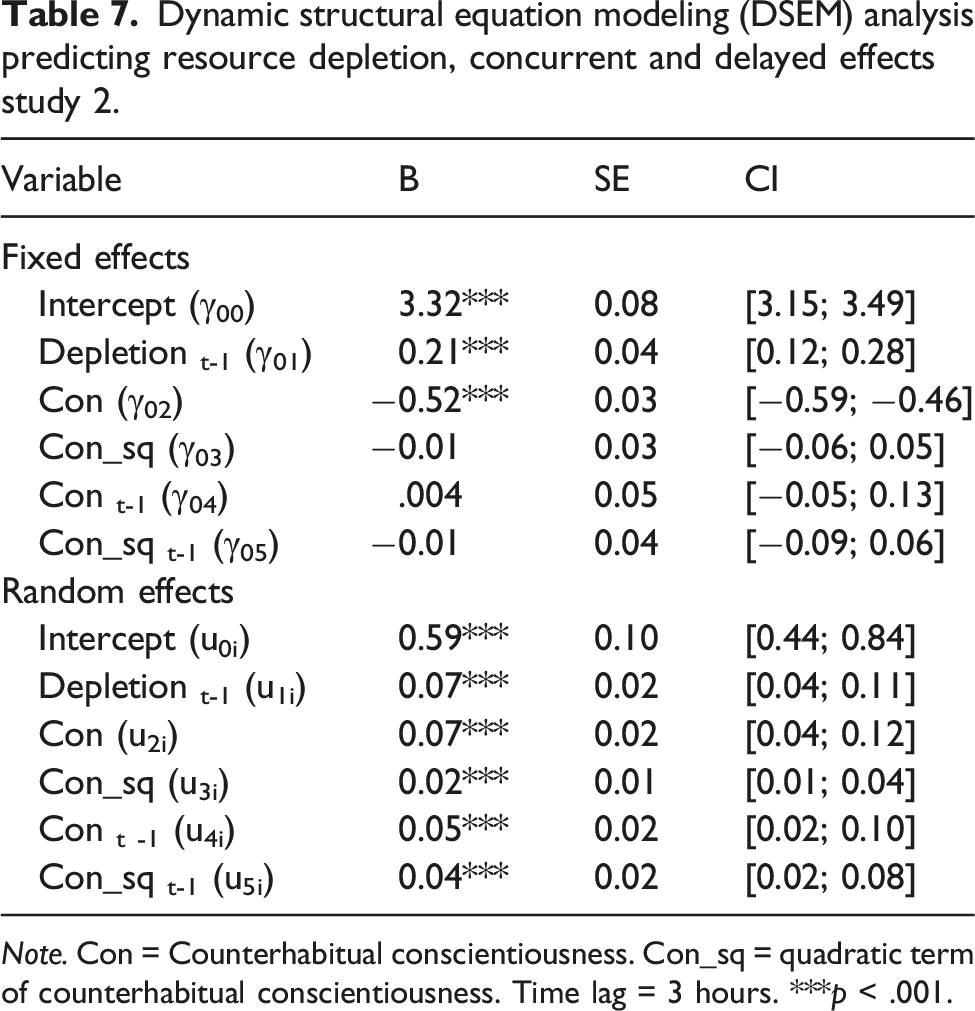
Note. Con = Counterhabitual conscientiousness. Con_sq = quadratic term of counterhabitual conscientiousness. Time lag = 3 hours. ***p < .001.
For the lagged effects (see Table 7), we found neither the linear (γ04 = 0.04, 95% CI = [−0.05; 0.13]) nor the quadratic (γ05 = −0.01, 95% CI = [−0.08; −0.06]) effect to be associated with resource depletion, although there were between-person differences in the strength of these associations (Var(u4i) = 0.05, 95% CI = [0.02; 0.10]; Var(u5i) = 0.04, 95% CI = [0.02; 0.08]). Thus, our findings provide no support for a delayed depleting effect of (counterhabitual) conscientiousness.
Cumulative effects
Multilevel regression parameters relating counterhabitual conscientiousness to end-of-day depletion, cumulative effects.
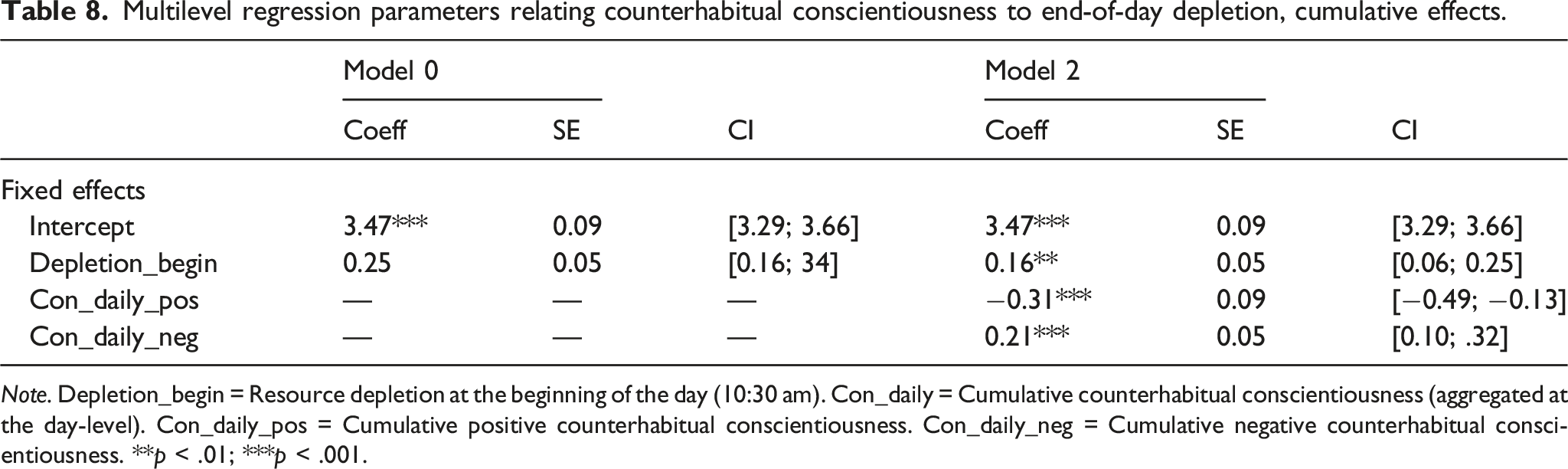
Note. Depletion_begin = Resource depletion at the beginning of the day (10:30 am). Con_daily = Cumulative counterhabitual conscientiousness (aggregated at the day-level). Con_daily_pos = Cumulative positive counterhabitual conscientiousness. Con_daily_neg = Cumulative negative counterhabitual conscientiousness. **p < .01; ***p < .001.
Discussion
Results of Study 2 largely paralleled those of Study 1. Concurrently, self-rated conscientious behavior was related to lower levels of resource depletion, while conscientiousness was unrelated to resource depletion after a three-hour delay. Furthermore, when looking at cumulative effects, we found that repeated negative deviations from one’s habitual level of conscientiousness related to higher levels of resource depletion, while repeated positive deviations related to lower levels of resource depletion. All in all, these findings again supported the idea that higher levels of conscientiousness are associated with higher levels of wellbeing.
General discussion
The aim of the current paper was to explore the consequences of state conscientiousness by looking at concurrent, delayed, and cumulative effects. Whereas the large majority of research has focused on concurrent or immediate effects (e.g., Pickett et al., 2019), we explored the possibility that (counterhabitual) conscientiousness might be costly later on or when cumulated over time. Our findings showed that this is not the case. We found that self-reported momentary levels of conscientiousness relate negatively to momentary levels of emotional exhaustion, resource depletion, and negative affect. That is, the more one reports to act in a conscientious manner, the less one feels depleted, exhausted, and experiences negative affect. This finding is in line with the reasoning that the pleasant consequences that follow from acting conscientiously lead individuals to experience more positively valanced feelings (Fayard et al., 2012; Pickett et al., 2019). When looking at delayed effects, results once again failed to support the costly nature of (counterhabitual) conscientiousness. When controlling for one’s current level of (counterhabitual) conscientiousness, acting more conscientious than typically related to higher levels of negative affect 1 hour later. Because this effect turned nonsignificant when removing the concurrent effects, we are reluctant to overinterpret them.
Finally, when looking at cumulative effects over time, results revealed that on days when people report to repeatedly behave less conscientiously than they normally do, they felt more exhausted, depleted, and experienced higher levels of negative affect. In contrast, when controlling for the effect of negative cumulative counterhabitual conscientiousness, repeatedly behaving more conscientiously than normally was unrelated to emotional exhaustion and negative affect, while it was negatively related to resource depletion. Hence, our findings show that repeatedly behaving less conscientiously than normally matters more than repeatedly behaving more conscientiously in the prediction of emotional exhaustion and negative affect.
We are not the first to show such asymmetries. For example, for conscientiousness Pickett et al. (2020) showed that primarily behaving less conscientiously than one normally does related to less positive and more negative affect, while behaving more conscientious was less strongly related to positive and negative affect. Or for extraversion, Zelenski et al. (2012) found that dispositional extraverts who acted introverted performed worse on a Stroop task, but that this was not true for dispositional introverts who acted extraverted. In the same vein, Gallagher et al. (2011) showed that extraverted people who acted in an introverted manner reported their behaviors as more effortful. Hence, there is growing evidence that the dichotomy out-of-character versus in-character (i.e., acting counterhabitual or not) is inapt to capture the complex reality of counterhabitual behavior. Instead, it might be more productive for future research to explicitly recognize potential asymmetries and refer to below-typical, typical, and above-typical behaviors. 18
One reason for these observed asymmetries might be a negativity bias. This cognitive bias implies that negative events have a more significant impact on our psychological state than positive ones (Norris, 2021) because negative information is processed more thoroughly than positive information (Rozin & Royzman, 2001). Another explanation might be that on days when participants report repeatedly behaving less conscientiously than typically, they might have experienced some particular difficulties or failures that contributed to both low state conscientiousness and high exhaustion and negative affect near the end of their work day. Although the non-experimental nature of our studies does not allow for drawing causal inferences, we do consider this explanation relatively unlikely provided that previous studies on counterhabitual behavior performed in a controlled laboratory setting (e.g., Gallagher et al., 2011) showed similar findings.
In sum, our findings consistently show that higher levels of conscientiousness relate to lower levels of momentary emotional exhaustion, resource depletion, and negative affect within the individual. When looking at cumulative instances over time, however, behaving less conscientious than habitually appears to be more important for predicting exhaustion and negative affect than behaving more conscientious than habitually. As a set, these findings contradict the idea that (counterhabitual) conscientiousness is associated with costs.
Limitations and future research
A number of limitations of the current work need to be acknowledged. First, we relied on self-reports to measure our focal variables, and although this way of measurement is not uncommon with these constructs, it makes our findings susceptible to common method bias. However, there are several reasons why the issue of common method bias is not that worrying for our findings. First, we person-centered the conscientiousness scores, which implies that we eliminated between-person differences in response biases from the data (Beal & Weis, 2003). Second, whereas such biases might have affected the concurrent findings, the delayed and cumulative effects are less susceptible to such biases because the predictor and outcome are measured at different time points. Lastly, research has shown that common method variance is less problematic when investigating higher-order effects or interactions, which is what we do when studying concurrent and delayed effects (because of the inclusion of the curvilinear effects; Siemsen et al., 2010).
Second, it should be noted that causality could not be established with our study design. Experience Sampling Method (ESM) data are correlational in nature because individuals are not randomly assigned to the situations they encounter each day (Conner & Lehman, 2012). For example, as we already mentioned above, an alternative explanation for our findings might be that both state conscientiousness and emotional exhaustion are influenced by the nature of the task they are working on, instead of state conscientiousness influencing emotional exhaustion. It is also possible that people fail to act in a conscientious manner when they are emotionally exhausted or depleted. To test this possibility, we performed an additional analysis in which we expanded our models, allowing emotional exhaustion, negative affect (in Study 1) and resource depletion (in Study 2) at time t-1 to predict conscientiousness at time t (also including the autoregressive effect of conscientiousness on itself). These models were tested using fixed rather than random slopes, because the random-slopes models were too heavily parametrized, resulting in convergence issues. For both emotional exhaustion and resource depletion, but not for negative affect, we found a negative association with later levels of conscientiousness (see Table S3-S5). Although this finding needs to be cautiously interpreted, and although studies with more repeated observations and more participants are needed to test random effects models, these findings suggest that the relationship between conscientiousness and emotionally exhaustion/depletion is a complex (and possibly reciprocal) one.
Third, although we refer to counterhabitual behavior, we did not ask respondents specifically about their conscientiousness-related behaviors. We instead asked them to report on how they perceived themselves at that particular moment. These responses most likely reflect a general momentary feeling that could be related to behavior at that moment, but it could also be derived from feelings or motivational states.
Moreover, future studies that—despite the null findings in the present paper—still want to investigate the consequences of counterhabitual behavior may consider that the effects of “over- or under engaging” on one personality dimension might be different depending on whether one is “over- or under engaging” on the other personality dimensions (Kuijpers et al., 2022). Counterhabitual behavior might be less costly if one behaves away from the baseline on one dimension only rather than on several dimensions simultaneously. Kuijpers et al. (2022) looked into this issue. Across three high intensity repeated measures datasets, these authors showed that out-of-character behavior, as measured by the summed absolute deviation from one’s personality profile, was associated with decreased levels of positive affect and increased levels of negative affect. Although the unique contribution of each individual personality dimension to this overall index remains unknown, combining their findings with ours suggests that the effect of counterhabitual behavior on an isolated personality dimension might differ from a more inclusive approach in which multiple personality dimensions are considered.
Another endeavor for future studies might be to investigate the potential mechanisms driving the relationship between counterhabitual behavior and affective outcomes. Studies looking into the affective cost of counterhabitual behavior often hypothesize that these costs follow from the fact that these behaviors are mentally depleting (e.g., Jacques-Hamilton et al., 2019). Although our results did not show any costs, Kuijpers et al. (2022) specifically investigated the mediating role of research depletion and showed that, indeed, resource depleting mediated the relationship between “out-of-character” behaviors (operationalized as the summed absolute deviation from one’s personality profile) and positive and negative affect.
Another issue is that we measured participants during work hours. As a result, we captured their work-related conscientiousness baseline, and this baseline might differ from their general baseline, provided that people tend to be a bit more conscientious at work than at home (Horstmann & Ziegler, 2020). Because of this reason, in the present study counterhabitual behaviors refer to behaviors that deviate from how someone would typically behave at work. Specifically focusing on a single context (work) also has a distinct advantage in the sense that it does not conflate within-person with between-context variation, allowing for a more straightforward interpretation of counterhabitual conscientiousness. This would not have been possible if we would have measured participants across contexts because one’s habitual level of conscientiousness can be very different at work than at home or in the sports club.
Finally, given the relatively limited time span of the data collection (i.e., 5 days in Study 1 and 12 days in Study 2), and the moderate response rates, our results should be taken with caution. Particularly for the cumulative effects, our sampling scheme allowed us to test for daily cumulative effects only. Future studies should therefore try to look at alternative—and probably longer—periods of time over which one’s experiences might cumulate (see e.g., Kuijpers et al., 2021). In addition, research on the effects of counterhabitual behavior seems to suggest that those effects are either small or non-existing. To be able to detect such small effects, we need studies that are sufficiently powered. Hence, there is a need for well-planned studies based on rigorous a-priori power analyses, and because real-life studies on counterhabitual behavior imply high-intensity longitudinal data, such power analysis can only be done using simulation research. Lastly, the ICC revealed that there was more between-person than within-person variation in emotional exhaustion and negative affect. The consequence is that we focused on explaining a relatively small portion of the variance in these variables.
Conclusion
Because several studies show that conscientiousness is positively associated with a wide range of positive outcomes in life, one may wonder why we do not uniformly invest in becoming more conscientious. Based on a long psychological tradition emphasizing “being true to oneself”, it has been suspected that deviating from one’s typical conscientiousness level might carry psychological costs (Leikas et al., 2021). Because the consequences of (counterhabitual) conscientiousness might change over time, we studied the relationship between (counterhabitual) conscientiousness and exhaustion, depletion, and negative affect across different time frames. Our results revealed that concurrently, higher levels of conscientiousness tend to go hand in hand with lower levels of emotional exhaustion, resource depletion, and negative affect. When assessing cumulative instances over time, lower levels of conscientiousness seem to matter more for the prediction of emotional exhaustion and negative affect, while acting more conscientiousness than typically was also related to lower levels of resource depletion. We therefore found no support for the assumption that counterhabitual behavior is associated with wellbeing-related costs.
Supplemental Material
Supplemental Material - Does it pay off to act conscientiously, both now and later? Examining concurrent, lagged, and cumulative effects of state conscientiousness
Supplemental Material for Does it pay off to act conscientiously, both now and later? Examining concurrent, lagged, and cumulative effects of state conscientiousness by E Kuijpers, J Pickett, B Wille, and J Hofmans in European Journal of Personality
Footnotes
Declaration of conflicting interests
The author(s) declared no potential conflicts of interest with respect to the research, authorship, and/or publication of this article.
Funding
The author(s) disclosed receipt of the following financial support for the research, authorship, and/or publication of this article: This work was supported by the Fonds Wetenschappelijk Onderzoek (FWO; Research Foundation - Flanders) research fund [grant number G024618N].
Data accessibility statement

Supplemental Material
Supplemental material for this article is available online.
Notes
References
Supplementary Material
Please find the following supplemental material available below.
For Open Access articles published under a Creative Commons License, all supplemental material carries the same license as the article it is associated with.
For non-Open Access articles published, all supplemental material carries a non-exclusive license, and permission requests for re-use of supplemental material or any part of supplemental material shall be sent directly to the copyright owner as specified in the copyright notice associated with the article.
