




Abstract
Anxiety and depression are pervasive and pernicious mental health problems for young adults. Developmental trajectories of adolescent temperament (Effortful Control, Negative Emotionality, and Positive Emotionality) may help us predict who will experience anxiety/depression during young adulthood. The present study used longitudinal data from a large, community sample of Mexican-origin youth (N = 674) to examine how temperament develops across adolescence (age 10–16) and whether the developmental trajectories of temperament are associated with anxiety/depression during young adulthood (ages 19 and 21). Results indicate that Effortful Control, Negatively Emotionality, and the Affiliation facet of Positive Emotionality tend to decrease across adolescence, whereas Surgency tends to increase. Smaller decreases in Effortful Control and greater increases in Positive Emotionality across adolescence were associated with fewer anxiety/depression symptoms during young adulthood, whereas smaller decreases in Negative Emotionality were associated with more anxiety/depression symptoms later on. Thus, temperament development serves as both a protective factor (Effortful Control, Positive Emotionality) and a risk factor (Negative Emotionality) for later anxiety/depression in Mexican-origin youth.
Introduction
Anxiety affects about one in seven and depression one in 10 American young adults (Goodwin et al., 2020; Mojtabai et al., 2016). In addition to the immense personal suffering associated with anxiety and depression, experiencing these internalizing problems during young adulthood contributes to various negative outcomes both concurrently and prospectively (Naicker et al., 2013), including lower graduation rates (Breslau et al., 2008) and higher levels of unemployment (Kawakami et al., 2012). For Latino youth, and Mexican-origin youth in particular, dealing with acculturative stress and discrimination can lead to higher rates of anxiety and depression symptoms than youth who are members of other ethnic groups (Bridges et al., 2021; Maiya et al., 2021; Stein et al., 2019; Suarez-Morales & Lopez, 2009; Torres, 2010). Given this widespread public health problem, it is important to identify factors that contribute to anxiety and depression symptoms during young adulthood, which may then highlight potential prevention and intervention targets.
One important factor to consider is adolescent temperament (Compas et al., 2004). Numerous studies have examined the relation between temperament and anxiety/depression, but most of this work relies on cross-sectional data or examines how temperament assessed at one timepoint predicts subsequent levels of anxiety and depression. Thus, past research provides relatively little insight into how changes in temperament might impact anxiety and depression. Moreover, the vast majority of past research in this area has focused on samples comprised of predominantly White American and European youth. The present study used data from a long-term, longitudinal study of Mexican-origin youth living in the United States (N = 674) to examine the developmental trajectories of three temperament domains—Effortful Control, Negative Emotionality, and Positive Emotionality—from late childhood (age 10) through adolescence (age 16), and their associations with anxiety and depression at ages 19 and 21. Importantly, we addressed the overlap between anxiety and depression by examining how temperament trajectories are associated with symptoms they share in common (generalized distress), as well as distinct aspects of anxiety (anxious arousal) and depression (anhedonia).
Temperament
Temperament refers to individual differences in reactivity and self-regulation that are present from an early age and relatively enduring (Rothbart, 2007; Rothbart, 2011). Researchers studying individual differences during adolescence often label traits as either “temperament” or “personality”, though there is no clear conceptual or empirical distinction between the two (Clark & Watson, 2008; Shiner, 2015; Shiner & DeYoung, 2013; Shiner et al., 2021; Soto & Tackett, 2015). Research on youth temperament is often guided by Rothbart’s highly influential model (Rothbart et al., 2000), which posits three key constructs: Effortful Control (EC), Negative Emotionality (NEM), and Positive Emotionality (PEM). According to Rothbart’s model, the EC domain involves one’s capacity to plan and suppress inappropriate impulses (Inhibitory Control), perform an action or pursue goals when there are competing desires (Activation Control), and focus and shift attention when needed (Attention). The NEM domain involves unpleasant affect derived from anticipating distress (Fear) and negative affect related to ongoing tasks being interrupted (Frustration). Often, the NEM domain is expanded to include hostile reactivity to negative stimuli including person- and object-directed violence (Aggression) and unpleasant affect, lowered mood, and lack of enjoyment in activities (Depressed Mood). The PEM domain involves pleasure derived from high intensity or novel activities (High Intensity Pleasure/Surgency; hereafter referred to as Surgency) and a desire for close, warm interpersonal connections (Affiliation). Factor analytic work, including research using the same dataset as the present study (Lawson et al., 2021), suggests that EC and NEM represent broad but cohesive domains, whereas the PEM facets do not form a cohesive domain (Putnam et al., 2001; Snyder et al., 2015). Consequently, we consider both domain and facet-level scores for EC and NEM but only facet-level scores (i.e., separate Surgency and Affiliation) for PEM.
Summary of previous research examining temperament and personality development during adolescence.
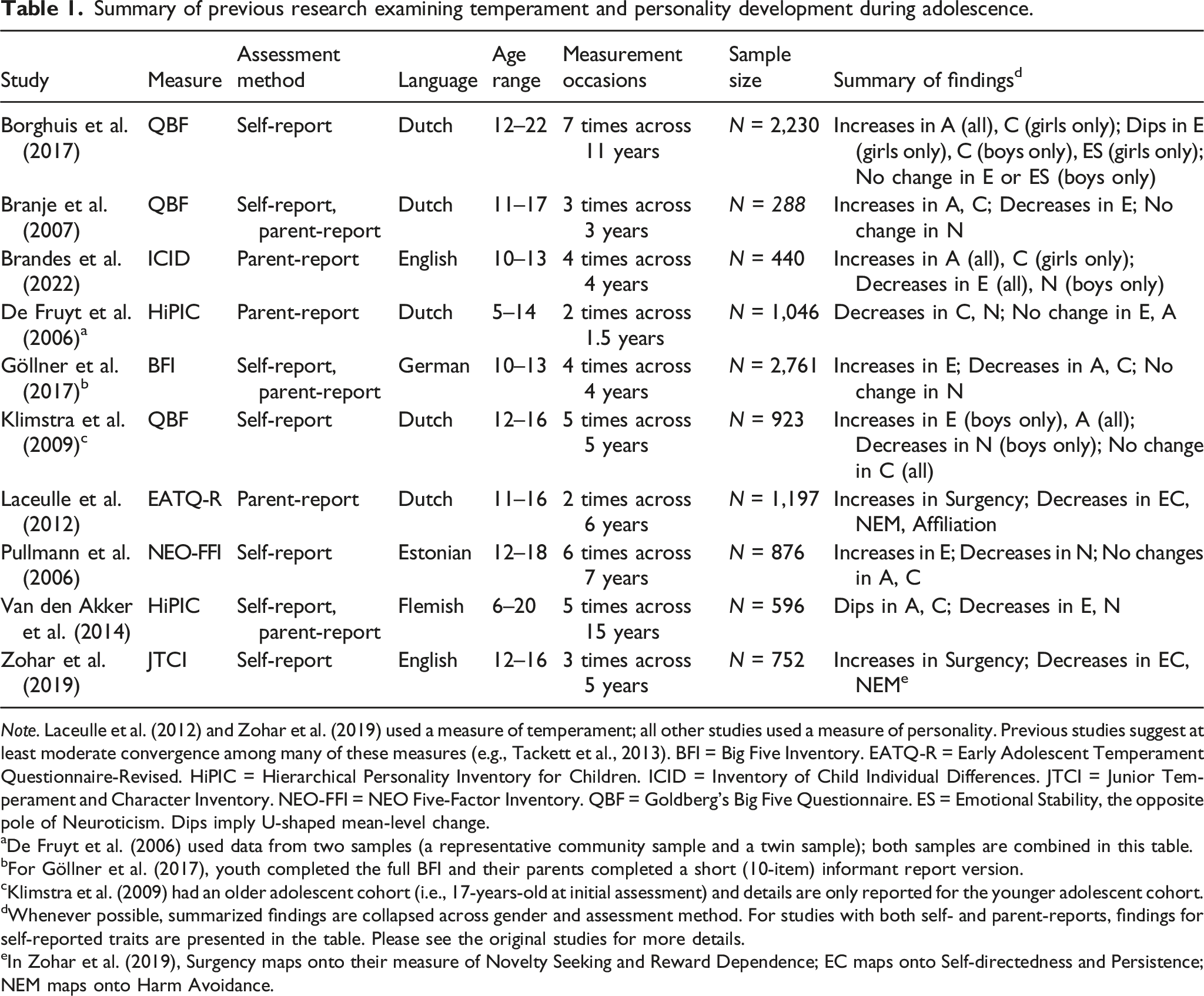
Note. Laceulle et al. (2012) and Zohar et al. (2019) used a measure of temperament; all other studies used a measure of personality. Previous studies suggest at least moderate convergence among many of these measures (e.g., Tackett et al., 2013). BFI = Big Five Inventory. EATQ-R = Early Adolescent Temperament Questionnaire-Revised. HiPIC = Hierarchical Personality Inventory for Children. ICID = Inventory of Child Individual Differences. JTCI = Junior Temperament and Character Inventory. NEO-FFI = NEO Five-Factor Inventory. QBF = Goldberg’s Big Five Questionnaire. ES = Emotional Stability, the opposite pole of Neuroticism. Dips imply U-shaped mean-level change.
De Fruyt et al. (2006) used data from two samples (a representative community sample and a twin sample); both samples are combined in this table.
For Göllner et al. (2017), youth completed the full BFI and their parents completed a short (10-item) informant report version.
Klimstra et al. (2009) had an older adolescent cohort (i.e., 17-years-old at initial assessment) and details are only reported for the younger adolescent cohort.
Whenever possible, summarized findings are collapsed across gender and assessment method. For studies with both self- and parent-reports, findings for self-reported traits are presented in the table. Please see the original studies for more details.
In Zohar et al. (2019), Surgency maps onto their measure of Novelty Seeking and Reward Dependence; EC maps onto Self-directedness and Persistence; NEM maps onto Harm Avoidance.
Developmental changes in temperament across adolescence
Adolescence is a developmental period characterized by rapid maturational changes, shifting societal expectations, conflicting role demands, and increasingly complex peer and romantic relationships (Hill & Edmonds, 2017). Many have speculated that these dramatic biological, cognitive, and social changes may be matched by accompanying changes in temperament. Most notably, researchers have suggested that adolescent personality development follows the disruption hypothesis, where “biological, social and psychological transitions from childhood to adolescence are accompanied by temporary dips in some aspects of personality maturity” (Soto & Tackett, 2015, p. 360). In particular, youth may struggle to meet the increased demands and challenges of adolescence and become (temporarily) less responsible, kind, and emotionally stable during this process. In contrast, other researchers have posited that adolescents rise to the challenge of this tumultuous developmental period, raising their level of personality maturation by becoming more well-regulated, prosocial, and emotionally stable (Bleidorn et al., 2013; Roberts et al., 2006). In particular, the maturity principle assumes that normative personality development equips adolescents to engage in relevant educational, occupational, and interpersonal domains. However, meta-analytic findings suggest that there are only minor mean-level changes in traits from age 10 to 18, especially when compared to changes that occur during young adulthood (Bleidorn et al., 2021; Roberts et al., 2006), suggesting that neither disruption nor maturation captures the whole picture. Thus, debate persists about the normative development of temperament traits during adolescence.
Effortful control
Several longitudinal studies have examined developmental trajectories of EC and related constructs (e.g., Conscientiousness) across adolescence. Most studies find mean-level decreases in both self- and parent-reported EC (De Fruyt et al., 2006; Göllner et al., 2017; Laceulle et al., 2012; Van den Akker et al., 2014; Zohar et al., 2019). However, some studies have found no mean-level changes in EC (Göllner et al., 2017; Klimstra et al., 2009; Pullmann et al., 2006; Roberts et al., 2006) and other studies even found mean-level increases in Conscientiousness, but only for girls (Borghuis et al., 2017; Brandes et al., 2022; Branje et al., 2007). Despite these discrepancies, the majority of evidence supports the disruption hypothesis with respect to EC across adolescence. Indeed, research using data from the same sample as the present study has documented mean-level decreases in EC from age 10 to 14 followed by mean-level increases from age 14 to 19 (Atherton et al., 2020a).
Negative emotionality
Previous research has found mean-level decreases in NEM (and Neuroticism) during adolescence using both self- and parent-reports (Brandes et al., 2022; De Fruyt et al., 2006; Klimstra et al., 2009; Laceulle et al., 2012; Pullmann et al., 2006; Roberts et al., 2006; Van den Akker et al., 2014; Zohar et al., 2019; but see Borghuis et al., 2017, Branje et al., 2007; Göllner et al., 2017, who largely found no changes). These findings support the maturity principle of personality development because they suggest that youth are becoming more emotionally stable as they get older. However, research on the facets of NEM suggests a more complicated pattern; although the core facets of Fear and Frustration seem to decrease during adolescence (Brandes et al., 2022), the Depressed Mood facet tends to increase, especially for girls (Soto et al., 2011).
Positive emotionality
Findings on mean-level changes in PEM during adolescence are mixed. For Surgency (and the related construct of Extraversion), some longitudinal studies have found mean-level increases in both self- and parent-reports (Göllner et al., 2017; Klimstra et al., 2009; Laceulle et al., 2012; Pullmann et al., 2006; Roberts et al., 2006; Zohar et al., 2019), whereas others have found no mean-level changes (Borghuis et al., 2017; De Fruyt et al., 2006) or even mean-level decreases in Surgency across this period (Branje et al., 2007; Brandes et al., 2022; Van den Akker et al., 2014). The longitudinal evidence is similarly mixed for the other facet of PEM, Affiliation. Some studies have found mean-level increases in Affiliation (Borghuis et al., 2017; Brandes et al., 2022; Branje et al., 2007; Klimstra et al., 2009), whereas others have found mean-level decreases (Göllner et al., 2017; Laceulle et al., 2012; Van den Akker et al., 2014) or no mean-level changes across adolescence (De Fruyt et al., 2006; Pullmann et al., 2006; Roberts et al., 2006).
Together, previous studies suggest normative decreases in EC (aligned with the disruption hypothesis), normative decreases in NEM (aligned with the maturity principle), and mixed evidence with respect to PEM development across adolescence. However, the empirical basis for these findings is relatively weak, given that many studies used a single informant to assess temperament, included only a few measurement occasions, examined only domain and not facet-level changes, and/or followed youth across only part of the adolescence. Thus, more research is needed to better understand the trajectory of temperament across the adolescent years. Next, we review past research and theory on the association between temperament trajectories and anxiety/depression symptoms in young adulthood.
Temperament as a risk factor for anxiety and depression
The vulnerability model of personality and psychopathology posits that certain temperament traits place an adolescent at greater risk for, or protect them from, developing later psychopathology (Tackett, 2006). For example, youth who have lower attention control early in life may be predisposed to depression later on, whereas youth who are more fearful early on may later experience more anxiety symptoms (Muris & Ollendick, 2005). Consistent with the vulnerability model, previous theory and research supports the idea that certain traits serve as risk or protective factors for adolescent anxiety and depression (De Pauw & Mervielde, 2010; Nigg, 2006; Pérez-Edgar & Fox, 2005).
Effortful control
Lower levels of EC, especially the Attention facet, are conceptually related to higher levels of depression (Compas et al., 2004; Muris et al., 2007) and cross-sectional studies have confirmed these associations (e.g., Oldehinkel et al. 2004). Longitudinally, lower levels of EC during adolescence may predispose individuals to experience depression during young adulthood. For example, youth who are lower in EC are likely to have difficulty regulating their behaviors and emotions, so they may be more likely to engage in rumination and have trouble disrupting maladaptive cycles or following through with problem-solving tactics related to depressive thoughts (Aldao et al., 2010; Van Beveren et al., 2016). These dysfunctional processes may contribute to problems in peer and romantic relationships, academic failure, and other negative life outcomes that can trigger depression. Consistent with these ideas, several two-wave studies found associations between lower levels of EC and higher levels of depression one to 4 years later (Crockett et al., 2013; Loukas & Roalson, 2006; Ormel et al., 2005; Verstraeten et al., 2009). However, in two of these studies, the effect of EC was no longer significant after controlling for depression at the first wave (Loukas & Roalson, 2006; Verstraeten et al., 2009). In contrast to depression, there is little theoretical justification for a relation between EC and anxiety, and past research has rarely examined these specific associations, instead grouping internalizing symptoms together (e.g., Crockett et al., 2013). In summary, there is limited evidence that EC predisposes youth to subsequent depression symptoms and no longitudinal evidence that EC contributes to anxiety problems in adolescence.
Negative emotionality
Numerous studies have shown that higher levels of NEM are concurrently related to both anxiety and depression (e.g., Anthony et al., 2002). Developmentally, the presence of NEM in an adolescent’s thoughts, feelings, and behaviors may contribute to an increased risk of experiencing adverse life events, which then increases risk of anxiety and depression in response to these negative events (Klein et al., 2011). More specifically, youth who have tendencies toward fear and frustration are likely to engage in maladaptive avoidance of their problems, suppressing thoughts and feelings rather than adaptively coping with them (Van Beveren et al., 2016). Further, tendencies toward sadness may make youth less likely to attempt to reappraise situations to try to see the positive, leading to downward spirals. Indeed, empirical studies have documented that NEM is longitudinally associated with later internalizing problems. Research suggests that prior levels of both self- and parent-reported NEM predispose youth to later anxiety and depression (Bould et al., 2014; Bouma et al., 2008; Brendgen et al., 2005; Caspi et al., 1996; Crockett et al., 2013; Davis et al., 2015; Lonigan et al., 2003; Mezulis et al., 2011; Ormel et al., 2005; Verstraeten et al., 2009; Wetter & Hankin, 2009). However, interpreting these findings is complicated by the conceptual overlap between measures of NEM and measures of anxiety and depression, making it important to explore findings at the facet level to determine whether the associations at the superordinate level are driven entirely by conceptually analogous scales (e.g., Fear with anxiety; Depressed Mood with depression) that have some content overlap.
Positive emotionality
Low levels of Surgency, indicating the absence of feelings of high energy positive affect (e.g., enthusiasm, excitement), is conceptually similar to anhedonia, a core feature of depression. Indeed, Surgency is concurrently negatively associated with depression, but not anxiety (e.g., Phillips et al., 2002). Some longitudinal studies suggest that lower self- and parent-reported Surgency are prospectively associated with increased risk of developing depression and anxiety (Lonigan et al., 2003; Ormel et al., 2005; Verstraeten et al., 2009), but other studies found no prospective association (Bould et al., 2014; Mezulis et al., 2011).
The association between Affiliation and internalizing problems is even less clear. One theory is that youth who are higher in Affiliation, and thus desire close connections with others, may be more sensitive to interpersonal stressors and more anxious later on, especially during young adulthood when life circumstances could lead to difficulty establishing and maintaining consistent social support. The limited empirical research on the Affiliation facet of PEM suggests that there is no association between self- and parent-reported Affiliation and internalizing problems, either concurrently (Oldehinkel et al., 2004) or two to three years later (Ormel et al., 2005). However, one study found that higher levels of Affiliation were associated concurrently with higher levels of anxiety, but not depression (Kushner et al., 2012). Altogether, little is known about the prospective effects of Surgency and Affiliation on later anxiety and depression.
Temperament change
Above and beyond initial or average levels, changes in temperament across adolescence may be especially relevant for adjustment later on. In particular, youth who are experiencing disruption (vs. maturation) with respect to various temperament traits during adolescence may struggle more with their mental health in young adulthood. For example, an adolescent who is increasing in their Fear, Frustration, and Depressed Mood and decreasing in EC may have more difficulties coping with the many challenges of adolescence, selecting themselves into more dysfunctional environments (e.g., choosing friends and romantic partners who are prone to conflict), and evocating changes in and reacting to their environment in ways that further increase their NEM over time and lead to more negative life outcomes. Together, these transactional processes could create a vicious cycle of declining levels of functioning, contributing to the development of anxiety and depression (Hopwood et al., 2022; Klein et al., 2011).
The handful of previous studies that have examined how changes in temperament relate to later internalizing problems have found results consistent with this pattern. In a 3-year longitudinal study of 190 children aged 8- to 12-years-old at baseline, youth who experienced smaller decreases in EC and smaller increases in fear and irritability (assessed via the EATQ) had fewer internalizing problems at the final assessment (Lengua, 2006). Further, a longitudinal study of 290 8- to 9-year-old Belgian children followed across 6 years found that child personality trajectories, measured via parent- and teacher-reports on the HiPIC, were related to self- and parent-reported internalizing problems at the final assessment (Van den Akker et al., 2010). In particular, youth who had lower Extraversion, Agreeableness, Conscientiousness, Emotional Stability, and Openness intercepts and those who became less extraverted and emotionally stable over time (i.e., those with more negative slopes) experienced more internalizing problems later on. A third study of 1195 Dutch adolescents assessed at ages 11, 16, and 19 found that temperament development (assessed via the EATQ-R) from age 11 to 16 predicted internalizing problems at age 19 (Laceulle et al., 2014). In particular, youth who showed smaller decreases or greater increases than their peers in Fear and Frustration, respectively, were more likely to exhibit internalizing symptoms between age 16 and 19. Therefore, prior research indicates that not only initial levels, but also changes in temperament across adolescence, may play a role in the development of internalizing problems.
Summary
Together, these findings suggest robust concurrent and prospective associations between temperament traits and anxiety/depression, but they also highlight numerous gaps and inconsistencies in previous literature. Indeed, despite the many strengths of past research, most longitudinal support for the vulnerability model relies on studies with only one or two waves of temperament data, leaving open the question of whether changes in temperament might predispose youth to later anxiety and depression. The three studies that examined changes in temperament and later anxiety/depression (Lengua, 2006; Laceulle et al., 2014; Van den Akker et al., 2010) had relatively few measurement occasions and/or covered only part of adolescence, leaving open questions about the precise trajectory of temperament across adolescence and association with internalizing problems in young adulthood. Further, with one exception (Loukas & Roalson, 2006), the vast majority of previous work uses samples of predominantly White American and European youth, limiting the generalizability of these findings to other racial and ethnic groups. Moreover, most of these studies examined only depression or anxiety, and those that examined both rarely attempted to disentangle the two to examine how temperament relates to their unique and common components. This is important given the well-established comorbidity between anxiety and depression, and the likelihood that certain temperament traits might be distinctly associated with anxiety or depression, but not both. Notably, one study that did examine anxiety and depression separately found that high NEM was associated with both, whereas high Affiliation was uniquely associated with anxiety and low EC uniquely associated with depression (Kushner et al., 2012). This suggests that the tripartite model of anxiety and depression (Anderson & Hope, 2008; Clark & Watson, 1991), which posits that there are both overlapping (i.e., general distress) and distinct aspects of anxiety (i.e., anxious arousal) and depression (i.e., anhedonia), may be an especially useful framework for understanding the temperamental precursors of anxiety and depression.
The Present Study
The present study used data from the California Families Project (CFP), an ongoing longitudinal study of 674 Mexican-origin youth and their parents, to examine the developmental trajectories of EC, NEM, and PEM from late childhood (age 10) through adolescence (age 16), and their associations with anxiety and depression in young adulthood (ages 19 and 21). In particular, we examined the following research questions: 1. What is the average developmental trajectory of EC, NEM, and PEM, and their respective facets from age 10 to 16? 2. Are the EC, NEM, and PEM trajectories (i.e., level and slope) associated with anxiety and depression at ages 19 and 21? Further, do these associations replicate for (a) the facets of each temperament domain, (b) age 19 and age 21 anxiety/depression, and (c) different components of anxiety/depression, including general distress (symptoms related to anxiety & depression), anxious arousal (symptoms unique to anxiety), and anhedonic depression (symptoms unique to depression)? Further, do the associations hold when controlling for (d) prior levels of anxiety and depression (age 16) and (e) parent anxiety and depression? Parent anxiety/depression may serve as a common cause and thus confound the relation between child temperament and anxiety/depression (Bould et al., 2014; Bouma et al., 2008; Degnan et al., 2014; Durbin et al., 2005; Ormel et al., 2005; Pérez-Edgar & Fox, 2005) 3. Is gender associated with the temperament trajectories and does gender moderate the associations between temperament development and anxiety/depression?
1
Prior research has documented gender differences in temperament development (Borghuis et al., 2017; Brandes et al., 2022; Göllner et al., 2017; Klimstra et al., 2009) and anxiety/depression (McLean et al., 2011; Nolen-Hoeksema, 2001). We examined gender as a moderator to explore the generalizability of our findings across boys and girls.
Summary of Hypotheses.
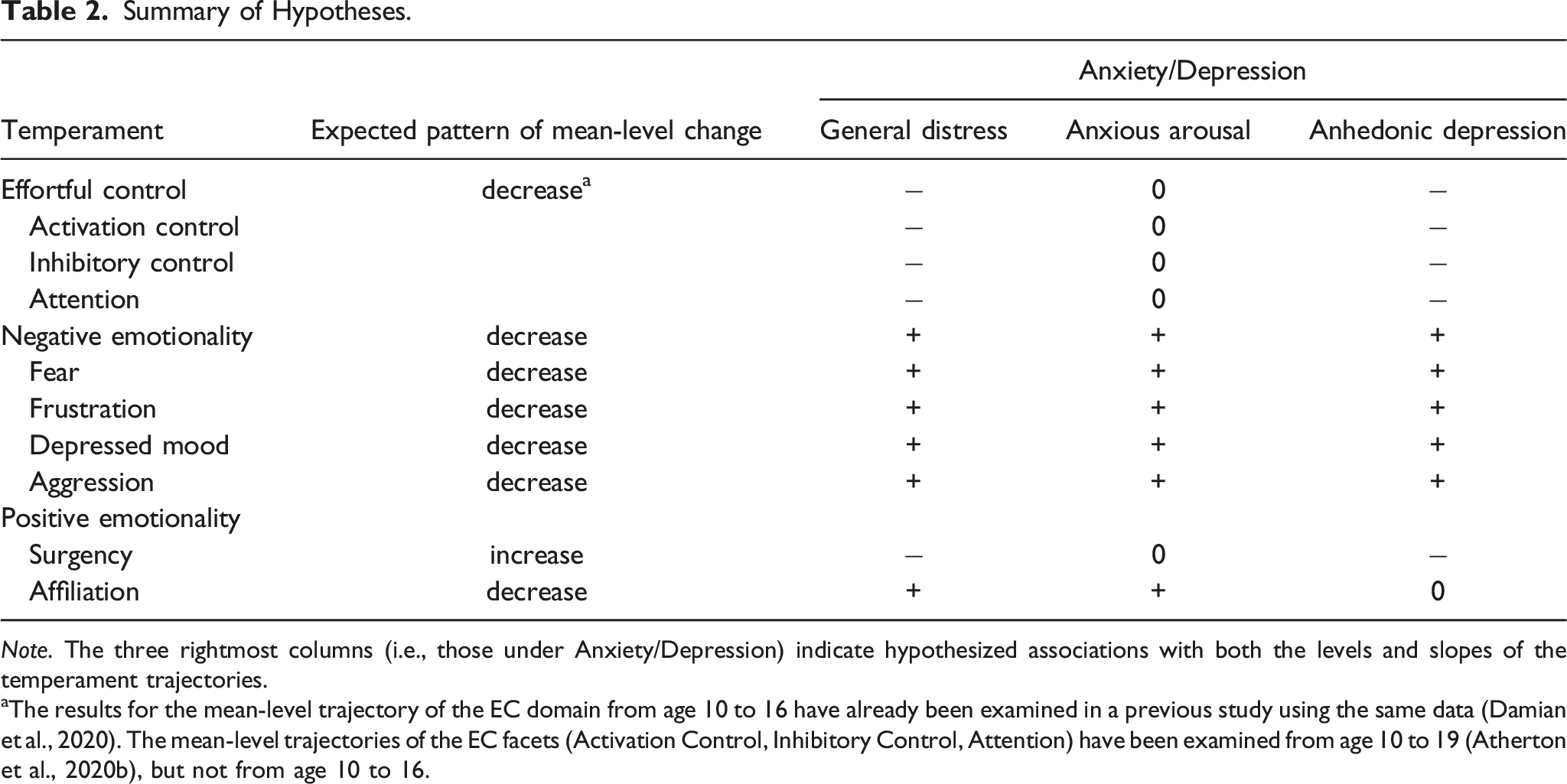
Note. The three rightmost columns (i.e., those under Anxiety/Depression) indicate hypothesized associations with both the levels and slopes of the temperament trajectories.
The results for the mean-level trajectory of the EC domain from age 10 to 16 have already been examined in a previous study using the same data (Damian et al., 2020). The mean-level trajectories of the EC facets (Activation Control, Inhibitory Control, Attention) have been examined from age 10 to 19 (Atherton et al., 2020b), but not from age 10 to 16.
With respect to research question 2, we predicted that: (a) individuals with lower initial levels and more negative slopes of EC (and each of its facets) would have higher levels of later general distress and anhedonic depression, but not anxious arousal; (b) individuals with higher initial levels and more positive slopes of NEM (and each of its facets) would have higher levels of later general distress, anxious arousal, and anhedonic depression; (c) individuals with lower initial levels and more negative slopes of Surgency would have higher levels of later general distress and anhedonic depression, but not anxious arousal; and (d) individuals with higher initial levels and more positive slopes of Affiliation would have higher levels of later general distress and anxious arousal, but not anhedonic depression. Additionally, we expected that the Fear facet of NEM would have the strongest association with later anxious arousal and the Depressed Mood facet of NEM have the strongest association with later anhedonic depression. We expected that all of the predicted associations would hold after controlling for prior levels of anxiety and depression and after controlling for parent anxiety and depression.
Associations between temperament trajectories and young adult anxiety/depression.
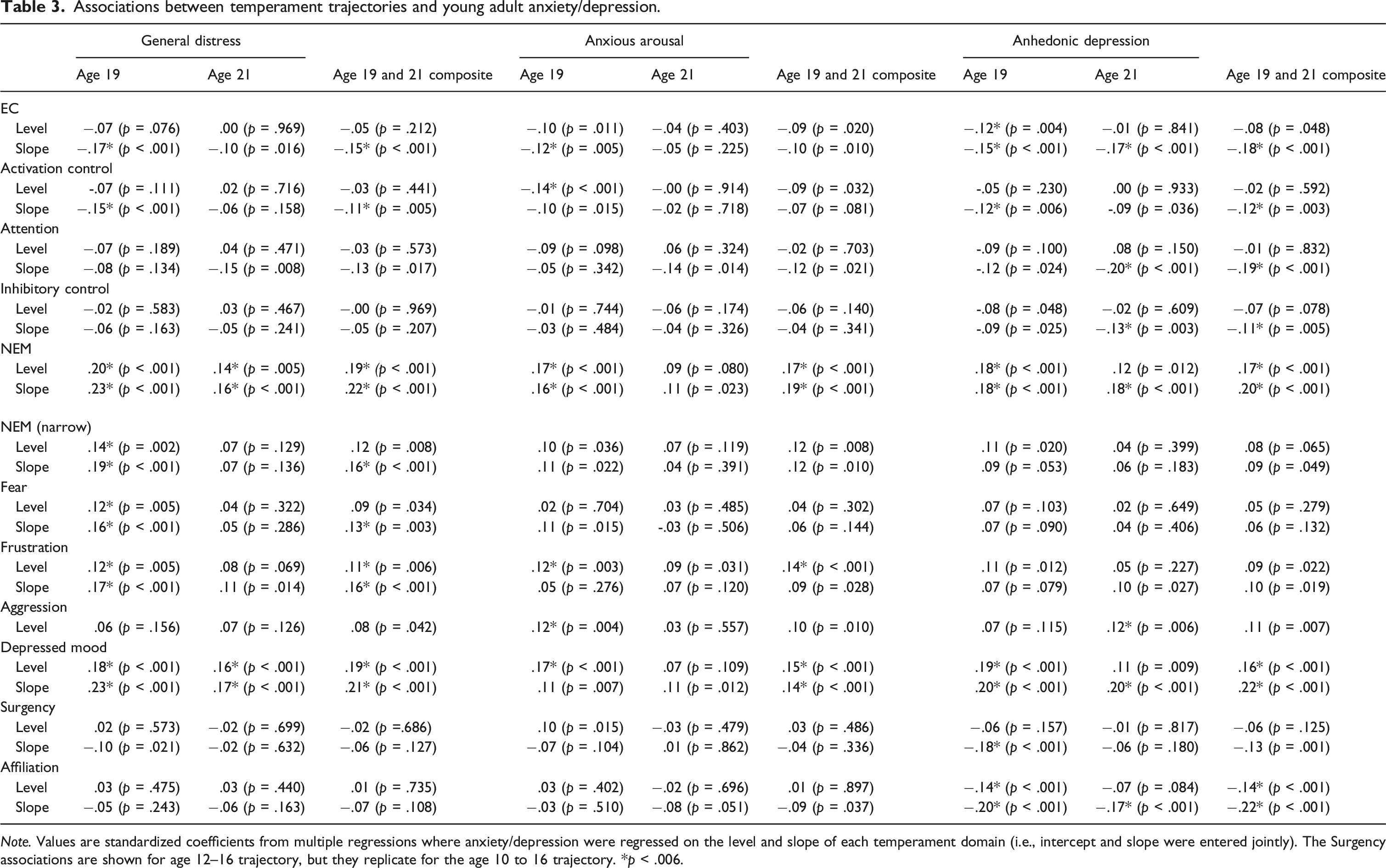
Note. Values are standardized coefficients from multiple regressions where anxiety/depression were regressed on the level and slope of each temperament domain (i.e., intercept and slope were entered jointly). The Surgency associations are shown for age 12–16 trajectory, but they replicate for the age 10 to 16 trajectory. *p < .006.
The present study extends past research in several ways. First, our use of four waves of temperament data provides a more nuanced understanding of the development of temperament from late childhood through adolescence, including an examination of nonlinear trajectories. Second, our long-term, longitudinal data, spanning from 10- to 21-years-old, allows us to test the vulnerability model of temperament and psychopathology by examining prospective associations between adolescent temperament trajectories and young adult anxiety/depression. This builds on previous shorter-term longitudinal studies that found associations of EC and NEM with anxiety/depression. Third, we examined these associations in a sample of Mexican-origin youth, which contributes to the generalizability of previous work in this area that has focused on predominantly White adolescents. This is especially important given the higher rates of anxiety/depression in ethnic minority youth, which are due, at least in part, to experiences of acculturative stress and discrimination (Bridges et al., 2021; Maiya et al., 2021; Stein et al., 2019; Suarez-Morales & Lopez, 2009; Torres, 2010). Fourth, we used multimethod assessments of temperament (i.e., self- and parent-report), which helps capture temperament constructs more validly and adds to past longitudinal work that relied on only a single assessment method. Multimethod assessments also help alleviate concerns that associations between temperament and anxiety/depression are due solely to shared method variance (Compas et al., 2004; Klein et al., 2011; Wilson & Olino, 2021). Fifth, we used a well-validated measure of temperament to examine both domain and facet-level trajectories, which is important because mean-level changes in facets can be more heterogeneous than mean-level changes in domains (Brandes et al., 2022; Klimstra et al., 2018; Ormel et al., 2005; Schwaba et al., 2022). Finally, we used a measure of anxiety and depression based on the tripartite model, which allowed us to examine how temperament is associated with the common core of anxiety and depression (general distress), as well as with the unique aspects of anxiety (anxious arousal) and depression (anhedonia).
Methods
Participants
The present study used data from the California Families Project, a longitudinal study of Mexican-origin youth and their parents (N = 674). 3 Children were drawn at random from rosters of students from the Sacramento and Woodland, CA school districts, in 2006–07. The focal child had to be in the 5th grade, of Mexican origin, and living with their biological mother in order to participate in the study. Approximately 72.6% of the eligible families agreed to participate in the study, which was granted approval by the University of California, Davis Institutional Review Board (Protocol # 217484-21). The children (50% female) were assessed annually from age 10 to 19, and then 2 years later at age 21. The present study used data from when the children were ages 10 (Mage = 10.86, SD = .50), 12 (Mage = 12.81, SD = .49), 14 (Mage = 14.75, SD = .49), 16 (Mage = 16.80, SD = .51), 19 (M age = 19.86, SD = .52), and 21 years old (Mage = 21.74, SD = .73). Retention rates compared to the original sample are as follows: 86% (age 12), 90% (age 14), 89% (age 16), 87% (age 19), and 80% (age 21). Sample size for the present study was determined by the availability of data at each assessment; we used data for all available participants (i.e., no exclusions where applied).
Participants were interviewed in their homes in Spanish or English, depending on their preference. Interviewers were all bilingual and most were of Mexican heritage. Sixty-three percent of mothers and 65% of fathers had less than a high school education (median = 9th grade for both mothers and fathers); median total household income was between $30,000 and $35,000 (overall range of income = < $5000 to > $95,000). With regard to generational status, 83.6% of mothers and 89.4% of fathers were 1st generation, and 16.4% of mothers and 10.6% of fathers were either 2nd or 3rd generation.
Measures
Child temperament
EC, NEM, and PEM were assessed at ages 10, 12, 14, and 16 via self- and mother-reports using the short version of the Early Adolescent Temperament Questionnaire – Revised (EATQ-R; Ellis & Rothbart, 2001). Ratings were made for each item on a 4-point scale ranging from 1 (not at all true of you/your child) to 4 (very true of you/your child). Descriptive statistics including means, standard deviations, and alpha and omega reliabilities for the observed variables are shown in Table S1. For all domains and facets, we created latent variables using parcels including both self- and mother-reported data. All study materials and R scripts for this project are available on the Open Science Framework (OSF): https://osf.io/qa27t/.
Effortful control
The EC scale has three facets: Activation Control (5 items), Attention (6 items), and Inhibitory Control (5 items). Activation Control assesses the ability to perform an action or pursue goals when there are competing desires. Attention assesses the ability to focus and shift attention when needed. Inhibitory Control assesses the ability to plan and suppress inappropriate impulses.
Negative emotionality
The NEM scale has two facets: Fear (6 items) and Frustration (7 items). Fear assesses unpleasant affect derived from anticipating distress. Frustration assesses negative affect related to ongoing tasks being interrupted. Depressed Mood and Aggression also load onto the NEM domain. Aggression (6 items) assesses hostile reactivity to negative stimuli including person- and object-directed violence. Depressed Mood (6 items) assesses unpleasant affect, lowered mood, and lack of enjoyment in activities. To account for different scoring methods for the NEM domain, we ran analyses examining a broader (including Fear, Frustration, Aggression, and Depressed Mood) and a narrower (including only Fear and Frustration) conceptualization of NEM (Lawson et al., 2021).
Positive emotionality
The PEM scale has two facets: Surgency (6 or 14 items) and Affiliation (5 items). 4 Surgency assesses pleasure derived from activities involving high intensity or novelty. At age 10, the Surgency scale included the 6 items from the short version of the EATQ-R. Because of low reliability of the 6-item scale at age 10 (see Table S1), eight items were added from the full-length version of the EATQ-R Surgency scale at ages 12, 14, and 16. Given the low reliability at age 10, and the change in item content, we report main Surgency analyses using all of the items from age 12 to 16, and report analyses from age 10 to 16 in the Supplemental Materials. Affiliation assesses the desire for warmth and closeness with others. Surgency and Affiliation do not form a coherent superordinate factor (Lawson et al., 2021; Snyder et al., 2015); consequently, we did not compute a PEM domain score and instead examined these scales separately.
Child anxiety and depression
Child anxiety and depression symptoms were assessed at ages 16, 19, and 21 via self-report using the Mini-Mood and Anxiety Symptom Questionnaire (Watson et al., 1995a, 1995b). This 26-item measure assesses three components of internalizing problems: general distress, anxious arousal, and anhedonic depression (Corral-Frías et al., 2019). General distress (8 items) includes symptoms that are experienced by both anxious and depressed individuals (e.g., “felt worthless”, “felt uneasy”). Anxious arousal (10 items) includes symptoms specific to anxiety, including somatic tension or physiological hyperarousal (e.g., “was short of breath”, “hands were shaky”). Anhedonic depression (8 items) includes symptoms specific to depression, including anhedonia or the absence of pleasurable experience (e.g., “felt like nothing was very enjoyable”, “felt really lively, up” – reverse-scored). Ratings were made on a 4-point scale ranging from 1 (not at all) to 4 (very much). We created separate latent variables for each component (i.e., general distress, anxious arousal, anhedonic depression) at each assessment (age 16, 19, and 21) and then saved the factor scores to use in all analyses. In particular, scores from ages 19 and 21 were used as outcomes in all analyses and scores from age 16 were used as a control variable in a subset of the analyses. In addition to examining scores from ages 19 to 21 separately, we also computed a composite “young adulthood” score for each of the components (i.e., general distress, anxious arousal, anhedonic depression), which is an average of scores from ages 19 to 21. Descriptive statistics for the three components at each age are shown in Table S2 and correlations among the components at each age are shown in Table S3.
Mother anxiety and depression
Maternal anxiety and depression symptoms were assessed via self-report when the children were 10-years-old using the MASQ (described above). Descriptive statistics are as follows: general distress (M = 1.62, SD = .58, α/ω = .88/.91); anxious arousal (M = 1.23, SD = .36, α/ω = .84/.89); anhedonic depression (M = 1.78, SD = .59, α/ω = .87/.91). We created separate latent variables for each component (i.e., general distress, anxious arousal, anhedonic depression) at each assessment and then saved the factor scores to use in all analyses.
Statistical analyses
All data cleaning and analyses were conducted in R (R Core Team, 2019) via RStudio Version 1.2.1335 using full information maximum likelihood estimation (FIML) to account for missing data (Allison, 2003; Schafer & Graham, 2002). We used the following R packages to analyze the data and visualize the results: psych (Revelle, 2018), lavaan (Rosseel, 2012), ggplot2 (Wickham, 2016), semTools (Jorgensen et al., 2019), and lm.beta (Behrendt, 2014). Model fit was assessed via comparative fit index (CFI) and root-mean-square error of approximation (RMSEA). We interpreted good fit as values greater than or equal to .95 for CFI and less than or equal to .06 for RMSEA (Hu & Bentler, 1999). We assessed differences in model fit via change in CFI less than or equal to .01 (Chen, 2007) and change in chi-square and degrees of freedom (Cheung & Rensvold, 2002; Meade et al., 2006).
Latent variables and measurement invariance
We created latent variables for each temperament domain and facet using both self- and mother-reported items to create parcels to use as indicators (the same items across self- and mother-reports were placed in the same parcels). Parcels typically produce more stable solutions, are less likely to share specific sources of variance, and reduce the likelihood of spurious correlations (Little et al., 2002). Indicators based on the same items were allowed to correlate across waves. We conducted tests of longitudinal measurement invariance for all domains and facets. In particular, we compared three measurement models: (a) freely estimating the factor loadings for the latent factors at each age of assessment (i.e., configural invariance); (b) constraining the respective factor loadings to be equal at each of assessment (i.e., weak invariance); and (c) constraining the factor loadings and intercepts to be equal at each age of assessment (i.e., strong invariance). If the more constrained models did not fit worse than the lesser constrained models, then we concluded that the structure of the latent construct was the same over time. Because we did not find evidence of strong measurement invariance for the majority of the domains/facets, we also examined evidence of partial strong measurement invariance (i.e., freeing the intercepts of one of the parcels from the strong invariance model). We found evidence for partial strong longitudinal measurement invariance for all domains and facets, except Fear where we found strong invariance (Table S4). 5
For child anxiety and depression, we created latent variables for each component of the MASQ (i.e., general distress, anxious arousal, anhedonic depression) using parcels created with self-reported items. Given that we were not interested in mean-level change in anxious and depressive tendencies, we did not test for longitudinal measurement invariance. We saved factor scores to use in the subsequent analyses examining associations between temperament development and anxiety/depression. We followed the same process for mother anxiety and depression when the children were 10-years-old. Factor loadings of parcels for all latent variables are shown in Table S5.
Research question 1: Mean-level change in temperament
To examine mean-level change in the temperament domains and facets from age 10 to 16, we ran univariate latent growth curve (LGC) models with four timepoints (ages 10, 12, 14, and 16). To guide our selection of a growth trajectory, we conducted a series of LGC model comparisons and evaluated changes in fit indices. Specifically, we compared three models: (1) no growth model, where only an intercept (no slope) was estimated; (2) linear growth model, where the slope increased linearly over time; and (3) latent basis model, where the first and last time points of the slopes were fixed to zero and six, respectively, and the middle time points were freely estimated in order to detect nonlinearities in the growth model. 6 We considered model fit, as well as parsimony, when selecting a LGC model for each domain and facet. For the best-fitting model, we tested for individual differences in the level and slope by examining the variance of the average level and slope. We then saved factor scores of the level/slope for each participant using the retained model for use in subsequent analyses, rather than attempting to fit latent variable models that include estimates of both growth in temperament and latent outcomes. This helped facilitate consistency across analyses by minimizing problems associated with model non-convergence for more complex analyses.
Research question 2: Temperament and anxiety/depression
To examine whether individuals’ developmental trajectories predicted their subsequent anxiety/depression, we tested whether the level and slope of each temperament domain/facet from the retained LGC model was significantly correlated with anxiety/depression at age 19, 21, and the young adult composite. In particular, we ran multiple regressions where we regressed the factor scores of each anxiety/depression component (i.e., general distress, anxious arousal, anhedonic depression) at each age on the factor scores of both the level and slope from the retained LGC model, separately for each temperament domain and facet. For these analyses, we set the alpha level to .006 (two-tailed) to account for multiple comparisons; we report exact p-values. 7 Then, for the significant associations, we examined whether the findings held when controlling for prior levels of anxiety/depression by adding the corresponding component from age 16 as a predictor in the multiple regression (e.g., when examining the association between EC and anhedonic depression at age 19, we included anhedonic depression at age 16). Next, we examined whether the original findings (i.e., not controlling for age 16 anxiety/depression) held when the corresponding mother’s anxiety/depression was included as a control variable.
Research question 3: Gender
Finally, we tested whether gender was associated with the temperament trajectories and whether gender moderated the associations between temperament development and anxiety/depression. To examine the association between gender (a dichotomized variable) and temperament trajectories, we ran multiple group models and compared models that constrained the means, variances, and covariance of the level and slope of girls and boys to be equal across groups to models that allowed these parameters to be freely estimated across groups. If the constrained model did not fit significantly worse than the freely estimated model, then we concluded that the developmental trajectory is the same across girls and boys. To examine whether gender moderated the association between temperament development and anxiety/depression, we included the main effect of gender in the regression model as well as the interaction term between gender and the level/slope of temperament (separately for the level and slope). 8
Results
Mean-level change in temperament
First, we examined mean-level change in all of the temperament domains and facets by comparing no growth, linear growth, and latent basis models (Table S6). Intercorrelations among the temperament trajectory levels and slopes are shown in Table S7.
Effortful control
The individual and best-fitting average trajectories for the EC domain and facets are shown in Figure 1 (see Table S6 for model parameters). For both the EC domain and Activation Control facet, we found that youth tended to decrease linearly, on average, from age 10 to 16. For Attention, youth increased, on average, from age 10 to 12, followed by slight decreases from age 12 to 16. Finally, youth linearly increased, on average, in Inhibitory Control from age 10 to 16. There were substantial individual differences in the level and slope for EC and its facets, except for Attention and Inhibitory Control whose slope variances were not significant. Individual and average trajectories for the effortful control domain and facets.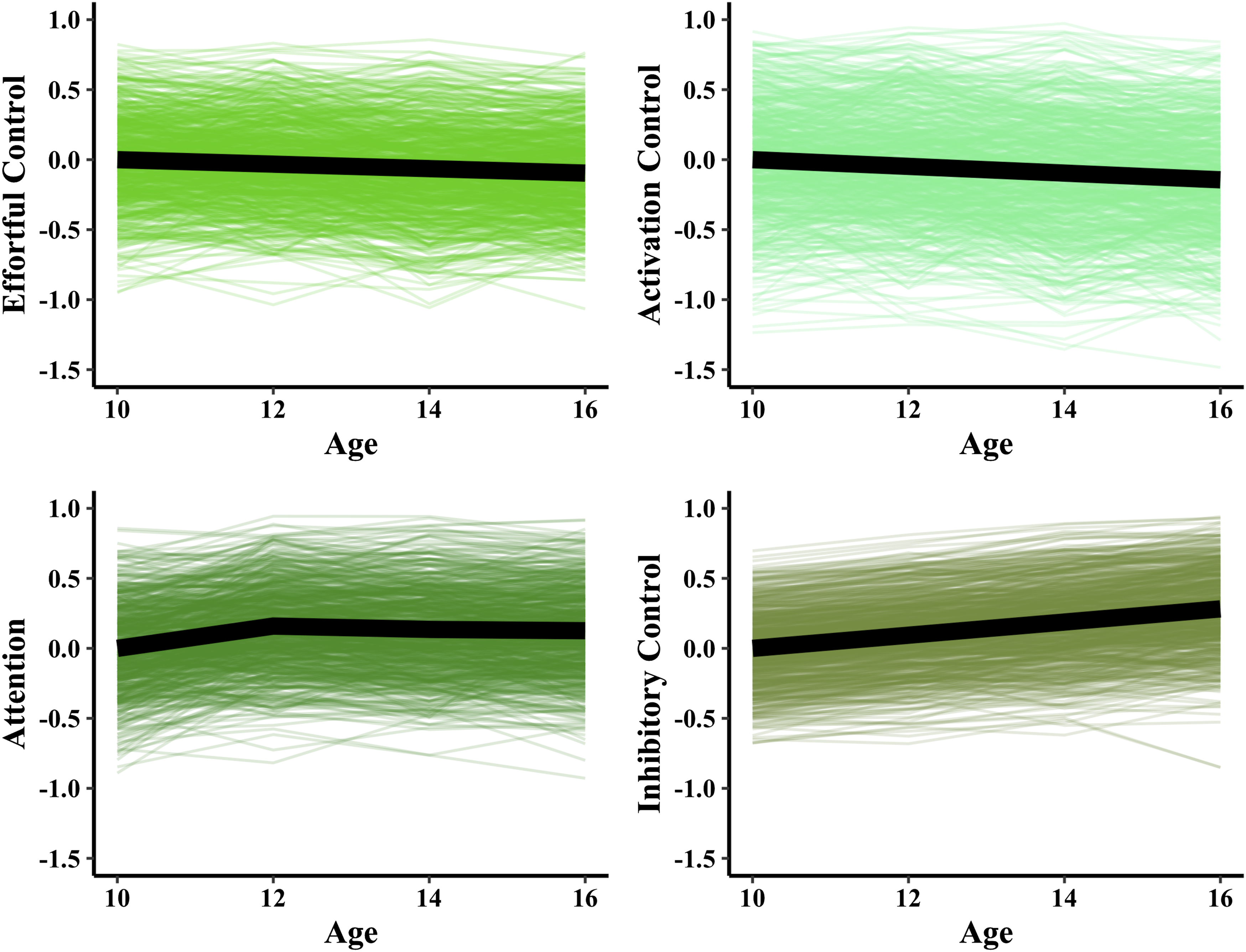
When we examined gender differences in the trajectories of EC and its facets, we found no significant differences in the means of the levels or slopes (see Table S8 for model fit comparisons of multiple-group models). 9
Negative emotionality
The individual and best-fitting average trajectories for the NEM domain and facets are shown in Figure 2 (see Table S6 for model parameters). For both the broad and narrow NEM domains and the Fear facet, we found nonlinear mean-level decreases across adolescence, with the greatest decreases taking place from age 10 to 12. Both Frustration and Depressed Mood decreased linearly from age 10 to 16. Aggression—a facet where most of the youth scored very low at every assessment—showed no mean-level changes across adolescence. For NEM and all of its facets, there were substantial individual differences in the estimated levels and slopes. Additionally, none of the NEM trajectories differed for boys versus girls (Table S8). Individual and average trajectories for the negative emotionality domain and facets.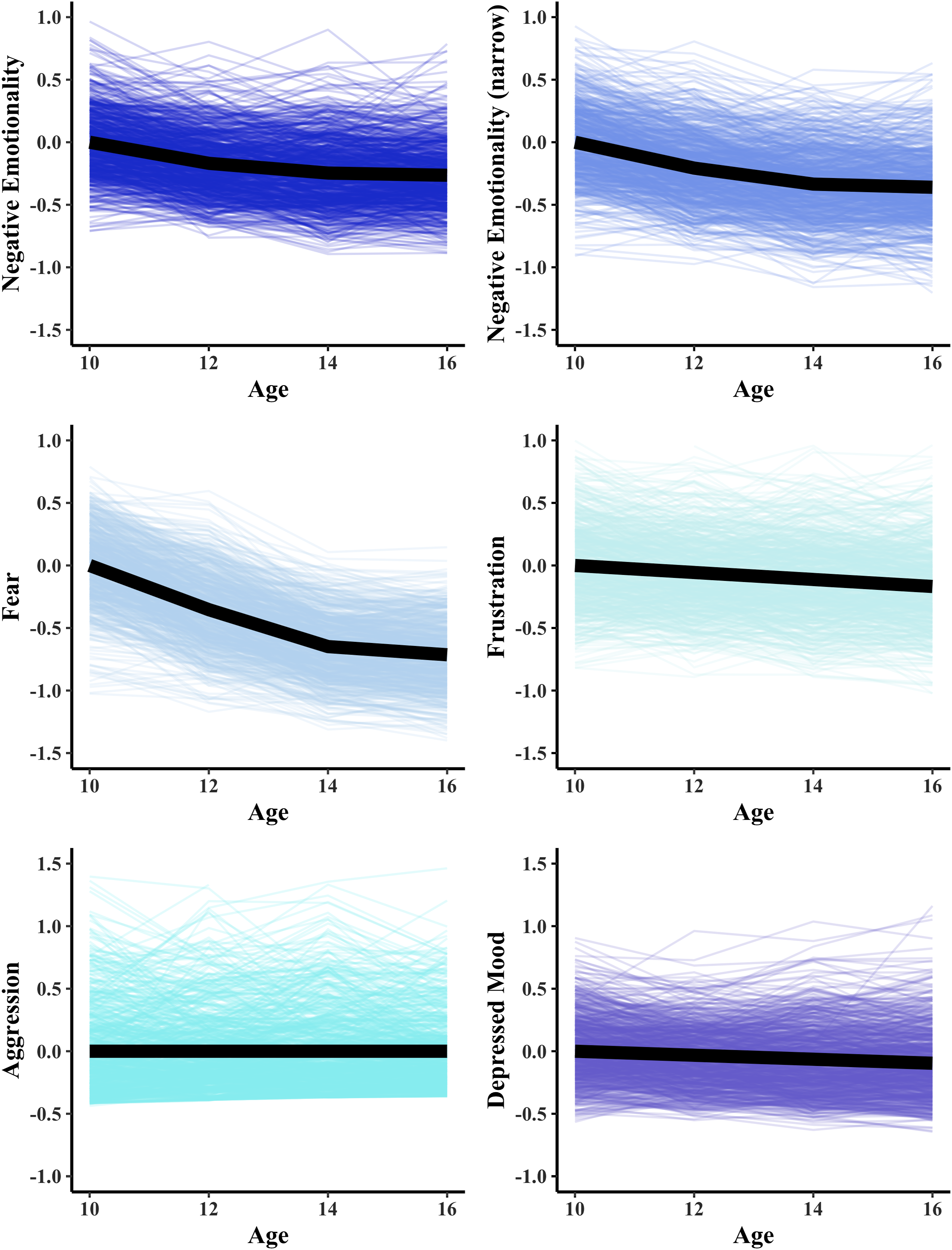
Positive emotionality
The individual and best-fitting average trajectories for the PEM facets are shown in Figure 3 (see Table S6 for model parameters). For Surgency, we found that youth tended to increase from age 12 to 16.
10
Affiliation showed slight decreases from age 10 to 16. For both Surgency and Affiliation, there were substantial individual differences in the estimated levels and slopes. The Surgency and Affiliation trajectories did not differ significantly for boys versus girls (Table S8). Individual and average trajectories for the positive emotionality facets.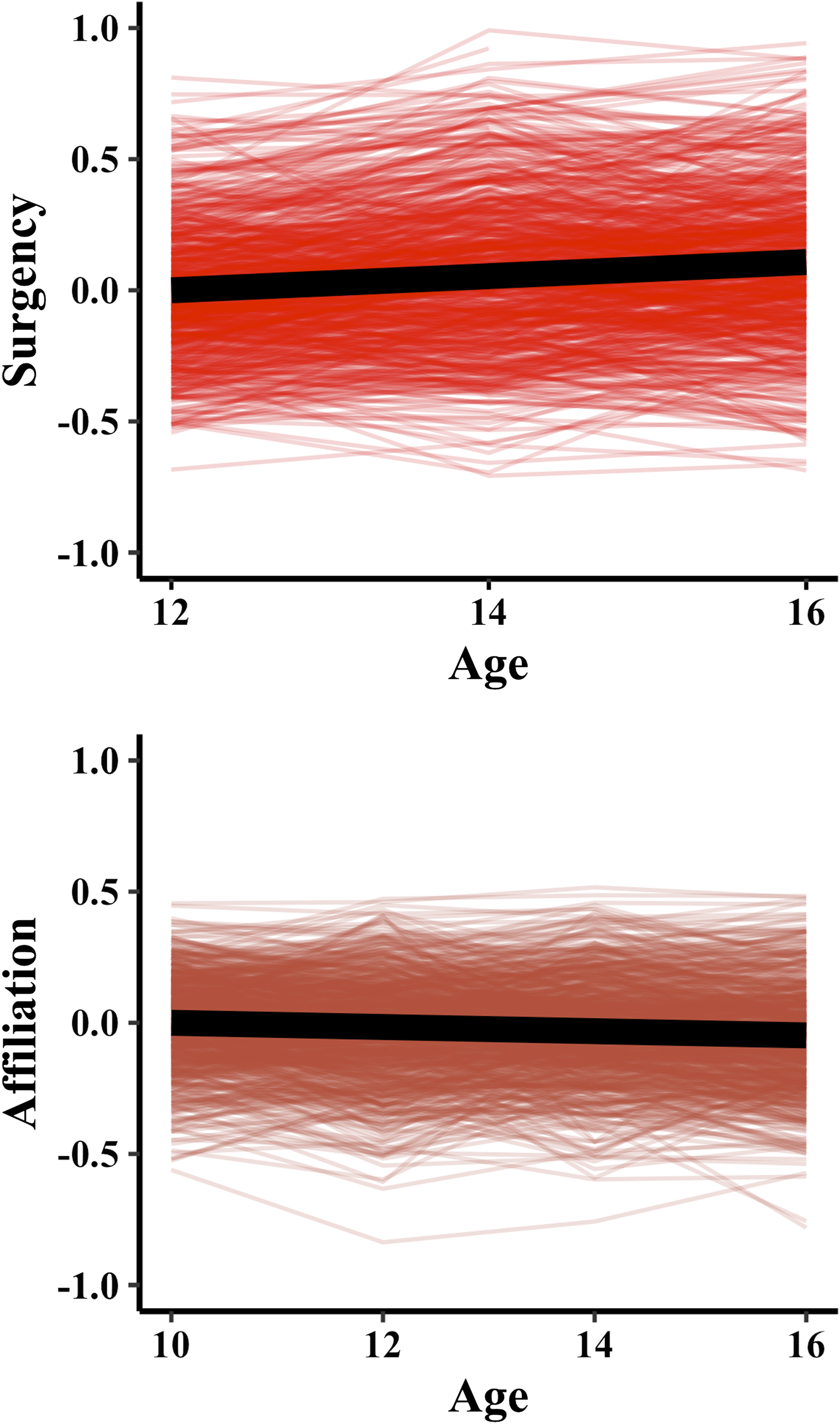
Temperament development and anxiety/depression
Next, we examined whether youths’ individual temperament trajectories during adolescence were associated with their anxiety/depression symptoms during young adulthood. Table 3 shows the standardized coefficients from multiple regression analyses with the level and slope of each temperament domain/facet jointly predicting anxiety/depression at ages 19 and 21 (and their composite). General distress, anxious arousal, and anhedonic depression were each regressed separately on both the intercept and slope for each temperament domain/facet (i.e., intercepts and slopes pairings were included jointly). In most cases, the effect sizes were larger for the more proximal measure of anxiety/depression (age 19), although the vast majority of results at age 19 were in the same direction at age 21. Given this pattern, we focus below on the results for the composite scores, but present exact results at ages 19 and 21 in all tables.
Effortful control
The slope of the EC domain was significantly negatively associated with general distress during young adulthood (β = -.15, p < .001), which suggests that youth who experienced greater decreases in EC from age 10 to 16 felt more worthless and uneasy later on. This association was largely driven by Activation Control (β = −.11, p = .005). For anhedonic depression, the slopes of the EC domain (β = −.18, p < .001) and all facets were significantly negatively correlated with unique depression symptoms during young adulthood. Neither the EC domain nor its facets were associated with anxious arousal during young adulthood. Notably, the slopes, but not the levels, of EC were most often associated with general distress and anhedonic depression symptoms during young adulthood. This suggests that it is the way an adolescent develops from age 10 to 16, rather than where their EC begins at age 10, that is more relevant to their later depression symptoms.
When we controlled for prior anxiety/depression symptoms (assessed at age 16) in the models, none of the associations between the EC trajectories and anxiety/depression remained significant using our preregistered alpha level of .006 (Table S9). This suggests that, although adolescent EC development is associated with later depression, it does not predict over and above prior symptoms of depression. Conversely, when we controlled for mother anxiety/depression symptoms assessed when the youth were 10-years-old, most (i.e., 75%) of the associations remained significant (Table S10). This suggests that adolescent EC development remains a robust predictor of young adulthood depression even when mother depression is taken into account.
Negative emotionality
For the broad NEM domain, both the level (β = .19, p < .001) and slope (β = .22, p < .001) were positively associated with general distress during young adulthood, suggesting that youth who are higher in NEM at age 10 and those who experience smaller decreases in NEM from age 10 to 16 are more distressed later on. These associations were driven by the Fear, Frustration, and Depressed Mood facets. Similarly, both the level and slope of the broad NEM domain were positively associated with anxious arousal and anhedonic depression during young adulthood. These associations with specific anxiety and depression symptoms were largely driven by the Depressed Mood facet, and were not significant with the narrower assessment of NEM that only included the Fear and Frustration facets.
When we controlled for anxiety/depression symptoms at age 16, only the level of Depressed Mood remained a significant predictor of later general distress and anhedonic depression (Table S9). As was the case with EC, the vast majority of associations between NEM trajectories and anxiety/depression (i.e., 84%) remained significant when we controlled for mother anxiety/depression (Table S10).
Positive emotionality
The slope of Surgency was negatively correlated with anhedonic depression during young adulthood (β = −.13, p = .001), such that youth who experience smaller increases in Surgency from age 12 to 16 report higher levels of anhedonia during young adulthood. For Affiliation, both the level (β = −.14, p < .001) and slope (β = −.22, p < .001) were negatively associated with anhedonic depression in young adulthood, indicating that youth with lower Affiliation at age 10 and those who experience greater decreases from age 10 to 16 have higher levels of anhedonia in young adulthood. The trajectories of Surgency and Affiliation were not significantly related to general distress or anxious arousal during young adulthood.
When we controlled for specific depression symptoms at age 16, the slopes of both Surgency and Affiliation remained significant predictors of anhedonic depression at age 19 (Table S9). Further, all of the PEM associations (i.e., 100%) remained significant when we controlled for mother anxiety/depression (Table S10).
Gender as a moderator
To examine whether gender moderated the association between adolescent temperament development and anxiety/depression during young adulthood, we included gender and its interaction with temperament level and slope into multiple regressions predicting EC, NEM, and Surgency (the core of PEM; Table S11). We found one significant interaction (β = −.16, p = .005), suggesting that the association between the Surgency level and anhedonic depression is stronger for girls than for boys.
Discussion
The present study examined the development of EC, NEM, and PEM from late childhood (age 10) through adolescence (age 16) and associations between these developmental trajectories and anxiety/depression in young adulthood (ages 19 and 21). For the development of adolescent temperament, we found evidence of both personality maturation (NEM, Surgency) and disruption (EC) from age 10 to 16. Additionally, we found numerous predicted associations between the developmental trajectories of temperament and anxiety/depression during young adulthood. Below, we situate our results in the existing literature and discuss the findings more generally, separately for each temperament domain.
Mean-level change in temperament
Consistent with the disruption hypothesis (Soto & Tackett, 2015) and with the majority of prior empirical research (De Fruyt et al., 2006; Göllner et al., 2017; Laceulle et al., 2012; Van den Akker et al., 2014; Zohar et al., 2019), we found mean-level decreases in the EC domain from age 10 to 16. These previous studies span a wide range of measures, assessment methods, languages, age ranges, and measurement occasions (see Table 1), suggesting that this finding is robust and generalizable across various samples and methods. At the facet level, results for Activation Control mirrored those of the EC domain; however, for Attention, youth increased, on average, from age 10 to 12 but then decreased from age 12 to 16. Conversely, youth tended to increases in Inhibitory Control from age 10 to 16. Overall, these findings suggest that, on average, youth tend to become worse at regulating their impulses and paying close attention as they go through adolescence, although there is substantial variability across individuals.
Aligned with the maturity principle (Roberts et al., 2006) and consistent with our hypotheses, we found mean-level decreases in NEM and all of its facets, except Aggression, from age 10 to 16. These findings converge with prior research examining NEM development across adolescence (Brandes et al., 2022; De Fruyt et al., 2006; Göllner et al., 2017; Klimstra et al., 2009; Laceulle et al., 2012; Pullmann et al., 2006; Roberts et al., 2006; Van den Akker et al., 2014; Zohar et al., 2019). Similar to EC, the breadth of measures and longitudinal designs used in previous studies (see Table 1) suggests that this normative pattern is generalizable to adolescents from a wide range of populations. Although we expected to find linear decreases in NEM and its facets, we found nonlinear trajectories for the NEM domain and Fear facet; in particular, decreases were greater in magnitude from age 10 to 12 than from age 12 to 16. This pattern suggests that the majority of personality maturation with respect to NEM happens earlier on in adolescence and then continues at a slower rate from mid- to late-adolescence. This may be due to the fact that the challenges of adolescence ramp up substantially after puberty and the transition to high from elementary school, with increasing autonomy from parents, more complex peer and romantic relationships, and an increasingly competitive school environment, all of which demand more emotional stability. With respect to Aggression, we found that a no-growth model fit the data best due, in large part, to the fact that most youth reported very low levels of Aggression at all ages. Therefore, we do not interpret this finding as evidence that adolescents do not change in their aggression across adolescence, but rather that the EATQ-R did not do a good job measuring aggressive tendencies in this sample.
Consistent with our hypotheses, we found increases in Surgency from age 12 to 16 (and replicated these associations from age 10 to 16), which is consistent with many previous studies (Göllner et al., 2017; Klimstra et al., 2009; Laceulle et al., 2012; Pullmann et al., 2006; Roberts et al., 2006). Also consistent with our hypotheses, we found small mean-level decreases in Affiliation from age 10 to 16. The decrease is consistent with previous research on the Affiliation facet (Göllner et al., 2017; Laceulle et al., 2012; Pullmann et al., 2006; Van den Akker et al., 2014), although the small magnitude of the change helps explain why some studies have found no mean-level changes in Affiliation across adolescence (De Fruyt et al., 2006; Pullmann et al., 2006; Roberts et al., 2006).
Across all of the temperament domains, the findings from the present study were largely consistent with previous studies that used many different measures of both temperament and Big Five personality traits (see Table 1). Given that relatively few studies used a temperament measure across this same age range (e.g., Laceulle et al., 2012; Zohar et al., 2019), it is difficult to draw strong conclusions about the reasons underlying small discrepancies from past findings. However, together, this suggests that, in addition to similar conceptualizations and well-documented moderate concurrent correlations, temperament traits and personality traits develop across adolescence in much the same way, highlighting the similarity between these constructs (Lawson & Robins, 2021) and supporting evidence that the distinction between them is somewhat arbitrary (Clark & Watson, 2008; Shiner et al., 2021). Furthermore, in our sample, we did not find any significant gender differences in the levels and slopes of the temperament domains and facets, which diverges from previous studies including Brandes et al., 2022, Borghuis et al. (2017), Göllner et al. (2017), and Klimstra et al. (2009) where many of the domains showed pronounced gender differences. The discrepant findings may reflect differences between the studies in the samples (Mexican-origin youth vs. majority White youth), the measures, the assessment methods, the developmental periods examined, or a combination of these factors (see Table 1 for a detailed comparison of previous studies).
Temperament development and anxiety/depression
After estimating the developmental trajectories of the temperament domains and facets, we examined whether these trajectories predicted anxiety and depression in young adulthood. Notably, this design allowed for “taking into consideration developmentally normative…change in personality and psychopathology [which] is critical for understanding their links at any given time over the course of development” (Wilson & Olino, 2021, p. 920). Our prospective, longitudinal design, which allowed us to examine associations between temperament change and anxiety/depression, has several characteristics that were previously identified as important directions for future studies (Klein et al., 2011). For example, we examined multimethod assessments of EC, NEM, and PEM, as well as their facets, helping to “determine whether a more specific level of analysis will yield more powerful effects and increase the specificity of associations between personality constructs and particular forms of psychopathology” (Klein et al., 2011, p. 19).
As predicted, changes in EC were associated with symptoms related to depression (i.e., general distress and anhedonic depression), but not those uniquely related to anxiety (i.e., anxious arousal). This finding is consistent with prior longitudinal research that found significant associations between earlier levels of EC and later depression, but not anxiety (Crockett et al., 2013; Loukas & Roalson, 2006; Ormel et al., 2005; Verstraeten et al., 2009). It is also consistent with Lengua’s (2006) finding that youth who experienced smaller decreases in EC across 3 years had fewer internalizing problems at the final temperament assessment (i.e., in Year 3). For the facets of EC, we found that associations with Activation Control largely paralleled the EC domain, whereas the slopes of Attention and Inhibitory Control were correlated only with anhedonic depression, but not general distress. This pattern is not consistent with theoretical work suggesting that the Attention facet should be most strongly associated with anxiety and depression (Compas et al., 2004; Muris et al., 2007). However, these findings may reflect the fact that decreases in Attention and Inhibitory Control are related to emotion regulation, including reward and threat sensitivity, which is related to anhedonic depression but not general distress (Young et al., 2022). Inhibitory Control may be especially relevant to the emotion regulation strategy of suppression, or inhibiting emotionally expressive behavior, whereas youth with better Attention Control may be able to shift their attention away from what is making them sad and selectively attend to positive thoughts (Compas et al., 2004; Nigg, 2006). Notably for the developmental trajectories of the EC domain and facets, individual differences in the slopes, but not the levels, were most often associated with depression during young adulthood, which suggests that the way youth develop across adolescence is more relevant to young adulthood psychopathology than their initial EC levels at age 10. This finding supports the idea that adolescents who are getting worse at regulating themselves may have even more trouble dealing with changes during adolescence and the transition to young adulthood, given that they have had fewer opportunities to develop effective strategies for coping with negative person-environment transactions, such as dysfunctional relationships with parents, teachers, peers, and romantic partners.
As predicted, higher initial levels and smaller decreases in the broad NEM domain across adolescence were associated with higher general distress, anxious arousal, and anhedonic depression scores during young adulthood. These findings converge with previous research that has consistently documented earlier levels of both self- and parent-reported NEM predisposing youth to later anxiety and depression (Bould et al., 2014; Bouma et al., 2008; Brendgen et al., 2005; Caspi et al., 1996; Crockett et al., 2013; Davis et al., 2015; Lonigan et al., 2003; Mezulis et al., 2011; Ormel et al., 2005; Verstraeten et al., 2009). They also converge with prior studies showing that changes in NEM were related to later internalizing symptoms (Laceulle et al., 2014; Lengua, 2006; Van den Akker et al., 2010). Not surprisingly, the strongest associations were with the Depressed Mood facet; in particular, both the levels and slopes were associated with general distress, anxious arousal, and anhedonic depression during young adulthood. This suggests that adolescents with a temperamental disposition toward depressed mood may spiral downward over time in their anxiety and depression symptoms, perhaps due to difficulties coping with academic, familial, and interpersonal problems that occur frequently during adolescence. There were also clear associations between Frustration and both general distress and anxious arousal. Adolescents who get irritated and annoyed when dealing with daily problems or when their progress toward reaching their goals is thwarted may feel more stressed and helpless in the face of future problems, contributing to later distress and anxiety. Further, our findings suggest that the associations between NEM and anxiety/depression are not exclusively due to conceptual overlap between measures. In particular, we saw associations between the narrow NEM domain (including only Fear and Frustration) and general distress, suggesting that key aspects of temperament besides conceptually overlapping Depressed Mood are prospectively associated with anxiety/depression. Surprisingly, the Fear domain was not associated with anxious arousal, despite the fact that fear is a core aspect of what is unique to anxiety.
Partially consistent with our hypothesis, the individual differences in changes in Surgency were negatively associated with anhedonic depression, but not general distress, during young adulthood. This suggests that youth who become more novelty seeking and reward sensitive across adolescence are less likely to experience anhedonia later on. This finding connects to previous longitudinal research that has found that higher Surgency is associated with fewer internalizing problems later on (Lonigan et al., 2003; Ormel et al., 2005; Verstraeten et al., 2009). The fact that Surgency development relates to anhedonic depression, but not general distress, is likely due to the complementary relationship between anhedonia (lack of pleasure) and Surgency (high-intensity pleasure; Klein et al., 2011). Further, contrary to our hypothesis, individual differences in the levels and slopes of Affiliation did not predict either general distress or anxious arousal. However, Affiliation was associated with anhedonic depression, such that youth who have lower initial levels and greater decreases in Affiliation from age 10 to 16 tend to have higher levels of anhedonic depression during young adulthood. These findings add to the limited and inconsistent research on Affiliation and anxiety/depression (Kushner et al., 2012; Oldehinkel et al. 2004; Ormel et al., 2005). Overall, the PEM domain (both levels and changes over time) showed inconsistent associations with later anxiety/depression symptoms, potentially because PEM may serve as a risk or a protective factor for internalizing problems depending on the context. For example, high levels of Surgency may be protective in higher risk, but not lower risk, environments (Nigg, 2006; Werner & Smith, 1992).
Across all three temperament domains, we found evidence consistent with our hypotheses about the vulnerability model of personality and psychopathology; in particular, certain temperament traits place an adolescent at greater risk for, or protect them from, later psychopathology (Tackett, 2006). These findings were stronger for general distress and anhedonic depression than for anxious arousal, which is consistent with prior research suggesting that temperament has a tighter connection with depression than anxiety (Laceulle et al., 2014). Further, extending previous research, we found that the way temperament develops across adolescence (i.e., individual differences in change) predicts experiences of anxiety/depression over and above initial temperament levels. This suggests that youth who are experiencing personality disruption across adolescence may struggle more with mental health problems in young adulthood, compared to youth who show normative personality maturation during adolescence. Importantly, we replicated prior results in our sample of Mexican-origin youth, providing initial evidence for the generalizability of these patterns. Of course, future research should continue to examine the generalizability of these results to other samples of Mexican-origin adolescents, Latinx adolescents more generally, and adolescents of other races, ethnicities, and nationalities.
Our associations between temperament and anxiety/depression are relatively robust for several reasons. First, our measure of anxiety/depression asked about symptoms during the previous week. This means that adolescent temperament (age 10–16) was significantly associated with anxiety/depression symptoms during a particular week three (for age 19) to five (for age 21) years later. Second, we used a fairly strict Bonferroni correction to adjust our alpha level to .006. Therefore, the significant associations we interpret have p-values lower than .006 and, in a world where there is no significant association between temperament and anxiety/depression, such findings would be infrequent. Third, the majority of the significant temperament-anxiety/depression associations remained significant when we controlled for mother anxiety/depression. However, when we controlled for prior anxiety/depression symptoms (assessed at age 16), the majority of the associations between temperament and anxiety/depression were no longer significant. This suggests that adolescent temperament is significantly related to anxiety/depression during young adulthood, but primarily via its effect on anxiety/depression in late adolescence.
Limitations and future directions
The present findings should be considered in the context of several limitations that suggest directions for future research. First, the present study does not examine any of the various sociocultural factors that may influence associations between temperament and anxiety/depression. Given previously documented associations between internalizing problems and stressors impacting Mexican-origin youth, including acculturative stress and discrimination, (Bridges et al., 2021; Maiya et al., 2021; Suarez-Morales & Lopez, 2009; Torres, 2010), future research should examine whether experiences with these stressors moderate the associations between temperament and anxiety/depression. Second, the present study focused on the vulnerability model, but we were unable to distinguish between the predisposition model (i.e., personality and psychopathology are causally related) and precursor models (i.e., personality and psychopathology are associated due to shared etiology); to address this issue, future research should use twin designs or quasi-experimental interventions to better elucidate the nature of the temperament-psychopathology association (Wilson & Olino, 2021). Further, our results do not necessarily undermine other developmental models of temperament and anxiety/depression, including the scar, pathoplasty, and spectrum models (Durbin & Hicks, 2014; Tackett, 2006). Future research should continue to examine all of these models and, particularly, whether certain models better capture the developmental associations for certain combinations of temperament traits and mental health problems. For example, previous research suggests that Affiliation has a pathoplastic relationship with anxiety/depression (Cain et al., 2012; Dawood et al., 2013; Przeworski et al., 2011; Salzer et al., 2008). Third, anxiety and depression may be changing in tandem with temperament traits across adolescence and into young adulthood, so future studies should examine these co-developmental patterns. For example, youth showing increases (decreases) over time in EC may show corresponding decreases (increases) over time in depression across the same period. Fourth, future research should further explore gender differences in temperament development and its associations with anxiety/depression. For example, it is possible that the well-documented gender difference in depression is due, in part, to gender differences in the temperamental traits associated with the development of depression. Fifth, researchers should explore whether mental healthcare providers at schools and community centers could use measures of adolescent temperament to identify adolescents likely to experience anxiety and depression in young adulthood and connect them with resources to mitigate the negative impact.
Conclusion
The present study provides a nuanced depiction of the development of EC, NEM, and PEM (and their facets) from age 10 to 16 in a large sample of Mexican-origin youth. Additionally, our findings suggest robust associations between the way that temperament develops across adolescence (i.e., level and slope of the trajectory) and anxiety/depression in early adulthood, with EC and PEM serving as protective factors and NEM as a risk factor.
Footnotes
Acknowledgments
Thank you to Ethan Caleb Prater-Fahey for creating R functions to run the structural equation models.
Author contributions
Authors WB and CJH moved from the University of California, Davis to the University of Zurich while conducting work on this manuscript.
Declaration of conflicting interests
The author(s) declared no potential conflicts of interest with respect to the research, authorship, and/or publication of this article.
Funding
The author(s) disclosed receipt of the following financial support for the research, authorship, and/or publication of this article: This research was supported by a grant from the National Institute on Drug Abuse (DA017902) to Richard W. Robins.
Data availability
Study materials and R scripts for this project are available on the Open Science Framework (OSF):  . We are not legally or ethically allowed to publicly post data for this project because the participants in the study have not given informed consent to have their personal data publicly shared, and we do not have IRB approval to post data publicly. Researchers interested in replicating findings can contact the corresponding author to gain access to individual-level data.
Supplemental Material
Supplemental material for this article is available online.
Notes
References
Supplementary Material
Please find the following supplemental material available below.
For Open Access articles published under a Creative Commons License, all supplemental material carries the same license as the article it is associated with.
For non-Open Access articles published, all supplemental material carries a non-exclusive license, and permission requests for re-use of supplemental material or any part of supplemental material shall be sent directly to the copyright owner as specified in the copyright notice associated with the article.
