Abstract
This study addresses two questions: Do Big Five traits change from early to middle adolescence? How do developmental trajectories differ between educational environments (i.e., secondary school tracks)? We used a representative random sample from Germany, following 6th graders (T1, N = 1662; age: M = 11.68; SD = 0.63; female = 47.4%; from N = 87 primary schools) to the end of compulsory secondary education over three measurement points (i.e., assessing students in 6th, 7th, and 9th grade). Results of latent change modeling indicated overall increases in mean levels for all personality traits from early to middle adolescence. Regarding selection effects, the results indicated that more conscientious, agreeable, extraverted, open, and emotionally stable sixth graders were more likely to transit into an academic rather than a non-academic secondary school track. Moreover, the results showed that these initial differences in personality traits seemed to diminish between 6th and 9th grade for all personality traits. Additionally, controlling for selection effects, a contextual effect was discernible for conscientiousness. This study highlighted the potential role of differential learning environments for modifying changes in personality traits during adolescence.
Although a growing body of research has shown that people’s personalities change across the lifespan (e.g., Roberts & Wood, 2006) and also during adolescence (e.g., Leung, 2020), there is less evidence on the contextual influences that affect processes of personality maturation during adolescence. Nevertheless, contextual factors are thought to be major drivers of changes in personality factors (Caspi et al., 2005; Roberts, Caspi, & Moffit, 2003). Schools are the main developmental context for adolescents, and the seminal Fifteen Thousand Hours study, referring to the number of hours spent in secondary school, still provides impressive testimony on that matter (Rutter et al., 1979). Hence, a significant question regarding whether trajectories of personality development are correlated with school experiences and whether they may vary between differential learning environments remains unanswered.
We followed a large sample of German students over 3 years, from the transition from primary to the end of compulsory secondary school (i.e., ages 12–15), using tracking practices (i.e., the assignment to academic and non-academic secondary school tracks) as a systematic and strong variation of differential learning environments. We used a fairly unique research design, which entails following the sample from before the transition into different school tracks up to 3 years later, which allowed us to include measurements both before and after the transition. Therefore, we address two questions: (1) Do Big Five traits change from early to middle adolescence? (2) How do developmental trajectories differ between educational environments—after the transition from primary school to different secondary school environments. In doing so, we disentangle processes of selection and socialization. We also account for gender differences.
Personality development in adolescence
The concept of personality is an umbrella term that refers to relatively stable behavioral tendencies. These tendencies are associated with different life outcomes, such as health, well-being, social relationships, or education (Roberts et al., 2007). Although the term personality is used in conjunction with various concepts, the most prominent and frequently applied conceptualization is the five-factor model (Big Five), which describes five broad domains of individual differences: extraversion, neuroticism, openness, agreeableness, and conscientiousness (McCrae & Costa, 1997). The relevance of these five factors has been confirmed across multiple cultures (John et al., 2008) and at different ages, even in childhood and adolescence (Allik et al., 2004; Brandt et al., 2020a).
Although personality traits were originally conceptualized as being largely stable across the lifespan (McCrae & Costa, 1997), it is now known that people’s personalities change and that these changes are especially pronounced in adolescence and emerging adulthood (Buck, 2020; Leung, 2020). The developmental period of adolescence has been described as a period of multiple challenges and changes. Since adolescents are confronted with the main task of developing their identities, adolescence is associated with large fluctuations in how young people perceive themselves and develop their identities (Erikson, 1959; Marcia, 1980; Roberts & Caspi, 2003). Maintaining an identity is thought to increase stability in personality traits by guiding information perception and processing, modifying behavior, and providing reference points for a more consistent perception of the self (Roberts & Caspi, 2003; Roberts et al., 2008). At the same time, maturation processes play a major role during adolescence. Hence, age-associated role expectations and developmental tasks generate pressure for adolescents to emphasize personality traits that may help them to perform their socially expected roles and relationships, that is, to be a reliable, responsible, respected, and stable person who is able to work with others (Arnett, 2000; Hill & Edmonds, 2017; Hogan & Roberts, 2004; Roberts & Mroczek, 2008). As adolescents mature and progress along their life paths, their personality traits may thus continuously change, but these processes should lead to a more consistent and mature personality at the end of adolescence (Hill & Edmonds, 2017). Adolescence is consequently an important developmental period as far as building continuity and stability in personality is concerned (Hill & Edmonds, 2017) and personality maturation is reflected in increases in mean levels of personality traits across adolescence but also in increases in their stability (i.e., maturity principle of personality development; Roberts et al., 2008).
Extrapolating from these global theoretical assumptions, this study aims to describe normative developmental trajectories in personality traits across adolescence. Focusing on mean-level changes during adolescence, previous research suggested that personality maturation occurs across the life span—that is, mean levels increase; however the evidence on which traits change the most and in which age group trait changes occur is partly contradictory (Van Dijk et al., 2020). Research on adolescents has consistently indicated increases in mean levels of conscientiousness, agreeableness, and openness across adolescence, and some studies have also found evidence of increases in emotional stability or extraversion. In a large meta-analysis of personality development across the lifespan, Roberts et al. (2006) found small increases in emotional stability and extraversion and marginal increases in openness to experience during adolescence between the ages of 10 and 18; by contrast, agreeableness and conscientiousness remained stable. Investigating Dutch adolescents annually over 5 years, Klimstra et al. (2009) found statistically significant increases in emotional stability and agreeableness and also indications of increases in extraversion and openness. However, more recent studies reported that the mean levels of personality factors may follow a U-shaped pattern across adolescence—that is, scores may decrease in early adolescence and increase across middle and late adolescence. Hence, based on a meta-analysis, Denissen and colleagues (Denissen et al., 2013) reported decreasing mean levels of conscientiousness, emotional stability, and extraversion in early adolescence and increasing levels of conscientiousness, emotional stability, and openness thereafter. A large-scale cross-sectional study by Soto and colleagues (Soto et al., 2011) confirmed these findings and additionally found a U-shaped pattern for agreeableness. Building on these findings, researchers have formulated the disruption hypothesis (Denissen et al., 2013; Soto, 2016), which proposes that the transition from childhood to adolescence may be accompanied by temporal drops in maturation processes.
Personality development and gender
Gender differences in personality factors are also well documented (e.g., Costa et al., 2001; Feingold, 1994). Since previous empirical evidence suggests that male and female late adolescents differ in their personalities in a comparable way like adults do (see Feingold, 1994; Specht et al., 2011), these differences may emerge at earlier stages in life, and early adolescence may be an especially susceptible period. Correspondingly, the gender intensification hypothesis proposes that increasing socialization pressure to conform to gender roles leads to emerging or increasing differences in behaviors, attitudes and psychosocial functioning (see Priess et al., 2009).
A handful of studies investigated whether adolescent personality development differs by gender (for an overview, see Slobodskaya, 2021). De Bolle and collegues (2015) investigated gender differences in personality traits among adolescents from 23 countries and found higher scores in girls for openness and conscientiousness during adolescence; gender differences in neuroticism, agreeableness, and extraversion emerged in adolescence in terms of higher scores for girls. Göllner and colleagues (2017) used a German sample to investigate Big Five development at the transition to early adolescence (i.e., fifth–eighth grade). They found higher levels of agreeableness, conscientiousness and openness in girls than boys. Since these differences already existed at the beginning of their study and did not change across early adolescence, they concluded that these gender differences emerge prior to the age of 11. As an exception, they reported no initial gender difference in extraversion, but higher increases in girls than boys during adolescence.
Personality development in context
In addition to describing how people’s personalities change across the life span, studies have found substantial evidence that individuals also vary considerably in their personality trajectories (Klimsta et al., 2018). Several comprehensive frameworks suggest that personality traits interact with environmental influences and point to processes of selection and socialization. Hence, the model of personality-environment transactions (Roberts et al., 2008) argues that stable internal factors and environmental influences interact in shaping people’s personalities. This theory assumes that people select specific environments according to their personality characteristics. Five-factor theory (McCrae & Costa, 2008) stresses that personality dispositions guide individuals to shape their own life course actively and determine how persons select and deal with developmental tasks and transitions at different ages (Caspi et al., 2005). On the other hand, social investment theory proposes that contextual influences may change an individual’s personality (Roberts & Wood, 2006). According to this theory, age-graded life transitions and experiences—such as becoming a parent, marrying, or entering a new educational context—are usually associated with expectations to behave in a more mature way, for instance, by being more agreeable, conscientious, emotionally stable, or open. These expectations may stimulate individuals to invest in these new social roles and are thus associated with personality maturation (Bleidorn et al., 2013). Predicated on these assumptions, the corresponsive principle of personality development (Caspi et al., 2005; Roberts et al., 2008) stresses that individuals’ personalities may select them into life transitions and these personality traits may be deepened by experiences during these life transitions, leading to increasing stability and continuity in personality traits across the life span (i.e., the cumulative continuity principle; Caspi et al., 2005; for a related idea, see also the person-environment fit; Robins et al., 2001).
Personality development in educational contexts
Schools are one of the most important developmental contexts during adolescence and play an important role in the development of the Big Five personality traits, especially conscientiousness (Hill & Edmonds, 2017). Regarding the development of personality traits in adolescence, one important contextual influence and life transition factor may be ability grouping in secondary schools. Almost all school systems around the world use some sort of grouping to select their students into more homogenous groups. In most cases, at least after primary education, students are grouped according to their abilities with the goal of creating learning environments with an appropriate fit to students’ abilities and needs (Maaz et al., 2008). This grouping can take place within schools when students are assigned to subject-specific learning groups (course-by-course tracking) or overarching learning groups for all subjects (within-school tracking or streaming). It can, however, occur by assigning them into separate schools, typically called explicit between school tracking (see Chmielewski et al., 2013).
In the case of Germany, explicit between-school tracking takes place by allocating students to different types of schools after primary education ends in fourth or sixth grade (i.e., academic vs. non-academic tracks: Becker et al., 2016). Those school tracks differ in terms of student composition but also in a broad range of institutional characteristics, such as differential curricula or teaching staff—thereby creating differential learning environments (Baumert, Stanat, & Waterman, 2006). Academic tracks are generally thought to be more academically oriented environments that make higher demands on students by offering more cognitively demanding instruction styles, higher workloads, higher subject-specific teacher qualification levels, and a less pronounced focus on social factors (Baumert et al., 2010). Non-academic tracks are described as placing a greater focus on social and interpersonal skills than academic tracks; they offer more individualized learning processes but invest less effort in assigning specialist subject teachers. Yet, while the teaching style is less concerned with specific subject expertise, it does have a broader pedagogic focus on developing the individual (Baumert et al., 2004; Jonkmann et al., 2009; Tetzner et al., 2020). Hence, investigating students who are subject to more rigid and systematic explicit between-school tracking—as is found in the German school system—might provide a stronger test of the question whether school context effects matter for personality development, as it maximizes differences between learning environments (see Chmielewsky et al., 2013).
When connecting tracking- and ability grouping practices to personality development in adolescence, we could envisage both processes of selection and socialization. According to the five-factor theory and the cumulative continuity principle, individuals actively select and modify their environments according to their personalities (i.e., active niche building) and several empirical studies have indicated selection effects for personality on different life transitions (e.g., Luhmann et al., 2013; Specht et al., 2011). It is also well-known that ability grouping restricts the variety of student characteristics within learning environments: academic track students not only have higher academic abilities but also show higher academic motivation and engagement and have access to greater socioeconomic resources (Köller et al., 2003; Maaz et al., 2008; Trautwein et al., 2006a). These selection effects may also include personality factors. Since all personality traits—but especially conscientiousness and openness—have been shown to be associated with higher academic achievement (Brandt et al., 2020b; Poropat, 2009; Tetzner et al., 2020) and teachers rate higher persistence, effort, and interest as beneficial for mastering academic challenges (Caspi et al., 2005), highly conscientious and highly open students should be more likely to select themselves into high ability groups. Recent research has supported this assumption by showing that academic track students have higher levels of conscientiousness, agreeableness, extraversion, and openness and lower levels of neuroticism than non-academic track students, even before their transition into secondary school (Tetzner et al., 2020). Examining selection effects into college, Lüdtke and colleagues (Lüdtke et al., 2011) found that higher emotional stability and higher openness predicted college attendance.
Building on these differences, academic and non-academic school tracks may also provide differential contexts for the subsequent development of personality traits. The differential student compositions and differences in institutional characteristics (i.e., socialization effects; Baumert et al., 2004; Köller et al., 2003) may provide different contextual cues to students that activate their personality traits differently (i.e., trait-activation theory; Tett & Guterman, 2000), and academic and non-academic secondary school tracks may represent learning environments in which personality traits are differentially relevant for educational success. Extrapolating from social investment theory, more academic school contexts may place a particular emphasis on processes of knowledge accumulation (Ireson & Hallam, 2001; Trautwein et al., 2006a) and impose behavioral expectations for students to act in a more achievement-enhancing way. In terms of institutional differences, teachers typically provide more cognitively activating instruction for high ability groups in academic track schools (Baumert et al., 2004). This more challenging instruction might make it more possible and necessary for students to actively modify their own learning processes by rewarding intellectual autonomy and creativity (Noftle & Robins, 2007) and encouraging students to find and discuss different solutions to and opinions on a problem or idea (Baumert et al., 2010; Gamoran, 1993). In such environments, achievement-associated personality traits, such as openness and conscientiousness, may be especially beneficial. Moreover, there is evidence that teachers and parents expect higher academic achievement from students in high-achieving groups (Baumert et al., 2006) and that high-achieving peer groups evaluate achievement-oriented behavior more positively (Juvonen & Knifsend, 2016). As an additional mechanism, preparation for university may influence personality development by fostering academic traits. Consequently, students may commit to and invest in this new social role in ways that influence their personality maturation. Hence, academic track students may have higher academic goals and engagement (Köller et al., 2003; Maaz et al., 2008) and may also be more likely to exhibit open and conscientious behavior. In a nutshell, academic contexts may particularly necessitate and foster learning-oriented personality traits, such as openness and conscientiousness (i.e., the corresponsive principle of personality development, Roberts et al., 2003).
Non-academic environments may also exert specific environmental influences on personality development. Non-academic tracks provide more socially and personally oriented instruction (Baumert et al., 2004) and enable closer and more frequent contact with one teacher (Jonkmann et al., 2009). Moreover, transitioning to a non-academic school track may be accompanied by social pressure for students to prepare for work life and to develop more practically oriented job-related skills. This may influence personality development by fostering traits that are especially valuable for performing well in job contexts but also for integrating socially and being a cooperative coworker, such as agreeableness, emotional stability and extraversion). Non-academic school tracks may therefore be a more social-skill-oriented school setting that may value socially desirable and socially visible personality traits—such as agreeableness and extraversion—more highly. Such personality traits may thus play a more prominent role in students’ learning processes and outcomes (Digman, 1997).
However, differential learning environments may also influence individuals’ self-perception due to differences in contextual information. Self-concepts in the academic domain are highly susceptible to contextual achievement information. On the one hand, and in line with social comparison theory (Festinger, 1954), schools can cause contrast effects, which negatively influence self-evaluations, because relative achievement judgments are more negative in high-achieving learning environments and more positive in low-achieving ones (see Marsh et al., 1987, for an overview). On the other hand, and in line with social identity theory (Kelly, 2009), schools may induce positive assimilation effects due to identification processes, as individuals may view themselves more positively if they are in high-achieving, prestigious learning environments and more negatively if they are in stigmatized environments (Chmielewsky et al., 2013; Dumont et al., 2017; Trautwein et al., 2005). The two effects can occur simultaneously but vary in relative size, and, typically, the net result between the two is negative, especially when students do not see each other on a day-to-day basis (cf. Chmielewsky et al., 2013). The negative net result is also labeled the frog-pond-effect (Davis, 1966) or, even more so, the big-fish-little-pond-effect (Marsh et al., 1987).
In the academic domain, these context effects are strong for academic self-related constructs (e.g., academic self-concept, self-efficacy, or motivation) and limited or non-existent for non-academic constructs (Dai, 2004; Dai & Rinn, 2008; Marsh et al., 2008). It is therefore unclear whether these contextual processes affect personality trait development. However, it can be debated to what extent some personality traits are more closely related to academic achievement and related feedback than others. As elaborated above, conscientiousness and openness are more closely related to academic experiences than extraversion and agreeableness. Neuroticism could also be susceptible to context effects as, for example, achievement information is thought to be more negative in higher achieving environments and therefore experiences of failure are more likely, which may lead to an increase in neuroticism.
A few previous studies examined personality changes in educational contexts. Lüdtke et al. (2011) followed 2000 German students on their path from secondary school to university or vocational training and found that university students had lower increases in conscientiousness and greater increases in agreeableness than their peers who followed a vocationally oriented path. In another study of emerging adolescence in Finland, Leikas and Salmela-Aro (2015) found that conscientiousness increased more in university students than in their counterparts who did not enter university. However, they also found that this was only true for students who entered university prior to the age of 20. They also reported associations between entering working life and both increases in conscientiousness and decreases in neuroticism. Regarding context effects within secondary schooling, there is some evidence that conscientiousness and the related “grit” are susceptible to contextual contrast effects. A quasi-experimental study on charter schools in the United States showed that charter schools with higher academic expectations were associated with a negative contrast effect on conscientiousness and grit (the same was found for self-control; West et al., 2016).
To the best of our knowledge, no previous study has investigated the interplay between personality development and different learning environments during adolescence in secondary schooling and explicit academic tracking practices. However, some studies on related constructs can provide first indications for associations. Hence, previous research has shown that intelligence develops more positively in academic school tracks, even after accounting for initial differences (Becker et al., 2012; Guill et al., 2017). Since intellectuality is a prominent facet of openness, this finding would correspond to the assumption that academically related traits develop more positively in academic school tracks. In another study, Becker and colleagues (2014) compared the psychosocial development of especially highly achieving and gifted students who made an early transition to an academic track with regular students who remained in elementary school for another 2 years. This study revealed a more pronounced increase in school anxiety in early tracking students (which may have a conceptual overlap with neuroticism). In the same manner, peer relations (which may be related to agreeableness) developed more positively in the regular, elementary school context.
The present study
This study aimed at describing personality development during adolescence in different contexts. This exploratory study had two purposes: First, we examined whether Big Five traits changed from early to middle adolescence. Based on previous findings and theoretical considerations regarding maturation, we expected to find mean-level increases in personality traits across adolescence—that is, as young people proceeded towards maturation. This means that we expected to find increasing levels of extraversion, openness to experience, conscientiousness, and agreeableness and decreasing levels of neuroticism.
Second, we investigated how developmental trajectories differed due to educational environments (after the transition from primary school into different secondary school environments). To the best of our knowledge, this is the first study that has investigated whether the globally prevalent practice of ability grouping in secondary education may influence the personality development from early to middle adolescence. Our use of three measurement points between sixth and ninth grade allowed us to investigate both initial differences in personalities prior to the transition into different educational contexts (selection effects) and short-term (between sixth and seventh grade) and longer-term (between sixth and ninth grade) differences related to school tracks (socialization effects). We (a) describe the normative personality development in both secondary school environments and (b) disentangle processes of selection and socialization by controlling for initial differences via propensity score matching. Based on the corresponsive principle (Caspi et al., 2005), the cumulative continuity principle (Roberts et al., 2008), and the person-environment fit concept (Robins et al., 2001), we expected that personality traits would develop differently between educational contexts, that is, between academic and non-academic secondary school environments. We predicted a particularly positive influence of an academically oriented learning environment on conscientiousness and openness, even though these may be counteracted by negative contrast effects as well. For the non-academic environment, we assumed a positive effect on agreeableness. Moreover, we explored whether gender influenced personality development in different contexts and in particular whether it moderated the potential effects of different learning environments.
The hypotheses of this study were not preregistered.
Methods
Sample
The data came from the multi-cohort longitudinal Berlin-study (Maaz et al., 2013; Neumann et al., 2017). The BERLIN-study is a joint project by the Max-Planck-Institute for Human Development (MPIB, Berlin, Germany, Principal Investigator: Prof. Dr. Jürgen Baumert), the German Institute for International Educational Research (DIPF, Frankfurt am Main/Berlin, Germany, Principal Investigator: Prof. Dr. Kai Maaz) and the Leibniz Institute for Science and Mathematics Education (IPN, Kiel, Germany, Principal Investigator: Prof. Dr. Olaf Köller). The initial sample of the first cohort of the Berlin-study was obtained by randomly selecting N = 89 schools from all public primary schools, regionally stratified by school district. Two classes per school were randomly selected, and data were collected from all students in these classes. Since the main purpose of the overall study was the evaluation of structural changes in Berlin secondary school system, participation in this study was mandatory for all members of the school system (i.e., students, teachers, and school principals) according to Berlin school legislation. This contributed to the high participation rates (for further details on the sampling and study design see, Becker et al., 2013; Becker et al., 2017).
For this study, three measurement points were included from the first cohort. Students were assessed at the end of primary school—that is, at the end of sixth grade in spring 2011 (t1), at the beginning of seventh grade (8–12 weeks after the transition to secondary school) in autumn 2011 (t2), and at the end of ninth grade in spring 2014 (t3). The sample of students followed longitudinally was N = 1816. Students who changed secondary school or repeated a grade were excluded from the sample to ensure that the school and class context remained constant across the 3 years of secondary school, resulting in a final sample size of N = 1662 students (age: M = 11.68; SD = 0.63; 47% female; from N = 87 primary schools), of whom n = 519 went to the academic track in the next school year (51% female; n = 22 schools) and n = 1143 who transitioned to the non-academic track (46% female; n = 65 schools). The mean of the highest within-family value of the International Socio-Economic Index of Occupational Status (Ganzeboom, De Graaf, & Treiman, 1992) was M = 49.42 (SD = 20.92; Median = 50.37) 1 , and 40% of students had at least one parent who was born abroad. The sample was comparable to the population from which it was drawn (see Becker et al., 2013; Becker et al., 2017 for population characteristics). At all measurement points, students were assessed in their schools. Trained personnel administered tests and questionnaires according to a standardized script.
Measures
Personality
The short scale of the Big Five Inventory (BFI-S; Gerlitz & Schupp, 2005) including 15 items was used to assess self-ratings of personality at each measurement point (t1, t2, and t3). The scale is based on items of the German translation of the BFI-44 by John et al. (1991). The subscales for extraversion, neuroticism, agreeableness, and conscientiousness were used in their original lengths, that is, three items each. Two other items from the BFI-44 were used to extend the subscale on openness. All items were measured on a 7-point Likert scale (1 = strongly disagree, 7 = strongly agree). Several items were reverse coded. The BFI-S showed convergent validity with the full version of the BFI (Donnellan & Lucas, 2008), other personality inventories, and external criteria (see Gerlitz & Schupp, 2005; Hahn et al., 2012). Reliabilities (measured by McDonalds ω, 1999) were low to satisfactory, but reasonable for such short questionnaires of the Big Five, with conscientiousness: ωG6/G7/G9 = .68/.67/.67; extraversion: ωG6/G7/G9 = .51/.56/.64; openness: ωG6/G7/G9 = .73/.75/.75; agreeableness: ωG6/G7/G9= .51/.62/.59; and neuroticism: ωG6/G7/G9 = .46/.54/.51. The reliabilities are comparable to samples of other adolescents and the original adult sample (e.g., Brandt, Becker, Tetzner, Brunner, Kuhl, & Maaz, 2020).
Academic track selection
To examine the extent to which developmental trajectories differed between educational environments after the transition from elementary to secondary school, we used a dummy variable to distinguish between students who chose to attend a more non-academic learning environment (non-academic track), and students who chose to attend an academically oriented environment (academic track).
Gender
Students’ gender was dummy coded, with male = 0 and female = 1.
Missing data
Several covariates and outcomes of interest had missing values. Missing values were obtained by multiple imputation (n = 20) using the MICE package in R version 4.1.1 (van Buuren & Groothuis-Oudshoorn, 2011). The rate of missing values for the variables used in the subsequent matching process ranged from 2.59% for the teacher’s school track recommendation for the student (in a written statement, the primary school teacher recommends attendance of a non-academic comprehensive school (ISS) or an academic Gymnasium school), to 43.08% for father’s highest professional qualification. Some variables had no missing values, such as the student’s gender or information on whether the student’s family was exempt from subsidizing learning materials due to low parental income. Missing values in personality items ranged between 9.5 and 10.3% for t1, between 4.4 and 4.8% for t2 and between 14.7 and 14.9% for t3. Missing data in personality measures at any time point was not associated with personality at another measurement point. When we plotted each parameter against the iteration number, we found good convergence of the MICE algorithm for all imputed variables. A check on the imputations by plotting the densities of the observed and imputed values indicated that the imputations were reasonable (e.g., all imputed values were within a plausible range).
Latent structural equation modeling and propensity score (PS) matching were carried out for each of the 20 imputed data sets. Parameter estimates and standard errors were averaged over the set of analyses—following Rubin’s (1987) rules—and implemented as an option in Mplus.
Analytical strategy
To address our research questions, we estimated multivariate latent change models. We used the software package Mplus 8.6 (Muthen & Muthen, 1998–2017) for structural equation modeling. Additionally, we used propensity score matching to more directly separate self-selection effects from contextual effects. We describe the procedures below. The statistical analysis code needed to prepare the data and reproduce our analyses are available at https://osf.io/pbwzv/?view_only=6092bebece2143699e832ce7592af332.
Measurement model
For all models, we used latent factors that were tested stepwise for measurement invariance. This procedure allowed us to investigate structural relationships independently of random measurement error and longitudinal changes in the reliabilities of constructs (Bollen & Curran, 2006). We specified separate longitudinal structural models for all five personality factors across the three measurement points, with one latent factor for each point, and progressively tested them for measurement invariance. Additionally, we allowed for correlated residuals of the corresponding manifest items across adjacent time points (Bollen & Curran, 2006). We evaluated the fit of our models using multiple model fit indices: comparative fit indices (CFIs) and Tucker-Lewis indices (TLIs) above .90/.95 and root mean square errors of approximation (RMSEAs) and standardized root mean square residuals (SRMRs) below .08/.05 typically indicate an acceptable/excellent fit to the data (see Hu & Bentler, 1998; Meredith, 1993; Schermelleh-Engel, Moosbrugger, & Muller, 2003).
Stepwise Testing of Measurement Invariance of Personality Items Across Sixth, Seventh, and Ninth Graders.
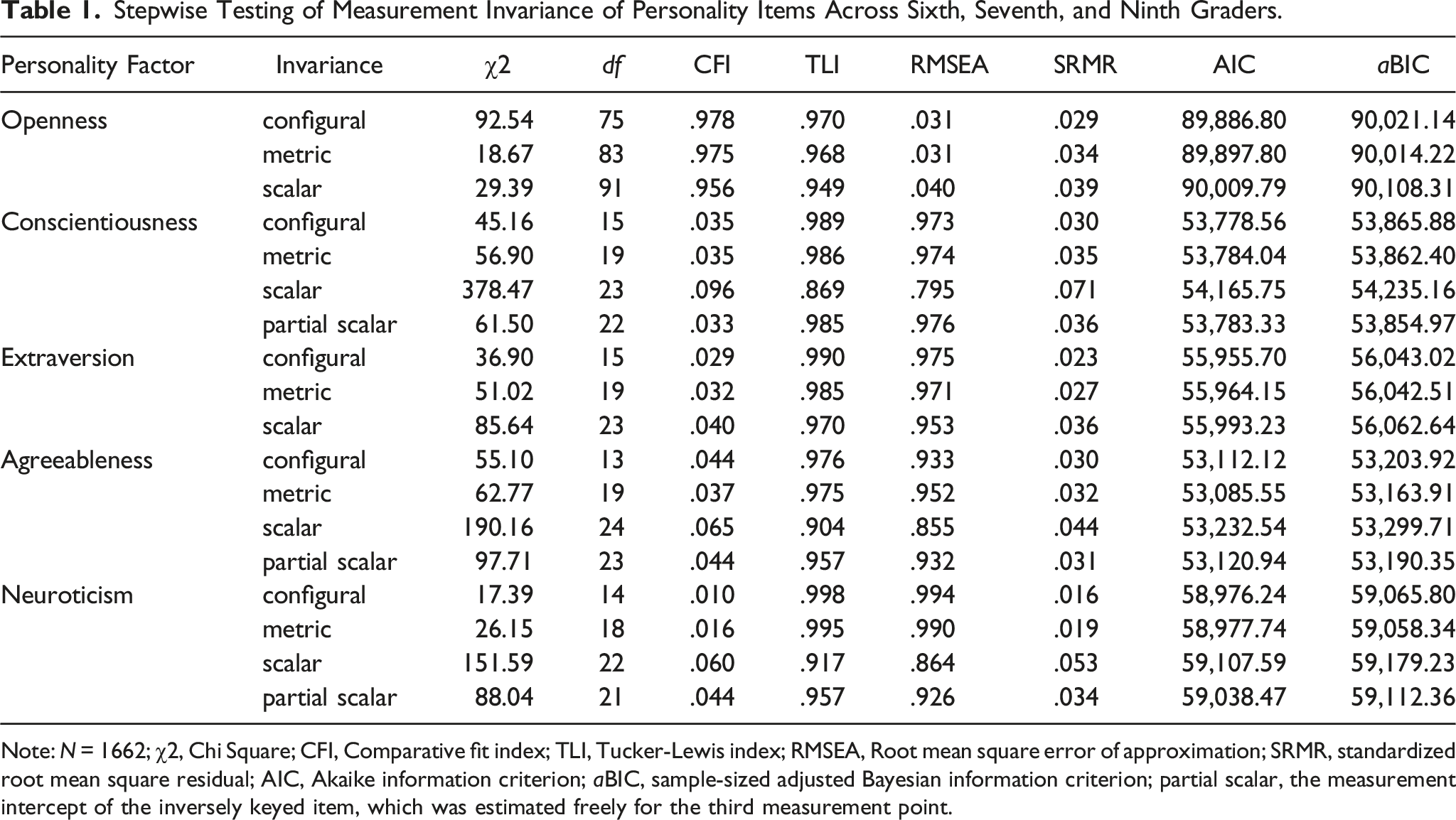
Note: N = 1662; χ2, Chi Square; CFI, Comparative fit index; TLI, Tucker-Lewis index; RMSEA, Root mean square error of approximation; SRMR, standardized root mean square residual; AIC, Akaike information criterion; aBIC, sample-sized adjusted Bayesian information criterion; partial scalar, the measurement intercept of the inversely keyed item, which was estimated freely for the third measurement point.
Latent change models
We used multivariate latent change models to estimate mean-level changes in personality factors between the sixth and ninth grade controlling for stable interindividual differences (aim 1; McArdle, 2009; McArdle & Hamagami, 2001; see Figure 1). We used the specified measurement models to estimate a latent intercept factor (i) and two slope factors (Difft2-t1 and Difft3-t1): The latent intercept factors represented interindividual differences in each personality factor at t1, whereas the latent slope factors reflected interindividual differences in intraindividual mean-level changes over two time spans. To estimate those slopes, we specified baseline change models, estimating change between the baseline measurement and t2 (Diff t2–t1) and between the baseline measurement and t3 (Diff t3–t1). This procedure allowed us to estimate interindividual differences in mean-level changes over both shorter (Diff t2–t1) and longer time periods (Diff t3–t1). To facilitate interpretability, we set the metric for all models with M = 0 and SD = 1 to the first measurement, so change estimates can be directly interpreted as effect sizes on the common metric. Latent baseline change model investigating the effects of secondary school track attendance and gender on developmental trajectories of personality factors.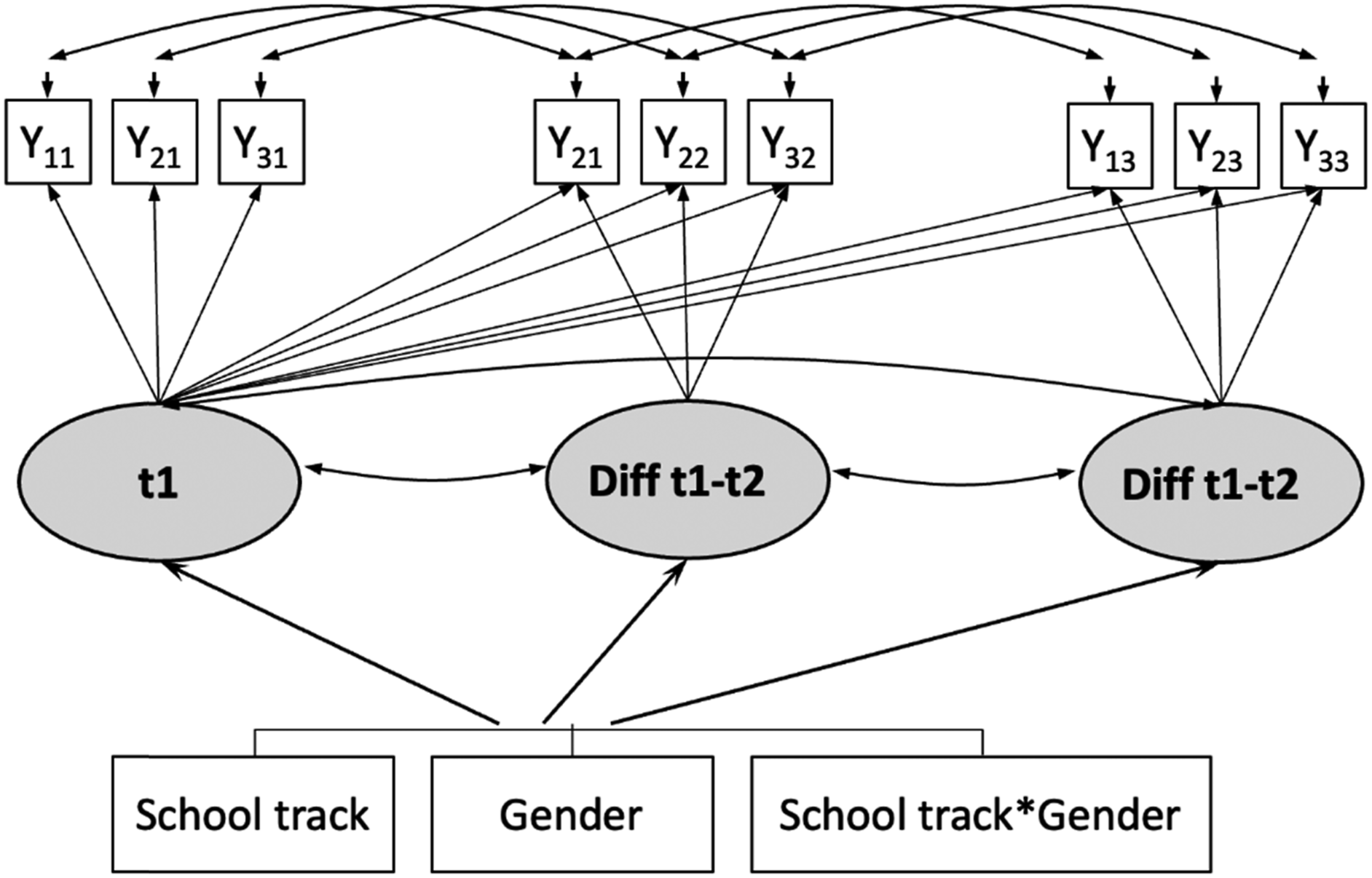
To test for differences in personality trajectories by learning environment and gender (aim 2), we next added school track attendance and gender as predictors to the model. Our use of school track attendance as a predictor for the intercept allowed us to test whether differential personality levels predicted selection into academic or non-academic school tracks (i.e., selection effects). Further, we used school track attendance and gender as predictors of mean-level changes in personality factors (socialization effects) over shorter (Diff t2–t1) and longer (Diff t3–t1) time periods. This allowed us to compare mean-level personality changes in academic track students to those in non-academic track-students (as well as boys vs. girls). Finally, we also estimated models that additionally included an interaction term between school track attendance and gender as an additional predictor for the intercept and slope factors.
Propensity score matching
Although change score analyses remove stable interindividual differences, it remains difficult to interpret developmental trajectories between non-equivalent groups in different educational environments if the analysis does not account for different levels of initial values, as different change rates may be associated with different levels and differential distributions between groups (known as Simpson’s or Lord’s paradox; Holland & Rubin, 1983; West & Thoemmes, 2008). This is relevant to the present study as various change mechanisms—such as the corresponsive and cumulative principle—would directly factor into this problem.
One objective of this study was to investigate whether personality development trajectories differ between educational environments. For this purpose, the developmental trajectories of students who attended an academic track (Gymnasium) were compared to the trajectories of students who attended a more non-academic learning environment (Integrierte Sekundarschule, ISS). One problem in interpreting these effects relates to self-selection, as the students in these learning environments systematically differ. The selection process explicitly intends to allocate students according to their cognitive ability and achievement, and at the same time, they also differ in other factors, for example, parental social background or student’s educational aspirations and, most importantly, personality. Descriptive statistics show that students who attended the non-academic track differed systematically from students who attended the academic track in several respects (see Table A1). For example, students who attended the academic track performed on average significantly better in mathematics, t(1562.85) = 26.18, p < 0.001, and in German, t(1493.91) = 27.73 p < 0.001, in sixth grade than individuals who attended the non-academic track. Significant mean differences were also evident as early as sixth grade on all five personality traits measured by the BFI (e.g., conscientiousness: t(1246.27) = 9.40, p < 0.001). Personality trait scores were higher for students attending the academic track than for students attending the non-academic track, with the exception of neuroticism, t(931.77) = −4.18, p < 0.001 (for further information on the samples and measures see Becker et al., 2013; Becker et al., 2017: Tetzner et al., 2020).
Although change scores remove all stable differences, it remains difficult to interpret developmental trajectories between educational environments if the different levels are not accounted for. Individuals with different achievement levels may have different rates of change per se (see, e.g., Holland & Rubin, 1983)—which would also correspond to the various change mechanisms we would assume for personality change (especially the corresponsive principle).
We addressed the problem of baseline differences between students who attended an academic versus a non-academic track by applying propensity score matching (PSM). PSM aims to make treatment effects in observational studies easier to assess by balancing the data on the propensity score (PS), ideally resulting in homogeneous samples on the relevant covariates. Therefore, differences in outcomes after the treatment can be directly interpreted as effects of the treatment, as pre-treatment differences between groups are controlled for when homogenizing the groups via the PSM (for an overview, see, e.g., Morgan & Winship, 2015; Stuart, 2010). There are several algorithms to perform PSM. In its simplest form, it involves forming pairs of students who attended a different track but have similar propensities to choose a particular treatment, in this case, attending the academic track. An implicit assumption here is that PSM does not need to achieve a complete balance of all covariates imaginable but should balance those covariates that are especially relevant for treatment assignment and, simultaneously, outcomes (Austin et al., 2007). Typically, the pre-treatment measure is a key variable for removing relevant between-group differences (Steiner et al., 2010).
In its simplest form, which typically functions well, PSM is a two-step procedure: (1) a PS is estimated for each individual, and (2) individuals with similar PSs are matched. In the first step in our case, PSs were estimated by specifying a logistic regression model that included a broad set of 29 covariates. We selected covariates that were most likely to be related to the track (self-)selection. This included information on individual ability (e.g., objective performance tests and grades in mathematics, German, science, and first foreign language in sixth grade), individual and social background characteristics (e.g., gender, parental educational and socioeconomic background, immigrant background operationalized as parents’ country of birth), and, last but not least, the baseline measures of all personality traits that are less relevant for track selection but most relevant for the outcome itself. A detailed overview of covariates included in the matching procedure is provided in Table A1.
The next step was to match individuals with similar PSs. For this purpose, we used nearest neighbor matching with a specified caliper of c = 0.05 using the linearized PS (logits of PS). The caliper was used to enforce closer matches, resulting in a better balance of observed baseline differences. Furthermore, as the control group (i.e., students who attended the non-academic track) was significantly larger than the treatment group in our case, we did not only allow single pairs but also multiple matches, using a 1:15 ratio-matching. This means that students who attended the academic track were matched with up to fifteen students who attended the non-academic track. Matching was done without replacement. The above matching specifications were chosen as they yielded the best trade-off between balance and efficiency. The matched sample is a weighted sample because ratio matching was performed. PSM was conducted using the MatchIt-package in R (Ho et al., 2021; Ho et al., 2011).
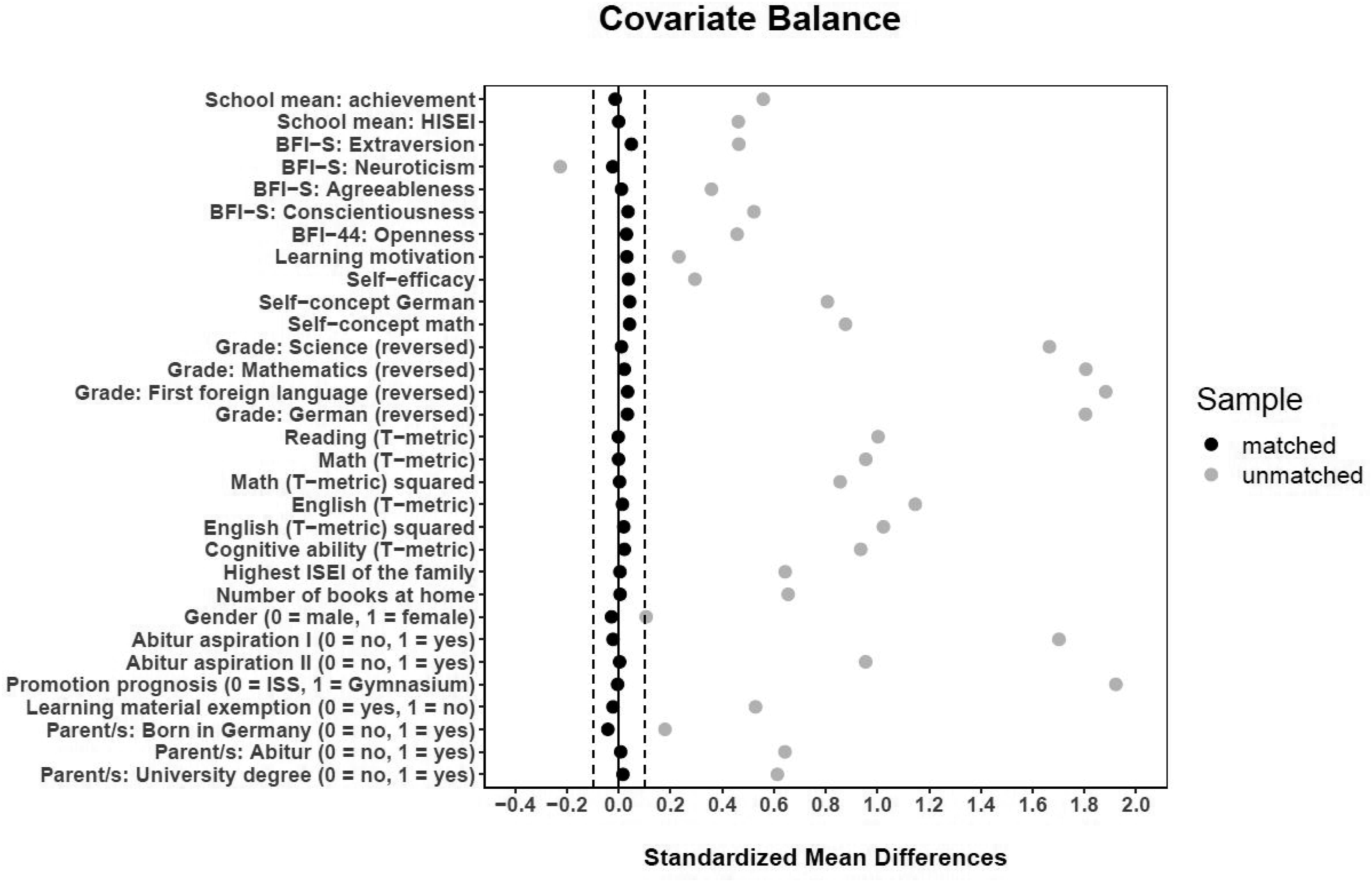
After matching, differences between all covariates were negligible. We used a Love plot to visualize and assess the between group difference before and after matching. This plot summarizes covariate balance, represented by standardized mean differences, before and after conditioning on the PS. The plot indicates good covariate balance for the matching performed (see Figure A1), as the standardized mean differences for all covariates became smaller after conditioning on the PS. The matched sample is used in the main analyses below.
Other specifications, such as using a ratio other than 15 (5, 10, or 20), using matching with replacement given the ratios, or using a different caliper (0.02 or 0.1) yielded similar but not as efficiently used and consistently balanced samples, which was the reason to use the PSM described above. However, the alternative specifications suggest a relative robustness against the specific model adjustments and therefore a certain reliability of PS estimation and the corresponding matching algorithms (as noted in Thoemmes & Kim, 2011). Note, however, that full matching, especially when including the full sample, did not yield sufficiently balanced samples.
Results
The descriptive statistics and correlations are reported in Tables A1 and A2 in the Appendix. In the following, we report the results from latent change modeling.
Age-graded changes in personality factors
Latent Initial Level and Difference Scores for the Development of Personality Factors Across Adolescence.
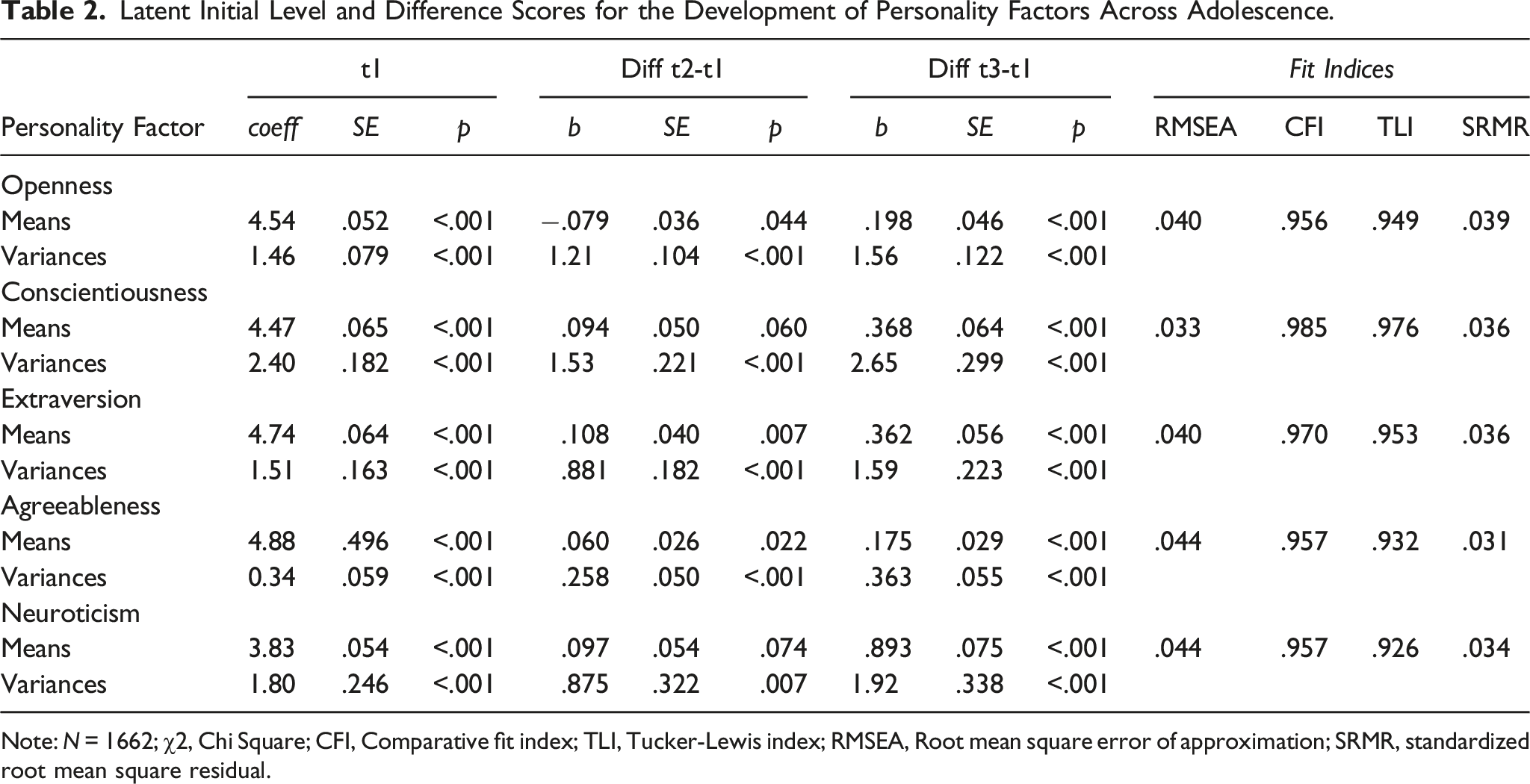
Note: N = 1662; χ2, Chi Square; CFI, Comparative fit index; TLI, Tucker-Lewis index; RMSEA, Root mean square error of approximation; SRMR, standardized root mean square residual.
Effects of school track and gender
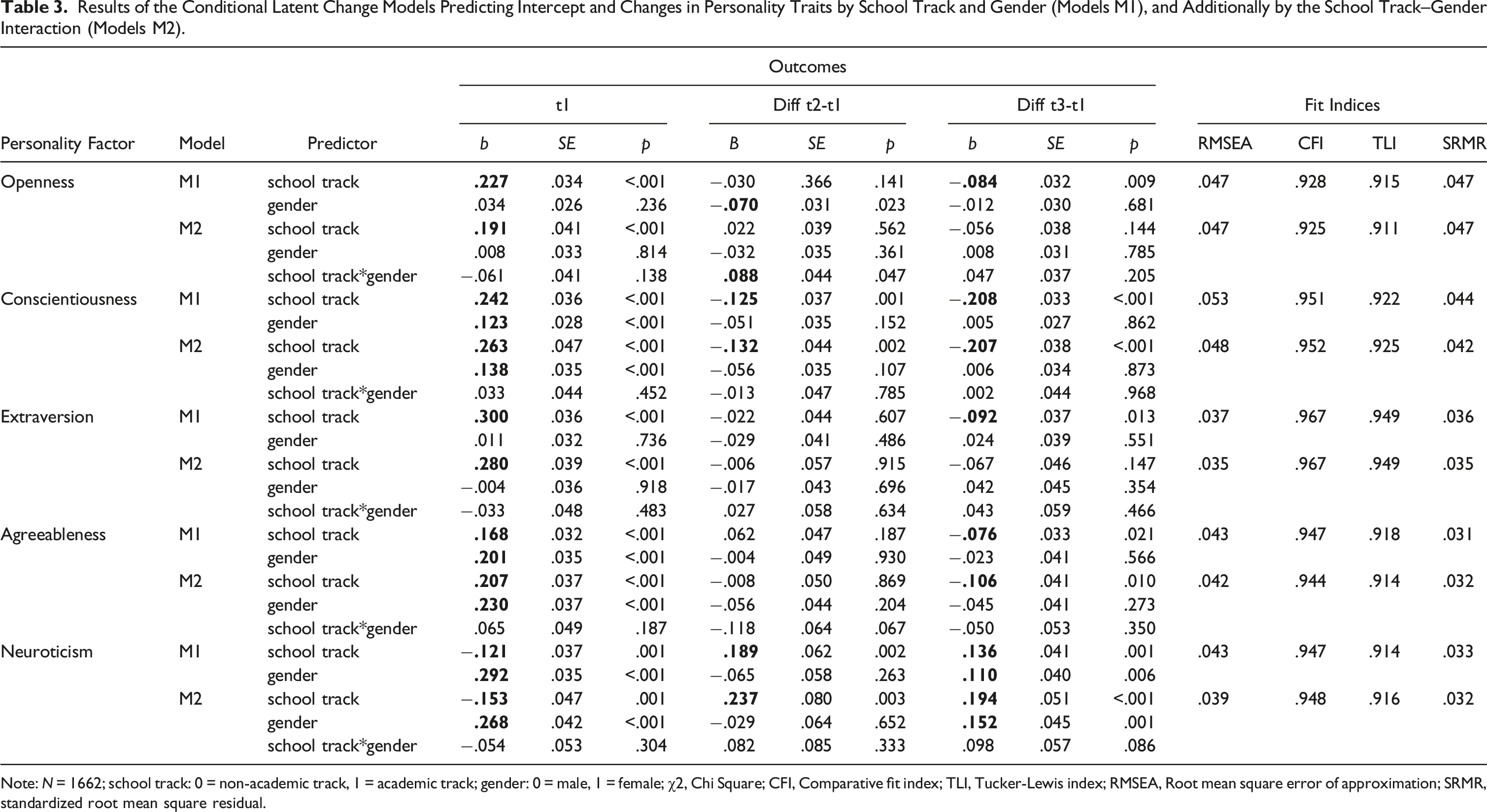
Results of the Conditional Latent Change Models Predicting Intercept and Changes in Personality Traits by School Track and Gender (Models M1), and Additionally by the School Track–Gender Interaction (Models M2).
Note: N = 1662; school track: 0 = non-academic track, 1 = academic track; gender: 0 = male, 1 = female; χ2, Chi Square; CFI, Comparative fit index; TLI, Tucker-Lewis index; RMSEA, Root mean square error of approximation; SRMR, standardized root mean square residual.
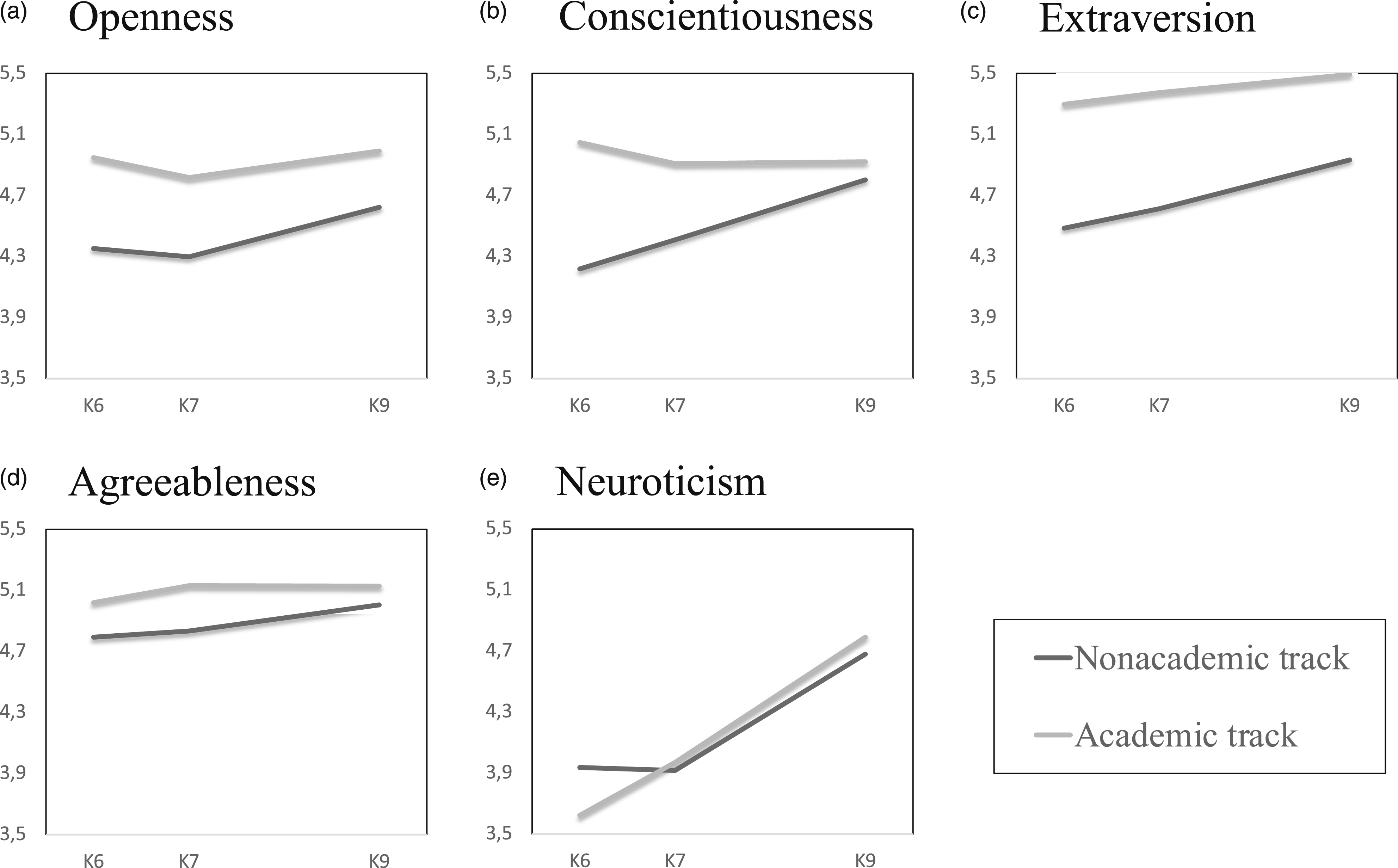
Mean-level changes in personality factors as a function of school track attendance.
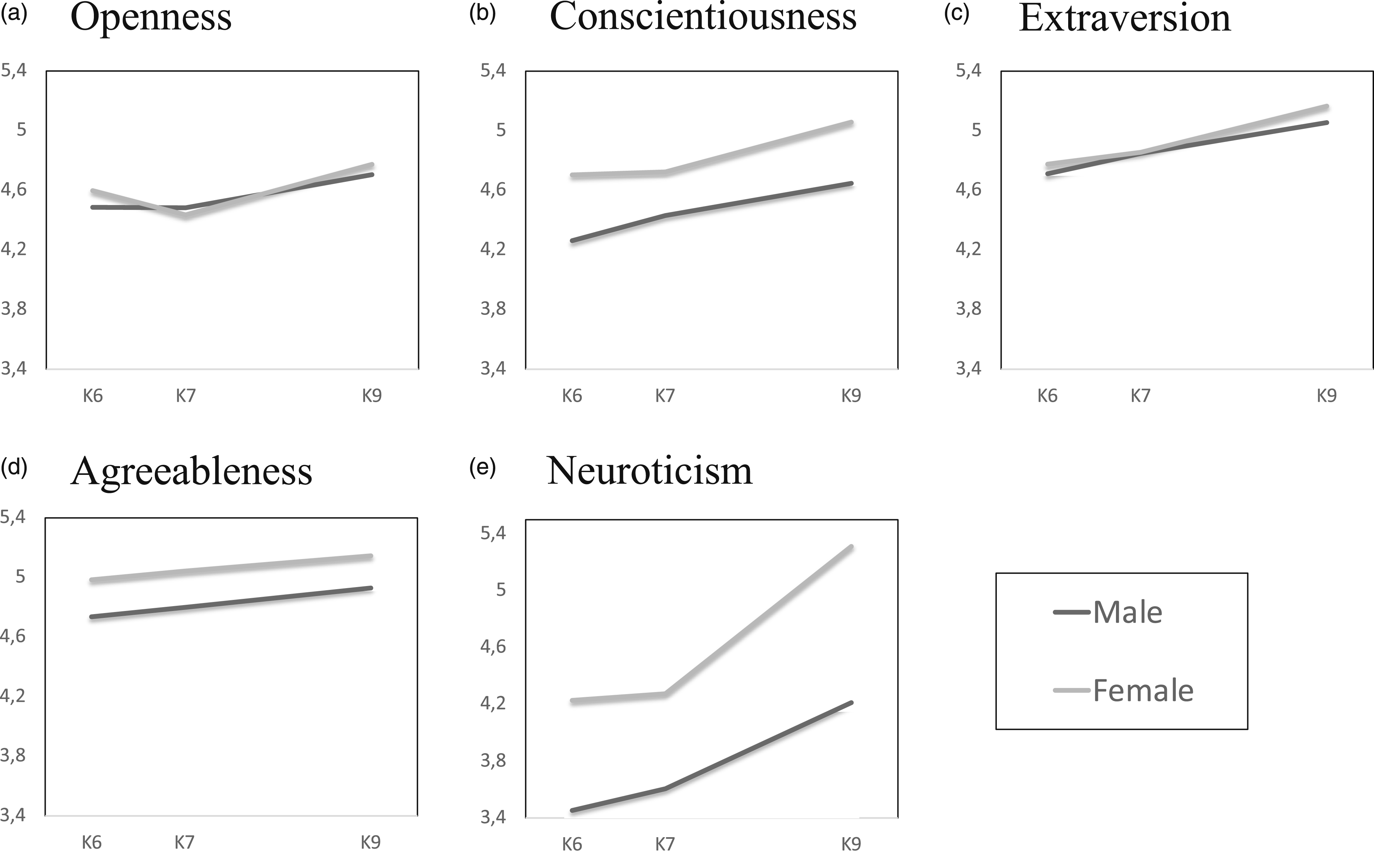
Mean-level changes in personality factors as a function of gender.
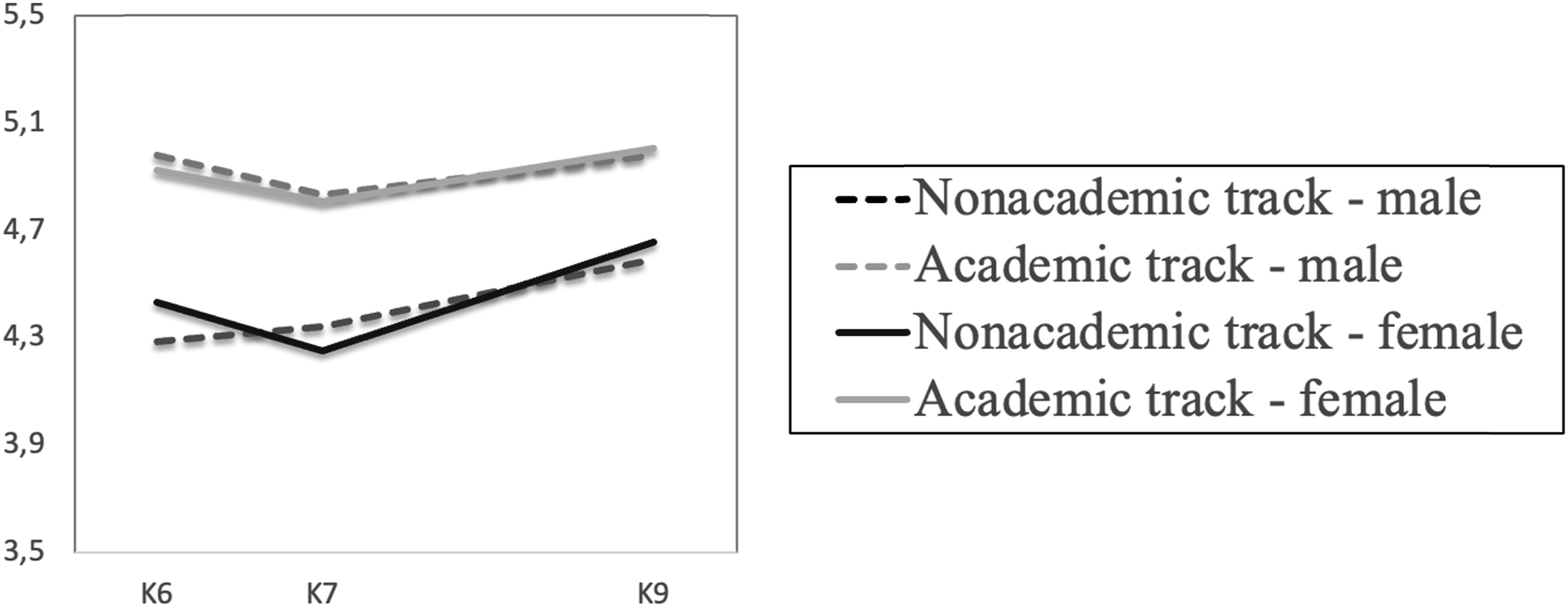
Mean-level changes in openness as a function of gender and school track attendance.
Concerning selection effects the results of all models indicated that, among sixth graders, there was a statistically significant association between higher levels of openness, conscientiousness, extraversion, and agreeableness and lower levels in neuroticism on the one hand and the transition to an academic school track in the next school year on the other. These effects were low to medium sized. The results also suggested higher levels of conscientiousness, agreeableness and neuroticism in female than in male sixth graders but no initial gender differences in openness and extraversion.
Focusing on socialization effects, Model M1 (Table 3) indicated differential personality trajectories between school tracks for all personality traits. More specifically, for openness, we found no differences in changes between school tracks in the short term but small-sized differences over the long term, that is, the overall increase between sixth and ninth grade seemed to be less pronounced in academic track students than in non-academic track students. The results of our analyses indicated a similar pattern for extraversion and agreeableness. For conscientiousness, we found a differential developmental pattern: there were differences between school tracks in the short term and even more pronounced differences in the long term, indicating that conscientiousness only appeared to increase over time in non-academic track students, whereas it appears to decrease in academic-track students (see also Figure 2). In the case of neuroticism, we found that increases were more pronounced in academic than non-academic-track students, both in the short and long term.
Regarding gender effects, we found a greater increase of neuroticism in female than in male students, which indicated that the initial gender difference increased across adolescence from sixth to ninth grade. Changes in conscientiousness, extraversion, and agreeableness across adolescence did not differ by gender. For openness, we found a complex pattern: although female and male sixth graders did not differ statistically significantly in their openness, we found a greater short-term decrease in openness for female students in the next school year. However, in the long run, we found no differential changes for male and female students, that is, between sixth and ninth grade.
Regarding interaction effects as tested in models M2 (see also Table 3), our results also indicated that openness may develop differently for female and male students during the transition to differential learning environments. For all other personality traits, the interactions between school track and gender were not statistically significant.
Results after propensity score matching
Results of the Conditional Latent Change Models Predicting Intercept and Changes in Personality Traits by School Track and Gender (Models M1), and Additionally by the School Track–Gender Interaction (Models M2) after Propensity Score Matching.
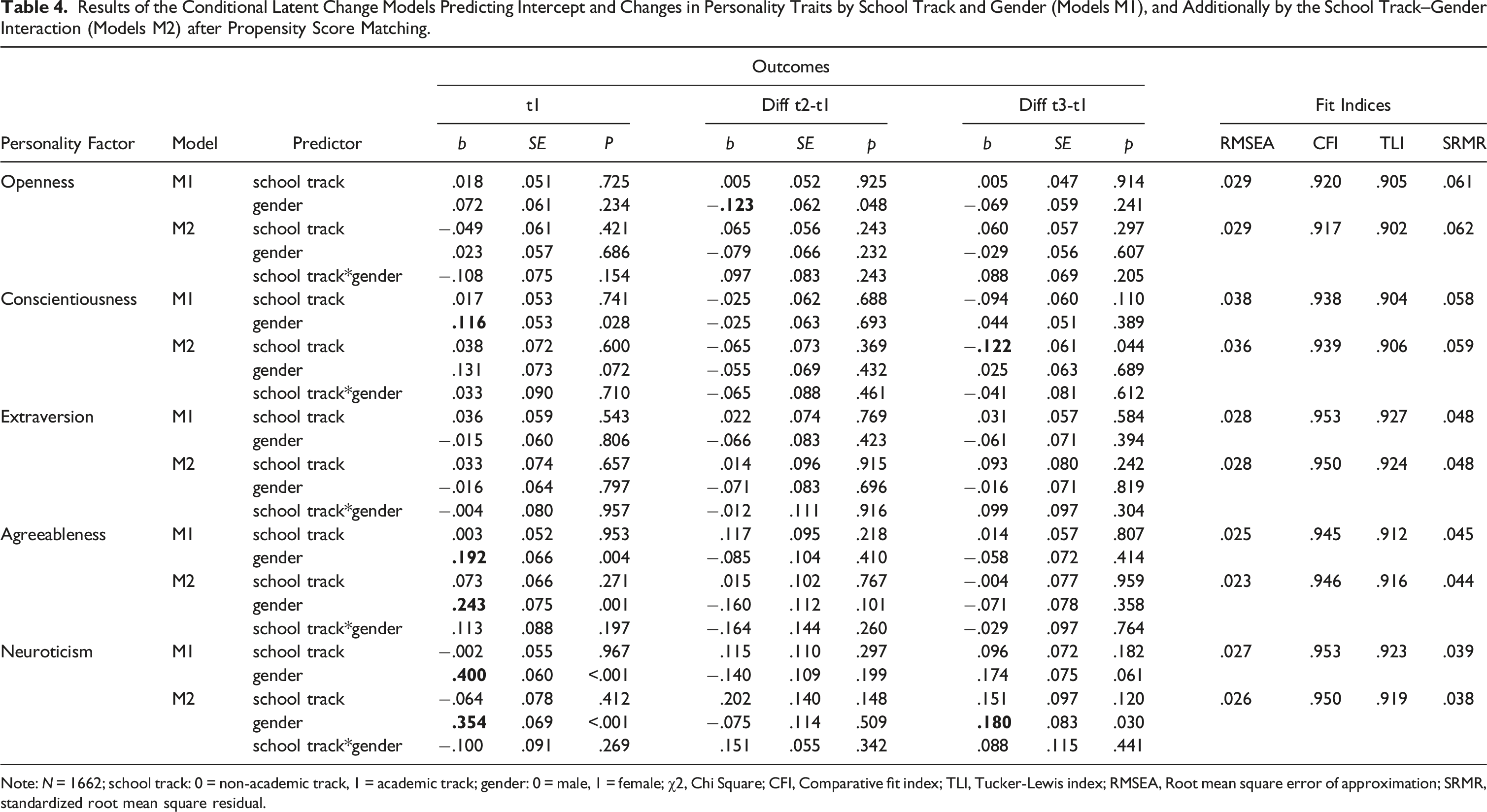
Note: N = 1662; school track: 0 = non-academic track, 1 = academic track; gender: 0 = male, 1 = female; χ2, Chi Square; CFI, Comparative fit index; TLI, Tucker-Lewis index; RMSEA, Root mean square error of approximation; SRMR, standardized root mean square residual.
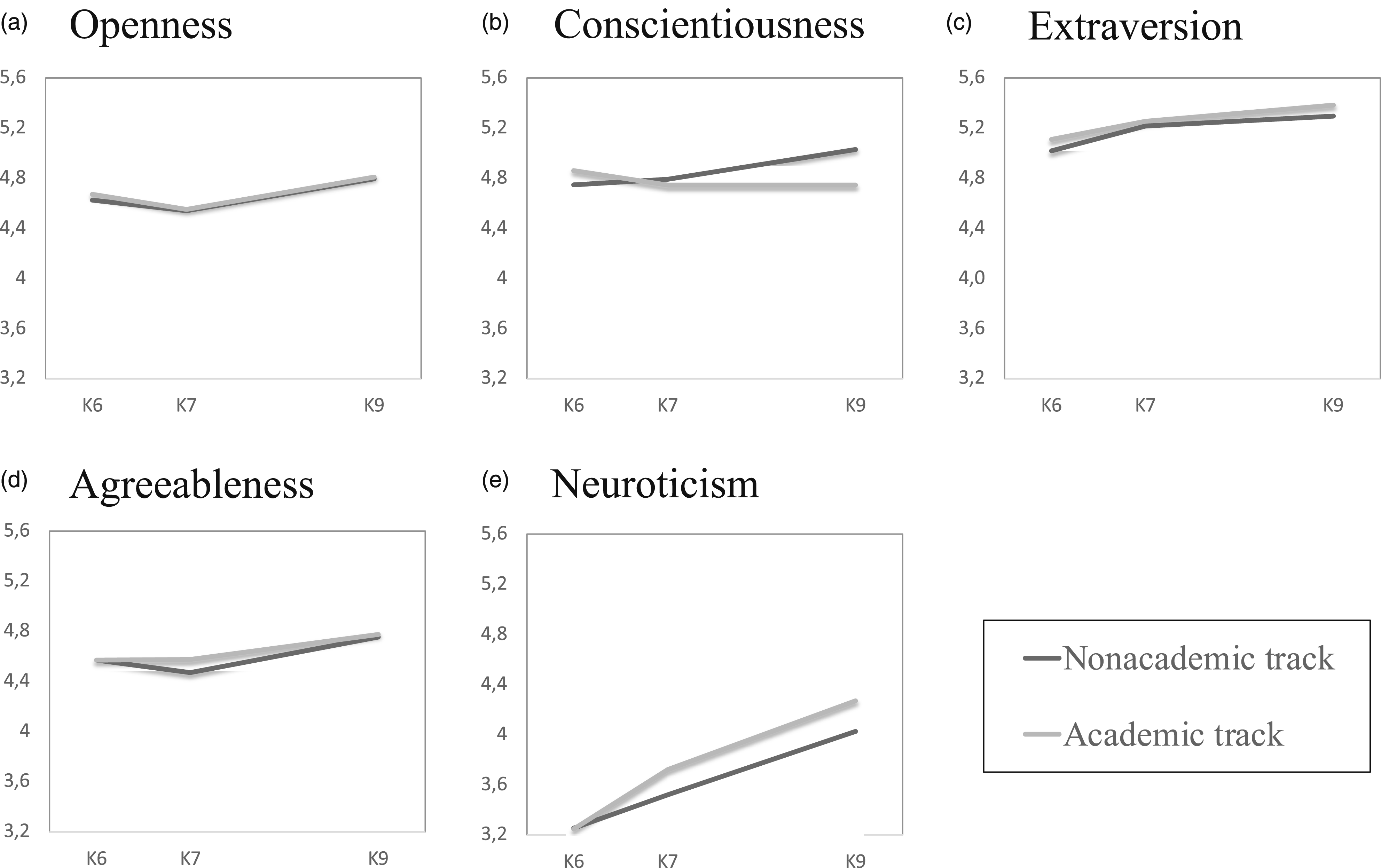
Mean-level changes in personality factors as a function of school track attendance after propensity score matching.
Discussion
This study aimed to advance the knowledge of how and why personality changes occur across adolescence. Overall, our findings partly replicated previous research, showing that personality factors change across adolescence, mostly leading to greater maturation. It also replicated previous findings as far as gender effects are concerned. Our findings extended previous research in showing an interplay between personality development and educational contexts during adolescence.
Age-graded changes in personality factors
The first aim of our study was to investigate the developmental trajectories of personality traits across adolescence. We especially focused on the time period between 12 and 15 years (sixth and ninth grade; i.e., early to middle adolescence). We found increases in mean levels for all personality traits from early to middle adolescence. This finding was partly in line with previous results and theoretical considerations. On the one hand, our findings are consistent with the maturity principle (Roberts et al., 2008), which proposes that age-associated social expectations and social roles exert pressure on adolescents to achieve higher maturity, that is, higher mean levels of extraversion, agreeableness, openness, and conscientiousness. The increases we found in extraversion, agreeableness, openness, and conscientiousness are in line with this principle. These findings also support previous findings that indicated increases in mean levels for personality traits across adolescence (Klimsta et al., 2009; Roberts et al., 2006).
On the other hand, contrary to the maturity principle, our findings indicated short term declines in adolescents’ openness between sixth and seventh grade and even increases in neuroticism (i.e., decreasing emotional stability) across the short and long term. For openness, this U-shaped pattern—that is, short-term decreases and long-term increases—is in line with the assumptions of Dennissen and colleagues (2013). These authors have stated that developmental transitions, such as the transition to secondary schooling, coincide with new behavioral expectations from significant others and society. For example, parents and teachers may expect more achievement-related behavior from a secondary school student in comparison to a primary school student. For the students, these expectations may evoke new reference points for the perception and evaluation of their own behavior. Denissen and colleagues (2013) proposed that there is an initial phase where students internalize the new reference points but need more time to adapt their behavior to achieve higher maturation. This process may lead to a short-term decline in personality factors such as openness but long-term increases. Another explanation may come from educational sciences and emphasizes the fact that the transition from primary to secondary schooling is a challenging situation for students, which not only requires them to adjust to new learning environments but also to new teachers, a changing classroom and peer context, or a new physical environment, among others. Dealing with this new situation and integrating in this new context requires multiple adaptive processes that may overwhelm students in the first year after the transition (e.g., school anxiety rises and self-esteem drops after the transition; cf. Knoppick et al., 2015) and lead to short-term declines in openness.
Regarding neuroticism, our results also contradicted previous findings that indicated increasing emotional stability in adolescence (Klimstra et al., 2009; Roberts et al., 2006). One explanation may be that we only focused on development from early to middle adolescence, but neuroticism may increase from middle to late adolescence (see Denissen et al., 2013). Possibly, that the need to adapt to the new environment, especially the new social role as a secondary school student, and the increasing pressure to perform well at school, triggers a long-term decrease in emotional stability. The adjustment may take longer and recovery may not occur until later adolescence. Last but not least, the biological changes and associated psychological adjustments may be more intense and demanding and therefore lead to increased neuroticism in earlier rather than later adolescence.
Personality development in educational contexts
The second main aim of our study was to investigate whether personality development from early to middle adolescence differs between educational environments. To the best of our knowledge, no previous study had addressed whether the globally prevalent practice of ability grouping in secondary education may interrelate with personality development from early to middle adolescence. Since our study used an initial measurement point in primary education prior to ability grouping into secondary school, we were able to address both processes of selection and socialization. Our use of three measurement points allowed us to assess effects over longer time spans—that is, the period of compulsory secondary education from sixth to ninth grade (i.e., age 12 to 15)—as well as effects in the short term, that is, directly after the transition into secondary school from sixth to seventh grade.
Selection effects
Regarding selection effects, the results indicated that more conscientious, agreeable, extraverted, open, and emotionally stable sixth graders were more likely to transition into an academic rather than a non-academic school track in the next school year. These results are in line with five-factor theory and the cumulative continuity principle, which propose that individuals actively select and modify their environments according to their personalities. They are also in line with prior empirical findings of selection effects in educational contexts (Lüdtke et al., 2011; Tetzner et al., 2020). One explanation for this initial relation may be that personality is highly associated with educational success and attainment (Poropat, 2009; Spengler et al., 2016) and several studies have connected each of the five-factor personality traits positively with academic achievement. Hence, students may be more likely to be assigned to academic school tracks because of their higher abilities but these may also be associated with a more mature personality pattern. Moreover, research has also shown that specific personality characteristics, such as higher persistence, effort, and interest, are generally rated as beneficial for mastering academic challenges (Caspi et al., 2005). This may also directly contribute to selection effects.
Socialization effects
Concerning socialization effects, that is, the further development of personality factors in differential learning environments, the results indicated that these initial differences in personality traits seemed to diminish over time. For all personality traits, differences in ninth graders were less pronounced than in sixth graders. This finding contradicts some general theoretical assumptions, especially the cumulative continuity principle and the corresponsive principle of personality development (Caspi et al., 2005), which propose that students’ personalities not only select them into specific life transitions—for example, certain secondary school tracks—but also that experiences during these transitions and in the specific environment may especially match students’ personalities and further sharpen and accentuate existing profiles.
Regarding tracking effects in a narrower sense, after controlling for initial differences via propensity score matching, we found no specific differential development between early and middle adolescence for openness, extraversion, agreeableness and neuroticism. Overall, this difference between analyses with and without controlling for baseline differences indicates that initial differences in personality traits (and potentially other sociodemographic, psychosocial, or achievement-related factors) may influence further personality development. One possible explanation for this finding may be that most academic track students may have already reached a quite “mature” level in these personality traits. Although students from the non-academic track show higher increases over time in specific traits, they never overtake students from the academic track. There might simply be more room for “maturation” for those from the non-academic track at that point in their development. They may merely compensate previous delays in maturation.
There is another plausible explanation for the overall reduction in personality differences between school tracks. the overarching educational system’s general socialization influences and aims may, in the grand scheme, be more common among different tracks and exert a homogenizing influence rather than actually increasing heterogeneity. This has also been suggested in recent sociological publications (e.g., Downey & Condron, 2016) Even though the students pursue achievement goals on different levels, every school aims to educate its students to become responsible, agreeable, and conscientious emerging adults who can master the challenges of working life. These overall commonalities in pedagogic aims and efforts may not yield overly specific differential effects, at least not beyond what students themselves contribute to the context.
In contrast to the other personality traits, our results showed an especially interesting picture for conscientiousness. Overall, more conscientious 6th graders were more likely to transition to an academic school track in the 7th grade than their less conscientious classmates. In accordance with the other traits, these initial differences seemed to diminish over time. However, after controlling for initial differences via propensity score matching, conscientiousness seemed to develop more positively in non-academic than academic track students between 6th and 9th grade. This is inconsistent with our prediction that more achievement-related personality traits—that is, conscientiousness and openness—would develop more positively in academic school tracks due to the characteristics of the more achievement-oriented contexts, differences in student composition, and differences in institutional characteristics, such as more activating and challenging instruction (Baumert et al., 2004). In fact, the results for conscientiousness seem to indicate a negative contrast effect. Either the academic track students developed more negatively or the non-academic track students developed more positively in their respective learning environments. This is in line with findings reported by West et al. (2016), who also found evidence of negative effects of school environments with higher achievement expectations in a US sample. Using global indicators such as absenteeism, West et al. (2016) suggest that in their study, student perceptions may have changed rather than actual behavior. This idea that changes in self-evaluations after contextual transitions may not necessarily reflect real behavioral or trait changes is also in line with an idea proposed by Dennissen and colleagues (2013), who stated that new environments may create new reference points for students’ self-perceptions. Especially teachers’ and parents’ expectations of adjusting to the increasing academic demands and work load may put pressure on early adolescents and may thereby cause temporary declines in their estimations of their conscientiousness.
Gender effects
We additionally investigated whether differences in personality development between school tracks were related to gender. In this regard, the results of our study indicated overall gender differences that were mostly in accordance with prior findings (e.g., De Bolle et al., 2015). As early as sixth grade, girls were more conscientious, more agreeable, and less emotionally stable than their male counterparts. Partly contradictory to previous findings, we found no gender differences in openness. However, gender differences in openness may be more likely to occur on the facet-level (see Costa et al., 2001).
For all traits except neuroticism, gender differences did not change across early adolescence and, hence, still existed prior to early adolescence. This is in line with Göllner and colleagues (2017) who also found that gender differences already existed at the age of 10 and did not develop differently across adolescence. However, in line with the gender intensification hypothesis (Priess et al., 2009), we found for neuroticism that existing gender differences even increased between sixth and ninth grade. This is also in line with De Bolle and colleagues (2015), who reported more mature personality profiles in girls than boys during adolescence but also higher scores in neuroticism for girls.
Focusing specifically on gender differences in school track effects on personality development, we only found an interaction term for openness, indicating that openness slightly decreased for girls in the non-academic track but increased for boys. Overall, our findings indicated no gender specificity in the interplay between personality development and education contexts from early to middle adolescence.
Limitations and implications for future research
This study offers various advantages over previous research: we used a large representative longitudinal sample, were able to address the less investigated age group between 12 and 15 years, and examined the transition into and development in different educational contexts by providing an initial measurement that was taken prior to transition into different environments and was thus not biased by contextual effects.
However, several limitations must also be noted. First, we investigated personality development by using a short personality inventory on the trait level. Although the BFI-S shows convergent validity with longer personality scales (Hahn et al., 2012), short scales are not able to cover the full breadth of the Big Five as longer inventories may do and reduced reliabilities may impede the interpretation of findings. Moreover, some facets of the global traits may match our arguments regarding possible school track effects more than others. For example, for openness, the sub-facet of intellectuality may be more prone to change as a function of influences of the educational environment than the sub-facet of unconventionality. Future studies should examine whether facet-level analyses provide differing results regarding personality development in secondary education contexts.
Second, future studies should also examine whether our results are internationally replicable across different education systems and different kinds of ability grouping. In our analyses, we used the most rigid form of ability grouping (i.e., explicit between-school tracking), which most likely produces more distinct learning environments than, for example, course-by-course tracking. This had the analytical advantage of differentiating group membership much more clearly than other forms of ability grouping would have allowed and, thus, may have revealed differential personality developments in different learning environments much more clearly than other forms of ability grouping may have done (see also Tetzner et al., 2020).
Third, future studies should also consider using additional indicators for assessing adolescents’ personality rather than solely using self-reports. Especially regarding possible biases in self-perceptions due to contrast effects or changing reference points (Denissen et al., 2013; West et al., 2016), a promising option for deepening our understanding of personality development in secondary schooling may entail additionally investigating behavioral indicators (e.g., persistence in doing homework and preparing for class as an indicator for conscientiousness; see also West et al., 2016) or even using evaluations by parents and teachers (see Brandt et al., 2021).
Finally, although we revert to different established theoretical frameworks (e.g., corresponsive principle, the cumulative continuity principle, the Big-fish-little-pond-effect) to formulate hypotheses about how adolescents develop their personalities and why these developments may differ across educational contexts, we did not test these theories and their underlying mechanisms in a direct way. Instead, this study wanted to provide a first description of this topic. Nevertheless, future studies should expand this focus and address underlying mechanisms, for example by adding additional predictors that may shed more light on the genesis of differences in personality developments between differential learning environments.
Conclusion
In a nutshell, our results indicate that there is substantial change in early adolescent development. Given the developmental processes that individuals have to master as they go from being children to adolescents and eventually adults, this does not come as a surprise. Our study contributed to that debate by highlighting the importance of and amount of change during that developmental period, and it also hints at the potential role of schooling and differential learning environments during that time. On the one hand, students select themselves into educational environments that mostly match their skills and characteristics. On the other hand, at least in some respects, students’ self-evaluations of their personality seem to change in response to influences that are associated with new educational environments; both processes contribute to the changes adolescents experience to a different extent. However, there is still scope for research that explores how this short snapshot of early adolescent development matters for subsequent developmental processes in later adolescence and for transitions into adulthood.
Footnotes
Acknowledgments
We are grateful to the BERLIN-study team for allowing us to use the dataset. The BERLIN-study is a joint project by the Max-Planck-Institute for Human Development (MPIB, Berlin, Germany; Principal Investigator: Jürgen Baumert), the German Institute for International Educational Research (Frankfurt am Main/Berlin, Germany; Principal Investigator: Kai Maaz) and the Leibniz Institute for Science and Mathematics Education (Kiel, Germany; Principal Investigator: Olaf Köller). The BERLIN-study is funded by the Berlin Senate Administration for Education, Science and Research and the Jacobs Foundation.
Data accessibility statement
This article earned Open materials badge through the statistical analysis code needed to prepare the data and reproduce our analyses are available at https://osf.io/pbwzv/?view_only=6092bebece2143699e832ce7592af332. The BERLIN-study data are not publicly available as this does not comply with the consent given by participants and may contain information that could compromise research participants’ privacy. BERLIN data presented in this study are available for inspection upon request from the principle investigators of the study in coordination with the authors if the study ( ).
).
Declaration of conflicting interests
The author(s) declared no potential conflicts of interest with respect to the research, authorship, and/or publication of this article.
Funding
The author(s) received no financial support for the research, authorship, and/or publication of this article.
Note
Appendix
Descriptive Statistics of Continuous and Binary Covariates Before Matching.
Note: Cohen’s d was calculated for continuous variables. Phi φ was calculated for binary variables. BFI = Big Five Inventory.
Total
Academic Track
Non-Academic Track
Cohen’s d/Phi φ
Label
N
Mean
SD
N
Mean
SD
N
Mean
SD
Gymnasium versus ISS
School mean: achievement (reading, math, English)
87
50.23
5.06
22
50.69
5.25
65
50.07
5.02
0.12
School mean: HISEI
87
49.45
10.28
22
50.28
11.10
65
49.17
10.06
0.10
BFI-S: Extraversion
1662
4.53
1.26
519
4.92
1.21
1143
4.36
1.25
0.46
BFI-S: Neuroticism
1662
3.76
1.34
519
3.55
1.36
1143
3.86
1.32
0.23
BFI-S: Agreeableness
1662
5.15
1.14
519
5.41
1.05
1143
5.04
1.16
0.34
BFI-S: Conscientiousness
1662
4.47
1.36
519
4.94
1.30
1143
4.26
1.33
0.51
BFI-44: Openness
1662
4.56
1.24
519
4.92
1.16
1143
4.39
1.24
0.44
Learning motivation
1662
2.47
0.77
519
2.59
0.76
1143
2.41
0.77
0.23
Self-efficacy
1662
2.88
0.54
519
2.98
0.50
1143
2.83
0.55
0.28
Self-concept German
1662
2.78
0.70
519
3.12
0.62
1143
2.62
0.67
0.77
Self-concept math
1662
2.86
0.82
519
3.27
0.69
1143
2.67
0.80
0.81
Grade: Science (reversed)
1662
−2.78
1.03
519
−1.98
0.71
1143
−3.15
0.94
1.41
Grade: Mathematics (reversed)
1662
−2.96
1.09
519
−2.08
0.71
1143
−3.36
0.99
1.48
Grade: First foreign language (reversed)
1662
−2.92
1.04
519
−2.06
0.67
1143
−3.32
0.94
1.54
Grade: German (reversed)
1662
−2.80
0.92
519
−2.02
0.62
1143
−3.15
0.81
1.56
Reading (T-metric)
1662
52.40
10.30
519
58.77
9.24
1143
49.51
9.42
0.99
Math (T-metric)
1662
49.16
9.94
519
55.61
9.83
1143
46.22
8.50
1.02
English (T-metric)
1662
47.20
11.00
519
54.39
9.13
1143
43.93
10.20
1.08
Cognitive ability (T-metric)
1662
45.23
8.54
519
50.50
8.19
1143
42.84
7.58
0.97
Highest ISEI of the family
1662
49.41
19.97
519
58.29
20.09
1143
45.37
18.56
0.67
Books at home
1662
3.10
1.30
519
3.66
1.23
1143
2.85
1.26
0.65
Gender (0 = male, 1 = female)
1662
0.47
0.50
519
0.51
0.50
1143
0.46
0.50
0.05
Abitur aspiration I (0 = no, 1 = yes)
1662
0.63
0.48
519
0.93
0.26
1143
0.50
0.50
0.42
Abitur aspiration II (0 = no, 1 = yes)
1662
0.65
0.48
519
0.87
0.33
1143
0.55
0.50
0.31
School track recommendation (0 = N-AT, 1 = AT)
1662
0.38
0.49
519
0.85
0.35
1143
0.17
0.38
0.65
Learning material exemption (0 = yes, 1 = no)
1662
0.61
0.49
519
0.76
0.42
1143
0.54
0.50
0.21
Both parents born in Germany (0 = no, 1 = yes)
1662
0.57
0.50
519
0.63
0.48
1143
0.54
0.50
0.08
At least one parent with Abitur (0 = no, 1 = yes)
1662
0.37
0.48
519
0.59
0.49
1143
0.27
0.45
0.30
At least one parent with a university degree (0 = no, 1 = yes)
1662
0.33
0.47
519
0.54
0.50
1143
0.23
0.42
0.30
Correlation Matrix of Personality Constructs,School Type,and Gender.
Note: Gender: 0 = male, 1 = female; School track: 0 = non-academic Track, 1 = academic track; Intercorrelations of |r = 0.05| or above differ statistically from zero at p < .05.
Items
1
2
3
4
5
6
7
8
9
10
11
12
13
14
15
16
1
Openness t1
2
Conscientiousness t1
0.46
3
Extraversion t1
0.42
0.23
4
Agreeableness t1
0.31
0.39
0.18
5
Neuroticism t1
-0.09
-0.20
-0.22
-0.10
6
Openness t2
0.54
0.28
0.27
0.22
-0.09
7
Conscientiousness t2
0.30
0.58
0.14
0.30
-0.11
0.41
8
Extraversion t2
0.30
0.21
0.53
0.14
-0.22
0.42
0.27
9
Agreeableness t2
0.26
0.33
0.12
0.50
-0.06
0.32
0.41
0.20
10
Neuroticism t2
-0.03
-0.08
-0.11
-0.01
0.45
-0.03
-0.19
-0.16
-0.05
11
Openness t3
0.37
0.13
0.18
0.15
-0.01
0.44
0.15
0.22
0.13
-0.01
12
Conscientiousness t3
0.18
0.38
0.04
0.20
-0.02
0.18
0.47
0.08
0.20
-0.04
0.34
13
Extraversion t3
0.21
0.08
0.42
0.02
-0.13
0.23
0.09
0.48
0.07
-0.11
0.35
0.13
14
Agreeableness t3
0.12
0.22
0.04
0.36
-0.02
0.11
0.24
0.04
0.43
0.01
0.22
0.29
-0.01
15
Neuroticism t3
-0.01
0.02
-0.07
0.04
0.36
-0.03
-0.03
-0.10
0.03
0.40
-0.02
-0.03
-0.20
0.06
16
School track
0.20
0.23
0.20
0.15
-0.11
0.18
0.16
0.19
0.20
-0.01
0.13
0.01
0.14
0.09
0.02
17
Gender
0.06
0.10
-0.01
0.19
0.20
0.02
0.08
-0.03
0.19
0.19
0.08
0.16
0.00
0.17
0.32
0.05
Love plot for comparing academic track or non-academic track students before (blue dots) and after matching (gray dots). Points represent the means of standardized mean differences across imputations. BFI-S, big five inventory; Parent/s, at least one parent.