




Abstract
Post-traumatic growth is a compelling idea, yet extant research has often employed retrospective reports of change, rather than examining change over time. Research on samples of people that are traditionally seen as hard-to-reach are rare within personality psychology. In Karakter, we assessed a sample of Syrian origin young adults who recently resettled in the Netherlands (initial N = 168) four times over a 13-month period to examine experiences of adversity, emotions, and positive personality change. Here, we provide a detailed narrative of the research process, beginning with a description of how we incorporated open science practices in Karakter. We then turn to a discussion of the changes, challenges, and opportunities we encountered in the research. In doing so, we discuss conceptual and methodological considerations when examining personality change. We close with suggestions for researchers who are interested in conducting similar studies with populations that are underrecruited in the future.
Empirical research on the experience of adversity (i.e., extremely difficult life events such as forced migration, serious injury, sexual abuse, or terminal illness) has facilitated much needed advances in our understanding of its psychological consequences (Bhugra, 2004; Norman et al., 2012). Traditionally, the negative outcomes of adversity, which range from acute adjustment difficulties to long-term living with a mental illness, have received greater attention (Seery et al., 2010). Yet, positive psychological outcomes have also been observed in people who have experienced various adverse events (Chan et al., 2016; Linley & Joseph, 2004).
The burgeoning research on the effects of adversity raises important conceptual, methodological, and sample-related challenges that are critical to consider for future work to better understand its possible positive outcomes. For these reasons, we take a somewhat unusual approach in the current paper and focus our attention on these issues and our own insights from conducting a project called Karakter, a multi-wave longitudinal study of Syrian young adults with refugee backgrounds who had recently resettled in the Netherlands. We describe the development of the study in detail to provide context for discussing these challenges. In doing so, we not only hope to convey the merit of conducting studies like Karakter, but also anticipate that these methods can inform future research endeavors aimed at studying people’s positive outcomes while facing or following adversity.
The Karakter project
In Karakter, we followed a sample of Syrian origin young adults (initial N = 168) who had recently resettled in the Netherlands. Syrian young adults comprise one group of people who have experienced and continue to face extraordinary adversity since the Syrian conflict began in 2011, with 13.3 million people being displaced or forced to resettle in a different country (USA for United Nations High Commissioner for Refugees, 2020). Many Syrian people have experienced adversity through war and armed conflict in their home country, a likely difficult and dangerous migration journey after being forced outside of their home country, and hardships that accompany resettlement in a new one. For many people who seek or have refugee status, adversity can be considered in relation to flight as: (1) pre-flight, before coming to the Netherlands, (2) peri-flight, during the journey, and (3) post-flight, after arriving in the Netherlands (Bhugra, 2004; Sleijpen et al., 2016).
In the Netherlands, a primary reason for recent population growth has been the influx of immigrating people, with Syrian people making up one of the largest groups of newcomers with refugee backgrounds (Statistics Netherlands, 2019). The increase in the number of Syrian people who have been resettling in the Netherlands requires a better understanding of their experiences. Much of the research that concerns people with refugee backgrounds has taken a deficit-model approach (e.g., Nickerson et al., 2015). Moreover, the prevalence of pathology is generally higher in Syrian people with refugee backgrounds residing in Europe and this has been suggested to be related to past and/or present experiences. Yet, it is important to note that there are also many people who do not show symptoms of mental illnesses (Acarturk et al., 2020; Chung et al., 2018; Nickerson et al., 2017), suggesting it is important to identify what factors may contribute to coping with adversity or even post-traumatic growth.
The Karakter project joins a research area (e.g., Sleijpen et al., 2016) that seeks to learn more about the psychology of people with refugee backgrounds by focusing on positive characteristics, events, and outcomes. Additionally, by studying adversity and positive personality change in Syrian young adults, we were able to include a sample of people who are underrecruited within personality psychology. Moreover, by conducting research with people who have refugee backgrounds, we sought to generally contribute to a more diverse understanding of people’s psychological experiences (Henrich et al., 2010).
Goal 1: Reconceptualizing post-traumatic growth as positive personality change
The idea that people can grow and even experience positive consequences in the wake of adversity is a compelling one that has received growing attention in psychological research (Calhoun & Tedeschi, 2014). Post-traumatic growth (PTG) refers to the experience of positive changes over time as a result of being exposed to extremely difficult life events (Tedeschi & Calhoun, 2004). PTG has typically been conceptualized as self-reported improvements in a person’s relationships with others, possibilities for one’s life, perceptions of a person’s strength, one’s spirituality, and appreciation of one’s life (Jayawickreme & Blackie, 2014; Tedeschi & Calhoun, 1996). Moreover, growth has been operationalized, at least in theory, as increases that surpass baseline levels in these areas (Tedeschi & Calhoun, 2004). Recently, personality psychologists specifically interested in growth following adversity have refined the conceptualization of PTG as positive personality change (Blackie et al., 2017; Jayawickreme & Blackie, 2014). Positive personality change is viewed as actual personality change. Yet, much of the research focused on PTG has employed retrospective reports of change, asking people whether they experienced change after experiencing extraordinary hardship. People’s subjective perceptions of change are important, but extant empirical work has largely not aligned with how PTG is actually conceptualized. That is, whether people actually show change in personality traits over a prolonged period of time.
Given the recent reconceptualization of PTG as actual positive personality change (Blackie et al., 2017; Jayawickreme & Blackie, 2014), we aimed to measure actual instead of retrospectively perceived change in Karakter. We reasoned that the closest way to approximate measuring such change was by conducting personality assessments over time. Therefore, we employed a study design that utilized longitudinal data collection of people’s responses to measures assessing growth-relevant traits (Tennen & Affleck, 2009) with the objective of making interpretations of change based on trajectories of people’s responses over the duration of the study.
Goal 2: Studying an underrecruited sample of people
Personality research has traditionally focused on samples of people from Western Educated Industrialized Rich Democratic (WEIRD; Henrich et al., 2010) populations. Yet, understanding post-traumatic growth requires the inclusion of samples of people who have and continue to face adversity, including those with refugee backgrounds. In doing so, the research may be more ecologically valid than conducting research with samples of college students and other convenience samples where exposure to adversity may be relatively low. Nonetheless, it is generally the case that non-representative samples are used in the study of post-traumatic growth because recruiting a representative sample from these populations is especially challenging (Jayawickreme & Zachry, 2018). For example, the number of participants in the study may be smaller than samples drawn from general populations, and may be underpowered for many conventional statistical analyses. Relatedly, results from the research may be more biased and less generalizable because of the non-representativeness of the sample (but see Jager et al. (2017) for a discussion). Moreover, it may be difficult to discern effects that hold up to future replication attempts, because it is not typical to report in great detail changes that occur over the course of a longitudinal study, or all the analyses that were conducted for scientific publications. With these issues in mind, in Karakter, we sought to examine emotions and positive personality change in a sample of Syrian origin young adults in the Netherlands.
The current commentary
In this commentary, we provide a detailed narrative of the research process, including the changes, challenges, and opportunities we encountered in Karakter. First, we describe how we incorporated open science practices into our research process. Second, we describe the design of Karakter, where we applied methodologies from personality psychology (e.g., the PAIRS study; Vazire et al., 2015) to explore the experiences of Syrian young adults resettling in the Netherlands. In addition to describing the study design itself, we share our experiences regarding the people involved in conducting the project, including the participants, research team members, and a cultural advisory board. Special attention is also paid to changes in design and procedure. Third, we explain our approach to the measures we used, including links to our open materials and describing the importance of methodologies from cross-cultural psychology that examine structural validity and measurement invariance (He et al., 2017; van de Vijver & Leung, 1997).
Fourth, we share our thoughts and experiences on issues such as cultural sensitivity, recruitment, including people from the sample of interest in the research team, participatory research, and generalizability to help facilitate future research endeavors (Cornwall & Jewkes, 1995; Wallerstein & Duran, 2006). Finally, we discuss the limitations and strengths of conducting studies like Karakter in light of conceptual and methodological considerations for examining post-traumatic growth (PTG) and positive personality change.
Incorporating open science approaches in Karakter
The European Commission (2016) defines Open Science as “a new approach to the scientific process based on cooperative work and new ways of diffusing knowledge by using digital technologies and new collaborative tools.” The credibility revolution (Vazire, 2018) has underscored the importance of striving for open, transparent, and better scientific practices across different areas of psychology. Recent work (Syed & Kathawalla, 2020) argues that research especially focused on culture can benefit open science, and vice versa. Karakter was developed with these principles in mind and in this section, we outline how open science practices were incorporated into our exploratory, longitudinal study.
Karakter was a result of obtaining grant funding, and at the outset, the grant’s call for proposals was explicitly geared towards early career researchers. Funds were to be divided among 10 research teams, signaling a collaborative approach and support for young scholars from diverse backgrounds. Open science practices were encouraged in the grant application, specifically with regard to the harmonization of measures across the funded projects (i.e., a list of recommended questionnaires and their associated items were provided by the leaders of the initiative). Excited by this initiative, we created a section focused on open science in our grant proposal, outlining the use of power analyses, preregistration where applicable, and the sharing of materials and data on repositories like the Open Science Framework (OSF; https://osf.io/). Upon receiving the grant, we convened with the funded research teams to discuss our projects. One outcome of the meeting was an umbrella project site that linked to pages for each of the research teams. This OSF project page (https://osf.io/y76dw/) enables us to disseminate our research products, including our protocols, codebooks, data management plan, registrations, and manuscript preprints. The benefit to using repositories such as the OSF is that the project is findable and accessible given that it has a Digital Object Identifier (DOI) as a persistent identifier and there is no paywall to access it. Although we are not able to share our data openly due to the sensitive nature of the data, we have archived our pseudonymized data in Utrecht University’s Yoda repository (https://www.uu.nl/en/research/yoda).
Another idea that emerged from our discussions was that we were in a unique position to offer a commentary about how a project like ours progressed. It became clear to us as we began recruiting people into our study that by contemporary standards, we had obtained a relatively small sample using a design that was quantitatively oriented (i.e., we had designed the study to be questionnaire focused, with relatively few open-ended questions). As the project moved forward, we adapted our study design using feedback from our research team members, and our team pivoted in our thinking about the unique contributions of Karakter. Our most critical peers in the field might argue that our project is limited in its contribution; after all, Karakter is not a representative panel study. Yet, we felt there was intrinsic value in gathering quantitative and qualitative data about the people who participated in our study. Despite personality psychology’s many strengths, the populations sampled in the field currently lack diversity. In offering a rich, open, and transparent description of Karakter and all of its changes, we hope that our experiences can help inform future research on personality change in understudied samples. We also utilized CrediT (Contributor Roles Taxonomy; Consortia Advancing Standards in Research Administration Information, 2020) in lieu of the traditional authorship model and author lists on manuscripts. We use this contributorship model (Holcombe, 2019) to acknowledge all contributions to the project rather than limit it to those who were involved in the writing or revising the manuscript being submitted. This serves to acknowledge our collaborative efforts on this project, and highlights specific individual contributions, supporting our team members’ careers, and strengthening the academic pipeline.
Detailed description of study design
Karakter included four assessments that took place approximately every 4 months over a 13-month period. Study participation included three components. The first component of the study was an hour-long questionnaire that included a range of individual difference measures and open-ended questions to shed light on the experiences that participants perceived as personally important (we refer to this as macro-level). The second component of the study was an experience sampling study that was delivered in the smartphone application Ethica Data (www.ethicadata.com) and used to capture participants’ daily self-reported experiences (we refer to this as meso-level). See Supplemental Material 1 for the codebook for the macro- and meso-level measures). The third component of the study was the collection of everyday behavior through naturalistic audio recordings using the Electronically Activated Recorder (EAR; Mehl, 2017) on the EAR on Android smartphone application (movisens GmbH, 2018; we refer to this as the micro-level). All three components were included in the first three assessments; only the first component was administered in the fourth assessment. The research was approved by the Medisch Ethische Toetsingscommissie (Medical Ethics Committee; METC) under protocol NL66459.041.18.
Participants
Eligible participants were: (1) of Syrian-origin (as determined by their self-identification as being of Syrian nationality and living in Syria before the Syrian conflict), (2) fluent in reading and writing Arabic due to the study being administered in Arabic, the official language of Syria, (3) between the ages of 18- and 35-years old, and (4) living in the Netherlands between 6- and 60- months prior to initial participation. It is important to note that the criterion for being in the Netherlands widened due to the challenge of recruiting people who had recently arrived in the Netherlands.
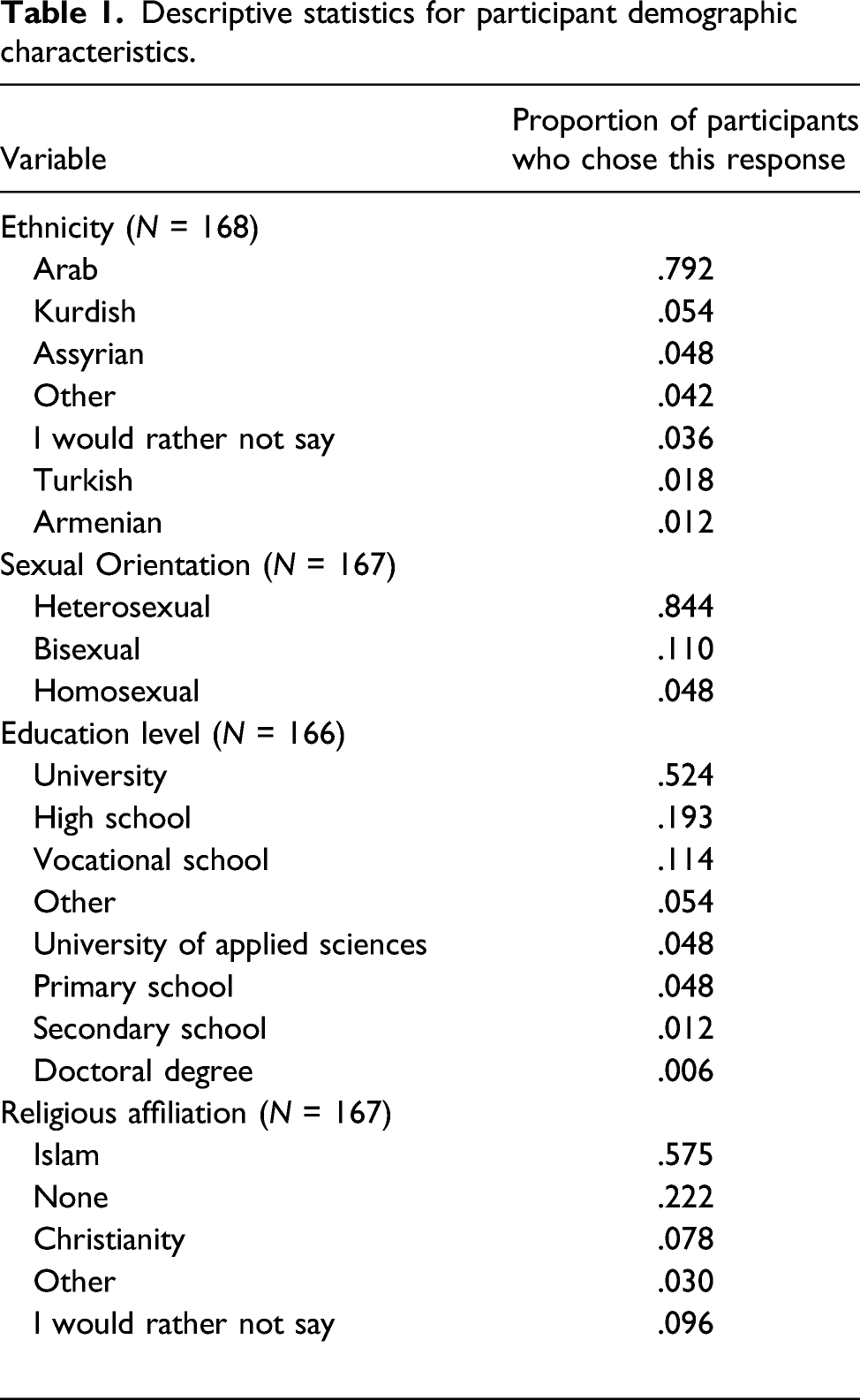
Descriptive statistics for participant demographic characteristics.
Descriptive statistics for participant refugee background.
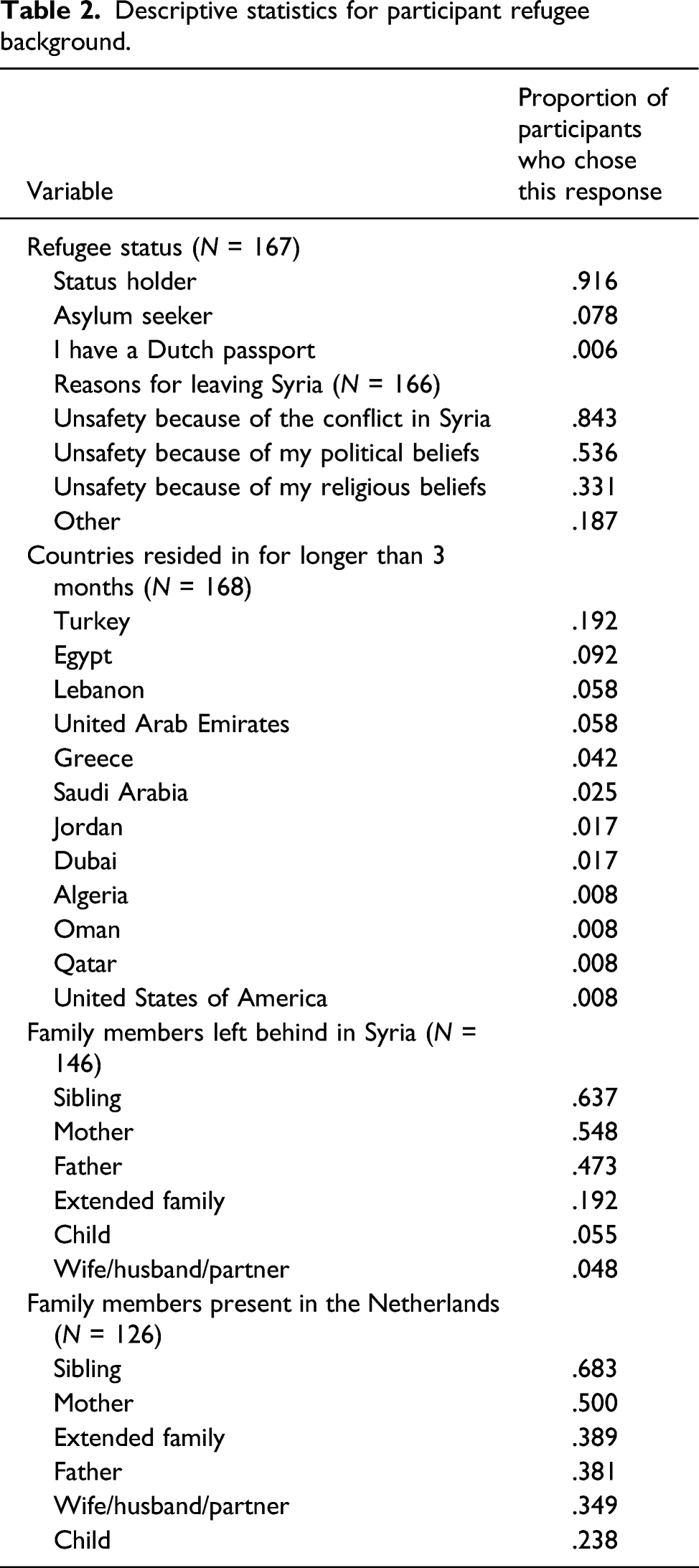
The majority of our participants identified as Arab, as heterosexual, and with the religion of Islam. Additionally, more than half of our participants held a university degree. Moreover, nearly all of our participants had refugee status in the Netherlands, and the majority chose “unsafety because of the conflict in Syria” as a primary reason for leaving Syria. Furthermore, more than half of our participants reported living in another country for more than 3 months before coming to the Netherlands, and on average, participants had been in the Netherlands for 3 years (M = 36.5 months, SD = 15.73). It is interesting to note that 50% of the Syrian population in the Netherlands is between the ages of 18- and 35-years-old, that the majority are male, and that generally high levels of education (Refugee Work Netherlands, 2020).
The retention rates for the macro-level component of the study were relatively good (see Bakker et al., 2016 for a rough comparison), with 72% (N = 121), 64% (N = 108), and 66% (N = 111) of the original sample participating at the second, third, and fourth assessments, respectively. Before the beginning of these waves, we contacted participants regardless of whether they participated in the previous wave, unless they explicitly stated that they did not wish to be contacted. Recalling that the meso- and micro-level components of the study were assessed only in the first, second, and third assessments, of those who participated in these waves, 99% (N = 166), 89% (N = 96), and 73% (N = 81) completed the meso-level component of the study; 34% (N = 57), 13% (N = 16), and 8% (N = 9) completed the micro-level component of the study. After the first assessment, a portion of participants did not participate in some assessments, but participated in others (e.g., they did not participate in the second assessment, but participated in the third and fourth assessments).
Participants were recruited primarily through the organization Refugee Start Force (www.refugeestartforce.eu), who posted advertisements for the study in Arabic and Dutch on Twitter and Facebook on our behalf. The advertisement included a short summary about the study, inclusion criteria, information about compensation, and links to the project website (www.karakterproject.nl) and an online form to express interest in participating. A small proportion of participants were recruited from organizations that serve people with refugee backgrounds (e.g., asylum seeker centers, language centers, and community groups focused on social events). Depending on the recruitment channel, members of the research team visited centers, gave presentations, handed out brochures, and attended community events to share information about the study. Members of the research team contacted potential participants via email or phone call to provide more information, ask questions to ensure people met study inclusion criteria, and arrange for data collection appointments. See Supplemental Material 2 for our flyers, brochures, and a presentation.
At the end of each assessment, participants specified their preference for compensation: (1) money through a bank transfer (disclosing bank account information and transferring funds electronically is common in the Netherlands), (2) a voucher for a national supermarket (i.e., Albert Heijn), or (3) a gift card from the Dutch tourist information office that can be used for a wide range of activities and products (i.e., Vereniging voor Vreemdelingenverkeer). The compensation amount was variable and depended on participation in the three components of the study. Participants received a fixed amount of money for completing the macro-level component, and an additional variable amount depending on how many experience sampling assessments were completed in the meso-level component. Compensation increased with each wave, totaling a maximum of 50 euros. No financial compensation was given for participation in the micro-level component to ensure that participants did not feel pressured to participate in this component; however, participation in this component was compensated with lottery tickets, which allowed the participant to enter a raffle to win a tablet at the conclusion of the study. Lottery tickets were also given to those that participated in all four assessments of the study, as well as when they completed 100% of the meso-level component. Compensation was limited to a bank transfer during the fourth assessment because of university closures and safety concerns due to COVID-19. Compensation by wave and component is shown in Figure 1. Compensation scheme for participants. Note: Macro-level = questionnaire on tablet; meso-level = surveys on smartphone; micro-level = audio recording on smartphone. The ticket denotes a lottery ticket for entry into winning one of three tablets.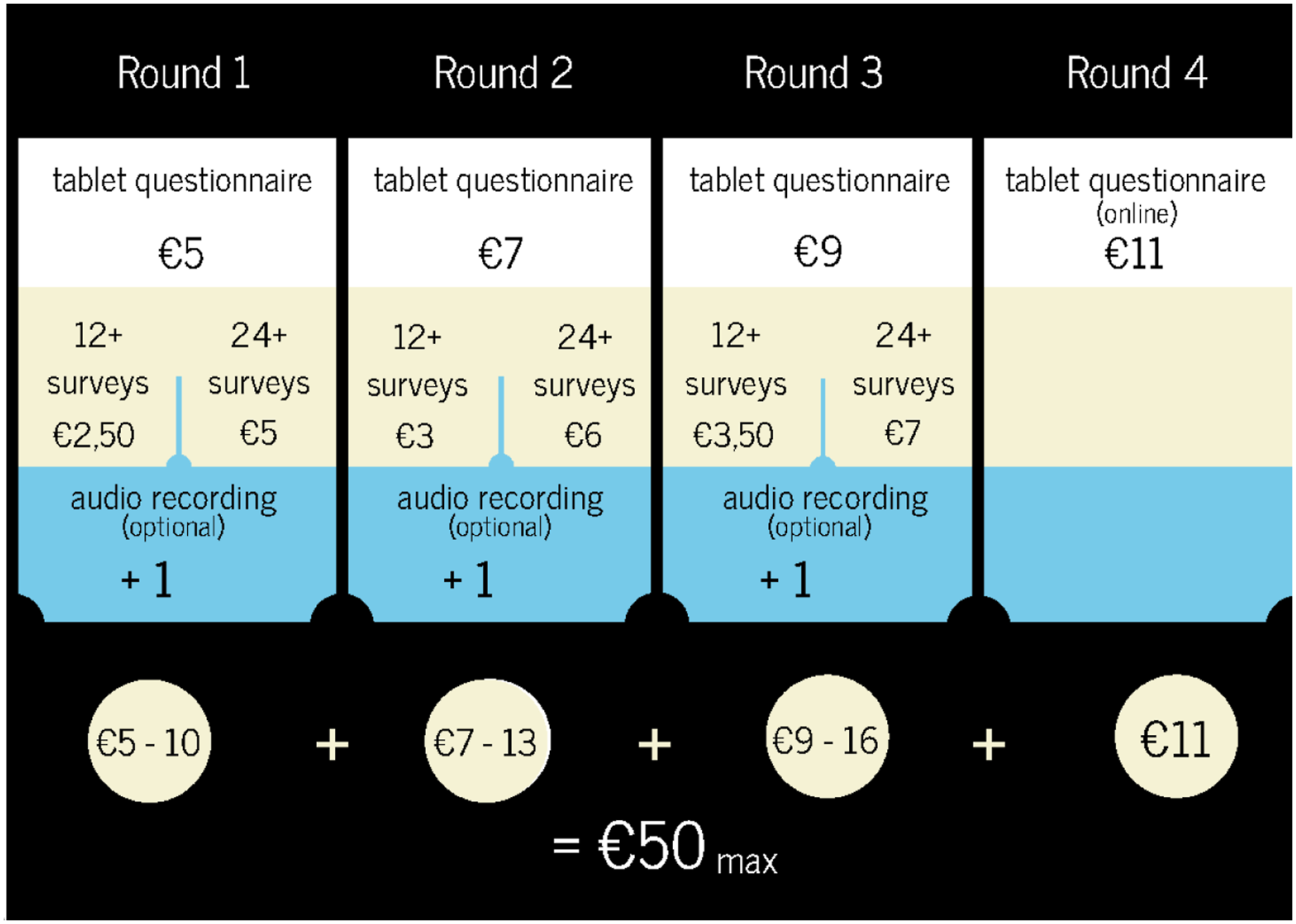
The idea of financial compensation was a topic of much discussion within our research team. It was initially difficult for the American co-investigator (J.M.C.) to grasp the typical compensation amount for study participation in the Netherlands, because it is lower relative to the compensation that would be offered in a comparable study conducted in the United States (e.g., an hour or participation is not necessarily compensated with the equivalent of an hourly wage). Additional feedback from Dutch colleagues and the METC made it clear that financial compensation, although important, could not be used to attract participants to enroll in the study. Furthermore, members of our research team who were involved in data collection found that discussing financial compensation with participants was a delicate matter. For example, during data collection appointments, members of our research team heard from participants that a primary reason for joining the study was to share their experiences so that people both within and outside of their communities could learn and gain from them. Because it was part of our protocol to explicitly provide details regarding compensation at each data collection appointment, we acknowledged this by stating that we recognized that compensation may not be the key reason for participation.
Enriching the experience of our participants
An important issue raised in response to our application to the METC was the idea that we carefully consider ways in which our study could enrich the experience of our participants. We thought of four ways to address this need. The first way was to create newsletters to share our progress to keep in touch with our participants. Each newsletter was accompanied by a small gift (i.e., a tote bag, a water bottle, a plantable newsletter that contained seeds, and a planner; see Supplemental Material 2). We also planned additional, optional activities to occur after data collection. For example, we held a celebratory event at the conclusion of the study where initial results were shared with participants. This event was moved online due to COVID-19, and it was facilitated by two of the Syrian research team members (K.A. and Z.A.S.), consisting of: (1) a brief introduction video where research team members introduced themselves and shared their “favorite thing about the Netherlands”; (2) a presentation by the co-investigators (O.M.L. and J.M.C.) regarding the goals and current status of the project, as well as ideas for future research; one participant’s own retelling of her experiences leaving Syria and coming to the Netherlands; and (3) an open discussion about the participants’ experiences with the project. During this event, our participants shared invaluable information with us. A few participants expressed interest in receiving a report of the findings that was written for them and more contact between the assessment waves. Regarding the meso-level component, other participants commented that they sometimes experienced distress reporting on their emotions and would have appreciated learning more about emotional coping skills. In contrast, one participant said that this component was seen as a time to connect with themselves during otherwise busy days. Additionally, some participants expressed gratitude for allowing them to share their stories with us, noting that they gained insights about themselves in doing so. With regards to future research directions, one participant suggested that they would have liked to be asked more about their social networks back in Syria.
An additional activity we organized was a seminar series on different topics in psychology, where participants received a certificate for attending. Similar to the end-of-study event, the seminar series occurred online due to COVID-19. We have also coordinated an online book that highlights the personal stories of our participants via poetry, visual, and other artistic works to share with the wider Dutch and international communities.
Research team members
In total, there were 17 team members (5 Dutch, 3 Syrian, 1 German, 3 Greek, 1 Indian, 1 Irish, 1 Palestinian, 1 Serbian, and 1 Turkish) living, studying, and/or working in the Netherlands who were involved in material preparation, participant recruitment, data collection, and data management. At the beginning of the project, the team members educational background varied. Some were either pursuing or held a bachelor degree, some were pursuing a master’s degree, and the person with the highest educational level was pursuing a doctoral degree. One team member identified as male, with all others identifying as female, and team members ranged in age from 23- to 36-years-old. Team members who participated in data collection were required to complete an online training course focused on how to interact appropriately with people who have experienced trauma (i.e., Psychological First Aid Online from the National Child Traumatic Stress Network [https://www.nctsn.org/resources/psychological-first-aid-pfa-online]). Additionally, our Syrian team members led the data collection team in cultural sensitivity training, and in related discussions as the project progressed.
Our research team also consisted of four consultants (3 Dutch and 1 American; all female identifying) from different career stages who were working at universities in the Netherlands, Australia, and Canada. The consultants provided expertise in cultural sensitivity, research design, and the logistics behind carrying out Karakter. There were two co-investigators (American and Dutch; female) who were both at the early career stage (i.e., they held assistant professorships at their respective universities) and worked in the Netherlands at the beginning of the project.
Cultural advisory board
In order to ensure cultural sensitivity of research and recruitment materials, we organized a Cultural Advisory Board (CAB). This board included six people (one male, five female; with Syrian, Palestinian, Egyptian, and German heritage; ranging in age from 23- to 42-years-old) who held expertise in psychology and could provide advice drawing on their lived experience to enhance the cultural sensitivity of our study. CAB members were recruited from our research team’s networks. CAB members gave feedback on the questionnaires used in the study, recruitment materials, and the study website. We used forms to collect feedback regarding overall experience, language use, and cultural sensitivity.
Improvements to our materials were made with regard to the translation of questionnaires (e.g., CAB members suggested translations for items that did not have a clear Arabic equivalent and these were discussed with the translation team) and for potentially sensitive topics, such as religion, ethnicity, and sexual orientation. For example, CAB members recommended that we use a more indirect measure of sexual orientation (i.e., using the item stem, “I am interested in…” with the response categories, “men,” “women,” “both,” and “other”).
In the case that CAB members did not agree on the sensitivity of a topic, the opinion of the two Syrian board members was weighted more heavily. For instance, one CAB member remarked that the item, “erotic,” which is from a survey assessing participants’ emotional experience, was inappropriate. However, both Syrian CAB members thought the item would not be offensive to Syrian young adults and could be included as long as participants could choose to not answer the item. Therefore, we adopted the approach the two Syrian CAB members recommended.
Procedure
Appointments were planned so that the interval between two waves was around 4 months from the previous appointment. To accommodate the schedules of the participants and research team members, we planned for a margin of 2 weeks before 4 months had passed, to 3 weeks after 4 months had passed. In some cases, scheduling within this time window was not possible, resulting in participation outside of this time window.
Waves 1 to 3 (February 2019 to February 2020). Appointments were typically made with one participant. On some occasions, appointments were made with small groups of participants ranging from two to 10 people; in this case, these appointments were made only if participants indicated a preference for this arrangement.
Members of the research team met participants in a location chosen by the participant, which was usually at the participant’s home or in a public location such as a library, community center, or café. We used a “buddy system” during appointments where each team member was assigned another research team member who they would message once before, during, and after the appointment. This system allowed for our team to be in contact with each other in the case of questions about study materials or protocol, and to ensure that any issues regarding the well-being of either the participant or team member was addressed.
In the first assessment, two members of the research team were always present, and at least one researcher was from Syria; participants were asked if they had a preference for the language in which the data collection appointment would be conducted for subsequent assessments, and this was indirectly related to researcher nationality. For example, there were a few instances in which participants preferred meeting a researcher who was not Syrian, and one of our Syrian research team members thought that this may be due to participants being hesitant about being negatively evaluated by someone from their cultural group. After the first assessment, appointments were typically carried out by one researcher.
During each appointment, information about the background of the research, the research procedure, privacy, and compensation was given to the participant in Arabic, following a standardized protocol. The participant was then given an opportunity to have any questions answered. The participant then signed a hard copy of an informed consent form, and disclosed their contact information on a separate form (in later assessments, they were only asked to provide this information if their contact information had changed). The researcher then prepared a Samsung Galaxy tablet or a laptop for participation in the macro-level assessment by opening a Qualtrics survey on the web browser and entering a participant ID number in the survey, and then handed it over to the participant. The researcher remained in the room to be available to answer questions, but was seated far enough away from the participant to ensure the participant’s privacy while completing the questionnaire.
After the participant completed the macro-level portion of the study, the researcher asked the participant about their experience with the questionnaire, answering any questions before describing the other parts of the study. Then, if the participant expressed interest in participating in additional study components, the researcher demonstrated and enrolled the participant in the experience sampling study using the Ethica Data application and/or the naturalistic audio recording component of the study using EAR on Android application. If the participant did not have a smartphone and/or wished to participate in the naturalistic auditory recording component of the study, they were provided a Wiko Sunny smartphone. The researcher then handed the participant a self-addressed, stamped envelope for returning the smartphone after participating in the assessment; during the third assessment, this method of obtaining the smartphone was changed to an in-person pick up to comply with updated privacy regulations. At the conclusion of each in-person assessment, a card with our contact information and other various psychological resources was provided. Within a day of the appointment, the researcher followed up by sending a text/WhatsApp message to the participant to ask how they were doing and to provide additional resources if appropriate. For example, we would remind them of the psychological resources on the card. We also compiled a list of organizations that could provide support with educational and professional development, which we would send to the participant if they had expressed interest in this. If the participant was enrolled in the experience sampling study and/or the naturalistic audio recording, further follow-ups were made to address participant questions, technical difficulties, and any other issues regarding participation.
Wave 4 (February 2020 to July 2020). The fourth assessment was administered entirely online. Participants were first contacted by a researcher at their earliest eligibility by emailing them that a specific research team member would be available to support them during their participation. The research team member’s contact information, availability for a phone call or text/WhatsApp message, and a personalized link to a Qualtrics survey were provided. In the case that the participant did not respond to the survey, the researcher adhered to a protocol to follow up with the participant through text/WhatsApp and a phone call across the time window. Informed consent was obtained electronically through a digital signature. Participants were also instructed to pause the survey if they had any questions, and to contact the research team member before returning to the survey. As noted earlier, COVID-19 closures began in mid-March, coinciding with Wave 4 participation. We relaxed the time window for this assessment because we anticipated that COVID-19, combined with this assessment being online, would create difficulties for our participants. Specifically, the time window for this assessment was expanded to 5 weeks. Additionally, our personnel were set to complete their work on the project by July 1, 2020. Therefore, the time window for a small number of participants (n = 10) was moved forward by 2 weeks to ensure that there was enough time for them (e.g., 2 to 3 weeks) to participate while we had available personnel.
Changes in the Research Process
The final study design, inclusion criteria, and procedure described above were the result of balancing issues regarding: (1) feasibility (e.g., available participants, budget, and available personnel) and (2) the intention to collect information from participants that we thought might be more useful than we had originally planned (e.g., including more open-ended questions as the study progressed).
One of the most pronounced changes made was in the recruitment channels we used, which in turn, led to changing inclusion criteria, sample size expectations, data collection procedures, and an increase in our personnel needs. Specifically, we had originally planned to recruit from organizations that serve people with refugee backgrounds (i.e., Centraal Orgaan opvang asielzoekers [Central Organization for Asylum Seekers; www.coa.nl/en], VluchtelingenWerk Nederland [Dutch Council for people with refugee backgrounds; www.vluchtelingenwerk.nl/], Open Meals for Refugees [http://www.diversityhouse.nl/events/open-meal-with-refugees/], and language centers), expecting that data collection with groups of people (∼10–20 people at each time) was feasible.
Yet, once our recruitment efforts began, we immediately noticed that the number of people with Syrian heritage at these organizations was relatively low, because the influx of people from Syria into the Netherlands was already past its peak at this point. Additionally, many of the people that met our initial inclusion criteria (i.e., that they have been in the Netherlands between 6 months to 24 months) and who lived in centers that served people with refugee backgrounds were hesitant to participate, presumably because of the stress and unpredictability that accompanied living in these centers.
We increased the upper-bound of our inclusion criteria to 60 months, and looked to social media as one of our recruitment channels. Because of this decision, we were then faced with changing our data collection procedures from data collection in a group context to individual data collection appointments, substantially increasing our need for personnel. See Table 1 on pp. 15–20 of the Supplemental Material 1 for a table that includes details on the changes that were considered and implemented during the study and the reasoning behind them.
Measures
Translation of Materials
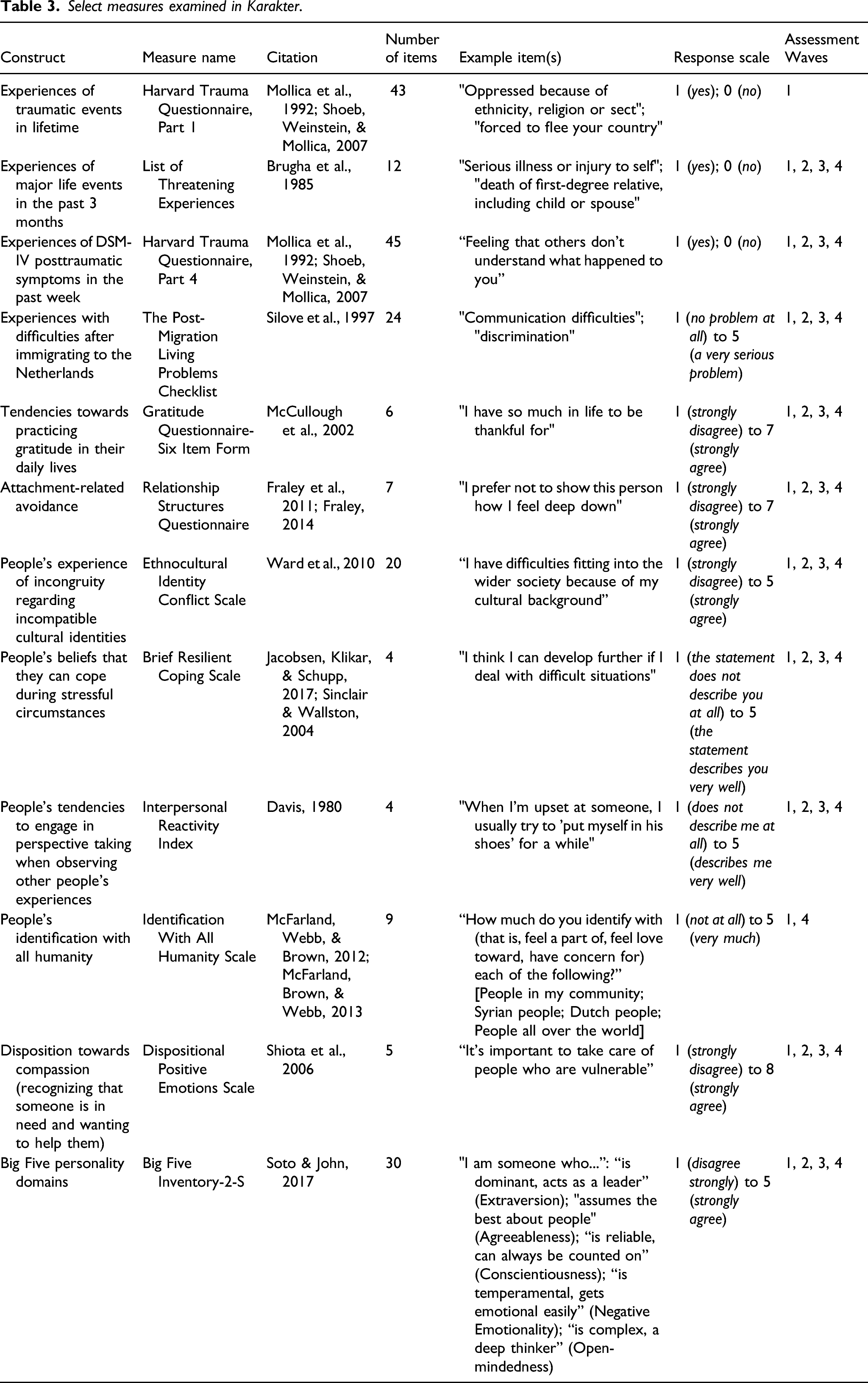
All questionnaires used in this study, with the exception of our open-ended questions, were originally constructed for use in English-speaking, Western samples of people. We were able to access Arabic versions of the Big Five Inventory-2-S 1 (Soto & John, 2017) and the Harvard Trauma Questionnaire (Mollica et al., 1992; Shoeb et al., 2007); for all other measures, we implemented a back-translation procedure with the goal of having Arabic versions of the questionnaires that were appropriate for the people in our sample.
First, the questionnaires were distributed to a team of six people who were fluent in both Arabic and English. Each English questionnaire was translated into Arabic. Then, the Arabic version of each questionnaire was translated into English by another person without viewing the original English items. Next, the original items, their Arabic translations, and the English back-translations were collated into one file. This file was shared with two additional bilingual Syrian people who did not participate in the translation or back-translation. Each person independently compared the original English items and back-translations. When there was a discrepancy, each person documented potential reasons for them (e.g., certain English expressions did not have an Arabic equivalent, there were phonetic similarities between words, some translations varied in level of language formality). Finally, several meetings were held in which these two people discussed the translations with each other and the co-investigators. All items were discussed individually, with the goal of selecting translations that were as close to the meaning of the original item while also attempting to have items that were plausible and comprehensible to a person who had lived in Syria before the Syrian conflict.
Demographic information. Participants were asked to provide a range of background information about themselves. We inquired about descriptives such as age, gender, ethnicity, sexual orientation, education level, religion, length of stay in the Netherlands, refugee status, reasons for leaving Syria, countries lived in besides Syria and the Netherlands, family members present in the Netherlands, and family members present in Syria.
Select measures examined in Karakter.
Structural Validity, Measurement Invariance, Reliability, and Additional Descriptives
Supplemental Material 4 includes a series of descriptive analyses that provide initial insights into our sample 2 . We describe a few of these descriptive results below, but see Laceulle et al. (2022, this issue) for a focused examination of longitudinal change in dispositional compassion.
Because the majority of the measures we used were created for use in Western samples, it is important to obtain a sense of how well our participants’ responses to the various measures we administered showed evidence of structural validity and longitudinal measurement invariance. Without this information, it is difficult to gauge the extent to which people’s scores, and subsequent changes in them can be meaningfully interpreted. To examine structural validity, or the extent to which people’s scores on a measure reflect the purported dimensionality of the construct being assessed, it is typical to conduct a confirmatory factor analysis, drawing paths from a latent variable to a set of measured items (Kline, 2016) using scoring instructions as a guide. In general, we observed that 7 of the 11 configural models we examined met at least three of our model fit benchmarks (i.e., RMSEA equal to or less than .08, CFI and TLI equal to or greater than .90, and SRMR equal to or less than .08). These results suggest that our efforts with the translation process and consultation with our CAB were moderately successful.
Longitudinal measurement invariance examines the extent to which the same construct is assessed across time (Widaman et al., 2010). Evaluation of model fit is done by comparing results to values for a variety of model fit indices, including root mean square error of approximation, comparative fit index, Tucker–Lewis index, and standardized root mean squared residual (Browne & Cudeck, 1993; Hu & Bentler, 1999); because it is sensitive to sample size, chi-square statistics are reported (Kline, 2016), but are not often used to evaluate model fit. There are debates about the evaluation of model fit (e.g., McNeish & Wolf, 2020). For instance, some researchers do not have high expectations for meeting traditional benchmarks when using personality inventories, given that measurement models in data from samples that are drawn from populations in which the measures were originally developed do not generally show adequate fit (e.g., Hopwood & Donnellan, 2010). We generally observed the majority of the models we examined showed evidence of longitudinal measurement invariance. Specifically, the model fit worsened (as indicated by a significant change in χ2) between the configural and weak models for two of the seven models that met our model fit criteria above. Additionally, two of the remaining five models met the criteria for strong invariance, and three met the criteria for strict invariance.
Relatedly, although a mention of internal consistency may seem relatively basic in the context of the current commentary, it is especially important to consider options for reliability estimates in a sample such as Karakter. Although coefficient alpha is the most widely used measure of reliability, it carries strict assumptions that are not often met by questionnaires for psychological constructs, and could potentially result in reduced estimates of reliability. Specifically, coefficient alpha may be used when responses form a unidimensional structure, and scores have identical factor loadings; coefficient omega (ω) is a more accurate estimate of reliability when such assumptions are not met (e.g., Flora, 2020). When examining ωtotal, we noted that 34 of the 42 reliability estimates showed values of at least .7; ωtotal range = .37 to .92, ωtotal mdn = .83.
Additionally, although a thorough exploration of all variables of interest in Karakter is outside of the scope of this article, we wish to make note of a few descriptive results. With regard to adversity-related variables, at the first assessment, our participants showed relatively high scores on the Harvard Trauma Questionnaire, Part 1 (M = 16.39, SD = 8.01), Harvard Trauma Questionnaire, Part 4 (M = 2, SD = .57), and the Post-Migration Living Problems Checklist (M = 10.20, SD = 5.65). At the same time, our participants also showed extremely high scores on the Compassion subscale of the Dispositional Positive Emotions Scale (M = 7.07, SD = .86), and moderately high scores on the Gratitude Questionnaire—Six Item Form (M = 5.08, SD = .89). On the one hand, these descriptive results indicate that participants had experienced extreme hardships in their lifetime, moderate levels of post-traumatic stress, and great difficulties with the immigration process in the Netherlands. On the other hand, they show that participants report tendencies towards positive emotions. Taken together, these results indicate that for the participants in our sample, experiences of adversity and positive emotions were not mutually exclusive.
Challenges of studying positive personality change in Karakter
Conceptual Challenges
Although a longitudinal study improves upon past methods for studying the positive effects of facing adversity, it alone may not be sufficient for examining positive personality change, because a strict empirical test necessitates at least a baseline assessment of the construct of interest. Therefore, depending on which aspect of adversity one is interested in, studies like Karakter are limited, even when acknowledging the difficulty of obtaining pre- and peri-flight assessments—it would require having the prescience and/or the resources to reach people who were being forced to leave Syria before migration and during the migration process. Still, we attempted to get a sense of pre- and peri-flight adversity in two, albeit imperfect ways: (1) by obtaining participant reports of lifetime traumatic experiences (Mollica et al., 1992; Shoeb et al., 2007), and (2) by collecting open-ended narratives focused on the journey between leaving Syria and arriving in the Netherlands from participants. One benefit to such narratives is that participants can share their own evaluations of the events that occurred during their journey, in contrast to the researchers assuming that participants are affected in the same way, something that cannot be gleaned from checklist assessments of lifetime trauma.
When considering post-flight adversity, the limitations of studies like Karakter may be relatively smaller, because a baseline assessment could be potentially captured in the research, and the experience of adversity itself can be assessed longitudinally. Specifically, in Karakter, we examined post-flight adversity via reports of recent traumatic experiences (Brugha et al., 1985), recent post-traumatic stress symptoms (Mollica et al., 1992; Shoeb et al., 2007), and current post-migration living difficulties (Silove et al., 1997). We also assessed ethnocultural identity conflict (Ward et al., 2010). As more people with refugee backgrounds resettle in countries that are culturally distant from their home countries, a focus on post-flight adversity may be even more important as stakeholders and communities focus on issues of integration and well-being of newcomers. Furthermore, in assessing traumatic experiences and constructs like post-migration living difficulties and ethnocultural identity conflict, it is possible to get a sense of whether trauma before migration, acculturation processes, or a combination of the two are associated with any growth that is observed.
Methodological challenges
Although we used multiple methods and conducted our study over four measurement occasions, the entire study spanned only 13 months. Like other longitudinal studies before it, Karakter was constrained by factors such as funding and personnel needs, and it is likely that this is one reason why the issue of timing regarding personality change (e.g., at what time interval should expect personality change to occur?) has been relatively neglected (e.g., de Moor et al., 2021; Luhmann et al., 2014). Ideally, we would have followed our participants for a longer period of time, as it would offer more information with regards to people’s trajectories.
With regard to study implementation, in addition to being one of the most major changes implemented in our study, our primary difficulty was with recruitment. One of the greatest challenges arising from our issues with recruitment was the increase in personnel needs, specifically that we had planned to collect data from people in large groups, but switched to collecting data primarily through one-on-one appointments. Another consequence that followed from our recruitment difficulties was that it took about 7 months to collect data for the first measurement occasion, and this extended the study timeline considerably.
Additionally, although we sought to assess reasonable coverage of our psychological constructs of interest with questionnaires that have shown evidence of producing valid scores in Western cultural contexts, and despite our best efforts during the translation process, it became clear that some items were “lost in translation” for some of our participants, and that some items were lacking. For example, our team members often raised the issue that our participants did not understand the item, “I often look for patterns in the objects around me” (an item from the Dispositional Positive Emotions Scale [Shiota et al., 2006] that was meant to assess dispositional awe). Another example is that one of our participants mentioned the divorce of her parents, and we realized that events like this were not covered by our questionnaires. It is likely that in our quest to use what we thought were high quality instruments that already existed, we missed important information about the people in our sample. One solution for future research efforts is to use a cognitive interviewing technique (e.g., Willis, 2015) when piloting materials. In these interviews, participants share their thoughts with a research team member as they complete a questionnaire. The research team member guides a conversation that probes participants to share their opinions about comprehension and can lend insights into the appropriateness of each item’s applicability within the specific cultural context.
Communication challenges
Communicating with participants
With regard to data collection specifically, communication with participants via text and phone call, and in person was sometimes challenging, due to language barriers combined with the fact that we had a small number of Syrian team members. In addition to language, cultural sensitivity was a critical aspect of our data collection efforts, and it is likely that there were times where we did not meet expectations. An issue that a Syrian team member (K.A.) brought up was the asymmetry between the non-Syrian team members and participants with respect to shared experiences. “While Syrian researchers were naturally well-aware of the difficult reality of refugees in the Netherlands, participants had the expectation this [was] the case also for non-refugee researchers.”
Furthermore, our team members who were specifically involved in data collection noted that it was sometimes challenging to gauge the extent to which their attempts at being professional and respectful toward participants were received as such by the participants and their families. Some participants expressed the wish to further connect with research team members by asking for their phone numbers or social media contact information. Others would ask for help in completing administrative forms or translating letters. A Syrian team member (K.A.) noted the following: “We’ve heard from some participants that meeting new people was a big factor in their decision to join our study in the first place. In some cases meeting the researcher was the only social encounter our participants experience during the visitation week. This reinforced a sense of responsibility [for] the research team that made drawing lines even harder. [Another] point is the difference in the culture of hosting guests. When interviews took place at someone’s [home], it was hard for researchers to draw the line, but I also believe it was a main challenge for participants to do so as well.”
Another Syrian team member (Z.A.S.) noted that it was important to be considerate of the connections that the participants experienced with members of the research team: “When the participant ask [ed] for a specific person of [the] data collection team and that was [not] possible...we explained to the participant that the team member [was] really appreciative [that they were] asking about them...but [they were] very busy with other appointments and unfortunately wouldn’t have time to meet with [them].”
A non-Syrian team member (L.C.) also noted the following: “Since each data collection appointment bore the potential to get a quite intimate glimpse into the lives of our participants, it was at times inevitable to realize their personal struggles, too. I then found it difficult to juggle my societal duties and responsibility towards the well-being of our participants with being appropriately distanced and maintaining a professional attitude (even though I am aware that these are not necessarily mutually exclusive).”
A bicultural team member (H.R.) mentioned that sometimes she received questions with regard to her identity: “Sometimes participants asked what my values were in relation to religion or how I integrated Dutch values with my cultural heritage values. Some of them explained that they cannot deal properly with the directness of Dutch people and asked [for] advice.”
Additionally, our use of experience sampling methodology with our participants was an additional challenge, such that there were instances in which our research team members observed that some participants were reluctant to contribute to such intensive data collection because of the burden of answering so many daily questionnaires. This is not an uncommon concern in short-term intensive longitudinal studies, but it may be especially important to consider the burden placed on participants when working with underrecruited samples of people. Relatedly, we went into the project expecting that participation in the EAR was going to be low because of concerns regarding the participant’s privacy; we later heard from our team members that participants expressed more concern about the privacy of the people they interacted with at home and at work in their daily lives rather than for themselves. Additionally, some participants expressed concerns that these recordings might end up in the hands of the Syrian government.
Communication within the team
Despite the enthusiasm and good intentions of our research team members, the diversity of cultural backgrounds, experiences, and personalities in our group sometimes resulted in conflict and experiences of negative emotions. From the American co-investigator’s perspective, one difficulty was not being fully cognizant of the stress on the research team that was brought on by the many changes implemented throughout the project, because of her experience that this uncertainty characterizes the majority of research projects.
One observation that a Syrian team member (K.A.) brought up was about the structure of the team: “Difficulties I’ve faced personally were mainly balancing two work cultures at the same time; On one hand, the deeply rooted hierarchy that surfaced when interacting with team members who shared my country of origin, and on the other hand, the “flat” team dynamic where contributions are made equally and the only perceived differences were classified as to the nature of the task on hand.”
Additionally, one difficulty was mentioned by a Dutch researcher (L.M.), which resonated for several other team members: “I found it a challenge to continuously recognize and challenge my own ideas and prejudices. I feel like as a researcher it’s easy to tell yourself you’re objective, but we all have internalized prejudices about other groups whether we want it or not, right? And I think that as a researcher working with groups that you’re not a part of yourself, you should continuously be doing this work. But I didn't always do a good job with that.”
These issues and others resulted in difficult conversations that impacted us professionally and personally, but that we ultimately think have made Karakter a better project.
Opportunities in studying positive personality change in Karakter
Despite the many challenges and limitations of Karakter, this project offers the opportunity to gain valuable insights into the lives and positive personality development for our sample of Syrian origin young adults who seek or have refugee status in the Netherlands. Importantly, we were able to shine a light on positive aspects of the people in our sample, contributing to the growing body of literature focused on positive outcomes for people with refugee backgrounds (e.g., Sleijpen et al., 2016).
Furthermore, due to its longitudinal nature, our project provides data that are better equipped to examine the extent that people can experience positive personality change following experiences of extreme hardship. Relatedly, including various measures of adversity can help us explore the link between adversity and positive personality change in different ways (i.e., lifetime adversity, major life events in the past 3 months, and experiences with difficulties after immigrating to the Netherlands). Other methodological opportunities included the use of mixed methodologies that allow us to capture our constructs of interest from different perspectives and changes in them at multiple levels of analyses (i.e., personality questionnaires, experience sampling methodology studies, and naturalistic audio recordings).
The current research also provides a unique opportunity to personally connect with young adults of Syrian origin in the Netherlands in ways that may not be as commonplace within personality psychology. As a result of the in-person data collection appointments, we had the opportunity to see, listen to, and speak with our participants; it was common for our participants to share food and drink during these appointments. One remarkable instance is when one of our Syrian team members showed up to a data collection appointment and was reunited with a friend that she had not seen since leaving Syria. Moreover, although we had to pivot to holding our end-of-study event and seminar series online due to COVID-19, we were still able to convene with our participants and interact with them.
In addition, we also gained insights about the validity of our research design and instruments when participants would ask for clarification regarding some questions and procedures, raising the possibility that our quantitative measures may function differently in our sample. It was through the in-person data collection appointments that we also learned what our participants found important about our study. For example, in earlier waves, our research team members pointed out that the participants wanted more opportunities to talk about their present and their future, which led to the addition of an open-ended question in later waves. As a result of our participants’ feedback during our data collection, we were able to calibrate our study towards their wishes. Furthermore, our end-of-study event, seminar series, and electronic book allowed us to further connect with our participants as people, which we think will allow for greater likelihood of future research projects with people with similar backgrounds, help us calibrate our interpretations of the results, and ultimately give any practical implications of our findings a better chance of being implemented.
Furthermore, one effect of conducting Karakter that we did not expect was that it allowed for other young people of Syrian origin and those with heritage from neighboring countries to contribute to the research process and develop an interest in becoming researchers themselves. As we described earlier, we collected open-ended narratives from our participants. Because the narratives were in Arabic, the co-investigators thought it was especially important that the research assistants be fluent in Arabic, and either have Syrian heritage or be familiar with Syrian culture in order to code and rate narratives for themes such as self-event connections and emotionality, among others. The American co-investigator assembled the research team (in Canada, as she had relocated there) for this specific aspect of the data analysis. She was delighted to find that members of the research team felt that they were engaging in meaningful work by seeing aspects of themselves and their culture(s) reflected in the stories of our participants, in combination with learning about psychological research methods. Team members expressed that relating to research in this way was a new experience for them, and since then, some have developed an interest in becoming researchers themselves, and have already taken steps towards proposing research that they feel should be done in their communities. We have assembled a new team of coders to transcribe and code the EAR data, and hope that this team is similarly inspired by the research.
Suggestions for future research
Our experiences working on Karakter have yielded initial realizations and some future directions that we think will be useful to personality psychologists who wish to examine positive personality development following adversity, especially in samples of people who are underrepresented in the current literature. Throughout this commentary, we have offered our opinions on what we thought went especially well in conducting Karakter. Below, we offer broader recommendations for future research. However, it is important to note that it is likely that we will have more insights into future directions as we delve deeper into the data.
We believe it is imperative that researchers take a multidimensional perspective with regard to the people they wish to learn more about. That is, although we think that acknowledging and obtaining a better understanding of hardships is important, recognizing and also asking people about other aspects of their livelihood and experiences should also be a critical aspect of the research. This is especially important in research focused on people who have refugee backgrounds (Patterson & Leurs, 2019), as “focusing on growth rather than trauma is crucial in shifting portrayal of victimized refugees and instead encourages policies tailored towards giving [those with] refugee [backgrounds] higher autonomy” (Steimel, 2010). Our research attempted to pull from the integrative approach (García Coll et al., 1996; Motti-Stefanidi and S Masten, 2017; Suárez-Orozco et al., 2018), positive psychology (Csikszentmihalyi, 2000); Cobb et al., 2019), developmental psychopathology (Sroufe, 1990), and narrative approaches (Labov & Waletzky, 1997; McAdams, 2001) to make steps towards this goal.
One related recommendation we have for future research is to include people who are members of the groups we want to know more about in the research process, including in the design of the study, preparation of materials, data collection, interpretation of the results, and in the communication of findings. In addition to the CAB, we were fortunate to have Syrian team members who communicated openly with the rest of the research team and with our participants. Without their expertise and involvement, we would not have adjusted some materials to be more culturally sensitive, pivoted in our research design to include more qualitative components, and connected with our participants to the extent that we did, to name a few (Ellis et al., 2007). As we have built our relationships over the duration of the study, we have had conversations with members of our research team that have allowed us to explicitly consider how each of our identities affect the research process (e.g., Who conducts the research? Who is participating in the research?). We recommend that personality researchers who are interested in pursuing research like ours build their research teams with the recognition that personal biases should be acknowledged and openly discussed from the very beginning.
With regards to the more technical aspects of the research, we recommend that personality psychologists and the funders that support their research endeavors have a broader time perspective and plan for high-quality and longer studies to better understand long-term positive personality change. Although we put in our best efforts to conduct a good study, we were constrained by the timeline that was put forth by the funding agency. As our project has evolved, we have realized that with respect for the topics and people involved, substantial time and energy is required to build relationships and mutual understanding in order to do meaningful research, and to allow for the findings have a reach beyond scholarly outlets.
Relatedly, one thing we wish we would have done if we were able to do the study again is to spend more unstructured time with people from the community and ask them what they specifically thought was important for researchers to pursue with regards to research questions prior to pursuing our research. In doing so, this would increase the possibility that our research could have a greater practical impact and also, allow participants to take more active roles in the research process. We also recommend that personality researchers take a mixed methods approach in future research in other samples of people with recent migration backgrounds, such that there is balance between qualitative and quantitative methodologies (Creswell, 2014). By examining life experiences, identity (Sussman, 2000), and personality in other samples of people with recent migration backgrounds, this could shed light on the cultural specificity and validity of the constructs (e.g., culturally specific conceptualization and assessment of mental health difficulties; Kohrt et al., 2014) that are purported to be universal in WEIRD people.
Furthermore, careful consideration of causality should be taken regarding Karakter and studies like it. Although the traditional approach to post-traumatic growth (i.e., asking individuals to retrospectively report on the extent they experienced growth as a result of facing adversity) has been questioned (Frazier et al., 2009; Jayawickreme & Blackie, 2014), the optimal solution is to obtain a baseline assessment of positive personality traits. It is not possible to know if changes in personality are a direct consequence of the adversity our participants experienced in Syria or during their migration to the Netherlands. Therefore, the lack of a baseline assessment requires careful interpretation of any changes in positive personality as being the result of the adverse events.
In Karakter, we did not have the resources to follow our participants over a prolonged period of time. Our recommendation for those who have the means would be to plan longer term research beginning shortly after arriving in the Netherlands and continuing over several years. Based on our experience with recruitment, we would recommend that initial assessments be very brief, and be focused on collecting demographic information and data on immediate needs (vs. an extended battery of questionnaires focused on psychological constructs). Then, as people gained more stability in their living circumstances, subsequent assessments could be expanded.
Moreover, we encourage researchers to take an open science perspective to such work. This includes being clear about working definitions, frameworks, and measures used, but also describing constraints on generality (Simons et al., 2017). We believe that there is utility in conducting research in underrepresented samples, even when samples are small, especially when researchers are open about the characteristics of their recruitment procedure, study design, and quality of materials. We also encourage researchers to document and share the changes in their study; we hope that our attempt to do so (in Supplemental Materials 1) can serve as an example for future longitudinal studies.
Conclusion
The narrative that people can grow through adversity is pervasive, and relatively recently, personality psychology approaches have been applied to examining post-traumatic growth as positive personality change over time. In Karakter, we examined experiences of adversity, emotions, and positive personality change in a sample of Syrian origin young adults who recently resettled in the Netherlands over 13 months, contributing research on a sample of people that is traditionally seen as hard-to-reach in personality psychology. In this commentary, we shared our experiences with the research process, including how we used open science practices, and how our study changed as it progressed. We described challenges and opportunities we encountered in the research. We hope that in doing so, researchers who are interested in conducting similar studies in future research can benefit from our experiences.
Supplemental Material
sj-pdf-1-erp-10.1177_08902070221081319 – Supplemental Material for Lessons learned from conducting a study of emotions and positive personality change in Syrian origin young adults who have recently resettled in the Netherlands
Supplemental Material, sj-pdf-1-erp-10.1177_08902070221081319 for Lessons learned from conducting a study of emotions and positive personality change in Syrian origin young adults who have recently resettled in the Netherlands by Joanne M. Chung, Laurien Meijer, Renée Zonneveld, Zeina Al Sawaf, Kinan Alajak, Neha Moopen, Haza Rahim, Leyla Çiftçi, Eva Alisic, Jennifer E. Stellar, Trudy Mooren, Marieke Sleijpen, Tara Tešanovic, Huda Al Baker, Rima Dali, Marilena Papadantonaki, Natalia Papakosta, Michelle Antink, Sofia Charisopoulou, Mariëlle Frens, Sarah O’Connor, Duygu Taşfiliz and Odilia M. Laceulle in European Journal of Personality
Supplemental Material
sj-pdf-2-erp-10.1177_08902070221081319 – Supplemental Material for Lessons learned from conducting a study of emotions and positive personality change in Syrian origin young adults who have recently resettled in the Netherlands
Supplemental Material, sj-pdf-2-erp-10.1177_08902070221081319 for Lessons learned from conducting a study of emotions and positive personality change in Syrian origin young adults who have recently resettled in the Netherlands by Joanne M. Chung, Laurien Meijer, Renée Zonneveld, Zeina Al Sawaf, Kinan Alajak, Neha Moopen, Haza Rahim, Leyla Çiftçi, Eva Alisic, Jennifer E. Stellar, Trudy Mooren, Marieke Sleijpen, Tara Tešanovic, Huda Al Baker, Rima Dali, Marilena Papadantonaki, Natalia Papakosta, Michelle Antink, Sofia Charisopoulou, Mariëlle Frens, Sarah O’Connor, Duygu Taşfiliz and Odilia M. Laceulle in European Journal of Personality
Footnotes
Acknowledgments
We are especially grateful to all of the people who participated in the Karakter project. We thank Eranda Jayawickreme, Frank Infurna, the members of the John Templeton Foundation’s Pathways to Character Initiative (Laura Blackie, Elaine Cheung, William Chopik, Marie Forgeard, Igor Grossmann, Aaron Heller, Rich Lucas, Maike Luhmann, Gloria Luong, Kate McLean, Patricia Moreno, and Rebecca White), and Rich Bollinger for their support throughout this project. We also thank the narratives coding and rating team (Mariam Fishere, Tilmann Habermas, Shahed Al Asmi, Karen El-Kadri, Alisar Abdel Rahman, Tarek Nouneh, Sarah Hamzah, Shams Al-Badri, and Celine El-Hert), and the EAR transcription and coding team (Shams Al-Badri, Motasem Almesri, Dima Al Habbal, Alma Natafji, Layan Nablsi, May Khaled, and Shahed Ebesh).
Author Contributions
J.M.C.: Conceptualization, data curation, formal analysis, funding acquisition, investigation, methodology, project administration, resources, software, supervision, writing—original draft, writing—review and editing. L.M.: Investigation, methodology, project administration, resources, supervision, writing—original draft, writing—review and editing. R.Z.: Data curation, formal analysis, investigation, methodology, project administration, resources, software, supervision, writing—original draft, writing—review and editing. Z.A.S.: Conceptualization, investigation, methodology, project administration, resources, validation, supervision, writing—review and editing. K.A.: Conceptualization, data curation, formal analysis, investigation, methodology, project administration, resources, software, validation, writing—review and editing. N.M.: Data curation, project administration, writing—original draft, writing—review and editing. H.R.: Investigation, resources, writing—review and editing. L.C.: Investigation, writing—original draft, writing—review and editing. E.A.: Conceptualization, funding acquis.ition, methodology, resources, writing—review and editing. J.E.S.: Conceptualization, funding acquisition., methodology, resources, writing—original draft, writing—review and editing. T.M.: Conceptualization, funding acquisition, me.thodology, resources, writing—review and editing M.S.: Conceptualization, funding acquisition, .methodology, resources. T.T.: Investigation, resources. H.A.B.: Investigation, validation. R.D.: Investigation, validation. M.P.: Investigation, writing—original draft, writing—review and editing. N.P.: Investigation, writing—original draft, writing—review and editing. M.A.: Investigation. S.C.: Investigation. M.F.: Investigation. S.O.: Investigation. D.T.: Resources, writing—review and editing. O.M.L.: Conceptualization, funding acquisition, investigation, methodology, project administration, resources, supervision, writing—original draft.
Declaration of conflicting interests
The author(s) declared no potential conflicts of interest with respect to the research, authorship, and/or publication of this article.
Funding
This research was supported by a grant from the John Templeton Foundation’s Pathways to Character Initiative awarded to Joanne M. Chung and Odilia M. Laceulle.

Supplemental material
Supplemental material for this article is available online.
Notes
References
Supplementary Material
Please find the following supplemental material available below.
For Open Access articles published under a Creative Commons License, all supplemental material carries the same license as the article it is associated with.
For non-Open Access articles published, all supplemental material carries a non-exclusive license, and permission requests for re-use of supplemental material or any part of supplemental material shall be sent directly to the copyright owner as specified in the copyright notice associated with the article.
