




Abstract
When establishing a career in adulthood, two major socioemotional ingredients are expected to affect people’s success: how people act (personality) and what motivates them to act this way (motivation). However, little is known about whether and how personality and motivation change together and how their possible dynamic interplay predicts success. We investigated the roles that changes in personality and expectancy beliefs played in explaining occupational success in 4121 participants assessed after high school (Mage = 22.80, SDage = 0.70; 63% female) and about 20 years later. We used latent change models and moderated structural equation modeling to investigate correlated change and latent change interactions of personality and expectancy beliefs in predicting success. Results illustrated that besides being related in a nomological net, personality and expectancy beliefs also illustrated a strong interrelatedness in change across time. We found the clearest joint change dynamics between emotional stability, conscientiousness, self-concept, and self-efficacy. Changes in personality and expectancy beliefs were furthermore associated with objective and subjective occupational success. The results call for a more integrative view on personality-motivation dynamics across time for understanding the long-term adaptive ingredients of occupational success stories in adulthood.
Interindividual differences in occupational success, the achievement of which is a major life task of adulthood, have been addressed by at least two distinct paths of research: personality psychology (e.g. Judge et al., 1999; Roberts et al., 2007) and motivation psychology (e.g. Nye et al., 2012; Parker, 1998). From these traditions, we know that, besides the well-known relevance of cognitive abilities (e.g. Schmidt & Hunter, 1998), both personality and motivation affect success at work. Despite recognizing their importance, however, it is an open question whether and how personality and motivation work together across time as a person establishes a career in young and middle adulthood. Particularly in this developmental period, not only motivation but also personality is subject to substantial change (Hoff et al., 2020; Roberts et al., 2006). Although changes in constructs and their possible dynamic interplay have rarely been considered in previous work on occupational success, knowledge on this interplay is extremely desirable. This is the case because, on the one hand, research can inform personality theory about motivational sources of personality change across young to middle adulthood (cf. Hudson & Fraley, 2015). On the other hand, it can also show how motivational changes are affected by personality characteristics. Furthermore, these findings can shed light on how the interplay of these two dynamics is related to subsequent success stories.
Therefore, the aim of the present study was to understand (a) the longitudinal interplay between personality (assessed as the Big Five, which includes emotional stability, extraversion, openness, agreeableness, conscientiousness) and motivation constructs (which can roughly be subsumed under the expectancy beliefs of intellectual self-concept, occupational self-efficacy, and occupational demotivation). Furthermore, we aimed to understand (b) the role of their dynamic interplay for both objective (income, job prestige, and leadership position) and subjective (job satisfaction and work–life balance) occupational success indicators. To address these aims, we used two assessment waves from an ongoing longitudinal data set (BIJU; Baumert et al., 1996) to study the occupational pathways of N = 4121 young adults after they finished high school until they became more settled in the labor market around the age of 40.
The interplay between personality and motivation across adulthood
For a long time, personality traits and motivation were mainly studied in separate fields because researchers focused on the singular effects and singular relevance of these constructs for explaining individual behavior and important life outcomes (e.g. Bandura, 2012; Mischel & Shoda, 1995, Roberts et al., 2007; Soto, 2019). But we would like to argue that not only are the two constructs cross-sectionally interrelated in a nomological net, but they are also interrelated across time, that is, changes in personality are connected to changes in motivation.
Importantly, when talking about personality, we refer to the Big Five because researchers have come to agree that it is necessary to have a limited number of constructs to describe interindividual differences in key characteristics in an economical way. In contrast to personality traits, many different integrative frameworks exist for motivation. In the current study, we focused on expectancy beliefs as key motivational variables for predicting occupational success.
A nomological net between personality and motivation
Several older and more recent theoretical developments include both personality and motivation as relevant constructs for defining individual characteristics (e.g. Costa & McCrae, 1995; Denissen & Penke, 2008; Fleeson & Jayawickreme, 2015; Hennecke et al., 2014; Roberts & Wood, 2006). Particularly in terms of heritability and stability, the old distinction between “core traits” and “characteristic adaptions” seems outdated as personality traits and motivation constructs appear to be more similar than different (Jansen et al., 2020; Kandler et al., 2014; Rieger et al., 2017).
Going one step further, scholars have begun to address the possible interplay of personality and motivation by suggesting that they may represent two sides of the same coin: a descriptive side and an explanatory side (Fleeson & Jayawickreme, 2015). Personality traits are the descriptive part, illustrating how interindividual differences in feeling, thinking, and behaving manifest themselves in behavior (in a broad sense). On the other side, motivation constructs are the explanatory part, clarifying why individuals show differences in the direction, endurance, and intensity of the manifestation of the descriptive trait characteristics. This notion leads to the assumption that interindividual differences in how people behave in various situations may also largely stem from why they do so. This highlights the need to consider both constructs in order to predict behavior.
Such integrative considerations in recent decades have been supported by initial empirical evidence. A wide range of motivation constructs have been cross-sectionally linked to all or to selected Big Five personality traits (Barrick et al., 2003, Judge & Ilies, 2002, Marsh et al., 2006). Of particular interest in the current paper are the associations that have been established with key expectancy beliefs such as goal-setting and self-efficacy (Judge & Ilies, 2002) as well as multidimensional self-concept (Marsh et al., 2006). Despite knowledge about the cross-sectional link between personality and motivation, the question of the ways in which changes in personality and changes in expectancy beliefs may be interrelated across adulthood remains unanswered.
Dynamic interplay: Personality and motivation across time
Building upon the theoretical notions of an interplay between personality traits and motivation constructs, research has suggested that motivation works as a driving force in personality development (Denissen & Penke, 2008; Dweck, 2017; Hennecke et al., 2014).
The framework for self-regulated personality development suggested by Hennecke et al. (2014) applies ideas of early expectancy-value theory (e.g. Atkinson, 1957) as a motivational source of personality development. Hennecke et al. (2014) suggested that self-regulated personality trait change is based on three essential motivation-related conditions: The person needs, first, an initial desire for trait changes, second, the conviction that change is possible, and third, the perseverance to maintain the trait-related behavior (i.e. to achieve real personality trait changes instead of short-term behavioral adjustments).
In this framework, the first condition emphasizes the creation of an initial desire for change. It has been argued that the successful accomplishment of developmental tasks and social roles may provide the content for this desire and thus help to fulfill the first condition in the framework (Huttemann et al., 2014). This is in line with the best-established evidence to date, which highlights the functions of social role investment and developmental task fulfillment as key sources for trait changes (for an overview, see Wagner et al., 2020). In the occupational context, the desire to become more successful, earn more money, or be a better leader could trigger trait changes toward becoming more diligent, assertive, or careful. Particularly when leaving school, this content should be very desirable as new occupational roles are adopted.
The second condition needed to believe that change is feasible depends primarily on a person’s expectancy beliefs such as self-efficacy and self-concept. Expectancy beliefs can thus be considered one explanation for why a person not only invests in a specific new role but is also able to maintain behaviors in the long term and hence to achieve personality trait change. Being confident that one can master new job demands strengthens one’s confidence in one’s own agency and helps a person maintain goal-directed behavior such as being hardworking and diligent, particularly when one is satisfied with the new role. In this study, we thus focused on expectancy beliefs such as occupational self-efficacy, intellectual self-concept, and occupational demotivation as candidates that had the potential to show a dynamic interplay with personality across adulthood.
Although the framework of self-regulated personality development has not yet been empirically tested, research over the last two decades has been able to support some of the components described above and may be able to help integrate others: Research has robustly illustrated that substantial personality trait change can be observed, particularly in the phase from early to middle adulthood, with people becoming increasingly more mature (Roberts et al., 2006; Wagner et al., 2020). In accordance with the assumed mechanisms, taking on new occupational roles and investing effort in these roles has been found to be related to lasting personality trait change (Denissen et al., 2014; Lodi-Smith & Roberts, 2007; Roberts et al., 2003). However, whether expectancy beliefs are related to trait change remains an open question.
In addition to personality development, the constructs of self-efficacy, self-concept, and demotivation might also have the potential to change in response to or in conjunction with such experiences. That is, despite the fact that motivation is often considered to be only a flexible driver of thoughts, feelings, and behaviors, theoretical notions (Hennecke et al., 2014) and initial empirical evidence (Bleidorn et al., 2010; Lüdtke et al., 2009) have emphasized that the effect might work in the opposite direction. That is, people are more likely to desire certain goals that are in line with their personality traits. Values and expectancies concerning certain goals are, therefore, most likely in line with a person’s personality traits. Accordingly, the expectation that one will achieve a certain goal might not only be in line with a person’s personality, but when personality traits change, desired goals and the expectancies to reach these goals might also change. Thus, personality change may be related to change in motivation.
In sum, in addition to cross-sectional associations, theoretical and empirical research has highlighted the possible longitudinal interplay between personality traits and expectancy beliefs across time. Subsequently, we will argue and test whether, over and above the well-established main effects, change in personality and change in expectancy beliefs as well as their dynamic interplay should be explored as predictors of occupational success.
Predicting occupational success: The roles of personality and motivation
At present, it remains unknown how a potential change dynamic between personality and expectancy beliefs translates into work success. This is important to determine because working toward this goal is one of the most critical developmental tasks of young and middle adulthood (Heckhausen, 2002; Huttemann et al., 2014). Yet, mastering a developmental task has clearly been found to be related to the activation of adaptive capacities with change in personality and motivation being very important for developmental success (Dweck, 2017). Specifically, as human beings are considered active agents of their development, people are understood to shape their own developmental course by drawing on their personal resources (Lang & Heckhausen, 2006).
In addition, it is important to think about what it actually means to master the developmental task of occupational success. In an attempt to systematize outcomes, the most common distinction made in the field is the differentiation between objective (or extrinsic) and subjective (or intrinsic) success criteria (Judge et al., 1999; Ng et al., 2005; Sutin et al., 2009). Objective criteria reflect countable units of work performance, such as income, promotion, or hierarchy level. By contrast, subjective criteria cover people’s evaluations of their own occupational attainments, usually conceptualized as job satisfaction (Judge et al., 1999).
The Big Five and occupational success
Research has determined that the most pronounced associations between the Big Five and occupational success occur in young adulthood (Bui, 2017). As one explanation, employees with less professional expertise must rely more on their typical behavior (i.e. their personality), whereas older employees benefit from role- and profession-specific knowledge, limiting the influence of general behavioral patterns. Accordingly, previous empirical research has been able to underpin substantial relations between the Big Five and both objective and subjective occupational success criteria: Longitudinally, conscientiousness was found to be a positive predictor of educational attainment, income, job prestige (Damian et al., 2019), work–family conflict (Wille et al., 2013), and job satisfaction (Wille et al., 2014). The second most consistent predictor, emotional stability, revealed positive associations with objective criteria such as income, promotion, and educational attainment (Ng et al., 2005; Rammstedt et al., 2017; Sutin et al., 2009). In terms of subjective criteria, emotional stability was positively associated with job satisfaction (Boudreau et al., 2001; Bui, 2017; Sutin et al., 2009, Wille et al., 2014) and negatively predicted work–family conflict 15 years later (Wille et al., 2013). Sutin et al. (2009) furthermore investigated the longitudinal association between income and changes in emotional stability and found that higher income was associated with increases in emotional stability across a 10-year time interval. Extraversion demonstrated associations with promotion (Ng et al., 2005) as well as with job and career satisfaction in some studies (Boudreau et al., 2001, Wille et al., 2014, but see Bui, 2017). When longitudinal approaches were applied, extraversion predicted income across periods of 10 and 11 years (Damian et al., 2015; Sutin et al., 2009).
The findings on agreeableness have differed depending on whether studies explored associations with objective or subjective success criteria: Agreeableness showed the most negative associations with objective success criteria, such as income, promotion, full-time employment, and hierarchy level (Boudreau et al., 2001; Ng et al., 2005; Rammstedt et al., 2017). However, associations with subjective criteria were mostly positive when longitudinal data were used with respect to job satisfaction (Wille et al., 2014) but negative for work–family conflict (Wille et al., 2013). For openness, findings were mixed with respect to income and job satisfaction (Bui, 2017; Ng et al., 2005; Rammstedt et al., 2017), whereas negative associations were found with work–family conflict and hierarchy level (Boudreau et al., 2001; Wille et al., 2013).
Given these robust findings on initial levels, the next step is now to treat personality as an adaptive individual resource by investigating the role of change in personality as a predictor of occupational success. Although previous studies have tended to focus on the other direction, that is, on how work experiences might influence personality change (Roberts et al., 2003; Wille & De Fruyt, 2014; Woods et al., 2020), one initial study addressed effects of personality change on occupational variables (Schwaba et al., 2019). They found that change in personality traits might also have an influence on evaluations of occupational conditions: People with increases in their openness placed more importance on their salary compared with people without increases in openness. A slightly different focus was taken by studies investigating how changes in occupational success (e.g. job satisfaction) were associated with personality trait changes (Scollon & Diener, 2006; Wille et al., 2014). They found that increases in job satisfaction were associated with increases in emotional stability, extraversion, and conscientiousness.
Motivation and occupational success
In addition to the Big Five, expectancy beliefs also explain occupational success. Occupational self-efficacy, defined as the belief that one can perform job-related demands (Rigotti et al., 2008), is assumed to play a paramount role in determining both objective and subjective occupational success (Abele & Spurk, 2009). Scholars found that occupational self-efficacy predicted a person’s salary and career success when compared with both a reference group and their own standards across a 9-year time interval (Spurk & Abele, 2014). Furthermore, occupational self-efficacy was associated with a person’s job satisfaction, commitment to work, and performance across different European countries in cross-sectional data (Rigotti et al., 2008). In addition, a first study showed that a student’s motivation in high school, which is usually examined only for its direct effect on school success, also showed associations with occupational success in middle adulthood (Spengler et al., 2018). The beliefs students had about their academic skills in school predicted their occupational prestige 50 years later.
Interestingly, although motivation constructs have often been regarded as relatively flexible and adaptive, not much research has considered change in motivation as a predictor of occupational success. Moreover, the few existing studies have mostly focused on the role of goal pursuit in determining developmental and, only occasionally, occupational success (e.g. Haase et al., 2012). So far, however, no clear link between changes in goal pursuit and occupational success has been established. With our study, we strive to fill this gap by looking for effects of changes in expectancy beliefs on both objective and subjective occupational success criteria.
Interdependency of personality and motivation in predicting occupational success
In addition to the singular effects of personality and motivation in predicting occupational success, there is initial evidence that personality and motivation also interact in predicting occupational success. These initial studies have usually focused on whether or not expectancy beliefs mediate the association between personality traits and occupational success (Barrick et al., 2003, Maggiori et al., 2016; Spurk & Abele, 2011) by treating the constructs as static instead of changeable entities. Such studies have shown that expectancy beliefs such as occupational self-efficacy (partially) mediate associations of the Big Five with both objective (salary) and subjective (job satisfaction) occupational success. Although testing for mediating effects, these first studies have pointed toward an interdependency between personality and motivation in predicting occupational success. In the context of our study, we move beyond the static illustration of the constructs by testing moderation effects between change in personality and change in expectancy beliefs.
Integrating thoughts about self-regulated personality development with the dynamic nature of human development, mastering occupational roles calls for the activation of adaptive capacities (Heckhausen, 2002; Hennecke et al., 2014; Huttemann et al., 2014). By making use of an individual’s adaptive resources, joint change dynamics in personality traits and in expectancy beliefs should predict occupational success beyond initial standings. For instance, the perception of increases in one resource (e.g. self-concept) triggers increases in another construct (such as conscientiousness) resulting in a positive chain reaction of beneficial occupational behavior. To the best of our knowledge, no study has yet applied the idea of adaptive individual resources to life tasks with the intention of predicting occupational success. Hence, we examined whether change in personality traits and change in expectancy beliefs and their interaction across time would affect occupational success above what is known from people’s initial standings on these variables.
The present study
To understand the specific roles of change in personality and change in expectancy beliefs as well as their dynamic interplay in predicting occupational success across young and middle adulthood, we had three aims in conducting the current study: First, as a starting point for our analyses, we investigated the general nomological net between the two families of constructs. On the basis of findings from previous studies (e.g. Judge & Illies, 2002; Marsh et al., 2006), we expected that all Big Five personality traits would show positive associations with intellectual self-concept (Hypothesis 1a). We furthermore expected that all personality traits but agreeableness would show positive associations with occupational self-efficacy beliefs (Hypothesis 1b). As we did not find strong evidence in the literature for associations between the Big Five and occupational demotivation, we refrained from making specific predictions about these associations.
Second, on the basis of this nomological net, we further examined the ways in which changes in personality traits and expectancy beliefs are interrelated (i.e. correlated change) across the time period from when people finish high school until they are established in the labor market in middle adulthood. On the basis of theoretical assumptions and empirical findings, we expected associations between change in personality traits and change in expectancy beliefs across time (Bleidorn et al., 2010; Hennecke et al., 2014; Lüdtke et al., 2009). Accordingly, we expected correlated change between change in all personality traits and change in all expectancy beliefs (Hypothesis 2).
Our third goal built upon the interrelatedness between personality traits and expectancy beliefs and moved toward predicting occupational success. This third goal was divided into two parts. In the first part, we studied whether or not changes in personality and changes in expectancy beliefs would be associated with interindividual differences in occupational success. Building on knowledge that focused primarily on main effects (Bui, 2017; Gelissen & de Graf, 2006; Ng et al., 2005; Sutin et al., 2009, Wille et al., 2014), we hypothesized that changes in conscientiousness and emotional stability would show positive associations with objective and subjective occupational success (Hypothesis 3a), whereas changes in agreeableness would show negative associations with objective occupational success (Hypothesis 3b). We furthermore expected positive associations with changes in extraversion and objective occupational success (Hypothesis 3c). As the evidence on openness was limited, the remaining analyses on associations between personality traits and occupational success were exploratory. Given previous findings on the role of expectancy beliefs in predicting occupational success (Rigotti et al., 2008; Spurk & Abele, 2011), we expected that changes in self-efficacy would be related to both objective and subjective occupational success criteria (Hypothesis 3d). We expected that changes in occupational demotivation would be negatively associated with subjective success (cf. Ng et al., 2005, Hypothesis 3e) and changes in intellectual self-concept would be positively associated with objective success criteria (cf. Spengler et al., 2018, Hypothesis 3f).
In the second part of our third research goal, we investigated the role that possible correlated changes between personality and expectancy beliefs might play in predicting occupational success (latent change interaction). These analyses were largely exploratory because no previous study has tested the effects of such complex change interactions on occupational outcomes. On the basis of previous studies on the interrelatedness between personality traits and expectancy beliefs (Spurk & Abele, 2011; Maggiori et al., 2016), however, we hypothesized that the interactions of changes in conscientiousness and emotional stability with changes in occupational self-efficacy would show positive associations with objective success criteria (Hypothesis 3g). On the basis of results from Maggiori et al. (2016), we expected that the interactions of changes in conscientiousness, emotional stability, and extraversion with changes in occupational self-efficacy would show positive associations with subjective success criteria (Hypothesis 3h). Finally, we expected that the interactions of changes in conscientiousness, extraversion, and agreeableness with changes in occupational demotivation would show negative associations with objective success criteria (Hypothesis 3i).
Method
Participants
The BIJU study (Educational Careers and Psychosocial Development in Adolescence and Young Adulthood; Baumert et al., 1996) is an ongoing longitudinal study that began in 1991. It follows the educational and occupational pathways of adolescents from secondary school onward in two former East and two former West German federal states. We used two waves of data from the original sample that first included the key variables in this study. We took the data from Wave 6 (2001/02) involving N = 3261 participants when the participants had started vocational training, had entered the labor market, or had begun attending a university. We subsequently refer to this time point as T1. We also took data from Wave 8 (2018/19) involving N = 2687 participants when they were assessed about 20 years later. We subsequently refer to this time point as T2. We included all participants in our sample who provided data on our study variables at least once (i.e. at either T1 or T2). This resulted in a final sample of N = 4121 participants (63% women) with an average age of M = 22.80 (SD = 0.70) at T1 and an average age of M = 39.81 (SD = 0.73) at T2. Attrition analyses between the full sample at T1 and the sample that provided data at both time points (complete longitudinal participation) showed that participants who dropped out between T1 and T2 were not statistically significantly different (all ps > .01) or substantially different (all ds < |0.07|) from continuers in terms of personality traits, intellectual self-concept, occupational self-efficacy beliefs, occupational demotivation, gender, or cognitive abilities.
Measures
Big Five personality
We used a short version of the German NEO-FFI adapted for the BIJU study, which originally contained 25 items (Borkenau & Ostendorf, 1991) that were rated on a 4-point Likert scale ranging from 1 (does not apply at all) to 4 (fully applies). In a first step, we used confirmatory factor analysis to investigate the measurement structure for each personality domain separately. All models were identified by restricting the loadings of one item to one and one item intercept to zero across time points. This resulted in measurement models with good fit for emotional stability with five items (no items were reverse coded). In each of the remaining domains, one item had to be excluded from the model in order to establish the configural factor structure. Thus, agreeableness was measured with four items, three of which were reversed coded; extraversion was measured with four items, none of which were reverse coded; conscientiousness was measured with four items of which one item was reverse coded; and finally, openness was measured with four items, including two reverse-coded items (for item wordings, see Table S19; for model fits, see the configural invariance models in Table 1). The reliabilities, which were based on the measurement-model-based reliability index ω (McDonald, 1999), were reasonable (ωEmotional stability = .79, ωAgreeableness = .72, ωExtraversion = .70, ωConscientiousness = .74, ωOpenness = .77 at T1; ωEmotional stability = .78, ωAgreeableness = .75, ωExtraversion = .71, ωConscientiousness = .73, ωOpenness = .75 at T2).
Evaluation of longitudinal measurement invariance for Big Five personality and expectancy beliefs across 20 years and two measurement points.
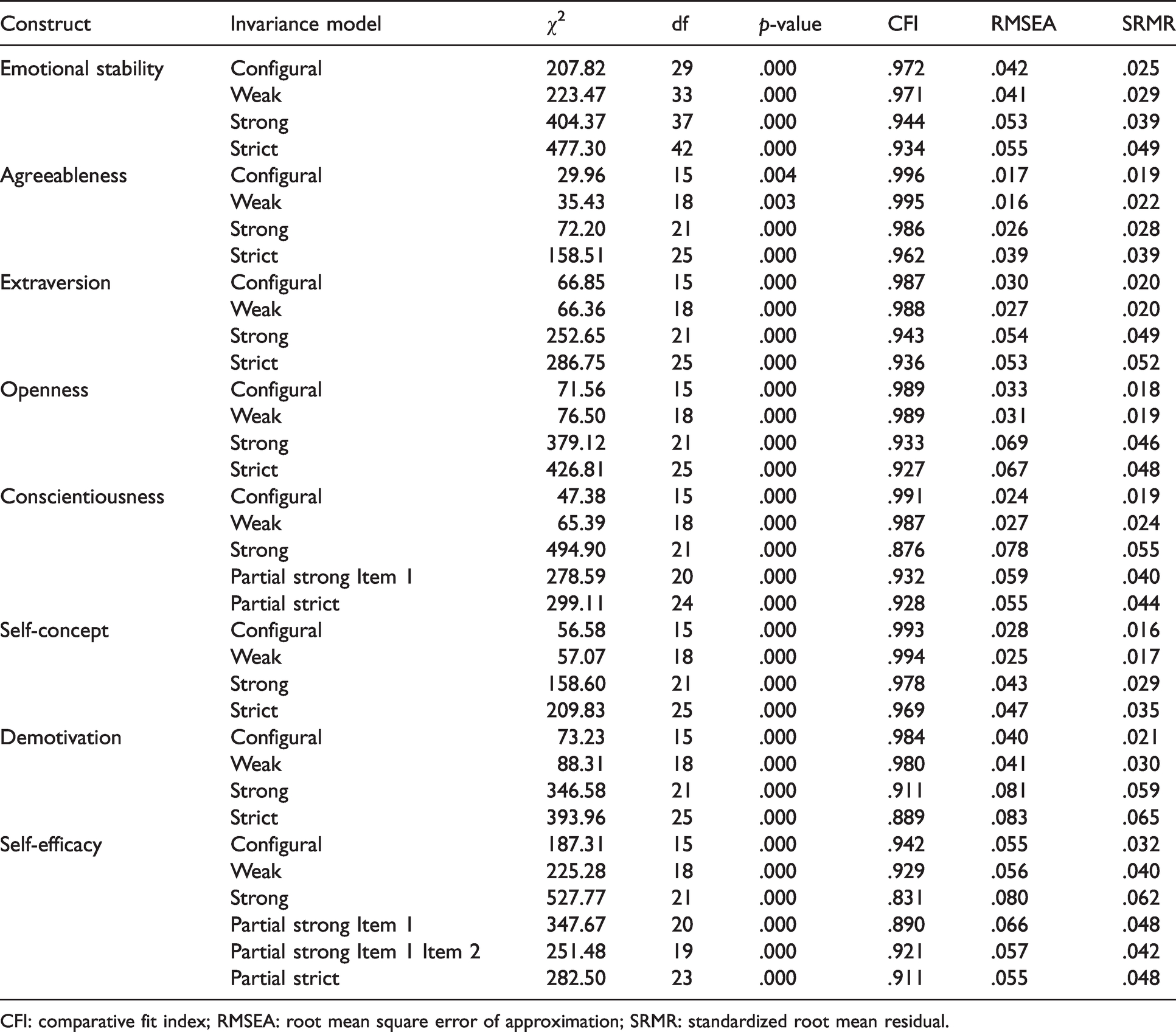
CFI: comparative fit index; RMSEA: root mean square error of approximation; SRMR: standardized root mean residual.
Motivational constructs
For the motivational perspective, we included three indicators, which were also investigated in confirmatory factor analyses (see Table 1). First, we included intellectual self-concept (Fend & Prester, 1986), which was assessed with four items (e.g. “I often think that I am not as smart as others,” “I am not as gifted as others”) that were rated on a 4-point Likert scale ranging from 1 (does not apply at all) to 4 (fully applies). All four items were recoded so that higher values reflected a more positive intellectual self-concept. Reliabilities were satisfactory at both time points: ω Self-concept = .81 at T1 and ω Self-concept = .84 at T2.
Second, we measured occupational self-efficacy (Skinner et al., 1988) with four items (e.g. “I am confident concerning professional difficulties because I can always rely on my abilities,” “I feel up to most professional demands”) that were rated on a 4-point Likert scale on a scale ranging from 1 (does not apply at all) to 4 (fully applies) with reasonable reliabilities at both time points: T1 ω Self-Efficacy = .69 and T2 ω Self-Efficacy = .69.
Third, we measured occupational demotivation (Wild et al., 1995) with four items (e.g. “Studying/my job is very frustrating for me,” “I feel like I am wasting my time in college/at work”) that were rated on a 4-point Likert scale ranging from 1 (does not apply at all) to 4 (fully applies) with somewhat varying reliabilities that ranged from ω Demotivation = .77 at T1 to ω Demotivation = .86 at T2. As a special characteristic of our data set, only a subsample answered these items at T1 (participants who decided to enter tertiary education). The whole sample was assessed at T2. 1
Objective occupational success indicators
As objective outcomes, we asked for participants’ incomes (“How much was your gross salary in the last month?”) and their current job position (“In which professional position do you work at the present time?”) and whether or not they held a leadership position (“How many people do you supervise?”). We used a logarithmized value for income and leadership position 2 in order to improve the distributional characteristics of the variables. Regarding job position, the open statements were coded in accordance with the International Standard Classification of Occupations (ISCO, 2008; International Labor Office, 2012). These codes were then transformed into International Socio-Economic Index of Occupational Status (ISEI; Ganzeboom, 2010; Ganzeboom et al., 2003) scores. We used the ISEI scores in our analyses as indicators of people’s job prestige.
Subjective occupational success indicators
As subjective measures, we used two indicators: First, we measured job satisfaction (Westermann et al., 1996) with three items (e.g. “Overall, I am satisfied with my current work,” “My work is really interesting to me”) that were rated on a 4-point Likert scale ranging from 1 (does not apply at all) to 4 (applies perfectly). The reliability was satisfactory (ωSatisfaction = .90). Second, we assessed work–life balance (Syrek et al., 2011) with five items (e.g. “I am satisfied with the balance between my work and private life,” “I am able to achieve a good balance between stressful and relaxing activities in my life”) that were rated on a 6-point Likert scale ranging from 1 (does not apply at all) to 6 (applies perfectly). One item was reverse coded. The reliability was also satisfactory (ω Satisfaction = .90).
Covariates
In a second step in all our analyses, we controlled for the influence of a set of variables with relevance to occupational success. These were participants’ gender (male/female), whether or not participants had a partner (yes/no) at T2, and whether or not they had children (yes/no) at T2. In our sample, 1457 people had a partner and 1587 had children. We furthermore controlled for cognitive abilities in Grade 10, assessed with 25 items from a nonverbal subtest (figure analogies) of the cognitive abilities test (in German: Kognitiver Fähigkeitstest [KFT]; N2-Test, KFT 4-13+R; Heller et al., 1985). Finally, we controlled for participants’ individual educational level by counting participants’ total years of education at a time point that fell 10 years after T1 (at about age 30). In doing so, we used the Comparative Analysis of Social Mobility in Industrial Nations classification scheme (König et al., 1988) to code both general and tertiary education. This scheme allowed us to transform the information into total years of education (Blossfeld, 1993). On average, participants in our sample had 16.49 years of education (SD = 2.74), indicating a well-educated sample.
Descriptive statistics and manifest intercorrelations between study variables are shown in Table 2. Personality scales and motivation constructs showed statistically significant correlations both cross-sectionally and over time. They were furthermore associated with the objective and subjective occupational success indicators, with associations with subjective outcomes being stronger and more consistent. In fact, demotivation and job satisfaction showed very close associations (r = –.76), indicating a strong overlap in constructs.
Means, standard deviations, and correlations of manifest personality scales, expectancy belief scales, and occupational success indicators.
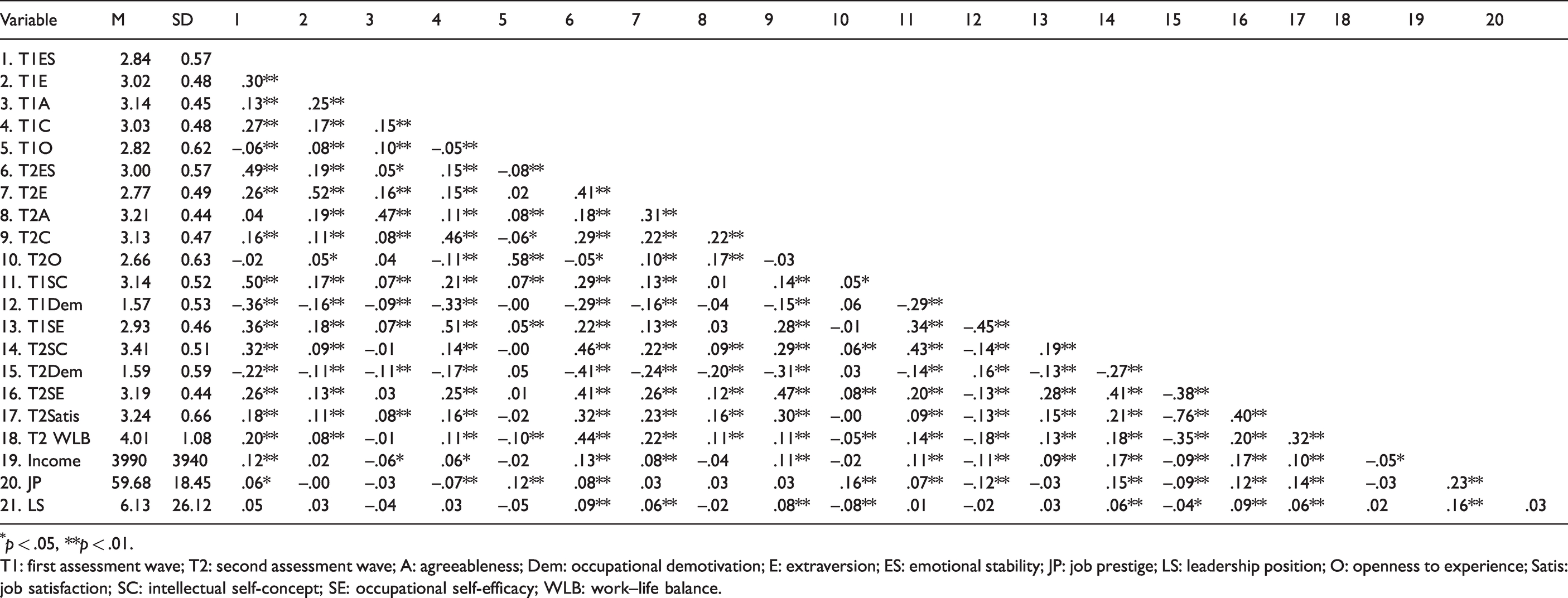
p < .05, **p < .01.
T1: first assessment wave; T2: second assessment wave; A: agreeableness; Dem: occupational demotivation; E: extraversion; ES: emotional stability; JP: job prestige; LS: leadership position; O: openness to experience; Satis: job satisfaction; SC: intellectual self-concept; SE: occupational self-efficacy; WLB: work–life balance.
Analytical strategy
Before we were able to address our research aims, we tested for measurement invariance across time to guarantee that the observed change in manifest variables was real change and was not due to changing relations between the latent variables or their indicators (Bollen & Curran, 2006). We tested for measurement invariance in four steps: By beginning with a configural model, we estimated the model fit of increasingly restrictive measurement models with metric invariance (i.e. equality of factor loadings across time), strong invariance (i.e. adding the equality of item intercepts across time), and strict invariance (i.e. adding the equality of item residual variances across time). We evaluated increasingly restrictive models regarding their overall fit with comparative fit index (CFI) > .95/.90, root mean square error of approximation (RMSEA) < .05/.08, and standardized root mean residual (SRMR) < .08/.11 for good/acceptable model fit, respectively (Hu & Bentler, 1999; Schermelleh-Engel et al., 2003). When model fit exceeded these thresholds, we tested for partial invariance. In all of these models, we allowed the residual variances of the same items to correlate across time as has been suggested (Bollen & Curran, 2006). The implementation of more restrictive measurement models was associated with model fit changes that exceeded the postulated criteria for statistically significant change in model fit, which have been established in multi-group measurement invariance models, particularly regarding the CFI (with ΔCFI > .01; Chen, 2007). As all reported final models had an acceptable or good model fit, we decided to use the more parsimonious and better fitting measurement models in our analyses. Accordingly, we established strict measurement invariance across time for personality traits and expectancy beliefs (see Table 1), whereas for occupational demotivation, only strong measurement invariance could be established. Accordingly, all of the following analyses (i.e. the latent change models and the moderated structural equation models) were based on a measurement model with strict factorial invariance, and for demotivation, with strong factorial invariance.
To address our first and second research aims (see Figure 1 for more details on the effects we tested), we applied bivariate latent change models (second order latent growth models; Sayer & Cumsille, 2001) for each of the personality–motivation combinations separately. The correlation of the intercepts was used to explore the nomological net of the variables at baseline (Effect a in Figure 1, Hypotheses 1a and b). The association between the two linear slope factors 3 was used to explore the correlated change between personality traits and motivation constructs (Effect b in Figure 1, Hypothesis 2).
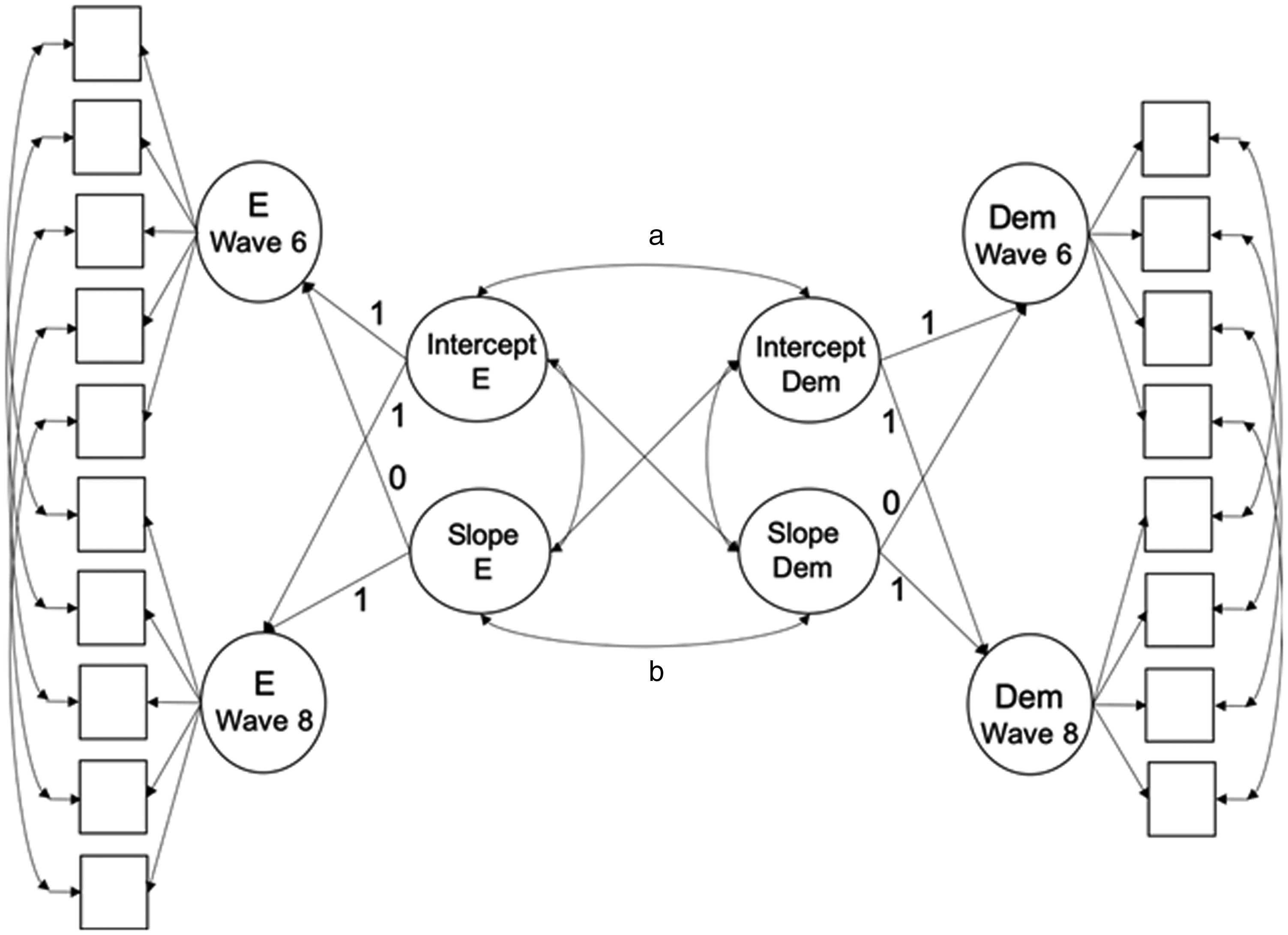
SEM for research aims 1 and 2 including extraversion (E) and occupational demotivation (Dem) as exemplary constructs of personality and motivation.
Finally, to test our third aim, we used moderated structural equation modeling (Klein & Moosbrugger, 2000). In a first step, we investigated the role that changes in personality and motivation played in predicting the occupational success variables over and above the well-established main effects (intercept effects) of each variable. However, for model complexity reasons, we did not include additional interactions between intercept effects. Thus, our results are controlled for main effects but not for other interactive effects. In the second step, we extended this model by including latent interactions between the two slope factors to explore the role of the interplay between changes in constructs when predicting occupational success (see Figure 2 for more details on the tested effects). In the first step of this analysis, we investigated the associations between change in personality traits (slopes) and the occupational success indicators (Effect e in Figure 2, Hypotheses 3a to 3c) as well as the associations between change in expectancy beliefs (slopes) and the occupational success indicators (Effect f in Figure 2, Hypotheses 3d to 3f). The second step extended these models by adding latent interaction effects (interactions between slopes of personality and slopes of motivation) on occupational success indicators (Effect g in Figure 2, Hypotheses 3g to 3i).
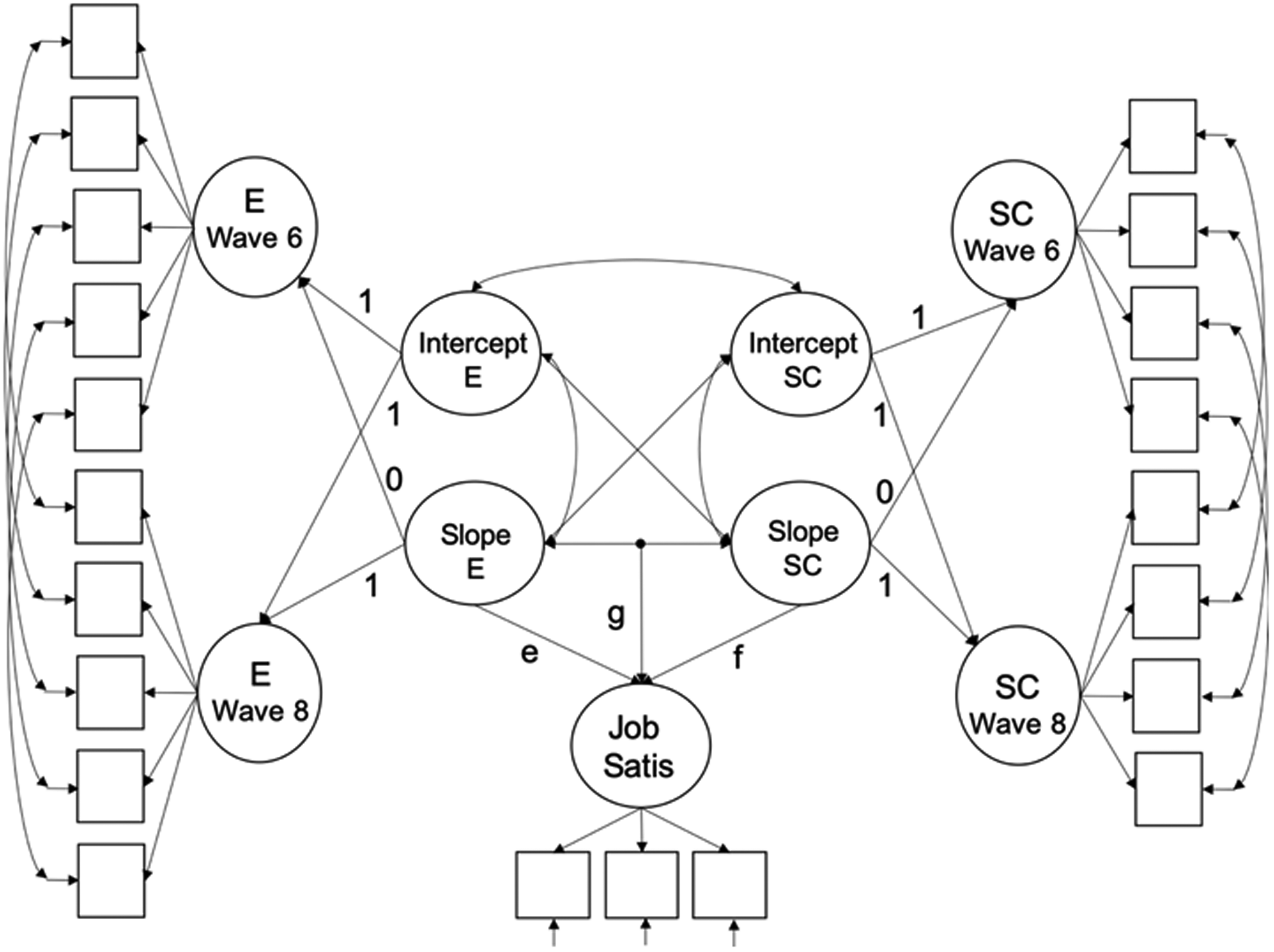
SEM for research aim 3 including extraversion (E), intellectual self-concept (SC), and job satisfaction (Job Satis) as exemplary constructs of personality, motivation, and occupational success.
All models were estimated without covariates (unconditional models) and with covariates (conditional models). In the models with covariates, both the intercepts and slopes of the personality traits and expectancy beliefs were regressed on the covariates. As χ2 statistics are sensitive to trivial differences between the specified model and the empirical data in large samples, we used additional established fit criteria to evaluate the goodness of model fit of our SEMs for good and acceptable model fit, respectively (CFI > .95/.90; RMSEA < .05/.08, SRMR < .08/.11; Hu & Bentler, 1999; Schermelleh-Engel et al., 2003). In models with latent interaction terms, no overall model fit in terms of the CFI, RMSEA, or SRMR could be estimated (Klein & Moosbrugger, 2000). Therefore, we computed Δχ2 values based on the log-likelihood values and scaling correction factors for all models indicating a statistically significant prediction of the occupational success indicators by the interaction between the slopes of personality and motivation (see Hildebrandt et al., 2009). We interpreted findings as significant only when they reached the p < .01 level, 4 but we also report exact p-values and 99% confidence intervals to provide the reader with the complete information. We used full information maximum likelihood procedures so that we could use all of the information available in the data set (see Enders, 2010). Measurement invariance models and latent change models for Aims 1 to 3a were estimated using the lavaan package (Version 0.6-6, Rosseel, 2012) in the R environment (R Core Team, 2016). Models with latent interaction terms were estimated in Mplus 8.2 (Muthén & Muthén, 1998–2018). 5 All hypotheses and the analytic plan were preregistered on the Open Science Foundation (OSF) before data analyses began (see https://osf.io/arwvj/?view_only=0587f15db6514cdf80736e3f7fb334ff). Model codes and online supplementary materials can also be found on the project’s OSF site (https://osf.io/eq5kf/).
Results
In accordance with our research aims, we present our findings in three steps. First, we report the findings regarding the nomological net between personality traits and expectancy beliefs at baseline. In a second step, we report findings on their dynamic interplay over time indicated by correlated changes. Third, we report findings on the roles of the changes and the interrelations of these changes (latent interaction) in personality traits and in expectancy beliefs in determining objective and subjective occupational success indicators. As we were primarily interested in personality and motivation, we initially report all findings without covariates to get a sense of their dynamic interplay and their joint role in determining occupational success. We complement this picture by subsequently showing how the result patterns changed when the relevant covariates were included (Table S18 summarizes our research aims, hypotheses, and evaluations of the hypotheses).
The interplay between personality and motivation across time
Before addressing our main research questions, we report rank-order stabilities for and latent mean differences between the personality traits and expectancy beliefs. These results were based on strict univariate invariance models (strong invariance for occupational demotivation) across our study interval of 20 years. We found that personality traits and expectancy beliefs showed both stability and change across time (see Table 3). Across the time from young to middle adulthood, the personality traits were characterized by higher rank-order stability than the expectancy beliefs, but their mean-level changes were comparable. At the same time, the personality traits and expectancy beliefs themselves differed considerably with conscientiousness and agreeableness showing the weakest rank-order stabilities and extraversion showing the strongest mean-level changes. Regarding the expectancy beliefs, occupational demotivation showed the weakest rank-order stability and intellectual self-concept showed the largest mean-level changes. Consequently, both families of constructs are subject to stability and change. The question that remains is whether both families of constructs are interrelated in a nomological net (Research Aim 1) and across time (Research Aim 2). To address these two research aims, we estimated a series of bivariate latent change models (see Figure 1). All of these models showed at least acceptable model fit (all CFIs > .90, RMSEAs < .08, and SRMRs < .11, except for two models with CFIs that were slightly under the cut-off). Next, we provide detailed results with respect to our hypotheses.
Latent mean differences and rank-order stabilities for personality and expectancy beliefs across 20 years from young to middle adulthood.
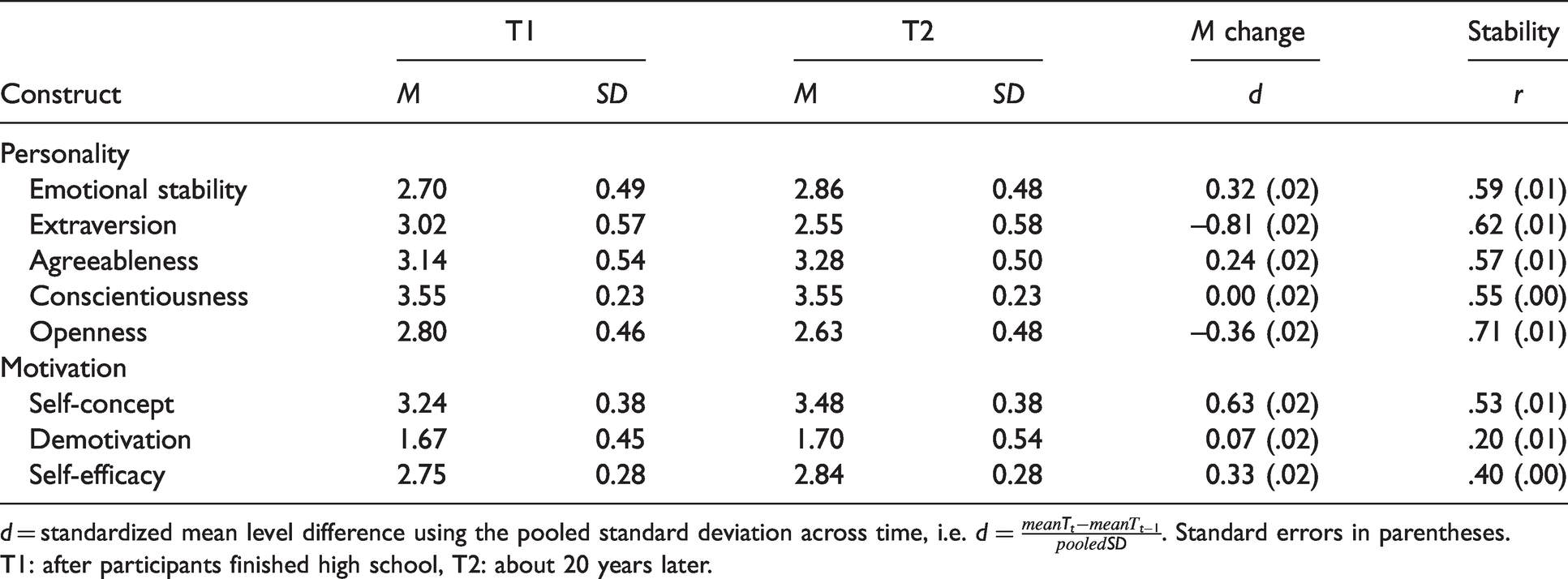
d = standardized mean level difference using the pooled standard deviation across time, i.e.
T1: after participants finished high school, T2: about 20 years later.
The nomological net between personality and motivation
To explore the nomological net, we investigated the correlated intercepts of the unconditional latent change models (Effect a in Figure 1). The results showed that most of the personality traits and most of the expectancy beliefs were statistically significantly associated at baseline. Table 4 summarizes the correlated intercepts across all the estimated unconditional bivariate models. Tables S1 to S5 in the online supplementary materials show the model fits and all the parameter estimates of each of the unconditional bivariate latent change models separately. In line with Hypotheses 1a and 1b, emotional stability (r = .63 p < .001; r = .51, p < .001), extraversion (r = .14, p < .001; r = .22, p < .001), and conscientiousness (r = .25, p < .001; r = .73, p < .001) were positively associated with intellectual self-concept and occupational self-efficacy beliefs. In line with Hypothesis 1a, agreeableness (r = .07, p < .001) and openness (r = .05, p < .001) were positively associated with intellectual self-concept. Supporting Hypothesis 1b, agreeableness was not associated with occupational self-efficacy beliefs. Contrary to Hypothesis 1b, however, openness also did not show associations with occupational self-efficacy beliefs at baseline. Occupational demotivation showed associations with emotional stability (r = –.48, p < .001), agreeableness (r = –.10, p < .001), extraversion (r = –.12, p < .001), and conscientiousness (r = –.45, p < .001) at baseline.
Correlations of intercepts and slopes between the personality and expectancy belief constructs.
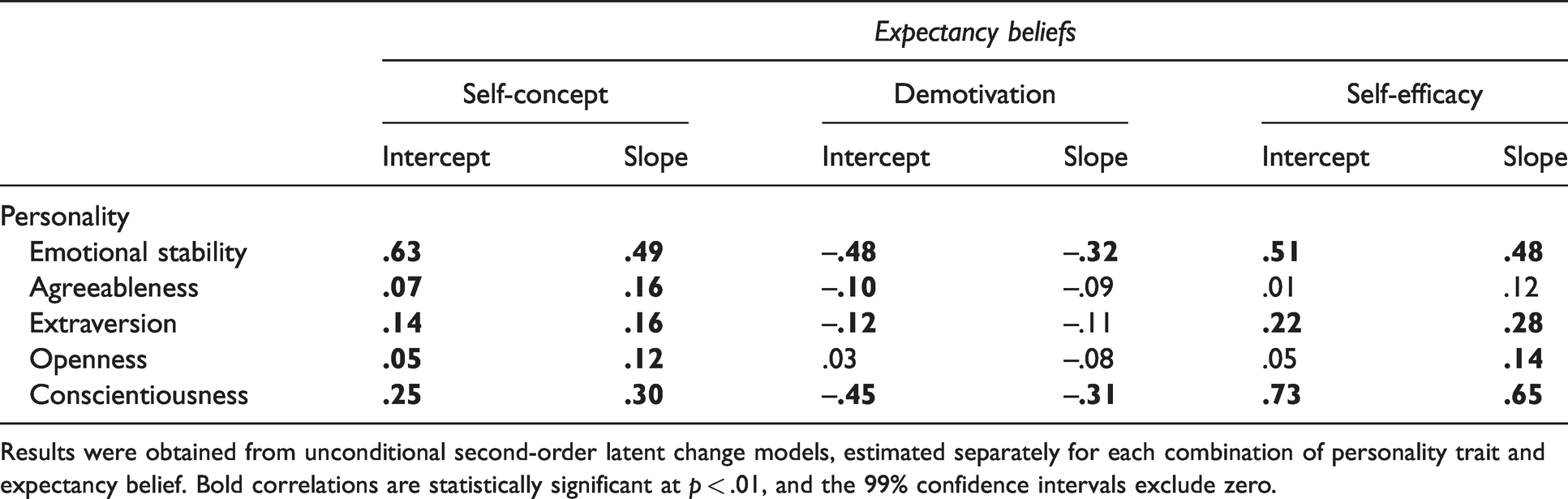
Results were obtained from unconditional second-order latent change models, estimated separately for each combination of personality trait and expectancy belief. Bold correlations are statistically significant at p < .01, and the 99% confidence intervals exclude zero.
After including the covariates in the models (see Tables S6 to S10 in the online supplementary materials for model fits and parameter estimates), the patterns remained completely stable. In summary, most personality traits and most motivation constructs are linked in a nomological net.
Dynamic interplay: Personality and motivation across time
To test our second aim, examining the dynamic perspective of change in personality traits and change in expectancy beliefs, we investigated correlated change between the two families of constructs (Effect b in Figure 1). Supporting our second hypothesis, the results confirmed the existence of correlated change between personality and expectancy beliefs across time. Table 4 summarizes the correlated slopes across all the estimated unconditional bivariate models. Tables S1 to S5 in the online supplementary materials show the model fits and all the parameter estimates of each of the unconditional bivariate latent change models separately. All the slopes of the personality traits were statistically significantly correlated with the slopes of intellectual self-concept (r = .12 to .49 all ps < .002). Changes in emotional stability (r = –.32, p < .001) and conscientiousness (r = –.31, p < .001) showed statistically significant associations with changes in occupational demotivation. Furthermore, the slopes of emotional stability (r = .48, p < .001), extraversion (r = .28, p < .001), conscientiousness (r = .65, p < .001), and openness (r = .14, p < .001) were statistically significantly associated with the slopes of occupational self-efficacy. The strongest correlations between the slopes were found for emotional stability, intellectual self-concept, and occupational self-efficacy, as well as between conscientiousness and occupational self-efficacy. Importantly, the variances of the slopes were all statistically significant (all ps < .001), indicating that people change at different rates across time.
When including the covariates in our models (see Tables S6 to S10 in the online supplementary materials), the results remained stable except for openness: The correlated changes between openness and intellectual self-concept and occupational self-efficacy were no longer statistically significant. Furthermore, we found one additional example of correlated change between the slopes of extraversion (r = –.14, p < .001) and occupational demotivation. Thus, our results so far clearly illustrate that not only do personality traits and expectancy beliefs belong together in a nomological net, but they also illustrate a strong interrelatedness in their change trajectories across time.
Predicting occupational success: The roles of personality and motivation
We included the occupational success indicators in our latent change models in order to examine the roles that changes in personality and expectancy beliefs play in determining both subjective and objective success criteria (Aim 3a). First, we report findings on the unconditional latent change models (Tables 5 to 9), and in a second step, we report findings on the conditional latent change models with time-invariant covariates (Tables S11a to S15c in the online supplementary materials). Please note that we had to exclude the models that predicted job satisfaction from occupational demotivation because the overlap in constructs (r = –.76) resulted in estimation problems with values that went beyond the plausible boundaries.
Predictions of objective and subjective work success from the intercepts and slopes of emotional stability and three expectancy beliefs.
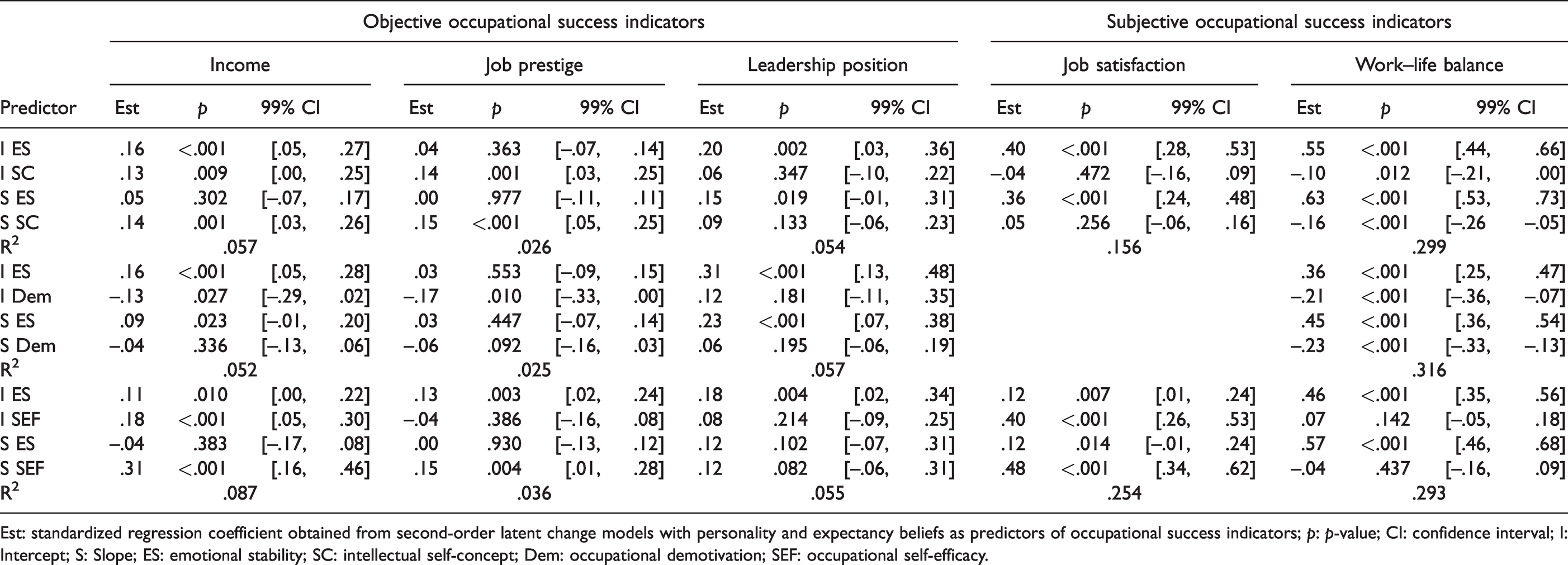
Est: standardized regression coefficient obtained from second-order latent change models with personality and expectancy beliefs as predictors of occupational success indicators; p: p-value; CI: confidence interval; I: Intercept; S: Slope; ES: emotional stability; SC: intellectual self-concept; Dem: occupational demotivation; SEF: occupational self-efficacy.
Predictions of objective and subjective work success from the intercepts and slopes of agreeableness and three expectancy beliefs.
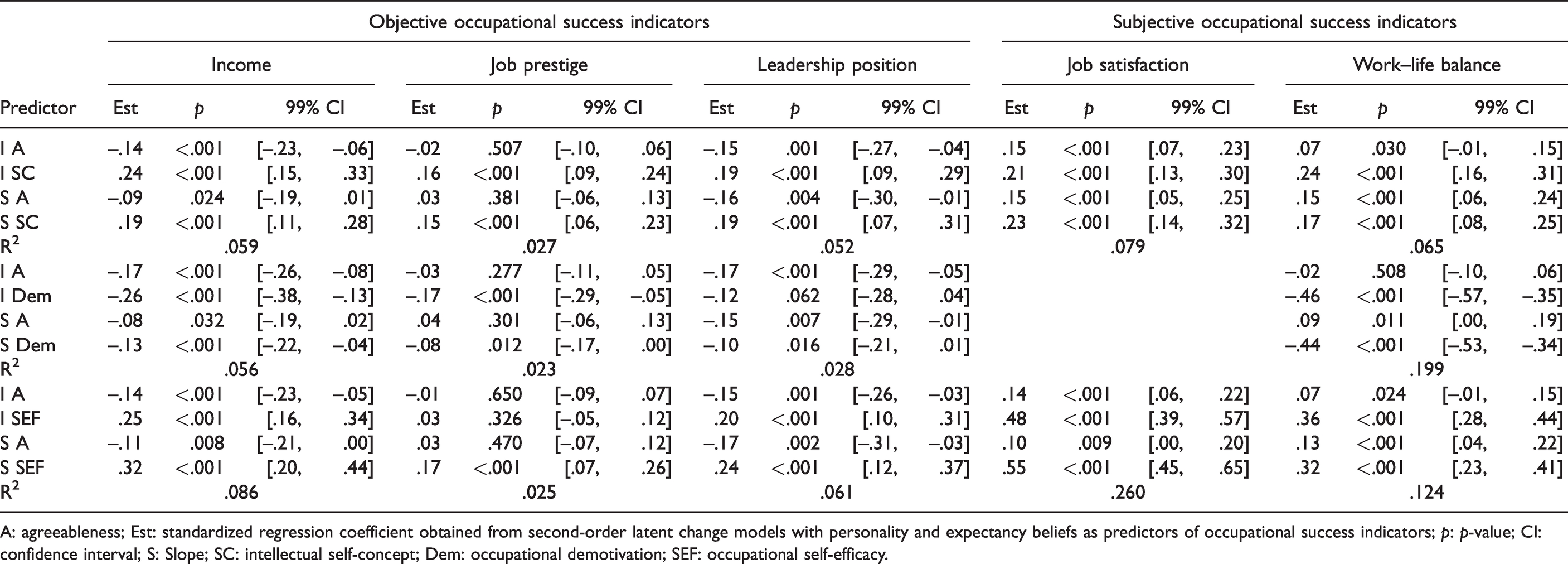
A: agreeableness; Est: standardized regression coefficient obtained from second-order latent change models with personality and expectancy beliefs as predictors of occupational success indicators; p: p-value; CI: confidence interval; S: Slope; SC: intellectual self-concept; Dem: occupational demotivation; SEF: occupational self-efficacy.
Predictions of objective and subjective work success from the intercepts and slopes of extraversion and three expectancy beliefs.
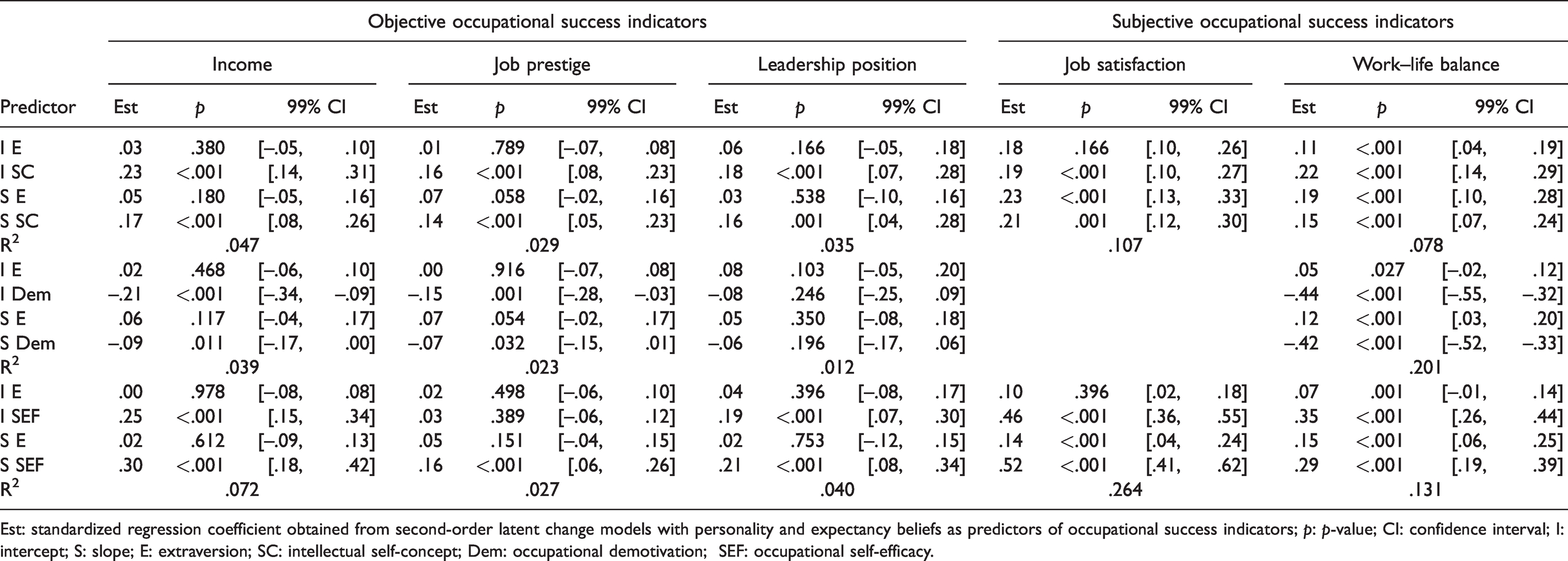
Est: standardized regression coefficient obtained from second-order latent change models with personality and expectancy beliefs as predictors of occupational success indicators; p: p-value; CI: confidence interval; I: intercept; S: slope; E: extraversion; SC: intellectual self-concept; Dem: occupational demotivation; SEF: occupational self-efficacy.
Predictions of objective and subjective work success from the intercepts and slopes of openness and three expectancy beliefs.
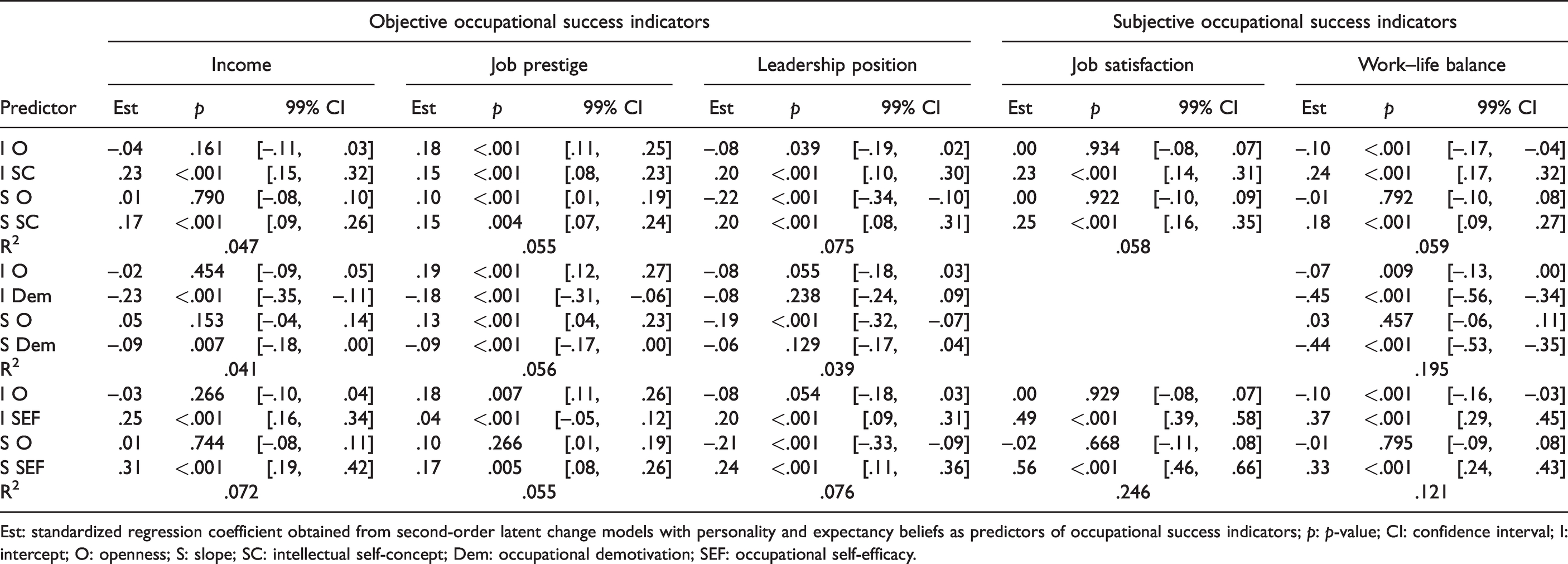
Est: standardized regression coefficient obtained from second-order latent change models with personality and expectancy beliefs as predictors of occupational success indicators; p: p-value; CI: confidence interval; I: intercept; O: openness; S: slope; SC: intellectual self-concept; Dem: occupational demotivation; SEF: occupational self-efficacy.
Predictions of objective and subjective work success from the intercepts and slopes of conscientiousness and three expectancy beliefs.
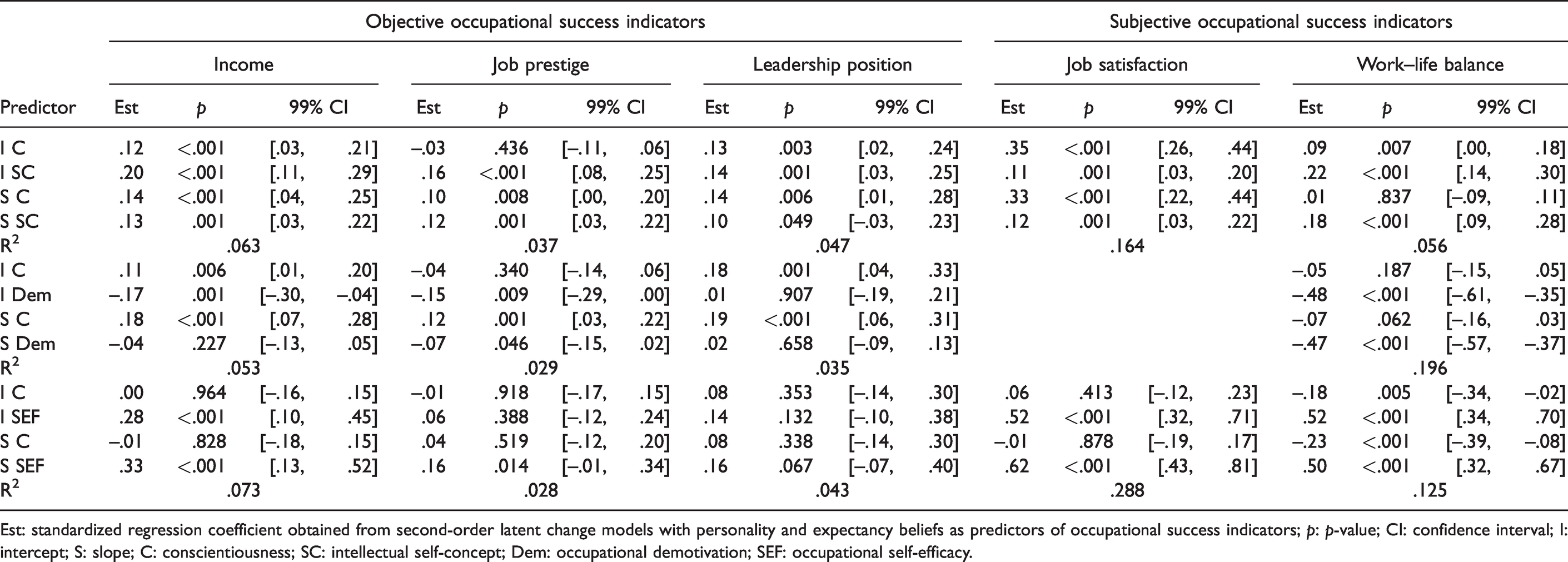
Est: standardized regression coefficient obtained from second-order latent change models with personality and expectancy beliefs as predictors of occupational success indicators; p: p-value; CI: confidence interval; I: intercept; S: slope; C: conscientiousness; SC: intellectual self-concept; Dem: occupational demotivation; SEF: occupational self-efficacy.
The predictive validity of change: Unconditional latent change models
In line with our expectations, we found significant main effects of change in personality traits and in expectancy beliefs on objective and subjective occupational success criteria (Tables 5 to 9). Across all models, the combination of personality and motivation illustrated the strongest predictive power with respect to work–life balance (up to 32%) and job satisfaction (up to 29%) but less so across the objective job indicators (less than 10%). Given the nomological net between the two families of constructs and their interrelatedness across time, change in personality as well as change in expectancy beliefs showed differential predictive effects across occupational success indicators. Thus, hypothesis testing was highly dependent on the respective pairing of personality traits and expectancy beliefs.
Largely in line with Hypothesis 3a, changes in conscientiousness and in emotional stability were related to objective as well as subjective success criteria. An increase in conscientiousness was related to higher income, a more prestigious job position, and more leadership responsibilities (models with intellectual self-concept and occupational demotivation). Furthermore, adults with an increase in conscientiousness were more satisfied with their jobs (in the model with intellectual self-concept) but also reported a worse work–life balance (in the model with occupational self-efficacy). An increase in emotional stability was also related to more leadership responsibilities (in the model with occupational demotivation). However, adults with an increase in emotional stability reported a better work–life balance (across all models) but also higher job satisfaction (in the model with intellectual self-concept). Partially supporting Hypothesis 3b, we found that an increase in agreeableness was associated with fewer leadership responsibilities (in the models with occupational self-efficacy and occupational demotivation). Rejecting Hypothesis 3c, change in extraversion did not show any statistically significant associations with the objective success indicators.
Although associations with subjective success indicators were not hypothesized, people showing increases in agreeableness were more satisfied with their jobs and reported a better work–life balance (in both the models with intellectual self-concept and occupational self-efficacy). Also, increases in extraversion were related to better work–life balance and higher job satisfaction irrespective of the expectancy belief.
Although we had no hypothesis on changes in openness, we found that decreases in openness were associated with more leadership responsibilities regardless of which motivation construct was considered. Furthermore, changes in openness positively predicted job prestige (irrespective of expectancy beliefs).
Regarding changes in expectancy beliefs, in line with Hypothesis 3d, we found that increases in occupational self-efficacy were associated with income irrespective of personality domain, job prestige (in all models except the one with conscientiousness), or leadership position (in the models with agreeableness, extraversion, openness). Also supporting Hypothesis 3d, we found that people who showed increases in occupational self-efficacy were more satisfied with their jobs and had a better work–life balance irrespective of which personality domain was considered. In line with Hypothesis 3e, increases in occupational demotivation were associated with a more negative work–life balance (regardless of the personality domain except for agreeableness). Finally, and in line with Hypothesis 3f, when people reported increases in their intellectual self-concept, they also earned more money (all models except the one with conscientiousness), supervised more people (all models except the ones with emotional stability and conscientiousness), and held more prestigious job positions (all models). Increases in intellectual self-concept were further associated with more job satisfaction and a better work–life balance in all models.
The predictive validity of change: Conditional latent change models
When we included time-invariant covariates in our models, the effects were particularly strong for the objective success indicators (see Tables S11a to S15c in the online supplementary materials), and the amount of explained variance increased (to 41% for job prestige, 26% for income, and 16% for leadership position). Being male, well-educated, and childless were statistically significantly associated with receiving a higher income; more years of education and higher scores on a cognitive abilities test were related to more prestigious job positions; and being male and more intelligent were related to more leadership responsibilities. For subjective outcomes, the covariates were generally less important with only a few statistically significant associations across models: Being male and childless were associated with a better balance between work and private life in some models, whereas cognitive abilities predicted more job satisfaction in one model.
With respect to personality effects across conditional models, differences with the unconditional models were rather unsystematic. That is, change in conscientiousness was no longer statistically significantly associated with job prestige. The same was true for agreeableness in terms of leadership position (in the model with occupational demotivation). Regarding openness, associations between change in openness failed to reach statistical significance in predicting job prestige (irrespective of expectancy beliefs).
When the covariates were included, differences between unconditional and conditional models were more systematic for expectancy beliefs than for personality traits. Particularly regarding intellectual self-concept, change was no longer substantially associated with income (in the models with emotional stability and conscientiousness), leadership responsibilities (in the models with extraversion), and job prestige (in all models). Also in terms of occupational self-efficacy beliefs, change was no longer statistically significantly associated with job prestige (in the models with extraversion and emotional stability) or with income (in the model with conscientiousness). Interestingly, testing the models that included the covariates led to some new findings: Negative associations occurred for change in occupational demotivation with income and job prestige (in all models except the one with conscientiousness).
As the covariates played a minor or even negligible role in determining subjective success indicators, associations with change in personality and motivation were only marginally affected, and the pattern of associations remained nearly unchanged. In total, two associations were no longer statistically significant when the covariates were included, namely, for change in occupational self-efficacy (in the model with emotional stability) when predicting work–life balance and for change in agreeableness (in the model with occupational self-efficacy) when predicting job satisfaction. In addition, more negative associations between change in occupational demotivation and work–life balance became statistically significant when the covariates where included (now also in the models with agreeableness). Emotional stability, occupational self-efficacy beliefs, and intellectual self-concept appeared to be the most consistent predictors of subjective success criteria, whereas emotional stability and intellectual self-concept were more stable predictors across the covariates than occupational self-efficacy beliefs were.
When we took a more differentiated view on the occupational success indicators, the largest amount of variance in income was explained by a model that included emotional stability and occupational self-efficacy beliefs with larger effect sizes for the slope associations than for the intercept associations (standardized regression coefficients). For job prestige, the most variance was explained by openness and occupational demotivation, and for leadership position, the most variance was explained by openness and occupational self-efficacy with comparable effect sizes for the intercepts and slopes. For the subjective success indicators, the slopes of emotional stability showed the largest effect sizes in a model with occupational demotivation, whereas the largest amount of variance in job satisfaction was explained by the model with conscientiousness and occupational self-efficacy, again, with comparable effect sizes for the intercepts and slopes. Overall, although there was great variation across the models, when statistically significant associations occurred, the effect sizes for the slopes were often comparable in size or even larger than the effect sizes for the intercepts.
In sum, the findings suggest that change in personality traits and change in expectancy beliefs are related to occupational success beyond the initial levels of the constructs. Moreover, their interdependencies both at baseline and in change trajectories need to be considered. Specifically, conscientiousness, emotional stability, and occupational self-efficacy beliefs appeared to be the most consistent predictors of both objective and subjective occupational success indicators. This pattern was further supported because the associations turned out to be most stable across multiple pairings with variables from the other construct family and were largely unaffected when the relevant covariates were included.
Predictive validity of change interactions in personality and motivation
To address the second part of our third aim, we applied latent interaction models or moderated structural equation modeling (Klein & Moosbrugger, 2000) to investigate whether or not the interaction between change in personality traits and change in expectancy beliefs was associated with occupational success indicators. Importantly, we estimated models that included latent interaction terms only when there were observed correlated slopes between personality and expectancy beliefs. We first report the models without the covariates and later demonstrate the robustness of findings when the covariates were considered. The results for the unconditional moderated structural equation models are shown in Table 10. Table 11 shows model comparisons between the unconditional latent change models and the moderated structural equation models.
Predictions of objective and subjective work success from correlated change between personality and expectancy beliefs modeled as a latent interaction.
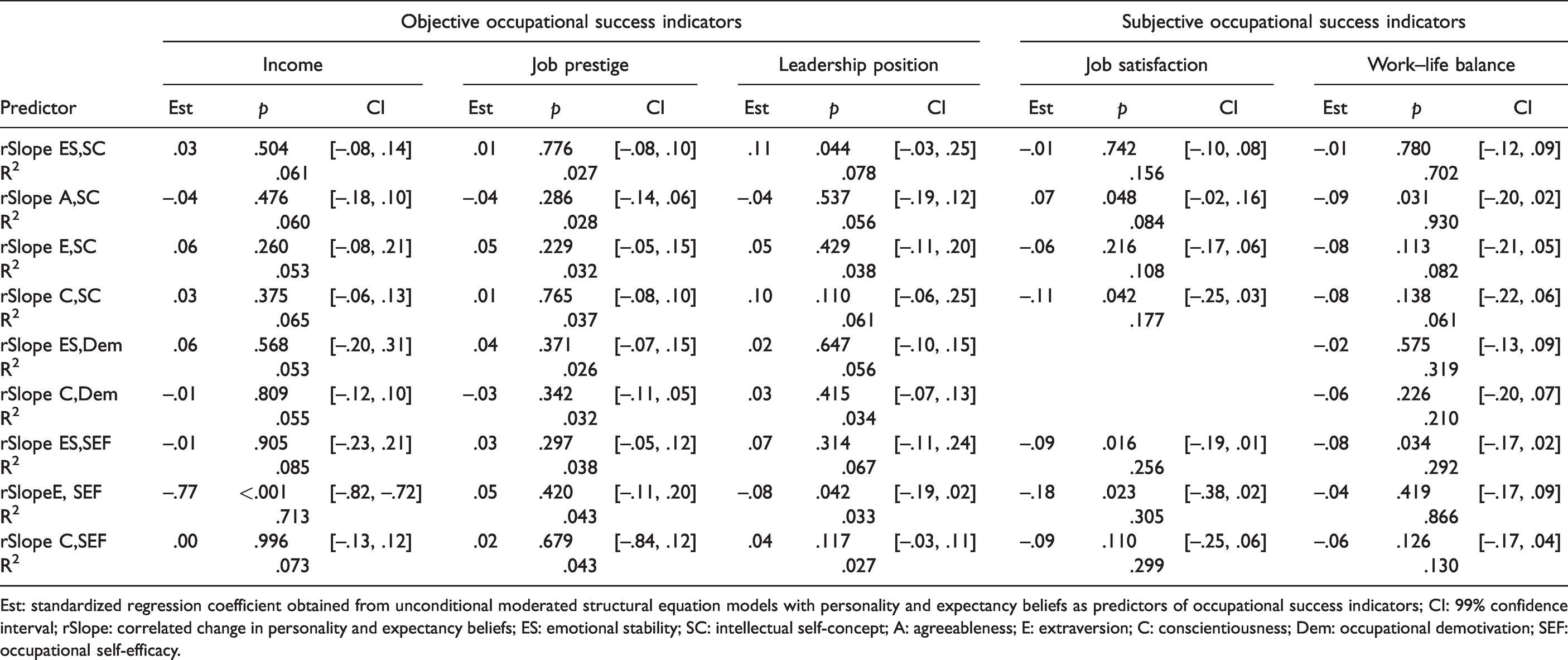
Est: standardized regression coefficient obtained from unconditional moderated structural equation models with personality and expectancy beliefs as predictors of occupational success indicators; CI: 99% confidence interval; rSlope: correlated change in personality and expectancy beliefs; ES: emotional stability; SC: intellectual self-concept; A: agreeableness; E: extraversion; C: conscientiousness; Dem: occupational demotivation; SEF: occupational self-efficacy.
Model comparisons of latent interaction models with latent change models without the interaction term.
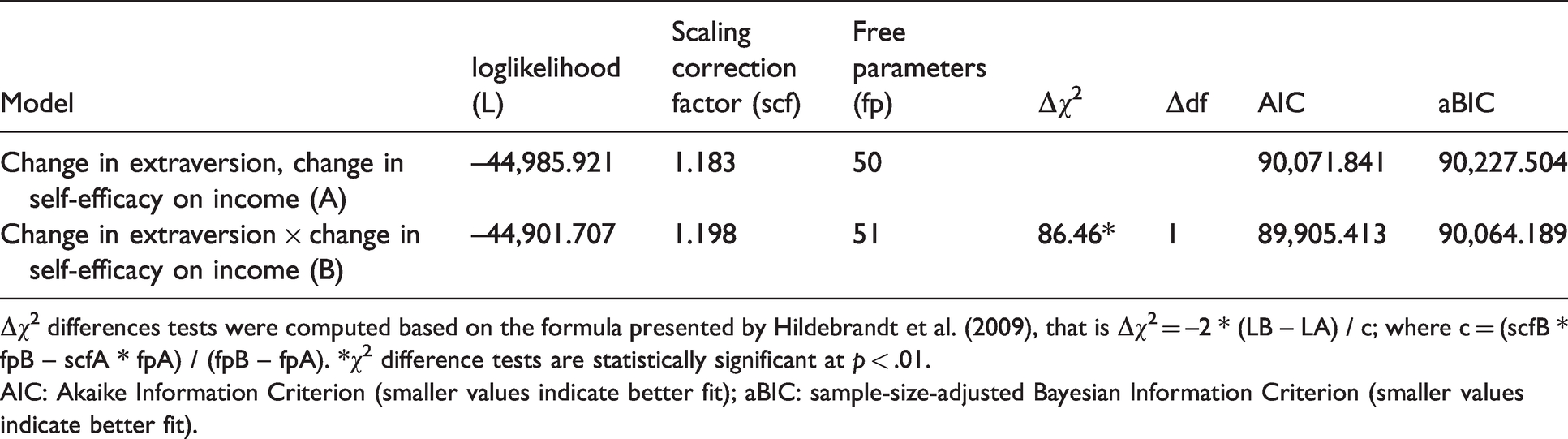
Δχ2 differences tests were computed based on the formula presented by Hildebrandt et al. (2009), that is Δχ2 = –2 * (LB – LA) / c; where c = (scfB * fpB – scfA * fpA) / (fpB – fpA). *χ2 difference tests are statistically significant at p < .01.
AIC: Akaike Information Criterion (smaller values indicate better fit); aBIC: sample-size-adjusted Bayesian Information Criterion (smaller values indicate better fit).
Contrary to our Hypothesis 3g, the interaction between change in occupational self-efficacy and change in conscientiousness as well as in emotional stability was not associated with objective occupational success beyond the single slopes. Thus, it appears to be the individual increase in maturity-related traits and self-efficacy that is related to more objective occupational success, whereas the dynamics of longitudinal interrelatedness do not appear to provide additional benefits. We found a substantial latent interaction effect between change in extraversion and change in occupational self-efficacy on income (B = −.77, p < .001, R2 = .71), but not, as proposed in Hypothesis 3h, on subjective indicators of success. Accordingly, people reporting an increase in one construct resulted in a weakened effect of the change of the other construct on income. The more complex model with the latent interaction term did illustrate a statistically significant improvement in the model fit, and the AIC and aBIC were smaller in the model that included the latent interaction (Table 11). For conscientiousness and emotional stability, Hypothesis 3h was not supported, and neither was Hypothesis 3i. Beyond our hypotheses, we found correlated change in five additional cases. Accordingly, we investigated effects of their interactions on success outcomes in an exploratory fashion. No other effects emerged.
The single interaction effect that we found was stable when we controlled for time-invariant covariates (see Table S16 in the online supplementary materials). Surprisingly, two other interaction effects emerged when the covariates were included: The interaction between change in conscientiousness and change in occupational self-efficacy was statistically significantly associated with income (B = –.71, p < .001, R2 = .84). Furthermore, the interaction between change in emotional stability and change in occupational self-efficacy was statistically significantly associated with income (B = –.79, p < .001, R2 = .90). The more complex models that included the latent interaction terms illustrated a statistically significant improvement in model fit, and the AIC and aBIC turned out to be smaller in these models (Table S17 in the online supplementary materials). Although the single effects pointed to a potentially interactive way in which change in personality and change in expectancy beliefs work together to predict occupational success beyond the main effects of change, the findings were less robust across models, and more research is needed to better understand these findings.
Discussion
The aim of our study was to investigate the conjoint and dynamic roles that personality traits and expectancy beliefs play in determining objective and subjective occupational success. According to our invariance models and latent change analyses, three main findings stand out: First, personality traits and expectancy beliefs were found to be related in a nomological net. Second, given that both constructs were found to be subject to stability and change across a time interval of 20 years, they further reflected an interrelatedness across time by showing substantial correlated change, with the most pronounced correlated change between emotional stability and conscientiousness on the personality side and intellectual self-concept and occupational self-efficacy beliefs on the motivation side. Third, change in personality and in expectancy beliefs predicted occupational success over and above what was known from their initial effects. These results tended to be robust across other established occupational success indicators such as cognitive abilities, education, or gender.
A more integrative view on personality and motivation
Three main patterns stood out with respect to the integrative perspective on personality and motivation across adulthood. First, our study supported previous theoretical assumptions (e.g. Denissen & Penke, 2008; Fleeson & Jayawickreme, 2015) and empirical findings (e.g. Barrick et al., 2003; Judge & Ilies, 2002) by showing that personality traits and expectancy beliefs belong together in a nomological net as their initial standings were found to be related. In particular, being more relaxed (emotional stability), sociable (extraversion), and diligent (conscientiousness), for example, goes along with more positive self-evaluations of one’s own intellectual abilities, more positive expectations that one will master a certain occupational goal, and less demotivation while mastering this goal. It is also likely that personality traits and expectancy beliefs potentially fill the gap that the other construct group opens. For instance, personality traits have been criticized as being unbalanced in terms of behavior, cognition, emotion, or even desire (Pytlik Zillig et al., 2002; Wilt & Revelle, 2015), thus leaving room for expectancy beliefs to step in.
Second, our findings are in line with previous research (Jansen et al., 2020; Kandler et al., 2014; Rieger et al., 2017) that showed that stability and change in personality traits and expectancy beliefs co-occur in a rather comparable fashion. Particularly the intellectual self-concept indicated comparable rank-order stabilities to conscientiousness, agreeableness, and emotional stability. Such findings expand recent findings on the changeability of traits in general (e.g. Bleidorn & Hopwood, 2018; Schwaba & Bleidorn, 2017; Wagner et al., 2020) to reflect a broader perspective that illustrates the long-term stability and change of expectancy beliefs as well. The transitional phase from early to middle adulthood appears to be highly sensitive to changes in both constructs, with change patterns that roughly resemble maturation in “core” personality traits such as emotional stability, agreeableness, and conscientiousness (Roberts & Mroczek, 2008) as well as expectancy beliefs such as intellectual self-concept and occupational self-efficacy, both of which became more positive across time. The findings may be regarded as a first illustration that principles of personality trait change (e.g. social investment and maturation) may to some extent be generalizability to average trends in expectancy beliefs (cf. Dweck, 2017; Heckhausen et al., 2010).
However, there was one exception to this generally positive developmental pattern: Occupational demotivation increased over time, potentially indicating, on average, a lower investment in occupational roles across the course of development from early to middle adulthood. Although in line with previous research that found more positive job attitudes in those new to the job (Boswell et al., 2005) and decreases in job commitment as working life continued (Vandenberghe et al., 2011), a deinvestment in the job role can potentially be explained by the developmental phase people are in: In the rushhour from young to middle adulthood, people face a diverse set of life tasks, such as finding a romantic partner, starting one’s own family, and establishing their career and therefore need to divide their investment into several roles (Evandrou & Glaser, 2004; Freund, 2020; Hutteman et al., 2014). 6
The third result pattern refers to the interrelatedness of change trajectories for personality and motivation. Our findings of substantial correlated change support the theoretical notion of a joint developmental dynamic of constructs across time (e.g. Hennecke et al., 2014). Change in personality traits and change in expectancy beliefs should not be considered independent of each other. Although correlated change does not allow any directional assumptions, one may view this as initial empirical support for the idea that expectancy beliefs are a driver of personality change (Hennecke et al., 2014). In the theoretical framework, the second condition for personality change requires that people believe that change is feasible. Therefore, trait change is highly dependent on people’s beliefs in their own abilities to master a task or goal. Our study provides initial evidence for this as changes in occupational self-efficacy and intellectual self-concept showed associations with changes in almost all Big Five personality traits. The most pronounced associations were found between changes in emotional stability and intellectual self-concept or occupational self-efficacy beliefs as well as between conscientiousness and occupational self-efficacy. It appears that young adults who are at the starting point of their occupational career and are faced with new occupational and personal challenges feel the need to become more responsible, diligent, and resilient. When paired with the strong belief that change is feasible because they perceive that they have the resources to master new demands, trait change appears to be more likely. Interestingly, the change characteristics appeared to differ across personality traits: Whereas changes in emotional stability might be better perceived by the people themselves, such that self-descriptions highlighted increases in emotional stability across the 20 years of the study, changes in conscientiousness appeared to be less pronounced in self-descriptions, and thus, less present in mean-level differences, but they were more pronounced in comparison with others, that is, in rank-order (in)stability.
However, given theoretical notions (e.g. Hennecke at al., 2014), correlated change dynamics can also be interpreted the other way around: Changes in expectancy beliefs may be driven by personality changes. This would suggest that personal adjustments and changes in direction, endurance, and intensity of behavior are shaped in accordance with an individual’s personality make-up. When a person becomes more self-confident after experiencing that they were able to master a new challenge, this self-confidence appears to feed directly back into this person’s perceived resilience. For example, changes in intellectual self-concept and occupational self-efficacy were positively associated with changes in almost all personality traits. Thus, it appears that increases in agency-related expectancy beliefs have positive consequences for a diverse set of experiences and behavior, such as attitudes toward other people, work, and oneself. However, being dissatisfied with one’s job has more direct consequences for one’s work attitudes (e.g. becoming less industrious) and emotionality (e.g. becoming tense and sad). Future studies should expand upon these findings by using time-sensitive analyses to detect a chronological order in changes.
Explaining occupational success: Adaptive capacities of personality and motivation
We hypothesized and found that change in personality traits and change in expectancy beliefs explained variance in both objective and subjective occupational success beyond the variance explained by initial levels of these variables. Thus, not only dispositional levels but also their change dynamics across time were related to a person’s occupational success story. In line with more general notions of human agency (Lang & Heckhausen, 2006), people appear to draw on their internally adaptive resources to master occupational demands and challenges. In addition, our results suggest that such internal adaptive resources not only change across adulthood but that these changes in personality and motivation are linked to occupational success in middle adulthood. We would like to highlight four features that should be considered across these findings.
First, it is important to emphasize that the associations we found were largely robust when we included covariates such as gender, education, or cognitive abilities. In line with previous work, our covariates explained more variance in the objective than in the subjective success indicators (Ng et al., 2005). Interestingly, the effects of expectancy beliefs, especially intellectual self-concept, on the objective success outcomes were less robust than the effects of personality traits. As self-concept is known to be strongly shaped by school experiences (Wolff et al., 2018), controlling for education appears to weaken the role of intellectual self-concept for objective success indicators.
Second, our results furthermore indicate that effects of changes in personality and expectancy beliefs on occupational success outcomes are more likely to occur when there is already an effect of the initial level of the same construct. This suggests that above and beyond the initial level, changes in the respective constructs are also important predictors of success across adulthood. Confirming previous findings, we found that changes in emotional stability, conscientiousness, and occupational self-efficacy showed the most consistent associations with both objective and subjective occupational success. Interestingly, whereas increases in conscientiousness were associated with higher income, more prestigious jobs, and leadership responsibilities, this increase was also related to a worse work–life balance. Thus, the same trait (i.e. conscientiousness) might not be singularly related to positive effects. This is in keeping with earlier findings that assigned conscientiousness the role of a “double-edged sword” for occupational success (Lin et al., 2015: 105). Lin et al. (2015) argued that conscientious people allocate their resources unequally because they focus primarily on fulfilling their work obligations and neglect self-care. Our findings furthermore showed that becoming more emotionally stable across time and increasing in occupational self-efficacy beliefs was related to singularly positive effects on objective occupational success outcomes that were also not contradicted by negative consequences on subjective outcomes. This speaks to a potentially protective role of emotional stability and occupational self-efficacy in buffering the challenges and stressors that come with demanding job positions, whereas more diligent and performance-oriented behaviors potentially increase people’s feelings of work pressure (Alarcon et al., 2009; van Doorn & Hülsheger, 2015). A further interesting finding in this context involves changes in agreeableness, which demonstrated negative associations with objective success indicators (except for job prestige) but positive associations with subjective success indicators. The negative associations in terms of objective success indicators could be explained by a decrease in competitive work behaviors and an increasing focus on interpersonal relationships rather than on work success in individuals who become more agreeable across time (Judge & Zapata, 2015; Judge et al., 1999). Positive effects on subjective outcomes may point to good relationships with colleagues and hence to more well-being at work for people whose agreeableness increases across adulthood.
Third, findings from our bivariate latent change models highlight that, in most cases, the specific combination of personality and motivation matters when predicting occupational success. Specifically, there were a number of change effects that appeared to be robust: emotional stability from the personality side and self-efficacy from the motivation side were found to be robust predictors of specific success outcomes irrespective of the particular other construct in the model. By contrast, all further effects appeared to be conditional on the specific pairing with the other construct group. For instance, when people reported that they became more conscientious over time, this resulted in more prestigious job positions only when their intellectual self-concept also increased. What can we learn from such findings? On the one hand, these findings suggest that, most likely due to the nomological net between the construct families, personality and expectancy beliefs should be considered jointly: Effects of one specific change pattern on occupational success appear to be affected by the change in the respective other construct. For instance, increases in intellectual self-concept appear to be particularly beneficial for earning more money, holding more prestigious job positions, and supervising more people when this coincides with becoming less agreeable, more open, and more extraverted. On the other hand, the findings underline the important role of emotional stability and occupational self-efficacy. It appears that each plays a key role in determining occupational success and possibly even guides the ways in which other personality traits and expectancy beliefs unfold their effects on occupational success across time. Altogether, our findings support the theoretical notion that personality traits and expectancy beliefs work as complementary constructs in explaining interindividual differences in behavior (e.g. Denissen & Penke, 2008; Fleeson & Jayawickreme, 2015) that may in turn foster or hinder occupational success. As an example, showing an increase in diligent behavior will most likely result in more success at work when this change is accompanied by increases in self-confidence. Thus, our results are the first empirical findings to highlight the joint dynamic perspective on personality and motivation when explaining occupational success across adulthood.
Finally, with our last research question, we explored the ways in which latent interactions between change in personality and change in expectancy beliefs additionally predict occupational success. Our results provide the first indications of such a complex interrelated pattern of change between personality and expectancy beliefs across time. We have to acknowledge, however, that these findings were less robust, and two effects emerged only in the models with covariates. The only robust finding even went contrary to our hypothesis: The association of changes in extraversion with income moderated (weakened) by changes in occupational self-efficacy. That is, when becoming more extraverted, the positive effect of increases in occupational self-efficacy on income was weakened (negative interaction effect). Nevertheless, both variables can be interpreted as moderators and, thus, influences can act in both directions. It is possible that increases in extraversion tie up resources for achieving social goals outside the job world, and thus, the effect of change in self-efficiency is not met by adequate success stories in the job world. Given the fact that these effects were mostly identified in an exploratory fashion, future studies are needed to replicate these findings prior to making any further substantial interpretations. We hope that our findings will encourage such future research.
Limitations and outlook
The current study is characterized by many strengths, including the use of a large data set that covered 20 years of adult development, an investigation of the conjoint roles of changes in personality and expectancy beliefs, and tests of the effects on objective and subjective occupational success indicators. Moreover, we used latent modeling approaches while controlling for relevant covariates based on preregistered hypotheses and a preregistered analytical plan. However, some limitations need further attention. First, this study was correlational in design, and no causal inferences can be drawn. We cannot determine the specific interplay between personality and expectancy beliefs across time to answer questions, for instance, about a leader–follower dynamic between constructs. Although we built most of our assumptions on strong theoretical claims, further studies applying a microlevel analytical approach with intensive assessments of constructs and experimental settings are needed to complement our findings. With such studies, it will be possible to come closer to daily processes and adaptations of personality and motivation that most likely scale up to our macroanalytic findings (Bleidorn et al., 2020).
Second, we used a limited set of motivation constructs that can best be covered under the umbrella of expectancy beliefs. In line with the theoretical notions of the self-regulation framework (Hennecke et al., 2014), expectancy beliefs should play a paramount role in personality change processes. Particularly for the second condition of trait change, people must trust in their own adaptive capacities to believe that change is feasible. Nevertheless, other motivation constructs applied in developmental theories of lifespan development and beyond (e.g. goal engagement/disengagement, Heckhausen et al., 2010; needs, Dweck, 2017; sense of purpose, Hill et al., 2016) are worth considering in future studies that look at the conjoint changes of personality and motivation and their dynamic interplay when predicting occupational success. In a similar vein, the Big Five personality traits were assessed with a relatively short inventory, as participants’ time and resources are limited in large-scale studies. Although short inventories try to capture the full heterogeneity of interindividual differences and have been widely accepted in personality research (Brandt et al., 2020; Lucas & Donnellan, 2011; Wagner et al., 2016), the reduced scope of the assessed personality spectrum may alter the associations with the assessed expectancy beliefs and occupational success indicators. Future studies should therefore replicate our findings with longer inventories.
Third, personality traits, expectancy beliefs, and their changes might not only shape a person’s occupational success, but they are also likely to respond to the specific experiences a person undergoes at work (Wille & De Fruyt, 2014; Woods et al., 2020). Future studies should further push the idea of a developmental interplay between variables by additionally applying a dynamic perspective on occupational success criteria. How are changes in personality and motivation and their dynamic interplay affected by changes in occupational experiences?
Fourth, all assessments were based on self-reports. Although self-reports provide meaningful information about the internal states of a person (Vazire, 2010), and personality change in the direction of maturation has been observed from both self- and observer reports (Luan et al., 2017), observer reports can help validate the findings by controlling for overlapping variance in predictor and outcome variables. Furthermore, future studies may also use even broader success criteria such as other-reported leadership qualities to substantiate effects on self-reported criteria.
Fifth, the implementation of measurement invariance was associated with significant model fit deteriorations for the more restrictive models based on changes in fit criteria. Despite this fact, we are confident in our models and estimation strategies based on three facts: First, changes in fit criteria have been solely established based on multi-group measurement invariance models (e.g. Chen, 2007). Second, all reported final measurement models had an acceptable or good model fit. Third, all findings on mean-level changes obtained with these models match well with previous findings. Accordingly, we established and estimated measurement models that meet all basic requirements to draw mean-level inferences across time. However, it remains an open question whether these changes in single fit indices also indicate a significant model fit deterioration in longitudinal designs and what consequences result for mean-level comparisons across time (Little, 2013).
Finally, in a few models, one fit indicator, the CFI, was slightly below the cut-off values. In these models, specific systematic variance on the item level that was not captured by the latent variables was found. In order to keep the theoretically assumed factor structure, we refrained from including correlated errors within the assessment waves (as was suggested by the modification indices) because all the other fit indices (RMSEA and SRMR) suggested a good model fit. Furthermore, the use of the CFI as a pointwise estimate of model fit was criticized in recent research, as it was found to be strongly dependent on the magnitudes of the item loadings (Moshagen & Auerswald, 2018). Our confidence in our models was also strengthened by the fact that our findings are similar to previous results (e.g. in terms of intercept–outcome associations).
Conclusions
In sum, achieving success at work—one of the most important developmental tasks of young and middle adulthood—is shaped by an individual’s adaptive capacities such as personality and motivation. Our findings suggest that not only do the Big Five and expectancy beliefs belong together in a nomological net, but both constructs also exhibit substantial stability and change across young and middle adulthood, and these change trajectories provide predictive validity for occupational success above what is known from their respective initial levels. Importantly, these effects on more objective socioeconomic but also on psychosocial indicators of occupational success were largely robust against well-established predictors such as cognitive abilities or education. We hope these findings will encourage future studies to link these frequently separated fields. We believe that only this joint and dynamic consideration will enable us to fully understand human behavior and functioning.
Supplemental Material
sj-pdf-1-erp-10.1177_0890207021996965 - Supplemental material for The joint power of personality and motivation dynamics for occupational success: Bridging two largely separated fields
Supplemental material, sj-pdf-1-erp-10.1177_0890207021996965 for The joint power of personality and motivation dynamics for occupational success: Bridging two largely separated fields by Naemi D Brandt, Anne Israel, Michael Becker and Jenny Wagner in European Journal of Personality
Footnotes
Data accessibility statement

Open Science Statements
Acknowledgements
We are grateful to the BIJU Study team and, in particular, to the principal investigators of the BIJU Study, Jürgen Baumert, Olaf Köller, and Kai S. Cortina, for providing the dataset.
Declaration of conflicting interests
The author(s) declared no potential conflicts of interest with respect to the research, authorship, and/or publication of this article.
Funding
The author(s) received no financial support for the research, authorship, and/or publication of this article.
Notes
References
Supplementary Material
Please find the following supplemental material available below.
For Open Access articles published under a Creative Commons License, all supplemental material carries the same license as the article it is associated with.
For non-Open Access articles published, all supplemental material carries a non-exclusive license, and permission requests for re-use of supplemental material or any part of supplemental material shall be sent directly to the copyright owner as specified in the copyright notice associated with the article.
