



Abstract
Vocational interests predict major life outcomes such as job performance, college major choice, and life goals. It is therefore important to gain a better understanding of their development during the crucial years of late childhood and early adolescence, when trait-like interests are starting to develop. The present study investigated the development of vocational interests in a longitudinal sample, comprising N = 3,876 participants—assessed at four time points from ages 11 to 14. Stability, state-trait variance components, mean-level development, and gender differences in mean-levels of Realistic, Investigative, Artistic, Social, Enterprising, and Conventional (RIASEC) dimensions were examined. Stabilities were moderate for all dimensions, but Realistic, Investigative, Social, and Conventional interests became more stable over time. For Realistic, Artistic, Social, and Conventional interests, the trait variance increased over time. At age 14, all dimensions had substantial trait variance components. The mean-levels of Realistic, Investigative, Artistic, and Conventional interests decreased over the 3 years (–0.44 < d < –0.24). Initial gender differences—with girls having higher Artistic and Social interests and boys having higher Realistic and Investigative interests—increased over time. By investigating the development of vocational interests in late childhood and early adolescence, we complement previous findings and provide first insights about state-trait proportions in early adolescence.
Keywords
Vocational interests shape people’s lives in many different ways. They are important predictors of work- and achievement-related outcomes, such as job performance (Nye et al., 2012, 2017; Van Iddekinge et al., 2011), gross income (Stoll et al., 2017), and academic performance (Rounds & Su, 2014; Su, 2012). In addition, they predict life decisions with long-lasting consequences such as the choice to attend a higher educational school track (Usslepp et al., 2020), choice of college major (Päßler & Hell, 2012; Wille et al., 2020), and the persistence of these choices (Allen & Robbins, 2008), major life goals (Stoll, Einarsdóttir, et al., 2020), and even life outcomes such as getting married and having children (Stoll et al., 2017).
Early adolescence is supposed to be particularly relevant for vocational interest development because, on one hand, it is assumed that vocational interests are not yet fully developed at that time (Gottfredson, 1981; Holland, 1997; Low et al., 2005), and on the other hand, adolescents are encouraged by their parents (Kracke, 1997; Whiston & Keller, 2004) as well as their schools (Gysbers, 2005; Noack et al., 2010) to explore occupational opportunities and various career paths (Gati et al., 2019). In addition, late childhood and early adolescence is generally regarded as a crucial period for an individual’s development and maturation (Petersen, 1987)—indicating that this life phase constitutes a transitional phase in young people’s lives. However, to date, only a few studies (see Päßler & Hell, 2020; Tracey, 2002) have investigated stability and change in vocational interests during these crucial years.
The present study addresses this gap in research by providing detailed descriptive information about the longitudinal development of vocational interests over the course of late childhood and early adolescence. We used data from a large longitudinal study (N = 3,876, 136 classes) in which students in Germany were followed across four time points, at intervals of 1 year each, from fifth to eighth grade (ages 11 to 14). To provide a detailed picture of various aspects of development, we investigated three complementary indicators. Besides approaches that are commonly used, such as mean-level change and stability, as well as gender differences in mean-level change, we also investigated proportions of state and trait variance components, to gain further insights about the nature of vocational interests.
Indicators of Development in Vocational Interests
The development of vocational interests is usually investigated with various indicators that capture different perspectives on continuity and change—with mean-level changes and retest correlations constituting the two most common methods (Low & Rounds, 2007). Overall shifts in mean levels represent changes in interest intensity averaged across an entire sample. Mean-level changes are often described as normative change, indicating “generalizable patterns of personality development that apply to most people” (Roberts et al., 2006, p. 1). Retest correlations are frequently used as indicators of the stability of constructs, capturing the relative rank order between individuals over time (Low & Rounds, 2007).
Additional information about the stability of and change in a construct can be obtained by disentangling its stable, long-term changing and short-term fluctuating components through the use of state and trait variance components (Geiser et al., 2015). This approach allows researchers to investigate whether a construct is better characterized as exhibiting long-lasting irreversible trait development or short-term reversible fluctuations (Bishop et al., 2015; Geiser et al., 2015). As recent theories described that vocational interests may consist of both, state and trait components (Su et al., 2019), this approach could facilitate the understanding of how large the respective state and trait components are and how they change over time. Disentangling state and trait variance components is especially promising during late childhood and early adolescence, when major biological (e.g., puberty) and social transitions (e.g., changes in requirements in school life and changes in peer constellations) are assumed to initiate long-lasting, irreversible trait development (Soto & Tackett, 2015). Separating proportions of state and trait variance has already been used in other research areas (e.g., Braun et al., 2020; Schmukle & Egloff, 2005); however, we are not aware of any study that has to date investigated state and trait variance components in vocational interests.
Theoretical Assumptions and Empirical Findings on the Development of Vocational Interests in Late Childhood and Early Adolescence
Longitudinal research on the development of vocational interests in childhood and adolescence is still scarce to date. Even though the existing meta-analyses on stability (Low et al., 2005) and mean-level change (Hoff et al., 2018) both comprise the time period of late childhood and early adolescence as the youngest age-group, their aggregated coefficients are based on only five (age-group 12 to 14 for Low et al., 2005) and two (age-group 11 to 14 for Hoff et al., 2018) primary studies. Of these studies (Knapp & Knapp, 1984; Kuder, 1964, 1975; Lubinski et al., 1995; Tracey, 2002; Zytowski, 1976), only one (Tracey, 2002) investigated vocational interest development during early adolescence, whereas the others either validated interest inventories or measured interests only once during the respective time frame.
In addition, all studies included in the meta-analyses comprised only two time points. Therefore, the aggregated coefficients provided information about stability and change in different age groups but did not necessarily resemble longitudinal pattern of development across multiple time points. Recent multiwave studies (Hoff et al., 2020; Stoll, Rieger, et al., 2020) with older samples have demonstrated that the pattern of development observed in one sample across time can differ from the pattern suggested by the existing meta-analyses.
Due to the lack of empirical findings, we drew on assumptions from three relevant theoretical frameworks to develop expectations about how vocational interests should develop during late childhood and early adolescence. First, we drew on Holland’s (1997) theory of vocational personalities and work environments, which constitutes the most widely used framework for interest classification (Hoff et al., 2018). Second, we used the Trait Situation Interest Dynamic (TSID; Su et al., 2019) model, which integrates conceptions of state and trait interests. Third, we used Gottfredson’s (1981) theory of circumscription and compromise, which focuses specifically on the development of occupational preferences from childhood to adolescence. To complement these theoretical assumptions, we tie in the existing empirical evidence and describe how our study builds on these findings.
Late Childhood and Early Adolescence as a Phase of Increasing Interest Stability?
According to Holland (1997), people can be characterized by six general interest dimensions: Realistic, Investigative, Artistic, Social, Enterprising, and Conventional (RIASEC; for more information, see Table 1). He emphasized that vocational interests are personal dispositions, and he described the RIASEC dimensions as “personality types” (p. 2). Vocational interests are therefore defined as preferences that are “trait-like” and consequently seen as relatively stable over longer periods of time (Rounds & Su, 2014, p. 1).
Reliability Coefficients and Item Examples.
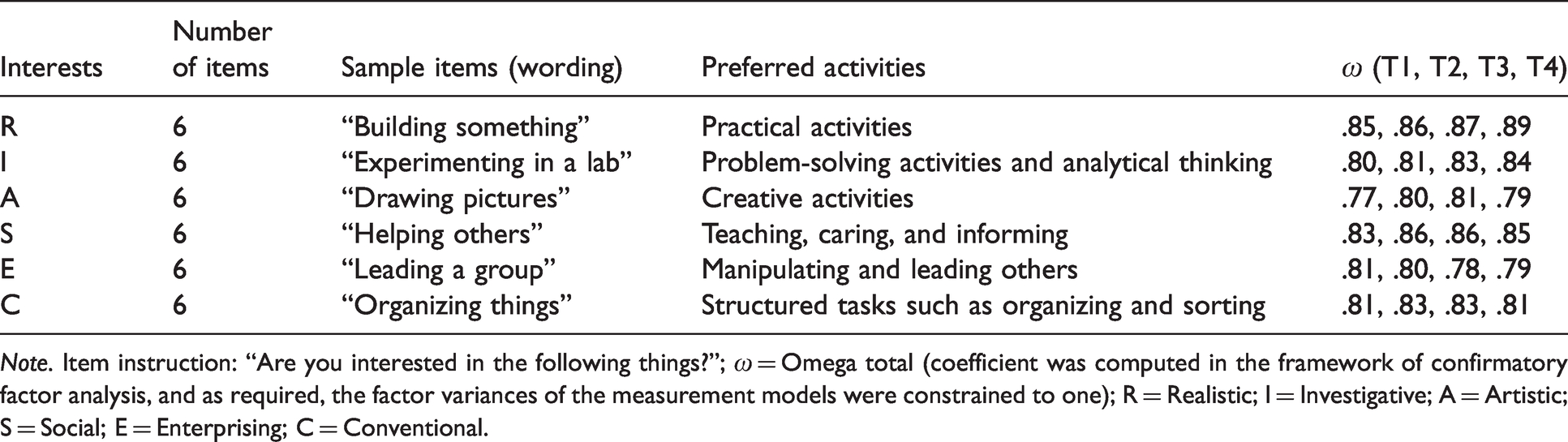
Note. Item instruction: “Are you interested in the following things?”;
Holland (1997) made only a few predictions about how vocational interests should develop over the course of late childhood and early adolescence. He stated that stability is fostered through cumulative learning on the basis of experiences, where preferences for single activities are gradually rewarded and reinforced—for example, through personal satisfaction or external rewards. Preferences for certain activities that are reinforced eventually transform into a disposition, whereas preferences that are not reinforced are neglected. Although changes in vocational interests are possible across the entire life span, such changes become less likely with age (Holland, 1997). This also implies that changes in vocational interests are more likely during late childhood and early adolescence. Hence, investigating the development of vocational interests during that respective time period seems particularly vital.
Recently, Su et al. (2019) proposed the TSID model by suggesting that, despite their generally high stabilities, vocational interests also comprise parts that are influenced by situational characteristics. Stable interests reflect a mental representation of an object, including the related affective and cognitive responses. If interests are less stable and are highly prone to the influence of situational characteristics, this mental representation cannot be assumed to be fully developed yet. Su et al. (2019) assumed a fluent transition between the stable and the situational component of interests, which resembles a state-trait continuum (Braun et al., 2020). According to the TSID model, interests solidify through an accumulation of positive experiences—such as novel activities that arouse curiosity, provide surprising information or are cognitively engaging (Hidi & Renninger, 2006; Renninger & Hidi, 2011)—or are altered through an accumulation of negative experiences (Su et al., 2019). By describing reengagement in specific activities as a key mechanism of interest development, the TSID model builds on Holland’s assumption of cumulative learning as well as processes described by other interest theories (Hidi & Renninger, 2006; Holland, 1997; Renninger & Hidi, 2011; Silvia, 2001). In addition, people have experiences that are embedded in a multiplicity of different environments. People usually choose environments that offer activities that are in line with their interests. Their experiences strengthen (or weaken) their interests in these activities and increase (or decrease) the probability that they will choose similar environments in the future. The TSID model therefore emphasizes that interests also develop on the basis of a dynamic interplay between the person and the environment (Su et al., 2019).
Empirical results on vocational interest stability support Holland’s (1997) assumptions. The meta-analysis by Low et al. (2005) showed that vocational interests reflect relatively high retest correlations, especially during adulthood (peaking around r = .65 and r = .77), and already demonstrate moderate retest correlations during early adolescence (r = .51). In addition, their results suggest that retest correlations are higher in older age groups like late adolescence and young adulthood. Taken together, these results indicate that vocational interests possess moderate stability in late childhood and early adolescence, but their stability increases with age.
However, the empirical basis for the stability of vocational interests is still sparse. The meta-analysis by Low et al. (2005) comprised only five studies in the youngest age-group (12–14 years) and of these five studies, only Tracey (2002) investigated the development of vocational interests across two time points during adolescence. Tracey’s (2002) sample consisted of two cohorts of U.S. students that were followed from fifth to sixth (N = 126) and from seventh to eighth (N = 221) grade. He reported an increase in stability, with moderate retest correlations (.35 < r < .62) for the interval between fifth and sixth and high retest correlations (.72 < r < .81) for the interval between seventh and eighth grade.
Päßler and Hell (2020) investigated the development of vocational interests in a longitudinal sample of 541 Swiss children between the ages of 10 and 12. The sample comprised three waves, each including students from different grade levels (T1 = Grades 4 to 6, T2 = Grades 5 to 7, T3 = Grades 6 to 8). Päßler and Hell (2020) reported moderate stabilities between the first two waves (.37 < r < .44) and small to moderate stabilities between the last two (.17 < r < .47). The current study builds on findings from Tracey (2002) and Päßler and Hell (2020) by investigating whether the differences in stability they reported can also be found when a sample of participants enrolled in the same grade levels are followed over time.
Normative Change in Late Childhood and Early Adolescence—A Period of Decreasing Interests?
Gottfredson (1981) described the development of occupational preferences from childhood to adolescence. According to Gottfredson, the overarching processes that are central for shaping adolescents’ vocational interests are circumscription and compromise. During circumscription, children and adolescents gradually integrate the concepts of size and power (ages 3 to 5), gender (ages 6 to 8), prestige (ages 9 to 13), and views of their own unique self (age 14 and older), such as abilities, values, and personality, into their self-concept (Gottfredson, 1981). This integration takes place in the respective environment or social context, and self-concept is therefore very likely to be influenced by and to interact with the environment as it develops. Different environments may consequently lead to different self-concepts. Through their experiences and interactions with other people in different environments or social contexts, children and adolescents gradually rule out occupations that do not match their developing self-concept. According to Gottfredson (1981), vocational interests therefore depend on the internal comparison between one’s views of oneself and one’s views of certain occupations. After the phase of circumscription, Gottfredson postulated a phase of compromise in which adolescents begin to realize that some of the occupations they regard as suitable for their self-concept might not be available to them. Accordingly, adolescents shift their interests to occupations that might be less compatible with their self-concepts but more accessible. The process of compromise again highlights that interests interact with the respective environment as these interests develop.
Against this background, it could be assumed that through the process of circumscription, vocational interests become more differentiated with age because adolescents gradually figure out which activities they do not like. This differentiation on the individual level could manifest in mean-level decreases on the group level (e.g., in RIASEC dimensions; see also Tracey, 2002). In addition, there is evidence of a similar pattern of mean-level decreases in other motivational constructs, for example, the intrinsic value of school subjects (Gaspard et al., 2017) and academic self-concept (Cole et al., 2001) as well as an increase in the specialization of school-subject domains over time (Denissen et al., 2007). Furthermore, the process of circumscription could also initiate a general disinterest in the world of work at first, as the gradual identification of unsuitable occupations may be accompanied by an accumulation of negative experiences. This circumstance would also manifest in mean-level decreases of interests during these specific years (e.g., in RIASEC dimensions).
Evidence of decreasing mean levels was identified in the meta-analysis by Hoff et al. (2018), who reported mean-level decreases for five of the six RIASEC dimensions during late childhood and early adolescence (ages 11 to 14). Two of these five interest dimensions showed decreases that were statistically significant, with small effect sizes between d = –0.30 and d = –0.17. These results were based on two studies, of which Tracey’s (2002) two-cohort study was once again the only one that was published. He reported mean-level decreases in four of the six RIASEC dimensions for each cohort, from fifth to sixth (i.e., decreases in Realistic, Investigative, Artistic, and Enterprising interests) and from seventh to eighth grade (i.e., decreases in Realistic, Investigative, Enterprising, and Conventional interests). Päßler and Hell (2020) obtained similar results, reporting significant decreases in Realistic, Investigative, Artistic, and Social interests from ages 10 to 12.
Late Childhood and Early Adolescence as a Phase of Gender Differentiation?
Gottfredson’s (1981) theory suggests that the manifestation of gender differences in vocational interests has already begun by the age of 6. At this age, children begin to understand the concept of gender roles and start to recognize cues, such as stereotypical gender-specific clothing and activities (Gottfredson, 1981). With increasing age, children understand more abstract cues, such as differences in stereotypical gender-specific personality characteristics (Gottfredson, 1981). According to Gottfredson (1981), the behavior of children during this time can be characterized as “concern[ed] with doing what is appropriate for one’s sex” (p. 569). Gender differences in vocational interests should therefore begin to manifest during childhood and should be present over the course of adolescence and adulthood.
Indeed, there is empirical evidence for robust and large gender differences in the mean levels of vocational interests in adolescence and adulthood. Su et al. (2009) conducted a meta-analysis on gender differences in vocational interests in which they included cross-sectional studies with participants who ranged in age from 13 to 43. The results showed that across all age groups, males had higher mean-level scores in Realistic and Investigative interests, whereas females had higher scores in Artistic, Social, and Conventional interests. The effect sizes for these gender differences were quite large, with
A similar pattern in gender differences can already be found during late childhood. Tracey (2002) reported gender differences for fifth-grade students, with boys scoring higher on Realistic and Investigative interests and girls higher on Artistic, Social, and Conventional interests. Similar results were reported by Päßler and Hell (2020). Although meta-analytic results (Hoff et al., 2018) have indicated that the gender gap between Social and Realistic interests widens over the course of late childhood and early adolescence, this pattern was not confirmed in the longitudinal study by Päßler and Hell (2020).
The Present Study
We investigated the development of vocational interests over the course of late childhood and early adolescence. We used large-scale longitudinal data (N = 3,786) assessed at four time points in Grades 5, 6, 7, and 8. We used prior empirical and theoretical work to derive our three main research questions and to guide our expectations. We did not preregister the assumptions of the following study.
First, we investigated the stability of vocational interests. We computed retest correlations for each scale between the scale scores from all adjacent time points. On the basis of prior results, we expected that vocational interests would be moderately stable in terms of retest correlations (r around .50; see Low et al., 2005). In addition, on the basis of assumptions derived from Holland (1997), we expected that retest correlations would increase over the course of late childhood and early adolescence.
Second, we investigated state and trait variance components and how they change over time. We computed state and trait variance proportions for each scale at each time point. According to the assumption of Su et al. (2019), we assumed that vocational interests consist of both state and trait variance proportions. In addition, according to Holland (1997) as well as Su et al. (2019), we assumed that the trait variance proportions are more substantial than the state variance proportions and that the trait variance proportion would increase over time.
Third, we investigated how mean levels in vocational interests develop from ages 11 to 14. Because current evidence based on multiwave data is scarce, we decided to provide comprehensive descriptive information about the yearly development of vocational interests on the basis of manifest mean levels. To account for measurement error and test for different types of growth, we also inspected latent mean-level trajectories. On the basis of the results from Hoff et al. (2018), Tracey (2002), and Päßler and Hell (2020) and the theoretical considerations derived from Gottfredson (1981), we expected a general decrease in mean levels over the course of late childhood and early adolescence. However, in line with the results from Hoff et al. (2018) and the general stability of vocational interests, we assumed that, over the 3 years, these decreases would be rather small (d < 0.30). No assumptions were made concerning the types of mean-level trajectories (i.e., linear or quadratic) because no prior evidence was available. We exploratorily tested which growth type fitted the data better.
Fourth, we investigated gender differences in vocational interests. In line with Su et al. (2009), we expected that boys would have higher mean levels in Realistic and Investigative interests and girls in Artistic, Social, and Conventional interests. In addition, according to the theoretical assumptions derived from Gottfredson (1981), an increase in gender differences over time could be assumed. However, because the empirical findings from Hoff et al. (2018) and Päßler and Hell (2020) were inconclusive, we made no assumptions about increases in gender differences over time but investigated them exploratorily.
Method
Sample
We used data from the Tradition and Innovation (TRAIN; Jonkmann et al., 2013) study. 1 TRAIN is a large-scale longitudinal study in which students from lower, intermediate, and multitrack schools (a combination of the lower and intermediate tracks) were followed annually from fifth to eighth grade (T1, T2, T3, and T4). The study protocol and data protection measures of the TRAIN study were reviewed and approved by the responsible departments and the independent data protection official of the Ministry of Culture, Youth, and Sports at Baden-Württemberg and the Saxon Ministry of State for Education and Culture. Participation was voluntary, and students could participate only with active parental consent.
The schools were chosen from the states of Baden-Württemberg and Saxony. From every school (99 overall), one to two classes (136 overall) participated in the study. The sample sizes were n = 2,894 (46% female) students at T1 (Grade 5), n = 2,936 (45% female) students at T2 (Grade 6), n = 2,993 (46% female) students at T3 (Grade 7), and n = 3,060 (46% female) students at T4 (Grade 8). The sample size increased slightly over time because additional students were included at later time points. The reasons were repetition, changes in a class, or the relocation of a participant’s family. The overall number of students who participated at a minimum of one time point was N = 3,876, which was also the sample used in the current analysis (for details about the sample composition and dropout, see Supplement A). It should be noted that although TRAIN comprises a large longitudinal sample, it is not representative of all students in the German states of Baden-Württemberg and Saxony because it does not include students from the highest school track. TRAIN was designed to investigate the influence of learning environments from lower, intermediate, and multitrack schools on educational outcomes, and higher track students were therefore not part of the sample (Jonkmann et al., 2013).
We conducted two types of attrition analyses at each time point. First, we compared participants who dropped out of the study at a respective time point with the participants who remained in the study. Second, we compared participants who joined the study at a respective time point with the participants who were already participating before that time point. Differences in interest measures, sociodemographic variables, achievement measures, and personality characteristics (i.e., Big Five) were investigated. In general, differences in interest measures, sociodemographic variables, and personality characteristics were small and, in the majority of cases, not significant. Comparing participants who dropped out of the study with the remaining participants, the standardized mean differences ranged from
For achievement measures, the largest differences were found for school grades, which ranged from
Instruments
Vocational interests were operationalized in accordance with the RIASEC framework. As there is currently no interest inventory that was designed for the transition from childhood to adolescence, two frequently-used and validated interest inventories were modified and combined. For adolescents older than 14, the Revised General Interest Structure-Test (AIST-R; Allgemeiner Interessen Strukturtest; Bergmann & Eder, 2005) is used most often in German-speaking countries (e.g., Germany, Austria, and Switzerland). For children, the German version of the Inventory of Children’s Activities (ICA; Tracey & Ward, 1998; German version [ICA-D]: von Maurice, 2006) is used. To ensure and enhance the comprehensibility of the interest inventory for the young age-group of the TRAIN study, experts from the research field of vocational interests selected items from the German version of the ICA, items from the AIST-R, and constructed a few new items, focusing on activities that were familiar to children at age 11, but still suitable (i.e., not too childish) for adolescents at the age of 14. They followed the recommendations made by Tracey (2002) about measuring children’s vocational interests by asking about “familiar activities, rather than unfamiliar occupations” (Tracey, 2002, p. 149). The final questionnaire consisted of 11 items from the AIST-R, 15 items from the ICA, and 11 new items (see Supplement B).
Every RIASEC dimension was assessed with six items per time point. Students answered the question “How much do you like this activity?” on a 5-point Likert scale ranging from 1 (not at all) to 5 (very). Sample items and reliability coefficients for all scales and every time point can be found in Table 1. Omega total (McNeish, 2018) ranged from .77 <
Statistical Analyses
We provide all analysis scripts of the current study in an OSF repository (see: https://osf.io/tuys8/?view_only=cb07ca448fdf4dce998e250ae635a419).
Measurement Invariance
To adequately attribute latent mean-level differences to changes in the latent construct, strong measurement invariance is required. Therefore, we investigated measurement models with different degrees of invariance across time as well as across the Time
The following fit indices and values were used to judge whether the overall fit of the models was adequate: Incremental fit indices such as the Comparative Fit Index (CFI) and the Tucker–Lewis Index (TLI) with values of .90 or higher, the Standardized Root Mean Square Residual (SRMR) with a value of .08 or lower, as well as the Root Mean Square Error of Approximation (RMSEA) with a value of .06 or lower (Hu & Bentler, 1999).
For evaluating the changes in incremental fit indices (i.e., CFI, SRMR and RMSEA) between the respective models (i.e., configural, weak and strong invariance), we applied the recommendations made by Chen (2007). We used the recommended values to test for factor loading invariance with an adequate sample size, with values ≥ .010 for
According to the fit indices, all the longitudinal models with strong invariance provided an adequate fit (for fit indices, see Supplement C). However, for the models that indicated invariance across the Time
To achieve partial strong invariance, intercepts of single items with large gender differences are freed in accordance with the weak measurement invariance model. To achieve partial strong invariance in our study, we freed one item intercept for Social, two item intercepts for Realistic, Investigative, Enterprising, and Conventional, and three item intercepts for Artistic. All other item intercepts were invariant across time and gender. The final partial strong invariance models indicated an adequate overall model fit (according to Chen, 2007). For a detailed description of the measurement invariance results, see Supplement C.
Mean Levels and Retest Correlations
To examine the manifest mean-level change and correlation coefficients, we specified a saturated path model that included all the manifest scale scores for the six RIASEC dimensions (see a depiction of the model in Supplement D). The six manifest scale scores were allowed to be freely correlated across all time points. Descriptive statistics, mean-level differences, and retest correlations for adjacent time points were derived from this model. To examine the mean-level differences with a standardized effect size, we computed Cohen’s d for repeated measures (Lakens, 2013; for the formula, see Supplement C). With regard to the meta-analytic findings from Hoff et al. (2018) and the general stability of interests, we considered the changes over the 3-year time period ranging from d = 0.20 to d = 0.30 to be substantial.
To estimate the model parameters, we used a maximum likelihood estimator that is robust against non-normality and nonindependence of data by choosing the analysis option TYPE = COMPLEX in Mplus 8 (Muthén & Muthén, 1998–2017). The estimator is labeled Maximum Likelihood Robust (MLR) in Mplus 8, and its χ2 test statistic is asymptotically equivalent to the Yuan-Bentler T2 test statistic (Muthén & Muthén, 1998–2017; Yuan & Bentler, 2000). For significance testing, we provided 95% confidence intervals (CIs) for all parameters in the saturated path model and for all parameters in the subsequent models. In addition, all subsequent models were also specified with the MLR estimator in Mplus 8 (Muthén & Muthén, 1998–2017).
Computing Proportions of State and Trait Variance
To compute the proportions of state and trait variance, we specified a generalized second-order growth model (GSGM; Bishop et al., 2015) with time-invariant factor loadings and time-invariant intercepts for each interest dimension separately (for a depiction of the model, see Supplement D). The GSGM is a hybrid between a latent state-trait model (LST; Steyer et al., 1999) and a growth curve model (GCM; McArdle & Epstein, 1987). The GSGM consisted of three components that were represented by three latent variables: a component that is stable over time, representing initial trait levels; a component that captures growth over time, representing trait growth; and time-point-specific components, representing time-point-specific fluctuations (or state residuals). An advantage of the GSGM is the possibility of separating the model-implied variance components of the indicators that are due to the trait, trait growth, state residual, and measurement error (Geiser et al., 2015). We included the growth component in the model because, according to theory, vocational interests are dispositions that develop over time. Therefore, long-term changes such as trait growth should be accounted for and included as part of the proportion of reliable trait variance. A model without a growth component would merely represent state variability that implies no trait development over time (Geiser et al., 2015). The intercept factor of the growth curve model part was identified by fixing the factor loading of the first item of each time point to 1 and the intercept to 0 (see Supplement D for a model depiction).
The model-implied variance components were used to calculate the consistency (CO), occasion specificity (OS), and reliability (REL; Geiser et al., 2015) of the interest constructs. CO represents the proportion of the variance of the indicators that is due to the trait and trait-growth components, whereas OS represents the proportion of the variance that is due to the state residual component (see Supplement D for the formulas). The state residual component OS represents the influences of the situation and the Person
The total model-implied variance of every item in the GSGM can therefore be segmented into the components OS, CO, and measurement error (
Specifying Growth Type
For every RIASEC dimension, we specified two GSGMs, one with linear and one with quadratic trait growth. To decide whether the model with the quadratic growth type fits the data substantively better, we determined whether the changes in the descriptive fit indices between the model that contained only the linear growth and the model that additionally contained the quadratic growth were substantial. If this was the case, we decided to choose the model with a quadratic growth factor. To assess the changes in model fit, we used the values proposed by Chen (2007). Because these recommendations were explicitly given for measurement invariance testing, we used them with caution and only as approximate guides. As no assumptions about the growth type could be derived from current studies, our approach here was to investigate which growth type best described the data.
Analyzing Gender Differences
To examine gender differences in the mean levels, we used multigroup modeling. We specified a multigroup saturated path model to obtain manifest mean-level scores for boys and girls. For the GSGM multigroup models, we first specified an overall model, where both groups, boys and girls, had linear as well as quadratic growth components. We then determined whether the means of the respective quadratic growth factors were statistically significantly different from zero. If this was not the case, we specified another model in which we constrained the quadratic growth type for the respective group. If the change in the descriptive fit indices according to the values proposed by Chen (2007) was negligible, we decided to keep the constrained model. Due to missing prior evidence, the approach of choosing the appropriate growth type was again data driven.
Missing Data
To deal with the occurrence of missing data, we used full information maximum likelihood estimation (see, e.g., Enders, 2001) in all models. To make the Missing at Random assumption more plausible and to reduce possible selection bias due to attrition, we included multiple auxiliary variables that could explain the causes of the missing data, thus improving parameter estimation (Collins et al., 2001; Enders, 2008; Graham, 2003). The auxiliary variables were included in the estimation of the model in line with the saturated correlates model approach (Graham, 2003) through the Mplus 8 AUXILIARY command (Asparouhov & Muthen, 2008). In this approach, auxiliary variables are included in the analysis through correlations with variables that are part of the actual analysis, but these auxiliary variables are not part of the structural model. All variables that indicated significant differences during the attrition analysis were included as auxiliary variables in all analyses (for an overview of these variables, see Supplement A).
Nested Data Structure
In the present data set, students were nested in classes, which led to a hierarchical data structure that could cause an underestimation of the standard errors. Because classes were not the focus of our analysis, we treated them as a nuisance (McNeish et al., 2017) and therefore relied on cluster-robust standard errors to correct the underestimation. We used the implemented analysis option in Mplus 8, TYPE = COMPLEX, which computes the standard errors on the basis of a sandwich estimator method that accounts for the violation of the independence of observations assumption (McNeish et al., 2017). The intraclass correlations of the RIASEC scales with class as the cluster variable ranged from .02 to .11. We decided not to include school as another cluster variable because only the intraclass correlations for Investigative, Enterprising, and Conventional at the first time point were noteworthy with an intraclass correlation coefficient of .09. The intraclass correlations of the majority of the variables were below .04 (see Supplement A for an overview of the intraclass correlations).
Results
The exact p values of all parameters depicted in the Results section and a correlation matrix containing all scales can be found in the respective output files on the OSF repository (see: https://osf.io/tuys8/?view_only=cb07ca448fdf4dce998e250ae635a419).
Stability of Vocational Interests
Retest Correlations
To investigate the stability of vocational interests, we computed retest correlations for the vocational interest scales. In line with our assumptions, the 1-year retest correlations for all interest dimensions were moderate, ranging from r = .41 to r = .64 (see Table 2). The retest correlations for the entire 3-year interval were lower, ranging from r = .32 to r = .49 for all interest dimensions.
Manifest Retest Correlations of RIASEC Scales and Their Change Over Time.
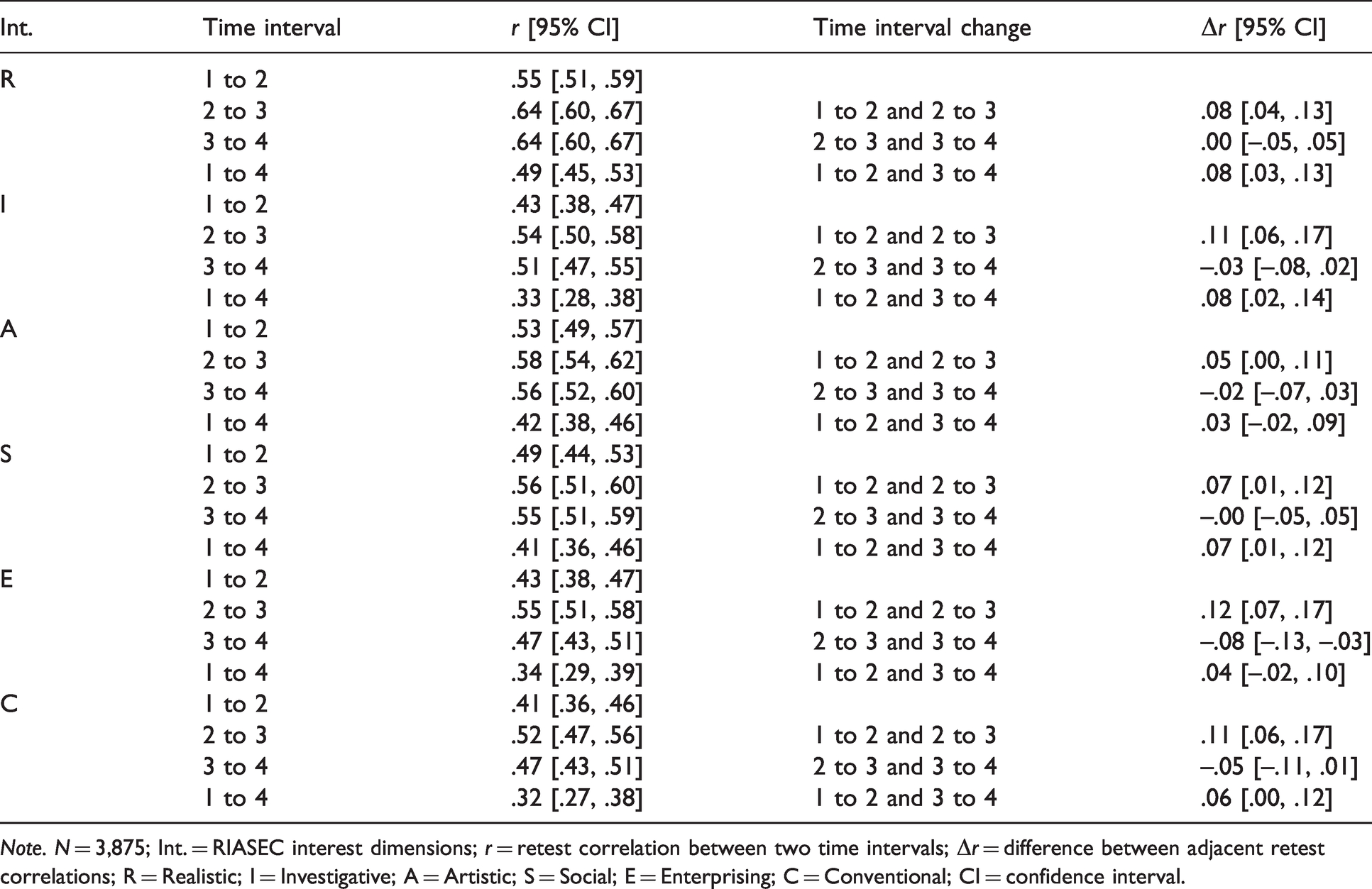
Note. N = 3,875; Int. = RIASEC interest dimensions; r = retest correlation between two time intervals;
Realistic, Investigative, Social, and Conventional showed significant increases in retest correlations from the first to the last interval, with increases ranging from
For Artistic and Enterprising, the retest correlations also increased from the first to the last interval (see Table 2), by
Proportions of State and Trait Variance of Vocational Interests
To investigate vocational interest stability while accounting for trait development, we computed components of state and trait variance (see Table 3). In line with our assumptions, the CO coefficients (i.e., the proportion of the variance in the indicators due to the trait and trait-growth components) for Realistic, Artistic, Social, and Conventional significantly increased by 5% to 12% from T1 to T4 (see Figure 1).
Consistency and Occasion Specificity of RIASEC Dimensions per Time Point.
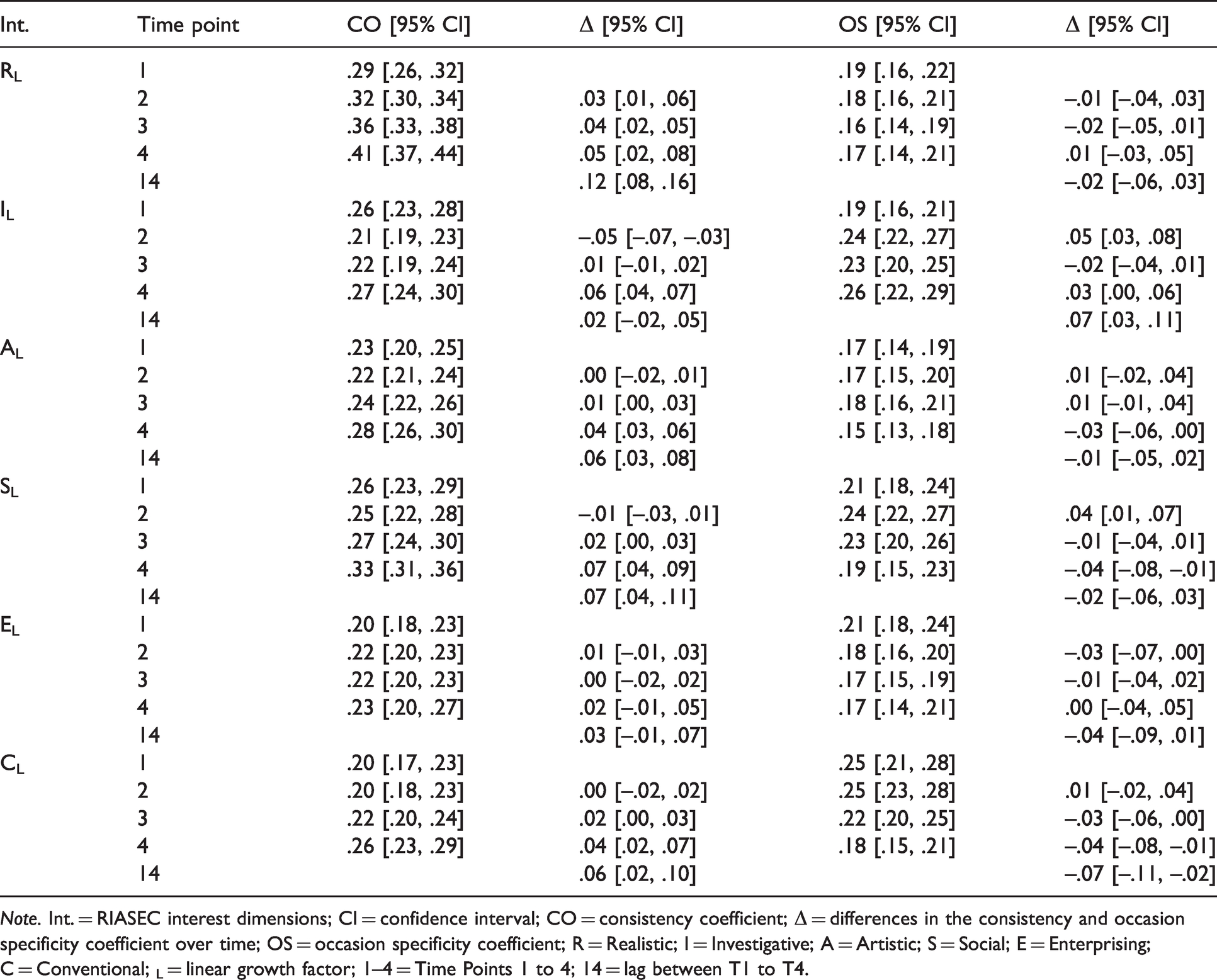
Note. Int. = RIASEC interest dimensions; CI = confidence interval; CO = consistency coefficient;
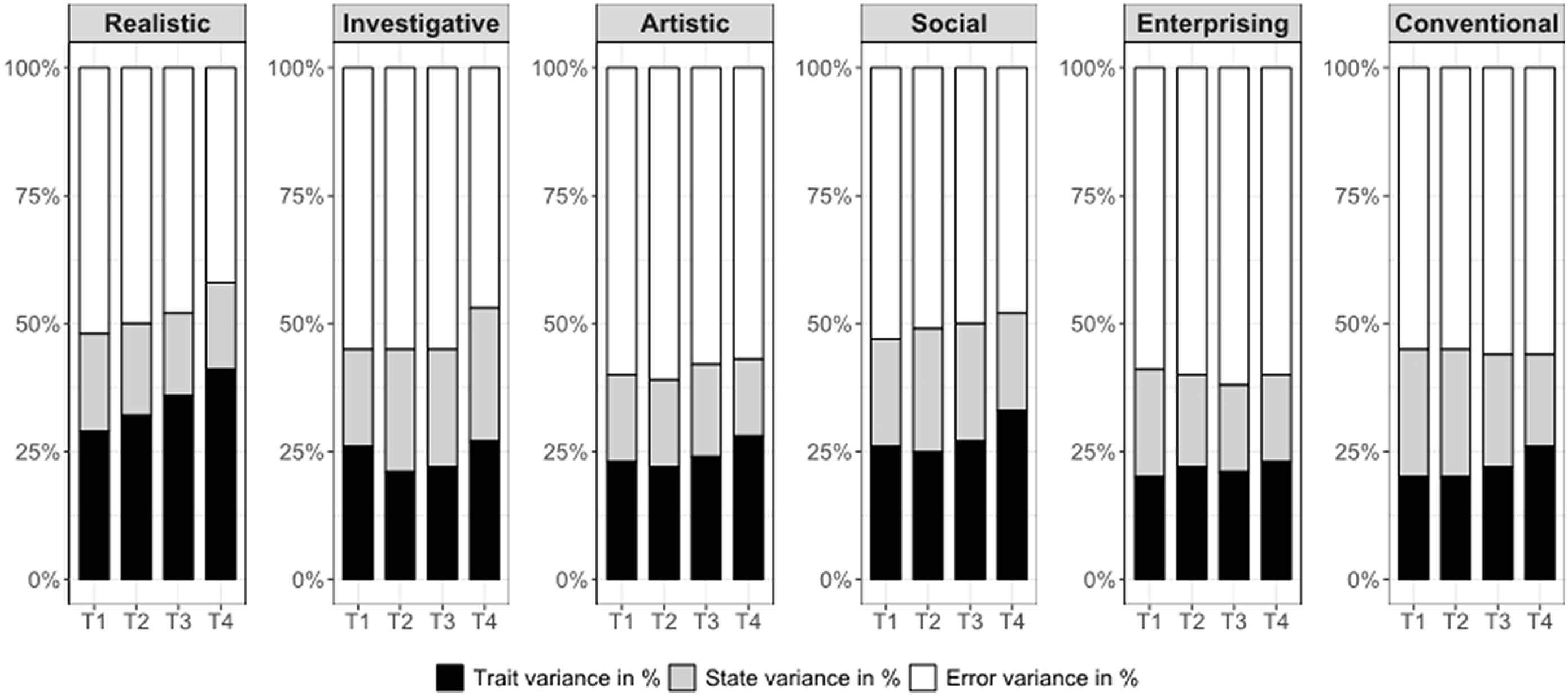
Time-Point-Specific Proportions of State and Trait Variance in the Overall Sample.
From T1 to T4, the OS coefficients (i.e., the proportion of variance due to the state residual component, representing the influence of the situation and Person
In contrast to our expectations, from T1 to T4, the CO coefficients for Investigative and Enterprising did not change significantly. In addition, from T1 to T4, the OS coefficient for Investigative showed a significant increase, whereas the OS coefficient for Enterprising did not change significantly. At T4, CO coefficients for Enterprising (Δ = .06, 95% CI [–.01, .13]) and Investigative (Δ = .02, 95% CI [–.04, .07]) did not differ significantly from the respective OS coefficients, a result that was not in line with our assumptions.
Mean-Level Development of Vocational Interests
To investigate the mean-level development of vocational interests, we examined the coefficients in the saturated path model (see Table 4) and the trajectories of the latent mean levels. In line with our assumptions, the mean levels of the majority of the interest dimensions decreased from T1 to T4 (Figure 2). The mean levels for Realistic, Investigative, Artistic, and Conventional decreased significantly over the 3-year time period, with effect sizes ranging from d = –0.44 to d = –0.24. The latent mean levels of these interest dimensions showed a significant linear decrease over time, and including a quadratic growth factor did not substantially improve the model fit according to the indices in Table 5 (for an overview of all model fit indices, see Supplement C).
Descriptive Statistics and Mean-Level Change in the RIASEC Scales in the Overall Sample.
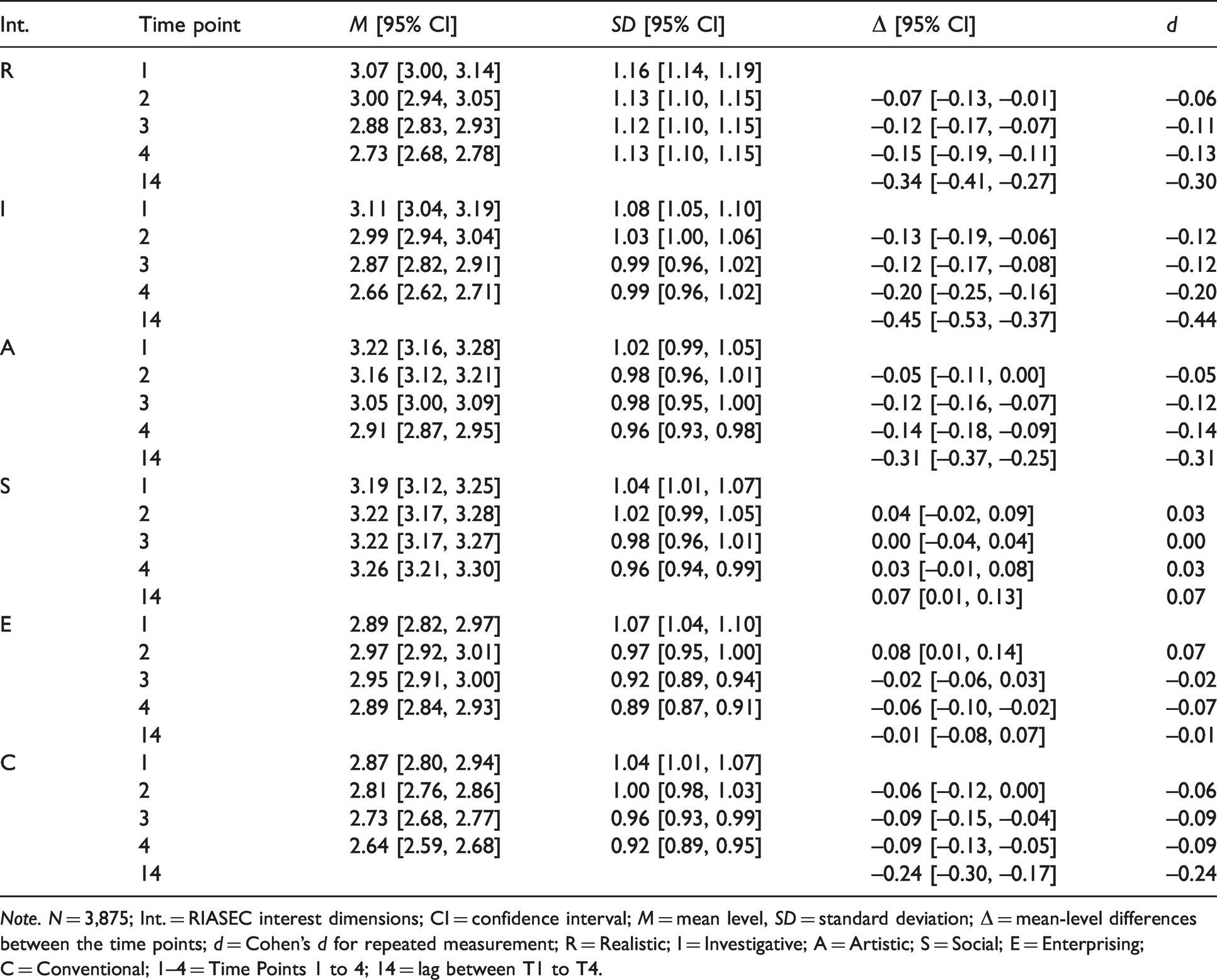
Note. N = 3,875; Int. = RIASEC interest dimensions; CI = confidence interval; M = mean level, SD = standard deviation;
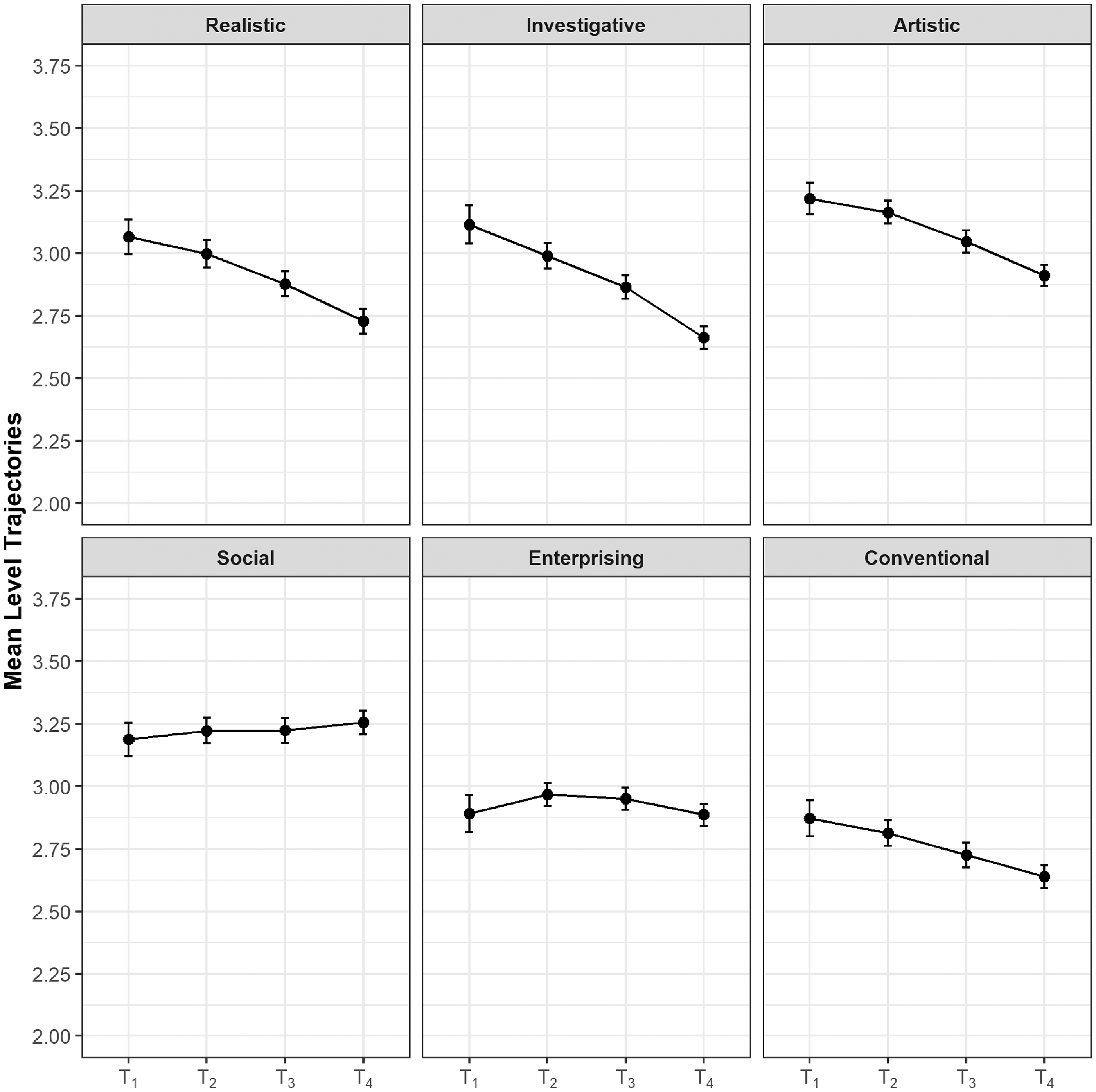
Manifest Mean Levels of the Scale Scores for the RIASEC Dimensions.
Fit Indices for Single and Multigroup Generalized Second-Order Growth Model.
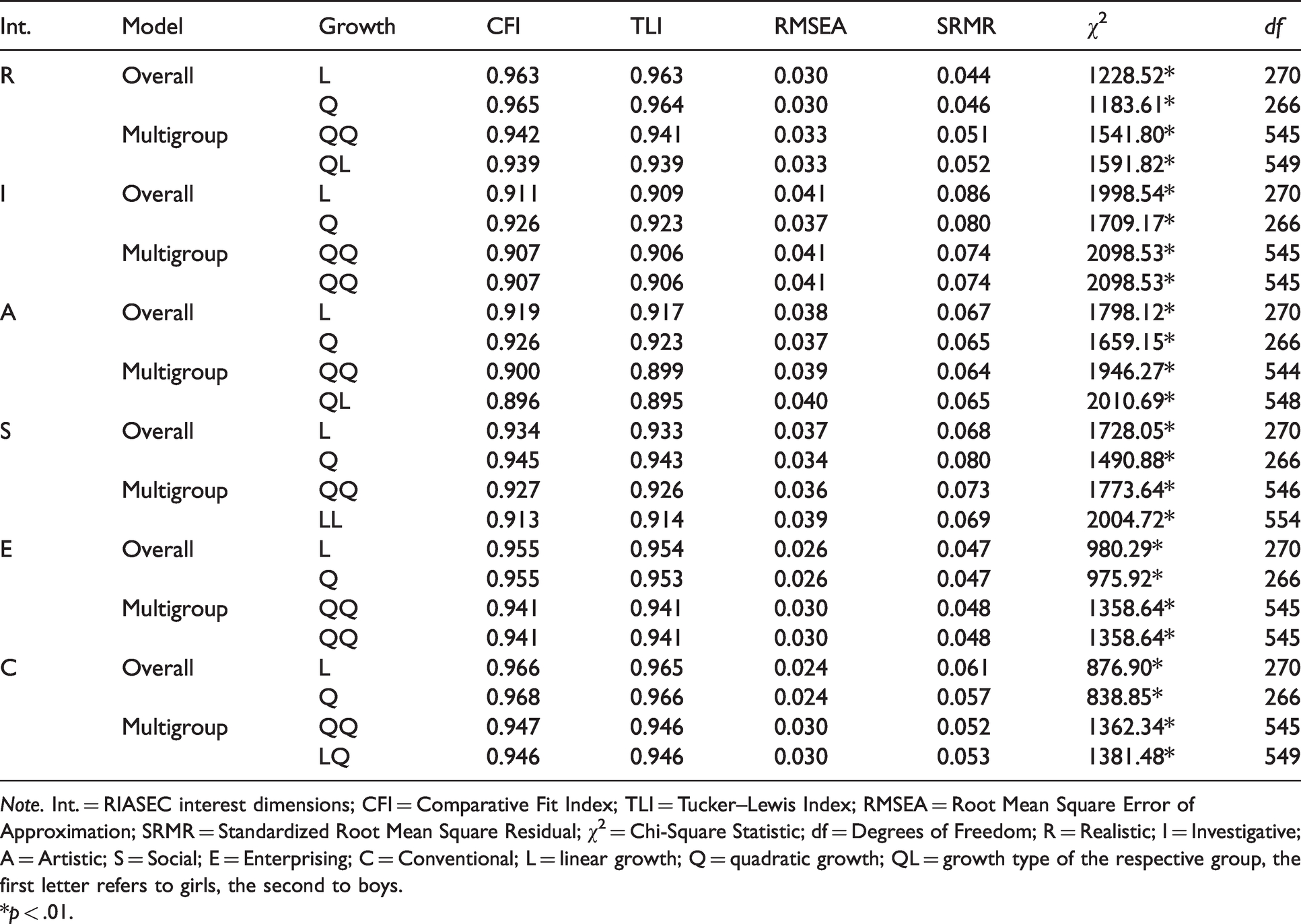
Note. Int. = RIASEC interest dimensions; CFI = Comparative Fit Index; TLI = Tucker–Lewis Index; RMSEA = Root Mean Square Error of Approximation; SRMR = Standardized Root Mean Square Residual; χ2 = Chi-Square Statistic; df = Degrees of Freedom; R = Realistic; I = Investigative; A = Artistic; S = Social; E = Enterprising; C = Conventional; L = linear growth; Q = quadratic growth; QL = growth type of the respective group, the first letter refers to girls, the second to boys.
*p < .01.
By contrast, Social was the only interest dimension for which the mean levels increased slightly (d = 0.07), whereas the mean levels for Enterprising did not change (d = –0.01) from T1 to T4. The latent mean levels for Social and Enterprising showed a linear trend over time, and including a quadratic growth factor did not substantially improve the model fit. For Social, the mean levels of the latent growth factors indicated a significant increase, and for Enterprising, a nonsignificant decrease (see Table 6 and Supplement C).
Intercept and Slope of Single and Multigroup Generalized Second-Order Growth Models.
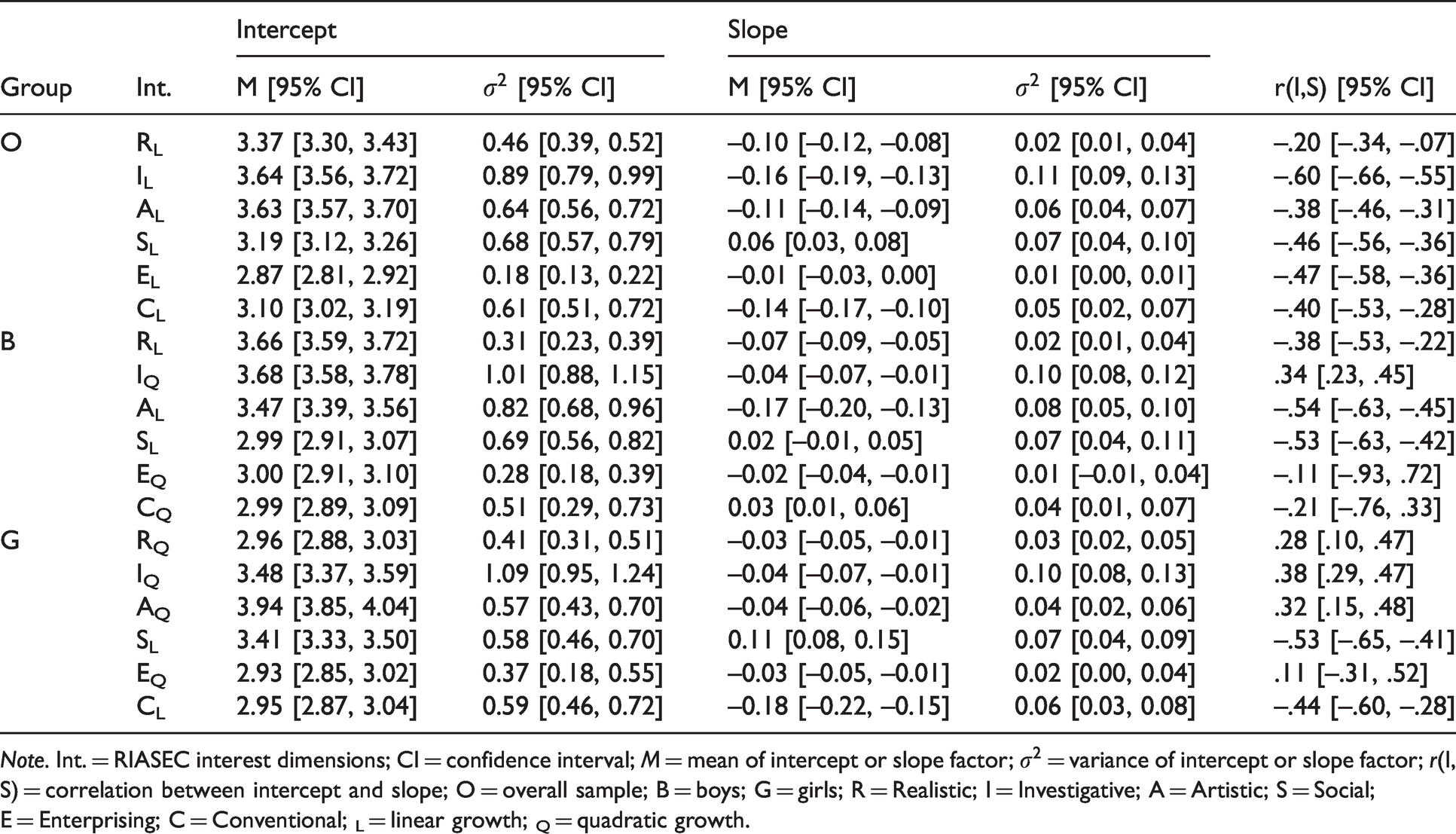
Note. Int. = RIASEC interest dimensions; CI = confidence interval; M = mean of intercept or slope factor;
Gender Differences in the Mean Levels of Vocational Interests
To investigate the mean-level differences between boys and girls, we examined the coefficients in the multigroup saturated path model (see Table 7) and the multigroup GSGM. In line with our assumptions, we found gender differences in the manifest mean levels for Realistic and Investigative, with boys having higher mean levels than girls. For boys and girls, manifest mean levels for Realistic and Investigative decreased significantly from T1 to T4 (see Tables 8 and 9), with standardized effect sizes ranging from d = –0.44 to d = –0.54 for girls and d = –0.24 to d = –0.35 for boys. For Realistic and Investigative, the gender differences in the manifest mean levels increased from T1 to T4 (see Figure 3). The latent mean levels for Realistic and the corresponding model fits (see Table 5) indicated a linear trajectory for boys and a quadratic trajectory for girls. For Investigative, the latent mean levels indicated a quadratic trajectory for girls and boys.
Differences in Means, Standard Deviations, and Mean-Level Changes Between Boys and Girls.
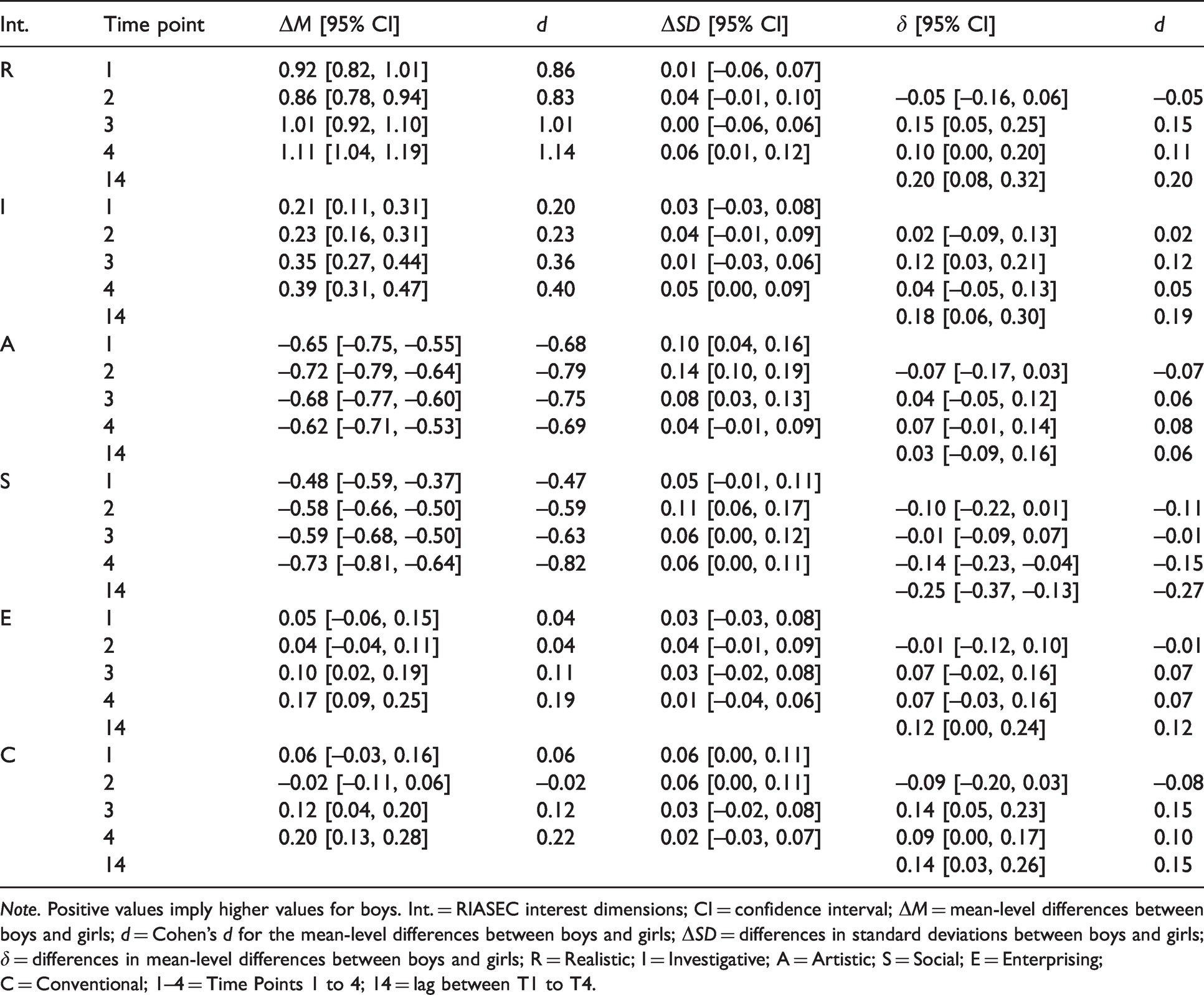
Note. Positive values imply higher values for boys. Int. = RIASEC interest dimensions; CI = confidence interval;
Descriptive Statistics and Mean-Level Change in RIASEC Scales in the Sample of Girls.
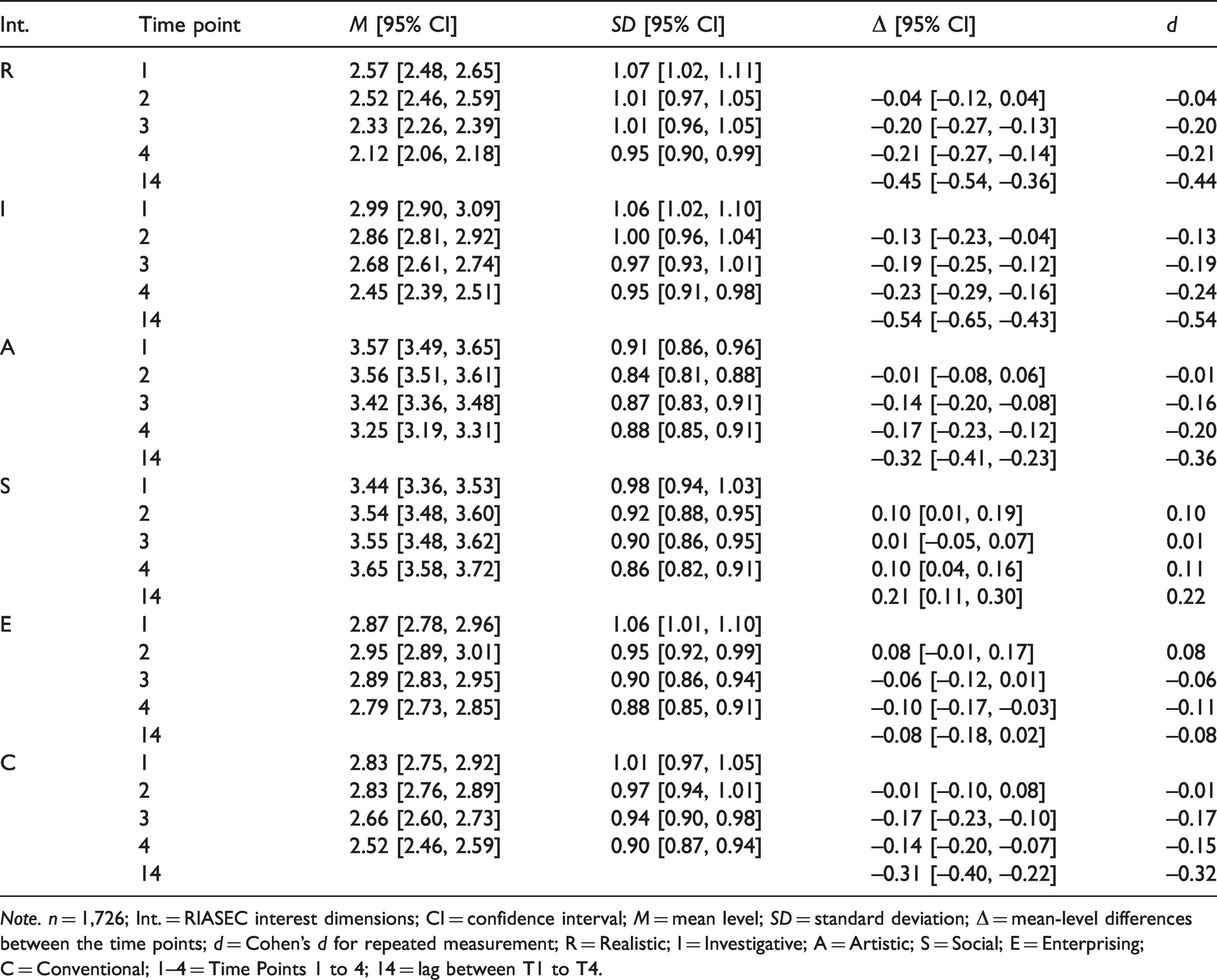
Note. n = 1,726; Int. = RIASEC interest dimensions; CI = confidence interval; M = mean level; SD = standard deviation;
Descriptive Statistics and Mean-Level Change of RIASEC Scales in the Sample of Boys.
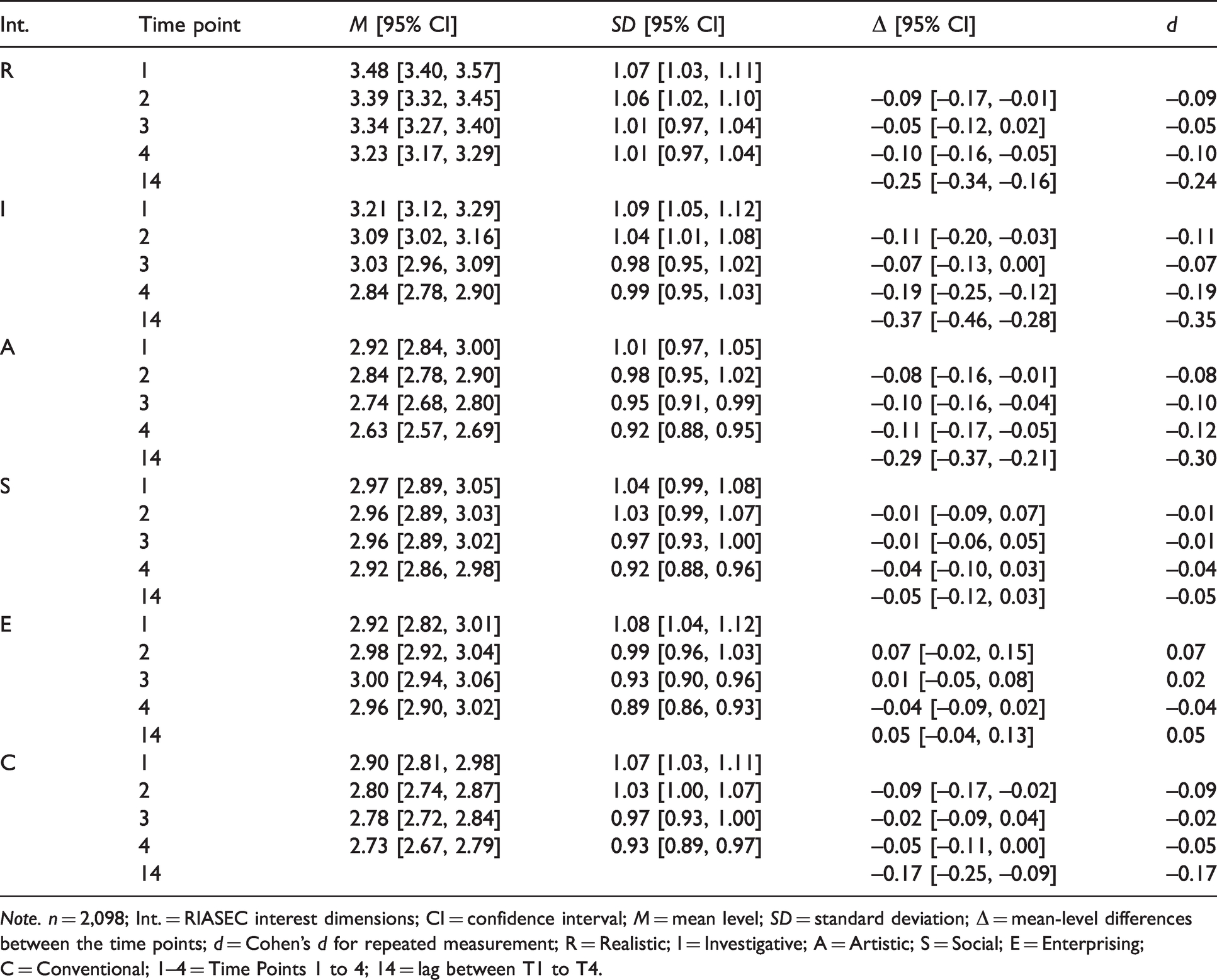
Note. n = 2,098; Int. = RIASEC interest dimensions; CI = confidence interval; M = mean level; SD = standard deviation;
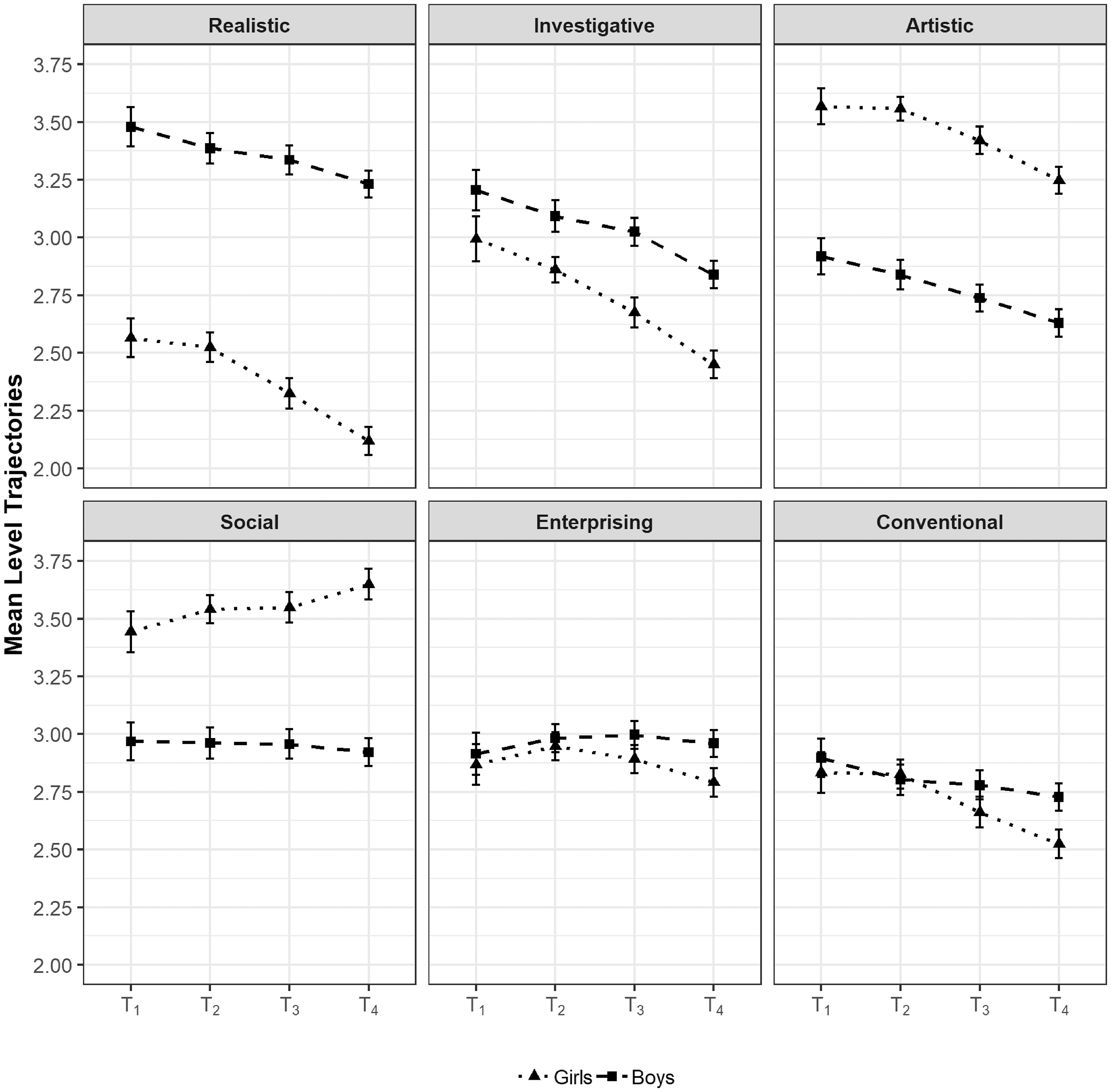
Manifest Mean Levels of the Scale Scores for the RIASEC Dimensions for Girls and Boys.
In line with our assumptions, we found gender differences in manifest mean levels for Artistic and Social (see Table 7), with girls having higher mean levels than boys. Both boys and girls showed significant decreases in their mean levels for Artistic, with effect sizes of d = –0.30 and d = –0.36, respectively. Their developmental pattern differed, however, for Social (see Figure 3), where boys did not show significant changes in their mean levels from T1 to T4, and girls showed a significant increase (d = 0.22). Differences between boys and girls in their manifest mean levels in Social interest increased over time. For Artistic, gender differences in the manifest mean levels did not increase over time (see Table 7). The latent mean levels for Artistic indicated a linear trajectory for boys and a quadratic trajectory for girls (see Table 5). For Social, the latent mean levels indicated a linear trajectory for girls and boys.
In contrast to our assumptions, for Conventional, boys demonstrated higher manifest mean levels than girls at T3 and T4. In addition, at T3 and T4, boys had higher mean levels than girls for Enterprising. From T1 to T4, boys and girls did not show significant changes in manifest mean levels for Enterprising. However, both groups showed significant mean-level decreases in Conventional, with d = –0.32 for girls and d = –0.17 for boys. Despite having similar manifest mean-level change patterns, the manifest mean-level differences between boys and girls on both interest dimensions increased from T1 to T4 (see Figure 3). According to the fit indices (see Table 5), the latent mean levels for Conventional indicated a quadratic trajectory for boys and a linear trajectory for girls. For Enterprising, the latent mean levels indicated a quadratic trajectory for girls and boys.
Discussion
The current study used multiple indicators of continuity and change to examine the development of vocational interests over the course of late childhood and early adolescence (i.e., ages 11 to 14), in a sample in which the same participants were followed over four time points. The multiwave data made it possible to investigate mean-level trajectories and changes in stability coefficients as well as gender differences in vocational interests over time—information that is currently not available for the crucial period of late childhood and early adolescence. In addition, by investigating state and trait variance proportions, new empirical evidence was generated that informs about the relative proportions of state and trait components in vocational interests.
Our study had three major findings: First, vocational interests showed moderate retest correlations (around r = .50) over the course of late childhood and early adolescence, and the retest correlations for the interest dimensions Realistic, Investigative, Social, and Conventional showed significant increases over time. In addition, the findings on state and trait variance proportions indicated that vocational interests generally possessed a substantial proportion of trait variance that further increased over time. Second, over the course of late childhood and early adolescence, Realistic, Investigative, Artistic, and Conventional showed decreases in their mean levels. The effect sizes for these changes were small to moderate, and the latent mean-level trajectories indicated linear trends over time. Third, we found gender differences in the mean levels of all interest dimensions that increased over the course of late childhood and early adolescence for all interest dimensions—except Artistic.
Increasing Stability in Interests During Late Childhood and Early Adolescence
The moderate (.41 < r < .64) retest correlations in our study are in line with the meta-analytic findings from Low et al. (2005), who reported an average retest correlation of r = .51. In addition, the majority of the interest dimensions possessed retest correlations that increased with age.
The proportions of state and trait variance in the current study indicate that the majority of vocational interests possess a substantial trait component that increases with age. Because no other studies have investigated state and trait variance proportions in vocational interests, we will compare them to constructs that have a similar dispositional nature. Rieger et al. (2017) reported proportions of trait variance for personality traits using the same data set, indicating that the proportions of trait variance in personality traits are similar in magnitude to the ones reported for vocational interests. Rieger et al. (2017) also reported proportions of trait variance for interests in school subjects that were averaged across all time points, with estimates ranging from .27 to .30. The proportions of trait variance found at T4 in the current study were similar in magnitude, ranging from .23 to .33, except for Realistic, which had a proportion of trait variance of .41.
Our results are in line with Holland’s (1997) and the TSID model’s (Su et al., 2019) theoretical assumptions. Holland (1997) stated that stability is fostered through cumulative learning on the basis of experiences, where preferences for single activities are gradually rewarded and reinforced. Similar assumptions are made by the TSID model, which implies that interests solidify through an accumulation of positive experiences or are altered by an accumulation of negative experiences.
This assumption would also be in line with Gottfredson (1981) because having experiences could help adolescents gain a better sense of their self-concept (i.e., their views of who they are, what is suitable for them, and what their skills are). An improved understanding of one’s self-concept could also lead to a further solidification of interests. If adolescents have a better sense of who they are, what they like, and what they are good at, they may also have a better sense of which activities seem suitable to them.
In line with these thoughts, we assume that the increase in stability and the increase in the proportions of trait variance could be explained by an increase in opportunities to have autonomous experiences that are in line with one’s interests. During early adolescence, school (e.g., increased focus on vocational orientation) and peer group environments (Larson & Richards, 1991) as well as relationships with parents (Collins & Russell, 1991; Keijsers & Poulin, 2013; Larson & Richards, 1991) undergo noticeable changes. Accompanied by increased autonomy from their parents (Keijsers & Poulin, 2013), these changes can provide adolescents with a larger range of opportunities to experience new activities (e.g., extracurricular activities). In addition, adolescents become increasingly able to self-select suitable environments and to reengage in the activities they are interested in. In line with Holland (1997) and the TSID model (Su et al., 2019), such an increase in self-determination during the transition from childhood to adolescence should lead to a solidification of vocational interests (Ryan & Deci, 2000).
In addition to this general trend of interest solidification, we also found differences between the six interest dimensions. The Realistic, Investigative, Social, and Conventional dimensions increased in stability, but this was not the case for Artistic or Enterprising. These differences illustrate that not all interest dimensions solidify in the same way over the course of late childhood and early adolescence. The six RIASEC dimensions capture different categories of activities of which some might be more accessible to adolescents than others. If solidification is fostered by having experiences, it can be assumed that activities that are experienced less often or that are less accessible develop differently. For example, we found increases in stability for Realistic and Social but not for Enterprising. Realistic activities often comprise practical tasks (i.e., building things out of wood, playing outside, or creating things with one’s hands) that are already familiar to children and adolescents. Similarly, activities that are related to Social interests mainly describe interactions between people, indicating that Realistic and Social activities are more prominent in the lives of children and young adolescents. By contrast, Enterprising activities, such as leading a group, selling things, and organizing events, are less prominent in the lives of children and young adolescents. Consequently, adolescents might have less opportunities to experience this type of activities, the mental representation of Enterprising activities might be less developed in younger ages, and the respective interest dimension might therefore be less stable (Su et al., 2019).
Decreasing Mean Levels During Late Childhood and Early Adolescence
In line with our expectations, the majority of Holland’s (1997) RIASEC dimensions decreased over the course of late childhood and early adolescence, a finding also reported by Hoff et al. (2018) and Päßler and Hell (2020). However, in comparison with Hoff et al. (2018), we found significant decreases in four instead of two RIASEC dimensions and larger effect sizes (Current study: –0.44 <
We argue that these overall mean-level decreases could indicate a differentiation process by which adolescents gradually figure out which activities and occupations they do not like—similar explanations were already provided by Tracey (2002) and Krapp (2002). The differentiation could be initiated on the basis of the process of circumscription (Gottfredson, 1981). Adolescents gradually figure out which activities they do not like by circumscribing possible occupational choices on the basis of how well the activities fit with their developing self-concept. This implies that over time, fewer occupations seem suitable to them. This misfit between one’s view of oneself and the view of possible occupations could lead to a decrease in interest intensity and consequently to a decrease in the mean levels of vocational interests.
A different explanation can be derived from personality research, where decreases in mean levels of conscientiousness, agreeableness, and openness have been reported over the course of late childhood and early adolescence (Denissen et al., 2013; Soto et al., 2011; Soto & Tackett, 2015; Van den Akker et al., 2014). The temporary declines in the otherwise increasing trajectories of personality traits during adolescence are described as a disruption period that is assumed to originate from the physiological, social, and normative changes that occur during that time (Soto & Tackett, 2015). Hoff et al. (2018) and Päßler and Hell (2020) argued that the disruption hypothesis should be extended to vocational interests. They stated that due to the challenges that occur during early adolescence, at least one of the basic needs of competence, autonomy, and relatedness—which are necessary for developing interest (Ryan & Deci, 2000)—cannot be regularly fulfilled, which results in a general decrease in interest.
In contrast to our assumptions, we found mean-level increases in Social interest for girls, a finding that was in line with Hoff et al. (2018) and that differed from Päßler and Hell (2020), where the mean levels of Social interest decreased over time. Although we had expected all interest dimensions to decrease, there might be plausible reasons for why Social interests, by contrast, increased in our sample for girls. People with higher scores on Social interests usually prefer activities such as listening to someone’s problems, helping other people, or engaging in social situations (Holland, 1997). They also tend to be characterized as empathic, friendly, and sociable (Holland, 1997). There is evidence that similar behaviors and characteristics seem to be relevant in social interactions and especially for popularity in peer groups (Parkhurst & Hopmeyer, 1998). Late childhood and early adolescence are characterized by an increase in the orientation toward (Berndt, 1979; Fuligni et al., 2001) and the time spent in peer groups (Larson & Richards, 1991). Therefore, it could be assumed that increases in peer-group importance are accompanied by increases in Social interests—which might be beneficial for integration into and socialization in peer groups. These increases in Social interests may also resemble general increases in people-oriented interests (i.e., Social, Artistic, and Enterprising interests) reported by Hoff et al. (2018) for late adolescence and older age groups. In returning to the multidimensionality of vocational interests, this suggests that differences in developmental patterns might also be influenced by the functions these interests can fulfill in adolescents or the outcomes that are associated with these interests.
Increasing Gender Differences During Late Childhood and Early Adolescence
We found gender differences for Realistic, Investigative, Social, and Artistic as early as fifth grade. Similar findings were reported by Tracey (2002) and Päßler and Hell (2020). These findings are in line with Gottfredson (1981), who proposed that gender differences begin to manifest at the age of 6. In addition, we also found increases in gender differences in all interest dimensions except Artistic. These findings were in line with Hoff et al. (2018), who reported increases in gender differences for Realistic and Social interests. However, the current study is the first to report increases in gender differences for a majority of interest dimensions. At T4, we found gender differences on all interest dimensions, with Realistic, Investigative, Enterprising, and Conventional demonstrating higher values for boys, and Artistic and Social demonstrating higher values for girls. These results were largely in line with the findings of the meta-analysis by Su et al. (2009), who reported higher mean levels for girls on Artistic, Social, and Conventional and higher mean levels for boys on Realistic, Investigative, and Enterprising.
Increases in gender differences over the course of late childhood and early adolescence are in line with the increased gender orientation in this life phase described by Gottfredson (1981). Children and adolescents incorporate gender as an important aspect of their self and are consequently more drawn to activities and occupations that represent the matching gender. In addition, gender differences in vocational interests could be strengthened by an increase in peer-group orientation during late childhood and early adolescence (Berndt, 1979; Fuligni et al., 2001; Larson & Richards, 1991). There is evidence that peer groups during late childhood are either more female-dominant or male-dominant (Rubin et al., 2006; Wilson et al., 2011). Therefore, children and adolescents might not only incorporate gender into their self-concept, but they might also socialize within same-sex peer groups, which might in turn contribute to the development of more gendered interests.
Integrating Current Findings Into the Life Course Development of Vocational Interests
The current study complements a recent trend of emerging multiwave studies in vocational interest research (Hoff et al., 2020; Päßler & Hell, 2020; Stoll, Rieger, et al., 2020). Taken together, the findings from these multiwave longitudinal studies provide information about the pattern of vocational interest development that spans an age range from late childhood and early adolescence (ages 10 to 12; Päßler & Hell, 2020), late adolescence to young adulthood (ages 16 to 24; Hoff et al., 2020), and a 10-year time period across young adulthood (ages 19 to 29; Stoll, Rieger, et al., 2020). The present study investigated the age range of 11 to 14 and therefore extends the existing longitudinal findings.
Regarding stabilities in vocational interests the current study is the first to demonstrate that the stability of vocational interests has already begun to increase at younger ages. This indicates that increases in stability are already beginning as early as late childhood, continue afterward from late adolescence to young adulthood (Hoff et al., 2020; Stoll, Rieger, et al., 2020), and halt during young adulthood (Stoll, Rieger, et al., 2020). However, increases in stability during late childhood and early adolescence are relatively small in comparison with the increases that occur in later life stages (Hoff et al., 2020).
Regarding state and trait variance components of vocational interests, the current study provides first insights that trait variance proportions increase across late childhood and early adolescence. However, as proposed by Su et al. (2019), also state variance proportions were substantial, especially during late childhood, suggesting that vocational interests can consist of both, state and trait components. Although empirical evidence is missing so far, according to Holland (1997), we would assume that trait variance proportions further increase over the life course, while state variance proportions further decrease. More research with older samples is needed to test these assumptions.
Regarding normative change in vocational interests, the current study supports previous findings for late childhood and early adolescence. Taken together, the longitudinal mean-level trajectories indicate that the mean levels of vocational interests decrease over the course of late childhood and early adolescence (Päßler & Hell, 2020), increase from late adolescence to young adulthood (Hoff et al., 2020; Stoll, Rieger, et al., 2020), and remain relatively stable during young adulthood (Stoll, Rieger, et al., 2020). This suggests that the disruption hypothesis, which was originally proposed in personality trait research, can also be applied to vocational interests (for a similar argumentation, see Hoff et al., 2018; Päßler & Hell, 2020).
Previous findings have indicated that gender differences are already present during late childhood and early adolescence (Päßler & Hell, 2020) and remain relatively stable across young adulthood (Stoll, Rieger, et al., 2020). However, the results of the current study suggest that gender differences in vocational interests increase during late childhood and early adolescence. This finding was very prominent as all interest dimensions, except Artistic, exhibited increases in gender differences over time.
In regards to the life span development of vocational interests, our study provides important information on the developmental pattern in late childhood and early adolescence. However, the picture is not yet complete and more longitudinal studies are needed, that focus on other relevant life phases—including for example the entrance in school or the transition from work life to retirement.
Limitations and Future Outlook
This study has several strengths such as a large multiwave longitudinal sample that captures an important—and so far, understudied—life phase, as well as the investigation of three different indicators of stability and change. However, there are some limitations that should be mentioned. First, the students included in our sample were from the low and intermediate school tracks in Germany, whereas academic track students were not part of the sample. This could limit the generalizability of our results. However, the general lower, intermediate, and higher tracks in Germany are not tracked by content type (e.g., Technical, Economic, or Nursing School), which indicates that although school tracks differ in their performance requirements, they do not differ in the content-related experiences they offer. In addition, the theory of vocational interests does not propose different developmental trajectories for students from different academic or school tracks. Nevertheless, future studies on interest development in younger age groups should also include students from the highest school track to capture the entire student population.
Second, only partial measurement invariance could be achieved across the Time
Third, the goal of the current study was to investigate mean-level change, retest correlations, and state-trait variance proportions of vocational interests in a descriptive way. We did not probe for the effects of specific factors that might have driven continuity and change in vocational interests. Accordingly, we can only speculate about the reasons and processes that led to the changes in mean levels, retest correlations, and proportions of state and trait variance. Future studies should focus on the factors that could influence vocational interest development. In the current study, we discussed several mechanisms that might influence vocational interest development. However, future research will need to investigate these mechanisms to provide further insights into the processes that drive vocational interest development.
Conclusion
The present study illustrates that vocational interest development over the course of late childhood and early adolescence can be characterized by an increase in stability, an increase in trait variance proportions, a decrease in mean levels, and an increase in gender differences. Our results demonstrate that longitudinal studies based on multiwave data can provide crucial descriptive information and improve the understanding of vocational interest development. These descriptive insights could lay the groundwork for future research that focuses on underlying processes and predictors of mean-level changes and stability in vocational interests.
Supplemental Material
sj-pdf-1-erp-10.1177_08902070211035630 - Supplemental material for The Development of Vocational Interests in Early Adolescence: Stability, Change, and State-Trait Components
Supplemental material, sj-pdf-1-erp-10.1177_08902070211035630 for The Development of Vocational Interests in Early Adolescence: Stability, Change, and State-Trait Components by Thomas Gfrörer, Gundula Stoll, Sven Rieger, Ulrich Trautwein and Benjamin Nagengast in European Journal of Personality
Footnotes
Data Accessibility Statement

Declaration of Conflicting Interests
The author(s) declared no potential conflicts of interest with respect to the research, authorship, and/or publication of this article.
Funding
The author(s) disclosed receipt of the following financial support for the research, authorship, and/or publication of this article: Thomas Gfrörer is a doctoral student at the LEAD Graduate School & Research Network (GSC1028), which was funded by the Excellence Initiative of the German federal and state governments. This research project was also supported by the Tübingen Postdoctoral Academy for Research on Education (PACE) at the Hector Research Institute of Education Sciences and Psychology, Tübingen, funded by the Baden-Württemberg Ministry of Science, Research, and the Arts. The TRAIN study was initiated and funded by grants from the Ministries of Education, Youth, and Sports in Baden-Württemberg and Saxony, Germany.
Supplemental material
Supplementary material for this article is available online.
Note
References
Supplementary Material
Please find the following supplemental material available below.
For Open Access articles published under a Creative Commons License, all supplemental material carries the same license as the article it is associated with.
For non-Open Access articles published, all supplemental material carries a non-exclusive license, and permission requests for re-use of supplemental material or any part of supplemental material shall be sent directly to the copyright owner as specified in the copyright notice associated with the article.
