




Abstract
The Values in Action (VIA) framework maps 24 character strengths onto six more abstract virtues through a theoretical classification. However, compared to other individual difference constructs, there is little consensus about the factor-analytic structure of the VIA trait space. Applying Horn’s parallel analysis, Goldberg’s Bass-ackwards approach, and cross-country congruency analysis, we scrutinize the factor-analytic solutions-hierarchy of the 24 VIA strengths with the aim to identify one or more useful global levels of abstraction (akin to the Big Five, HEXACO/Big Six, or personality metatraits). We assessed the 24 character strengths with the psychometrically refined IPIP-VIA-R inventory in two large and heterogeneous samples from Germany and the UK (total N ≈ 2,000). Results suggested that three global dimensions suffice to capture the essence of character strengths: Level III recovered more than 50% of the total variation of the 24 character strengths in well-interpretable, global/general, cross-culturally replicable dimensions. We provisionally labeled them positivity, dependability, and mastery. Their superordinate Level-II-dimensions were reminiscent of the “Big Two” personality metatraits Dynamism and Social Self-Regulation. Our results advance the understanding of the VIA character trait space and may serve as a basis for developing scales to assess these global dimensions.
Introduction
The question of how to define and describe human character has interested philosophers since antiquity. In modern-day psychological research, Peterson and Seligman’s (2004) Values in Action (VIA) classification of character strengths and virtues ranks among the most prominent and well-established approaches to studying “good character”. These authors identified 24 theoretically justified and empirically supported character strengths, which they assigned to six more abstract virtues. They developed the Values in Action Inventory of Strengths (VIA-IS) to measure these 24 character strengths (Peterson et al., 2005).
Whereas Peterson and Seligman’s (2004) original classification of character strengths to virtues is based on theoretical considerations, subsequent studies on individual differences in character have used techniques such as principal component analysis (PCA) or exploratory factor analysis (EFA) to investigate the empirical (factor-analytical) structure of the VIA character trait space and to identify higher-level dimensions (i.e., factors or principal components) on which to aggregate the 24 character strengths (e.g., Anjum & Amjad, 2019; Brdar & Kashdan, 2010; Macdonald et al., 2008; McGrath, 2015; Peterson et al., 2008; Ruch et al., 2010; Shryack et al., 2010; Singh & Choubisa, 2010). However, these studies have not led to a consensus regarding the most useful global level(s) of abstraction on which to aggregate the 24 VIA character strengths. 1 Thus—in marked contrast to other major individual difference constructs such as personality traits from the lexical tradition or intelligence—the VIA research tradition still lacks consensus about useful global levels of aggregation (such as “domains” or “metatraits”) above the 24 character strengths. The varying nature and quality of the measurement instruments, samples, and methodologies used in previous studies have likely contributed to this unfortunate state of affairs.
In the present study, we revisit the hierarchical structure of the 24 VIA strengths through a rigorous factor-analytic approach. Our aim is to identify one or more global levels in the solutions-hierarchy revealed with the Bass-ackwards approach (Goldberg, 2006) that comprise (1) well-interpretable, (2) global/general, and (3) cross-culturally replicable higher-level dimensions. We measure the 24 character strengths with the IPIP-VIA-R inventory (Bluemke et al., 2021), a selection of 96 items (i.e., four per VIA character strength) from the established International Personality Item Pool (IPIP; Goldberg et al., 2006) based on content validity, unidimensionality, and other psychometric criteria. With the present study, we hope to contribute to a better understanding of the VIA trait space and provide researchers with different levels of abstraction on which to describe individual differences in character for different research purposes.
Theoretical and empirical approaches to VIA: The theoretical classification of character strengths and virtues
Peterson and Seligman (2004) endeavored to map out the realm of human excellence and describe people of “good character”. Through an extensive theoretical analysis of religious doctrines, philosophical traditions, and cultural artifacts from China, South Asia, and the West (e.g., Confucianism, Buddhism, and Judeo-Christianity), they derived six abstract “core virtues”. They considered the six virtues of courage, justice, humanity, temperance, transcendence, and wisdom to be cultural universals (we describe the six virtues in more detail in the Supplementary Online Material (SOM) available from the project website on Open Science Framework (OSF) 2 ). Furthermore, they identified 24 more specific “character strengths” based on an extensive collection of positive traits. Character strengths represent specific instances, realizations, or ways of expressing the six virtues. They represent morally valued character traits that can contribute to a fulfilled life for both the self and others (Peterson & Seligman, 2004). These character strengths are the theoretically justified and empirically supported (see Peterson & Seligman, 2004) building blocks of the VIA character trait space similar in abstraction to personality facets (see Bluemke et al., 2021; McGrath et al., 2020; the tables from Bluemke et al., 2021, in the SOM on OSF).
Peterson and Seligman (2004) assigned each of the 24 character strengths to one of the six virtues. They modeled their theoretical classification on Carl Linnaeus’ classification of species, which is based on common attributes. That is, they identified conceptual similarities among the 24 character strengths, based on which they mapped them onto the six pre-defined core virtues (see SOM on OSF for more details on Peterson and Seligman’s (2004) classification approach). For example, valor, industriousness, integrity, and zest are “emotional strengths that involve the exercise of will to accomplish goals in the face of opposition, external or internal” (p. 29), which map onto the virtue courage. They described their classification as a “hierarchy of abstraction”. 3
Peterson and Seligman (2004) maintained that a person possesses a virtue if they show one or two—but usually not all—of the strengths subsumed under this virtue. 4 For example, a person may score low on industriousness and zest but still be considered to possess the virtue of courage if they score high on valor and integrity. Importantly, this implies that character strengths classified under the same virtue as different instances of that virtue are not necessarily correlated with each other.
Empirical factor-analytic approaches to the 24 VIA character strengths
Peterson and Seligman’s (2004) theoretical classification of character strengths to virtues based on shared attributes must be demarcated from empirical, factor-analytic approaches that are based on observed patterns of correlations among the 24 character strengths. Factor-analytic studies employ Goldberg’s (2006) Bass-ackwards approach or related techniques to establish the hierarchical structure of a trait space and identify (mostly global) levels of abstraction on which individual differences can be described. Different from Peterson and Seligman’s (2004) theoretical classification, lower-level dimensions in factor-analytic investigations are assigned to higher-level dimensions based on their empirical correlations, expressed through factor loadings. In contrast to the scoring assumptions in Peterson and Seligman’s (2004) Linnaean classification, a person scoring high on a factor-analytically derived higher-level dimension in the VIA trait space will tend to score relatively higher on all lower-level dimensions (e.g., the VIA character strengths) associated with that same higher-level dimension. 5
Although both approaches share the goal of describing human character on different levels of abstraction, the theoretical approach and the empirical (i.e., factor-analytic) approach are ultimately incommensurable, and their conclusions need not coincide. Factor-analytic methods cannot directly test Peterson and Seligman’s (2004) theoretical classification of character strengths and virtues because this classification is not based on observed correlations of the character strengths, although there are other methods (e.g., based on expert ratings) to empirically validate this classification (see Ruch et al., 2019; Ruch & Proyer, 2015). Thus, it cannot be expected that the six virtues identified by Peterson and Seligman (2004) will be recovered through factor-analytic means, even though it may of course occur.
While we consider the theoretical and the factor-analytic approach to establishing a trait hierarchy as complementary and equally legitimate, our focus in the present paper is exclusively on the latter. In research on individual differences, the factor-analytic approach is a well-established and widely used standard approach to establishing the hierarchy of a trait space. For example, Bass-ackwards analysis and related techniques have been successfully used to unravel the hierarchical structure of intelligence and personality and identify different useful aggregation levels. These aggregation levels reach from global, encompassing only a few (e.g., 2–6) highly aggregated traits, to specific, encompassing a large number (e.g., 15–30) of narrow traits. Specifically, the trait hierarchy of intelligence comprises a G factor (general mental ability; e.g., Jensen, 1998) that can be broken up into two more specific factors (fluid and crystallized intelligence; Cattell, 1943, 1963), which in turn subsume a range of more specific abilities (e.g., Lang et al., 2016). Similarly, the trait hierarchy of personality ranges from a General Factor of Personality (Rushton et al., 2008; albeit highly controversial and of questionable utility), two metatraits (e.g., Stability and Plasticity as in DeYoung, 2006; or the “Big Two” Dynamism and Social Self-Regulation (SSR), as in Saucier et al., 2014), the Big Five domains (McCrae & John, 1992) and the six HEXACO/Big Six domains (Ashton & Lee, 2007, Thalmayer & Saucier, 2014), followed by more fine-grained levels such as aspects (DeYoung et al., 2007), facets (Ashton & Lee, 2007; Costa & McCrae, 1992; Soto & John, 2017), and nuances (Mõttus et al., 2017).
Establishing the trait hierarchy of individual difference constructs and identifying useful levels along the hierarchy’s continuum of abstractness/generality is important for several reasons. First, it helps to better understand the nature and makeup of the construct. For example, how many global higher-level dimensions span the VIA trait space populated by the 24 VIA character strengths? Is there a strong and potentially meaningful general factor (like the G factor of intelligence)? Are there meaningful metatraits (similar to Stability/Plasticity or the Big Two)? Insights into these questions can also stimulate future theorizing as to the sources and functionality/adaptivity of individual differences in character (e.g., in terms of cognitive, genetic, evolutionary, or cultural processes and correlates).
Second, it facilitates comparisons with other trait spaces and their hierarchy allowing to establish points of convergence and divergence. For example, do the global traits on the uppermost levels of the VIA trait hierarchy resemble global traits in other trait hierarchies, such as the Big Two metatraits or the Big Five domains in the personality trait hierarchy? From a conceptual point of view, there is reason to expect both similarities and differences between the VIA trait space and the lexical personality trait space (spanned by the Big Five or HEXACO/Big Six). This is because VIA comprises purposively selected, positively valued (i.e., evaluative) traits but is not lexically exhaustive. For the same reason, however, VIA may cover content (e.g., spirituality, humor, valor, social intelligence) that is insufficiently represented in the Big Five and HEXACO/Big Six frameworks. Therefore, the comparison of the VIA trait hierarchy and the personality trait hierarchy is instructive.
Third, establishing the trait hierarchy enables researchers to measure constructs on different levels of abstraction that best fit their specific research questions. Different levels of abstraction may be most suitable for different purposes. For example, a researcher interested in parsimonious description may prefer to measure only a few global dimensions, which is also sufficient if their lower-level dimensions show equal association patterns (Mõttus et al., 2020). By contrast, another researcher interested in more fine-grained description, prediction, or explanation may opt for a more high-dimensional model comprising all 24 character strengths or even single items, sometimes called “nuances” (Mõttus et al., 2020; see also Danner et al., 2021). By analyzing all single items of a VIA inventory, this researcher may hope to exploit the total information available and sidestep potential issues of aggregate constructs, such as their questionable causal status and multi-determined nature (i.e., a score/value on a higher-level construct can correspond to multiple configurations of its lower-level constituents; Mõttus et al., 2020). Then again, offering different aggregation levels also allows for predictive research that is aligned with the Brunswikian symmetry principle. The Brunswikian symmetry principle states that the maximum possible association between two constructs is strongest when both constructs are on the same level of abstraction (Nesselroade & McArdle, 1997; Wittmann, 1988). Accordingly, the 24 VIA character strengths—which are similar in their level of abstraction to personality facets (see Bluemke et al., 2021; McGrath et al., 2020; the tables from Bluemke et al., 2021, in the SOM on OSF)—may maximize predictive power for narrow criteria, whereas global dimensions are sufficient and may even have higher predictive power for broader criteria (e.g., Mõttus et al., 2017). Moreover, not all research contexts allow for the assessment of all 24 character strengths: Multi-theme surveys in which questionnaire space is limited may choose to assess only a few global dimensions.
Previous factor-analytic studies on the VIA character strengths
Although understanding the hierarchical nature of a construct is thus important and indeed standard in much of individual differences research, a consensus on the VIA trait hierarchy has not yet emerged. Previous empirical studies on the factor-analytic structure of the VIA trait space predominantly used Peterson et al.’s (2005) original 240-item VIA-IS inventory to measure the 24 character strengths, while some used various short forms (the shortest consisting of 24 items) or language adaptions (e.g., Polish, Spanish, Portuguese, Croatian, Hebrew, Chinese, or Urdu) of it. Most of these studies employed exploratory factor-analytical techniques (e.g., PCA or EFA) to identify a single most useful or plausible global level in the solutions-hierarchy on which to aggregate the variance contained in the 24 character strengths. The number of factors or components that were retained varied widely across these studies: one (Noronha et al., 2015; Seibel et al., 2015; Singh & Choubisa, 2009), three (Castro Solano & Cosentino, 2018; Duan et al., 2012; McGrath, 2015; McGrath & Wallace, 2019; Redfern et al., 2014; Shryack et al., 2010), four (Anjum & Amjad, 2019; Brdar & Kashdan, 2010; Macdonald et al., 2008; Najderska & Cieciuch, 2018; Petkari & Ortiz-Tallo, 2018; Xie, 2015), or five (Azañedo et al., 2014; Höfer et al., 2019; Littman-Ovadia, 2015; Littman-Ovadia & Lavy, 2012; McGrath, 2014, 2015; Peterson et al., 2008; Peterson & Seligman, 2004; Ruch et al., 2010; Singh & Choubisa, 2010). 6
According to Ng et al. (2017), five-dimensional solutions appear to be most common, whereas other authors have highlighted a three-dimensional solution comprising the dimensions caring (interpersonal strengths), inquisitiveness (intellectual strengths), and self-control (intrapersonal strengths) as most reproducible across different VIA instruments, samples, and analytical strategies (McGrath, 2015; McGrath et al., 2018; McGrath & Wallace, 2019). Thus, factor-analytic findings regarding the number and nature of global dimensions in the VIA trait space are inconsistent.
The inconsistent results of previous studies most likely stem from differences across studies in the statistical analyses, sample composition and quality, and the quality of the VIA instruments. First, most studies used open-ended, exploratory factor-analytic approaches with their results strongly depending on the specific implementation of the statistical analysis. Whereas several studies showed that their findings were robust to different extraction methods (e.g., PCA or principal axis factoring) and rotation methods (i.e., orthogonal or oblique) (McGrath, 2014, 2015; Redfern et al., 2014; Shryack et al., 2010), different factor retention criteria might have contributed to the inconsistency of results. Some studies applied the Kaiser criterion (i.e., retaining factors that have an eigenvalue greater than one), which can result in the retention of too many factors or components (Zwick & Velicer, 1986). Also, parallel analysis (PA; Horn, 1965), which aims to overcome limitations of the Kaiser criterion, may result in the retention of too many factors or components for large sample sizes (Revelle, 2019). Therefore, it may be advisable to replicate PA results based on a large sample with a smaller subsample and to use a further method to determine factor retention alongside PA, for example Velicer’s (1976) Minimum Average Partial (MAP) method. However, determining a “single best” global level solely based on factor retention criteria is incompatible with the idea of a trait hierarchy, which can encompass more than one useful global level. Yet, only very few studies (e.g., McGrath, 2015; Shryack et al., 2010) used the Bass-ackwards approach (Goldberg, 2006) to unravel the VIA solutions-hierarchy. Moreover, none of the previous factor-analytic studies reported whether results were robust to using (disaggregated) item scores instead of the 24 (aggregated) scale scores as input for the factor analyses.
Second, sample composition and quality varied widely across previous studies. Most studies were based either on student samples (Brdar & Kashdan, 2010; Duan et al., 2012; Macdonald et al., 2008; Noronha et al., 2015; Petkari & Ortiz-Tallo, 2018; Singh & Choubisa, 2009, 2010; Xie, 2015) or on convenience samples that were biased toward a specific demographic group (e.g., the highly educated or females; e.g., Azañedo et al., 2014; Castro Solano & Cosentino, 2018; Littman-Ovadia, 2015; McGrath, 2014, 2015; McGrath & Wallace, 2019; Ng et al., 2017; Peterson et al., 2008; Redfern et al., 2014; Seibel et al., 2015; Shryack et al., 2010). Such selective samples are likely to suffer from restriction of range and reduced variance, which may limit the number of relevant dimensions that can be identified. Some studies used samples of non-native speakers, who may not have understood the items correctly, or a mixture of native speakers and non-native-speakers (e.g., Ng et al., 2017; Petkari & Ortiz-Tallo, 2018; Singh & Choubisa, 2010). Only few studies (e.g., Höfer et al., 2019; Ruch et al., 2010) used large samples with N > 1,000 that were drawn at random or at least were sufficiently diverse.
Third, most studies used the original 240-item VIA-IS (Peterson et al., 2005), one of its short forms or language adaptions, or alternatively the IPIP-VIA version available on the IPIP website (Goldberg et al., 2006). Despite their merits, all these instruments have psychometric shortcomings that threaten the validity of factor-analytic studies: Several items lack content validity because they do not represent the definitional core of a strength well or are too situation-specific (Bluemke et al., 2021; McGrath & Wallace, 2019). Second, the item content of some character strengths scales is too disparate (McGrath, 2014, 2019; McGrath & Wallace, 2019), hampering unidimensionality and complicating the computation of meaningful aggregate scores (Bluemke et al., 2021; McGrath, 2014; Ng et al., 2017). Many items do not load on the assigned character strength or require several cross-loadings on other strengths (Bluemke et al., 2021; McGrath, 2014; Ng et al., 2017), which shows that these items are not pure measures of their targeted character strength. In addition, because of an exclusive or imbalanced use of positively keyed items, scale scores based on the VIA-IS or the IPIP-VIA cannot be adequately corrected for acquiescent responding (“yeah-saying”). Acquiescence is a widespread source of bias especially in cross-cultural research (Lechner et al., 2019). If not adequately corrected for, acquiescence can bias means and covariance-based statistics of items and scale scores, including any higher-level dimensions aggregated from these scales. Finally, the different VIA-IS variants and the IPIP-VIA have been criticized for their limited cross-cultural applicability (Bluemke et al., 2021; McGrath, 2019) because they make use of idiomatic item wording, which threatens precise translatability, or ask about culture-specific behavior that is not a universal indicator for a character strength. This may have contributed to the inconsistencies in factor-analytic studies that used different language adaptions of the VIA-IS.
The present study
In the present study, we revisit the structure of the VIA trait space through the factor-analytic approach. Our aim is to identify useful global levels of abstraction or aggregation in the VIA trait hierarchy that allow to describe the VIA trait space with greater generality and parsimony than the 24 specific character strengths—much akin to what the global Big Two, Big Five, or HEXACO/Big Six traits represent in the lexical tradition of personality research. To overcome the aforementioned methodological limitations that have contributed to the inconsistencies in previous research on the hierarchical structure of the VIA trait space, we adopted a refined methodological approach: We drew on large and heterogeneous quota samples from two countries, Germany and the UK. These samples helped to prevent restriction on range, and the two-country design allowed us to investigate the generalizability of our findings. We assessed the 24 character strengths with the German- and English-language versions of the IPIP-VIA-R inventory (Bluemke et al., 2021). IPIP-VIA-R was psychometrically refined with regard to content validity and cross-cultural applicability, scale length, balanced item keying, essential unidimensionality, and discrimination (i.e., reduced overlap) of the 24 VIA scales. The scale scores were the focus in our main analyses. To add further rigor, we also conducted a robustness check in which we used the 96 item scores as input instead of the 24 scale scores.
To identify useful global aggregation levels above the 24 VIA character strengths, we first established the dimensionality—that is, the number of relevant dimensions (i.e., principal components) that span the VIA trait space populated by the 24 character strengths—through Horn’s (1965) PA and Velicer’s (1976) MAP procedure. We then unfolded the solutions-hierarchies with Goldberg’s (2006) Bass-ackwards approach and examined the cross-cultural replicability of the dimensions on each level by means of component congruency analysis (Tucker, 1951).
We defined three criteria to judge whether each level in the solutions-hierarchy represented a “useful” global aggregation level. These criteria refer to the internal structure and the robustness/replicability of the higher-level dimensions on each level. They flow from, and are fully consistent with, our aim to identify useful global levels of abstraction above the 24 character strengths: Interpretability: A level in the solutions-hierarchy is “well-interpretable” if all of its dimensions are characterized by a unique set of highly-loading “marker strengths” (i.e., character strengths with a loading of λ ≥ .50; for details, see Method). That is, the strengths that load highly on one dimension should not load highly on other dimensions of the same level, such that all dimensions represent the essence of a different set of strengths. This criterion ensures that all higher-level dimensions are distinct and can be meaningfully interpreted, labeled, as well as communicated. Globality/Generality: A level in the solutions-hierarchy is “global” if all dimensions on that level represent more abstract, general concepts that express what several of the more specific character strengths have in common. We therefore stipulate that each dimension of a useful global level of aggregation should bundle the essence of at least three character strengths. For this to be the case, we stipulate that a global dimension should comprise at least three highly-loading marker strengths (λ ≥ .50). Cross-cultural replicability: A level in the solutions-hierarchy is “cross-culturally replicable” if the patterns of loadings show high cross-country congruency (Tucker’s Φ ≥ .90; for details, see Method). Cross-national replication is a sign that the higher-level dimensions are robust (i.e., not a chance finding). It is also a precondition for their applicability in cross-cultural research and their status as potential human universals.
Method
Data
In each of two data collections (in 2018 and 2019), we sampled respondents in Germany and the UK through a commercial online access panel provider. We pooled the non-overlapping data from both collections within each country. For both data collections, we drew a German quota sample based on gender, age, and level of education that matched German census data and a parallel sample in the UK. The four initial samples comprised N = 518 and N = 509 respondents in Germany, and N = 522 and N = 524 in the UK, totaling N = 1,027 in Germany and N = 1,046 in the UK.
To ensure data quality, we excluded careless responders based on the Mahalanobis distance of the individual response vector from the mean sample response vector (Meade & Craig, 2012), the ipsatized variance across item scores (DeSimone & Harms, 2018), and the average response time per item (Leiner, 2019). In each sample from Germany and the UK separately, respondents were flagged as careless responders if they fell within the upper 2.5% of the sample distribution of the Mahalanobis distance, or the lower 5% of the sample distribution of the ipsatized variance, or if their average response time per item was ≤ 1 second. Most estimates of the proportion of carless responders in a survey range between 5% and 15% (DeSimone & Harms, 2018). For example, Meade and Craig (2012) detected 10–12% careless responders in a student sample. Assuming that this can be considered as upper limit for our samples, we aimed for an exclusion rate below 10%. Using this approach, 83 respondents in Germany (8.08%) and 96 respondents in the UK (9.18%) were flagged as careless responders and excluded from the analyses. Table 1 shows the composition of the pooled final analysis samples after exclusion of careless responders. The share of missing values on VIA item scores and scales scores calculated therefrom were negligible (six values in total across both analytical samples). The input correlation matrices of the VIA variables were based on pairwise complete cases.
Sample characteristics in Germany and the UK.
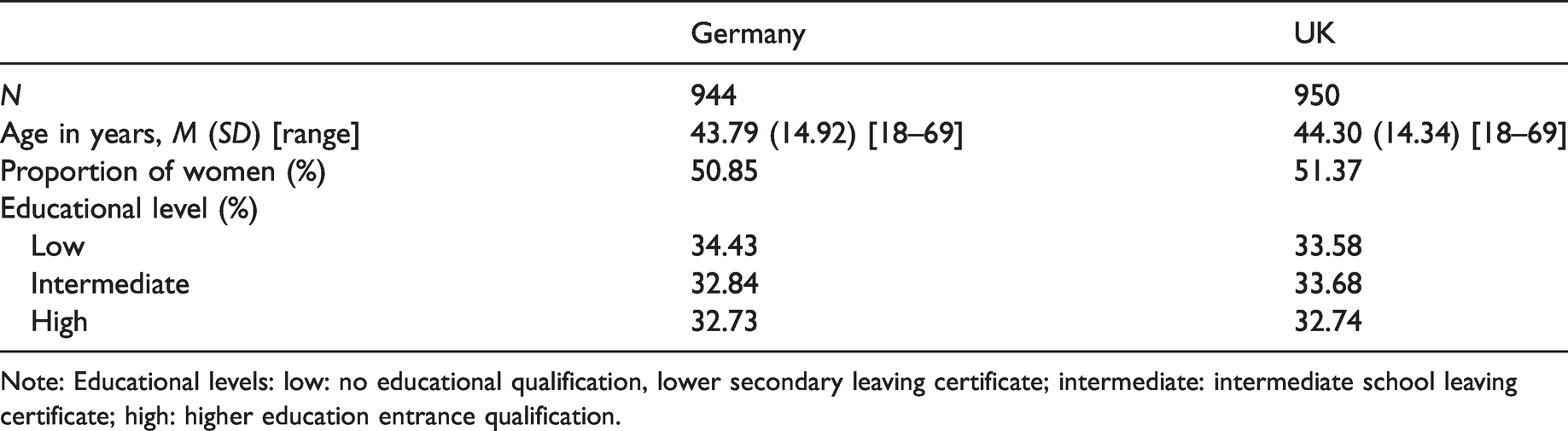
Note: Educational levels: low: no educational qualification, lower secondary leaving certificate; intermediate: intermediate school leaving certificate; high: higher education entrance qualification.
Open science and transparency statements
The factor-analytic methods in our study required sample sizes large enough to ensure stable correlation matrices and patterns of loadings. By pooling data from two data collections in both Germany and the UK, we ensured large absolute sample sizes and high subject-to-item ratios (approx. 40:1 in scale-based analysis and approx. 10:1 in item-based analysis; see Osborne & Costello, 2004). The samples were also four times larger than the sample sizes typically required for sample correlation matrices to stabilize according to simulation studies (Schönbrodt & Perugini, 2013).
The merged dataset including a filter variable for careless responders (which we applied to obtain our final analysis samples) can be retrieved from the project website on OSF. We also provide the codebooks of the data collections to make additional variables, which were not used in the present paper, evident.
A subset of about 50% of the data used in our present study (i.e., the first collection in 2018) constituted the cross-replication sample for the development of the IPIP-VIA-R (Bluemke et al., 2021). There it was used for the validation of each of the 24 character strength scales and computation of statistical indices for unidimensionality, reliability, construct and criterion validity, and cross-cultural measurement invariance. None of the data were previously used to analyze the hierarchical structure of the VIA trait space.
Measures
We assessed the VIA character strengths with the 96-item IPIP-VIA-R inventory (Bluemke et al., 2021) which will be published on the IPIP website at https://ipip.ori.org/. We also provide both the IPIP-VIA-R inventory and tables from Bluemke et al. (2021), which attest to the psychometric quality of the IPIP-VIA-R, on the project’s OSF website. The IPIP-VIA-R is a purposeful item selection from the IPIP (Goldberg et al., 2006). IPIP-VIA-R measures each of the 24 VIA character strengths with a balanced-keyed set of four items (i.e., two positively and two negatively keyed) that were selected to refine content validity (i.e., their compliance with the definition of each character strength), essential unidimensionality, discrimination (i.e., reduced overlap between scales aiming at reduced cross-loadings), and cross-cultural applicability. In Germany, the bivariate correlations between its 24 unit-weighted scale scores ranged from r = –.16 to r = .61, with an average correlation of r = .31. In the UK, the bivariate correlations ranged from r = –.10 to r = .64, with an average correlation of r = .36. We estimated the composite reliability for each of the 24 unit-weighted scale scores based on a latent measurement model, taking into account the categorical nature of the response scales (Bluemke et al., 2021). The MIMIC measurement model comprised a latent character strength variable measured with four items and the ipsative mean across the 96 VIA items as an observed exogenous covariate. This covariate explained/removed the variance proportion in each item that resulted from acquiescent responding, a major source of bias especially in cross-cultural research (Lechner et al., 2019). We refer to our reliability estimates as ωH because of their conceptual similarity with Reise et al.’s (2013) omega hierarchical: they reflect only the common variance of the four items represented in the latent character strength variable as reliable variance, but not the acquiescence variance. The average ωH across the 24 short scales was .75 (SD = .07) and ranged between .55 and .85 in Germany. In the UK, average ωH was .76 (SD = .05) and ranged between .62 and .82. We estimated test–retest reliability (rtt) based on subsamples of the analysis samples with comparable sample composition (N = 228 in Germany, N = 225 in the UK) and a 2–3 weeks test–retest interval. The average rtt of the 24 scales was .73 (SD = .06) and ranged between .59 and .85 in Germany. In the UK, the average rtt was .67 (SD = .06) and ranged between .55 and .79. ωH and rtt coefficients were computed in Mplus (version 8.3; Muthén & Muthén, 1998–2017). Descriptive information, ωH, and rtt for each scale in Germany and the UK are provided as SOM on the OSF project website.
Statistical analyses
All subsequently described statistical analyses were conducted in R (version 3.6.1; R Core Team, 2019). All Mplus and R code and information on R package versions can be retrieved from the OSF project website.
Our factor-analytic approach consisted of three complementary steps (described in detail below). The 24 unit-weighted scale scores representing 24 distinct character strengths served as input in all steps. As a robustness check, we re-ran all analyses using the 96 item scores as input. We summarize the results of this robustness check in the main article and report details in the SOM on the OSF project website. We purged both the 24 scale scores and the 96 item scores of acquiescence variance, although in different ways: Whereas acquiescence is roughly averaged out in scores built from balanced scales, we corrected item scores for acquiescence bias by means of ipsatizing (Billiet & McClendon, 2000; Lechner et al., 2019).
Because we do not assume the relationship between the character strengths and their higher-level dimensions necessarily to be causal (in neither direction) and the higher-level dimensions to be latent constructs or variables, we represented the higher-level dimensions as principal components, thereby treating the higher-level dimensions as weighted linear composites of the character strengths (see Bollen & Diamantopoulos, 2017; Edwards, 2011; Mõttus & Allerhand, 2018 for an in-depth discussion on the properties of PCA). Furthermore, the use of principal components is in line with most previous factor-analytic studies on the VIA trait space (e.g., McGrath, 2015; Ruch et al., 2010; Shryack et al., 2010) and the theoretical approach by Peterson and Seligman (2004) in which a non-causal relationship between the 24 character strengths and the six core virtues is assumed.
Step 1: PA and MAP
We used PA (Horn, 1965) and MAP (Velicer, 1976) in Germany and the UK. PA and MAP are different methods—whose results need not always agree—to determine how many relevant dimensions (i.e., principal components) can be extracted from a correlation matrix in order to parsimoniously summarize the (co-)variation contained in the set of input variables. In PA, empirical eigenvalues are compared with random eigenvalues to determine how many components in the correlation matrix at hand “are meaningfully different from random noise” (Lang et al., 2016, p. 39). We conducted PA with the psych package (Revelle, 2018) and used the 95th quantile (Glorfeld, 1995) of 1,000 resampled or simulated data matrices to determine the random eigenvalues. Because PA is sensitive to sample size in a way that larger samples might result in an over-extraction of components (Revelle, 2019), we conducted the PA in both countries based on both the full analysis sample and a random subsample of N = 500 each to check the robustness of the full-sample-based results.
We conducted MAP with the EFA.dimensions package (O’Connor, 2020). Whereas PA takes the total variance of the input variables into account, MAP focuses on their common variance. MAP works by partialing out an increasing number of components from the variables’ correlation matrix and stopping when the average squared partial correlation of the off-diagonals is minimized (O’Connor, 2000; Velicer et al., 2000). We used the revised MAP criterion in which the partial correlations are taken to the fourth (instead of second) power (Velicer et al., 2000).
Note that we used PA and MAP as helpful guidance but not as key criteria. Although PA and MAP are highly informative as to how many strong and relevant dimensions can be extracted from a correlation matrix, their results do not dictate a single “correct” number of dimensions to retain (or, equivalently, single “correct” level of the Bass-ackwards analysis; Goldberg, 2006). For example, even in cases in which PA/MAP suggest the extraction of, say, four dimensions, a five- or even six-dimensional solution might still be useful, depending on the criteria of usefulness. Therefore, when scrutinizing global levels of a trait hierarchy, researchers often do not stick strictly to PA/MAP results but give more weight to other criteria (e.g., Lang et al., 2016)—as we do in the present study. None of our previously defined criteria of what constitutes “useful” global levels (interpretability, globality/generality, cross-cultural replicability) depends solely on PA/MAP, although interpretability and globality/generality are of course not fully independent of PA/MAP.
Step 2: Bass-ackwards analysis
To unfold the solutions-hierarchy of the VIA strengths, we conducted Bass-ackwards analyses (Goldberg, 2006) both in Germany and in the UK. The Bass-ackwards approach is a simple exploratory procedure to investigate the hierarchical structure of a set of variables. Using the unit-weighted scale scores for each of the 24 character strengths as input, we conducted PCAs extracting an increasing number of components—first one component, then two components, and so forth. We then computed correlations between components of adjacent levels. For our Bass-ackwards analyses, we used the R code provided by Waller (2007). 7 We modified Waller’s function to apply to obliquely rotated principal components (Promax rotation, m = 4).
To facilitate the interpretation and evaluation of each dimension, we classified the character strengths depending on the size of their loadings: We classified strengths that loaded with λ ≥ .50 on a higher-level dimension as its marker strengths, because these strengths play a major role in defining the substantial meaning of the dimension. Likewise, we classified strengths that loaded with .30 ≤ |λ| < .50 on a higher-level dimension as co-defining strengths, because these strengths play a secondary/minor but non-negligible role in defining the substantial meaning of the dimension. We disregarded strengths that loaded with |λ| < .30 on a dimension. 8
Based on the resulting solutions-hierarchy, we identified those levels whose dimensions (i.e., components) met our interpretability and globality/generality criterion. We examined and reported Levels I–VIII of the solutions-hierarchy, but not lower levels, because—as usually in Bass-ackwards analyses—our focus in this study was on identifying global dimensions. Beyond Level VIII, it is numerically impossible that the dimensions of a level could comprise a unique set of minimum three highly-loading marker strengths and thus meet our interpretability and globality/generality criterion.
Step 3: Cross-country congruency analysis
We identified those levels of the solutions-hierarchy that comprised the most similar and thus most replicable dimensions across Germany and the UK (our third criterion). We first rotated the principal component solution at each level to maximum similarity between countries, using the component loading matrix (pattern matrix) obtained in Germany as the target matrix. For this target rotation, we used Jennrich’s (2002) gradient projection rotation optimization algorithm as implemented in the GPArotation package (Bernaards & Jennrich, 2005). 9 We then computed Tucker’s Phi (Tucker, 1951) to gauge the congruency across countries of the target-rotated components on the same hierarchical level. The size of Tucker’s Phi is independent of the mean absolute size of component loadings and expresses similarity in terms of profile similarity but not in terms of a similar amount of explained variance (Lorenzo-Seva & ten Berge, 2006). Following Lorenzo-Seva and ten Berge (2006) and Jensen (1998), we interpreted values of Tucker’s Phi of Φ ≥ .95 as essentially equivalent, Φ ≥ .90 as highly similar, and Φ ≥ .85 as fairly similar.
Results
PA and MAP
Figure 1 shows scree plots obtained from the PAs. In both countries, a strong first component emerged (eigenvalue > 8 in Germany and > 9 in the UK, respectively) in both the full samples (panels (a) and (b)) and the random subsamples (panels (c) and (d)). The second component already had a much smaller eigenvalue (< 2.5 in all samples). Overall, PA suggested retaining three components—somewhat more unambiguously in Germany (panels (a) and (c)) than in the UK (panels (b) and (d)). Likewise, MAP suggested retaining three components in both countries. Based on the full analysis samples, these three (unrotated) components explained 36.05%, 9.05%, and 6.46% of the total variance (i.e., 51.56% combined) in Germany and 40.45%, 8.96%, and 5.56% (i.e., 54.97% combined) in the UK, respectively.
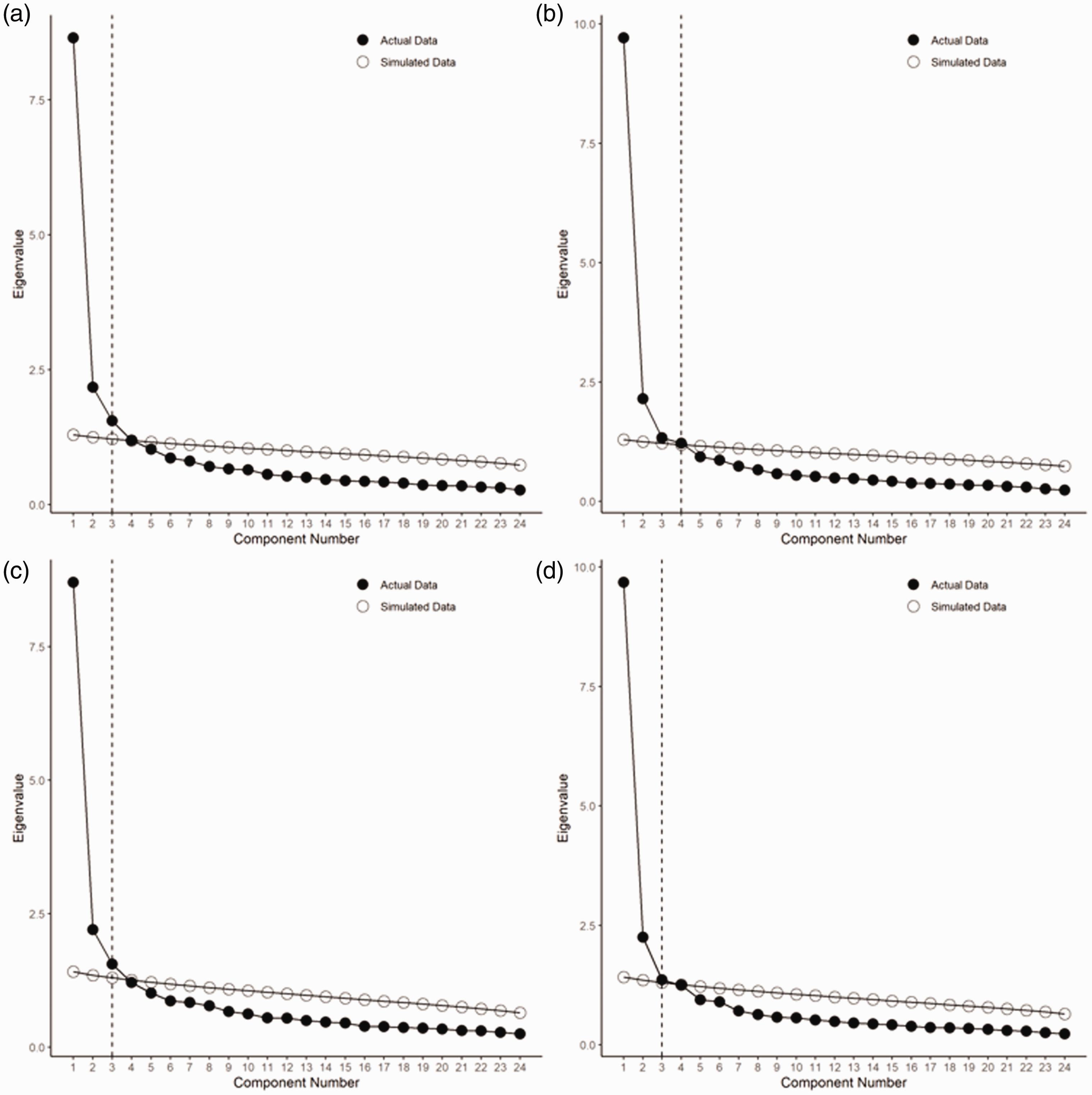
Results from PAs. The plots show the eigenvalues of the first to 24th principal component extracted from actual and simulated or resampled data. Panel (a): full analysis sample Germany (N = 944). Panel (b): full analysis sample UK (N = 950). Panel (c): random subsample Germany (N = 500). Panel (d): random subsample UK (N = 500).
These results show a strong saturation of the first component and suggest that three global dimensions suffice to capture the essence of the 24 VIA character strengths as measured with the IPIP-VIA-R. A three-component solution was sufficient to recover more than half of the total variation in the 24 character strengths in both countries.
Bass-ackwards analysis
Figures 2 and 3 show the (truncated) results from the Bass-ackwards analyses in Germany and the UK. Each figure depicts Levels I−VIII of the solutions-hierarchy with the rectangles representing obliquely rotated principal components and the coefficients along the paths expressing correlations of components of adjacent levels. To evaluate the components according to our criteria of interpretability and globality/generality, the rectangles contain lists of their marker strengths (i.e., character strengths with loadings of λ ≥ .50 on that component; top rows) and co-defining strengths (i.e., character strengths with loadings ranging of .30 ≤ |λ| < .50; bottom rows) in descending order. Arabic numerals denote cross-culturally corresponding components at a hierarchical level across Figures 2 and 3. For Germany, the Arabic numerals indicate the order of extraction within each solution or level. For the UK, at some levels, the components were extracted in a different order than for Germany. (We provide the detailed outputs of the Bass-ackwards analyses including loading matrices, between- and within-level correlations of the Levels I–XXIV on the project website on OSF.)
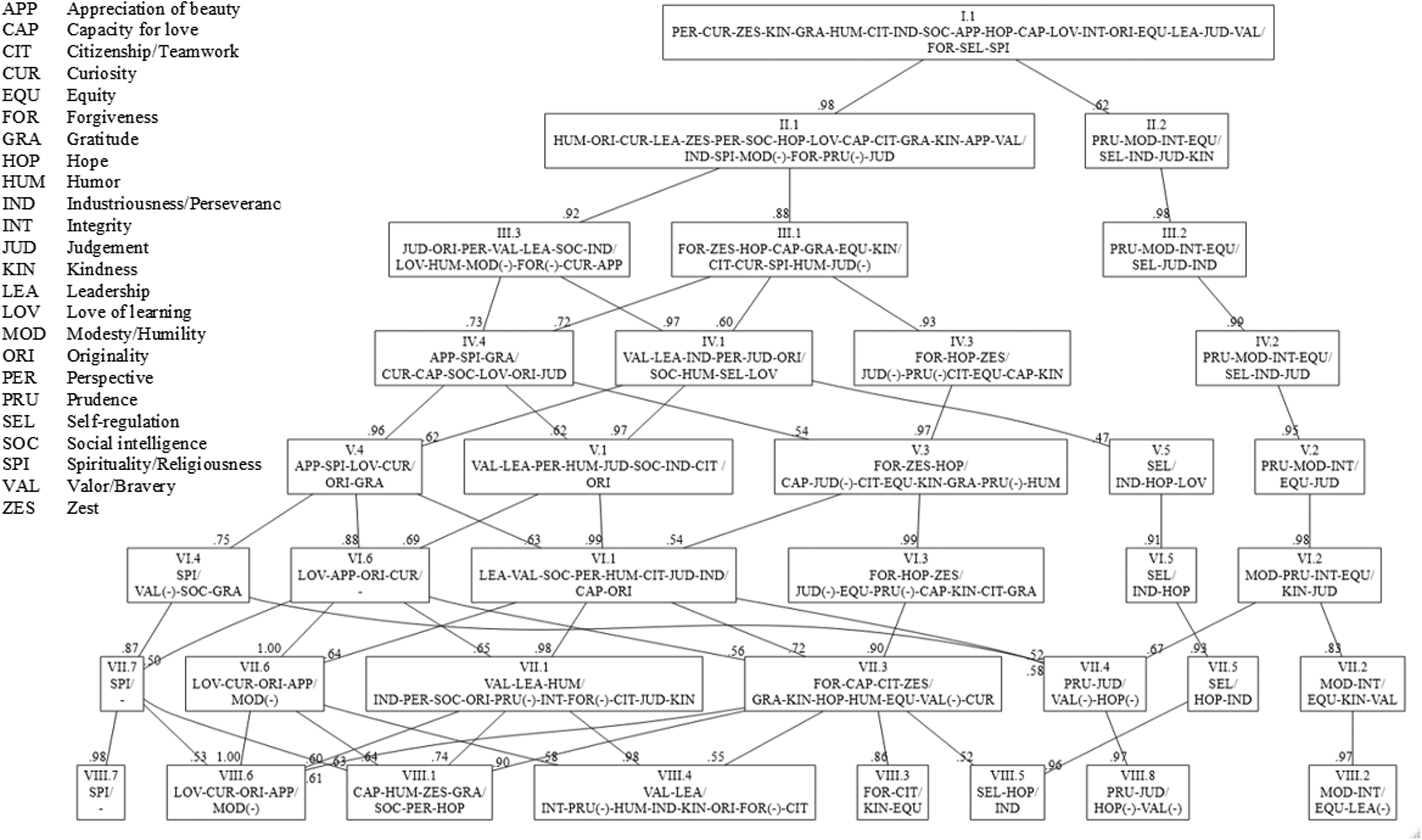
Levels I–VIII of VIA solutions-hierarchy in Germany. Boxes represent obliquely rotated principal components. Roman numerals denote hierarchical levels. Arabic numerals denote the order in which components of a hierarchical level were extracted. Character strengths are depicted in descending order of (absolute) loading size with marker strengths (λ ≥ .50) in top row and co-defining strengths (.30 ≤ |λ| < .50) in bottom row. (–) denotes inversely loading character strengths. Within-level correlations: rII.1/II.2 = .46, rIII.1/III.2 = .33, rIII.1/III.3 = .62, rIII.2/III.3 = .31, .20 ≤ rIV ≤ .56, .06 ≤ r V ≤ .61, −.05 ≤ r VI ≤ .67, −.03 ≤ rVII ≤.61, −.14 ≤ rVIII ≤ .66.
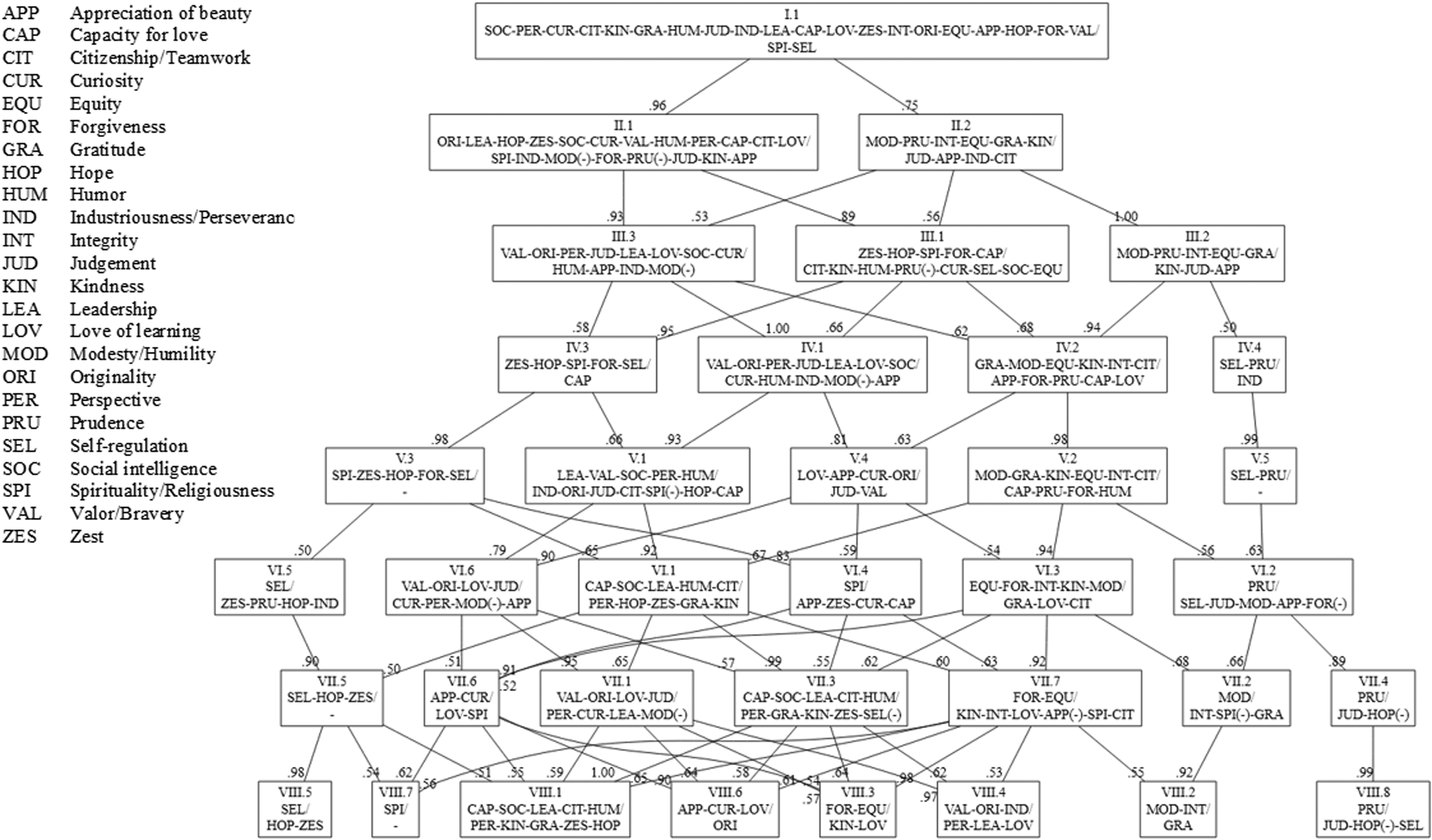
Levels I–VIII of VIA solutions-hierarchy in the UK. Boxes represent obliquely rotated principal components. Roman numerals denote hierarchical levels. Arabic numerals denote a component’s counterpart in Germany. Character strengths are depicted in descending order of (absolute) loading size with marker strengths (λ ≥ .50) in top row and co-defining strengths (.30 ≤ |λ| < .50) in bottom row. (–) denotes inversely loading character strengths. Within-level correlations: rII.1/II.2 = .53, rIII.1/III.2 = .49, rIII.1/III.3 = .68, rIII.2/III.3 = .50, −.17 ≤ rIV ≤ .58, −.17 ≤ rV ≤ .55, −.27 ≤ rVI ≤ .61, −.07 ≤ rVII ≤ .66, −.11 ≤ rVIII ≤ .65.
Level I
The strong first (and sole) component at Level I expressed a manifold of positively loading marker strengths in both Germany and the UK. Perspective, curiosity, kindness, gratitude, and humor were among the highest-loading marker strengths in both countries. In Germany, 19 of the 24 character strengths had loadings of λ ≥ .50 on the first component, whereas that number was 20 in the UK. In addition to the large number of highly-loading marker strengths, in both countries, self-regulation and spirituality were among the moderately loading co-defining strengths (.30 ≤ |λ| < .50).
The large number of character strengths with high or moderate loadings again indicated a high saturation of the first component. Only two of the 24 strengths—modesty/humility and prudence—showed negligible loadings on the first component. This suggests that these two character strengths are different from most other character strengths and do not share their common core.
Level II
In both countries, component II.1 (subsequently, we refer to components only by their numerical code) was highly correlated with the sole component at Level I. Originality, leadership, and zest were among the highest-loading marker strengths of this component in both Germany and the UK. In contrast, yet consistent across countries, II.2 was characterized primarily by those strengths that appeared most distinct in the one-component solution, namely prudence and modesty/humility, now complemented by integrity and equity. A substantial correlation between II.2 and the sole component at Level I emerged in both countries, albeit lower than that of II.1.
Level III
At Level III of the solutions-hierarchy, II.2 re-appeared as III.2, as evidenced by the high correlations across levels between the two components in both countries. Marker strengths of III.2 in both Germany and the UK were prudence, modesty/humility, integrity, and equity.
III.1 and III.3 split from II.1. Their respective marker strengths were essentially the same across countries: Forgiveness, zest, hope, and capacity for love were marker strengths in both countries for III.1, whereas judgement, originality, perspective, valor, leadership, and social intelligence were marker strengths in both countries for III.3.
Thus, all three dimensions at Level III had largely a unique set of highly loading marker strengths, and these marker strengths were essentially the same in both countries. Given the distinctness and number of marker strengths of each of the three components, Level III can be judged favorably against our criteria of interpretability and globality/generality in both countries. (In addition to the Figures 2 and 3, we provide the loading patterns of Level III in Germany and the UK including full and shortened labels of the character strengths scales as SOM on OSF.)
Levels IV−VIII
From Level IV onward, the globality/generality criterion was no longer met in both countries. In the UK, IV.4 appeared as a first “splinter” component marked by only two character strengths, namely self-regulation and prudence. In Germany, V.5 was exclusively marked by self-regulation.
On Level VI, two components in Germany and three components in the UK had only one highly-loading marker strength and were therefore of insufficient globality/generality. Self-regulation and spirituality, which loaded only moderately on the sole component at Level I in both countries, splintered off and dominated separate components at Level VI in both Germany and the UK. Prudence dominated another component in the UK. Of note, the six dimensions at Level VI did not resemble the six core virtues proposed by Peterson and Seligman’s (2004) theoretical classification.
At Levels VII and VIII, on which a component structure with three marker strengths per component is still feasible in principle, several components were characterized by only one or two marker strengths in both countries, again undermining the globality/generality criterion. The majority of components at those levels were characterized by only few marker strengths and co-defining strengths.
In general, beyond Level III, the globality/generality of dimensions within a hierarchical level varied and decreased strongly: Whereas the global dimensions observed at Level III propagated through subjacent levels of the solutions-hierarchy largely unchanged, the additionally extracted components often were narrow being characterized by only one or two marker strengths. It is a pattern to be expected in the Bass-ackwards approach that global dimensions from higher levels reappear at (or propagate through) lower levels, whereas additionally extracted components are often narrow “splinter” components (see Goldberg, 2006; Shryack et al., 2010). Observing this pattern already from Level IV on is in line with the scree plots and PA results in Figure 1, which suggested that only three strong higher-level dimensions span the VIA trait space (as measured with the IPIP-VIA-R).
Cross-country congruency analysis
Table 2 shows the congruency coefficients (Tucker’s Φ) between the components in Germany and their target-rotated counterparts in the UK at Levels I–VIII of the solutions-hierarchy. At Levels I−III, all components showed congruencies of Φ ≥ .90 or even Φ ≥ .95. This indicates that the components are of high similarity or even essential equivalence across countries, which implies that their structure and meaning were replicable and almost identical across countries.
Tucker’s Phi coefficients indicating the congruency across countries of the components at each of the Levels I−VIII.
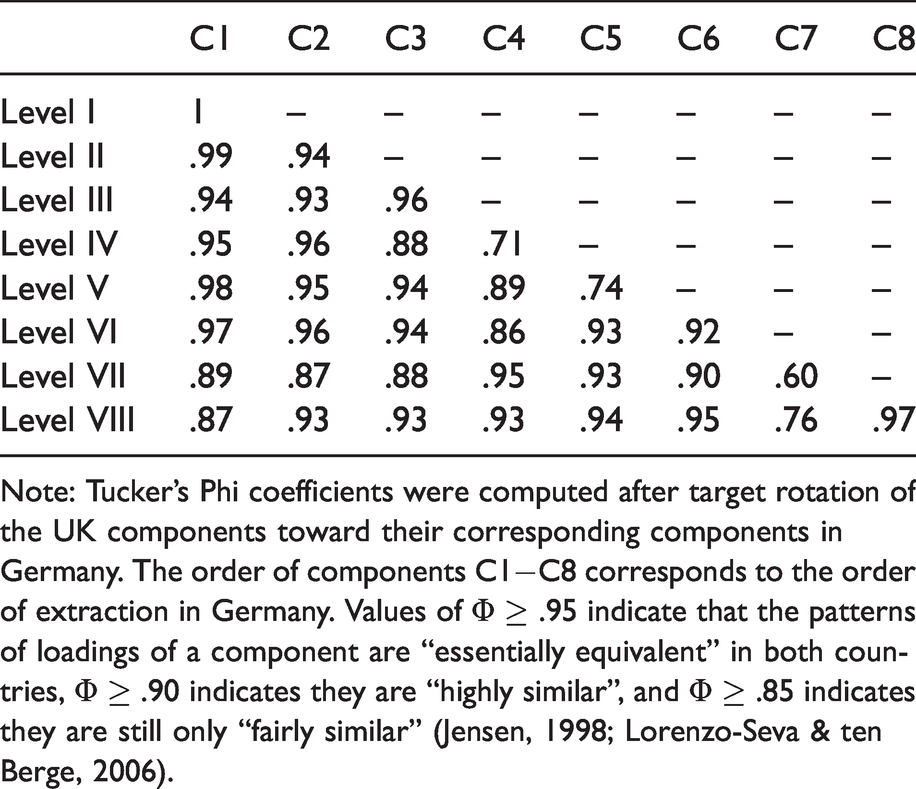
Note: Tucker’s Phi coefficients were computed after target rotation of the UK components toward their corresponding components in Germany. The order of components C1−C8 corresponds to the order of extraction in Germany. Values of Φ ≥ .95 indicate that the patterns of loadings of a component are “essentially equivalent” in both countries, Φ ≥ .90 indicates they are “highly similar”, and Φ ≥ .85 indicates they are still only “fairly similar” (Jensen, 1998; Lorenzo-Seva & ten Berge, 2006).
All of the subjacent Levels IV–VIII contained one or more components with congruencies of Φ < .90, indicating a lower degree of similarity of the loading patterns across countries. Among these levels, Level VI stands out as relatively good, with five of its components showing Φ > .90 and only VI.4 showing Φ = .86, which would still be considered “fairly similar” (Lorenzo-Seva & ten Berge, 2006). Nevertheless, these results suggest that only Levels I−III, but not subjacent levels, exclusively comprised higher-level dimensions that were highly similar across Germany and the UK. Consequently, Levels I–III but not subjacent levels unambiguously met our criterion of cross-national replicability.
Summary
According to our criteria, we identified Levels I–III (thereof foremost Level III) as useful global levels of abstraction above the 24 character strengths. These levels comprise well-interpretable and cross-nationally replicable dimensions that abstract the common core from several character strengths in different ways. The dimensions on these levels likely represent global character or personality constructs that (1) can contribute to theory-building in character research and (2) allow for a parsimonious and more global assessment of individual differences in human character. Levels IV–VIII and subjacent levels, by contrast, did not qualify as “useful” global levels according to our criteria. This of course does not preclude that these more fine-grained levels are of theoretical and practical value. For example, the narrow dimensions they contain may improve prediction of specific outcomes compared to global dimensions. However, according to our criteria, these levels clearly do not constitute useful global levels in the sense that Levels I–III do.
Robustness checks using the 96 items as input
The results presented thus far were based on the 24 character strengths’ scale scores, in line with previous studies and consistent with our aim to identify useful aggregation levels that summarize the 24 well-established character strengths. However, as a robustness check, it may be instructive to test whether the levels we identified as “useful” global levels (i.e., the Levels I–III and of these especially Level III) also emerge when using the 96 disaggregated item scores of the IPIP-VIA-R instead of the 24 aggregated scale scores as input. We therefore re-ran all analyses using the 96 ipsatized item scores. Although the item scores contain additional variance compared to the variance that is present in the aggregated scale scores (i.e., more specific trait variance capturing substance beyond the character strengths as well as more specific method variance), this additional variance is unlikely to be retained at high levels of aggregation. Accordingly, we expected to replicate the global dimensions from the scale-based analyses with item-based analyses. We report and discuss the results in detail in the SOM on OSF.
As to be expected from the additional variance contained in the item scores, PA and MAP performed on the 96 item scores suggested to extract 7–10 components, and hence more than in the scale-based analyses. However, a closer look revealed much greater agreement between the item-based and scale-based analyses than PA and MAP suggest. Specifically, judging the item-based results against our three criteria of what constitutes useful global levels, we found that the globality/generality criterion only held from Levels I–III and that the dimensions on Levels I–III—but not subjacent levels—fulfilled the interpretability criterion with the item-based marker strengths (see below/SOM on OSF) largely corresponding to the scale-based marker strengths. Moreover, item-based congruency analyses confirmed that only Level I–III reflected cross-culturally replicable higher-level dimensions throughout, whereas subsequent levels contained at least one component that fell short of the Φ ≥ .85 cut-off indicating fairly similar components (we outline in the SOM why item-based and scale-based congruency analyses are more comparable when applying Φ ≥ .85 in the item-based analysis and Φ ≥ .90 in the scale-based analysis, respectively).
These conclusions held irrespective of whether we interpreted the item-based findings in the light of the 24 character strengths or took a truly bottom-up interpretation approach that does not presume that the 24 character strengths exist. When interpreting the solutions-hierarchy in light of the 24 character strengths, we looked at the sum of the absolute item loadings of each character strength to classify it as co-defining or marker strength of each dimension (more details are provided in the SOM on OSF). In the truly bottom-up interpretation approach, we looked at the item-based solutions-hierarchy by counting the single items with |λ| ≥ .50 and |λ| ≥ .30, respectively, ignoring which character strength they belonged to (i.e., instead of adding up the absolute loadings of the four items building a character strength scale).
In sum, in the item-based analyses, too, Level III of the solutions-hierarchy proved most appropriate to describe the VIA trait space parsimoniously and more generally with higher-level dimensions. By contrast, all levels below Level III must be discarded based on our criteria of interpretability, globality/generality, and cross-cultural replicability. Thus, despite some differences, the scale-based and item-based analyses led to the same overall conclusions.
Discussion
There is an ongoing debate about useful global levels of abstraction at which to best summarize the 24 VIA character strengths described by Peterson and Seligman (2004). In contrast to most major individual difference constructs (e.g., personality traits in the lexical tradition or intelligence), no trait hierarchy for VIA has yet been established, and no consensus has been reached as to the number and nature of higher-level dimensions that might lend themselves as useful aggregates of the 24 character strengths. In the present study, we unraveled the hierarchical structure of the VIA trait space through a factor-analytic approach. Our aim was to identify useful levels of abstraction on which to summarize the variation in the 24 VIA character strengths in well-interpretable, global/general, and cross-culturally replicable dimensions.
Converging evidence for Level III as the most useful global level of aggregation
When jointly considering our three criteria, Level III of the solutions-hierarchy clearly emerged as the most useful level for aggregating the 24 character strengths. PA and MAP agreed in suggesting that three components are enough to parsimoniously summarize the (co-)variation contained in the 24 character strengths. The first three components jointly accounted for a large proportion of the total variation in the 24 character strengths, of more than 50% in both countries in particular. Even more important, the solutions-hierarchies unfolded through the Bass-ackwards approach indicated that only Levels I–III, but not subjacent levels, consisted of exclusively global dimensions that each summarized what at least three highly-loading character strengths have in common. Moreover, component congruency analyses interpreted based on conventional cut-offs for Tucker’s Φ showed that only Levels I–III, but not subjacent levels, are populated exclusively by highly similar or essentially equivalent dimensions across Germany and the UK. (Note that cut-offs are to some extent arbitrary. Applying Φ ≥ .85 as cut-off indicating fairly similar components would suggest considering Level VI of the scale-based solutions-hierarchy cross-nationally replicable, too.)
A closer look at the component structure of Level III revealed that all 24 character strengths appeared either as marker strengths (λ ≥ .50) or as co-defining strengths (.30 ≤ |λ| < .50) in both Germany and the UK. In other words, none of the character strengths fell outside the trait space covered by the three dimensions. Furthermore, none of the character strengths functioned as marker strength for more than one component (the only exception was a cross-loading of equity). Consequently, as required by the interpretability criterion, each of the three dimensions was characterized by a unique set of highly-loading marker strengths which also were largely the same across countries (4–6 shared marker strengths per dimension). Cross-loadings, by contrast, were only present in co-defining strengths.
Hence, each dimension at Level III was readily interpretable based on its unique set of marker strengths that were shared across countries. However, naming global dimensions is generally challenging, as the chosen labels must be more inclusive than the constituent character strengths and ideally capture all their connotations. Further complicating the task, we were careful to avoid terms already used in Peterson and Seligman’s (2004) classification to avoid confusion. The current labels are therefore provisional and will likely be replaced by more suitable ones in the future. The provisional labels of the three dimensions are positivity (III.1), dependability (III.2), and mastery (III.3). Positivity is characterized by forgiveness, zest, hope, and capacity for love, thus describing a cheerful, optimistic, and forbearing reconciliator. Dependability is characterized by prudence, modesty/humility, integrity, and equity, thus describing a reliable, trustworthy, and caring “tower of strengths”. Mastery is characterized by judgement, originality, perspective, valor, leadership, and social intelligence, thus describing a wise and ingenious leader.
Although each dimension on Level III was identified by a unique set of highly-loading marker strengths, it should be noted that the dimensions were correlated because we opted for oblique rotation. In Germany, the correlations between positivity and dependability and between dependability and mastery were both r ≈ .30. In the UK, these two correlations were both r ≈ .50. The correlation between positivity and mastery was the highest one in both countries (r = .62 in Germany, r = .68 in the UK). In this context, it is noticeable that positivity and mastery both emerged from the same higher-level component (II.1) and maintained high correlations with their ancestor at Level II. This suggests that positivity and mastery themselves are related aspects of a more abstract concept.
Our conclusion that three dimensions are appropriate aggregate representations of the 24 character strengths (as measured with the IPIP-VIA-R) concurs with some previous findings on the factor-analytic hierarchical structure of VIA (Castro Solano & Cosentino, 2018; Duan et al., 2012; McGrath, 2015; McGrath et al., 2018; McGrath & Wallace, 2019; Redfern et al., 2014; Shryack et al., 2010). Together with these previous studies, our findings suggest that the VIA trait space (spanned by three global domains) is somewhat narrower than the lexical personality trait space (spanned by 5–6 global domains). This is not surprising, given that the VIA character strengths are, by design, not lexically exhaustive but represent a purposive theoretical selection of positive, morally valued traits that can contribute to a fulfilled life and are universally valued across cultures and time. Moreover, it should be noted that even though three global dimensions may suffice to capture the essence of the 24 VIA character strengths, these character strengths may still contain some content that is not well represented in, say the Big Five or HEXACO/Big Six framework (e.g., spirituality, humor, valor, or social intelligence; see correlations with Big Five facets in Bluemke et al., 2021; the tables from Bluemke et al., 2021, in the SOM on OSF; see also McGrath et al., 2020).
It should also be noted that even though we arrived at the same number of dimensions as these previous studies, the nature (or content) of the present three-dimensional solution differs from previous ones. Specifically, previous work has interpreted the three dimensions as representing different “targets of virtuous action” (McGrath, 2015, p. 418): the self (bundling intellectual strengths, labeled “Inquisitiveness”), others (bundling interpersonal strengths, labeled “Caring”), and the physical world (bundling intrapersonal strengths for dealing effectively upon the environment, labeled “Self-Control”) (McGrath, 2015; McGrath et al., 2018). By contrast, our results are better aligned with the logic of a factor-analytic trait hierarchy: The specific positively valued traits embodied by the 24 character strengths are aggregated to three global/general positive traits that play a role across different targets in both social and non-social contexts. For example, the character strength of perspective is not only relevant for mastering one’s own life but is also helpful to others who seek advice from an individual who scores high on perspective.
We attribute the different nature of previously identified three-dimensional solutions to the psychometric shortcomings of previously used VIA instruments. Several items of previously used VIA instruments had questionable content validity, barely controlled acquiescent response style, or were otherwise insufficiently distinct measures of their targeted character strength, all of which resulted in insufficiently nuanced scales with substantial item cross-loadings (e.g., Ng et al., 2017). Using VIA scales that did not discriminate sufficiently well between character strengths, the character strengths may have previously formed higher-level structures based on rather crude communality among strength scales (e.g., most character strengths with emphasis on any kind of interpersonal context bundled up as the so-called “Caring”-dimension). By contrast, the IPIP-VIA-R more likely captures the character strengths in a fine-grained manner with content-valid items in essentially unidimensional (i.e., factor-pure) scales, allowing a sound higher-level structure to be revealed.
A closer look at the other levels of the solutions-hierarchy
Even though Level III proved to be the most useful level of abstraction above the 24 VIA strengths according to our criteria, Level II also fulfilled our three criteria and may present another useful global aggregation level for the VIA character strengths. A closer look at Level II showed that dimensions II.1 and II.2 resemble metatraits in other areas of individual difference research. In particular, they had some similarities with the two personality metatraits of Plasticity and Stability (DeYoung, 2006; DeYoung et al., 2002) and—to a greater extent—with the Big Two of Dynamism and SSR (Saucier et al., 2014; Thalmayer & Saucier, 2014). These metatraits, in turn, have commonalities with the two well-known axes of interpersonal perception—agency and communion (Bakan, 1966).
Specifically, dimension II.1 was characterized by the strengths of originality (i.e., having original ideas, coming up with innovative and productive ways to do things), leadership (i.e., organizing collective success of a group and fostering good working relationships among members), and zest (i.e., approaching activities with physical and mental vitality, feeling alive and energetic). As such, it was somewhat reminiscent of Plasticity (i.e., how to successfully integrate new information and flexibly respond to changes, as expressed by the shared variation of Extraversion and Openness) and to a greater extent reminiscent of Dynamism (i.e., activity, potency, ascendancy, being skillful and comfortable in social situations). II.2 was characterized by the strengths of prudence (i.e., being smart and careful about choices in the interest of avoiding undue risks and preventing regrets), modesty/humility (i.e., being modest (though realistic) about one’s abilities and weaknesses, valuing contributions by others), integrity (i.e., being truthful to others and to oneself, trustworthy, and acting with moral integrity), and equity (i.e., treating people equally, with respect and in a fair and unbiased manner). As such, it was somewhat reminiscent of Stability (i.e., maintaining psychosocial stability, as expressed by the shared variation of Agreeableness, Conscientiousness, and Emotional Stability) and to a greater extent reminiscent of SSR (i.e., propriety, socialization, community, solidarity, respect, compliance).
It was evident from the high between-level correlations and the overlapping marker strengths that II.1 (reminiscent of Dynamism and Plasticity) is largely retained in mastery at Level III, whereas II.2 (reminiscent of SSR and Stability) is basically retained in dependability at Level III. Furthermore, positivity at Level III captured “positive affectivity” as one specific aspect of Plasticity from II.1 (DeYoung et al., 2002). Beyond that, positivity at Level III strongly resembled “positivity” as conceptualized by Caprara et al. (2012): as confidence in other people as well as a positive perception of the self, one’s life, and one’s future. Thus, Level III of the VIA solutions-hierarchy resembles different personality metatraits (DeYoung, 2006; Saucier et al., 2014) and additionally allows measuring a third—related but distinct—metatrait: positivity. Capturing something reminiscent of Dynamism/Plasticity and SSR/Stability, Level II also offers potentially viable higher-level dimensions for an even more parsimonious aggregation of the 24 character strengths. However, compared to Level III, Level II aggregates the 24 character strengths unevenly distributed over the components (i.e., 12 (II.1) vs. four (II.2) marker strengths shared across countries), less differentiated, and with the loss of some viable information (i.e., forgiveness as one core aspect of positivity only features among the co-defining strengths).
In contrast to some previous studies that advanced four- or five-dimensional solutions (e.g., Brdar & Kashdan, 2010; Höfer et al., 2019; Macdonald et al., 2008; Peterson et al., 2008; Singh & Choubisa, 2010) or that reproduced Peterson and Seligman’s (2004) six core virtues through highly liberal approaches (Ng et al., 2017; Vanhove et al., 2016), the utility of these levels of the VIA solutions-hierarchy (as global levels) appears questionable according to our criteria and results: At Levels IV–VIII, the dimensions within each level varied widely in their degree of cross-cultural replicability and globality/generality, with some dimensions being almost as specific as a single character strength. Furthermore, Level VI did not recover Peterson and Seligman’s (2004) six theoretically derived core virtues. For example, in Germany, VI.4 and VI.5 each featured only a single marker strength (spirituality and self-regulation, respectively) and VI.6 captured love of learning, appreciation of beauty, originality, and curiosity. To reiterate, we did not expect the factor-analytic solutions-hierarchy, which is based on observed correlations as they occur “in nature”, to coincide with Peterson and Seligman’s (2004) theoretical, Linnaean-type classification of strengths and virtues, which is based on conceptual similarity and which the authors labeled as preliminary, urging the reader “not to be too concerned about the details of how [they] classified the 24 strengths under the six virtues” (p. 31).
Might socially desirable responding explain the strong component saturation?
Whenever self-rated character/personality traits are concerned, some remarks on the issue of socially desirable responding (SDR) are in order. By their very nature as positive qualities that can contribute to the well-being of the individual and others, the 24 VIA character strengths are socially desirable by definition. Especially in view of the high saturation of the first component, this raises the question of whether component I.1 represents a meaningful general factor (i.e., good character manifesting in a wide range of behavioral tendencies that are valued by most people) or mainly represents SDR. More generally, it directs attention to the extent to which SDR drives any correlations between the character strengths—and hence the loadings and component correlations in the solutions-hierarchy. We provide a detailed evaluation of the role that SDR plays in our findings in the SOM on OSF. We discuss six different aspects related to SDR: (1) Steps taken to lower SDR during the construction process of the IPIP-VIA-R; (2) the low-stakes survey context; (3) the only moderate skewness of the item scores and scale scores; (4) previous evidence suggesting that SDR is only a weak source of variance in VIA questionnaires; and (5) evidence that SDR in a survey (e.g., on VIA) is not only a response style but may partly translate to socially desirable conduct in real life; as well as (6) the differentiated and complex pattern of loadings and correlations between the components on the Levels I–III (and the on average moderate bivariate correlations between the 24 strengths scales—r = .31 in Germany and r = .36 in the UK—from which they result). Considering all of these aspects leads us to be optimistic that SDR is unlikely to be a strong, let alone the main, driver of the high saturation of component I.1, the loadings and component correlations in the subjacent levels of the solutions-hierarchy, and the pattern of correlations between the 24 character strengths more generally. Instead, there is reason to assume that the loadings and correlations are driven primarily by content, not style. That said, future investigations may want to further expand on the issue of SDR in the higher-level dimensions we identified.
Limitations and directions for future research on character traits
Still, our study has some limitations that future studies should address. Our results are based on a single instrument, the IPIP-VIA-R. Even though it is safe to conclude that this inventory allows for an improved assessment of the 24 VIA strengths compared to its ancestor, and probably most other available VIA instruments, no single instrument is perfect. In order to conclusively establish useful global levels of the VIA trait hierarchy, future research should replicate our findings using other VIA instruments—ideally new instruments that provide good content validity, approximation to unidimensionality, and cross-cultural applicability. At the same time, we note that there are already studies based on other VIA instruments that agree with ours in highlighting Level III as useful global level in the VIA trait hierarchy, for example, a recent study of McGrath and Wallace (2019) who employed a revised version of the VIA-IS, the 192-item VIA-IS-R measuring each character strength with eight items.
Although we advanced over previous studies by using large and diverse samples from two countries, future studies would benefit from using true random samples from the general population and especially from investigating a larger set of cultures and languages. Doing so would help establish whether the promising three-dimensional solution is cross-culturally replicable beyond the two WEIRD (Western, educated, industrialized, rich, and democratic) countries investigated here, Germany and the UK. For this to be a feasible goal, high-quality translations and proper cultural adaptations of IPIP-VIA-R or other VIA instruments need to be developed. It will also be of particular importance to replicate our results with informant/observer reports to see whether such ratings conform to the same higher-level structure as self-reports (e.g., McCrae & Mõttus, 2019). This will also help gauge the extent to which the hierarchical structure of VIA character strengths based on self-reports is biased by SDR. Although IPIP-VIA-R self-reports appear not to be biased by SDR in a detrimental way (see SOM on OSF), this point deserves greater attention in future research.
Furthermore, our analyses focused exclusively on the internal structure (i.e., constitution and content) of the higher-level VIA dimensions as well as their robustness and replicability across cultures. However, further thoughts and tests on the theoretical and practical utility of Level III, and also Level II, are needed. Therefore, future research should locate the dimensions of the Levels II and III in a nomological network of Dynamism/Plasticity and SSR/Stability, the Big Five and the Big Six/HEXACO, and agency and communion. Furthermore, it should demonstrate (incremental) predictive power of the Level-III-dimensions beyond these related constructs to gauge the added value of the three global VIA dimensions for applied purposes. Moreover, future research should show how the three global VIA dimensions can contribute to a better understanding of the sources of individual differences in character (e.g., by identifying neuronal and genetic correlates of the three dimensions) and their functionality/adaptivity (e.g., by theorizing why individual differences in the three dimensions were preserved in the evolutionary process, how individual differences in the three dimensions contribute to the functioning of societies and cultures). Also, to understand the role of the three global VIA dimensions in the course of people’s lives (marked by different stages of development and critical life events), it will be important to investigate their precursors and their potentially different developmental trajectories.
Finally, although the 24 VIA strengths represent an extensive trait space of well-defined and both theoretically and empirically supported constructs, they may not exhaust the entire character space that one could conceive: The VIA framework is not based on an exhaustive lexical approach. It restricts itself to cross-culturally, potentially even universally valued character traits thereby disregarding culture-specific character strengths that may matter in narrower contexts. Thus, our results must not be misunderstood as having identified an exhaustive character trait hierarchy. Rather more modestly, they are aimed at advancing the establishment of the factor-analytic VIA trait hierarchy. Beyond that, further mapping out the full character space and establishing an exhaustive character trait hierarchy is an important end—to which the results of our Bass-ackwards analyses may contribute: Components that splinter off on the levels below Level III, thereby missing the globality criterion, may point to underrepresented content of the character trait space (see Goldberg, 2006). For example, spirituality and self-regulation were no marker strengths (i.e., did not load highly) of any of the global dimensions on the Levels I–III across countries. Instead, they splintered off (e.g., as VI.4 and VI.5). There might be character strengths that correlate with spirituality or self-regulation and that are not fully represented yet in the (VIA) character trait space. Expanding the character trait space by such further character strengths, might potentially lead to the emergence of additional global dimensions (i.e., aggregates of the character strengths). Peterson and Seligman (2004) themselves expected that their collection of 24 character strengths might be extended in the future. Even so, it should be noted that these authors’ theoretical groundwork was extensive and inclusive. As a result, we know of no study that identified relevant content that fit Peterson and Seligman’s (2004) definition of character strengths but was absent from their classification more than 15 years since the initial publication of their classification. Thus, the initial list of 24 VIA character strengths has so far stood the test of time.
Conclusion
Our study suggests that a maximum of three interpretable and cross-culturally replicable global dimensions can be identified in the VIA trait space (as measured with IPIP-VIA-R). The three dimensions can be described as follows: Dimension III.1 (positivity) is characterized by forgiveness, zest, hope, and capacity for love, III.2 (dependability) is characterized by prudence, modesty/humility, integrity, and equity, and III.3 (mastery) is characterized by judgement, originality, perspective, valor, leadership, and social intelligence. Level III thus potentially represents the most useful level of aggregation on which to capture the essence or common core of the 24 VIA character strengths. This level of aggregation lends itself especially for empirical applications in which a parsimonious, global description of the VIA trait space or the prediction of broad outcomes is the goal. For an even more global description, Level II with its two meta-traits resembling the “Big Two” of Dynamism and SSR may also present a viable alternative. Future studies may develop scales to measure the two or three key dimensions in research contexts that do not require or allow the level of detail provided by the 24 original character strengths. Overall, our findings may contribute to the long-term goal of reaching consensus on the hierarchical structure of VIA and establishing a factor-analytic VIA—or even character—trait hierarchy, analogous to the personality trait hierarchy and the intelligence trait hierarchy.
Footnotes
Acknowledgements
The authors thank Manfred Schmitt (Universität Koblenz-Landau, Germany) for his valuable feedback on several versions of this manuscript.
Data accessibility statement

Declaration of conflicting interests
The author(s) declared no potential conflicts of interest with respect to the research, authorship, and/or publication of this article.
Funding
This research received no specific grant from any funding agency in the public, commercial, or not-for-profit sectors.