




Abstract
The current study is concerned with the stability of and changes in vocational interest profiles and interest congruence in vocational education and training (VET). Specifically, we examined (1) the stability of vocational interest profiles, (2) the existence of occupational socialization effects that manifest themselves as increases in person-environment (P-E) congruence, and (3) the question of whether or not changes in P-E congruence are psychologically relevant because they are related to trainees’ attitudes towards their VET course. We used data from a three-wave longitudinal sample comprising N = 2611 trainees from five different VET courses in Germany. Through the use of meta-analytical aggregation techniques, we were able to analyze interindividual differences in intraindividual interest stability and P-E congruence and to relate these differences to trainees’ satisfaction with VET. On average, interest profiles turned out to be highly stable over the entire course of VET. However, we found substantial interindividual and intergroup differences in interest stability. Average P-E congruence increased slightly in two groups, providing only little evidence for the presumed socialization effects. Nevertheless, interindividual differences in P-E congruence and changes in P-E congruence were psychologically relevant because they were linked to trainees’ satisfaction with their VET course and changes therein.
Keywords
Introduction
Vocational interests are considered to be dispositional, traitlike preferences for work-related activities. As such, they are powerful predictors of human behavior and attitudes in organizational and educational contexts (Nagy et al., 2012; Rounds & Su, 2014; Su et al., 2019; Volodina, Nagy, & Retelsdorf, 2015). Longitudinal research suggests that vocational interests show considerable stability over long periods of time (Low et al., 2005). However, the long-held belief that traitlike vocational interests, once developed, are essentially inalterable has been challenged lately (e.g., Neyer et al., 2014; Roberts et al., 2008; Specht et al., 2014). Consequently, researchers have begun to also analyze changes in vocational interests over time (Hoff et al., 2018; Schultz et al., 2017; Stoll et al., 2020).
A driving force behind systematic changes in vocational interests could be individuals’ striving for congruence between their interests and the characteristics of particular work environments, which is a central assumption of several widely acknowledged vocational theories (Holland, 1997; Schneider et al., 1995). A critical aspect of these theories is the assumption that person-environment (P-E) congruence is primarily established through occupational selection. Consequently, researchers following these traditions have considered changes in P-E congruence almost exclusively from a perspective of occupational transitions, that is, as a consequence of occupational selection processes (cf. Wille et al., 2014). Whereas research on personality development has provided considerable, yet far from undisputed, evidence for the existence of reciprocal effects between personality traits and environmental experiences (Denissen et al., 2014; Roberts et al., 2003), the possibility that systematic changes in vocational interests occur in reaction to experiences in work environments has hardly ever been tested systematically (exceptions are the work of Meir & Navon [1992] and a very recent study by Nye et al. [2020]). However, it seems reasonable to assume that socialization effects occur and are manifested in increases in P-E congruence over time, especially in tertiary education, where occupational socialization is often considered to be a central aspect of educational success (Lempert, 2006).
In the present study, we examined this assumption by investigating the stability of and changes in the vocational interest profile shapes of young adults in vocational education and training (VET). We specifically focused on interest profile shapes because they indicate the intraindividual patterns of likes and dislikes that are a central aspect of occupational socialization. Specifically, we aimed to answer the following questions: (1) How stable are trainees’ vocational interest profile shapes over the course of VET? (2) Is there any evidence for occupational socialization effects that manifest themselves as increases in P-E congruence? (3) Are changes in P-E congruence psychologically relevant because they are related to trainees’ attitudes towards their VET course? To this end, we analyzed the intraindividual stability of and changes in vocational interest profile shapes, as well as that in the congruence between these interest profiles and commensurate environmental profiles that indicated VET course-specific patterns of demands and opportunities. Lastly, we examined whether or not changes in P-E congruence were associated with corresponding changes in trainees’ satisfaction with their VET course.
Vocational interests and interest profiles
Vocational interests, as defined in the framework of Holland’s (1997) seminal theory of vocational personalities and work environments, are considered to be traitlike—and therefore relatively stable—characteristics of the human personality. Holland proposed a typology of six distinct interest domains: Realistic, Investigative, Artistic, Social, Enterprising, and Conventional (RIASEC). Each of these domains describes a broadly defined array of prototypical work activities and an associated personality type. An individual’s specific configuration of these six interest domains defines their interest profile. The interest profile depicts an overarching compendium of the kinds of work-related activities a person likes and dislikes. Likewise, the six interest domains can also be used to define a profile of environmental characteristics that indicates the kinds of activities that are required and/or supported in particular contexts (e.g., an organization, a college major, or a vocational training course).
The interest profile is a thorough account of an individual’s vocational interests. Psychological profiles generally comprise three distinct components. First, profile elevation is defined as the mean-level of the profile scores. In the case of vocational interests, elevation is often considered to be a nuisance factor (for a complete discussion see Tracey, 2012). Second, profile scatter is defined as the variability of the profile scores (e.g., Xu & Tracey, 2016). A scattered profile is characterized by clear differences between domains that the individual endorses strongly and domains that they do not agree with. Third, profile shape is defined as the specific configuration of the six interest scores in relation to each other (Cronbach & Gleser, 1953). Profile shape is the central component of the interest profile because it defines the intraindividual pattern of likes and dislikes. For example, Rounds et al. (1987) found that correspondence indices based solely on profile shape were the best predictors of job satisfaction (see also Xu & Li, 2020). However, using the interest profile as the unit of analysis also poses particular challenges that must be overcome through the use of appropriate methodological approaches.
In general, analyses of the relationships of vocational interests with vocational and educational outcomes (e.g., Le et al., 2014; Nye et al., 2017; Van Iddekinge et al., 2011), of their similarity within groups (e.g., Etzel et al., 2019), and of their stability (e.g., Tracey et al., 2005; Xu & Tracey, 2016) can be approached by taking one of two general methodological perspectives. The most commonly adopted perspective is known as the variable-centered approach (e.g., Furr & Funder, 2004). From this perspective, the focus is on the relationships of particular variables across all individuals within a group (e.g., the correlation between Artistic interests across two measurement occasions). An alternative perspective is taken in what is typically referred to as the person-centered approach (e.g., Asendorpf, 2015; Block, 1971). From this point of view, the focus is shifted towards more holistic analyses of profiles within persons (e.g., the intraindividual stabilities of individuals’ entire interest profiles across two measurement occasions).
In the past two decades, there has been a slight but noticeable shift in the vocational interest literature towards a stronger focus on the more elaborate analyses that consider the entire interest profile as the central unit of analysis. For example, Warwas et al. (2009) were able to show that mathematical literacy was positively associated with interest profiles with a predominantly Realistic orientation and negatively associated with profiles with a predominantly Artistic orientation. Furthermore, Etzel et al. (2019) analyzed the similarity of vocational interest profiles within families and found the profiles of mothers and fathers, as well as those of parent–child dyads, to be significantly more similar than those of corresponding randomly paired dyads. Both Nagy et al. (2012) and Volodina, Nagy, and Köller (2015) found that students’ educational choices were strongly related to their interest profiles. Finally, Le et al. (2014) and Perera and McIlveen (2018) were able to show that vocational interest profiles were predictive of students’ choice of and persistence in majors from the fields of science, technology, engineering, and mathematics. Likewise, longitudinal analyses of vocational interests have also increasingly considered the stability of and changes in interest profiles.
The stability of vocational interest profiles
Research on the stability of vocational interests has produced a large body of literature (e.g., Hansen & Swanson, 1983; Hirschi, 2010; Low et al., 2005; Tracey et al., 2005). To the present day, most studies have approached this question from a variable-centered perspective. The most commonly analyzed types of stability from this perspective are rank-order stability and mean-level change. Rank-order stability describes the stability of individuals’ placement on a particular variable relative to the other individuals in a population. In their meta-analysis of more than 60 independent studies, Low et al. (2005) found rank-order stabilities of the six RIASEC domains to be even higher than those of the Big Five personality traits. Their findings suggest that the six RIASEC domains display consistently high rank-order stability over substantial periods of time and that stability peaks in middle to late adolescence (at the age of 18–22). More recent studies provide further evidence for the high stability of vocational interests in this regard (Hoff et al., 2019; Schultz et al., 2017; Wille et al., 2014; Xu & Tracey, 2016). Mean-level change describes normative changes in interest levels. In this sense, mean-level change describes absolute changes in average interest scores across all individuals over time. In their recent meta-analysis, Hoff et al. (2018) were able to show that such changes, while of moderate magnitude, occur across the life-span.
Although analyses of rank-order stability and mean-level change provide important insights, they do not make it possible to analyze the stability of intraindividual interest configurations. For this reason, person-centered approaches towards interest stability have recently received more attention. The major advantage of these approaches is that they enable researchers to consider interindividual differences in intraindividual stability and change (Nesselroade, 1991) by using the interest profile as the unit of analysis. Such analyses are especially meaningful in vocational interest research and they extend knowledge about interest stability beyond what can be learned from variable-centered analyses. Furthermore, they can be extended to analyze different kinds of profile agreement, such as the similarities of individuals’ interest profiles with one or more reference profiles (e.g., Le et al., 2014; Wille et al., 2014). The most common type of stability from this perspective is profile stability, which is commonly operationalized as the ordinary Pearson correlation between two profiles. A particular benefit of this measure is that it is only sensitive to the similarity (or dissimilarity) of profile shapes and, thus, does not confound stability attributable to other profile components. However, changes in profile elevation can still be examined in order to investigate the extent to which individuals’ absolute, domain-overarching interest levels change over time.
In their meta-analysis, Low et al. (2005) aggregated average profile correlations from 30 independent studies and found them to be, on average, very high (
Taken together, there is unambiguous evidence for the high stability of vocational interests, regardless of the specific subpopulations (e.g., adolescents in educational settings [Tracey & Robbins, 2005] or adults in the work force [Schultz et al., 2017]), the time span (e.g., from late middle school to senior year in high school [Tracey et al., 2005] or over several decades [Low et al., 2005]), or the specific type of stability (e.g., rank-order stability [Hoff et al., 2019] or profile stability [Schultz et al., 2017]) under consideration. However, despite this broad agreement, stability estimates are typically not so high as to suggest that no change could occur at all (Low et al., 2005). This then raises the question of whether this indicates unsystematic fluctuations around an essentially stable interest profile (e.g., measurement error or situational effects) or whether this means that interests can change systematically over time (e.g., in the sense of an adaptation to the environment).
The apparent ambiguity between the relatively high stability of dispositional attributes (e.g., vocational interests and personality traits) on the one hand and the possibility of systematic changes in these attributes (e.g., socialization) on the other hand has preoccupied researchers in the past decades (e.g., Caspi & Roberts, 2001; Wille & De Fruyt, 2014; Wille et al., 2014). Today, there is widespread agreement that personality comprises both stable and variable parts (e.g., Neyer et al., 2014; Roberts et al., 2008). However, whereas personality researchers have already begun to empirically address questions of systematic changes in personality in applied settings (Roberts et al., 2003), most longitudinal research on vocational interests has focused only on different aspects of interest stability, while the possibility of environmental influences on interest development in early and late adulthood is still widely understudied (Wille & De Fruyt, 2014). A particularly interesting example of such environmental influences are occupational socialization effects that could manifest themselves as increases in P-E congruence due to individuals adapting their interest profile shapes to better fit the environmental demands.
P-E congruence and its role in occupational selection and socialization
A central aspect of Holland’s theory is the congruence hypothesis, which states that individuals are motivated to seek out and are more likely to thrive in work environments that are in congruence with their interests because such environments provide them with opportunities for activities that they are intrinsically motivated to undertake. Consequently, a good match between individuals’ interests and environmental characteristics is assumed to result in higher satisfaction, motivation, performance, and continuance in the respective environment. In this regard, Holland’s theory is complemented by other prominent theories: the Attraction-Selection-Attrition model (Schneider, 1987) and its extension, Roberts' (2006) Attraction-Selection-Transformation-Manipulation-Attrition (ASTMA) model. The Attraction-Selection-Attrition model assumes that work environments comprise individuals with similar personality structures because individuals are attracted by and get selected into environments that match their own personality. An implicit assumption of this framework is that P-E congruence is solely a result of occupational selection processes. The ASTMA model, on the other hand, extends this view by considering individuals’ potential to change either their own personality (Transformation; e.g., adopting one’s personality to the demands of the work environment) or the conditions of their work environment (Manipulation; e.g., enforcing changes in job responsibilities).
In the highly standardized German VET system, trainees have little influence on which particular activities they have to perform in their training. Consequently, the possibilities to increase P-E congruence through the active manipulation of their training environment (e.g., by choosing to perform entirely different activities) are strongly limited. This is especially true for P-E congruence that focuses on the match between trainees’ vocational interests and corresponding activity demands posed by their VET program. However, trainees can change their attitudes towards the environment (e.g., their interests) or their perceptions of the environment (e.g., perceptions of environmental presses; Harms et al., 2006). VET programs are highly structured educational contexts that have clearly defined requirements that determine which kinds of activities are central to the program in question. Due to the high degree of specialization, the overarching focus of activities is very stable over the entire course of training. Therefore, it can be expected that—in these contexts—perceptions of activity requirements are also very stable, leaving changes in interests as the most plausible option for trainees to increase P-E congruence.
In general, there are two ways to conceptualize P-E congruence: Alpha Fit (the match between individuals’ interest profiles and a fixed environmental profile) and Beta Fit (the match between individuals’ interest profiles and their individual environmental perceptions; Roberts & Robins, 2004). Based on the aforementioned arguments, this study focuses on Alpha Fit, which has the additional advantage that changes in P-E congruence are solely attributable to changes in interests, whereas Beta Fit confounds changes in interests with changes in environmental perceptions.
Taken together, prominent vocational theories propose two central mechanisms that enable individuals to establish high P-E congruence: occupational selection and occupational socialization. However, empirical analyses concerned with the role of vocational interests in establishing P-E congruence have asymmetrically favored analyses of occupational selection over empirical investigations of occupational socialization. For instance, Donohue (2006), Oleski and Subich (1996), and Wille et al. (2014) were able to show that career changers tended to move towards jobs that were more congruent with their interests. The profile component that predominantly drives occupational selection is profile shape because it indicates the intraindividual configuration of a person’s likes and dislikes for specific activity domains. In a systematic examination of the relative importance of these profile components for predicting occupational choices, Prediger (1998) found that profile shape contributed the most to the prediction of occupational group membership, where as profile elevation did not contribute to the prediction at all. Furthermore, Nagy (2006) demonstrated that interest profiles were the strongest predictors of college-major choices over and above school type, gender, and abilities (see also Volodina & Nagy, 2016).
However, because it might not always be possible to establish high P-E congruence through selection and because leaving a work environment is often associated with considerable costs, it is reasonable to assume that individuals could establish P-E congruence by adapting their interests to better fit their current environment, that is, through occupational socialization. This could be accomplished either by subordinating one’s primary interests to activities that are required in order to succeed in the current environment (if fit is not optimal) or through an intensification of one’s already existing preference structure (if fit is already quite high). The latter idea is similar to that of the corresponsive principle, a concept from research on personality development, which postulates that those characteristics that lead to the selection of a particular environment are also the most likely to change in reaction to this environment (Roberts et al., 2008). Moreover, it is complemented by the central assumptions of the most prominent theory of interest development, the Social Cognitive Career Theory (Lent et al., 1994). The Social Cognitive Career Theory assumes that interests indirectly guide behavior towards certain activities and environments that enable the practice of such activities and that positive performance attainments in the practice of these activities lead to a consolidation of these interests (and vice versa for negative experiences).
To this day, empirical studies on occupational socialization through interest change are scarce. There are, however, a few mentionable exceptions that have touched on the possibility of systematic changes in vocational interests in reaction to work experiences. First, Meir and Navon (1992) found that the vocational interests of newly employed bank tellers (an occupation typically associated with strong Conventional interests) shifted towards Conventional interests after four to six months of employment. Second, Schultz et al. (2017) were able to show that women employed in Realistic, Artistic, or Conventional occupations showed an increase in corresponding interests over the course of 20 years. Finally, there is one study that tackled the question of occupational socialization on the level of interest profiles (Wille et al., 2014). The authors did not find any evidence for increases in P-E congruence over time, and they found it to be only weakly related to job satisfaction. However, this lack of evidence for socialization effects could be attributable to the fact that congruence was assessed in reference to participants’ current jobs—thus confounding socialization and selection effects—or to the relatively large time span between measurement occasions. These studies have just recently been complemented by a longitudinal study on vocational interest changes in relation to changes in work environments (Nye et al., 2020). In their study, the authors found that RIASEC scale scores were relatively stable, but that changes in work environments were accompanied by corresponding changes in RIASEC scale scores. Moreover, they were able to show that interest congruence was associated with job satisfaction to the extent that individuals with higher job satisfaction exhibited greater changes in fit.
The present study
In this article, we examine three distinct yet interrelated research questions concerning the stability of and changes in the vocational interest profile shapes of young adults in VET: (1) How stable are trainees’ vocational interest profile shapes over the course of VET? (2) Is there evidence for socialization effects that can be expected to manifest themselves as changes in trainees’ vocational interest profile shapes towards higher P-E congruence? (3) Are changes in trainees’ P-E congruence psychologically relevant because they are related to trainees’ attitudes towards their VET course?
At least two key features make the context of VET especially suitable for examining these questions. First, for many young adults in Germany, VET presents the first structured vocational setting that they enter after graduating from school. It is reasonable to assume that occupational socialization effects should occur in the early stages of engaging with the demands and opportunities of a new environment (Frese, 1982). The context of VET is therefore suitable to study such effects because it actively aims to foster the socialization of young adults in specific work environments by conveying skills and expertise to them as well as attitudes and value systems (Lempert, 2006). Second, VET courses in Germany are highly structured and the general conditions are laid out by VET course-specific guidelines developed by the Federal Institute for Vocational Education and Training. Consequently, trainees enrolled in any particular VET course can be expected to be confronted with very similar work demands, despite the fact that they might actually be working in different organizations. More importantly, VET courses are highly specialized and each specific VET course confronts trainees with a clearly defined set of demands and opportunities that can be expected to be very stable over the course of training.
In this study, we relied on a large longitudinal sample of trainees from five different VET courses in Germany. The measurement occasions were roughly one and a half years apart (at the beginning of VET, before the intermediate exams, and before the final exams). On the one hand, the five VET groups constitute different environments characterized by different environmental demands and opportunities. On the other hand, trainees within the same VET group can be considered to be confronted with highly similar environmental demands and opportunities over the course of their training. This unique design made it possible to investigate the stability of and changes in interest profiles in reference to time-invariant, VET course-specific profiles of demands and opportunities. Consequently, we were able to study changes in P-E congruence that were solely attributable to changes in trainees’ interest profiles and also to examine the consistency of these findings across five different contexts.
Interest profile stability
Given the ample evidence for the stability of vocational interest profile shapes (e.g., Hoff et al., 2019; Low et al., 2005; Schultz et al., 2017; Wille et al., 2014), we expected the interest profile shapes of trainees across all VET groups to be, on average, positively correlated over the course of VET. Specifically, based on previous findings on interest profile stability, we expected that average profile correlations would be of medium to large magnitude but still considerably below perfect agreement. Following the arguments of Frese (1982), who assumed that environmental influences on personality characteristics, if they occur at all, can be expected to arise in transitional periods, we expected interest profile shapes in the first phase of VET to be less stable than in later stages of training.
P-E congruence: Selection versus socialization
As stated above, there is a large imbalance between research on the roles of occupational selection (e.g., Hansen & Dik, 2005; Le et al., 2014; Nagy, 2006; Volodina, Nagy, & Retelsdorf, 2015) versus occupational socialization (e.g., Nye et al., 2020; Wille et al., 2014) in establishing congruence between individuals’ interests and the demands and opportunities of their work and educational environments. In general, there are several possible ways in which individuals could increase P-E congruence. Higher P-E congruence could be achieved by adapting one’s interests to better fit the activity demands of the work environment or by transforming either the actual activity demands or one’s perceptions thereof (e.g., Harms et al., 2006) to better fit one’s interests. In the current study, we deliberately focused on the first of these possibilities because our main focus was the development of vocational interests over the course of VET. Thereby, we assumed such socialization processes that lead to a higher congruence between trainees’ interests and the activity demands of the VET program to depict a plausible mechanism according to which interests could change in a systematic way in reaction to the demands of the VET environment.
Based on the central assumptions of the Social Cognitive Career Theory (Lent et al., 1994) and in line with the corresponsive principle of personality development, it can be expected that such socialization processes, if they occur at all, will be manifested through systematic changes in interest profile shapes towards a greater congruence with the corresponding environmental profile. Consequently, two scenarios appear plausible. In scenario one, interest profile shapes are essentially stable, except for unsystematic fluctuations. In this scenario, we would not expect to find any systematic changes in trainees’ average P-E congruence over time. In scenario two, interest profile shapes are subject to systematic changes in reaction to individuals’ exposure to the environment. In this case, we would expect that, on average, trainees’ P-E fit increases over time. In line with the arguments of Frese (1982), we would furthermore expect these changes to occur in the early stages of training.
Evidence for such effects would entail the immediate follow-up question about the size of these socialization effects relative to selection effects. In this study, we addressed this question by estimating selection effects for each VET group. Specifically, because we expected selection to be manifested in a high P-E congruence at the beginning of training, we compared the average P-E congruence estimates of the first measurement occasion with corresponding baseline P-E congruence estimates that reflected the expected average P-E congruence if trainees were randomly assigned to VET courses. The latter were derived from an independent, large, and representative reference sample of tenth-graders in Germany. This approach was necessary because psychological profiles usually contain a normative component that can result in a positive average P-E congruence even when selection occurs completely at random (Wood & Furr, 2016).
P-E congruence and satisfaction
Even in cases where no systematic socialization effects occur, trainees are likely to differ in their degree of P-E congruence. Furthermore, changes in trainees’ interest profile shapes could reflect either increases or decreases in trainees’ P-E congruence. These considerations give rise to the question of whether or not interindividual differences in P-E congruence and changes therein are related to trainees’ satisfaction with their VET course. In particular, it can be expected that high levels of P-E congruence (and increases/decreases therein) are positively associated with trainees’ satisfaction with their VET (and corresponding increases/decreases therein; see also Nye et al., 2020), especially when congruence is assessed on the basis of interest profile shapes (Rounds et al., 1987; Xu & Li, 2020). In this study, we investigated the relationships of P-E congruence with trainees’ self-reported satisfaction with VET. The corresponding analyses served two purposes: (1) They provide validity evidence for our approach towards measuring P-E congruence, and (2) they made it possible to investigate whether or not changes in interests that lead to higher or lower levels of P-E congruence are psychologically meaningful.
Method
Participants and procedure
Data were taken from the Mathematics and Science Competencies in Vocational Education and Training study (Retelsdorf et al., 2013). The study tracked trainees from different VET courses in Germany over the entire course of their training. Data were collected between 2012 and 2017 at three critical stages of VET: Shortly after the beginning of training (T1), just before the intermediate examinations (T2), and just before the final examinations (T3).
We only considered data from the five VET groups that were assessed on all three measurement occasions (N = 2752). Within each group, trainees who participated on fewer occasions were also considered in the analyses. Prior to our analyses, we excluded participants who did not answer at least one item of each RIASEC domain (n = 113). From those who remained in the sample, we excluded n = 7 more who had no variability in their interest profile because they rated every item identically. Our final sample thus comprised N = 2611 trainees from five different VET courses (n = 425 industrial mechanics, n = 585 automotive technicians, n = 426 electronic technicians, n = 525 chemical laboratory assistants, and n = 650 industrial clerks).
Participants who were excluded from the analysis based on the aforementioned criteria did not differ significantly from those who remained in the sample with regard to sex (OR = 1.05, p = .765), age (t2693 = 1.95, p = .051), or school leaving certificate (general qualification for university entrance versus lower certificates; OR = 1.31, p = .160). The full sample comprised 28% female and 71% male trainees. n = 34 participants did not provide information about their sex. In all five groups, the large majority of trainees was under 21 years old (industrial mechanics: M = 18.1, SD = 2.4; automotive technicians: M = 17.9, SD = 2.1, electronic technicians: M = 18.2, SD = 2.7, chemical laboratory assistants: M = 18.4, SD = 2.7, industrial clerks: M = 19.2, SD = 2.5).
Reference sample
In order to warrant an appropriate evaluation of selection effects, we used additional data from a representative sample of secondary school students just before their transition to further stages of their education (i.e., at the end of the 10th grade). These data were taken from the Transformation of the Secondary School System and Academic Careers—Grade 10 (TOSCA-10) study in Germany (Trautwein et al., 2010). We included data from students based on the same criteria that applied to our main sample (i.e., students who responded to at least one item of every RIASEC domain and whose profile variability was larger than zero). The reference sample thus comprised N = 2565 students. These students were, on average, 16.8 years old (SD = .71).
Measures
Vocational interests and environmental characteristics
In both the main sample and the reference sample, participants’ vocational interest profiles were assessed with the General Interest Structure Test (GIST; Bergmann & Eder, 2005). In the GIST, each RIASEC domain is measured with 10 items that describe different work activities (e.g., “Construct electrical devices or systems”). Participants are asked to rate how much they like these activities on a scale ranging from 1 = strongly dislike to 5 = strongly like. The GIST assesses vocational interests reliably and there is ample evidence for its validity (Nagy et al., 2010). The internal consistency estimates of the six RIASEC domains in the full sample across all three measurement occasions were high (.86 ≤ α ≤ .93).
The VET group-specific environmental profiles were created on the basis of the participants’ judgments of the importance of common work activities for their training. These judgments were assessed with the Environmental Structure Test (EST; Bergmann & Eder, 2005). The EST comprises the same 60 activity descriptions as the GIST. The difference to the GIST is that participants are now asked to indicate the importance of these activities for their current work (again, on a scale ranging from 1 = not important at all to 5 = very important). Again, internal consistencies for the corresponding RIASEC scales were high across all time points (.86 ≤ α ≤ .94).
In the present study, both interest and environmental profiles were conceptualized as the array of the trainees’ judgments of the 60 activity items. In other words, we analyzed profiles on the item level instead of aggregating these items to RIASEC scores. There were two reasons for this approach. First, considering vocational interest profiles at the item level enabled us to detect more nuanced shifts in intraindividual preference patterns because these profiles contained the complete information about individuals’ likes and dislikes. Second, because we examined individuals in highly specific vocational contexts, it could be assumed that some of these contexts, in particular the three VET groups with a technical focus, would be less distinguishable on the level of aggregated profiles. The use of item-level profiles, on the other hand, allowed us to consider even slight differences between these work environments and, thus, increased the likelihood of detecting socialization effects.
Satisfaction with VET
Trainees’ satisfaction with their VET course was measured with a three-item subscale of an established instrument for the assessment of academic satisfaction (Westermann et al., 1996). The phrasing of the items was adapted to fit the VET context (e.g., “I really enjoy what I do in my training”). Participants rated the respective items on a scale ranging from 1 = does not describe me at all to 4 = describes me exactly. Internal consistencies were high across all VET groups and measurement occasions (.83 ≤ α ≤ .90). In the subsequent analyses, these items were used as indicators for latent satisfaction variables. Measurement intercepts and loadings were set to be invariant across VET groups and measurement occasions in order to identify the latent means. The mean of the Industrial Clerk group at Time 1 was fixed to zero as a reference value. This measurement model provided a good fit to the data (χ2[131, N = 2597] = 292.1, p < .001, CFI = .984, RMSEA =.049 [.041, .056]). 1
Statistical analyses
Our research questions required us to overcome two methodological challenges. First, we had to employ appropriate methods to adequately assess the quantities of interest on the level of individual interest profiles. Second, we had to employ methods that would allow us to appropriately aggregate the individual-level coefficients, make inferences about the underlying multivariate distributions, and test specific hypotheses about them.
These requirements essentially break down to the issue of aggregating dependent effect sizes from independent sources. Consequently, by treating individuals in our sample as independent studies and the individual-level profile-similarity coefficients as dependent effect sizes from the same source, we handled these challenges by applying meta-analytical aggregation strategies. In particular, we adopted Cheung's (2013) structural equation modeling specification of a multivariate random-effects meta-analysis (MREMA). In this approach, dependencies between effect sizes from the same sources are treated by accounting for their sampling variances and covariances. Moreover, the inclusion of latent random-effects variables allowed us to study interindividual differences in stability and P-E congruence coefficients that correspond to the variability of effect sizes between studies in conventional applications of meta-analysis. Furthermore, the structural equation modeling approach allows for a straightforward extension to the multigroup case (i.e., VET courses) and for the handling of missing effect sizes via full information maximum likelihood estimation.
Calculation of environmental reference profiles
In order to construct appropriate environmental reference profiles, we aimed to identify the most precise representations of the trainees’ perceived importance of particular work activities for their specific VET course. Specifically, we wanted to ensure that the environmental reference profiles represented a profile that the majority of trainees from a particular VET course agreed on. To achieve this, we fitted particularly specified factor mixture models to each VET group’s EST ratings (separately for each measurement occasion). We estimated mixture models with two latent classes in which only profile shape determined class membership.
Specifically, the EST score of individual i on item j in class c was modeled as

Figure 1 displays the environmental reference profiles of all five VET groups on all three measurement occasions (Items 1–10 belong to the Realistic domain, 11–20 to the Investigative domain, etc.). As can be seen, the average judgments of the demands and opportunities that characterize a particular VET environment were highly invariant over time (.97 ≤ r ≤ .99). For the three technical VET groups (automotive/electronic technicians and industrial mechanics), the highest item scores were found for items belonging to the Realistic domain, indicating that these activities were the most important for their VET course. However, as can be seen by the differently peaked profiles of the first 10 items, these groups differed noticeably with regard to which Realistic activities were considered to be particularly important. Chemical laboratory assistants scored highest on items from the Investigative and Conventional domains, thus exhibiting a clearly distinguishable item-level profile compared to all other VET groups. Finally, for the industrial clerks, items from the Conventional domain were judged to be most relevant. Again, their item-level profiles exhibited a substantially different shape than those of the remaining VET groups. These descriptive results emphasize the merits of considering more fine-grained environmental characteristics by assessing them on the item level. Due to their high temporal stability, we used the average of the three time point-specific profiles as our VET group-specific environmental reference profiles for the subsequent analyses. 2
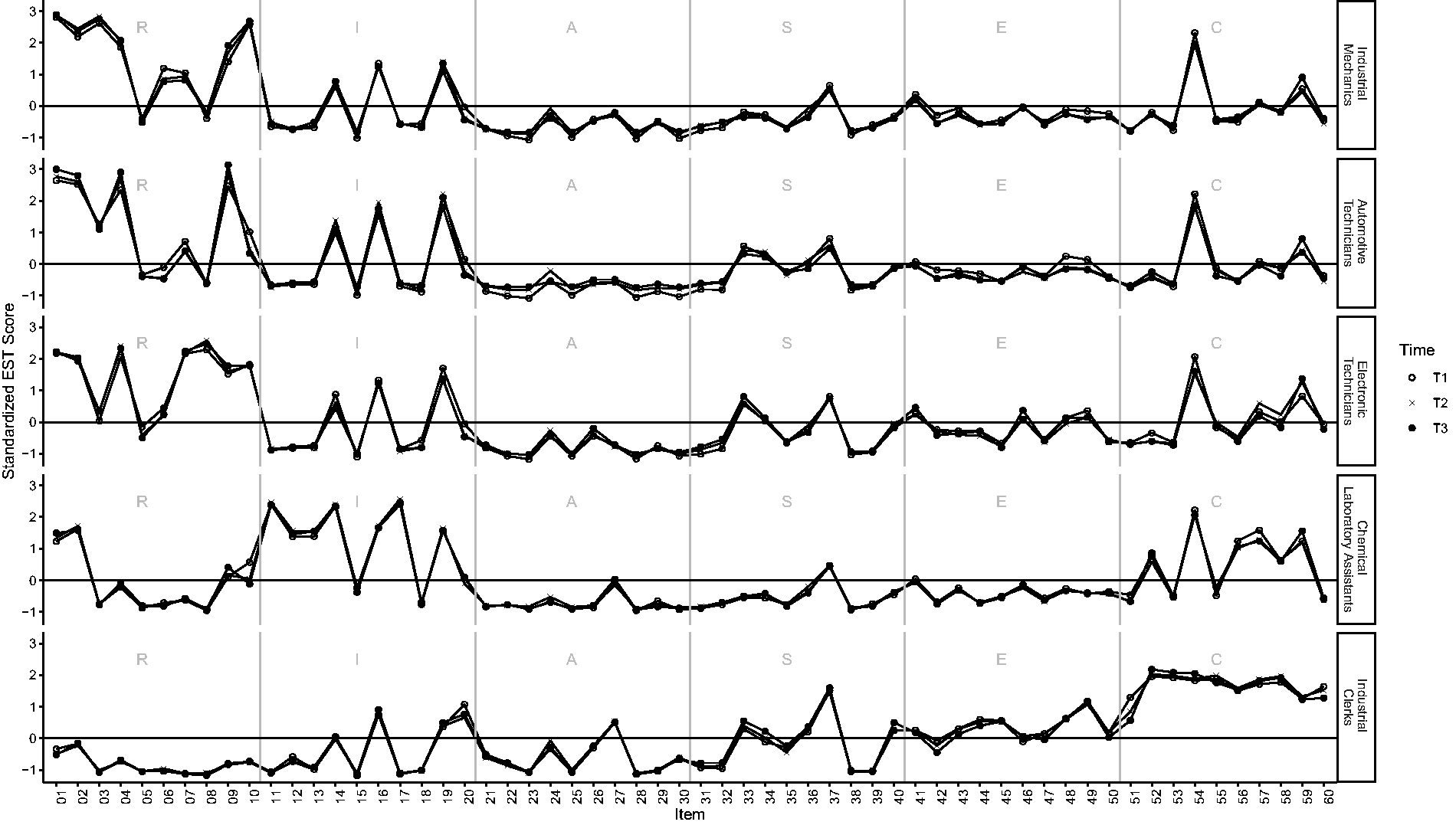
VET group-specific environmental reference profiles. Note. Environmental reference profiles of each VET course on all three measurement occasions estimated via factor mixture models.
MREMA Step 1: Estimation of individual-level coefficients
For each individual on each of the three measurement occasions, we calculated the Pearson correlation between (a) the individual’s interest profiles on different measurement occasions, and (b) the individual’s interest profiles and the respective environmental reference profile of their VET group. The latter coefficient is similar to the Alpha Fit index suggested by Roberts and Robins (2004), which has the advantage of providing a clear interpretation when changes in this index are analyzed: Because the environmental profile is the same for each individual in a particular VET group, changes in Alpha Fit are solely attributable to changes in the trainees’ interest profile shapes towards higher agreement with the environmental profile. In this regard, this congruence index is better suited than the Beta Fit index, which uses the individuals’ own perceptions of the VET course’s demands, thus confounding changes in interest profiles with changes in environmental perceptions. Although the study of such perceptions is, in general, an interesting and understudied topic, the questions examined in the current study clearly require the use of Alpha Fit.
Because the sample distribution of profile correlations tends to be skewed, we further transformed these profile correlations to z-scores using Fisher’s r-to-z transformation. The main reason for this was to ensure that the variables were normally distributed, which was a requirement for the extended analyses presented later (latent growth curve models). Although the z-metric was used to ensure the appropriateness of the statistical inference about the parameters, we report our results in the familiar r-metric. 3 The individual-level effect sizes were estimated by fitting particularly specified fully saturated structural equation models to each individual’s available data with Mplus (version 8.4; Muthén & Muthén, 1998/2018). The corresponding sampling variances and covariances were obtained from the asymptotic variance–covariance matrix of the parameter estimates (given by the TECH3 output in Mplus).
MREMA Step 2: Aggregation
Figure 2 displays the general specification of a single-group MREMA model with three dependent effect sizes specified as a structural equation model (Cheung, 2013). The manifest variables ES1–ES3 hold the respective effect size estimates obtained in Step 1. Their variances and covariances (
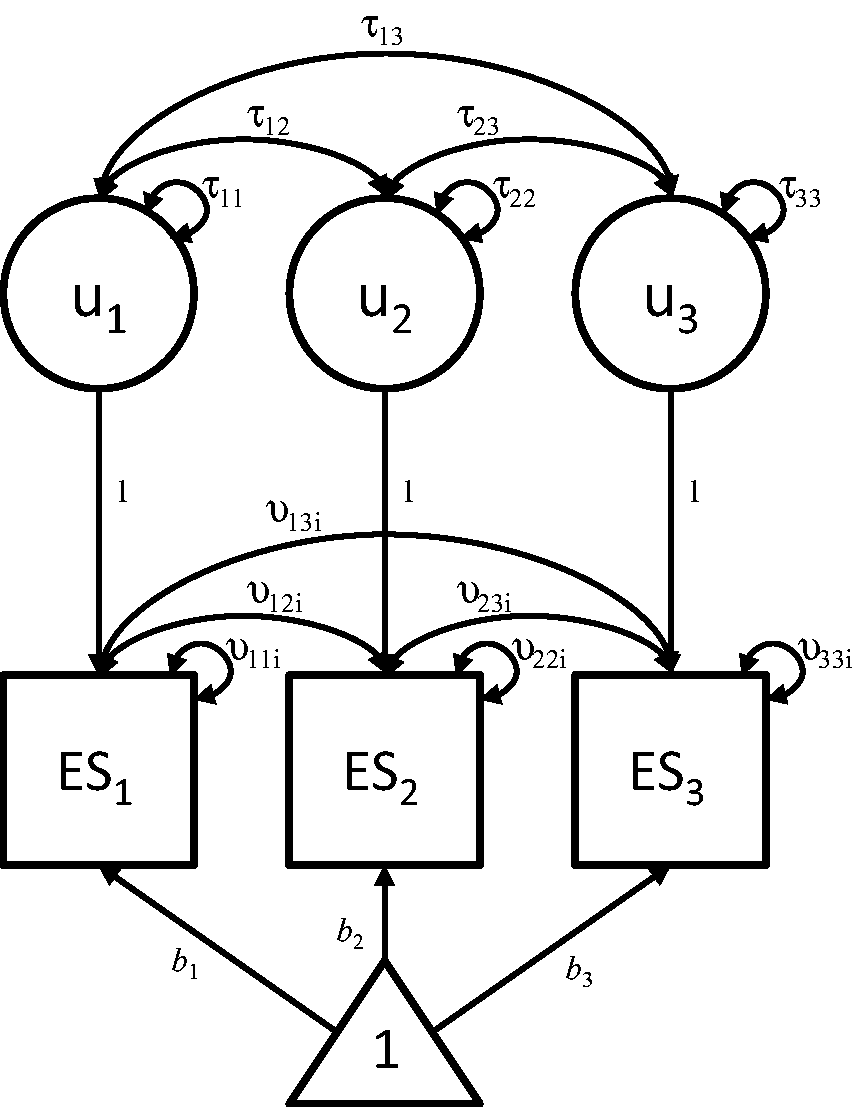
Exemplary MREMA structural equation modeling specification. Note.
In our application, we extended the model depicted in Figure 2 to the multigroup framework. Specifically, we included VET course as a grouping variable and estimated all MREMA parameters freely within each group. The bases for our analyses were two unrestricted multigroup MREMA models: one for the two stability effect sizes and one for the three congruence indices.
Stability of interest profile shapes
The average profile stability between any two measurement occasions was given by the intercepts of the first MREMA model. In order to test whether or not the stability estimates within each group were significantly different from one another, we subtracted the estimate of T1→T2 stability from that of T2→T3 stability via the model constraint command in Mplus. This procedure provides a standard error for the difference variable that is derived by the delta method and thus makes it possible to evaluate whether or not the two estimates are significantly different from one another.
Selection effects
As mentioned above, we defined selection effects as the difference between the VET group-specific aggregated P-E congruence effect size at T1 and the respective baseline P-E congruence estimate obtained from the reference sample. The latter was obtained by calculating the average z-scores of the correlations between the interest profiles of the participants from the reference sample and the five VET group-specific environmental reference profiles. In order to account for the differences in the demographic compositions between the VET groups, the z-scores were averaged using a weighted mean. The weights mirrored the proportion of male and female participants with either a higher education entrance qualification or any lower school leaving certificate in the respective VET group. By doing this, we determined the following baseline effect sizes: industrial mechanics:
Socialization effects
In order to evaluate whether or not the average P-E congruence between trainees’ vocational interest profiles and the VET group-specific environmental reference profiles increased significantly over the course of training, we defined new parameters that indicated the differences between the P-E congruence effect sizes from different measurement occasions. By doing this, we obtained two indicators of occupational socialization effects (T1→T2:
Relationship between P-E congruence and satisfaction
The final set of analyses aimed to investigate the cross-sectional and longitudinal relationships between P-E congruence and satisfaction with VET. These analyses were meant to provide evidence for the psychological meaningfulness of interindividual differences in P-E congruence (and changes therein) by showing their association with a soft marker of trainees’ success in their VET program. As a preliminary step, we calculated the rank-order correlations of the satisfaction measures. Satisfaction was moderately stable from T1 to T2 (.32 ≤ r ≤ .54) and slightly more stable from T2 to T3 (.44 ≤ r ≤ .65). We then estimated an unconstrained multigroup model combining the MREMA model for the P-E congruence estimates with the measurement model for the latent satisfaction with VET measures. This model was used to (1) estimate the cross-sectional correlations between P-E congruence and satisfaction on each measurement occasion and (2) to serve as a baseline model for the subsequent latent growth curve model. In order to analyze whether or not changes in P-E congruence were associated with corresponding changes in satisfaction, we extended the first model to a multigroup latent growth curve model for both constructs. This model is depicted in Figure 3. For satisfaction, the loading of the latent slope factor was fixed to 0 at Time 1 and fixed to 1 at Time 3. The factor loading for Time 2 was estimated freely to allow for a nonlinear trajectory. For P-E congruence, the factor loadings for Times 2 and 3 were fixed to 1 because the freely estimated loadings were very close to one. To identify the mean structure of satisfaction with VET, the mean of the intercept factor was fixed to zero in the industrial clerk group. This model allowed us to estimate, for each VET group, the correlation between the growth trajectory of P-E congruence (i.e., the slope) over time and the growth trajectory of satisfaction over time. The Mplus syntaxes and the data to estimate all of the models described above can be retrieved via https://osf.io/us9a2.
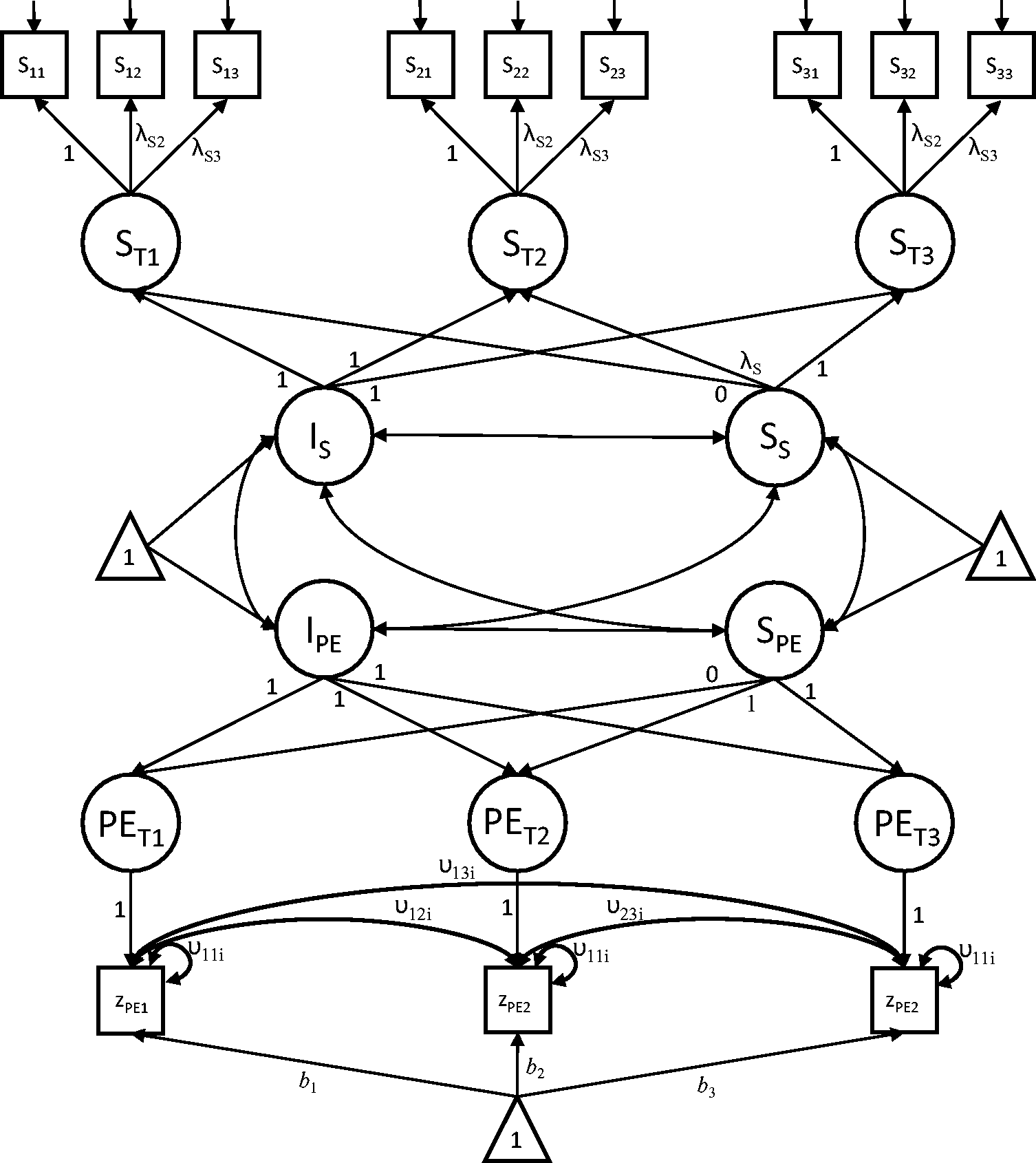
Structural equation modeling specification of an extended MREMA model with latent growth curve factors for P-E congruence and satisfaction with VET for a single VET group. Note. PE: P-E congruence; S: satisfaction with VET. The lower part corresponds to the MREMA model from Figure 2. The upper part represents the measurement part of the latent satisfaction with the VET measure (measurement intercepts for the satisfaction items are omitted to simplify the visualization). Of particular interest are the means of the latent growth curve factors (intercepts [I] and slopes [S]) and the correlations between the two slope factors (
Results
Table 1 presents the trainees’ groupwise average profile elevations and average profile scatters, as basic descriptive information of the GIST and EST profiles. In addition, Figure 4 displays the average standardized interest profiles in the same way as the environmental reference profiles in Figure 1. First, in all VET groups, average GIST profile elevations were of moderate magnitude (2.56 ≤
Descriptive statistics for the average interest and environmental profiles and satisfaction with VET.
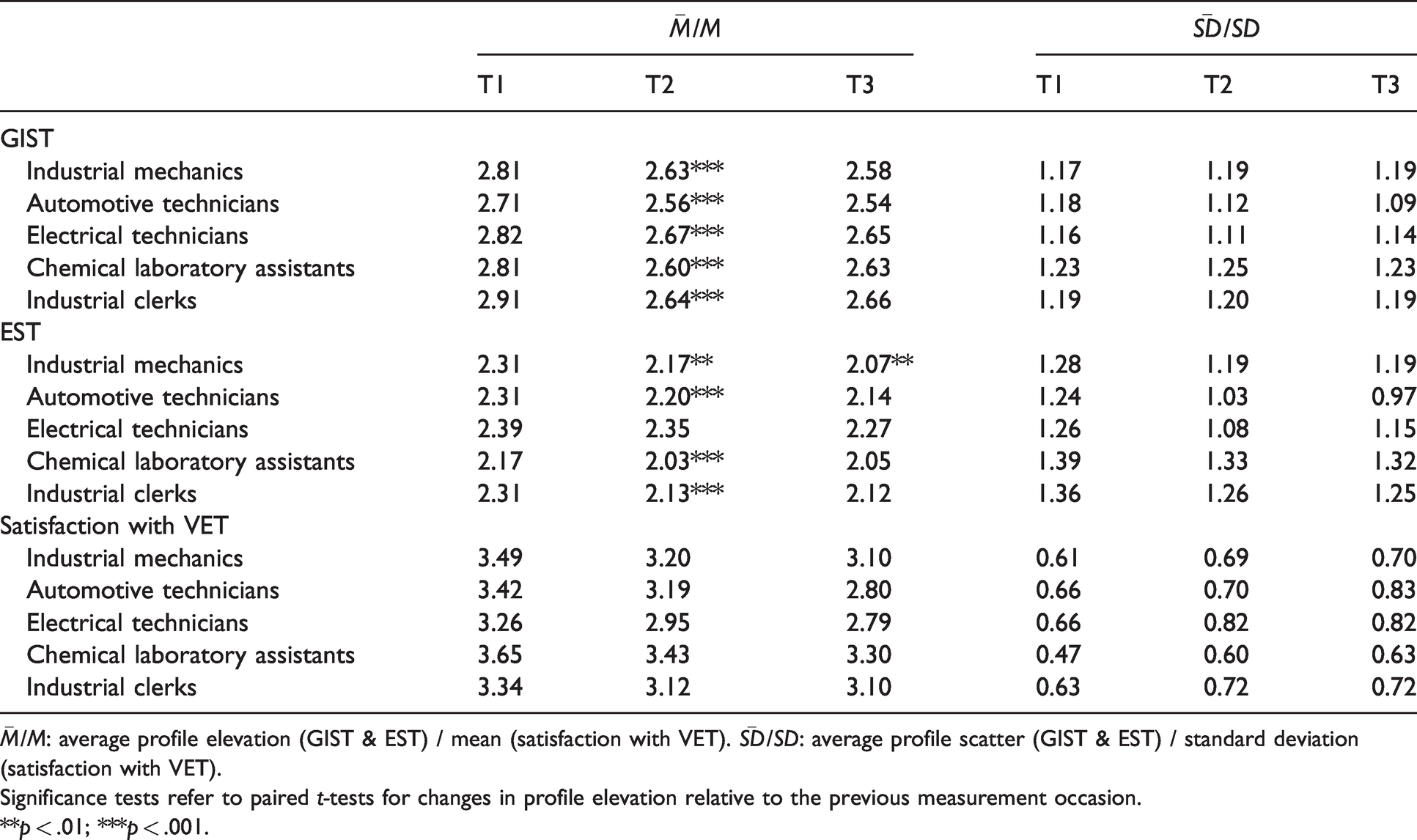
Significance tests refer to paired t-tests for changes in profile elevation relative to the previous measurement occasion.
**p < .01; ***p < .001.
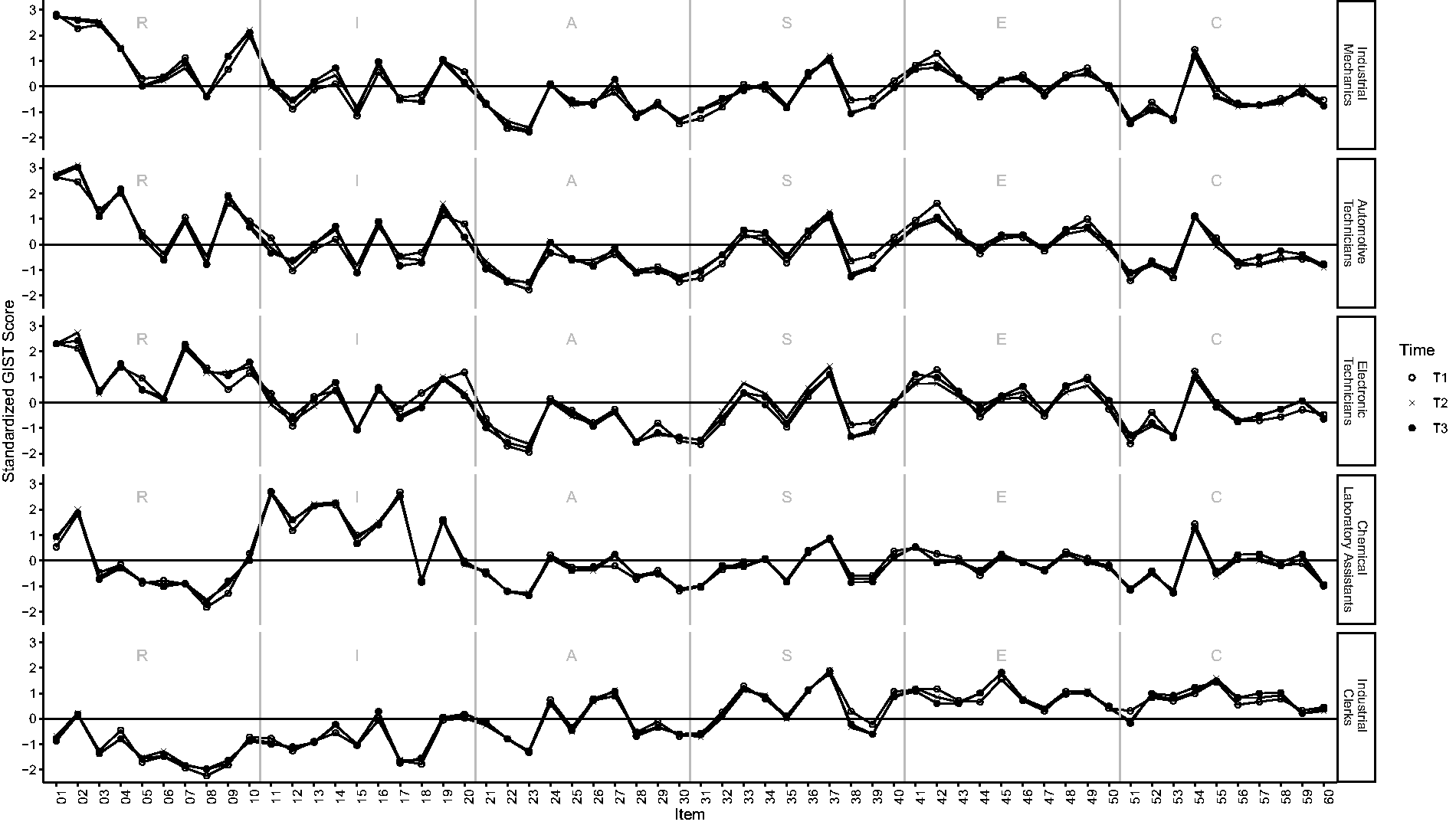
VET group-specific average standardized interest profiles. Note. Average standardized interest profiles of each VET course on all three measurement occasions.
As can be seen in Figure 4, the central characteristic of the average interest profiles, their profile shape, was highly stable over time for all VET groups (.93 ≤ r ≤ .99). Trainees from the technical VET groups scored high on items belonging to the Realistic domain and low on items from the Artistic and Social domains. Trainees from the chemical laboratory assistant VET scored high on items from the Investigative domain and lower on those from the Realistic and Artistic domains. Lastly, trainees from the industrial clerks VET group scored lowest on items from the Realistic and Investigative domains and higher on those from the Enterprising and Conventional domains. Similar to the results for the environmental reference profiles (Figure 1), these item-level profiles exhibited finely accentuated profile shapes that might have been blurred on the level of scale scores.
Interest profile stability
The results of the unconstrained multigroup MREMA model for the stability effect sizes are displayed in Table 2. Note that all analyses were conducted on the level of Fisher r-to-z transformed effect sizes and that the aggregated effect sizes and confidence intervals presented herein were transformed back to the r-metric to facilitate interpretability. Across all groups and measurement occasions, the aggregated profile correlations were significantly larger than zero and of medium to large magnitude (0.47 ≤
Point and interval estimates of MREMA analyses for profile stability.
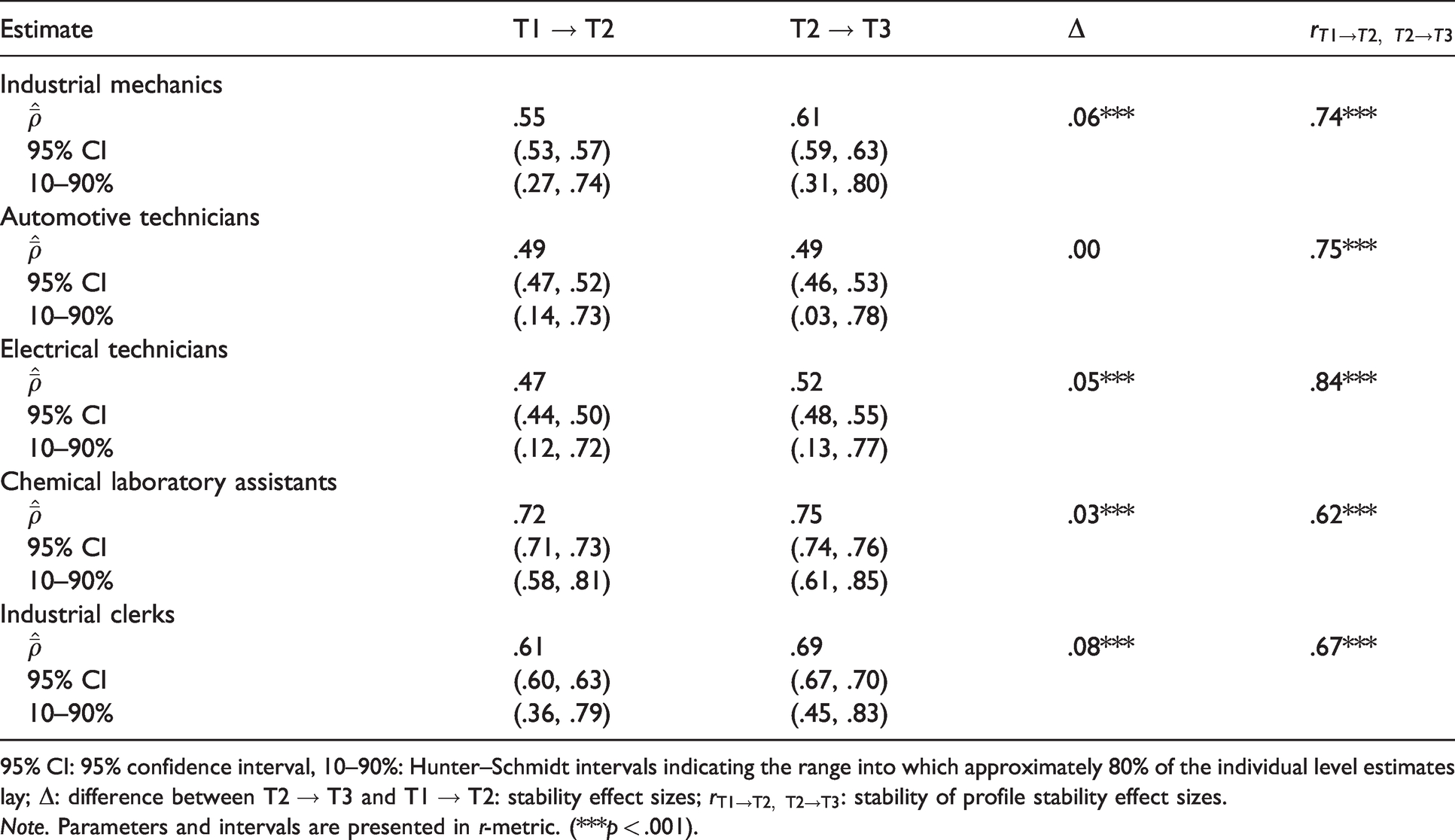
95% CI: 95% confidence interval, 10–90%: Hunter–Schmidt intervals indicating the range into which approximately 80% of the individual level estimates lay;
Note. Parameters and intervals are presented in r-metric. (***p < .001).
As a visual aid, the aggregated stability estimates for each VET group and their corresponding 95% confidence intervals (black range indicators) are visualized in Figure 5. Furthermore, the plots contain Schmidt–Hunter credibility intervals (e.g., Brannick et al., 2019), indicating the range in which roughly 80% of the individual stability estimates lay (gray range indicators). They were calculated by taking the average profile stability estimates from the MREMA model and adding/subtracting 1.28 times the standard deviation. Consequently, these indicators illustrate the extent of interindividual differences in intraindividual profile stability. Although the patterns of the average stability estimates over time were more or less similar, the absolute size of the aggregated stability indices differed significantly between VET groups (the respective Wald tests yielded
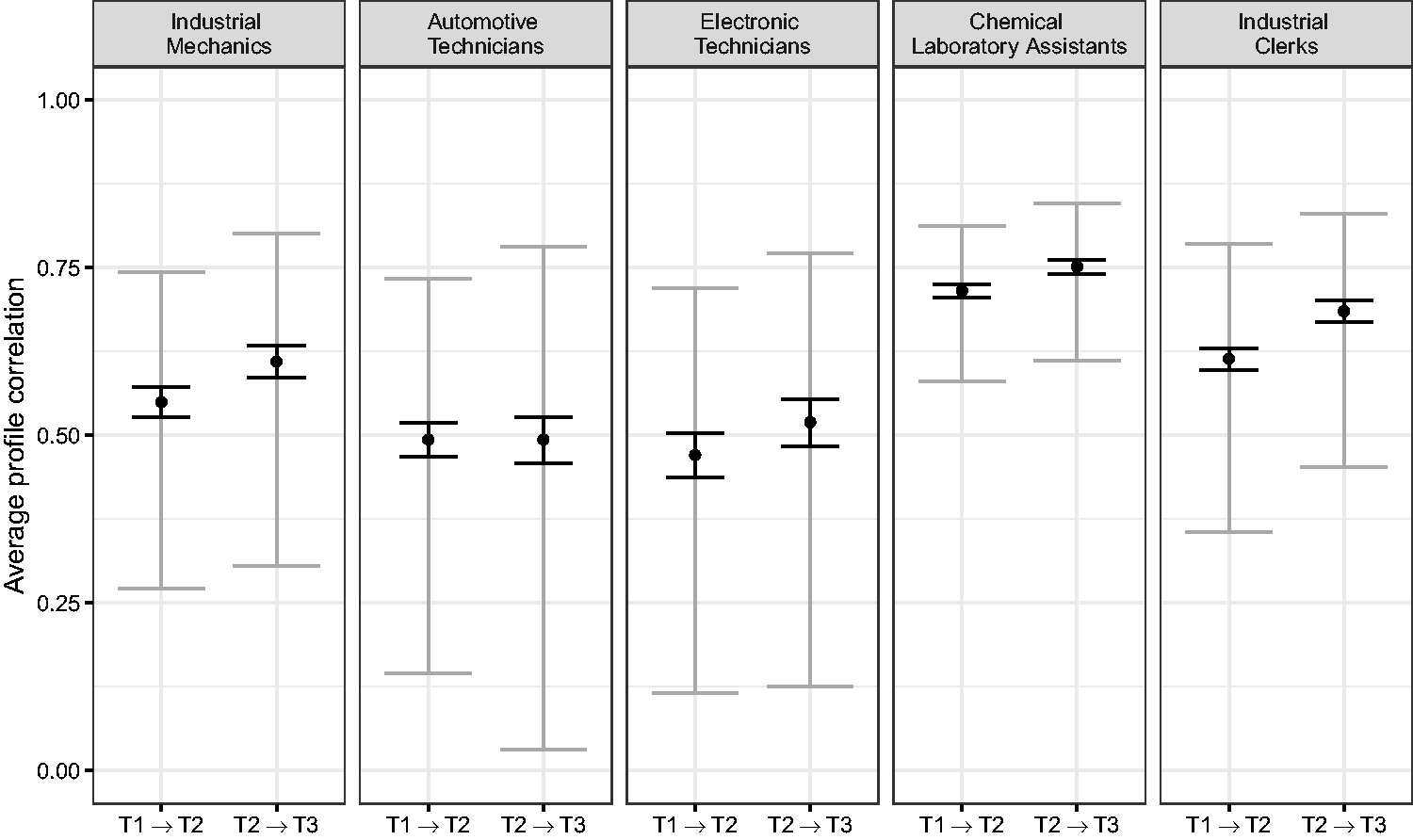
Results of the MREMA model for the interest profile stability effect sizes. Note. Aggregated average profile correlations of the stability estimates, corresponding 95% confidence intervals (black) and Schmidt–Hunter intervals indicating the range in which approximately 80% of individual data points lay (gray).
In all VET groups, the stability estimates themselves were highly stable across time. This is indicated by the high correlations between the respective random-effects variables (.62 ≤ rT1→T2,T2→T3 ≤ .84). In other words, all VET groups comprised participants with varying degrees of profile stability, and participants with a higher (or lower) profile stability in the first stages of their VET tended to retain this high (or low) stability in the second phase of their training. Finally, average stabilities increased over the course of training in all VET groups, with the exception of the automotive technicians, who displayed no change in average profile stability. Taken together, our analyses indicated that all groups comprised individuals with higher and lower levels of stability over the entire course of VET. Based on the average stability effects’ sizes and their variance terms, we were able to infer that the proportion of trainees with rather unstable interest profiles was largest in the groups of automotive and electronic technicians, which had the smallest average stability effects coupled with the largest variance components.
Development of P-E congruence
Table 3 presents the results of the unconstrained multigroup MREMA model for the three P-E congruence effect sizes, from which the selection and socialization effects were derived. Furthermore, Figure 6 illustrates the aggregated P-E congruence effect sizes for all five VET groups (T1–T3) in the same way as the stability effect sizes are illustrated in Figure 5. Here, each panel includes an additional horizontal black line indicating the respective baseline P-E congruence effect derived from the reference sample.
Point and interval estimates of MREMA analyses for person-environment congruence.
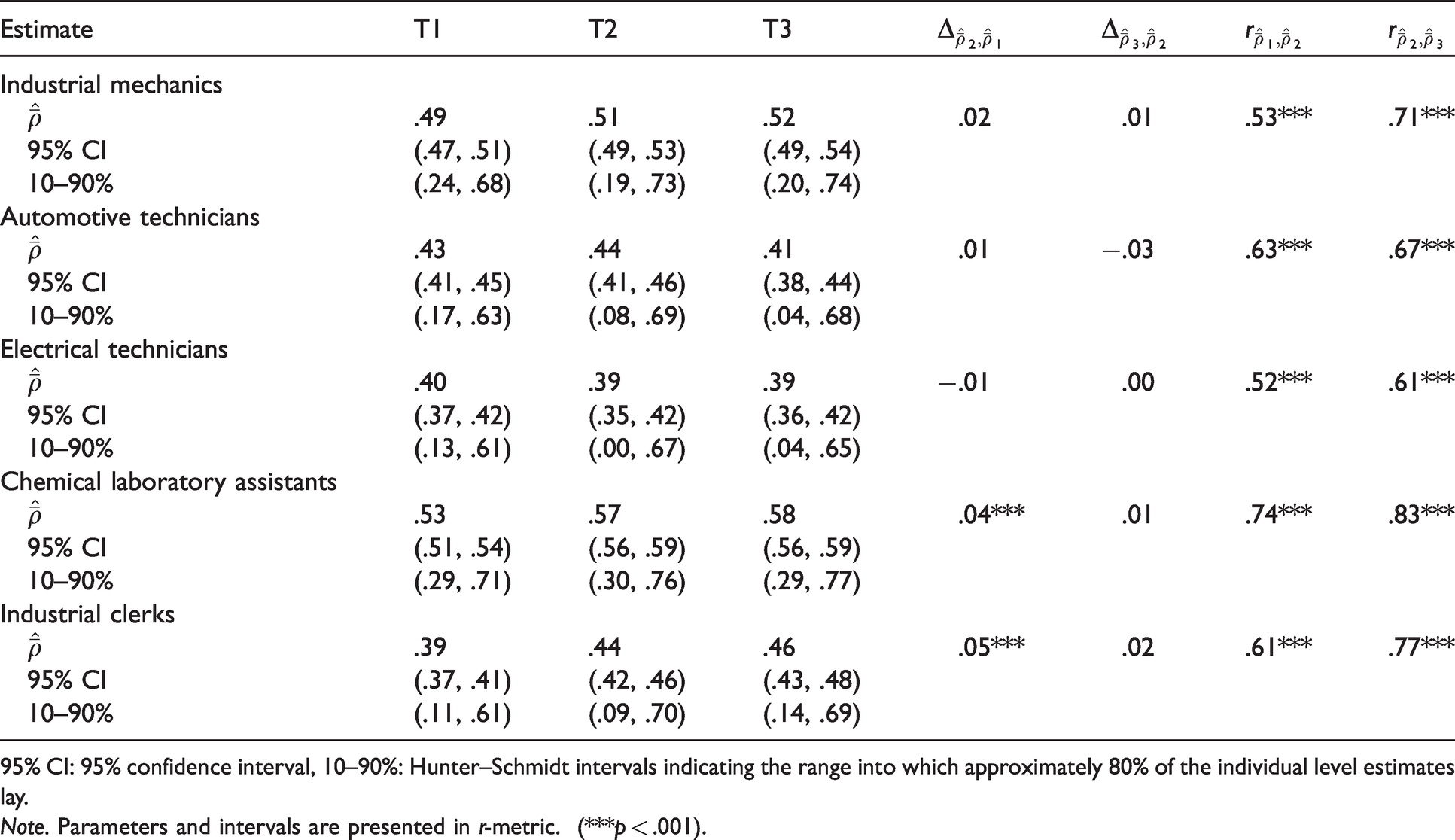
95% CI: 95% confidence interval, 10–90%: Hunter–Schmidt intervals indicating the range into which approximately 80% of the individual level estimates lay.
Note. Parameters and intervals are presented in r-metric. (***p < .001).
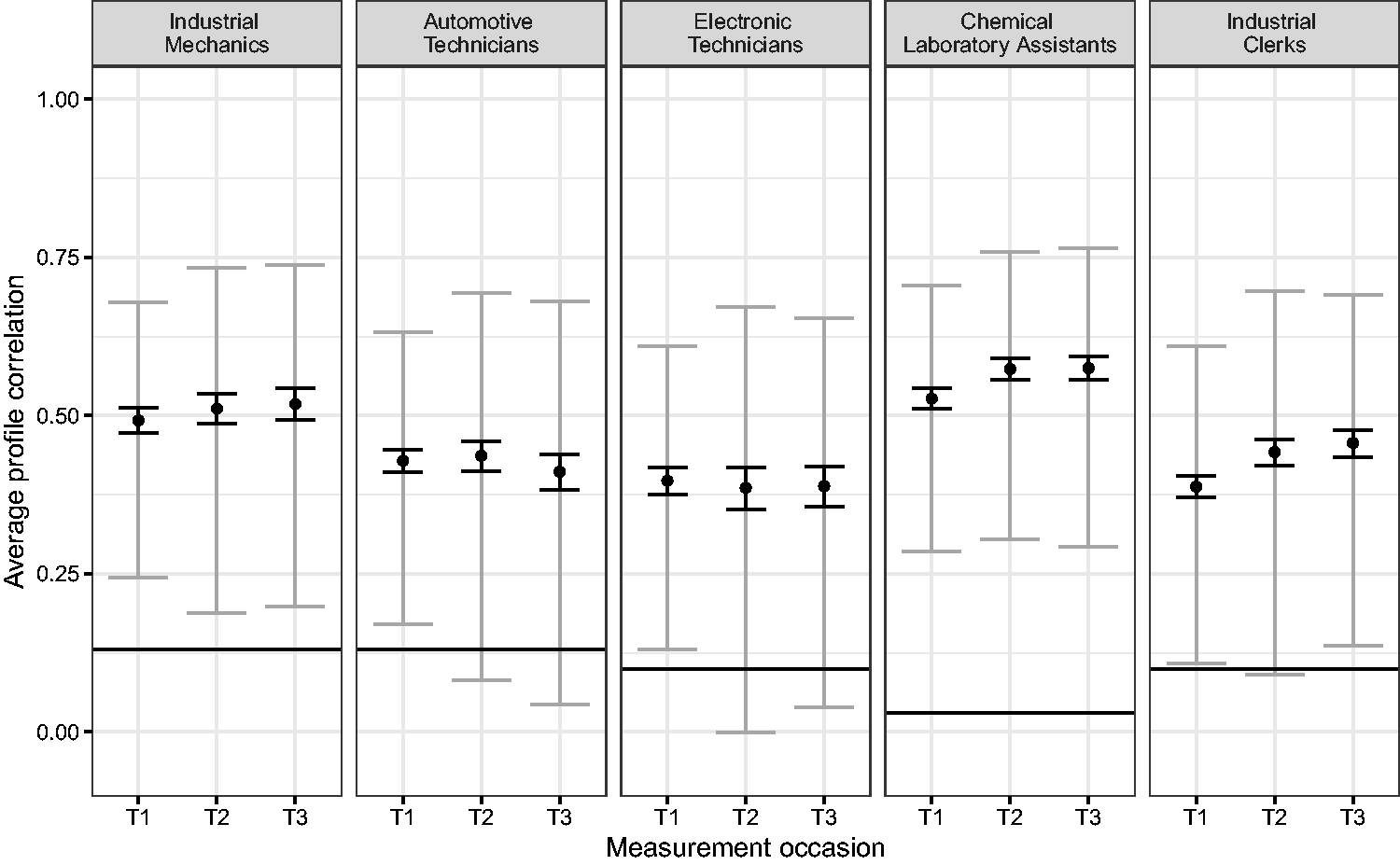
Results of the MREMA model for the P-E congruence effect sizes. Note. Aggregated average profile correlations of the P-E congruence estimates, corresponding 95% confidence intervals (black) and Schmidt–Hunter intervals indicating the range in which approximately 80% of individual data points lay (gray). Horizontal black lines indicate the corresponding baseline estimates from the reference sample.
Across all VET groups and measurement occasions, trainees’ interest profiles were, on average, positively correlated with the respective VET group environmental reference profile (0.39 ≤
Just as for the aggregated stability effect sizes, P-E congruence was found to be highly stable over time (.52 ≤
The middle columns of Table 3 present the socialization effects that were expected to be manifested in an increase in average P-E congruence over time. We defined these effects as the differences between the aggregated P-E congruence effect sizes at different time points i and j (
The magnitude of the few significant socialization effects is best judged in reference to the corresponding selection effects, which we defined as the difference between the VET group-specific average P-E congruence estimates at T1 and the corresponding average P-E congruence estimates obtained from the reference sample (.29 ≤
Taken together, the findings presented in this section suggest that initial average P-E congruence indices and changes therein differed significantly between VET groups. Furthermore, in all groups, P-E congruence displayed high intraindividual stability, especially in the second phase of VET. Our findings strikingly illustrate that average group-level socialization effects are rather negligible compared to the sizeable selection effects. However, despite the high average stability, we found significant variability in intraindividual P-E congruence and changes in P-E congruence. This advocated a closer examination of whether or not these differences were associated with trainees’ attitudes towards their VET course rather than just being noise in the data.
Relationships between P-E congruence and satisfaction with VET
In order to analyze the associations between P-E congruence and satisfaction with VET within and across time, we first fitted an unconstrained model containing the MREMA model for the P-E congruence measures and the measurement model for satisfaction and allowing all latent variables to covary. From this model, we derived the cross-sectional correlations presented in the first supercolumn of Table 4. Across all VET groups and measurement occasions, we found medium to large correlations between P-E congruence and satisfaction with VET (.25 ≤ r ≤ .46). Next, we extended this model to include latent growth indicators (slopes and intercepts) for both measures. These restrictions did not lead to a decrease in model fit compared to the unconstrained baseline model. 4 The second supercolumn of Table 4 displays the intercept and slope means and standard deviations for both P-E congruence and satisfaction. The third supercolumn of Table 4 presents the correlations between the intercepts and slopes, respectively.
Cross-sectional correlations between satisfaction and P-E congruence and results of the latent growth curve model.
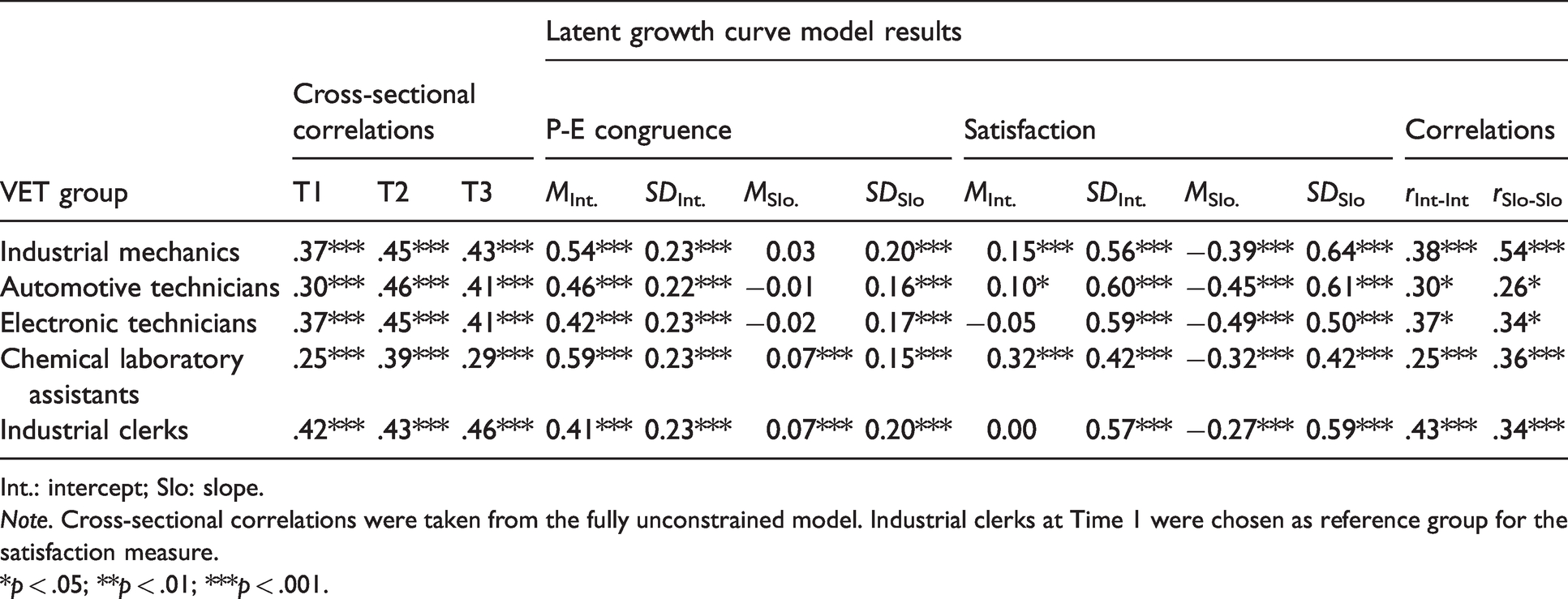
Int.: intercept; Slo: slope.
Note. Cross-sectional correlations were taken from the fully unconstrained model. Industrial clerks at Time 1 were chosen as reference group for the satisfaction measure.
*p < .05; **p < .01; ***p < .001.
The means of the intercept factor of P-E congruence corresponded closely to the aggregated T1 P-E congruence effect sizes in the z-metric. In line with the results from the MREMA model, slope means were only significant and positive for chemical laboratory assistants and industrial clerks, indicating that average P-E congruence increased only in these VET groups. Regarding satisfaction with the VET, the mean of the intercept factor of the industrial clerk VET group at T1 was set to 0 as a reference value. Industrial mechanics, automotive technicians, and chemical laboratory assistants displayed a higher initial satisfaction with VET, while there was no significant difference for electronic technicians’ initial satisfaction with VET. In all five VET groups, satisfaction decreased significantly over the course of VET, as indicated by the significant, negative slope means. Finally, for both P-E congruence and satisfaction, slope and intercept standard deviations were significantly larger than zero. This means that although P-E congruence was very stable on average, there were substantial interindividual differences in initial congruence and satisfaction as well as in their respective trajectories over the course of training. Corresponding visualizations of these interindividual differences can be found in the online supplemental materials.
On the between-group level, the rank-orders of the means of the P-E congruence and satisfaction latent growth curve model factors were well aligned. This means that (1) trainees from VET groups with higher initial P-E congruence were more satisfied than those from groups with lower initial congruence and (2) trainees from VET groups with a stronger increase in P-E congruence displayed a less steep decline in satisfaction with VET. However, because we only have data from five different VET groups, these findings are merely descriptive and must be considered with the necessary caution. On the individual level, the correlations between the intercept factors closely resembled the cross-sectional correlations between P-E congruence and satisfaction with VET at T1 (see the left-most column of Table 4). This is obvious because these factors capture the initial levels of P-E congruence and satisfaction, respectively. The correlations between the slope factors, on the other hand, capture covariation in the trajectories of P-E congruence and satisfaction with VET over the course of training. In all five VET groups, slope–slope correlations were significantly different from zero and of medium to large magnitude (.26 ≤ r ≤ .54). This means that changes in P-E congruence over the course of training were accompanied by corresponding changes in satisfaction with VET, providing further evidence for the validity of our approach towards operationalizing P-E congruence.
Discussion
The present study was concerned with profile-level examinations of the stability of and changes in vocational interests over the course of VET. By referring to one of the core concepts of Holland’s theory, the congruence hypothesis, we were particularly interested in the development of the congruence between vocational interest profiles and environmental reference profiles that indicated VET course-specific demands and opportunities. Through the use of meta-analytical aggregation methods, we were able to analyze population estimates of intraindividual stability and change and their relationship with satisfaction with the VET course. In the following sections, we critically evaluate our findings and discuss their theoretical and practical implications.
Stability of vocational interest profiles over the course of VET
One central finding of our study was that the interest profile shapes of trainees in highly specialized vocational contexts were, on average, considerably stable over the course of three years. However, although average stability estimates were of medium to large magnitude, they were not so large as to suggest that no change or development could have occurred at all. Our findings are, thus, in line with previous research on the stability of vocational interest profiles in other educational and occupational settings (e.g., Hoff et al., 2019; Low et al., 2005; Schultz et al., 2017; Tracey et al., 2005).
Although average profile stabilities were high, we found evidence for considerable variability in profile stability at both the individual and the group level. Specifically, we found that all VET courses comprised trainees with varying degrees of profile stability and that there were systematic differences in average profile stability between VET courses. Moreover, our results indicate that these interindividual differences in intraindividual profile stability were also considerably stable over the entire course of training. These findings indicate that future work could search for possible moderators of profile stability on both the individual and the group level.
Based on our theoretical rationale, P-E congruence was expected to be one plausible correlate of interest profile stability. Specifically, it could be argued that trainees who have a good fit to their environment are less likely to display substantial changes in their interest configuration. Indeed, additional analyses provided support for this assertion. Throughout all VET groups, trainees’ congruence with the environmental reference profile was correlated with their stability from the respective time point to the next (.26 ≤ r ≤ .56, all p < .001; detailed results are available upon request). However, the absence of clear socialization effects in our study suggests that this issue might be more complex than it appears at first glance. Because we found no indication of a general tendency of trainees with low levels of P-E congruence to increase their interest congruence over the course of VET, more research on the relationships between P-E congruence and interest stability is called for.
Two other plausible variables that could explain differences in trainees’ interindividual differences in profile stability are their age and variables related to individuals’ career maturity, such as their educational background, or their cognitive abilities. For example, Low et al. (2005) found interest rank-order stability to be associated with age, peaking in the age range of 18–22. Although trainees from different VET courses differed significantly with regard to age, F(4, 2570) = 23.03, p < .001, the absolute differences were rather small (17.9 ≤ M ≤ 19.2). More importantly, these differences were not systematically related to profile stability, which means that groups with a higher average age did not tend to have higher average profile stabilities.
Regarding the differences in educational backgrounds, the two VET groups with conspicuously low profile stabilities comprised 33% (electronic technicians) and 38% (automotive technicians) trainees with the lowest school leaving certificate. The group of industrial mechanics comprised only 15% trainees with the lowest certificates, and the two VET groups with the highest average profile stabilities (chemical laboratory assistants and industrial clerks) almost exclusively comprised participants with school leaving certificates qualifying them for university entrance. A closer look at these VET groups revealed that the average profile-stability indices within each group differed significantly between trainees with different school leaving certificates (detailed results of these additional analyses are available upon request). A potential question that should be further examined in future research is whether or not these differences can be attributed to differences in general cognitive abilities.
P-E congruence and its role in occupational selection and socialization
Another central research question investigated in this study was whether or not intraindividual configurations of vocational interest profiles changed systematically over the course of VET. To this end, we analyzed whether or not interest profile shapes changed towards greater congruence with the activity demands posed by the respective VET environments. On the group level, the results of these analyses were somewhat ambiguous. In two out of the five VET groups under investigation, P-E congruence increased slightly over the course of training, whereas no such changes were found for the other groups.
It should be noted once more that our analyses deliberately focused on only one potential way in which trainees could increase P-E congruence. As argued above, trainees could also increase their P-E congruence by transforming the objective activity demands or their perceptions thereof to better fit their interests. The former possibility can be ruled out in the context of VET, because the VET programs are highly standardized and they severely restrict trainees’ possibilities to choose which activities they have to perform during their training. However, this can be substantially different in other contexts where individuals have more degrees of freedom in choosing which activities they would like to pursue, such as later stages of university education, where students from the same major can diversify by choosing specialized courses. Although the possibility of increasing P-E congruence through changing one’s perceptions of the environment was not actively pursued in the current study, the fact that trainees’ environmental demands profiles were even more stable than their interest profiles does not leave much room for these perceptions to substantially affect P-E congruence over time. Again, this situation could be substantially different in less standardized settings or when different conceptualizations of P-E congruence are used (i.e., congruence based on more malleable constructs, such as needs and corresponding environmental pressures). Future research on this topic should aim to systematically examine the unique contributions of these different pathways to changes in P-E congruence.
Overall, the few socialization effects that were identified in the current study were much smaller than the corresponding selection effects. Our findings thus suggest that trainees in VET contexts establish P-E congruence primarily through occupational selection. In this sense, they further support other relevant studies on the importance of vocational interests for vocational choice behavior (Le et al., 2014; Lent et al., 2003; Nagy, 2006; Volodina, Nagy, & Retelsdorf, 2015).
However, these findings do not mean that changes in P-E congruence are psychologically irrelevant. On the contrary, our findings about the relationship between P-E congruence and satisfaction clearly support the critical role of P-E congruence in individuals’ career-related success. First, we found that VET groups with more favorable trajectories of P-E congruence displayed a less steep decline in satisfaction with VET over time. Second, we were able to replicate this finding on the individual level within each VET group. Therefore, our findings suggest that both the time-stable component of group and individual differences in P-E congruence—established by the process of occupational selection—and changes in P-E congruence over the course of VET are important for individuals’ vocational satisfaction. In this regard, our findings complement those of Nye et al. (2020) and Wille et al. (2014), who both found P-E congruence to be relatively stable over time and, in the latter case, also found substantial links between changes in interest congruence and satisfaction. An important advancement of our study is the fact that we assessed P-E congruence in reference to a time-invariant reference profile, which allowed us to attribute this stability to the stability of the trainees’ interest profile shapes, whereas in previous studies (e.g., Wille et al., 2014), changes in P-E congruence might also have resulted from individuals’ occupational transitions.
Finally, the observed positive relationships between P-E congruence and satisfaction, both from a static and a dynamic perspective, accentuate the appropriateness of our approach towards operationalizing P-E fit as the similarity between the shapes of the trainees’ interest profiles and a commensurate environmental reference profile. Most importantly, the fact that we found strong evidence for the covariation of changes in P-E congruence and changes in satisfaction with the VET course indicates that changes in P-E congruence and, thus, changes in vocational interest profile shapes are not only random fluctuations or mere indications of measurement error but, rather, have real consequences for relevant educational outcomes. In this regard, our findings join those of other studies on personality development that have analyzed and partially supported the assumption that environmental experiences in general, or work experiences in particular, might affect the development of personality traits and vocational interests over time (Denissen et al., 2014; Lüdtke et al., 2011; Roberts et al., 2003; Schultz et al., 2017).
Practical implications
Our findings also have some important implications for counseling practice. First of all, we were able to show that the driving force behind trainees’ pursuit to establish congruence between their interests and their environment is the selection of a fitting VET course. This particular finding further emphasizes the widely acknowledged importance of career counseling during middle school and the significance of conveying accurate characterizations of the demands and opportunities young adults are likely to be confronted with in particular career paths. However, our findings also suggest that, for some individuals, P-E congruence can increase over the course of training to counterbalance a suboptimal match at the start of a new phase in one’s professional life and to thereby possibly prevent those individuals from dropping out. Likewise, for others, P-E congruence can decrease over the course of training along with their satisfaction with their VET course. It is plausible to assume that individuals with such unfavorable P-E congruence trajectories are more at risk of dropping out of training than others. However, because we only examined correlations between slope-factors of congruence and satisfaction, more research is needed to disentangle the causal pathways between the two constructs.
More research is also needed to identify the circumstances under which and the extent to which young adults are able to refine their interests in order to reach a sufficient level of P-E congruence. This issue is especially important as our study suggests that some individuals do not adapt their interests to the environmental affordances and opportunities. Therefore, the processes leading to different levels of P-E congruence appear to be highly idiosyncratic. More knowledge about the determinants of these processes would open up the possibility of career interventions to help counselees to fathom the potential of adjuvant adaptations of their preferences, self-evaluations, and attitudes towards particular work tasks.
Finally, our study used an innovative approach to assess P-E congruence that might prove viable for counseling practice. Specifically, we conceptualized P-E congruence as the match between the shapes of trainees’ activity interest profiles and a commensurate environmental reference profile that was created on the basis of trainees’ perceptions of the activity requirements of their VET course. Thereby, we used single activity items rather than broader interest domains in order to gain a more detailed account of trainees’ patterns of likes and dislikes. In doing so, we found stronger relationships between interest congruence indices and satisfaction than previous studies (e.g., Tsabari et al., 2005; Xu & Li, 2020). Such indices could straightforwardly be used in counseling practice. This approach seems appropriate for relatively stable and clearly defined vocational contexts, such as VET, where it would be relatively easy to assess reference profiles. Once these reference profiles are available, counselors could assess counselees’ interest profiles and correlate them with different reference profiles to identify the best possible match.
Limitations and future directions
The sample used in this study comprised young adults enlisted in five different VET courses in Germany. Although we considered VET to be a particularly suitable context to examine our research questions, further research with more diverse samples is needed in order to further generalize our findings. For example, future research could try to replicate our findings using a sample of job entrants from various age groups and different vocational fields. Such studies could also consider the possibility of changes in environmental perceptions as a potential reason for changes in P-E congruence.
In our study, both vocational interest profiles and environmental reference profiles were assessed via self-report measures. This could lead to fears of measurement bias that is a result of individual differences in scale usage (e.g., a tendency to use extreme response categories). Such bias can lead to artificially large associations between measures, due to common method variance. However, two aspects of our study mitigated such unwanted effects. First, the environmental profiles were averaged across individuals, thus canceling out individual response tendencies. Second, our decision to use profile correlations as congruence indices further mitigated method bias because profile correlations were largely unaffected by response tendencies and only depended on the relative pattern of responses.
By relying on profile correlations to assess the similarity between trainees’ interest profiles over time and between trainees’ interest profiles and the VET course-specific environmental reference profiles, we deliberately focused on the examination of agreement between profile shapes. We chose this approach because we consider profile shape to be the central parameter of the interest profile, because profile shape has been found to be a pivotal predictor of vocational choice behavior (e.g., Nagy, 2006; Prediger, 1998), and because recent studies have demonstrated the predictive superiority of the profile correlation over alternative congruence indices (Xu & Li, 2020). Moreover, our findings regarding the decrease in profile elevations in all groups and measures, which are probably an indication of scale-usage effects, severely question the validity and utility of this particular profile component (see also Tracey, 2012).
Nevertheless, future research could pick up on our approach and also investigate the role of profile scatter. Some researchers have found interest profiles to become increasingly more differentiated over time (Tracey et al., 2005), a finding that is often interpreted as an indication of individuals becoming increasingly self-aware about which kinds of activities they prefer (Super, 1980). Moreover, in an analysis of individual-level predictors of interest stability, Hirschi (2010) was able to show that differentiation was positively related to interest stability. However, because these continuative questions were far beyond the scope of the current study, they should be scrutinized in future research on the stability of and changes in vocational interests.
Conclusion
The present study aimed to examine the stability of and changes in vocational interest profiles and interest congruence over the course of VET. Of particular interest was the question of whether or not trainees’ interest profiles changed systematically towards higher congruence with their respective VET environment, which would indicate processes of occupational socialization. Interest profiles were found to be—on average—very stable over the entire course of training and only little evidence for (small) socialization effects was found on the group level. However, we identified substantial interindividual variability in profile stability and P-E congruence trajectories that were related to trainees’ satisfaction with their VET course. In sum, our findings clearly demonstrate that (1) the driving force behind individuals’ attempts to establish P-E congruence is interest-based occupational selection, (2) occupational socialization effects appear to be far less important for establishing P-E congruence, and (3) intraindividual variations in P-E congruence over time are psychologically relevant because they are related to individuals making changes in their environmental evaluations.
Supplemental Material
sj-pdf-1-erp-10.1177_08902070211014015 - Supplemental material for Stability and change in vocational interest profiles and interest congruence over the course of vocational education and training
Supplemental material, sj-pdf-1-erp-10.1177_08902070211014015 for Stability and change in vocational interest profiles and interest congruence over the course of vocational education and training by Julian M Etzel and Gabriel Nagy in European Journal of Personality
Footnotes
Data accessibility statement

Declaration of conflicting interests
The author(s) declared no potential conflicts of interest with respect to the research, authorship, and/or publication of this article.
Funding
The author(s) disclosed receipt of the following financial support for the research, authorship, and/or publication of this article: The research reported in this article is part of the project “Mathematics and Science Competencies in Vocational Education and Training” that was funded by the Leibniz Association (SAW-2012-IPN-2).
Supplemental material
Supplemental material for this article is available online.
Notes
References
Supplementary Material
Please find the following supplemental material available below.
For Open Access articles published under a Creative Commons License, all supplemental material carries the same license as the article it is associated with.
For non-Open Access articles published, all supplemental material carries a non-exclusive license, and permission requests for re-use of supplemental material or any part of supplemental material shall be sent directly to the copyright owner as specified in the copyright notice associated with the article.
