



Abstract
Purpose
To evaluate the reach and short-term effectiveness of the Turn To social marketing campaign, which encourages healthy coping strategies for mental health challenges and promotes mental health communication in Texas.
Design
A cross-sectional survey was conducted in March 2023, 3 months after the campaign launch.
Setting
Data were collected online.
Sample
A sample of adult Texans (N = 1979).
Measures
Mental health-related norms, efficacy, behaviors, and campaign awareness.
Analysis
Multivariable linear regressions and multivariable logistic regressions were performed to assess the relationship between campaign awareness and potential campaign outcomes.
Results
Exposure to the campaign was positively associated with higher levels of self-efficacy (B = .009, P < .001) and response efficacy (B = .042, P = .045) in stress management, stronger perceived norms of seeking (B = .088, P < .001) and providing (B = .088, P < .001) mental health support, and a greater likelihood of engaging in recommended behaviors—such as asking for help from one’s social network (OR = 2.126, P < .001).
Conclusions
Our findings suggest that the campaign has achieved several indicators of early success. Social marketing campaigns may offer a feasible and promising approach to encouraging healthy coping strategies for mental health issues and fostering social connection through more open conversations about mental health challenges.
Purpose
In recent years, concerns about social connections—or lack thereof (ie, loneliness, isolation)—have increased and drawn attention from researchers, practitioners, policymakers, and the general public.1-4 Even before the COVID-19 pandemic, data indicated that a substantial proportion of people experienced loneliness.3-5 A 2018 survey showed that more than a fifth of adults in the United States often or always felt lonely, left out, or isolated from others. 5 The pandemic and the measures implemented to mitigate it made the issue even more salient. A systematic review confirmed that loneliness and isolation have increased compared to pre-pandemic levels. 6
Previous research has extensively documented the adverse effects of social disconnections, isolation, and loneliness on emotional, physical, and behavioral outcomes.2,7,8 Specifically, epidemiological studies show that these factors are linked to depressive symptoms, 9 incident dementia, 10 increased risk of heart disease and stroke, 11 and a higher likelihood of mortality. 12 Conversely, social connection can serve as a preventive and protective factor for health, with evidence showing a 50% increased likelihood of survival among people with stronger social relationships. 13 While loneliness and isolation are often assumed to affect older populations more, 14 emerging evidence suggests that they impact people across the life span. 15 Survey data, particularly collected during the COVID-19 pandemic, also indicate that young adults may be at even greater risk, as their social connections were more significantly disrupted by the pandemic. 16 Despite the key role social connection plays in determining health and the concerning trends, few public health frameworks and interventions have included social connection, prompting scholars to call for more research and practice in this area.1,4
Building on this reasoning, the Texas Human and Human Services Commission (HHSC) funded a media campaign named Turn To that aims to promote social connection and healthy coping behaviors for mental health challenges, ultimately helping to prevent the increased use or misuse of substances to manage mental distress. The objective of the current study was to assess the campaign reach and effectiveness 3 months after its launch. Since Turn To is a multi-year campaign, media strategies and implementation can be refined based on these early evaluation findings. Specifically, we report the recall rate of the campaign, the frequency and channel of campaign exposure, as well as the differences in mental health-related norms, efficacy, and behaviors between those exposed to the campaign and those who were not. This is the first evaluation of the Turn To campaign and provides initial evidence of its effectiveness in potentially enhancing social connection, contributing to the limited evidence base on using mass media campaigns to promote social connection.
The Turn to Campaign
The Turn To campaign was one of the largest public health interventions in Texas. It was officially launched in late November 2022. The concept of “Turn To” conveys the idea of turning to healthy coping strategies (eg, family, friends, and activities) during difficult times. This concept was tested with the general public and community leaders across Texas through interviews and focus groups during the formative research. 17 The main components of the campaign included a website, a series of videos, and associated print and digital advertisements, available in both English and Spanish. Campaign messages normalized feelings of loneliness by featuring different individuals who felt stuck and were struggling, and highlighted the positive outcomes of reaching out to others or engaging in different activities. A wavy yellow arrow appears across all campaign materials, symbolically connecting the people featured in the ads or pointing to helpful mental health resources. These consistent elements helped create a recognizable campaign brand, which may boost campaign recognition. Campaign materials were distributed via TV, radio, print media, social media, and community display screens. By March 2023, just over 5 million dollars had been spent on media buys, resulting in over 700 million impressions and nearly 30,000 TV and radio spots.
Drawing from broad behavior change theories, such as the health belief model and the reasoned action approach,18-20 the current evaluation sought to examine whether norms and behaviors related to social connection are influenced by the campaign. According to these theories, behavior is shaped by the beliefs underlying it. For example, seeking and providing support to family and friends can be influenced by social normative beliefs about how common such behaviors are. Since the campaign not only emphasized the importance of social connection but also acknowledged broader mental health challenges, it may also prompt other mental health-related behaviors, such as information seeking and talking to therapists. Thus, the current evaluation examined a range of mental health-related norms, efficacy beliefs, and behaviors beyond social connection, and asked whether campaign awareness was associated with these outcomes.
Methods
Design
Data for the current study were from a larger cross-sectional survey that assessed campaign reach and outcomes as well as gathered audiences’ feedback on campaign creatives. The University of Texas at Austin IRB approved the study procedures. The survey was administered by the survey research firm Centiment, who provided a quota-matching sample of Texan adults based on age, gender, and race/ethnicity. Centiment panels comprise individuals who have opted in to participate in research across a range of topics. To ensure data quality, the platform uses both automated and manual security checks, such as IP verification, proxy detection, ReCaptcha, fraud scoring, and duplication prevention. Data were collected in March 2023, 3 months after the campaign had been launched (ie, post-test only). Respondents had the option to select their preferred survey language, English or Spanish. After agreeing to participate, they answered questions about their beliefs, attitudes, and behaviors related to mental health. Then they were shown some sample graphic ads from the Turn To Campaign and were asked whether they had seen any of these ads. Those who reported seeing the ads were further asked where they had seen the ads and what they had done as a result of seeing the ads. Those who did not recall seeing the ads were shown a campaign video and were asked about their feelings and thoughts about the video—these responses were used to refine the campaign materials and were not reported in the current manuscript.
Sample
Respondents who provided a non-Texas zip code or failed an attention check were excluded from analysis. The final sample included 1979 Texans aged 18-93 years old (M = 44.6, SD = 17.6). Over half of the respondents were female (53.2%). Over one-third identified themselves as Hispanic/Latino (37.2%), 43.8% identified as non-Hispanic White, 11.8% identified as non-Hispanic Black, and 7.2% identified as other or multiple races. The final sample closely aligned with the demographic distributions of the Texas population in terms of age, gender, and race/ethnicity according to the 2023 U.S. Census Bureau Data (comparison details provided in the supplemental materials). Most respondents chose to take the survey in English (95.7%). Over one-third of respondents had at least a bachelor’s degree (35.3%), 31.7% reported having some college education, 27.5% completed high school, and 5.6% had less than a high school degree. Additionally, over one-third of respondents reported living in a large city (34.5%) or a suburb area near a large city (35.6%), 20.5% lived in a small city or town, and 9.4% lived in a rural area.
Measures
Mental Health-Related Norms and Efficacy
We measured perceived norms and efficacy related to mental health help-seeking and help-providing behaviors. To capture norms, respondents were asked: “How common do you think it is for people like you to (1) seek mental health support from professionals, if needed (formal help-seeking); (2) seek mental health support from family or friends, if needed (informal help-seeking); and (3) provide mental health support to their social network, like family or friends (informal help-providing)?” Response options ranged from 1 (extremely rare) to 5 (extremely common) (formal help-seeking: M = 3.13, SD = 1.18; informal help-seeking: M = 3.27, SD = 1.19; informal help-providing: M = 3.53, SD = 1.07). To assess efficacy, respondents were asked whether they agreed or disagreed with two statements: “There are effective coping strategies available to reduce stress” (response efficacy) and “If I wanted to, I could easily manage my stress” (self-efficacy). Response options ranged from 1 (strongly disagree) to 7 (strongly agree) (response efficacy: M = 5.64, SD = 1.13; self-efficacy: M = 4.87, SD = 1.50).
Mental Health-Related Behaviors
Respondents were asked whether they had performed a list of behaviors during the past 30 days with the response options of “Yes,” “No,” and “Not sure.” Those who answered “No” and “Not sure” were combined into one category in analysis. The list of behaviors included “searched for information about mental health online” (Yes: 27.0%), “consulted a mental health professional” (Yes: 16.0%), “asked for help from family or friends to help manage your own mental health issues” (Yes: 23.5%), and “talked with someone close to you about their mental health issues” (Yes: 39.1%).
Campaign Exposure
The primary independent variable was campaign exposure, which was assessed with a self-reported, aided recall measure. Respondents read a brief description of the Turn To campaign and saw 6 graphic ads from the campaign, which were selected in consultation with the agency who planned and managed media buy. Respondents were asked whether they had recalled seeing any of the sample ads with “Yes” or “No.” Those who recalled seeing the campaign were further asked where they recalled seeing the ads from a list of channels, including digital, print, and interpersonal as well as how often they saw the ads with options of “Almost every day,” “About 3 times a week,” “About once a week” and “About once a month.” They were also asked whether they had taken any actions as a result of seeing the campaign, ranging from visiting the campaign website to sharing the campaign with other people.
Potential Covariates
The following demographic variables were included in the analyses to account for potential confounding effects: age (5 categories: 18-25 years old, 26-40 years old, 41-55 years old, 56-70 years old, and 70+ years old), gender (3 categories: male, female, and other), race/ethnicity (4 categories: non-Hispanic White, Hispanic/Latino, non-Hispanic Black, and other), geographic location (4 categories: large city, suburban area, small city or town, and rural area). Additionally, we identified two continuous covariates, social connection and mental health status. Social connection was measured with the Social Provisions Scale (Cronbach’s α = .94, M = 5.25 on a 7-point scale, SD = 1.05) and a higher score indicated a higher level of social connection. 21 Mental health status was assessed with the Kessler Psychological Distress Scale (K6) and items were recoded so a higher score indicated a worse mental health status (Cronbach’s α = .92, M = 2.38 on a 5-point scale, SD = 1.04). 22
Analysis
We ran descriptive analyses for all variables to understand data distribution patterns and assess measurement reliability. For continuous dependent variables (ie, mental health-related norms and efficacy), we conducted multivariable linear regressions with campaign exposure as the independent variable, adjusting for potential covariates. For categorical dependent variables (ie, mental health-related behaviors), we performed multivariable logistic regressions with the same independent variable and covariates. Among those who reported campaign exposure, we further regressed all outcome variables on frequency of exposure to demonstrate any potential dose-response effects. Missing data were handled by listwise deletion. All analyses were performed using SPSS v29. Due to space constraints, the following results section reports the regression coefficients for the independent variables—campaign exposure and frequency of exposure; full multivariable regression tables are provided in the supplemental materials.
Results
Campaign Exposure
Reported Channel of Campaign Exposure (n = 436)
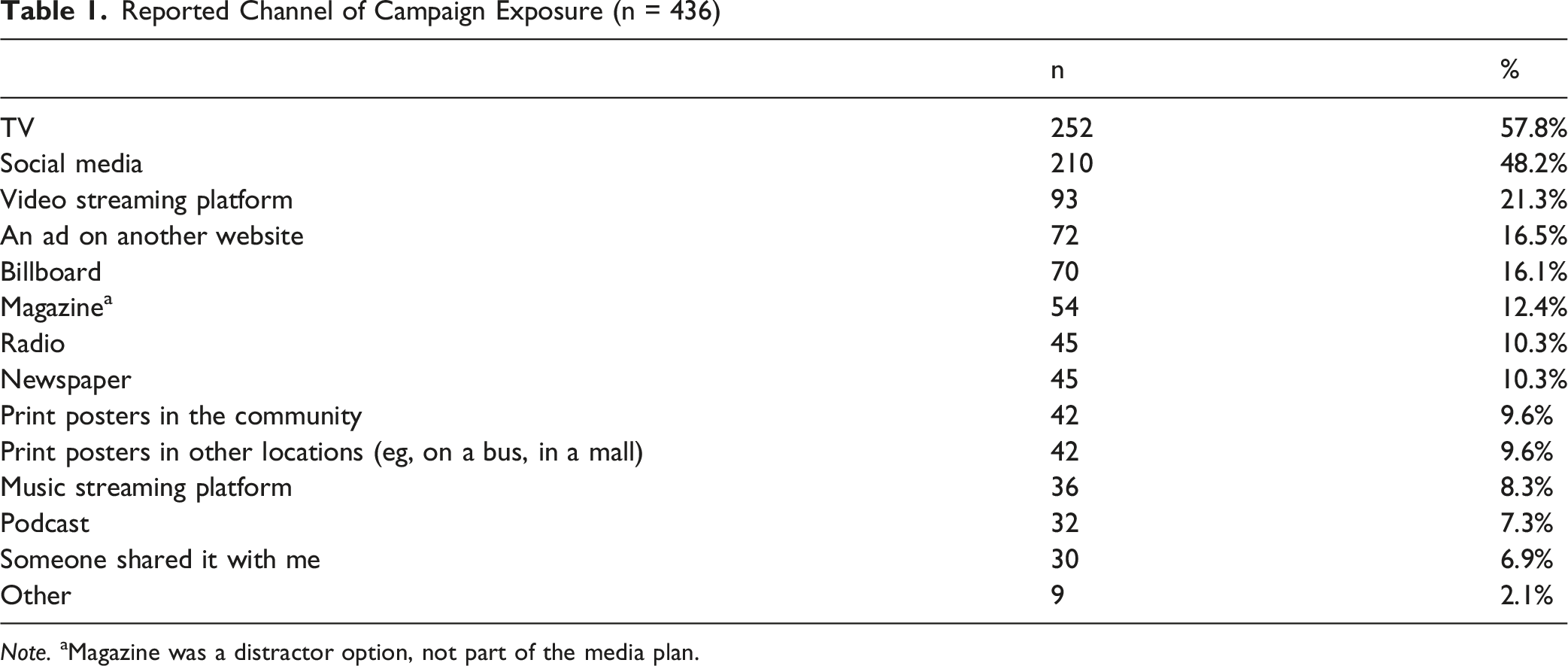
Note. aMagazine was a distractor option, not part of the media plan.
Reported Action After Campaign Exposure (n = 436)

Association Between Campaign Exposure and Mental Health-Related Norms and Efficacy
We regressed each normative and efficacy variable on campaign exposure. Recall of the Turn To ads was significantly associated with endorsement of all targeted variables. Specifically, those who recalled seeing the ads reported greater perceived norms regarding seeking mental health support from both professionals (B = .073, P = .001) and family or friends (B = .088, P < .001) as well as providing mental health support to their social network (B = .088, P < .001). They also reported greater response efficacy (B = .042, P = .045) and self-efficacy (B = .099, P < .001) of stress management than those who did not recall seeing the ads.
Association Between Campaign Exposure and Mental Health-Related Behaviors
Multivariable logistic regressions were performed to examine the associations between campaign exposure and mental health-related behaviors. Compared to those with no exposure, those exposed to the Turn To ads were more likely to search for information about mental health online (OR = 2.253, 95% CI: 1.744, 2.909, P < .001), consult a mental health professional (OR = 2.346, 95% CI: 1.771, 3.109, P < .001), ask for help from family or friends to manage their own mental health issues (OR = 2.126, 95% CI: 1.645, 2.749, P < .001), and talk with someone else about that someone else’s mental health issues (OR = 2.157, 95% CI: 1.701, 2.735, P < .001).
Association Between Frequency of Exposure and Outcomes
When regressing outcomes of interest on frequency of exposure, we found that frequency of exposure was positively associated with mental health-related efficacy. Specifically, those with higher frequencies of exposure showed higher levels of both response efficacy (B = .130, P = .005) and self-efficacy (B = .115, P = .012) of stress management. However, the associations between frequency of exposure and normative beliefs were not statistically significant (seeking support from professionals: B = .010, P = .840; seeking support from family/friends: B = .024, P = .628; providing support to family/friends: B = .010, P = .843). Additionally, those with higher frequencies of seeing the ads had greater odds of searching for mental health information online (OR = 1.511, 95% CI: 1.180, 1.935, P = .001), consulting a mental health professional (OR = 1.339, 95% CI: 1.031, 1.738, P = .028), and asking for help from family or friends (OR = 1.717, 95% CI: 1.329, 2.217, P < .001); a significant association was not found for the behavior of talking with someone else about their mental health issues (OR = 1.181, 95% CI: .929, 1.502, P = .175).
Discussion
Social disconnection has emerged as a new public health concern over the past decade, warranting more research and intervention efforts due to its adverse effects on individual health. The present study evaluated whether the initial phase of the Turn To campaign, a Texas initiative to promote social connection and healthy coping behaviors, was reaching and potentially influencing its intended audiences. Evidence suggests that the campaign achieved several measures of early success.
First, exposure to the Turn To campaign was positively associated with higher levels of self-efficacy and response efficacy in stress management, stronger perceived norms of seeking and providing mental health support, and a greater likelihood of engaging in recommended behaviors—such as searching for mental health information, consulting a mental health professional, asking for help from one’s social network, and talking to someone else about their mental health struggles. Additionally, among those exposed to the campaign, greater frequency of exposure was associated with increased efficacy and certain behavioral outcomes, indicating potential dose-response effects.
These findings offer early evidence that the Turn To campaign is a promising approach to fostering social connection and encouraging mental health communication. Given the limited evidence base on the effectiveness of mass media campaigns in this domain, direct comparisons with similar efforts are difficult. Whereas research on campaigns in other areas (eg, tobacco prevention and cessation) suggests that behavior change often requires months, 23 we observed positive associations between campaign exposure and actual behaviors within a relatively short time frame. It is possible that the coping strategies promoted by the Turn To campaign, such as checking in on others or trying a new hobby, may be more immediately adoptable and less resource-intensive than behaviors targeted by other public health campaigns, such as cancer screenings or smoking cessation. Also, the campaign brand Turn To may serve as a salient cue to action, prompting individuals to engage in these relatively low-barrier activities.
We acknowledge that the cross-sectional data limit our ability to draw causal inferences between campaign exposure and the observed outcomes. It is possible that individuals who already held these beliefs or engaged in these behaviors were more attentive to the campaign and, therefore, more likely to report exposure. However, we also directly asked respondents who reported seeing the campaign to indicate whether they had taken any actions as a result. Notably, over 60% reported engaging in at least one relevant behavior, suggesting that the campaign may be a promising strategy for promoting behavioral change. Specifically, it is encouraging that about a quarter of those exposed to the campaign reported talking to someone about their own or another person’s mental health issues—an action that may both indicate and facilitate increased social connection.
Second, the level of campaign exposure can significantly influence effectiveness. 24 The Turn To campaign demonstrated some initial reach, with 22% of participants reporting having seen or heard campaign advertisements; however, this also indicates substantial room for improvement in overall campaign awareness. In comparison, health communication campaigns with larger budgets and longer duration, such as The Real Cost and Tips from Former Smokers, have reported substantially higher exposure levels, often exceeding 75%.25,26 By this benchmark, the Turn To campaign had a relatively low exposure level. However, it is important to consider contextual factors. The Turn To campaign had a shorter implementation period and operated with a much smaller budget.
The Turn To campaign advertisements employed a comprehensive media strategy, producing advertisements in multiple formats and disseminating them across a variety of channels. In the current study, 58% of participants reported seeing the campaign on TV and 48% reported exposure via social media, making these the two most commonly reported channels. Smaller proportions reported exposure through streaming platforms and print media. Notably, although the initial phase of the campaign was not distributed through magazines, 12% of participants indicated exposure via this medium. This may reflect challenges participants experience in accurately recalling when and where they encountered specific campaign materials.
To better reflect the intended statewide audience, the campaign materials featured people from diverse demographic backgrounds. Given this media strategy, audiences may have been exposed to different versions of the campaign advertisements. For the purpose of this evaluation, the materials used to facilitate aided recall were selected by the media agency based on impression data. It is possible that some participants who had seen other Turn To campaign advertisements may not have recognized the specific materials used in the survey and thus underreported exposure. However, the campaign’s consistent branding elements—such as the slogan and the distinctive wavy yellow ribbon featured across materials—may help reinforce brand identity and improve awareness over time.
Several limitations should be noted when interpreting the study findings. First, as mentioned earlier, the study used cross-sectional data, making it difficult to determine the causal direction of the observed relationships. Confounding factors, such as media use and health awareness, can be associated with both campaign exposure and outcomes. It is possible that heavy media users and more health-aware individuals are already more inclined toward behavior change; these are the same individuals who are more likely to be exposed to the campaign. In real-world practice, researchers often lack the resources or opportunity to evaluate media campaigns using more rigorous data collection methods over time (eg, repeated cross-sectional or longitudinal designs). 27 Thus, the findings presented here should be interpreted as indicative of potential campaign effects rather than as conclusive evidence of actual impact. Second, both campaign exposure and outcomes were assessed with self-report measures. Respondents may have overreported recommended beliefs and behaviors due to social desirability bias. Third, while we adjusted for potential covariates in the analysis, there may be other unmeasured factors (eg, other media campaigns) that could influence the findings.
Our findings suggest that exposure to a mass media campaign promoting social connection and healthy coping behaviors was associated with some favorable mental health-related norms, efficacy, and behaviors. While we do not have conclusive evidence of a causal effect and the campaign has been in the market for a relatively short duration, this study provides preliminary evidence that contributes to the limited literature on the impact of mass media campaigns in promoting these behaviors. Mass media campaigns may be a feasible and promising approach to encouraging healthy coping strategies for mental health issues and fostering social connection through more open conversations about mental health challenges. Public health practitioners should consider levering mass media communication to promote social connection and should rigorously evaluate both the short- and long-term effects of these efforts. Mental health struggles are on the rise. Social connection can serve as a protective factor for mental health, yet few public health interventions have incorporated it into practice. This study evaluated the reach and short-term effectiveness of a social marketing campaign named Turn To, which encourages healthy coping strategies for mental health challenges and promotes mental health communication in Texas. Findings suggest campaign exposure was associated with several favorable outcomes, including greater efficacy in stress management, stronger perceived norms around seeking and providing mental health support, and a higher likelihood of engaging in recommended behaviors. Given the initial evidence of the campaign’s effectiveness in potentially enhancing social connection, mass media campaigns may be used to promote social connection and healthy coping strategies.So What?
What Is Already Known on This Topic?
What Does This Article Add?
What Are the Implications for Health Promotion Practice or Research?
Supplemental Material
Supplemental Material - Exposure to and Impact of a Mass Media Campaign Promoting Healthy Coping Strategies With Mental Health Challenges
Supplemental Material for Exposure to and Impact of a Mass Media Campaign Promoting Healthy Coping Strategies With Mental Health Challenges by Weijia Shi, Erin Donovan and Michael Mackert in American Journal of Health Promotion.
Footnotes
Acknowledgements
The authors thank Susan Kirtz and Laura Anaya Rodriguez for their assistance in gathering campaign materials and media buy information for this evaluation.

Ethical Considerations
The study was approved by The University of Texas at Austin IRB.
Consent to Participate
All participants provided consent prior to participation.
Author Contributions
Weijia Shi: Writing – original draft, Methodology, Formal analysis, Conceptualization. Erin Donovan: Writing – review & editing, Methodology, Funding acquisition. Michael Mackert: Writing – review & editing, Methodology, Funding acquisition.
Funding
The authors disclosed receipt of the following financial support for the research, authorship, and/or publication of this article: This work was supported by a grant from the Texas Health and Human Services Commission (Contract #HHS001042300001).
Declaration of Conflicting Interests
The authors declared no potential conflicts of interest with respect to the research, authorship, and/or publication of this article.
Supplemental Material
Supplemental material for this article is available online.
References
Supplementary Material
Please find the following supplemental material available below.
For Open Access articles published under a Creative Commons License, all supplemental material carries the same license as the article it is associated with.
For non-Open Access articles published, all supplemental material carries a non-exclusive license, and permission requests for re-use of supplemental material or any part of supplemental material shall be sent directly to the copyright owner as specified in the copyright notice associated with the article.
