




Abstract
Purpose
This study aimed to examine the relationship between distinct adolescent social connectedness profiles and psychological distress in a summer care program.
Design
A longitudinal design was employed to capture changes over 10 weeks in summer.
Setting
The study was conducted in a community-based care program which provided weekday care over a 10-week summer period.
Sample
The sample consisted of 47 adolescents aged 10-14 years attending a summer care program.
Measures
Social connectedness was assessed using adult and peer subscales of the Hemingway Measure of Adolescent Connectedness, while psychological distress was measured using the Kessler Psychological Distress Scale (K10).
Analysis
Two-step cluster analysis was used to identify distinct social connectedness profiles, and generalized estimating equations (GEE) examined psychological distress patterns between profiles over time, controlling for age and sex.
Results
Two profiles emerged from the analysis: “baseline bonders” (n = 21) with moderate-low connectedness scores, and “strong socializers” (n = 26) with high connectedness scores, particularly with adults. GEE analysis revealed a significant time-by-profile interaction (β = −4.42, P = .017). Baseline bonders showed significant improvement in psychological distress (initial M = 22.46, final M = 19.20), while strong socializers remained stable (initial M = 17.38, final M = 18.54).
Conclusion
Distinct social connectedness profiles were associated with differential program effects on psychological distress. Findings suggest the need to better understand connectedness and distress profiles and trajectories across summer programing.
Purpose
Social connectedness, the subjective sense of belonging and closeness to others, is crucial for adolescent development and mental health. 1 During adolescence, relationships expand beyond family, with peer and non-familial adult connections becoming increasingly important for psychological wellbeing. 2 Higher social connectedness correlates with lower rates of depression, anxiety, and psychological distress among adolescents, 3 while lack of connectedness can increase mental health risks. 4 Summer months disrupt adolescents’ social networks and routines, potentially leading to isolation and mental health declines. 5 Summer care programs, which provide structured activities and supervised environments for youth during school breaks, may buffer these effects by offering opportunities for sustained peer interactions and adult mentorship. 6 However, little is known about how varying patterns of peer and non-familial adult connectedness within these programs relate to adolescent mental health. Cluster analysis can identify patterns of social connectedness among adolescents, revealing subgroups with similar characteristics within heterogeneous populations and has successfully identified social support types and school connectedness profiles among adolescents.7,8 Applying cluster analysis to summer care settings can illuminate how varying peer and non-familial adult connectedness patterns relate to adolescent mental health during this period. The purpose of this study was to identify distinct clusters of adolescents based on their patterns of social connectedness to peers and adults within a summer care program. We also examined how these social connectedness profiles related to changes in psychological distress over the course of a 10-week summer program.
Methods
Participants
The study recruited adolescents between 10 to 14 years old from a Boys & Girls Club summer program in central Texas. This program facilitated full-day care consisting of a variety of semi-structured activities including physical activity, crafts, and games during weekdays for ten weeks across the summer. Participants completed surveys at the start and end of the summer program (8 weeks apart providing one week at either end based on adapted programing and providing a baseline of being able to meet and socialize). A research team member administered the surveys on a computer in a private room at the club during regular hours. Parents were informed about the research and assured that withdrawing their child would not affect their participation in the program. Before each survey, adolescents provided written assent. The study protocol was reviewed and approved by the Institutional Review Board at the researchers’ university.
Measures
At both survey time points, participants reported their age, sex, race, and ethnicity.
Mental Health
The Kessler Psychological Distress Scale (K-10), a 10-item measure with strong psychometric properties (Cronbach’s alpha T1 = 0.92; T2 = 0.86), was used to assess psychological distress as the primary outcome variable, given the frequent co-morbidity of depression and anxiety symptoms in adolescents. 9 The K-10 evaluates non-specific psychological distress by asking participants to rate the frequency of depression and anxiety symptoms over the past month (e.g., In the past 30 days, how often did you feel so nervous that nothing could calm you down) on a 5-point Likert response scale ranging from 1 (none of the time) to 5 (all of the time).
Social Connectedness
An adapted Hemingway Measure of Adolescent Connectedness was used to measure social connectedness. 10 This adapted scale contains 10 items divided into two subscales: peer connectedness (e.g., “I try to spend as much time as possible with my friends”; Cronbach’s alpha T1 = 0.82; T2 = 0.78) and adult connectedness (e.g., “I make an effort to get along with my teachers”; Cronbach’s alpha T1 = 0.76; T2 = 0.81). Participants responded to each item on a 5-point Likert scale ranging from 1 (not at all true) to 5 (very true).
Analysis
To identify distinct profiles of social connectedness, a k-means cluster analysis was performed on the peer and adult connectedness subscales using R (version 4.1.0).11,12 The optimal number of clusters was determined using the elbow method, silhouette analysis, and the gap statistic.11,12 A two-cluster solution was selected based on this criteria. The final cluster solution was validated using visualization techniques. Clusters will be labeled as social connectedness profiles from here on. Profile one, labeled “baseline bonders,” was characterized by moderate to low scores on both adult and peer connectedness subscales. Profile two, labeled “strong socializers,” exhibited relatively high scores on both subscales, with a predominant emphasis on adult connectedness. To examine differences in psychological distress between profiles while accounting for the repeated measures design and potential confounding factors, we employed Generalized Estimating Equations (GEE) with an exchangeable correlation structure, controlling for age and sex.
Results
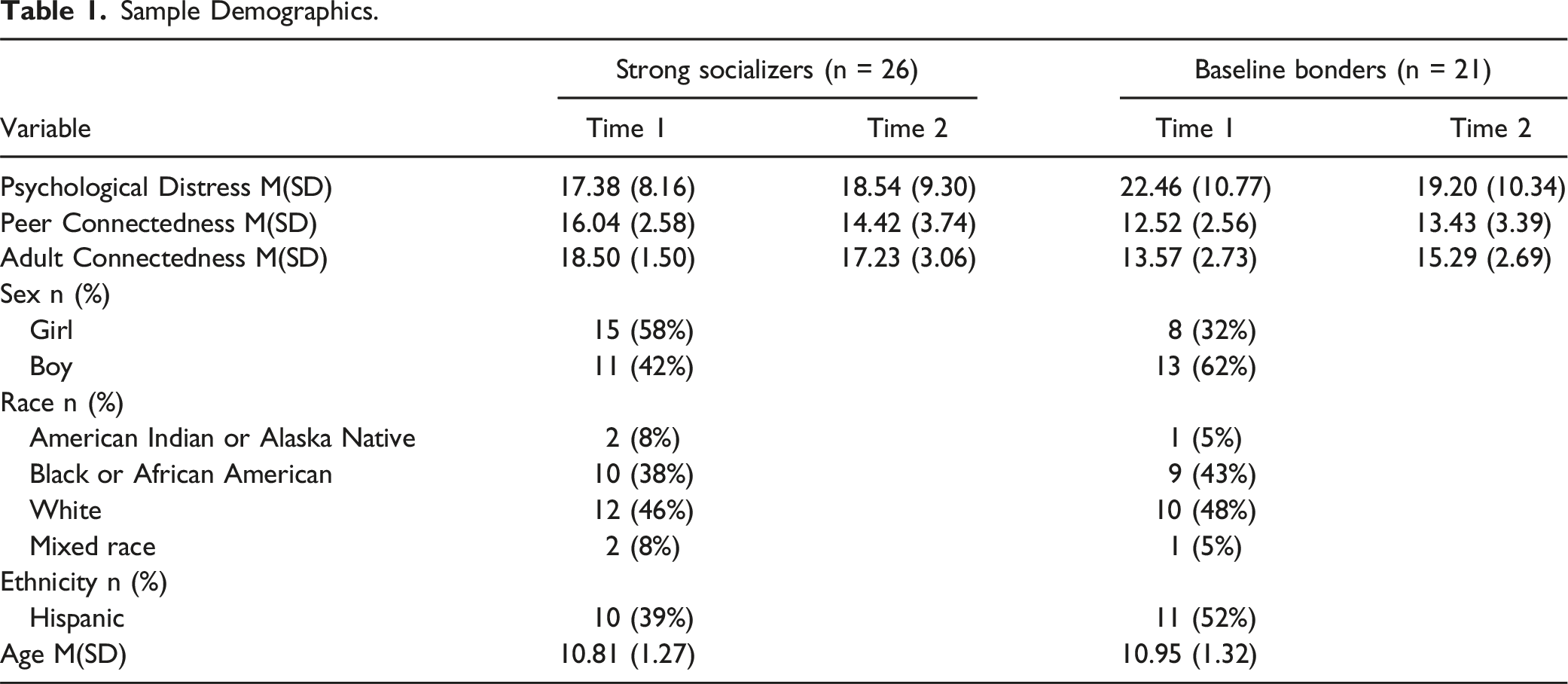
Sample Demographics.
Profile Differences
At the start of summer, there was a significant difference in psychological distress scores between baseline bonders (M = 22.46, SD = 10.77) and strong socializers (M = 17.38, SD = 8.16); t(46) = 2.21, P = .03. However, at the end of the summer, this difference was no longer significant, with baseline bonders (M = 19.20, SD = 10.34) and strong socializers (M = 18.54, SD = 9.30) showing similar levels of psychological distress; t(46) = 0.09, P = .92. GEE analysis revealed a significant interaction between time and profile membership (β = −4.42, SE = 1.86, P = .017), indicating that changes in psychological distress over the summer differed between profiles. After controlling for age and sex, baseline bonders showed a significant decrease in distress (β = −3.26, SE = 1.42, P = .022), while strong socializers’ distress levels remained stable (β = 1.16, SE = 1.12, P = .301). The between-profile difference in psychological distress was significant at Time 1 (β = 5.08, SE = 2.31, P = .028) but not at Time 2 (β = 0.66, SE = 2.24, P = .768), suggesting convergence of distress levels over time.
Discussion
Summary
This study aimed to identify distinct profiles of adolescents based on their social connectedness patterns and examine how these profiles related to psychological distress over the course of a summer care program. Our analysis revealed two distinct groups: “baseline bonders,” characterized by moderate to low social connectedness scores, and “strong socializers,” who exhibited higher social connectedness, particularly with adults.
Our findings suggest further research is needed on the potential role of social influence and social norms in shaping psychological distress among adolescents while at summer care programs. At the start of the program, baseline bonders reported significantly higher levels of psychological distress compared to strong socializers. However, the convergence of psychological distress scores between the two groups suggests a regression toward group behavioral and reporting norms over time. 13 As adolescents spent more time together in the program, social influence likely led to more uniform expressions of psychological distress, potentially due to peer socialization and the establishment of shared group norms around emotional disclosure and help-seeking behaviors. 14 This normalization process may explain why strong socializers’ reported distress increased slightly while baseline bonders' decreased - reflecting movement toward a common group standard rather than true changes in underlying mental health status. Initial feelings of disconnection among baseline bonders may have also motivated them to actively seek new social connections when given the opportunity, potentially activating support-seeking behaviors and coping mechanisms that contributed to reduced psychological distress.15,16 Similar social influence effects were evident in connectedness measures, where initial differences between profiles diminished as group cohesion was potentially developed. These findings align with social comparison theory and highlight how peer groups can shape both behavioral expression and symptom reporting in adolescent settings.
The differential impact of the summer care program on psychological distress across social connectedness profiles warrants close consideration and may suggest such programs may particularly benefit adolescents with initially lower social connectedness. This finding underscores the importance of early identification and targeted support for less socially connected youth in summer care settings. Future research should employ social network analysis to map the evolution of friendship networks and examine how changing network positions influence psychological distress over time. This approach would be able to understand these changes in social connectedness on a more specific and granular level. Additionally, ecological momentary sampling methods could capture real-time data on social interactions and mood fluctuations, providing deeper insight into the mechanisms driving distress reduction. Program designers should consider implementing peer mentoring systems and individualized approaches to ensure all participants, regardless of initial connectedness, derive maximum benefit.
Limitations
Several limitations should be considered when interpreting this study’s results. The small sample size (N = 47) limits generalizability and statistical power, while reliance on self-report measures introduces potential bias. The lack of a control group makes it difficult to attribute changes solely to the summer care program, and more frequent measurements could provide a more nuanced understanding of fluctuations in social connectedness and psychological distress over time. Further, other controls such as differential participation in the program and mental health service utilization or diagnosis were not collected. Additionally, while cluster analysis offered valuable insights, alternative analytical approaches could provide complementary perspectives on social connectedness patterns. Despite these limitations, this study provides important initial insights into the relationship between social connectedness profiles and psychological distress among adolescents in summer care settings, laying the groundwork for future research.
Significance
The utility of cluster analysis in this study is evident in its ability to reveal meaningful subgroups of adolescents based on their social connectedness patterns. By identifying these distinct profiles, we uncovered differential patterns of psychological distress that might have been obscured in a variable-centered approach. This person-centered method provided insights into how social connectedness profiles relate to mental health outcomes, potentially informing more targeted interventions. The observed changes in psychological distress across profiles throughout summer also underscore the value of this approach in assessing program effects on different subgroups of participants. These findings demonstrate how cluster analysis can be a powerful tool for understanding the complex interplay between social factors and mental health in adolescent populations, particularly in the context of summer care programs. Social connectedness is crucial for adolescent mental health, but summer months can disrupt social connections and routines. Summer care programs may provide opportunities for social interaction and support. This study identifies distinct profiles of social connectedness in summer care programs and examines their relationship with changes in psychological distress, providing insights into the role of peer and adult connections in summer settings. Findings suggest summer programs can help normalize social behaviors and psychological wellbeing through group influence, with particular benefits for those initially less connected. However, care must be taken to maintain engagement across all participants as social norms develop. Future research should examine social network dynamics and real-time social interactions to better understand how these programs shape adolescent mental health outcomes.So What?
What is already known on this topic?
What does this article add?
What are the implications for health promotion practice or research?
Footnotes
Declaration of Conflicting Interests
The author(s) declared no potential conflicts of interest with respect to the research, authorship, and/or publication of this article.
Funding
The author(s) disclosed receipt of the following financial support for the research, authorship, and/or publication of this article: This work was supported by a seedling grant from the Texas A&M University Health Science Center.
Ethical Statement

Data Availability Statement
Data can be made available upon request.