




Abstract
Purpose
To examine adolescents’ perspectives regarding external and internal influences of the e-cigarette initiation process.
Design
Semi-structured, in-depth qualitative interviews.
Setting
California, remote videoconference.
Participants
Adolescents ages 13-17 who currently or previously used e-cigarettes (n = 47).
Method
Interviews occurred from May 2020-February 2021. Two researchers coded transcripts based on a codebook developed inductively. Coded excerpts were reviewed to identify encompassing themes related to adolescent e-cigarette initiation.
Results
Adolescents were often near e-cigarette use by peers, family members, and others, creating ample opportunities to try e-cigarettes in response to curiosity, peer pressure, and desires to cope with stress or belong to a group. Adverse first experiences were common (eg, throat irritation, nausea), but many adolescents vaped again or continued to use regularly in attempts to cement friendships or alleviate symptoms of stress and anxiety. Specific characteristics of e-cigarette devices, including low-cost, concealability, and variety in designs and flavors facilitated initiation, continued use, and nicotine dependence.
Conclusions
Adolescents progress to e-cigarette use via a multistage process, starting where social expectations and opportunity converge. While individual circumstances vary, many continue to vape as a perceived coping tool for emotional issues, to gain social belonging, or influenced by e-cigarette characteristics that contribute to ongoing use and dependence. Efforts to deter use should address the devices themselves and the social forces driving youth interest in them.
Keywords
Purpose
E-cigarette use has reached concerning levels among adolescents globally.1,2 Youth who use e-cigarettes are more likely to report adverse respiratory symptoms, nicotine dependence, and mental health problems.3-5 Many young people experience addiction to e-cigarettes and want to quit,6,7 yet relatively few youth e-cigarette cessation strategies have been proven effective or been widely adopted. In this context, e-cigarette prevention takes on heightened importance. Indeed, trying a nicotine product just once may be consequential. For combustible cigarettes, for example, smoking just a few puffs in adolescence is strongly predictive of future daily smoking compared to not trying at all. 8 Given the potential significance of these initiation experiences, closer scrutiny of the circumstances and decision-making around first trying e-cigarettes could help to inform programs and product regulations that ultimately deter youth use.
Adolescence is a critical developmental period marked with experimentation. In this investigation, we used qualitative in-depth interviews to explore the e-cigarette initiation experiences of adolescents in California, United States. Considered were the social contexts and environments in which participants made decisions regarding vaping for the first time, their reactions to their first use of an e-cigarette, and factors that influenced their subsequent decisions to continue to vape. Qualitative data provide a level of explanatory detail not available from closed-ended surveys and may be particularly well suited for subsequently informing resonant health communication. This investigation occurred at a key time, when adolescent e-cigarette use was at a near peak in the United States, as e-cigarettes evolved into smaller, more potent, and more affordable devices, 9 and when adolescents faced unprecedented external stressors related to the COVID-19 pandemic.
This research examined e-cigarette initiation, which we considered to include the event when an adolescent tried a nicotine-containing e-cigarette for the first time. 10 Additionally, we expand the concept of initiation to entail the broader process surrounding a trial event, comprising opportunity, decision-making, social and environmental cues, characteristics of e-cigarette devices, physical sensations, and beliefs that collectively drive progression from trial to ongoing use. The purpose of this study was to understand better the socio-contextual and product-related factors influencing e-cigarette initiation.
Approach
Setting
Participant interviews occurred in California via videoconference in 2020 and 2021.
Participants
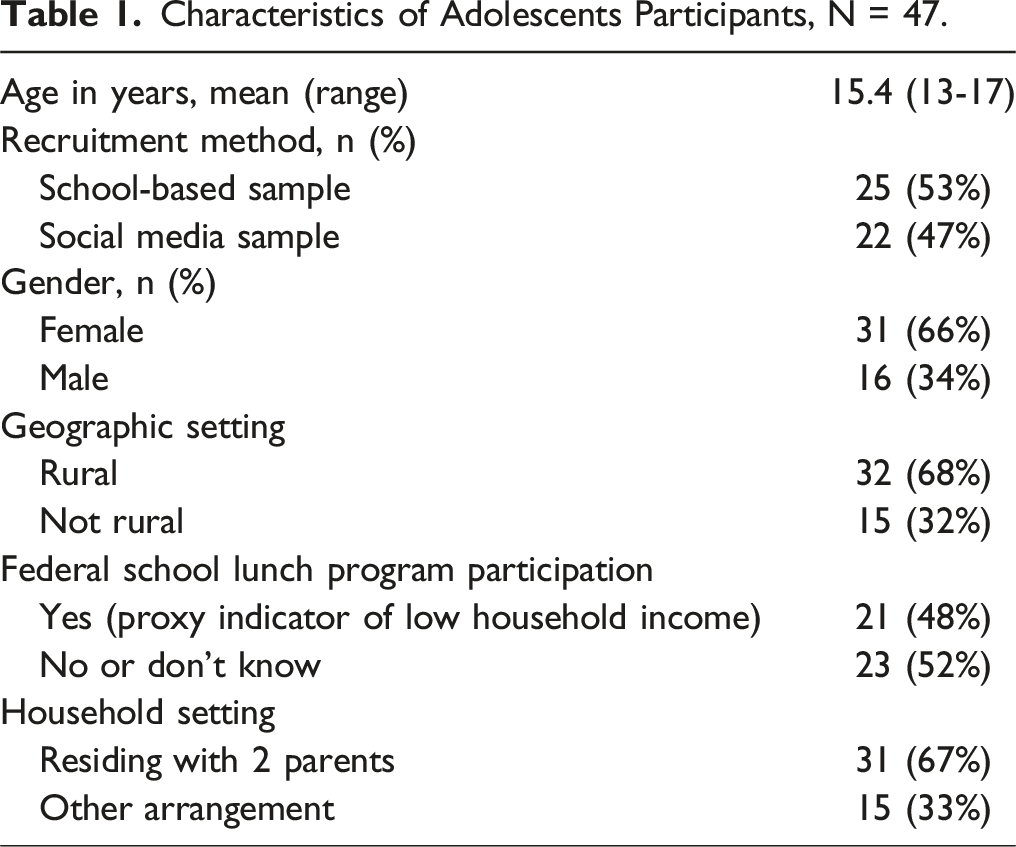
Characteristics of Adolescents Participants, N = 47.
Method
Data Collection
Two study investigators (CGC, KSH) conducted individual, semi-structured interviews by videoconference. Interviews lasted approximately 1 hour. Interview questions addressed participants’ routines around school, physical activity, sleep, social relationships, stress, and access to and use of nicotine vaping and cannabis products, including before and after school closures for the COVID-19 pandemic. E-cigarette initiation was invoked by the question, “Tell me about the first time you tried a vape.” Interviews explored settings where initiation occurred, who was present, the decision-making process for first trying e-cigarettes, and the physical, mental, and/or emotional responses to this experience.
Analysis Strategies
Interviews were audio-recorded and transcribed verbatim. Analysis followed a grounded theory approach using software (Dedoose version 9.0.17) for coding and analyzing transcripts. Two investigators, a master-level senior research associate (CGC) and PhD-researcher with formal qualitative training (KSH), developed an initial codebook based on iterative data review of 3 transcripts. Discrepancies were addressed and resolved through discussion. Revised and newly identified codes were subsequently applied to all transcripts.
Results
We categorized adolescents’ experiences into 3 components of the e-cigarette initiation process: I) access and opportunity; II) reasons to try; and III) reactions to trying. These 3 components were present in the majority of initiation stories, though they manifested in different ways. Below we describe the circumstances and thought processes that participants described for each component surrounding their own initiation experiences. Quotes representing common themes are included to illustrate concepts in participants’ own words.
Initiation Component I. Access and Opportunity
Recalling their initiation experiences, participants invariably described not only the location’s characteristics but also how relationships, especially friendships, played out in those spaces. Participants often described first trying an e-cigarette in or near schools, private homes, or parks.
Finding Safe Spaces to Try E-Cigarettes in School
Common across initiation locations was being somewhere participants felt comfortable and believed they were unlikely to get caught. Schools offered highly familiar spaces where fellow adolescents provided access to e-cigarettes but were also locations where disciplinary consequences loomed for e-cigarette use or possession. Thus, adolescents sought spaces within schools free from surveillance by teachers or security personnel. One participant described discovering a place hidden from view of school security cameras, where she first tried vaping while with friends in the seventh grade. “We have security cameras everywhere, right? Except, there’s this back way, behind the school… They didn’t have security cameras over there that worked and they didn't have teachers over there, so everyone would just go back there to do whatever.” Participant 46, female, age 14
Bathrooms are 1 of the few school locations without cameras or security staff. Bathrooms were also a location nearly impossible to avoid, where vaping by students was described as a constant occurrence. Vaping initiation in school bathrooms was often an unplanned event. “[At school] a lot of people smoked [used e-cigarettes], and I was around it all the time. And then I was with my new group of friends. I was just in the bathroom with all of them, and then I walked out the stall, and then, everyone was out there, and that’s when I tried it for the first time.” Participant 33, female, age 14
Private Spaces
E-cigarette initiation also occurred in homes, where privacy was more assured and where relationships with friends or family members had an especially strong influence. “We're at my friend’s house… we’re just in his garage and my friend pulled out [an e-cigarette] and he... asked me if I wanted to try it. And I, in my head, I thought about it. I was like, I don't really want to do this, but I still said, yeah.” Participant 38, male, age 13
Siblings, parents, and other family members in the home sometimes provided access to products, knowingly or not. The ability to navigate private spaces without detection facilitated use. “…My mom actually was smoking Puff Bars, and she didn’t know I knew what they were, kind of. So, when I was with my friends, in the middle of the night, I would grab it [mother’s Puff Bar], and then I would hit it. And then it [my e-cigarette use] kind of grew from there, honestly.” Participant 33, female, age 14
Outdoor Public Spaces
Parks and parking lots were also mentioned as locations where participants first tried an e-cigarette. These locations provided a sense of being away from surveillance and authority figures and were perceived as natural gathering places for adolescents to “hang out.” The absence of adults lowered resistance to trying e-cigarettes.
Social Factors Facilitate Opportunities
Across all narratives, e-cigarettes were seen as easy to access and try. Access opportunities were plentiful and from varied sources, including stores and vape shops, online purchases (from retailers or informal secondary purchases from other adolescents), or finding products around the home. Participants frequently found themselves in proximity to friends or acquaintances who offered them chances to vape. Given the ease-of-access and perceived ubiquity of vaping among peers, some adolescents described trying e-cigarettes as something that happened with little foresight or contemplation. “The first person I ever tried it [vaping] with was my friend… she always had one on her. So, every once in a while, if we hung out and I would try it. It wasn’t like a major decision… I know I don’t need it. It’s literally just a means of passing time for me. So, it wasn’t like a great big decision that was conflicting me. It just kind of happened at one point.” Participant 4, female, age 16
Indeed, some participants were unsure why they tried e-cigarettes. One adolescent described the casual spontaneity as, “it was just there” [Participant 42, female, age 14]. Another participant described reservations after first trying an e-cigarette, citing concerns about addiction and health consequences. Despite apprehensions, he tried it again while at school and was disciplined and then did not try again. When asked why he decided to try vaping the first time, he said, “I don’t know. I really don’t know.” [Participant 22, male, age 14]
Among participants’ first e-cigarette experiences, it was uncommon to seek it out proactively. However, some described taking steps to create an opportunity. “I was hanging out with friends and they didn’t peer pressure me. It was just like, I knew what that was [an e-cigarette] but I was like, ‘What's that taste like?’ And he was like, ‘Oh it’s a Vuse. It’s a flavor.’ I was like, ‘Can I hit it?’ And he was like, ‘Yeah, go ahead.’ So, I did it.” Participant 26, male, age 16
Asked where they were when e-cigarette initiation took place, participants often emphasized who was there and their emotional connection to them. Social connections provided more than access to e-cigarettes; they also yielded information about how to use them. One participant described trying a pod-based e-cigarette several times, but outside the excitement of doing something rebellious, found the experience “stupid.” Only after his friend demonstrated how to inhale deeply did he sense rewarding, physical effects. Another participant described wanting to purchase a mod-type e-cigarette for himself after researching products on social media. He sought advice from a friend who owned a similar device and received guidance on price, flavors, and nicotine concentration needed to make this purchase with confidence.
Initiation Component II. Reasons to Try
Once presented with an opportunity, adolescents described various reasons they chose to try e-cigarettes.
Wanting to Belong
Several participants were experiencing life transitions, including recent moves from another town or promotion from middle school to high school. Participants described seeking belonging as a distinct concept from peer pressure. Peer pressure was seen as wanting to maintain existing relationships within a friend group, whereas wanting to belong was about connecting to new social groups. One participant reflected on moving to a new school and wanting to be associated with students she perceived as popular. In this context, she described her first experience using an e-cigarette in self-affirming terms. Identifying as someone who vapes (and is confident in which vapes she likes) made her feel accepted by this new group of popular friends. “I’m not a mint person [mint flavor vaper]. I'm just an apple person, green apple.” Participant 32, female, age 16
For another participant, e-cigarettes helped him to identify with his friend group. “…When you do [vape], you think you’re, you’re everything. You think you’re so cool. So, when I did it, it gave me a feeling of power, like I’m finally fitting in with my friends.” Participant 38, male, age 13.
Peer Pressure
E-cigarette initiation often occurred within contexts where participants believed they could not say no. Some participants felt constrained by crowded physical spaces where others were vaping. For other participants, e-cigarettes were difficult to turn down when endorsed by a trusted friend. One participant described twice trying e-cigarettes because a long-term friend, and later, soccer teammates encouraged it. Both experiences yielded unpleasant physical reactions (eg, bad taste, cough, throat irritation). Nonetheless, this participant became friends with other students who used e-cigarettes and began vaping regularly herself.
Some participants reported that they were unsure whether they acted under peer pressure. One participant described not wanting friends to look at her “weird” if she declined their offer to vape. Another recalled friends offering an e-cigarette and stating, “You don’t have to if you don’t want to,” but the participant was uncertain whether pressure negated that statement. Other participants described pressure from friends, whom, in hindsight, they saw as bad influences. “When you’re in school with them and they’re your friends... you don’t see that they’re bad… I was with a guy that was a really bad influence, and he’s kind of the person that got me into vaping ‘cause he convinced me that it wasn’t bad… He was just saying that there wasn’t really any chemicals in it, and he was saying how it was mostly just glycerol, which he said was in food, so that wasn’t bad.” [Participant 9, female, age 15]
Alleviating Emotional Pain
Participants frequently reflected on their mental and emotional health, including feelings worsened under academic pressure, family health and finances, unsafe neighborhoods, and the COVID-19 pandemic. Several participants perceived nicotine as helpful in alleviating these negative feelings. One participant reported that she was experiencing depression when friends suggested using e-cigarettes. She did not consider vaping to be a remedy, but an escape. “[Vaping was] a little bit of just knowing that something was there. Even if it wasn’t, even if it wasn’t good, just knowing something was there that just felt a bit better.” Participant 17, female, age 14
Some participants reported that e-cigarettes had a calming effect, putting them more at ease when feeling stressed or in a bad mood. One adolescent dealing with mental health issues said that his first e-cigarette experience provided a sense of relaxation and “escape” from his depression. “I felt very relaxed. I wasn’t really happy. But I wasn't sad or depressed. I was more of just content. ...I felt very light on my feet. Like, it felt like I was moving but without consciously moving. And it just, most things just felt a lot better than usual.” Participant 47, male, age 15
Another participant reported mental health issues and lived in a neighborhood rife with gang violence. Frequent fights in his school made him feel anxious, with a need to be alert constantly. E-cigarettes initially provided stress relief. He continued using them, despite headaches, nausea, and other symptoms.
Curiosity
Participants often cited curiosity as their motivation to try e-cigarettes, either in a general sense or specifically about flavors, nicotine, physical sensations, or doing tricks with vape smoke. Amused by the large vapor clouds, 1 participant said, “You feel like a dragon.” For some, a perception that vaping was a trend on the rise fed their curiosity and lowered their resistance to trying it. “I was very curious, I’m like, ‘Oh well, I guess I’ll try it [vaping] because I think it’s trending, of course,’ and I tried.” Participant 13, male, age 17
Initiation Component III. Reactions to Trying
Participants’ first e-cigarette experience was memorable partly for the strong physical sensations many of them felt and also for the social feedback they received from the people with them.
Physical Sensations
Several adolescents described unpleasant early encounters with vaping, involving 1 or more physical or mental discomforts. Nausea and dizziness were common. “It’s like, you know when you’re drinking water really fast and then it goes down the wrong pipe? It was basically like that. But instead… there was a choking sensation. But it also stung a little bit, ‘cause you’re not used to that being inhaled. So, it was kind of like, ‘Oh, this is not fun.’” Participant 43, female, age 16 “It wasn’t the first time I did it [vaping], but sometimes when I did it, it made my stomach feel like really upset and I’d just get really tired. And that would last for like 20 minutes.” Participant 38, male, age 13
For most of these participants, initially unpleasant experiences did not deter them from trying e-cigarettes again, discovering that the negative sensations could be overcome with time. The discomforts were seen as tolerable and counterbalanced by more pleasant effects. “...I was like, ‘Ew, I can’t. No.’ And then I tried it [vaping] again. I don’t inhale ‘cause I don’t want the toxins. It’s just the smoke. I think it's really cool. But you can still taste it. So, the taste, the flavors are pretty cool I’d say.” Participant 43, female, age 16
Sweet flavors, a wide variety of flavors to try, the option to select low or high nicotine concentrations, and even technology (for example, devices that tracked and provided readouts of puffs taken) were cited as reasons to keep trying vaping, even in light of unpleasant first experiences.
Positive Physical Effects and Social Reinforcement
Participants described positive physical effects from using e-cigarettes, including improved focus, stress relief, and a pleasant high or “buzz.” For several participants, being with friends made unwelcome symptoms more tolerable and reinforced any pleasant physical sensations. One participant, despite experiencing dry mouth, coughs, and headaches from e-cigarette use, recalled the social satisfaction of vaping with friends. “It was like, ‘Oh yeah, we’re chilling, hitting a vape.’” Participant 46, female, age 14
Feeling a buzz was described positively. In some cases, it required a few attempts and guidance from more experienced friends to learn how to use an e-cigarette to get this sensation. “There's this thing where you call, where you get like a buzz... like a body buzz. And you feel a little bit sleepy and it makes you feel kind of lightheaded. It just feels kind of good.” Participant 38, male, age 13
E-Cigarette Initiation as a Process
Opportunity, motivation, social pressure, and physical sensations can converge during a multistep e-cigarette initiation process. In 1 example, an adolescent described being at a park with 5 female friends who vaped regularly. She felt pressured to try vaping with no option to decline. She recognized her own curiosity about how it would feel and what would happen. She played sports and had heard that e-cigarettes give you more energy. She tried 1 and did not like the experience. After vaping, she felt that it was “wrong” and was filled with regret. She realized that vaping was different from what she had heard. On the contrary, she felt unwell. Later, she tried again, at the same park, with the same group of friends. Again, she felt pressured to try it but also thought the second time would be different. It was not. “I didn’t really like it. It was different from what people would say it was like... It made me feel a little sick.” Participant 18, female, age 15
Another participant described mixed feelings about the circumstances of her first vaping experience. While she wanted to try vaping, she had not planned to do it the day her best friend, who vaped frequently, offered it to her. This happened with a group of friends in 1 of their homes. The experience was not enjoyable. The participant was nervous about being caught by her strict parents. “Mentally, I was just freaking out about it.” Participant 45, female, age 17
It was not an emotionally or physically good experience. She described a painful, burning sensation in her throat. Despite this, she tried vaping again. Overcoming her fear of being caught, she became more comfortable and continued vaping. “I wanted to be cool, too. So, I was just like, ‘I might as well get used to it.’ That was just the sort of like mindset I had, I think.” Participant 45, female, age 17
Conclusion
This investigation examined e-cigarette use initiation not as a single event but as a multistage process. While individual experiences varied, for the vast majority of adolescents, first trial of an e-cigarette occurred at the convergence of social expectations and opportunity. Primed by expectations that e-cigarette use was common and welcomed among their peers, adolescents became receptive to opportunities to vape once they found themselves in spaces beyond the surveillance of authority figures and where declining an offer to vape would be socially difficult. From there, physical sensations (pleasant or unpleasant) and emotional factors influenced decisions about continued use, which for many, shaped their self-identity. Despite potential concerns about health or nicotine dependence, many participants believed that vaping provided a sense of belonging within a peer-group and a way to cope with emotional stress.
E-cigarette use by others contributed to vaping normalization and access opportunities. Among United States middle and high school students who had ever used e-cigarettes, use by a friend was the most-endorsed reason they first tried vaping. 12 Social network analyses13,14 and the clustering of e-cigarette use within schools 15 provide further quantitative evidence of the importance of peer use in e-cigarette initiation, as corroborated in qualitative investigations in Massachusetts, 16 Minnesota, 17 and Colorado. 18 Peers provided access to e-cigarettes and also necessary information, helping new users to navigate a changing technology and technique-sensitive devices. Parents and other family members also occasionally served as access points to e-cigarettes and role models of vaping behavior, at times without clear messaging to children about avoiding use themselves. 19
Participants in this study reported a range of physical effects upon vaping initiation, ranging from a pleasant high to coughing, headaches, and nausea. Favorable sensations, most notably sweet, fruity taste and smell from stylish, easy-to-use devices, have been often cited as major contributors to e-cigarette uptake among youth.20-23 In a prior cohort, adolescents were asked to recall the sensations they experienced the first time they vaped, and more positive sensations predicted continued e-cigarette use over time. 24 However, several participants in our study described a determination to continue vaping, despite initially unpleasant effects. Not unlike adolescent males describing a need to overcome initially unappealing aspects of oral spit tobacco to reap perceived social rewards, 25 gaining a sense of belonging among peers inspired trying vaping again. Thus, while regulation of e-cigarette characteristics, such as flavors and nicotine delivery, are warranted to reduce youth use, such policies should be coupled with additional social denormalization efforts.
Curiosity, opportunity, social pressure, and pleasant physical effects were all cited as reasons to try vaping, but a desire to cope with stress and anxiety was consistently uncovered as a force driving continued e-cigarette use. This finding is consistent with prior qualitative studies documenting perceived stress relief and escape from emotional pain as reasons that adolescents vape.16-18 A related study documented how adolescents transitioned from e-cigarette initiation to ongoing use and addiction, particularly under the profound disruption of the COVID-19 pandemic. 26 In a longitudinal cohort, perceived stress predicted progression from e-cigarette trial to current use, 27 and among current e-cigarette users nationally, feeling anxious, stressed, or depressed was the most-endorsed reason for use. 12 For young people dependent on nicotine, misperceiving relief from withdrawal symptoms as true stress reduction may contribute to an ongoing cycle of use and addiction.
A strength of this study is its considerable detail regarding 1 key aspect of e-cigarette use behaviors: the initiation process. Videoconference allowed enrollment of a relatively large sample across a broad geographic region, particularly when most schools were inaccessible to researchers due to the pandemic. Among limitations is that participants were purposefully selected to include adolescents with a past or current history of e-cigarette use; not represented are adolescents who chose not to initiate vaping despite opportunities to try. Similarly, despite assurances of privacy, some adolescents may have chosen not to participate out of concern about discussing a behavior that most parents and schools forbid. Race/ethnicity data were not collected systematically and could not be explored. Finally, experiences of these participants in California may not generalize to all settings.
In summary, this study describes multiple factors that contribute to e-cigarette initiation among adolescents. Participants reported plentiful opportunities to try e-cigarettes, as presented by peers and family members (sometimes unknowingly). A sense of ubiquity normalized vaping behavior, increased curiosity, and reduced perceived danger, such that initiation events seemed spontaneous, even inevitable. Pleasant physical sensations, such as sweet flavors, helped motivate adolescents’ decisions to use and remain logical targets of tobacco control policy and regulation. Yet, for many participants, there were social and emotional reasons to vape, seen as offering an escape from loneliness, stress, and mental health concerns. For these young people, tobacco prevention and cessation strategies must not focus solely on e-cigarettes themselves but should find ways to connect adolescents with supportive resources to enhance mental health and social well-being. E-cigarette use (vaping) among adolescents is a public health concern. Adolescents have reported curiosity, flavors, friends, and emotional health as reasons to vape. E-cigarette initiation is a multifactorial, multi-step process that begins when social expectations meet opportunity. Attributes of e-cigarette devices themselves (eg, appealing flavors, stylish design) contribute to initiation and continued use, as do perceptions that vaping offers a favorable social identity and an escape from emotional and mental health problems. Efforts to reduce youth e-cigarette use should address the devices themselves, social expectations about vaping, and address adolescent mental health and well-being.So What?
What is Already Known on This Topic?
What Does This Article Add?
What Are the Implications for Health Promotion Practice or Research?
Footnotes
Acknowledgments
Thank you to Janelle Urata of the University of California San Francisco for administrative support and contributions to participant enrollment. The content is solely the responsibility of the authors and does not necessarily represent the official views of the NIH or the Food and Drug Administration.
Declaration of Conflicting Interests
The author(s) declared the following potential conflicts of interest with respect to the research, authorship, and/or publication of this article: Dr. Bonnie Halpern-Felsher is a paid expert scientist in some litigation against the e-cigarette industry and an unpaid scientific advisor and expert regarding some tobacco-related policies.
Funding
The author(s) disclosed receipt of the following financial support for the research, authorship, and/or publication of this article: This work was supported by National Institutes of Health (grant numbers U54HL147127 and UL1TR001872).
