



Abstract

Nature Draws No Color Line
In 1902, Booker T. Washington, Founding President of Tuskegee Normal and Industrial Institute (Tuskegee University), delivered one of his weekly sermons, “Getting Down to Mother Earth.” In this speech to the faculty and students, he signified nature’s role in uplifting the racial and economic conditions of “the Negro race”, specifically formally enslaved, deeply impoverished, second generation Black Americans. “That is one of the stepping stones with which nature has provided us. Here the path is plain, if we have the courage to follow it. Eighty-five percent of the people of the Negro race live—or attempt to live—by some form of agriculture. If we would save the race, and lift it up, here is the great opportunity around which, in a large measure, individual, organized, religious and secular effort should centre for the next fifty years…And remember that when we get down to the fundamental principles of truth, nature draws no colour line”.
1
As one of the most revered Progressive Era orators, Washington refuted and impugned notions of racial superiority, a critical philosophy of the time, undergirded and scientifically legitimized by doctrines of Social Darwinism.2,3 He believed that the “mere connection with what is known as a superior race will not permanently carry an individual forward unless he has individual worth, and mere connection with what is regarded as an inferior race will not finally hold an individual back if he possesses intrinsic, individual merit”, a tenet articulated in Up From Slavery (1901). 4 One of his 2 autobiographic recounts, Up From Slavery, described with an environmentally and racialized consciousness his ascent from an enslaved child born on a tobacco plantation in Franklin County, Virginia to a prominent educator, reformer and leading figure in America. Exemplified by statements such as, “Mother Nature, where all nations and races that have ever succeeded have gotten their start”, or “my theory of education for the Negro would not confine him for all time to farm life—but that, if he succeeded in this line of industry, he could lay the foundations upon which his children and grandchildren could grow to higher and more important things in life”, Up From Slavery sets the stage for Washington’s second autobiography, Working With The Hands (1904).5,6 Considering that “the great body of the Negro population must live in the future as they have done in the past, by the cultivation of the soil”, Working With The Hands continued to position nature as an untapped resource to be conquered for human exploitation as well as the vessel with which the “Negro, when given a chance, makes himself indispensable to the community in which he lives, [both] White and coloured”.7-9
Through reflexive discourse, Washington postured a level of elitism within his private natural spaces, like the girdled Tuskegee Institute woods or his personal garden, and expressed “pity [for] the man or woman who has never learned to enjoy nature and to get strength and inspiration out of it”.10,11 In these privileged natural surroundings with trees, birds and “the sweet fragrance that springs from a hundred plants”, Washington reveled in the absence of racial categorization and indulged in an existence “where no one can disturb or vex” him (Figure 1).
10
While castigated as a conciliatory figure with resistive and conformist politics at the expense of Black American civil rights, particularly with assertions that acquiesced segregation (“In all things that are purely social we can be as separate as the fingers, yet one as the hand in all things essential to mutual progress”), renounced agitation (“The wisest among my race understand that the agitation of questions of social equality is the extremist folly”), and subordinated demands (“More than this, he has no right to request”), Washington appealed for mutual economic development among Black and White southerners by way of industrial education and agricultural expertise.
12
He held the belief that once White Americans saw how Black Americans could “contribute to the market place of the world”, and be content with living “by the production of [their] hands”, racial equality and social justice would soon be achieved.
12
“I spoke of an instance where one of our graduates had produced two hundred and sixty-six bushels of sweet potatoes from an acre of ground, in a community where the average production had been only forty-nine bushels to the acre…The White farmers in the neighborhood respected him, and came to him for ideas regarding the raising of sweet potatoes. These White farmers honored and respected him because he, by his skill and knowledge had added something to the wealth and the comfort of the community in which he lived”.
5
Booker T. Washington, Fishing, circa 1900; Available at: http://archive.tuskegee.edu/repository/digital-collection/booker-t-washington/booker-t-washington-fishing-001-001-02-002/.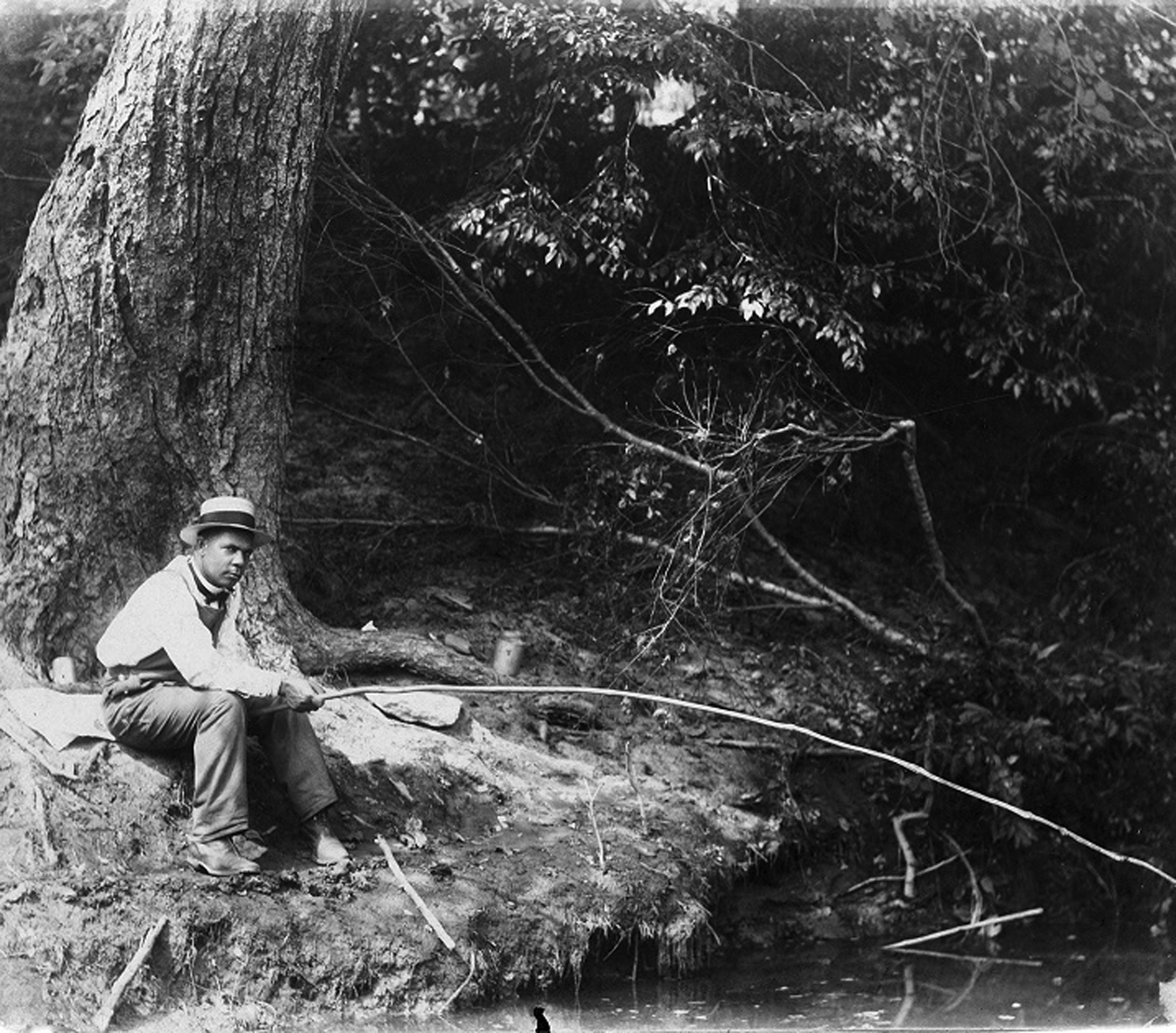
Along these lines, Washington emphasized reconciliation rather than resistance and voiced such sentiment in a speech at the Atlanta Cotton States and International Exposition on September 18, 1895, a period of time in American history that was plagued by lynchings, race riots, segregation, and economic exploitation of Black Americans. 13 Despite the address being critically renamed the ‘Atlanta Compromise’ by adversaries, namely W.E.B. DuBois, a preeminent racial and social justice pioneer, the message resounded with many and especially the soon to be President Theodore Roosevelt. 14 Greatly burdened by the so called “Negro Problem”, Roosevelt was drawn to Washington. While Roosevelt espoused to principles of White supremacy, imperialist expansionism, and Social Darwinism, Washington’s philosophy and rhetoric of racial uplift, explicitly Negro accommodation by way of nature domination, was not entirely incongruent to Roosevelt’s ideologies.15-17 As the Rough Rider and dynamic force of conservationism, who rose politically to the White House, he and Washington formed and cultivated a friendship. Ultimately, Washington was appointed as Roosevelt’s Presidential Advisor on “Southern and Negro Policy” and leveraged their alliance to benefit his entire race in spite of some countrywide backlash and misgivings. 18 By its very nature, the alignment between these 2 men from very different backgrounds, but who shared strong affinities for land and wilderness, was viewed with skepticism, optimism, and criticism among both White and Black Americans. Notably, W.E.B. DuBois was believed to resent Washington’s expanding political and social influence, as well as his allyship with Roosevelt. 19
Wilderness was the Home of God
Following with Washington’s use of the “color line” phrase, DuBois opened one of the most seminal pieces of American literature, The Souls of Black Folk: Essays and Sketches (1903), with a proclamation decorated in physical landscape language, “sun…hills…harvest”, that foreshadowed well beyond the 20th century. “I have seen a land right merry with the sun, where children sing, and rolling hills lie like passioned women wanton with harvest. And there in the King's Highway sat and sits a figure veiled and bowed, by which the traveler’s footsteps hasten as they go. On the tainted air broods fear. Three centuries' thought has been the raising and unveiling of that bowed human heart, and now behold a century new for the duty and the deed. The problem of the Twentieth Century is the problem of the color line”.
20
When he published this scholarly work in 1903, the color line DuBois spoke of referenced anti-Black racism and “the relation of the darker to the lighter races of men in Asia and Africa, in America and the islands of the sea”.
20
However, decades later in his autobiographical account, Darkwater: Voices from Within the Veil (1920), the color line represented more of an ecological dimension.
21
Distintly, DuBois “believe[d] in [the] liberty of all men” to “enjoy the sunshine…uncursed by color” (Figure 2).
22
Hints of an ecological color line appeared in DuBois’ earlier works, including The Souls of Black Folk: Essays and Sketches, when he remarked on the “winding and intricacy of the geographical color line”, and throughout his career he favored the metaphorical use of nature for many of his publications (e.g., The Horizon: A Journal of the Color Line; Moon Illustrated Weekly) or endeavors (e.g., The Niagara Movement).23-26 As such, the color line which DuBois examined contoured and reconfigured over the course of his sociological and political pilgrimage and eventually collided into a discord with Washington. W.E.B. DuBois, Resting in Hammock, circa 1940; Available at: https://www.facebook.com/MainePres/photos/a.1070166346399943/3160225144060709/?paipv=0&eav=AfYDiA9A8_ujMyVjihlbaY96IHiZVhMXSDyhaLU_4EP9V6bl3GrXraBfxFYi0tpjH4s&_rdr.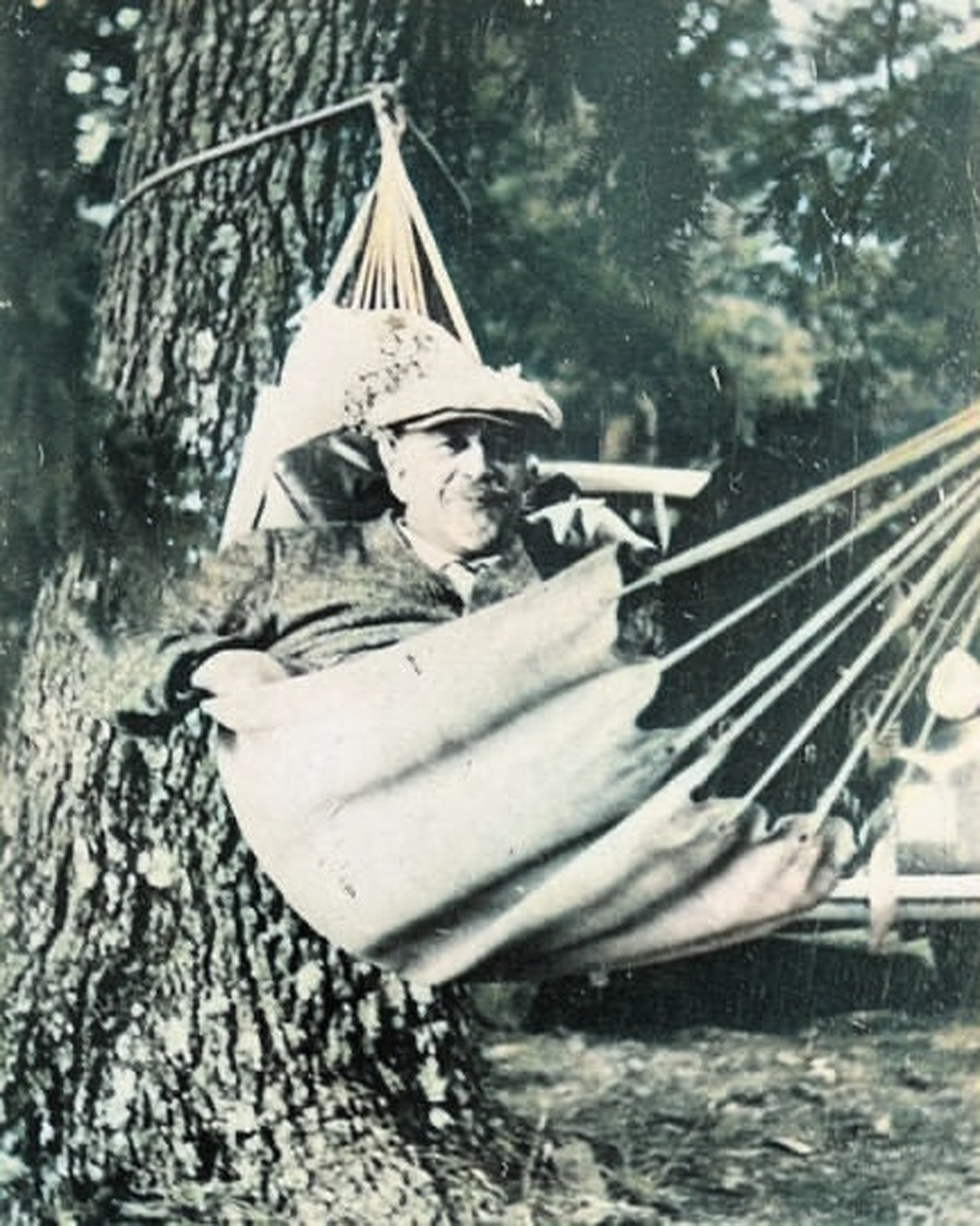
The clash between DuBois and Washington on the manner in which equality for Black Americans would be enacted is well known. These extraordinary 19th and 20th century leaders piercingly dissented on philosophies, approaches, and resolutions for Black American social and economic progress. In opposition to Washington’s tone of accommodation for White American oppression and gradualism for Black American advancement by way of vocational training, DuBois advocated for persistent agitation, political action, and liberal arts education for Black Americans. Specifically, he argued that immediate change could be accomplished by establishing a small group of college educated and influential Black leaders, “The Talented 10th”. He believed that, because White society was intrinsically racist, or rather composed of “certain people [who] suppress and mistreat darker races”, Black Americans needed to “fight for freedom” and defend their rights through education and political activism.27-30 Interestingly, these 2 scholars of racial uplift did not always disagree. For example, years before DuBois unfavorably monikered Washington’s Atlanta Cotton States and International Exposition speech the ‘Atlanta Compromise’, he had actually sent him a letter stating “Let me heartily congratulate you upon your phenomenal success at Atlanta – it was a word fitly spoken”.31,32 Similar to Washington, DuBois expressed concern with the economic forces that alienated Black Americans, particularly southern sharecroppers, from the land. In The Souls of Black Folk: Essays and Sketches, DuBois reckoned that racial oppression, chiefly the degradation of Black Bodies occurred right along with the degradation of the land. He addressed the southern Black Belt, its currency of cotton, and how the land was “forlorn and forsaken”, “uncared for and poor” through decades of ravage and loss. 33 First, the degeneration occurred under the system of slavery, “the speculative demand for land once marvelously rich but already partially devitalized by careless and exhaustive culture”, and then under the system of sharecropping. 34 Through sharecropping, an agricultural labor system that perpetuated racialized and economic hardship, farmers experienced disenfranchisement and extreme poverty. In an effort to stay solvent, they overproduced the land. 33
Despite the eventual divergence between DuBois and Washington, both men looked to nature for inspiration, elevation and adequation. In The Souls of Black Folk: Essays and Sketches, DuBois takes a spiritual look at wilderness and likens it to a godly higher power. “Like all primitive folk, the slave stood near to Nature's heart. Life was a “rough and rolling sea” like the brown Atlantic of the Sea Islands; the “Wilderness” was the home of God, and the “lonesome valley” led to the way of life”.
14
One could argue that DuBois inhabited a “creative and earthy form of Christian faith” that mirrored a form of religious naturalism, or rather an ethos that used a naturalistic framework to affirm religion and regard the physical environment with a sense of profound admiration, respect, and meaning.35-37 Through his understanding of religion as a naturalistic practice he was equally troubled with how racism wounded the moral and spiritual connection of Black Americans with nature and asked, “Why do not those who are scarred in the world's battle and hurt by its hardness travel to these places of beauty and drown themselves in the utter joy of life?” 38 When DuBois imparted this question in Darkwater: Voices from Within the Veil, he retorted “Did you ever see a “Jim-Crow” waiting room?” 39 With the indignities of being “browbeat” by ticket agents, being sold tickets at higher prices, sitting in a room with “no heat in the winter and no air in the summer, and then riding on a Jim-Crow train car while being starred at by a “stream of White men saunters”, DuBois bluntly voiced how racism impeded Black Americans from experiencing the pleasures of the great outdoors. 39 As pointedly stated by John Claborn in his book on civil rights activism and environmental consciousness “for DuBois there is no “nature” without the baggage of the color line, no Grand Canyon without Jim Crow, and no wide open landscapes without claustrophobic cityscapes”. 21
Sowing and Reaping from Dust of Dawn
“People who fight against White racism but fail to connect to the degradation of the earth are anti-ecological – whether they know it or not. People who struggle against environmental degradation but do not incorporate in it a disciplined and sustained fight against White supremacy are racist – whether they acknowledge it or not”.
40
In the United States, the access, connection, and sense of belonging to the natural world became more racialized in the 19th and 20th centuries. While DuBois and Washington diverged on pathways to Black American freedom, these 2 civil rights giants treasured and anchored their natural experiences to achieve these liberties. Whether it was seeing the “face of beauty from the Grand Canyon” for DuBois, “the one thing that lived…eternal in [his] soul” or for Washington encouraging hard work with a biblical farming adage, “harvest is always in proportion to the amount of earnest labour that we put into our work”, these trailblazers promoted and upraised nature’s essentiality.39,41,42 Perhaps, in a different time or at a different moment, DuBois and Washington could have merged their biophilia. After all, the nonagenarian gave an interview 6 months before his 1963 death in his Ghanaian home and expressed great fondness for Washington. Adorned with a soft smile, DuBois said “I believe him [Washington] to be sincere”, an opinion he denoted in one of his most rhetorically impeccable autobiographies, Dusk of Dawn: An Essay Toward an Autobiography of a Race Concept (1940), when he wrote “I had nothing but the greatest admiration for Mr. Washington and Tuskegee”.43,44 Upon Washington’s death in 1915, Dubois inscribed words marking the end of an era, “The death of Mr. Washington marks an epoch in the history of America. He was the greatest Negro leader since Frederick Douglass, and the most distinguished man, White or Black, who has come out of the South since the Civil War”. 28 Unfortunately, Washington would never really known of this veneration.
Over a century and exactly 60 years since Washington’s and Dubois’ deaths, respectively, this composition hopes to deliver a recognition of their overarching sensibilities to effectuate racial justice and most significantly their shared adulation and devotion to a “promised land” and “murmur of the sea” that betrayed them both.45,46 Even Dubois acknowledged their accord and mentioned how “in the early years [he] did not dissent entirely from Washington's program”.
44
The harmony of their earthly language uttered the essence of a man born enslaved and the other born free. Washington, an admirable citizen who penetrated circles that were inaccessible to most Black Americans of the time, but who oscillated between arrogance and conformity often sermonized words of outdoor harmony (Figure 3). “As I go from bed to bed in the garden, gathering my lettuce, pease, spinach, radishes, beets, onions and the relishes with which to garnish the dishes, and note the growth of each plant since the previous day, I feel a nearness and kinship to the plants which makes them seem to me like members of my own family. When engaged in this work, how short the half-hour is, how quickly each minute goes, bringing nearer the time when I must go to my office. When I do go there it is with a vigour and freshness and with a steadiness of nerve that prepares me thoroughly for what perhaps is to be a difficult and trying day- a preparation impossible, except for the half-hour spent in my garden. All through the day I am enabled to do more work and better work because of the delightful anticipation of another half-hour or more in my garden after the office work is done. I get so much pleasure out of this that I frequently find myself beseeching Mrs. Washington to delay the dinner hour that I may take advantage of the last bit of day light for my outdoor work”.
47
Booker T. Washington, Feeding Chickens, circa 1900; Available at: https://newafrikan77.wordpress.com/2016/11/14/black-farming-and-land-ownzership-matters-what-booker-t-washington-showed-us/.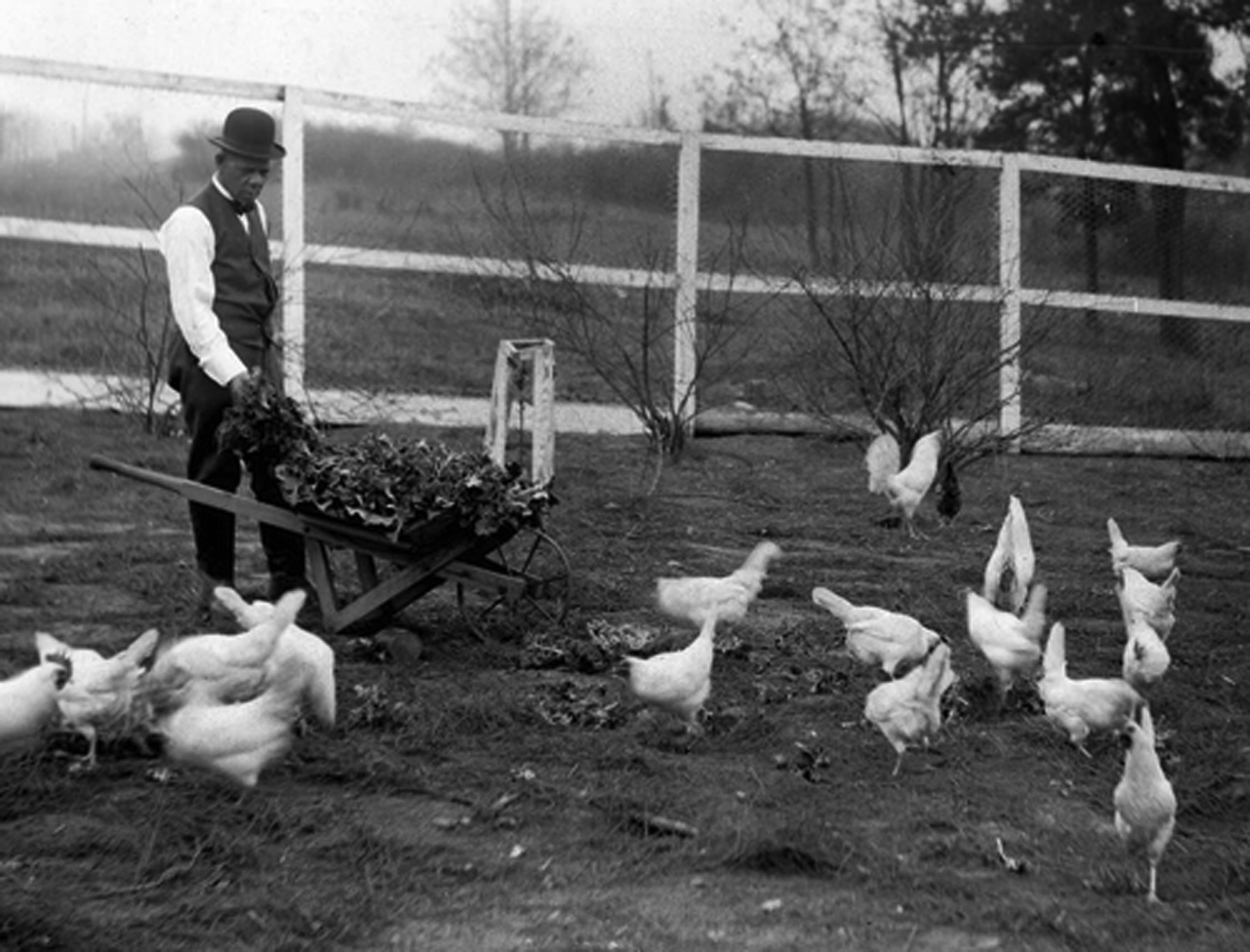
And DuBois, the canonized sociologist of race who founded the National Association for the Advancement of Colored People, but who received little to no accolade on his environmental racism scholarship offered a collection of nature filled poetry, like his 1920 Children of the Moon release (Figure 4). “I found a twilight land, Where, hardly hid, the sun Sent softly-saddened rays of Red and brown to burn the iron soil And bathe the snow-white peaks In mighty splendor. I rose upon the Mountain of the Moon, I felt the blazing glory of the Sun; I heard the Song of Children crying, “Free!” I saw the face of Freedom And I died”.
48
W.E.B. DuBois, Sitting in Garden, circa 1958; Available at: https://credo.library.umass.edu/view/full/mums312-i0497.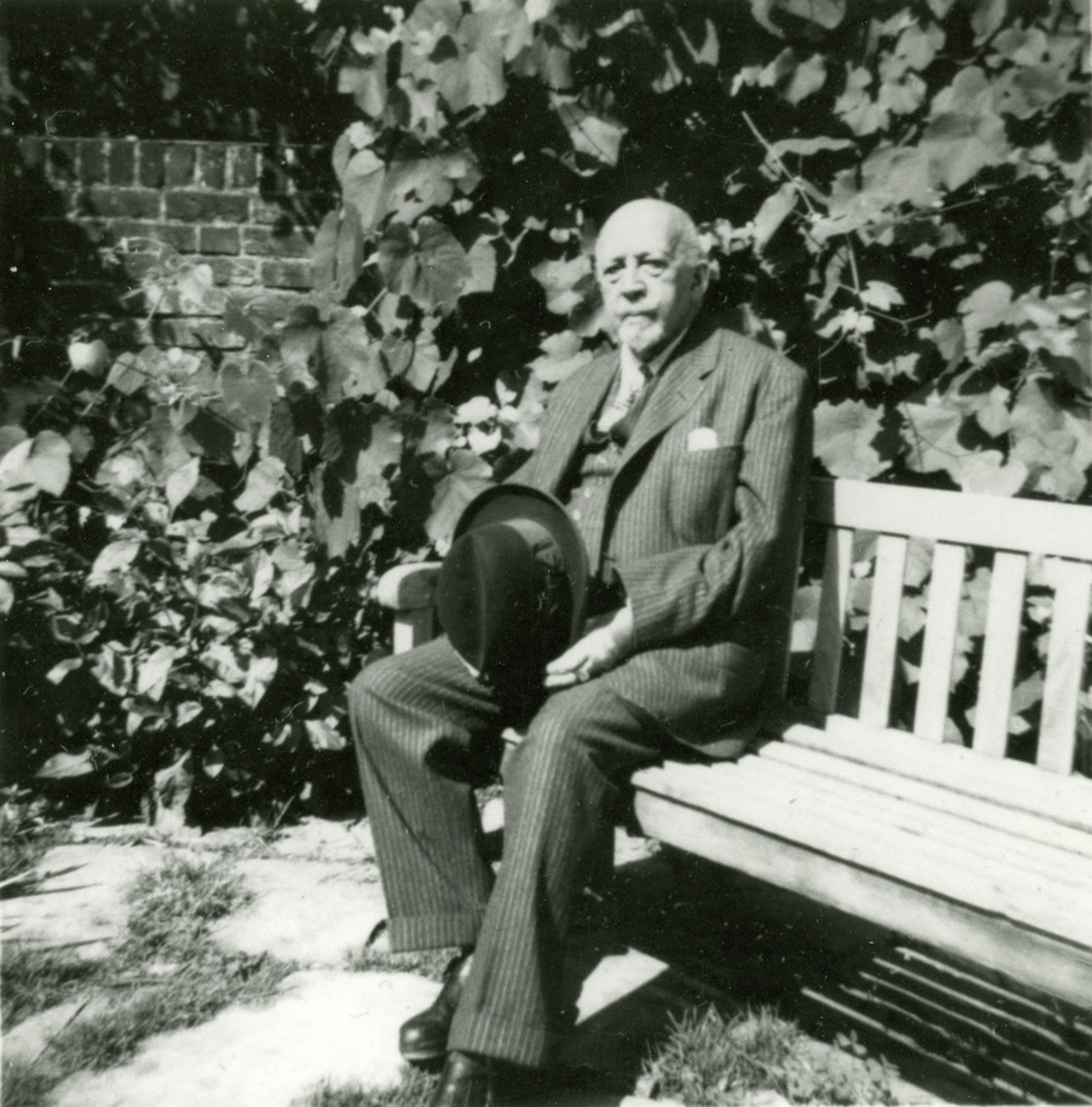
These two civil rights giants underscored a remarkable truth: There was and is not a single passageway to bringing about racial equality. But in the most paramount way, DuBois and Washington highlighted the importance of intersectional justice; “racial justice without environmental justice is no justice at all”. 49 Together, justice seekers everywhere can posthumously honor these esteemed figures by sowing a labor of racial and environmental reform to reap freedom and fairness in basic human rights from dust of dawn.
Environmental Justice Recommendations
• Challenge yourself to learn about the many different ways environmental racism has presented itself to “differentially affect or disadvantage (where intended or unintended) individuals, groups or communities based on race”.
50
Environmental racism can be perpetuated in many forms to create “a mosaic of varying hazards”, such as contaminated water (e.g., Flint Water Crisis), park privilege (e.g., Christian Cooper), police brutality (e.g., too many to name), or toxic air (e.g., Cancer Alley), for many communities of color and low-income populations. • Advocate for environmental reparations or actions to improve historic and present day environmental injustices. For example, research has shown that historically redlined neighborhoods have fewer trees.
51
Supporting organizations like American Forest can improve tree inequity in cities around the country and help ameliorate some of the environmental harm incurred from redlining and other discriminatory housing policies.
52
Footnotes
Declaration of Conflicting Interests
The author(s) declared no potential conflicts of interest with respect to the research, authorship, and/or publication of this article.
Funding
The author(s) received no financial support for the research, authorship, and/or publication of this article.