




Abstract
Purpose:
We examined the impact of an orientation to promote good—one aspect of strengths of character, understood as having consistent thoughts and taking actions that contribute to the good of oneself and others—on flourishing outcomes.
Design:
We used data from 2 longitudinal observational studies. The primary study used 2 waves of data collected in June 2018 and July 2019. The secondary study used 3 waves of data collected in February 2017, March 2018, and March 2019.
Setting:
Two culturally different populations of adults were examined: (1) a large service organization based in the United States and (2) a Mexican apparel company in the supply chain of a major global brand.
Subjects:
1,209 U.S. employees and 495 Mexican apparel workers were included in the study.
Measures:
Self-reports of orientation to promote good, Well-Being Assessment, Flourishing Index, the CDC Health-Related Quality of Life and the Job-Related Affective Well-Being Scale were used.
Analysis:
An outcome-wide approach and lagged regression analyses were applied. To combine the estimates across samples meta-analytic estimates were computed. Bonferroni correction was used to correct for multiple testing. Robustness of the results to potential unmeasured confounding was examined using E-values.
Results:
Orientation to promote good was positively associated with subsequently higher levels of life satisfaction and happiness (β = 0.14, 95% CI: 0.09, 0.19), self-assessed mental health (β = 0.11, 95% CI: 0.06, 0.15) and physical health (β = 0.08, 95% CI: 0.04, 0.12), social connectedness (β = 0.102, 95% CI: 0.06, 0.15) and purpose in life (β = 0.07, 95% CI: 0.03, 0.11). It was also associated with decreased anxiety (β = -0.11, 95% CI: -0.17, -0.06), depression (β = -0.07, 95% CI: -0.1, -0.02) and loneliness (β = -0.09, 95% CI: -0.13, -0.04). Possible effects on both positive affect (feeling happy) and negative affect (feeling sad, stressed and lonely) in general and while-at-work were also identified.
Conclusions:
Policymakers and practitioners should consider orientation to promote good as an important factor for improving population health and human flourishing while also at work.
Purpose
There is a long philosophical tradition that in order to attain complete eudaimonic well-being, excellent character—understood as acting in accord with virtue—is essential. 1 Importance of character strengths for well-being and resilience was also recognized in the early 2000s by scholars in positive psychology. 2,3 Their theoretical and empirical studies on character strengths emphasize psychological components of goodness in human beings and focus on positive and self-fulfilling human capacities. 4 They also support the hypothesis that the exercise of character strengths does indeed contribute, on average, to positive aspects of human flourishing [comprising both physical health and mental health outcomes as well as being happy, having meaning and purpose, being “a good person,” and having fulfilling relationships 5 ] as well as to decreased depressive symptoms, with results lasting at least 6 months. 6 Other studies have also shown that generosity, helping others, and being kind may increase the well-being of the giver 7 -9 and be associated with an increased life satisfaction, 10 happiness and positive affect 11 and decreased depression. 12
However, substantially less is known about the benefits for health and well-being of an orientation to promote good, i.e. having thoughts and taking actions that contribute to the good of oneself and others. Theoretical considerations regarding this orientation support their potential for positive impact on well-being 13 -16 and empirical evidence corroborates a positive association of character strengths with life satisfaction. 2,17
Previous studies have substantially advanced our understanding of the impact of character strengths, i.e. positive, trait-like capacities for thinking, feeling, and behaving in ways that benefit oneself and others, 18 on human flourishing. Yet, they are subject to certain limitations. First, studies of moral rightness of acts focused almost always on one particular population: for example, military personnel or school community members 15 and usually on cross-sectional associations with one particular outcome, e.g. life satisfaction. 2 Examining multiple outcomes simultaneously within one study can provide a broader picture of the role of specific character strengths across various outcomes and consequently may also help to reduce publication bias (by reducing the risk of cherry-picking positive results). Such outcome-wide analysis can also provide potential to better inform public health recommendations. 19,20
Second, some methodological limitations, such as residual confounding and reverse causation, in observational studies remain a concern. Specifically, the association between orientation to promote good may be bidirectional. Not only might strengths of character positively contribute to human flourishing, but it may also be that happy and healthy people may be more inclined to take actions that contribute to the good of themselves and others by, for example, engaging in altruistic activities and maintaining moral standards. However, previous observational studies on character strengths have rarely used repeated measures, which can potentially address the issue of reverse causation. Instead, they have used cross-sectional data and reported results of a correlational nature, which usually vastly overestimates the strength of the causal relationship. 21
To try to address this issue of causation, many experimental studies or meta-analyses using experimental studies have been conducted. 6,7,9,22 -24 These studies consistently report that people who help others and act justly are happier. However, by design, they focus on triggered acts in which character strengths are used (e.g., acts of kindness and moral rightness) and usually report only short-term effects. Due to their experimental design, they are unable to provide information about persistent effects of the general moral qualities and sustained moral and kind behavior.
To provide additional insights into the role of character strengths for well-being and health over the long term, this study uses longitudinal observational data from 2 samples differing with respect to cultural contexts (i.e., from the individualistic [American] culture and the collectivist [Mexican] culture). It also applies an outcome-wide analytic approach 19,20 in which multiple outcomes are considered for a single exposure. By focusing on examining numerous outcomes, this approach can also facilitate the reporting of so-called “negative” or non-significant results, which has been proven to be problematic due to the resistance of journal editors to publish such negative results. 25,26
In our case, the outcome-wide approach was applied to examine the impact of an orientation to promote good on a wide spectrum of health and well-being outcomes. These outcomes included physical and emotional health outcomes as well as life satisfaction and happiness, meaning and purpose in life, and social connectedness. In considering these outcomes, we used an expansive conceptualization of human flourishing, also referred to as a complete well-being, 27 according to which people care “not only about physical health and test results within normal limits” but also more broadly about being happy, having meaning and purpose, being “a good person,” and having fulfilling relationships—factors constituting physical, psychological and social well-being.5(p1667)
This study aims to examine how character strengths, reflected in an orientation to promote good, influence health and well-being. Specifically, we hypothesize that an orientation to promote good will have (1) a favorable effect on positive well-being outcomes (including emotional and physical well-being, purpose in life, and social connectedness) as well as on positive affect at work and (2) a protective effect against ill-being outcomes (including emotional and physical ill-being) and negative affect while at work.
Methods
Design and Sample
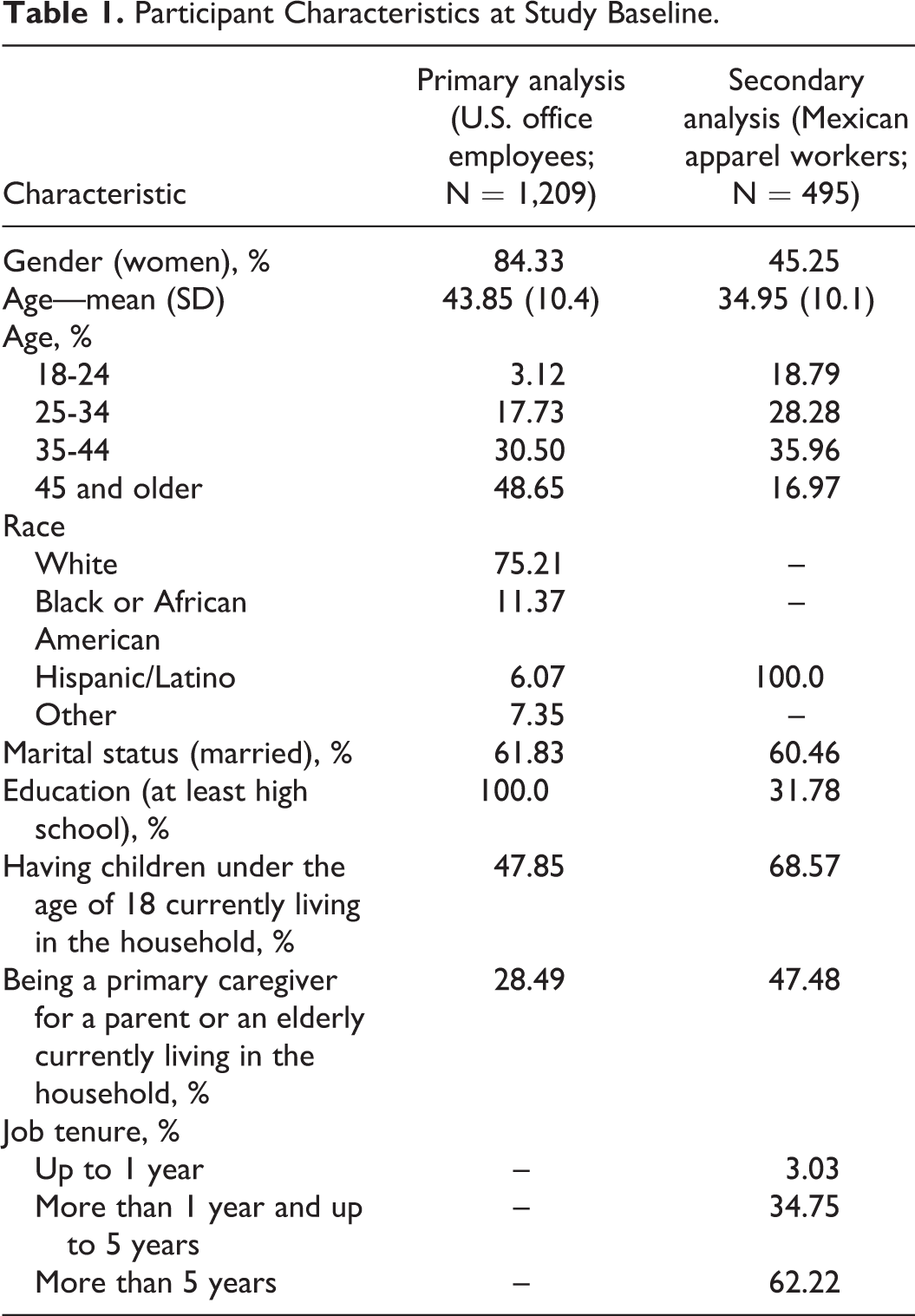
Two waves of data from the Worker Well-Being Survey reported by employees of a large services organization based in the United States were used. Participants were randomly sampled. The invitation and reminders to participate were sent to 15,000 employees in June 2018 through the work email system. There were 2,370 respondents (response rate of 15.8%) in the first wave who were subsequently invited to participate in the second wave of the study in July 2019. 1,209 respondents participated in both waves. The retention rate from wave 1 was 51.2%. In the sample, females accounted for 84.5% vs. 74.5% for the entire population. Mean age of participants was 43.5 years in the sample vs. 45.6 in the population. Both differences were statistically significant. These statistics also reflected the differences between the invited respondents and those who participated since the invitations were sent to the random and representative in terms of gender and age sample.
As a secondary data source, 3 waves of data collected from 495 Mexican apparel workers from the supply chain of a major global brand were used. The first wave was administered in February 2017, the second in March 2018, and the third in March 2019. At each data collection wave the aim was to survey as many workers as possible without causing too much disruption to production. Therefore, during survey administration, groups of workers were released from their assembly line positions (e.g., one production line at a time) to come to the survey stations. In total, 2,355 workers (51.7% of the total workforce) were offered a chance to participate in the first wave of the survey, and out of them, 2,278 took the survey (response rate of 96.1%). 2,486 workers participated in the second wave (67.4% of the total workforce) and 2,723 in the third wave (70.8% of the workforce). However, due to the high turnover rates, the retention rate from wave 1 through wave 2 and to wave 3 was 22.5% and the final panel dataset with the same individuals in all 3 waves had a sample size of 495. In the sample females accounted for 44.2% vs. 43.0% for the entire population. Mean age of participants was 35.7 years in the sample vs. 34.5 in the population. Differences in mean age were statistically significant.
Table 1 presents the descriptive statistics for both samples at baseline.
Participant Characteristics at Study Baseline.
The Worker Well-being Survey was designed to comprehensively assess human flourishing at work and the state of working conditions. It has thus far been employed with a sample of more than 13,000 garment workers in China, Cambodia, Mexico, Sri Lanka, Poland and the United States, and in addition, more than 8,000 office and manufacturing employees of two Fortune 500 manufacturing companies and one major insurer in the U.S. 28 -30
Both data collection efforts were preceded by a communication campaign 1 week prior to surveying. In the case of the primary data source, the survey was administered online to give participants a secure, anonymous space to report on sensitive health and well-being topics, and a cash prize ranging from $100 to $1,000 was offered as an incentive to 52 randomly selected participants. In the case of the secondary data source, data collection was administered on tablets in the factory in private designated areas separate from employees’ workstations. In addition, 80 high-quality t-shirts with logos of either a global brand or an Ivy League university, as well as 3 smartphones, were raffled at each data collection wave among participants.
In both cases all current employees of at least 18 years of age were eligible to participate in the survey. Participation was voluntary and confidential. Informed written consent was obtained from all participants. All protocols for recruitment and participation were reviewed and approved by the Harvard Longwood Campus Institutional Review Board.
Measures
Health and flourishing outcomes
We examined 13 outcomes for the primary analysis and 15 outcomes for the secondary analysis from the Well-Being Assessment, 30 the Flourishing Index, 31,32 the CDC Health-Related Quality of Life (CDC-HRQOL; secondary analysis) 33 and the Job-Related Affective Well-Being Scale (JRAWBS; secondary analysis). 34
The Well-Being Assessment (Cronbach’s alpha = 0.951) 30 and the Flourishing Index (Cronbach’s alpha = 0.822), 31,32 provided the following outcomes: purpose in life (2 items, composite score), social connectedness (2 items, composite score), life satisfaction and happiness (2 items, composite score), self-assessed physical health (single item) and self-assessed mental health (single item). All of these outcomes were used in all of the primary and secondary sets of data and analyses. Additionally, in the primary U.S. dataset, 5 additional single items measuring physical health and 3 additional single items measuring emotional health from the Well-Being Assessment were used.
The 2 CDC-HRQOL items on the number of days in the last month during which an individual experienced (1) feeling depressed and (2) feeling anxious were used in the secondary dataset and analyses. The JRAWBS measures (used in the secondary analysis) included feeling (1) happy, (2) energetic, (3) close to people, (4) trustful, (5) sad, (6) depressed, (7) stressed, and (8) lonely, while at work. The reliability of the positive affect while-at-work composite score was Cronbach’s alpha = 0.841 and of negative affect—Cronbach’s alpha = 0.845.
All measures used in the study have been already validated and proved to be reliable. However, we highlight that our approach uses single items rather that a composite score from these composite measures. Additionally, we used all items from each instrument that were available in the datasets.
Wording of questions is presented in detail in Table 2.
Associations Between an Orientation to Do Good and Subsequent Health and Well-Being.
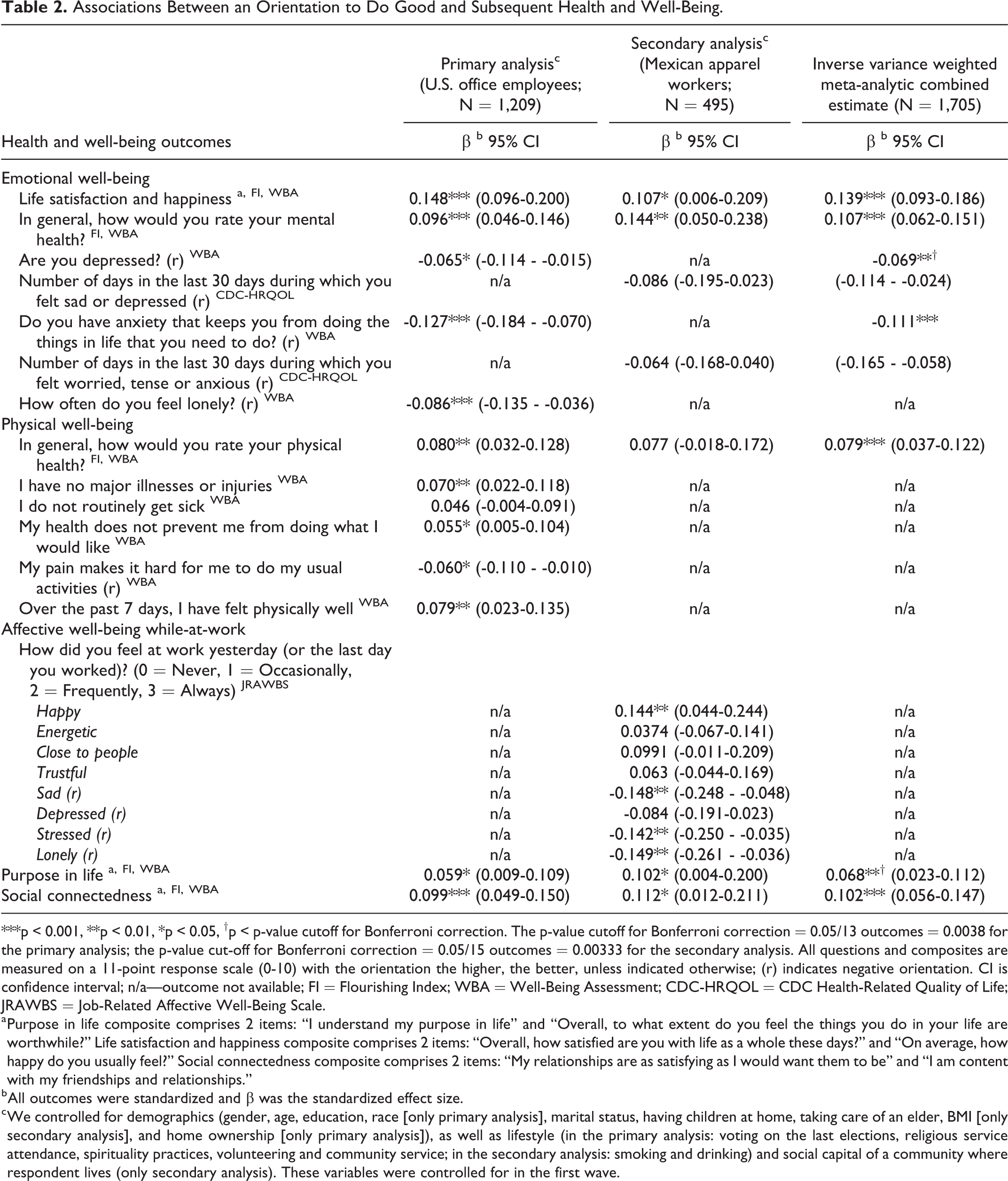
***p < 0.001, **p < 0.01, *p < 0.05, †p < p-value cutoff for Bonferroni correction. The p-value cutoff for Bonferroni correction = 0.05/13 outcomes = 0.0038 for the primary analysis; the p-value cut-off for Bonferroni correction = 0.05/15 outcomes = 0.00333 for the secondary analysis. All questions and composites are measured on a 11-point response scale (0-10) with the orientation the higher, the better, unless indicated otherwise; (r) indicates negative orientation. CI is confidence interval; n/a—outcome not available; FI = Flourishing Index; WBA = Well-Being Assessment; CDC-HRQOL = CDC Health-Related Quality of Life; JRAWBS = Job-Related Affective Well-Being Scale.
a Purpose in life composite comprises 2 items: “I understand my purpose in life” and “Overall, to what extent do you feel the things you do in your life are worthwhile?” Life satisfaction and happiness composite comprises 2 items: “Overall, how satisfied are you with life as a whole these days?” and “On average, how happy do you usually feel?” Social connectedness composite comprises 2 items: “My relationships are as satisfying as I would want them to be” and “I am content with my friendships and relationships.”
b All outcomes were standardized and β was the standardized effect size.
c We controlled for demographics (gender, age, education, race [only primary analysis], marital status, having children at home, taking care of an elder, BMI [only secondary analysis], and home ownership [only primary analysis]), as well as lifestyle (in the primary analysis: voting on the last elections, religious service attendance, spirituality practices, volunteering and community service; in the secondary analysis: smoking and drinking) and social capital of a community where respondent lives (only secondary analysis). These variables were controlled for in the first wave.
Orientation to promote good—Strength of character
A single item was used: I always act to promote good in all circumstances, even in difficult and challenging situations. 5 Respondents could choose an answer on a 0 = “not true of me” to 10 = “completely true of me” scale. This item was part of the Flourishing Index, validated in workplace and cross-cultural settings. 31,32 Our use of a single item results from the fact that, although the Flourishing Index comprises 2 character strength items and the Well-Being Assessment comprises 7 of them, both instruments comprise only 1 item measuring an orientation to promote good.
Control variables
A rich set of control variables, already established as influencing changes in health and emotional, physical, and social well-being, were used to investigate the influence of orientation to promote good on health and human flourishing. Specifically, we controlled for demographics (gender, age, education, race [only in the primary dataset], marital status, having children at home, taking care of an elder, BMI [only in the secondary dataset], and home ownership [only in the primary dataset]), as well as the lifestyle (only in the primary dataset: voting in the last elections, religious service attendance, spirituality practices, volunteering and community service; in the secondary dataset: smoking and drinking) and social capital of the community where respondent lives (only in the secondary dataset). These variables were controlled for in the first wave. Additionally, in each regression the baseline outcome was controlled for. Finally, the prior wave’s assessment of an orientation to promote good was also used in the secondary analysis as a control because control for its prior influence may help further rule out reverse causation and residual confounding. 20
Analysis
As the goal was to establish evidence concerning a potential causal link between an orientation to promote good and subsequent health and well-being outcomes, longitudinal data was used and a statistical approach for modeling longitudinal data was employed. This approach offers more reliable evidence for causation by virtue of the logical temporal sequence of cause and effect. We used either 2 (in the primary dataset) or 3 (in the secondary dataset) waves of annual data from 2 panels of employees. Lagged regression analysis was applied. To reduce confounding and risk of reverse causation, we adjusted for prior values of outcome variables (and of the exposure in the secondary analysis) in all models. Standardized regression estimates were provided to report standardized effect sizes. Complete case analysis was conducted. For outcomes available in both analyses—to combine effect estimates across cohorts—the inverse-variance weighted meta-analytic estimates, using random-effect model, were computed. 35,36 Bonferroni correction was used to correct for multiple testing.
Robustness of the results to potential unmeasured confounding was addressed by performing a sensitivity analysis. Sensitivity measures—E-values—were calculated to assess the extent to which an unmeasured confounder would need to be associated with both the exposure and the outcome to explain away the observed temporal association, 37,38 The E-value is the minimum strength of association on the risk ratio scale that an unmeasured confounder would need to have with both the outcome and the primary exposure or independent variable, above and beyond the measured covariates, in order to explain away the observed association. 38,39 Detailed information on how to interpret E-values and their confidence intervals is provided below Table 3. The analysis with the primary U.S. dataset was complemented by the secondary analysis of the Mexico data, which provided validation of results in different settings in terms of cultural origins and work design.
E-values for Effect Measures and for CI Limits—For Associations Between an Orientation to Promote Good and Subsequent Health and Well-Being.
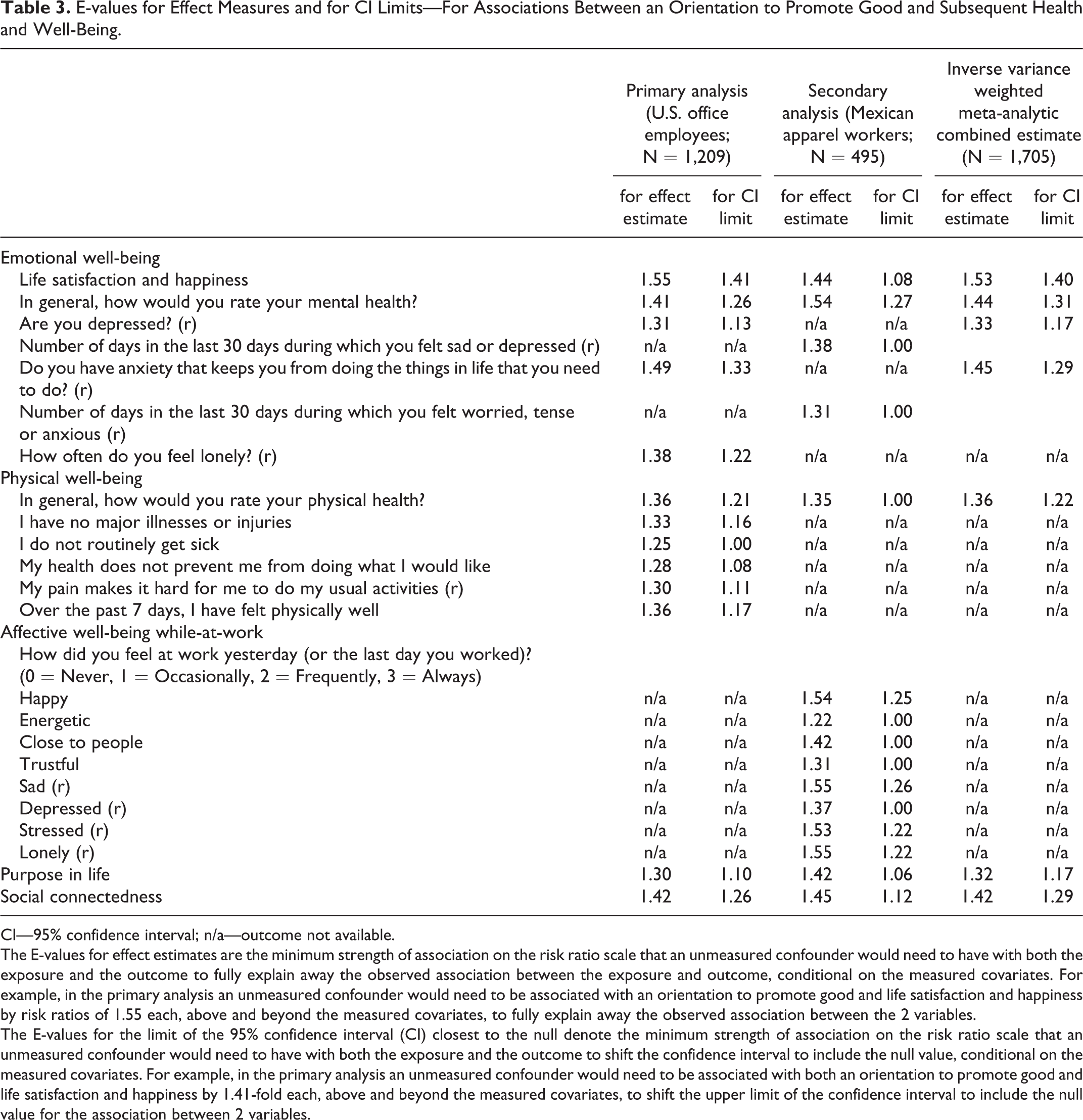
CI—95% confidence interval; n/a—outcome not available.
The E-values for effect estimates are the minimum strength of association on the risk ratio scale that an unmeasured confounder would need to have with both the exposure and the outcome to fully explain away the observed association between the exposure and outcome, conditional on the measured covariates. For example, in the primary analysis an unmeasured confounder would need to be associated with an orientation to promote good and life satisfaction and happiness by risk ratios of 1.55 each, above and beyond the measured covariates, to fully explain away the observed association between the 2 variables.
The E-values for the limit of the 95% confidence interval (CI) closest to the null denote the minimum strength of association on the risk ratio scale that an unmeasured confounder would need to have with both the exposure and the outcome to shift the confidence interval to include the null value, conditional on the measured covariates. For example, in the primary analysis an unmeasured confounder would need to be associated with both an orientation to promote good and life satisfaction and happiness by 1.41-fold each, above and beyond the measured covariates, to shift the upper limit of the confidence interval to include the null value for the association between 2 variables.
Analyses were performed using Stata 15.
Results
The Primary U.S. Dataset
In the primary analysis (Table 2, left panel), we found that all examined emotional well-being outcomes and 5 out of 6 physical health outcomes were beneficially affected by an orientation to promote good. Specifically, this character strength was found to have a positive effect on subsequent life satisfaction and happiness and self-assessed mental health, as well as playing a protective role against anxiety, loneliness, and possibly depression. However, in the case of depression, the association did not reach the p < 0.05 threshold after the correction for multiple testing.
Additionally, a positive association was found between an orientation to promote good and subsequent social connectedness and purpose in life, although, for purpose in life, the association did not reach the p < 0.05 threshold after the correction for multiple testing. The strongest effects were observed for 2 emotional well-being outcomes: a composite of life satisfaction and happiness (β = 0.148, p < 0.001) and anxiety (β = -0.127, p < 0.001).
The Secondary Mexico Dataset
In the analysis of the secondary data (Table 2., middle panel), always acting to promote good in all circumstances, even in difficult and challenging situations, was found to be positively associated with 2 out of 4 examined emotional well-being outcomes and 4 out of 8 analyzed affective well-being while at work outcomes. Specifically, similar to the primary U.S. dataset analysis, an orientation to promote good was found to be positively related to subsequent life satisfaction and happiness as well as to self-assessed mental health. It was also found to be associated with 1 positive affective state (feeling happy) and 3 negative affective states (feeling sad, stressed and lonely), though these aforementioned associations did not reach the p < 0.05 threshold after correction for multiple testing.
No association in the secondary data was found with the one examined physical well-being outcome. However, similarly to the primary analysis, a positive association was found between an orientation to promote good and subsequent purpose in life and social connectedness. Although the effect sizes were larger than in the primary analysis, they did not reach p < 0.05 after the correction for multiple testing. Note, however, that the sample size was smaller. Several associations thus achieved conventional thresholds concerning “statistical significance” (p < 0.05) but not after Bonferroni correction. To achieve further statistical power and gain additional insight we also proceeded with meta-analytic estimates across the 2 datasets.
Combined meta-analytical estimates (Table 2, the right-most panel) provided additional validation of the role of an orientation to promote good for human flourishing. For the meta-analytic estimates, associations passed the p < 0.05 threshold, even after the correction for multiple testing, for life satisfaction and happiness (β = 0.139, p < 0.001), self-assessments of mental health (β = 0.107, p < 0.001), self-assessments of physical health (β = 0.079, p < 0.001), meaning and purpose in life (β = 0.068, p < 0.0033), social connectedness (β = 0.102, p < 0.001) as well as feeling depressed (β = -0.069, p < 0.0033) and feeling anxious (β = -0.111, p < 0.001).
Sensitivity Analysis
The robustness of the results to unmeasured confounding was assessed and the sensitivity measures—E-values—were reported (Table 3). There was evidence that the association between an orientation to promote good and subsequent well-being measures was moderately robust to unmeasured confounding. Specifically, E-values for effect estimates were between 1.25 and 1.55 for the well-being outcomes in the primary analysis and ranged from 1.22 and 1.55 in the secondary analysis. However, in the secondary analysis, for a number of outcomes we noted E-values for confidence interval limits equal to 1, indicating lack of robustness in that dataset. However, the meta-analytic estimates—combining the evidence across the 2 sets of data—provided additional evidence supporting moderate robustness of the results to potential unmeasured confounding.
Discussion
Trends in both positive psychology and positive health suggest a shift in focus from prevention of ill health and reducing risk factors to identifying positive factors contributing to health and well-being. 6,40 -42 This study contributes to our understanding of the impact on human flourishing of character strengths reflected in an orientation to promote good. By examining two culturally different samples and using longitudinal data, this study adds to the evidence that an orientation to promote good may play a positive role in improving functioning across numerous areas of human thriving. Specifically, this study found that an orientation to promote good—reflected in having consistent thoughts and taking actions that contribute to the good of oneself and others—was positively associated with the subsequent life satisfaction and happiness, self-assessed mental health and physical health, social connectedness and purpose and meaning in life, as well as with a lower risk of anxiety, loneliness and depression—with the strongest effects for life satisfaction and happiness and anxiety. Possible effects on both positive (feeling happy) and negative affect (feeling sad, stressed and lonely) while-at-work were also identified (however, they were examined only in the secondary sample).
Consequently, our results reinforce the evidence from experimental studies 6,9,10,23 and meta-analyses 9,12,22 that altruistic behaviors and using character strengths may indeed benefit emotional well-being and mental health. For example, the use of character strengths in a new way was found to increase happiness 43,44 and be correlated with life satisfaction. 17
However, our results and those of prior work are in some tension with the experimental findings of Khanna and Singh 45 and Mongrain and Anselmo-Matthews 44 who—in replication of Seligman et al.’s 6 experiment—reported no contribution of the use of character strengths to decreased depressive symptoms. Unique to our contribution is that it provides some evidence that these positive effects on promoting well-being and protecting against anxiety and depression can be observed well beyond the 6-month period 6 —the longest period that we were able to find in the literature after which the effect of an intervention based on a novel use of character strength were still discernible. Our results indicate that the effects of an orientation to promote good can still be observed even 1 year later.
Contrary to prior cross-sectional evidence of no correlation between application of signature character strengths and self-reports of physical health, 46 this work provides empirical evidence that use of character strengths and promoting good in all circumstances, even in difficult and challenging situations, may be beneficial for self-perceived physical health.
Also, in contrast to some of other studies, 11 our results suggest that an orientation to promote good has some potential to alleviate negative affect, especially that related to feeling stressed, sad and lonely while-at-work. Finally, another distinctive contribution is in presenting empirical evidence on the beneficial effects of using of character strengths on having sense of meaning and purpose in life, social connectedness, as well as on reducing anxiety. While the first 2 outcomes have been acknowledged as factors contributing to improved physical health and longevity in general, 41,47,48 remarkably little is known about their determinants. 42 This study provides some insights in this respect.
Despite its strengths, this study is subject to certain limitations. First, our study made use of observational and self-reported data and may be subject to unmeasured confounding, for example, personality and core self-evaluations. 9,49 However, our sensitivity analysis, based on the calculated E-values, indicated that a number of the results presented were at least moderately robust to potential unmeasured confounding, even beyond a considerable number of measured potential confounders already included in the analyses. This further strengthens the evidence for causality.
Second, since our study uses self-reported data, it may be subject to social desirability bias. 50 Consequently, self-reports of an orientation to promote good may be subject to limited accuracy and reliability. However, the longitudinal character of the study provides some reassurance that the findings are not entirely due to report bias. The advantage of self-reports of character is, however, that they reflect respondents’ general attitude toward right behavior and the perception of their own behavior in this respect. Third, only working adults provided data for the analyses. Since labor market status—reflected in having a job vs. being unemployed—has proved to be highly influential for well-being and health, 51,52 further analyses should be performed to replicate the results in other populations. Fourth, we relied on single item measures of an orientation to do good. It is certainly preferable, when possible, to use multi-item measures in assessing character. 53 We opted for a single item measure because the Worker Well-Being Survey, which provided data for this study, comprised measures of multiple phenomena comprising well-being, physical and psycho-social working conditions, work safety and occupational health, job burden, job autonomy, job resources, work-family conflict and others. The Survey was administered in a workplace setting in which less time-consuming instruments may be beneficial. Specifically, by being short enough for practical use, these short instruments may facilitate a company’s efforts to assess and improve worker well-being. 31 Such short instruments can also be found in psychology, 54 educational psychology 55 and organizational behavior. 56
The limitations are balanced by several strengths of our study. First, this study examines the role that an orientation to promote good may play in improving functioning across a broad range of domains of health and well-being simultaneously. Such an approach provides a comprehensive examination of the impacts that this character strength may have, and moreover, may expose certain patterns of the associations that may not be discernible if single outcomes were examined in separate studies. Second, owing to our examination of 2 very distinct samples, with different job characteristics and professional profiles and conducted in different geographical and socio-cultural contexts (i.e. in an individualistic [American] one and a collectivist [Mexican] one), we have evidence that our results are similar across these contexts. This culturally sensitive aspect of our study is congruent with the findings from experiments that have indicated that positive health and well-being, resulting from altruism and kindness (e.g., helping others), may be embedded in human nature and emerge in diverse cultural contexts. 57 Our findings also show that although people in collectivistic societies (who usually have higher interdependent and lower independent self-construal 58,59 ) perceive their health differently and adopt different health practices than those from individualistic societies, 60 their health and well-being may be similarly influenced by an orientation to promote good. Third, the longitudinal design and the adjustment for a wide range of covariates and prior values of the exposure (in the secondary dataset) and the outcomes helps establish clear temporal order and address control for reverse causation and unmeasured confounding. Fourth, the sensitivity analysis for unmeasured confounding provides further evidence for the robustness to confounding for a number of the associations.
So what?
Personal character strengths are potentially modifiable and effective in improving health and well-being as well as in limiting risks of ill-being, as shown by diverse experimental studies. 6,9,10,23 Many of these similar effects have been observed regardless of the beneficiaries of these acts (e.g. strong ties, weak ties and to self) 24 and cultural contexts. 57 Based on the results of the present study, policymakers and practitioners might consider an orientation to promote good as an important factor for improving population health (including physical health) and human flourishing, as well as for protecting against work-related stress. Since people possess a range of psychological mechanisms that motivate them to help others and behave in a right manner, as suggested by evolutionary behavioral science, 61,62 policies promoting the use of the character strengths as a public health factor are likely to be perceived positively by the general public and be potentially successful as they are inherently in line with human nature.
Examples of character strengths interventions, for example, delivered as self-help, may include the three so far well tested behavioral exercises. These are primarily suggested by Seligman et al. 6 : (1) the gratitude visit based on writing and delivering in person a letter of appreciation to someone who had been kind to them but whom they had never properly thanked, (2) every day for a week writing down three good things that happened each day, together with a causal explanation for each thing, and (3) using character strengths in a novel way (e.g., being honest or being kind). These kinds of positive psychology interventions are also proven to be comparably effective when delivered using the Internet, as opposed to a more traditional face-to-face therapeutic setting. 63 These interventions may respectively promote a cognitive or behavioral orientation toward the good. 16 Finally, another type of activity worth promoting in this regard is volunteering, as this involves a sustained helping others and there is some evidence showing that volunteering at least 100 hours/year reduces risk of mortality and physical functioning limitations, and favorably contributes to higher physical activity and better psychosocial outcomes. 64,65
Footnotes
Authors’ Note
DWB contributed to the study concept, data analysis and interpretation of the result, she also drafted and revised the manuscript. PB contributed to data analysis and interpretation of the result, he also revised the manuscript. TVW developed the study design and the study concept, contributed to interpretation of the results, revised the manuscript and provided funding for the study. EM developed the study design, revised the manuscript and provided funding for the study. All authors approved the final version of the manuscript
Declaration of Conflicting Interests
The author(s) declared no potential conflicts of interest with respect to the research, authorship, and/or publication of this article.
Funding
The author(s) disclosed receipt of the following financial support for the research, authorship, and/or publication of this article: Dr McNeely and Dr VanderWeele report receiving grants and personal fees from Aetna Inc. Dr McNeely reports receiving grants from the Levi Strauss Foundation, she also reports serving as director of SHINE at Harvard (Sustainability and Health Initiative for NetPositive Enterprise); SHINE conducts global research about well-being. Support is made possible through SHINE from multiple companies. This research is support by Templeton Foundation grant 61075, by Well-Being Research Program A33796 Aetna Inc. and by the Levi Strauss Foundation under the grant Follow up of Well-being measures in Mexico, China, Cambodia, and Sri Lanka.
