




Abstract
Purpose:
The purposes of this study were to examine associations between objectively measured walkable urban design attributes with Japanese older adults’ body mass index (BMI) and to test whether objectively assessed physical activity and sedentary behavior mediated such associations.
Design:
Cross-sectional.
Setting:
Matsudo City, Chiba Prefecture, Japan.
Participants:
Participants were 297 older residents (aged 65-84 years) randomly selected from the registry of residential addresses.
Measures:
Walkable urban design attributes, including population density, availability of physical activity facilities, intersection density, and access to public transportation stations, were calculated using geographic information systems. Physical activity, sedentary behavior, and BMI were measured objectively.
Analysis:
The relationships of walkable urban design attributes, Walk Score®, and BMI were examined by multiple linear regression with adjustment for covariates in all models. Mediation effects of the physical activity and sedentary behavior variables in these relationships were tested using a product-of-coefficients test.
Results:
Higher population density and Walk Score® were associated with lower BMI. Light and moderate-to-vigorous physical activities partially mediated the relationships between these walkable urban design attributes and BMI.
Conclusions:
Developing active-friendly environmental policies to (re)design neighborhoods may not only promote active transport behaviors but also help in improving residents’ health status in non-Western contexts.
Purpose
Research examining relationships between walkable urban design attributes and weight among older adults is limited in two ways. First, almost all previous studies have been conducted in Western countries, 1,2 even though environmental characteristics in Asia are often very different. 3 Therefore, the extant evidence may not be applicable to Asian contexts. Second, while there are several studies investigating the mediation effects of active behaviors in the relationship between built environment attributes and weight status among adults, 4 -6 only one study examined such mediation effects among older adults. 7 Nevertheless, no studies have investigated the mediating effects of both objectively assessed physical activity (PA) and sedentary behavior (SB) in these relationships. The purposes of this study were to examine associations between objectively measured walkable urban design attributes and Japanese older adults’ body mass index (BMI) and to test whether objectively assessed PA and SB mediated such associations.
Methods
Design
This study used cross-sectional data collected in 2013 from older adults living in Matsudo City, Chiba Prefecture, Japan.
Sample
An invitation letter was sent to 3000 older adult residents who were randomly selected from the registry of residential addresses. Of these, 951 (31.7%) agreed to participate in the main mail-based survey and 349 (37.7%) took part in the on-site examination, including a self-administered questionnaire and other health assessments (eg, body composition test). All participants provided written informed consent. The study was approved by the Institutional Ethics Committee of Waseda University (2013-265) and the Institutional Review Board of Chiba Prefectural University of Health Sciences (2012-042).
Measures
BMI was calculated as weight divided by height squared. Weight was measured using a scale (BIA, MC-980A; TANITA, Tokyo, Japan). Height was measured with the participants standing without shoes and feet together. Active style Pro accelerometers were used to assess PA and SB (Active style Pro HJA 350-IT; Omron Healthcare Co Ltd, Kyoto, Japan). 8 The daily average time spent on SB (≤1.5 METs), light-intensity PA (LPA; >1.5 to <3.0 METs), and moderate-to-vigorous PA (MVPA; ≥3.0 METs) was calculated. 9
Four walkable urban design attributes were calculated using geographic information systems within both 800 m and 1600 m network-based buffers around participants’ geocoded residential addresses as follows: (1) population density: density of each buffer area excluding water and no-population zone, (2) availability of PA facilities: number of sport and fitness clubs within each buffer area, (3) intersection density: ratio of 3-way or more intersections per km2, and (4) access to public transport stations: road network-based distance to the nearest train station. Each participant’s residential address was manually entered into the Walk Score® web site (www.walkscore.com) and the score recorded. 10 Walk Score® assigns a walkability score to any given address considering access to a variety of destinations, such as supermarkets, restaurants, fitness centers, and parks, as well as street layout.
Covariates included sociodemographic information, smoking habits, mobility function (using a single SF8 item 11 ), accelerometer wear time, and average slope of areas within two aforementioned buffers.
Analysis
The relationships of walkable urban design attributes, Walk Score®, and BMI were examined by multiple linear regression with adjustment for covariates. Generalized linear models (gamma distribution with identity link function) were used to examine the association between the environmental attributes and potential mediators. Sobel test on indirect effects was used for testing the significance of mediation effects.
Results
After excluding missing and invalid values, data from 297 participants were included (Table 1).
Characteristics of Study Participants.a
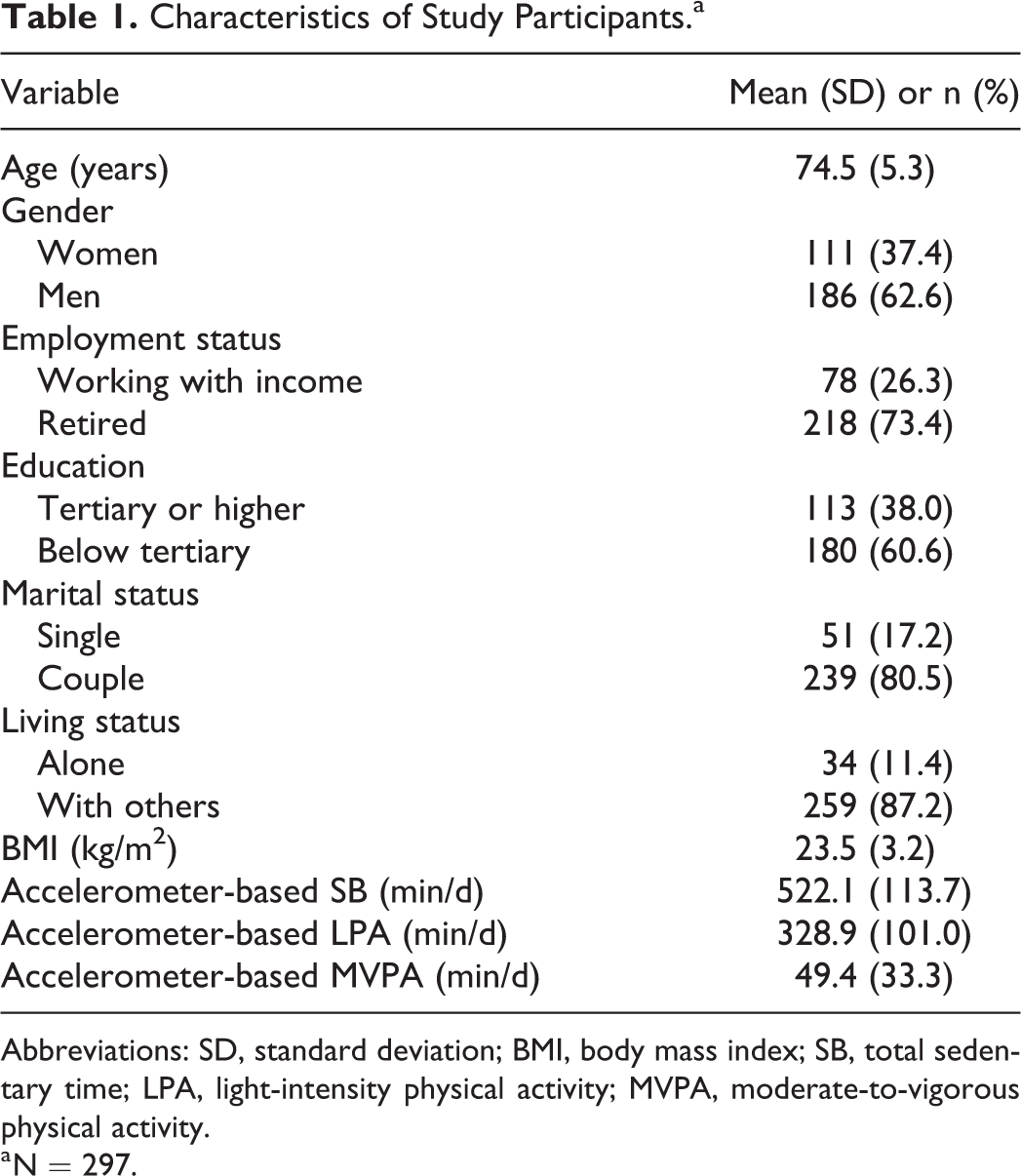
Abbreviations: SD, standard deviation; BMI, body mass index; SB, total sedentary time; LPA, light-intensity physical activity; MVPA, moderate-to-vigorous physical activity.
a N = 297.
Associations of Environmental Attributes With BMI
There were significant negative associations between population density within 800 m and within 1600 m and BMI (B = −0.46, 95% confidence interval [CI] = −0.84 to −0.09; B = −0.49, 95% CI = −0.86 to −0.12, respectively). Walk Score® was also significantly negatively associated with BMI (B = −0.52, 95% CI = −0.89 to −0.15). The mediation effects of PA and SB in these significant associations were further examined.
Associations of Environmental Attributes With Potential Mediators (Path A)
A one standard deviation increase in population density within 800 m and 1600 m was associated with a 4.27 and 4.30 minutes per day increase in MVPA, respectively (Table 2). A one standard deviation increase in population density within 800 m and 1600 m was also marginally associated with 8.74 and 9.26 minutes per day increase in LPA. An increase in one standard deviation in Walk Score® was associated with a 10.91 and 3.16 minutes per day increase in LPA and MVPA, respectively.
Mediation Variable Models of Associations Between Walkable Urban Design Attributes With BMI.
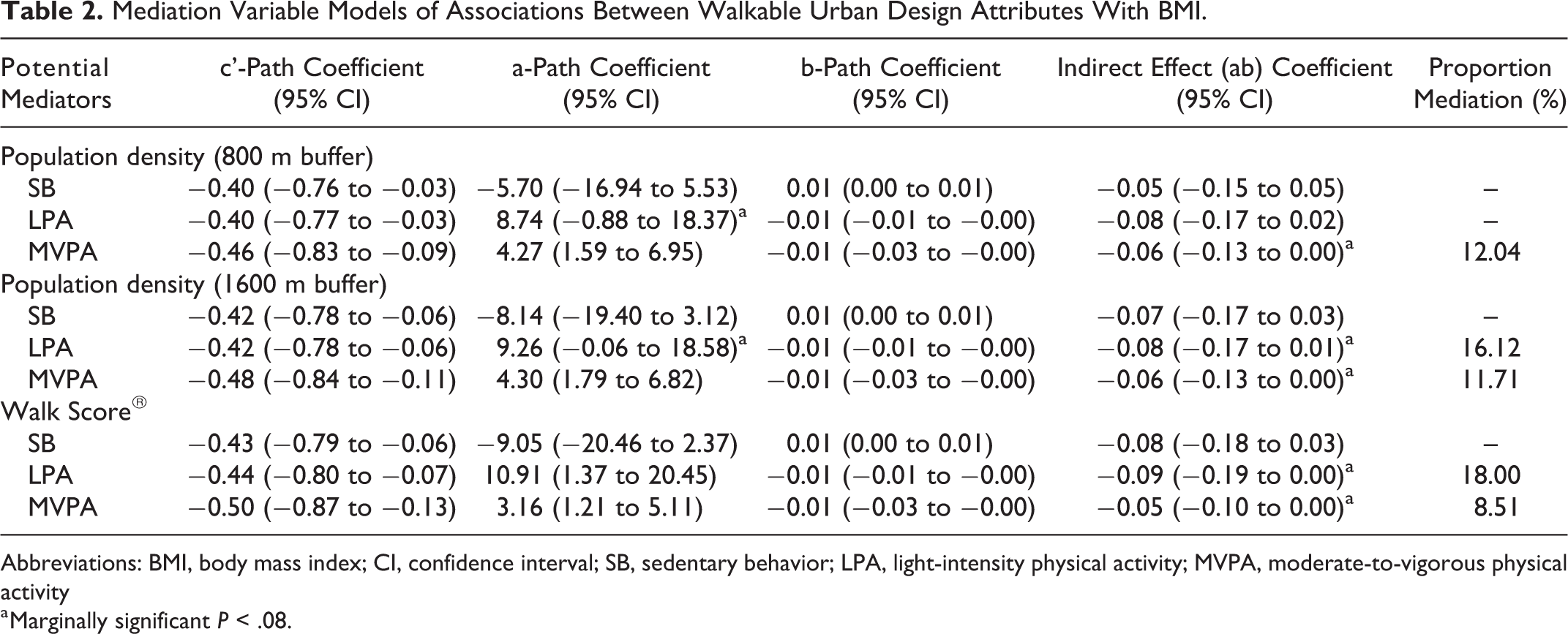
Abbreviations: BMI, body mass index; CI, confidence interval; SB, sedentary behavior; LPA, light-intensity physical activity; MVPA, moderate-to-vigorous physical activity
a Marginally significant P < .08.
Associations of Potential Mediators With BMI (Path B)
With respect to PA, all significant relationships were in the negative direction, such that more LPA and MVPA were associated with lower BMI. Also, a significant positive association was found between SB and BMI (Table 2).
Mediated Pathways
LPA mediated the relationship between population density within 1600 m and BMI by 16.1%. The proportions of the total effect of population density within 800 m and within 1600 m on BMI mediated by MVPA were 12.0% and 11.7%, respectively. Both LPA and MVPA mediated the relationship between Walk Score® and BMI by 18.0% and 8.5%, respectively (Table 2).
Discussion
Summary
Similar to previous research, 1,12 we found higher population density to be associated with improved weight status. Our study also showed higher Walk Score® was associated with lower BMI. This is similar to previous studies of adults that found associations between Walk Score® and obesity measures. 13,14 Consistent with this evidence from Western countries, our findings support that walkable urban design attributes are related to older adults’ weight in an Asian context.
Consistent with the only previous study, 7 we found the effects of population density and Walk Score® on BMI to be partially mediated through MVPA. As well, LPA partially mediated the observed associations between population density within 1600 m and Walk Score® with BMI. SB was found not to be a mediator in the associations between walkable urban design attributes and BMI, since the built environment had no effect on SB in our sample. This is consistent with a recent review that found modest evidence of the role of neighborhood environmental factors on SB. 15 The partial mediation effects of PA indicate that there are other pathways such as access to un/healthy food 16 and social capital 17 through which walkable built environments may influence older adults’ BMI.
Limitations
Given the cross-sectional design, we were unable to draw causal linkages. We also did not include perceived environmental measures, which may differentially influence older adults’ weight status. 18 Other limitations included the small sample, recruitment from a single city with unclear variability in built environments, absence of public parks from the PA facilities, and error associated with assessing SB with accelerometers.
Significance
This study adds to the literature by investigating associations of walkable urban design attributes with older adults’ weight status in Japan, particularly as it is the first study to do so in Asian contexts. Our study also advances current knowledge by examining how objectively assessed PA and SB mediated these associations.
So What?
What is already known on this topic?
Several studies have shown associations of walkable urban design attributes with older adults’ weight status.
What does this article add?
This study adds evidence about the role of walkable built environments on older adults’ weight status in Asian contexts and on the mediation effects of objectively assessed PA and SB in this relationship. The findings of this study suggest that LPA and MVPA were significant mediators of the association.
What are the implications for health promotion practice or research?
The significant associations of built environment variables with BMI in older adults in Japan supports the cross-cultural generalizability of prior results from Western countries identifying built environments as an important public health concern. Developing active-friendly environmental policies to (re)design neighborhoods may not only promote active travel behaviors but may also help in improving older adults’ health status in non-Western contexts.
Footnotes
Declaration of Conflicting Interests
The author(s) declared no potential conflicts of interest with respect to the research, authorship, and/or publication of this article.
Funding
The author(s) disclosed receipt of the following financial support for the research, authorship, and/or publication of this article: Koohsari was supported by a JSPS Postdoctoral Fellowship for Research in Japan (#17716) from the Japan Society for the Promotion of Science. Nakaya was supported by the JSPS KAKENHI (#JP15H02964). Hanibuchi was supported by the JSPS KAKENHI (#JP25704018). Oka is supported by the MEXT-Supported Program for the Strategic Research Foundation at Private Universities, 2015-2019 the Japan Ministry of Education, Culture, Sports, Science and Technology (S1511017). None of the authors has any financial interest in  .
.