




Abstract
There is a need for a measure that examines teacher roles in implementing the Self-Determined Learning Model of Instruction (SDLMI) to advance equity in opportunities and experiences to build self-determination for all students, including students with disabilities and students of color with disabilities. In this study, the authors introduce a measure, the SDLMI teacher roles self-report measure, developed using the theoretical framework of the causal agency theory and knowledge of SDLMI implementation. This measure focuses on three roles defined in SDLMI implementation: advocate, facilitator, and instructor. Teachers are trained to take on each of these roles when implementing the SDLMI to provide inclusive and culturally responsive opportunities to promote self-determination. Preliminary findings from this study indicate that the advocate, facilitator, and instructor roles are positively correlated, but they are different constructs and demonstrate different patterns of relations with each other. Given these preliminary findings, more work is warranted to examine the relationship between the SDLMI teacher roles self-report measure and teacher implementation and student outcomes.
Keywords
Implementing evidence-based practices (EBPs) with fidelity can be challenging for educators in school contexts (Rowe, Collier-Meek, et al., 2021). For example, educators have reported barriers, including a lack of training and professional development opportunities, competing beliefs, and complex roles and responsibilities (Raley et al., 2023). Emerging research is seeking to understand educators’ roles in implementing EBPs to identify barriers and facilitators to the fidelity of implementation. For example, researchers have highlighted the need to examine teachers’ perceptions of their roles in implementing EBPs (Richmond et al., 2019). This is particularly important as teacher roles can be a malleable factor that could potentially impact the implementation fidelity of EBPs and resulting student outcomes (Cook et al., 2015), including self-determination outcomes.
In the context of college and career readiness frameworks for all students, general and special education teachers play important roles in implementing EBPs designed to teach abilities and skills associated with self-determination (e.g., decision-making, goal-setting, problem-solving) to promote in- and post-school success for all students, inclusive of students with disabilities (Lombardi et al., 2018; Morningstar et al., 2017). Although self-determination, or students’ abilities to act as causal agents as they set and work toward goals (Shogren et al., 2015), has been identified as a means to enhance in- and post-school outcomes for students with disabilities (Rowe, Mazzotti, et al., 2021), students with disabilities do not often have access to opportunities and supports to develop self-determination in inclusive, general education settings. This issue is even more notable for predominantly marginalized students with disabilities, inclusive of students of color with disabilities (Shogren, Scott, et al., 2021). There is a need to define general and special education teacher roles in implementing evidence-based self-determination instruction using inclusive and culturally responsive and sustaining supports to promote self-determination outcomes for all students. Defining these roles can inform assessment as well as professional development to support equitable outcomes for all students (Leko et al., 2015; Leko & Roberts, 2014).
Assessment of Teacher Roles in Implementing EBPs
There has been limited research focused on developing and gathering evidence for the validity and reliability of measures of teacher roles in implementing EBPs to improve outcomes for all students, including students with disabilities (Brownell et al., 2020). The lack of existing measures of teacher roles might be explained by the lack of focus on clearly defining teacher roles in existing EBPs (Billingsley et al., 2009; Laframboise et al., 2004; McLaughlin, 2010). For example, Youngs and colleagues (2011) conducted interviews with new elementary general and special education teachers to examine their expectations of their roles in implementing interventions in inclusive classrooms. Special education teachers reported feeling their roles were less defined than general education teachers and they were more dependent on general education teachers in defining their roles. In secondary contexts, ambiguity in teacher roles can be problematic as research suggests uncertainty in roles across secondary general and special educators is associated with burnout and attrition (Billingsley & Bettini, 2019; Embich, 2001). Furthermore, elementary general and special education teachers tended to report that their roles were mainly focused on acting as instructors (Urbach et al., 2015). While acting as an instructor is important, only focusing on this domain reflects a traditional view of teaching in which teachers are primarily deliverers of content and information (McCray et al., 2014).
Emerging research and theory suggest teacher roles are dynamic in complex settings like schools and require teachers to move beyond solely acting as instructors and instead being flexible and responsive to the needs of all students, including students with disabilities (Gomez-Najarro, 2020; McCray et al., 2014). For example, teachers can act as advocates by maintaining high expectations for students and removing systemic barriers that limit students’ access to the supports they need in inclusive settings (Ruppar et al., 2017). As such, there is a need for assessments that measure the contemporary roles teachers play to ensure all students receive high-quality instruction in inclusive settings (Shepherd et al., 2016). Such assessments need to be rooted in clear definitions of the roles that implementers are expected to play in implementing EBPs, particularly when implementing the intervention in inclusive settings, integrating culturally responsive practices, and addressing college and career readiness outcomes.
Researchers have initiated a line of work to integrate EBPs to promote self-determination for all students in inclusive settings and established the impacts of self-determination instruction on students with and without disabilities self-determination and goal attainment outcomes in inclusive settings (Raley et al., 2021; Shogren et al., 2016). This research suggests the need to more effectively support pre- and in-service teachers in learning the specific roles they play when implementing EBPs designed to promote self-determination in inclusive settings while integrating culturally responsive practices (Shogren, Scott, et al., 2021) as supportive contexts and inclusive opportunities are important to the development of self-determination (Shogren & Raley, 2022). Teachers play critical roles in creating such contexts for their students to set goals for learning and offer choices and remove barriers, empowering students to self-initiate and self-direct progress. More research, however, is needed to fully understand teacher roles when implementing EBPs to promote self-determination in inclusive settings (Raley et al., 2023).
Teacher Roles in Self-Determination Intervention Implementation
Researchers have long suggested that teachers implementing EBPs designed to promote self-determination take on multidimensional roles to ensure self-determination interventions are responsive, sustaining, and leverage students’ cultural resources across school, home, and community environments (Shogren & Raley, 2022). Self-determination researchers have also suggested that because of the complexity of implementing EBPs to promote self-determination, like the Self-Determined Learning Model of Instruction (SDLMI; Shogren et al., 2018; Wehmeyer et al., 2000), teachers must take on specific and multidimensional roles. Developers of the SDLMI have defined three specific roles that teachers take on when implementing the three core components of the SDLMI (student questions, teacher objectives, and educational supports): instructor, advocate, and facilitator. See Table 1 for SDLMI teacher roles and associated descriptions.
SDLMI Teacher Roles and Self-Report Measure Example Items.
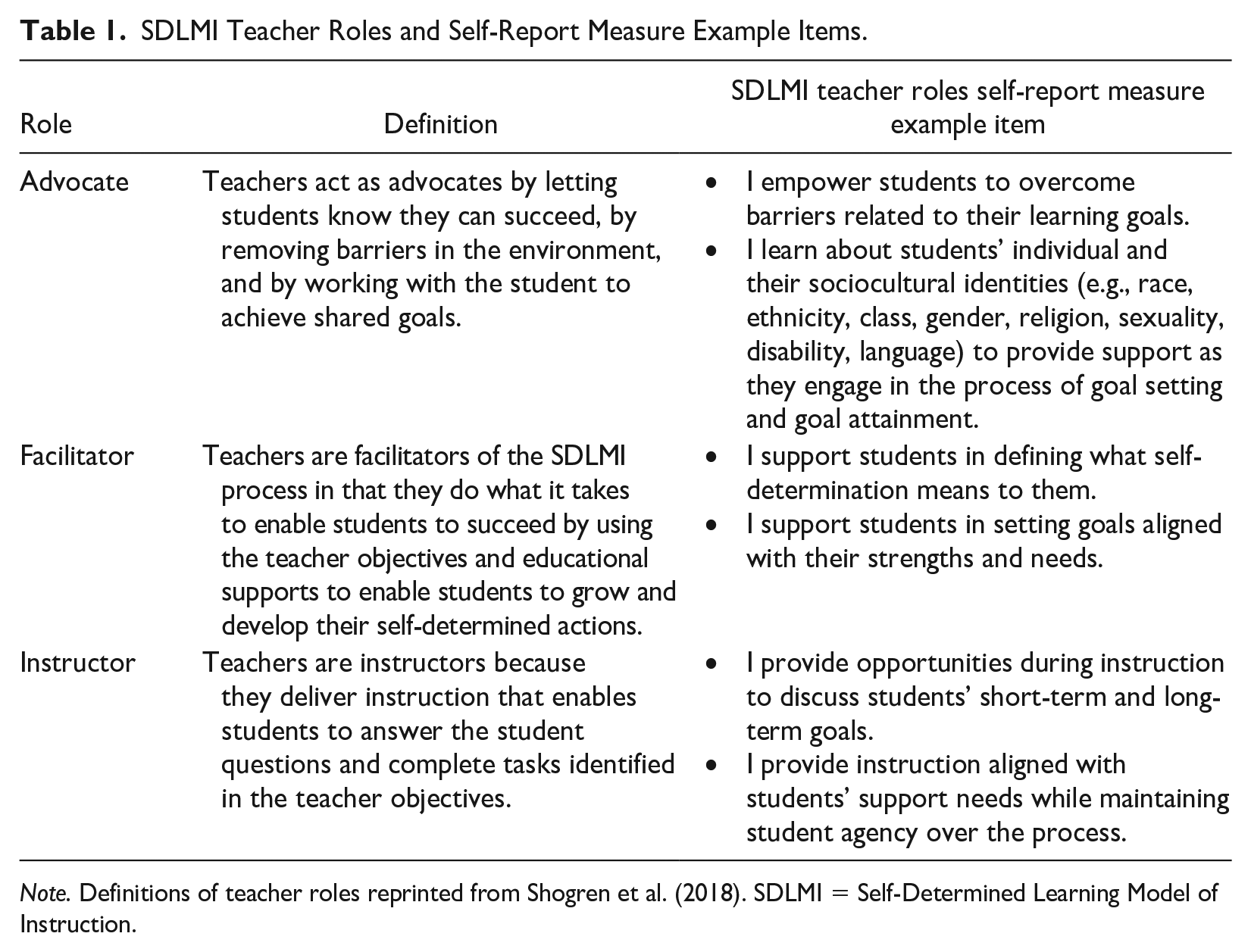
Note. Definitions of teacher roles reprinted from Shogren et al. (2018). SDLMI = Self-Determined Learning Model of Instruction.
The SDLMI is designed to enable trained teachers to teach students abilities and skills associated with self-determination and engage in self-regulated problem-solving to set and achieve goals across contexts (e.g., academic instruction, transition planning, and community settings). The SDLMI is divided into three distinct phases: Set a Goal (Phase 1), Take Action (Phase 2), and Adjust Goal or Plan (Phase 3; see Figure 1). Each phase presents a problem that students solve by answering four student questions per phase (12 total) that are intended to teach students how to self-regulate actions to reach self-selected goals. Each student question is linked with teacher objectives that provide a “road map” for teachers to implement the SDLMI. There are primary educational supports associated with each teacher objective. In implementing these three core components, teachers are trained to act as advocates, facilitators, and instructors to enable students to grow in abilities and skills associated with self-determination.
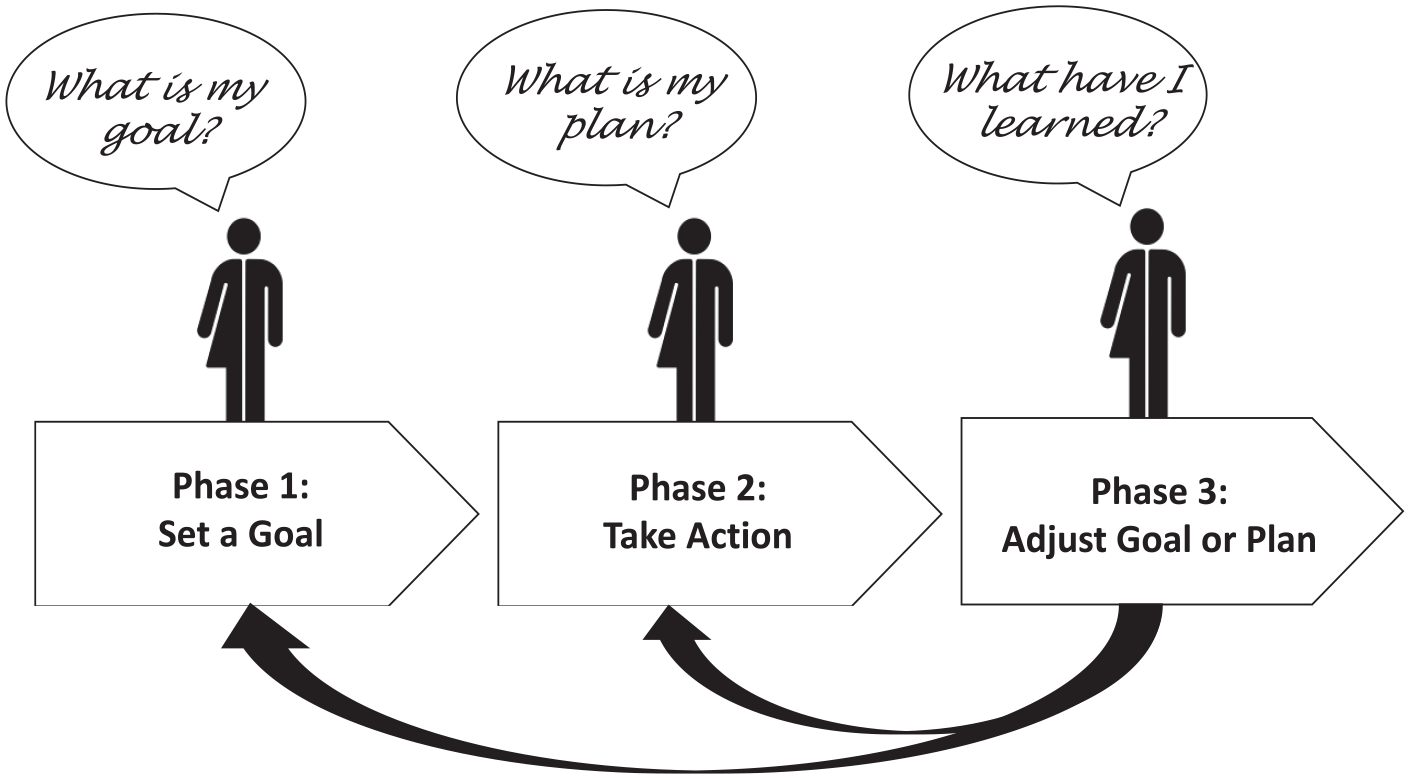
Three phases of SDLMI.
As highlighted in Table 1, SDLMI teachers act as advocates by communicating to students that they can succeed, removing barriers in their environments, and working with students’ support networks (e.g., family, friends, community, teachers, and school leaders) to achieve shared goals. For example, teachers can act as advocates in SDLMI implementation by naming and challenging systemic barriers students of color with disabilities encounter (e.g., lack of centering of students’ and families’ values and needs; Cooc & Yang, 2017; Scott et al., 2021). Teachers act as facilitators in SDLMI implementation when they do what it takes to enable students to succeed and grow and develop their self-determined actions. For example, teachers can act as facilitators by providing students with opportunities to make choices and respecting those choices as students set goals, encouraging self-initiation and promoting intrinsic motivation to enable self-determined learning (Reeve, 2016). Teachers act as instructors in SDLMI implementation by delivering instruction that enables students to answer the 12 student questions aligned with the teacher objectives, building specific self-determination skills and abilities. For example, teachers act as instructors by providing needed educational supports during instruction to enable students to link action plans to goal attainment.
Need for a Measure of Teacher Roles When Implementing the SDLMI
While these three roles are clearly defined in the SDLMI and included in professional development and implementation materials, there has not yet been a measure of these multidimensional roles to better understand the degree to which teachers embrace these roles during SDLMI instruction. This is particularly important as little is known about teachers’ identification, adoption, and integration of these roles during SDLMI implementation. The demands placed on teachers and the roles they take on are complex, creating a clear need for a measure of teacher roles in implementing the SDLMI and the relationship between the adoption and integration of these roles and student outcomes. Further, such a measure could potentially inform fidelity of implementation as well as coaching, to ensure teachers are implementing the core components of the SDLMI as intended. Having a measure of teacher roles would provide important data to inform the creation of systems of support for SDLMI implementation in schools, including targeted supports through professional development and coaching for teachers to enable them to use culturally responsive self-determination teaching practices within SDLMI implementation. Teachers’ understanding of SDLMI, fidelity of implementation, as well as recognition of the need to integrate culturally responsive teaching practices in SDLMI implementation may influence teachers’ perception of their roles as advocate, facilitator, and instructor (Hagiwara et al., 2022). More research, however, is needed to explore these directions, and a necessary first step is creating a measure to assess teachers’ perceptions of their roles during SDLMI instruction. Therefore, the goal of this paper is to (a) describe the development of the SDLMI teacher roles self-report measure and (b) provide preliminary data on the internal consistency of the SDLMI teacher roles self-report measure as well as the correlations between the three roles assessed.
Method
Development of SDLMI Teacher Roles Self-Report Measure
The SDLMI teacher roles self-report measure development team included researchers involved in the development of the SDLMI and its associated teacher roles as well as researchers with expertise in assessment development. The SDLMI teacher roles self-report measure was designed to measure three teacher roles defined in SDLMI implementation: advocate, facilitator, and instructor (Shogren et al., 2018).
Item Generation
The research team took several steps in developing the initial scale and initial item pool, following the guidelines described by DeVellis (2017). Specifically, the development team reviewed SDLMI professional development and implementation materials as well as causal agency theory (Shogren et al., 2015), the theoretical framework that guided the development of the SDLMI to identify key concepts and terms. Given the limited existence of teacher roles measures in the field of special education (Brownell et al., 2020) as well as broader field of education (Richmond et al., 2019), we utilized other SDLMI measurement tools to generate items. For example, we reviewed items from the SDLMI fidelity measure (Shogren & Raley, 2018). We also searched the literature to generate items related to culturally responsive teaching practices (e.g., Aceves & Orosco, 2014; Gay, 2018) as well as autonomy-supportive teaching practices (e.g., Reeve, 2016). This process led to the initial draft version of the SDLMI teacher roles self-report measure with 12 items on the advocate subscale, 13 items on the facilitator subscale, and 12 items on the instructor subscale. Items were written from a teacher’s perspective (e.g., “I empower students to overcome barriers related to their learning goals”; see Table 1 for example items across subscales). To allow for objective scoring and greater variability of responses (DeVellis, 2017), teachers were asked to respond to each item on a 5-point Likert-type scale: 1 (Not at all), 2 (A little), 3 (Somewhat), 4 (Mostly), and 5 (Definitely). All items were written in one direction. Scores are generated for each subscale by averaging responses to each item within the subscale. High average scores indicate that teachers are reporting they adopt the three roles in their SDLMI instruction.
Focus Group Interviews
After the initial set of items was generated, we sought feedback from multiple groups to inform item refinement. A major focus was ensuring clarity of items and alignment with the teacher role constructs, consistent with best practices in measure development (DeVellis, 2017). The development team conducted interviews with three sets of respondents (see Table 2). The first group of interviews was conducted with researchers familiar with the SDLMI and its implementation. Respondents were asked to complete the draft version of the survey (approximately 15 minutes), and then engage in an interview with the lead author to review each item of the survey and make recommendations for adjustments (approximately 30 minutes). Interviews were recorded to ensure that all suggestions, concerns, and feedback were integrated into the next version of the assessment.
Revision Cycles of SDLMI Teacher Roles Self-Report Measure.
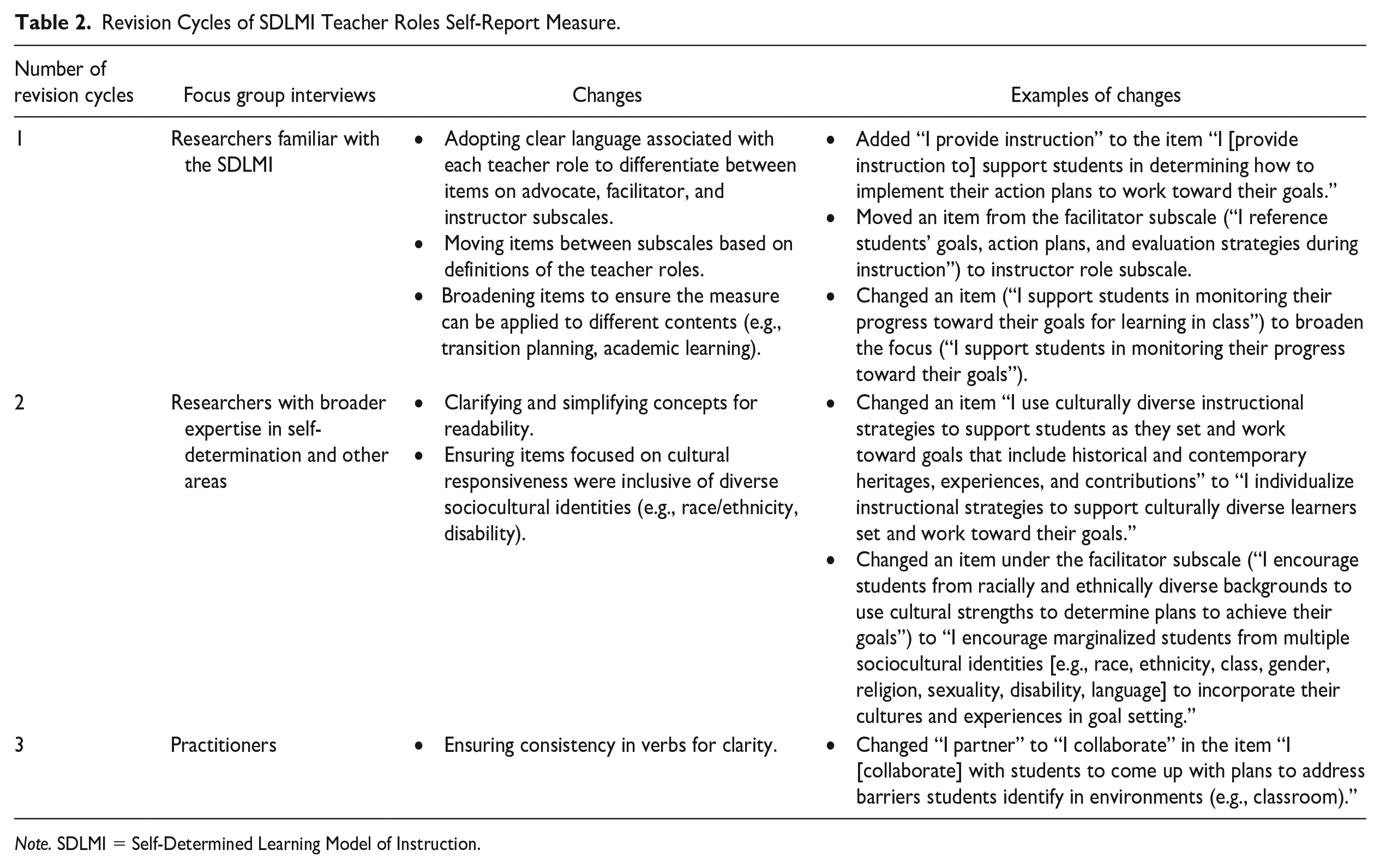
Note. SDLMI = Self-Determined Learning Model of Instruction.
A change made to the items after the first set of interviews was to clarify the language used to differentiate teachers’ roles in each subscale as respondents felt there was overlap. For example, for the instructor subscale, we added “I provide instruction” to the item “I [provide instruction to] support students in determining how to implement their action plans to work toward their goals” to clarify the item is focused on the teacher’s role in delivering instruction to students focused on implementing action plans and working toward goals. Respondents also suggested that some items needed to be moved between subscales based on definitions of the teacher roles. For example, one item was included under the facilitator subscale (“I reference students’ goals, action plans, and evaluation strategies during instruction”) and respondents consistently suggested it be moved to the instructor role subscale. After all feedback from the first group of interviews was integrated, a second group of interviews was conducted with researchers with broader expertise in self-determination and other areas related to self-determination (e.g., transition planning, academic learning, and culturally responsive pedagogy). We followed the same procedures completed with the first group of interviews. Respondents completed a revised version of the survey which integrated the feedback from the first round of interviews (approximately 15 minutes), and then engaged in an interview with the lead author to review each item of the survey and make recommendations for adjustments (approximately 30 minutes). A change made to the items after the second group of interviews was to reword some items to clarify and simplify concepts as well as ensure the items focused on cultural responsiveness were inclusive of diverse sociocultural identities (e.g., race/ethnicity and disability). For example, one item included under the facilitator subscale (“I encourage students from racially and ethnically diverse backgrounds to use cultural strengths to determine plans to achieve their goals”) was reframed as (“I encourage marginalized students from multiple sociocultural identities [e.g., race, ethnicity, class, gender, religion, sexuality, disability, language] to incorporate their cultures and experiences in goal setting.”). After all feedback from the second group of interviews was integrated, the third group of interviews was conducted with practitioners (i.e., high school general and special education teachers) who had SDLMI implementation experience. It took respondents about 15 minutes to complete the survey and the interviews were 10 minutes. The only change made to items from this set of interviews was to consistently use specific verbs. For example, partner and collaborate were used interchangeably, and teachers suggested using collaborate instead of partner for clarity. Overall, there was a general agreement among practitioners that the items were clear and understandable as well as reflected the SDLMI teacher roles they embraced in their implementation.
Preliminary Data Collection on the SDLMI Teacher Roles Self-Report Measure
The SDLMI teacher roles self-report measure was designed to be completed by teachers who are implementing the SDLMI. The tool was designed to be used after SDLMI professional development and on an ongoing basis as teachers are implementing the SDLMI to examine how teachers are adopting the three roles in their SDLMI implementation. To examine the feasibility of the tool for use by implementing teachers, its psychometric properties, and the relationship between the three SDLMI roles, we recruited a sample of high school general and special education teachers who had implemented the SDLMI in inclusive classes (e.g., mathematics classes, homeroom planning periods) with students with and without disabilities. Before data collection, human subjects approval was obtained from the university Institutional Review Board (IRB) as well as the permission from the Midwest suburban district to conduct this study.
The targeted sample consisted of 22 teachers who had been trained in the SDLMI as a part of an initiative at their high school and had at least 1 year of implementation experience. Of the targeted sample, 21 (95%) teachers completed the SDLMI teacher roles self-report measure. The average number of years of SDLMI implementation experience of the sample was 2.19. Most participants were general education teachers (n = 17; 81%), and fewer were special education (n = 3; 14%) and career and technical education (n = 1; 5%) teachers. Teachers who identified as male (n = 13; 62%) outnumbered teachers who identified as female (n = 7; 33%) and one teacher (5%) preferred not to identify their gender. The majority of teachers identified as White/European American (n = 16; 76%), followed by Hispanic/Latinx (n = 2; 10%), Black/African American (n = 1; 5%), American Indian or Alaska Native (n = 1; 5%), and two or more races/ethnicities (n = 1; 5%). Most teachers held a master’s degree (n = 12; 57%) followed by a bachelor’s degree (n = 8; 38%) and a doctoral degree (n = 1; 5%). Teaching experience ranged from 1 to 17 years, and the majority of participants had teaching experience above 17 years (n = 8; 38%). Table 3 provides additional teacher demographic information.
Sample Demographics.
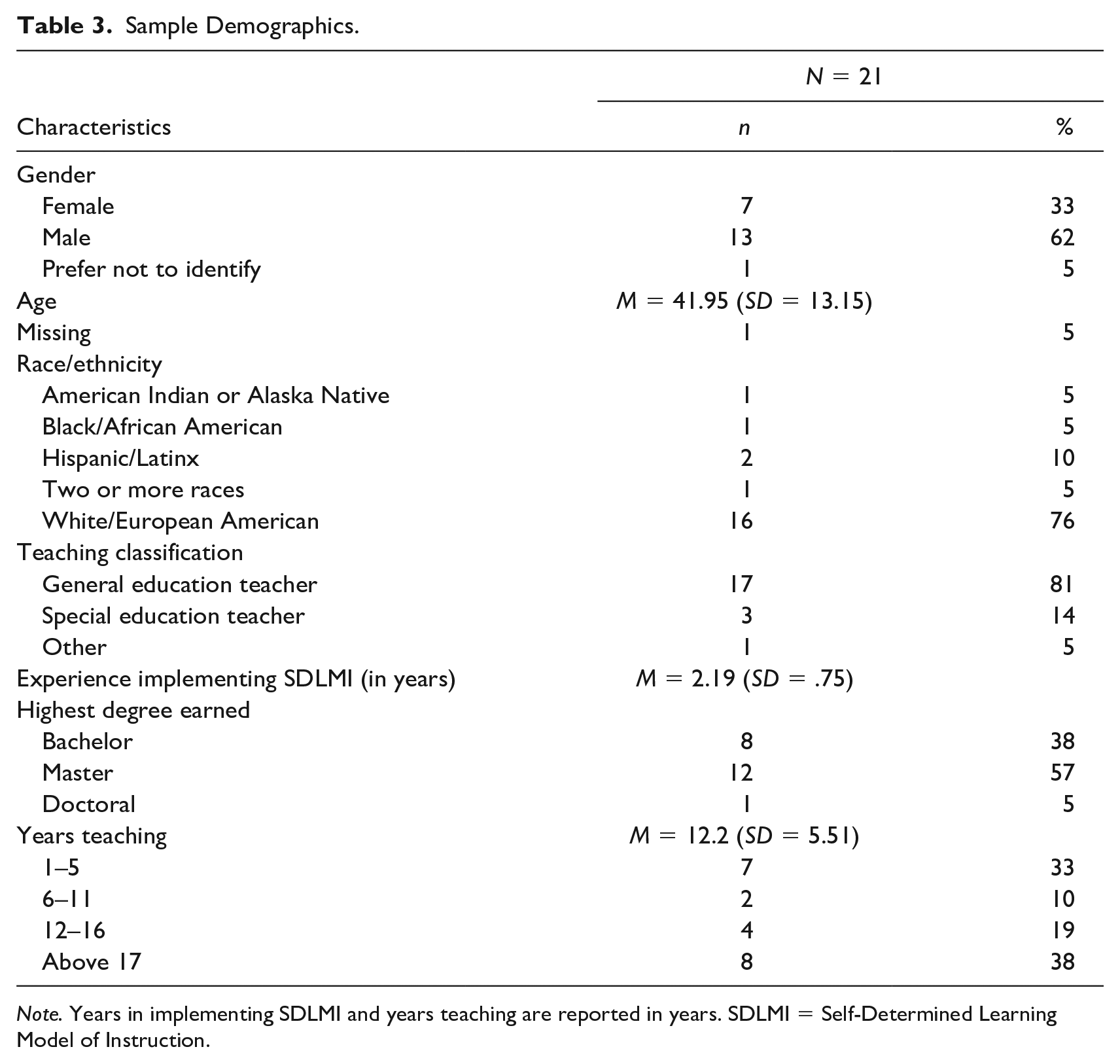
Note. Years in implementing SDLMI and years teaching are reported in years. SDLMI = Self-Determined Learning Model of Instruction.
Data Analysis
Data analysis focused on examining the internal consistency of the SDLMI teacher roles self-report measure as well as the correlations between its associated subscales. To evaluate internal consistency, we calculated coefficient alpha for items within each subscale, as we conceptualized each subscale as distinct. We evaluated internal consistency based on the following criteria suggested by DeVellis (2017): below .60 indicates unacceptable; between .60 and .65 indicates undesirable; between .65 and .70 indicates minimally acceptable; between .70 and .80 indicates respectable; between .80 and .90 indicates very good. After establishing internal consistency for each of the three subscales, we examined Pearson correlations between the subscales to observe their overlap and relation to each other. All analyses were completed using IBM SPSS Statistics High Sierra, version 10.13.6.
Results
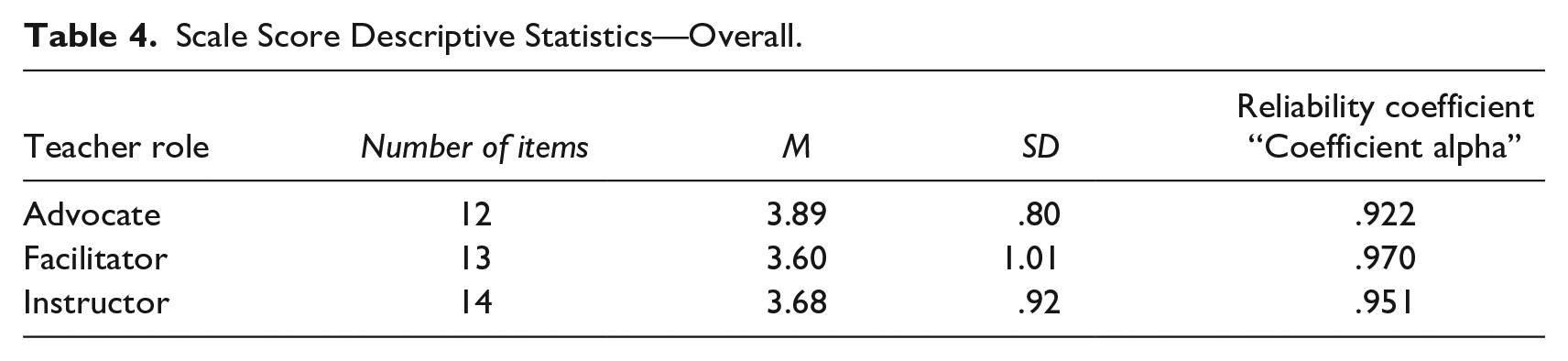
Prior to examining the psychometric properties of the SDLMI teacher roles self-report measure, we calculated descriptive statistics. Table 4 provides information on the means and standard deviation of each subscale. The advocate subscale had slightly higher mean scores (M = 3.89; SD = .80) than the instructor subscale (M = 3.68; SD = .92) and the facilitator subscale (M = 3.60; SD = 1.01). This suggests that teachers embraced the three roles between “Somewhat” and “Mostly” during the SDLMI implementation. The level of internal consistency (as estimated by coefficient alpha) ranged from .970 to .922 across subscales, demonstrating that all subscales were internally reliable. The reliability was highest in the facilitator subscale (.970) followed by the instructor subscale (.951) and the advocate subscale (.922). We then examined the correlations among the three teacher role subscales (advocate, facilitator, and instructor) and found significant positive associations. The strongest correlation was between instructor and facilitator (.867), while the weakest correlation was between the advocate and facilitator subscales (.631). Table 5 provides a correlation matrix for all subscale scores across teacher roles.
Scale Score Descriptive Statistics—Overall.
Scale Score Correlation.
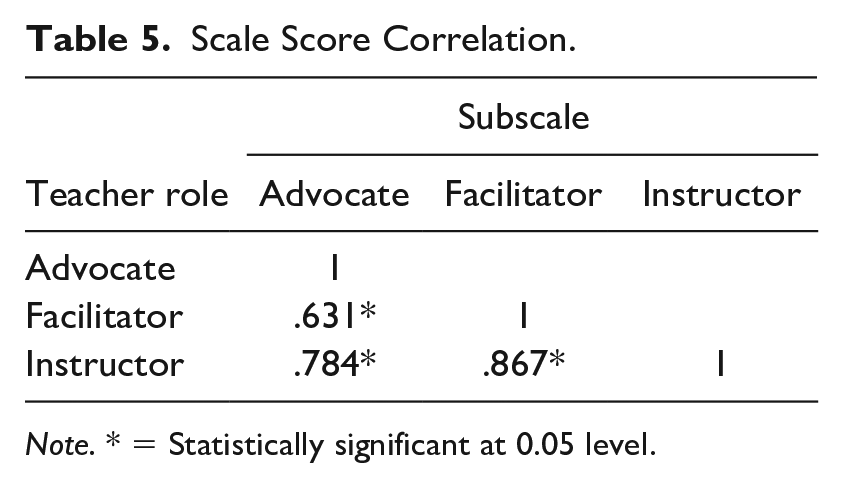
Note. * = Statistically significant at 0.05 level.
Discussion
There is a critical need to develop measures of teachers’ perceptions of their roles in implementing EBPs and collect reliability and validity evidence. Such work can advance understanding of how to measure teachers’ perceptions of adopting and embracing multidimensional roles when implementing EBPs like the SDLMI. Measuring teachers’ perceptions of their roles in implementing the SDLMI can allow for a greater understanding of how they use the SDLMI to support students in becoming self-determined. It can also allow for greater tailoring of professional development and coaching to better understand how to support teachers to take on and integrate the roles of advocate, instructor, and facilitator during SDLMI implementation, recognizing that changes in their roles might be needed over time based on students’ needs, previous self-determination instruction, and students’ cultural values and preferences. Thus, the purpose of this study was to describe steps taken to develop the SDLMI teacher roles self-report measure as well as an analysis of preliminary data to inform understanding of its psychometric properties.
Overall, in this study, we suggest several findings to guide ongoing refinement and use of the SDLMI teacher roles self-report measure in research and practice. First, the results suggest the systematic process for developing items for the SDLMI teacher roles self-report measure based on the theoretical framework of the causal agency theory (Shogren et al., 2015) and SDLMI implementation (Shogren et al., 2018) led to a measure feasible for use by teachers. Multiple cycles of revisions were implemented with experts in self-determination, SDLMI implementation, and related areas to refine the items, advancing evidence for the content validity of the measure. Second, the preliminary analysis of data collected on the SDLMI teacher roles self-report measure with a small sample of teachers that have implemented the SDLMI for at least a year indicates that each item aligns with what it intends to measure (i.e., the roles of an advocate, facilitator, or instructor), providing evidence supporting the reliability of each subscale. This suggests that each subscale score can be used to reliably understand teachers’ perceptions of their adoption and integration of the three SDLMI roles, although ongoing research is needed with larger samples. This also suggests that educators may be able to use this scale to gain clarity of their roles when promoting self-determination for all students, inclusive of marginalized students with disabilities. Given the systematic barriers marginalized students with disabilities encounter in schools (Scott et al., 2021), in addition to teacher roles as facilitator and instructor when implementing self-determination instruction, teachers can also advocate for students and their families to ensure students are provided with inclusive and equitable opportunities and supports to build skills and abilities associated with self-determination.
Third, findings from this study suggest that teachers reported taking on all three roles measured by the SDLMI teacher roles self-report measure: advocate, facilitator, and instructor. This finding suggests that teachers can embrace the multiple roles needed to advance student-directed learning opportunities that advance self-determination (Shogren et al., 2018) and serve not only as an instructor, as is often the focus of interventions (McCray et al., 2014), but also as an advocate and facilitator. Finally, findings also indicate moderate to strong relationships between scores on the three subscales. The pattern of correlations suggests the three SDLMI roles are distinct but related and there may be closer associations between certain roles (e.g., instructor and facilitator), although more research on these relationships is needed. In the following sections, we highlight limitations that should be considered in the context of the findings as well as implications for future research and practice.
Limitations
First, although we conducted short interviews with teachers to refine the measure, we did not conduct cognitive interviews (Desimone & Le Floch, 2004). Future refinement would benefit from using a structured cognitive interviewing process for gaining additional information from end users. Second, we engaged multiple groups (e.g., researchers with expertise in self-determination, assessment, and culturally responsive practices) in one round of review during the development process to inform item refinement; however, conducting more rounds of review could have further maximized content validity (DeVellis, 2017). Third, in this study, we included a small sample of general and special educators implementing the SDLMI from one high school, thereby limiting generalizability. Additional research, with larger samples of teachers and schools, is needed. Fourth, most of the participants were general education teachers, and given the different and important roles that general and special education teachers take on, future research should include an equal sample size of general and special education teachers to examine any differences across general and special education teacher responses to individual items and role subscales. Fifth, teacher participants had a range of years of experience in implementing the SDLMI with the average teacher implementing for slightly more than 2 years. Ongoing research is needed to examine how teachers’ perceptions of their roles when implementing the SDLMI change with varying years of implementation. Finally, in this study, we did not examine how teacher factors (e.g., race/ethnicity, gender, teaching licenses, classroom type or subject area, and how long teachers had implemented the SDLMI) influenced responses because of the small sample size.
Implications for Research
Despite these limitations, in this study, we suggest that as researchers continue to explore ways to enable teachers to promote equity and self-determination for all students, there is a need for greater attention to teacher roles in implementing the SDLMI (and other EBPs). This work should focus on understanding (a) how teachers’ SDLMI roles (advocate, facilitator, instructor) change over time, (b) the relationships between teachers’ adoption of SDLMI roles and student outcomes, and (c) the impact of teacher implementation supports (e.g., coaching) on their roles, implementation of the SDLMI with fidelity, and use of culturally responsive practices.
Given the ongoing need to provide inclusive opportunities and supports to develop self-determination in inclusive, general education settings, the current study provides insight into the specific roles teachers take on during SDLMI implementation. In particular, the findings from this study suggest positive and strong correlations between the three SDLMI role subscales, with the strongest correlation between instructor and facilitator subscales and lower correlations—although still moderate—between the instructor and advocate and facilitator and advocate subscales. It could conceivably be hypothesized that the overlap between instructor and facilitator roles occurs because of the complementary nature of these two roles as teachers act as instructor by delivering the SDLMI and its associated core components (i.e., student questions, teacher objectives, and educational supports) while acting as facilitator by providing students with opportunities to use their abilities and skills associated with self-determination through the process of delivering the core components of the SDLMI. The teacher role as an advocate is more distinct from other roles because teachers act as advocates when they partner with students to remove systemic barriers and leverage their strengths as they support students in setting and working toward their goals. Over time, teachers might need targeted support (e.g., coaching) as they take on these multidimensional roles and grow in them with supports. As such, more research is needed to examine these relationships with a larger and more diverse sample. In particular, more work is needed to examine how this type of relationship might change as general and special education teachers grow in their abilities as advocates, facilitators, and instructors during SDLMI implementation. In addition, examining potential differences in the SDLMI roles general and special educators take on is particularly important for future research as special education teachers might more easily be taken on the role of advocates compared to general education teachers as they receive more training in supporting students with diverse support needs to access equitable and inclusive education (Ruppar et al., 2017).
Further research is also needed on the relations between teacher roles, as measured by the SDLMI teacher roles self-report measure, and student outcomes (e.g., transition, academic, and social outcomes) and teacher fidelity of implementation to inform professional development and coaching. Prior research has suggested an interactive relationship between teachers’ perceptions of SDLMI implementation and student outcomes (Shogren et al., 2020). It can be argued that student outcomes are enhanced when teachers grow in their roles and abilities over time as they learn how to implement SDLMI and receive implementation support (e.g., coaching). But more research is needed. Given the alignment of SDLMI teacher roles self-report measure subscales and the SDLMI fidelity measure (Shogren & Raley, 2018), more research is also needed to observe how teachers take on advocate, facilitator, and instructor roles and how this relates to SDLMI fidelity. For example, after observing an SDLMI lesson, trained observers complete the SDLMI fidelity measure, reporting on items related to teachers’ quality of delivery. Future research should examine how observational data on teachers’ quality of delivery correlates with teachers’ roles measured by the SDLMI teacher roles self-report measure. With high-quality professional development and coaching, it would be hypothesized that teachers’ fidelity of implementation, particularly quality of delivery, would be enhanced as they embrace their roles as SDLMI instructors, facilitators, and advocates. Relatedly, scaling up EBPs, like the SDLMI, and maintaining high fidelity are complex (Fixsen et al., 2009). There is a need to explore factors that can facilitate the use of the SDLMI in complex contexts, such as general education classrooms that include students with diverse supports needs, inclusive of students with disabilities and students of color with disabilities. Within the framework of implementation science, research suggests that implementation drivers, including competency, organization, and leadership, are critical to facilitate the implementation of the SDLMI with fidelity. More research is needed to understand how implementation drivers can facilitate teacher roles when implementing the SDLMI in inclusive settings with all students (Raley et al., 2022). For example, an important implementation driver in adoption and sustainment of SDLMI in inclusive general education classrooms is coaching; thus, understanding teachers’ integration of multidimensional SDLMI teacher roles and culturally responsive teaching practices can inform strengthen this implementation driver in practice.
Implications for Practice
Findings from this study have important implications for practice, including highlighting the importance of (a) professional development and coaching supports for teachers to effectively implement the SDLMI and take on the three roles and (b) supports for pre- and in-service teachers to learn to take on multidimensional roles to promote equity and self-determination outcomes for all students learning in inclusive settings. More work is needed to develop supports through coaching and professional development for teachers to implement the SDLMI in culturally responsive ways with fidelity. For example, although steps were taken to integrate culturally responsive teaching practices in each subscale of the SDLMI teacher roles self-report measure, ongoing work is needed to explore how teachers adopt and apply these roles in practice, given other research suggesting challenges with teacher integration of culturally responsive teaching practices into the SDLMI implementation (Shogren, Scott, et al., 2021). Research suggests teachers’ perceptions of students’ identities influence the opportunities and supports they provide for students of color with disabilities to learn and practice abilities and skills associated with self-determination (Shogren, Anderson, et al., 2021). Furthermore, teachers still question students’ capacities for self-determination when they have extensive support needs (Carter et al., 2008, 2009). This suggests a need, in practice, for teachers to grow in their awareness of systemic biases and the roles they can take in implementing the SDLMI to remove systemic barriers.
Although professional development is provided for teachers to incorporate students’ cultural values and strengths into SDLMI implementation, prior studies did not assess teachers’ perceptions of their roles in implementing the SDLMI in culturally responsive ways (Shogren, Scott, et al., 2021). This is particularly important as the implementation of SDLMI requires teachers to adopt a student-directed approach while integrating culturally responsive teaching practices (Shogren et al., 2018) rather than a teacher-directed approach that reflects the traditional view of teaching (McCray et al., 2014). Supporting teachers in understanding their roles and abilities to integrate culturally responsive teaching practices into self-determination instruction is important because sociocultural identities shape the expression of self-determination (Scott et al., 2021). Research, however, consistently shows that teachers lack the knowledge and supports to integrate evidence-based, culturally responsive teaching practices into their instruction (Brown, Boda, et al., 2019). The current findings in the context of previous research on the integration of culturally responsive teaching practices highlight the critical need for coaching and professional development to enhance the use of culturally responsive practices. For example, researchers have taken an innovative approach to develop the SDLMI coaching model (Hagiwara et al., 2020) to provide teachers with systematic support to use and implement SDLMI in culturally responsive ways with fidelity, including the perception of their roles in implementing the SDLMI.
Finally, more work is warranted to use the SDLMI teacher roles self-report measure in professional development focused on implementing and integrating culturally responsive teaching practices into the SDLMI. Researchers have designed a self-report of teacher self-determination knowledge, skills, and use survey (SD-KSU; Shogren et al., 2018) to measure teachers’ perceptions of changes in their knowledge, skills, and use of instruction to teach abilities and skills associated with self-determination. The SD-KSU focuses on assessing teachers’ perceptions of the importance of abilities and skills associated with self-determination in preparing students to participate in general education classes, learning general education curriculum, developing social skills, self-regulating learning, and achieving community living, employment, and postsecondary goals. The SD-KSU, however, does not assess how professional development might impact teacher roles in implementing the SDLMI and teachers’ knowledge and roles in integrating culturally responsive teaching practices and their abilities to identify and incorporate sociocultural identities of students into the implementation of the SDLMI (Shogren, Scott, et al., 2021). Ongoing work to determine how to assess, in practice, changes in teachers’ perceptions of their knowledge, skills, and use of instruction, like the SDLMI and culturally responsive practices will be important to advance teaching and learning outcomes.
Finally, while teachers perceive the importance of promoting self-determination for student success (Bojanek et al., 2021), this has not been a focus in teacher preparation programs (Hagiwara et al., 2022). Leko and colleagues (2015) suggest the need for teacher preparation programs to foster effective teacher performance to implement EBPs in inclusive settings. Measures, like the one developed in this study, can potentially be used in teacher preparation to inform teachers’ knowledge of and understanding of their roles in implementing EBPs in a specific area (Brownell et al., 2020), like preparing teachers to implement EBPs designed to promote self-determination. As such, teacher preparation programs may consider how assessments like the SDLMI teacher roles self-report measure can be used to prepare teachers to reflect on their roles in implementing self-determination interventions, like the SDLMI. This can inform courses and fieldwork experiences on teacher roles, including advocate, facilitator, and instructor, that teachers take on to promote self-determination. Thus, we recommend that teacher preparation programs consider preparing teachers to take on the roles of advocate, facilitator, and instructor to promote self-determination for all students learning in inclusive settings.
Conclusion
In this study, we introduce an assessment tool developed that builds on the theoretical framework of the causal agency theory and SDLMI implementation. This measure focuses on three roles, including advocate, facilitator, and instructor, that teachers take when implementing the SDLMI to provide inclusive and culturally responsive opportunities to promote self-determination for all students, including students with disabilities and students of color with disabilities. Findings from this study suggest that the SDLMI teacher roles self-report measure items can reliably measure the three teacher roles in implementing the SDLMI. The findings also indicate that the roles of advocate, facilitator, and instructor are positively correlated, but they are different constructs and demonstrate different patterns of relations in the context of implementing the SDLMI. There is a need to continue the development of this measure to advance research and practice focusing on teachers’ perceptions of their roles in teacher implementation of the SDLMI and student outcomes.
Footnotes
Declaration of Conflicting Interests
The author(s) declared no potential conflicts of interest with respect to the research, authorship, and/or publication of this article.
Funding
The author(s) received no financial support for the research, authorship, and/or publication of this article.
