




Abstract
The paper analyzes the impact of local demography on the electoral strategies of ethnic political parties. We focus on Hungarian parties in Slovakia and their tactics of fielding candidates in the 2014 and 2018 mayoral elections in 4,461 municipalities with competitive elections. We find that local demography is an essential explanatory factor concerning the strategies of ethnic parties. Our results show that in towns where an ethnic minority predominates, ethnic parties are more likely to challenge each other in elections. On the other hand, we find only little support for the split demography hypothesis that ethnic parties will cooperate in such an environment. Although Hungarian parties form alliances in these municipalities, their occurrence is not different than in towns where the same ethnic group dominates the local population. Finally, we observe that in areas where Hungarians are a numerical minority, inter-ethnic alliances are formed, but only by the more moderate ethnic party. In general, the paper shows that the ethnic composition of municipalities can provide incentives to avoid ethnic outbidding as well as to enhance intra-ethnic rivalry.
Introduction
Many democratic countries have active ethnic political parties that exist primarily to defend the interests of ethnic minorities and mobilize votes on ethnic issues. 1 If voting goes along ethnic lines and only a single ethnic party exists, it can maintain a monopoly over co-ethnic voters and become a stable part of the party system with loyal supporters. Such a dynamic, however, changes if more co-ethnic parties compete for the votes of the same ethnic groups. Recent studies show that such a scenario does not inevitably lead to ethnic outbidding since these parties have more alternatives to adopt. 2 While this issue is well covered theoretically, only a few studies have empirically tested ethnic parties’ electoral strategies. 3
This paper aims to answer the research question of how local demography impacts the electoral strategies of ethnic political parties at a local level. The study does not attempt to explain all factors that influence the behavior of these parties in electoral settings. Rather, it intends to contribute to the existing literature by emphasizing the influence of demographic factors on the strategies and contribute to the current understanding of the effects of intra-ethnic competition on the electoral tactics of such parties in countries where multiple ethnic parties coexist.
We use data from the 2014 and 2018 mayoral elections in Slovakia and focus on the two main Hungarian parties, the Party of the Hungarian Community (SMK) and its more moderate challenger, Most–Híd (Bridge). Hence, we provide an analysis of 4,461 municipalities with competitive elections to explore how ethnic parties adapt to local demography when running their candidates.
We find that in municipalities where Hungarians are the dominant group, ethnic parties are more likely to compete against each other since the overall victory of the ethnic group is secured by demographic numbers. On the other hand, we find only limited support for the expected cooperation between Hungarian parties in municipalities with split demography. Although such cooperation occurs, it is less likely than in municipalities with a Hungarian majority, where theoretically a rivalry between ethnic parties should emerge. Our findings support the theory that in areas with Hungarians composing a numerical minority, ethnic parties will more likely cooperate with the majority parties (for example, Slovak ones) to effectively increase their voice. However, this finding applies primarily to Most–Híd, while for the more radical SMK cooperation with Slovak parties is only a marginal option. In general, we find that the more radical ethnic party focuses more on municipalities with a larger portion of its own ethnic group, while the focus of the more moderate ethnic party is expanded even to localities with a very low share of the ethnic minority.
The structure of the paper is as follows. The next section deals with theoretical approaches to ethnic parties. It discusses the impact of the existence of multiple co-ethnic parties and introduces the theoretical expectations. These suggest that ethnic parties adjust their electoral strategies based on local demography, which will be tested in the paper. After that follows a description of Hungarian parties in Slovakia, their ideology, historical roots, and mutual relations. “Data and Methods” focuses on data and methods and introduces and explains the variables used. The “Results” section presents the results of the analysis, and the main findings are discussed in the concluding part.
Ethnic Parties and Their Electoral Strategies
Ethnic parties are specific political actors. Unlike non-ethnic parties, they do not seek to appeal to the whole society, but are bound to the ethnic groups they represent. In principle, the pre-condition of their emergence and the successful establishment is an ethnically diverse society with at least one substantial ethnic minority, although some authors suggest additional cultural and historical requirements. 4 In particular, these parties identify with a non-dominant ethnic group in a country and direct their appeals to this numerically limited part of the society. 5 In other words, ethnic parties operate along ethnic lines and cleavages rather than other dimensions such as class.
If the electoral market is ethnically segmented to a large extent, ethnic parties have the highest potential for success if they are unchallenged by any co-ethnic rival. 6 If only a single ethnic party exists, it can secure close to a monopoly on votes from its ethnic group and thus enjoy a stable pool of loyal voters. Providing the electoral rules allow for it, and the size of the ethnic minority exceeds the threshold, an unchallenged ethnic party can develop into an established political actor with parliamentary representation and access to government. 7 The Party of the Hungarian Coalition (SMK) in Slovakia is one such example. After becoming the single relevant representative of the Hungarian minority in the country in 1998, the party scored its best results in general elections. It also became a member of the national government for eight consecutive years, gaining control over portfolios that allowed it to skew public funding to localities with a higher share of the Hungarian population. 8
It is common, however, that multiple co-ethnic parties compete for minority votes, which raises questions about their electoral strategies. The emergence of new ethnic parties changes the dynamics of the system since they open up intra-ethnic competition within the (limited) pool of ethnic minority voters. Horowitz and other earlier works in the field suggest that such intra-ethnic rivalry leads to the ethnic outbidding scenario, in which ethnic parties challenge their co-ethnic rivals by adopting more extreme policies to present themselves as the only true defenders of the minority they aim to represent. 9 The outbidding model thus proposes that competition between ethnic parties over votes from the same ethnic group triggers a spiral of a growing preference for radical over moderate strategies, leading to increased tension and even violence, hence destabilizing the political system and society. 10 From this perspective, ethnic parties intentionally exacerbate existing ethnic divisions to achieve electoral victory and “their mobilization drives are ‘catch-us’ rather than ‘catch-all.’” 11
More recent literature shifts away from this deterministic assessment of intra-ethnic competition and its evolution into ethnic outbidding. Instead, these authors point out that there are mitigating factors and alternative strategies that make it possible to avoid this scenario. Mitchell et al. show that power-sharing institutions provide incentives for the establishment of inter-ethnic cooperation, thus averting centrifugal polarization. 12 According to the authors, an example of such an institution is the government in Northern Ireland since the 1998 Agreement, which requires cooperation and bargaining across ethnic groups. Similarly, the structure of cleavages may work against ethnic outbidding. If competition takes place more along the economic dimension and less along ethnic lines, ethnic parties tend to act more moderately. 13 The same can be said of imperfectly segmented electoral markets, since here parties mobilize voters not only from their own ethnic group but also broaden their appeals across ethnic lines. Zuber presents this concept of nested competition, where parties present offers across ethnic divides while competition within ethnic groups occurs within the larger context of inter-ethnic party competition, by illustrating the actions of political parties in Romania. 14
Therefore, the key issue is to understand and explain which strategies co-ethnic parties choose if they are competing for the same group of voters. Compared to the scenario with only a single ethnic party, competition between multiple parties poses a challenge, given they have only a limited pool of potential supporters to mobilize from the ranks of their ethnic minority. Stroschein suggests that to address the strategies of ethnic parties, local demography is essential. 15 The more citizens vote along ethnic lines, the more elections resemble a census. 16 Hence, for ethnic parties, the expected likelihood of electoral success varies if their co-ethnic voters form only a tiny segment of the local population or if they are predominant. In other words, local demography is a factor that provides varying incentives for ethnic parties to choose different strategies (see below).
Previous work on this topic has analyzed the strategies of ethnic parties by focusing on various issues. For instance, Sanjaume-Calvet and Riera-Gil study parties in Catalonia in five regional elections. They base their analysis on party manifestos, including the use of language, and find that the respective parties adopted various strategies from moderation to outbidding. 17 McGauvran and Stewart analyze ethnic parties from over twenty countries and show that economic inequality is associated with political extremism and both these factors affect results in local elections in Romania and Slovakia. 18 In this paper, we follow the line of authors who have studied the strategies of ethnic parties by observing their patterns of fielding candidates in local elections. Their studies provide compelling evidence of how local demography affects the electoral strategies of ethnic parties. On the other hand, the work to date is based on a rather small number of cases. Stroschein’s work concentrates on three cities and their surrounding counties in Romania, and Stewart analyzes two municipalities in Macedonia. 19 For this reason, we aim to fill the gap in the literature by providing a large-N study analyzing the electoral strategies of two rival co-ethnic parties.
Prior studies indicate that local elections are the most appropriate context for an in-depth study of ethnic parties’ strategies. 20 Depending on the territorial structure of a country, local elections take place in several hundred or even thousands of individual and independent localities. This gives political parties an opportunity to diversify their strategies in accordance with local conditions. For instance, a party may choose to field its candidates alone in some municipalities and in other towns enter various alliances with other parties and agree on joint candidates. In national elections, a country’s territory is typically divided into a number of constituencies, or it is not divided at all, which limits the choice of strategies a party may adopt. What is more, if elections are held under the rules of proportional representation, political parties are even more constrained since they are obliged to select a single mode of candidacy for the whole country, be it a single list or an electoral alliance. In sum, given their territorial diversity and the number of mutually independent districts, local elections allow the most detailed analysis of ethnic parties’ electoral strategies.
The literature on this topic points to the impact of local demography on actions taken by ethnic parties. More specifically, ethnic parties are expected to respond to the ethnic composition of the population and adopt a strategy with the highest potential to succeed. The work by Stroschein delineates some possible scenarios. In localities with a population relatively split between the state majority and the ethnic minority, ethnic parties should pursue cooperative action leading to a joint candidate since by doing so they avoid fragmenting the votes of their co-ethnics. A split demography does not necessarily require that ethnic groups are identical in their size but their shares in the population are relatively similar. 21 On the other hand, if the ethnic minority dominates the local population, such fragmentation is less risky. According to Stroschein, in this case, ethnic parties might compete against each other, since the numbers ensure the winner will come from their ethnic group. For instance, if the ethnic minority comprises 80 percent of the local population, multiple ethnic parties may compete without risking that the other fifth of the inhabitants will tip the victory to a candidate from outside the ethnic minority. Finally, in places where the state minority is only a local minority, ethnic parties are unable to ensure victory alone and are incentivized to enter inter-ethnic bargaining and cooperate with majority parties to enhance their voice and post-electoral access to offices. 22
Stroschein tests these assumptions using data from three cities and counties in Romania, each fitting one of the three demographic scenarios. She finds that the actions of Hungarian parties in Romania are consistent with the theoretical expectations. In particular, in a locality where Hungarians composed only a minority, these parties engaged in cooperation with Romanian parties. In an ethnically split town, the Hungarian parties opted for a united strategy, while in the county with Hungarians dominating the local population, these parties competed against each other. 23 Building on Stroschein’s theory, Stewart finds further evidence of the effects of local demography on ethnic parties’ electoral strategies. His study focuses on local elections in Macedonia and finds that the theory holds even after administrative changes that shift the demographic structure of the localities. Stewart analyzes two Macedonian municipalities, namely Kičevo, which witnessed a substantial change in the ethnic composition of its population, and Kumanovo, where the social structure was almost unaffected by the redrawing of its borders. The author finds that changes in the ethnic composition of the municipalities impacted the electoral strategies of ethnic parties as expected. For instance, after losing their numerical majority in Kičevo, the Macedonian parties abandoned their previous rivalry and opted for a joint candidate. 24
The theory thus suggests that ethnic parties adjust their electoral strategies in relation to local demography. Previous findings also indicate that although each ethnic party aims to succeed individually, they also focus on the electoral interests of the whole ethnic group they represent, as depicted by their expected risk aversion in ethnically split localities. Following the findings of Stroschein and Stewart, we formulate our first three hypotheses. 25
Besides these expectations, previous work indicates that the role of ideology should be taken into account when analyzing ethnic parties’ strategies. Although people belonging to an ethnic minority share the same ethnicity, their interests are not automatically identical. Stroschein suggests that some goals such as education in the minority language might be shared by all voters from the ethnic group. However, in areas where the ethnic minority makes up the numerical majority in the local population, more radical aims such as territorial autonomy have higher value, and vice versa. 26 In general, this shows that ethnic minorities are not homogeneous blocs with a united vision of shared political goals. On the contrary, as the share of the minority rises in the local population, their goals might become more radical, that is, less in accordance with ethnic parties that aim to act in a moderate way. Hence, more radical ethnic parties should experience a higher appeal among minority voters in areas where the ethnic group dominates the local population and should act accordingly when preparing their strategies for elections.
On the other hand, moderate ethnic parties take a different approach. They avoid outbidding and, instead, employ a strategy known as lateral underbidding, wherein they preserve their ethnic identity while distinguishing themselves from their more radical co-ethnic counterparts by expanding their appeal to encompass other ethnic groups within the country. In short, they broaden their appeal beyond their ethnic base and adopt more moderate stances on ethnic-related policies. 27 What is more, moderate ethnic parties should also be more open to alliances with majority parties since by doing so they may show such cooperation is not only beneficial, but may prepare the ground for further cooperation, justifying their inter-ethnic appeal. Moderate ethnic parties are thus expected to be more likely than their radical counterparts to broaden their territorial focus and participate in locations with a lower proportion of their co-ethnic voters. In other words, we expect that radical and moderate ethnic parties have different general patterns of fielding candidates in relation to local demography.
Hungarian Parties in Slovakia
Slovakia is among the Central and Eastern European countries with sizeable ethnic minorities. Roughly 80 percent of the country’s population is Slovak, and one-fifth of the inhabitants belong to several minorities. The largest group is the Hungarians, who comprise approximately eight percent of the society. Historically, most Hungarians inhabit a strip of territories in southern Slovakia bordering their kin-state Hungary.
After the re-emergence of democracy in 1989, several Hungarian parties formed and successfully became a stable part of the Slovak party system. Researchers stress that the successful establishment of an ethnic party requires the fulfilment of several conditions, such as historical attachment to the land and previous dominance over the territory. 28 Hungarians in Slovakia are a good example of this since they inhabited the land for centuries and, until the end of Austria-Hungary in 1918, they governed the territory. Ever since the first democratic election in 1990, Hungarian minority parties have provided a supply to meet demand as Slovakia’s ethnic Hungarian population tended to vote en masse for parties who made a clear pitch to defend the interests of that minority. 29 This is in contrast, for example, to the Roma minority in Slovakia, whose population size is comparable to that of the Hungarian minority but has not yet formed any similarly relevant political parties.
In the first half of the 1990s, Hungarians in Slovakia formed three relevant political parties. However, despite their ideological differences, the parties cooperated and formed electoral alliances in order to reach the electoral threshold, granting them stable parliamentary positions. In 1998, Slovakia adopted a new electoral rule disadvantaging pre-electoral alliances to such an extent that Hungarian parties decided to merge into a single organization, the Party of Hungarian Coalition (SMK). For more than a decade, SMK had a monopoly over Hungarian voters, enjoyed their stable support, and for two consecutive terms between 1998 and 2006, participated in the national government. 30
The situation changed after the 2006 general election. Although SMK scored its highest result since its emergence, the disappointment of becoming an opposition party led to internal turmoil. Eventually, Béla Bugár, who led the party until 2007, left its ranks and started a splinter party called Most–Híd (a name consisting of the Slovak and Hungarian words for “Bridge”). The new party proclaimed itself as civic and stressed the need to support all ethnic groups in the country. Its name was chosen as a symbol of bridging gaps between Slovaks and Hungarians. Although Most–Híd did not define itself as an ethnic party and opened its ranks to a variety of Slovak representatives, its appeals, territorial structures, and membership base were concentrated in southern Slovakia and its sizeable Hungarian population. Hence, observers classify Most–Híd as an ethnic party and label it accordingly. 31 Following the parliamentary elections in 2010, Most–Híd became the more successful of the two parties. Moreover, it formed part of a right-wing coalition government led by the Slovak Democratic and Christian Union (together with the conservative Christian Democratic Movement and liberal Freedom and Solidarity party) between 2010 and 2012, and was also part of a heterogenic coalition government led by the social democratic party SMER and the nationalist Slovak National Party between 2016 and 2020.
In terms of ideology and their position on the left-right or liberal-conservative scale, both Most–Híd and SMK exhibited similarities. They both were rather center-right parties, affiliated with the European People’s Party, and placed a strong emphasis on political decentralization in their political programs. 32 However, the main distinction between them could be attributed to the varying degrees of emphasis placed on ethnic issues. Most–Híd is an example of a challenger ethnic party that did not follow the outbidding process. On the contrary, its moderate stance places it in the lateral underbidding category as defined by Zuber, meaning that the party tried to broaden its support beyond the Hungarian ethnic group and adopted more moderate policies related to ethnicity. 33 SMK, however, reacted by radicalizing its profile and politics. Contrary to the inter-ethnic appeals of Most–Híd, SMK intensified its stress on ethnic issues. It developed closer relations with Hungarian PM Orbán’s FIDESZ party and in 2012 eventually renamed itself the Party of the Hungarian Community with an unchanged abbreviation. 34 In sum, while Most–Híd made appeals across ethnic lines, SMK aimed to declare itself the true defender of the Hungarian minority. Harrach and Rákóczi confirm that while electoral districts with dense Hungarian populations had been the main voter base for both parties, SMK was the stronger of the two in the more homogenous “Hungarian” districts (where the share of votes in the district almost perfectly correlated to the share of minority inhabitants), and on the other hand, Most–Híd was more successful in the capital city and areas of scattered Hungarian communities. 35
At first, relations between the two Hungarian parties were cold due to personal conflicts between their representatives, and they remained reserved for several years. SMK and Most–Híd were thus unable to repeat cooperative model of the 1990s and instead competed against each other in general elections. As a result, after 2010, SMK became a non-parliamentary party but retained important positions in subnational politics. On the other hand, Most–Híd repeatedly secured parliamentary seats and even became part of two national governments. Before the 2020 election, the parties discussed the idea of an electoral alliance but with no result, leaving them both without parliamentary seats as neither passed the threshold. Hence, for the first time since 1990, no Hungarian party obtained seats in the Slovak parliament. This overall failure led the Hungarian parties to the bargaining table, resulting in 2021 in an agreement to merge into the Alliance party to avoid further fragmentation of Hungarian votes. In the 2022 local election, the Alliance party secured more than 7.6 percent of all mayors thus equaling the local gains of SMK during its “monopolistic” period between 1998 and 2006. In the spring of 2023, the party faced internal turmoil, leading to the departure of a significant number of representatives who were originally affiliated with Most–Híd. These members cited the inclusion of populist pro-Orbán member of the Slovak parliament György Gyimesi, who held radical stances on ethnic issues, on the party’s candidate list before Slovakia’s early election in September 2023 as the main reason for their departure. In the election, the scenario from 2020 was repeated, as no Hungarian party passed the threshold. 36 While Alliance scored 4.4 percent votes, the reinstalled Most–Híd formed a joint list with the party The Blue led by former Prime Minister Dzurinda with a tiny gain of 0.3 percent of votes. The results thus suggested the higher popularity of a more radical minority politics among the voters. In response to that, in the end of 2023, the Alliance officially renamed itself the Hungarian Alliance and elected Gyimesi as its deputy chairman.
Data and Methods
In this paper, we analyze the electoral strategies of two Hungarian parties in Slovakia, SMK and Most–Híd. While previous work in the field has analyzed the strategies of fielding candidates qualitatively, we use a quantitative approach with a large-N dataset. For this purpose, we use data from two mayoral elections in 2014 and 2018. In Slovakia, citizens vote directly for both mayors and local assemblies; however, the data availability for these two types of elections differs. While the data for mayoral elections are completely disclosed and available on the website of the Statistical Office of the Slovak Republic, when it comes to the elections to local assemblies, the central state institutions in Slovakia provide only the list of elected candidates but not the list of all the candidates in the electoral race. The decision of whether to publish the complete lists for the 2018 elections (and before) was left to the municipalities and not all of them did so. 37 Such circumstances make it impossible to analyze the electoral strategies of parties in elections to local assemblies, and we, therefore, focus only on mayoral elections, similarly to some previous studies. 38 We collected data from all municipalities with competitive elections with at least two candidates, giving us a total of 4,461 observations. The data were retrieved from publicly available sources provided by Statistical Office of the Slovak Republic. 39
Mayoral elections in Slovakia are held under first-past-the-post rules, whereby the candidate with the most votes is elected. 40 According to the electoral law, candidates for mayor must be at least twenty-five years old and have official permanent residency in the town in which they aim to compete. Concerning party affiliation, candidates can either run as independents or as partisans. Each party either fields its own candidate or may enter a coalition with other parties with a joint candidate. Importantly, in each municipality, parties may adopt a strategy fully independent from that in other towns. 41 Hence, in some municipalities, a party may have its own candidates, while in other localities, it may decide to enter various alliances. Such rules provide an excellent ground for analysis of the electoral strategies of ethnic parties since they have various options at the lowest territorial level.
We use a set of dependent variables. First, we use a nominal variable with five categories corresponding to possible scenarios relating to the electoral participation of the two Hungarian parties. Value 1 is given to towns where none of the two parties participates in elections. Values 2 and 3 are given to municipalities where only one of the ethnic parties (but not the other) fields a candidate. Competition between the Hungarian parties is coded with a value 4, and finally, a value of 5 is assigned to towns where SMK and Most–Híd run a joint candidate. Second, to explore the various models of alliances the Hungarian parties in Slovakia enter into, we use two further nominal variables on the party-municipal level for each party. For instance, the categories of this dependent variable for SMK are as follows. Value 1 is given to towns where the party does not participate and value 2 to municipalities where SMK runs independently without other parties. The remaining three values are reserved for different types of possible alliances: value 3 is given to towns where SMK cooperates only with Most–Híd, and value 4 covers alliances only with majority, that is, Slovak, parties. Lastly, value 5 is assigned to municipalities where SMK cooperates with both Most–Híd and Slovak parties. The dependent variable for Most–Híd includes the same five categories respective to its alliances. This set of dependent variables allows us to properly test the conditions under which SMK and Most–Híd choose their strategies in terms of competition and (inter-ethnic) cooperation.
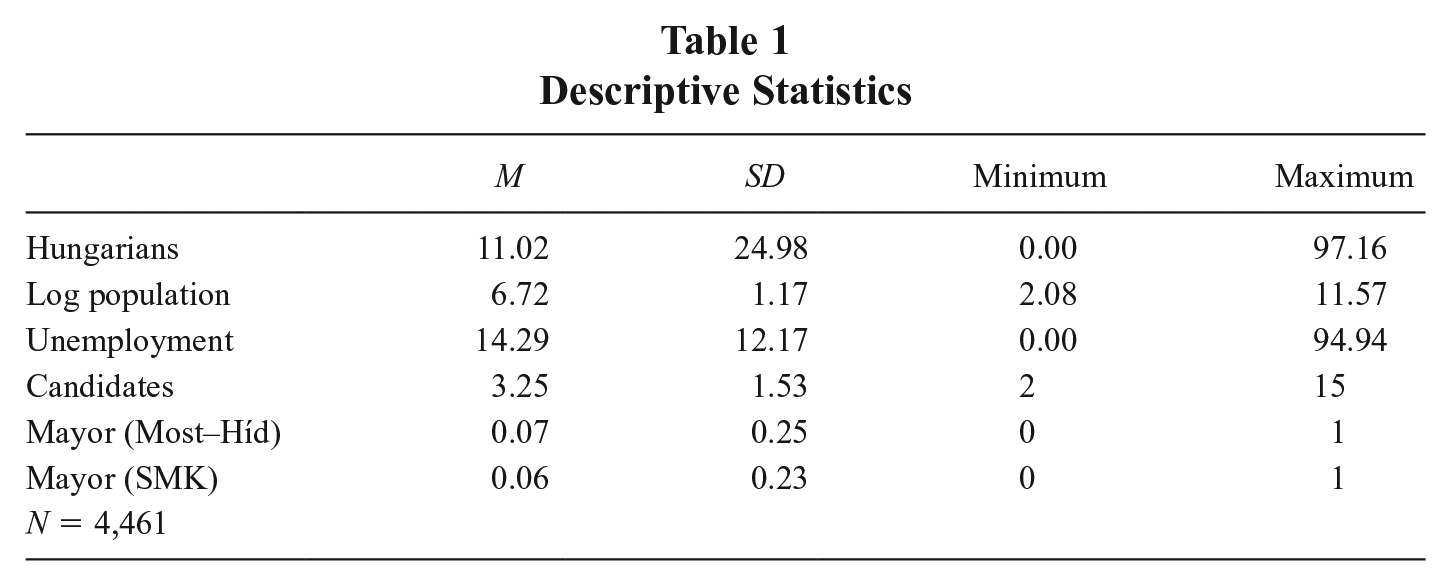
Our independent variable describing local demography is the share of Hungarians in the local population. The variable is a scale, and its values correspond to the percent share of Hungarian inhabitants in municipalities according to the national census. For the regression models, we adopt a set of control variables to capture the socio-demographic characteristics of each town. These features include the municipal population (logged) and the unemployment rate. We further control for the number of candidates running in the elections to measure the potential impact of competitiveness on the strategies of ethnic parties. We also include two binary controls capturing whether each of the Hungarian parties respectively has an incumbent mayor. Given that sitting mayoral candidates in Slovakia have been found to enjoy a substantial electoral advantage, such candidates’ previous success might impact the strategies of political parties when fielding their candidates. 42 Finally, we add a dummy variable controlling for the election year. We apply it to control for some specific circumstances that might have occurred during either of the elections. Table 1 presents the descriptive characteristics of the independent and control variables.
Descriptive Statistics
We apply regression analysis to estimate the impact of predictors on our dependent variables. More specifically, we use multinomial logit regression. This technique is an extension of binary logit regression and it is suitable for analysis of categorical dependent variables with at least three categories. Multinomial logit regression allows us to estimate the likelihood of each category of the dependent variable based on the values of the independent variables. Hence, this approach provides relevant insight into the relationship between the predictor and outcome variables. 43
Results
This section presents the results of our analysis. The complete regression models used in the study are listed in the Supplemental Appendix. Initially, we computed Model 1, which included the dependent variable representing the five scenarios of Most–Híd and SMK’s participation in the elections (see Table A1 in the Supplemental Appendix). Since the direct outcomes of multinomial models can be difficult to comprehend, we visualized the predicted probabilities to estimate the impact of the local demography, coded as the share of Hungarians in the municipalities (Figure 1).
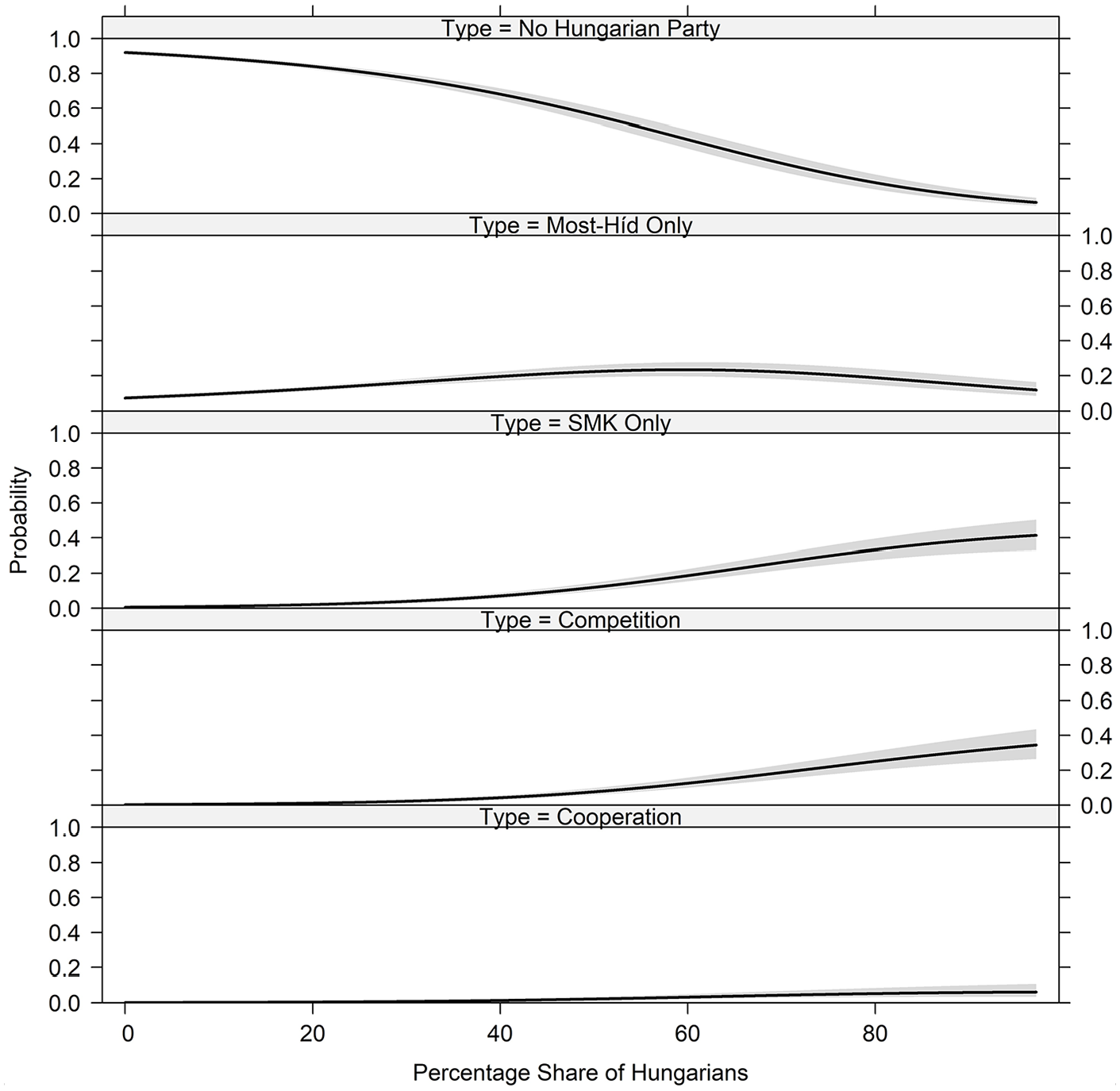
Predicted probabilities based on Model 1
Unsurprisingly and in line with the character of ethnic parties, the probability that none of the Hungarian parties participated in the elections dropped as the share of Hungarians in the local population increased. More specifically, in municipalities with no or only very few Hungarian residents, this scenario was the most probable outcome. When the share of Hungarians reaches roughly one-third and keeps increasing, non-participation of Hungarian parties in mayoral elections loses its dominance among the scenarios. Finally, in towns where Hungarians dominate the local population, this outcome becomes marginal.
Note, however, that even in municipalities where Hungarians comprised a large portion of the inhabitants, such as 65 or 75 percent, it was common for neither ethnic party to nominate a candidate. Although this finding might be unexpected, it is connected to the more general pattern of political participation in Slovakia. Almost all political parties lack widespread membership, and their numbers range from a few hundred to several thousand. Based on reports political parties deliver annually to the state, the membership base of SMK during the period analyzed ranged between nine to ten thousand people, and the number of Most–Híd members was about half that size. What is more, similarly to France and the Czech Republic, Slovakia has one of the most fragmented territorial structures in Europe. 44 Hence, in Slovak local elections around 2,900 mayors and more than 20,500 members of local assemblies are elected, making a total of approximately 23,500 people. Altogether, no party in Slovakia has the personnel capacity to field full lists of candidates in all municipalities. Moreover, the electoral rules require that all candidates have permanent residence in the municipality where they compete, making the logistics for political parties even more difficult. Thus, even if Hungarian parties aimed to participate solely in towns with at least some share of their co-ethnics, they would lack enough candidates to cover them all. As a result, SMK competes in roughly 10 percent of municipalities, while Most–Híd participates in mayoral elections in 15 percent of cases.
Concerning their general patterns of fielding candidates, we observe clear differences between SMK and Most–Híd. The varied participation of SMK in the elections is depicted in the last three sections of Figure 1, which shows that the party almost ignores elections in areas with low numbers of Hungarians in the local population. Only after Hungarians reach a critical mass of around 40 percent does SMK tend to start fielding candidates, and it intensifies this action as the number of its co-ethnics increases. On the contrary, Most–Híd reveals a different pattern of electoral participation in accordance with its underbidding position. Although it is more likely to field mayoral candidates in areas with a higher incidence of Hungarian voters (Sections 2, 4, and 5 in Figure 1), its focus extends to towns with a preponderance of non-Hungarian, that is, primarily Slovak, inhabitants. These findings confirm our predictions that the more radical ethnic party skews the pattern of its candidates in favour of areas inhabited prevailingly by its co-ethnics (Hypothesis 4), while its more moderate counterpart aims to attract votes even from localities dominated by the titular majority (Hypothesis 5).
Our results also fully confirm the theoretical expectations regarding competition between ethnic parties (Hypothesis 1). Based on the predicted probabilities (fourth section in Figure 1), this scenario occurs only very rarely before the share of Hungarians reaches roughly half of the local population. As the number of Hungarians rises, direct competition between Most–Híd and SMK for the office of mayor becomes more likely. In this regard, Hungarian parties in Slovakia act in line with the existing literature. 45 This analysis shows that they enter into competition only when victory for Hungarians is secured based on local demography, such that the remaining inhabitants are unable to elect a non-Hungarian candidate.
The results, however, provide only very limited support to predictions concerning the cooperation of ethnic parties (Hypothesis 2). In general, we find that SMK and Most–Híd run joint candidates only rarely. Out of 4,461 observations, this outcome happened only sixty-five times, which might indicate tension between the parties preventing them from cooperating in many municipalities. Still, the data allow us to analyze the impact of local demography on running joint Hungarian candidates. The theory predicts these intra-ethnic alliances will occur in municipalities with split demography, in this case in towns split relatively evenly between Slovaks and Hungarians. 46 The results of the analysis (last section in Figure 1), however, show that the likelihood of a joint SMK and Most–Híd candidate running was lower in split towns than in municipalities where Hungarians dominate the population. Also, in towns with split demography, competition was more likely than cooperation between the ethnic parties, even when it jeopardized victory for the Hungarians. In general, the pattern of cooperation between the two ethnic parties was similar to that of competition, only with overall lower probabilities. Our analysis thus confirms that ethnic parties engage in cooperation under conditions of split demography, but unexpectedly they do so more often in enclaves, that is, in towns with a Hungarian majority, even though they are not at risk of losing to a non-Hungarian candidate in these localities.
The final issue is the modes of cooperation adopted by the ethnic parties in Slovakia. Table 2 gives an overview of how both Hungarian parties place their candidates. The data indicate that when both ethnic parties participate in mayoral elections, the preferred approach is for each party to run a candidate independently, without forming any alliances. This strategy was chosen in approximately 190 cases (out of a total of 2,926 municipalities in Slovakia) per election for both parties, with a slight decrease for SMK in 2018. In terms of joint candidates, both Most–Híd and SMK have an equal number of municipalities where Hungarian parties run jointly, either alone or with other Slovak parties.
Strategies for Fielding Candidates for Each Ethnic Party
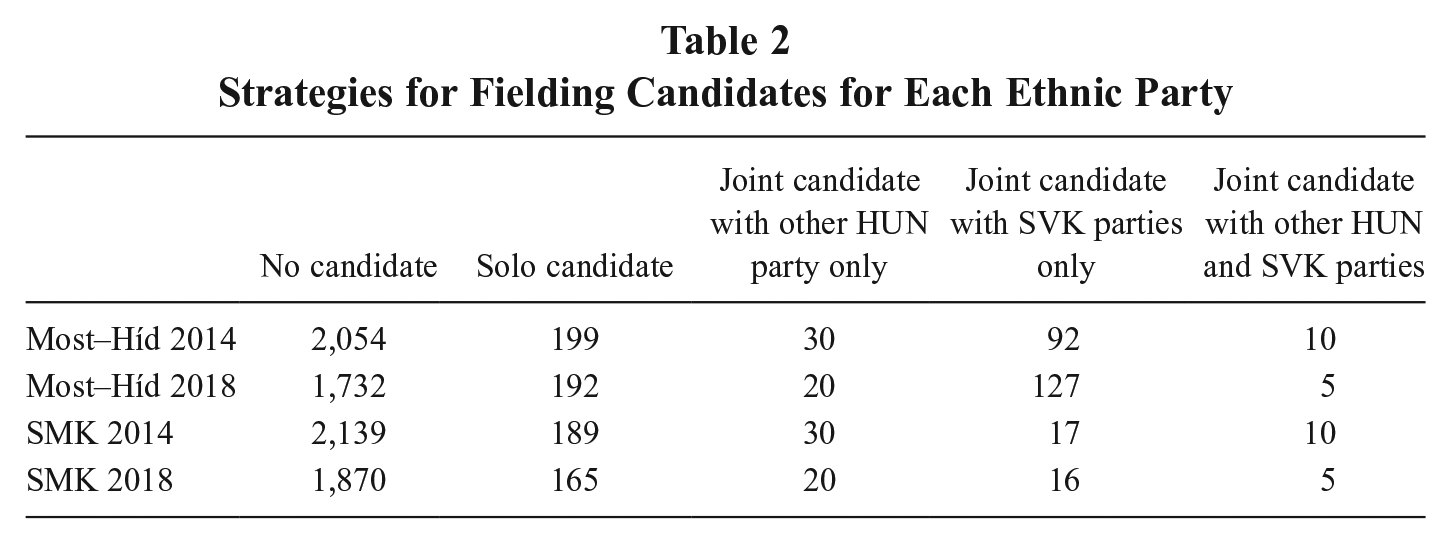
However, the crucial difference lies in alliances that involve only one of the Hungarian parties and other Slovak parties. For Most–Híd, this scenario ranks second in terms of participatory options, with a total of 219 cases of such cooperation. On the other hand, SMK, the more radical Hungarian party, shows a reluctance to form such alliances, having done so only thirty-three times. Hence, among the two Hungarian parties in Slovakia, it is the more moderate and bi-ethnic one that opts for inter-ethnic cooperation in a relevant way that is in line with its underbidding approach.
To estimate the impact of local demography on these cooperative scenarios, we calculated two further models that cover the strategies of both Hungarian parties separately. In Model 2, the dependent variable is a categorical variable with scenarios of candidacy strategies of Most–Híd. The outcome variable in Model 3 works in the same way but for SMK. Concerning the independent and control variables, both models do not differ from Model 1. The results of the models are included in the Supplemental Appendix (Tables A2 and A3). We use the same procedure as for Model 1 and visualize the predicted probabilities to identify how the share of Hungarians affects the tactics of both ethnic parties (Figure 2).
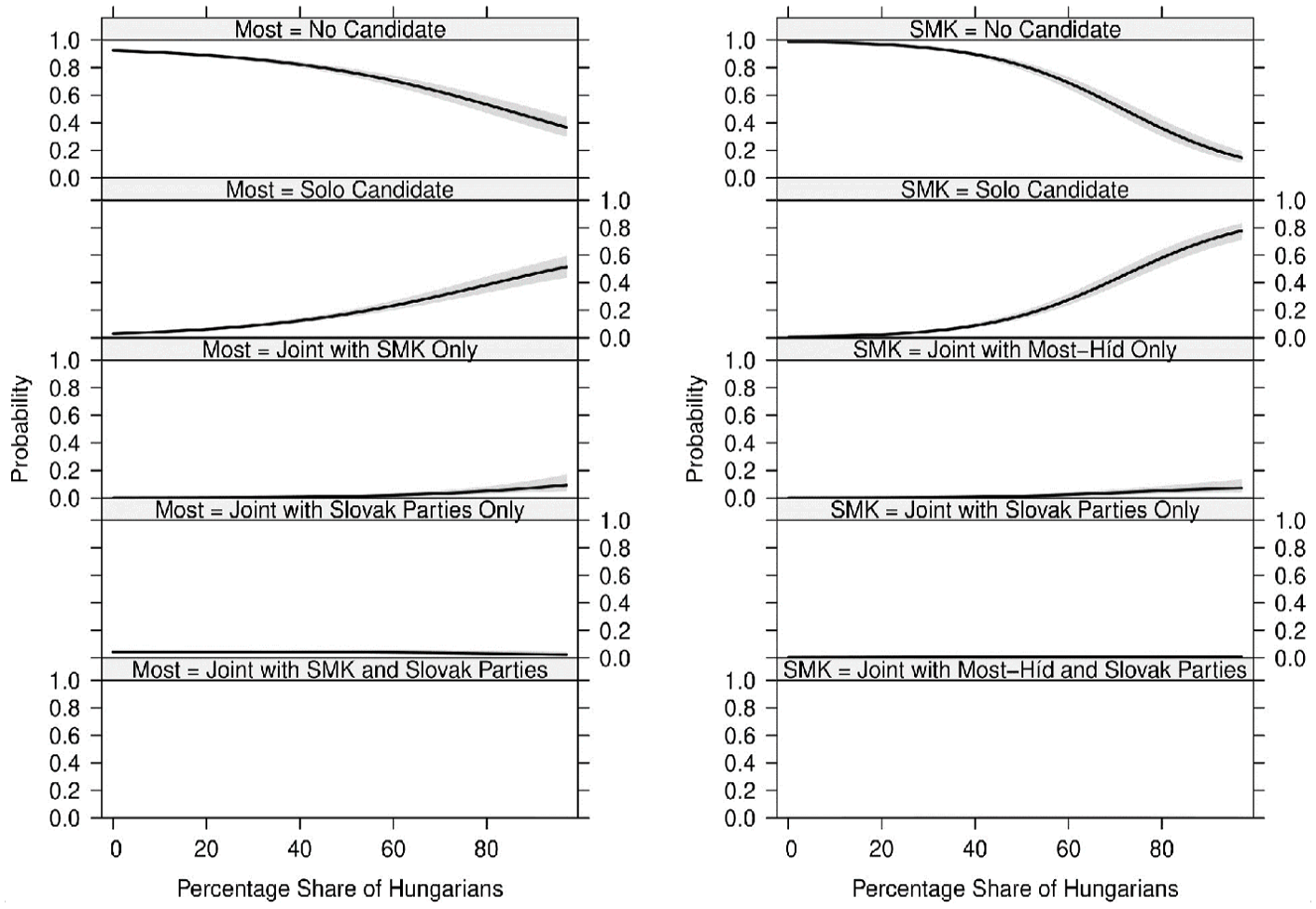
Predicted probabilities based on Model 2 (Most–Híd) and Model 3 (SMK)
We observe that as the share of Hungarians in the population rises, the likelihood rises for both ethnic parties of fielding a solo candidate. This trend is steeper for SMK, which corresponds with our previous finding that the pattern of its campaigning is skewed towards areas with a preponderance of Hungarians. The results also confirm that while SMK avoids elections in municipalities with a low portion of Hungarian inhabitants, Most–Híd is more active in these areas. The crucial finding, however, involves inter-ethnic alliances (Hypothesis 3). In the case of SMK, this electoral strategy is rare and there is no obvious impact of local demography on its choices. The probability that SMK will engage in alliances with Slovak parties is almost equally low regardless of the share of Hungarians in a locality. A different picture, though, emerges for Most–Híd. As observed in Table 2, inter-ethnic cooperation is a scenario this party actively uses, although not as frequently as fielding a solo candidate. Our findings indicate that Most–Híd enters such alliances more often in municipalities where the Hungarian minority forms a numerical minority and the likelihood of this strategy declines as Hungarians become the main segment of the local society. Note that out of 219 alliances of Most–Híd with Slovak parties in which SMK did not participate, only fifteen were formed in municipalities where Hungarians composed a majority and 179 (81.4 percent) were in towns where they were less than 20 percent of the population. Hence, our analysis confirms the theory that ethnic parties engage in inter-ethnic cooperation in areas where their co-ethnics are a minority and thus their electoral victory is less probable. 47 However, we confirm that the theory holds only for the more moderate ethnic party since the more radical ethnic party enters alliances with majority parties less often and regardless of the local demographic conditions.
In summary, the results partially confirm our hypotheses. In municipalities where the local majority consists of an ethnic minority, we observe competition among ethnic parties (H1). Conversely, there is limited evidence supporting the idea that in municipalities with a diverse demographic makeup, ethnic parties engage in pre-election cooperation by fielding a joint candidate (H2). Additionally, inter-ethnic alliances emerge in municipalities where the ethnic minority is a numerical minority in the local population, but this occurs primarily with the moderate party (H3). Lastly, the findings reveal that the more radical ethnic party tends to concentrate its candidates in municipalities with a higher proportion of the ethnic minority population (H4), while the more moderate ethnic party tends to focus its candidates also in municipalities where the ethnic minority is not the dominant local population (H5).
Discussion
The previous section presented our findings on candidacy strategies of ethnic parties based on local demographic conditions. We find that various demographic contexts are linked to different strategies adopted by the ethnic parties when fielding candidates. What is more, the analysis showed that these strategies of ethnic parties differ due to their ideological distinctiveness. In this part, we discuss potential alternative explanations and limits of our study. We focus on three points, namely on the role of the local party organization, the national strategies of the ethnic parties, and the roles the ethnic parties have in the political system.
Local Party Organization
The literature indicates that members and local branches provide important grounds for parties to compete, mobilize voters, and succeed in elections. 48 Thus, it might be argued that patterns of candidacy copy the territorial structure of local party branches rather than follow a party strategy for the elections. We agree that established local branches give better grounds for candidates to increase their electoral prospects. On the other hand, the following factors suggest that the potential impact of local branches network on candidacy strategies does not contradict our main argument but rather adds to its better understanding.
First, we assume that the local party organization is not independent but to some extent, it is instead a reflection and a product of the political party. Especially in the case of ethnic parties, their local branches do not compose a random geographic pattern, but in accordance with these parties’ focus, they concentrate primarily in areas inhabited by ethnic minorities. Based on that, it is further relevant to expect the territorial structures of radical and moderate ethnic parties to differ geographically due to their ideological differences. According to the existing literature, with a rising share of minorities in the local population, their goals tend to be more radical. 49 Providing this applies to voters it is reasonable to expect a similar conclusion for party members (see below). Hence, a more radical ethnic party such as SMK is likely to attract more radical members who are more prevalent in areas with a higher share of the ethnic minority. On the other hand, a moderate ethnic party such as Most–Híd should instead attract less radical co-ethnics who live more often in areas where the Hungarians are not a local majority. As a result, the geographic pattern of local organization of ethnic parties should differ partly because of their varying positions on minority issues. Thus, we argue that both candidacy strategies of ethnic parties as well as the network of their local branches are to some degree shaped by local demography. 50
Second, if the local party organization of ethnic parties is relevant for candidacy, this phenomenon should be limited prevailingly to the decision of parties to run their own candidates or not to compete at all. On the other hand, the potential effect of local branches should not influence the cooperative strategies of ethnic parties. The main reason is that while running one’s own candidate is easier with an established local branch, for a joint candidate, the participating parties do not need a functioning local organization, but they can only express formal support to a nominee of a different party. In the case of ethnic parties, this primarily applies to areas with none or only a very low share of the minority population since here they typically lack any local structures. However, our results show that while SMK almost completely refrained from participation in elections in these localities, Most–Híd regularly opted for a cooperative strategy with Slovak parties. Given that local branches of both Hungarian parties in localities dominated by the Slovak population were weak or absent, such differences in their candidacy approaches cannot be sufficiently explained by this institutional factor. Hence, we do not deny the importance of local party organization but based on the listed factors, we do not find it contradictory to our main argument about the impact of local demography on the electoral strategies of ethnic parties.
National Strategies of Ethnic Parties
A further question that arises is whether the decision to field candidates is influenced by the national strategies of Hungarian parties or if their local branches have greater autonomy in this regard. While parties in Slovakia are generally centralized, this does not apply fully to ethnic Hungarian parties. 51 Our research suggests that local branches may have played a role in planning tactics for local elections due to a large number of municipalities in Slovakia, which makes central management of all aspects of local elections, including candidate selection, a difficult task. Furthermore, if ethnic parties had firm central strategies, we would expect a more uniform approach across municipalities, which our findings contradict. However, even if candidacy decisions were made at the local level, we believe they would not have significantly diverged from the approaches taken by central party elites. We base this assumption on a 2017 survey of mayors from SMK and Most–Híd, which revealed substantial differences between the two ethnic parties, with SMK mayors adopting more radical positions on ethnic issues, minority rights, and inter-ethnic relations. 52 Therefore, we suggest that regardless of whether national parties or local branches made the decisions on candidate selection, the results would have been similar due to shared ideological stances within the parties’ structures.
We find that in many towns with split demography, only one of the Hungarian parties fields candidates, while the other abstains in what might indicate a coordinated intra-ethnic action. In his paper on Macedonia, Stewart shows how one ethnic Albanian party decided to not run a candidate to help a co-ethnic party, and it is possible that Hungarian parties in Slovakia make similar implicit agreements. 53 Although such a scenario cannot be excluded, several factors make it improbable. First, to support a candidate of a co-ethnic party, an explicit alliance gives a stronger mobilizing signal to the voters than a tacit agreement behind closed doors. All the more so if the voters for both parties are not distant from each other, as is the case for Hungarian parties in Slovakia. According to a survey from 2020, if voters were given second votes, SMK supporters would choose Most–Híd most often and vice versa. As such, an explicit local alliance between the two parties would probably not damage support for the respective candidate. Second, as mentioned above, the absence of party-affiliated candidates in Slovakia in many towns is primarily due to the parties’ limited personnel capacities. For instance, to field a full list of candidates for mayor and the local assembly in all towns with at least 10 percent Hungarian inhabitants—more than 500 municipalities—a party would require around 4,500 suitable members, a number which almost equals the Most–Híd membership base. Combined with the permanent residency rule for candidates, Hungarian parties would need extremely well-organized structures covering the whole southern Slovakia in even the smallest settlements. Parties in Slovakia, however, do not generally build vast organizations. 54 In our view, these factors limit the probability that the tactic of not fielding a candidate to support a co-ethnic Hungarian party occurred frequently. However, we cannot exclude its existence entirely.
Position of Ethnic Parties in the Political System
Finally, one may argue that the different approaches of Most–Híd and SMK to cooperation with Slovak parties at the local level are not so much a result of their varying ideologies but their positions in the political system. After its formation, Most–Híd became the stronger actor at the national level, with access to both parliamentary seats and the national government while SMK began a trajectory towards becoming a non-parliamentary party. Hence, it is possible that the ties to other parties that Most–Híd developed at the national level allowed it to engage in such cooperation more easily in local elections. A comparison of towns in which Most–Híd allied with Slovak parties shows that this number grew from ninety-two in 2014 when the party was in opposition to 127 in 2018 when it was a junior member of the government. This increase indicates that being an active governing party might lead to more inter-ethnic interactions also at the local level. On the other hand, even in 2014, when both Most–Híd and SMK were in opposition, the difference between the number of alliances these parties formed with Slovak parties (ninety-two and seventeen, respectively) is crucial, pointing to the importance of party ideology rather than position in the system. What is more, SMK cannot be considered a party without any ties to Slovak parties either, since it was a member of two national governments between 1998 and 2006. Hence, although the higher engagement of Most–Híd in national politics after 2010 might have encouraged inter-ethnic alliances, we still find support to suggest that party ideology is a factor worth considering when analyzing this form of cooperation.
In this section, we have explored potential alternative explanations for the case analyzed here. Our focus was on examining the impact of local party organization, the national strategies of ethnic parties, and the position of these parties within the political system. While we acknowledge that these factors may exert some influence, we have provided compelling arguments for why their potential role should not significantly confound the findings presented in this paper. Therefore, we emphasize the importance of local demographics as an essential element for understanding the strategies employed by ethnic parties when selecting their candidates.
Conclusions
Ethnic parties are specific political actors that, unlike other parties, do not appeal to the whole electorate but primarily focus on mobilizing voters from their ethnic group. If only a single ethnic party exists and citizens vote along ethnic lines, such a party can maintain a monopoly over co-ethnic voters and gain a stable position in the political system. However, in many countries, more than one ethnic party compete for minority votes. Prior literature assumes that such intra-ethnic rivalry leads to ethnic outbidding, that is, a process where ethnic parties move to more radical and extreme positions to label themselves as the true defenders of their ethnic group. 55 More recent studies, however, indicate that ethnic outbidding is not the only outcome since ethnic parties have alternatives. 56
In this paper, we analyzed the electoral strategies of the Hungarian parties in Slovakia. The country witnessed intra-ethnic rivalry between two parties, the more radical SMK and the moderate Most–Híd, which ended in 2021 when the parties merged into the joint Alliance party. In particular, we focused on the impact of local demography on Hungarian parties’ strategies when fielding candidates in mayoral elections in 2014 and 2018. We collected data from 4,461 municipalities with competitive elections, which to our knowledge is the first analysis of its kind, given that previous investigations were small-N studies using qualitative approaches. 57
We found that local demography is an important explanatory factor concerning the electoral strategies of ethnic parties. Our results showed that in areas where the ethnic minority predominates, Hungarian parties are more likely to compete against each other since their rivalry does not jeopardize the overall victory of their ethnic group. Furthermore, we observed that direct competition between Most–Híd and SMK is rare in towns with a lower presence of Hungarians, but this option becomes more frequent once they form a local majority and continues to rise as the proportion of Hungarians rises. On the other hand, we found only limited support for the hypothesis that ethnic parties cooperate in towns with split demography. We can only speculate about the specific reasons, as there might have been a number of unobserved factors which influenced the decision not to run a joint candidate, such as personal tensions, differences, and the inability to reach a consensus on a single candidate. Although our analysis showed such alliances do occur, the likelihood of alliances under such conditions is no different from that in municipalities where Hungarians are the dominant ethnic group.
The theory outlined by Stroschein also expects ethnic parties to engage in inter-ethnic cooperation in localities where the ethnic minority composes a numerical minority. 58 Our analysis confirmed this expectation but only to some degree. We found that Most–Híd entered such alliances quite frequently, primarily in municipalities where Hungarians were a minority. Such an approach is in line with the underbidding attitude that includes appealing to voters even beyond the ethnic minority. 59 On the contrary, no such effect of local demography was found for SMK. Thus, if more than one ethnic party exists in a country, it seems necessary to analyze party strategies in a separate manner, as pooling them together might lead to false claims of their general willingness to engage in inter-ethnic cooperation. Our analysis shows that local demography can incentivize crossing ethnic lines and running joint candidates with majority parties, but this effect works only for the moderate ethnic party, which finds such activity more in line with its appeal. Consideration should, however, be given to Most–Híd’s bi-ethnic character, which, in addition to its moderate stance, might serve as a supportive element for the formation of inter-ethnic alliances. Further investigation into other moderate ethnic parties is essential to provide additional evidence and insights into the ongoing trends in electoral cooperation across ethnic lines.
Our ambition also was to compare the general patterns of fielding candidates of the more radical ethnic party and the more moderate party. Our findings are in line with our expectations, that a more radical ethnic party will generally skew its focus to geographical areas with proportionally more of its co-ethnics, while the more moderate party broadens its activities even to localities inhabited predominantly by the titular majority. Although both SMK and Most–Híd concentrate more on towns with larger numbers of Hungarian inhabitants, it is SMK that more often avoids rallies in towns with zero or only a minimal presence of this ethnic group. Most–Híd’s strategies and appeal, combining its ethnic status with an expanded focus beyond the ethnic minority electoral market, are thus in line with Zuber’s concept of nested competition. 60
In sum, our paper enhances our understanding of ethnic parties’ electoral strategies. Our findings are particularly relevant for ethnically diverse countries, especially those with intra-ethnic competition among multiple ethnic parties. We demonstrate that specific ratios of ethnic minority populations at the local level can foster inter-ethnic cooperation, functioning akin to power-sharing institutions. 61 Conversely, certain demographic conditions can stimulate heightened competition among ethnic parties. Our research suggests that in multi-ethnic countries characterized by regions with diverse demographics or where ethnic minorities frequently constitute local minorities, the conditions are more likely to mitigate the risk of ethnic outbidding compared to countries where ethnic groups live separately. The latter scenario tends to incentivize ethnic parties to engage in rivalry. Given these insights, and to further enhance our understanding of this field, we align with Stewart’s 62 perspective and recommend additional research on the influence of local demography on the strategies of ethnic parties in countries that have not been thoroughly explored in previous studies.
Supplemental Material
sj-pdf-1-eep-10.1177_08883254241235628 – Supplemental material for Between Conflict and Cooperation: Electoral Strategies of Ethnic Parties
Supplemental material, sj-pdf-1-eep-10.1177_08883254241235628 for Between Conflict and Cooperation: Electoral Strategies of Ethnic Parties by Peter Spáč and Jozef Zagrapan in East European Politics and Societies
Footnotes
Funding
The author(s) disclosed receipt of the following financial support for the research, authorship, and/or publication of this article: Peter Spáč’s work was supported by the Specific University Research Grant funded by Masaryk University. Jozef Zagrapan’s work was supported by Slovak Research and Development Agency (project APVV-22-0242).

Supplemental Material
Supplemental material for this article is available online.
Notes
Supplementary Material
Please find the following supplemental material available below.
For Open Access articles published under a Creative Commons License, all supplemental material carries the same license as the article it is associated with.
For non-Open Access articles published, all supplemental material carries a non-exclusive license, and permission requests for re-use of supplemental material or any part of supplemental material shall be sent directly to the copyright owner as specified in the copyright notice associated with the article.
