




Abstract
The figure of the dissident has become one of the key symbols of political opposition to Communism in Poland, with former dissidents playing a significant role in shaping the post-socialist and liberal order. While highly visible political struggles in polarized Poland have been foregrounded in confronting the Communist and dissident past, the seemingly less spectacular and more modest attempts at rethinking and reinterpreting the figure of the dissident that has emerged in contemporary Polish theater have gone almost unnoticed. This article examines how two contemporary theatrical plays engage with the polarized political discourse in Poland by problematizing the complex and gendered experience of dissidence. The artistic and political significance of the plays is elucidated against the backdrop of conservative and right-wing tendencies in the contemporary public sphere and artistic world that redefine the broader context within which Polish cultural producers operate. Zooming in on how these performances generate new representations and meanings of the anti-Communist political opposition, the article shows how the plays offer an occasion for rethinking and reinterpreting the figure of the dissident and its troubled legacy. As they explore the fields of tension that open up between individual political commitment and the relational and collective experience of dissidence, the plays make visible how the figure of the dissident has become a tool in remaking a Communist and post-socialist past and shaping a polarized present.
Introduction
Without doubt, the figure of the dissident and political activist makes for an enchanting object of projection and adaptation. 1 Amid intensified public debate and struggles over the meaning of the Communist past, regime change and post-1989 reforms, and the impact of these on the new political order in contemporary Poland, the figure of the dissident occupies a unique position. Caught between different biographical trajectories, experiences, and wavering political commitments, the former members of the political opposition became actors connecting the past with the present, while also shaping the latter’s contours.
While highly visible political struggles have been foregrounded in confronting the Communist and dissident past, less is known about the seemingly less spectacular and more modest attempts at rethinking and reinterpreting the figure of the dissident that has emerged in contemporary Polish theaters. 2 Two recent theatrical performances—Kuroń: Pasja według św. Jacka (Kuroń: The Passion of St. Jacek, 2017) and Kuracjuszki (Female Sanatorium Guests, 2019)—provide an occasion for shifting the focus. 3 As I argue in what follows, considering theatrical plays as both reproducing and generating representations and meanings of the anti-Communist political opposition serves to make several interventions.
First of all, this change in focus brings into view the continued relevance of the figure of the dissident as a resource for understanding the present without simply amplifying the voices of former dissidents that are already represented in the growing genre of political autobiographies and book-length interviews. 4 By integrating theatrical performances into discursive knowledge production and critique of political opposition as one of the founding myths of post-1989 civic Polish identities, the article traces connections between major political tropes from polarized debates in the public sphere and artistic, performative, and audio-visual creation.
Second, the article opens up a notion of political theater that is usually understood as situated outside conventional art institutions, in alternative performance spaces, or as offering a radical enactment of public dissent in the form of activist theater. 5 A theatrical play does not have to offer “substantive, concrete or universalist solutions to hegemony” 6 for it to be political. What it can also do is to bring into view social exclusions and provide moments of openings “working against the closure strategies that jeopardize democratic principles.” 7 Given that cultural producers in Poland operate under growing pressure from conservative milieus and the government to produce narratives blending Catholicism and nationalism, the performances are political insofar as they intervene in this public sphere and do so from a liberal standpoint. The two plays show that established institutions in post-1989 Poland—such as Teatr Powszechny im. Zygmunta Hübnera in Warsaw, where they both were staged—can be platforms for expanding the political dimension of theater by challenging or intervening in existing political narratives. 8 In order to capture these complexities, this article works with a broader understanding of political performance rather than adhering to a narrow definition of political theater. Accordingly, what makes the two theater pieces political is their fundamental and explicit connection to the figure of the dissident as one of the foundational myths of post-socialist Poland and to broader conservative attempts to inculcate norms, meanings, and practices in the public sphere. The two theatrical performances were produced amid a wave of change that, beyond mere rhetoric, mobilized new and existing institutions in a bid to challenge entrenched sociocultural hierarchies, including within the art world. I argue that, in this context, both productions not only offer a new depiction of the figure of the dissident but also activate them by proposing a socio-political commentary that is critical of the maladies of social life in Poland.
Lastly, this article contributes to a growing awareness and interest in the role played by gender dynamics in shaping dissident circles and in the representation of female dissidents. 9 Rather than taking the masculine gender of dissidents at face value, more and more cultural producers question the doxa (in Pierre Bourdieu’s sense) of normative gender performances and the societal order behind them. 10 Is this specific form of oblivion—which works to the advantage of a male-centered narrative—part and parcel of the dissident legacy and collective memory? If so, how does it shape the social perception of political mobilization and the figure of the dissident as a founding myth behind the formation of Polish civic society? I argue that the two productions under consideration here explore these and related ideas by analyzing how enmities and stereotypical depictions play out in the way (female) dissidents are remembered. Rather than presenting a teleological and redemptive story of a dissident past that brought “us” to the present, the plays are embedded in the present. They primarily intervene in the “here and now” by pushing “us” to go beyond the current intellectual and social impasse (the play on Kuroń) and to engage with alternative collective self-images of being a political activist (the play on female dissidents).
Intellectual and Cultural Armament
The two theater plays Kuroń: Pasja według św. Jacka (2017), directed by Paweł Łysak, the director of Teatr Powszechny, and written by Małgorzata Sikorska-Miszczuk, and Kuracjuszki (2019), created by Justyna Lipko-Konieczna and Dorota Ogrodzka, share common features both in terms of topics addressed and the immediate institutional contexts within which they emerged. 11 On a fundamental level, both plays engage with the experience of political opposition to Communism in socialist Poland by taking as a starting point the actual lived experience of dissidence and the toll it had taken on activists’ lives. The production of the plays drew on the support of one of the best-established theaters in Poland—Teatr Powszechny im. Zygmunta Hübnera in Warsaw. With its motto “a theater that interferes” (teatr, który się wtrąca), which is displayed on the building’s facade, it is no surprise that Teatr Powszechny is an institution with a sense of mission. In addition, educational workshops were provided to children and adults to learn about the history of the dissident movement through the experience of female dissidents and Jacek Kuroń. The merging of art and pedagogy was supposed to create conditions for the participants to forge “lively and personal relationships with history.” 12
Most significantly, both theatrical performances premiered during an intensified phase of the rule of the Euroskeptic and conservative Law and Justice party (Prawo i Sprawiedliwość, PiS), which on October 25, 2015, won the national elections for the second time since 1989, with 37.58% of the vote. 13 Not only did the PiS-led government launch ambitious social programs that allowed for some redistribution of wealth, but it also contributed significantly to the intensified polarization of the public sphere in Poland and to shifting the boundaries of communicative norms and rules. 14 With divides running along political, ideological, cultural, and life-style differences, socialist history—or rather its competing interpretations—was increasingly weaponized and used for a whole variety of purposes, underscoring the malleable politicization of history. It is no secret that the use of history has become part of the government’s political program and discourse. 15 Jarosław Kaczyński, the leader of the PiS party and the architect of its eclectic ideological outlook, is known for holding strong opinions concerning the past, and his interviews continue to generate considerable controversy among commentators and various audiences. In 2018, on the occasion of the official commemoration and 37th anniversary of the implementation of martial law, he wrote a letter that was read publicly during the main official event. In his letter, Kaczyński expressed his “moral disagreement with the failure to account for Communism and to judge the Communist crimes committed during the Polish Protests of 1970 [Grudzień 1970] and martial law.” He then continued with the sweeping statement that “the lack of accountability leads to blurring the distinction between good and evil, between the victim and his executioner, and finally between patriotism and treason.” 16 Kaczyński’s quote and the ideological and political worldviews that he activated (and helped create) remind us that polarization often involves deep moral convictions and strong judgments about the past and, by extension, political opponents in the present.
The past is used to backstop contemporary politics fueled by social prejudice and the divisive line of “us” vs “them.” 17 Perhaps it is precisely the willingness and readiness of political parties to tap into (and affirm) malleable emotional affiliations with the past and moral judgments about the present that partly explain the recent spike in political polarization in Poland. 18 Restoring the importance of the past and its specific meaning has become part of an effort to dominate political opponents ideologically and symbolically (and economically). Paradoxically, this turn toward history has made the differences between Kaczyński and his fellow former dissidents (who shaped key developments of 1989 and the years that immediately followed) more pronounced as they have drifted apart ideologically. 19
This specific restoration or Kulturkampf takes place on many levels, and state-funded art and educational institutions play a crucial role as loci for initiating and shaping changes in societal hierarchies, norms, and public values. 20 The fact that the institutional setting in Poland is state-funded, with limited public-private partnerships, is a socialist legacy. 21 The most well-known examples that illustrate the struggle over institutions and historical knowledge production are the Museum of the Second World War in Gdańsk and the POLIN Museum of the History of Polish Jews in Warsaw. In both cases, the directors of the museums, who are also prominent historians—Paweł Machcewicz in Gdańsk and Dariusz Stola in Warsaw—embodied political views and interpretations of the socialist past that differed from the government-endorsed right-wing historical narrative, which privileges Polish martyrdom and suffering over other experiences. This wide ideological gulf translated into substantial disagreements regarding the content of exhibitions, the broader curatorial vision, and the role of institutions in shaping public history. 22 As a result, Machcewicz had to leave the Museum of the Second World War in 2017, and Stola had to give up his directorship of POLIN in 2019.
When Piotr Gliński, the Minister of Culture and National Heritage, intervened, the impact of his actions went far beyond the individual careers and lives of Machcewicz and Stola. Many commentators viewed the conflict as a sign of government encroachment on cultural institutions that ought to be free from overtly political interference in a democratic society, even if they depend on state funding. In other words, by publicly questioning the competence of the directors responsible for some of the most high-profile exhibitions in successful and well-functioning museums and by using institutional tricks to end their tenure, the ministry’s involvement seemed to target the democratic foundations of social order itself. Public history museums thereby became a field of struggle for mnemonic hegemony and against mnemonic reconciliation because, as Berthold Molden has observed, “access to and control over means of communication and diffusion of historical narrative are of outmost importance for the establishment and maintenance of mnemonic hegemony.” 23 Yet, as Giovanni Levi writes, “it would be absurd to consider the political use of history something new. By definition, history’s character as a civic science makes it a political activity.” 24 While this was also true for Polish historiography after 1989, the overt politicization of major cultural institutions by the government more recently seems to signal a new phase.
In the story of the state-led conservative turn in culture, successful attempts at replacing the leadership of key art museums in Poland play an essential role. Already in 2013, liberal journalists bemoaned the conservative resentment present within some right-wing milieus that pushed them to call, de facto, for art censorship. 25 Such calls did not fall on deaf ears. While not openly calling for censorship, in 2015 Monika Małkowska published an article that aligned well with the conservative critical turn. The piece was published in Rzeczpospolita (The Republic), one of the largest conservative dailies, and in it, she berated the contemporary art scene for functioning like a liberal-left clique with the curator as a god-like figure at its center. 26 Małkowska couched her opinions in a language inspired by a conservative, anti-liberal, and somewhat resentful narrative. She compared the contemporary art scene to a mafia that produces “gibberish that is easy to laugh at, revealing its tautologies, antinomies and logical contradictions, and other errors, interspersed with borrowings from English,” and she portrayed it as part of a broader “theoretical over-fertilization” of low quality. 27 Although Małkowska’s intention was to offer a diagnosis of the maladies of the contemporary art scene, her claims were construed in a divisive language suggesting that much more was at stake in her intervention than a level-headed critique. Indeed, her intervention was one of the first in the public sphere—during PiS rule—which focused on the field of art, turning it into a magnifying glass making visible how the conservative reordering operates before spreading to other fields. This conservative reordering was able to build both on tendencies to strip the post-1989 past of its values and on established anti-liberal resentment in the art world.
The symbolic high point of conservative discourse on the arts’ turn to concrete action probably occurred on January 1, 2020, when Piotr Bernatowicz was appointed the new director of one of the most renowned art institutions in Poland: the Ujazdowski Castle Center for Contemporary Art (Centrum Sztuki Współczesnej Zamek Ujazdowski, CSW). The art community criticized the choice of the new director over his far right-wing views, his lack of relevant experience in managing an institution of a scale comparable to the CSW, and the clear political motivation behind his appointment. As a result, a petition was organized calling for revocation of the appointment, which was soon answered by a counter-petition organized by right-wing milieus in defense of the new director. 28 Unsurprisingly, during his tenure, Bernatowicz reshuffled the artistic and public program of the CSW in line with his political outlook. By mostly exploring politically conservative topics, the altered program left little space for developing the artistic pluralism that would accommodate various perspectives on art and art criticism.
Other museums were not spared, either. One year later, Janusz Janowski became the director of the prestigious Zachęta National Gallery of Art, which additionally oversees the selection for the Polish Pavilion at the Venice Biennale. His choice was marked by a litany of negative press reactions and controversies surrounding his ultra-Catholicism, which allegedly restricted his understanding of art worth promoting, his limited ability to attract and retain curatorial talent, and the fact that there was no competitive procedure. 29 Even some conservative commentators known for their critical view of the left and liberal camps were critical of Janowski’s appointment. 30 Other critical voices included Anda Rottenberg, a seasoned art critic, curator, and herself a former director of Zachęta from 1993 until 2001, who left the gallery after a conservative and anti-Semitic backlash against her and an exhibition including Maurizio Cattelan’s controversial artwork La Nona Ora (The Ninth Hour, 1999), a sculpture of Pope John Paul II struck by a meteorite. 31 According to Rottenberg, today “we are dealing with the appropriation of successive institutions by those in power. This is being done in a cynical and brutal manner.” 32 Since no open competition for the job was announced, she argued, it was impossible to say whether Janowski was the best candidate or even what his program was. By connecting the case of Zachęta with the broader concerted effort to change public institutions dramatically, Rottenberg suggested that what was at stake was more than the future of Zachęta itself. 33 On November 15, 2022, Jarosław Suchan, the longtime director of the Museum of Modern Art in Łódź, was officially replaced by the then interim director Andrzej Biernacki. Known for his openly critical opinion of a museum that, according to him, allowed everything to be art and was superficially progressive but is in fact colonized by “the West,” Biernacki is the latest example of right-wing attempts to create a new cultural elite. 34
As the aforementioned line of critical commentary and examples suggests, the government-orchestrated appropriation of public institutions is as much about democracy itself as it is about these particular institutions. The controversies prompted by the unexpected nominations reveal the need to demand information and justification from the Minister of Culture regarding these decisions. The critiques emanating from the art world could be viewed as performing a relationship of accountability—a relationship that is par excellence democratic. To hold ministers accountable for their choices by demanding public justifications is a classic form of enacting democratic power. It dramatizes the question, Who can claim ownership of institutions and the public agenda? Who and what exactly creates conditions for such ownership? The unfolding crisis comes into view as a crisis of accountability in which the power holders fail to give an account of their actions to the communities most directly impacted by their decision. Correspondingly, the resulting social conflict is centered on concrete political decisions as well as on the underlying crisis of democratic control. In light of these controversies, accountability as a political, institutional, and social mechanism—as something that is owed to the people and ought to be fundamental to democracy—is further weakened while already being fragile in the context of post-socialist and post-transformation Poland. 35
Rather than backtracking, this situation propelled other institutions to continue to use their artistic programs as platforms to offer commentary on and reimagine the present. For example, the Museum of Modern Art in Warsaw organized the exhibition “Who Will Write the History of Tears?” (Kto napisze historię łez?), which examined the tense relationship between an oppressive regime and women’s bodies through the prism of engaged art. Given that Poland is a country where conservative views on societal issues remain broadly shared and ideological cleavages around women’s reproductive rights are deepening, it is no secret that the exhibition took aim at culturally and politically backed forms of reproductive coercion. 36
The theater community in Poland has also been affected by the increasingly polarized and conservative political climate that arrived with PiS rule. While the PiS-led government claimed to have increased public spending on culture, 37 it was only in 2017 that it allocated more than 1% of the country’s budget to culture. 38 Despite the fact that, after 1989, state repertory theaters were not dissolved and continue to receive state funding at different levels (from the ministry and local governments), theaters still need to support themselves by commercial activities, such as renting out their spaces as venues for special events. 39 The weakening sense of the relative financial stability, which has traditionally been provided by the state, has created tensions between financial dependency on state funding and commercial activities, on one hand, and artistic independence, on the other. As one observer notices, “a theater needs generous patrons, state and private alike, but it defends itself against politicization and ideologization.” 40 Already in 2015, the Minister of Culture, National Heritage, and Sport from the PiS-led government protested against the invitation of two Czech porn actors to perform in the play Śmierć i dziewczyna (Death and the Maiden, based on Elfriede Jelinek’s theatrical plays) directed by Ewelina Marciniak in the Polish Theater in Wrocław. Another example involved the Słowacki Theater in Cracow, where a local PiS politician publicly called for a production of Dziady (Forefather’s Eve) to be pulled because of its openly political character and the fact that the main male protagonist was played by a woman. 41 Poignantly, Dziady is a nineteenth-century poetic drama written by Adam Mickiewicz, considered to be Poland’s greatest poet and a champion of Polish independence. The new interpretation of Dziady examines toxic divisions in contemporary Poland from a liberal perspective. As a result, it was accused of being “harmful to children” 42 and in violation of Polish tradition. 43 Ironically, in 1968 the staging of a politicized interpretation of Dziady by Kazimierz Dejmek in Warsaw (and the anti-Soviet reactions of its audience) triggered the Communist government to ban it, leading to major student protests in defense of freedom of speech and against censorship in art. Ironically or not, there is thus a long tradition of resorting to radical rhetoric and, at the same time, seeking the backing of powerful institutions in order to gain authority.
The conservative turn in state-subsidized cultural institutions had long been in the making, and it is precisely against this backdrop that the creators of the two plays analyzed in this article operated. A closer look at the convergence around state-sponsored art and culture and public institutions dealing with the past reveals that the conservative turn in the public sphere and in cultural institutions is no longer reducible to a series of unconnected interventions. The sheer scale and ideological radicalization of the organized effort put into recrafting public institutions reveal the importance of culture for the government-led politics of revisionism. No longer a marginalized sphere in PiS’s ideological landscape, state-sponsored high-brow culture has gradually become one of the essential tools in the government’s efforts to uproot the liberal elites associated with the post-1989 order and, by extension, to radically reexamine the accomplishments of post-socialist transformation. Like other art institutions, the theater world is not immune to political tribulations. As Marta Kotwas and Jan Kubik point out in their analysis of the populist turn in contemporary Poland, the dynamic interactions among the sphere of official politics, the economy, and various cultural domains create the necessary conditions and infrastructures of populist mobilization. 44
Kuroń: Pasja według św. Jacka
Jacek Kuroń’s life (1934–2004) was defined by a great variety of prolific activities in the political opposition and beyond, which gained him an almost canonized status among some political activists and broader audiences. Kuroń was a co-author of the “Open Letter to the Party” in 1964–1965, a co-organizer of student protests in March 1968, a founding member of the Workers’ Defense Committee (Komitet Obrony Robotników, KOR), one of the main advisors of Solidarity, and after 1989, a two-time minister of Labor and Social Policy. 45 Importantly, he was also a savvy political strategist, a political prisoner, and original thinker. Although Kuroń’s biography and legacy were complex and certainly not without complications, he is nowadays primarily remembered as a political figure. Born into a left-leaning family and embedded within such circles, his life and work were shaped by his left-wing political outlook. Kuroń was also a passionate pedagogue who co-founded the left-wing “Walterowcy” scouting troops in Warsaw in the mid-1950s, which were active until 1961. His identity as a pedagogue interested in social movements and grassroots social organizations was essential both in his self-understanding and in how he was perceived by others. While his passion for pedagogy and commitment to political opposition brought him recognition among many fellow dissidents, his membership in the Polish United Workers’ Party, past political sympathies, and involvement in “red” scouting were often used to disqualify him in post-1989 Poland. 46
Kuroń’s mercurial position—somewhere between being a revered hero from the anti-Communist past of the left-leaning milieus, a demonized sympathizer of Communism, and a supporter of neoliberal restructuring—comes to the fore in the play of Łysak and Sikorska-Miszczuk. Set somewhere between the (anti-)Communist past and a post-2015 present, the production shows the vigorous yet destructive nature of political involvement and struggle both in the past and today. One of the first scenes stages a telling but tense exchange between somewhat generic characters from the audience who embody different ideological standpoints on the legacy of the political and social transformation that followed the regime change in 1989. 47 Crisscrossing the liminal border between the stage and the audience, all parties in the discussion are triggered by Jacek Kuroń and what he stood for, and as it turns out, all are opinionated. What appears to be a slightly unpleasant but familiar scene turns into a full-blown verbal confrontation filled with anger, resentment, symbolically violent comments, and misinformation. The emotionally laden opening scene epitomizes not only contemporary Poland in the grips of political polarization but also an almost paralyzing inability or lack of good will of those involved to come together and engage in a conversation. Importantly, this simple observation, which seems to be obvious to the viewer, seems to be beyond the reach of the characters engaged in the confrontation—as if the need to manifest one’s opinions on political fissures strongly became unnoticeable to the extent that it feeds a perpetuum mobile–like dynamic of battle. Vacillating between criticism and anger over the neoliberal restructuring of the early 1990s (“Kuroń had no political vision of Poland after 1989!”), accusations of dissident movements’ inherently patriarchal structure (and the absence of women in the Roundtable Negotiations in 1989), and acceptance of the outcomes of the political transformation, the theater piece tells a larger truth about social relationships and their limitations in contemporary Poland. It seems to suggest that one’s opinion on the Communist past and transformation of 1989 is an inseparable part of one’s contemporary political identity.
Despite Kuroń being the looming figure in the theatrical show, throughout the play, the audience engages with him in multiple and relational ways. The stage is reminiscent of the living room in his and his wife’s apartment on Mickiewicz Street in Warsaw (with his desk, tea in a glass, phone, and bookshelf with a photograph of the priest Jan Zieja), the walls are covered with enlarged photographs of him from secret police files and private collections, and in the corner stands a bench from the backyard at his house where he used to sit with his fellow dissident friends to discuss politics. The stage design captures his life through reconstructing the appearance of his apartment as a locus of both political activity and private life. 48 By referring to the apartment as a social bedrock of political activity, the play consciously operates within a visual code intrinsically connected to Kuroń’s personality and immediate milieu. While it mostly presents Kuroń as the primordial figure of a dissident, the play also acknowledges him as a real person with allies, supporters, and adversaries.
Another dimension of the web of relations centered around Kuroń becomes visible in the conflict-driven interactions between him and other figures from the opening scene. Here the actors, representing different parts of the audience, throw verbal accusations at him, pointing to difficult facts from his life such as the drowning of three teenagers under his watch in 1955 and his commitment to socialist pedagogy. To some extent, the collective accusation targeting Kuroń follows a script associated with right-wing attacks on Kuroń. Simultaneously, the adversarial and precarious relations that emerge on stage between him and his critics transform him into an almost generic figure of a dissident who stands for the contested legacy of the political opposition at large. The play, then, is as much about Kuroń as it is about what the social movement behind Solidarity has and has not become; it is about the limits of the co-option and institutionalization of a grassroots movement and the dilemma of how to move forward with the troubled legacy of the transformation of 1989.
Importantly, the figure of Kuroń’s first wife Grażyna Bogucka-Kuroń, known also as Gaja (1940–1982), plays a prominent role as Kuroń’s interlocutor and companion, who has also paid a price for their commitment to political opposition. The drama is brought to a crushing turning point when Gaja (played by Ewa Skibińska) dies due to health problems that she developed during her incarceration in 1982—highlighting the emotional burden that inevitably comes with political commitment. Through the prism of the relationship between Gaja and Jacek Kuroń, the play zooms in on the gendered dynamic of political mobilization; a dynamic that—contrary to some popular accounts—does not necessarily reproduce fixed gendered dichotomies. Despite tensions and asymmetries between her and her partner and the hardship of political activism, Gaja is depicted as a real and empowered figure. Gaja is not confined to a marginal role that is simply part of a sensorial extravaganza of the play’s artistic language—on the contrary, Gaja is part and parcel of the story as an active co-creator of the dialogues and the aesthetic and iconographic grandeur of the show.
Although the production is far from hero-worship, it is still infused with national symbolism, as it plays with the Romantic topos of an individual redeeming the nation. The iconography (an oversized Polish flag that suddenly falls on the Kurońs, causing Gaja to disappear behind it) and choreography (Kuroń and his interrogator, with naked torsos and wearing boxing gloves, moving around the stage throwing punches at each other) are layered with meaning, giving the play affective depth (see Photographs 1 and 2). The seriousness is amplified by sound (including the Queen of the Night aria from Mozart’s Magic Flute) and lighting design, turning the play into an over-theatrical experience from start to finish. The intense level of dramatism and symbolism (Gaja stating: “I am the Polish People’s Republic!”) binds Kuroń’s life and legacy together with the destiny of Poland. Rather than offering emotional restraint, Gaja’s statement is a dramatized depiction of the intertwinement between (gendered) political sacrifice and the history of Poland.
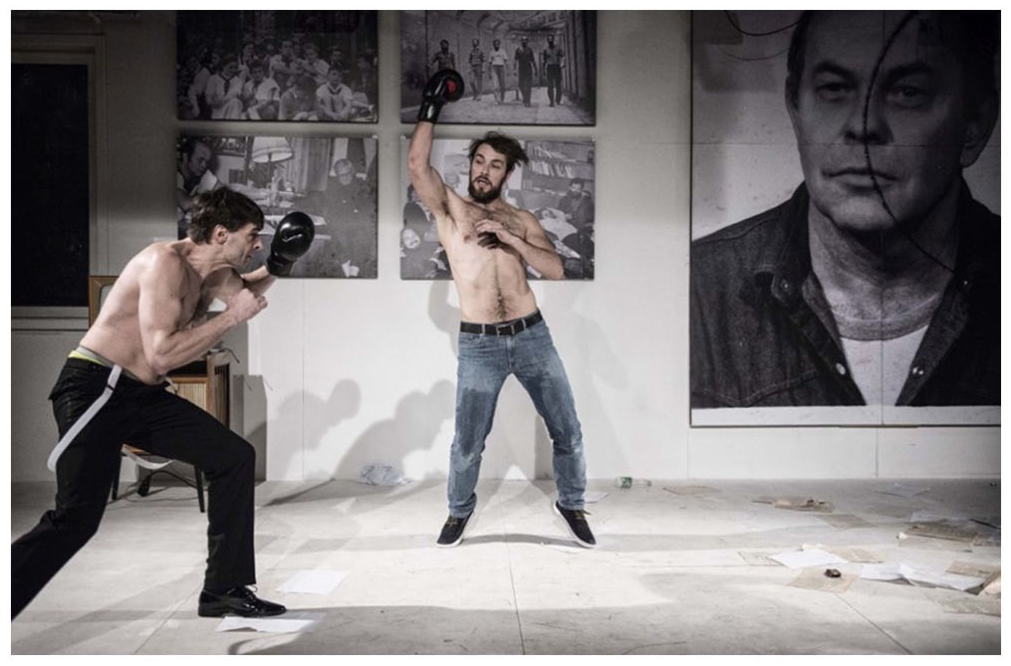
A scene from Kuroń: Pasja według św. Jacka. Photograph by Magda Hueckel.
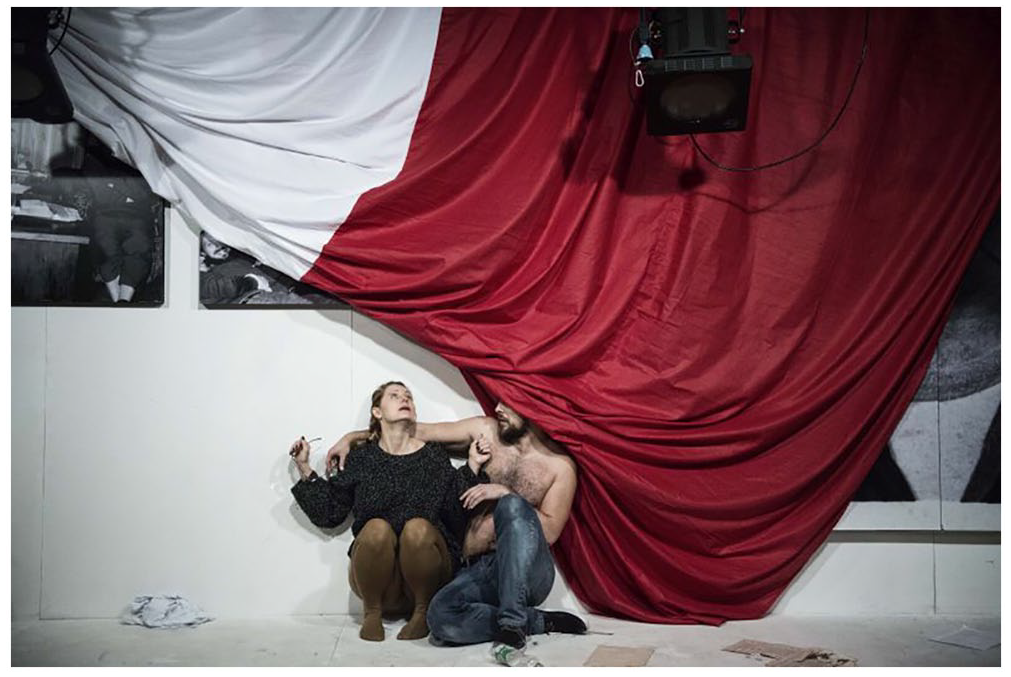
A scene from Kuroń: Pasja według św. Jacka. Photograph by Magda Hueckel.
The final chapter of the story is set in Poland under the rule of the conservative government, amid the intensified partisan fights and debates of the present. The audience is brought together to see Kuroń as a historical figure full of contradictions, whose life trajectory embodies the contemporary history of Poland, and as a metaphor for addressing larger truths. What is at stake here is—again in a somewhat dramatic register—Poland and its very future. In the context of the play, the political activity of the Kurońs comes to personify the abstract ideas and meanings of national mythologies (e.g., struggle for Poland, sacrifice), thereby rendering these “abstract ideas concrete and creating affective bonds among subjects.” 49
Far from inciting protest, in the play, Kuroń appears as a real but also metaphorical figure, a famous dissident from the past becoming a source of inspiration in these challenging times. As one of the characters points out, Kuroń would have called for ending the conflict and pushed for dialogue. It seems as if the theater piece confronts the audience with a fundamental question: Must politics in contemporary Poland always be a social war? Rather than mapping onto Kuroń’s left-wing legacy, the makers of the play bring to the fore the more conciliatory dimension of his life and legacy, making him into more of a liberal than the left-wing activist he perhaps was. In that sense, by undermining Kuroń’s left-wing outlook, emphasizing liberal values, and bending his legacy to fit contemporary societal challenges, the play toys with the somewhat selective collective memory of Kuroń and what he stood for.
Kuracjuszki
As much as the experience of Solidarity was unrivaled in terms of mass grassroots political mobilization and organization-building independent of the party, the declaration of martial law can be identified as a collective and individual trauma. 50 It also highlighted the fact that there are different modalities of being a dissident and representing dissidence. The decision of Wojciech Jaruzelski, who was then the ruling politician and army general, to impose martial law suddenly was perceived by many as a sharp watershed that came with a sense of deprivation, standing in stark contrast to that of empowerment during the period when Solidarity was legally active. Martial law officially began at midnight between Saturday and Sunday, December 12–13, 1981, and lasted until July 22,1983. 51 It was clear that martial law was aimed mainly at Solidarity and other institutions and groups engaged in the political opposition, such as the Catholic Church. 52 Jaruzelski’s order was accompanied by the announcement of the formation of the Military Council of National Salvation (WRON or WRONa), a military authority to administer the country for the duration of the state of emergency. 53
The daily lives of ordinary people were already affected in the first hours of martial law, as two secret operations immediately restricted the political and civil rights of citizens. The first of these, known under the code name “Jodła,” was a joint operation of the security service (Służba Bezpieczeństwa, SB) and the police, deployed to arrest Solidarity activists and other members of the opposition. Andrzej Paczkowski estimates that already on the first day (by 7 a.m. on December 13), 2,874 people were arrested throughout Poland. 54 In Warsaw alone, hundreds were incarcerated as part of “Jodła.” 55 In total, during martial law, 9,784 56 people were placed in about fifty-two internment camps that were spread all over the country. 57 As a result of the arrests, most of the leaders and prominent activists of Solidarity were incarcerated, including Lech Wałęsa, Tadeusz Mazowiecki, Bronisław Geremek, Bogdan Borusewicz, Jacek Kuroń, and many others. The second operation, known as “Azalia,” was aimed at seizing and blocking all means of communication. For instance, phone calls were blocked, and buildings in Warsaw belonging to public radio and television were placed under strict army control. 58 Both operations were meant to paralyze basic Solidarity activity, such as staging strikes and disseminating information. The goal of another major operation, named “Klon,” was to turn as many political activists into covert agents working for the state as possible. “Klon” was mainly carried out by the security service and involved holding meetings and interrogating the internees. 59 As a result of the declaration of martial law, fundamental civil rights were severely curtailed, the country was placed under a curfew in force between 10 p.m. and 6 a.m., and assemblies were banned.
Among those who had to reorient themselves after the shock of martial law was a less visible group of dissidents, namely incarcerated women who, prior to their arrest, were professionally and politically active, and who had to adapt suddenly to the reality of life in the internment camp in Gołdap, to which they were transferred after being arrested. The 392 internees in Gołdap included key activists and less well-known ones alike—people such as Ludwika Wujec, Grażyna Kuroń, Anna Walentynowicz, Barbara Malak-Minkiewicz (then Barabara Malak), and Hanna Macierewicz. Housed in the facilities of a former summer retreat, the camp was treated by the authorities as a flagship camp to be presented abroad as proof of the excellent and humane living conditions in the camps, in order to counter overwhelmingly negative accounts of martial law in the international press. 60 For instance, the camp’s “pretentious interior was characterized by corridors decorated with palm trees, soft couches, armchairs, and television.” 61 Yet, the relatively good material living conditions (in terms of both food and accommodation) clashed with the reality of various forms of repression that directly and negatively impacted the well-being of inmates. Although the word “kuracjuszki” (which means female bathers or patients in medical spas) does not have an equivalent in English, to a Polish-speaking audience, the pun is obvious. The word “kuracjuszki” has a care-free undertone to it that clashes with the actual experience of confinement under martial law. The choice of such a title is also an ironic commentary on the relatively good living conditions in the internment camp in Gołdap. As hundreds of politically active women were abruptly taken away from their work, lives, and families—in many cases, also from small children—and as they were incarcerated for an unknown period of time, they were deprived of the basic needs of a sense of security, self-esteem and dignity, stable contact with loved ones, and productive activity.
Living in the Gołdap camp meant to live a life under confinement while being unsentenced, to live in a comfortable hotel room while waiting for the next meeting with the security service, to resist consumer goods that were hard to get while hunger-striking in solidarity with a friend, and to stage theater plays and sing songs while not knowing about the whereabouts of one’s loved ones. Life in the camps under martial law was paradoxical, as internees inhabited a highly supervised and intimate space that also did not belong to anyone.
Kuracjuszki is a work at the intersection of theatrical play and contemporary performance (see Photograph 3). The show’s storyline consists mostly of anonymized stories of female activists that are presented in a fractured way. The creators and actresses of the production met with the former interns and collected their stories. Using the personal narratives of the women’s time in Gołdap, the creators organized the performance in chronological order: women’s activism in Solidarity, the night of the implementation of martial law and arrest, the long trip from the arrest to the internment camp, arrival in Gołdap, and the everyday life of the internees’ community. The somewhat fragmented construction of the narrative, together with its playfulness and rhythmic structure, results in a polyphonic and collective account of dissidence; it is an account in which formal expression is intrinsically linked with the message it tries to put across.
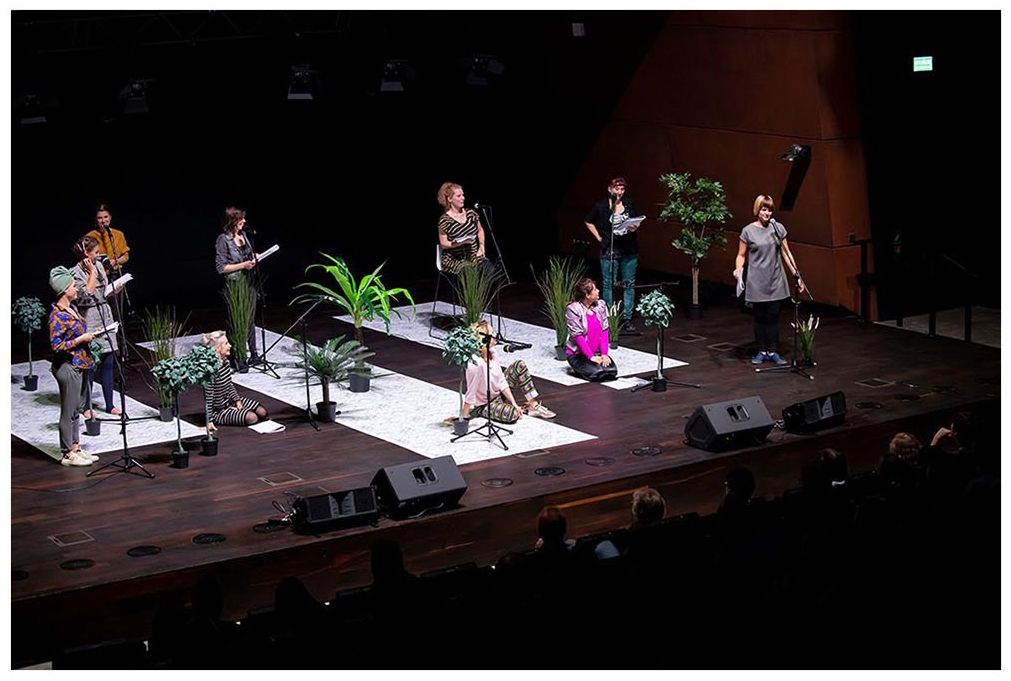
A scene from Kuracjuszki. Photograph by Alicja Szulc.
Unlike the play about Kuroń, where details of his life and accusations raised against him are central to the narrative, Kuracjuszki toys with the idea of the uniqueness of individual experiences by bringing to the fore the collective and relational character of dissenting political involvement. The use of voice and music magnifies the collective experience of female activists, as most parts of the script are read aloud by one actress, and regular choir-like intervals crisscross the short monologues. Of particular importance is one phrase that is read aloud repeatedly by all the actresses: “Me? I’m no revolution. I’m no heroine. I don’t think I was a leading activist.” What might suggest a humble self-image and an awareness of their position within the broader movement of Solidarity also contrasts with the hero-centered narrative in which individual people—usually men—with a name and biography are the driving force behind historical change. The refrain also emphasizes that the status of a dissident is not self-evident, even to the dissidents themselves; it is always precarious and dependent on the politics of naming. While this might seem an obvious fact amid intensified attempts on the right side of the political spectrum in Poland to rewrite the recent history of dissidence by inserting it into contemporary political struggles, Kuracjuszki emphasizes that answers to the question of “who a dissident is” have a history of their own. The women’s recollections, in which they are hesitant to aggrandize their contribution to the political opposition, show that although there is little doubt that there were certain hierarchies at play within the community of political dissidents, the question of who a “real” dissident is was already shaping the political identities of women before 1989 and today’s “politics of the past.” 62 On one hand, the women in Gołdap claim to be proud and certain of their political convictions, but on the other, they are inhibited in unequivocally claiming a position among the pantheon of political dissidents.
By deliberately concealing the identities of those interned women quoted in the oral history interviews, the creators of the performance underline the diverse nature of the experience of being part of a political movement under adverse conditions. In this sense, the performance builds a micro-historical narrative allowing it to capture the mundane, even at times banal, scenes and activities that convey the gendered character of political incarceration, in which normalized gender stereotypes were used by secret police during the interrogations to discipline the internees and extract information from them. For instance, women pointed out that they were made to feel guilty about their children and aging parents who needed care and were waiting for the women at home. The unfulfilled obligation to perform the informal labor of love—still traditionally performed by women—was used as a disciplining tool to persuade female internees to collaborate with the secret police. Exposure to their own vulnerabilities, which were at times explored by the interrogators, was an inseparable part of belonging to the community of women held in Gołdap. Given that prolonged incarceration is a total experience, the fractured narrative of the theater piece reveals that the internees went through a wide spectrum of experiences ranging from playful games and boredom to attempts at protesting. Tactics of social contestation blend with everyday coping tactics. What also merits special attention is the play’s use of voice and compartmentalized narrative as tools for speaking and participating, but also expressing the unspeakable or the unspoken. The atmospheric sound design integrates sounds that do not necessarily fit into what is authorized within the dissident “soundscapes,” such as giggling and erotic sounds that again point to the lived and real experience of dissidence. In this experience, it was precisely the entanglements of the intimate and the corporal that enabled the reproduction of a sense of political and personal self in the internment camp.
The creators of the performance chose a different aesthetic strategy in designing the set than the one used in the play about Kuroń, opposing the play’s sublime character. Kuracjuszki’s minimal set and costume design give it an unpretentious charm with a playful edge. The performers wear casual clothes that look as if they belong to the actresses, making the play seem contemporary and as if the story were taking place now and not during martial law. This sense of synchronicity results in a production that is accessible and infused with a sense of familiarity and closeness. In that sense, the play has the potential to bridge distances between individuals with extraordinary biographies—such as dissidents—and an audience that is both a recipient and perhaps a contributor to the production and spreading of knowledge about dissidents. As one of the creators of the show, Dorota Ogrodzka, puts it, the identity and experience of the actor or performer with whom she works are enormously important in her theatrical work. 63 The play is very much text-based, and the vibrant visual language and choreography underline the physicality and materiality of the female activists’ recollections; as often is the case, the decor is also about meaning-making and creating conditions for a sensorial experience. Underneath the veneer of casual interactions, the play touches on a fundamental dimension of theater as a potentially inspiring or thought-provoking experience—by bodily and linguistically reproducing women’s voices, the show exposes the audience to alternative ways of engaging with one of the iconic figures in contemporary Polish history: the dissident.
In the performance, the representation of the dissident swings back and forth like a pendulum between two poles. On one hand, the play “uses” the interned women’s status as dissidents to validate or authorize experiences and practices that might come across as taboo, such as mental well-being, fear, shame, and in-group conflict. On the other hand, Kuracjuszki works with the image of the political opposition by destabilizing classic—male-centered—narratives of dissidents, where male companionship, audacity, and power, together with intellectual sharpness, dominate the common understanding of the political opposition. Although Kuracjuszki goes beyond a position-taking and overtly value-laden theater, it still confronts the audience with the gender divisions of the times and the ways in which they may have continued to be reproduced since 1989, albeit in altered form. In that sense, Kuracjuszki does not feel too distant from today’s challenges or climate of discussion, as the play allows viewers to see and question gender imbalances in the past and today. Rather than explicitly seeking to transform notions of the dissident and to overcome current crises, the performance takes a position in the world by providing new interpretations of who the dissidents were and what counts as dissident activity. In doing so, the play offers new ways in which the legacy of dissidence can be relevant today beyond the right-left division.
Conclusion
Rather than providing a complete account of the contemporary Polish “theaterscape,” this article has focused on two contemporary plays that try to unpack the experience of dissidents in a way that is neither a hagiographic narrative nor an overtly politicized tale downplaying individual (usually the opponent’s) achievements. The performances do so by rethinking and reshaping the representation of dissidents—playing along with their established images while, at times, going against and beyond them. A careful analysis of both plays reveals two different but complementary strategies for coming to terms with the myths and politics of memory surrounding the figure of the dissident, political activism, and solidarity. Rather than being narrowly counter-hegemonic performances or merely blending satirical and alternative types of theatrical plays with more professional ones (an approach popular during socialism), 64 both theater productions analyzed in this article can be viewed as political in a more complex sense, in which their political content, ambition, and aesthetic form are interwoven. 65
In the bristling individual performances of Kuroń: Pasja według św. Jacka, a powerful yet fragile political commitment becomes visible. The skillfully cultivated drama casts the life of the main protagonist as one filled with sacrifice and passion and his legacy as contested. In doing so, the show taps into a broader climate of polarization engendered by intensified political struggles over the meaning of the past and its reverberations in the present and future. Ultimately, the creators of the play engage with the figure of Kuroń to provide a socio-political commentary. In contrast, Kuracjuszki uncovers the collective experience of women’s political activism by exploring the power of collectivism and everyday practices and by dispersing the singular authorial voice of the figure of the dissident. Using theater as a self-reflective and intimate medium, both plays enable unsettling interpretations of the present by grounding it in the past, going beyond the highly politicized and visible lines of political confrontations in the public sphere. In doing so, both plays, I would argue, frame dissidents as an entry point into the complex dynamics of the making and unmaking of the foundational myths of post-1989 Poland.
The political background against which the plays were created prompts us to understand democracy beyond the electoral system and to see the art world as a magnifying glass of societal tensions and changes. At the same time, with the knowledge that they produce, cultural institutions and their infrastructure serve as tools for the alteration of the social order by promoting new symbols, interpretations, and audiences. These, in turn, can contribute to remaking the national past for the purposes of contemporary culture wars. By reemphasizing (as in the play on Kuroń) and deconstructing (as with the play on female activists) the post-1989 national mythologies around dissidence, both productions activate the potential of theater to be a site for interrogating political, social, and cultural doxas, shifting the contours of political consciousness. Although the shows engage with the category of the dissident in different manners and for different purposes, they both bring to light the historical, social, and political complexity of the political opposition—an opposition whose political relevance lies precisely in its undermining of selective, one-dimensional, and heroic narratives of the past, narratives that make it hard to learn from the past at all. 66
