




Abstract
In June 2020, an earnest debate occurred in Latvian society surrounding controversy around the local ice cream brand called “Blacky” in English. While some pointed out that this was an expression of racism, others defended the right to name things “as they were” and relocated the political context within a nationalist perspective that “lacked” a racial history. This article explores “racial innocence” as a form of racism in Latvia. Racism and racial innocence, universalism, and particularism in interpreting race mobilize different sets of connections, not only revealing diverse understandings of race but also claiming authority and presenting inner logic to assert these positions. Despite the claimed lack of racial encounters and the absence of a history of colonial superiority, Latvians use racism as a part of the nation-building process and as a way of placing the country on the global map. I suggest that racial innocence is the dominant framework of conceiving racism, where the concept of race plays an important part in creating local hierarchies of the Self and Other. In the Latvian context, race is very much about “self” and self-boundedness, which is being challenged in the process of Europeanization and in situations of interpersonal encounters requiring a reconsideration of the ethics of conduct, racial privilege, and the “natural” grounds of Latvian society.
This article covers the paradox of racism without race in Latvia and (eastern) Europe. Can people be accused of racism when they refuse to see the world in those terms? Eastern European countries were seen to react differently to the refugee crisis, 1 and Europe itself has been accused of applying double standards to Ukrainian and other refugees after the Russian aggression against Ukraine.2–4 Using the Latvian case study as an example, I argue that the racism it uncovers acts as an interplay between the universal and the particular, while race appears as a distinct object in the discussion. The universal perspective articulates racism in a global sense by recalling divisions based on colonial pasts, while the localized Latvian (and European) perspective deals with racial innocence and its own agenda of naturalizing race as a part of national self-determination, replicating itself in scholarly, political, and popular life.
At one level, I engage with (eastern) Europeanness and the race debate, navigating between particularist and universalist positions and looking at the connections these make, simultaneously acknowledging the complicity of science in constructing race and racializing social inequalities. The next layer of the story discusses Latvian perceptions of race as a case within the broader phenomenon of racism in Europe and its changes over time, arguing that innocence, denial of race, and calls for tolerance are important constitutive parts of racism in Latvia and Europe. This part reveals the dynamics of the application of race in constructing self-identity and otherness and proves the need to examine perspectives on race ethnographically. Finally comes an example in the debate about race in ice cream advertisement, which triggered the writing of this article and influenced my reading of scholarship about racism in the region. Each of these story lines is interconnected but cannot be told simultaneously, as each belongs to a different level of focus within the picture. In recounting the case, historical details and extracts of ethnographic examples from the work of other scholars become relevant. When I refer to academic texts, those provide clues for interpretation and examples for comparison, breaking into my argument. But, as I will show in the article, the very concept of racism is highly complex in perspectives and connections, messy with personal affects, global transfers of concepts, and multiple possible interpretations and truths. I uncover these layers in reverse order, starting with the case of ice cream and its broader national context, which helps me in proving my argument, and I end by positioning it within a broader debate of interpreting and proving (eastern) Europeanness.
Introducing the Ice Cream Case
The Latvian Rūjiena ice cream company started producing a new product line of three differently coloured ice creams in 2018, but the line was not very successful, so it was largely unnoticed until being accused of being racist in June 2020. The contested ice cream was called “Melnītis” in Latvian—“Blacky” in English: a black-coloured version of the ice cream, with a black currant flavour (see Figure 1). The debate arose around its English name, which some vigilant citizens considered improper.
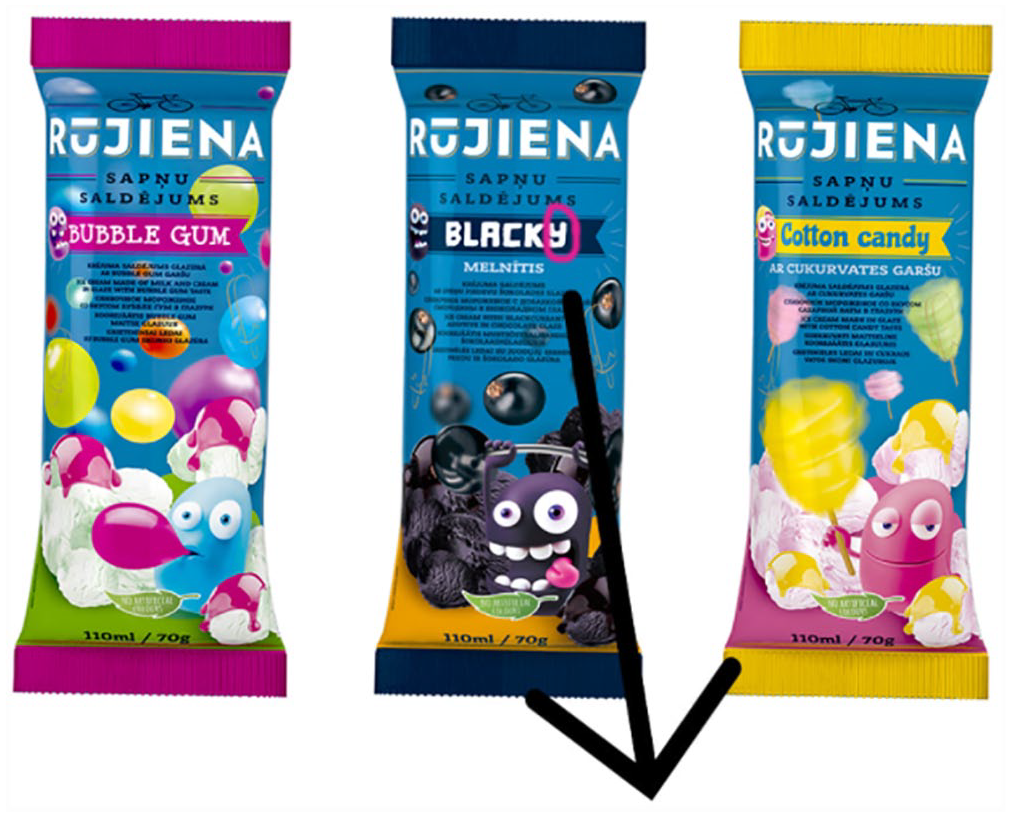
Picture from Rūjienas saldējums’ official Facebook page, 12 June 2020 5
A Canadian Latvian who was also a member of a liberally oriented political party wrote to the producers, pointing out the racist connotations associated with the English version of the brand. Her correspondence with the product line manager was later reproduced on her party’s Facebook account (soon removed when the party decided not to engage in the debate) and showed that she had failed to be persuasive. The product manager had replied (author’s translation from Latvian),
Hello, we at Rūjiena ice cream have received your rebuke for using the name “blacky” for the image of our black ice cream cartoon. [. . .] Thank you for your attention, but I don’t think you should be worried, because the word “blacky” is used by many companies for their product names and brands in various countries (check Google), including the United States, and is not on the lists of offensive or discriminatory words. [. . .] P.S. Yes, I consulted over the brand name with an MBA from the United Kingdom.
The case was picked up by the conservative and mainstream media, featuring accounts of the dispute with comments from the retail sector on ice cream consumption patterns in general (e.g., nra.lv, a conservative paper) or locally known foreigners of Latin American origin in an article named “Ice Cream Melnītis Racism Scandal: Does It Offend Famous People in Latvia with Dark-Coloured Skin?” (published on the women’s magazine portal Santa.lv). None of the “experts” interviewed, including “popular people with a dark skin colour,” actually felt racially offended by the English name of the ice cream, and most commentary following the article supported the local brand and its right to “name colours as they are.”
The account of an Afro-Latvian activist, however, featured a more critical position on racism in Latvia. His correspondence with the ice cream producers was also not fruitful. However, the producers revealed that the ice cream name might change, or they might simply stop producing the line, as its production life was nearing an end and had not been successful anyway. While expressing sympathy with “the dignity of some groups of society,” the representative of the company also noted at the end of his letter that
we will not make a decision on the basis of insults, accusations, and threats because we want a respectful and reasoned discussion with the public. All this hurts and offends us, the company and every one of its employees.
The representative added a quotation from an Internet dictionary as a proof of the “innocence” of their intentions and the faultlessness of their actions: “blacky, ADJECTIVE, Somewhat black, blackish.”
The producer’s reply was reproduced on several Internet portals. It simultaneously contains several seemingly contradictory positions. First, the reply both paid lip service to tolerance and at the same time renounced it as an inappropriate power game. Second, when looked at closely, race is not the only hierarchy here. The case displays language as a means of creating hierarchies. A locally distributed ice cream brand felt the need to print an English name in larger type than the corresponding text in Latvian. In addition, language hierarchy was present in claims about the appropriateness of the English name, since it came from “an MBA from the United Kingdom” and Google, again relying on an authority beyond one’s own national space. Language, as much as race, can be used to create and justify hierarchies. Paradoxically, one can remain self-determined in a Latvian space while clearly using English for the “higher” positioning of one’s product.
By introducing the example of this Latvian ice cream, I suggest that we reconsider racial and ethnic hierarchies within the broader context of nation building and identity politics within changing global hierarchies of power and identity in post-socialist space. Nayak 6 focuses on racialization in Häagen-Dazs ice cream advertising within a U.S. context, claiming that the image of the black body becomes the place of “the practice of whiteness.” In that case, the symbolism of the black body and its ascribed sexuality embodied the racial relations of the colonial period. The visual representation of the ice cream brand in the Latvian case is a humanized berry of deep violet colour. It is endowed with wide eyes and a large set of teeth, giving it a more sinister look when compared with the “Bubble Gum” and “Cotton Candy” figures from the same product line. I myself did not see any racial connotation here until such a helpful suggestion was made by a reviewer of this article. The connection was not made in public discussion of the case, and attention focused solely on language use. After the remark, I could clearly “see” the visual racialization of the berry and suspect that its design had neither been that “innocent” nor explicitly registered as such. I leave this point until below but note that what we have here is a miniature version of the same clash of perspectives on racism and racial innocence that we can see on the Latvia–Belarus border and in academic debates.
This comparison between ice cream examples allows me to argue that the articulation of race makes new connections through negotiation, referring to global definitions, hierarchies, and local contexts producing different meanings. While in the U.S. case the symbolism of the black body becomes obvious due to the particular historical experience of slavery and inter-racial relationships, in Latvia it is entangled with positioning the nation within a global world.
A Deeper Analysis of the “Blacky” Ice Cream Case
Data about the Latvian ice cream case come from social media accounts and media articles as well as comments “below the line,” that is, reader opinions written about the article or the story itself. The stories I have chosen for analysis represent diverse Latvian local media channels, ranging from the more liberal to conservative. The texts were selected by entering the keywords “Melnītis” and “Blacky,” the Latvian and English versions of the ice cream product name, respectively. I use (with permission) entries and comments appearing in a social network account belonging to an activist standing up to racism in Latvia who discusses this case. In total, eight articles with comments, as well as one Facebook account following the story, were used, making up 143 pages of text, which was coded using Atlas.ti and then analysed. The names of the Facebook account holder and those participating in the debates are anonymized in this article.
The public discussion, articles, and Facebook comments can be classified roughly into several frames. Some commenters entertained the idea of a dystopia where mentioning colours and some traditional products such as rye bread (black in colour) were prohibited. Some ridiculed political correctness, which now extended to monitoring ice cream. A few made misogynistic comments on the gender and age of the initial “troublemaker,” but some straightforwardly recognized that the use of the English word as brand name was offensive. I proceed to analyse these frames in more detail.
Most of the comments rely on “racial innocence” or the belief that what they thought had no connection to race or racism. When looking deeper, this conviction relied on connections offered by racism. The user called Si, imagining a prohibition against naming white and black coloured items, underlined the common-sense absurdity of this dystopia and through this absurdity brushed off the seriousness of claims about racism:
I just learnt that I am racist since I wash white and black clothes separately (a comment made on Rūjienas saldējums Facebook page).
While the argument superficially seems to be about self-determination in language,
7
it has a deeper context. The “racial innocence” argument itself presupposes that connections are made “just” at the level of language and imaginary space, that is, no one really expects accusations of racism to change one’s washing habits. The effect of this imaginary is to allow race to be presented as void of any racial history related to personal and lived experience. However, these fantasies are possible only due to a certain racial history, even when repeatedly underlining a disconnection with it:
It can be agreed that “blacky” is a word with a racist meaning, but only if it is applied to a person. [. . .] why have you forgotten the very basis—what is racism? Even elementary Wikipedia says: Racism is the belief that one group of people is better than another and discrimination against these underrated groups. So, 1) how can the name of an ice cream contain such a view? 2) the ad says that it is a dream ice cream—essentially translated—the best that one can desire. Then it turns out that racism is against whites, because black is considered better here, a dream ice cream? In my opinion, you have to be a racist to try to see something like this in an ice cream advertisement. (Comment on the Rūjienas Saldējums article in portal Pietiek.com, https://pietiek.com/raksti/kad_rasisma_apkarotajiem_entuziasma_vairak_neka_saprata/)
This example (as well as others) demonstrates an interesting point and advances the point of my “unseeing” of the visual racialization of the berry in the advertisement. The commenter above is an essentialist: that is, ice cream is seen as ice cream and racism as racism, and both are differentiated by the very fact of them being separate entities. This disconnection is achieved through essentializing them and erasing the connection between the signifier (name) and the signified (ice cream). The relations between ice cream and race here are merographic 8 ; from one perspective, ice cream and naming can be seen as distinct phenomena on their own; at another level, they can become seen as connected via associating “black” with “being better” ice cream, deliberately deploying the ambivalence inherent in racial history.
This merographic character of connection allows us to “unsee” politics and power by disconnecting racism (Wikipedia as a source in the quote above underlines its distant and unreal place of existence) from other contexts such as ice cream advertising. At the same time, this very connection is present in the reversed fantasy of black ice cream being superior to white. While essentialism allows people to remain innocent about the connection; it is precisely these racist assumptions that allow the absurdity of claiming black supremacy, as the commentator implicitly “knows” this is not true. Using an analogy borrowed from Bourdieu
9
and originally applied to masculinity, two operations (or connections) are in place here: first, the naturalization of categories of gender (race in this case) and, second, legitimizing “a relationship of domination by embedding it in a biological nature that is itself a naturalized social construction.”
10
In other words, racism is naturalized by embedding it into a specific “genuine” context that helps to “unsee” the very racial reasoning found elsewhere, just as masculine domination is naturalized by making it invisible via a connection to a “naturally” gendered sexuality. It is thus no wonder that several commentators invoke gender alongside race, discrediting the initial troublemaker by stressing her gender and making a pun from her name: “babene”—here the meaning is probably derived from the Russian “баба [baba],” used as a derogatory term for an elderly, foolish woman:
This babene should better pack her belongings and go back to the great country she came from. No need to upset and irritate people!
While in most instances commentators and journalists alike claimed there was no connection between colour, race, and ice cream, it was constantly invoked behind the scenes. Representatives of race surfaced in the santa.lv article as experts proving that Latvia did not have any problems with race, while at the same time the concept of race as visual otherness perceived through the colour of their skin enabled their selection as “experts.” The Apollo.lv Internet portal, which usually takes a liberal or neutral position, illustrated its article on this case with a picture featuring the hands of a dark-skinned person holding two ice cream cones. The text was neutral and featured the producer’s claim that the ice cream was not connected to race.
Despite an open denial of racial discourse, the presence of racist argumentation could be found in many comments, with some directly stating that
I am not a racist, but I am insanely irritated that blacks are raised above whites. Because most black people [uses a phonetic transliteration of a derogatory term in English], let’s be real here and not pretend that we don’t see or know that they have arrived here in the US, the EU just to get money, to have fun, to demolish, and so on. If they did not want to work in Africa, then they do not plan to do so here. And there is no need to say how hardworking, culturally educated, loyal to the country they are in. And when such black-bottom kissers start reprimanding us for racism, etc., I want to vomit.
“Innocence” and “lack of racial discourse” locally, perhaps, is not the only explanation for the frame of the discussion of race here. While one commentator noted the Latvian version of the ice cream name “Melnītis,” a diminutive used in standard Latvian to name livestock, another mentioned that it was also used as a derogatory term for black people by some U.S. Latvians, having acquired a similar meaning to the English “blacky.”
The contestation of racism here goes beyond linguistics, translation, and cultural history. Some commentators acknowledge the problem with the name in English but use “local culture” to disconnect it from the English-language context:
They are using the word [melnītis] as a derivative of the Latvian word “melns” or “melnais” [black, the black one] which have been used for centuries in latviešu tautas dziesmas [Latvian folk songs]. Therefore, it belongs to the culture and has no connection with the actual meaning of the English word that has been printed on the packaging.
The realm of culture opens up space for debates that reflect on the perception of culture and its history. Some commentators see the presence of racism as the consequence of a lack of education or simply a Soviet legacy, and therefore not part of a contemporary Latvian culture. Commenters reproduce an argument common among “tolerance workers,” hinting at the xenophobic nature of current Latvian culture, and sometimes they apply an evolutionary perspective according to which Latvians should “grow out” of xenophobic attitudes and become more open.
Only one commenter explicitly points out that racism should not be seen as “just culture” but rather as an established connection between nationalism and xenophobia that extends to the realm of interpersonal relations:
What a great argument! So, if my daughter (a Latvian citizen by the way) is called a n*****, a monkey, someone refuses to sit next to her (justifying this by their proud nationalism), the problem is my three-year-old’s head? And for all those who agree without saying anything that everything is fine, they are “hospitable” Latvians.
The question posed by this commenter, indeed, cannot be answered by referring to national history and identity politics or the quality of education, as it deals with the ethics of interpersonal conduct and the embodiment of disputed categories and connections. Race is inscribed in the body, but while the black body comes under attack due to its visibility, white privilege remains “unseen” and dictates the terms of conduct and innocence of interpretation. The commenter problematizes the reality of racism in Latvia by juxtaposing its existence “in the head” versus in the realm of interpersonal relations. Indeed, most commenters discuss racism as external to interpersonal and embodied relationships or the “situation of communication” (using Dzenovska’s terms mentioned below) as it is part of their racial privilege.
Similarly, at an ethnographic level, Dzenovska
11
stresses these two modes of interpretations in presenting her interlocutor Michael’s (introduced in her book as an African American living in Latvia) encounter with his friend’s mother. The friend’s mother had claimed that the Latvian word nēģeris was not racist as it did not have any negative connotations in Latvian; Michael, however, still found the use of the word offensive. Dzenovska analyses the situation thus:
What made her racist in Michael’s view was not only the fact that she was using this word, but that she also refused to consider Michael’s claim that the word was offensive. The mother of Michael’s friend insisted that the word’s meaning was local, that is, Latvian, rather than embedded in translocal connections and histories. She also insisted that the word’s meaning was external to the communicative situation, which was also an ethical encounter between her and Michael. She claimed meaning through tradition, which, she thought that Michael, as a relative newcomer to Latvia, had to respect.
12
This interpretation demonstrates the rich texture of race, pointing towards not only different racial histories but also the embeddedness of race in communicative situations. Here a small detour in anthropological approach is necessary. Euro-Americans, 13 as Strathern 14 (see also Edwards and Petrovic-Šteger 15 ) claims, simultaneously operate at two levels of relationships/relations: personal and conceptual. These levels do not stand in opposition, but rather fold into each other. A difference is that both present “a connection from another angle.” 16 As Dzenovska notes, the friend’s mother draws on “external” or conceptual placement of the term, while Michael sees it as an interpersonal or “ethical” encounter. Thus, racism can be seen as a concept but also experienced as an interpersonal relationship. While at a conceptual level racism can reinstate inequalities, at an interpersonal level it allows them to be embodied. It might seem a trivial observation, but it is important in explaining the encounter described above. The experience of practical embodiment of the racial hierarchies and interpersonal interaction prevents Michael from accepting his friend’s mother’s explanation that the “N word” is harmless in a Latvian linguistic context, as her embodiment of whiteness which entitles her to expertise in Latvianness also helps in missing the point that Michael considered the word personally offensive.
Here we see the difference according to one’s position in terms of race: Michael in Dzenovska’s case and the child in this episode did not have invisible white racial privilege. Moreover, their conceptual thinking is always influenced, if not by direct experience of personal racist encounters, then by their very possibility. This is why well-meant comments in support of the Afro-Latvian activist, which invited the activist not to take the ice cream case seriously, did not help, as he himself could not afford the privilege of innocence.
A privileged position in terms of race becomes visible from the deprivileged position of the Other. Another participant in the ice cream discussion, evidently a foreigner, replied to the comment quoted above:
Latvians (certain ones) are very serious about their “pure blood.” You either identify yourself as a Latvian or nothing. No less will ever be accepted.
This biological nature of Latvianness is not openly voiced in the rest of their comments, as it is perceived as self-evident. However, a biological objectification of ethnicity appears on the other side of the coin when racializing the Other. One popular framing of the comments seemingly does not address the situation but conveys superiority and sovereignty in determining the positioning of one’s nation:
Let them learn our understanding and not to preach their bible to us in a foreign church. As a Latvian I know what I am ashamed of and what not. Which words I use and which not. Neither Germans nor Mexicans will teach me what is right or wrong in my understanding of my language or the ice cream of my country.
It is not accidental that a complaint about the name of an ice cream is answered using this self-defensive argument. As I showed, this ice cream case is paradoxical when viewed as a whole. On one hand, race is used as a principle in making hierarchies and definitions of the self and the other, but, on the other hand, the presence of race is “unseen” as it is naturalized. Practically, commenters took positions either condemning or supporting the ice cream label, thus avoiding the paradox altogether. Indeed, self-boundedness is achieved not only through the availability of a connection, for example, via the naturalization of Latvianness, but also the autonomy to make connections. This is why some commenters felt annoyed by being shamed and accused of intolerance. The attribution of shame and accusation was possible from a different position, which simultaneously subjected the autonomy of the objects of criticism.
Returning to the ice cream case, racism there was mostly directed at self-identification and acknowledgement of one’s privilege through the means of culture and language. The “Other” plays a dual role in this self-positioning. While the English language was seen as a source of prestige displayed in upper-case letters on the packaging, and its appropriation was gained through the process of globalization, it also contributed to vulnerability and the responsibility of opening the self-imagined structures of privilege to critique.
The Latvian Context of Racism
Race and Self-Identification
I further unwrap the case by looking at the history of race, paying attention to articulations and interpretations of race in the Latvian context. First, racial theories surfaced in Latvian academic and political environments after the establishment of Latvia as an independent state in 1918. These were part of a wider European phenomenon, eventually contributing to National Socialist ideology in its most extreme expressions. Second, after the Soviet occupation, “racial theories without race” were applied and Latvia was cut off from the global discourse on race. Finally, during the period of regained independence since 1991, race has reappeared as a mixture of discourses and practices around national identity, racial innocence, and global demands for tolerance and anti-racist policies.
Racism was used as a scientific approach in physical anthropology in the interwar period of the twentieth century. Felder
17
stresses the significance of physical anthropology and concepts of race and eugenics in early Latvian nation building, writing:
Labelled as “Nordic,” Latvians not only became biologically and culturally part of “civilised” Europe, but they were also described biologically and genetically as being “worthy.” This genetic or “racial” value gave Latvians a solid position in the process of “natural selection,” at least for [Latvian anthropologist] Prīmanis, the struggle for survival among nations—and it legitimised the young nation and its nation state.
18
According to Felder,
19
the racial categorization reflected the political situation of the era. Latvians were seen as originally “Nordic with admixture of East Baltic traits.” The Nordic legacy of the Latvian nation was seen as similar but parallel to that of the Germans, as Latvian relations with the Germans, as former colonizers, were cold at that time. Russian or Slavic influences were considered “negative” based on popular Western agreement on the “inferiority” of the Slavs.
20
Zelče
21
and Dzenovska
22
contest Felder’s claims linking racism and eugenics, and they invite us to look at the specific historical context and differences in comparison with German physical anthropology of that time. Zelče
23
quotes Prīmanis, an anthropologist, professor, and director of the national Institute for the Vital Force of the Nation (Tautas dzīvā spēka institūts), at its opening in 1938, demonstrating that eugenics were less connected to race than to the development of the Latvian nation:
The number of inhabitants should increase, so that the state can be strong and fulfil its endowment. The institute will explore circumstances under which one could facilitate an increase in the number of bodily and mentally healthy individuals, study population density problems in Latvia, and research the physical and mental nature of inhabitants, especially that of Latvians.
Indeed, Prīmanis was not speaking about race here directly, and Latvian eugenics were mainly focused on health and welfare and the size of the nation or, as Grāvere and Vētra 24 claim, “liberal eugenics.” Looking back at that early period of anthropology, it seems that despite the application of popular racial theories of the period, it was mainly directed at Latvians. Drawing from scholarship on race, 25 Latvian physical anthropology was not an exception, as “in the context of modern nation building, racism facilitated the social construction of homogeneity through exclusion, but it also functioned to consolidate elites by neutralizing class and legitimating inequality.” 26
Research on recent population genome studies in Latvia traces the developments of physical anthropology after 1991 and supports Felder’s findings concerning the role of racial theories in legitimizing the nation. In 2000, the Latvian national media eagerly wrote about finding a Baltic or a Latvian gene, coding for the Landsteiner-Wiener Blood Group Antigen, with variant B being most wide spread among Latvians. 27 The research also placed Latvians on the regional map, positioning them in relation to other nations via their genetic heritage.
Latvians became reified 28 through research that connected history, locality, and language with biology (genes or, previously, skull and height measurements), using science as an invisible connector. The “naturalness” of genes then further legitimized national hierarchies. This is why the media debate and scientific presentations following the introduction of the Population Genome Act and population research policies in Latvia 29 unexpectedly evoked the experience of German colonization when it was discovered that funding came from a German-based company and samples were to be transferred to Germany for analysis. In the end, the Latvian state funded the project, helping Latvians to establish control over their genetic material. Similarly, discussions about gamete donation evoked a panic over Latvian sperm being exported, thus compromising national integrity. 30 These examples show that ethnicity is still perceived in biological terms. It is a matter of scholarly choice whether to analyse the situation through the prism of race. I take the biologization or naturalization of nation as an important building block in understanding the current application of race in a Latvian context. In my discussion of the case, naturalization of one’s racial identity was the tool to sustain innocence, yet despite doing so, racial hierarchies were developed.
Alongside anthropological endeavours, obsession with the classification and identification of self and others in Latvia is present within the current politics of identity in Latvia and is well illustrated by Rhodes,
31
who in her doctoral dissertation based on fieldwork in Latvia lists thirteen terms of national and ethnic identification used in a single Latvian integration policy document.
32
Ten terms describe the Latvian self and self-identification with space, political structure, social memory, and “culture,” only the final example being understood as a biocultural substance:
In comparison, only three terms describe the “Other,” positioning it according to the level of proximity to the Latvian self, culture and language, and citizenship. For example, ethnic minorities (mazākumtautības in Latvian, literarily “nations in minority”) were Latvian citizens who had lived in Latvia for generations but possessed a “different” language and culture, but the rest of the “Others” were called immigrants, stripping them of cultural identity and using the phonetically close term to “migrants” in Latvian, which had a denigratory meaning in Latvia, mostly used in relation to Soviet citizens settling in Latvia during the Soviet occupation.
Dzenovska
34
also stresses the importance of self-determination of language and culture used in forming their own, Latvian, discourse and their “power to name and to constitute a subject in language.” Dzenovska recounts a meeting where ethnic minority representatives and tolerance workers discuss the politics of naming ethnic groups in the Latvian language. The discussion presented racially charged representations of the “Other” ethnic groups, where Jewish, Roma, and African Latvian participants stand for their respective groups and express opinions, making Latvian privilege in this situation of naming practice “invisible”:
the first principle for using a particular word is to know how the person or the group wants to be called. If they want to be called ebrejs rather than žīds, then there is no question about it.
35
The “invisible” deciding subject here is presumably a Latvian, manoeuvring “in this space ethically and politically, while at the same time maintaining a sense of historical and cultural embeddedness.” 36 Relationship work behind the scenes is dual: while tolerance work stemming from global incentives strives to establish ethical relations with others, a “sense of historical and cultural embeddedness” also allows the presenting of a definition of self. Dzenovska points towards the contradiction between the ethics of tolerance and self-determination, which is impossible to solve and poses practical implications for Latvians committed to maintaining their identity while their tolerance is being policed by others.
Weitz 37 uncovers the historic complexity of the race issue in the Soviet Union, showing the possibility of “racial politics without the overt concept and ideology of race.” Despite Soviet authorities using the Marxist-Leninist framework as the dominant state ideology, in which ethnicity seemed redundant, it was of practical importance. First, it was used as a stepping stone in the project of creating the Soviet people. Second, ethnic origin as a classification system helped in organizing and justifying ethnic purges. Here, I borrow Weitz’s 38 approach and apply it to Latvian nation building as a process that “has entailed various mixes of racial as well as liberal political elements.” Lauren Rhodes 39 supports the observation of the absence of racial discourse there. She points towards a paradox present in the international monitoring of hate crime based on race, asking, “How can one criminalize ‘racial speech’ when there is not a discourse on race to begin with in Latvia?” At the same time, she is open to the possibility of racism without “a conceptualization of race.” 40
This ambivalence of racial discourse in post-Soviet space requires of us a careful application of the concept of race. I argue that elusiveness of race and/or even denial of racial discourse is an important feature of race or racial innocence in Latvia. It is present as practical patterns of reasoning and behaviour or semiconscious habitus, 41 surfacing in particular contexts and available through social analysis. When applying scholarly theories of race, it is important to acknowledge their cultural and political contexts and not to transfer them directly onto the circumstances we might analyse.
Accepting Global Politics of Race
Latvia started working towards integration into the European political space when it regained its independence in 1991. The first monitoring by the European Commission against Racism and Intolerance (“ECRI”) in Latvia was conducted in 1998. The Commission was created in 1994 to “combat the growing problems of racism, xenophobia, antisemitism and intolerance threatening human rights and democratic values in Europe.” So, on entering “Europe,” Latvia had to openly confess its problems with racism. These were not necessarily seen as problems or even racism from an inside perspective. When evaluating Latvia, the first ECRI report noted that “instances of aggressive nationalism, racism and anti-Semitism have been observed in Latvia,” and it further claimed that these
do not appear to be characteristic of the society in general and seem to relate instead to ignorance, psychological factors created by past experiences as well as to the difficult economic conditions faced by a great part of the population and the rapid division of the population into rich and poor.
42
The most recent interim follow-up report 43 points towards one problem area: the “handling of racist and homo-/transphobic hate crimes,” noting that recommendations concerning non-citizens have been fully implemented. 44
The accusations of racism accelerated with the refugee crisis in 2016–2018 and the current Belarus border crisis. An Amnesty International 2022 report on the situation on the Latvia–Belarus border
45
notes a “sharp distinction” and “stark contrast” between the acceptance of Ukrainian refugees and those crossing the border via the Belarus border, and it claims the existence of a “fundamentally racist and discriminatory approach to non-white refugees and migrants.” The organization went as far as to suggest that
Latvia, Lithuania, and Poland have become the symbol of Europe’s double standard towards racialized individuals and groups who have been attempting to enter the countries from Belarus.
46
The updated version of the report includes the critical reception of the report by the Latvian authorities. Latvia, Lithuania, and Poland interpreted the situation as hybrid warfare and not an expression of racial bias, and as Amnesty International claimed, 47 “the European Commission appeared to fully condone the measures taken by the three countries, driving the ‘hybrid threat’ narrative.”
Dual Frameworks of Race
As a result, two main frameworks using racism can be found co-existing in post-1991 Latvian society. The first deals with a racial discourse without race and the second with European interpretations of race as a societal problem. Similarly, in scholarship concerning race in Latvia, these two positions are sustained. The first is represented by the Swedish scholar Felder 48 who calls for acknowledgement of the role of eugenics and racial anthropology in the process of Latvian nation building. The second position stresses the particularity of Latvia’s situation. Both Rhodes 49 and Dzenovska 50 see the introduction of the concept of race in Latvia as a part of Europeanization and globalization, mostly connected to external projects of building tolerance. This allows Dzenovska 51 to uncover the complexity of racism in Europe and Latvia “across political regimes with the historical particularities that shape public and political subjectivities in concrete places.” Dzenovska critically addresses the nature of political correctness concerning race at both theoretical and ethnographic levels and applies historic-cultural causality in the scholarly interpretation of racism. Therefore, Dzenovska 52 criticizes Felder for imposing certain frames of tolerance work when analysing Latvian history. 53
As Rhodes 54 notes, it is mostly scholars with an Anglo-American background who apply the concept of race to analyse the situation in Latvia, while race is virtually absent in local and governmental discourse, where terms related to nationality and ethnicity are preferred. The terms “race” and “racism” are seldom defined in Latvian policy documents. When they do appear, they can be found in publications by non-governmental organizations (NGO) or European Union (EU)-commissioned reports on discrimination, the integration of immigrants, or visually different minorities. 55 A 2020 survey 56 shows that 19.9 percent of the Latvian population would not want to work with a colleague of African origin, 47.4 percent would not want such a person married to their children, 27.6 percent could not imagine such a person as a friend and 19.2 percent as a neighbour, and 14.8 percent would not want them in their country at all. In all, 50.1 percent would not accept such a person as state president. Higher prejudice was found against Muslims and Roma people, while Russians and Ukrainians scored better than Americans on all accounts, or Swedes on most accounts. Kaprāns et al. note 57 that focus group discussions highlight the “intolerance of Latvian inhabitants or desire to distance themselves especially from persons of another race.” At the same time, Kaprāns et al. do not find a stable ideological position on race among their respondents and claim that chauvinistic beliefs do not always coincide with racism. Of the respondents, 34 percent believed that some cultures are superior to others, while 56 percent believed that representatives of some races or ethnic groups are born with lower levels of intelligence. 58
The Latvian case, first, demonstrates that racial hierarchies can be built upon different and sometimes contradicting assumptions and theories, with these co-existing in the same time and space. These connections are not always explicitly acknowledged. Second, when compared with other countries, hierarchies built by racial differentiation, as well as the areas to which this differentiation applies, differ across Europe.
Racial Discourse without Race
Race and racism have been clumsy concepts, often uncomfortably overlapping with those of “ethnicity,” “nationality,” “class,” 59 “culture,” 60 or “a complex set of practices of differencing and exclusion.” 61 Moreover, they have been applied in empirical situations where race has been omitted and lacks a solid conceptual apparatus. Bourdieu and Wacquant 62 warn us of the dangers of applying concepts outside their historical contexts and the implications of transferring racial dualism from the U.S. to a European context.
It is the position of Bourdieu and Wacquant which shows the double application of the concept of race in scholarship on Europe. A “universalist” position, for example, is used in a recent special issue on racism and eastern Europe introduced by Kalmar, 63 who argues that racism in eastern Europe is to be understood as a reaction towards the racialization of eastern Europe in western Europe. Kalmar attributes this to “the long-standing imperial rivalry between the West and Russia.” Lulle 64 invites us to consider particularism in the interpretation of eastern Europeanness. Even she uses the notion of class instead of race when explaining the marginalization of eastern European migrants; her call for differentiating between the representation of those migrants in private and public spaces and abstract locations like the media can be taken into account in the debate on race. Lulle includes self-representations of Latvian migrants in the United Kingdom in her analysis, and this allows her to challenge the “West”–“East” dichotomy present in “universalist” interpretations. As she argues, the dichotomy may be well present in the U.K. media, 65 but it ignores and is not aware of subjective interpretations and historical-cultural perceptions of class experienced by migrant workers themselves.
I advance the argument on the two analytic perspectives on race in eastern Europe further, suggesting that these perspectives become part of the landscape of racism we analyse, feeding and using the same tropes of conceptualizing race. When looking at scholarship done in a Latvian context, Rhodes 66 avoids using the “ossified term race” as too culturally specific to analyse the Latvian situation except for occasions when it belongs to “source material.” I propose to utilize both positions based on empirical material: Latvia has its racial discourse despite the absence of a “racial history,” as well as its self-claimed “innocence” over race, still presenting a complex picture with race playing an important role in local nation-building processes. 67
Latvia is not unique in claiming “innocence” and simultaneous involvement with race. It is a broader European phenomenon. As Gullestad
68
claims regarding Norway, “when defending a hegemonic self-image of innocence of Norway—as standing outside the history of colonialism and being just a victim of Nazism—majority Norwegians employ racial ideas with a long history in Europe.” Similarly, Wekker documents
69
a similar expression of racial innocence in the Netherlands, which—contrary to Norway or Latvia—has been a colonizing country. According to Wekker,
70
“white innocence”
encapsulates a dominant way in which the Dutch think of themselves, as being a small, but just, ethical nation; colour-blind, thus free of racism; as being inherently on the moral and ethical high ground, thus a guiding light to other folks and nations.
She uncovers innocence tropes used to justify the absence of race in Dutch national self-representation but also proves its role in deeper knowledge-making procedures. The Latvian ice cream case does not offer the same richness of data due to its scope but demonstrates certain commonalities in European racial innocence—its perceived national scale and common tropes of suffering voiced with racial innocence (e.g., Dutch and Norwegian suffering under Nazi regime and Latvian suffering under German imperial and National Socialist regimes, as well as Soviet and Russian Tsarist regimes).
I agree with Weitz 71 that “race is not essentially about skin color but about the assignment of indelible traits to particular groups. Hence, ethnic groups, nationalities, and even social classes can be ‘racialized’ in historically contingent moments and places.” So I view racism here as a set of resources with which to imagine and position the self and the Other, as well as a tool that allows the nation and its position globally to be naturalized and legitimized. In this sense, it has its own historical-cultural variability and potential for transformation.
While the current diverse views and practices of racial hierarchies in Latvia seem self-evident, how does it then come about that this “innocence” over race 72 is sustained despite a plethora of terms and policies of integration and tolerance 73 ? Part of an answer can be found in Dzenovska’s 74 book, where she speaks of a “paradox of Europeanness” as, on one hand, an “imperative to profess and institutionalize the values of inclusion and openness” and, on the other, practicing an institutionalizing “exclusion and closure,” enacting “spatial and temporal displacement of the negative aspects of exclusion onto marginalized subjects, places, or the past.” 75 She discusses the paradox within the framework of Western political philosophy, claiming that the problem of the lack of expected tolerance in Latvians towards the Other is juxtaposed to situations where the “rebounded self is prioritized” and “freedom and sovereignty is invoked over ‘ethical appeal.’” 76 “Innocence” then comes as a rational answer to the paradox and tension between “values of inclusion and practices of exclusion at the foundation of European polities,” 77 and it means prioritizing national boundedness in place of the tension.
What I have tried to demonstrate is, first, that “innocence” has deeper roots and is to be understood as the means of legitimizing national autonomy and positioning it in global hierarchies. Innocence helps to hide this operation of “naturalisation” and thus allows the nation to hold onto the idea of its claims being taken for granted. Second, I have shown that the due to the merographic nature of knowledge, race can be used to make many connections and form different and even contradictory perspectives without losing its integrity as a concept. Racism and racial innocence, universalism, and particularism mobilize different sets of connections and doing so practice their autonomy to make connections and participate in politics of race in social media, policy, and academia discourse. This is why examination of these “partial” logics opens not only the logic of the operation of racism on the whole but also draws attention to the politics of positionality, weaving together explicit and hidden connections to race, creating new categories and legitimizing new positions of advantage.
Concluding Remarks
While one can intellectually address racial innocence, tracing it as a complex relation between the Latvian self and the Other as I have done here, it does not help to solve the paradox of racism without race in practical terms. The solution, perhaps, has to do with acknowledging one’s own positions and connective work behind it. After all, Derrida 78 warns us of the singularity of responsibility and the impossibility of a prescribed framework of ethics to address it. Ethical positions are particular. Looking from a context of inter-personal relationships, as I have briefly sketched in this article, reconsidering the ethics of conduct and the role of race in distribution of privilege may provide an alternative to an intellectual and political refiguring of Self and Other. It is less an imposed ethics of tolerance and more a personal commitment to refiguring one’s privilege and hierarchical position by utilizing a sense of interdependence, mutual support, and encouragement.
Another route to critically address racial innocence and the privilege it creates is the uncovering of the mechanisms of its naturalization and thus legitimization. Much of the debate in the ice cream case addressed race at a conceptual level, its main toolset consisting of the appropriation of language, production of often absurd imaginaries that implicitly referred to race, and exercising national vulnerabilities and the European discourse on tolerance. “Racism without race” presents itself as a complex set of resources—linguistic, cultural, and political—not necessarily culminating in a single and explicit theory of racism. Rather, the Latvian case demonstrates that race is a building block in legitimizing and naturalizing local identity and positioning the nation within a broader arena of identity politics using the argument of racial innocence. While doing so, the ice cream advertisement created a position that utilized different connections and navigated hierarchies for legitimizing and positioning oneself in the global world. While this position acknowledged the perceived inferiority of the Latvian language to English in global linguistic hierarchies, it compensated for and reversed this by claiming mastery of English, simultaneously benefiting and detaching itself from those same global hierarchies.
