




Abstract
As part of de-Communization, states in central and eastern Europe and the former Soviet Union used lustration measures to remove Communist officials and secret police collaborators from positions of power and to bring to light Communist-era abuses. As a form of transitional justice, lustration is unusually temporally tethered to the Communist past. However, in practice some states stretched lustration’s temporal parameters, reaching back up to eighty years to pre-Soviet and Nazi World War II (WWII) abuses, and extending forward decades into the post-Communist present. This temporal stretching expanded lustration’s goals beyond vetting mechanism to corruption fighter, historical memory marker, and nation-state (re)builder. Lustration’s temporal stretching conflicts with Venice Commission, Council of Europe, and European Court of Human Rights guidelines and legal rulings on lustration. This article presents three temporal approaches to the window of time covered by lustration in eleven post-Communist states between 1990 and 2018: lustration focused on a single, elongated Communist past, lustration covering multiple pasts, and lustration spanning both Communist and post-Communist abuses. Comparative cases in these three temporal categories illustrate significant variation within states surrounding the temporal purview of lustration. This regional variation is juxtaposed with Council of Europe guidelines, related court rulings, and Venice Commission amicus briefs to illustrate contending temporalities surrounding the use of lustration as an “extraordinary” justice measure in consolidated democracies. This study highlights the importance of time as a variable and invites more empirical work on the conditional effects of time on transitional justice.
Introduction
Lustration is a form of vetting widely used as a post-Communist transitional justice measure in central and eastern Europe (CEE) and some states in the former Soviet Union. 1 At its most basic level, lustration engages the contents of the Communist-era secret police files to screen the backgrounds of public and semi-public officials and political candidates for evidence of collaboration with the Communist security services or positions in the Communist regime, resulting in possible public disclosure and/or employment exclusion from positions in the new regime. 2 As a form of vetting, lustration could be used in other political contexts; however, there are limited examples of the decoupling of lustration from its Communist-era moorings. 3 As such, the term lustration is unusually temporally tethered to the Communist period and has been alternately defined as a mechanism for de-Communization. 4 Although one might assume the period of the past applicable for lustration to be so situated in Communism as to be uncontested, CEE states have stretched both the historical time periods covered by lustration laws and the concomitant goals of the measures. This temporal stretching conflicted with the Council of Europe’s, the European Court of Human Rights’ (ECtHR), and the European Commission for Democracy through Law’s (the Venice Commission) more delimited understanding of the window of time covered by lustration and lustration’s goals. This article engages these contending temporalities, presenting significant variation both within CEE and between CEE and the Council of Europe, Venice Commission, and ECtHR regarding the appropriate temporal approaches to lustration as a form of post-Communist transitional justice.
Most CEE lustration laws span actions that took place during the Communist period, starting at the time of Soviet de facto control and covering a window of time more than four decades long. In some cases, lustration’s temporal purview stretches back more than eighty years, encompassing Soviet World War II (WWII) crimes, Nazi-era abuses, and even abuses in 1918. Several states have extended the shadow of the Communist past into the politics of the present, including activities and offenses committed decades into the post-Communist present. This variation within post-Communist states illustrates more than differences in temporal scope; it hints at differences in the use and intention of lustration. In contrast, ECtHR rulings, Venice Commission legal reviews, and Council of Europe parliamentary guidelines suggest a decade of the past for lustratable offenses, covering crimes committed after 1980 through independence. 5 They proscribe the stretching of lustration to the crimes of the distant past or abuses committed after independence, arguing that could facilitate the politicization of measures, undermine due process safeguards, and compromise rule of law principles. 6 Together, such a temporally expansive approach could undermine the process of democratic consolidation. 7 This article engages these contending temporalities both within the post-Communist sphere and outside it, considering legality and legitimacy implications.
Despite the importance of time as a variable, a structure, and a constraint, there is limited scholarship systematically engaging temporal parameters and transitional justice. 8 To address this lacuna, I present three temporal approaches to the window of time for lustratable offenses seen in practice in eleven states in CEE over the period 1990–2018: lustration focused on a single and elongated Communist past; lustration covering multiple pasts, including pre-Communist era abuses; and lustration spanning both Communist and post-Communist abuses in which the shadow of the past casts a pall on the politics of the present. Comparative cases inform each temporal category, illustrating both temporal stretching and concomitant conceptual stretching in the use of lustration. Council of Europe guidelines, Venice Commission amicus briefs, and ECtHR court rulings highlight areas of contestation over the legal, moral, and temporal parameters for lustration.
Several findings emerge from these comparisons. First, the three temporal categories illustrate a much more diverse approach to the periods of the past (and present) covered by lustration than that recognized in the literature. We know that the timing and duration of lustration can affect the efficacy and legitimacy of the measures, but we have a limited understanding of the potential impact of these divergent temporal parameters on transition goals. Second, the temporal stretching is linked to a conceptual stretching of the goals of lustration. The selection of a window of the past(s) for lustration can expand it from functioning primarily as a personnel reform and truth-telling device into a historical memory marker and nation-state (re)builder as well. This is a much broader array of objectives than the prominent democratization and trust-building goals in the lustration literature, meriting scholarly evaluation of the legality and morality of such repurposing. Third, in some cases states have stretched the temporal scope of lustration into the post-transition period, blurring the differences between transitional justice and ordinary justice. This raises legal and political concerns surrounding the use of retrospective justice mechanisms to tackle the shadow of the past on the politics of the present. Finally, this article provides some comparative scaffolding to discuss time and transitional justice, directing our collective attention to the importance of more empirical evaluations of the potential impact of temporal parameters on a broader array of transitional justice measures, such as truth commissions and reparations.
Time and Transitional Justice
The use of the word lustration evolved over time, with terms like screening, de-Communization, and vetting used interchangeably until scholars and policymakers converged on “lustration” to describe and differentiate the post-Communist form of vetting from purges or other types of screening measures. 9 Lustration laws can be defined as “special public employment laws [to] regulate the process of examining whether a person holding certain higher public positions worked for or collaborated with the repressive apparatus of the communist regime.” 10 Stan’s influential review of transitional justice across CEE similarly situates her definition of lustration within the Communist experience: “the banning of communist officials and secret political police officers and informers from post-communist politics and positions of influence in society.” 11 In practice, evidence of previous regime collaboration or high-ranking positions in the Communist Party, as documented in the secret police files and archives, could result in employment removal, employment exclusion, and/or public disclosure, thereby creating incentives for recusal from positions of public trust. 12
Lustration also includes a truth-revelatory element, or a means of “shedding light” on the past, differentiating it from typical vetting measures. 13 Previous regime collaboration could be revealed through wider public disclosures and/or individual access to the secret police files, functionally serving as a substitute for truth commissions in many countries in the region. It is this revelatory component that Vojtěch Cepl, one of the authors of the Czech constitution and a former Czech Constitutional Court judge, captured when he described lustration as a “ritual purification means of restoring the social order,” catalyzing a “changing [of] the hearts and minds of people.” 14 Boed similarly described lustration as a way to advance “the purification of state organizations from their sins under the communist regimes.” 15
Lustration is not an unproblematic transitional justice mechanism. Early work on lustration questioned whether it would have positive effects, likening it to a purge rather than a justice mechanism. 16 The ECtHR has repeatedly cautioned about the excessive scope of positions reviewed, the disproportionality of punishment, and a potential lack of individual accountability, reminding states that such legal derogations are extraordinary, not ordinary, justice mechanisms. 17 Scholars have questioned the morality of using the flawed contents of objectionably compiled secret police files to advance truth-telling and accountability. 18 Examples of the political manipulation of lustration laws by political parties and policymakers abound, animating legal concerns about lustration in general, as well as more specific concerns about measures that are delayed or extended in time. 19 The potential rule of law derogations and due process violations as well as moral concerns have contributed to policy recommendations that lustration be short in duration and concluded as quickly as possible. 20
The impact of lustration on institutional trust-building, good governance, and democratization in CEE has been mixed and conditional. 21 Single case studies have often found less positive or even negative effects, often linking the contentious politics surrounding lustration to suboptimal outcomes. 22 Comparative case studies have shown more positive, albeit conditional, relationships between lustration, governance, and trust. For example, David’s three-country comparison of Poland, Hungary, and the Czech Republic and Choi and David’s experimental analysis of these countries found positive relationships between lustration, trust, and governance, in contrast to single-case studies of these same countries. 23 Large-N empirical evaluations of the impact of lustration have shown more positive effects, including institutional trust-building, support for good governance, and anti-corruption effects. 24 More recent scholarship expanding the range of cases and using more controls has shown strong, albeit conditional, effects on democracy. 25
Time and temporal parameters as conditions that potentially affect the efficacy and legitimacy of lustration have received less explicit scholarly attention. Timing issues have largely been framed as critiques of measures that start too late and extend too long, with concerns that such measures could be less efficacious, unnecessary, or even counterproductive to the democratic transitions. 26 For example, if the onset of lustration is significantly delayed and bureaucratic networks from the previous regime remain in place, the measures might lose their ability to establish a break with the past. Worse, the United Nations (UN), the ECtHR, and the Venice Commission have raised concerns about delayed measures, suggesting that ulterior motives like political instrumentalization could undermine rather than support democratic transitions. 27 The UN noted how singularly susceptible this form of transitional justice is to such instrumentalization, made worse with the passage of time. 28 Moreover, lustration may become obsolete with time. The more years that pass from the transition, the more natural bureaucratic turnover and demographic change there will be, rendering delayed measures largely unnecessary.
Just as systematic empirical work on the impact of lustration has modified some and upended other initial, pessimistic predictions about the measures, more intentional consideration of time as a variable has also shifted understandings of lustration’s impact. Studies that compare the efficacy of late and early measures have shown that late is not necessarily bad and early is not necessarily best with respect to lustration. 29 For some transition goals, delayed lustration was as effective or even better than the earliest programs at promoting public trust and supporting democracy. 30 As secret police file repositories improved their ability to manage information and rule of law safeguards became better institutionalized, lustration commissions in many countries became better at both identifying collaboration and protecting legal safeguards. 31 Over time different political party coalitions can also form, opening up possibilities for lustration and accountability that might not have existed early in the transition. In short, empirical consideration of time as a variable have changed early assumptions about the disutility of delayed justice measures.
The duration of lustration measures is a second timing consideration that has raised legal, procedural, and moral concerns. 32 The Council of Europe originally envisioned their use for a decade, after which they should be discontinued because they would no longer be necessary to support CEE’s democratic transitions. 33 The ECtHR similarly argued that extraordinary justice mechanisms like lustration were inconsistent with rule of law principles in consolidated democracies and should be brought to an end as soon as possible. 34 The Venice Commission echoed these concerns, emphasizing that drawn-out lustration programs increased the risk of politicization. 35 In essence, the legal dispensations afforded to lustration were not appropriate as time passed and their continued use might undermine fledgling democracies by corrupting the transitional justice process. There is also a political concern that measures that drag on too long will become politically irrelevant to citizens, lose legitimacy, and fail to support trust in government.
Despite the Council of Europe’s prescribed decade-long temporal limit, CEE states regularly elongated the duration of use, citing continued needs to support regional democratic transitions. The Czech Republic started lustration in 1991 with an early and delimited program of five years, gradually removing all built-in expiration dates. 36 Bulgaria, Romania, and Poland continued to screen public office holders and reveal their collaborator pasts more than two decades after the transition. 37 Empirical work has shown that long measures continue to support transition goals well beyond the Council of Europe’s decade-long prescription. 38 Citizens remained engaged with lustration measures for decades after the transition, and in some countries continued to support public disclosures of previous regime collaboration more than twenty-five years into the transition. 39 Expected natural bureaucratic turnover did not age out as many officials as expected, with Bulgaria’s disclosure measures continuing to reveal secret police collaborators in high-ranking official positions as late as 2020. 40 In short, initial expectations about the duration of lustration measures have also shifted in the face of more directed research on time and transitional justice.
With this in mind, this article turns to a third temporal consideration—the slice of the past captured by transitional justice. There is no scholarship that explicitly compares the different periods of time covered in lustration laws across the post-Communist region. Even scholarship attuned to temporal factors, such as late and long lustration, does not problematize the historical period(s) of the past (and present) included in lustration laws. There are reasons why it is useful to engage this understudied variation in temporal approaches to lustration. First, longitudinal and comparative studies intentionally testing the impact of the timing of lustration on transition goals have shown that even delayed measures can have beneficial effects. In so doing, this scholarship has modified policy recommendations for the use of vetting measures. The slice or slices of the past (and present) covered by lustration could also impact the ability of the measures to support transition goals like democracy and trust-building. By developing a typology of temporal periods used in lustration, this article advances our ability to empirically test the potential consequences of temporal choices on lustration’s effects.
Second, memory politics has a robust scholarly footprint, demonstrating how the period of the past selected for remembrance and accountability can revise history and reshape the political landscape. Especially in the context of regime change, contested sovereignty, or the creation of new states, some periods of the past might be vaunted or pilloried in the rewriting of national narratives to advance the (re)construction of the state. 41 Rewriting history textbooks to reframe understandings of historical events and thus categories of victim and perpetrator, using memorialization to heroize certain leaders and erase others, or making certain experiences pivotal to the nation-state origin story are all politically charged examples of memory politics at play in the post-Communist sphere. 42 As rich as the field of memory politics is in explicating the selective engagement of certain pasts for political purposes, there is limited scholarship directly related to the periodization of the past for lustration measures. Privileging some pasts and silencing others in the lustration process could have potential underexplored political, social, and economic implications. 43
Third, reconfiguring the temporal frame for retrospective justice could alter the goals of the reform mechanism itself. In the case of lustration, expanding the temporal focus from the recent past to eighty years of the past or even the politics of the present has potential implications on the intended goals of the measures. The implications of stretching the intention of lustration from a predominantly personnel reform mechanism and truth-telling device into a corruption fighter, historical narrative rewriter, and tool of domestic politics bear intentional consideration. As noted in this literature review, legal and moral concerns surround the use of lustration as a tool to support democracy and trust-building. Fundamental transformations in the intentions of lustration might raise additional due process concerns, questions about hidden political machinations, and morality questions, areas of concern already raised in ECtHR rulings and Venice Commission opinions. Having a temporal framework to think about the shifting nature of lustration’s goals could help advance such systematic inquiry. Through more intentional consideration of the period of the past and/or present covered by lustration measures, transitional justice scholars will be in a better position to assess possible consequences and policy implications.
Temporal Approaches to Lustration
This section compares the temporal approaches to the periods of time covered by lustration as seen in eleven post-Communist countries over the period 1990–2018. The countries are drawn from both the former Soviet Union (FSU) and CEE and include both EU and non-EU member states. Across the eleven countries there is variation in implementation of lustration, including early and late measures, measures that are wider and narrower in the scope of positions vetted, and measures that are more punitive or more truth revelatory. Three temporal approaches to lustration emerge from these varied cases: (1) an elongated past—the Communist past, (2) multiple pasts—Communism and pre-Communism, and (3) the shadow of the past on the present—the Communist past overlapping with the post-Communist present. Each section illustrates areas of convergence and contestation both within these temporal groupings and between them and ECtHR rulings, Venice Commission legal opinions, and Council of Europe policy guidelines.
Elongated Past
Countries in this group enacted lustration laws covering a single past—the Communist past. However, even these temporally expected cases created a more elongated window of time for lustration than the ten-year window suggested by the Council of Europe’s guidelines, or the window of the past typically suggested in vetting programs. In practice, CEE lustration laws covered a forty-year window of the past for actionable crimes and memberships, beginning with Soviet direct or indirect rule through independence or the ratification of a new constitution.
Table 1 presents a range of lustration cases, including early (Czech) and delayed (Poland and Romania) programs as well as expansive (Czech Republic and Bulgaria) and truncated (Hungary) programs, but irrespective of the modality, the time periods for lustration covered decades of the past. 44
Lustration and Disclosure Measures Focused on a Single, Elongated Past
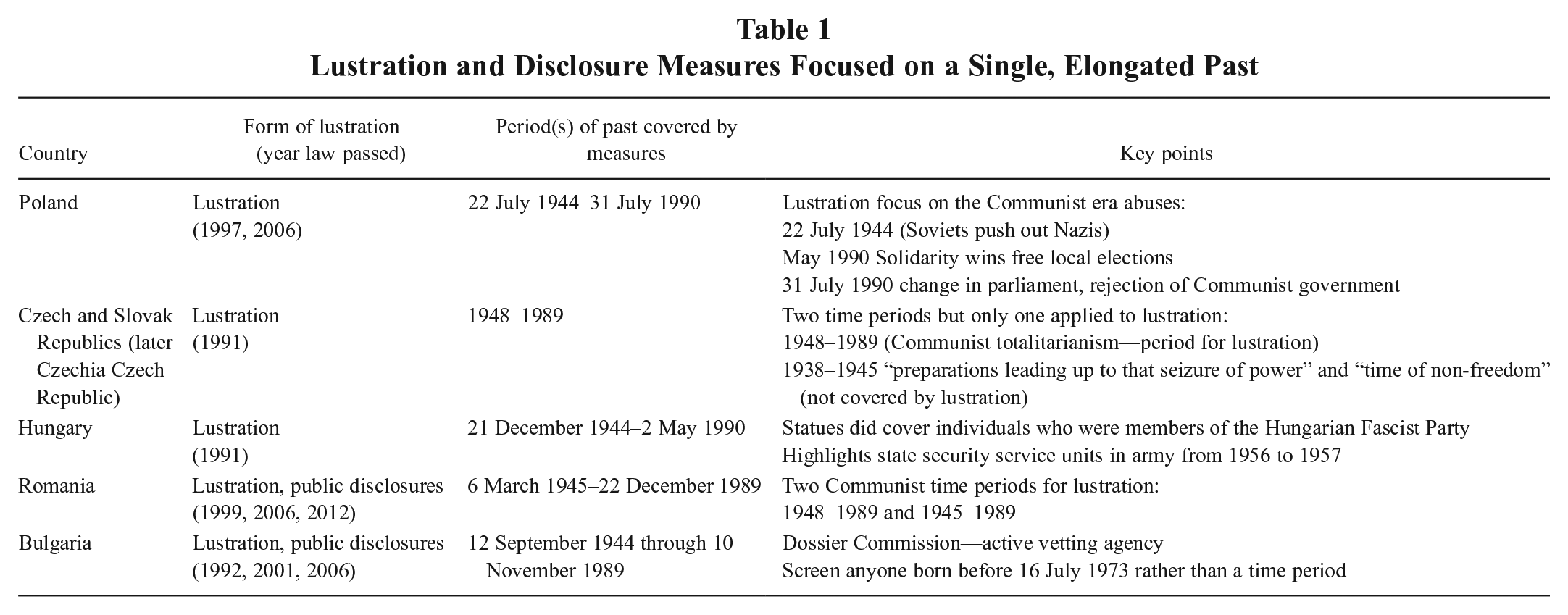
For example, the 1991 Czechoslovak lustration law, the vanguard for the region, covered the period from 25 February 1948 to 17 November 1989, bracketing the period from the Communist seizure of power to the Velvet Revolution and highlighting some crucial historical moments like the Prague Spring. 45 Poland’s lustration parameters closely cleaved to the historically recorded start (22 July 1944) and the end (31 July 1990) of Communist rule. 46 Hungary’s 1991 lustration law focused on offenses committed under Communism, with some specific dates highlighted, such as the 1956 uprising. 47 The Hungarian, Czech, and Polish secret police file repositories and memory agencies mark and acknowledge broader periods of oppression. The Czech Institute for the Study of Totalitarian Regimes differentiates 1938–1945—the “time of non-freedom . . . [including] preparations leading up to the seizure of power”—from 1948 to 1989, the “time of Communist totalitarian power.” 48 The Polish Institute of National Remembrance covers a range of crimes and atrocities committed by “the security apparatuses of the Third Reich and the USSR” from 1939 to 1990 as well. 49 While significant for memory studies, these even broader periods of time are not covered by lustration.
Romania used public disclosures as a means of advancing a type of informal lustration in the face of political fighting and problems with the implementation of lustration laws. 50 Despite differences in implementation compared with the Czech vanguard program, Romania’s temporal approach to lustration functionally replicated others in this category. Romania differentiated periods within Communism, marking historical moments related to changes in the authority and independence of the security services (the Securitate) in the immediate post-WWII environment (1948–1967) and the years of consolidated Communism (1967–1989), with all periods covered by lustration. 51 Bulgaria also used public disclosures as an informal lustration program, after its initial lustration laws languished under domestic opposition. Bulgaria is the only country in this group that did not set out lustration parameters in terms of years, instead stipulating that anyone born before 16 July 1973 and working in certain broadly understood positions of public trust would be screened and publicly disclosed for previous regime collaboration. 52 Functionally, this meant that anyone older than eighteen years could be lustrated, without specifying an outside temporal limit. 53
These elongated temporal windows for lustratable offenses stand in contrast to the Council of Europe’s prescription that lustration should capture only one decade of the past. In its 1996 precedent-setting policy “Measures to Dismantle the Heritage of Former Communist Totalitarian Systems,” it explained that crimes of the distant past were not threats to the democratic transitions.
Lustration shall be imposed only with respect to acts, employment or membership occurring from 1 January 1980 until the fall of the communist dictatorship, because it is unlikely that anyone who has not committed a human rights violation in the last ten years will now do so (this time-limit does not, of course, apply to human rights violations prosecuted on the basis of criminal laws).
54
In 2006, the Council of Europe reaffirmed its original position, reminding states to conclude any outstanding lustration programs, as they were legally questionable, administratively unnecessary, and inconsistent with consolidated democracies. 55
Two main temporal findings emerge from this set of cases focused on a single Communist past. First, these cases adopted a longue durée view of the Communist past, reaching to the start of Soviet domination to mark the window of lustratable offenses. This elongated time period went decades past what the Council of Europe thought was necessary to protect the democratic transitions and exceeded UN vetting guidelines. 56 In short, even these “expected cases” created temporally expansive windows of the past for lustration, stretching decades farther back than personnel reforms might imply. Second, the temporal bracketing and historical specificity of the lustration parameters suggest that lustration was being used as more than a personnel reform device or a truth-telling mechanism; it also served as a historical marker, flagging important events in time and periodizing history before and after Soviet influence. The next set of cases will return to this periodization, situating lustration within a nation-(re)building narrative.
Multiple Pasts
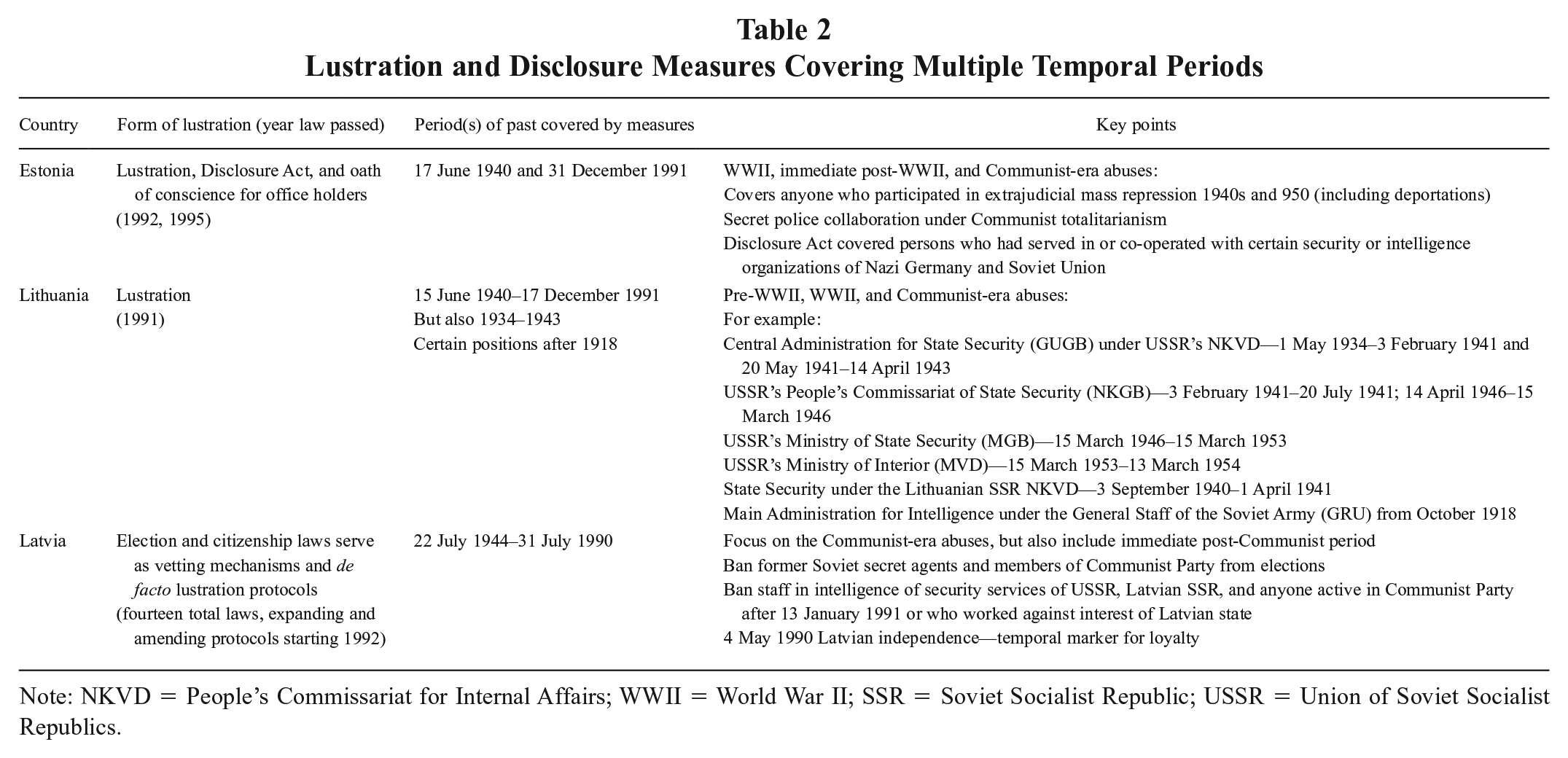
Countries in this group designed lustration measures to cover multiple temporal periods, both stretching the reach of lustration into the distant past, including WWII and pre-WWII era abuses, and/or extending it into the immediate post-Communist period (see Table 2). Abuses committed by different actors, across different political regimes, over different historical periods are bundled and layered, highlighting webs of complicity across time and actors. This temporally expansive approach accompanied a conceptual expansion of lustration’s functions as well, expanding lustration beyond personnel reform and truth-telling measures to historical narrative revision and nation-state (re)building mechanisms. 57
Lustration and Disclosure Measures Covering Multiple Temporal Periods
Note: NKVD = People’s Commissariat for Internal Affairs; WWII = World War II; SSR = Soviet Socialist Republic; USSR = Union of Soviet Socialist Republics.
Estonia’s lustration processes were advanced by several types of punitive and truth-revelatory laws, including oaths of conscience, disclosures of previous regime complicity, and citizenship laws. 58 False oaths of conscience (süümevanne) about collaboration with either Nazi Germany or the Soviet Union rendered civil servants and office holders ineligible for public employment. 59 The Citizenship Law (1995) and Disclosure Act (1995) set out procedures to identify, make public, and exclude individuals who collaborated with the KGB or Nazi security services from 1940 through 1991. 60 All measures shared an expansive temporal scope from Nazi Germany through Soviet-era Communism to independence.
Lithuania’s original 1991 lustration law was vague regarding the time periods of the past covered, but the amended 1999 law specified a window of actionable offenses from October 1918 through 1 January 1992. 61 This created an expansive set of pasts for lustration, encompassing the pre-Nazi, Nazi, Soviet, and immediate post-independence periods. Within this more than seven-decade range, time periods were historically specified and detailed by unit and division. For example, lustration included individuals in Department 4 of the USSR People’s Commissariat for Internal Affairs (NKVD) Main Directorate of State Security (GUGB) from 29 September 1938 to 8 February 1941. Anyone who worked in the Main Administration for Intelligence under the General Staff of the Soviet Army from October 1918 was captured under the same lustration umbrella. 62 Someone who was twenty years old in 1918 would be 100 years old at the passage of this 1999 lustration law. The specificity of the law combined with the temporal range suggests lustration functioned not just as personnel vetting measure and truth-revelatory mechanism, but as an intentional historical marker as well.
Latvia adopted a constellation of lustration-like measures similar to Estonia, employing election protocols, loyalty affidavits, and citizenship laws to vet positions of power in the new regime. 63 Citizenship laws distinguished Russians and other nationalities from Latvians or their descendants, defined as citizens prior to Soviet annexation on 17 June 1940. 64 Latvia’s lustration did not have a pre-Soviet element, focusing instead on the “material and moral damage” committed by the KGB under Soviet occupation. 65 While this might appear more like a case of a single past, Latvia’s measures extended the temporal parameters into the post-independence period, creating a temporal arc over multiple, distinct historical regimes. For example, the Electoral Law (1995) barred candidates who had been active in the Communist Party of Latvia after 13 January 1991 from standing in parliamentary elections, thereby extending measures past Latvia’s independence on 4 May 1990. 66 The Latvian government justified the temporal elongation as necessary to counter internal pro-Soviet challenges to the new democracy, citing an attempted coup in January 1991, challenges to the March 1991 independence plebiscite, and an attempted coup in August 1991 by the Latvian Communist Party. 67
The ECtHR criticized the elongated temporal parameters used by the Baltics on legal and normative grounds. In Sõro v. Estonia (2016), the ECtHR argued that going back to Nazi-era offenses was too long a historical period of time for lustration. The ruling reconfirmed that lustration was appropriate for a period no earlier than 1980 and no later than the ratification of the new constitution after independence, arguing that “maintaining a legal obligation to confess non-criminal, professional activities that may have occurred thirty-five to seventy-five years ago is pointless.” 68 Estonia was also warned that expansive temporal parameters were more prone to misuse and political instrumentalization, and should be avoided to prevent “partisan discrimination, personal revenge, and political witch-hunting.” 69
The case of Ždanoka v. Latvia stands as an exception to the temporal prohibition against extending the window of time for lustration past independence. 70 In an unprecedented case, the ECtHR accepted Latvia’s short temporal extension of lustration into the post-independence period on the grounds that sufficient evidence existed that pro-Soviet groups posed an immediate threat to Latvia’s democratic transition. All subsequent efforts by post-Communist states to invoke this precedent have been rejected by the ECtHR. Instead, court decisions have reinforced a temporal wall between pre- and post-independence periods and abuses.
Taken together, countries in this group illustrate three key points about time and transitional justice. First, it is not simply that states aggregated crimes from multiple time periods under a single transitional justice umbrella. The temporal stretching of lustration highlights the relationships made between the crimes and perpetrators across the different time periods. Nazi and Soviet aggressors conspired, creating duplicitous entanglements and human rights abuses across periods of occupation. 71 Moreover, the crimes of Communism in Latvia bled over into threats to the new state after independence. Such temporal stretching raises awareness of the complicities of perpetrators of abuses across time periods. Second, the very long periods of the past covered by lustration, replete with detailed periodization and department-level specificity, scaffold a historical narrative focused on foreign perpetrators of abuses. 72 Creating a temporal arc over pre-Nazi-era, Nazi-era, and Soviet-era crimes brackets a prolonged historical period of occupation in between periods of independence. This reinforces a narrative that these nations were not willingly complicit with actions committed on their territories over these periods. 73
Third, this periodization and elongated temporal arc support othering narratives, in which the primary culpability for crimes committed during these periods can be othered on occupiers and outsiders. Such othering helps to navigate the challenges of Baltic complicity with both Nazi and Soviet aggressors, something which “blurs otherwise clear distinctions between resistors, perpetrators, and victims.” 74 Citizenship laws in Estonia and Latvia vet based on nationality, not complicity, resulting in the targeting and exclusion of Russians based on ethnicity not actions. Davoliūtė and Budrytė note that this othering narrative minimizes the noted complicity of Lithuanian nationals in both the Holocaust and Communist-era abuses. 75 Such a distortion of the intention of lustration and vetting programs, potentially compromising their legitimacy and legality, is something which the ECtHR has addressed in several cases. 76
Shadow of the Past on the Present
A third set of countries stretched the reach of crimes covered by lustration decades into the post-independence period (see Table 3). Albania, Ukraine, and North Macedonia’s lustration umbrellas covered Communist-era crimes, immediate post-Communist crimes, and crimes and abuses even twenty years after the transition, drawing a temporal arc linking the crimes of the past to the crimes of the present. States argued that high levels of current corruption were linked to or abetted by the continued influence of Communist-era networks, stymieing economic and political reforms. While other post-Communist states also framed lustration as anti-corruption devices, these countries did not actually extend the temporal reach of lustration to encompass crimes Committed after independence. 77 In contrast, this group of countries extended the temporal range of lustratable offenses to include actions committed in the post-Communist period, thereby explicitly expanding the transformative intention of transitional justice.
Lustration and Disclosure Measures: Shadow of the Past on Politics of the Present
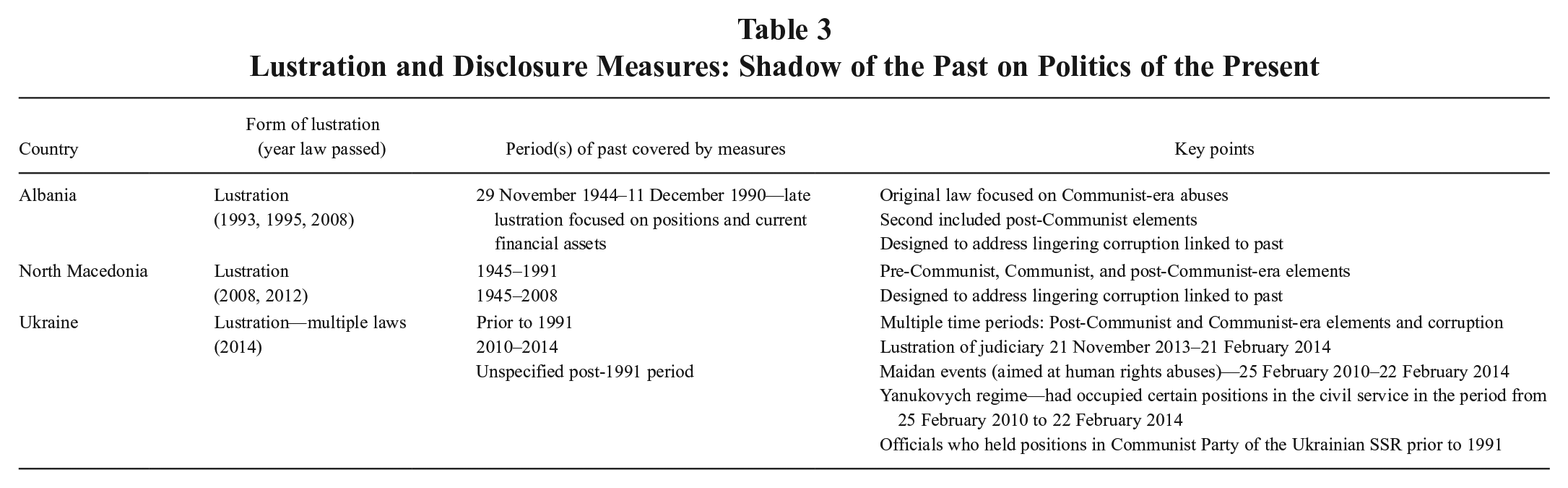
Albania passed several lustration laws early in its transition, focused on the proximate Communist period, but they were limited in their implementation, suffered from political instrumentalization, and expired with little impact. 78 A series of revised lustration measures in 2015, 2016, and 2018 revisited lustration and expanded its temporal scope. The measures targeted elected and appointed public office holders, judges, prosecutors, and the police, screening for evidence of previous regime collaboration and/or evidence of unaccounted for material gains, asset holdings, and connections with organized crime. 79 In this way lustration was based on crimes committed in the past and crimes committed in the present. 80 The Venice Commission noted that the laws were vague in terms of duration, the length of employment restriction, and the periods of the past to be screened, and it asserted that they pushed lustration beyond transitional justice. 81
Linking corruption in the present to lingering Communist-era criminal networks from the past, Albania argued for a temporally expansive approach to lustration, capturing crimes after the transition. 82 Using the rationale of democracy preservation, Albania argued that the relationships between criminal networks and public office holders “pose[d] a serious threat to [the] integrity and functioning of democracy and democratic institutions and to the national security.” 83 Passed more than twenty-five years after Albania’s transition in 1991, these measures drew an arc over crimes committed in the Communist period and crimes committed in the post-post-Communist period. While acknowledging the severity of corruption in Albania, both the Venice Commission and the ECtHR nevertheless rejected Albania’s sweeping temporal scope and the inclusion of post-transition periods under the same lustration umbrella. 84 As of 2021, Albania had not followed through with these lustration measures, with only limited vetting in practice. 85
Like Albania, the former Yugoslav Republic of Macedonia (hereafter North Macedonia) passed, revoked, and revised several lustration laws, until finally passing a set of procedures late in the transition process. Together, the 2000 and 2008 lustration laws regulated the public identification of collaborators covering the period 2 August 1944 to 30 January 1998, creating an arc from the post-WWII period, through the Communist period, into the post-Communist period, and extending well past independence. 86 Since North Macedonia marks independence as 8 September 1991, this temporal window extended lustration’s actionable crimes seven years past independence. North Macedonia cited high levels of corruption linked to Communist-era networks as part of the rationale for its temporally elongated approach. 87 Like Albania, the central debate was not whether current corruption was tied to Communist-era networks, but whether transitional justice was an appropriate way to tackle it.
Stretching the periods of time covered by lustration provoked domestic discord. In 2010, the North Macedonian Constitutional Court declared several provisions of the 2008 Lustration Act unconstitutional, including the extension of lustration to actions and affiliations after independence. 88 To support its decision, the Constitutional Court invited the Venice Commission to review the Lustration Act. The Venice Commission concurred with the Court’s ruling and presented a two-pronged rationale against temporally expansive lustration. 89 First, the Commission argued that retrospective justice mechanisms, like lustration, were not the tools to address current problems with corruption. Any threats to democracy after the transition should be addressed with regular rule of law mechanisms, not extraordinary transitional justice measures. 90 Transitional justice measures often require rule of law derogations, which are permissible only for delimited and extraordinary windows of time during a transition. Second, the Commission argued that individuals from the distant past do not pose much of a threat to democracy as time elapses.
Lustration shall be imposed only with respect to acts, employment or membership occurring from 1 January 1980 until the fall of the communist dictatorship, because it is unlikely that anyone who has not committed a human rights violation in the last ten years will now do so.
91
This reinforces the Council of Europe’s and ECtHR’s legal arguments that stretching lustration to cover crimes of the present—even ones linked to the past—was both legally inappropriate and administratively unnecessary.
The Constitutional Court’s decision remained domestically contentious. The ruling party asserted that under the guise of adherence to rule of law principles, the Constitutional Court minimized the time covered by transitional justice to protect itself and the President from corruption disclosures. 92
Having in mind that the Constitutional Court’s current composition was appointed during the political zenith [of the former President of the Republic], [the ruling party] believes that canceling lustration’s scope of application after 1991 has one goal only: to prevent the Lustration Commission and the citizens of Macedonia from learning whether [the former President of the Republic and his party] officials, who controlled the secret services, actually used those structures against their political opponents.
93
The first North Macedonian lustration case heard by the ECtHR involved charges against the former President of the Constitutional Court at the time of the lustration debate (2003–2011), who was later outed for a false lustration attestation, hiding his former secret police connections. 94 In the face of domestic battles over lustration, changes in domestic leadership, on-going corruption, and the illegal surveillance scandal involving the former prime minister Nikola Gruevski, lustration efforts foundered and were not implemented. 95 As previously reviewed, questions about how long and how late to employ lustration have been politicized in some CEE programs. The case of North Macedonia illustrates the potential politicization of the third temporal parameter, namely the periods of time covered by lustration.
Ukraine stretched the temporal reach of its lustration measures to cover crimes and actions committed across different regimes in different periods: the Communist period, the immediate post-Communist period, and the post-post-Communist period. Enacted twenty-three years after independence, Ukraine’s 2014 lustration program consisted of multiple lustration laws, bills, and policies to vet the security sector, the intelligence services, and the public sector. 96 Similar to other regional programs, Ukraine’s lustration included key de-Communization elements, targeting former KGB agents, individuals with connections to the secret police, and members of Ukraine’s Soviet Socialist Republic’s security bodies in the pre-1991 Communist period. However, the laws also extended the temporal scope for lustratable offenses into the period after Ukraine’s independence from the USSR in 1991, specifying officials under former President Viktor Yanukovych from 25 February 2010 to 22 February 2014 and individuals who committed rights violations during the Euro-Maidan Revolution (the Revolution of Dignity) from 21 November 2013 to 23 February 2014. 97 This expansive swath of time linked and layered a range of crimes and perpetrators, including Communist-era human rights offenses, war in the Donbas region (2014), conflict in Crimea (2014), and abuses perpetrated against Euro-Maidan protesters.
The Ukrainian government presented a democracy promotion rationale for its temporally expansive approach to lustration, pointing to the continued staffing of central and local government authorities with former Communist elites as evidence of a pressing need for personnel reforms. 98 Like Albania and North Macedonia, Ukraine suggested a temporal continuum between the Communist-era secret police networks and the economic and political networks fueling corruption in the post-Communist environment. 99 To bolster the anti-corruption elements of lustration, Ukraine also included financial transparency and financial auditing elements into its reforms, and it tasked the Lustration Commission to coordinate its work with new anti-corruption institutions. 100 In this way, lustration looked to the past and to the present for criteria for vetting.
The Venice Commission, the Council of Europe, and the ECtHR raised many legal concerns with Ukraine’s approach to lustration, but for this article only two problems associated with the expansive temporal parameters for lustration are considered. 101 First, the institutions inserted a temporal wall separating acts prior to Ukraine’s independence from the USSR from acts committed after 1991. The ECtHR argued that while it supported the right of states to use lustration and public sector loyalty criteria to protect their new democracies from the past, this did not mean that such measures could be used on acts and abuses committed in a post-transition environment. 102 The Council of Europe contended that stretching lustration from the Communist period across the post-post-Communist periods was tantamount to “questioning the actual functioning of the constitutional and legal framework of Ukraine as a democratic state governed by the rule of law.” 103 Second, the conceptual stretching of lustration into an anti-corruption mechanism was viewed as inconsistent with transitional justice, blurring the distinction between retrospective and prospective justice. Both the ECtHR and the Venice Commission criticized the adaptation of lustration into an anti-corruption measure, arguing this was most appropriately dealt with using ordinary rule of law measures consistent with Ukraine’s democracy. 104 Like the Albanian and North Macedonian cases, the message remained that although high levels of corruption might have links to the past, lustration should not be repurposed as an anti-corruption device in the present.
The temporal stretching of lustration in the cases presented in this section reveals two main findings. First, states created an expansive temporal arc linking the crimes of the past to the crimes of the present, and in so doing they repurposed lustration from transitional justice mechanisms to post-transition reform measures. In these cases, lustration partially reflected efforts to address enduring problems related to the shadow of the past, namely a lack of bureaucratic turnover and high levels of corruption. While the ECtHR and Venice Commission thought ordinary justice measures could be used to address the problems of current corruption in these countries, the rampant corruption noted in all three cases suggested otherwise. States and institutions reasoned differently about the appropriate use of extraordinary justice measures—like lustration—to address extraordinary problems decades into the transition.
Second, the period of the past/present selected in these cases for lustration illustrates an element of potential domestic instrumentalization. Either elongating or foreshortening the window of time covered by lustration can reflect political machinations, advantaging some political actors and disadvantaging others. In the case of Ukraine, elongating lustration to target officials complicit with Yanukovych in the post-independence period was flagged by the Venice Commission as politically motivated. In the case of North Macedonia, foreshortening the window of lustration to exclude sitting officials similarly appeared politically motivated, despite being justified as in compliance with rule of law principles. We know that delayed measures and elongated measures are susceptible to politicization. This section has illustrated that the third temporal dimension—the period of time covered by transitional justice—can also be instrumentalized.
Why Do Contending Temporalities Matter?
Lustration as a form of transitional justice is usually temporally tied to a certain past—the Communist past. This article has illustrated much more temporal variation in practice in eleven post-Communist states. Countries elongated the temporal reach of lustration into crimes of the distant past(s) and forward to the politics of the present, in some cases encompassing multiple pasts and multiple perpetrators. Even “typical” states focused on a single Communist past have interpreted this through a longue durée lens spanning more than four decades. Some countries drew a temporal arc stretching back more than eighty years, covering the Nazi occupation, WWII, and various Soviet occupations within their lustration umbrella. Others extended the shadow of the past decades into the politics of the present, encompassing crimes committed more than a decade after independence. In this way states have layered the crimes of multiple periods, linking them more than sequencing them in their justice programs. This conflicts with the Council of Europe’s interpretation of lustration as delimited and applicable for crimes committed only between 1980 and independence. There are several reasons why the contending temporalities surrounding the use of lustration in CEE matter for our understanding of transitional justice.
First, the contending temporalities illustrate differences in expectations and use of transitional justice held by countries and institutions. The ECtHR, Council of Europe, and Venice Commission argued that lustration is an extraordinary justice measure. The possible due process derogations and rule of law deviations render them potentially legally problematic, and therefore they should be exceptions to, not substitutes for, ordinary justice. 105 To support this argument, the ECtHR and Venice Commission inserted a hard temporal wall between pre-independence and post-independence abuses, arguing extraordinary justice solutions should not be applied to the post-independence period, as this could undermine democratization. Moreover, consolidated democracies need not resort to such legally problematic justice mechanisms. In practice post-Communist states have challenged this hard temporal distinction, arguing that extraordinary justice measures continue to support their democratic consolidation. Presenting evidence that the shadow of the past corrupted politics of the present, states utilized temporally fluid understandings of lustratable offenses. The post-Communist examples suggest the need for more intentional consideration of how the past blurs into the politics of the present. These contending temporalities raise broader questions, including the mix of backward and forward justice elements and ordinary and extraordinary justice elements most appropriate in transitional justice programs. 106 This is relevant not only in the context of lustration, but for any form of transitional justice in which temporal parameters set boundaries for abuses and redress.
Second, time is an underexplored variable in transitional justice evaluations. Studies that have comparatively explored how the timing and duration of lustration impacted democracy and trust have called into question blanket assumptions that late measures are bad and long measures are ineffective. This study suggests that a third temporal variable—the periods of the past/present—merits more intentional, comparative examination. It is possible that multiple pasts or multiple periods of time covered by transitional justice could support or alternately undermine transition goals. It is also possible that measures linking the recent past to the present might be even more efficacious in advancing transition goals. At this point in our empirical work, we just don’t know. Stepping into this empirical lacuna, this article has suggested ways to start investigating this research question, providing three operationalizations of a temporal scope variable—single past, multiple pasts, and past–present continuum. This suggested categorization is generalizable to cases outside the Communist sphere and malleable enough to allow for additional considerations, such as multiple regimes in a single past or single regimes across multiple time periods. Although it is outside the scope of this article to present an empirical test of the consequences of the different periods of time covered by measures, this study invites more empirical work on the conditional effects of temporal parameters on transitional justice.
Third, changing the temporal parameters covered by lustration is one way to repurpose the intention of the measures. This piece has illustrated that along with a temporal stretching of lustration, there has been a concomitant conceptual stretching of its intended impact beyond the originally conceived democratization and trust-building goals. Temporally expansive lustration can also serve to revise historical narratives, facilitate nation-state (re)building, and target new and old corruption. With this conceptual stretching of lustration as a form of transitional justice, new legal, moral, and political considerations could arise, which have yet to receive systematic scholarly attention.
Moreover, this raises implications for how we test the impact of lustration. When coding cases of lustration one might consider variation in both the temporal forms of lustration and the goals of these temporally modified measures. For example, a temporally elongated and periodized approach to lustration marking periods of occupation and redefining categories of perpetrators and victims might not advance the original lustration goals of trust-building and personnel reform as much as other goals, such as historical narrative revision and nation-state (re)building. Therefore, to evaluate the impact of this malleable form of transitional justice, we must amend our thinking about the meta-goals linked to lustration. Given the oft-used nature of personnel reforms as transitional justice measures, more intentional consideration of how certain temporal parameters might advance different meta-goals is vital to program design and would support the UN’s call for design reconsiderations in future transitional justice programs. 107
