




Abstract
Who gets to benefit from failure is a hot topic in recent research on science and innovation. This article articulates the phenomenon of failure privilege on the terrain of public policy, that is, circumstantial and institutionally ingrained dispositions to use policy downfalls, derailments, and crises as resources of policy action, tools of integration, and dynamism. Building on analyses of policy failures, the article advances a typology of three forms of privilege: exploitation, (in)visibilization, and projection of policy futures. It brings illustrations from abortion policymaking in Poland. Here, failure privilege interacts with a bio-political and culturally polarized setting that further blends neoliberal mechanisms of failing with post-Communist transformation of cultures of failure. This leads to the argument that exploitation and controversial interventions in public policy demand legitimacy that is today constructed by advancing imaginaries and models of failure that allow actors to both visibilize new futures and advance a policy stalemate. Failure is a powerful resource of integration and even surveillance, as well as a factor furthering the politics of waiting. Redefining it is a crucial policy win and entails complex and implicit mechanisms impacting policy agendas.
Introduction
Two assumptions seem to underline recent critical failure studies. First, failure is a subject that deserves to be researched more closely. Second, failure often unfolds as a resource, and even as a privilege. Both these propositions come from the generalization of failure rhetoric and narrative, coupled with attempts and initiatives to democratize failure, render it more inclusive, and discuss it in terms other than the traditional lack of success. The article builds on current efforts to see failure as tied with ignorance, exploitation, neglect, and the economic and political projections of our future. It articulates failure privilege and highlights manifestations in the area of abortion policy in Poland that allow our analytical horizon on failure to be extended.
Failure privilege, we argue, constitutes the most intriguing and challenging puzzle to be resolved, not solely conceptually and methodologically but also in terms of politics, policymaking, and social emancipation. Scientists, from behavioral economists to sociologists and anthropologists, social movements, personal life coaches, and sportspeople—to give just the most visible examples—reframe failure as we speak. And they do so by addressing emerging forms of inequalities, invisibilities, exploitation, and power dynamics. System, market, and information failures are shown to be leading to income inequality 1 and environmental injustice. 2 Failure to ensure access to sexual and reproductive health services and reproductive “non-knowledge” is shown to foster economic inequality and influence reproductive politics. 3 These are considered to impact our imaginaries of success and failure and to influence behavioral patterns of investment in human capital and education. 4 At the same time, it reveals that the concatenation of failure with future and inequality is not a given, but emerges from historically contingent and socio-economically particularized dynamics, as illustrated by Van Oyen 5 about failure in the Roman world. Failure is thus increasingly being framed as an issue of inequality, injustice, and vulnerability. It is seen as an issue of privilege.
We profile privilege based on reflections in distinct domains and illustrations of how failure functions—from research on the laws and principles of success in science studies to failure analysis in policy studies, and finally the practice and politics of abortion policy in Poland. All these forms of failure privilege should be taken into account if we want to construct and articulate failure research in a manner that is integrative, global, and comprehensive. This article builds on our familiarity with failure research in science, security, and innovation studies, as well as in critical failure studies and on deep and long-term involvement with policy issues and contested policymaking in Poland, such as in relation to abortion policy. Our analytical ambition, however, is to mobilize toward an even more interdisciplinary and globally comparative inquiry and unravel the social and politically complex dimensions of failure privilege and the extent to which this functions as a resource of politics and policymaking.
The article evolves in a few steps. (1) We survey the ground in relation to recent failure research. (2) We begin with studies of the laws and principles of success in competitive contexts, as these constitute one of the most advanced undertakings in terms of quantifying failure dynamics in competitive environments, such as science, art, and startups. We show how these recent explorations of the laws and principles of success unravel preferential distributions of the power of failure and the magic of success in society. Yet they also look at failure predominantly in relation to success, which means many of the other contemporary forms of failure are left out of the question. (3) Following this, we take policy studies into account, an area of research that has considerable experience with tackling failure. We show how policy studies go beyond the issue of success. They have a good sense of the circumstances of policymaking that are even more “demoralizing” than our usual understanding of failure. Political ignorance and regulatory stalemate, for instance, feed on policy frustration and political marginalization, as they prevent something that, in the case of a lack of success, comes by default—closure and movement to the next level. Overall, we show that policy sciences allow us to distinguish as many as three forms of failure privilege that are all liberated from success: exploitation, (in)visibilization, and future projection. (4) We turn to abortion policymaking in Poland and explore how these three varieties manifest themselves with respect to an already bio-politically loaded context and culturally controversial issue. They are all present while also displaying some particularities in relation to the local context of reproductive policymaking. Exploitation, for instance, more than the pragmatic usage of crises, entails legitimized political inaction and tolerated structural violence against groups of members of society that are vulnerable to policy change. (In)visibilization of failures becomes a tool of control, surveillance, and new policy change mobilization, while future projection ensures that controversial policy changes are rendered acceptable by advancing new policy imaginaries and reinterpreting our models of failure and the logics of privilege. These findings allow us to conclude that failure privilege is one of the most sophisticated tools for advancing policymaking. The manufacturing of failure situations is something that contemporary policies cannot do without. Failure privilege is about both the known and the unknown, both straightforward/pragmatic and indirect/symbolic. It entails both violent actions and legitimized delays. This makes failure privilege in the field of bio-politics and reproductive governance all the more resourceful and productive, not only locally but also globally.
What Is New about Failure?
This is a rather tricky question, considering that several authors seem to agree we are rather predisposed to think about and focus on success. Failure, although feared and even obsessive, is more at the tail end of our concerns and imaginaries. As argued by Wang and Barabási 6 in relation to science studies, we are complacent about a certain “ignorance of failure” and have a long way to go to catch up with the implications of this inattention, as well as on how we should be straightforward about it.
Amid this background of general ignorance of failure, it is interesting to note that contemporary crises and unexpected events have, nevertheless, initiated an unprecedented discussion and awareness of failure. Although seemingly ignored, failure occurs as the main interpretative trope in relation to crises. Failure rhetoric prevails. We generally live in a context where “crises are failures,” as skillfully depicted by Best, 7 meaning we interpret crises as symptoms of broader dysfunctionalities and as political and policy misfits. We use failure framing, jargon, and mindset to tackle new areas of contestation and polarization and to raise inquiries regarding the potential of crises and setbacks to trigger social changes and the meaningfulness of their impact. Failure framing is not only an individual act or modality to depict setbacks but also an outcome of existent “cultures” and “regimes of failure.” 8 The framing is done by social agents (policymakers, the media, etc.), but this only echoes the collective and institutional understandings of failure that describe the context and manufacture capacities to fail. Specific social agents depict failure one way or the other contingent on how failure is being projected in their domains. They may even challenge the existent norms of success and projections of failure. Yet, it is important to understand that all this failure work is referential and relates to existent practices of framing failure in social and policy domains.
Failure is less an event, or a point of demarcation, of what is and what is not accomplished, but more a cultural system of expectations, valuations, and forms of anticipation, patterns of behavior, and interactions with practices of contestation. 9 This means that the globalization of failure unfolds as globalization of the rhetoric of doubt and contestation, and of anticipatory forms of invalidation. The expectation is that policy initiatives do not succeed, they succeed but not the way they used to, or they do not succeed at all. The issue of social change, for instance, is contested using failure rhetoric to the point that social scientists are skeptical of whether crises do actually trigger meaningful revolutions. This is why the 2015 migrant crisis was so predominantly referred to as “the so-called refugee crisis.” 10 Big and critical failures, such as those linked with economic crises, disappoint in their impact on power relations, a phenomenon discussed by Best 11 as “neoliberalism’s ‘unfailures.’” Crises are expected to bring radical change. Yet, more often than not, “things don’t fall apart,” and change unfolds rather incrementally and only rarely as a powerful blow. 12 The authors unravel the symbiotic relation between inequality and failure. They emphasize critically that failure is uneven and related to deeper structural vulnerabilities and systemic injustices. Not only is inequality “unfair” and unequal, we learn, but so too is failure.
There are considerable contradictions between what failure is expected to be and how failure unfolds in everyday life and public policy. This is why the association of failure with inequality is such a powerful frame and narrative and why recently advanced perspectives on failure have an increasingly critical and reflective component. These processes draw attention not only to what failure is and what it should be, but also to how failure allows the reproduction of power relations in society, the cumulative advantage of existing asymmetries, and the proliferation of strategic ignorance. 13
The role of failure in achieving success is also intriguing, and it is a puzzle who gets to benefit from failure and who does not. The usage of failure as a resource of action is neither self-evident nor a universal and egalitarian social capacity, so to speak. But it is very much contextual, as well as provisional, on the power relations in society. We refer to such exploitative capacities as failure privilege—that is, the contingent and institutionally ingrained capacity of social agents to use policy downfalls, derailments, and crises as a resource of action and as a tool of integration and dynamism in policymaking. The mechanisms of failure privilege unfold in contexts marked by deep inequality and perhaps even injustice in how the experiences of failure are played out in society; how those who learn from failure, and who do not, are pre-selected; and how the required skills and dispositions to transform failure into success are distributed.
Model 1: Failure Privilege in Recent Studies of the Laws and Principles of Success in Competitive Contexts
In trying to understand failure privilege, the best place to start is arguably the recent attempts to quantify failure and to grasp how and when this might turn into success. Such research has been carried out with impressive findings in relation to competitive contexts such as science, startups, technology, and even art.
Barabási,
14
for instance, employs a quantitative methodology aimed at unraveling the patterns of success and failure in science. He sees the “trajectory toward success” as entailing moments of recognition, appreciation, and praise, meaning that, more than performance, success is a public endorsement of performance. This is why, for this author, it is fundamental to define success as a “collective phenomenon rather than an individual one.”
15
Recognition and appreciation are public statements of achieved status that are conditional on complex and demanding social processes that cannot be taken for granted but have their own rationalities and timing. Barabási shows how the existent logics of valuation have the tendency to be biased toward already existing forms of success. Appreciation is lent to the already successful idea or project, which is socially pre-selected for “preferential attachment”:
Yet instead of endorsing unknowns and underdogs, we too often choose the superstars in our networks. That’s the mechanism behind wealth inequality and unbounded success. Preferential attachment explains why life isn’t fair.
16
Barabási’s preferential attachment is a privilege because it facilitates the “chances” and “trajectories” of success that are embedded in the contexts of inequality. More than privilege, we add, it is also a failure privilege, because who can be successful and who cannot be also sets the boundaries of who can use failure as a resource and who cannot. Coping with failure, refashioning it as a source of resilience and productivity is a socially and institutionally ingrained capacity of social agents. As with the “capacity to aspire” that was theorized by Appadurai, 17 the possibility to fail in a manner that is productive and moves forward is a social skill. Barabási also mentions that early life successes turn out to be linked to the fact that young people can afford to be ignorant and neglectful of premature experiences of failure. In this, we see clearly how the privilege to ignore and neglect failure fosters resilience and productivity, which eventually leads to success. What is less obvious, however, is how the capacity to overcome obstacles and signs of a lack of success by ignoring is not within everybody’s reach. At older stages in life, for example, it is intuitively perceived to be unsuitable.
Yin et al., 18 yet more interdisciplinary-oriented researchers, quantify the path to success in three domains: science, startups, and security. They show there is a thin line separating those who “eventually succeed and those who do not,” 19 and that the two groups are, in fact, quite similar, just that they display distinct “failure dynamics.” It is essential, according to Yin et al., to have the capacity to learn incrementally from past failures, incorporate the signs and elements of initial setbacks, and build more effectively and attentively and in a manner that favors cumulative knowledge. These authors explicitly reveal failure privilege as an individually fashioned ability to move from failure to success through skilled and smart learning. However, it is observable that they also see it as played out more at the individual level—as the capacity of agents, be they individuals or organizations—than as a collective outcome asset.
Barabási 20 and Yin et al. allow us to see how research on the laws and principles of success accounts for the capacity to fail as an essential mechanism. Although these authors do not explicitly mention inequality and invisibility, they highlight strongly the preferential distributions of the power of failure and the magic of success in society. In Barabási’s analysis, failure plays out as privilege because here the definition of success as a collective phenomenon allows the logic of favoritism and preferential attachment to be captured, while in the investigation by Yin et al., 21 failure occurs as a skill of adaptive learning in competitive contexts with incremental changes of behavior that, slowly but surely, lead to success. These explorations conceptualize the differentiated dynamics of failure and slightly unequal trajectories toward success and failure as socially and cognitively ingrained capacities and advantages to cope with setbacks and obstacles. This is a remarkable analytical gain. However, we should note that the extent to which the modalities of learning are embedded in the cultures and contexts of success and failure, with their institutional, class, and gender determinants (Figure 1), is still blurred.
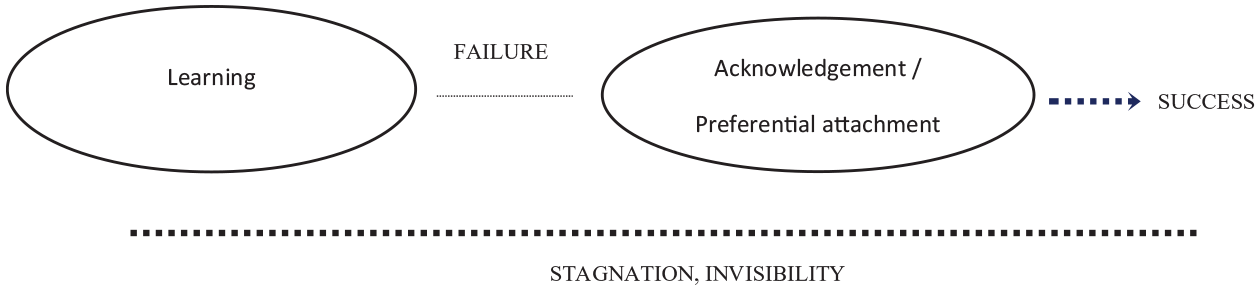
Failure Privilege and Dynamics—Recent Studies of the Laws and Principles of Success in Competitive Contexts
This raises the question whether the dynamics of failure and the patterns of success trajectories should indeed be taken up as allegories of structural vulnerabilities and social mobility injustices. Is failure privilege an issue of ability or one of advantage? Perhaps privilege is not such a good word for describing failure dynamics after all? It might bias us against depicting individual patterns of learning from failure and against the egalitarian effects of the dynamics of failure in general. These are all analytically legitimate questions, yet perhaps too complex to be dealt with within the limits of this paper. No matter how these small conceptual dilemmas end up being resolved, it is interesting to note that, in the accounts that summarize the findings of the science of success for a broader audience, the aspect of advantage, distinction, and privilege in coping with failure is always underlined. The paper by Yin et al., 22 for instance, is depicted in Scientific American with the following subtitle: “Scientists use big data to understand what separates winners from losers.” 23 Failure privilege, success privilege, and privilege, for that matter, come with candid rhetoric in everyday life. Meanwhile, the globalization of failure rhetoric has rendered the framing of failure through the lens of inequality even more ordinary.
Recent studies of the laws and principles of success in competitive contexts also allow us to see how failure is predominantly seen as an issue of inequality, yet in relation to success. Even in cases where the bias toward success is reflexively considered and critically discussed, the issue still remains that failure is seen and evaluated through the prism of success. Yet, we may ask, is the contemporarily predominant experience of failure due to a lack of success? Why is the “success/failure binary” so powerful? 24 Is this how we experience failure? What do we ignore and leave out when framing failure this way?
Model 2: Failure Privilege in Policymaking
Policy studies have a long tradition and rich analytical and methodological experience in looking into the problem of failure against the background of major themes such as coping, learning, and the persistence of failure. 25
While conceptually creative and empirically exploratory, this literature has mainly addressed failure dynamics in non-failure-privilege terms. The field is just opening up to critical exploration of the processes of exploitation and cumulative advantage that emerge in relation to failure—the “dark sides” 26 of policymaking. It is just beginning to feel the possibility of critically exploring the convergence between failure models and the accumulation of benefits and advantages in terms of framing the policy agenda. Interestingly, one of the main visible effects of this interest in the dark side is a shift in how failure is being conceptualized. As pointed out by Leong and Howlett, 27 policy studies usually see failure as contingency, policy learning as an effort aimed at transcending from policy failure to success and effectiveness, and policymaking as rather benevolent and driven by good intentions. Yet, as indicated by Howlett, 28 the moment we bring in policy volatility and the related behavioral risks, we reframe the nature and role of policy failures while also unraveling the more controversial and counterintuitive elements of “maliciousness” and “willful ignorance.” 29
Such critical sediments advance the relativization and decentralization of success in failure dynamics. They free failure from success by revealing a lot of the things that happen around policy failures. These processes may be related to success, but they do not have to be. Leong and Howlett, 30 for instance, concentrate in their analysis on “inherent vices”—“unpreparedness,” “uncertainty,” “maliciousness,” “non-compliance,” and “non-learning”—arguing that these constitute significant sources of policy failures and are conducive to “policy volatility.” The “vice” metaphor used here is quite relevant and resonates with the “pathologies” of complex policy systems that Mueller 31 talks about or with the “privileges” in policymaking indicated by Kasali. 32
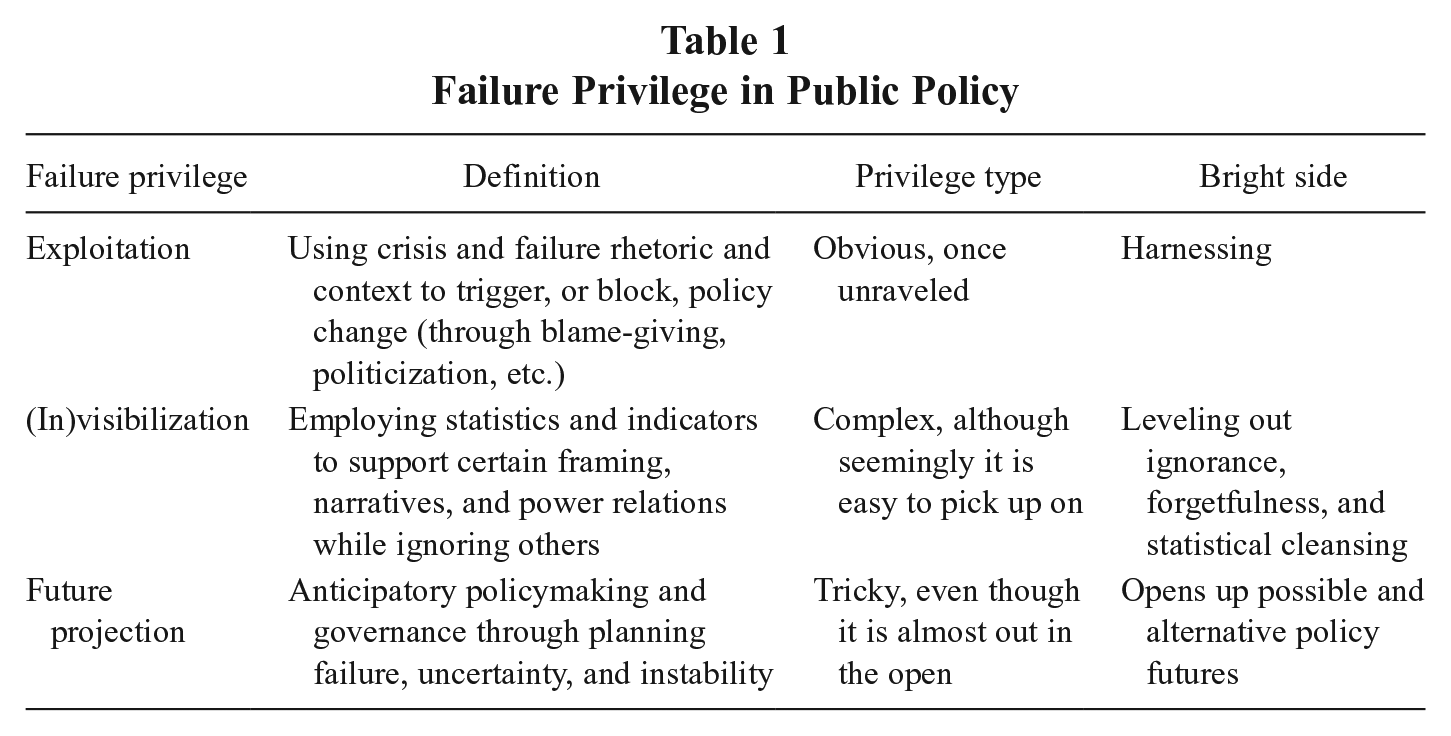
Failure analysis in policy studies allows us to discuss three instances of privilege in policymaking: (1) exploitation, when crisis and failure rhetoric and context are used to trigger, or block, policy change, such as through blame-giving, politicization, and polarization; (2) (in)visibilization, when statistics and indicators are employed to support certain framing, narratives, and power relations while ignoring others; and (3) projection of policy futures, when anticipatory policymaking and governance are realized through planning failure, uncertainty, and instability. The privilege type in each of these three cases manifests itself differently. In exploitation, privilege is rather obvious once uncovered. In (in)visibilization, it is complex and intricate despite its apparent simplicity. In the projection of policy futures, it is thorny and hard to read, although quite perceptible and ordinary. There is also a bright side to failure. In exploitation, failure harnesses policymaking, triggering innovation and resistance. In (in)visibilization, failure leads to disclosing ignorance and the related mechanisms of forgetting and misrepresentation. In the projection of policy futures, it allows the manufacturing and gaining of access to new and alternative possible futures (see Table 1).
Failure Privilege in Public Policy
Exploitation
Exploitation privilege means that crisis and failure rhetoric and context are used to put/defer policymaking into/from action, whether symbolically or instrumentally. This occurs in relation to processes such as blame-giving, politicization, and polarization. As Boin, ’t Hart, and McConnell 33 argue, “crisis exploitation” contemporarily unfolds as “the purposeful utilization of crisis-type rhetoric to significantly alter levels of political support for public office-holders and public policies,” especially amid policy and political responses to crises. This exploitation pattern may also be discerned in the case of failure.
Crisis and failure, as noticed by Best, 34 enjoy today a relationship of rhetoric and political complicity. 35 Crises have the tendency to behave as material allegories of systemic failures, and they are framed using failure speech, while failures, we may add, resemble crises in the sense of becoming more fragmented, accelerated, and interrupted by other crises or failures. Crisis exploitation and failure instrumentalization thus interact and, to a great extent, overlap and support each other. Several authors in policy studies show this symbiosis quite clearly. Ripoll Servent, 36 for instance, discusses how, amid the European refugee crises, the failure of the European Union (EU) asylum policy was framed as an “opportunity for success.” Maor, 37 meanwhile, analyzes the dynamics and structural opportunities for blame avoidance and crisis exploitation in the governance of COVID-19 in Israel. Blame games and the politicization of policy failures appear to be the main forms of failure exploitation. As indicated by Brändström and Kuipers, 38 policy failures are subjected to “selective politicization,” at the end of which some remain “normal incidents,” while others turn into “political crises.” Policy failures open blaming and politicization opportunities that may even lead to changes in policy practices, triggering risks of “politicized policy practice.” 39
The emancipatory and policy significance of crisis exploitation, which we term in Table 1 as the bright side of failure privilege, manifests itself in that it facilitates the engagement of alternative and unconventional resources. Easterling, 40 for instance, argues in the field of architecture that failures, collapses, and battles should be “harnessed” in the sense of being seen as of value and the source of design information and solutions more broadly. The privilege of using failure in policy studies occurs predominantly, however, in a strategic way. This urges us to look more into the policy value of the strategic exploitation of failure. An interesting example here is the instrumental employment of a “disproportionate policy response” in policy contexts that are emotionally overloaded (moral panics, fears) and may eventually turn out to lead to the achievement of policy goals. 41
(In)visibilization
(In)visibilization privilege means that the extent to which we make policy failures known or unknown can change the dynamics and agenda of policymaking. We usually think that privilege hides or obscures the experiences of failure, keeping failures out of view. Policy studies suggest, however, that there is also considerable advantage in the visibility of failure. The more failure in policymaking is real or expected, the broader the mobilization around it.
“Visibility” is identified by Howlett 42 as one of the six dimensions of policy failures, along with “extent,” “avoidability,” “intentionality,” “duration,” and “intensity.” The privilege stems from the considerable advantage in having our failures acknowledged, calculated, and statistically included in broader collections of data (on “modes of visibility” as power and visibility as resistance, see Gordon 43 ). One reason why visibility acts as a privilege is because failures are not evident from the outset. Bovens and ’t Hart 44 argue that “fiascos do not just ‘happen,’” and policy failures pertain to “contested constructs.” Meanwhile, Howlett 45 draws attention to the misclassification and miscategorization of policy failures—“different aspects and types of failure are often poorly specified and incorrectly juxtaposed.” (In)visibilization as a privilege alludes to the fact that despite the quite common rhetoric of failure, the apprehension and characterization of an event or process as failure is actually quite rare, or it takes place only in relation to pre-selected cases. The intuition of policy studies converges here with Appadurai and Alexander’s 46 view that “failure is not a self-evident quality of projects, institutions, technologies, or lives.” This indicates that failure is not only a social construction but also a battle over meaning and representation. And just like any battles and social processes that involve elements of recognition and contestation, failure is, likewise, in the eye of the beholder.
Failure is rarely a straightforward lack of success, but rather stalemate, abandonment, or frustrating limbo. This situation is so common and normal that we rarely formulate it as such. We do not realize that what is even more infuriating and frustrating than failure is being in a state where failure is not acknowledged, as in Barabási’s 47 analysis of the science of success, when performances that are not being credited are left behind, forgotten, disremembered—“If we don’t see, [. . .] if we [. . .] don’t find your project worthy, it will likely falter, or stagnate, or barely make it off the ground” (on stagnation, see also Yin et al. 48 ). Invisibility, forgetfulness, neglect, and fatigue are the main vulnerabilities of the dynamics of failure in the contemporary world. 49
Invisibilization, for instance, is what happens when one crisis is perceived to “displace” another, as discussed by Knoll and Bisong 50 in the case of the migration debates in Europe that became “overshadowed” by the COVID-19 pandemic; when groups of people simply lose perceptibility in society (see the invisibility of persons with disabilities 51 ); or the invisibility of people who are longtime unemployed or have been expelled (“they become invisible to the eyes of the system,” as powerfully suggested by Sassen 52 ). The relevant part of this invisibility is supported and triggered by patterns of calculation and modalities of constructing statistics, which Sassen 53 calls “economic cleansing.” The visibility of certain failures and setbacks at the expense of others is an inherent effect of algorithmization and the construction of indicators as tools of crisis governance. There is “statistical capacity” 54 and power in rendering visible as invisible or in supporting invisibility. Privilege sets in whenever statistics and indicators are employed as part of crisis and failure exploitation to support certain framings, narratives, and power relations. This was documented by Fukuda-Parr 55 in the case of the preparedness indicators that were “kept invisible” during the COVID-19 pandemic because of political convenience and in the interests of protecting existent “policy narratives” and maintaining the status quo of global “epistemic infrastructures.”
Ignorance is not just a source of policy failures but also a hindrance for their visibility, which leads to inequalities and asymmetries in the governance of failure more generally. In this context, the visibilization of failure becomes the main antidote to “willful ignorance” 56 and a tool for the democratization of policymaking and regimes of failure in social and political contexts.
Projection of Policy Futures
Projection privilege means that there is power in ascribing/denying a future to policymaking. Policy is contingent on its future. Policy failures today are not so much past experiences but rather things expected to happen in the future. Currently, establishing what these futures are constitutes one of the main mechanisms of steering public policy.
Future projection entails forms of anticipatory policymaking and governance through planning failure, uncertainty, or instability. It unfolds in conditions of unknown and uncontrollable possible futures, 57 when uncertainty and instability are put to strategic use, and when politics and crisis management define contingency planning and delineate trajectories of preparation. 58 Future projection is a privilege that temporarily repositions failure. It becomes an element that is imagined, projected, and expected to pose specific challenges for policymaking. The “future event” threatens “to disrupt” 59 and coordinates imaginative resources for designing policymaking in conditions of rapidly changing circumstances. The failure privilege in this case is thus linked with contingency and attempts to design effectiveness, resilience, and robustness in the context of anticipated future crises. Political and policy agents plan, prepare, and anticipate coping with failure in relation to rapidly changing circumstances and future emergencies.
Future projection comes close to the privilege of strategic exploitation by using visibilization mechanisms to see what the future failures will be. As indicated by Collier and Lakoff, 60 projected threats and catastrophes (such as cyberattacks, war, and pandemic diseases) support the social perception of the vulnerability of national and political systems and the imaginary of future emergency governance by experts, officials, and policymakers. The future is highly privileged because it legitimizes the constitution of hermetic epistemic regimes of preparedness and control that entertain contexts of perceived vulnerability.
As in the case of exploitation and (in)visibilization, the privilege nature of projection becomes evident in framing contestations and rivalries around policy futures. Where there is privilege, there is an epistemic fight and normative resistance, even if hidden. As indicated by Mische, 61 “futures in action” impact the social structure, and social agents are drawn into “sites of hyperprojectivity” (i.e., “sites of heightened, future-oriented public debate about possible futures”). These possible futures, significantly, do not only prescribe what is meant to happen, but they also construct configurations of who has a future, and who does not, because certain futures become reified and others ignored. 62 Research on the social meaning of future in critical failure studies, coming from queer theory and disability studies, has shown how the perception of social failure materializes through the projection of there being “no future” 63 for groups that do not fit our imaginary of “reproductive futurism,” 64 productivity, heterosexuality, and able-bodiedness in general. Failure, then, becomes a state of arrested futurity where agents are marginalized because they are seen as missing out on an acceptable future. This means that the projection of futures with no future becomes the ultimate and most disruptive future event that can happen—such as worlds with interrupted fertility, imposed vagrancy, or climate change displacement. 65
Exploitation, (in)visibilization, and future projection allow at least three elements that distinguish failure privilege in policymaking to be grasped. First, this model goes beyond the ability or advantage to cope with and react to setbacks, mistakes, and a downturn. Privilege is also the opportunity and capacity to relate instrumentally and strategically to situations of crises and failures, overreacting and even provoking these. It further represents access to indicators and algorithms that would allow depiction and inclusion in the distribution of resources and the networks of mobilization and support, as well as the ability to contain uncertainty and prepare for projected possible futures and failures that are likely to bring disruption. Policy failure experiences are complex and trivial, and it is difficult to say whether we are dealing with the intermediary states between success and failure or (which is more likely) that failure processes today are multi-dimensional and engage a variety of nuances and states that are often even more frustrating and unsettling than what is traditionally being depicted as failure, that is, a clear and straightforward lack of success (see Figure 2).
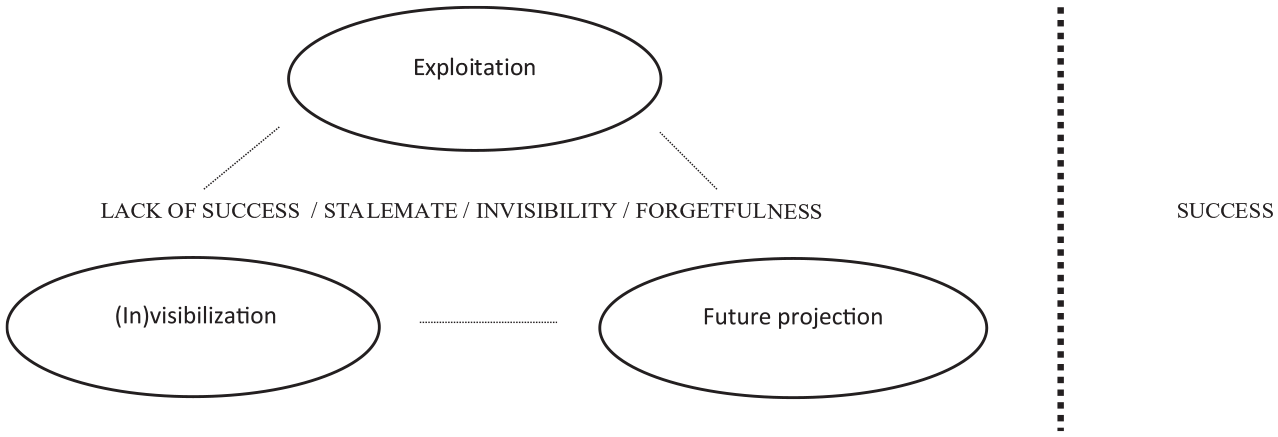
Failure Privilege and Dynamics—Policy Studies
Second, the dynamics of failure are not always secondary or subordinated to the scope of success. Failure does not obsessively chase success, as we saw might be interpreted from the first model of failure privilege discussed on the basis of recent studies of the laws and principles of success in competitive contexts. Failure analysis in policy studies helps us understand that the likelihood of achieving a self-evident state of a lack of success that would allow closure and movement to the next level is one in a million. Ignorance, stalemate, and frustrating limbo are more accurate terms for describing policy business as usual.
Third, exploitation, (in)visibilization, and future projection may unfold distinctively but may also appear in a combined form and support each other. The projection of possible policy futures, for instance, entails visibilization of potential configurations and invisibilization of models that remain in the way or are outdated. Meanwhile, exploitation is supported by calculation, the use of indicators, and anticipation of new policy scenarios. In this latter case, policymaking through failure works at maximum capacity and has effects of integration and energizing at the level of public policy. In other words, the more types of failure a policy domain or agenda experiences, the more privileged it will be.
These findings allow us to decentralize the importance of success in the dynamics of failure and to understand that failure rarely manifests itself as a clear lack of success but rather as invisibility, stagnation, marginalization, and statistical misrepresentation, as well as recognizing failure more in terms of how it works and what its dynamics are than what it is or is supposed to be. Failure constitutes not so much a problem and drawback for policymaking as a resource and propulsion point. Nowhere is this more visible than in the case of highly polarized yet increasingly vigorous policy domains—such as abortion policy.
Failure Privilege and Abortion Policy
In order to get a better idea of how failure privilege works, we shall turn to abortion policy and its highly contested change, integration, and dynamization rhythm. Abortion policy allows us to explore the extent to which the success of policymaking is contingent on failures, be they real or projected. Failures keep public policy going. They are just as constitutive of policymaking as successes, contestations, and possible futures.
Abortion policy’s link with failure privilege stems from the fact that reproductive matters are epistemologically and politically instituted as a contentious issue of bio-politics with ramifications in the spheres of morality, religion, technology, and education. Regulatory interest in abortion is globalizing, and so are the varieties of abortion law change. In Argentina, 66 Mexico, 67 and Colombia, 68 for instance, there is regulatory openness toward liberalizing policies. In Honduras 69 and, outside Latin America, in Poland, on the other hand, we encounter more restrictive regulation that builds on the constitutional protection of life. In the United States, in 2022, for instance, the Supreme Court overturned the constitutional right to abortion 70 —the decision of Dobbs v. Jackson Women’s Health. Changes in the legal governance of abortion are linked to interpretative, political, and legal contexts of human rights protection. 71 Meanwhile, the impact of constitutional rights manifests itself in whether they include the right to abortion, as in the case of the United States, or the constitutional protection of life, as in the cases of Poland and Honduras.
Abortion policy triggers hyperpolarization between what, in a very simplified form, we may term the “pro-life” and “pro-choice” sides of the debate. It is a forceful tool for political mobilization in global and national debates. Its power of contention stems from the fact that, although mostly evaluated in moral terms, the topic is further interpreted as juridical competence and the legal governance of processes linked with human rights and/or constitutional rights imaginaries that are fundamental yet also conflicting. On the pro-life side, for instance, abortion policy and governance are usually about the right to life of the “unborn children” and/or the constitutional protection of “fetal personhood” and “prenatal life,” whereas on the pro-choice side, it is an issue of women’s rights to bodily autonomy and to choose and/or the constitutional right to privacy from government interference and freedom of religion. These imaginaries are so powerful that they basically change the normative context, argumentative logic, and attitudinal models in relation to abortion policy. In addition, there are further ramifications and interactions with other avenues of policymaking—healthcare, social welfare, disability policy, and so on. Thus, abortion is strongly embedded in the normative and ethical landscape and political and ideological environment in which it is governed and instituted.
Failure in the case of abortion policy is an issue of the inherent as well as the negotiated limits of neoliberalism, the transformation of women’s movements and discourses of feminism, and the shift in the ascendance and distribution of the ideals of choice (and life) in society. Failure framing is deeply encrypted in most aspects of reproductive politics and everyday life, with unfortunate and challenging reproductive episodes and experiences being recurrently depicted through failure framing:
“Fertility failure,” “failure to progress,” and “failure to conceive” are important examples, as are descriptions of women’s pelvises as “inadequate,” cervixes “incompetent” or “insufficient,” and cervical mucus as “hostile.”
72
As Moore and Cattapan 73 agilely observe, “failure speak” is not only inherent in medical literature, clinical practice, and fertility care, but it is also performative and triggers emotional framings and micro-valuation contexts. It generates expectations of reproductive success and brings along “confusion, disempowerment and the feeling of being betrayed by one’s body.” 74 Abortion policy and reproductive governance are measured in regulatory milestones and ticking systems of what has been achieved and what has not, such as the “failure to push forward legislation to guarantee abortion rights nationwide,” the “failed bill on abortion,” the “risks for women when abortion is banned,” and the “failure to uphold women’s rights.”
Failure occurs not only as speech but also as inherent, transformative, and contaminating elements of reproductive policy and practice. Failure also has a variety of manifestations. Boltanski, 75 for instance, employs failure to depict derailments in the control of sexual intercourse that cause the “advent in the flesh” of “beings conceived outside the frameworks that ensure their preconfirmation through speech.” According to this author, the existent regimes of “engendering” (procreating, bringing into the world) are constructed such that they offer “practical solutions” for “handling such situations”—ranging from “destruction” to “adoption.” There is a kind of threshold up to which these failures are “tolerable” and “invisible,” beyond which normally “hidden” contradictions and pressures spill over and require public attention and intervention. These interventions are the acts of governing by the state of the manner in which people “produced (or did not produce) their children” 76 or in which people failed privately, leading ultimately to acts of failing politically and institutionally. The French author suggestively refers to the dynamics of the criminalization of abortion in France and its immanent failure to contain abortion (the legal and practical challenges to criminalization) that triggered new regimes of ignorance, invisibility, and clandestineness, as well as of control and risk.
On a global level, beyond doubt, the most striking proof of the strong linkage between abortion policy and failure privilege is COVID-19. The pandemic rendered contact with abortion care difficult (even in countries where abortion is legal or steps have been taken to improve access to abortion). It opened opportunities for changes in policy that materialized distinctively at the global level (by limiting or expanding access either to abortion [legally] or to sexual and reproductive healthcare [as practice]). Crisis exploitation, as attempts to advance policy change by politicians and social movement organizations, unfolded precipitously and in the open. As observed by Hunt, 77 the exploitation patterns during the pandemic exhibited by anti-abortion and pro-abortion rights social movements and organizations entailed framing the crisis as “both a ‘threat’ and an ‘opportunity.’”
Failure and contingency were strategically exploited to advance change in access to abortion. And this exploitation included projecting failure futures and steering with (in)visibility. Access to abortion policy in rapidly changing circumstances occurred in close relation to inequality, health inequity, and structural violence, as well as with the normative and political domains. 78 The inequities were deepened, and this is why the pandemic acted as a disruption that caused new fractures to be brought to light and made visible. The crisis was not as much a trigger of inequality as an amplifier and exacerbator of existent fractures and forms of discrimination. According to Nandagiri et al., 79 “COVID-19, rather than creating new forms of injustice, has rendered visible existing structural violence and inequities.” The high level of crisis exploitation of abortion policy during the pandemic nurtured both the possibility of change and the potentiation of reproductive injustice and inequality.
Abortion Policymaking in Poland
In choosing the cases that will allow us to understand the role of failure in the dynamization of abortion policy, we may consider different methodological filters. Are we interested in the failure dynamics in an abortion policy that is already energized and has visible points of juncture? Or are we looking for instances of abortion policy in which the reproductive debate and politicization is more moderate and we can show how this can be traced back to the failure dynamics? Considering that we are at the beginning of these explorations, we decided to focus on failure concatenations in relation to an abortion policy that is highly convoluted, heated, and has failure events written all over its future. Polish abortion policy is highly illustrative in this regard. It is an extremely polarized and dynamic field that allows the presentation of instances from abortion debates and policy interventions to illustrate and support the three forms of failure privilege we have developed in this article and to further replenish our understanding. 80 Exploitation, we will learn, is not only about the active policy behavior of taking advantage, but it also entails inaction. (In)visibilization, through statistics, calculations, and indicators, opens avenues for manufacturing control and enforcing discipline. Meanwhile, the projection of policy futures is realized first and foremost through the reimagining of failure in given contexts and the institutionalization of failure alternatives—utopia and dystopia—in the political mainstream.
In Poland, abortion law is part of the broader configuration of debated interventions in “social reproduction.” It unravels “failing forwards” mechanisms of neoliberalism, as analyzed by Shields 81 in relation to Polish programs such as the “500+” child benefit. It also plays a fundamental role in the formative process of the emergent “Polish constitutional identity” subsequent to the 1989 anti-Communist revolution, as demonstrated by Bucholc. 82 Polish abortion policy is an issue of party politics, juridical intervention, the mobilization of social movements, and the concerns of non-governmental organizations. It entertains and triggers organizational and institutional work that develops around providing/restricting access to abortion in medical and surgical forms.
Next to Malta, 83 Poland is considered to have one of the most restrictive abortion policies in Europe. In 1993, it criminalized abortion by The Family Planning, Human Embryo Protection and Conditions of Permissibility of Abortion Act of 7 January 1993. This allowed pregnancy to be terminated in case of danger to the woman’s life or health, pregnancy resulting from a crime, and “grave and irreparable” fetal impairment. Commonly referred to as an “abortion compromise,” a feeling of half failure was prevalent on both sides of the abortion debate, as it was considered the policy change was stuck somehow in the middle. The pro-life side was dissatisfied with the provision for the possibility of legal abortion in certain cases, as it considered that this option creates opportunities for the tolerance of abortion and resistance to criminalization. Meanwhile, the pro-choice movement opposed the restricted access to abortion overall. The compromise, in time, fueled the revival of the heated debate about abortion policy between pro-choice and anti-abortion advocates, with obvious political implications.
After the right-wing and declared pro-life party, Law and Justice, came to power in 2015, a draft law submitted in 2016 to delegalize abortion altogether triggered mass abortion ban protests in the country—the 3 October 2016 Black Protest. 84 The policy change proposals eventually culminated with the Constitutional Tribunal’s ruling of 22 October 2020 that delegalized abortion due to irreversible fetal impairment and, thus, introduced a near-total ban on abortion in the country. This elevated abortion policy in Poland to a contested critical junction and site of hyperprojectivity. According to Bucholc, 85 this initiated a “legal-cultural turn” with the effect of “closing of the jurisprudential horizon.”
Upon the ruling, the possibility of legal abortion was stipulated in two cases: if the pregnancy threatens the mother’s life or health, or if it results from a criminal act (rape or incest). The policymaking space became highly controversial with “hot failures” (using Callon’s 86 terminology of “‘hot’ situations”) that were loudly contested and fell in the epistemic and normatively divided fields opened by the competitive pro-life and pro-choice framings. For the supporters of restrictive abortion regulation, failure means anything to do with liberalization. Meanwhile, for the advocates of the legalization of abortion, failure is exactly the opposite. The abortion issue is so normatively, affectively, and politically loaded that in order to locate and identify failure, we first need to know who is the beholder. We need to know in advance which arguments are backing particular perspectives on abortion policy more generally, and this will provide intuition about the kind of failure we are talking about. Failure is not so much a collective phenomenon as a very structured and polarized field. At the same time, abortion policy is highly privileged in terms of materializing and projecting policy changes. Abortion policy is contingent on failure privileges and mechanisms. The materialized and projected failures in abortion policy in Poland do not slow down the pace of policy change (real or imaginary); quite the contrary.
Exploitation in Polish Abortion Policy
Crisis exploitation, as a failure privilege mechanism, surfaces in abortion policy in Poland on various levels. As is observable in the above short historical account of abortion regulation, policy change quite often appears here in a context marked by political and historical moments of junctures and sites of hyperprojectivity. Are these crises exploited by the elites and social movement organizations to advance abortion activism in Poland? What is the role of political and historical contingency in the dynamization of abortion policy? This is a complex problem. Failure and the policy dynamic in abortion reached such high levels of contingency and autonomy that policymaking is basically self-propelling and creating its own crises that it subsequently exploits. The situation is further complicated by the fact that the general political and historical context in Poland is, by default, marked by crises and sites of hyperprojectivity. Crises, acceleration, and contingency are business as usual in Poland, blending neoliberal and post-Communist transformation paradoxes with “failing forwards” governance mechanisms and controversial interventions in social reproduction. 87
This means we have to approach crisis exploitation in abortion policy in Poland as more normatively, gender, and bio-politically contained while remembering that crisis exploitation is a very contextual issue and depends on the type of the crises that are being incidentally, axiologically, or programmatically exploited. The COVID-19 pandemic, for instance, was a crisis situation that induced new failure situations, inequalities, and injustices globally in access to abortion care and reproductive rights. Lockdown measures acted as technical and material obstacles to access to abortion, and it was a situation of structural violence against the reproductive rights of women that, somehow, emerged independently of abortion activism. The extent to which we are dealing with outright crisis exploitation is not self-evident, 88 but we have to approach the situation more comparatively and temporally and observe the local policy responses.
In the case of Poland, given the generally complex bio-political and policy context, the interventions in abortion policy during the pandemic seemed to have a pragmatic and exploitative component. The ruling party was criticized for initiating changes that tried to use the difficult time to advance its political agenda even before the Constitutional Tribunal’s controversial decision—for example, the “Stop Abortion” bill by the parliament on 15 April 2020. 89 In a similar manner, the ruling of 22 October 2020 may be associated with a “debt repaid to Law and Justice’s rightwing Catholic constituency after its re-election last year.” 90 Irrespective of whether this is a strategic form of exploitation, or a contingent or self-propelled one, what clearly stands out is how quickly the pandemic moved from being associated with a “window of opportunity” for triggering legal change to being linked with a reservoir of political risks and uncertainty for the ruling party. This happened because of the proliferating protests on the streets of Poland that were depicted as posing great pandemic risks, thus rendering governance uncontrollable and the local “pandemic crowd” unpredictable. 91 Beyond exploitation, the intended changes manufactured a “new” and “unintended” dynamic 92 in the abortion debate and protests, which at the abortion governance and policy level materialized basically in stalemate. The ruling of 22 October 2020 was published on 26 January 2021, thus coming into effect after a very stressful three-month period of regulatory uncertainty coupled with COVID-19-related restrictions.
The October 2020–January 2021 policy stalemate was less an obvious capitalization on existing failures in abortion policy, and the subsequent changes, and more a power privilege of refraining from acting on or inducing a politically grounded period of policy waiting that had confusing effects in reproductive practice. The failure privilege in the abortion stalemate basically boiled down to the fact that while, formally and legally, abortion on the grounds of fetal abnormality might have taken place until the ruling officially came into force, access to legal abortion was difficult because of the “freezing” effect on hospitals. Although the ruling has not yet been published, hospitals refused or delayed abortion upon lawyers’ advice because of uncertainty and fear of persecution. 93 The stalemate and delay subsequent to a ruling that had not yet been enforced caused a decrease in women’s access to abortion care, a situation which was very often experienced as ad hoc, exploitative, and in obvious breach of the legal right to such care. The lack of action or strategic ignorance further emerged in the subsequent contingency on failure privilege in abortion policy in Poland. For example, the impact of the Russian invasion of Ukraine created a clash between the need of Ukrainian refugees for emergency contraception and abortion services and the near-total abortion ban in Poland. The women and children fleeing the war as a result of the invasion added new dramatic layers in making reproductive health and care a privilege in Poland while also rendering the addressing of failure privilege in public policy all the more constricted.
Crisis exploitation thus has its correspondent form in a sort of tolerated, strategic inaction wherein the privilege materializes as the possibility of basically not acting, as in “inaction,” “doing nothing.” 94 Crisis exploitation occurs not solely in relation to the self-evident and original crises and failures but also as a complex process with diluted responsibility configuring as the effects of waiting, limbo, and uncertainty that are triggered by policy change, irrespective of whether the change is contested or not (see Figure 3). Remarkably, the “freezing” effect on Polish hospitals continues to be exercised, although the period of uncertainty with regard to the conditions in which abortion can be made is basically over. The practice persists in the form of possible outright refusal or postponing the decision to terminate pregnancies and remove the fetus to save women’s lives. “Doing nothing” or “postponing action until it is too late” came to the attention of public opinion and generated immense waves of protest subsequent to the painful death of a young woman, 22 weeks pregnant, who was refused an abortion and died in hospital after suffering septic shock. 95 This is arguably the most critical point of the effects of recent reproductive governance in Poland, as well as of the intensity of society’s response and the polarization around it.
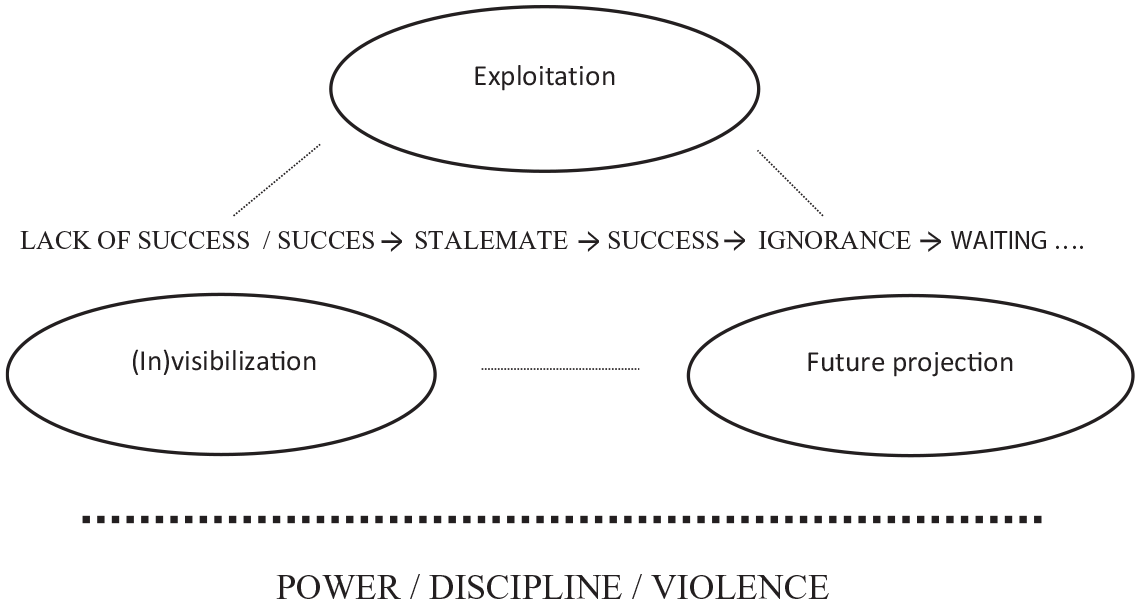
Failure Privilege and Dynamics—Abortion Policy in Poland
(In)visibilization in Polish Abortion Policy
Statistics, indicators, and calculations support highly privileged contexts, wherein the operation of symbolic power and structural violence manifests itself through developing “modes of visibility,” 96 invisibility, and being kept in check. If we want to understand failure privilege and resistance to abortion policy in Poland, we have to follow the numbers and understand how success and failure is being measured. We have to grasp what is made known and public through these measurements, as well as what is ignored and forgotten.
In Poland, abortion indicators and statistics became essential for measuring policy change and reacting to it. Every intervention in social reproduction not only manufactures new data but also produces new blind spots and known unknowns about resistance to abortion policy that are highly relevant and a power struggle issue. One of the most problematic calculative areas for the currently near-total ban on abortion is certainly the complex and non-transparent phenomenon of medical abortions and pregnancy terminations conducted abroad. These data both exist and are hard to obtain. Its status as a known unknown constitutes a sign of resistance against a policy that is regarded as one of the strictest in Europe, which also provides the legitimacy to follow up with increased disciplinary measures and enforce control on the reproductive reality. The uncertainty regarding “how many abortions happen in Poland?” unravels two, seemingly contradictory, manifestations of failure: the failure of recent changes in abortion policy, on one hand, and the failure as a resource for further changes in the same abortion policy, on other. The power balance is reinstated by political agents through acts of visibilization that use registration and calculative devices as disciplining techniques. The recent setting up of a “register of pregnancies” in June 2022, a year and a half after the near-total ban on abortion, illustrates how failure privilege and symbolic violence are being carried out. The need to calculate and provide statistics as a way to control failure in the existent abortion policy triggers measures of visibilization and calculation that increase the power and range of the near-total ban on abortion. 97
Calculating and measuring failure is an essential resource for the dynamization and coordination of failure policy change. Abortion policy in Poland arduously establishes control and surveillance by introducing calculative devices into new areas of resistance. This is illustrated in this case by the abortion checks and audits on hospitals by ultraconservative groups and representatives of pro-life social movement organizations in order to check, for instance, whether Ukrainian refugees are receiving abortions at Polish hospitals. 98 Abortion policy also further triggers and allows invisibility and economic and statistical cleansing as a way of escaping scrutiny. There is a lack, for instance, of ordered and comprehensive data on the governmental program (Za życiem) supporting pregnant women and mothers of children with fetal impairment. 99 At the same time, policy and political agents institutionalize their own indicators and modes of visibility. The decrease in the number of abortions becomes one of the most important valuation tools of policy failure and success, which also renders it ideal for enforcing or controlling visibility and indirect statistical cleansing.
Controlling visibility may play out as a strategy of coping with invisibility and the unknown. Illustrative in this sense are the episodic fights against the visible manifestations of abortion in order to limit the invisible ones, such as the petition submitted to the Sejm (the lower chamber of the Polish parliament) on 28 December 2022. Prepared by the Life and Family Foundation, the act proposed the prohibition of any public information about the possibility of abortion and the curbing of the promotion of information materials. Those who “publicly promote any action regarding the possibility of abortion within and outside the country [. . .] shall be liable to a fine, the penalty of restriction of liberty or imprisonment for up to 2 years” (article 256a). 100
This pro-life regulatory activism—supported by “nearly 150,000 signatures”—has the appearance of society’s attempt to put pressure on the government to further control the reproductive regime. At the same time, however, it is also a strategy to limit the most visible effects of the recent changes in Polish reproductive governance, such as the systematic increase in social support for the legalization of abortion up to the twelfth week of pregnancy (70% in favor, CATI survey, 7–9 November 2022) 101 ; the growth in literacy about abortion procedures; the known unknowns about the infrastructure of available abortion care; and the high demand for self-managed online medical abortion, as facilitated by the websites of organizations such as the Abortion Dream Team. 102 By taking anticipatory action against these predictable effects that are now materializing, reproductive regulatory activism uses future events, derailments, and failures as tools of oppression and heightened surveillance in society. This reminds us of Sarah Ahmed’s 103 discussion of “happiness” as a “tool of oppression,” as well as the idea of “learning to stop worrying and to love surveillance,” as documented, for instance, by Nitsan Chorev 104 during the pandemic. Along with happiness and digitalization, failure is one of the trickiest tools for securing consensus around intervention and control in contemporary society.
Gaining visibility in policymaking is about displaying it in the public sphere and often plays out as street and guerilla marketing. Anti-abortion organizations, for instance, apply visibilization strategies using graphic images of aborted fetuses. These images are printed on the sides of trucks that are then parked in front of the hospitals with maternity wards exposed as conducting pregnancy terminations or simply moved around the centers of Polish cities. This trick enables them to circumvent the regulations regarding advertising—the truck is not a billboard but a parked vehicle. The pictures show small mutilated bodies covered with blood. The aim of making them visible in public is to frame abortion as connected to pain and harmful to the fetus. Pro-choice activists counteract this visibilization strategy and framing of abortion as cruel injustice inflicted on the body of the unborn child by employing three types of response: reporting to the police that truck drivers are disturbing the peace and causing outrage in a public place; blocking the trucks and not allowing them to circulate in the city traffic, calling this a “citizen’s arrest” 105 ; and banning the display of images of aborted fetuses in the public sphere 106 or more specifically of the use of vehicles with “obscene or graphic content,” such as the decision of the City Council of Łódź on 15 September 2021. 107 All three responses entail invisibilization through cancelling pro-life activism on the streets—with the purpose of removing certain framings of the abortion issue from the public sphere and the streets. This further triggers reactions on the part of pro-life activists or the local powers-that-be in the form of cataloging some pro-choice guerilla strategies, such as vehicle blocking, as contraventions, or by issuing decisions about disregarding existent decisions of city councils, as can be done by the local Wojewoda (the government representative in a region). 108
Acts and strategies of visibilization and invisibilization thus often succeed and trigger each other in a public and guerrilla game of sorts over urban displays and the use of banners. The imaginary of failure and “reproductive futurism” are business as usual in this kind of policymaking display.
Future Projection in Polish Abortion Policy
The Constitutional Tribunal’s ruling of 22 October 2020 that delegalized abortion due to irreversible fetal impairment, and thus introduced a near-total ban on abortion in the country, was a quite firm intervention in the local reproductive futurism and regime. As observed by Bucholc, 109 it amounted to a “legal-cultural turn” in the protection of rights and international law. This, we may add, also elicited failure-related mobilization around the new changes in abortion policy in the sense that building consent and justification for the enforced acceptance of radicalization of abortion policy was achieved by the ruling party through attempts to reimage failure in women’s reproductive health.
Projection of the future and reinterpretation of failure in abortion policy takes shape in quite sophisticated ways. Most distinctive in the case of Poland are the efforts by elites and social movement organizations to develop new reproductive imaginaries that are convergent with, and prefigure, their policy initiatives. The Tribunal ruling supports the reproductive imaginary of the world of Polish “unborn children” and manufactures this future through rhetoric, legal “material representations” (see Mische 110 ) and objects in the public sphere. This new system of future failure and anticipatory care marks specific evolutions, most visibly the development of a “rhetoric of pregnancy” 111 in terms of “fetal personhood.” 112 This has occurred through a “shift in general discourse; in the official language of legal acts, where, for example, ‘foetus’ has been replaced by ‘conceived child’ (in the law) or by ‘unborn child’ (in discourse)” 113 ; and in the proliferation of giant national bottom-up billboard campaigns financed by pro-life campaigners. These billboards advertise imaginaries of “unborn children” sprinkled with rhetorical statements such as “I am 11 weeks old,” “Love each other, Mom and Dad,” or “Where are these kids?” They entertain a certain emotional-political blackmail by putting up in front, on display, reproductive futures that were supposed to happen, yet are not yet currently happening, in Poland. The billboards counterfactually visibilize the projections of the possible world that did not happen but was supposed to happen 114 and can still happen or, to be more accurate, are now possible due to the new abortion policy initiatives. This is a completely different imaginary and failure culture compared to the one advanced by the classic, shocking anti-abortion campaigns with aborted fetuses known and intended to cause controversy, discussed in the previous section. The counterfactual projectivity of possible policy futures and the reinterpretation of reproductive failure are meant to resonate at deeper levels with members of society while discretely delegating blame and responsibility for curbing procreation and children’s futures to the same actors with the aim of rendering them more reproductively proactive and responsible. These are all emerging moves in the context of a very low total fertility rate—since 2013, Poland is clearly on a population decrease curve, and in 2021, the total fertility rate amounted to 1.33. 115 This already visible trend was also influenced by the pandemic, during which there was an increase in deaths caused by COVID-19 and an even stronger decline in births.
The pro-life imaginary allows, following Boltanski, 116 what we may term as cooptation of the “unborn children” inside the “frameworks that ensure their preconfirmation through speech.” It is a powerful vision that is responded to by the pro-choice supporters with picturing a world where women “do not feel safe,” where women who want to have children risk, paradoxically, falling victim to the privilege of non-action under conditions of uncertainty, or where women are prosecuted for helping other women in need who do not have their reproductive rights guaranteed and protected. 117 In this dystopia, in the Handmaid’s Tale kind of world, the blame for the dangerous and anti-woman futures in the making is directed toward the political system and is highly politicized 118 and patriarchalized. The Constitutional Tribunal’s ruling rendered this dystopia the usual trademark of the reproductive regime and futurism in Poland. Voices about future procreation decisions were raised by the pro-choice-leaning participants in the public debate who pointed to the fear of getting pregnant under the near-total ban on abortion. The ruling triggered a “rhetoric of reaction” 119 that predicts how the banning of abortion with the aim of protecting unborn children and boosting fertility will have the perverse effects of reducing the number of children born because women will avoid pregnancies. These futures are then verified and “measured” by emerging statistics and calculations which indicate an increase in reactive reproductive attitudes and behaviors in the population. For example, the Public Opinion Research Center (CBOS) published a report in January 2023 showing the decrease in the number of women intending to have children. 120 In 2022, according to the survey data, only 32 percent of women aged between 18 and 45 years affirmed they plan to give birth in the future. Five years earlier in 2017, 41 percent of women in the same age category declared they wish to have a baby in the future. In the public debate that started after announcing these results, this new behavioral pattern was strongly recognized as evidence of abortion policy failure, which is shown to negatively impact the natural increase in population.
In addition, although the future cannot be measured, as indicated by Mische, 121 and it is likewise impossible to dissect the complex entanglement of bio-political interventions, cultural processes, the general atmosphere of uncertainty in the labor market, and the circumstances of the pandemic, we see how the existent imaginaries impose their failure metric nevertheless. The pro-choice imaginary operates with projections concerning how individual women plan to have (or not to have) children as a result of legal changes in the reproductive regime in Poland.
Both the pro-life new reproductive imaginary of unborn children and prenatal hospices for women of unborn children with fetal abnormalities and the pro-choice denounced reproductive dystopia of subjugated reproductive rights are worlds in the making oriented toward the future, which are built on new models of failure and failure privilege.
Conclusions
In this paper, we aimed to accomplish a conceptual and methodological profiling of failure privilege in public policy. We began with an overview of failure in recent studies of the laws and principles of success in competitive contexts, which allowed us to better locate and specify the failure privilege model in policy studies. The problem of failure in policymaking, we learned, is primarily differentiated by the fact that it goes beyond a lack of success. But it also entails forgetfulness, ignorance, stalemate, and even waiting as contemporary recent manifestations of failure.
Building on our analysis of policy studies, we identified a typology of three forms of failure privilege: exploitation, (in)visibilization, and projection of policy futures. Subsequently, we showed illustrations from abortion policymaking in Poland and discussed how failure privilege manifests itself amid a bio-political and regulatory contentious setting. The Polish case study allowed us to confirm the three forms of failure privilege while also bringing in some nuances. First, crisis exploitation is tricky to identify as a strategic policy behavior in a context in which uncertainty, rapidly changing circumstances, and acceleration become the normal contextual elements of policymaking. Crises are an almost pre-existent element, and failure privilege is not manifested as much in the open and straightforward pragmatic utilization of policy windows of opportunity as in the seemingly justified inaction, legitimized delays, and prolongation of periods of uncertainty and injustice that feels ad hoc and illegal to members of society. Second, (in)visibilization through statistics, calculations, and indicators is one of the most important resources of policymaking, because identification of new failures is essential to the dynamization and coordination of the policy agenda. Known unknowns about the failures of policy interventions, though a seeming vulnerability, also open possibilities for manufacturing control and enforcing discipline. Third, courageous and controversial interventions in public policy demand legitimacy that is constructed today by advancing new imaginaries and new models of failure that allow new futures to be envisaged. Failure is a powerful tool of integration and for gaining consent, and redefining it is one of the most influential and complex modalities impacting the policy agenda.
We demonstrated in this paper that failure privilege is always there. Sometimes, it is the pre-selection and pre-socialization of dispositions and abilities to turn failure into success—such as in recent studies of the laws and principles of success in competitive contexts. At other times, it is a sophisticated and complex mix of exploitation, (in)visibilization, and projection of new futures, as in the case of policymaking. And sometimes, it borders discipline and power and becomes a tool for exercising violence and advancing new normative futures and alternative paradigms in policymaking. We saw this in relation to abortion policymaking, which aims to reinterpret what counts as failure in reproductive health and conception agency and to produce new models of accomplishment, success, and realization in relation to women’s bodies, unintended pregnancies, and diagnoses of fatal birth anomalies.
Footnotes
Funding
The authors disclosed receipt of the following financial support for the research, authorship, and/or publication of this article: The publishing of this work was supported by the National Science Centre, Poland, under the research project “Failures and Public Policy: The Possible, the Contingent and the Chance in the Polish Context,” number 2019/33/B/HS5/00232.
