




Abstract
The aim of this article is to study the translation of Polish literature into Slovene to shed light on Polish literary (and cultural) diplomacy in Slovenia. Being acquainted with the culture of another nation is an important factor in forming closer political and economic relations, since literature is a source of “soft power,” which relies on attraction rather than on the power of explicit or implicit coercion. Using quantitative analysis, we surveyed how many and which works were translated from Polish into Slovene between 1865 and 2021. Our qualitative analysis based on semi-structured interviews with Slovene translators further explores who chose the texts and decided what to translate from Polish into Slovene. The key finding of the article is that strong cultural cooperation (in our case, translation of Polish literature into Slovene) can be an advantageous platform for enhancing and strengthening political and economic relations between the two countries, as well as for fostering better understanding between the two nations.
Keywords
Introduction and the Research Problematique 1
In 2020 and 2021, both Poland and Slovenia celebrated the anniversaries of several watershed moments in their history. In 2020, Poland celebrated the fortieth anniversary of the founding of the Solidarity independent trade union, while Slovenia celebrated the thirtieth anniversary of its independence referendum; in 2021, thirty years had passed since Poland attained complete independence from the Soviet Union and since Slovenia declared its independence. In 2022, the two countries also celebrated the thirtieth anniversary of the establishment of diplomatic relations, 2 making it an appropriate time to evaluate the relations between Poland and Slovenia. Today, both countries are members of the European Union (EU) and North Atlantic Treaty Organization (NATO). Over the past three decades, they therefore not only established bilateral cooperation but also often had to coordinate their actions within various European fora. Poland and Slovenia are likewise members of the V4+ group. Meanwhile, bilateral relations took on a greater political dimension under the government of Slovene Prime Minister Janez Janša (2020–2022), which may be attributed to the ideological congruence between his government and that of the Polish PM Mateusz Morawiecki. 3
All of the above tend to support the thesis that the relations between Poles and Slovenes are, or ought to be, very close and friendly. Nevertheless, parts of the Slovene public talked about seemingly insurmountable social differences between the two peoples and states on several occasions.
4
The former Polish ambassador to Slovenia Paweł Czerwiński perhaps articulated it best in an interview given at the end of his term.
5
When the journalist noted that some seek to place Slovenia in the Balkans—although, like Austria, the Czech Republic, or Poland, it has politically, economically, and culturally always been part of Central Europe—he replied,
I have noticed a quite different approach, [. . .] according to which Slovenia is part of Western Europe, not Central Europe, and has nothing to do with those backward countries that, to many Slovene political scientists, do not belong to Central Europe at all, but to the East.
He added,
The Slovene public is mostly leftist. The Visegrad group of conservative states is always under a bit of suspicion; there are still a lot of stereotypes from the former Yugoslavia that “we [Slovenes] are better and more European than those Easterners.”
After clearly expressing his view of the political opinion of Slovenes towards Poland, he had this to say about grudges between the two countries:
Certainly Slovenes are not resented for anything [. . .] in Poland. [. . .] If there is anything we might resent, it is that attitude of superiority from the nineties and the contempt that has sometimes been brutally shown by Slovene politicians, journalists, and members of the elite.
He commented on the Slovenes’ patronizing attitude to Poles by saying,
I have yet to meet a Slovene who has visited Poland without liking it. But at the same time, I hear this rather patronizing “you have made such progress, everything is in such nice order,” as if everyone expects us to be on Sudan’s level.”
Although the interview by the ambassador before leaving Slovenia was a relaxed one and did not follow the classical patterns of diplomatic language, his words do imply that the relations between Slovenia and Poland are perhaps not the best, or that there are deficiencies in certain areas that might usefully be remedied if one wishes to strengthen bilateral relations and especially if one would like to achieve greater cohesion, not only in politics and business but also in social ties between the two peoples. Better understanding of the cultures of both Slovenia and Poland is undoubtedly a means to such an end.
All of this brings us to the aim of the article, that is, to analyse Polish cultural diplomacy in Slovenia, with a special emphasis on translations of Polish authors into Slovene (i.e., literary diplomacy). 6 We decided to focus on cultural diplomacy between both countries, arguing that “guns or butter” (the ability to coerce) counts for less in this day and age than the ability of countries “to attract” or “co-opt.” This is also visible in the perception of the Ukrainian-Russian war happening right now, where battles are not waged only on the battlefields but also in media and culture—notably through art, music, and literature. Soft power, or, as stated by Nye, 7 smart power, is not a fait accompli, but it is becoming increasingly important. 8
Why analyse the presence of Polish literature in Slovenia? There are three reasons. First, as described by Benedict Anderson,
9
nations [as imagined communities] are also formed through common language practices (which likewise include “reading” literature in one’s own language). Second, in the case of Slovenia, reading and literature still matter. Data, compiled as part of the Knjiga in bralci VI (Books and readers VI)
10
research project, show that more than 51 percent of Slovenians describe themselves as readers, meaning that they have “read at least 10 books in the last 12 months in lies in the hands of the individual who decides voluntarily, based on its internal drive, to start the crusade towards the unknown. As such it is the most powerful tool of cultural diplomacy and can be compared only to music as a tool of cultural diplomacy.
13
Taking all of this into account, we posed a research question with the aim of answering it as part of our research. The article therefore explores the state-of-the-art of Polish literary diplomacy in Slovenia between 1865 (the first translation from Polish to Slovene) and 2021, with a special emphasis on its characteristics (its structure, the type of translated works, how decisions regarding the translation of a work are made—bottom-up or top-down, etc.). The answers to these issues will give us the opportunity of evaluating the level of development of Polish literary diplomacy in Slovenia.
We are aware that the proposed research has some limitations. One caveat would be that we limited ourselves only to literature, not focusing on other cultural diplomacy activities (music, art, visual culture, gastronomy, etc.). While we agree that the analysis could also be done by including certain other relevant angles, we chose to focus on literature because cultural cooperation between the two nations analysed is strongest in the field of literature. As this area of research is as yet unexplored, we further argue that a detailed analysis of literary diplomacy between Slovenia and Poland could also promote research into other instruments of cultural diplomacy between these countries. The second potential criticism could pertain to the selection of the case study. In the case study, we argue that Slovene–Polish relations have been politically neglected for decades because of mutual lack of interest, 14 both countries aspiring to join Western EU countries and leave their “Eastern” or “Central” European legacy on the margins. We argue that on the Polish side, the political lack of interest for Slovenia stemmed from Poland trying to align itself with Germany, France, and Great Britain, while Slovenia saw Poland as something psychographically distant—not only because of the geographic distance but also because Poland, unlike Slovenia, was part of the Eastern Bloc, which is why it perceived itself as being more westernized than Poland. When both countries joined the EU in 2004, they started to (re)discover each other.
The structure of this article follows a logical sequence. The introduction and the description of the research problem are followed by a theoretical section, where we use the method of analysis, coupling, and synthesis of primary and secondary sources to develop a conceptual apparatus for literary diplomacy as a subform of cultural diplomacy. This is followed by a two-part empirical section. In the first part, we present translation from Polish into Slovene using quantitative methods, and in the second, we carry out a qualitative analysis of semi-structured interviews with three established Slovene translators from Polish. The last part of the article summarizes the basic findings, discussing and elaborating the contribution of literary diplomacy to Polish–Slovene relations.
Cultural and Literary Diplomacy: A Theoretical Framework
Due to the ontological particularities of diplomacy as an activity of state entities, there are still relatively few discussions of various fields of diplomacy, and as a result, many questions remain open. Brglez, 15 and Udovič and Brglez 16 divide diplomacy studies into four areas: history of diplomacy, diplomatic and consular law, protocol/diplomatic ceremonial, and the structure of diplomacy. Udovič 17 defines the structure of diplomacy in terms of two criteria: number and orientation. In terms of number, diplomatic activities are divided into unilateral, bilateral, plurilateral, and multilateral; in terms of orientation, they are divided into four main pillars, namely, political diplomacy (i.e., diplomacy in the narrow sense), economic diplomacy (i.e., diplomacy serving the economic interests of the state and enterprises), military and defence diplomacy (i.e., diplomacy as a tool for promoting defence and military cooperation), and cultural and public diplomacy (i.e., diplomacy as an instrument for promoting a country’s soft power). The latter differs from the other three mainly in terms of its starting point: whereas political, economic, and military/defence diplomacy are premised on active persuasion, cultural and public diplomacy are based primarily on achieving the national interest through active attraction or co-optation, 18 meaning that they persuade through the creation, development, and reinforcement of the prestige or brand of the country. 19 A precondition for the realization of cultural diplomacy is that the country possesses soft power, which Nye 20 defines as “the ability to get what you want through attraction rather than coercion or payments.” In his view, a country’s sources of soft power are its culture, its political values, and its foreign policy. 21 In cultural diplomacy, the central role is of course played by culture, which Nye 22 understands as the “set of values and practices that create meaning for a society.” But what kind of culture? Can we speak of cultural diplomacy where individual sub-cultures within the country are concerned or only in cases where dominant national culture patterns are concerned? 23 There are more questions than answers, as the problem consists precisely in how to define culture and determine its central locus.
Cummings 24 attempts to solve the enigma by deliberately avoiding a definition of the concept of “culture,” defining cultural diplomacy as the “exchange of ideas, information, art, and other aspects of culture among nations and their peoples in order to foster mutual understanding.” Cummings’ definition has been expanded by Arndt, 25 who understands it as the means of a government to realize national interests; Ogoura, 26 who stresses that the aim of cultural diplomacy is “to improve a nation’s image and prestige through such aspects of culture as fine and performing arts, language education, and intellectual traditions”; and Goff, 27 who asserts that “cultural diplomacy is first and foremost about bridging differences and facilitating mutual understanding; [. . .] [it] provide[s] context for policy decisions and political actions [. . .] [and explains] aspects of culture that might otherwise be difficult to grasp for foreign populations.” Cultural diplomacy, then, is an activity by which a certain nation wishes to create an image of itself, or to improve it, in another country. To do so, it employs various strategies, which include not only high-level events but also part of the “low politics” that nations conduct in their everyday diplomatic relations.
An interesting characteristic of cultural diplomacy is highlighted by Pigman,
28
who finds that cultural diplomacy is “often intended to be explicitly reciprocal.” This means that in cultural diplomacy, states seek to symmetrically establish a balance of (soft) power, as well as processes of gaining and preserving prestige.
29
Pigman
30
goes on to explain that compared with public diplomacy, “cultural diplomacy differs in that it is not generally crafted to have an issue-specific message focus.” We might say that the purpose of cultural diplomacy differs from the purposes of other forms of diplomacy, as it is not directly goal-oriented or oriented to the national interests it seeks to secure; rather, it mainly seeks to create a favourable environment. Ang, Isar, and Mar
31
also point out that cultural diplomacy is not a uniform and unified concept that is easily conceptualized and operationalized:
There are persistent tensions between “traditional” cultural diplomacy activities grounded in social and cultural exchange such as people-to-people engagements, collaborative projects, etc. on the one hand and activities premised on sectoral and market competition within globalising cultural fields on the other. Given the proliferation of types of activity in recent times—we haven’t even mentioned the burgeoning field of digital diplomacy—within the cultural diplomacy domain, it may be useful to disaggregate the very notion of “cultural diplomacy” and examine separately its various modalities, each with its differing dynamics, various incorporations within specific cultural and professional fields, and participating communities.
If cultural diplomacy is nearly impossible to define unambiguously, the case of literary diplomacy is even more challenging. The concept of literary diplomacy 32 is a relatively new one, comprising activities connected with the promotion of the literature of one country in another country. Husain 33 points out that literary diplomacy is “an important aspect of cultural diplomacy” and adds that in this regard, the physical presence of authors in the other country is particularly important (whether in the form of translations or going there in person to present their literary works). Another important part of literary diplomacy are book fairs, where authors, their books, and translations are presented. Nawotka 34 highlights, among others, the Frankfurt Book Fair, whose “Guest of Honor program [. . .] is perhaps the most powerful venue of all and can have lasting ramifications for a country which suddenly sees hundreds of its books translated into German, and subsequently, other languages.” He also cites several cases in which countries have improved their public image through their participation in and activities at book fairs. 35 The Czech diplomat Jaroslav Olša 36 stresses that literary diplomacy has a long-term effect that makes itself felt especially by creating interest in a little-known country in certain circles. He even claims that literary diplomacy can be far more effective than commercial diplomacy. In his view, it is precisely by literary diplomacy that a country can attract interest, which also brings opportunities in other fields. 37 We may conclude that literary diplomacy has three main characteristics: (1) it is implicit and acts on individuals; (2) it is more long-term than other forms of diplomacy, as it does not address specific problems or seek concrete solutions for them, but mainly creates a pleasant environment for the individual; (3) it indirectly and covertly helps build the brand not only of the country but also of its fundamental attributes—its statehood, nation, people, and language—and as such, it engenders a desire to learn something new, which is the first step in successful diplomatic action.
Case Study: Slovene–Polish Literary Diplomacy
Introduction
Ties between Poland and Slovenia became pronounced mainly after 1991. There are several reasons for this, notably geographical distance, historical turning points and characteristics, (a lack of) business interest, and ups and downs in political cooperation between the two countries. The first real opportunity for cooperation arose with the nineteenth-century growth of Pan-Slavism, which was very influential on Slovene territory, but never really accepted by Poland. As stated by Podgornik and Udovič,
38
this was probably because Poland, given its different structure and history of statehood, did not understand the significance of Slavism for the national formation of the Slavic nations in Central Europe, and at the same time, it understood all too well the attempts to homogenize the Slavic idea under Russian hegemony. The weakness of Slovene–Polish ties can also be attributed to two other political and geographical factors: (1) unlike most Central European countries, Poland was a mid-sized country and as such also important to the balance of power, as was symbolically shown in 1991 with the founding of the Weimar Triangle,
39
and (2) Poland never really wanted to form ties in Central Europe, as it had greater political and diplomatic ambitions. Moreover, closer ties were hampered by geographical distance and by political and economic variables. Lukanc
40
explains it as follows:
Yugoslavia and Poland were characterized by a number of similarities as well as a number of differences. Both countries were children of the First World War. In 1918, the collapse of the great European empires allowed the South Slavic nations to join in a common state, whereas Poland after 123 years of division got the opportunity to renew its statehood, this time in modern form. [. . .] The many similarities notwithstanding, geographical distance dominated the relationship between Yugoslavia and Poland, and the two countries did not find any common ground that would enable the establishment of closer relations between them.
This situation would change only after the Second World War, when Yugoslavia (including Slovenia) and Poland intensified their cooperation, apart from 1948 to 1955. After 1991, the two countries further strengthened their political and economic cooperation. They established diplomatic relations on 10 April 1992. These new beginnings, however, were not without problems. Poland belonged to the V4 group (together with Slovakia, the Czech Republic, and Hungary), which Slovenia wished to avoid because (or such were the rumours and unofficial explanations among politicians and diplomats) it saw V4 as belonging to “Eastern Europe” (and as such underdeveloped, shaped by communist rule, etc.), while Slovenia was (and should be) by its forma mentis and tradition part of “Western Europe.” Joining the V4 would therefore entail Slovenia leaving its natural position and joining politically and economically less-developed countries. 41 This affected not only political-economic cooperation but also cultural exchange with the Central European region. 42
Despite their reservations in the 1990s, the relations between the two countries improved after 2000 with more intensive high-level state visits and growing foreign trade (see Figure 1), mainly in pharmaceutical products and electrical devices and equipment. 43 The more intensive contacts can be attributed not only to the slow fading of Slovene stereotypes about Poles but also to the fact that Poland had already joined NATO in 2000 (as Slovenia also aspired to do) and that both countries wanted to become EU member states.
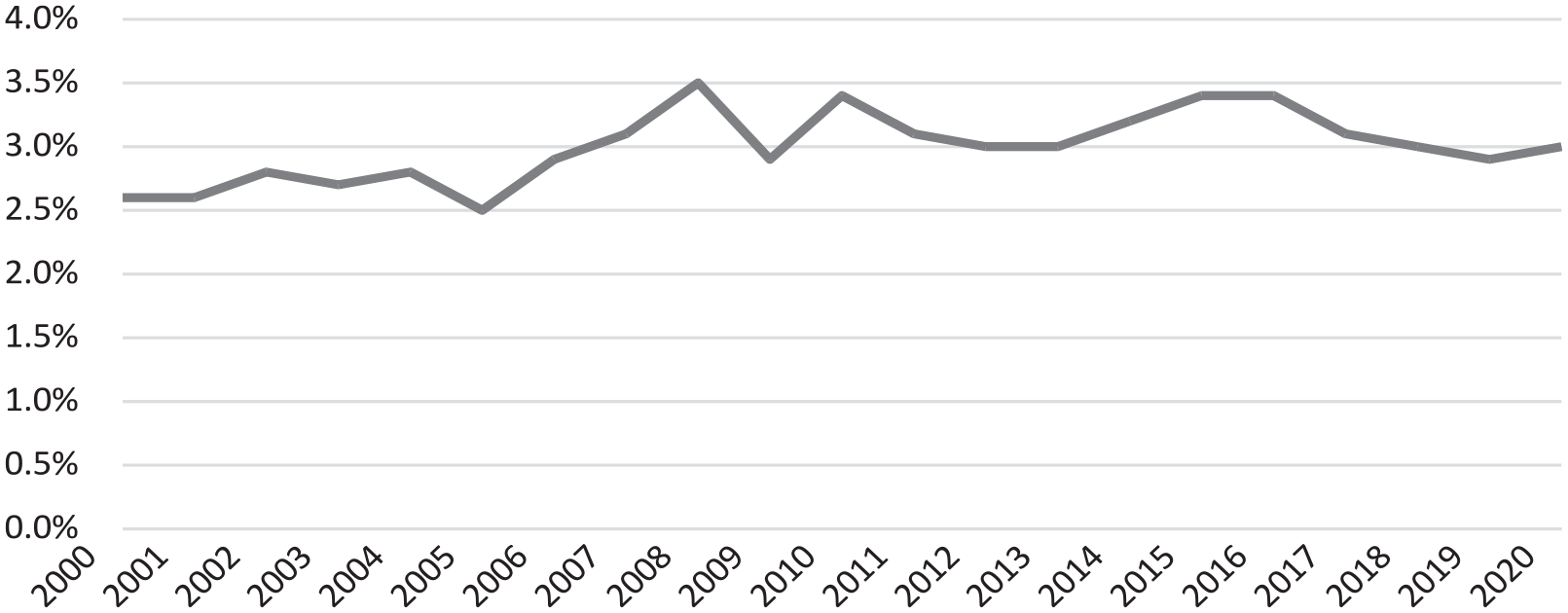
Slovene exports to Poland (in percentage of total exports) from 2000 to 2020
After 2004, when both countries became members of the EU, political relations grew more frequent at both bilateral and multilateral levels, 44 whereas business cooperation stagnated somewhat. 45 The above-mentioned former Polish ambassador to Slovenia, Paweł Czerwiński, 46 explained the paucity of business ties—considering the possibilities—by saying, “Better cooperation is hindered by the two countries’ poor knowledge of each other and of the business opportunities that they could both certainly exploit better.”
Cultural cooperation has been better than economic and political cooperation. A milestone in this regard was Emil Korytko, a nineteenth-century Polish revolutionary and ethnographer, expelled from Poland (Lvov) because of his pronouncements. Upon reaching sanctuary in Ljubljana in 1837, he began spending time with Matija Čop, France Prešeren (the most famous Slovenian poet), and other contemporaries. Korytko taught Prešeren Polish, who in turn later also started translating Polish poetry. Prešeren’s work was also influenced by the oeuvre of Adam Mickiewicz. In Slovenia (known as Carniola at the time), Korytko carried out important ethnographic work, which made its way into the collection Slovenske pesmi kranjskega naroda (Slovene Songs of the Carniolan People; op. posth. 1839–1844), first published in the nineteenth century and still considered the foundational book of Slovene folk literature. 47
In the twentieth century, cultural contacts grew weaker due—among other things—to the new geopolitical situation in Central Europe, but they intensified at the end of the twentieth century, which is confirmed also by the current Polish ambassador to Ljubljana, Dr. Krzysztof Olendzki, 48 who pointed out that Slovene–Polish cultural cooperation was very important before 1991, but intensified from that year on: “There was active cooperation before 1991, especially in the fields of music, art history and architecture, but since 1991 it has spread to the literary field.” He added that Poland in 2003 established the Polish Book Institute, its mission being to promote Polish literature in other countries. Poland has therefore clearly placed importance on literary diplomacy, which helps people in other countries continuously rediscover Polish culture and business, as well as the country as a whole.
Cultural (or rather educational) ties between Poland and Slovenia during the last two centuries were also enhanced by the establishment of an educational platform or framework that provided fertile ground for the establishment of Polish literary diplomacy in Slovenia—that is, the teaching of Polish at Slovenian institutions.
The first occasional Polish-language courses in Slovenia started in 1910 with the inception of the Society of Friends of the Polish Nation (Društvo prijateljev poljskega naroda). This society provided ad hoc language courses and cultural events. It closed its doors during the Second World War, but once again became active in 1947 with the establishment of a Polish-language programme at the Faculty of Arts, led by Rozka Štefan and Nikolaj Jež. In 2004, the programme was upgraded to the Polish Studies Department (polonistika), which continues to be offered today. In 2002, the University of Maribor established its own Polish-language programme. 49
All the above-mentioned facts suggest that there is intensive literary diplomacy between Poland and Slovenia. Whether this is in fact the case will be discussed after the presentation of the empirical data on the translation of Polish literature into Slovene.
Translation of Polish Literature into Slovene: A Quantitative Analysis
The beginnings of Polish–Slovene literary translation 50 can be traced to the turn of the eighteenth and nineteenth centuries. The first literary translation was done by Martin Kuralt (1757–1845), a priest and poet who between 1785 and 1809 worked as a curator of the university library in Lvov and formed connections with Polish intellectuals there. Around 1800 (the exact year is unknown), he translated the third aria of Wojciech Bogusławski’s (1757–1829) opera Cud mniemany, czyli Krakowiacy i Górale (The Presumed Miracle, or Krakovians and Highlanders, 1794, known in Slovene as Dozdevni čudež ali Krakovčani in Gorjanci) into Slovene and German. 51 Only the German translation was printed; the Slovene one remained in manuscript form. 52
There was a boom in Slovene translation after the March Revolution of 1848, which led to waning German influence on Slovene territory and to the abolition of press censorship in the Habsburg Monarchy. This period also saw a general growth in literacy due to school reforms, as well as growing urban populations that soon became the main readers of periodicals and books. All of this led to the extremely fast development of print media and publishing. 53 Numerous newly established newspapers, magazines, and publishing houses also began to regularly publish translated literature. Translations from Polish first appeared in the periodical press, until the first translation in book form appeared in 1865—Michał Czajkowski’s (1804–1886) novel Kirdżali (1839, published in Slovene as Kirdžali), translated by the priest Lavoslav Gorenjec (1840–1886). 54
Data collection methodology
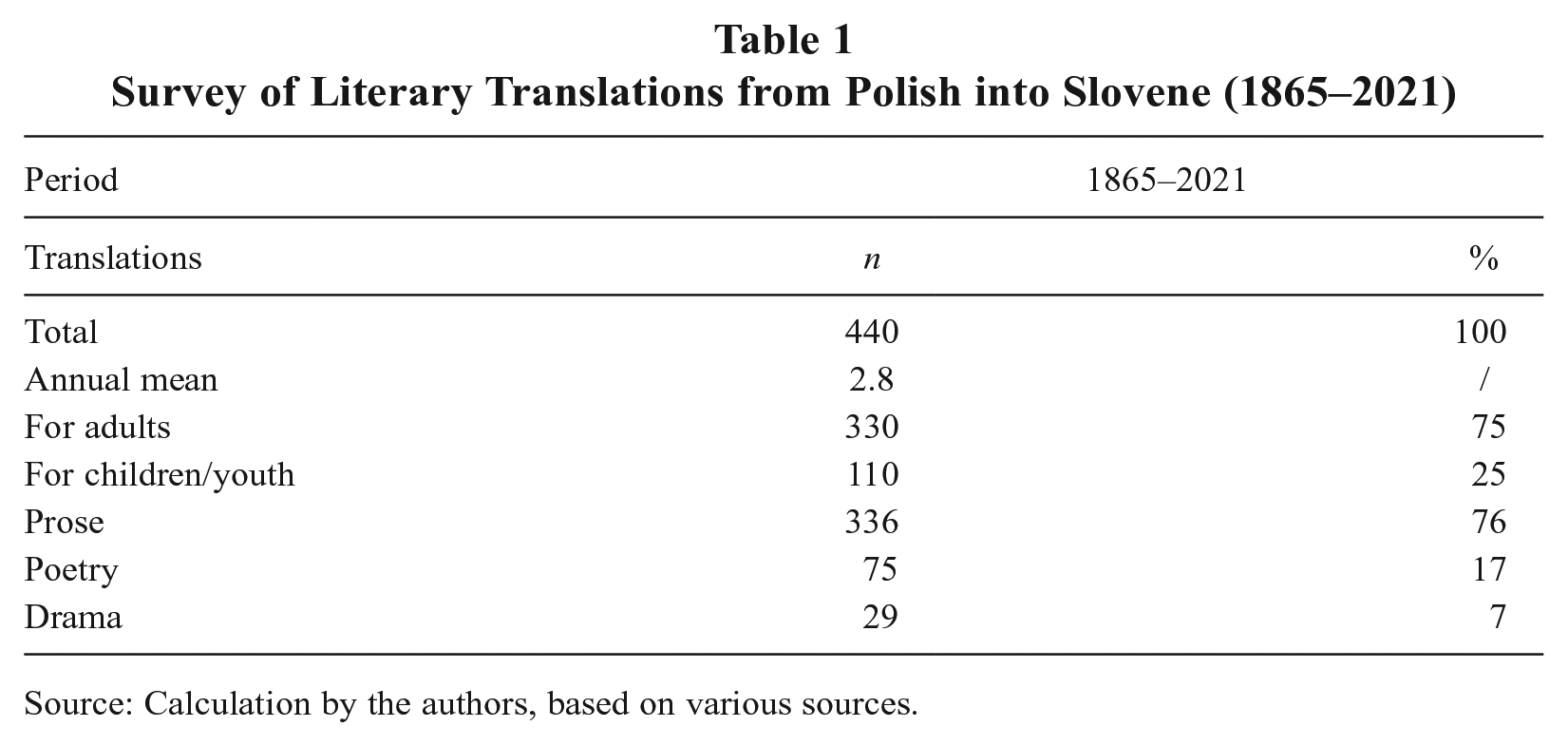
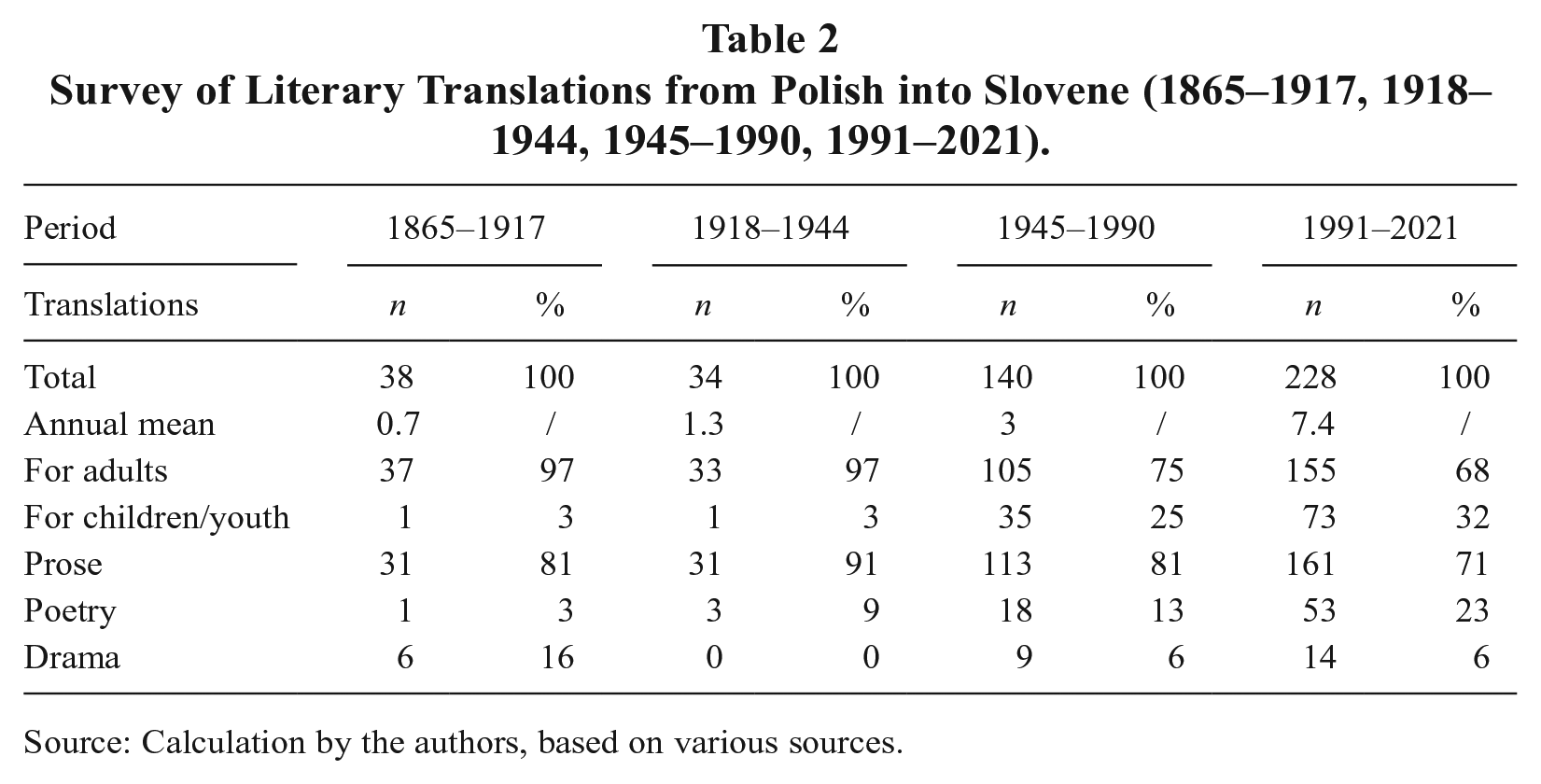
The following statistical survey offers insight into the dynamics of literary translation from Polish into Slovene from the second half of the nineteenth century to the present. It is based on data from the Slovene bibliographical system COBISS, 55 supplemented with data from published bibliographies of Slovene translations from Polish. 56 The statistical analysis includes all Slovene literary translations from Polish that were published in book form between 1865 and 2021. The results are summarized in tabular form, divided into two parts. Table 1 shows cumulative data for the whole period covered by the analysis (1865–2021), whereas Table 2 splits the data into significant periods of Slovene history over the past 157 years, namely, the eras of the Habsburg Monarchy (1865–1917), the first Yugoslavia (1918–1944), the second Yugoslavia (1945–1990), and independent Slovenia (1991–2021). 57 We give the total number of translations and the average number of translations per year for each period, followed by an overview of translations by target readership and literary genre.
Survey of Literary Translations from Polish into Slovene (1865–2021)
Source: Calculation by the authors, based on various sources.
Survey of Literary Translations from Polish into Slovene (1865–1917, 1918–1944, 1945–1990, 1991–2021).
Source: Calculation by the authors, based on various sources.
Results
Table 1 presents a survey of literary translations from Polish into Slovene from 1865 to 2021. As can be seen from the table, there were 440 translations in total during that period, averaging nearly three translations per year. Most of the translated works were for adult readers, and the most translated genre was prose.
Table 2 presents the data on the number of translations from Polish into Slovene broken down according to periods. The average number of translations per year nearly doubled from the first period to the second. The same relationship holds between the second and third period, as well as the third and fourth. Furthermore, the number of translations increased greatly in the decades following the Second World War: nearly twice as many were made during the second Yugoslavia as before 1945, and about as many were made in independent Slovenia as in the three preceding periods together. A particularly large leap can be seen after 1991, when we registered an average of seven translations per year. This certainly points to the intensification of Polish literary diplomacy and also to increased Slovene interest in Polish literature. The breakdown of translated works by target readership is also interesting: while the pre-1945 period mainly saw translations of works for adults, we see significant growth in translations of books for children and adolescents in the post-war period. This percentage further increases after 1991 to nearly one-third of all translations. As for literary genres, the data follow a similar pattern to those on target readerships. In all four periods, prose was translated the most. Translations of poetry and plays started to appear more frequently in the second Yugoslavia and even more frequently after Slovenia’s independence. Nevertheless, translations of prose make up three-fourths of all the literary translations. 58
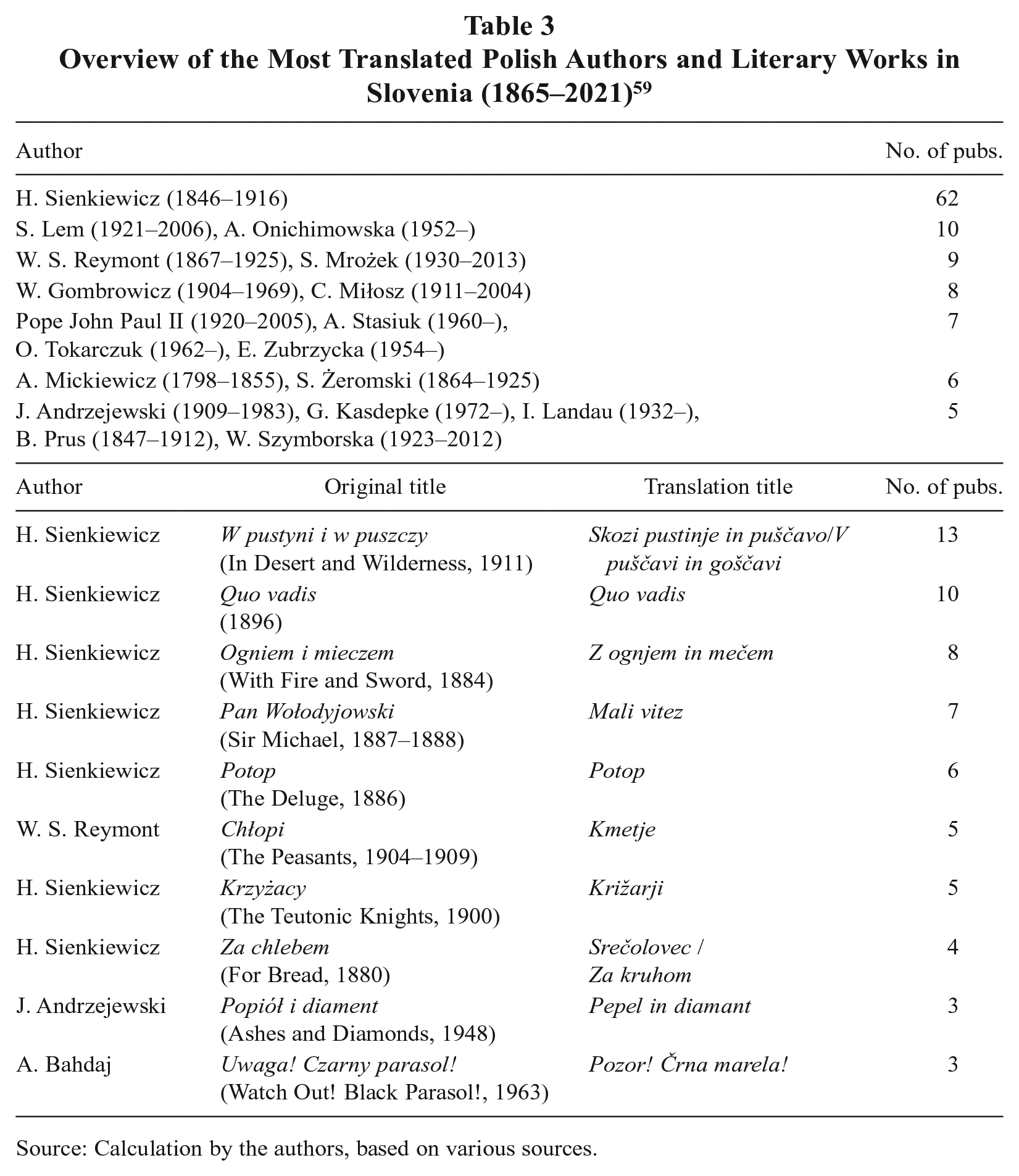
Turning from the general to the specific, Table 3 deals with the question of which Polish authors and books have most often been translated into Slovene.
Overview of the Most Translated Polish Authors and Literary Works in Slovenia (1865–2021) 59
Source: Calculation by the authors, based on various sources.
Table 3 shows that the Polish authors most translated in Slovenia include several of the most prominent names in Polish literature from the nineteenth century onwards. Although it is mostly authors of adult prose that have been and continue to be translated into Slovene, the list also includes several poets, playwrights, and writers for younger readers. 60 All the ten books that made the list are prose (seven novels for adults, two novels for young adults, and one short story), seven of which were written by Sienkiewicz. 61 Judging by the number of editions, the most popular Polish work among Slovene readers is Sienkiewicz’s international bestseller for younger readers, In Desert and Wilderness. It is followed by his historical novels Quo vadis and With Fire and Sword, which brought him his greatest success both at home and abroad.
If we decouple the aggregate data of Table 3, the following can be highlighted:
Before Slovenian independence (1991), the most “liked” (i.e., the most translated) author was Henryk Sienkiewicz, followed by authors from Romanticism, Realism, and Young Poland (Adam Mickiewicz, Bolesław Prus, and Władysław Stanisław Reymont), as well as by the science-fiction author Stanisław Lem and the author of the Theatre of the Absurd, Sławomir Mrożek.
A shift occurred after 1991 in the structure of literary translation to Slovene, with the most translated nowadays including writers who reached their glory after the Second World War or after the collapse of the communist regime in Poland, among them the Nobel Prize winners Czesław Miłosz, Wisława Szymborska, and Olga Tokarczuk; Pope John Paul II; one of the most prominent modern Polish writers, Andrzej Stasiuk; and two writers for children 62 —Anna Onichimowska and Elżbieta Zubrzycka. 63
Based on the quantitative data, then, we may conclude that Polish literature in Slovenia is no neglected Cinderella; on the contrary, for at least the past thirty years, and perhaps even a decade more, it has been a staple in the programmes of Slovene publishers, and it has kept growing in importance since 1991. 64 Researchers studying this field attribute the growing success of Polish literature in Slovenia to (1) increasing numbers of publishing houses and published titles, 65 (2) increased concern of publishers with literature for children and youth, 66 and (c) changes in the literary market and its adaptation to the needs of readers—Slovenes are avid readers of translated literature, novels in particular. 67
Translation of Polish Literature into Slovene: A Qualitative Analysis
Data collection methodology
Our quantitative analysis involves three established translators from Polish into Slovene, hereafter referred to as P1, P2, and P3. 68 In the semi-structured interviews, which were carried out between May and June 2020, we were especially interested in four questions: (1) How do the translators decide on the translation of Polish texts—independently, or are they encouraged to do so by the Polish state? (2) What problems do they most often face in translating Polish literary works (funding, interest, searching for appropriate translation solutions, etc.)? (3) In their work, do they rely on funding from Polish or Slovene (state) institutions? (4) How do they assess the role of translators in the development of Slovene–Polish relations? The translators’ answers are presented in thematic sections and combined with the replies to the same questions by the Polish ambassador to Slovenia, as we wish to extract the most relevant replies regarding translation and literary diplomacy through cross-checking.
Results
First, we were interested in what factors “drive” the three translators to translate a certain Polish work into Slovene. We expected that this would mainly be support from state authorities, that is, directions on what works required translating, but our assumptions turned out to be incorrect. P1 stressed that it was their own choice to translate quality texts. They added that when they discovered an author who seemed to be of good quality, they tried to translate as much of that author’s work as possible. The comment about determining the quality themselves is interesting (“awards do not concern me, for based on my experience as a reader I know that an award is no guarantee of quality”). In the past, P1 had also done translations based on suggestions from Slovene publishers, but only because the publishers suggested quality books. To P3, too, the aesthetic criterion was key. 69 In the past, P3 too had received suggestions to translate certain books, but would only take on those translations if they had literary value. Unlike P1 and P3, P2 divided the drivers of their translation work into three categories: (1) personal motivation for the text and the author, (2) the generally recognized literary worth of a certain work, and (3) having a publisher interested in publishing the translation. If P2 selected what needed to be translated, all three criteria had to be met; if the publisher suggested it, only the first two. P2 also stressed an important barrier that made them less keen on translating certain books, namely, “the distance to and lack of familiarity with the context of certain specific Polish topics in Slovene society.” This historical and socio-cultural distance is probably also a reason why work dealing with Polish history is more rarely translated, as was also pointed out by Ambassador Olendzki. 70
All the translators took a more critical stance regarding the question of the interest of Slovene publishers and the funding of translations of Polish literature. P2 stressed that translations of Polish literary works in Slovenia depended above all on the subsidies that publishers receive for such translations. P3 added that Polish books that would be worth translating “wait considerably longer for final inclusion in the programme [of the publisher] than do those from Western languages, as well as e.g. Russian, Serbo-Croatian [. . .] ones, especially regarding poetry.” P3 also said that it was odd that Slovene publishers rarely published different books by the same author. P1 was even more critical of the Slovene institutions co-funding translations, stressing that publishing houses in Slovenia did not receive equal treatment. P1 had personally had quite a few bad experiences with (the lack of) subsidies for certain translations, and therefore concentrated more on external, non-Slovene institutions when deciding to translate something and seek subsidies for it.
As to whether translators cooperate with Slovene and Polish institutions in their search for subsidies and which institutions are the most important for their work, all the interviewees said that they cooperate with Slovene publishers and with the Polish Embassy in Slovenia
71
and the Polish Book Institute. Regarding cooperation with the latter, however, P3 noted,
I generally find that Slovene publishers are not overly interested in Polish subsidies, and therefore the share of books subsidized by the Polish Book Institute is not remotely proportionate to that of other countries [. . . ], nor to the number of translations from Polish published in Slovenia.
Finally, the translators gave different answers to whether literary diplomacy contributes to a deepening of relations between Poles and Slovenes. P3 stressed that this was a question beyond their scope, as they were more interested “in questions of literary theory and literary history than in reception.” Regarding their own role in helping Slovene readers getting to know Poland, P3 added, “I see my role more as one of enabling Slovene readers to read translated books, [. . .] and in part I also see the role of translated texts in general in the development of [. . .] the language.” P1 understood the issue differently, saying that “the translator is a cultural mediator, in both directions.” In the promotion of mutual acquaintance between Poland and Slovenia, in P1’s view, personal connections mattered more than state bodies:
Polish–Slovene relations would not exist without personal friendships and mutual respect. There can be no international relations without people and their personal commitment. Here I am not thinking only of translators, but of everyone who lives and moves in several cultures, without regard to profession. We, a lot of people, are promoting all these cultures and countries that we love out of enthusiasm, because we wish to share their goods with our surroundings—with friends, with all our like-minded acquaintances, with random participants in events, with readers and others that defy labelling. On the official/governmental level, the things going on may be more visible (thanks to media coverage), but their impact cannot compare with the living web of close contacts that grows somewhere down below, outside the media spotlight.
P2 bridged the views of P1 and P3, stressing that “the first task of the translator is cultural mediation.” P2, then, was willing to take on the responsibility of getting Slovenia and Poland better acquainted, but at the same time they see the translator not only as a mediator but also as a co-creator:
Translators from Polish have had a very specific role since the last quarter of the nineteenth century: They bring in a specific element of the European cultural consciousness as it took form in the “Polish Republic” from the Renaissance onward. The Polish literary tradition, namely, has a special importance, a symbolic capital, especially for Central Europe, for the West and South Slavs. Within the narrower Slavic area, it adapted and modified the world literary systems, and it was one of the first to form in its own language a complete repertoire of literary genres, formulate the principles of Classicist poetics and to form its own tradition in the basic cultural formations (Classicist, Romantic, Modernist), some fundamental literary patterns that were an example to other Slav entities, especially the smaller ones. Through translated literature there develops a great mosaic in which we behold our own place and role.
In P2’s opinion, Polish literary diplomacy in Slovenia does not only aim to make Polish culture more familiar, it also has a higher purpose, namely, the positioning of Slovene socio-political realities in the system of European values. In their view, by translating Polish literature into Slovene, we are transferring not only the letters but also the symbolic capital possessed by Poland and Polish literature, and which has in fact spilled over into the entire literature of the Slav peoples. In P2’s frame of reference, Poland for Slovenes does not only represent relations through cultural contacts, it also determines their frame of thought and action:
We Slovenes have adopted into our cultural tradition the sonnets and poems of Mickiewicz, the historical epics of Sienkiewicz, the positivist stance of Prus, the early catastrophism of Kasprowicz. Herbert, Zagajewski, Miłosz, Gombrowicz, Lem—they have become “our own”; their local worlds, their “little homelands” have broadened our outlook by becoming part of our cosmos. We understand it better and from our own “little homeland” we have become more aware what and who we are.
Discussion and Conclusion
The importance of literary diplomacy in modern diplomatic relations is only beginning to gain recognition in theoretical work. In this article, we have analysed it based on the case of Slovene–Polish relations. Although this case has limited “reach” and certain conceptual limitations (a single country, the small number of translators from Polish into Slovene, limited access to data on the co-funding of translations, etc.), we can still draw certain important conclusions to further thinking about the power and significance of literary diplomacy for strengthening relationships between countries.
First, it is necessary to analyse different levels of acquaintance between cultures or nations, which is the foundation for further (deeper) cooperation. The Polish ambassador, Dr. Krzysztof Olendzki, stresses that when speaking of understanding between cultures and nations, we need to be aware that such understanding exists on three levels: at the level of (political) institutions and elites, culture, and the general public. He considers all three of these important, but sees the general public as being the most important, as it enables the broadest and most enduring understanding of a different nation/culture. 72 He thinks that Slovenia and Poland in the 1990s forgot about their historical cooperation “since we both wanted to prove that we are Europeans. Thus we replaced the ‘Slovene’ and the ‘Polish’ with the European.” Due to this rupture, “many ties were broken since we did not have the desire to stay together.” Today, he says, the situation is different: the two countries are actively cooperating in the political, economic, and cultural fields, 73 and it is in the latter field that cooperation is most distinct.
Second, we need to be aware of the significance of literary diplomacy between Slovenia and Poland for the relations between the two states. The empirical analysis of the translation of Polish literature in Slovenia showed that the number of translations grows over time, and that the number of published books grew by leaps and bounds after 1991. It is telling that both the Polish Book Institute and the Polish Embassy in Slovenia actively take part in Polish literary diplomacy but leave the choice of books and translations of literary works to translators. Neither the Polish Embassy nor the Polish Book Institute decides on the titles, contents, or anything else; hence, they do not directly take part in shaping translation policy, but rather encourage the translation of the Polish books proposed by the translators. 74 As the ambassador puts it, the translator is autonomous in his decision about the translation of a particular work. Of course, the “autonomy” of the translator can be a double-edged sword; it can be a hindrance to the successful realization of literary diplomacy, as translators may have different, subjective views and priorities than do representatives of Polish statecraft.
Third, the question arises as to the importance of the translator as an agent of Polish literary diplomacy. As we have made clear, the translators stated that they decide autonomously what to translate, but simply by opting to translate Polish literature, they reinforce the soft power of Poland in Slovenia. Although they wish to be apolitical (P2: “I am more interested in questions of literary theory and literary history than in reception”), they remain political in the sense that they act as mediators of another culture. What does this mean for literary diplomacy? The fact is that translators are not only its agents, but they also have agency of their own, as besides developing the language of one culture or the other, they also influence opinions about the other culture. The better the translation, the closer the translated work will be to the reader. And if the book is a good one, and the translation is well received by the target public, the reader’s goodwill for the work will spill over onto the whole culture/country from which the work comes. The translator is thus a kind of literary diplomat whose work establishes “friendly relations between the sending State and the receiving State,” 75 not on the level of political elites, to be sure, but especially on the level of the general public.
Finally, to answer the research question posed at the outset, we find that the number of translations from Polish has grown since 1991, and that translations have also diversified. It should be stressed that translations have continued to concentrate on key authors and work of Polish literature, and that there have been few “excursions” into more marginalized work. The main driver on the translators’ side is the aesthetics of the work. Although each translator conceives it differently, this remains the basic principle. This is good for literature and culture, but of course more questionable from the point of view of literary diplomacy, the activities of the state in general, and the building of its reputation and prestige abroad. On the one hand, the indirect or bottom-up approach to translations contributes to strengthening the soft power of the state; on the other, it also represents a “threat” that the state might lose control of the instruments of literary diplomacy because it leaves matters to the discretion of the translators. This caveat notwithstanding, we may conclude by noting that literary diplomacy between Slovenia and Poland is highly developed and also has the potential to serve as a frame for developing better understanding and also more intensive economic and political cooperation between both nations.
Footnotes
Author’s Note
The article is a result of two research programmes (P5-0177: Slovenia and Its Actors in International Relations and European Integrations, and P6-0265: Intercultural Literary Studies) and of the programme Young Researchers, all funded by the Slovenian Research Agency (ARRS).
