




Abstract
The developments that took place in Central and Easter Europe (CEE) over the last three decades have consequences for how researchers define and understand the concept of civil society. This article revisits four major approaches to civil society that were developed after 1989 and provides reasons for a reconceptualization in light of new research and empirical data. It argues that civil society in CEE needs to be studied not as an outcome or a facilitator of democratization and democratic consolidation, but as a phenomenon in its own right. The article also supports an earlier claim of scholars that the static liberal approach to civil society has limited explanatory potential in the CEE context and advocates a dynamic approach, which is guided less by normative assumptions and more by the actual experience of societies practicing various forms of social self-organization. Four criteria of the dynamic model that are proposed include a broad understanding of civic activism as the key dimension of civil society, a clear focus on its potential, a better understanding of the normative content of civic activism, and a recognition of a value-related aspect of civil society activism.
Introduction
The developments that took place in Central and Eastern Europe (CEE) over the last three decades have consequences for how researchers define and understand the concept of civil society, whose actors often take an organizational form but also as a public space for discourse and engagement. The goal of this article is to propose a reconceptualization of civil society in light of existing research and new empirical data coming from a survey conducted in five CEE countries. There are three main reasons for such reconceptualization that the article discusses. First, it argues that civil society in CEE needs to be studied not as an outcome or a facilitator of democratization and democratic consolidation, but as a phenomenon in its own right that plays an important societal role, regardless of the regime type. 1 Second, it argues that the static liberal approach to civil society is problematic because it operates within a certain vision of the social and political order that a liberal state embraces. As such, it has limited explanatory potential in the context of the CEE region. Finally, it argues that despite low rates of individual participation usually measured in surveys, the existing civil society actors that constantly emerge or become mobilized, their empowerment for action, and their influence at the local and national levels are decisive indicators of the potential of civil society, even if they are more difficult to measure. Individual participation and associational membership are just one aspect of the strength and potential of a civil society. 2 Other aspects include the capacity measured over time for social mobilization and engagement in community life through civic campaigns, peaceful protests, contestation, social movements, and other forms of civic activism, as well as the density of relationships that allow for effective engagement, including supportive interactions between civil society and government.
These three sets of arguments refer closely to the earlier conceptualizations of civil society that are critically evaluated in the sections below: “Approaches to Civil Society in Central and Eastern Europe” and “Findings and Discussion: Re-Examining Civil Society in CEE.” As a number of scholars have already acknowledged, 3 starting in the 1990s, 4 there is a need for a more useful theoretical model of civil society. I call it a dynamic approach and argue that it ought to be guided less by normative assumptions and static approaches and more by the actual experience of societies practicing various forms of civic engagement. As these forms are often spontaneous and sensitive to domestic dynamics, we cannot expect that they evolve according to the same pattern everywhere.
The dynamic approach to civil society presented in the section “Toward a Dynamic Approach” uses the term “dynamic” in two ways. The first stresses that civil society development changes over time. The second refers to the shifting sphere of actors, actions, and indicators. This dynamic process of civil society development has been particularly evident in the context of contemporary CEE countries that have different regime types, from consolidated democracy to consolidated authoritarianism. The conditions for the engagement of civil society actors vary, depending on the openness of the regime. This new conceptualization should find some common ground that will allow for a better understanding of civic activism under favorable, mixed, and unfavorable political and institutional conditions. It is the vibrant and evolving nature of civic activism and the factors which prompt civic participation of all kinds that need a closer theoretical consideration. A dynamic approach to civil society research does not dismiss the static liberal conception of civil society altogether, but it departs from the dominant conceptualization based mostly on the findings of de Tocqueville and Putnam 5 that stress associationalism and social capital as the major indicators of civil society’s strength or weakness.
The discussion presented here is based on a mixture of methods. It applies conceptual analysis to previous research on civil society in the post-communist context. Critical discussion of four dominant approaches to civil society presented in the section “Approaches to Civil Society in Central and Eastern Europe” aims at evaluating the theoretical frameworks used in earlier research, their shortcomings, and their applicability today. Some of the theoretical arguments of this article are also supported by new quantitative data presented in the section “Findings and Discussion: Re-Examining Civil Society in CEE” as well as available indices of democracy in CEE. Quantitative analysis is based, as with other papers in this special section, on the survey data gathered for this project in an original nationally representative survey entitled “Perceptions of civil society and activism” conducted in five CEE countries (Bosnia and Herzegovina, Czech Republic, Poland, Russia, and Ukraine) in the winter of 2019 and 2020. Empirical findings coming from these five countries allow for comparison of the dynamics of civic activism in three different sets of states in CEE, those which were regarded as leaders of democratization (the Czech Republic and Poland), post-conflict (Bosnia and Herzegovina), and post-Soviet (Russia and Ukraine). These dynamics of civic activism are further elaborated on in this special section with the use of both quantitative and qualitative methods applied by the authors of the articles focusing on individual countries and their comparison.
Approaches to Civil Society in CEE
The conceptualization of civil society in the context of CEE countries has come a long way since the early 1980s when the term reappeared in social science. At first, it referred to a certain unexpected process of social self-mobilization against the communist state in Poland. 6 Subsequently, it became an important panacea to authoritarian regimes and a significant tool in the process of democratization and consolidation. 7 The concept of civil society that was applied in this unique context was dynamic and not static for it referred to the actual wave of civic activism in the late 1980s. When the transformation began, however, a static liberal conception somehow became dominant in the discussion on civil society development in the region. The expectation was that along with democratization, civic spirit would foster new democratic attitudes, and civil societies would somehow but certainly play a major role in the process of democratic transitions throughout the region. 8 These expectations fueled at least four theoretical approaches to civil society in CEE and led to a number of misunderstandings. The following discusses the four approaches, as well as some of their shortcomings that have become clear in light of research and empirical evidence.
Civil society as an arena of democratic consolidation
The main argument of this subsection is that civic activism in CEE should no longer be studied as simply a vehicle of democratization, but instead should be understood as an important social phenomenon that has many forms and accomplishes a variety of goals. The first major approach to civil society conceptualization in the context of CEE results from certain assumptions about democratization and the processes of regime change after 1989. 9 Following Tocqueville and Putnam, 10 many social scientists 11 regarded civic spirit and civic engagement as necessary factors to facilitate democratization and democratic consolidation. Active and involved civil society was seen as a society of vigilant citizens who can shape the public good and defend democratic values and institutions if they happen to be in danger (a good early example of such potential was civic mobilization in Slovakia against the policies of Vladimir Mečiar’s government 12 ). The understanding of civil society as one of the key arenas of democratic consolidation 13 was closely linked with the transition paradigm 14 and the expectation that the two processes, civil society development and democratic consolidation, should fuel each other or that by definition civil society development was a precondition of a liberal-democratic order. 15
The root cause of this misunderstanding is partly conceptual and emerges from a static liberal understanding of what civil society is and what its roles ought to be. In the 1990s, like a consolidated democracy, a strong civil society was seen as an inevitable end goal of political transformation, despite stark differences between countries. By the late 1990s, and despite Carothers announcing the end of the transition paradigm, 16 civil society remained a facilitator of both democratization and democratic consolidation in much of the research of the time. This persistent assumption was based on two implicit hypotheses, both of which proved to be incorrect. The first treated democracy and democratization as partly conditioned by the development of civil society understood as largely an institutionalized sphere of various non-governmental organizations (NGOs) and civil society organizations (CSOs). Second, within this institutionalized sphere, advocacy NGOs were considered “the key mechanism by which citizens’ interests are expressed to the government.” 17 Giving priority to advocacy NGOs by default contributed to the narrow perception of civil society as a mechanism of influence exercised by organized civil society actors such as NGOs.
What should have been expected from newly democratizing countries were certain institutional conditions for civil society development, such as constitutionally guaranteed freedoms of association, assembly, and speech. These conditions, once established, could not, however, guarantee that the Western type of associationalism and participatory civic culture would emerge overnight. In the post-communist context, treating individual membership of CSOs and NGOs as the major indicator of civil society development could only produce disappointment and misleading conclusions. 18 And, not surprisingly, it did. What was overlooked in the early literature on the topic was the fact that “the impact of civil society on democratization appears to be determined not by the collective strength of its various components but by surrounding political and economic conditions.” 19 Consequently, a large group of scholars focused their attention on different and more promising aspects of civil society in the region, such as protest and contentious movements, 20 and social capital. 21
If civil society is considered one of the five arenas of democratic consolidation, as indicated by Linz and Stepan, 22 then the question arises as to the functions of the other arenas, especially institutions and political elites. Is democratic consolidation more likely to happen if civil society is strong enough to act as a check upon the government and hold political elites and institutions accountable? The contemporary Polish and Hungarian cases are illustrative here. The mere survival of an electoral democracy, even if it is watched by vigilant citizens, does not signal that it is consolidated. Democratic deficits and recent processes of de-consolidation in Poland and Hungary can hardly be explained by the weakness of civil societies in these countries. Rather, the question is whether civil societies can perform the role of a “firewall” 23 that will protect democracy from backsliding. The certainty about the factors that determine success of democratization has faded away in recent decade and made some declare that “what determines the potential for democracy in a given setting is uncertain and may even be unknowable.” 24 Civil society may indeed be a vehicle of democratization, but its contribution to democratic consolidation cannot be easily evaluated and verified empirically.
The “weakness of civil society” thesis
The second major approach in research on civil society was initiated by those who were disappointed with the slow growth of civil societies in the region, declaring the “weakness of civil society” as a distinct problem for post-communist countries. 25 Some described this apparent weakness of civil society as paradoxical, 26 providing a number of reasons for this outcome. Bernhard, for example, initially attributed the weakness of civil society to the demobilization of insurgent civil society and the loss of leadership in CSOs because of migration into mainstream political channels. 27 Bogdanor and Pearson argued that the weakness of civil society in CEE was, instead, caused by the region’s propensity toward populism and nationalist attitudes. 28 Szelényi et al. described “strong social democratic vacuum” in Hungarian politics following the fall of communism. 29 Similar arguments were formulated with respect to other CEE countries. 30
Although several important studies documented low levels of trust in political institutions and low membership in voluntary associations in post-communist Europe with surprise and concern, others criticized the “narrow borders of the concept,” challenging scholars to rethink and broaden their definition of civil society 31 or to better explain its dynamics. 32 In a series of case studies conducted between 1995 and 1999, Klingemann, Fuchs, and Zielonka combined comparative analysis (using the United States, Norway, and West Germany as reference countries) with country-by-country research on several post-communist societies, concluding that “each country proved to have its own peculiarities” while “similar patterns” were “often generated by different factors, and they help us to explain the many unexpected results emerging from the statistical evidence.” 33
The gloomy picture of an underdeveloped civil society was also caused by high expectations associated with the dissidents’ conception of civil society and the subsequent paradigm of transition and democratic consolidation. Against this trend, some researchers noticed that the major problem with the weakness thesis was the methodology of civil society measurement. Its proof came from often selective, cross-European or cross-country attitude polls such as the World Values Survey, which produce uniform aggregated results for each country, while other evidence, such as national-level surveys on various aspects of civil society, density of CSOs, and informal activities including protests and ad hoc movements, escape the measurement. 34 The problem is that the weakness thesis assumes that there is some kind of a standard norm with regard to the level and forms of citizens’ participation in a civil society and that there are some standards as regards various legal and institutional conditions for civil society functioning. Although such standards can be identified for the latter, in case of the former we can only obtain a vague qualitative comparison on the weak-strong scale and then decide where each characteristic begins numerically. It is unclear how to design a standard model of participation or a model that would stipulate the adequate form and density of civic participation for each given case. The weakness thesis implicitly assumes that citizens in civil societies regarded as “weak” should be more involved and join associations, be active in politics, and be more engaged in groups, movements, or grassroots organizations because citizens in “old democracies” display these tendencies. In addition, this weakness might be time-relative and adapt to changing overall conditions for civil society and issues of concern, and thus should be assessed with measures that allow for a dynamic approach that shows changes over time.
Dominant methodologies of civil society measurement focused on individual membership in CSOs seeing it as “strength.” They also used time-series analysis, and the results have been compared with those collected in other regions, notably with older democracies or post-authoritarian regimes. 35 Comparisons between regions make sense when there are no deeply rooted differences between them. 36 Comparisons within the region should not be too broad in space and should be carried within the time frame which allows for noticing important changes over time. An application of more comprehensive and context-sensitive measures led some scholars to acknowledge that civil societies in CEE are, in fact, “dense, diverse, and free” 37 and similar to their counterparts in Western Europe. The analysis presented here does not aim to either agree or disagree with such diagnosis. Yet, this discussion demonstrates that a more nuanced understanding of what civil society is and how it should be measured is required to foster more comprehensive and less biased research on its development and condition.
Foreign-funded civil society
Another approach in research on civil society in the region has focused on the phenomenon described as a “foreign-funded civil society,” which invests in strong NGOs but achieves weak social support and accountability of civil society actors. 38 International funding for CSOs within the framework of support for democratization processes increased in the 1990s, raising concerns that such organizations are accountable to external rather than domestic constituencies, and advance foreign rather than local agendas. Several studies have noticed that the rapid process of foreign-sponsored “NGOization of civil society” left grassroots activities and non-institutionalized civic activism beyond the scope of research. 39
The neo-Tocquevillian emphasis on associationalism is linked to neoliberal ideas about minimizing the role of the state. It is assumed that NGOs, non-profit organizations, charities and voluntary associations are more flexible and innovative than the state. They can substitute for the state, in providing social services, for example, they can check abuses of the state and poor governmental practices; and they can call corporations to account.
40
This version of civil society was embraced by many Western donors in the early 1990s when civil society was needed to provide support during economic transition and its shocks, and to foster good governance in the context of neoliberal economics. Today, this approach is less helpful for several reasons. First, despite Western donors’ support for progressive civil society groups, their impact on successful democratization and liberalization has varied across the post-communist region. Second, the recent withdrawal of Western donors from the region left many progressive NGOs vulnerable or unable to continue their mission against the official governmental agenda. Third, this approach relied on an unrealistic assumption of Western scholars and policymakers that former communist societies would pursue progressive goals and that liberal values would dominate their political agenda.
Receiving grants from foreign donors and being responsible to them, and not to the citizens, proved destructive for NGOs in the long run. This was particularly evident for NGOs that were left out of policy-making or “ghettoized.” 41 In a number of countries of the region where this phenomenon has developed (including in Bosnia and Herzegovina), citizens were distrustful of CSOs and thus unwilling to support or join them. 42 In recent years, foreign funding to NGOs, especially in Russia and Hungary, came under attack as both Putin and Orbán introduced severe restrictions on the operation and capabilities of all organizations receiving foreign funding. This added yet another interesting facet to civil society research on the effectiveness of foreign support to the NGO sector in the region, on the one hand, and on NGO’s responses to new restrictions, on the other hand. 43
The institutional approach
The fourth approach looks at civil society through the lens of institutionalization, and this dominates well-known indices such as Freedom House “Nations in Transit,” the United States Agency for International Development’s (USAID) Civil Society Organization Sustainability Index, or the CIVICUS Monitor. The institutionalization of civil society includes aspects such as freedom of association, freedom of speech and assembly, political and legal opportunities and constraints, state regulation of CSOs, the relationship between civil society and the state, financial support for CSOs, and the relationship between the not-for-profit and for-profit sectors. “Nations in Transit” reports evaluate “the organizational capacity and financial sustainability of the civic sector; the legal and political environment in which it operates; the functioning of trade unions; interest group participation in the policy process; and the threat posed by antidemocratic extremist groups.” 44 This approach focuses more on the environment in which civil society actors operate than on actual civic participation, its role, and the potential to transform or impact social and political spheres, and even less so on the dynamic nature of civic activism. One of its shortcomings, similar to the other approaches, is that it focuses on the institutionalized forms of civil society, such as NGOs and registered CSOs, overlooking other forms of activism.
A good recent example of applying the institutional approach is a comparative analysis of civil societies in CEE conducted by Vandor et al. 45 who, on the basis of expert reports, focused in their project on institutional actors of civil society from fifteen post-communist countries in CEE as well as Austria, looking at formal characteristics of civil society such as the size, form, and functions; the typical funding sources and legal forms of organization; and the roles of organized civil society in the fields of culture, advocacy, social services, and social entrepreneurship. 46 For this approach, civil society appears as a static category that describes a certain social reality that either is institutionalized or is not fully institutionalized. What escapes attention is the diversity of civil society and the fact that it is a very dynamic sphere of ever-changing scope of participation, which apart from formal institutionalized forms—registered voluntary associations—is home to many non-institutionalized and ad hoc forms of civic engagement. Although limited in scope, this approach provides valuable insights as regards internal and external factors (especially membership in the European Union [EU] 47 ) that influence the strength and weakness of civil societies in CEE.
Findings and Discussion: Re-Examining Civil Society in CEE
This section presents and analyzes recent empirical findings that provide clear support for the reconceptualization of civil society. It specifically refers to two common hypotheses in previous research on civil society in CEE. The first links civic engagement and civil society development with democratic consolidation, while the second sees social capital measured by the level of social trust as one of the major preconditions of civic participation.
The perspective advocated in the 1990s and described as the transition paradigm no longer explains patterns of civic engagement and activism in CEE. Recent processes of democratic consolidation and backsliding in CEE urge greater attention to the internal dynamics of these processes. For example, it needs to be clarified which institutions or political and civic actors or norms or attitudes are most directly involved in securing democratic outcomes and democratic sustainability.
To better illustrate these difficulties, I examined country-wide rates of individual civic participation to see whether they are correlated with the levels of political democracy. Respondents from our survey were asked to indicate whether they actively participated in any formal or informal civil society activity within the past year. The results summarized in Table 1 indicate the overall level of declared civic participation at a given point in time, suggesting that there is no correlation between the level of participation and democracy. According to recent democracy indices, the Czech Republic is the only consolidated democracy in the sample, and indeed Czechs seem to be more engaged in civic participation than citizens in four other countries. However, this is the exception rather than the rule.
Levels of Political Democracy and Participation
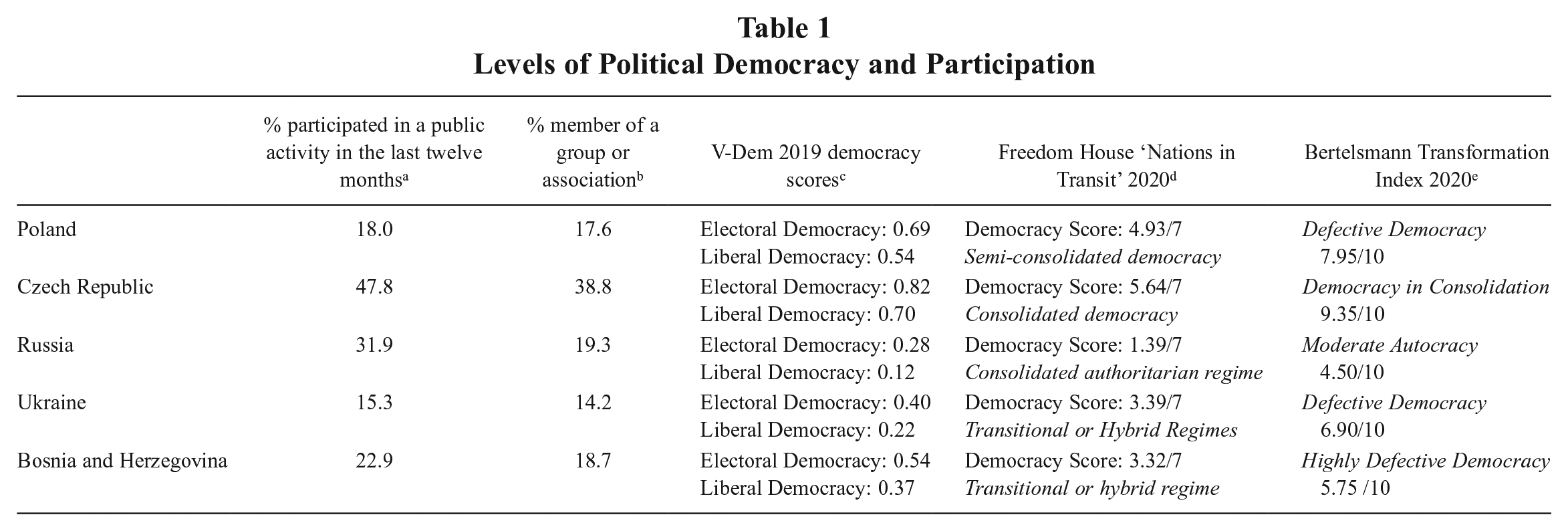
Respondents who answered that they had participated in one of the following public activities: protest/demonstration/strike, active involvement/membership in a civil society organization, volunteering, social movement; organizing others around a common interest, signing a petition, donating money to a civil society organization or non-governmental organization; sharing information about a public issue on social media; contacted a politician or civil servant; other. Source: “Perceptions of civil society and activism in Czech Republic, Poland, Bosnia and Herzegovina, Russia, and Ukraine,” National representative surveys, November 2019 to February 2020. Representative sample for each population is >1,000.
Respondents who are a member of any of the following groups: party, trade/labor union, business/professional organization, rights advocacy organization, church/religious organization; sports/leisure club; cultural association; another voluntary association; on-line group related to one’s interests. Source: Ibid.
Source: Varieties of Democracy, Democracy Facing Global Challenges: V-Dem annual democracy report 2019, online: https://www.v-dem.net/media/filer_public/99/de/99dedd73-f8bc-484c-8b91-44ba601b6e6b/v-dem_democracy_report_2019.pdf (accessed 10 October 2020).
Freedom House, “Nations in Transit 2020: Dropping the Democratic Façade” https://freedomhouse.org/sites/default/files/2020-04/05062020_FH_NIT2020_vfinal.pdf (accessed 11 October 2020).
Bertelsmann Transformation Index: https://www.bti-project.org/en/home.html?&d=G&cb=00000 (accessed 11 October 2020).
There is also an interesting difference between the two post-Soviet countries, Russia and Ukraine. Russia, despite being a consolidated autocracy, shows more civic participation than Ukraine (evaluated by Freedom House as a hybrid regime). Poland (semi-consolidated democracy) is more similar to Ukraine when it comes to individual participation than to the Czech Republic, although Poland and Ukraine are different with respect to civil and political liberties and the level of political democracy. Overall, with the exception of the Czech Republic, the data suggest that there is no obvious relationship between individual civic participation and the level of democracy. Interestingly, the citizens in Bosnian and Herzegovina, which is regarded as a highly defective democracy or hybrid regime, appear to be slightly more active than the citizens in Poland or Ukraine.
It is clear that the process of transformation that began in 1989 has produced different political and social outcomes in the countries of CEE. Their potential for successful democratization and consolidation was conditioned by a number of factors that are discussed in the literature. 48 It is, however, still unclear what was civil society’s role in these processes. As the data suggest, the much more interesting question is not what civil society can do for democracy, but how does robust civic activism occur in unfavorable institutional conditions produced by defective democracies, hybrid regimes, or moderate autocracies.
The following hypothesis was tested for this research: At the micro-level of individual survey respondents, rates of civic participation of all kinds are correlated with their expressed support for democratic values, social and political trust (trust in fellow citizens and representatives), as well as their behavioral indication of faith in democracy demonstrated by voting in elections. The results presented in Table 2 suggest that there is no correlation between social capital, measured by the level of social trust, and civic participation in the broad sense, although other factors produce stronger or weaker positive correlations.
Participation and Its Correlates among Respondents in Five Central and Eastern Europe Countries (Correlation Matrix)
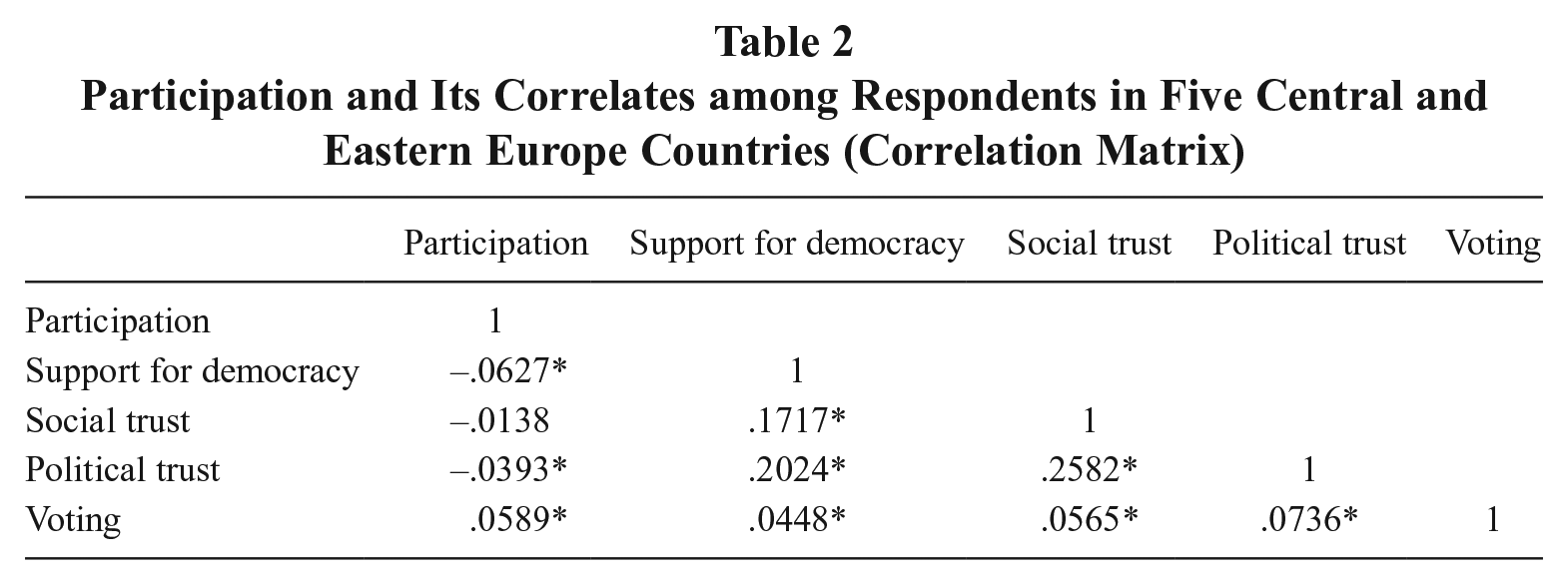
Source: “Perceptions of Civil Society and Activism” cross-national survey 2019–2020.
Note: Pearson’s r. N = 6,743. Participation is additive index of all forms of participation indicated by respondents. Forms of participation included a variety of activities ranging from protests to sharing information about a public issue on social media. Support for democratic values has been measured by the answers “strongly agree and agree” to the survey question: “Democracy is preferable to any other kind of government.” Social trust in fellow citizens: “Most people can be trusted,” answers “strongly agree and agree.” Political trust: “Most of the time we can trust people in government to do what is right,” answers “strongly agree and agree.” Voting, answer “yes” to the survey question: “Did you vote in the last parliamentary election?”
p < .05.
The importance of social capital to civil participation is implicit in the static, neo-Tocquevillian approach to civil society which builds upon the concept of social capital. Underlying it is the expectation that associationalism significantly contributes to the growth of social capital. 49 What has been disputed by some 50 is the assumption that other forms of civic engagement and especially elite-challenging actions such as peaceful protest, peaceful demonstrations, boycotts, and petitions do not contribute to the growth of social capital. The analysis of weakness and strength of civil societies in CEE has been much influenced by research on social capital which produced a ready-made explanation that positions the core of social capital in its function to produce collective action. When applied to the post-communist context, this explanation does not allow escaping a vicious circle (weak social capital produces weak civil society, whereas weak civil society produces weak social capital) that inevitably emerges once looking at empirical data on membership in civic associations in the region. This is a clear indication that theoretical considerations on civil society need to be better linked with empirical research. As Table 2 indicates, further empirical research is needed to test the correlation between not only membership of associations but also other types of civic activism and social capital. As other articles in this section clearly show, people in CEE countries are more and more involved in collective action that does not have the static institutionalized form of CSOs and NGOs which have been the subject of much research so far but develops in more informal and spontaneous ways. The claim that, in case of CEE societies, levels of elite-challenging action are rising at the expense of associational life has been tested in Poland by Ekiert and Kubik. 51 Meanwhile, others have stressed the importance of grassroots initiatives and informal civic activism in local communities advocating a critical approach to “highly normative and narrow understandings of civil society.” 52
Toward a Dynamic Approach
Existing research and a re-examining of different data provide reasons for the reevaluation of the static liberal conception of civil society. Other scholars have similarly acknowledged that a better operational conception of civil society is required, as well as more rigorous research on its condition, actors, and development. 53 This section provides arguments for a reconceptualization of civil society to better understand its dynamic character and the realities of civic participation in the context of former communist societies that have undergone radical social and political transformations. 54
Civil society is a dynamic sphere of autonomous social self-organization, which involves many different actors both formally and informally organized, and types of action that engage citizens who share values, attitudes, norms, or interests and are willing to act for their common or public benefit. The concept of civil society has a clear liberal underpinning, for one of its institutional conditions is the guarantee and exercise of such civil rights as freedom of association, freedom of assembly, and freedom of speech, as well as constitutionalism that provides the legal and institutional framework for civic participation. Thus, the advancement of a liberal democracy may be regarded as favorable to civil society development and stability, while the rise of illiberalism at the institutional and social level may be regarded as a threat or obstacle to civil society’s flourishing and institutionalization. The recent wave of research on civic activism in the region, as the empirical articles in this special section clearly demonstrate, requires that priority should not be given to the institutionalization of civil society and its liberal component, but to the actual forms of civic activism. What is also important are citizens’ perception of their own roles, as well as the values and needs they are ready to stand for and mobilize around. Understood broadly, 55 civic activism refers to many different forms of voluntary engagement at individual and group levels and may take both institutionalized and un-institutionalized forms. Although it can be supportive of democracy, its normative focus is not given and should be treated as an empirical question.
The static liberal conception of civil society, which has a long tradition in Western political philosophy,
56
understands it as a society of free individuals and communities that can pursue certain goals through their associations which are independent from the state and the economy or at least function in the sphere that is separate from both the state and the market. A good illustration is Ernest Gellner’s conceptualization of civil society as that set of non-governmental institutions, which is strong enough to counterbalance the state, and, whilst not preventing the state from fulfilling its role of keeper of peace and arbitrator between major interests, can, nevertheless, prevent the state from dominating and atomising the rest of society.
57
This definition suggests that in cases where civil society groups and institutions are not a counterbalance to the state (e.g., in Russia or Hungary today), it simply does not exist in the proper sense. Such a highly normative reading of civil society limits the very application of the concept to contexts where voluntary civic activities develop because of favorable institutional conditions based on liberal constitutional norms.
Another problematic aspect of the static approach is to associate the term “civil” with “civility” which as a category has never had much presence in social science research. 58 There is a strong temptation among researchers to take for granted that civil society, at least in the Western context, has always been progressive and stood for liberal norms. Civil society, almost by definition, is supposed to be liberal, supportive of liberal values and institutions, and if necessary, fighting against threats coming from groups that are perceived as illiberal. There is, however, a significant difference between saying that certain CSOs are conservative or patriotic or non-progressive and that they are uncivil. What creates a threat and leads to uncivility is a certain rhetoric and actions which divide or stigmatize CSOs and other civic actors along ideological lines, produce hate speech and exclusion, or even violence. Civic activism and mobilization are not by definition “uncivil” if they serve purposes that theorists prefer to see as anti-liberal, as if forgetting that civil society, like politics, is a sphere of disagreement and contestation as to what best serves the public good.
As the empirical articles on Bosnia, Poland, and Russia in this special section demonstrate, these claims are supported by the patterns of civic activism in these countries. These articles also indicate that there is growing online activism that requires more attention from scholars as well as new methods of research. In sum, there are theoretical, empirical, and methodological arguments to advocate for new or broader criteria in research on civil society along with its reconceptualization. In what follows, on the basis of the analysis presented so far, four such criteria are introduced to foster a dynamic approach to civil society research.
The first criterion concerns the broad understanding of civic activism as the key dimension of civil society. A real test for any civil society is whether active citizens can speak out and mobilize in different ways, either formally through volunteering, establishing, and joining CSOs and social movements or informally and locally, linking online activism with offline action or simply supporting various groups that represent their interests or views. Thus, civil society is not reduced to associationalism, but it includes various other forms of civic engagement which can have multiple forms and objectives. What makes all of them civic is that they serve to advance certain shared goals in the way that fulfills traditional requirements of civility such as respect for others and peaceful manner of pursuing shared goals. The term “activism” has been used to describe typically reactive or contentious social movements and actions aimed at political influencing, including demonstrations and expression of conflict or disagreement. 59 Recent developments, such as urban movements and various other community-based grassroots activities, have broadened the field of activism to include not only the reactive but also the proactive forms of collective action organized by citizens themselves on their own terms, usually outside of NGOs and CSOs or in cooperation with them. 60
The second criterion concerns the way civil society is measured and evaluated. Instead of measuring its weakness or strength, research needs to focus more on the potential of civil society which pertains to its capacity and especially to the ability to react and mobilize for action that serves numerous social and political goals. As this methodological argument will have to be developed elsewhere, suffice to say that the purpose of the dynamic approach is to indicate that a purely theoretical concept of civil society needs to be supported with an operational one that is applicable to empirical analysis of civic participation which changes over time. Therefore, the dynamic approach requires that the weakness or strength of civil society is a derivative of the dynamics of its development over time along multiple axes of indicators that are context-specific. Such approach should convey an estimate of where a given society is relative to its potential, or in other words, “relative to where it could be given the human and material resources that it has to work with.” 61
The purpose of the dynamic approach and its second criterion is to better link theoretical considerations with empirical research on civil society development and diffusion. In CEE, over the past three decades, civil societies developed along increasingly divergent trajectories. 62 In any society, including a democratic society, civic sphere often is a battle between forces defending democratic norms and institutions and those trying to subvert it. This is especially evident in the context of CEE today. When evaluating the transformative power of civil society activism, the dynamic model takes into consideration changing patterns of civic participation and can serve a number of different research goals such as evaluating civic activism in terms of its potential, opportunities, and threats, but also various other characteristics. It also encourages the use of methodologies that allow not only for a time-series analysis of civil society’s strength and weakness but also for evaluating its other components. Like political democracy, civil society has many different properties that can be evaluated, but not necessarily by a single score based on aggregated indicators that measure its strength or weakness along the same continuum in different contexts. Any comparative perspective, even within a certain clearly defined region, for example, the CEE region, faces the danger of oversimplification unless the grounds for comparison are justified and explained.
The third criterion of the proposed reconceptualization concerns the problem of the normative content of civil society. This is important because it would not hinder empirical research or lead to narrow or misleading conclusions, but would support new and innovative theoretical and methodological approaches. Civil society is neither merely a vehicle of democratic consolidation, nor its guardian. Rather, it is a sphere of voluntary social activity that cannot follow one pattern or pursue goals that fit into a given ideology. Its institutionalization requires that a certain normative framework is in place, but this does not exclude civic activism in a context where such institutionalization has not been completed or is weakened by illiberal government. If civil society is defined as a normative model that corresponds with the Western tradition, its applicability to different historical and institutional contexts becomes problematic. But if we retain some of its normative validity but treat civil society as an always dynamic sphere of civic participation of various kinds, of everyday activism that happens in free and partly free societies, we avoid the problem of coming to terms with an ideal category that cannot be fully operationalized. There are various models of civic participation in CEE today which are not always directly correlated with the level of democratization and liberalization. Thus, the third criterion of the dynamic model calls for an analysis that is both context-specific and inclusive as regards modes of civic engagement rather than prescriptive.
The last criterion refers to the value-related dimension of civil society understood in terms of cultural and moral values, as well as citizenship norms. This dimension contributes to civil society dynamism in two ways. First, citizenship norms shape attitudes toward civic participation including political efficacy and can vary depending on political culture and regime type. At the same time, civic participation is shaped by values, norms, and cultural expectations that groups and individuals identify with and which can mobilize civic activism of various kinds. The major division in today’s civil societies which partly explains its dynamism is between those civic actors who stand for and promote liberal values and those who form and promote conservative or nationalist-conservative civic movements, sometimes called right-wing activism. 63
Civil societies in the CEE region, as in other regions, do not represent and advocate one clear set of norms and values, but the whole spectrum of values and cultural or moral norms which mobilize civic engagement. An early expectation which assumed that along the process of democratization the static liberal model of civil society would simply diffuse throughout the region proved to be completely unfounded. The value-dimension seems to be particularly overlooked in civil society research despite the efforts of those who attempted to include it as one of the key aspects of civil society. 64 The theory of frame alignment suggests that CSOs can effectively create opportunities for participatory action only if activists frame contentious issues in a way that resonates with citizens. 65 This again needs to be tested empirically. From the theoretical perspective that is offered here, it is particularly important to understand the motivations and resources contributing to civic activism in its various forms.
Conclusion
Over the last three decades, research on civil society has advanced significantly. The concept of civil society is now well rooted in social science, and like other concepts, its meaning, definitions, and explanatory potential are still highly contested. This article has critically evaluated four major approaches to post-communist civil society that dominated earlier research. However, since 1989, civil societies in CEE dynamically developed in different ways. Some of them followed full institutionalization and now resemble civil societies in Western Europe, some attained only partial institutionalization due to problematic democratization, some function in the form of a rebellious civil society that exists primarily in the form of protests, and some needed to overcome the shortcomings of a foreign-sponsored civil society and invest more in grassroots initiatives. Such a variety of models and types of participation requires a dynamic approach to civil society. This article advocates a reconceptualization that treats the phenomenon of civic participation not as a certain structure, but as a dynamic process, 66 which requires better theoretical and methodological tools to study its forms, development, strength, and weakness over time, as well as its sustainability and its normative content.
The dynamic approach presented here is based on four interrelated criteria: a broad understanding of civic activism; clearly defined objectives for civil society measurement that can explore its potential and especially its ability to react and mobilize for action that serves numerous social and political goals; the requirement that the normative content of civil society should support and not hinder empirical research and especially innovative methodological approaches; and finally, a better understanding of the value-related dimension of civil society which contributes to civil society dynamism in ways that still need to be explained with comparative empirical research.
This dynamic approach encourages more empirically relevant research. An important research question is not whether Russia or Poland has a civil society and how strong it is in institutional terms, but rather what kinds of activism occur in civil society and how their social and political roles evolved. It is evident that various forms of civic participation often escape what common indices measure and evaluate on the basis of expert opinions. Similarly, while evaluating civil society’s role, we need to go beyond the presumption that this role is primarily in providing citizens with voice and a way to hold governments accountable. The dynamic approach does not assume that certain roles and expectations are given and fit all contexts, but leaves such questions to empirical research. In fact, many examples of civic activism in CEE today show that it is not much different from the types of activism that function in Western Europe or North America. What might, however, be different is the underlying civic norms, values, and perceptions of civic engagement in CEE societies as well as responsiveness of their political institutions and governments to civic engagement and advocacy and the openness of the public space. These aspects require comparative analysis within the region so that the current conditions of “really existing” civil societies can be better explained along with the actual forms of civic participation, their impact, and potential and roles that evolve over time. Thus, the dynamic approach is less oriented to a normative assumption of what civil society should be and leaves some of the normative questions open to an empirical analysis. Yet, the core of the concept of civil society is normative because it regards autonomous social self-organization as valuable when it advances rather than hinders certain social or public goods.
Footnotes
Funding
The author disclosed receipt of the following financial support for the research of this article: This research was supported by a research grant of the National Science Center in Poland (project no. 2018/30/M/HS5/00437). Open access for this publication was funded under the program “Excellence Initiative – Research University” at the Jagiellonian University in Krakow.
