




Abstract
Democratic reforms, or lack thereof, in countries addressed by the European Union’s (EU’s) Eastern Partnership initiative (EaP) have attracted considerable scholarly attention. Yet many studies approach these countries’ political and policy developments through the lens of external actors’ (especially the EU and Russia’s) engagements. While accounting for international influences, this article lends agency to the domestic actors by scrutinizing the antidiscrimination reform process in Moldova, one of the EaP countries with closer relations to the EU, against the background of their negotiations. In doing so, the article explains the outcome of the reform and makes a case for applying Robert Putnam’s (1988) Two-Level-Game approach to an analysis of a controversial reform process surrounded by international and domestic pressures in a nonconsolidated democracy. In addition to its empirical contribution, the article seeks to advance the applicability boundaries of the Two-Level-Game theory beyond classical Foreign Policy Analysis in a democratic context and enhance the scholarly debate on the external–domestic interplay in policy change and norm adoption.
Introduction
Since the launch of the Eastern Partnership (EaP) as part of the European Neighbourhood Policy (ENP) by the European Union (EU) in 2009, democratic reforms (or lack thereof) in the countries addressed by this initiative have attracted considerable scholarly attention. 1 However, the literature often analyzed democratization processes in EaP countries by examining how policies were chosen and developed by external actors, especially the EU, and their effects in “target countries.” 2 While many studies accounted for domestic developments in EaP states as explanatory variables, domestic actors, institutions, and structures were often regarded as objects of EU policies that were to be “Europeanized,” “democratized,” or “governed.” 3 Furthermore, the EU–Russia rivalry in the shared neighborhood propagated an image of EaP countries as sandwiched between regional powers rather than sovereign states, undergoing complex domestic preference-building processes.
This piece seeks to reverse this image by focusing on antidiscrimination reforms in Moldova, as a case study of an EaP country with closer links to the EU. This policy field merits inspection as antidiscrimination reforms constitute a highly dynamic and divisive process in countries pursuing legal approximation with the EU, such as Moldova, Georgia and Ukraine, primarily because of the inclusion of sexual minority rights in nondiscrimination clauses. The recognition of lesbian, gay, bisexual, transgender, and intersexual (LGBTI) rights and the adoption of antidiscrimination norms in these countries have incited heated and controversial public debates between domestic groups promoting tolerance toward sexual minorities and those espousing traditional Orthodox values. 4 The latter typically rejected any mentioning of LGBTI rights in antidiscrimination legislation and antagonized the public against all manner of antidiscrimination policy. 5 Despite these controversies, Moldova became the first EaP state to consider comprehensive antidiscrimination legislation and adopted the Law on Ensuring Equality in May 2012. This policy outcome amid highly politicized public debates and adversary positions of pro-tolerance and traditionalist groups constitutes the central puzzle of the present research. Simultaneously, while Moldova stands out as the first EaP country that adopted the antidiscrimination legislation, similar reform controversies could be observed in Ukraine and Georgia. 6 The Moldovan case is thus treated here as representative of the three countries that are commonly seen as EaP frontrunners seeking integration with the EU.
This article aims to trace the process of reforms and explain how this legislation came about by employing Robert Putnam’s Two-Level-Game (2LG) approach. 7 While Putnam initially developed his theory to interpret international negotiations, it allows accounting for both external and domestic drivers of a country’s policy choices. Hence, the 2LG approach can be particularly instrumental in an analysis of policy changes stemming from friction between external (the EU’s reform agenda) and domestic (contested preferences of national actors) processes, such as the case of the antidiscrimination reforms in Moldova.
So far, the 2LG approach has rarely been used to study policy choices and outcomes in nonconsolidated democracies or autocratic regimes, such as those in the EaP region. 8 Employing Putnam’s theory in a study of policy processes in Moldova (a nonconsolidated democracy), this article intends to solve the above empirical puzzle and contribute to the literature on the external–domestic interplay in policy change and norm adoption by applying an established theoretical approach to a new empirical field. 9 In doing so, the study relies on detailed process tracing as “a fundamental tool” of qualitative inquiry, 10 which is particularly apt for within-case analysis and theory development. 11
The article proceeds with a more in-depth review of the 2LG approach and its operationalization in the context of this study. The third section details the EU–Moldova negotiations regarding the ENP Action Plan, visa-free regime, and Association Agreement (AA) as external drivers of antidiscrimination reforms. Subsequently, we elaborate on contesting preferences between various domestic stakeholders and their attempts to influence the policy-formation process. The final section summarizes our findings concerning international and domestic negotiations with a conclusion highlighting the potential for further research, in particular the 2LG approach’s relevance for explaining policy processes in nonconsolidated democracies.
The Two-Level Game Approach as an Analytical Framework
This article’s theoretical approach reflects the need to analyze domestic policy processes and choices amid external influences in EaP countries. Robert Putnam (1988) ushered the concept of the 2LG into the scientific discourse shortly before the end of the Cold War, building on early linkage-approaches, functional regional integration approaches, as well as bureaucratic policy concepts and ideas of structural domestic determinants. Putnam’s nuanced perspective sought to explain and predict the outcome of international negotiations. Later, the approach was enhanced to examine the nature of (foreign) policy decisions through analyses of domestic and international factors. 12
Putnam posited that negotiation processes consist of two stages or levels: international bargaining, “leading to a tentative agreement,” and ratification (or approval) by domestic parties. 13 Every agreement (or policy change) negotiated at the international level must be ratified (or accepted) by domestic stakeholders, linking the two levels. Our analysis will use the 2LG approach to scrutinize EU–Moldova negotiations over the country’s ENP Action Plan, visa-free regime, and AA (international bargaining), focusing on the EU’s push for antidiscrimination reforms, to then deconstruct domestic policy processes and group preferences vis-à-vis Moldovan reforms (domestic ratification). The 2LG approach will thus allow us to analyze both external and domestic drivers (and spoilers) of the reform processes, instead of focusing on only one of these groups of factors.
Domestic ratification transpires via formal and informal mechanisms. The former requires the approval of formal decision-making actors (e.g., ministries, parliaments, constitutional courts), while the latter involves acceptance by civil society, interest groups, and the public. 14 Formal “ratifiers” stand in contrast to informal ones as their decision-making role is institutionalized and performed in accordance with predefined procedures. Nevertheless, informal ratifiers should not be underestimated, as political leaders (key negotiators) often make concessions to them to rally political support. 15 Hence, informal actors provide a “continuous strategy space” for key negotiators. 16
The set of all possible international agreements to be ratified domestically constitutes what Putnam calls a “win-set,” where the “win” is the necessary majority among domestic constituents. 17 The “win-set” in our analysis is the range of possible policy choices inspired or pushed for by the EU to achieve domestic ratification, that is, (at least minimum) support by all actors involved in or affecting decision making.
In order to produce an innovative 2LG analysis of Moldova’s antidiscrimination reform, this study incorporates the concept of domestic coalitions in policy-making processes. Based on this, we consider that to remain in office, each government must satisfy interests, distribute gains, or provide (public) goods among loyal domestic coalitions as a background condition for their EU negotiations. 18 The “overriding interest” of governments to “preserve their claim to power” by satisfying needs of crucial societal groups leads to processes wherein “policies are traded for political support.” 19 These supporting coalitions, which can be economic, political, or societal are smaller in authoritarian regimes than in democracies. 20
In nonconsolidated electoral democracies like Moldova, we expect to find “medium-sized” coalitions since they feature influential political parties and emerging independent civil societies, whereas decision makers often rally power via personal loyalties and may change through competitive elections. Within this study’s focus on antidiscrimination reforms promoted by the EU, we can identify two powerful coalitions in Moldova, those representing pro-tolerance/pro-EU and those promoting conservative/anti-LGBTI agendas, although the latter does not necessarily include groups opposed to EU approximation.
This study’s underlying questions are (1) How did domestic coalitions form in Moldova against the background of negotiations with the EU? and (2) How were the coalitions’ preferences transmitted to the policy-making level, shaping the “win-set” and outcomes of the antidiscrimination reform?
In an attempt to answer these questions, we use process tracing, drawing on multiple sources of qualitative data, to scrutinize the dynamics of preference building at the international and domestic levels. Process tracing in combination with the 2LG approach allows us to pursue an in-depth analysis of different international negotiations phases and the reform progress in Moldova, uncovering complex causal links by opening the “black box” of actor constellations, coalitions’ preferences, and political decision making. 21 We first deconstruct the negotiation processes over Moldova’s ENP Action Plan, visa liberalization regime, and AA, scrutinizing the EU offer and its push for reform (international level). Then, we reconstruct the policy process and domestic group preferences and trace their attempts to influence policy (domestic level). In doing so, we draw on official EU and Moldovan documents, human rights NGOs’ analyses, press releases, media reports, and expert interviews conducted with EU bureaucrats, Moldovan state officials, party members, and civil society representatives. The time frame studied spans from 2004 (launch of the ENP) to 2012 (adoption of the Law on Ensuring Equality in Moldova) with references to the implementation period through 2018.
The International Level: Three Stages of EU–Moldova Negotiations
The Moldovan antidiscrimination policy gained momentum in the wake of multifaceted negotiations between the EU and the Moldovan government. We can identify three important milestones with varying demands for antidiscrimination reforms: First, the EU–Moldova Action Plan of 2005 introduced a nonbinding commitment to initiate antidiscrimination legislation. Later, the EU made a clear promise in the EaP framework to offer a visa-free regime to those Eastern neighbors who fulfilled a set of conditions, including the enactment of antidiscrimination legislation. Finally, an antidiscrimination clause was encoded in the bilateral AA’s legal body “[to ensure] equal opportunities between women and men, as well as [to combat] discrimination on all grounds.” 22 In the following, we will look at these milestones in greater detail and show that the intensity of negotiations at the international level, the presence of concrete demands combined with attractive incentives on the part of the EU, and the involvement of domestic stakeholders in consultations at the stage of international bargaining were decisive for activating antidiscrimination reforms in Moldova.
EU–Moldova Action Plan negotiations
Bilateral Action Plans negotiated between the EU and its neighbors formed the core of the ENP from its inception in 2004. That year, Moldova and the EU negotiated their own Action Plan while the Party of Communists of the Republic of Moldova (PCRM), commanding an absolute majority after the 2001 parliamentary elections, began establishing closer ties to the EU. 23 During an official visit to Moldova in December 2003, then EU Commissioner for Enlargement Guenter Verheugen stated Moldova was “a priority country in the EU’s strategy” and agreed to draft a plan of action with the PCRM government “in less than six months.” 24 Commissioner Verheugen suggested Moldovan authorities prepare a “national plan,” which later guided four rounds of negotiations throughout 2004 that produced the ambitious EU–Moldova Action Plan. 25 The Action Plan stipulated inter alia that Moldovan authorities would “put in place and implement legislation on anti-discrimination and legislation guaranteeing the rights of minorities, in line with European standards.” 26 This measure represented a broader commitment “to shared values and effective implementation of political, economic and institutional reforms.” However, its antidiscrimination provisions were incorporated into sections referencing national minorities and gender equality, with no reference to LGBTI rights. Thus, Moldovan authorities were not expected to include LGBTI rights in the envisioned reforms.
Notably, while the European Commission had to approve the Action Plan before the two sides could officially sign the agreement, Moldovan negotiators did not consult extensively with domestic groups. The straightforward and domestically unopposed adoption of the Action Plan was facilitated by the PCRM’s parliamentary majority after the 2005 elections and support turn from other pro-European parties (for a more detailed discussion, see the section below on domestic developments). 27 In addition, the swift negotiations and behind-closed-doors format prevented in-depth exchanges with domestic actors, which certainly limited any influence at that stage of international bargaining.
Finally, just like the Action Plans with other ENP countries, the EU–Moldova Action Plan was a nonbinding political document. 28 Hence, while the EU demanded Moldova implement far-reaching reforms, Chișinău was under no legal obligations, nor did Brussels have concrete sanctioning mechanisms to enforce compliance. Unsurprisingly, there were no serious legislative attempts to counter discrimination in Moldova at this stage of negotiations. The government did prepare a draft Law on Preventing and Combating Discrimination in 2008, but it failed to obtain the requisite support from the Ministry of Justice (MoJ) and never reached Parliament before the end of the PCRM administration (as detailed in the next section on domestic developments).
The EaP and Visa-Free Regime Negotiations
The second antidiscrimination negotiation framework followed the launch of the EU’s EaP initiative as part of the ENP in May 2009. In order to advance relations with its Eastern neighbors, the EU promised full visa liberalization to EaP countries “as a long-term goal on a case-by-case basis provided that conditions for well-managed and secure mobility are in place.” 29 Thus, in this “venue” of international bargaining, the EU presented its visa-free regime as an easily identifiable benefit for domestic governments.
Initially, the visa-free regime was predicated on well-managed and secure mobility related to migration and border management, including the successful implementation of visa facilitation and readmission agreements. 30 The bilateral Visa Dialogue followed detailed “on-site evaluations” in 2010. Within this framework, the EU established a list of conditions for visa liberalization, which included human rights protections for vulnerable groups. 31 These derived partly from the EU’s experience of negotiating visa-free regimes with the Western Balkan countries in 2008–2010, where similar criteria had been identified, including antidiscrimination reforms. 32
Moldova’s Visa Dialogue negotiation process was accompanied by extensive consultations with domestic actors, including NGOs who promoted antidiscrimination reforms and LGBTI rights. 33 This resulted in the incorporation of a wide-ranging antidiscrimination concept encompassing sexual minority rights into a Moldovan Visa Liberalization Action Plan (VLAP). The VLAP outlined benchmarks for the EU’s visa-free regime, which required the adoption and effective implementation of “a comprehensive antidiscrimination legislation, as recommended by UN and Council of Europe monitoring bodies.” 34 In addition, the VLAP envisaged the EU monitoring both legislative adaptation and policy implementation in Moldova.
Notably, a coalition government composed of pro-EU parties formed in Moldova after the 2009 parliamentary elections. 35 The new government was determined to fulfill the VLAP conditions and agreed to adopt the Law on Preventing and Combating Discrimination by autumn 2011. 36 The 2011 draft law was based on the iteration prepared during the PCRM government in 2008, which mentioned “sexual orientation” among the nondiscrimination criteria. 37 Yet the draft law was withdrawn from Parliament because of considerable opposition and submitted for renewed public consultations.
The EU monitored the progress of antidiscrimination reforms in five reports on the VLAP’s implementation published between September 2011 and November 2013. 38 When the draft law faltered yet again in early 2012, the EU “made it clear to Moldovan authorities that the lack of comprehensive legislation on antidiscrimination was the only obstacle for moving” forward with the visa liberalization process. 39 This provided the necessary push effect for the adoption of the Law on Ensuring Equality on 25 May 2012, which was welcomed by the third VLAP report. 40 The final two VLAP reports acknowledged the formal regulations on combating discrimination, concluding that Moldova had implemented its new legislation and that all benchmarks had been fulfilled. 41 As a result, the EU abolished the visa regime for Moldovans in April 2014. 42 The EU–Moldova negotiations on the visa liberalization thus became a crucial external factor driving the antidiscrimination reform.
Association Agreement negotiations
The third “avenue” of EU–Moldova negotiations addressing the antidiscrimination policy were those on the Association Agreement enacted in July 2016. While the AA and visa liberalization negotiation processes were complementary, they evolved in separate formats. The logic of the AA negotiations was distinct because of its comprehensiveness. The political and economic components of the AA were convened in parallel negotiations; however, the nontrade chapters were discussed in 15 rounds over 30 months (January 2010–June 2013), whereas the trade-related spheres lasted seven rounds and 19 months (January 2012–July 2013). In comparison, the EU–Moldova Visa Dialogue that led to the VLAP only took seven months (June 2010–December 2010). 43
The AA negotiations were carried out by Moldova’s Ministry of Foreign Affairs and European Integration and did not involve public consultations. The abundant legitimacy enjoyed by the pro-EU government in 2010–2013 provided it with carte blanche in the negotiation process. 44 In addition, the EU requested the document remain confidential during negotiations, excluding civil society actors from the debate. Only after the AA was initialed in 2013 did its text become available to nongovernmental actors.
Crucially, the visa liberalization conditions were not necessarily the same as the AA’s. Nevertheless, the AA stipulates that antidiscrimination provisions are part of approximation with the EU acquis. Thus, the AA reiterates the condition that Moldova enact legislation “ensuring equal opportunities” and “combating discrimination on all grounds.” 45 Simultaneously, the Agreement requires Moldova’s approximation with antidiscrimination EU directives, including Directive 2000/43/EC on the equal treatment of persons irrespective of racial or ethnic origin and Directive 2000/78/EC establishing a general framework for equal treatment in employment and occupation. 46 However, while the AA sets an approximation deadline for the EU acquis by 2020, there is no conditionality mechanism comparable to the visa-free regime and it demands antidiscrimination reforms primarily in employment and social policy.
Still, the AA created conditions for continuous bilateral negotiations via a dynamic implementation process. One component were the Association Agendas with Moldova (2014–2016 and 2017–2019) wherein the implementation of antidiscrimination legislation was included in general terms. 47 The European Commission and Moldovan authorities agreed on the Association Agendas, which identified specific short- and medium-term measures to ensure the implementation of AA provisions to be assessed in annual Association Implementation Reports. However, the monitoring of Moldova’s antidiscrimination policy was not entirely coherent as its progress was mentioned in 2017 48 but not in 2018. 49 Thus, the AA negotiation and implementation processes did not become instrumental in pushing forward the antidiscrimination reform but rather accompanied the progress instigated by the VLAP.
Indisputably, the most intensive interactions between EU and Moldovan negotiators and domestic actors (formal and informal ratifiers) occurred during the talks on visa liberalization. The Visa Dialogue and the VLAP’s implementation phase were characterized by EU demands for antidiscrimination reforms, including sexual minority rights. With an easily identifiable incentive (visa-free regime) on the table and conditionality imposed by the EU as a core tenet of negotiations, this framework was the most productive in advancing Moldovan antidiscrimination reforms (see Table).
EU–Moldova Frameworks of Negotiations: Antidiscrimination Provisions and Policy Outcomes
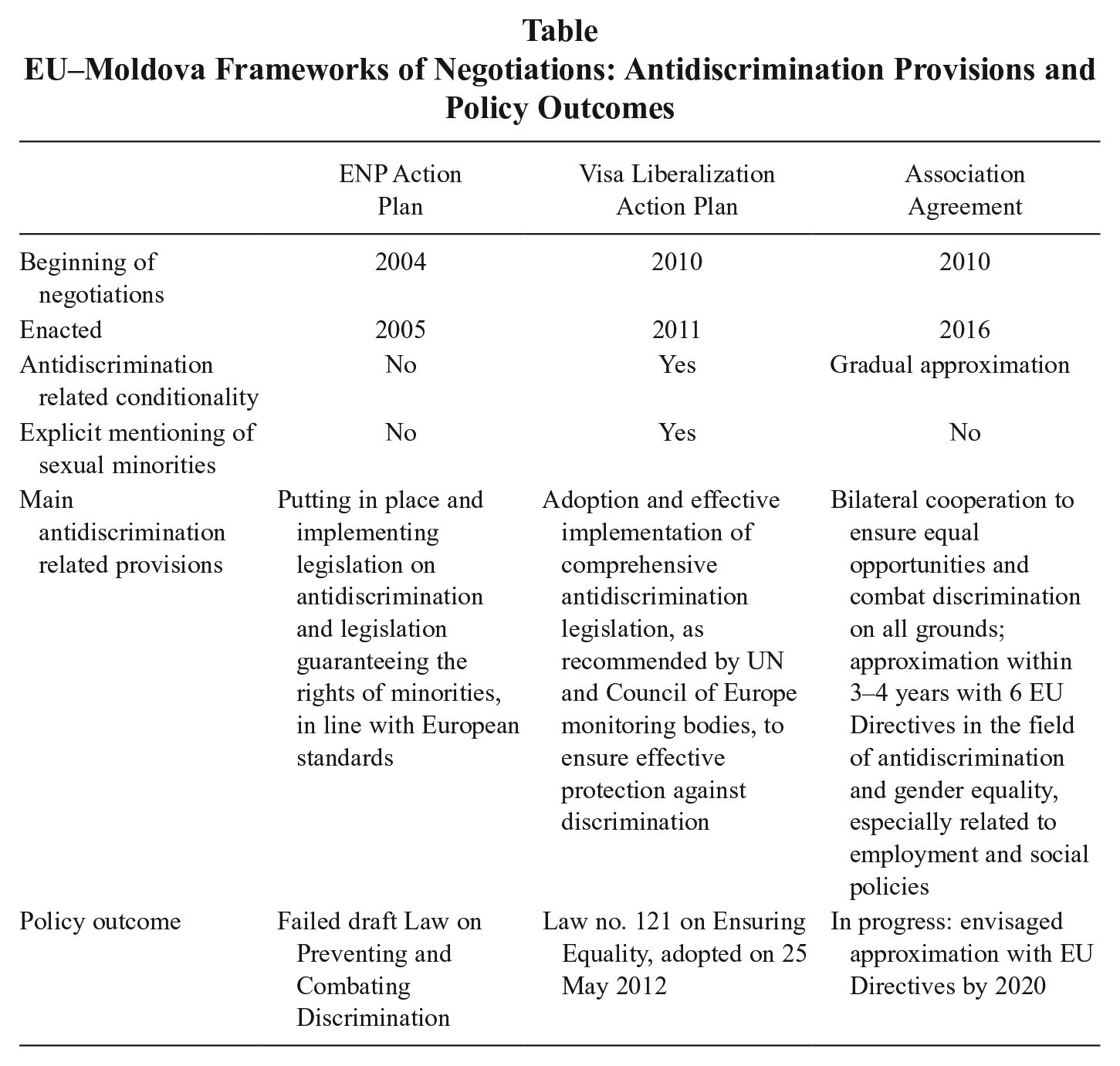
The above analysis of international-level negotiations demonstrates that the intensity of talks and broader involvement of domestic stakeholders, combined with an attractive offer and the external negotiator’s straightforward demands, propelled the policy change at the domestic level. However, it does not explain how domestic groups’ preferences fed into the policy-formation process or how the outcome of the reform came about. 50 In the next step, we attempt to do exactly that—elucidate the preferences of domestic coalitions, their channels of domestic influence and interplay with the international-level negotiations.
The Domestic Level: Tracing Policy Processes and Actors’ Preferences
In this section, we will look mainly at two periods of (attempted) legislative antidiscrimination reforms, 2004–2009 and 2010–2012, which were spurred on by EU–Moldova negotiations over the ENP-related Action Plan and visa liberalization, the latter partly overlapping with the AA negotiations. These periods were characterized by controversies between domestic groups over the inclusion and equal treatment of sexual minorities. While the first stretch yielded a failed draft Law on Preventing and Combating Discrimination of 2008, the second saw the adoption of a considerably revised version of the Law on Ensuring Equality in 2012. Moreover, the intervals coincided with the tenures of governments in Moldova led by opposing political forces (PCRM from 2001 to 2009 and a coalition government under the Alliance for European Integration from 2009 to 2013). While we refer to the implementation of reforms after 2012, our primary focus is the legislative deliberations between 2004 and 2012 as they featured contentious exchanges between the domestic and external negotiation levels. Concentrating on this period, we trace the reform process systematically, explicating its origins, domestic groups’ preferences and their channels of influence, which helps us to reveal determinants of the win-set and thus explain the outcome of the reform.
Reform initiation and blockades
While the 2004 ENP EU–Moldova Action Plan served as a catalyst for domestic debates on antidiscrimination reforms in Moldova, it was not the origin of the reform process. The need for legislative reform was first identified in the National Human Rights Action Plan of the Republic of Moldova for 2004–2008 (NHRAP), prepared in cooperation with the UN from 2001 to 2003, that is, before the ENP Action Plan negotiations. 51 Preparing the NHRAP involved consultations between policy makers (government and parliament) and civil society actors (mainly human rights NGOs), producing an ambitious plan that the government was expected to follow in the subsequent four years including antidiscrimination reforms.
Thus, chapter 12 of the NHRAP titled “The Ensuring of the Right to Freedom from Discrimination (The Rights of Sexual Minorities)” proposed two objectives for 2004–2008: (1) amending the legislative framework to ensure respect for the sexual minorities’ rights and (2) promoting tolerance toward these groups. In turn, the government was expected to take measures such as enacting legislation to allow “the prosecution for degrading or humiliating treatment …, as well as for the instigation of hatred towards persons of homosexual orientation.” 52 While the MoJ was the key executor in preparing this legislative reform, nongovernmental organizations were supposed to assume advisory roles.
According to civil society reports, Moldova’s government committed to adopting a law on antidiscrimination within the first years of NHRAP implementation. 53 This expectation was mirrored by the EU in the ENP Action Plan negotiations for Moldova in 2004. However, as civil society actors were largely excluded from negotiations, the Action Plan remained ambiguous in references to “rights of minorities, in line with European standards” without mentioning LGBTI groups.
With the 2005 enactment of the ENP Action Plan, pro-human rights/pro-LGBTI groups in Moldova obtained an additional point of reference to urge the government to adhere to its commitments. This coincided with the formation of the Non-Discrimination Coalition (NDC) of Moldova, the core civil society group advocating for antidiscrimination. The NDC assumed the task of pressuring the PCRM government into adopting the antidiscrimination legislation promised in the NHRAP and ENP Action Plan. The Coalition closely coordinated with international actors from the EU and the Organization for Security and Co-Operation in Europe (OSCE). 54 The latter supported legislative reform efforts through subcontracted expert studies on the legislative situation in Moldova with recommendations from international actors, including the EU. 55
In 2007, the OSCE’s subcontracted legal experts prepared a draft law on antidiscrimination, protecting the rights of sexual minorities, which was submitted to the MoJ for examination. The Ministry set up a working group to draft the law in October 2007, and after several meetings, the government presented its version of the draft Law on Preventing and Combating Discrimination in June 2008. The draft did not heed civil society actors’ initial recommendations and, according to the OSCE, lacked a clear implementation mechanism. 56
Within this period, the Ministry of Justice downplayed the need to include LGBTI rights into the antidiscrimination law, suggesting Moldova was not ready. 57 Campaigning for the 2009 parliamentary elections saw the submission of the draft law to Parliament postponed to a later stage. 58 Thus, a win-set necessary for the legislative reform could not be achieved at the time.
Reconstructing Actors’ Preferences and Their Impact on the Domestic Game
The preparation of the draft Law on Preventing and Combating Discrimination and the delayed submission to Parliament were indicative of the PCRM government’s domestic maneuvering and its interplay with international-level bargaining. As the key negotiator, the PCRM was bound by its political commitment to enact antidiscrimination legislation, as foreseen in the NHRAP and EU–Moldova Action Plan, and had to appease the various domestic coalitions and prevent opposition (mainly pro-European) parties from challenging its position in the 2009 elections. The tightrope was thus to strike a balance between delivering on its pro-EU promises while yet avoiding far-reaching reforms, which might scare away the Party’s Orthodox voters.
In order to understand why a win-set could not be achieved at this stage, we need to have a closer look at the key domestic coalitions and venues for channeling their interests. The pro-reform and anti-LGBTI coalitions were distinct in their composition and sources of influence. The former consisted of publicly visible NGOs, 59 espousing neoliberal values and empowered by international networks and western donors, including the EU. While the reach of this group might not have been effective in swaying Moldovans’ hearts and minds in favor of the reform, they managed to exert considerable pressure on the government through their international networks. 60 The reform adversaries, on the contrary, grounded their position in traditionalist views on family values and the often homophobic attitudes ingrained in the local population. 61 While the anti-LGBTI coalition could not rely on a comparably international channel of influence, it included a powerful societal actor, the Orthodox Church of Moldova. 62 As the largest church in the country, 63 it enjoyed the highest level of trust among Moldovan public institutions and was an influential opinion maker. 64 Expectedly, the church and related religious organizations opposed the inclusion of LGBTI rights into the envisaged legislation. Measures like collecting signatures against the draft law and using mass media (especially television) to slander sexual minorities helped clerics stir resentment toward LGBTI communities and legislation, and thus drove voter behavior. 65
These competing domestic interests caused the PCRM government to hesitate in the reform process. Under pressure from the pro-reform/pro-tolerance domestic coalition, it prepared antidiscrimination legislation and included sexual minorities among the protected groups (thus exceeding the interpretation of protections demanded in the ENP EU–Moldova Action Plan). The initiated reform, endorsed by the EU and OSCE, was in line with the PCRM’s “strategic course of European integration,” unanimously approved by all political parties on 24 March 2005. 66 The declaration fortified the PCRM as a pro-EU party in Moldovan politics and boosted the legitimacy of the PCRM government. However, in the absence of a clear incentive from the EU, the very link between public discourses on the Europeanization of Moldova and the advancement of sexual minority rights made it difficult for the government to follow through with the reform without losing a major part of their supporters. Amid the predominantly negative public perceptions of LGBTI communities circulated by the Orthodox Church and the PCRM’s sinking approval ratings in 2005–2008 67 largely tied to sexual-minorities protections, it became a matter of strategic choices for the PCRM leadership to postpone the antidiscrimination reforms until after the 2009 elections.
The Law on Ensuring Equality—A Reform Breakthrough?
The parliamentary elections and subsequent political crisis in Moldova in 2009 led to the formation of a coalition government under the Alliance for European Integration, with the center-right Liberal Democratic Party (PLDM), the left-centrist Democratic Party of Moldova (PDM) and the right-wing Liberal Party (PL) in the lead, pushing the PCRM into the opposition. This coincided with the launch of the EU’s Eastern Partnership (EaP) and the visa liberalization offer. By commencing the Visa Dialogue, the government established a reform agenda centered on EU approximation and a commitment to adopting antidiscrimination legislation by 2011.
While forming the Alliance government and taking positions in the central administration, the PLDM co-opted various former civil society actors. Hence, the new government was not only more open to cooperating with civil society on liberal reforms, but even absorbed some of its members. In addition to insider lobbying, civil society actors outside the government used the VLAP incentives and conditionality to advocate for the antidiscrimination legislation. The greatest pressure came from the NDC, which remained active after 2009. In addition to approaching Moldovan policy makers, the NDC used the Visa Dialogue and the subsequent VLAP implementation monitoring as channels to promote the antidiscrimination law among European negotiators. 68 Consequently, the government introduced the draft Law on Preventing and Combating Discrimination to Parliament in early 2011.
However, these developments did not eliminate widespread hostility toward LGBTI communities and the submission of the draft law (which listed sexual minorities among the protected groups) to Parliament provoked a new wave of opposition, both from certain parties and actors outside the political spectrum. The most outspoken adversary of the law was the PCRM itself. While the party never rejected the antidiscrimination reform outright, its members held that LGBTI rights contradicted the “historical, moral, and religious traditions of the Moldovan people.” 69 Opposition even came from within the Alliance for European Integration, despite their overall pro-EU and pro-reform orientation. Aware of the polarizing effect of the LGBTI rights public discourse and responding to the widespread negative public perception of sexual minority groups, several members of the PL and the PDM challenged the inclusion of provisions on sexual minorities in the antidiscrimination law. 70 Notably, none of the parties that formed the coalition government had expressed homophobic views or reservations concerning the protection of sexual minority rights before the initiation of the antidiscrimination legislation. Their public statements in opposition to the LGBTI rights inclusion in the draft law was rather a symbolic reaction to fierce protests, organized by the Orthodox clergy and NGOs representing traditionalist and religious groups, whose intensity surpassed that of 2007–2008. As a result, the government withdrew the draft law on 30 March 2011 to “cool down” opposition and allow for consultations. 71
As the consultations proceeded throughout 2011, opposition to the sexual minorities-related antidiscrimination reforms continued. The PCRM and Moldovan Orthodox Church remained steadfast in their resistance and developed an “unexpected alliance.” 72 Several local and regional councils under PCRM leadership adopted decisions to ban “homosexual propaganda” in early 2012, 73 which was welcomed by the Church. 74 In turn, the PCRM supported Church protests (e.g., distributing leaflets against the antidiscrimination law in Moldovan municipalities). 75
Government deliberations were also marked by controversy within the governing coalition as the Liberal and Democratic parties petitioned to remove any mentioning of sexual minorities from the draft law. Furthermore, the Ministry of Labor, Social Protection, and Family argued the MoJ should prioritize “Christian family values that are shared by the majority of the population” rather than LGBTI rights. 76 After extensive consultations, the Ministry of Justice accepted the PL’s demand to change the draft law’s title to “Law on Ensuring Equality,” thus striking the term discrimination. 77 Moreover, the revised draft excluded four discrimination grounds from Article 1 (among them sexual minorities) and only specified sexual orientation in Article 7 on employment-related discrimination. In addition, the institution for determining cases of discrimination to be established by the law, the Council for Preventing and Eliminating Discrimination and Ensuring Equality, was deprived of any sanctioning competences. 78 Following these alterations, the ruling coalition approved the draft law and submitted it to Parliament on 23 May 2012. The Alliance for European Integration unanimously supported the draft law, but the PCRM boycotted the session entirely, 79 and it barely acquired the necessary votes for a parliamentary majority, leading to the adoption of Law no. 121 on Ensuring Equality on 25 May 2012. 80
Determinants of the Win-Set
The controversial political debates, the issue’s salience, and persistent protests during deliberations on the draft law and afterwards illustrate the coalition government’s difficulties in delivering on Moldova’s commitments. The PLDM, the main supporter and formal ratifier behind the initial draft law’s wording, faced serious domestic and external constraints. While its leadership was openly challenged by the PCRM and Orthodox clergy, European negotiators made it clear that the adoption of a comprehensive antidiscrimination legislation was a prerequisite for visa liberalization. The PLDM’s European integration agenda was its primary source of legitimacy and the visa-free regime symbolized a much-desired step forward on the way to the EU, as perceived by the majority of Moldovans. 81 Failing to deliver would have discredited the governing coalition in the eyes of Moldovan voters.
The link between antidiscrimination reforms and the EU’s visa-free regime played into the hands of pro-reform groups given the broad public support for visa liberalization. 82 In fact, the anti-LGBTI coalition members never voiced open opposition to the overall process of reform or the visa-free regime, as it was seen as a great benefit for Moldova. 83 Since the impediment between opposing domestic coalitions was neither the visa-free regime nor the antidiscrimination reform itself, but sexual minority rights’ protections, the win-set of the decision makers ran down to a piecemeal legislation with an amended name and ambiguous conception of nondiscrimination. While the NDC criticized the concessions made in the final draft of the Law on Ensuring Equality as “inefficient and insufficient,” 84 the overall reform was positively received by civil society and the EU, eventually resulting in the much-desired visa liberalization.
The post-2012 period did not feature an abatement of controversies related to LGBTI protections in Moldova. The most prominent example was the 2013 attempt by several MPs from the governing coalition (Ghenadie Ciobanu and Valeriu Ghilețchi of the PLDM, and Sergiu Sîrbu of the PDM) to amend the Contravention Code to prevent the spread of information related to homosexuality. 85 The amendment sought to undermine the antidiscrimination legislation and displayed similarities to Russian legislation against the “propaganda of homosexuality.” 86 However, amid the EU’s monitoring of the VLAP implementation in place and the initialing of the EU–Moldova AA, parliament quickly annulled the previously adopted amendment in October 2013. 87 This example suggests the domestic game related to antidiscrimination reforms continued after adoption of the Law on Ensuring Equality in 2012 and the win-set could shift in the years to come depending on power constellations among domestic coalitions and external pressures, potentially reversing the reform progress.
This case of Moldova’s antidiscrimination reform demonstrates the value of the 2LG as an analytical framework for scrutinizing the complex domestic and external dimensions of international integration. As the process tracing illustrated, the reform outcomes in such a contested policy field were strongly shaped by domestic coalitions’ preferences, yet they would not have been possible without the international-level negotiations. Combined with the EU’s external push and the attractive reward on the negotiation table, the domestic actors’ preferences translated into highly dynamic tactics of reform blockading and compromise at different levels of decision making. The 2LG approach in combination with process tracing has made it possible to reveal these tactics and open the “black box” of the legislative reform.
Conclusion
This article aimed at explaining the outcomes of the controversial antidiscrimination reform processes in Moldova in the context of negotiations with the EU. By applying Putnam’s Two-Level-Game approach, 88 the study intended to lend agency to the domestic actors and advance our understanding of the domestic-external interplay in policy change and norm adoption in the EaP region. 89
In the case study of Moldova, which performed as an EaP frontrunner in pursuing the antidiscrimination reform, the article scrutinized the three most relevant international negotiation frameworks (on the ENP related Action Plan, the VLAP, and the AA) and traced the domestic-reform processes between 2004 and 2012. As shown, the different frameworks created varying pressures on Moldovan decision makers, with the Visa Dialogue and VLAP being the most effective avenues advancing antidiscrimination legislation. They introduced broad consultations with domestic and transnational civil society actors, which yielded straightforward EU demands for antidiscrimination reform, inclusive of sexual minorities. In addition, the much-desired reward of visa liberalization with the EU and the conditionality principle created serious constraints for Moldova’s leadership, wedged between domestic pro-reform and anti-LGBTI coalitions.
As pro-reform groups used international-level negotiations to advocate for a comprehensive reform and exploited EU conditions for visa liberalization to pressure domestic policy makers, this conditionality demonstrably impacted Moldova’s policy win-set, despite reform adversaries’ mobilization of the public against the legislation. While needing to deliver on international commitments and to preserve their legitimacy, the government navigated this narrow win-set, that is, its policy options that garnered enough support from domestic constituencies. The resulting Law on Ensuring Equality of May 2012, which constituted a satisfactory compromise for the opposing coalition, showcases how an unprecedented antidiscrimination legislation can be enacted in an EaP country.
This EaP case study demonstrates the merits of applying Putnam’s Two-Level-Game approach to tenuous nonconsolidated democracies while studying controversial reforms propelled by closer cooperation with an international organization such as the EU. Using this approach in a comparative examination of multifaceted policy interdependencies in semidemocratic political regimes could be the next step advancing the research agenda on external–domestic interplays in international norm transfers.
Footnotes
Acknowledgements
This work is part of the project “Domestic Preferences and EU Cooperation—Explaining Foreign Policies in Ukraine, Georgia, and Moldova. A Two-Level-Game Analysis,” supported by the German Research Foundation (DFG) under Grant Number 387774818.
