




Abstract
This paper proposes a framework to analyze the varying understanding of democratic developments. Based on the theory of frame-analysis, it distinguishes six brackets within which democratic developments can be interpreted. This framework is applied to identify the nature of international rankings of domestic democracy and to compare the framing of developments in Polish democracy in reports on democratic developments from international organizations. The conclusion is that sense-making of democratic developments in general varies enormously, and that this is also visible in the international rankings of democracy. Democratic developments in Poland are also assessed in different ways, resulting in varying claims about the nature of the developments in Poland.
Introduction
That democracy is about more than elections is well-known, but according to Geraldo Munck, “it is striking that there is little agreement concerning how far beyond electoral processes—the home ground of most definitions of democracy—the quality of democracy extends.” 1 Such differences are also visible in international indexes for ranking democracies as these use a variety of indicators. Examples are the indexes of Freedom House, Varieties of Democracy (V-Dem), the International Institute for Democracy and Electoral Assistance (IDEA), and the Sustainable Governance Indicators (SGI) of the Bertelsmann Foundation. What all these organizations have in common is that they provide country rankings based on what they define as the quality of democracy.
To reflect on those indexes has never been more relevant, as democracy is said to be in crisis. This is seen in the yearly reports of institutes that produce international rankings of democracies, such as Freedom House, V-Dem, and the Bertelsmann Foundation. These observations deeply contrast the positive remarks from over a decade ago. 2 In 2008, Freedom House was still very optimistic, telling us, “in mid-1992 about 24.8% of the world population lived in ‘free’ countries. Until mid-2007, this figure increased to 45.9%.” 3
The discussion about the state of democracy is topical again because of recent developments in, for instance, Poland, Hungary, and Turkey. These countries encounter heavy criticism for their return to autocratic regimes. The international criticism on election processes and the one-sided outcomes in Russia, Kazakhstan, Kyrgyzstan, and Uzbekistan, and the outside meddling in elections in among others the United States and the United Kingdom the criticism is also increasing. The question is, however, whether the assessment of backsliding democracy is justified and whether the indicators to back this claim is valid in general. Such questions are relevant, because there are also contrary views. The Stockholm institute IDEA, for instance, concludes: The empirical overview suggests that the current global state of democracy is one of trendless fluctuations—upturns and downturns in individual countries, but with no broad tendencies of decline or progress.
4
This article argues that such contrary views are due to the way people make sense of democracy and the dimensions included and excluded. Taking inspiration from Erving Goffman, 5 this is what we call bracketing. It involves the aspects inside the equation and the things left out. It is not about putting democracy between brackets—although many discussants seem to do that—but putting the specific dimensions/aspects/elements between brackets by which it becomes possible to judge the quality of democracy. Sometimes such bracketing is done explicitly, as on the website of the GlobalDemocracyRanking, 6 presenting the following formula: Quality of Democracy = (Freedom & other characteristics of the political system) & (Performance of the nonpolitical dimensions). However, as the contents of this article will show, this is only one of many possible ways to make sense of democracy.
This results in the following research questions underlying this article: What are the different ways to bracket democratic developments and what does this imply for the understanding of developments therein? We answer these questions through consecutively answering the following subquestions:
What is bracketing?
What bracketing emerges out of the literature on democratic developments?
What analyses does such bracketing enable?
What outcomes result from conducting such research?
In answering these questions, this article proposes a framework to analyze the varying understanding of democratic developments. Based on Erving Goffman’s theory of frame-analysis, the framework distinguishes six brackets within which democratic developments can be interpreted. This framework is applied to compare the framing of developments in Polish democracy in reports on democratic developments from international organizations.
The next section elaborates on the concept of bracketing. Goffman defined bracketing as a solution people use to deal with the complexities involved in the frame’s relation to the environing world in which the framing occurs. 7 It refers to what we all do when trying to identify what is going on, namely, to include certain aspects of a phenomenon (putting it within the bracket) and to neglect or disregard other aspects thereof (leaving it outside the bracket). Subsequently, we apply this idea of bracketing to the conception of democracy. In the third section, we distinguish between democracy as having inclusiveness in elections, having contestation as seen in fair elections, having capacitated and involved citizens, and having democratic leaders promoting liberal and social democracy. It results in a proposal for a framework to identify what people are talking about when assessing the quality of democracies.
The fourth section argues the relevance of such a framework. We apply the framework to identify the content of existing international rankings to understand the various ways in which developments in the Polish democracy are addressed in such reports. Many scholars judge Poland to be one of the main examples of deteriorating democracy. This section argues that this claim is based on the bracketing of democracy. It also argues that when the original elements of the concept of democracy would be central—inclusiveness and contestation—different claims could be in order.
Framing and Bracketing
The concept of framing has become problematic as it is increasingly seen as just a political strategy aimed at winning a debate, beating an opponent, and gaining support through using rhetorical statements, normative judgments, and all too simple associations. 8 Such strategic framing achieves its goal if the framing appeals to the audience, irrespective whether it relates to what is going on. Politicians can do this through a focus on a policy, a personality, or a principle, by using one-liners and associations triggering emotions, that need not be valid interpretations of reality. 9 It is the way the American president Donald Trump portrays all opposition as lying, stupid, ignorant, crazy opponents, abusing their power, and producing fake news, while portraying himself as the hero, being the only one who understands what would make America great again. The sense-making/signification of issues in terms of villains or suckers (the opponents) versus heroes and victims (the ones whose support is sought) provides a specific interpretation of things that happen in society, things to be done, or to be prevented.
Such strategic framing is also visible after crises, when stakeholders construct frames that depict the crisis as either caused by flawed politics, (ir)responsible individuals, faulty policies (social frameworks), or in natural frameworks, identifying occurrences as undirected, unanimated, unguided, that is, “purely physical.” 10 It is, among others, seen in blame games 11 and in attempts to mobilize collective action to tackle wicked problems. 12
Strategic framing has three distinctive characteristics. First, it aims to gain support among the audience, which is most effectively done through dramatization and inflaming emotions. It need not be an informative or correct interpretation of events. Second, effective strategic framing oversimplifies reality, that is, using one-liners to interpret and explain what is going on. It uses an either–or strategy, implying that one has to interpret what happens within either such or so a frame. Third, such framing is always normative, giving positive or negative connotations to what is happening.
The above clarifies that framing has become something that is to be judged as negative. It also disregards the original more neutral meaning of framing, meant to be a tool to provide an answer to the question individuals always ask: “What is it that is going on here?”
13
but as Goffman said immediately after: It is obvious that in most “situations” many different things are happening simultaneously—things that are likely to have begun at different moments and may terminate dyssynchronously. To ask the question what is it that is going on here, biases the matters in the direction of unitary exposition and simplicity.
14
Goffman emphasized that narrow strategic framing by keying an event around one issue is not what happens in everyday life. People use frames when investigating social phenomena like the development of democracy, but these are rather different from strategic frames. The main difference with strategic framing is that everyday framing does not necessarily intend to have political effects. Its main intention is to stay as close as possible to what is “really” happening. Goffman argued that “it might be thought that only arguments and competence to express matters verbally will be in play. But that is much too narrow a view.” 15 Normally there is not a contrast between the frame and what is going on, which makes strategic framing so exceptional in everyday life. According to Goffman, everyday interpretative frames are about the interpretation and sense-making of the actual unaltered event that takes place. Frames are mental structures that simplify and guide our understanding of a complex reality 16 and enable us to explain the reality to others. It is about interpreting it in a social or natural frame and the keying involved.
The problem with using the framing concept is the negative connotation it acquired through the years and the ambiguity its use incites. Returning to the origins of the theory on framing and what it involves it seems preferable to use the word bracketing that was originally part of the theory on framing. Regarding the subject under scrutiny, democracy, bracketing together with keying points to the meaning people attach to living in a democracy. As Goffman put it, “Keying concerns the set of conventions through which a given activity, which is already meaningful in terms of the primary framework, is transformed into something patterned on this activity.” 17 It implies adding a layer to the activity to which one anchors the event and wants to interpret and understand it. 18 Bracketing in time and space is broader than keying, as it determines when people see an event starting and ending, what they see as inclusive to the event, whether or not they consider the context in which the event takes place, and what one considers to be organizational properties of the event. 19 Bracketing means determining what is within and what is outside the framing of the event. 20
Bracketing Democracy
The concept of democracy is illustrative for understanding keying and bracketing. The classic definition of democracy is that it is “the social mechanism which permits the largest possible part of the population to influence major decisions.” 21 Later on Seymour Lipset defined it as the ability of citizens to choose their government through free elections that are contests among parties operating in an atmosphere of guaranteed freedom of speech and press. 22 This conception conforms with the definition given by Robert Dahl 23 and emphasizes the two procedural elements of democracy, that is, contestation and inclusiveness. Contestation exists when citizens “have unimpaired opportunities . . . to formulate their preferences, to signify their preferences to their fellow citizens and the government by individual and collective action, and to have their preferences weighed equally in the conduct of the government.” 24 Inclusiveness refers to “the proportion of the population entitled to participate on a more or less equal plane in controlling and contesting the conduct of the government.” 25
These two elements remained central in many of the definitions given afterwards, although the wording has changed. 26 According to Edward Muller, “the egalitarian political institutions of modern democracy provide all citizens with both the opportunity to participate in the governing process, as manifested by universal adult suffrage and free and fair elections, and the opportunity to contest governmental decisions, as manifested by rights of freedom of expression and association.” 27 Dahl himself argued that inclusiveness and contestation require institutional guarantees such as freedom of organization, freedom of expression, the right to vote, broad eligibility for public office, the right to compete for support and votes, the availability of alternative sources of information, free and fair elections, and the dependence of public policies on citizens’ preferences. Hence, the rule of law and promoting civil rights entered the equation.
Nonetheless, scholars judged this definition still to be minimalistic, pointing out that it is only about procedures and rules in making collective decisions. 28 They argue that democracy also refers to a substantial ideal, that is, the prevention of the abuses of power and the promotion of basic rights. In this conception, democracy is not only about who decides and how they decide but also about “what” is decided. These scholars judge the substance of the decisions made in terms of social equality and/or liberalism to be part and parcel of the conception of democracy. Below, we will elaborate on each of these elements resulting in a framework enabling us to specify the bracketing of democracy in international rankings.
Inclusiveness → Democracy = (Universal suffrage)
Applying keying and bracketing to the concept of democracy, the narrowest form of a primary framework is just looking at the presence of elections and the extent to which suffrage is universal. This is what democracy is about in its most elementary connotation. Nearly all countries in the world—the exceptions being Brunei and Qatar—have some kind of elections at the local and/or national level every so many years, and are in this narrow sense democracies.
The straight forwardness of the actual event does not prevent the event from evoking rather different interpretations/keying. Such an election process can enable or fail to empower the participants. They might have the feeling that because of the elections their interests will be taken into account, that they have influence in who, what, and how things that matter to them are going to be decided on. It might also give legitimacy to the people in power, based on the argument that they represent the people and act on their behalf in their decision-making. It is the rise in the number of countries that have general elections that makes an organization like the international IDEA rather positive about the global developments in democracy.
Recent surveys point out that the positive valuation of this kind of democracy is no longer the common one. Not even among people in old established democracies. In 2018, the Democracy Perception Index (DPI) found that a majority of people around the world feel like they have no voice in politics and that their governments are not acting in their interest (51 and 58 percent, respectively). The research pointed out that they have little faith that their government is formed “by the people” and works “for the people.” 29 One-half to two-thirds of the people answer “never” or “rarely” to the question “Do you feel that the voice of people like you matters in politics?” Half of the population in countries like the United States, Brazil, Canada, Australia, the United Kingdom, Ireland, South Africa, Switzerland, and Sweden are this negative. More than 60 percent of the populations in old democracies like the Netherlands, Belgium, Germany, Norway, Austria, Portugal, and France think so, and even three-quarters of the population in Japan answers in this way.
Many people seem to be disillusioned and agree with the cynical and classic saying of Mark Twain that “if voting made any difference, they wouldn’t let us do it.” In terms of primary frameworks, one can say that for many people elections and voting do no longer fit into the same social framework they were once intended for. Elections and voting as such have lost their positively valued associations and meaningfulness.
This brings us to a broader bracketing of democracy in which, dependent on the perspective and characteristics of the voters, the election process and the output and/or outcomes thereof are included. Below, these characteristics are discussed.
Contestation → Democracy = (Fair Election Process)
The quality of a democratic process is deemed inferior if there is hardly any contestation, that is, if a president is elected by 96 percent of the votes as happened in Kazakhstan in 2011, or even by 100 percent as in North Korea. Such one-sided outcomes are also found in Uzbekistan, Turkmenistan, Singapore, Zimbabwe, Hong Kong, Donetsk People’s Republic, and Cuba. The quality of democracy is higher when there is a level playing field for the opposition to get elected, that is, whether there are fair elections. This is doubted when landslide victories are in place.
This idea was central in the old Vanhanen Index of Democracy
30
in which competition (and participation) were central. He defined competition as “the percentage share of the smaller parties and independents of the votes cast in parliamentary elections, or of the seats in parliament.”
31
For Tatu Vanhanen, being a full democracy implies that the largest party should not have more than 70 percent of the seats and that at least 10 percent of the eligible participation should have the right to vote. This idea is still popular, as is seen in the Polity IV project, arguing that a fully institutionalized (+10) democracy, like Australia, Greece, or Sweden, has institutionalized procedures for open, competitive, and deliberative political participation; chooses and replaces chief executives in open, competitive elections; and imposes substantial checks and balances on the discretionary powers of the chief executive.
32
On the opposite side, in Turkey, The election process appeared mostly free, but largely unfair. Opposition candidates received little to no media coverage; the pro-Kurdish People’s Democratic Party (HDP) candidate, Selahattin Demirtas, had to campaign from prison; and the government restrained freedom of speech and freedom of association.”
33
Adding the layer of fairness to democracy brings us back to the thoughts of Robert Dahl. 34 He mentioned five conditions as crucial for the quality of election processes. The main criterion is that all people eligible to vote are to be treated as if they are equally qualified to participate in the process of making decisions. To achieve this, citizens must have adequate and equal opportunities to form their preference, and to express reasons for one outcome over the other; each vote needs to be counted as equal; they must have ample opportunities for discovering and affirming what choice would best serve their interests; they must have control over the agenda; and the more citizens are included, the higher the quality of the democracy. These thoughts can be translated into measures through the following indicators; the proportion of the population eligible to vote, the proportion of the population that actually votes (turnout), the alternatives they can choose from, the diversity of the information they can acquire (e.g., media freedom), and their involvement in the democratic process (e.g., party membership).
Taking such criteria into account, the number of democracies falls rapidly. The Polity IV project tells that in 2015 only 4.1 billion people out of 7.35 billion lived in a democracy, and the Economist is even more pessimistic for 2018, as only approximately 400 million people live in a full democracy. 35
As to the alternatives to choose from during elections, Freedom House concludes that governments have increasingly shed the thin façade of democratic practice that they established in previous decades. . . . More authoritarian powers are now banning opposition groups or jailing their leaders, dispensing with term limits, and tightening the screws on any independent media that remain.
36
The importance of media pluralism and freedom is emphasized by the same organization, writing in the spirit of Robert Dahl, A free and vibrant media sector is a foundational element of a healthy democratic system. Citizens should have access to fact-based information—both in traditional news sources and on social media—to understand how their governments function and to hold their leaders accountable for their words and actions.
37
However, as the Bertelsmann Stiftung (Foundation) concludes in its report on Sustainable Governance Indicators, “The model of liberal democracy is subject to growing pressure—in some countries this means that even central democratic and constitutional standards such as media freedoms are already severely damaged or undermined.”
38
According to the Bertelsmann Foundation, many countries show negative developments, while the rest of the countries remain at their previous levels: The following indicators can be highlighted in particular: media access for candidates and parties in the electoral process, party financing, media freedom, media pluralism, citizens’ access to information, civil rights, political liberties, non-discrimination and the appointment of justices. At the same time, the results show the declining quality of democracy extends across all four democracy criteria (electoral processes, access to information, civil rights and political liberties, rule of law).
39
Also, the valuation of the quality of democracy indicators varies widely among citizens in different countries. The Democracy Perception Index shows that across the 50 countries surveyed, somewhat more than half of respondents (56 percent) say that “the news they read ‘rarely’ or ‘never’ gives them a balanced or neutral information.” 40 Even more than 60 percent say so in full democracies like Greece, France, Italy, Spain, Portugal, and the USA.
Institutional Requirements → Democracy = (Capacitated Citizens)
One of the oldest ways of framing democracy is that the citizens need to be involved citizens, that they inform themselves, that they know the different options and the reasoning behind them, and that they participate in the democratic process. This idea of democracy has already been discussed for more than two millennia. It is the customary, almost obligatory, starting point to refer to the democratic origins in ancient Greece. In ancient Athens, democracy only applied to the well-educated, free males, born and raised in the polis, who supposedly could reason and bring their arguments forward in an eloquent way.
Although most countries nowadays have universal suffrage, many philosophers still adhere to the idea that the electorate should possess certain capabilities to make democracy work and that there should be institutional guarantees. 41 Some even argue that democracy is less about voting than it is about reaching well-argued consensus based on argumentation. 42 Jurgen Habermas sees a similarity between democracy and bringing issues before a court in which based on the strength of arguments and rationality, a consensus is formed about what is to be done. Respect and use of basic rights like civic and political freedom, right to participate in democratic process, equal opportunities, equal treatment, and justice apply to all citizens. According to Habermas, such justice, rational communication, and social solidarity enable equal participation in a public sphere and further democracy. He argues that the impact of the domestic sphere, loyalties, and individual interests can be minimalized. Democracy is less about voting than about reaching consensus, for which those involved need to know and to adhere to the rules of pragmatic rationality.
Similar, but still rather different, is the theory of Amartya Sen.
43
His basic concern is put on individuals’ freedom to achieve the kind of lives they have reason to value. He points to the need for a capacitated electorate to further public reason and democratic politics as the best way to come to legitimate decisions. Needed, according to Sen, is commitment among those involved in democratic processes. Sen argues that democracy is a demanding system, and not just a mechanical condition (like majority rule) taken in isolation.
44
It rests on the intrinsic importance of political participation and freedom in human life; second, the instrumental importance of political incentives in keeping governments responsible and accountable; and third, the constructive role of democracy in the formation of values and the understanding of needs, rights, and duties.
45
Others even made a plea for a “philosopher citizen”—as the counterpart to Plato’s philosopher king. 46 In the same spirit, Robert Goodin wants to replace voting as an aggregation of opinions by deliberation. As he argues, “votes are good, reasons better.” 47 He argues for “deliberative democracy within,” demanding from citizens not only to look at their personal preferences, but to assess what is “the right thing to do from all perspectives. It asks each of us to internalize the perspective of each (prototypical) other.” 48
As to such commitment to reach consensus, international institutes are skeptical about developments therein. The Economist Intelligence Unit’s Democracy Index (EIU) incorporates societal cohesion. The Democracy Index looks at social cohesion and asks whether there is a sufficient degree of societal consensus and cohesion to underpin a stable, functioning democracy. The score here has deteriorated for several years, suggesting a deepening of political polarization that could complicate political effectiveness and weaken the quality of policymaking and institutions. In this context, it seems too soon, despite the results of the 2018 Democracy Index, to suggest that the “democracy recession” has bottomed out.”
49
As to the participation in the democratic process, the SGI points out that democratic disillusion increases as seen in decreasing party membership and turnout during elections. As the Bertelsmann Foundation concludes, Many governments today rely less than before on the consultation of societal actors during the planning phase of political projects. . . . Many governments are obviously less successful than before in pursuing a coherent communication strategy that is aligned with broader government agendas.
50
Participation → Democracy = (Civic Involvement)
Such deterioration of civic involvement is not the case when analyzing their participation in policy processes. To enhance direct democracy and to obtain better service delivery outcomes, public participation in policy processes, co-production in the implementation of policies, and co-creation in the development thereof have become more and more daily practice. 51 Coproduction practices are innovative as citizens are asked to co-design, co-commission, co-asses, co-deliver, co-implement, and co-execute public services. 52 The practice has advanced significantly, even to the degree that citizen engagement has become obligatory in some sectors and in some countries, e.g. care-giving and waste management. 53 For public organizations to continue to provide basic services to the populace, public professionals are more and more inclined to involve citizens in voluntary and complementary service design and implementation. Scholarly research has demonstrated the benefit of citizens/service users in delivering public services 54 and how outcomes from such services could improve. 55
Such co-production is in line with the idea of citizens as stakeholders not so much interested in electing officials as they are in getting optimal outcomes. Such forms of more direct democracy lie in the direct participation of people having a stake in the policies. More generally, next to party membership and referenda, participatory budgeting, open government seeking direct involvement of the public in the realization of their goals are perceived as novel developments in this regard.
Content of Decisions → Democracy = (Leaders Promote Liberal Democracy)
A fifth way of bracketing democracy lies in the actions of the elected leaders. Taking them into the equation of democracy asks who the elected officials are and what it is they do after they are elected. Do they further democracy, or threaten the foundations thereof? Such actions can involve the reduction of the checks and balances built in the system, reducing the freedom of the press, phasing out the separation of powers, and concentrating power in their own hands. If the leaders take such actions and reduce the quality of the democracy, the country is seen as becoming less democratic. It is the criticism on what is nowadays called the rise of “populism,” of which Transparency International says: “Throughout the world, political leaders who run on a populist platform are gaining power and undermining democracy.” 56 The Bertelsmann Foundation tells similarly: “Populist parties in particular often aim to systematically sabotage the struggle for suitable political solutions by exploiting emotions with their campaigns.” 57
Important for the judgment of the quality of democracy is that this populism is accused to make anti-democratic and restrictive modifications of crucial aspects of legislation, regulating migrant’s rights, access to social protection systems, or independence of judicial power. 58 It is for such and other reasons that scholars have argued that “populists should be criticized for what they are—a real danger to democracy.” 59 Hawkins et al. 60 suggested that “the number of populist leaders has more than doubled since the early 2000s” 61 with nowadays approximately two billion people living in countries where (somewhat) populist leaders have gained ground. They point to countries including Poland, Venezuela, Argentina, Italy, India, the United States, Mexico, Brazil, Chile, Ecuador, Bolivia, the Czech Republic, Turkey, Hungary, Ecuador, Latvia, Paraguay, and Croatia. According to Lewis at al., working for the Guardian, it is worrying that strong populist tendencies are nowadays also found in established democracies, including Germany, Norway, Sweden, Uruguay, Finland, France, Spain, Austria, the Netherlands, and Canada.
It is also about the function of democracy to control and put restraints on government. Including control of and restraints on government in the equation of democracy implies that democracy is not only about giving people voice but also about offering them opportunities to hold government to account. As Max Roser representing the Polity IV group argues in Our World in Data, “A democracy is a political system with institutions that allow citizens to express their political preferences, has constraints on the power of the executive, and a guarantee of civil liberties.” 62 Other international organizations add that democracy is about the accountability of public officials, respecting Human Rights, and freedom of association; 63 freedom of assembly and demonstration, respect for the rights and freedoms of minorities (ethnic, religious, linguistic, immigrants); 64 or still broader, transparency of government policy making, satisfaction with democracy and trust in Parliament, reliability of the state budget, state accounts, state-owned firms’ accounts, basic economic and financial statistics, and reliability of state-owned banks’ accounts, the communication of state economic policy, the presence of a public debate about the state economic policy, and the degree of transparency in public procurement. 65
Examples of a deterioration in democracy in this respect are provided by Transparency International. On its website, it tells about its index of 2018 that “the continued failure of most countries to significantly control corruption is contributing to a crisis in democracy around the world” and they conclude that since 2006, 113 countries have seen a decline in their democracy scores. According to this organization, Poland and Hungary in particular are doing worse than before: In both Hungary and Poland, populist rhetoric is often used to discredit public scrutiny. In both countries, democratic institutions and values are at risk, and the government continually interferes and challenges the independence of both the media and judicial system.
66
Content of Decisions → Democracy = (Leaders Promote Social Democracy)
A last type of bracketing of democracy involves the outcomes of democracy. In a democracy, the policies developed need to be for the good of society as a whole. This interpretation is meant to prevent democracy to be a process in which two wolves and a sheep vote over what to have for dinner. For instance, the Office of the High Commissioner for Human Rights of the UN sees the protection and respect of human rights as an essential element of democracy. They tell that “group rights (e.g., indigenous peoples, minorities, persons with disabilities), are . . . essential for democracy as they ensure an equitable distribution of wealth, and equality and equity in respect of access to civil and political rights.”
67
The UN mentions as “essential democratic underpinnings” human rights fundamental freedoms, the equal rights of women and men, life in larger freedom, self-determination, and the removal of distinctions based on “race, sex, language or religion.” It refers to the following: Fundamental Rights capturing the degree to which civil liberties are respected, and whether people have access to basic resources that enable their active participation in the political process. This dimension . . . has three sub-dimensions. Two of them (fair trials and civil liberties) relate to the concept of liberal democracy, while the third (social rights and equality) relates to the concept of social democracy.
68
Promoting social democracy is also about impartial administration, that concerns how “fairly and predictably political decisions are implemented, and thus reflects key aspects of the rule of law.” 69 V-Dem explicitly sees egalitarian policies as a component of social democracy. Democracy is concerned with human development, as it creates a level playing field, in equalizing resources (e.g., access to health care, education, infrastructure, and media) among the electorate and developing sustainable policies.
However, in this broad sense, the situation in the world also seems to be deteriorating, especially in Europe. The SGI tells that “Poland, which alongside the United States, the Netherlands and Australia is one of the biggest losers when it comes to the aspect of social policy, has also experienced setbacks in terms of integration policy in recent years.” 70 The Bertelsmann foundation agrees, when it writes in its latest report on Sustainable Governance Indicators: “As the bar for democratic standards continues to be lowered and political polarization grows, it is becoming increasingly difficult to carry out sustainable reforms.” 71
The Resulting Framework
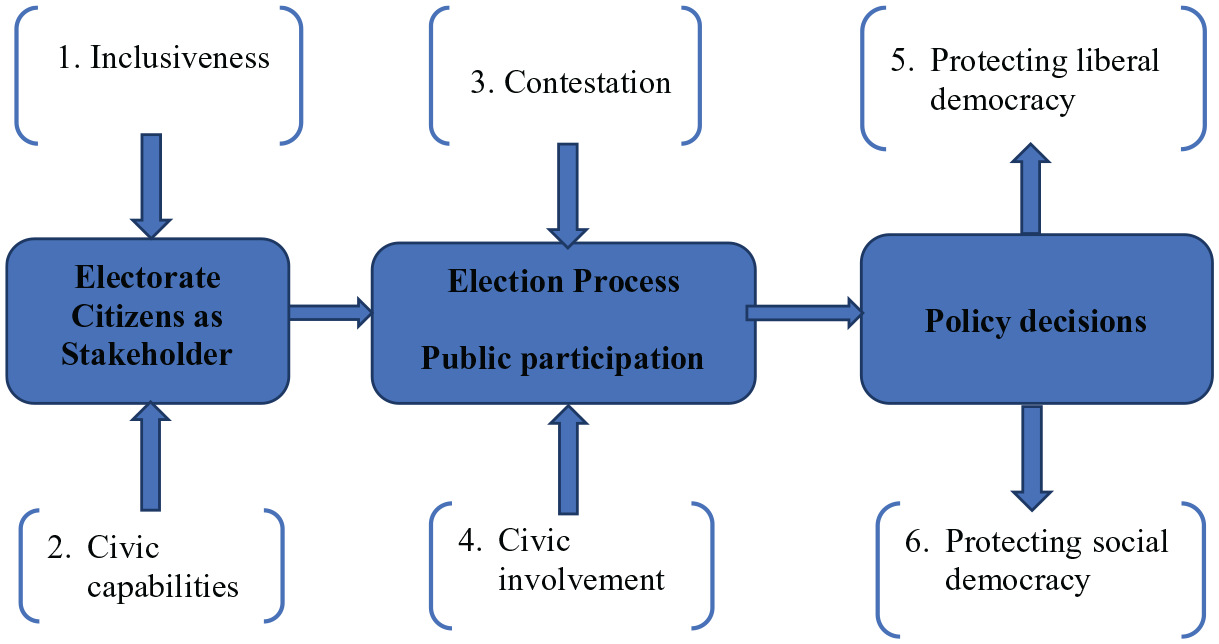
In the above, it was argued that democracy can be bracketed in multiple ways. On the one hand, democracy is about ensuring a representative democracy with citizens electing their leaders, the quality of a democracy depending on characteristics of that electorate, of the voting process and of the actions of the elected politicians. On the other hand, democracy is about ensuring direct democracy, with citizens participating in decision-making processes, the quality thereof depending on these factors. This is summarized in Figure 1.
Bracketing democracy
In the middle of the figure is the core of a democracy, i.e., in a representative democracy the election process as such with the voters on the left and the elected officials on the right, and in a direct democracy the participatory process in the middle, the stakeholders on the left and the policy decisionmakers on the right. Above and below, the characteristics are given by which one can frame that process. Table 1 gives the possible indicators for the six brackets.
The Brackets and Possible Indicators
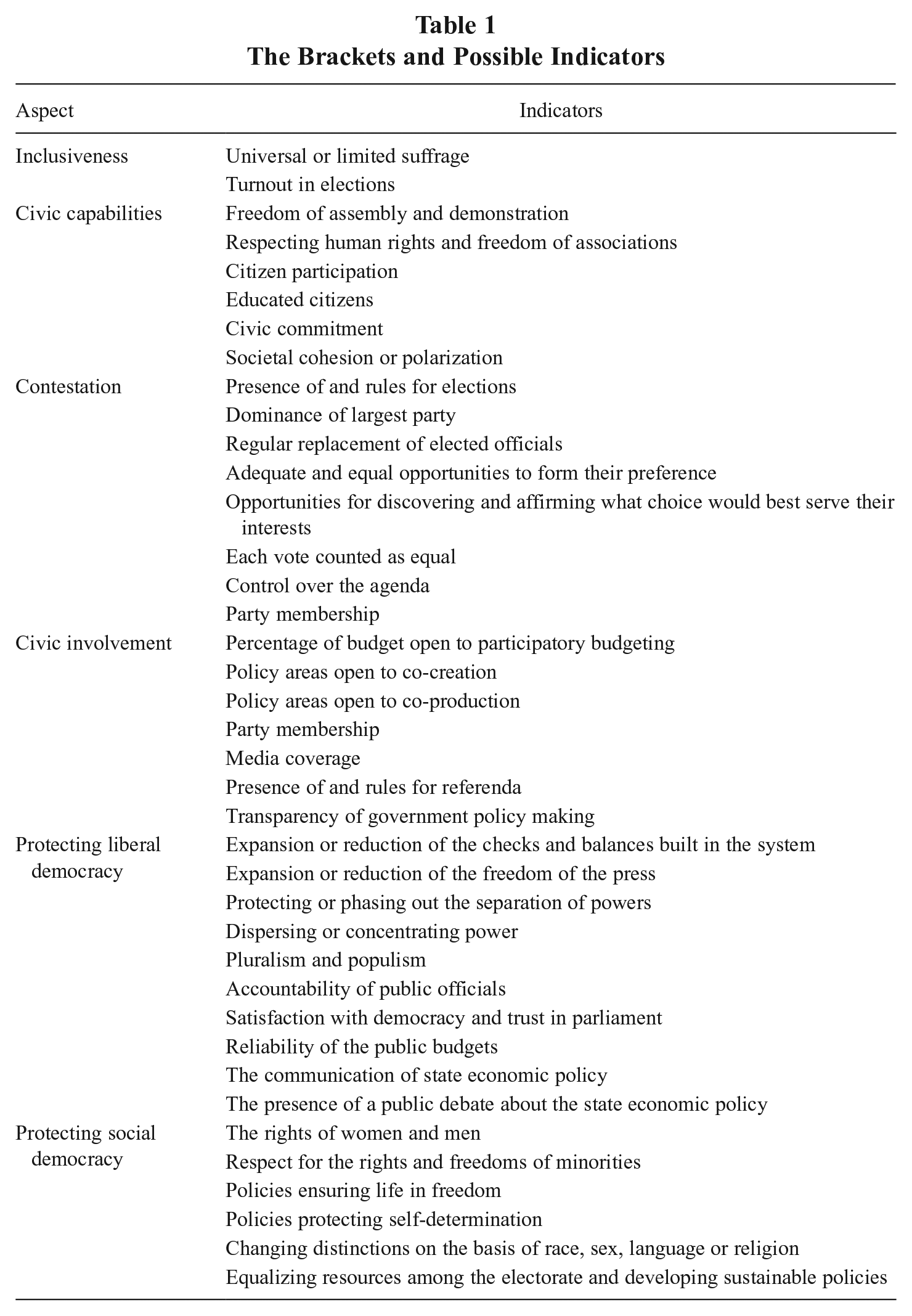
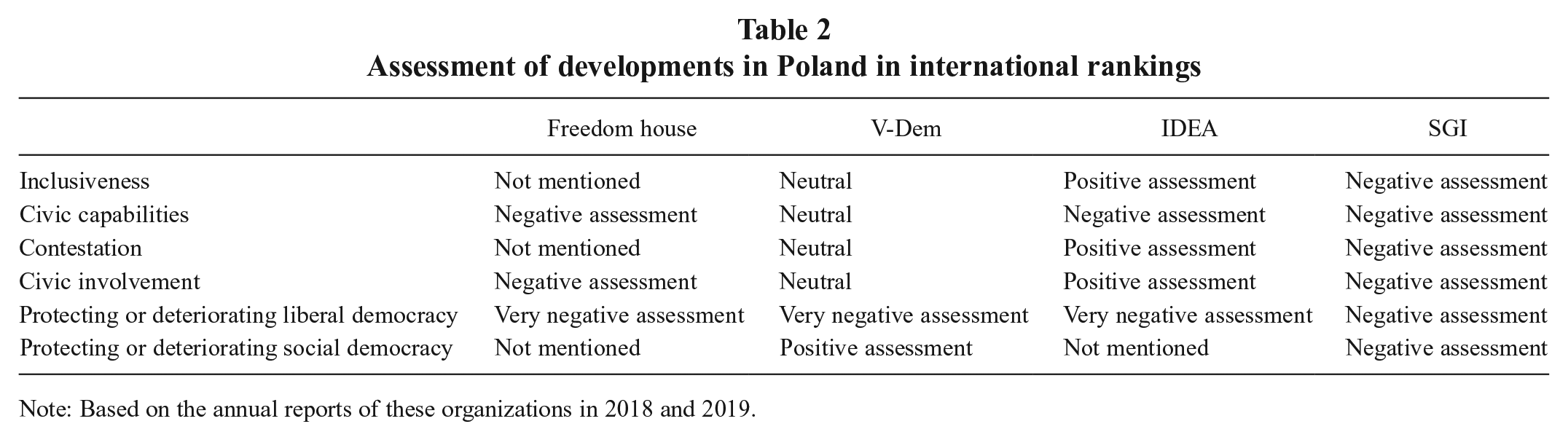
The bracketing involved in such framing can be narrow, that is, taking only one or two aspects into account, or broader, dependent on the number of aspects incorporated within the brackets defining democracy. Table 2 gives the operationalization of the bracketing. It tells what indicators are determinative for telling whether an aspect was included.
Assessment of developments in Poland in international rankings
Note: Based on the annual reports of these organizations in 2018 and 2019.
The framework enables content analyses allowing an evaluation of international rankings. Such an analysis is presented below. The expectation is that international rankings vary in their bracketing of the concept of democracy and that such bracketing is also related to their assessment in specific cases, in this research, developments in Poland. Additional analyses based on this framework enable an understanding of discussions about democratic developments in general. It is again expected that the valuation of multidimensional concepts in general and democratic developments in particular is not only determined by actual developments but especially due to the broadness and specific bracketing of the concept. The inclusion and exclusion of aspects of democracy determines the arguments on which one bases a claim for a deterioration or improvement.
The Varying Bracketing in International Rankings and Their Assessment of Recent Developments in Poland
Below we illustrate that the framework enables us to understand differences in international democracy rankings and to understand the critical remarks made on developments in democracy in a specific case, that is, Poland.
We take Poland as an example as many scholars have argued its democratic backsliding since 2015—being the year representatives of the conservative Prawo i Sprawiedliwość (PiS) (in English: Law and Justice Party) came into power. 72 Polish policies interpreted by international observers as contrary to basic democratic rights and the needed separation of powers, especially with regard to the change in regulations concerning the retirement of old judges and the appointment of new judges, triggered the European Commission in December 2017 to start an article 7 procedure against Poland. The Commission judged the developments in this country to be an infringement of article 2 of the European Constitution, in which the basic values of the EU are stated.
Crucial for selecting this country to illustrate the usefulness of our bracketing scheme is that all brackets are in play. The scholarly literature points to indicators for democratic backsliding in Poland in which all our brackets are reflected. Exemplary is the article by Wojciech Sadurski. 73 First of all, he mentions that the actual power is not held by those democratically elected (bracket 1). Furthermore, Sadurski mentions the limitations in the freedom of assembly by the Polish government (bracket 2) through privileging demonstrations that celebrate events of high importance in Polish history and the abolition of constitutional rights to appeal against decisions to prohibit a public assembly. 74 He also mentions the changing rules for controls on the fairness of elections and the changing rules for ballots being considered to be valid (bracket 3). Furthermore, developments include the state capture of national media that are said to have become propaganda machines for the government (bracket 4), and the removal of checks and balances through the subordination of the judicial system to the executive branch, which was done through changing the composition of the judiciary and removing judges opposing governmental decisions (bracket 5). Last but not least, Sadurski points to the demonizing of specific groups in society—especially members of the LGBTx-community and immigrants—as well as policies reflecting populism (bracket 6).
Sadurski wanted to make the claim that democracy in Poland is backsliding and used all the above arguments to substantiate this point. This does not imply that these arguments are undisputed. The claims can well be a consequence of the political preferences of this author. This makes the position of international rankings and their interpretation of the developments in Poland all the more relevant as these are supposedly independent rankings.
In the ranking of such developments as those from Freedom House, the position of Poland worsened steadily for the last five years, with a democracy score of 80 of 100 in 2015, then being named a consolidated democracy, to 65 of 100 in 2020, resulting in an inferior classification as a semi-consolidated democracy.
The broadness of the bracketing as found in the scholarly literature is reflected to a varying degree in the different reports on democratic rankings. Freedom House considers the democratic character of the governmental system, and the independence, effectiveness, and accountability of the legislative and executive branches (bracket 5); the conditions for fair electoral processes and civic involvement (brackets 3 and 4); the strength of civil society, that is, the organizational capacity and financial sustainability of the civic sector; the legal and political environment in which it operates; the functioning of trade unions; interest group participation in the policy process; and the threat posed by antidemocratic extremist groups (bracket 2); the existence of independent media (bracket 3); local democratic governance (bracket 1); and constitutional and human rights protections, judicial independence, the status of ethnic minority rights, guarantees of equality before the law, treatment of suspects and prisoners, and compliance with judicial decisions (bracket 5). The Freedom house ranking does include developments in the rule of law, decentralization, and corruption under the banner of democracy. This is not the case in our framework. Attention to the protection or deterioration of social democracy is not found as a separate heading in the Freedom House ranking. 75
The V-Dem ranking is similar in including inclusiveness, contestation, and the protection of liberal democracy, but is different in its inclusion of civic capabilities and participatory and social democracy. In V-Dem, the former addresses active participation by citizens in all political processes, electoral and nonelectoral. Social democracy is covered by its inclusion of the egalitarian principle as indicated by encompassingness and the equality in welfare, education, and health policies. As the producers themselves write to what extent all social groups enjoy equal capabilities to participate in the political arena. It relies on the idea that democracy is a system of rule “by the people” where citizens participate in various ways, such as making informed voting decisions, expressing opinions, demonstrating, running for office, or influencing policy making in other ways. The egalitarian principle of democracy is fundamentally related to political participation, as systematic inequalities in the rights and resources of citizens of specific social groups limit capabilities to participate in the political and governing processes. Therefore, a more equal distribution of resources across groups results in political equality and hence democracy.
76
The ranking from IDEA is different because it combines the indices for inclusiveness and contestation in what is called representative government. Similar to other rankings, it includes aspects of liberal democracy. IDEA splits this aspect, however, in three separate components, namely, fundamental rights, checks on government, and impartial administration, thus giving it additional weight. Like the V-Dem ranking, IDEA incorporates participatory democracy measuring people’s political participation and societal engagement at different levels. 77 Outside of the equation in this index is attention for social democracy.
The Sustainable Governance Indicators (SGI) include four components of democracy, that is, the electoral process, access to information, the rule of law, and civil rights/political liberties. In this case, the lower three brackets of democracy—civic capabilities, involvement, and social democracy remain outside of the equation. 78
Democracy Reporting International (DRI) emphasizes the separation and balance of power, independence of the judiciary, a pluralist system of political parties and organizations, the rule of law, accountability and transparency, freedom of the media, and respect for political rights. 79 Thus, it mainly brackets the promotion or deterioration of liberal democracy in its assessment, although some of the other brackets occur under these headings.
Seen in general in the international democracy rankings is that the original elements of democracy—contestation and inclusiveness—only get minor attention. The number of indicators and thus their weight in the final ranking is small in all rankings. On the other hand, the promotion or deterioration of liberal democracy is of crucial importance in all rankings. The number of indicators for this element is huge in all rankings and that increases the weight thereof in the final assessment. The different rankings vary to the extent they include elements of social democracy, civic involvement, and the conditions for fair elections in their bracketing of democracy (brackets 3, 4, and 6).
The international reports producing such rankings do, however, vary in the broadness of their bracketing of democracy. That is also seen in the comments visible in the reports about democratic developments in Poland. Below we address some of these comments as found in the reports to illustrate how the reports argue their rankings.
The Freedom House bracketing is rather narrow, pointing only to the conservative PiS in Poland, which “laid waste to the country’s legal framework in its drive to assert political control over the entire judiciary . . . to force the retirement of Supreme Court judges and gain partisan influence over the selection of election commission members.” 80 All comments in this report involve the liberal democracy threatened by the Polish elected leadership. In its Nations in Transit report, the assessment of Poland is broader, as it also reports changes at the local level, and in civic involvement.
The backsliding in liberal democracy was also noted by IDEA: “Of particular concern are the country’s overall declines on Civil Liberties and Checks on Government. On Civil Liberties, there is a general deterioration noted on Freedom of Expression and Freedom of Association and Assembly. Checks on Government have experienced setbacks on all three subattributes measured in the GSoD Indices: Media Integrity, Judicial Independence and Effective Parliament.” 81 IDEA sees the quality of local democracy in Poland and the representativeness of its national government as a good practice for regional learning 82 and even gives a score of 0.77 on representative government in Poland, which equals the scores of Austria and the United Kingdom. 83
The report of V-Dem 84 sees positive developments in Polish promotion of social democracy, as it says, “Among electoral democracies . . . Poland . . . stands out as over-performers in terms of this indicator of political equality.” 85 The negative comments concentrate around liberal democracy and these comments dominate.
The broadest bracketing is found in the SGI-Poland report from the Bertelsmann Foundation. 86 It addresses developments in all the elements of democracy, although always with a negative tone. Regarding inclusiveness, the report mentions that in 2017, the parliament amended the Act on Foreigners intending to make the domestic institutional framework for dealing with immigrants harsher again. 87
As to the capacity of citizens it is said that “some governments—for example in . . . Poland—deliberately bypass legally determined consultation procedures or exclude government-critical actors from these [the planning phase of reforms] processes,”
88
and in the case of Poland,
89
the country-experts criticize the one-sided consultation of societal actors by the respective governments or even a deliberate circumvention of the usual procedures: Generally speaking, the government’s clear majority in parliament has reduced the need for winning over social actors, and the government perceives many of them as enemies. Public consultation has been bypassed by introducing legislative initiatives through parliamentarians, since such initiatives do not require the regular consultation mechanisms, and therefore exclude experts and public. Moreover, the quick passage of major laws has reduced the time available for meaningful consultation.
90
Concerning contestation, it is said that a close connection exists between the government takeover of the PiS party and the deterioration in media access. 91
Regarding the power of elections to restrain government in its policies, the report mentions that large-scale lawsuits were systematically used against media outlets critical of the government. The visibility of opposition members in the news media gradually deteriorated. This was felt most dramatically by HDP parliamentarians who faced allegations of supporting terrorism and whose immunity was suspended in the months following 15 July.
92
Contrary to the assessment of V-Dem, SGI gives a negative judgement on the developments in social democracy as the report mentions that “Poland . . . is one of the biggest losers when it comes to the aspect of social policy.” 93
This exploratory assessment results in the conclusion that international rankings vary a lot in narrowness or broadness in bracketing democracy and their assessment of democratic developments in a country like Poland. On the other hand, they are strikingly similar in putting the emphasis on one bracket, that is, the decisions made by elected officials regarding liberal democracy. The attention to citizens’ participation in decision making is limited. They hardly address Civic Involvement and Civic capability. This neglects the interesting developments that seem to take place in Poland in this regard, such as decentralization, participatory budgeting, and co-production. 94 Taking this into the bracketing could have resulted in a different assessment of developments in Polish democracy. This brings us to the conclusions.
Conclusions
We asked in which ways democratic developments can be and are conceived and what this implies for the varying understandings of democratic developments in Poland. We first elaborated on the theory of framing in which bracketing is a central concept. Whereas nowadays it is sometimes suggested that framing involves manipulation by giving a single, narrow interpretation of what is going on, the original theory on framing did not assume such a limitation in the way people understand events. Rather, people and scholars alike are assumed to vary in the broadness of the way they give meaning to events. They vary in what they put between brackets and include in their understanding and what they leave outside the equation. We also argued that the concept of framing as such has acquired a rather negative connotation, whereas bracketing is a more neutral term. This points to the preference of using the concept of bracketing instead of framing.
Applying this concept of bracketing to the varying possibilities to understand developments in democracy, six possible brackets were distinguished, resulting in a framework to identify how democracy and its development is made sense of. The six dimensions include inclusiveness and capabilities of the electorate, contestation and civic involvement, and the promotion of liberal and social democracy. This framework enables the understanding of discussions about democratic developments, and the claims that democracy in general is in crisis. Whether the claims are correct depends on the bracketing of democracy.
Whereas scholarly research is rather broad in its bracketing of democracy, international rankings are comparable in their emphasis on developments in liberal democracy (our bracket 6). Our analysis of such rankings shows that the classical way in which democracy was bracketed, namely, in terms of contestation and inclusiveness, gave way to a new bracketing in which the decisions made by governments in terms of liberal democracy are central. This was illustrated for the Polish case. International ranking institutes make it appear that democracy in Poland is in crisis, but this is substantiated mainly by their assessment of the decisions of Polish elected officials regarding the conditions for liberal democracy. Empirical evidence about citizens perceived as stakeholders and their public participation in political decision making and local development could provide quite another picture of developments in Polish democracy.
We acknowledge immediately that the analysis presented here could have been much more detailed, and that the international rankings differ in much more aspects than mentioned here. One can, for instance, point to the varying ways in which they compile an overall score for democracy based on the indicators used. Such analyses are also needed but would go beyond the scope of this article.
Furthermore, such points only strengthen the conclusion drawn here, namely, that sense-making of democratic developments can vary enormously in theory, and that the broadness of the bracketing of democratic developments in international rankings varies also. Often, this bracketing is rather limited, only sometimes somewhat broader. The rankings have in common that they focus especially on developments in liberal democracy and tend to underrate the classic aspects of democracy, that is, contestation and inclusiveness. In that sense, they are not always convincing in their claim about democratic backsliding.
