




Abstract
This article discusses public and mediatized memory politics concerning Word War II in Finland, particularly its transnational dimensions brought about by post-Soviet immigration from the former Soviet Union. Despite the ongoing multiculturalization of Finnish society, where Russian speakers have become the largest immigrant group, Finnish national identity is still constructed around the idea of national independence and its heroic defence. Finnish collective and public memory with its monuments and celebrations concentrates on the sacrifice the nation made for Finnish independence in the wars against the Soviet Union during 1939–1944. In turn, these (re)produce performative membership in the Finnish nation. Likewise, recent Russian memory politics that celebrate Russia’s “great victory” in World War II have become visible in the Finnish public and media space owing to the Immortal Regiment marches held in Helsinki since 2017. This event is embedded within a series of complex connections between Russian speakers, Russian mediascapes, and pro-Russian activists in Finland, and represents an instance of the mediatization of transnational memory politics.
Introduction
Developments in media and communication technologies today enable a growing connectedness between people despite geographical borders. This often leads to paradoxical outcomes: instead of connecting inhabitants of the same country, technologically mediated communications may enhance divides, leading to fragmentation and polarization. Immigrant communities that differ linguistically and culturally from the societies where they live foster connections with the countries of their origin through their media use. From the perspective of integrating into the society of the country of immigration, this may be problematic. Mediatization of immigrant groups challenges existing integration politics, which aim at the inclusion of immigrants. 1 As pointed out in the Introduction and in other articles of this special section, 2 transnational and national identity politics based on collective memories deserve more attention, especially when they intertwine with the “techno-cultural opportunities” provided by contemporary media. 3 But also without technological change, transnationalism has been a crucial factor for understanding the dynamics of remembering. 4
In this article, I focus on the contemporary intertwining of immigration from Russia with potentially conflictual memory politics and mediascapes operating nationally and transnationally. The case study analyses the Immortal Regiment marches held to mark the 9 May celebration of Victory Day that have been organized by pro-Russian activists in Helsinki since 2017. My particular interest lies in pondering the interplay of the politics of memory with the different public narratives that are produced within the Russophone traditional and social media sphere.
This article is based on long-term studies of ethno-cultural processes related to post-Soviet immigration from the former Soviet Union to Finland. It is the result of a research project implemented between 2015 and 2017 focussing on Russian speakers’ media use in Finland and the attitudes of Finns and Russophone immigrants towards Russia. Additionally, it incorporates my study of Finnish and Russian national celebrations in the context of the cross-border and transnational connections brought about by immigration to Finland from Russia, as well as making use of a long-term ethnographic study of the Internet-based activities of Russian speakers in Finland.
The article aims at depicting and evaluating the ever-changing interrelations between collective memories, contemporary media environments, and migrations as sites of societal integration or disintegration. In the first part, I will outline the main features of the post-Soviet immigration to Finland, then characterize contemporary collective memories that have been formed in Finland and in Russia during this period. After presenting my theoretical points of departure, I briefly describe the performance of the Immortal Regiment march in Helsinki in 2018 and consider the developments that enabled it. I end by developing some conclusions concerning the need for advancing more inclusive forms of memory politics and their public display in contemporary Finnish immigrant society.
Russian Speakers: An Emerging Minority
Russian speakers in Finland consist of two groups: the so-called “old” and “new” Russians. The former are the descendants of Russian immigrants who arrived in Finland before or shortly after Finnish independence. Their ties with contemporary Russia are mostly historical; for them, Russian has gradually faded from daily use and their languages of everyday communication have become Finnish and Swedish. The descendants of these “old Russians” are considered to be both an invisible and integral part of Finnish society and history. 5 Consequently, the majority of present-day Russian speakers are post-Soviet migrants. This wave of migrants started to arrive beginning in the 1990s, and Finland continues to annually absorb some 2,500 new immigrants from the Russian Federation. 6 As a result, by 2050 it is estimated that there will be around 200,000 Russian speakers in Finland.
This post-Soviet immigration started in the early 1990s and proceeded through two main channels: the re-migration of individuals with Finnish roots and marriage with Finnish citizens. The re-migration program, which was finally closed in 2016 after twenty-six years of operation, resulted in the immigration of approximately 30,000 people. This group’s ethnic Finnish background was rarely accompanied by a mastery of the Finnish language. With the unfolding of this migration flow, the requirement for the incoming migrants to have a “Finnish identity” became inscribed in official documents and procedures. Likewise, demonstrating some kind of loyalty towards Finland was expected. The war-time evacuation of Ingrian Finns to Finland became a meaningful tie with the country. 7 The pattern of marriage migration is gendered: most migrants are Russian women who migrate mostly as the result of marriages with Finnish citizens. 8
In the 2000s, immigration from Russia occurred predominantly through family, labour, and educational residence permits. Today, Russian speakers constitute the largest group of immigrants speaking a foreign language in Finland and are the third largest language group after Finnish and Swedish speakers. At the end of 2017, a total of 77,177 people in Finland declared Russian as their mother tongue. Of these, 59,271 held Russian citizenship, 29,183 persons had only Russian citizenship, and 30,088 held both Russian and Finnish citizenships. These Russian speakers have a clear migrant background, with 56,696 being born in the former Soviet Union and 14,227 in the Russian Federation. 9
It can be assumed that the number of Russian speakers in Finland is in fact higher than the register suggests. Although the Finnish population register is very comprehensive, it does not reflect the whole picture, as one cannot, for example, register two native languages. Likewise, immigrants from other post-Soviet countries also speak Russian. Despite different ethnic and national backgrounds, Russian has become a lingua franca within post-Soviet migrant communities. 10
The Russian-speaking minority in Finland is ethnically, historically, culturally, and socially heterogeneous. Its members usually originate from territories adjacent to Finland: the Republic of Karelia, Leningrad oblast, Saint Petersburg, and Estonia. Geographically, more than 40 percent of Russian speakers are concentrated in the capital region of Finland, and about 30 percent live along the eastern border in proximity to Russia. Against the background of discussion on asylum seekers, Russian speakers remain an “invisible” minority because of their “whiteness” and under-representation in politics and the media. Their integration and socioeconomic position in Finland are hindered by difficulties in learning Finnish, the historical image of Russia, experiences of discrimination, over-qualification, high unemployment (19 vs. 9 percent of the Finnish-speaking population), and lower income rates. 11 The everyday lives of Russian speakers are permeated with transnational family, friendship, cultural, social, and media ties. 12
Since the beginning of the war in eastern Ukraine and Russian interference in different mediated processes in “the West,” Russian citizenship and transnational connections with Russia have been framed in Finland as a potential threat. The contemporary image of Russian speakers in Finland is negatively affected by an unquestioned, and banal, assumption associating them with the Russian state. Finnish discussions regarding imposing restrictions on individuals with dual citizenship, which is understood among Russian speakers as pertaining to them, are preoccupied with issues of loyalty and do not take into the account migrant’s everyday transnationalism and the meanings that they ascribe to citizenship. 13 On the other hand, their everyday transnational family ties and the closeness of their native localities in Russia, along with their transnational media consumption (enabled by contemporary information and communication technologies), inevitably bond them with Russia and Russian identity politics.
Conflicting Memory Setting
Russia and Finland share a 1,300-kilometer border and a long history of both coexistence and conflict. The seminal event that shaped the present-day Finnish–Russian border and the relations between these two neighboring countries took place during World War II. In today’s Finland and Russia, popular national interpretations of World War II have become “foundational events” through which to understand national identity, but the war is interpreted and remembered in very different ways.
In Finland’s collective memory, the result of World War II is interpreted as a defensive victory, even though the country lost. 14 The Winter War of 1939–1940 was started by the Soviet Union and resulted in the defeat of the Finnish army and the loss of the Karelian Isthmus, Ladoga Karelia, and territories in Northern Finland. Even so, Finland retained its sovereignty. In the Continuation War of 1941–1944, Finland aimed at regaining its lost territories and creating a “Great Finland” constructed from Finnish and historically Karelian territories on the Soviet side of the border. The Finnish army occupied a large part of Soviet Karelia and Leningrad oblast and fought in alliance with Nazi Germany. The Continuation War ended in 1944 with fierce defensive actions and a temporary peace treaty with the Soviet Union, which was cemented in the Paris Treaty of 1947. This treaty reaffirmed the territorial losses of 1940 with the additional territories in the North and set reparations, which Finland paid until 1952. In the Finnish–Soviet wars of 1939–1940 and 1941–1944, Finland lost approximately 10 percent of its territory and had to relocate more than 400,000 of its citizens. During the Soviet–Finnish war of 1939–1940, Soviet casualties amounted to 333,084 soldiers, whereas 26,662 Finnish soldiers were killed and 43,557 wounded. 15 During the war of 1941–1944 the USSR suffered 757,500 casualties, while the commensurate figure for Finland was 170,000. 16
The memory of the wars between the USSR and Finland waged within the context of World War II still forms the “great narrative of the Finnish nation,” 17 although the country is becoming even more ethnically and culturally diverse, and the politics of history, such as how history is taught in schools, is being adjusted to this reality. 18 The memory of the lost territories, first of all Karelia, is strongly articulated in the activities of societies of evacuees, popular culture, and academic and public discourse. This war narrative, along with how the home front is portrayed, presents the Finnish nation predominantly as a victim of these conflicts. Likewise, memories of the fighting, as well as of fallen soldiers and veterans, are widely treasured by Finnish families and constitute a large part of the nation’s collective memory. This memory, in turn, forms the core of the celebration of the main national festival, Independence Day, and is ubiquitous in the popular cultural production. 19
The collapse of the Soviet Union initiated a significant change in Finnish history and memory politics. While during the Soviet period the USSR’s victory over fascist Germany was recognized and praised on the official level, while patriotic memory was suppressed, after the Soviet Union’s collapse, Finnish war memory experienced a “neo-patriotic turn,” by which Finnish historians Kinnunen and Jokisipilä mean “the public renaissance of the pronouncedly nationalist attitudes and representations that began to dominate the public memory of the Finnish wartime. The neo-patriotic discourse builds on the constructed conception of wartime Finland as ‘unified and unique.’” 20
In addition, for a long time, Finnish historiography of the war has been dominated by the so-called separate war thesis: Finland’s war against the Soviet Union in 1941–1944 has been understood as largely independent of Operation Barbarossa and German policies and practices in the war in the East. Historian Antero Holmila 21 notices that Finnish historical writing has followed a patriotic interpretative framework, and aimed at the “objective” construction of the past without attempts to evaluate problematic episodes in the war, such as Finland’s participation in the Holocaust: “the historian has taken a backseat, telling the story ‘as it was.’” 22 The alliance with Nazi Germany during the Continuation War, Finland’s complicity in the Holocaust, and the occupation of Soviet Karelia as part of a project to create a “Great Finland” are still poorly articulated in public or cultural memory, although during the 2000s several academic studies related to these topics were published. 23
In Russia, the memory of World War II is formed around the symbolism of the “Great Patriotic War” and the 9 May celebration of Victory Day, which during the post-Soviet period has undergone a transformation from a late Soviet “celebration with tears in the eyes” to the joyful celebration of a victorious and powerful nation today. 24 In studies of Soviet and post-Soviet war memory, there is a common division made between the official memory of the “great victory” and a peripheral familial memory of the “bloody war.” 25 The post-Soviet war memory of the 2000s is characterized by state-led attempts to develop the neo-Soviet model of projecting the “great victory” onto the present-day state, and at the same time a multiplicity of local, non-governmental initiatives that aim at the individualization and personification of the memory of the fallen, which the state successfully incorporates into its own memory politics. 26 In post-Soviet Russia, Victory Day has become the main national celebration.
Still, Mischa Gabowitsch 27 argues that the meaning of Victory Day has changed within Russia, and especially in the other former Soviet states. Outside of Russia, in addition to the reiteration of the Soviet “victory myth,” it accommodates the initiatives and interpretations of various groups and actors and reflects the changed position of Russian speakers, who live now in the states that interpret the results of World War II as merely beginning of the “Soviet occupation” rather than “liberation from fascism.” 28
One of the recent “invented traditions” of the celebration of Victory Day on 9 May is the march of the so-called Immortal Regiment, which began in Russia in 2012 as a grassroots initiative before becoming incorporated into state-led celebrations in 2015. These marches are organized throughout Russia and abroad. In 2018, they were held in more than seventy countries where Russian minorities reside. The descendants of Soviet soldiers organize these marches, and they display portraits of their ancestors and performatively signal their veneration of what they endured.
Moreover, the Immortal Regiment presents itself as a “movement,” inviting participants to search out and present information about relatives who fought in the war and how their memory is cherished by their families. 29 The Immortal Regiment can therefore be simultaneously interpreted both as a successful outcome of state-led memory politics and as a way to protest against the state’s appropriation of the memory of the war. 30 Julie Fedor evaluates these marches abroad as declarations of support for the contemporary Russian leadership and its identity politics. 31 Such marches have been organized in the Finnish capital Helsinki since 2017, and have attracted two to three hundred participants each time. 32
Victory Day celebrations have been held in Finland before as well, and they were organized with the leading role of the Russian embassy. They consisted of ceremonies such as the laying of wreaths on the graves of Soviet soldiers and POWs in Hanko, Porkkala, and other places. Since 2017, the Immortal Regiment has been organized in Hanko in connection with these celebrations and in the center of Helsinki on the initiative of civic organizations of Russian-speaking immigrants. It can therefore be seen as a new step in the development of the Russian diaspora in Finland.
Theoretical Viewpoints: Memory, Immigration, Media, and Public Space
The relationship between collective memories and migration can be approached from several perspectives. In immigrant societies, the plurality of collective memories grows, and memory can be seen as one of the realms of transnational processes that produce identity and affective belongingness. On the other hand, collective or cultural memory can be seen as a field of dialogue on the ethics and pragmatics of remembering the past in an immigrant society, as a realm of the incorporation of migrants’ memories into the memorial culture of the host society. 33
The presence of groups whose collective memories can differ from those of the majority of the population can also be viewed from a critical perspective that assesses membership in society not only from a national, but also a transnational (e.g., European), perspective. The European or transnational/transcultural perspective brings forward the conversation regarding the mnemonic processes that are going on in contemporary societies, and which suggest that the worthiness of human lives and rights is more essential than glorifying the nation. 34 Relevant in the Finnish–Russian context is how post-Soviet developments have affected the understanding of World War II and its results. As many scholars highlight, in post–Cold War Europe these narratives have changed “from triumphal to traumatic,” as the results of the war, at least in the countries of the former Soviet Bloc, are re-evaluated. 35 The interpretative framework through which the outcome of the war is evaluated has shifted from “liberation from fascism” to “Soviet occupation” in accordance with the new historical narratives of these nation-states. Meanwhile, the scope of war narratives has broadened. While the question of their compliance with the Holocaust narrative has to be asked with respect to the prevailing European discussion, 36 these post-Soviet national narratives are predominantly being built around the victimized images of the Warsaw Pact nations that were not part of the Soviet Union proper—in the Baltic states and in Ukraine.
The contemporary Russian memory narrative, which is founded on the Soviet myth of the “great victory,” seems to counter this Europeanization and exploit the nationalist heroic memory script. 37 While studies of the post-Soviet Russian memory of the war point to the state’s ever-tightening regulation of history and memory politics, as well as their instrumental use and affective character, history and memory politics are also assessed as a field of multilevel agency involving different actors. 38 In the 2000s, the memory of the war became a battleground over its interpretation within and between neighboring countries that culminated in the instrumental use of its symbolism in the Russian–Ukrainian conflict since 2014. Post-Soviet nationalized historical narratives among many of the Soviet Union’s former satellite states have been represented in Russian official discourse as attempts to “rewrite history” and those who oppose Soviet and Russian narratives labeled as “fascists.” 39
This “memory war” has domestic, international, and transnational reach, the later appealing first and foremost to Russian-speaking minorities living abroad. 40 Consequently, the transculturation, 41 or transnationalization, of the memory of the war, by which Assmann 42 means the diffusion of particular “grammars of memory” over national and cultural borders, has become a multilevel and transnational process that impacts on the further consolidation and fragmentation of mnemonic communities. Along with the Europeanization of the memory of World War II, which coalesced around the memory of the Holocaust, the spreading of the heroic Russia-sponsored narrative is occurring first of all among Russian-speaking minorities outside of Russia. 43
The transnational diffusion of memory discourses across national borders has to do with notions of publicity and publics in multicultural societies. Theoretically, a democratic and multi-ethnic public sphere has to accommodate within itself different minority points of view on important issues and be able to enhance deliberations and democratic decision making. 44 On the other hand, according to Fraser, if people are involved in institutions that function transnationally, they need to have the possibility for democratic critique, and a transnational public space is needed. 45 Hence, in European immigrant societies, national public spaces are simultaneously rendered multiethnic and transnational.
Memory studies investigate the ways in which memories are articulated and presented in public spaces alongside an attention to power relationships within societies. 46 When collective memories are discussed in multiethnic immigrant societies, critical questions inevitably arise: What and whose memories are visible versus excluded from the public spaces? To whom are representations of memories addressed? What are the publics that can act in the public space? How does the public space become open to minority/immigrant memories? And how are the transnational dimensions of these memories dealt with? 47 Related questions include the following: What kinds of memories can be presented in democratic immigrant societies, and on what terms? Does the transnationalization of memory in fact mean the transnationalization of public memory and, if so, then in what way?
The process by which immigrants are incorporated into the memory community of a host society has been explored by Michael Rothberg. 48 As a model of inclusion, he applies the concept of multidirectional memory, which basically means a dialogic process of re-assessing collective memories against the memory of the Holocaust, and the gradual evolution of solidarity between members of different communities. German national memory of the war has developed through a long process of acknowledgement and adoption of the memory of the Holocaust as a way to deal with the past and serves as a model of European memory. 49 Obviously, in the case of Finland, where the patriotic “sovereign” national memory model prevails, the question of “how to immigrate into history” becomes more strained and bears the potential for conflict if two “sovereign” memories clash.
Studying collective memory also leads us to assess the role of the media in the transnationalization of memory discourses and practices. Media are traditionally seen as a realm of publicity. Contemporary, technologically driven transformations affect not only the media but also societies and cultures more broadly. Because of the development of information and communication technologies, media are increasingly woven into our everyday life: information consumption, entertainment, and communication with other people occur by means of the same mobile device and are highly intertwined. Everyday life becomes mediatized. 50 Krotz argues that mediatization should be seen as a meta-process relevant to other ongoing meta-processes, such as globalization, commercialization, and individualization, and it should not be assessed as an isolated process in a single society. 51 Mediatization inevitably concerns public spheres and memory. In the view of Helen Rutten, 52 mediatization affects both what we remember and how we remember. Mediatized memory is spreading globally and reaches “geo-cultural publics” 53 who live outside the national metropolises.
Collective memories in immigrant societies become multilevel processes and involve different actors. In addition to the integrationalist perspective, they need to be assessed from the viewpoints of uneven transnationalization and mediatization. Below I will concentrate on the performance of the Immortal Regiment in Helsinki in 2018 and examine its mediatized character.
The Immortal Regiment in Helsinki 2018: The Performance
In 2018, I engaged in participant observation of the march of the Immortal Regiment in the center of Helsinki that started on 9 May at 4 p.m. and proceeded from the Finlandia Palace along the Töölö bay beach to the Cultural Palace where a “cultural program” was organized. The event lasted approximately two hours and gathered around two hundred participants.
Before departing for the march, people gathered in the forecourt of the Finlandia Palace. Some women sang Soviet songs, shouted hooray and “good victory day,” some shared St. George’s ribbons, 54 and others seemed busy sharing other post-Soviet symbols of Victory Day: orange-and-black balloons, red flags with the inscriptions of the Immortal Regiment, and portraits of soldiers on sticks. There were also other pro-Russian or Soviet symbols represented on clothing or decorations. Some people brought self-made portraits mounted on cardboard. Among the names of the soldiers were both Russian and Finnish names. The atmosphere was joyful; some children ran around with red flags provided by the Immortal Regiment (see Figures 1–3). Many people took photos using their cell phones or cameras. At some point, the organizer of the march arrived in her car with more equipment. She wore a Soviet female military uniform with high-heel boots. When everything was ready, the column marched off. In addition to the flags, portraits, and balloons, organizers carried a portable speaker from which Soviet and Russian Victory Day songs were audible. The organizer of the march walked at the head of the column, chatting with people and taking photos. Organizers carried small Russian and Finnish flags, along with the flag of the so-called Donetsk People’s Republic. Some participants wore Soviet-style caps or jerseys emblazoned with the names of famous Russian ice hockey players. The column was very visible, loud, and colorful. A few Finns who were walking or running in the park seemingly did not understand what this event was about and ignored the commotion. The participants of the march walked along the park path by Töölö Bay, stopping to lay carnations in the water (because of the absence of a suitable monument to the Unknown Soldier, according to the leader of the march). Then they arrived at the Cultural Palace, where the organizer once again congratulated everyone and the participants released balloons. The march was escorted by a police car, which followed it from a distance.
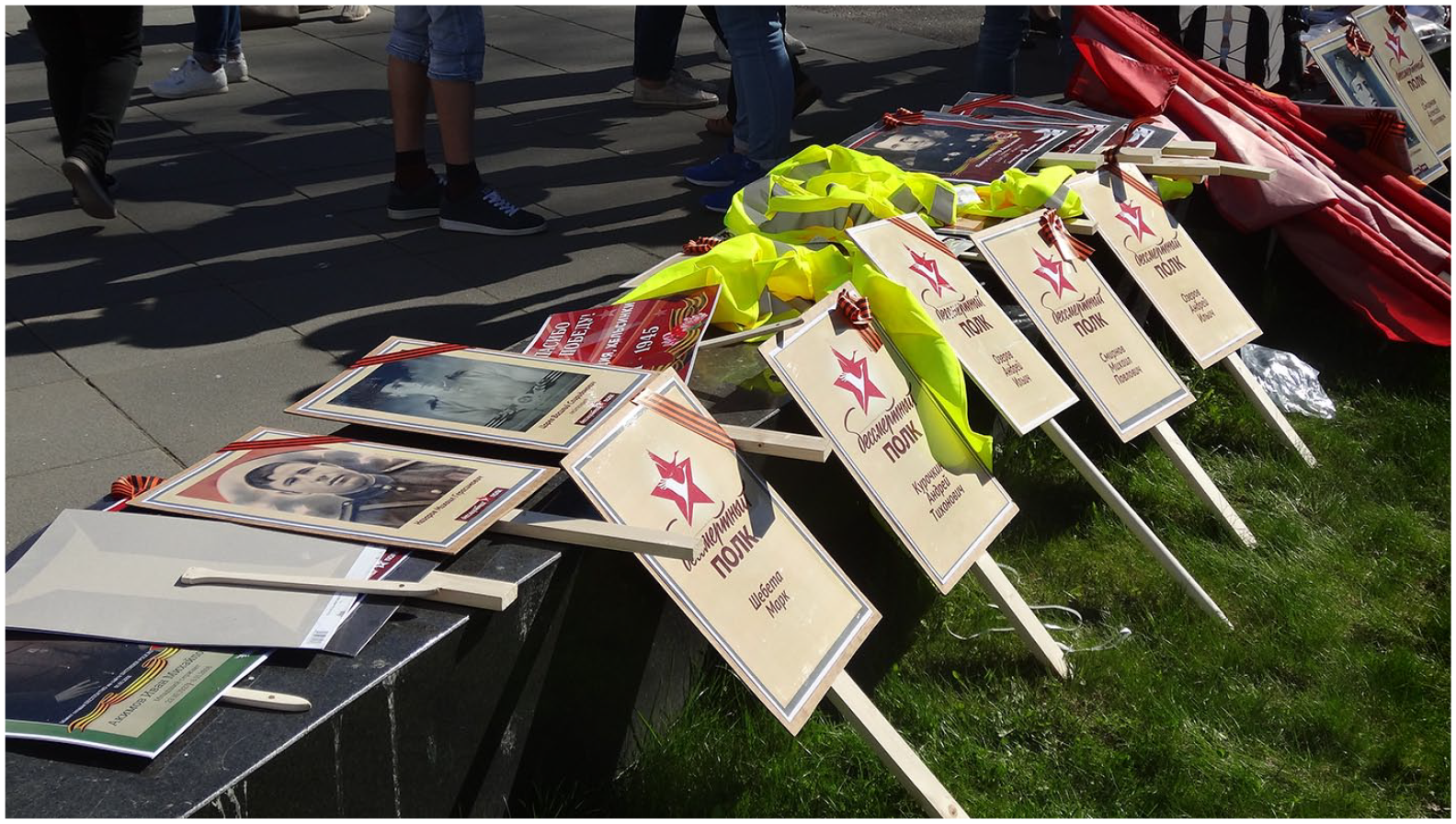
The equipment of the march prepared to be taken by the participants
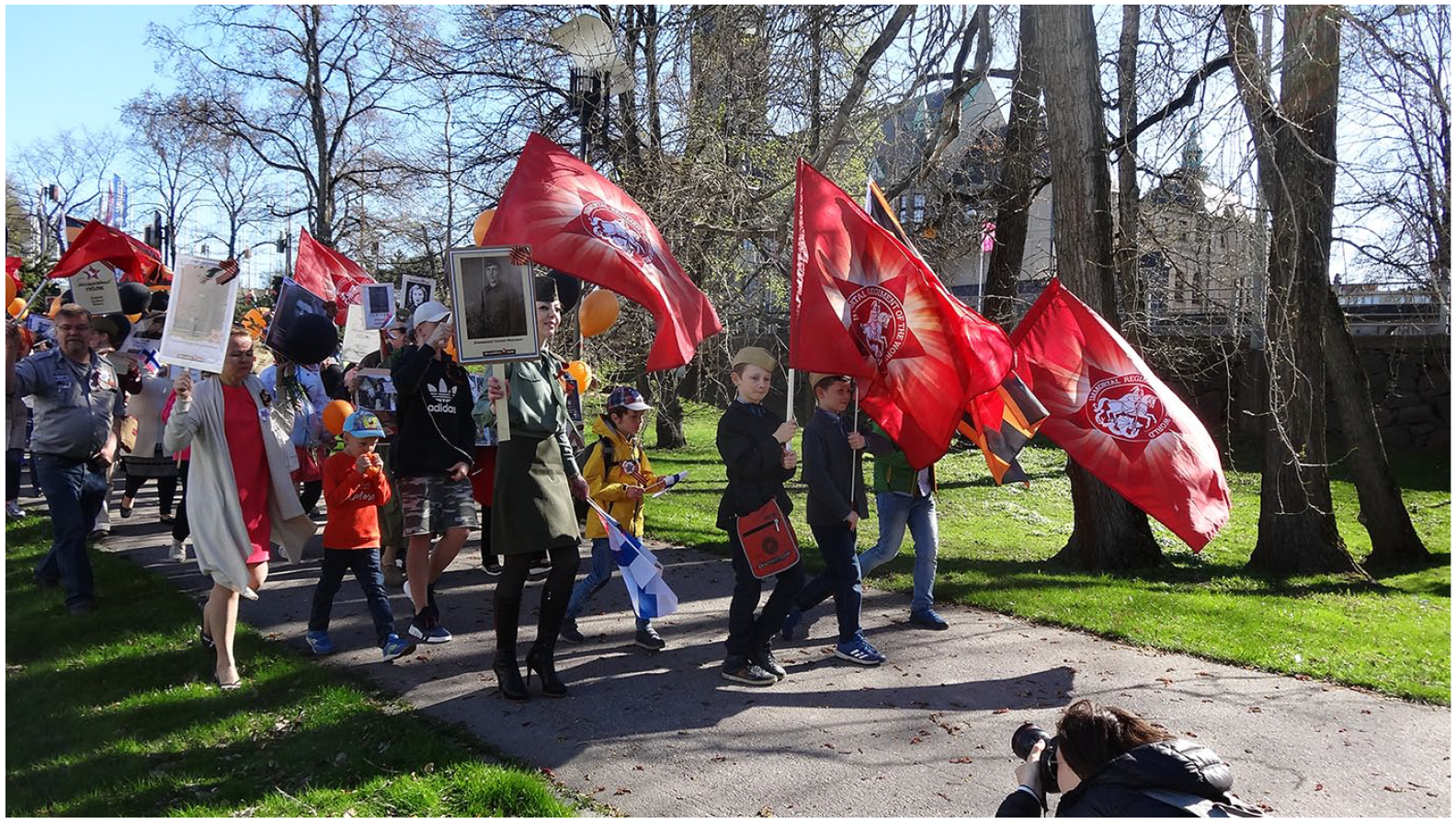
The Immortal Regiment march in Helsinki, 9 May 2018
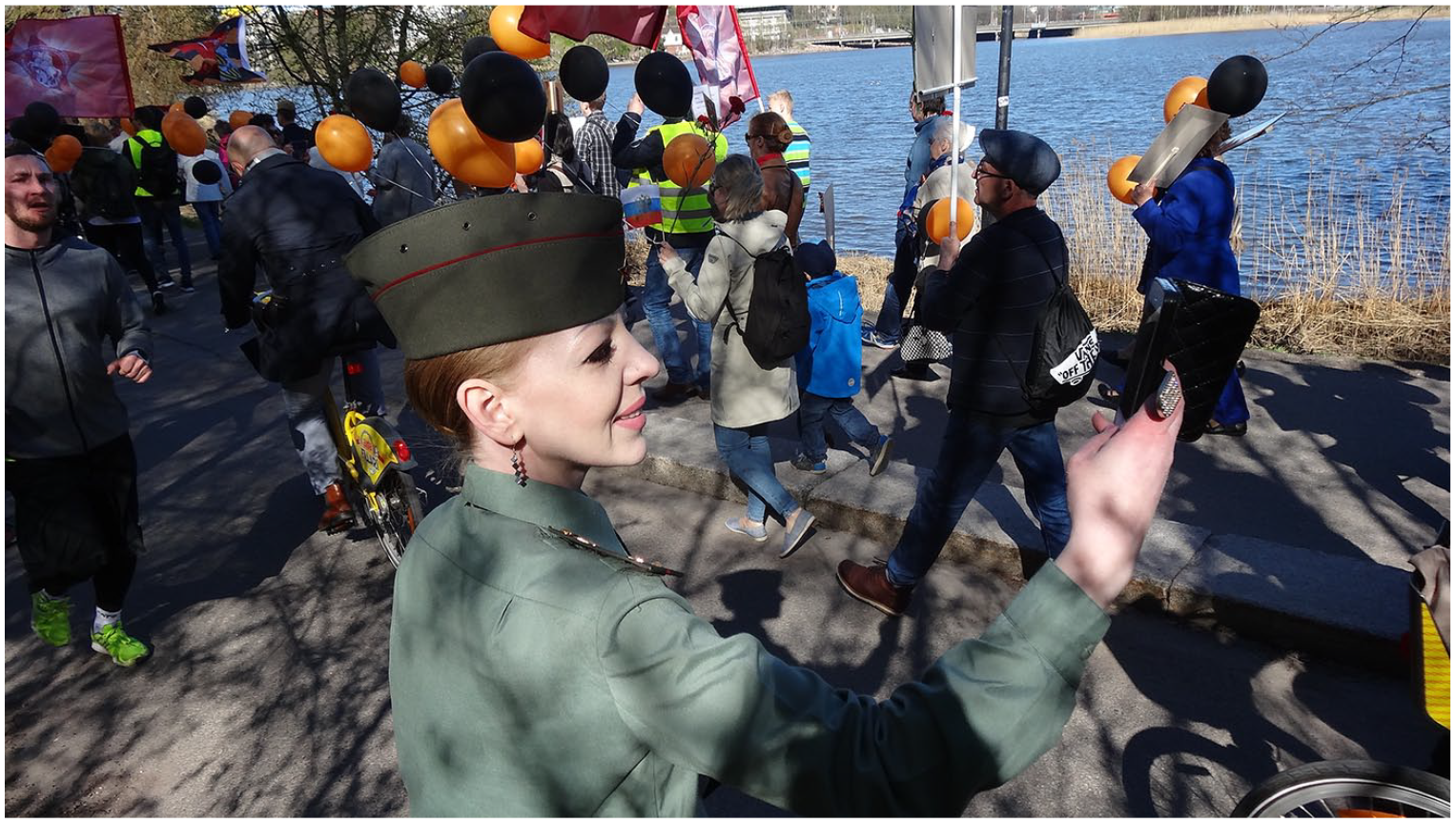
The organizer of the Immortal Regiment march taking a selfie
Afterwards the participants went into the cafeteria of the Culture Palace, where the organizer (clad in her Soviet military uniform) gave a speech, informing her audience that this year the march was organized with the support of the “all-world Immortal Regiment.” She observed that it was broadly announced in the social media and in the well-known Russian newspaper Spektr, whose new editor-in-chief turned out to be “brave” and had “initiated good changes” in the outlet. She likewise praised the participants for their courage and reproached Finland for its non-consistent adherence to freedom of speech and human rights.
She moreover presented the Immortal Regiment as a long-awaited event for all “ethnic Russians and those nationalities whose ancestors fought against Nazi Germany” and who now have the possibility to “walk with the photo of their hero, to honor the memory of the fallen, and sincerely rejoice over the victory.” According to her, the fact that four generations of people in Europe have lived in peace and enjoy “human rights, humanism and freedom” was possible because of the effort of Soviet/Russian people. In her words, “we have to prevent the recurrence of the war,” as “the West has apparently forgotten the horrors of war and thirsts for new conflicts.” After that, she read an amateur poem “from the Internet” that in a clichéd way presented gratitude to the Russian veterans and expressed sorrow for their sacrifice for future generations.
Then a small choir of Russian women sang some Soviet Victory Day–related songs. The organizer next presented “a veteran,” who said that she was born in 1938 and survived the Leningrad siege, and congratulated everybody. After this, more songs were sung, and some participants danced waltz-style dances as usually presented in Russian war-related movies. As the event began to wind down, the participants poured steadily out. The portraits of the veterans on the sticks that were used during the march were piled up in the lobby of the palace, seemingly awaiting reuse next year.
The Enabling Background: Mediatization of “Russian” Memory
Post-Soviet immigration to Finland has taken place for more than 25 years, but before the march of the Immortal Regiment, which took place for the first time in 2017, no self-organized event of the Russian diaspora had managed to organize a march in the center of Helsinki with so many participants and become so performative. In my view, it finally became possible because of a conjunction of several factors, including the increasingly mediatized and affective power of the “great victory” as a core element of contemporary Russian national identity, and the involvement of Russian speakers in transnational media use and social media communications. Additionally, an important role in the success of the Immortal Regiment march was played by its official organizer (a newly registered civic organization “for promotion of Finnish–Russian friendship”) and its chairperson. The perceived attitudes towards Russians as a source of threat that have strengthened in Finland since 2014, and the high concentration of Russian speakers in the capital area of Helsinki, in conjunction with the continuing immigration of ethnic Russians from Russia and other post-Soviet countries also had an impact on the mobilization of participants.
The techno-cultural opportunities provided by the media environment of the Russian-speakers and their involvement in social media communications play a pivotal role. In analyzing the relationship between the transformation of traditional media and the development of racist communication in both clandestine and open social media sites, which resulted in the institutionalization of a populist right-wing party in Finland, Karina Horsti 55 has leaned on the twin concepts of “mediapolis” and “folk-cultural production model.” 56 While a mediapolis conceptualizes today’s media environment as complex and fragmented (consisting of manifold connectivities, media cultures and information flows, and different platforms, as well as a convergence of communication and information genres and technologies), the “folk-cultural production model” reflects how media users operate within their media environments. This model acknowledges both the architecture of contemporary social media platforms, which provokes the diffusion of news stories and discussions about them, and the actual reflexive and participatory production of culture within this means of communication. The active participation of people in the creation of “folk culture” is due to the plasticity of digital objects, which enable their use, reuse, molding, and remolding. At the same time, when people engage in social media and become media producers, they become more self-conscious about the artifacts of others and of their own attitudes and opinions. In Horsti’s 57 analysis, it is exactly this interplay between technology, traditional media, and the clandestine spaces of social media, along with the active participation of users, that resulted in the formation of the populist The Finns party.
Studies of the Immortal Regiment underline the mediatized character of this phenomenon. Alexandra Arkhipova and her co-authors 58 highlight the importance of mediated social networks in the formation of celebration communities: Victory Day is felt to be extremely important, and whatever attitudes individuals harbor towards the Immortal Regiment march, they feel the need to express their feelings online. Mischa Gabowitsch 59 identifies the Immortal Regiment as a copycat movement. Copycats are usually leaderless and can start from an idea of activity first implemented locally, which is then copied by others who may not have any links to the original organizer. However, such movements address issues relevant to the whole of society. Copycats are flat and built around weak, non-hierarchical ties within mediated networks; they are weak and temporary, and do not become networks of solidarity or transform themselves into civic society organizations. Like flash mobs, copycats temporarily occupy central urban spaces, making themselves visible and present. Gabowitsch asserts that one of the central factors in the success of copycats lies in technological change, which, due to the proliferation of mobile media and communication technologies, leads people to see themselves primarily as individuals, and only secondarily as members of collectives.
In case of the Immortal Regiment in Finland, the “techno-cultural opportunities” that enabled this event consisted of several interrelated and concurrent components. Obviously, the mediatized Russian remembrance of the war serves as fertile ground. 60 The growing meaning of the “great victory” in the production of the Russian “telenation” is reflected in the broadcasting of state-controlled Russian TV: throughout May war-related Soviet and Post-Soviet movies, talk shows, documentaries, concerts, and news programs are repeatedly shown, thus creating a national media event. 61 Televized celebrations of Victory Day are planned and performed in order to produce an affective reaction in viewers, “to link remembering people together, to provide them with social space and symbolic tools that could help to make such linkage tangible.” 62 Serguei Oushakine defines this way of building commemorations as the “affective management of history,” which does not aim at symbolizing or translating the war experience into new metaphors, but instead at producing an emotional link with an “authentic” heroic past. 63
In a previous study, I described the attitudes of Russian speakers in Finland towards national celebrations. Whereas Finnish Independence Day is commonly perceived as an extra day off, with its references to the wars between the USSR and Finland as reproducing Russia and Russians as an enemy, Victory Day is evaluated by Russian speakers as important and meaningful. One of the habitual practices Russian speakers engage in during the celebration of Victory Day was reported as “watching TV,” and the programs that self-evidently belong to this ritualized mediatized celebration are the televised military parade on Red Square in Moscow and old Soviet-era movies. Many of our interlocuters told us how they respect the new way of celebration, meaning the Immortal Regiment marches, and how some of them try to participate in them when they visit Russia. Our project on Russian speakers’ media use in Finland discovered the importance of Russian TV in their everyday lives: Russian state-controlled TV provides them both with information and entertainment, while their involvement with Finnish media remains (compared to Russian media) rather thin. 64
Studies of the Russian television and media system highlight their dependence on the state and ruling elite, its propagandistic character and the ways it engages viewers by means of “nudge propaganda,” producing “truthinesses” on the issues of international and domestic politics and forming an image of President Putin as the “leader of the nation.” 65 The worldview that has been produced by the state-controlled channels portrays Russia as being unjustifiably accused and misunderstood by the West. The United States is presented mostly as a malicious manipulator that aims at the creation of a unipolar world, and Europe as follower of the United States. Meanwhile, Ukraine is presented as a battleground between the West and Russia. The engagement of the viewer happens by the means of juxtaposition between “us” and “them” in the news, infotainment, and entertainment formats with their simplified and rude rhetoric. The viewer is addressed as being informed and morally right. 66 This TV discourse is actively replicated on official and para-official Internet news sites and social media. 67
Finland’s Russian speakers are involved with the Russian-language Internet (RuNet) in many forms: Russian TV is watched through Internet sites, news outlets are followed online, and people connect with their friends and relatives through social media. This impacts the “social curation” of media consumption and involvement with the media in general: media use becomes even more guided by the links and recommendations of a particular user’s mediatized social networks. 68 Social media algorithms also impact the formation of media environments for users, producing rather monolithic and circumscribed “echo chambers.”
In addition to people’s personal contacts, numerous groups of Russian-speakers in social media participate in the “social curation” of media consumption for their followers: participants share links to news outlets that represent the Russian official or para-official media, or media in Russian produced outside of Russia, including news produced by the Finnish national broadcast company YLE. These links are backed up by suggestions fed to them through social media algorithms. The posted news (mostly from YLE) concerning Finland is predominantly negative and concentrates on societal problems. Some of the links receive comments, which gradually become heated as the conversation gains the typical features of an anonymous Internet discussion, such as use of the cursory and harsh language, hate speech, and an emotional character. These conversations end up with a sharp division into opposing groups, which after the outbreak of the conflict in Ukraine are habitually labelled with names that have been used to designate pro- and anti-Russian groups.
The language of these conversations contains lots of visual images, which refer to easily recognizable elements of Soviet and Russian popular culture, producing a sense of cultural and political like-mindedness. The comments that are left under the news links either praise or damn Finland or Russia; they also reiterate anti-American, homophobic, xenophobic, racist, heteronormative, and conservative viewpoints. Finland is criticized as too liberal and tolerant, pseudo-democratic, unfree, and Russophobic. Among the themes that have been producing sharp divides and “holy wars” (holivary) among those who participate in these groups are events in Ukraine and Crimea, child welfare in Finland and custody cases concerning Russian mothers, and the so-called migration crisis and asylum seekers in Finland. The attitudes towards World War II, the “great victory,” and the wars between Finland and the Soviet Union are among the most persistent themes of these conversations. Anastasia Rogova 69 has studied groups of Russian-speaking immigrants living in Canada that have formed around conservative family values as moral communities. One of the mechanisms for the formation of such like-minded entities is the involvement in “ordinary” Russian speakers’ social media groups that produce sharp affective polarizations with the help of heated conversation. 70 Hegemonic “Russianness” that has been developed in such conversations is based on ethnic (biological) descent, support of the Russian state, and reverence for the “Russian victory” in World War II. Simultaneously, Russians are there presented as being threatened in different ways—by migrants, Finns, child welfare inspectors, Americans, and so on.
The participants of these groups do not live exclusively in Finland. Some of them provide information on their location and history (which is asked during the social media registration process), but many stay unrecognizable or declare Russian or other non-Finnish locations as their places of residence. The character of some comments allows one to assume their writers work as paid commentators, “trolls” that have been interfering in social media abroad and in Russia. 71 The interference from abroad in the discussions that take place on the most popular Internet forum of Russian speakers in Finland was reported in our study 72 by the owner of the Internet portal in question. During the course of the occupation of Crimea and the war in Eastern Ukraine, lots of previously dormant accounts “awakened” and started commenting on these events in a pro-Russian way, initiating such a rude discussion that moderators decided to separate out Ukraine-related topics and disable the ability of some participants to comment on them.
These groups have thousands of registered members and are used by Russian speakers also as sources of practical information regarding immigration to Finland, finding jobs, promoting businesses, selling and buying goods, and so forth. Invitations to participate in the Immortal Regiment marches are also being spread through these groups. Having both a mundane and “heated” character, they engage people to follow various conversations, and provoke more divisions and polarizations in opinions, in such a way mobilizing participants to enter the physical public space and perform activities and replicate symbols that have become already highly meaningful for them.
The official organizer of this event, an NGO named RUFI that was registered in March 2017 and succeeded in organizing the first march of the Immortal Regiment in May, presents itself as a new and effective, as well as non-political, “Russian–Finnish organization” that promotes friendship between the two countries and peoples. It is very active on different social media platforms, for which it produces a lot of textual and video content. This consists of reporting on its activities in a textual or video format, making statements concerning political events, announcing forthcoming events, and providing links to mostly Russian official media outlets. The association openly and passionately promotes official Russian viewpoints and is connected with both the Russian official and Finnish “false media.” The chairperson of RUFI is featured as a representative of the “Russian diaspora” by some Russian TV channels when they report on Finnish events. Among others, the association is connected with Finnish activists involved in the media of Donbas separatists and outlets of the Finnish “alternative,” anti-liberal Internet media. The association also organizes trips to Crimea.
The background and connections of RUFI to the Russian authorities has been speculated about in the Finnish media. 73 The head of the organization has stated that it is not sponsored by Moscow. Nevertheless, the connections of the organization with the Council of Russian Compatriots, which executes Russian diaspora politics 74 in Finland, and especially with Johan Bäckman, imply the involvement of the organization in the promotion of Russian influence abroad. Bäckman has been associated with Russian activities in Estonia, Moldova, Syria, and Eastern Ukraine; he functions as a representative of the “Donetsk People’s Republic” in Finland. He is also connected with the Russian Institute for Strategic Studies and Russia’s Foreign Intelligence Service. 75 Through his continual presence in the official Russian mass media and his own activities on the Internet, he is well known in Russia (and among Russian-speakers in Finland) as a “Finnish antifascist,” a “human-rights activist,” and a “defender of Russians in Finland.” In October 2018, Bäckman, together with the founder of an “alternative” Internet outlet MV lehti Ilja Janitskin, was convicted for the harassment of journalist Jessikka Aro, who was investigating Russian “troll factory” activities. 76 With the help of the Immortal Regiment march, RUFI and the forces backing it have obviously strengthened their position as the “voice of the Russian minority” in Finland.
Discussion
The entrance of the Russian-speaking minority into the Finnish public space could be evaluated as a positive development: it ostensibly signals the empowerment of a group that has been repeatedly evaluated in the research as being invisible and discriminated against. However, given the present-day international situation and the accompanying sharpening of divisions not only between the West and Russia, but also between liberal-democratic and authoritarian-conservative values and political movements, such an assessment would be at best one-sided, if not simply naïve. The Immortal Regiment march has evolved within Russian national mediatized identity politics and is embedded in the media involvement of Russian speakers in Finland, which preferentially ties Russian speakers to the Russian state rather than promoting their integration into Finnish society. It strengthens not only pro-Russian actors, but actors that aim at shaking the liberal-democratic foundation of Finnish society.
The Immortal Regiment marches outside Russia should thus be seen in a broader context, and not only as part of mediatized identity politics and digitalized folk culture. Tatiana Zhurzhenko writes about them as tentative “points of crystallization of the Russian diaspora.” 77 A pro-Russia “Russian diaspora” has been manufactured throughout the 2000s within a framework of Russian compatriots’ politics, which construct Russians living abroad as conductors of the Russian state’s ideology and interests, and view the Russian state as their self-evident defender. In addition to the organizations of Russian speakers that join in the Russian government’s lead, Coordination Councils of compatriot organizations, the whole system of (non-Russians’) pro-Russian NGOs, politicians, media, and parties are involved in strengthening “alternative realities” which aim at diminishing trust in liberal-democratic societies. 78 The Immortal Regiment marches have become part of these larger ensembles and serve as a link that eventually connects Russian speakers with the Russian state and overcomes the mistrust towards Russian authorities that characterized the situation of the early 2000s. 79
The results of the Russian presidential election of 2018 show that president Putin has stronger support among Russian citizens living abroad than in Russia. For example, in Latvia and Estonia he received more than 90 percent of the votes cast by Russian citizens. 80 In Finland, more than 5,300 Russian citizens participated in this election, which is a historically high number (in the parliamentary elections of 2016 approximately 1,600 voters participated, and in the presidential election of 2012 the number was about 3,000). 81 In comparison, only 16–19 percent of Russian speakers took part in the Finnish municipal elections of 2012 and 2017, where people can vote regardless of their citizenship. 82 The growing number of those who voted in Russian presidential elections, and their high level of support for the current Russian president, is usually explained by Russian speakers’ uncritical involvement in Russian media and detachment from everyday life in Russia. 83
Russian speakers’ low level of involvement in Finnish societal life can also be explained by the fact that they tend to prefer media produced in Russia itself or Russian-language media produced in Finland. Our previous study of Russian speakers’ media involvement found that although there are several media outlets that are being created in the country on public and private funding, and even more actors who develop their media in blogging and vlogging formats, the ethnic media in Russian suffers from a lack of quality journalism. The Finnish public broadcasting company YLE started issuing five-minute-long TV news segments in Russian and translating key stories into Russian on their Internet site by 2013, and in this respect Russian-speakers are in privileged position compared to other immigrant groups. However, YLE’s activities are regarded as insufficient and guided “from above,” failing to produce content “on its own terms” and “give voice” to the Russian minority. The monthly newspaper Spektr, which has been published in Finland since 1998 thanks to private funding, has recently brought aboard a new editor with a more pro-Russian orientation. Still, it is not regarded by Russian speakers as a “real” newspaper and is not followed on a regular basis. Social media, along with its associated groups and forums, seem to comprise the main sites where the formation of opinion occurs, but it is not channeled into more traditional “respectable” media. 84
Conversations regarding the politics of memory, especially evaluations of war-related events, are churning in social media. “The war” remains one of the most addressed themes in the cultural production of both countries, and the memory of the war is interwoven into national celebrations and the “re-membering” of the nations. In Finland, we need more open and forward-looking conversation regarding the memory of the war, one that should involve Russian speakers too. This also requires the development of a more inclusive and functional journalistic system in Russian.
