




Abstract
This article is part of the special cluster, “Here to Stay: The Politics of History in Eastern Europe”, guest-edited by Félix Krawatzek & George Soroka.
The Western outskirts of the former Soviet Union suffered huge levels of destruction during World War II. It is for this reason that the memories of the war in countries such as Belarus and the Baltics have centered on the local opposition to the Nazi occupiers in an attempt to bring societies together after the war. This article compares how Latvia and Belarus have represented their involvement in World War II over time and undertakes an analysis of how young people today perceive of this aspect of their country’s history. Of particular interest is the extent to which young people are prepared to admit the existence of collaboration and whether a persona of moral authority is able to shift how young people assess the need for critical engagement with history. To that end, the study relies on an original survey generated in early 2019, which also enquired into questions related to historical memory. I argue that young Belarusians are, on average, more prepared to acknowledge collaboration than young people in Latvia and that the involvement of a moral authority shifts assessments of history in a decisive way in Belarus only. The results for Latvia stress in particular the persistent divide relating to the country’s two linguistic communities.
Introduction
The Western outskirts of the former Soviet Union were devastated during World War II. The violence committed in the context of the German and Soviet occupations of those territories led to the death of millions of soldiers and to an extreme suffering of the civilian population. 1 In this regard, Belarus, Ukraine, and countries in the Baltic region shared in a similar wartime experience, sustaining a region of memory. 2 This article studies two of these countries on the Western outskirts of the former Soviet Union, namely, Belarus and Latvia. Its goal is to investigate the extent to which young people today are willing to accept that some citizens of their country of residence contributed to the violence during World War II. Constructions of national identities in both Belarus and Latvia strongly rely on the partisan myth and narratives of heroic opposition to Nazi occupation. 3 However, it is beyond doubt that a serious degree of collaboration with the occupiers did take place, facilitating the exercise of terror. 4
Across the former Soviet Union, young people are today a target of the state’s mnemonic discourse. They are exposed to visions of national history through the school curriculum and media, as well as through their potential involvement in national commemorative practices and youth organizations. They are also exposed to wartime stories in their families. To explore the reception of mnemonic narratives by young people, this article uses original survey data from Belarus and Latvia, generated at the beginning of 2019. The survey, which targeted urban youth, included questions about collective memory, specifically about the extent to which respondents believe that there was collaboration with the Nazi occupiers during World War II, and whether they consider it necessary to engage critically with their country’s national history. The analysis offers a unique insight into the perception of historical narratives, and the way in which young people deal with memory.
Comparing Belarus and Latvia is intriguing for a number of reasons. Both countries share an experience of extreme violence during World War II, which saw a huge number of civilian and military deaths: around 20 percent of the total population of the Belarusian SSR and more than 10 percent of the total Latvian population. 5 But historically similar experiences have been received in distinct contexts. With the Soviet Union’s disintegration in 1991, both countries set off on diverging paths, also in terms of how they dealt with history. Whereas politicians in Belarus accepted independence reluctantly, and for a long time remained oriented towards the Soviet past and Russia, Latvian representatives quickly embraced Europe and strove for integration into Western political and mnemonic structures.
In both countries—and further afield—national identities rely upon the appeal to historical memories and the construction of alter images. 6 In this regard, Latvia emphasizes both its differences from Russia and its European qualities to fold its own narrative into that of a shared European resistance against totalitarian regimes. Indeed, in the Baltic States’ dominant political discourse, the occupations by both Soviet and Nazi forces are considered to be distinctly foreign occupations. At the same time, however, the Latvian situation is further complicated by the fact that the integration of its Russophone population into the country’s mnemonic setting remains unaccomplished, illustrating the important circulations of memories within the region. 7 In contrast, interpretations found in Belarus celebrate the Red Army as a liberating force and label the fascist occupier as the enemy. A self-critical engagement with national history is yet to take place in Belarus, with emphasis remaining on the country’s partisan groups.
Meanwhile, both countries are differently exposed to attempts to Europeanize their collective memory, that is, the harmonization of historical commemorative rules across Europe. 8 One core element of the attempts to Europeanize historical narratives is the focus on universal victimhood. 9 With European integration comes the expectation that a country should be prepared to critically examine its own national history. 10 In contrast, the Russian memory culture emphasizes heroism and strength. One might therefore assume that—as an EU member state—a more self-critical discourse on national history should prevail in Latvia than in Belarus. In the latter, meanwhile, one expects a less self-critical view of the country’s history—including collaboration with Nazi occupiers—to prevail.
The article argues that young Belarusians, most of whom grew up under an authoritarian system and are exposed to significant state efforts at crafting a heroic historical memory, are more likely to state that some form of collaboration took place than are their Latvian peers. Latvian youth, on average, do not believe that collaboration occurred, and instead take a somewhat defensive position on their country’s history. In Belarus, differences in view relate to what young people make of the country’s power structures and their own level of education; in Latvia, the self-declared mother tongue and the type of media that one consumes are the key factors. A second analysis considers the impact of a speaker with some degree of authority on whether respondents agree with the need to critically confront their country’s past. The vignette experiment demonstrates that this person of intellectual authority only has a significant impact in the case of Belarus, where it increases the view that one should self-critically face one’s country’s past.
I begin with a review of the literature on how World War II has been remembered in both Belarus and Latvia over time to then proceed to a discussion of the data and methods used for the analysis. The third and fourth section presents two related sets of analysis on the acknowledgement of collaboration and the influence of a public authority. The final section offers concluding thoughts and indicates avenues for further research.
Memories of World War II in Belarus and Latvia
Belarus: The partisan republic and the Russian mnemonic world
In Belarus the persistent visibility of symbols of the Soviet past, 11 combines with a weakly developed and highly contested sense of the nation’s historical roots. 12 Indeed, the country’s political elites have framed today’s Belarus as continuing the previous Soviet order, aided by the fact that Belarus lacked a sizeable and independent dissident movement during that period. Reflecting this continued importance of the Soviet order, November 7th—the anniversary of the October Revolution—remains an important national holiday, even if its meaning is today somewhat blurred. 13 Indeed, Belarus seems a special case in the Eastern European battleground of memories. As Ackermann argues, “With a very limited public sphere and few actors unconnected to state-run institutions, Belarus is not so much a battleground as a playground for a more circumscribed remembering of the past, involving the ongoing re-invention, updating, localization, and appropriation of standard Soviet narratives in a host of competing ways.” 14 The state is omnipresent in defining the rules of the game that characterize the official Belarusian memory culture. Speaking to this, Marples observes, “Essentially it is the regime that determines what is important about the past and why, and further, it regulates the interpretation of the past and funds books, school texts, monuments, and historic sites to ensure that its desires are met. . . . In this respect, modern Belarus is following the Stalinist tradition of legitimizing the present through ruthless control over the past.” 15
The leadership has cultivated an emphasis on the contribution of the people of Belarus to the partisan struggle during World War II. 16 Irrespective of the political rupture caused by the Soviet Union’s dissolution, this emphasis has persisted and has provided the basis for Belarusian–Russian cooperation after 1991. 17 In Soviet historiography, the partisans were framed as a mass movement that included the entire country, rendering them a “sacred and untouchable part of Belarusian national consciousness.” 18 The manufacturing and manipulation of the partisan myth during the Soviet era displaced the country’s war trauma, and contributed to a rather monolithic view of the Belarusian people. 19 Politically, this strategy is understandable, as the war provided a shared experience for all of Belarus, and its narrative presented the Soviet regime as an emancipatory force. In present-day Belarus, the war myth has therefore encouraged a selective and nostalgic view of the Soviet past. President Alyaksandr Lukashenka is the major guardian of this patriotic tradition, serving as a patrimonial figure and guarantor of social stability. 20
The lack of a critical confrontation with Stalinism, and the severe limits imposed on open discussions, are conducive to a shared historical outlook by Russia and Belarus, irrespective of ongoing political tensions. 21 In this context, a more self-critical and anti-Soviet interpretation of World War II can only be expected from societal initiatives, but will be conditioned by the surrounding political regime. 22 Indeed, several local initiatives have raised attention to specific historical aspects and contributed to raising awareness for historical complexity: “The Belarusian case is therefore a curious patchwork of reworked Soviet tropes that simultaneously assert Eurasian civilizational identity—rejecting Western victim-centered narratives and claiming descent from the pan-Soviet Victory—and carve out a separate, non-Russian space of national memory.” 23 One notable grassroots initiative is the resistance against the removal of memorial crosses—which the Russian Orthodox Church in Belarus, the majority denomination, has supported—at Kurapaty, the site of NKVD (People's Commissariat for Internal Affairs) executions prior to the Soviet entry into World War II. 24 Debates around the memory of Kurapaty has also attracted some limited attention through public debates carried by intellectuals. 25
Scholarship has identified various forms of collaborations and stressed the role of local perpetrators in the Holocaust. 26 Such collaborations, however, are sidelined within the country’s memory politics, reflecting President Lukashenka’s emphasis on a nationwide struggle against Nazism. 27 However, local populations have clearly been involved in the killing of Jews, for instance, by dragging them out of hiding places. 28 Collaboration with the Nazi occupiers took various forms, and included ordinary people, elements of local administration, the press, and the Orthodox Church. 29 The involvement of the Church reflects to some extent the grief of church officials over the Polonization (including Catholicization) that occurred in the country’s Western parts, and the pressure applied by Soviet authorities on the Eastern parts of the country prior to the war. 30 As is known from scholarship on Western European countries, the murder of the Jewish population and others would have been impossible without the local population’s support. 31 In all the occupied territories, resistance fighters were always only a small, albeit diverse, minority. 32
During perestroika, a timid discourse on collaboration grew in Belarus, challenging the myth of a monolithic fight against the Nazi occupiers. 33 This discourse acknowledged the Belarusian appropriation of Jewish property and the fate of Polish minorities. 34 However, the political will and resources needed for alternative visions of Belarusian history to gain traction are lacking. For instance, the fact that the Belarusian Youth Union was modelled on the Nazi Hitler Youth and had more than 10,000 members during the war remains largely ignored in the public and scholarship. This aspect of history is mentioned on the website of the Belarusian state archives, alongside other forms of collaboration, but remains truncated and hard to locate. 35
The Holocaust is rarely mentioned in political debates, despite the fact that proportionally, Belarus had the largest population of Jews in Europe, and almost all of them were murdered. The absence of survivors testifying to Jewish life in Belarus before and during the war has also enabled today’s wide silence on the Shoah. 36 Where the term Holocaust is used, the event is not placed in its wider European or global context. Rather, the few accounts typically relate primarily to the Belarusian population and tend to be factual and impersonal, failing to clearly portray either the victims or the perpetrators as historical agents. History textbooks are generally silent regarding both the local inhabitants who participated in the extermination operations and those who risked their lives to save the Jewish population. 37 The memorial culture, meanwhile, honors Soviet victims, and only very few mentions are made of Belarusian Jews. This interpretation reiterates Soviet historiography, which did not treat the Holocaust as having targeted the Jewish population, but rather discussed it as having targeted the entire Soviet citizenry. 38 As the Nazi terror is univocally condemned, the criminal nature of the Soviet regime is denied. 39
The prevalence of World War II memories in Belarus relates to the relatively late emergence of the country’s national independence movement. Given imperial rule over most of Eastern Europe, and comparatively late changes in agricultural organization and industrialization during the second half of the nineteenth century, Belarusian national consciousness materialized comparatively late. 40 Its timid beginnings took shape with the emergence of modern Belarusian literature, through Vincent Dunin-Martsinkevič (1807–1884), who was the first to demonstrate the richness of the Belarusian language, notably by translating the poet Adam Mickiewicz’s Polish-language works into Belarusian. Later, Belarusian students in St. Petersburg contributed to the late nineteenth-century framing of the national idea. They also began organizing in political groups, such as the Belarusian Revolutionary Party, led by Wacłau Iwanouski (1880–1943). The writer Francíšak Bahušévič (1840–1900) channeled many of these ideas and linked the cultivation of the Belarusian language to the creation of a national identity. 41 The foundation of the first legal Belarusian newspaper promoting the Belarusian language—Naša Niva—in 1906 further aided the emergence of national consciousness. 42
Ideas about national identity took a more decisive form during the decade leading up to the Revolution of 1917. 43 Such ideas were made manifest largely in the form of a cultural nationalism that lacked great political ambitions, more so given that Belarusian nationalism remained inherently contested within the multicultural territory. Following the brief period of independence under the Belarusian People’s Republic (BNR, from 1918–1919), the 1921 Riga settlement, which ended the Polish–Bolshevik War of 1919–1920, divided the country. The Eastern territories of today’s Belarus became part of the Soviet Union in 1922 and the Western territories parts of Poland. 44 Differences between East and West, the Soviet and the Polish parts, respectively, were important in the interwar years. 45 In the Soviet part, some flourishing of national culture took place during the 1920s, such as the promotion of the language within the educational system.
During Stalinism, the intellectual elite largely disappeared and the civilian population suffered large-scale repression. 46 With the annexation of the Western territories through the Molotov–Ribbentrop pact of August 1939—which also saw the culmination of anti-Polish terror in the BSSR—Belarus became a Republic. In today’s borders, Belarus took shape on the ruins of mass devastation in 1945. 47
In this environment of nation building, the experience of war had a socially integrating effect. The war’s brutality had affected the country’s entire population. 48 As Klymenko notes, the war provided narrative elements that are particularly evident in the history textbooks, and that relate to the country’s foundation, such as the united struggle against Nazi oppression and the suffering of ordinary Belarusians, which is symbolized by the Minsk ghetto and the Maly Trostinets extermination camp. 49 The framing of World War II that sidelines the suffering of the Jewish population is reiterated by President Lukashenka and seemingly agreed on in Belarus.
However, over the last two decades, there have nonetheless been some discernible shifts in the re-Sovietized and Russo-centric perspective. Until 2003, state discourse emphasized the unity of the three East Slavic peoples, and the majority of Soviet-era monuments were preserved. Indeed, President Lukashenka upheld a purified idea of Soviet history and culture, with great proximity to the Russian memory culture. 50 A university history textbook commissioned by the President in 2003, for example, presented the history of Belarus as a struggle for reunion with Muscovy Russia, but portrayed the country’s Western neighbors as aggressors. 51
After 2003, the country’s mnemonic orientation changed, notably with the introduction of the ideology of the Belarusian state. 52 When Putin’s Russia began to assert itself as the only genuine voice of the “Russian World,” Lukashenka was downgraded to a second-class assistant, no longer presented as an equal partner of Putin. In this situation, Belarus’s mnemonic narrative increasingly asserted the country’s independent nationhood, framing it as a nation between East and West, striving for independence. Nevertheless, World War II has remained the major event in Belarusian historical memory, and a focus for the state’s historical discourse. 53 At the same time, Soviet-era legends have been reiterated, and the partisans have been turned into an almost mythical and sacrosanct topic within the country’s mnemonic culture. Among the key developments between 2003 and 2010 was the expansion of memorial sites such as the Brest Hero Fortress, the Khatyn Memorial Complex, and the Liniya Stalina. The presentation of these sites emphasizes the heroism of the Belarusian people and their resistance to the fascists.
Further change occurred after 2010, with increasing assertion of a distinct Belarusian identity. The death of Yakau Trashchanok in 2011 enabled a new set of history textbooks to appear. Trashchanok, a former university teacher of Lukashenka, was key in developing the history teaching notably with an officially approved textbook published in 2003. In this book, he denied the independence of the Belarusian people and considered it being part of the three East Slavic ethnicities. 54 The newer history textbooks, however, stressed Belarusian cultural independence and the political significance of the ninth- and tenth-century polozk (Duchy). This interpretive shift aimed at elevating the weakly developed national identity by rooting it in a historical narrative that stretched back to the medieval period. The now popular reenactments of medieval events, for instance, emphasize the country’s Europeanness: “Belarus was on the outskirts but nevertheless a part of Europe” and therefore “the return of medieval knightly culture in Belarus is the return of Belarus to the European tradition.” 55 Within this new perspective, Russia, in turn, is framed as a threat to Belarusian independent statehood and to the country’s distinctive national idea. But despite the distance adopted towards present-day Russia, the Soviet war narrative is hardly contested.
Russia’s annexation of Crimea spurred Belarus’s will to assert its independent national identity and its distance from Eurasian integration. 56 Tensions over economic questions concerning Belarus’s relationship with Russia had been apparent for long, but the 2014 annexation of the peninsula raised the fundamental question of how Belarus should relate to Russia. At the same time, President Lukashenka realized that the cultivation of a strong national identity—or even the promotion of nationalism—might help to play a stabilizing role for authoritarian rule, as had occurred in Kazakhstan, Azerbaijan, and Tajikistan. 57 The need for political stability suggests that historical narratives in political and media discourse will remain prominent in Belarus.
Latvia: Memories of a Triple Occupation and the Route to Europe
Central to Latvia’s foreign policy have been attempts to get the country’s status as a victim of triple occupation during and after World War II recognized at the European level. The country’s history of foreign-imposed rule began with the Soviet occupation in 1940—one year after the signing of the Molotov–Ribbentrop Pact. This was followed by the Third Reich’s occupation of the country in 1941, and the return of Soviet rule from 1944 until 1991. As a goal of its mnemonic foreign policy, Latvia has strived to emphasize that it (along with the two other Baltic countries) suffered disproportionately during these years of war and foreign occupation. 58 Although a recognition of Soviet and Nazi atrocities as being part of Europe’s mnemonic canon has been slow to emerge and has met with some indifference, the idea that the two regimes are in some ways equivalent has not been contested as such. 59
In Russia, however, Latvia’s demand for an acknowledgement of having been a victim of Soviet aggression has encountered open resistance. In Russia’s present-day mnemonic self-understanding, the “Great Patriotic War” is central and its leaders have continuously dismissed demands by the Baltic States for any kind of official apology, including for the Molotov–Ribbentrop Pact. 60 Indeed, challenging the dominant war narrative questions the very core of how Russia has understood itself. 61 Inversely, from a Latvian perspective, challenging the interpretation of World War II as a war of liberation from fascism is a way to emancipate itself from Russia and assert independence. To this day, the Latvian population is embedded in conflicting mnemonic discourses expressed in the country’s linguistic-cultural divide.
This mnemonic struggle between Russian and Latvia has been ongoing since independence and can be seen in—among other things—the politicization of the law. 62 For example, in October 1996, the Latvian Parliament adopted a “Declaration of Occupation of Latvia.” The declaration concerned the entire period of Soviet rule and was dismissed by Russian parliamentarians. Critics argued that the declaration reflected a biased and incorrect interpretation of history and the relationship between the two countries. 63 Fundamentally, such a declaration contrasts with how Russia thinks about the Soviet Union’s rule during and after World War II. How could the liberator of Europe have also imposed occupation? A law proposed in 2015 further illustrates the bilateral historical tensions. Veiko Spolitis, a non-affiliated Latvian MP, proposed a bill that would have made it illegal to wear the St. George Ribbon, punishable by a fine or a short prison sentence. The proposal generated an emotional debate in the Russian press, in which commentators pointed to the MP’s alcohol consumption and the fact that the St. George Ribbon is a symbol of victory with which many Latvians sympathize. 64
The question of the appropriate date to commemorate the anniversary of the end of World War II also conveys the existing tensions between Russian and Latvia. Currently, 8th May symbolizes the end of the war across Western Europe. This date has been part of Latvia’s official commemorative calendar since April 1995. While Russophone Latvians continue to mark Victory Day on 9th May—the anniversary as celebrated in Russia—non-Russophone Latvians tend to regard this date as marking the beginning of the Soviet occupation. 65 Officially, Latvia has tried to reframe the meaning of 9th May by organizing small-scale events related to the 1950 Schuman Declaration, coining 9th May “Europe Day.” 66 At the same time, the Russian Immortal Regiment commemorative marches have also been organized in Latvia in recent years. The annual marches on 9th May attracted between ten and twenty thousand participants in 2019. 67 Primarily, it is the country’s ethnic Russians who participate in this celebration of the Soviet victory, showing the contested nature of Latvia’s World War II commemorations. 68
Speaking further to these divisions within historical memory, in contrast to the 9th May marches organized by Russophone Latvians, other Latvians commemorate the fallen soldiers of the 15th and 19th Waffen-SS divisions. The Daugavas Vanagi war veterans’ organization holds annual memory walks on March 16th, which is marked as the day of the Latvian Legion. These walks usually gather around one hundred participants and cause a great media outcry. Some celebrate the legionnaires today for their resistance to the Soviet occupation, but their support of Nazi Germany makes this a highly controversial group and a difficult memory. Over the commemorations hovers the question whether the Latvian Legion qualifies as a criminal organization, according to the criteria laid out by the Nuremberg Tribunal. 69
In comparison with Belarus, Latvia’s independent statehood was more developed throughout the twentieth century, which influences the country’s mnemonic culture. After having been part of the Russian Empire throughout the nineteenth century, Latvia became independent in August 1920 with the Latvian–Soviet Peace Treaty, following a period of armed conflict during and in the immediate aftermath of World War I. 70 Other countries gradually recognized Latvia’s independence. In this young country, the development of independent cultural and educational policies became part of the nation-building project. 71
Latvia’s short-lived democratic experiment found its end prior to World War II with the coup that brought Kārlis Ulmanis to power in May 1934. He dissolved Latvia’s parliament, the Saeima, and the country became increasingly authoritarian. Initially, there were hopes that a more authoritarian exercise of power and a clear one-man rule might allow for better control of the threat coming from anti-system right-wing forces. 72 But this hope ultimately proved naïve. Under Ulmanis, Latvia’s independent preparations for the war accelerated in response to Germany’s occupation of Czechoslovakia in March 1938. In spring 1940, the advancing Soviet forces arrested Ulmanis and other members of the government and occupied the Baltic countries from 17 June 1940 for one year. 73 In July 1941, the Nazi forces then occupied Latvia. The system of self-administration granted under German occupation facilitated the exercise of influence and control of the country. Oskars Dankers—the Latvian general in charge of administering the country—fulfilled the task most obediently. 74
German rule granted greater cultural rights to ethnic Latvians than to Slavs. The former were, for instance, encouraged to learn German, which was not expected of Ukrainians or Russians: “By conceding and compromising on cultural matters—which the less ideologically minded Germans regarded as mostly symbolic gestures anyhow—the Germans also assuaged Latvian national sensitivities, raised morale, and improved the likelihood of Latvian collaboration and contributions to the war effort.” 75 It was under German occupation that Latvian cultural symbols, such as the anthem and folk songs, returned to Latvia.
Under Nazi occupation, various forms of collaboration existed to enable the killing of more than 90 percent of the prewar Jewish population. 76 The limited research on the topic has touched on some of the most striking examples, such as the Arājs Commandos. This unit of indigenous murderers—subordinated to the German Sicherheitsdienst—lacked a counterpart in other regions that were under German control. 77 The group, led by Viktors Arājs (1910–1988), a Latvian nationalist partially of German descent, consisted of students and far-right military officials. 78 With well over one thousand members, it was responsible for the killing of around twenty-six thousand Jews, Gypsies, and people regarded as mentally ill, also in neighboring Lithuania and Belarus.
The 2005 commemorations of the sixtieth anniversary of the end of World War II added a new layer of conflict to the mnemonic tensions between Russia and the three Baltic States. Notably, Latvia’s Russian-language media reported widely on the Russian celebrations in Riga. Since then, commemorations held by the Russian-speaking population have steadily increased. Research has identified that those participating in such commemorations identify less with Latvia and more with the Russian Federation. 79 With the highest number of Russian-speakers in the Baltics, Latvia is indeed an important case for understanding the implications of this societal division.
Russia invests substantial resources in activities involving Russophone populations, be it in Crimea or elsewhere. 80 The Baltic States, notably Latvia and Estonia, are a key area of such attention, 81 and the Russian media serves as a particularly powerful means of exercising control and spreading information. Television seems to influence the Russian community in Latvia, substantiating the divide between the country’s two linguistic communities and shaping the conflicting mnemonic narratives. 82 The rebirth of Russian nationalism plays an increasingly central role in the Russian media, and those consuming it are not exposed to the histories of Soviet occupation or violence committed against Latvians. Particularly striking in the mnemonic frontier is the use of the term genocide. Its use in the Latvian media—as a synonym for Soviet atrocities to push for the recognition of suffering and victimhood—contrasts with the term’s neglect in the Russian-language media. Russia’s annexation of Crimea has further amplified divisions between the Russian and the Latvian mnemonic community and “brought back anxious memories of the Soviet Empire.” 83
Nevertheless, this discourse of a clear-cut opposition between linguistic communities is not simply replicated in everyday practice. Here, the divide is less rigid than state rhetoric suggests. Research on Latvian Russian-speakers living in London has highlighted this permeability. 84 In the same vein, Cheskin argues that it would be mistaken to assume that the majority of Russian-speakers has simply internalized the Russian version of history. Based on a survey conducted on 9 May 2011, he identified a move towards a democratization of historical understanding among Russian-speakers in Latvia. 85 Moreover, the survey data highlighted the importance of generational differences, with younger Russophone Latvians being more likely to accept the Latvian national version of history. This seems to mirror the effect of reforms in the school curriculum, and the increasing emphasis placed upon the Latvian language.
Data and Analysis: Understanding Young People’s Views of the Past
At the Berlin-based Centre for East European and International Studies (ZOiS), we commissioned a survey among one thousand Latvians and two thousand Belarusians living in the country’s largest urban areas. 86 The survey included questions related to the political and social attitudes of people aged sixteen to thirty-four years, and also aimed to explore their historical memories. The sample was based on a quota to ensure the representation of the reference population regarding age, gender, income, and place of residence. In Belarus, we included the cities of Minsk, Brest, Vitsebsk, Hrodno, Homyel, and Mogilev; in Latvia, we included the cities of Riga, Daugavpils, Jelgava, Jēkabpils, Jūrmala, Liepāja, Rēzekne, Valmiera, and Ventspils.
Respondents completed the survey online. Such a method comes with certain advantages and drawbacks. If freedom of expression is limited, as in Belarus, it is clearly advantageous that respondents do not face another person when answering potentially sensitive questions such as those related to their views on national history. In addition, the online medium is a form of communication that young people are particularly used to. Using an online survey may therefore help to minimize hesitations in the respondent, enabling them to answer more sincerely. Another advantage is that the costs are significantly lower than for conventional surveys. On the flipside, the obvious drawback of an online survey is the impossibility to control the immediate environment in which respondents answer the questions.
Both survey samples were drawn from an actively managed consumer panel, which includes extensive quality controls and face-to-face recruitment. We used a digital fingerprint technology to prevent respondents from filling in the survey more than once; information on gender, age, place of residence, and income indicated in the survey were cross-checked with information that the company managing the panel holds. Online penetration in both countries is sufficiently high to enable reliable investigation of the major urban areas.
Dependent Variable: Collaboration and Facing the Past
This article aims to understand the memories of young people in relation to the collaboration of their home countries in the Holocaust, and in relation to the issue of the moral importance of critically confronting one’s national history. To that end, two sets of analyses are undertaken.
The first analysis takes as a dependent variable the responses to the following question:
Do you think it is true that some [Belarusians/Latvians] collaborated during the Great Patriotic War with the Nazi forces and thereby contributed to the killing of Jews during the Holocaust?
The response options consisted of “yes,” “no,” and “do not know.” Respondents also had the opportunity to skip this question (as all other questions in the survey). In the analysis below, all three response options are kept separate, leading to three distinct dependent variables, each of which was dummy coded into 1 if this option was chosen, or 0 if otherwise. It was a conscious decision not to specify the form of collaboration, but to instead get a sense of the extent to which there is a reckoning of the fact that some kind of collaboration with the Nazi forces actually existed.
A second analysis revolves around questions of whether respondents feel that there is a need to recognize and critically confront the actions of their country during the Holocaust. To that end, each country’s sample was split in half, respecting the set quotas; otherwise respondents were allocated to each group on a random basis. Both groups received one question that related to the issue of collaboration during the Holocaust and whether it seemed important to recognize collaboration, rather than to continue underlining that the war was a patriotic fight for the homeland and thus using the war for the goal of nation-building. One group, the control group, received this question without any further specification. The treatment group, meanwhile, got a question with a speaker who had previously emphasized this need for a critical confrontation of the national past.
In Belarus, the questions read as follows:
Do you agree that it is more important to critically confront the participation of Belarus in the Holocaust and come to terms with the national past, rather than to continue to insist that the Great Patriotic War was only a patriotic struggle for the Soviet homeland? (Control Group)
Recently, Svetlana Aleksiyevich stressed that it is more important to critically confront the participation of Belarus in the Holocaust and come to terms with the national past, rather than to continue to insist that the Great Patriotic War was only a patriotic struggle for the Soviet homeland. Do you agree with her? (Treatment Group)
In Latvia, the questions read as follows:
Do you agree that it is more important to critically confront the Latvian involvement in the Holocaust and come to terms with the national past rather than to continue insisting that the war was a patriotic fight for the homeland? (Control Group)
Recently, the Commission of the Historians of Latvia underlined in a book publication that it is more important to critically confront the Latvian involvement in the Holocaust and come to terms with the national past rather than to continue insisting that the war was a patriotic fight for the homeland. Do you agree with this view? (Treatment Group)
When designing the survey, it was decided that it was more important to generate a plausible scenario for respondents than to enforce the exact same wording in both countries. Therefore, the type of speaker differs in the questions put to the respondents in the two countries, but each example is authentic, that is, both Svetlana Aleksiyevich and the Commission of the Historians of Latvia have made these calls. 87 Moreover, the issue of collaboration and the representation of World War II differs in both countries. Therefore, it seemed implausible to use exactly the same question wording. In an ideal experimental setting, one would use and compare the exact same questions, but in the present design, the framing of the questions was designed to be meaningful to each country. Indeed, the choice to force exact equivalence might have confused participants and led to a lower response quality. As in the first analysis, respondents had the option to express agreement and disagreement, or to state that they did not know how to respond. All three options were retained and dummy coded.
Independent Variables
The analysis includes a set of explanatory and control variables that are expected to have a bearing on respondents’ views on history.
It can be expected that respondents with a higher level of education might demonstrate a heightened awareness of the existence of collaboration during World War II, and of the need to critically engage with one’s own past. To this end, a variable for education (coded on a scale from 1 to 4 ranging from less than secondary to completed full higher education, mean value for Belarus 2.0 and Latvia 2.9) and historical knowledge (coded on a scale from 1 to 4 for self-assessed historical knowledge about the country’s history, mean value for Belarus 2.4 and Latvia 3) is included in the model. In the case of Latvia, a variable that relates to the language that respondents consider to be their mother tongue is included. Three independent variables capture whether a respondent indicates Latvian, Russian, or both.
It can also be expected that trust in state institutions will raise the loyalty to the mnemonic narrative that these institutions develop. To explore this aspect, different variables of institutional trust (all coded on a scale from 1 to 4) are part of the analysis. In the case of Belarus, trust in the president (mean value 2.5) and the Orthodox Church (mean value 2.3) are included; in Latvia, trust in the parliament (mean value 1.7) and the army (mean value 2.9) are included. This choice of variables makes sense given that Latvia is a parliamentary democracy, whereas Belarus is centered on the president. Moreover, the Church plays an important role in Belarusian sociopolitical life, but has lower visibility in Latvia. To sense the influence of attitudes towards a traditional state-power institution, the army was included in the Latvian case. The analysis also includes a variable relating to the frequency at which respondents participate in religious services (scale from 1 to 5, mean value for Belarus and Latvia 1.9). 88
In Belarus, the use of the social media site vKontakte stands out as a primary source for acquiring information. The survey asked about the media that respondents use as their first source of information (YouTube is also important, but the alternative broader online media category does not change the results). Also, as a second variable on media usage, the survey asked whether respondents use TV, radio, or newspapers, which are largely state controlled. In Latvia, the media is more diverse, and it would not make sense to try and fit clear-cut categories on the various web portals and TV stations. Instead, for Latvia a variable trust in the Russian media (mean value 1.5) was included as this seemed an important variable to further gauge the linguistic divisions within the population.
For both cases, control variables are age (ranging from 16 to 34), the household economic situation (scale from 1 to 7, mean value for Belarus 3.9, for Latvia 4.1, determined by asking for the household’s socio-economic position), and gender (female being coded as 0). Living in the capital is also included and coded as 1 for those living in the capital cities of each country, respectively.
Collaboration and National Perpetrators in the Holocaust?
Did Collaboration Exist?
The issue of collaboration with the Nazis during World War II has been treated very differently in Belarus and Latvia. To what extent do young respondents differ in their view on whether citizens of their country collaborated with the Nazi occupiers during the war?
In Belarus, nearly 60 percent of the sampled population acknowledged that some form of collaboration took place (Figure 1). Around 24 percent avoided the question, by stating that they did not know what to answer. In Latvia, however, the picture looks markedly different, with a very dispersed set of answers (Figure 2). The most frequent response among those surveyed was that they did not know the answer, followed in close succession by those who thought that there was collaboration and those who thought there was none.
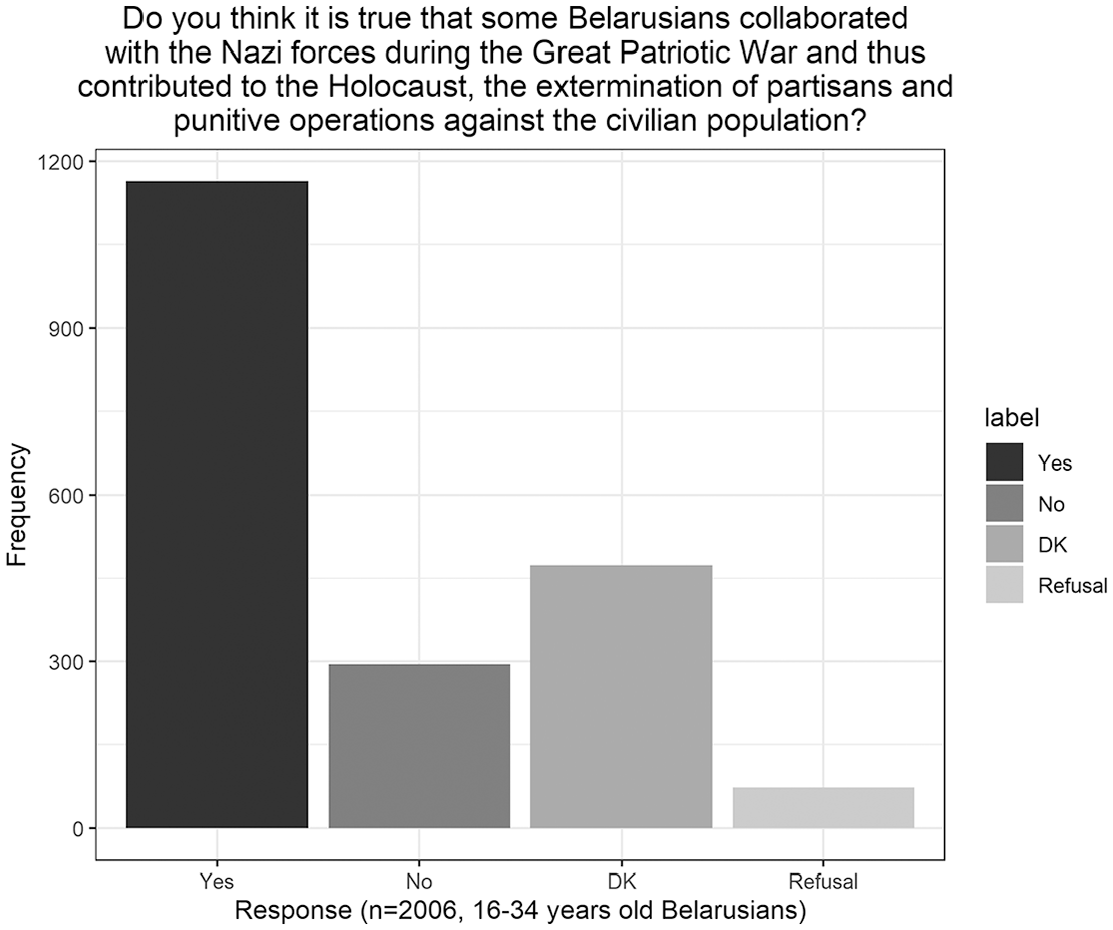
Views on Collaboration in Belarus
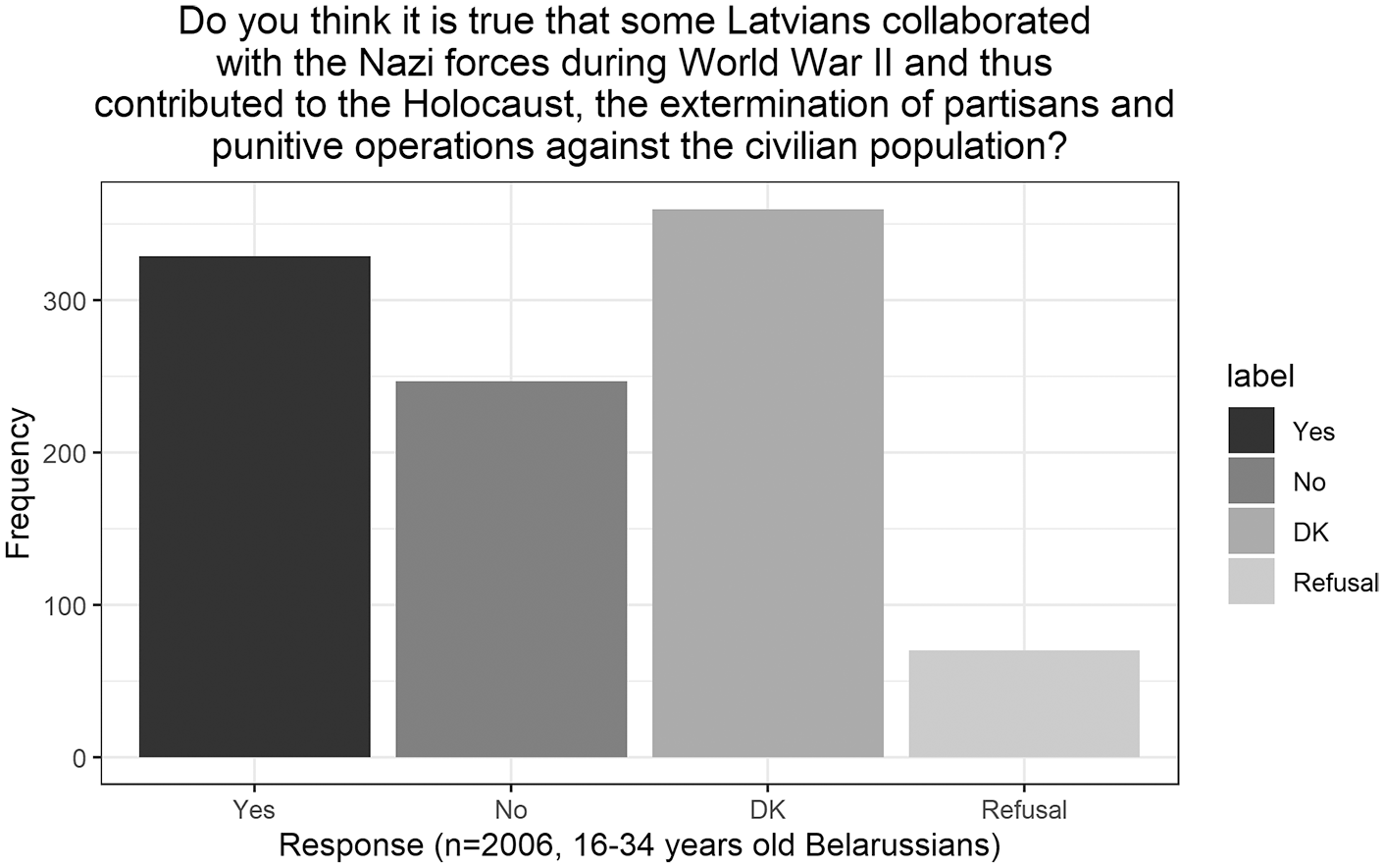
Views on Collaboration in Latvia
Comparing these distributions is already intriguing. Across the European Union, there is the expectation of a self-reflexive narrative of history—which includes a recognition of one’s own guilt and the active involvement in the crimes committed during World War II. However, Latvian youth, on average, do not believe that collaboration occurred, and instead take a somewhat defensive position on their country’s history. By contrast, youth in Belarus, who grew up under an authoritarian system with limited freedom of expression and who live in a country where the state has crafted the historical memory with an emphasis on the partisan myth, are more likely to state that some form of collaboration took place. 89 Below the surface of the rigid state discourse in Belarus, young people have developed their own independent thinking, certainly with regard to the country’s historical trajectory. Moreover, the views on collaboration point to the extent to which young people in Latvia might share in the impression that their memory is being threatened and that they need to defend a nation-affirming view of history. In the case of Belarus, on the other hand, the partisan myth seems unchallenged, whereas young people might be aware of the limitations of the state-imposed view on history and therefore more at ease with admitting the fact that collaboration was bound to exist.
Affirming Collaboration in Belarus
What characterizes those respondents who believe that collaboration took place? Looking at socio-economic variables, the effect of age and gender strongly predict who affirms that collaboration took place (Table 1). Being male increases the odds of asserting that collaboration existed by 56 percent, while older people are also more likely to affirm collaboration. The older share of young people often had the chance to travel abroad and many continue to maintain ties to friends and family members abroad, which affects their political and historical views through the remittances that these networks channel. Younger respondents were more likely to oppose the fact that collaboration existed, whereas women were more likely to indicate that they do not know whether collaboration took place. The level of education matters, with higher education relating to higher likelihood of agreeing with the existence of collaboration and lower education having the inverse effect. Household wealth or religiosity have no statistically significant effect.
Regression Belarus Views on Collaboration
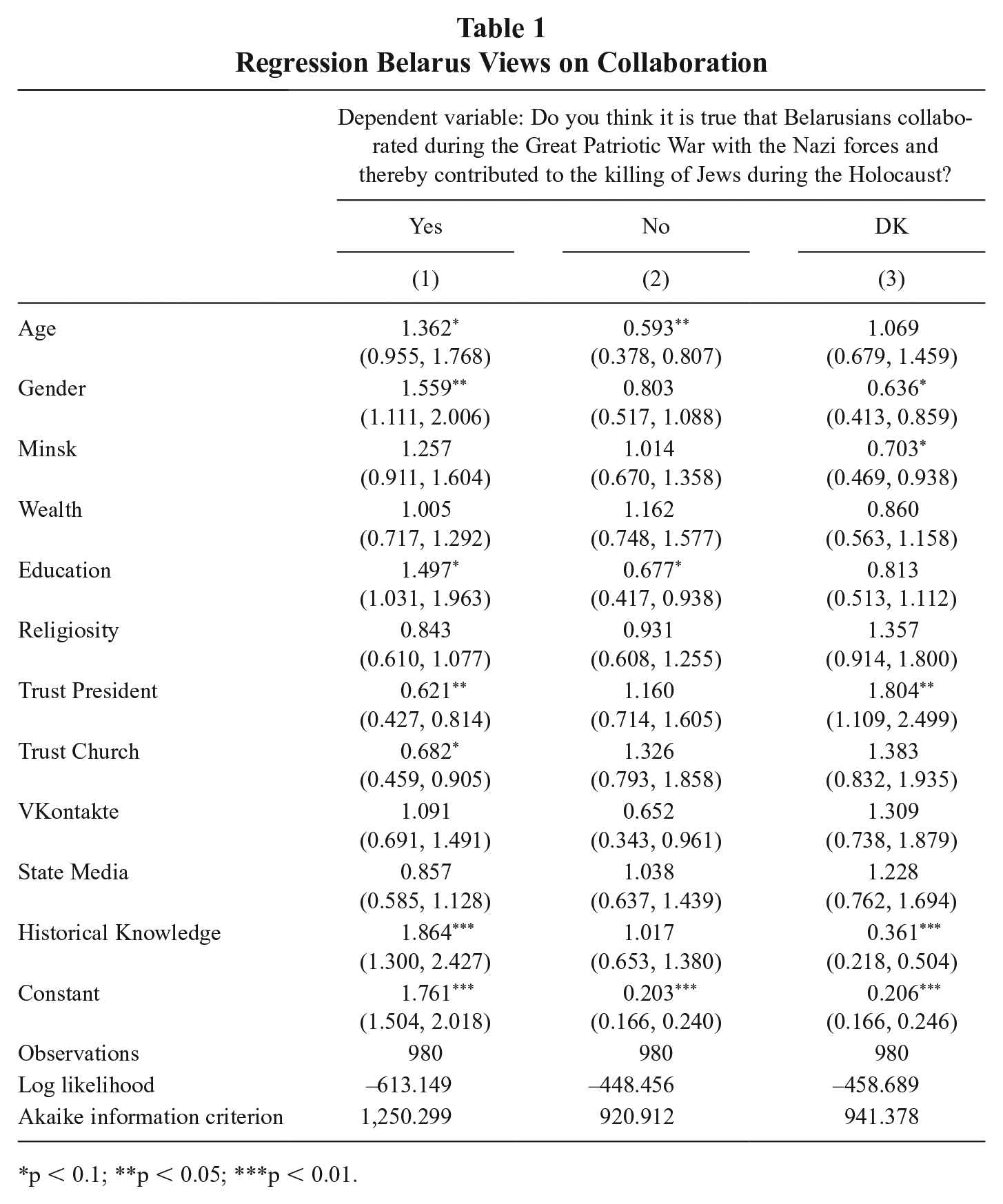
p < 0.1; **p < 0.05; ***p < 0.01.
Looking beyond the socio-economic indicators, the level of trust expressed in the president further relates in important ways to views on collaboration. The higher the trust in Lukashenka, the lower the probability that a respondent acknowledges that collaboration took place. Inversely, higher trust increases the likelihood to say no, but is only statistically significant for those who indicate that they do not know what response to give, indicating a limited reach of the presidential rhetoric. Low trust in the Church significantly predicts agreement with the idea that collaboration existed. There is no significant effect for the kind of media that respondents consume. Moreover, self-assessed historical knowledge is a significant factor for understanding the responses. Those who indicate that they have a high historical knowledge have nearly double the odds to affirm the existence of collaboration. Lower historical knowledge has no effect on believing that there was no collaboration, but a large effect on indicating that one does not know whether collaboration took place. 90
Affirming Collaboration in Latvia
In the case of Latvia, the statistically most significant and substantive effects relate to a respondent’s self-declared mother tongue (Table 2). The odds to state that collaboration took place are more than seven times higher among those who indicate that their native language is Russian, whereas they are nearly 70 percent less likely to indicate that no collaboration existed or that they do not know what to respond. For native speakers of Latvian, the direction of the effect is the opposite. Although the coefficients are smaller, they remain highly significant and substantive. For those who indicate that both languages are their mother tongue, no statistically significant effect can be identified for views on collaboration. The integrated narrative regarding Latvia’s national history is therefore clearly dividing the young population along lines of linguistic division, with Latvian speakers being significantly more assertive about a positive view of their country’s history, speaking to the idea of a defense of national history mentioned above. By contrast, the Russophone population is prepared to acknowledge the existence of collaboration and to critically engage with Latvia’s national history, clearly also reflecting the contemporary historical discourse crafted within Russia on the Baltic countries. 91
Regression Latvia Views on Collaboration
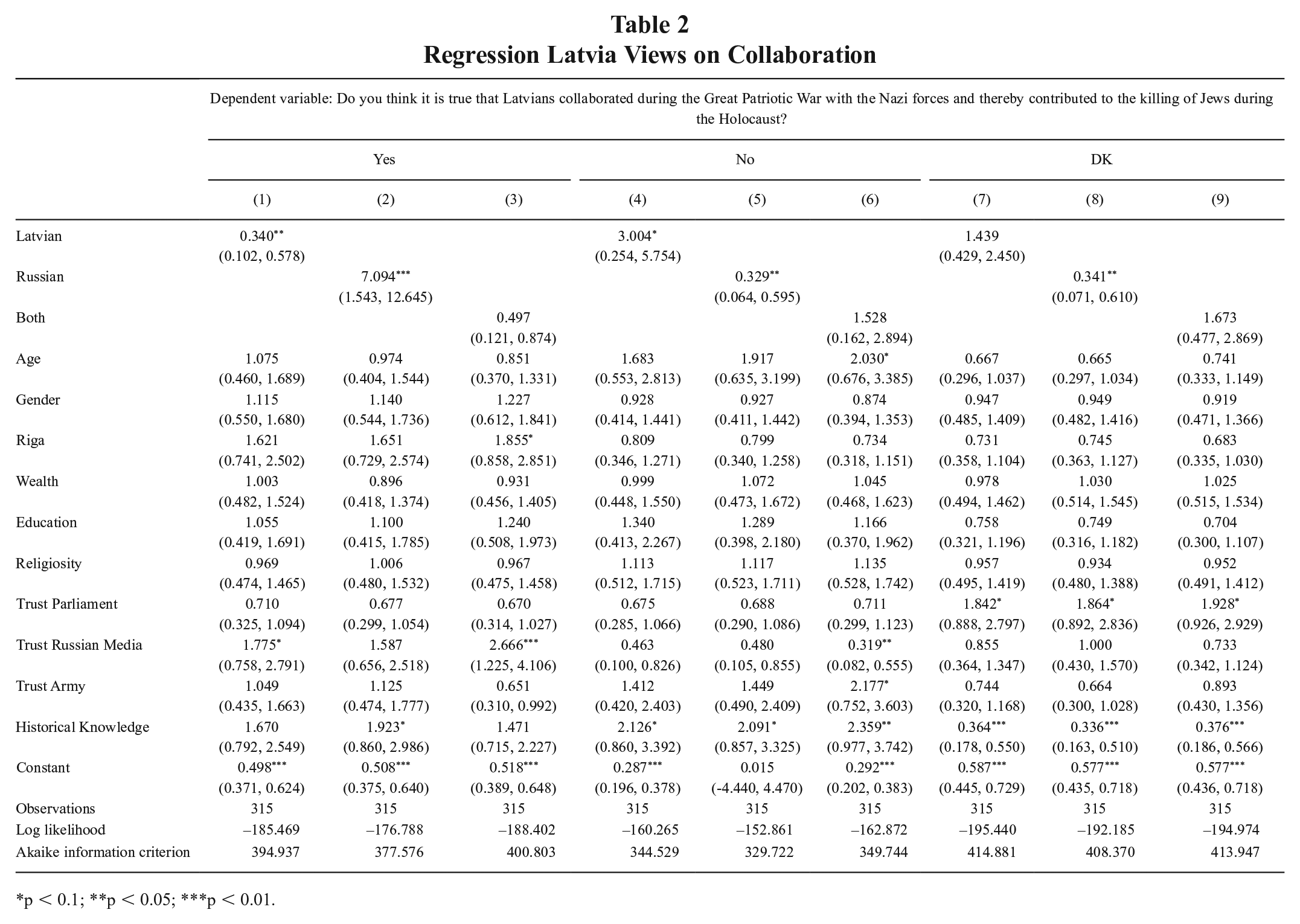
p < 0.1; **p < 0.05; ***p < 0.01.
Beyond the linguistic divide, the self-assessed historical knowledge also plays a key role in what answer respondents give regarding the issue of collaboration. The higher the historical knowledge, irrespective of one’s mother tongue, the more likely one is to side with one of the clear response options—to say yes or no—but the less likely one is to state that one does not know, though not all results achieve levels of conventional statistical significance. Moreover, respondents who indicate that both languages are their mother tongues are twice as likely to affirm that collaboration existed if their level of trust in the Russian media is higher; inversely, lower trust in Russian media predicts that respondents are less likely to state that no collaboration took place. Trust in parliament does not generate a clear picture, though higher trust increases the likelihood that respondents state they do not know what to answer. The level of education is largely irrelevant, as is religiosity, trust in the army, gender, and age.
In Belarus and Latvia, two different pictures regarding views on collaboration can be identified. In the former, it is the relationship to the country’s power structures and the level of education that informs an individual’s opinion. In the latter, the linguistic divide dominates responses and the type of media that one consumes.
Facing Your Country’s Wrongdoings: A Vignette Experiment
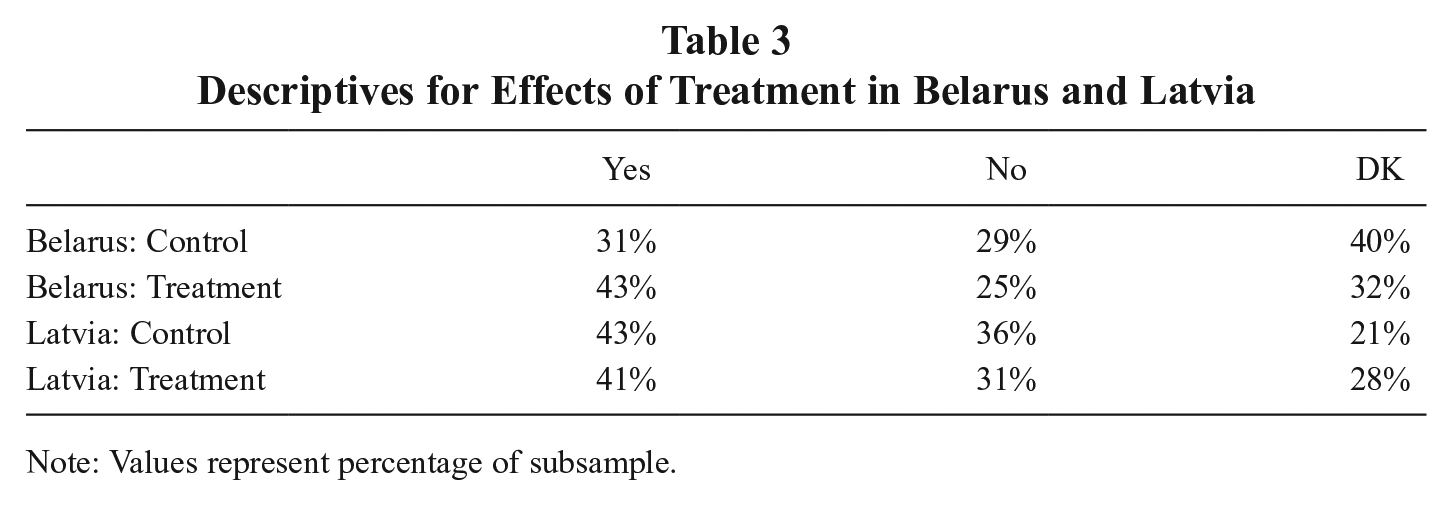
The second analysis considers respondents’ perspectives on the need for a critical confrontation with their country’s past, and considers the extent to which young people change their perspective when reminded of a speaker who has some degree of authority. The responses suggest that the effect of the treatment question (above) was effective in Belarus (Table 3). Those who received a vignette in which the famous author Svetlana Aleksiyevich stressed the need for a critical confrontation with one’s past were much more likely to affirm that they also believed that one should self-critically face one’s country’s past. They were also much less likely to not have an opinion on the topic. In Latvia, however, those who received a question mentioning the Commission of the Historians of Latvia, did not differ from the control group in their view on whether or not a critical confrontation with the past is desirable. If anything, the treatment made respondents less likely to say no and, instead, they stated they did not know.
Descriptives for Effects of Treatment in Belarus and Latvia
Note: Values represent percentage of subsample.
It is remarkable that young Belarusians are more likely to affirm that collaboration took place, as the previous analysis has demonstrated. However, moving on to the second issue of critically facing your country’s wrongdoings, it is staggering that they were less likely than their Latvian peers to state that a critical confrontation with one’s history should take place if no treatment question was given. On the abstract level at least, when it is not directly related to the issue of collaboration during the Holocaust, young Latvians are therefore more prepared to engage with their country’s history in a self-critical way. Those respondents in Latvia who agree that collaboration took place also state that a critical engagement with national history should take place (Spearman coefficient of 0.33), whereas those who state that no collaboration took place also are more likely to have stated that no critical engagement with national history should take place (Spearman coefficient of 0.21).
The Power of a Moral Authority in Belarus
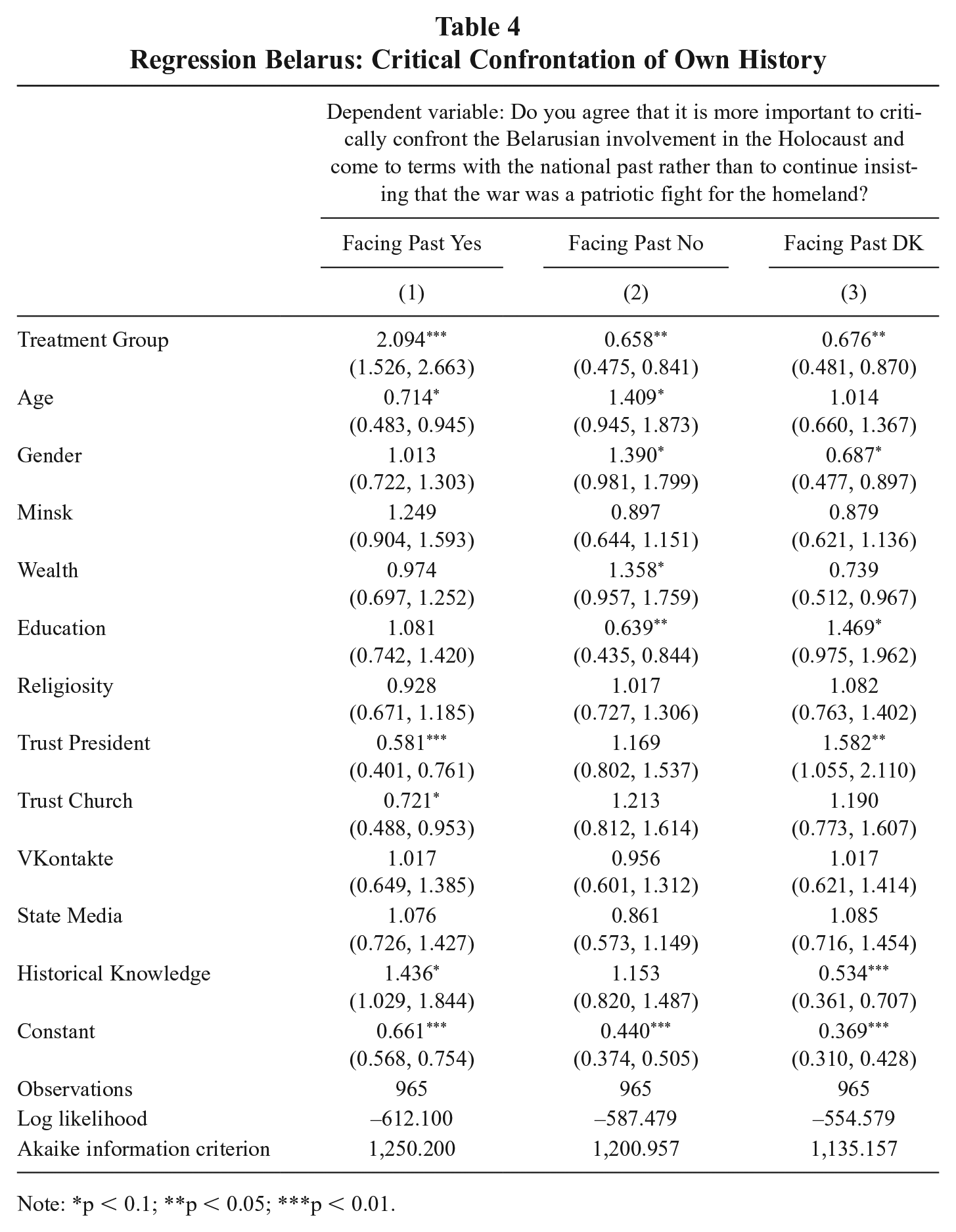
Young people in Belarus strongly shift their assessment if presented with Aleksiyevich urging for a critical confrontation with the country’s history. These respondents agree significantly more often with the need for a critical confrontation with their country’s past (Table 4). It doubles the odds of a respondent agreeing with the need for critical confrontation and decreases the odds of a respondent saying that this is not necessary by 35 percent, and it also decreases the likelihood of stating “do not know” by more than 30 percent. Moreover, self-assessed historical knowledge plays a large role. Respondents with a higher self-assessed historical knowledge are more likely to say that they recognize a need for critical confrontation with the history of their own country, irrespective of the kind of group to which they were assigned. Respondents with less historical knowledge are more likely to say that they do not know. Those respondents with a lower level of education are in a statistically significant way more likely to say that they do not agree with the need for a critical confrontation of one’s country’s past.
Regression Belarus: Critical Confrontation of Own History
Note: *p < 0.1; **p < 0.05; ***p < 0.01.
The two trust items, related to the President and the Church, play a significant role. They both work in opposite directions, which is to say that a higher level of trust in the President decreases the probability of agreeing with the need to critically confront one’s past, but increases the likelihood of stating no or do not know to the question. Low trust in the Church significantly increases the likelihood of agreeing with the need for a critical confrontation of one’s past. It is worth noting that for some time now, the Orthodox Church has taken a more critical position towards the crimes of Stalinism, and has become an actor that has contributed to the critical assessment of national history. Moreover, the Church does not primarily amplify the discourse of political power, as is the case in neighboring Russia. Rather, it has assumed an identity distinct from the state, which explains these results.
A number of other variables are important for understanding the responses. Socio-economic status turns out to be a statistically significant item. Respondents with a higher level of household wealth are more likely to disagree with the need to critically confront the past, whereas those with lower levels of household income are less likely to reply that they do not know what to say (though this is not statistically significant). Gender is statistically significant, with men being more likely to say no and less likely to say that they do not know. Exposure to media, however, merely has a small and statistically insignificant effect on the responses—be it the state-controlled or Internet media.
Latvia’s Linguistic Divide in Memory
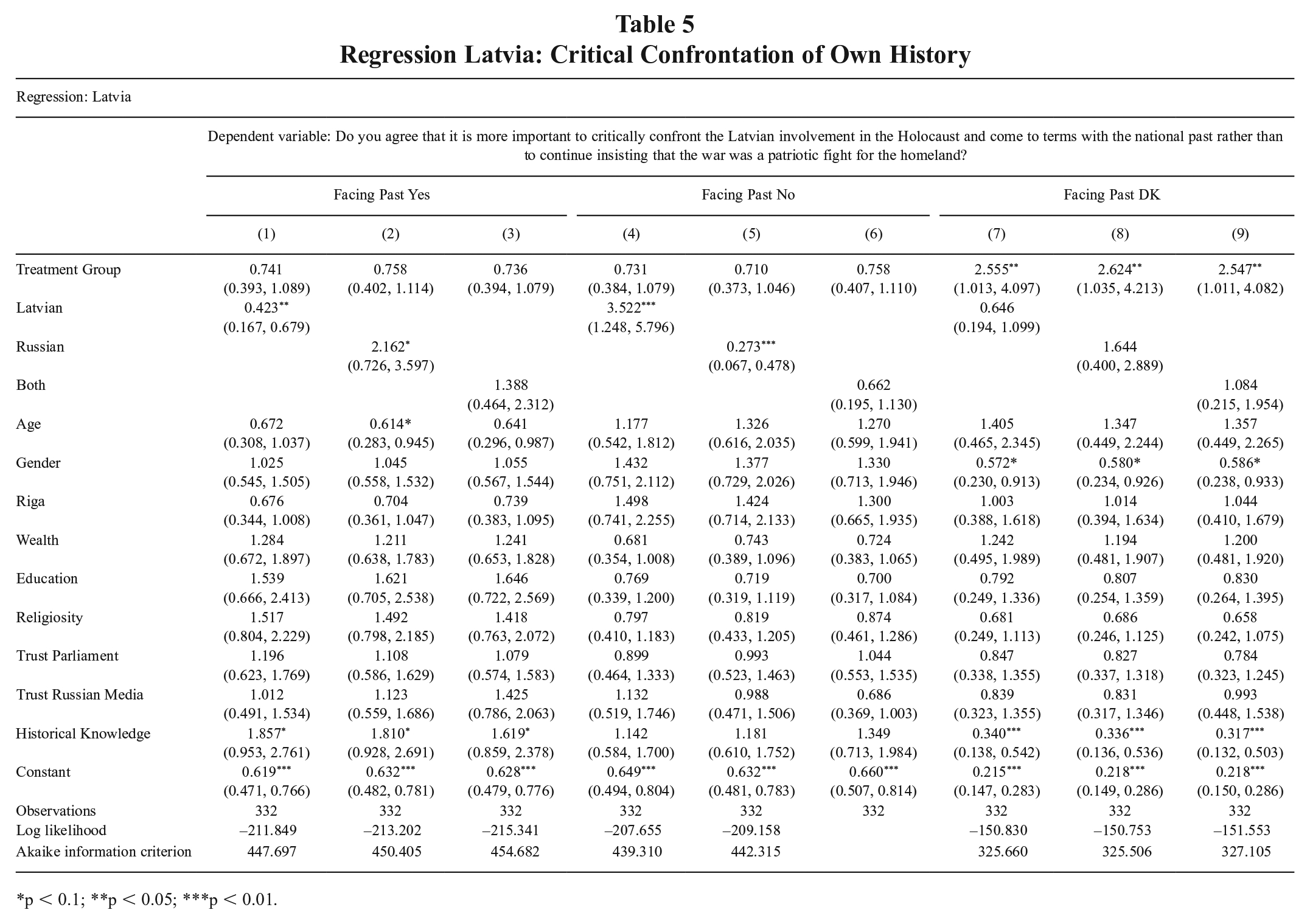
In Latvia, the effect of language also dominates the assessment of whether one ought to critically confront one’s national history (Table 5). In line with the above, native speakers of Latvian are almost 60 percent less likely to agree with the need for a critical confrontation with national history and more than three times as likely to say that no critical confrontation with the past is required. The opposite effect occurs for Russian speakers, who are twice as likely to agree with the need for critical confrontation of their country’s past. As the frequency analysis of the responses has already indicated, there is a treatment effect only insofar as the presence of the named speaker in the vignette increases the likelihood that respondents will state that they do not know whether one should critically engage with one’s past.
Regression Latvia: Critical Confrontation of Own History
p < 0.1; **p < 0.05; ***p < 0.01.
Beyond language, the variables of age, self-assessed historical knowledge, and gender turn out to be statistically significant in some of the models. Younger respondents tend to be more critical and agree more with the need to critically confront one’s past across all language groups, probably reflecting the discourse found within schools. However, age is statistically significant only for Russophone Latvians. Historical knowledge significantly increases the likelihood of agreeing with the need for a critical assessment and decreases the probability of stating that one does not know whether it is needed, irrespective of the indicated mother tongue. Across language groups, gender is relevant as women are in a statistically significant way more likely to say that they do not know. Wealth, living in the capital city, or consuming Russian media, however, have no statistically relevant effects in this analysis.
The linguistic divisions in Latvia are clearly manifest in the view on history that both groups express. In the vignette experiment, self-declared mother tongue has the largest effect and is key for differentiating between those who state yes or no to the question of whether one needs to critically confront the past of one’s country. In Belarus, the presence of a named authoritative speaker within the question has the most sizeable effect on respondents’ views. Other variables, such as the relation to the state or the level of a respondent’s historical knowledge also continue to play a crucial role.
Conclusion
This article has analyzed one aspect of the historical assessments that young people in two countries at the Western periphery of the former Soviet Union remember. Belarus and Latvia have engaged in very different ways with their national history, and vary in the extent to which they have emphasized the role of local perpetrators in the Holocaust, and thus of collaboration during World War II. In Belarus, national identity has been constructed around the partisan narrative with collaboration being foreign to the official discourse. The emphasis on this narrative has remained constant since the post-war period. In Latvia, however, the relationship with World War II is more complex, as evinced by the existence of a significant Russophone population and continuing contestation over how to commemorate, on a national level, the country’s Soviet and Nazi occupations. At the same time, Latvia, as with the other two Baltic States, has strived for integration into the European mnemonic sphere and has lobbied for the recognition of the violence of Stalinism being equal to that of Hitlerism.
For assessing memories in relation to these contested periods of national history, this article makes use of a survey that is representative of urban youth in both countries. From the survey, two questions were used that investigate whether respondents believe in the existence of collaboration and whether they see a need to critically confront one’s own national history. In this respect, the identified differences between Latvia and Belarus, and the importance of the linguistic division in Latvia, offer avenues for further research and for deeper exploration of the competing discursive elements that might explain why these differences have come to exist. I do not hesitate to emphasize that while a survey offers the advantage of allowing insights into the reception of mnemonic narratives, it does not allow one to trace the production of these narratives and to identify the interesting micro-argumentative structures in which individuals embed them. Although this remains a task to be addressed through further research, the present article has hopefully indicated the potential of combining large-scale survey work, the study of memory, and historical representations as they exist in the present.
