




Abstract
This article presents an analysis of the formation of organized interest groups in the post-communist context and organizational populations over time. We test two theories that shed doubt on whether vital rates of interest groups are explained by individual incentives, namely, the political opportunity structure and population ecology theory. Based on an analysis of the energy policy and higher education policy organizations active at the national level in Hungary, Poland, and Slovenia, we find that while the period of democratic and economic transition indeed opened up the opportunity structure for organizational formations, it by no means presented a clean slate. Communist-era successor and splinter organizations survived the collapse of communism, and all three countries entered transition with relatively high density rates in both organizational populations. We also find partial support for the density dependence hypothesis. Surprisingly, the EU integration process, the intensity of legislative activity, and media attention do not seem to have meaningfully influenced founding rates in the two populations.
Keywords
Introduction
What explains the formation rates of interest organizations in post-communist democracies over time? 1 While interest groups in the European Union (EU), Western Europe, and the United States are an increasingly broadly studied phenomenon, previous research has—with several notable exceptions 2 —largely neglected organized interests in the post-communist context. On the one hand, organized interests can be seen as a precondition for democracy. 3 On the other hand, Central and Eastern Europe (CEE) is burdened with a legacy of forced membership in communist organizations, and thus even after 1989 a widespread aversion to associational activities. Civil society is therefore seen as weak and underdeveloped. 4 This is compounded by a legacy of distrust in political institutions and apathy towards the political process. However, this very particular context of the abrupt collapse of totalitarian command economies followed by a fast-paced transition to democracy and market economy as well as the EU accession process offers a unique chance to test standard theories about organized interests.
One of the most fundamental questions in interest organization research is which factors explain interest organization formation. Recently, theories have gained traction in the literature that explain formation with external, context-level variables as opposed to the traditional focus on individual incentives. 5 According to political opportunity structure (POS) theory, the pattern of formation rates of interest organizations representing a certain issue is linked, among other things, to the overall openness of the political system, the importance and legitimacy of an issue and its constituency, or political support for the issue. 6 While taking the political and societal context into account, the population ecology approach explains the vital rates of interest organizations with the number of existing organizations, that is, the density of a given organizational population at any given time. 7 None of these theories have been tested on a sample of post-communist interest organizations to date. We aim to fill this research gap by conducting an analysis of formation rates on a sample of Hungarian, Polish, and Slovenian national-level interest groups in the higher education (HE) and energy policy sectors.
The article is structured as follows: the second section introduces the political ecology and political opportunity structure approaches to interest organization formation, the third section sets up the framework of analysis and states the hypotheses, and the fourth section describes the case selection, the dependent and independent variables, and the applied statistical model. The fifth section contains the descriptive and statistical analyses, and we reassess our conclusions in the last section.
The Theory of Density Dependence and the Political Opportunity Structure Framework
Population Ecology of Interest Organizations
Population ecology studies the success and failure, or in population ecology terms, the founding and mortality, of organizations on an aggregate level instead of the level of individual organizations. Following Stinchcombe, in their seminal 1977 article, Hannan and Freeman emphasize that the ability of organizations to adapt to environmental changes is limited. 8 Organizations thus are characterized by a large degree of structural inertia stemming both from internal pressures (material and human resources are not easily transferable, lack of information, status quo bias within the organization, and the power of normative agreements) and external pressures (legal and fiscal barriers to entry or exit, cost of information, legitimacy constraints, and problem of collective rationality). Populations are defined as aggregates of organizations (rather than members) that are “relatively homogenous in terms of environmental vulnerability.” 9 The question is then not how individual organizations adapt to changes in the organizational environment but how change impacts the “size distributions” and “the diversity of organizational forms within broadly defined areas of activity.” 10 In other words, organizational selection happens at the level of populations and not at the level of individual organizations.
The Density Dependence of Organizational Vital Rates
For the study of populations of interest organizations, the theory of density-dependent legitimacy and competition has the most far-reaching implications. The density of organizations is simply the number of organizations in a population at a given time and space. The theory developed by Hannan and Carroll explains “the variation in founding rates and mortality rates as functions of organizational density.” 11 They emphasize that founding rates and mortality rates operate at different levels, as they are governed by different processes: the founding process “operates for the population as a unit,” whereas “mortality processes operate at the level of organizations” (e.g. aging process). 12 Legitimacy can also be conceived as an institutional process. With the legitimation of an organizational form, the need for justification decreases. 13 This reduces the cost of organizing. Ceteris paribus, the “legitimation of a form increases the founding rate of populations using that form,” whereas competition induces a negative relationship between the density and founding rates. 14 As density grows, the “supplies of potential organizers, members, patrons, and resources become exhausted,” and existing organizations themselves react by “opposing attempts at creating still more organizations.” 15 Hence, as the number of organizations grows, so does the competition for resources, and after a certain point the population experiences density saturation. 16 This implies that the relationship between density and vital rates is non-linear. The relationship between density and founding follows a ∩ shape, and the relationship between density and failure has a U shape.
Political Opportunity Structure
The political opportunity structure (POS) 17 framework also considers population-level factors to be decisive, but unlike density dependence it focuses on the political environment, namely, the institutional context and the policy process. As Meyer and Imig stress, “external political circumstances set the context in which the calculus of participation takes place, determining the urgency of particular issues, and the scope and intensity of conflict.” 18 In the POS framework, policy and policy makers are seen as playing a pivotal role. Crucially, policy and policy makers are not treated as constants, rather as contextual factors that change over time. In addition to institutional activity, a system-level crisis may induce opportunities for mobilization. “As new political alignments emerge, the balance of power between contenders may be fundamentally altered, creating new openings in the structure of political opportunity.” 19 However, while crises are rare, policy reforms occur more frequently, and these can also expand the “political space as new policy problems appear, as government policy changes, and as political expectations are raised.” 20
Because the POS framework focuses on the policy process, one of its most important implications is its emphasis on sectoral analysis. Placing sectors rather than individual groups as the unit of analysis allows for the study of particular groups both in the context of macropolitical processes and of other groups with shared interests. Interest group sectors “are composed of the set of organized groups that share broadly similar policy concerns.” 21 Sectoral analysis gives greater agency to public interest groups than a narrower constituency definition would. As public interest groups usually pursue much broader societal goals than a business lobby organization would, it makes more sense to characterize sectors by the political outcomes interest groups aim to achieve. This perception assumes that issues, which interest groups pursue, change as a response to changes in the POS.
Framework of Analysis and Hypotheses
Following Nownes, our framework brings together the theory of density dependence and the POS framework. 22 His study tested the population density dependence theory on the number of homosexual rights interest group formations in the United States between 1950 and 1998. Specifically, he tested two competing hypotheses: one regarding the non-monotonic, ∩ shape of the relationship between density and founding rates and another regarding the traditional political opportunity structure approach to interest organization founding. The two independent variables testing the density hypothesis were density (the total number of homosexual interest right groups existing in a given year) as a linear term and density as a quadratic term capturing the non-linear relationship between density and formation rates. He included four variables testing the POS framework: the number of congressional hearings, issue salience, percentage of Democrats in congress, and the Clinton presidency—none of which proved to be significant. The analysis found that the two density variables were not only robust and significant but also in the expected direction: the linear density term was positive, showing that founding rates were high at a relatively low level of density, while the quadratic term had a negative effect on founding rates, indicating a clear saturation effect at a relatively high level of density.
Meyer and Minkoff differentiate between structural changes in opportunities and effects of signals sent by the political system, and the weight of issue-specific versus general openings in the polity. 23 Structural changes are defined as profound changes in political alignments and policies, while visible signals in the political environment may have greater symbolic than substantive importance. 24 While they suggest the application of separate structural and signal models when testing POS variables, they do not control for density dependence.
We test both structural and signal POS variables on the unique post-communist context. Although there were interest organizations during communist rule that also represented genuine interests, independent ones with the exception of the Solidarity movement in Poland—which was banned and operated illegally between 1982 and 1989—did not exist. However, data on interest organization formations show that although 1989–1990 was a critical juncture also in the development of interest organization populations in CEE countries, it was not “year 0” and did not wipe the field clean. There were new, independent organizations or splinter groups of larger, hitherto official, ones that had started to form by 1987 and 1988 in relatively “liberal” countries such as Hungary. Moreover, Gallai et al. found using a sample of Hungarian interest organizations that many reconstructed successor groups of communist-era interest organizations—or even pre-communist ones, which nevertheless were preserved and incorporated in the communist party-state with varying degrees of independence—proved to be quite successful after 1990. 25 These organizations could rely on their considerable financial assets, their embeddedness, and their political connections, while new organizations relied more on legal instruments and political mobilization. Nevertheless, the rapid and simultaneous transition from a totalitarian state to liberal democracy, from command economy to market economy, and in many cases to regained or new nationhood is a unique historical experience. 26 Therefore, we draw the following hypothesis:
Hypothesis 1: We expect the period of immediate transition to positively affect interest organization formation in CEE.
EU accession also fundamentally transformed CEE, and by 2013, eleven former communist countries had become member states. It is plausible to argue that the accession process and membership may have affected organizational founding. According to Grabbe, accession led to processes of diffusion, learning, and adaptation to European models and repertoires for interest representation in CEE political arenas, which potentially may have even strengthened the bargaining position of organized interests vis-à-vis national governments. 27 Thus, the EU accession process constituted a pivotal change in the institutional and policy context, which profoundly affected political opportunity structures. Against this background, learning effects from western peers and like-minded western organizations thus may stimulate a revival of civil society in CEE.
Hypothesis 2: We expect the EU accession process to positively affect interest organization formation in CEE.
According to POS theory, legislative activity and media attention are both expected to positively affect interest group formation. 28 Although both are issue-specific variables, legislative activity in a given policy field is related to structural change, whereas media attention on an issue is a visible signal to organizational entrepreneurs. We expect high legislative activity not only to send signals to individuals about the importance of an issue, thereby providing them incentives to form organizations, but also to affect the core interests of existing organizations and their constituencies to open up new opportunities. High legislative activity also provides higher levels of interest intermediation or protest.
Hypothesis 3: We expect the level of legislative activity in a given sector to positively affect interest group formation in the same sector in CEE.
Hypothesis 4: We expect the level of media attention on policy issues important for a given sector to positively affect interest group formation in the same sector in CEE.
Our last hypothesis is whether the theory of density dependence holds for the formation of interest groups in CEE. The post-communist context makes the conceptualization of the theory very challenging. While some independent interest organizations had already started forming in 1988 and 1989, other variables such as media attention or legislative activity can only be tested under truly democratic circumstances. These concerns will be discussed in the analysis.
Hypothesis 5: We expect interest group formation in CEE to be density-dependent, that is, it occurs as an inverted U shape initially driven by legitimacy processes at low density and driven by competition processes at high density.
Case Selection, Method, and Statistical Model
Case Selection
Although all post-communist countries share the legacy of one-party dominance and command economy, they diverged even during communist rule in their economic, agricultural, and social policies, and in their relative cultural and political openness (with considerable within-country variation over time). After the transition, different party systems, economic and social policies, and industrial relations and interest intermediation regimes emerged in CEE. 29 Moreover, there are considerable differences regarding the regulation of lobby activities and election financing. 30
Against this background, we analyze the formation of organized interest groups active at the national level in Hungary, Poland, and Slovenia, and in two policy domains, energy policy and higher education, between 1990 and 2014. The selection of policy areas is justified by their relative diversity, as each has both regulatory and redistributive components with different relative importance. Both policy areas also have concentrated interests (e.g., energy producers, university professors) and more diffuse interests (environmental groups, students). HE and energy policy account for a large portion of the public and private budgets. The two policy areas differ in an important respect, however: energy policy is mostly privatized despite a considerable degree of state control and tight regulations, whereas higher education is mostly publicly owned and financed in all three countries, despite a relatively large private sector in Poland and a considerable reduction in state-financed places at Hungarian universities, particularly since 2011. This difference makes our findings more generalizable as we control for public and private ownership through case selection. Importantly, both issue areas are currently subject to strong but varying degrees of reform and harmonization pressures reinforced by Europeanization (in HE the Bologna Process, in energy policy market and network liberalizations). The EU’s energy acquis prescribes the liberalization of gas and electricity markets, as well as pollution restrictions. Europeanization pressures were reinforced with the 2007 European Energy Strategy aimed at increasing the energy supply and security and ensuring the availability of affordable energy while promoting environmental sustainability. 31 Thus, the common energy policy consists of a mixture of both binding measures and softer coordination of energy supply issues and regional markets. 32 Higher education in Europe, by contrast, is driven by soft governance processes, most notably the Bologna Process. Originally outside the ambit of the EU, but later heavily influenced by the European Commission, 33 the Bologna Process has provided a key impetus for HE reforms at nearly all levels across Europe. Numerous authors have shown how processes of transnational communication and learning have resulted in changes at the core of pre-existing national systems. 34 Thus, we examine two policy areas whose organizational landscape may be heavily influenced by parallel Europeanization processes and are characterized by different coordination structures and functional logics.
The three countries in our sample differ starkly on two decisive characteristics for interest organizations: election funding and economic coordination. Poland and Hungary are usually grouped together under the label “Visegrad states” (along with Czechia and Slovakia). They both share the characteristics of a foreign-owned complex manufacturing export sector and relatively high levels of social expenditures and simultaneously moderate, albeit steadily falling, union density levels. 35 Poland constitutes a relatively liberal and weakly coordinated market economy. However, elections are publicly funded, and more extensive lobbying regulations exist, which may stymie the influence of interest groups. 36 Hungary exhibits stronger market coordination, 37 whereby elections are publicly funded and lobbying activities relatively tightly monitored. 38 Slovenia is the most highly coordinated and corporatist market economy in CEE. 39 As an ex-Yugoslav country, the Slovenian economy has historically been highly decentralized and enjoyed considerable autonomy from the state. Self-managed enterprises had considerable powers, while civil society already autonomously grew in the 1980s. However, regulatory controls over lobbying, the funding of parties, and electoral campaigns are comparatively weak, hence providing an interesting polar opposite case to Poland. Thus, we maintain that the three countries differ on their most important characteristics crucial for understanding the evolution of interest organizations and the structure of interest intermediation.
Dependent Variable: Number of Organizational Formations per Year
Our dependent variable is the number of formations of organizations active on the national level in energy and HE policy per year. We applied a sectoral approach in defining energy and HE policy interest groups active at the national level in Hungary, Poland, and Slovenia. 40 Sectoral analysis is important for testing the validity of the POS framework. That is, we included organizations in our two interest organization populations per country that might pursue adversary goals or represent different and often opposing constituencies (e.g., energy policy trade unions and energy policy employment organizations) as long as they were active in the same policy field trying to influence the same policy processes and decisions.
Our main sources for identifying national HE and energy policy interest organizations were the national online registries for civil society organizations. We used the same set of keywords in every language, and filtered out companies and regional-level organizations. However, all three registries have limitations that affected the quality of our data. For Poland, we used the National Court Registry (Krajowy Rejestr Sądowy [KRS]) as a starting point. 41 Since the KRS database only indicates registrations after the 2001–2002 period, we checked for each organization by Google, and contacted it directly to determine whether it was founded before this period. The Hungarian court registry of civil society organizations (Civil szervezetek névjegyzéke) begins in 1989. Nevertheless, we checked every organization registered as founded in 1989 in the registry to determine whether the real founding date was earlier. We applied the same approach to the Slovenian data, where we selected the organization from the register of AJPES (Agency of the Republic of Slovenia for Public Legal Records and Related Services), the primary source of official public and other information on business entities in Slovenia.
The data on the number of formations per year, our dependent variable, are reliable. However, for our main explanatory variable, density of organizations, we would have needed equally reliable information on the date of dissolutions. Moreover, we would have needed data on every organization that existed within the given time frame, that is, dissolved ones as well. However, the Polish and Slovenian databases supposedly only contain active organizations, while dissolved ones are deleted from the databases. The Hungarian database contains every organization already existing or founded since 1989, thus dissolved ones as well. Yet since the unified court registry was only founded in 2011, non-active organizations have been gradually deleted from the registry only since then. 42 We controlled for these shortcomings with Google searches on every single organization we included in the database, and we contacted all organizations that were coded as still existing in 2019.
Explanatory Variables
The explanatory variables for testing density dependence of organizational formations are density and density squared (density2). Density is the number of organizations “alive” at the beginning of each year. To account for the nonlinear nature of density dependence, density2 is also tested in the model. 43 That is, according to density dependence theory, the coefficient of density should be positive, as at the outset the increase in the density of a population affects founding positively. However, with high density rates competition increases, which affects the number of foundations negatively. Density2 tests this latter assumption.
Although the three countries had different transition processes (starting as early as 1989 in Poland, albeit with a semi-free election), the first phase of political and economic transition was largely over, with democratic governments, parliaments, and market economies already in place by the time of gaining EU candidacy in 1997. Subsequently, the main bulk of the acquis communautaire was introduced into national legislation before the countries gained actual membership in 2004. During this phase, the EU had begun pushing for institutionalizing social dialogue, potentially stimulating organizational foundations in the then EU-15 and CEE candidate countries. 44 Our selected CEE countries have been members since 2004. Accordingly, we introduce a period dummy for the years of the accession process between 1997 and 2004 to grasp pre-accession effects on organizational foundations, and a dummy for the membership between 2004 and 2014. The policy effects of the Europeanization process are captured by our legislative activity variable (see below), because European directives (and international treaties, e.g., on climate change) are implemented by national legislation. The first period between 1990 and 1997 constitutes the baseline.
Media attention is an important POS variable. Nownes used a data set where all the issues that appeared on the front page of the New York Times were coded, and he included a count variable on all LGBTQ-related issues per year. 45 We selected similar high-circulation, quality daily newspapers from all three countries (i.e., we excluded tabloids). Data similar to those Nownes used exist for Hungary. 46 The researchers of the Hungarian Academy of Sciences coded the front pages of the two biggest political print dailies, the left-leaning Népszabadság and the conservative Magyar Nemzet between 1990 and 2014. In this analysis, we use the coded data from Népszabadság, which was the bigger and arguably more independent one of the two until its abrupt closure by a businessman close to the ruling FIDESZ party in October 2016. 47 No such databases exist for Poland and Slovenia. Therefore, we coded ourselves the front pages of leading national-level, quality newspapers for the entire time period. In Poland we chose Rzeczpospolita, which has a conservative-liberal profile and is the second largest print daily newspaper by circulation of Poland. 48 For the Slovenian issue salience data, we used Delo, a national daily print newspaper, which was the first and the second by circulation during the twenty-five years of our time frame. It is a liberal-leaning, but independent, paper. The covers of Delo were accessible from 1991 only. Hence, the time frame for the statistical models containing this variable is restricted to 1991–2014.
The media attention variable is a count of the relevant front-page articles or headlines per year. For HE, we included every title that indicated a report or opinion article about HE of national and systemic importance. We did not include typical cyclical news on issues such as student applications or numbers, unless it affected issues of systemic importance (e.g., a recent reform is blamed for fewer applications to universities). For energy policy, we included every piece of news of national importance except for cyclical reports on different energy and fuel prices. Again, we included such news only if the prices were mentioned in the context of another issue (e.g., the price of electricity being liberalized, because this would indicate a significant policy change). We also included issues of climate change (e.g., carbon emission trading), air pollution, and environmental issues, which were relevant for energy policy.
The standard in the American literature to measure legislative activity is to use the number congressional hearings in a given period of time (or their state-level equivalents). Unfortunately, there are no such regularly held, comprehensive, and institutionalized national-level interest intermediation forums in the three countries that would cover the entire time frame, let alone both policy fields. We therefore use the number of legislative acts (i.e., adopted bills, including amendments) per year. We consider this variable as a good proxy, because a parliamentary majority is needed to adopt or amend a law. Moreover, there are certain deliberative requirements in every constitutional system, and a high level of legislative activity usually signals significant policy changes (even when implemented through several incremental changes rather than a visible reform).
For both policies we included any legislation that had a systemic national-level effect. In HE, this included funding, governance, internationalization, and expansion. In energy policy, we included regulatory issues, liberalization, privatization, price control regulation, and international cooperation and treaties (e.g., energy grid integrations and oil or natural gas pipelines). The legislative activity variable is a count of relevant acts and decrees per year (see below).
To collect the Hungarian legislative data, we used an existing database on the activity of the National Assembly. 49 The laws are coded for major topics (e.g., energy policy, education, and environmental protection), and a series of policy-relevant subtopics, which makes the identification of theoretically relevant laws possible and straightforward.
For Poland, we analyzed the archive of the main legislative body, the Sejm. We compiled a database of every piece of legislation concerning HE or energy policy since 1989. Regarding HE, we restricted ourselves to legislation relevant to university governance and funding, expansion, and the promotion of science and research, while for energy we included all legislation regarding energy efficiency, renewable energy, energy security, integration into European energy markets, as well as environment-related legislation regulating or deregulating the power industry.
For the Slovenian legislation, we used the official webpages of the Ministry of Infrastructure and the Ministry of Education, Science, and Sport, respectively. Additional amendments were included in the list by overviewing the particular Acts—official publications from the Official Gazette of the Republic of Slovenia. Besides national legislation, we also incorporated all relevant EU regulations and rules adopted by the Slovenian parliament as national laws, which were selected based on the covered policy dimensions.
Statistical Model
Our dependent variable, the number of organizational foundations per year, is a typical count data of events: the counts have integer values and are non-negative. We use Poisson regressions to estimate models of such data on the number of occurrences of a certain event. 50 In small, finite samples compared to a simple ordinary least squares (OLS) or a logged OLS model of event counts, the application of exponential Poisson regression results in “dramatically improved estimates.” 51 A Poisson distribution is skewed, that is, the distribution of errors is not symmetric, and the variance increases with the mean, that is, the variance is not constant. 52 A Poisson process assumes that “in a very short interval of time, Δt, the probability of one additional count is independent on past and present number of events.” 53 One of the basic assumptions of a Poisson distribution is that the mean equals the variance. The violation of this assumption is problematic if the variance is higher than the mean, that is, in case of overdispersion. If there is evidence of overdispersion, a negative binomial regression is preferred to the Poisson regression. 54 In case of overdispersion, estimates from the Poisson regression are inefficient with standard values that are biased downward. 55 However, we have a panel data structure, and according to Wooldridge, in such cases a fixed effects Poisson regression is preferred to a fixed effects negative binominal regression as its estimator is robust and it does not suffer from several shortcomings of the fixed effects negative binominal model. 56 In all of our cases, the variance of the dependent variable is higher than the mean. Nevertheless, as we ran the negative binomial regression models, the likelihood ratio test in every model showed a very low level of significance or insignificance, which indicates that overdispersion is not a concern for the results. Therefore, we decided to apply (country) fixed effects Poisson regressions instead of the negative binomial model.
We estimated five models for the interest organization formations in the HE and energy sectors, respectively. The results are largely in line with the descriptive statistics as far as density dependence is concerned. For the statistical analyses, the time frame was between 1990 and 2014 for all three countries except for the models with the issue-specific POS variables (media attention and legislative activity), where it was between 1991 and 2014 because of data availability for Slovenia.
Analysis
Descriptive analysis
Hungary
We identified a total of 81 national-level HE interest organizations in Hungary between 1990 and 2014. With 10 identified organizational deaths, the highest density rate stood at 71 in 2014. The year 1990 heralded a boom in group formation in HE: that year alone, 9 national-level interest organizations were formed (this is also the highest rate), and the density grew to 35 by then. The formation rate decreased to 7 in 1991 and 1992, respectively, and it never grew to more than 5 in the rest of the entire time frame. Because of the high initial density, the population saturated quickly (density stood at 62 already in 2001), formation rates declined, and during the 2000s the dissolution rate grew. That is, the formation process seems to be highly density-dependent (Figure 1).
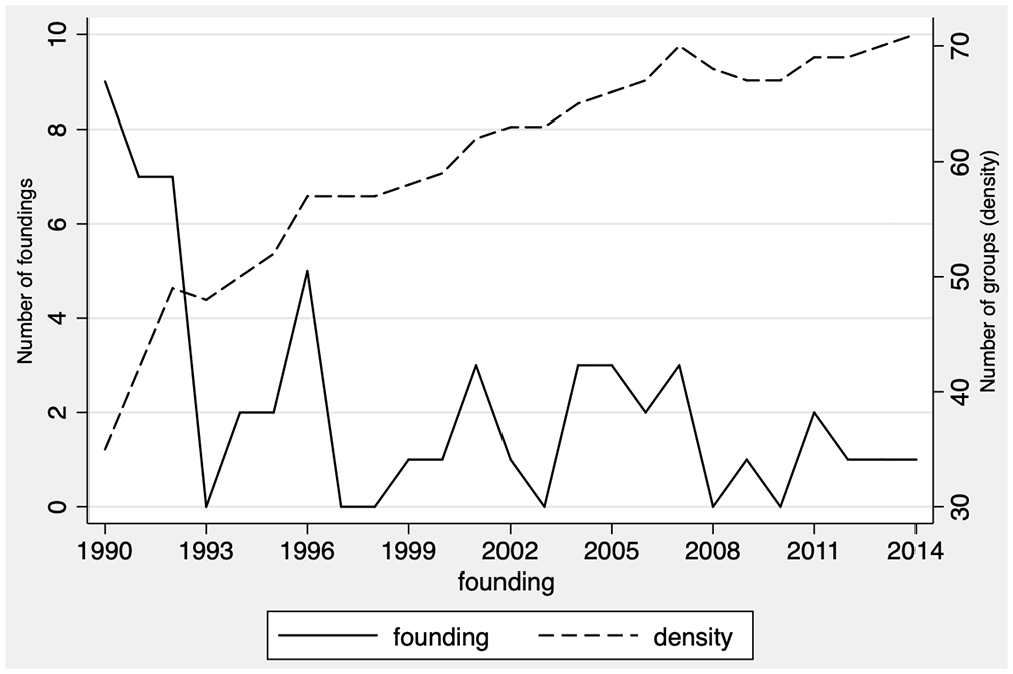
Density and founding of Hungarian higher education interest organizations, 1987–2014
For energy interest organizations, 1990 did not prove to be as significant as in HE. Of the 143 national-level energy policy organizations, 32 were founded between 1990 and 1992. Formation rates remained relatively high throughout the period: after a declining rate during the second half of the 1990s, the 2000s again saw high formation rates (in 2010 alone, 12 groups were formed; see Figure 2). However, dissolutions were also a relatively common occurrence: 29 organizations in total were dissolved. With a relatively low density in 1990 and two peak periods in organizational foundations, the formation process of energy groups in Hungary does not seem to be density dependent, or at least until 2014 we do not see a saturation effect (although dissolutions were increasing even before the 2011 legal change, when courts started the process of dissolving inactive and non-responsive organizations).
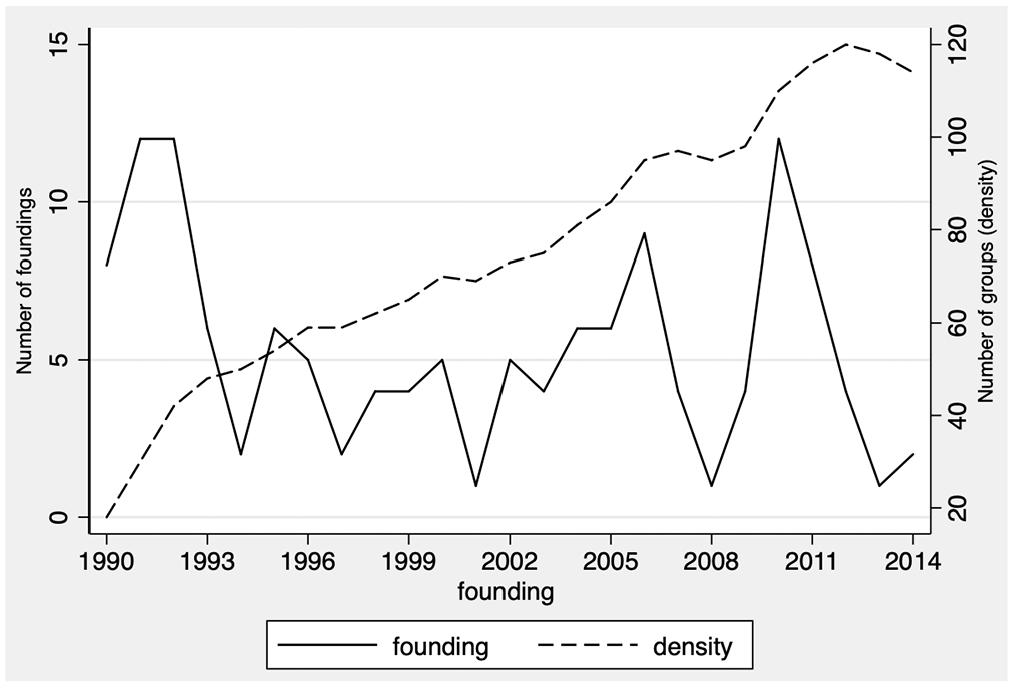
Density and founding of Hungarian energy policy interest organizations, 1987–2014
Poland
Regarding the demography of the complete Polish NGO sector, a recent conference paper indicates the relative scarcity of civil society organizations during the 1990s in comparison with the 2000s. 57 Our data sets on Polish HE and energy policy organizations are in line with this finding. There are, however, few identified organizational deaths in the data (1 for 106 energy policy organizations, and 2 for 77 HE organizations).
We found altogether 77 national-level HE interest organizations in the Polish court registry, of which we identified only two that were dissolved. The peak density is 75 organizations (in 2014). Figure 3 shows that the formation process of Polish HE organizations is density-dependent. However, the Polish process differs from the Hungarian: it starts at a much lower density (of only 7 in 1990), and the busiest years are not at the outset of the 1990s but during the 2000s. The peak year was 2002 with 9 formations, but there were relatively high foundation rates also after the EU accession (e.g., 5 formations in 2009 and again in 2012).
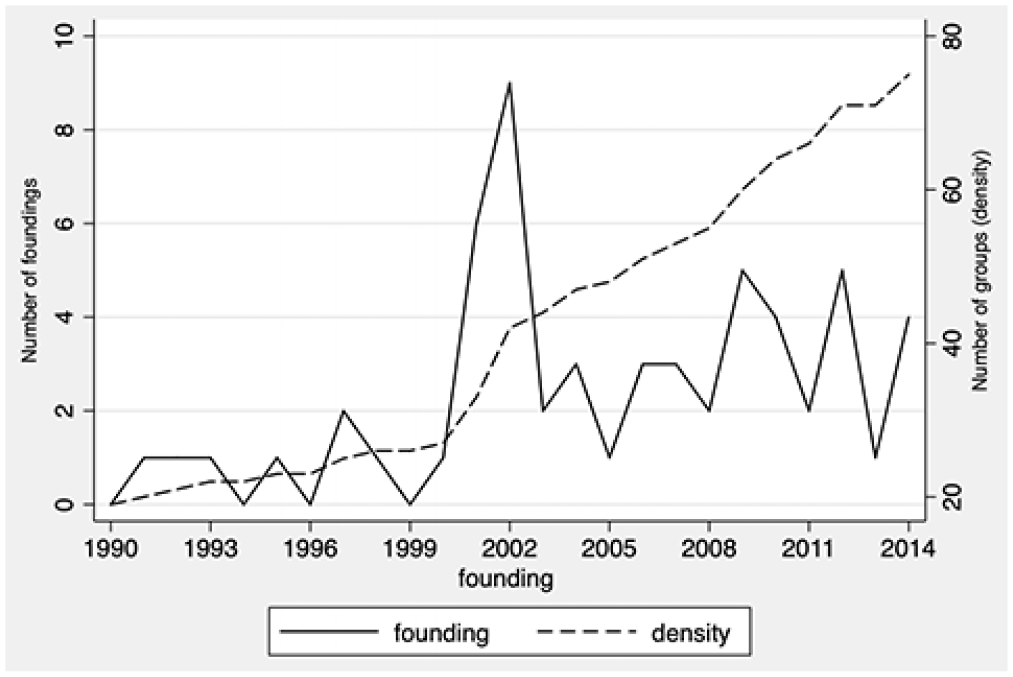
Density and founding of Polish higher education interest organizations, 1990–2014
We identified 106 national-level energy policy organizations. As Figure 4 shows, the formation process is similar to that of Polish HE interest organizations. Although the transition induced many more formations than in HE, 17 between 1990 and 1994, the 2000s also heralded a bigger founding wave, with 54 group formations during the decade. However, saturation does not seem to be as strong as in HE: in the four years between 2011 and 2014, 25 organizations were formed, 12 in 2013 alone (which is also the peak year).
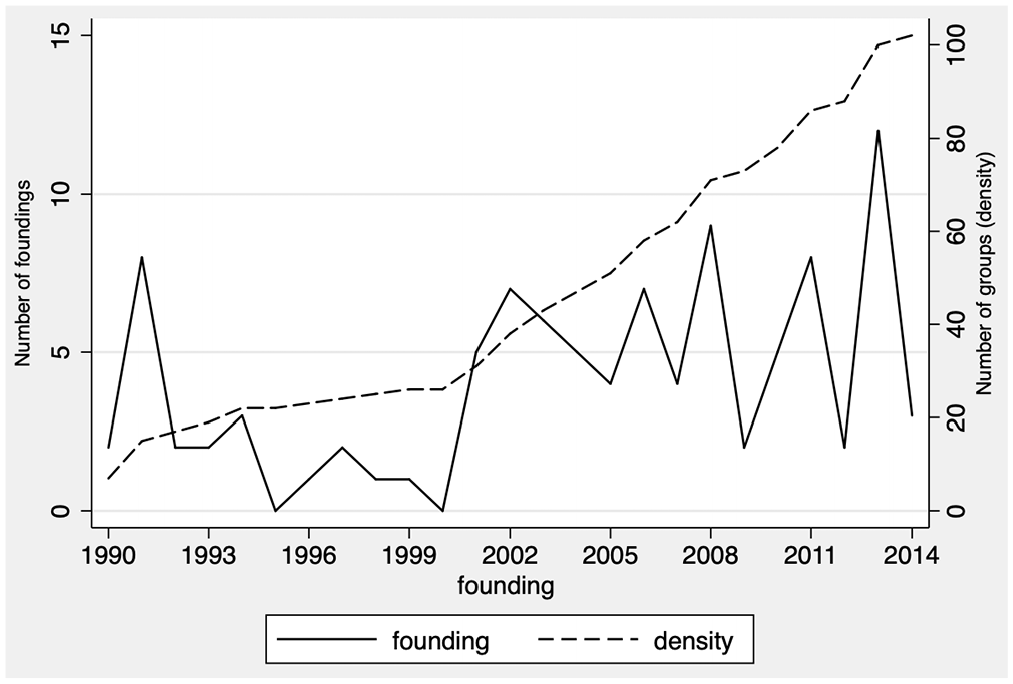
Density and founding of Polish energy policy interest organizations, 1990–2014
Slovenia
Figure 5 shows that organizational formation in Slovenian HE loosely follows a density-dependent process. However, the process is not as clear-cut as in Poland or Hungary. In 1990, the national-level HE population consisted of 17 organizations, and that year only two were formed. Among the 17 “post-communist” organizations—at least regarding their formation date—there are no organizations like those in Hungary, which were clearly anti-communist or independent organizations formed just before political transition (i.e., in 1988 or 1989). The busiest years of organizational formation were between 1995 and 1998, when 23 of the total 77 organizations were formed, with 1997 and 1998 as the busiest years (7 formations, respectively). By 1999, the density reached 48, and it took another 15 years to add 29 more organizations to the population.
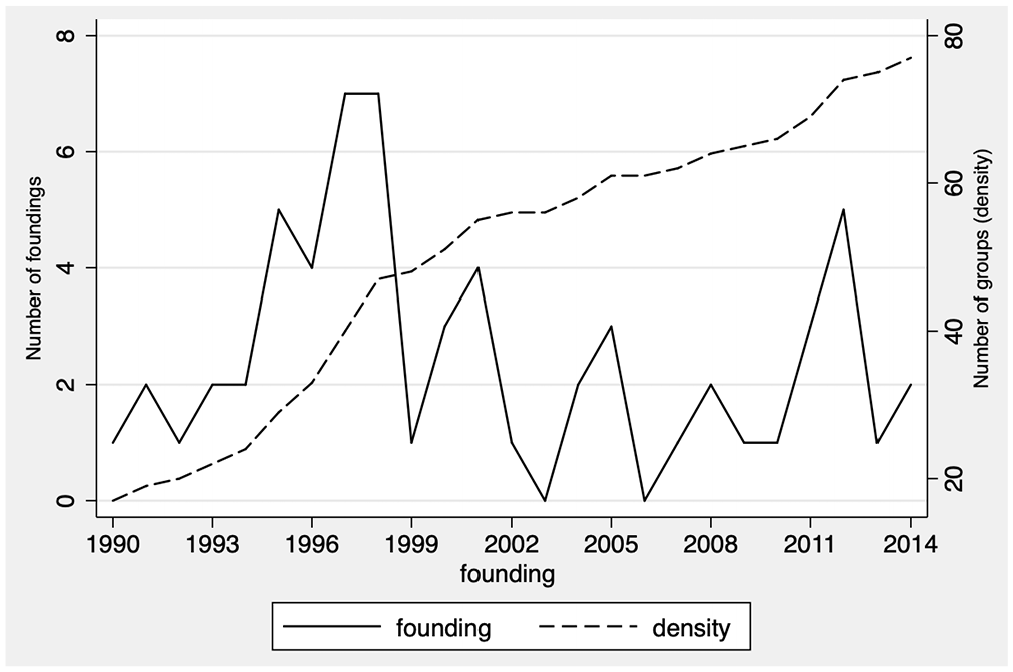
Density and founding of Slovenian higher education interest organizations, 1990–2014
We identified 38 national-level energy policy organizations in the Slovenian court registry and were able to identify two dissolutions. This relative scarcity might be due to the strong neo-corporatist institutions in Slovenia, which favour highly concentrated national-level unions, employers’ organizations, and business interest groups. In any case, as Figure 6 shows, the process seems to loosely follow a density-dependent pattern with a small population, where the “busiest” year was 1992 with 5 formations, while even 2010 is an exceptional year with 3 formations.
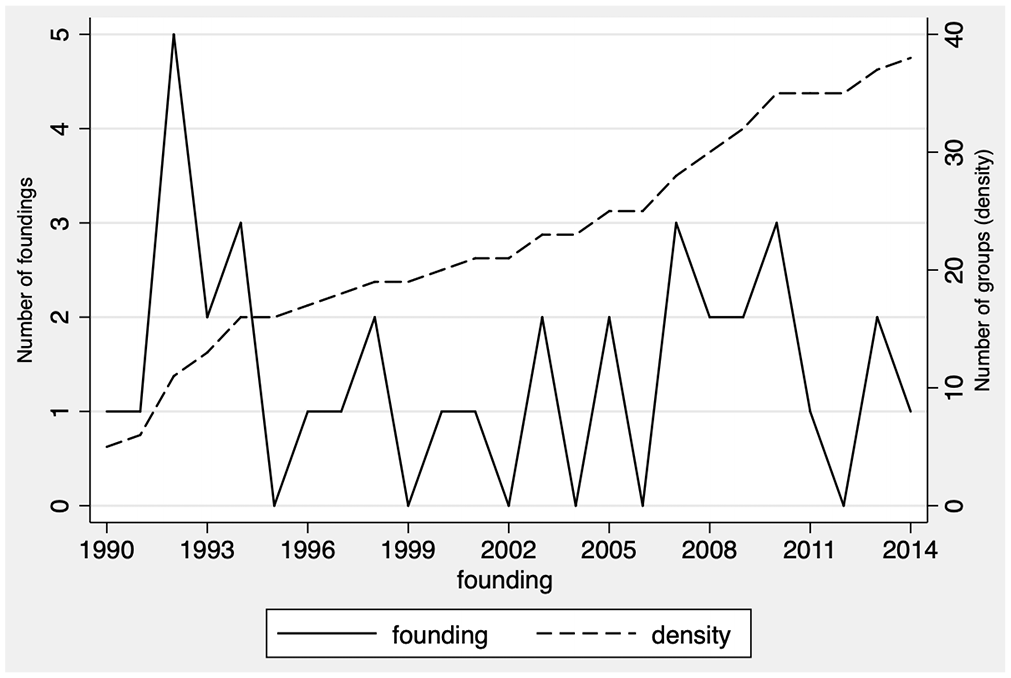
Density and founding of Slovenian energy policy interest organizations, 1990–2014
Statistical Analysis
For both HE and energy group formation, we tested three fixed effects Poisson models, respectively. Model 1 tests the structural change hypotheses without controls: the effect of the economic and political transition (hypothesis 1) and the effect of EU accession (hypothesis 2) with the EU candidacy (1998–2003) and EU membership (2004–2014) time period dummies (the transition period between 1990 and 1997 is the baseline). Model 2 is the full model testing density dependence (hypothesis 5), with density capturing the growth in formations at increasing but relatively low levels of density and density2 capturing the decline in formation rates at relatively high density. In model 2, we also introduce the issue-specific, signalling POS variables: legislative activity, that is, the number of relevant legislation and decrees per year (hypothesis 3); and issue salience, that is, the number of relevant pieces of front-page news of leading, quality national-level daily newspapers (hypothesis 4). Model 3 is identical to model 2 in everything but the operationalization of legislative activity and issue salience. In model 3, following Meyer and Minkoff, we lagged these issue-specific, signalling variables with one year to account for the possible time lag between information about perceived change and societal action (protest, group formation). 58
Table 1 shows the estimated models for HE group formation. Model 1 confirms what the graphs already showed: the period between 1990 and 1997 was the most positive for HE interest group formation. Both the period of EU accession and EU membership had fewer formation rates compared to the years of transition. In model 1, the coefficients are not significant. In model 2, as soon as we enter the other variables, they become marginally significant (note the very wide confidence intervals though). However, these results are not robust and are subject to model specification. Nevertheless, we found support for hypothesis 1, whereas we can tentatively reject hypothesis 2. The coefficients testing density dependence, density and density2, are significant and robust both in model 2 and in model 3 and are in the expected direction. That is, at relatively low levels of HE group density, formation rates grow, whereas at relatively high levels of HE group density, formation rates decline (hypothesis 5). We do not find support, however, for hypotheses 3 and 4. The coefficient of legislative activity is insignificant and negative in both model 2 and model 3. Media attention changes to positive direction in the lagged model (model 3) but remains insignificant.
The Founding of Higher Education Interest Groups in Hungary, Poland, and Slovenia 1990/91–2014
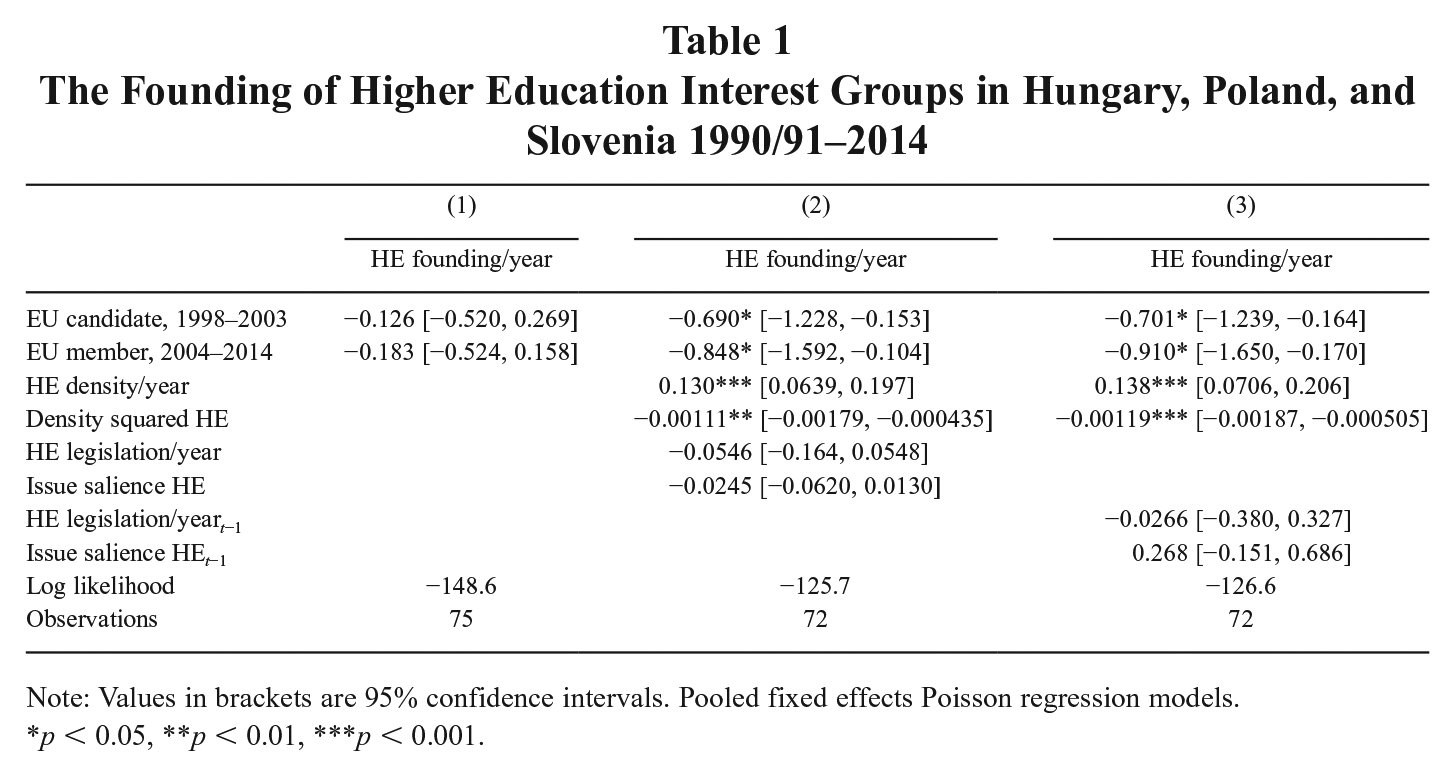
Note: Values in brackets are 95% confidence intervals. Pooled fixed effects Poisson regression models.
p < 0.05, **p < 0.01, ***p < 0.001.
How do we interpret the coefficients for density and density2? How do they affect HE formation rates? As they can only be interpreted together because they define the quadratic relationship (the direction of the parabola and the steepness of the slope), it makes sense to plot the predicted counts of HE group formations against the different levels of HE population density. 59 As Figure 7 shows, HE group formation indeed follows a density-dependent process across all three countries. However, the relatively flat curve and wide confidence intervals attest the differences between the cases: the relatively high initial density and fast saturation in Hungary, the more balanced evolution in Slovenia, and the late saturation in Poland.
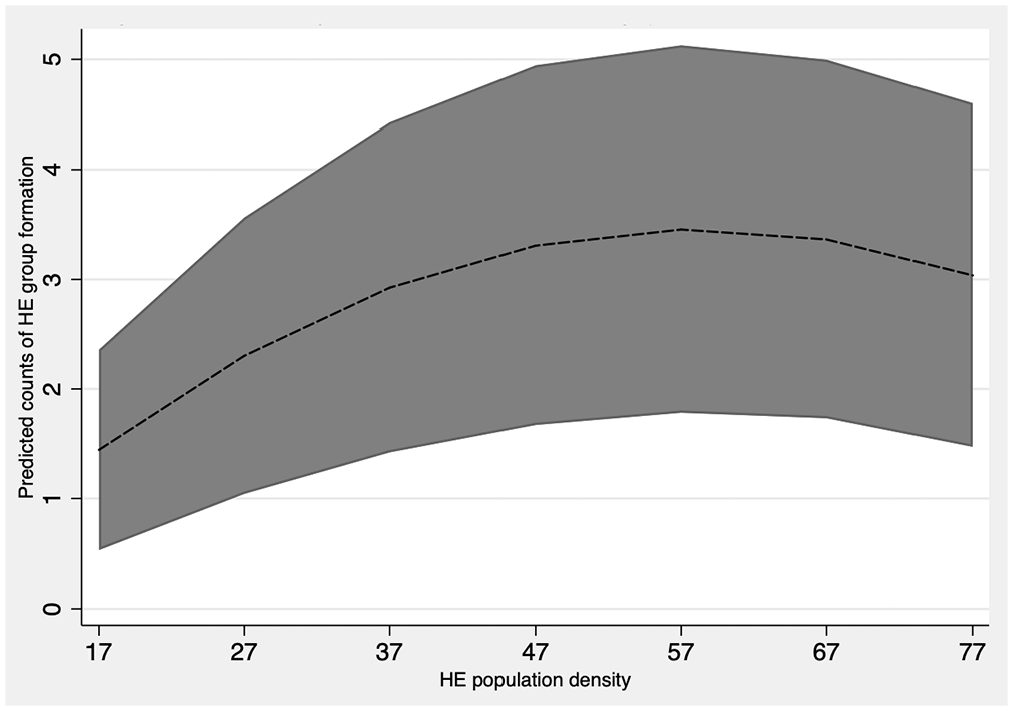
Predictive margins for HE group formation—Hungary, Poland, Slovenia; 95% CIs
Table 2 shows the estimated fixed effects Poisson regression models for energy policy group formation. As reflected in the graphs, we do not have a clear picture here. Density and density2 are both insignificant, although both are in the expected direction (density is positive, whereas density2 is negative). However, we cannot confirm that the formation of national-level energy policy interest groups follows a density-dependent process in the three countries (hypothesis 5). Nevertheless, the period dummies, just as in the models for HE group formation, show the importance of the post-transition period between 1990 and 1997, which is remarkable given the absence of a saturation in any of the national populations. We again find only tentative support for hypotheses 1 and 2, as the coefficients are not robust. The coefficients of the issue-specific POS variables are not robust, and their direction or significance are subject to model specifications in both model 2 and model 3. In the lagged, signalling model (model 3), issue salience is at least in the expected directions. All in all, we do not find support for hypotheses 3 and 4 in case of energy policy group formation either. We plotted the predicted counts of energy group formations against energy group population density. The graph (not shown) confirms that there is no evidence of density dependence in energy group formation rates (at least as of 2014).
The Founding of Energy Interest Groups in Hungary, Poland, and Slovenia, 1990/91–2014
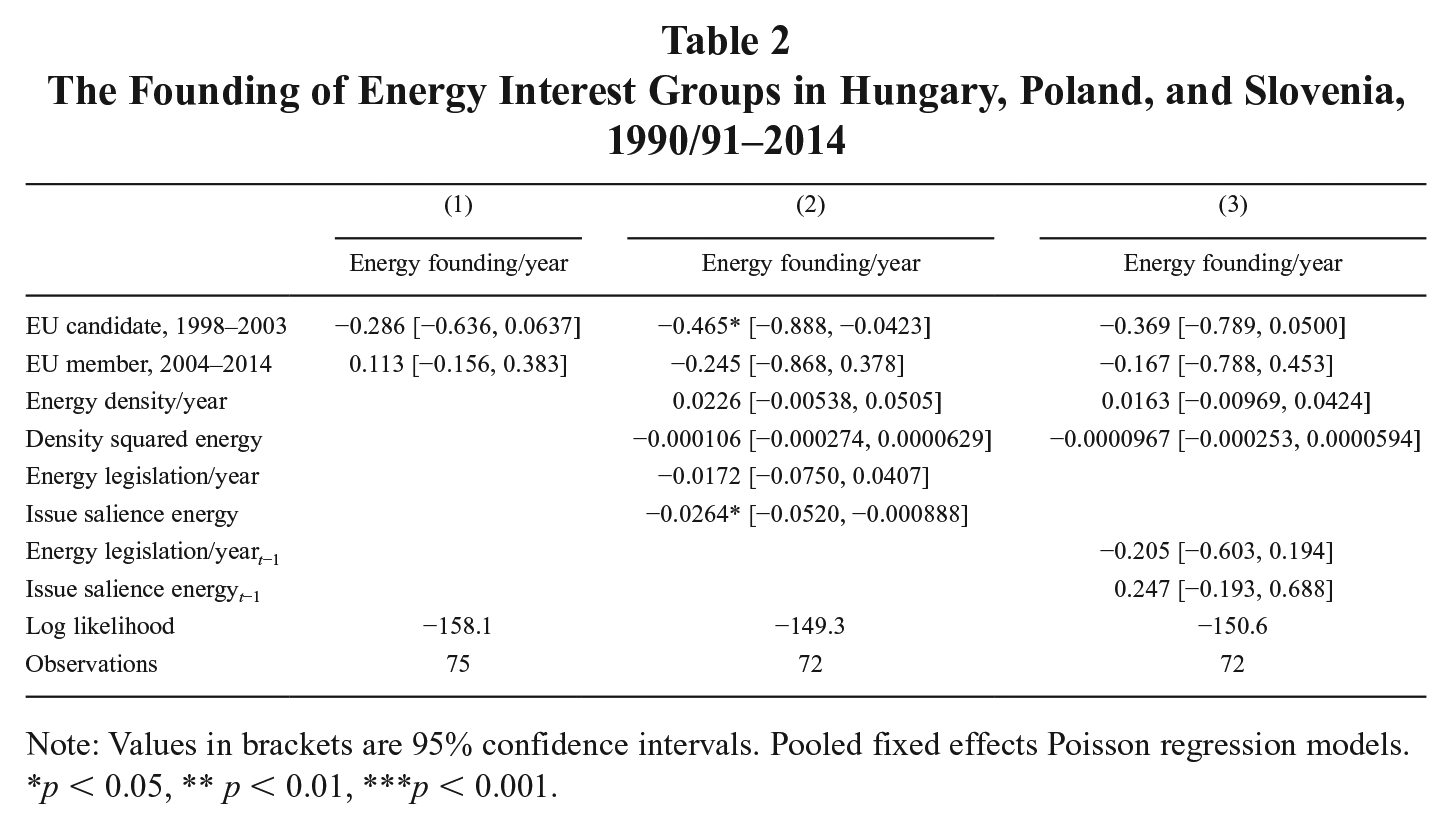
Note: Values in brackets are 95% confidence intervals. Pooled fixed effects Poisson regression models.
p < 0.05, ** p < 0.01, ***p < 0.001.
There might be several explanations for these results. First, it seems that the energy policy populations have not reached saturation as of 2014. Second, as opposed to HE, where interest organizations all inhabit the same government-controlled and financed environment subject to the same regulations and members of the interest intermediation processes, the sectoral approach might be more problematic for energy policy organizations. The organizations in the sample might be all too different with a sample that contains both unions, environmental groups, and business groups that are subject to different environmental pressures. Consequently, different energy industries might populate different policy and regulatory areas. Concentrating on sub-populations might lead to better results. However, that would lead to significantly lower formation counts and most probably require a qualitative approach.
Conclusion
Our analyses of the Hungarian, Polish, and Slovenian national-level HE and energy policy interest organization populations showed that the theory of density dependence at least tentatively holds in the post-communist context. This is an important finding in light of the very particular (almost natural experiment-like) context of the double (economic and political), and in the case of Slovenia, triple (+nation-building) transition. The political and economic transition also affected these populations significantly in most cases. However, our analysis also found that—just as in economic policy, growth regimes, party systems, or social policy—the crumbling of the communist regimes did not mean that organizational populations completely emerged from nowhere. Particularly in HE, relatively high 1990 density levels signal that there were numerous organizations that represented genuine interests even during communism (i.e., they were not simply organs of political control) and were able to survive transition and adapt to the new economic and political environment. Moreover, some truly independent organizations (both parties and interest organizations) were formed as early as 1988 and 1989 and often participated in the negotiated transitions. This was particularly the case in Hungary, where there was no such unified front against the communist party like the Solidarity movement in Poland. Therefore, to understand the structure and process of the vital rates of post-communist interest organization populations, the nature and structure of communist-era interest organizations and interest intermediation must be considered.
Surprisingly, we could not find evidence for an effect of the European accession process and EU membership (and the coinciding Bologna Process in HE). This seemingly counter-intuitive finding should be subject to future research. Beyond the saturation effects postulated by density dependency theory, we would preliminarily speculate that financial support from like-minded EU-level and Western European organizations was perhaps overestimated. 60 Ultimately, the accession process was conducted in a more technocratic fashion between national executives and EU-level bureaucrats, thus diminishing the prospects for influence and political returns of civil society organizations during this phase. It was ultimately the relatively isolated national executives that were responsible for implementing the acquis communautaire, thus making national-level parliamentary mobilization futile for interest organizations.
Similarly, legislative activity did not yield any significant results. We measured it with the number of laws adopted in a year affecting the given policy area and, thus, the interests of the interest organization population and providing incentives and organizational resources for new group formations. Nevertheless, unusually high levels of legislative activity might easily signal less instead of more social dialogue; indeed, it might indicate the decline of democracy and the rule of law in a country. For example, the authoritarian Hungarian prime minister, Viktor Orbán, relying on a constitutional majority, turned the Hungarian National Assembly into a law factory after his return to power with a landslide victory in April 2010. It is telling that in 2011 alone the Hungarian parliament adopted 365 laws (and a new constitution), whereas in the entire previous legislative cycle between 2006 and 2010 the complete legislative record amounted to 591 laws. 61 However, we plotted Hungarian legislative activity in our data set for both energy and higher education policy for the entire time frame (not shown), and we did not observe any “excessive legislation” between 2010 and 2014 for these policy areas (which is not to say that the adopted laws did not implement profound changes as, e.g., the higher education reforms between 2011 and 2013 clearly did and also sparked a huge national protest wave).
However, the non-finding of most of the POS variables in our models does not mean that the political environment did not affect the formation of HE and energy policy interest organizations, as our robust findings on the importance of the transition years between 1990 and 1997 show. Rather, this reflects the quality of existing data on interest organizations. The court registries are unfortunately of varying quality, and only the Hungarian one contains dissolved organizations. However, the data on dissolutions are negatively affected by legal and technical issues. The Polish registry only starts in 2001–2002 and it does not contain reliable information of dissolutions, and the Slovenian registry only contains existing organizations.
One of the most important tasks for further research is therefore to remedy the deficiencies of the court registry data by controlling the founding dates and specifying the dissolution dates, creating a reliable database on the vital rates of Hungarian, Polish, and Slovenian interest organizations. This is particularly important for the analysis of mortality rates. Notwithstanding the mentioned weaknesses of the data, our study paves the path for new areas of analysis. Clearly, the number of countries can be expanded, and other policy areas taken into account. Scholars should also explore changes in institutional configurations such as new lobbying regulations or the rearrangement in ministerial bureaucracies, for example, a new ministry, as potential catalysts for organizational formation. Furthermore, another avenue for research would be to assess the impact of neo-authoritarian-style governments on organizational ecologies in CEE. 62 The trend towards “democratic backsliding” and/or national conservatism in several post-communist countries with the accompanying widespread civic opposition may jump-start counter-movements, thus stimulating new forms of civil society engagement and organizational formation. At the same time, national-conservative governments may also nurture certain non-state groups (e.g., coal lobbies) to mobilize grassroots support, while cracking down on other hostile civil organizations. Targeted efforts to reshape the organizational landscape may thus directly impact populations. Another area of prospective research would be to look at interactions between interest organization development and party systems. CEE party systems have tended to oscillate between phases of extreme volatility with high party foundation rates and phases of relative stability. 63 Therefore, the question arises whether and if during phases of partisan volatility or stability interest groups come to replace parties as a means of political participation, thus affecting the formation rates.
Footnotes
Author’s Note
Ana Železnik is now affiliated with University of Ljubljana.
Funding
The authors disclosed receipt of the following financial support for the research, authorship, and/or publication of this article: This research was conducted as a part of the research project “The “Missing Link”: Examining organised interests in post-communist policy making” of the University of Konstanz, Germany and the University of Opole, Poland funded by the Beethoven 2 – Polish-German Founding Initiative of the Deutsche Forschungsgemeinschaft and the Narodowe Centrum Nauki. We sincerely thank both organizations for the generous funding.
Notes
 ). Currently, his research focuses on the role, influence, and population ecology of Central and Eastern European interest organizations in health care, higher education and energy policy, and on the implementation of Education for Sustainable Development in the German public education system.