




Abstract
Focusing on the “state” rather than the “nation,” this article explores the interplay between nation branding and Poland’s soft power statecraft. Contextualised by Poland’s European orientation in foreign affairs, this Bourdieusian study focuses on the field of diplomacy and statecraft, particularly its communicative practices for the articulation of soft power. Aided by policy documents and campaign artefacts, this analysis of interviews (n=45) with state actors and newcomers to the field, nation branders, traces their actions, and unfolds the effects of their practices on soft power statecraft. The central argument emerging from the analysis of findings rests on the cultural conditions and ideological effects of nation branding on the field. On the one hand, I find, these effects advance the process of “corporatisation” of Poland’s soft power statecraft. On the other hand, the embeddedness of nation branding in Poland marks a cultural shift in soft power statecraft towards technocratic and transactional promotional culture.
Introduction
Focusing on Poland, a relative latecomer to the race for more soft power in international relations, this article reveals the ideological effects of nation branding on diplomacy and statecraft. Since adopting the European orientation in foreign affairs, state actors endogenous to Poland’s field of diplomacy have embraced global competitiveness as a priority in statecraft, to which exogenous actors, nation branders,
1
have responded opportunistically: Nevertheless, in an increasingly competitive world, where there are far more nations than before and where technology offers remarkable promotion opportunities, nations continue to attempt to project their political power, influence and prestige; largely perhaps for their own self-esteem. Nowadays, however, nations also need to compete on hard, quantifiable issues—exports, inward investment, and tourism. And this is new.
2
While in theory nation branders offer ready-made consultancy for statecraft, in practice their ascendance in the field is not as straightforward as adapting their solutions. In Poland, I argue, the field realities are shaped by two key processes affording opportunities for nation branders: Europeanisation of foreign affairs and the corporatisation of statecraft. The former process of “Europeanisation” involves “national adaptation, national articulation, identities reconstruction, modernisation and policy isomorphism.” 3 The latter process of “corporatisation” entails the cultural orientation in statecraft whereby state actors “operate as if they were private firms facing competitive environment.” 4 Whilst the former makes up the political settings in which nation branders pursue the practice of nation branding, the latter, parallel to Europeanisation, denotes nation branding as a mark of the “corporatisation” of soft power, that is, the application of corporate-style practices to statecraft. As a master term, “soft power statecraft” 5 allows this study to extend the debate on communicative practices in the field of diplomacy to examine how and why nation branding, as a practice of non-state actors, nation branders, fell on fertile ground in the Polish state.
If the rise of nation branding marks a shift in soft power statecraft enabled by the European orientation of foreign affairs, notably, it proves to be enduring too: irrespective of a dominant regime, formerly neo-liberal, or recently right-wing populist, nation branding resonates among policy makers. In 2016, the populist government of Beata Szydło established the Polish National Foundation, the overall mission of which is to “promote brand Poland,” 6 as opposed to focusing on foreign affairs issues or interests. This logic of the dissociation of a “nation brand” from “political” interests echoes in academic definitions. According to Fan, a nation “has a brand image with or without national branding” and “nation branding” entails “applying branding and marketing communication techniques to promote a nation’s image.” 7 In addition to decoupling foreign affairs interests from nation branding, the above disjunction centres on the “nation” rather than the “state,” typically the first target of nation branders.
Further, soft power statecraft relies on political communication, 8 predominantly on the targeted practice of public diplomacy. Unlike public diplomacy, however, nation branding is modelled on “public–private partnerships,” and the transactional logic promising economic benefits in real terms. 9 Upon entry to the field, the allegedly universal idea of “branding” intermeshes with particularities of statecraft, challenging axiomatic assumptions about this practice. To uncover links between soft power statecraft and nation branding, this article draws from Bourdieu’s theories of state and practice. In doing so, it follows an interpretivist research agenda, 10 making a twofold contribution to the field. First, by revealing the effects of nation branding on the field, it identifies transformations in statecraft. Second, by focusing on Poland, it contributes to the debate on the adaptation of Central and Eastern European (CEE) states to the race for soft power regionally dominated by Russia. 11 In what follows, the field of soft power statecraft refers to the social space endogenous to the state architecture, and overlapping with the field of diplomacy. This space is made up of state actors relying on a polyphonic approach to the articulation of national interests and identities, as well as their interactive interplay with practices of newcomers exogenous to this space.
Why Poland?
The rationale for this study of nation branding in Poland entails academic, practice-related, and intuitive reasoning. Academic underpinnings for bridging the gap between nation branding and soft power statecraft include not only limited studies examining links between the two, but also the conditions enabling the proliferation of nation branding. Conceptually, the Polish case opens avenues for moving from an actor-specific approach to field analysis, as nation branders exert multi-relational effects. Analytically, Poland presents a case that permits inquiry about nation branding within broader regional and global processes. On the one hand, the Europeanisation of foreign affairs enables changes to statecraft presumed to continue generating soft power advantages for the Polish state gained since the early 1990s. On the other hand, nation branding furthers the global process of shifting statecraft toward corporate-styled solutions. Finally, Poland makes a strong analytical case as nation branding is still perpetuated by policy makers, despite that it has lost currency elsewhere, even in the United Kingdom, where it was first conceived.
Among practice-related arguments are those for understanding the implicit inner workings of nation branding in Poland. As such, this is not a study of “how to do nation branding” but an analysis focusing on the transformation of soft power statecraft. In that regard, Poland becomes a centre-stage for the examination of the contentious relationship between an orthodox conceptualisation and heterodox enactments of nation branding, and the ways in which nation branders were met with realities of the field. As well as revealing the pre-existing statecraft communicative practices for the articulation of soft power, Poland yields insights into the ways in which the logic of nation branding changes the field, and how practices—central and auxiliary—to nation branding aimed at re-structuring the field. Finally, the intuitive argument for undertaking this study of Poland stems from reflexive social theory encouraging me, in this case, to question my relationship with my own state. In essence, I was drawn to the analysis of nation branding motivated by intellectual and emotional curiosity about my relationship with Poland in a globalised world, central to which is a question about the role of nation branding in the articulation of identities shaping relationships between the state, its community and international community.
Towards Corporatisation of Diplomacy and Statecraft
With the Europeanisation of foreign affairs reinforcing a turn in diplomacy, statecraft practices aiding the globalisation of the Polish economy required broadening its public and commercial appeal abroad. As a middle power in European affairs, Poland has adopted a polyphonic approach to soft power statecraft, that is, the architecture of the field that enables the articulation of national interests and identities by specialised actors. These articulations have been made possible by adapting along the way multiple state-sponsored statecraft practices, the most prominent of which, spanning the field of diplomacy, is public diplomacy. 12 Closely related, cultural diplomacy is the lynchpin of Poland’s cultural relations, institutionalised as a practice for cultural exchanges in a fashion similar to that of its Western counterparts. The polyphonic approach is furthered by the use of investment marketing and destination marketing, two practices with market orientation, aiding Poland’s soft power statecraft, and centred on foreign direct investment and tourism respectively.
While a polyphonic approach to the articulation of soft power defines state-sponsored communicative practices in the field, Poland’s public diplomacy in particular, as elsewhere, has been theorised through the prism of the “new” public diplomacy paradigm, inspired by models directly derived from the theory and practice of corporate public relations. The emergence of corporate-styled nation branding has, however, triggered transactional dynamics and furthered the requirement to examine non-state actors in the field, which are not only dominated by the state but which, in addition, tend to operate in silos. 13
Although corporate public relations models, particularly those shaped by the logic of relationship building 14 and networks, 15 echo in the existing analysis of Poland’s soft power statecraft, 16 data-laden research is needed to unpack how newer practices such as nation branding intermesh with statecraft and, in turn, transform the field. While studies of nation branding in Poland tend to focus on “the nation,” 17 by asking and answering the following questions, this article shifts the analytical focus to “the state” and “statecraft” in particular:
Research question 1: What institutional conditions enabled the rise of nation branding?
Research question 2: What nation branding initiatives were undertaken?
Research question 3: What were the trajectories of action among nation branders?
Research question 4: What effects has nation branding had on statecraft?
Between Soft Power and Nation Branding
The concept of “soft power” pertains to influence through “state” and “national” reputations in the conduct of foreign affairs. Based on the attractiveness of resources such as political values, cultures, or wealth, in the field of diplomacy and statecraft these are rendered as capable of engendering persuasive effects. While ties between soft power statecraft and communicative practices such as public diplomacy are established, 18 the rise of nation branding added complexity to the inquiry. To aid the debate on transformations of statecraft, and to overcome terminological issues stemming from the limits of under-developed ontologies, I argue for a context-specific analysis of the “national” fields of soft power statecraft. With the exception of articles by Sharman 19 and Browning, 20 links between nation branding and foreign affairs remain tenuous, leaving an opportunity to examine how monophonic nation branding ascends to the field that, by default, articulates soft power in polyphonic ways.
Unlike public diplomacy, the practice disseminating ideologies in foreign affairs, 21 branding is ideological ex definitione, as through ascending to “new” fields it perpetuates the logic of marketing. As an ideological practice, it is defined by perceived added value and the transactional relationship of commodification 22 that accommodates “signifiers in order to legitimate itself within language.” 23 Notably, branding expands its portfolio of referents: “product branding,” “corporate branding,” “service branding,” and this acquisition-by-merger strategy extends to statecraft. Of these, nation branding is a proxy of corporate branding, following the a priori assumption about the universality of this synergy-making practice, namely, that “corporate level brands can also apply to countries, regions, and cities.” 24
Bourdieu, State Power, and European Affairs
Despite the celebratory embrace of the transactional logic of branding, the existing social theory–inspired analysis recognizes that nation branding has not emerged in a “post-political” vacuum. For example, Jensen was one of the first to discuss the implications of the reductionist market fundamentalism 25 of nation branding as a practice “designed” for the articulation of nation identities. Volcic and Andrejevic theorise nation branding as a global trend expressing commercial nationalism. 26 In her seminal work, offering a CEE regional perspective 27 on nation branding, Kaneva refocuses the debate on nation branding by considering it in broader political settings, and argues for the search of systematic critique of this practice. Finally, Aronczyk brings the concept of a “competition state” 28 to the debate about nation branding and, in doing so, puts the analytical focus on the “state” rather than the “nation.” Focusing on statecraft, arguably, this study takes the discussion of nation branding a step further.
Drawing from the theoretical oeuvre of Bourdieu, this section sets the stage for the analysis of nation branding as an ideological practice. Undoubtedly, Bourdieu’s theorisation of the state is relevant to soft power statecraft as his theories have been used for the study of foreign affairs 29 and nation branding, 30 although this article focuses on his view of the “state” as the setting behind “statecraft.” For Bourdieu et al., the state is the “concentration of different species of capital,” the power of which rests “in the realm of symbolic production that the grip of the state is felt most powerfully.” It is through the struggles for legitimacy that symbolic power as “the effect of the state” 31 is exerted over actors in diverse fields. Bourdieu’s theories of the state and practice are advantageous to this study as they favour empirical inquiry about particular fields, which permits unpacking orthodox and heterodox views on nation branding. These theories are pertinent to the analysis of the ideological effects that, exogenous to the state, nation branding has had on state actors endogenous to the field of soft power statecraft.
Mirrored in this article, Bourdieu’s conceptualisation of the state recognizes the demarcation between national and European fields of power, as nation branding plays out at the crossroads of the two, in the field of soft power statecraft. His social theories neither explicitly focus on the Europeanisation of foreign affairs, nor do they explore statecraft. In his works, Bourdieu, however, refers to the integration of European markets, 32 the process that gave the impetus to the Europeanisation of foreign affairs, enabling nation branding to emerge. Extending his theorisation of the state to European affairs, Arnholtz and Hommerslev note that the “construction of Europe is often undertaken by actors closely connected with national fields of power.” 33 Bourdieu does not single out “soft power” as separate to a field of power, but his take on the “symbolic grip of the state” aligns with it through the use of “culture, political ideals, and policies” in statecraft and the persuasion that is “an important part of it.” 34
Soft power statecraft is central to Poland’s strategic culture as it is a prism for the interpretation of the landscape of foreign affairs. Defined as “an ideational context surrounding the decision-makers in a state at any one time, shaping which options are perceived as effective and productive by the decision makers with regard to participation in military operation,” 35 strategic culture pertains to “hard power”; however, the stipulative logic of this term is relevant to “soft power” too. When faced with a strategic landscape, policy makers tend to rely on preconceived beliefs. The core belief of policy makers is that Poland’s interests in European affairs require advancement but, given limitations to statecraft, state actors resort to ideas exogenous to the field. Done this way, strategic culture, endogenous to statecraft, intertwines with practices derived from promotional culture, which shape the field in ways in which those practices become “virtually co-extensive with our produced symbolic world.” 36
Field, Practice, and Cultural Intermediaries
In a Bourdieusian analysis, Adler-Nissen recognizes that the conduct of foreign affairs starts at home
37
and, by extension, resources for the field of soft power statecraft can be enhanced with input from public affairs. Therefore, the analytical focus of this article is a “field”: a network, or configuration, of objective relations between positions. These positions are objectively defined, in their existence and in determinations they impose upon occupants, agents or institutions, by their present and the potential situation (situs) in the structure of the distribution of species of power (or capital) whose possession commands access to the specific profits that are at stake in the field, as well as by their objective relation to other positions (domination, subordination, homology, etc.).
38
Fields denote spaces for the production, circulation, and appropriation of goods, services, knowledge, or status by actors struggling for legitimacy. Bourdieu’s theorisation of action relies on semi-autonomous fields of practice. He explains practice as a struggle over ideas, power, and resources. Their analysis focuses on “objective structures” and “subjective dispositions” 39 through which actors display practical knowledge. The actions of nation branders, as new entrants to the field of soft power statecraft, are prone to diverse strategies underpinned by uncertainty. Since actors face constraints and opportunities, action seldom renders anticipated outcomes. Strategies are ritualised, but whether the action conforms to the rules of the field depends on self-interest. Action should neither be exclusively read as the pursuit of material resources, nor is all action prone to ideological misrecognition. In these settings, actors are practical strategists, trading in resources and dispositions. 40
Finally, nation branders are deemed to be a class of cultural intermediaries. Their cultural dispositions render them a “new” bourgeoisie. 41 This prefix new implies social mobility but by no means are they homogenous. For example, there are local and transnational nation branders. Following Eyal et al., 42 this article identifies dispositions derived from promotional culture as yielding better mobility prospects in present-day Poland than those acquired during the Soviet era. While the field of power accepts consultants, their actions in the field of soft power statecraft remain unclear. In entering it, however, cultural intermediaries embrace political concepts such as “state” or “nation”—central to the analysis of nation branding. As newcomers to the field, they intermediate between public affairs and foreign affairs.
Inadvertently, this study reveals limitations to Bourdieu’s theories of state and practice. These are particularly notable with regards to the field boundaries problem. While Bourdieu speaks of political fields or bureaucratic fields, his conception of state is not as far reaching as to differentiate the field of diplomacy, and the ways it overlaps with the field of power. This critique extends to his conception of the state as an accumulation of power, and subsequent use of the term “field of power” as if it was a separate entity. In this article, the problem of field boundaries has been moderated by following empirical realities in Poland: as the field of diplomacy has the strongest influence over the field of soft power statecraft, it is apparent that those two fields overlap with each other; however, there are more state actors holding responsibility for soft power statecraft than those positioned in the field of diplomacy.
Methodology and Analytical Procedures
The aim of this study is to explore the relationship between nation branding and soft power statecraft. Bourdieu’s “structuralist constructivism” 43 ontology stresses struggles between actors, beyond the confines of institutions, within the structures of particular fields. This worldview is mirrored in this analysis of soft power statecraft, as it foregrounds how state actors endogenous to the field relate to exogenous, non-state actors, nation branders. Taking an actor-specific approach, this meso-level analysis is sensitive to the field structure, and other “structuring structures” evoked by participants, for example, a “field of media.”
Answers to the research questions (p. 5) were drawn from multiple sources, including semi-structured interviews, campaign artefacts, and policy documents. A sample of participants (n = 45) was recruited in Warsaw and London among consultants, decision makers, diplomats, public diplomats and strategic communicators engaged in nation branding. The recruitment of participants for this study, on both the supply (nation branders) and demand (targeted state actors) sides of the relationship, followed convenience and snowballing techniques, particularly using the criteria of self-declared expertise in nation branding, a traceable record of the participation in the field and direct exposure to nation branding. Interviews were conducted in the participants’ mother tongue, in Polish or English (Appendix 1). The fieldwork took place between June and September 2009, March and April 2010, and September and October 2014. Interviews were recorded, transcribed, anonymised, and supplemented by field notes. Translations prioritised the targeted language. In addition, field artefacts (e.g., policy proposals, consultancy reports, press releases, advertisements, op-eds) were collected to cross-examine interviews. On transcript data, a discourse analysis was conducted 44 to report actions in the field and, by following themes of emic, inner-group and etic, outer-group perspectives, to unpack relationships between the actors. This approach aligns with Pamment’s research agenda on nation branding and the capabilities of soft power. 45
Findings
Mapping of the Field
The field of soft power statecraft is an extension of the field of power of the Polish state in which its government occupies the dominant position. Of significance to the field were these state actors: the Ministry of Foreign Affairs (MFA), the Ministry of Culture and Heritage, and the Ministry of Economy, all of which played different roles in setting the orientation of foreign affairs. The field of diplomacy was largely, but not exclusively, aligned with the Ministry of Foreign Affairs, the actor which had administrative bearing over the Council for Poland’s Promotion, an advisory body aimed at coordinating the field. This field overlaps with the field of diplomacy as the Ministry of Foreign Affairs oversees the Department of Public and Cultural Diplomacy. The Ministry of Culture and Heritage, however, had control over the Adam Mickiewicz Institute, the state actor responsible for cultural relations. The above state actors were engaged in the practices of public diplomacy and cultural diplomacy.
The polyphonic setup of the field was supplemented by the practices of the state actors affiliated with the Ministry of Economy, namely the Polish Tourism Organisation, the Polish Agency for Enterprise Development, the Polish Information and Foreign Investment Agency, and temporarily by the PL.2012, the purpose-built agency behind the organisation of the 2012 European Football Championship EURO tournament. Structurally, this agency was aligned with the Ministry of Sport and Tourism, but acted in the capacity of an actor engaged in soft power statecraft until 2013. These state actors do not make up the entire field, but for the purpose of this article, provide entry into the field in which nation branders left their traces.
Finally, among exogenous actors that shaped the field are either networked coalitions of marketing and advertising agencies such as the Advertising for Poland Association led by the Eskadra Group and AdPress, or associations representing business interests such as the Polish Brand Institute, an associate of the Polish Chamber of Commerce. The network of public relations consultants forming the “Public Relations 4 Poland” played its role in the field too, as did think tanks, for example, the Institute of Public Affairs, and foundations, for example, the Eastern Institute. These were local actors who were engaged in nation branding or advocacy for this practice. Among the transitional nation branders were Saffron Brand Consultants, DDB Corporate Profiles, Young & Rubicam, and Saatchi & Saatchi, branding agencies that either operated transnationally or in Warsaw, and began offering their consultancy to governments.
Mobilising Effects: Planting the Idea
Illustrating the openness of the field, participants’ emic accounts reveal that Poland’s statecraft became a fertile ground for promotional culture (research question 1). Nation branding emerged at the cross-roads between the Polish state, corporate actors, and the coalition of actors from the marketing and public relations industries (Figure 1). Coalescing the conduct of foreign affairs with statecraft as an ideological practice, nation branding was introduced to the field by local cultural intermediaries. One of its early iterations, the 2001 “Poland: Europe Is Bigger” campaign by DDB Corporate Profiles, was launched by the Ministry of Foreign Affairs. Reported by home and foreign media, it became a landmark iteration of nation branding, creating a bias in understanding of the field towards practices represented in the news.
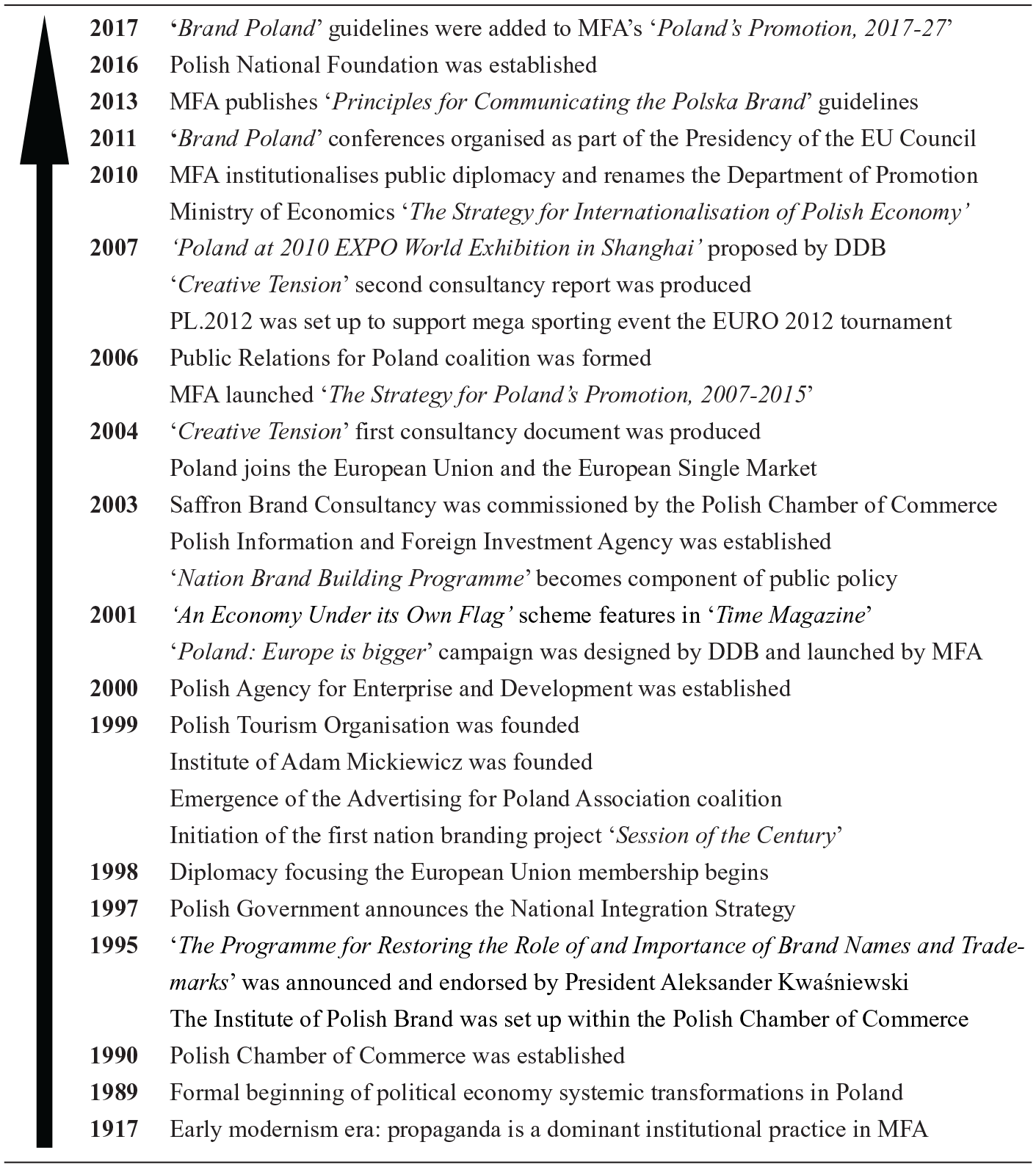
Timeline summarising key institutional developments in the field: actors and policies
While representations of branding were hardly new, the scope of nation branding goes beyond the landmark campaign. A myth of branding existed among participants, and brands embodying perceived national commercial success were idealised as, arguably, since the early days of systemic transformation, the Polish economy has failed to produce global corporate or product brands which could have been leveraged through soft power statecraft. The myth of branding was identified as the cultural interplay between state socialism and capitalism, embodying a self-fulfilling prophecy of Western corporate capitalism: Hmm . . . there are people who claim that it is important for Poland to have a national brand. They claim that having a nation brand means that a country is better perceived, it is better recognisable. In their view, this can leverage into, say, economic performance. So, if a state is more recognisable and perceived positively. . . . Because, you see, “a brand” is a positive term, it is not pejorative, right? It has clear positive connotations. So, if we say, in Polish—I don’t know about English as this might be culturally different—but in Polish, if we say, “this is a brand,” we automatically assume “quality.” We do not explicitly have to state, “good quality.” We subconsciously assume that we talk about a “good quality.” Henceforth, going back to nation branding, if you assume that Poland needs to have a nation brand, as some argue, it would automatically increase Poland’s international prestige.
46
The attribution of “outstanding recognition” or “extraordinary qualities” to commodities or organisations was seen as aiding soft power, allowing the merger and the amplification of the country-of-origin effect in statecraft.
47
In demystifying branding, the following simplification unfolded: a reference to an object as a “brand” creates a “subject” that signifies post-1989 premium market positioning. In turn, this misrecognition allowed nation branders to gain advantage in terms of the appeal of their idea and enabled them to establish affinity with the field. Apart from the myth of branding, issues pertaining to the European orientation of Poland’s foreign affairs were discernible as a theme enabling nation branding. This political challenge turned the field into a marketplace for statecraft ideas and practices: We are starting off with a big European project, promotion of the Polish economy, which is part of “The Innovative Economy” programme. Thanks to this programme we are hoping to finalise the construction of the overarching “meta-narrative” about Poland and then transfer it into our area to do with promotion of branded exports.
48
Bridging the past and the present, nation branding was juxtaposed against the early modern levée en masse mobilisation of nobles at times when European affairs were challenging for Poland. Using culturally loaded comparisons, the idea of nation branding was seen as a remedy to the imbalances stemming from limited Polish iconic commercial brands on European markets: Marketing is the warfare of our times. Similarly to nation branding, the Polish Hussars advancing at Kircholm or Vienna did a good job for Poland as a “brand.”
49
Despite the mis-contextualisation, since nation branding had been conceived for statecraft as opposed to warcraft, this idea has had mobilising effects. The conditions enabling the nation branders’ entry into the field included proliferation of the myth of branding, the European orientation of foreign affairs, commercial opportunities, and the re-orientation of statecraft towards an approach to soft power that bridges strategic culture with promotional culture (research question 1).
Popularising Effects: Acculturation to Branding
Despite the association of nation branding in Poland with “Creative Tension,” 50 participants reported this practice as the advancement of promotional culture in the national field of power (research question 2) preceding the emergence of this archetypical project conceived by Western consultants. For example, in 1999, the President Kwaśniewski endorsed “The Programme for Restoring the Role of and Importance of Brands and Trademarks” 51 proposed by the Polish Chamber of Commerce and called for consumer patriotism by supporting local brands. Guided by insights from a piece of market research, “The Economy Under Its Flag,” the Chamber established “The Academy of Brands,” a commercial scheme aimed at popularising corporate branding among businesses. 52 The value of the scheme was exemplified with a print advertising campaign, “An Economy Under its Own Flag,” featuring in Time magazine. 53
As well as commissioning campaigns, nation branders reported parallel trajectories. The head of the Polish Brand Institute,an associate of the Chamber of Commerce, became the key advocate popularising the idea and practice of branding. His familiarity with nation branding, shaped by co-operation with Saffron Brand Consultants, became a source upholding this ideology. Initially, the Institute popularised nation branding by publishing books by transnational consultants. This scheme was labelled “The Library of Brand Academy.” He promoted the idea of nation branding among policy makers and Polish youth, and billed it “an act of education.” In the meantime, targeting state actors with their proposals (“The Session of the Century”; “The Apple”; “Poland: Europe Is Bigger”), more nation branders engaged with the field. To capitalise on what Bourdieu calls practical knowledge,
54
and to leverage an idea into practice, the search for a unique selling proposition of brand architecture turned into a competition instead of a collaboration among the actors: For implementation, completion of projects, I am guessing. I was not always quite certain at times. Because for so many years nothing was happening, and I was observing how different men were jumping down each other’s throats. I finally concluded that I should do my own thing.
55
Practical Knowledge Effects
While Aronczyk points to “Logo for Poland” or “Creative Tension” 56 as, respectively, landmark or archetypical nation branding undertakings, the struggle to adopt and routinize nation branding into the field goes back to August 1999 (research question 3). Comprising marketing consultancies and media agencies, a local, not-for-profit coalition was formed. A key role in this coalition was played by the Eskadra Group and AdPress. Acting as the conduit between the industry and the field, this network aimed to reduce competition by the co-creation of campaigns. Initially, the Polish Tourism Organisation was targeted. Formalised as the Advertising for Poland Association, the network started off with a brainstorming session, “The Session of the Century.” The coalition offered expertise and took steps towards “systematic promotion of the tourism dimension of brand Poland.” 57
The creative idea for the first advertising campaign, “Poland: Adventure With a Happy Ending,” aimed at challenging stereotypes about Polishness in Germany. Its planning began once the Association was established, but soon lost momentum. In the meantime, the Association generated publicity to showcase its goals. Although the campaign gained the attention of the Polish Tourism Organisation, discussion over its launch came to a stop. The artefacts pointing to the practice of nation branding are the Association’s manifesto, “The Session of the Century,” a draft of a consultancy proposal, “On Poland With Passion,” and the campaign storyboards. 58 The Polish Tourism Organisation highlighted limitations to the creative side of the campaign as a reason for not commissioning it. The attempts at the revival of the Association proved unsuccessful and their expertise was traded elsewhere. 59
A similar scenario was reported in the case of the local public relations consultants’ scheme, “Public Relations 4 Poland.” In 2006, a network of public relations industry leaders formed a coalition aimed at counselling state actors in the field. This coalition embarked on a publicity campaign in the industry’s professional press and news media, which they aimed to leverage, to no avail, into relationships with actors in the field. This time, the Ministry of Foreign Affairs was targeted. After a few months, this coalition lost momentum and initial negotiations with the head of Public and Cultural Diplomacy at the Ministry of Foreign Affairs did not yield results or decisions. 60
Additional nation branding initiatives emerged as consultancy proposals. For example, the proposal “Poland at 2010 EXPO World Exhibition in Shanghai” 61 was not taken up by the field. In response, nation branders adjusted their trajectories of action and, in the absence of a cross-institutional platform for long-term collaboration, engaged in tactical tasks such as the launch of the 2008 TV advertising campaigns in the US media (e.g., Autumn of Change and Eye on Poland 62 ); publicity in foreign media (e.g., special reports in Financial Times 63 ); production of logos or booklets (e.g., Market Identity by Institute of Polish Brand), events (e.g., Young & Rubicam held workshops for the Polish Tourism Organisation), and the conduct of market research (e.g., Institute of Public Affairs or Nation Brand Index). The undertaking of tactical tasks by local nation branders was partly driven by the arrival of transnational consultants. Between 2003 and 2008, the field focused on the archetypical nation branding programme Creative Tension, 64 the re-iteration of which emerged in situ. The archetypical programme was not launched as per the design of its makers but, over time, interactions with state actors have shaped awareness of nation branding.
Monopolising Effects: Reiterations of the Older as the Newer
On 25 October 2013 the Council for the Promotion of Poland, an advisory body chaired by the Minister of Foreign Affairs, publicised guidelines entitled “Principles for Communicating the Polska Brand.” 65 Notably, management changes at the Ministry were deemed as facilitating a shift in the approach to soft power statecraft. 66 On this occasion, a network of nation branders aided the production of guidelines for a wide-scale nation branding campaign explicitly reiterating Creative Tension. In 2014, the actions of nation branders finally gained impetus. Given that public celebrations had been opportune promotional events for the state actors in the field, nation branders were mobilised by the twenty-fifth anniversary of reinstating democracy and the tenth anniversary of Poland’s EU membership.
Implicitly linked with the guidelines, the Public and Cultural Diplomacy Department at the MFA commissioned a TV advertising campaign titled Poland: Spring to New . . .. Produced by Saatchi & Saatchi in Warsaw, the campaign featured on CNN, BBC, Sky News, and Eurosport. The tenth anniversary of Poland’s EU membership was seen as an opportunity for nation branders to reflect on soft power statecraft. Given the perceived positive coverage of Polish economy in foreign news media, following a decade of rapid economic growth, the above events mobilised yet another coalition of nation branders. Collectively, its leaders acknowledged that the above changes were enabling the idea for Poland: Spring Into . . . as an authentic statecraft resource. Yet, the publishing of “fixed” brand guidelines, alongside the campaign, stood in opposition to the polyphonic approach to soft power statecraft: while the MFA supported the fruits of the nation branders’ practice, and collaborated with them on the advertising campaign, this was met with mixed attitudes by other field actors.
Homogenising Effects: Local Appropriations
An ideological practice of nation branding emerged, driven by a mixture of commercial pitches and public affairs tactics (research question 4). As such, it ascended to the field as a relation of communication. This insight is consistent with Bourdieu’s view of ideologies as structuring structures, but he cautions against the reduction of power to communicative relations. Indeed, the field conditions further reveal the inner workings of nation branding. Over time, interactions between actors have led to local appropriations of nation branding into institutional policies. Illuminating insight comes from the Polish Tourism Organisation, for which its own practice of destination marketing enhances brand Poland: The tourism dimension of brand Poland as the most important aspect of our mega-brand “Poland” might become an engine for marketing Poland overseas. This strategy can become a pioneering promotional artistry in a particularly important decade of modernisation already implemented in Poland as an EU member state.
67
In the institutional policy, another field actor, the Institute of Adam Mickiewicz, reveals the alignment of their practices with the idea of nation brand. Drawing from Creative Tension, the Institute’s practice of cultural diplomacy is explicitly reported as linked to nation branding, illustrating the expanding scope of its localised appropriations: 1. To increase the value of the brand “Poland”; 2. To enhance effectiveness and of brand Poland’s communication in the area of cultural exchanges; 3. To maintain the fifth position on the European market for cultural exchanges.
68
The Institute’s policy speaks of the nation brand architecture, and highlights points of leverage between product brands (e.g., films, art works), cultural diplomacy (e.g., “Polish Year in UK”), the Institute’s corporate brand and, finally, Poland as a brand. Reflective of the field dynamics, the Institute’s policy points out a “lack of clear visual identity of brand Poland.” 69 These statements reveal, however, that cultural diplomacy is seen as enhancing the nation brand.
The idea of nation branding became explicit yet again during the EURO 2012 mega-sporting event held in Poland and Ukraine, which was used by the field actors as an opportunity to increase their foreign media coverage. This time, interactions between nation branders and PL.2012, the purpose-built actor behind the tournament, took the form of workshops through which the organisers of the EURO 2012 were exposed to the idea of nation branding. Delivered on 13 and 23 July 2009, the workshops were spaces for sharing ideas about the branded vision of Polishness. The reproduction of the archetypical programme was explicit in the workshop presentation titled “Guidelines for Promotion of Brand Poland in the Context of UEFA EURO 2010™”: The strategy for brand Poland is a “supreme being” and a reference point for thinking about the strategy for promotion of Poland in the context of EURO 2012. As it stands, the weakness is the poor transferability of the Creative Tension core idea to a specific set of promotional activities, which could make the main direction for promoting brand Poland via specific tactics.
70
The appropriation of nation branding was not in all instances shaped by the actions of nation branders. For example, no field evidence was found to show that the Polish Agency for Enterprise Development had appropriated nation branding as an outcome of interactions with its advocates. Yet nation branding is evident in their Saragossa 2008 EXPO policy: According to the research conducted for the Organising Committee in November 2006, Poland, to an average Spaniard, is a cold, dark, poor, and sad country. It is a country in which nothing exciting happens, a country that one should stay away from. Poles, on the other hand, are perceived as clever, hard-working, and honest but, at the same time, as introverted and full of complexes. We are faced with an interesting situation whereby for Spaniards the brand “Poland” virtually does not exists, but brand “Pole” has several positive attributes.
71
These insights reveal that nation branding leads to a homogenising effect: “nation brand” is appropriated as a signifier of symbolic assets or, implicitly, outcomes of pre-existing statecraft practices. Transforming the field, state actors imply that communicative practices add value to “brand Poland” and are positioned as aiding soft power statecraft.
Universalising and Transgressive Effects: Fields of Power in Poland and Europe
The perpetuation of nation branding proceeded further, and, at a point, diplomatic and political leaders began employing the discourse on nation branding. Despite their discontent with the state actors in the field, nation branders note its universal use in the field of power: A few months have passed, and Minister Sikorski says that he and his experts have produced some kind of strategy, and all of a sudden, he talks about brand “Polska,” and claims that in the branding efforts we should use the term “Polska.” Nobody says that it was Michael’s idea; nobody says where it came from, but they sell those ideas as their own. OK, he is a politician. But it is interesting to see how nation branding is circulated.
72
Indeed, this type of appropriation is explicit in the Parliamentary exposés. For example, Radosław Sikorski, the head of diplomacy, employed the discourse on nation branding in legitimising the orientation of the Civic Platform Government’s foreign affairs
73
. Jarosław Kaczyński, the leader of Law and Justice, appropriated its discourse too. While nation branders claimed that Kaczyński opposed the wide-scale nation branding programme, through the practice of media relations, he perpetuates the idea of a brand as soft power asset: It is the Government’s task to act determinedly to change this situation; to make sure that the investigation gets to the truth, but also act to protect the status of Poland and defend the Polish brand, as this brand is seriously threatened, weakened, and degraded.
74
With the re-emergence of nation branding in the Polish field of power, its reproduction rests on it appropriation by political leaders, further de-contextualising it from the orthodox model of nation branders. Despite their claims that wide-scale campaigning was hindered by party politics, field insights reveal that nation branding was used by the leading political parties: Civic Platform and the Law and Justice. As an ideology, therefore, nation branding has had homogenising effects on statecraft, and universalising effects in the field of power.
Eventually, the appropriation of nation branding led to its transmission beyond the national field of power. For example, the 2011 Poland’s Presidency of the Council of the EU witnessed Polish political leaders introducing nation branding into the European field of power: in October 2011, the European Parliament hosted a conference curated by the Civic Platform’s EMPs and co-organised by the Polish Ministry of Economics and the Institute for Eastern Studies, “Brand Poland: Enhancing Images of Poland Worldwide.” At the event, discussion of Poland’s standing in European affairs intertwined with nation branding. In turn, the conference was indexed by news media at home, illustrating demand for reporting on the particularities of Poland’s soft power statecraft in European affairs. 75
Although used sparingly by political leaders, the discourse on nation branding goes beyond its illocutionary function. Despite the affinity with liberal politics, there is new evidence emerging that, in 2016, the populist Law and Justice Government established the Polish National Foundation, a body that perpetuates the ideology of nation branding, for example, to respond to the international backlash against the constitutional crises in Poland. The trend continues elsewhere: in 2017, the MFA adapted “Polish Foreign Policy 2017-2021,” 76 in which nation branding appears as a shortcut for intangible assets stemming from soft power statecraft. The publication of the guidelines Poland’s Promotion, 2017-27 77 and Brand Poland 78 followed.
Discussion
Emic accounts by participants paint the following field image: wide-scale initiatives were not actioned as per the orthodox vision 79 of nation branders but, similarly to insights emerging from the works of Kaneva 80 or Ståhlberg and Bolin, 81 the idea of nation as a “brand” resonates in the field and beyond. Despite the failure to get a collaborative programme off the ground, nation branding is not an “empty signifier,” and by perpetuating this ideology, its advocates reinforce the prevailing order of strategic culture in which Poland’s standing in foreign affairs is articulated as a “brand.” Struggling to leverage commercial brands as sources for soft power statecraft, nation branding mobilised anew communicative resources and power relations in the field. Among policy makers, the appeal of nation branding lay in their belief about what could be achieved for statecraft in the face of Europeanisation as structural “top-down” pressure on the Polish state. 82
Emic accounts foreground asymmetries in soft power capabilities, and the transformations in the field of soft power statecraft. The findings substantiate Bourdieu et al.’s axiom about the state as a holder of meta-power: it monopolises nation branding within the field and beyond its boundaries as, notably, one of the “species of power.” 83 Given that nation branding has ideological and praxis qualities, the reported interactions of nation branders with the field put Bourdieu’s concepts of field and practice to test. On the one hand, the migratory effects of nation branding highlight the problem of field boundaries. On the other hand, apart from developing nation branding campaigns, the field left traces of auxiliary practices, namely, advocacy tactics used to institutionalise nation branding into statecraft.
Advocacy is a tactic used in public affairs. Findings reaffirm that the emergence of nation branding involved commercial pitches and public affairs tactics, targeting state actors in the field. To that end, nation branding mobilised multi-trajectory action. Bourdieu recognises three action strategies: conservation strategies are pursued by actors who hold a dominant position in the field; succession strategies define attempts to gain access to dominant positions by new entrants; in contrast, subversion strategies are pursued by actors who expect to gain little. 84 While non-state actors pursued nation branding, simultaneously, as a class of cultural intermediaries, they struggled for the adoption of their practice into statecraft. In doing so, they deployed strategies that go beyond the practices central to it.
Matching the Bourdieusian field theory, the interaction of state actors with nation branders was a struggle for the recognition of nation branding. Its advocates applied succession strategies to advance their corporate interests within the field. But their action went further: they strived to influence soft power statecraft guidelines, and attempted to override the field order by sharing the bulk of campaigning with private sector actors. The subversion strategies involved public affairs tactics such as policy scanning, web activism, coalition building, community relations, engagement in steering committees, and extensive media relations. Additional auxiliary practices involved the production of consultancy reports, market research, professional publishing, policy proposals, meetings with policy makers, workshops, conferencing, and public speaking. 85 These drove the interactions in the field between 1999 and 2016 when nation branding was contested as an idea for soft power statecraft.
In advancing newer practices, cultural intermediaries, the disposition of whom lie in promotional culture, demonstrate how continuity and discontinuity of action adds to the field of uncertainty. 86 The mobilising effects of nation branding brought change to the field dynamics as the bottom-up actions of nation branders aggrandized brands and branding in the field of diplomacy and statecraft. The effects of nation branding exceed the mobilisation of action, and link to Bourdieu’s understanding of qualitative changes to the ways democracies expand the use of efficiency and marketing techniques as an “instrument of legitimation of power.” 87 The interplay of the strategic culture of the Polish state with nation branding demonstrates how prevailing business interests model statecraft to the tune of corporate managerialism. Further, Bourdieu’s insight into the market logic resonates in the field, as by changing the logic of pre-existing communicative practices, nation branders advance the doxa of market relations, presupposing de-politicisation, 88 the logic of which is publically appealing in Poland.
As a structuring ideology, nation branding brought to the field asymmetries of rationality, yielding misrecognitions of the process of Europeanisation. First, the monophonic modus operandi of nation branding designed around “public-private partnership” proved unfit for polyphonic statecraft. Second, enabling the rise of nation branding, the myth of branding was reinforced by the simplification that corporate managerialism guarantees professionalism in the field. Third, intangible assets in the field have been re-invented by nation branders, reinforcing the marketing logic based solely on a belief that brands, used as sources of soft power, lead to economic benefits. Fourth, unable to source high-profile corporate brands that use Polishness as country-of-origin effect technique, nation branders aimed to fill this gap by accessing field resources. Finally, misrecognition concerning the need for nation branding is based on the primacy of a symbolic asset, the nation brand, over other sources of influence.
Deep changes stemming from the interactions between state actors and nation branders include commodification of relations, of which transactional logic plays a central role in corporatisation. 89 Summing up, the field displays multiple effects of nation branding on statecraft: mobilising effects (action and strategy shifts), popularising effects (setting the institutional agenda), practical knowledge effects (routinisation strategies), homogenising effects (local appropriation), monopolising effects (nation branding appears as “owned” by the state), universalising effects (euphemised legitimacy), and transgressive effects (nation branding travels across social boundaries). While the field maintains the pre-existing relations of domination and subordination, the ideology of nation branding is used by political actors to legitimise these relations and, in doing so, advances the corporatisation of statecraft.
Unspoken in the discourse on nation branding is its relationship to other issues in public affairs, for example, economic or social policies, as potential sources of Poland’s soft power. The complexity of those areas, including their articulation and reception, raises questions about the practicalities of creating synergies in a field that displays a polyphonic approach to soft power statecraft. As it stands, nation branding tends to be “bolted” onto statecraft to re-package Poland’s soft power for public consumption, and the advocacy of nation branders has proved useful to Polish state actors in achieving this end. The findings illustrate that in Poland, despite its public appeal, nation branding struggles to maintain the appearance of de-politicisation as the field it has entered tends to monopolise representations of the state. Aligned with Bourdieu’s argument considering transparency as a defence from “brute economic interests,” 90 this article unfolds the inner working of nation branders, the effects of their ideological practice on statecraft, and points to its perpetuation in the field of power
Conclusions
This article analyses the perpetuation of nation branding and theorises it as an ideological practice in the field of soft power statecraft. It demonstrates how nation branding has been monopolised by the state and exists as a legitimising discourse, rather than an autonomous practice defined by a routinised code of conduct. As such, nation branders contribute to the reinforcement of the process of corporatisation of soft power statecraft. In demonstrating this, first, this article reveals the conditions for the emergence of nation branding. Second, it shows that nation branding in Poland goes back to 1999 and can be traced back to multiple, coalition-based public affairs undertakings. Third, it shows that nation branders engage in campaign design as well as advocacy to turn it into statecraft. Fourth, it discusses how nation branding has left an ideological legacy in the field.
Analysis of the process of corporatisation is a fruitful avenue for inquiry into soft power statecraft. This article’s analysis is, however, limited to a single national field of soft power statecraft. It reveals that nation branders entered the field as co-campaigners and practical strategists aiming to change the approach to soft power. Given the effects of nation branding, and its transgression of field boundaries, research on statecraft should focus on interplay that goes beyond the links between “hard power” and “soft power.” 91 With think-tanks, digital media technology, or corporate-styled new practices ascending in the field (e.g., Donald Trump’s “deal-making” corporate talk in relation to Poland), more attention should be given to the interconnections of “older” and “newer” communicative practices. In the case of Poland, cultural intermediaries have reinforced the managerialism and commercial orientation of the field and, by reproducing the ideology of nation branding, have adjusted statecraft to suit soft power capabilities for public consumption.
Supplemental Material
Appendix_1_Table_with_interview_participants – Supplemental material for Between Europeanisation and Corporatisation: Poland’s Nation Branding and Soft Power for Public Consumption
Supplemental material, Appendix_1_Table_with_interview_participants for Between Europeanisation and Corporatisation: Poland’s Nation Branding and Soft Power for Public Consumption by Paweł Surowiec in East European Politics & Societies and Cultures
Footnotes
Acknowledgements
I would like to express my gratitude to the anonymous reviewers, whose constructive and insightful comments much improved this article. I also would like to acknowledge Dr. Magdalena Kania-Lundholm for her comments on the early draft of this article.

Supplemental Material
Supplemental material for this article is available online.
Notes
Supplementary Material
Please find the following supplemental material available below.
For Open Access articles published under a Creative Commons License, all supplemental material carries the same license as the article it is associated with.
For non-Open Access articles published, all supplemental material carries a non-exclusive license, and permission requests for re-use of supplemental material or any part of supplemental material shall be sent directly to the copyright owner as specified in the copyright notice associated with the article.
