




Abstract
This article identifies patronage networks in three Ukrainian regions and develops some ideas on the relation between these networks, economic and political openness, and the provision of public goods. The research represents a rich empirical study linking business and politics in three regions (Kharkiv, Mykolaiv, and Ivano-Frankivsk) with different levels of openness and democratic reform. Formal and informal ties between politics and business are identified using primary (interview) and secondary data. By focusing on the local rather than national level in Ukraine, the article provides a comparison between different levels of patronage and type of networks. This study relates the empirical exploration of patronage networks in post-communist setting to a broader theoretical framework of limited access orders. Our findings show that although a multiplicity of networks might be a necessary condition for the opening of access to political and economic resources, it is not a sufficient one. We find that a single dominant network achieves a relatively high level of citizen satisfaction with public service provision, while the presence of multiple networks is not necessarily associated with citizen satisfaction with public goods provision.
Introduction
Social networks are ubiquitous in social, economic, and political life. 1 Like institutions, they represent stable or recurring patterns of behavioural interactions that constrain or enable individual or organizational access to information, social influence, resources, and social capital. In contrast to institutions, however, networks are mostly informal and capture a set of (interconnected) relationships between individuals, groups or organizations. 2 Network theory, applications of which have multiplied considerably in recent years, theorizes “processes and mechanisms that relate network properties to outcomes of interest”. 3
In highly developed democracies, policy networks have been found to improve the interface between government and civil society, and to facilitate consultation and policy implementation. 4 Networks, however, can play a very different role in non-democratic political contexts where they serve to control access to resources, information, and, ultimately, rents. The role of networks in controlling access to information and resources has been explored in the context of studies of patrimonial regimes, where they play a central role. 5
Placing these studies in a broader framework of socio-political orders, 6 we find that patronage networks play a central role in providing both rents and access to goods and services. The main proposition of North and colleagues in their analysis of social and political orders since recorded history 7 is that most states limit access to resources and institutions and are therefore defined as limited access orders, or LAOs. 8 In LAOs, dominant elites, connected in patron–client networks, structure the creation and distribution of rents, control violence, and determine various payoffs for their members. Individual patron–client networks can serve as a channel for upward mobility, an interface with other patronage networks or a mechanism of control via the existing dominant coalition. 9 Studying patron–client networks is therefore an important element of understanding LAOs, of which post-communist patrimonial states are an example.
In this article, we investigate the shape of patronage networks and provide some tentative conclusions as to how they might affect the level of democratic openness and economic diversity. We identify networks at the regional and local level in one post-communist state, Ukraine. Ukraine has been viewed as an archetypical example of a neo-patrimonial regime in which networks of oligarchs and politicians have dominated the economy and political life. 10
Specifically, we study the possible influence of network structure 11 on the potential for political and economic opening at the local level. Through an in-depth analysis of the shape of networks in three regions, we investigate whether the structure of networks can be related to progress towards political opening and economic diversification, and ultimately, transition towards an open access order. To do so, we identify the relevant network features in three cities: Kharkiv, Mykolaiv, and Ivano-Frankivsk. We explore in particular (1) to what extent there are close relations or overlap between political and economic actors; 12 (2) what kinds of relationships and ultimately networks exist between the local political and economic elites; (3) to what extent existing networks are centralized or fragmented; and (4) how key local actors are linked to the central government in Kyiv. We also look at the quality of public service provision as a possible variable mediating the impact of networks on opening of the political and economic relations.
The article starts with the conceptualization of networks and critical discussion of their role in maintaining limited and open access orders. We also discuss the link between networks and provision of public goods in combination with the findings from studies of post-communist patrimonial regimes. Drawing on these different insights, we formulate expectations regarding the effects of different kinds of networks on the opening of LAOs and discuss the comparative design of our study. Further, we present the cases, our operationalizations, and data-gathering strategy. Our rich empirical analysis, grounded in a broad theoretical framework, offers a valuable contribution to the study of effects of networks on the transformation of socio-political orders and opens doors for further empirical testing of the relation between them.
Networks in Limited- and Open-Access Orders
Networks and Limited-Access Orders
Are multiple networks better for democratization than a single one? The intuitive response seems to be affirmative, but the theoretical framework developed by North, Wallis, and Wiengast 13 provides a more nuanced answer. It presents the evolution of the state in a broad historical perspective as growth of both organizational forms and the power of dominant elite coalitions. As states become more mature, dominant elites form personal relationships through which they extend their control. 14 While broadening access to state institutions or resources can happen when dominant elite coalitions diversify, a multitude of networks can also represent a stable dominant coalition in a mature state. Such a mature natural state would keep an LAO stable in equilibrium. Therefore, the presence of a multitude of elite networks is not, as such, sufficient for a transition from LAO to OAO. Neither is the shape of these networks, for two reasons. Firstly, in large states with many different networks, these networks may interlock through interactions between small groups of elite individuals. Secondly, elite hierarchies can be highly centralized into a pyramid structure that descends vertically from a powerful ruler, or, alternatively they can be much flatter, comprising horizontally linked elites. 15 Nevertheless, since competition in the political and economic sphere is a feature of OAOs, one might expect that the emergence of a multiplicity of networks may become a facilitating factor of a transition towards an OAO. Specifically, the presence of multiple networks competing with each other might facilitate the evolution of rules that guarantee impersonal access to institutions, regardless of one’s access to power.
Another key distinction between open- and limited-access orders that guides our analysis is that in OAOs networks in political and economic life are mostly separate as economic organizations do not, generally, need to participate in politics to protect and maintain their rights. 16 Large economic organizations are not indifferent to politics, but instead only “tangentially involved.” Conversely, in LAOs, the connections between political and economic actors are much more visible and direct. 17 Therefore, in the empirical part of this article we seek to capture visible and direct connections between elite political and economic actors. To capture networks comprising members of political and economic elites would provide evidence of the existence of an LAO.
Last but not least, we extend our exploration of the effects of networks by considering their relationship with the provision of public goods and services. Public goods, such as security, property rights, water and energy facilities, and transport and digital infrastructure contribute to development and provide opportunities for participation in economic life. Public services, such as education, health care, and social welfare, ensure that people have the knowledge, dignity, and motivation to participate in political life. The structure and characteristics of elite networks might influence both the quality and satisfaction with public services. We can expect that when there is no dominant politico-economic network, competing elites holding positions of political power will have the incentives to provide quality public services in order to get the support of the people. When there is a single dominant network or when multiple competing networks have stable demarcated spheres of influence, the provision of public goods and services will suffer, as the elites have no interest in pleasing the public while having the opportunity to capture the resources for public service delivery for themselves.
Based on the above, we expect the existence of deeply interwoven networks between political and economic elites to be evidence of an LAO. With some caveats, we expect multiple networks to be more conducive to opening than single ones. Theoretically, competing networks would also be better at providing public goods.
Networks in the Post-communist Context
The collapse of the state was one of the most important aspects of the end of the communist system. After the first few years of transition, little was left from the all-powerful, all-encompassing state that had been the source of jobs, planning, re-distribution, and social control. One major consequence of the state weakness that characterized the early transition period was the increased importance of networks that served to perform some institutional functions. In an environment very low on trust, existing social relations based on family or friendships forged in the neighbourhood, at school, or at the workplace became a source of network ties that extended into all domains of social life, including the economy and politics.
The rising importance of networks in the post-communist context attracted the attention of scholars. The literature on post-Soviet republics developed three major approaches to the study of networks, examining (1) the reconstitution of Soviet-style formations and the exchange of favours; (2) the effect of the intertwining of business and political elites on economic development; and (3) the ability of cliques or clans to usurp the state. 18
In 1990s Russia, for example, networks played a very important role in shaping new economic realities and dealing with the lack of state enforcement. Former Soviet managers and new entrepreneurs made extensive use of networks to enforce mutual obligations. They avoided appealing to third party control—that of state agencies and structures—so as to preserve network cohesion. 19 At the turn of the century, as Vladimir Putin set out to rebuild the Russian state, state enforcement structures were strengthened. Patron–client networks, however, did not disappear. 20 They expanded to include representatives of the security structures (siloviki) and the so-called “oligarchs” in the business sector as well as regional political machines. 21
Across Eurasia, limited-access orders became the default political order, developed in highly “patronalistic” societies. 22 Patronalistic governements in this region are structured either as single- or competing-pyramid systems. 23 In a single-pyramid system, all networks coordinate around a single patron—usually a president. In a competing-pyramid system, rival networks jockey for position and compete with one another.
The general assumption is that competing pyramids can be more conducive to a democratic opening, but their presence is not a sufficient condition; they might simply divide the patronal system into competing closed pyramids. 24 Moreover, patron–client networks or patronal politics are not limited to the national level. They can be replicated at a sub-national and regional level as well. 25
Based on these analyses, we can expect that the identified economic elites in Ukraine may still be part of long-standing and powerful economic networks created in the last three decades. Moreover, we can assume that economic and political elites, including high-level officials—are important for governance of both economic transactions and state resources. In the next section, we present existing studies of political and economic ties in Ukraine to put our analysis in context.
Existing Studies of National and Regional Networks in Ukraine
Patronal networks had already been proven to be a key feature of the political landscape in Ukraine before the Orange Revolution in 2004. 26 Since the turn of the century, the Ukrainian state experienced several cycles of movement towards a competing-pyramid system and back to a single-pyramid system, driven by “patronal presidents and rent-seeking entrepreneurs.” 27 Presidents Viktor Yanukovych and to a lesser degree Leonid Kuchma created single-pyramid networks, while a competing-pyramid system emerged in post–Orange Revolution Ukraine with networks around President Viktor Yushchenko and Prime Minister Yulia Tymoshenko. Following the Euromaidan protests, rival networks began to form again around President Petro Poroshenko and Prime Minister Arseniy Yatsenyuk, but after the latter’s dismissal in 2016 a single-pyramid system started consolidating around President Poroshenko.28,29
While existing studies assert that patronage network systems develop around certain individuals in Ukraine, they usually do not include a systematic network analysis of the connections and overlaps between such groupings. The social network analyses by Kostiuchenko constitute an exception, looking at the political, economic, civic, educational, and kinship ties between members of the national parliament, the central government, and the presidential administration. 30 Further studies reveal that political and business networks within the political elite do not generally overlap, and that political elite members who participated in common economic activity in the past do not always develop business networks together. 31 In the national parliament (Verkhovna Rada) many MPs also have affiliations with large business groups outside the political elite, with enterprises from the Donbas region traditionally being particularly prominent. 32
Studies have also documented the rise—and sometimes fall—of regional networks to the national level. In particular, the rise of oligarchs under President Leonid Kuchma saw the Dnipropetrovsk, Donetsk, and Kyiv networks build on their local roots to take on national prominence by the turn of the century. 33 After the Orange Revolution in 2004, only the Donetsk network survived as a political force, initially as an opposition group represented by Yanukovych and the Party of Regions until he was elected president in 2010. Meanwhile, some oligarchs became more popular in their regions than local politicians, for example, by financing new football stadiums. 34
Post-Euromaidan and the fall of Yanukovych in 2014, the landscape of financial-political groups (FPGs) began to transform again. 35 Both the number of billionaire oligarchs and their wealth declined dramatically. The Donetsk network split up and individuals such as Rinat Akhmetov sought to maintain ties with both separatist leaders in Donetsk and Luhansk, as well as with MPs from the party of the President Poroshenko. 36 The failure of pro-Russian uprisings in Kharkiv, Dnipro, or Odessa can be explained in part by the rent-seeking interests of local and regional FPGs. 37
Given the size of Ukraine and the economic diversification of the regions, we can expect that not only the centralized networks matter, but also regional and local ones. Regional political and economic elites have always been important political actors in their own right in Ukraine. According to analysts, some “treat their regions as patrimonial domains and even have their own paramilitary forces.” 38 While the authorities in Kyiv may reward regional players loyal to them with rents and grant them positions in local government structures, there are still relatively autonomous regional political regimes that maintain their own local patron–client systems. 39
There are still many relatively autonomous patron–client systems at the regional level that can reach agreements with politicians at the national level, particularly during elections. 40 The role of figures such as Rinat Akhmetov, Ihor Kolomoiskyi, or Andriy Sadovyi at the national level has been highlighted, but the actual makeup of their regional or local networks has attracted less attention or systematic empirical research.
More recently, the authorities in Kyiv have made some deals with local power brokers and regional elites in order to ensure that they could maintain control in southern and eastern Ukraine. 41 By far the most prominent of the local power brokers was the oligarch Kolomoyskyi from Dnipro, who was made governor of the region in 2014–2015 and allegedly extended his influence into Odessa and Kharkiv regions. 42 President Poroshenko and Kolomoyskyi would later clash, and while Kolomoyskyi retreated from formal politics, allegedly he continues to exert influence, for example by supporting the presidential bid of Volodymyr Zelenskyi in 2019. 43
The importance of regional and local networks and the dynamic changes in the regions make the examination of local networks particularly salient. Yet research in local networks encounters the same challenges that have presumably caused the relative lack of specific network studies at the regional level: lack of reliable data on wealth, on informal rules and practices, and difficulty in identifying reliable and willing respondents. The next section introduces our approach to resolving these challenges, the case selection, and data collection.
Research Design
Approach and Case Selection
We use a comparative case design in which the unit of analysis is a city with its adjacent region. The city is a natural unit of economic and political activity, sufficiently well integrated and yet relatively autonomous from larger administrative and political structures in the country. Seeking to identify individuals that form part of political and economic elites, we cover the period from the most recent local elections in 2015 to the end of 2018. This time period is short enough so that the variables we observe remain relatively stable, while being long enough to find reliable evidence about the political and economic developments of interest. Throughout the analysis, we are referring to the state of the networks in this period.
We opt for a case selection strategy that maximizes variation on the outcome variable of interest—political and economic opening. This choice is driven by the lack of data on the structure of political and economic networks at the city-region level in Ukraine. The lack of data on the main explanatory variable precludes a case selection designed to test the influence of networks through a most similar system design with unknown outcomes or a large-N design that analyzes all relevant cases. 44 Since the network structures of the cases only become unveiled in the process of data collection and analysis, selection of cases by maximizing the variation in the outcome variable, which is more readily observed, becomes an attractive research strategy.
In essence, our design starts with cases that have exhibited different trajectories of political and economic opening since 2015, maps the relevant networks in these cases, compares to the (satisfaction with) public service delivery as a mediating variable, and provides some suggestions how these co-vary in the cases we study.
The inductive nature of this design does not allow for a proper test for the influence of networks. If we discover that the cross-case patterns in the two main variables (opening and networks) match, it would be suggestive of a causal connection between the two, but it could also result from random noise or confounding influences of other variables. To address these concerns, we select the cases in a way that keeps one plausible confounder—namely, East–West regional differences—constant across two of our cases. To further minimize the influence of other variables, we selected cities with comparably sized economies based on the Gross Regional Product (GRP) per capita as reported in official government statistics. 45 In addition, to gain more analytic leverage for discovering causal links between networks and opening, we seek direct evidence about the processes through which the networks might have influenced opening in the political and economic domains.
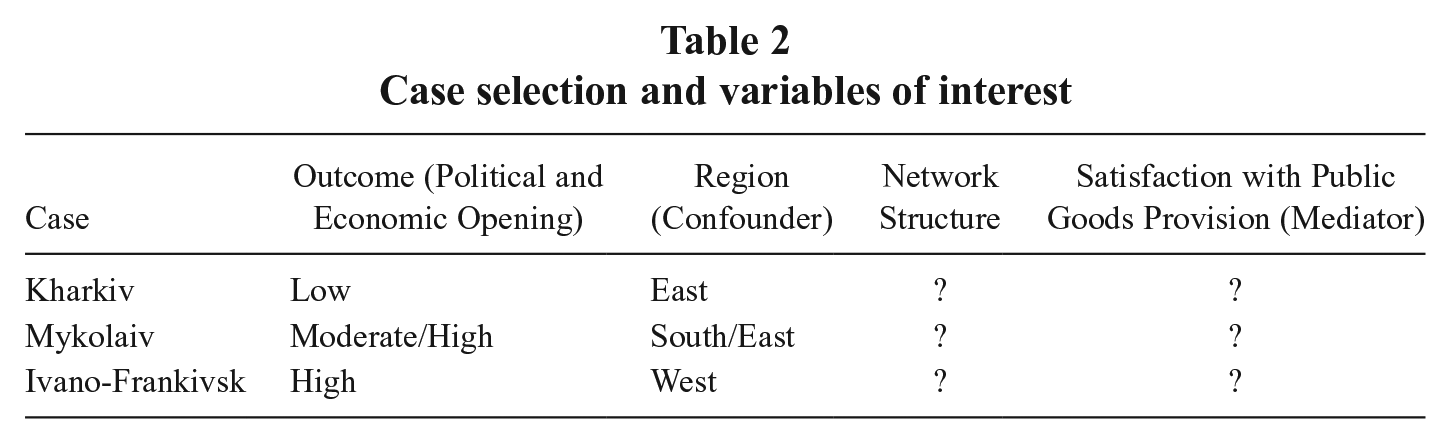
We chose the following cases: Kharkiv, a city in the east with a low level of political and economic opening; Mykolaiv, a city in the east with a relatively high progress towards opening compared to the other cities and regions in this part of the country; and Ivano-Frankivsk, a city in the west of the country that has experienced a relatively high degree of opening in recent years.
Measuring Opening
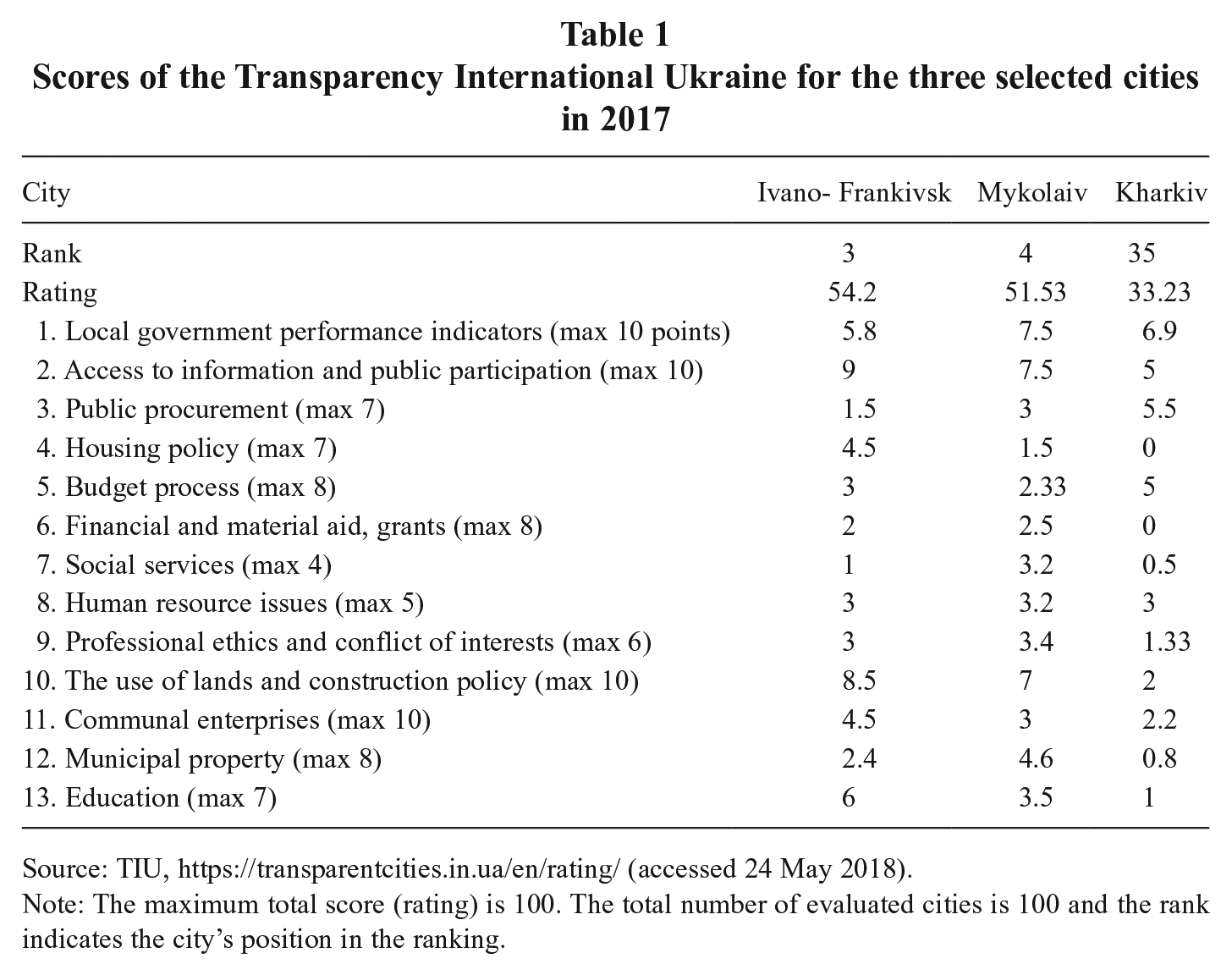
We operationalize opening, our main outcome (dependent) variable, with the help of the regional transparency and openness scores for 2017 provided by Transparency International Ukraine (TIU). 46 The TIU’s openness and transparency index includes evaluation of the information shared by the local governments with citizens and best practice procedures to ensure access to services and funds. They are grouped into 13 categories, each of which contains scores on several criteria (in total 91 different objects of assessment). The evaluations were conducted by TIU experts, primarily through the analysis of official websites, and were supplemented by other methods of data collection such as responses to a letter of inquiry, Internet data, and analysis by the research team. 47
This index is not a perfect measure of openness as it is mainly based on the availability of information online and does not include other potential channels of information that could be used by the local authorities and citizens. However, it evaluates the existence of well-defined procedures (see the Supplemental Material for details) and is a comprehensive proxy of openness as it deals with different aspects of access to politics and economy (see Table 1). Therefore, the index scores come very close to the conceptualization of open access to public organizations. 48
Scores of the Transparency International Ukraine for the three selected cities in 2017
Source: TIU, https://transparentcities.in.ua/en/rating/ (accessed 24 May 2018).
Note: The maximum total score (rating) is 100. The total number of evaluated cities is 100 and the rank indicates the city’s position in the ranking.
In 2017, Mykolaiv was one of the leading cities in terms of transparency and openness, ranked fourth in the country. Kharkiv, by contrast, scored relatively low, ranked 35th among Ukrainian cities. These two cities are comparable in terms of GRP: Mykolaiv and Kharkiv had a GRP per capita of between 40,000 and 45,000 UAH in 2015. Furthermore, in broad terms the industrial and economic structure in each region is similar. After selecting two economically similar cases in eastern and southern Ukraine that varied in terms of their degree of openness or transparency (Mykolaiv, relatively high, and Kharkiv, low), we then identified a region in the west of Ukraine that shows similar levels of transparency as Mykolaiv. Using again the composite indicator provided by TIU, we selected Ivano-Frankivsk for our third case. Ivano-Frankivsk scores high on openness and transparency and ranks third in the country. We present details on the operationalization of the variables, including political and economic opening, in Table 2.
Case selection and variables of interest
For public goods provision, which, following the theoretical discussion above, is an important mediating factor of the effect of network types on opening or stability, we use data from the regular annual survey of citizen attitudes about local governance and municipal services in Ukraine. 49
Mapping Networks: Approach, Sources, and Data Collection
To start mapping political and business networks, we first identify the main political and business figures in the cities. To do so, we rely on a combination of positional and reputational approaches to mapping social networks. The positional approach takes as its starting point the structural (institutional and organizational) positions and looks at the people who occupy these positions. The reputational approach relies on expert information to identify important actors based on their reputation in society and among specialist groups. The combination of positional and reputational approaches is necessary here as neither is sufficient on its own to reconstruct elite networks, also because of the difference between personal political influence and formal office position in the post-communist setting. 50
To identify influential elite members, we constructed lists of potentially influential politicians in the following way: First, we identified the most important structural positions in the cities. These included the positions of mayor, deputy mayor(s), heads of city council committees, as well as the (regional) governor and his or her deputies. For each city, this resulted in a list of twenty-two positions. We then proceeded to identify the individuals occupying each of these positions by consulting the official websites of the following institutions: City Council of Kharkiv, Regional State Administration of Kharkiv, City Council of Mykolaiv, Regional State Administration of Mykolaiv, City Council of Ivano-Frankivsk, and Regional State Administration of Ivano-Frankivsk. 51 With regard to the business figures, we applied the positional approach by identifying the persons that held the (informal) positions of largest taxpayers, largest employers, and owners of the largest fortunes (wealth) in the cities.
The resulting lists of politicians and business figures were then assessed using the reputational approach via fifteen expert interviews. Thirteen local experts 52 (four in relation to Kharkiv, five in relation to Mykolaiv, and four in relation to Ivano-Frankivsk) agreed to give an interview or responded to our questions in writing (the List of Interviews is provided in the Supplemental Material). As information about elite networks is very sensitive, the identity of most interviewees is not revealed. 53 To triangulate the information from interviews we used other sources available online, such as the main regional newspapers, country search tools, and e-declarations. 54
Empirical Results
In this section, we present the empirical results of our study. The analysis is organized by city, and for each city we analyze the links between politics and businesses. General information about the cities and a more detailed mapping of each of their political and economic elites can be found in the Supplemental Material.
Kharkiv: Links between Politics and Business
There are strong indications that there is a significant overlap between politics and business in Kharkiv. We found evidence of the existence of one strong network of political figures at the city government level. Members of that network are using their political and administrative positions to extract resources or to promote their business interests. The dominant network is concentrated around the mayor, Hennadiy Kernes, a key political and economic player in the city.
The majority of civil servants and city council deputies are from the political party led by Kernes—Za Kharkov, za Vozrozhdenie (For Kharkiv, for Re-birth). In addition to his support within the city council, Kernes is believed to be well connected to national-level political figures (see Supplemental Material). Interestingly, interviewee 1 emphasized that Kernes is a political entrepreneur who “has changed his political orientation drastically over the years”: he supported Yushchenko during the protests in 2004, to later join the opposition of Yanukovych’s Party of Regions, to again change his allegiance in 2014 and support the new authorities in Kyiv (interviewee 3).
The ownership structure of the assets of the mayor and his predecessor, Mikhail Dobkin—and the people linked to them—shows strong patronage links. Through these links, the family and friends of the mayor benefit from city resources. Family networks also allow politicians to hide their businesses by registering them under the names of wives and children. Interview 3 mentioned that entrepreneurs outside of these networks are afraid to become visible so as not to fall under the influence of the mayor. Conversely, if they do get involved in business activities, it is because they have an agreement with him. This seems to be relevant mostly for small and medium enterprises and in areas where a permit from the city council is needed for a business to operate. There are entrepreneurs in the city and the Kharkiv region that function without the support of the Kernes-Dobkin group (e.g., Oleksandr Yaroslavsky, Vsevolod Kozhemyako), albeit not always without problems.
We found that it is very common for entrepreneurs to serve in political positions, be it in the city council, regional council, or at the national level. Because entrepreneurs have access to politics at different levels, their political affiliation does not need to align with the mayor. Moreover, some entrepreneurs have clashed with the Kernes group in the past and are presented as his potential opponents in the next city elections (e.g., Oleksandr Feldman, Aleksandr Davtyan).
Thus, while the political network at the city level is tight and dominated by the mayor and his group (mostly linked to the Party of Regions or its later incarnations), the political constellation at the regional level is different. The regional administration is dominated by the Petro Poroshenko Bloc (PPB). However, our interviewees suggested that the regional administration has given informal consent to Kernes’s continued dominance, since he has taken a pro-Ukrainian stance since the conflict with Russia erupted.
The main conclusion of our analysis of networks in Kharkiv is that a pyramidal network intertwining politicians and businesses around the mayor dominates the city government, although this network does not unite all businesses. Apart from the Kernes-Dobkin aligned businesses, there is a broader range of competing businesses in the city. However, other entrepreneurs (e.g., Davtyan and Feldman) are not necessarily connected to each other, so we cannot say that they form a distinct and different network. Yet the majority of entrepreneurs not affiliated with the mayor’s network also perform political functions at different levels of government and represent different political parties, and as a result have the opportunity to use political influence to protect their business interests.
Mykolaiv: Links between Politics and Business
Summarizing the relations between politics and businesses in Mykolaiv, one interviewee noted that there are no politicians in the strict (“European”) sense of the word in the city. This means that politicians do not use their political functions to represent the citizens, but instead they represent “the interests of business/industrial informal clans.” Our analysis of the political and business structure of elites to a large extent aligns with this view. There is, however, pluralism and competition between different businesses and different political parties, so the picture that emerges is very different from the more centralized, single-pyramid political network in Kharkiv.
In local and regional politics, there is competition between different parties and interests. The city council, dominated by the Opposition Bloc, largely controls the city level politics and competes for influence with the regional institutions dominated by PPB. The elected mayor, Oleksandr Senkevich, is a representative of Samopomich and suffers direct attacks to his position from the Opposition Bloc and from the governor Oleksiy Savchenko, representing PPB. The conflict between Senkevich and Tetyana Kazakova (PPB) on the city level and Savchenko (PPB) on the regional level can be seen as an extension of the conflict between Poroshenko and Andriy Sadovyi on the national level (from PPB and Samopomich respectively). Interviewee 7 confirmed that this competition on the national and personal level considerably influences local-level politics. This political conflict in Mykolaiv, however, can only be understood when considering the role of businesses in the city.
Individuals identified as important political actors were also mentioned by our interviewees as having business interests or previous business careers in the city. Senkevich entered politics after becoming a successful entrepreneur in the IT sector (interviewee 7). Savchenko is, allegedly, the richest governor in Ukraine. 55 Before he joined regional politics, Savchenko was involved in the banking business. He established Partner Bank in 2006 and managed multiple other banks (Asia Universal Bank, Konversbank, and Avant Bank). Interviewee 6 mentioned that Savchenko was appointed to the post of the governor of Mykolaiv region to promote his business interests and the business interests of the other members of PPB. Kazakova too came to politics after developing her business assets. She used to own a large shopping mall in Mykolaiv called Yuzhnyi Bug (interviewees 5 and 8). City council members have strong business links as well: for example, Konstantin Kartoshkin, a city council member from PPB, is the director of Zorya-Mashproekt. This is a state corporation that has been producing marine gas turbines since 1946 and has been a part of the Ukroboronprom (association of enterprises in sectors of the defense industry of Ukraine) since 2010.
As in the political sphere, there is no single network in the business sphere of Mykolaiv. There are several large sectors in which businesses operate and they form multiple strong interest groups (see Supplemental Material). These interest groups are represented in or have links within local, regional, and national politics, while being associated with different political factions. Most of the influential entrepreneurs have been or are active in politics. Moreover, people who occupy political positions often originate from the business world. This shows that the political and business spheres overlap to a large extent and that multiple business interests dominate and dictate politics rather than the other way around. Finally, the political competition reflects the structure of the economy of the city and the business groups that operate in the main sectors: the harbour, ship-building, and agricultural production.
Ivano-Frankivsk: Links between Politics and Business
Our analysis of political and business elites in Ivano-Frankivsk shows that there is a strong relationship between business and politics. The relationship, however, does not seem to be structured in a single network. Almost all major business owners we identified (current or past) are also linked to local, regional, or national politics (as city council members, governors, or national parliament members). However, they belong to different political parties. Yet many of them, according to our interviewees, benefit from their positions, irrespective of their particular political affiliation. For example, the governor, Oleksandr Shevchenko, from PPB, allegedly benefits from road construction contracts (interviewee 13 on the basis of Prozorro data). However, other contracts are distributed to members of the city council belonging to Svoboda and their family and friends, linked to companies such as Vambut and Yarkovitsya. Another interviewee similarly believes that politics and businesses always go hand in hand in Ivano-Frankivsk. Moreover, in their opinion there are no political cleavages between elites. Different politicians and businessmen are rarely in conflict and if there is some issue between them, they try to resolve it without publicity. To summarize, politicians use their positions to pursue business interests and most of them began their careers as entrepreneurs.
In contrast to the situation in Kharkiv and Mykolaiv, there is no one group of politicians restricting access to business activities. So even though the party Svoboda allegedly uses its power within the city council to allocate public tenders to its preferred companies, this does not mean that all businesses are affected by this or that other businesses can operate only when connected to these sources of power. Moreover, businesses seem to be engaged with citizens more closely than in the other two cities that we have analyzed. The platform Teple Misto involves multiple companies in projects proposed by the citizens of Ivano-Frankivsk. As part of the Teple Misto initiative, citizens renovated and restructured an old factory space to be used as a centre for innovation, culture, and co-working. Interviewee 11 mentioned that such cooperation between civil society and businesses intensified after the Euromaidan. In addition, interviewees agreed that most of the local businesses, apart from the construction ones, are small and medium-sized enterprises: IT companies, hotels, bakeries, and dairy production. Their presence shows that business initiatives and activism are not heavily constrained by politicians.
Networks and the Provision of Public Goods
The networks we discovered in the three cities differ in terms of several key characteristics discussed above. Kharkiv is a case with a single-pyramid network clearly bringing political and economic power together, but only on the city government level. The networks in Mykolaiv and Ivano-Frankivsk are more diffuse. While in Mykolaiv there is competition between several different centers of political and economic power linked to particular business sectors, relations between businesses and politicians in Ivano-Frankivsk resemble a pluralistic system, albeit a restricted one. What is common in all three cities are the strong connections and overlaps between business and politics: politicians and high-level officials either own businesses, have done so, or transferred their property to family members. There are also some differences: the balance between business capturing city government or politicians creating businesses to convert their political influence to personal gain is different in the three cities.
The next question that we ask is whether the different types of network structure make a difference in terms of citizen satisfaction with the provision of public goods or in terms of more openness and transparency. As explained in the theoretical section, quality provision of public goods and services is not only a mark of open access orders, but also a mediating factor potentially influenced by network structure and influential in its own right on the progress towards the establishment and consolidation of an OAO.
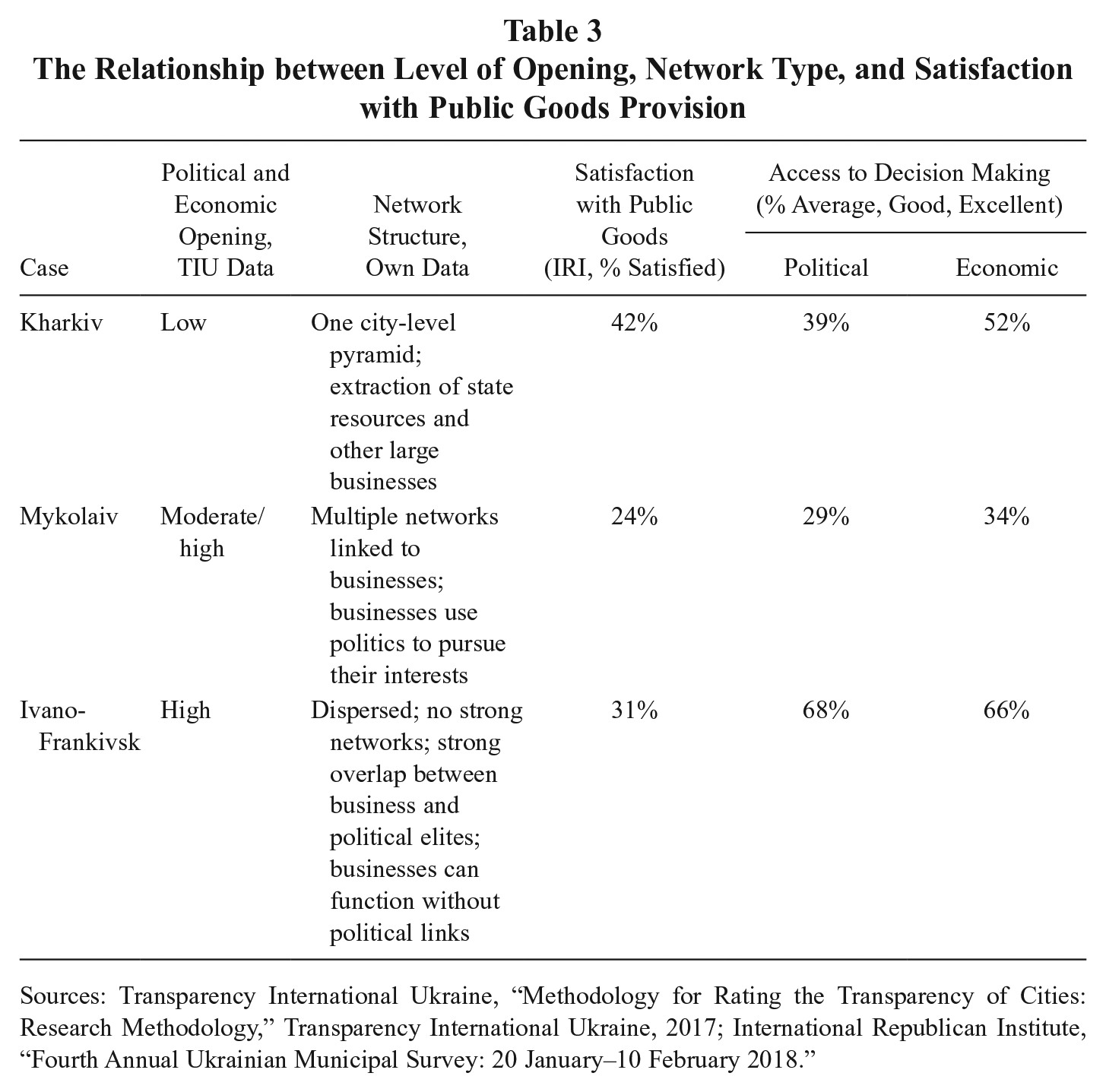
We set the type of network next to these outcome and mediating variable indicators in Table 3 using the International Republican Institute (IRI) survey. 56
The Relationship between Level of Opening, Network Type, and Satisfaction with Public Goods Provision
Sources: Transparency International Ukraine, “Methodology for Rating the Transparency of Cities: Research Methodology,” Transparency International Ukraine, 2017; International Republican Institute, “Fourth Annual Ukrainian Municipal Survey: 20 January–10 February 2018.”
The average score of the quality of public goods and service provision in Kharkiv is among the best in Ukraine, while Ivano-Frankivsk is at the mean level and Mykolaiv is among the worst in the country. 57 In three-quarters of the indicators, the highest percentages for provision of services as good or excellent are in Kharkiv. In seven of those, a majority of respondents in Kharkiv thought that provision was good or excellent: trash collection, sewage, transportation infrastructure and public transport, street lighting, street markets, public parks and gardens, and heating. For the vast majority of indicators, the respondents from Mykolaiv were the least happy. A more detailed breakdown of satisfaction in provision of specific public services for each city is provided in Table 1S in the Supplemental Material.
In all three cities, respondents believe that the main obstacle preventing businesses from coming to their city is corruption. 58 A minority of citizens believes that the mayor of their city is making an effort to combat corruption: a mere 6 percent in Mykolaiv, 19 percent in Kharkiv, and 22 percent in Ivano-Frankivsk, although the latter is actually the best result for Ukraine. 59
In Mykolaiv, citizens are not happy with either the local authorities or the public goods and services. The highly negative perceptions of opportunities to engage in entrepreneurship or attract new business are likely an indicator that the dominant businesses limit opportunities for others. Similarly, regional politics is dominated by national-level politics, so officials may be more focused on Kyiv than on the local population.
We know that public goods can be provided quite well by developed LAOs with strong dominant coalitions. 60 Responses from Kharkiv seem to indicate that the dominant coalition of politicians and entrepreneurs is successful in providing public goods while at the same time extracting rents from businesses, as indicated in our interviews. By contrast, transparency and input in decision making are perceived as low in Kharkiv.
Finally, Ivano-Frankivsk appears to be more transparent and allow more input in decision making, which perhaps reflects the city’s dispersed networks and lack of clear dominant coalitions. Although respondents think the mayor could do more to tackle corruption, they are more positive about the progress that has been made than in the other two cities. Nevertheless, the absence of a dominant coalition does not automatically mean public service provision is going to improve dramatically, as seen in Ivano-Frankivsk’s consistent, but average performance in the eyes of local citizens.
On the basis of these data, we can identify some contrasting trends in public satisfaction with public goods that provide food for further reflection. Citizens are satisfied with the city council and mayor in both Kharkiv and Ivano-Frankivsk, while in Mykolaiv there is far greater dissatisfaction. Respondents in Ivano-Frankivsk believe that they can influence decision making to a much greater extent than respondents in Kharkiv and Mykolaiv, which is once again the laggard of the three. However, respondents from Kharkiv are highly positive about the public services that they receive from the local authorities, even if they do not always feel they have a say over decision making. Corruption is still seen as a problem by citizens in all three cities, with respondents from Mykolaiv once again being the most pessimistic. Altogether these patterns do not support the expectation that citizens would be unsatisfied with the provision of public goods and services when there is a single network of political and economic elites running the city.
Conclusion: Networks and LAOs
The detailed empirical study of three regional cases presented in this article presents unique network data and some avenues for further research. In some ways, our results contradict expectations of existing studies, while in others they provide an illustration of general frameworks. Generally, even though we discover differences in how the networks are structured in the three cities we focused on, we find little evidence as yet that these differences are systematically related to the likelihood of political and economic opening. This might reflect the lack of strong and systematic connection between the two, at least in the case of Ukraine. But before we conclude that network structure at the local level is not associated with progress towards political and economic opening, we should note the data limitations that network analysis faces.
The nature of this study makes access to information especially difficult. This is not only an issue in our data collection but also a broader problem when studying political and economic networks. In nondemocratic regimes or LAOs, ties between political and economic elites are central, yet informal. Relationships of privilege, patronage, and control are rarely public, and even when they are “known,” they remain nearly impossible to capture with high level of precision and certainty. Moreover, political and economic elites actively protect the secrecy of their interconnections so that even people who are aware of such links often do not want to share information. In sum, the absence of evidence for dense links between political and economic elites does not imply that such links are absent. By the same token, we need to be cautious when making statements about the presence of these links. That being said, since we compare three regions within the same country using the same methodology, the relative differences in the networks are still informative.
Keeping in mind our restricted ability to extrapolate our findings to other cases, our analysis provides the following answers to the questions that drove our study: (1) close relationships and overlap between political and economic actors are prevalent in all three cases; (2) there are different types of relationships between the local and economic elites: single-pyramid political elites can be the owners of businesses and heavily restrict the functioning of other businesses (Kharkiv), political elites might be dependent on and used by multiple business networks (Mykolaiv), and multiple political networks might be also business owners without heavily restricting competition (Ivano-Frankivsk); (3) networks can be heavily centralized (Kharkiv) or fragmented (Mykolaiv and Ivano-Frankivsk); and (4) local actors can function in relative independence from the central government (Kharkiv) or can be linked to diverse political fractions at the central level that represent their interests (mainly Mykolaiv, but also Ivano-Frankivsk).
In more detail, our study of political and business networks in the three Ukrainian cities revealed that different shapes and types of networks exist on the local level. We have established that on the local government level in Kharkiv there is one dominant coalition that uses political power to extract state resources and control the business sphere. On the regional level in Kharkiv we identify a competing political network and businesses aligned with it, but at the moment, most likely due to an informal agreement, the two coexist. These lasting networks, and especially the local one around the mayor, seem to provide a relatively high level of public services, which ensures reasonable citizen satisfaction. In this respect, the situation in Kharkiv illustrates well the case of a mature natural state 61 with well-developed but restricted access to resources, controlled by a dominant coalition.
By contrast, Mykolaiv looks like a case of an LAO with multiple dominant coalitions: large businesses—both legal and illegal—with their own political protection at different levels of government. Meanwhile, the analysis of the networks of Ivano-Frankivsk indicates that this is a city without a clearly defined dominant coalition and therefore with the least limited access. However, although businesses do not necessarily need to participate in politics to maintain their rights of access to economic life, being in politics gives an advantage to particular businesses, indicating that these rights of access are not completely impersonal.
Since we do not find univocal evidence for strong effects of network structure, the question of what can account for the varying trajectories of the three regions remains. Among the many alternative explanations, some are more plausible than others. The differences in political culture between East and West Ukraine seem to be insufficient as an explanation: some regions in the east of the country have achieved roughly comparable levels of opening as those in the West, and citizen satisfaction with services can be equally high. The economic importance of the region as such also does not seem to be directly related to opening, but the economic structure of the region might be (see below). The ability of the local leaders to attract resources from the centre, and the embeddedness of local networks into national ones more generally, might play a role in explaining both the varying stability and fragmentation of networks and their effects on governance and opening. These different networks interact with limited access economic and political orders in different ways and have different consequences for public goods provision. We highlight two other findings that suggest promising avenues for further research.
First, we suggest that the type of networks that have developed and the extent of overlap between politics and business are related to the kind of resources available in the sectors in which the businesses operate. The difference between local economies dominated by large businesses focused on few commodities and more diversified economic landscapes where different sectors contribute to the economy are significant for the number of influential networks that exist. These differences might be exacerbated by the economic opening of Ukraine as a whole to new trading partners, such as the European Union, which might empower new economic and social actors and import different ideas about municipal and economic governance. 62
In Mykolaiv, for example, multiple business networks form dominant coalitions that use politics to advance their businesses. The overlap between businesses and politics is almost complete while access to politics and business activity is rather limited. Dominant coalitions appear to be in equilibrium, and citizens in general have few opportunities to participate in politics and the market. In Ivano-Frankivsk, we see that multiple actors can operate in the economic and civil spheres independently from the political sphere, although those in power still use their positions to advance their business interests. The seemingly higher level of independence of businesses from political elites makes the case of Ivano-Frankivsk the closest to potential opening.
Therefore, the cases of Mykolaiv (with its large agriculture, harbour, and ship-building business networks) and Ivano-Frankivsk (with a big construction business but also small size enterprises) show that presence of multiple networks might be a necessary condition for opening and ultimately for transition to OAO, but is not a sufficient one. Overall, LAOs appear to be resilient to different structures of networks of political and economic elites. What might make a difference, however, is not the multiplicity of networks but difference in kind. The case of Ivano-Frankivsk shows that the scope of actors that are able to access political and business resources is broader: the networks are more inclusive to civil society, to small businesses, and to actors of different political affiliations.
The case of Kharkiv shows that a system based on a single-pyramid network where local government elites extract resources from the state and limit access to politics and to the market to a high degree can deliver public goods effectively. Moreover, as a result, it can enjoy high levels of citizen satisfaction. Citizen satisfaction with the delivery of public goods might explain the stability of such systems. By comparison, the case with the largest number of independent actors and multiplicity of networks, Ivano-Frankivsk, shows better results in terms of satisfaction with public services than the other multiple network case, Mykolaiv. This provides cause for cautious optimism that cases where more universal access to political and market institutions is provided will also fare well and provide citizens with public goods if the involvement of multiple actors continues. But the findings also exemplify the complex dynamic between opening and governance capacity, which has been noted at the state level too. 63
Supplemental Material
Supplementary_material_When_Business_and_Politics_Mix_R1 – Supplemental material for When Business and Politics Mix: Local Networks and Socio-political Transformations in Ukraine
Supplemental material, Supplementary_material_When_Business_and_Politics_Mix_R1 for When Business and Politics Mix: Local Networks and Socio-political Transformations in Ukraine by Honorata Mazepus, Antoaneta Dimitrova, Matthew Frear, Dimiter Toshkov and Nina Onopriychuk in East European Politics & Societies and Cultures
Footnotes
Acknowledgements
This work was supported by the European Union’s Horizon 2020 research and innovation programme under grant agreement no. 693382. This article reflects solely the views of the authors, and the European Commission is not responsible for any use that may be made of the information it contains. We would like to thank Tetiana Kostiuchenko and Wojciech Konończuk for their helpful comments and for acting as our first expert interviewees at the early stages of research. Moreover, we would like to thank all interviewed local experts and those who connected us with them. We thank the editors and anonymous reviewers for their helpful comments.
Author contributions
HM & DT designed the study with contributions from AD & MF. HM coordinated data collection, NO collected most interview data with contributions from HM, AD, and MF. HM conducted data analysis with support from NO. HM interpreted the results and wrote most of the paper with major contributions from AD, contributions from MF & DT, and support from NO.

Notes
Supplementary Material
Please find the following supplemental material available below.
For Open Access articles published under a Creative Commons License, all supplemental material carries the same license as the article it is associated with.
For non-Open Access articles published, all supplemental material carries a non-exclusive license, and permission requests for re-use of supplemental material or any part of supplemental material shall be sent directly to the copyright owner as specified in the copyright notice associated with the article.
