



Abstract
Gang activity presents a serious risk to many communities across Canada. The prevalence of gang violence has prompted the creation of a variety of prevention, intervention, and suppression efforts. The current study reviews existing intervention approaches, with a particular focus on those targeting high-risk and gang-entrenched individuals, and situates a new intervention and exiting program within the current gang control framework. An overview of findings from a recent evaluation this program – which uses a joint civilian and police officer case management approach – is presented. The process and impact evaluation findings suggest the approach may be an effective strategy for reducing gang involvement, and provide insights for best practices and implementation considerations for policymakers with respect to gang reduction efforts more generally. Key recommendations include maximizing risk and needs assessments, better use of formal case plans, and streamlining staff roles.
Introduction
Many communities face increased risks and heightened fear due to gang activity and gang-related violence. Gang-involved individuals are at greater risk for negative outcomes such as substance use, low educational attainment, poor mental health (e.g., depression, anxiety), and higher rates of self-reported crime and incarceration (Bacak et al., 2022; Bjerregaard, 2010; Gilman et al., 2014; Pyrooz et al., 2014). Those involved with gangs are more likely to be involved in drug-related crimes, weapons offenses (e.g., weapons possession), and violence (Bjerregaard, 2010; Gaston et al., 2022; Melde et al., 2009; Sanchez et al., 2021). Specifically, individuals associated with gang activities face an increased likelihood of violent victimization, as well as violence perpetration, with a particular risk of homicide (Sanchez et al., 2021; Statistics Canada, 2023). Furthermore, gang activity often occurs in community spaces, significantly undermining public safety (Dunbar, 2017) and prompting the creation of gang control strategies.
Gang control strategies typically focus on one of three main goals: prevention (preventing individuals from joining gangs entirely), intervention (intervening with those at risk of or actively involved with gang life to reduce the risk of further involvement), or suppression (punishing or deterring gang activity via law enforcement strategies) (Howell, 2010; Huff, 2002; Klein & Maxson, 2006). When individuals develop gang connections or become more deeply entrenched, the goal for reducing their involvement shifts from prevention to intervention, often with a focus on removing those individuals from the gang and severing their gang ties. Given the complexities involved with the process of dissolving gang relationships and fostering meaningful desistance from gang activities, intervention and exiting programs may require specific and unique approaches (Decker et al., 2013; Pyrooz & Decker, 2011). The current study provides a comprehensive synthesis of the literature on gang exit programs and describes an innovative Canadian program targeting entrenched gang members and those at elevated risk of involvement. The study also presents findings from a rigorous evaluation of the program and offers evidence-based recommendations for program optimization and best practices in gang exit programming.
Gang Entry and Entrenchment
The process of joining and becoming entrenched in gang life is often complex due to the many risk factors and intricate interactions among factors that influence an individual’s decision-making with respect to gang involvement (Decker et al., 2013). These risk factors span multiple spheres and are typically categorized into individual, peer, family, and community domains. With respect to individual characteristics, low socioeconomic status, exposure to violence or drugs, low school commitment or performance, school suspension or expulsion, favorable attitudes toward gangs, adherence to the ‘code of the street’, delinquency, aggression, and other problem behaviors are predictive of gang entry (Chu et al., 2015; Esbensen et al., 1993; Gordon et al., 2004; Merrin et al., 2020; O’Brien et al., 2013; Peterson & Morgan, 2014; Pyrooz et al., 2019). In addition, the risk of recruitment and gang entry may also be higher among those experiencing symptoms of psychological distress (e.g., depression; Chalas & Grekul, 2017; Li et al., 2002; Merrin et al., 2015; Wojciechowski, 2021).
Family and peer influences may also be relevant, with family members and peers serving as behavioral models and in some cases introducing the gang lifestyle (Decker & Curry, 2000; De La Rue & Espelage, 2014; De Vito, 2020; Merrin et al., 2015). Peers are especially influential in the gang entry process, including exposure to peers involved in substance misuse and violence (Merrin et al., 2015; Peterson & Morgan, 2014); additionally, gang members have often reported joining because their friends were involved, to make new friends, or to impress girls (Chalas & Grekul, 2017; Chu et al., 2015; Decker & Curry, 2000). Furthermore, the community environment may also raise the risk of gang entry; areas with higher levels of social disorganization increase the likelihood of exposure to delinquent peers, trauma, victimization, and negative family dynamics, which in turn can increase the likelihood of deviant behaviors and foster an environment conducive to gang activity (Merrin et al., 2015; Smith et al., 2019).
Gang Desistance and Disengagement
The gang membership process follows a similar trajectory to general criminality as detailed by the life-course criminology framework, with periods of onset, persistence, and desistance (Pyrooz et al., 2010; Weerman et al., 2015). Desistance or disengagement from gang life may be characterized as a gradual weakening of gang-related social ties, but not necessarily full severance of these connections (Decker et al., 2013; Pyrooz & Decker, 2011). As well, though a reduction in criminal behavior should accompany gang desistance, it should not be the sole consideration for successful gang desistance as crime may occur in the absence of connections to gang-involved peers.
The desistance process involves five main stages, including triggering (i.e., the turning point or event that elicits the initial desire to leave gang life), contemplation (i.e., consideration of the feasibility of leaving, weighing the pros and cons of staying and leaving), exploration (i.e., consideration of alternative lifestyles and searching for opportunities for lifestyle change such as securing employment), exiting (i.e., formally leaving the gang), and maintenance (i.e., maintaining the decision to exit and not return; Berger et al., 2017). An individual’s specific trajectory and how they progress through the stages of desistance are directly related to their degree of gang embeddedness (Pyrooz & Decker, 2011; Pyrooz et al., 2013). Gang embeddedness refers to how immersed an individual is within the gang, the strength of their connections to other members, and their level of involvement in gang activities; those with stronger ties and greater immersion are more deeply embedded (Egan & Beadman, 2011; Pyrooz et al., 2013). Gang involvement can be transient or persistent; those who are more deeply embedded are more likely to persist with gang involvement over time compared with someone who is not as deeply embedded within their group (Pyrooz et al., 2013). As such, embeddedness is a critical factor to consider in the desistance process and will influence the reasons and motivations that may have a role in desistance decisions.
An individual’s motivations and methods for leaving the gang lifestyle can vary and shift during the disengagement process (Pyrooz et al., 2013; Roman et al., 2017). Factors that can trigger the initial decision to desist include traumatic or more generally negative experiences, such as losing a friend or family member, facing legal consequences, becoming disillusioned with the lifestyle, growing tired of being targeted by the police, and not wanting to be victimized by other gang members (e.g., Berger et al., 2017; Carson et al., 2013; Pyrooz & Decker, 2011; Roman et al., 2017). Other factors may encourage the transition to a more prosocial lifestyle, such as familial responsibilities, becoming a parent, establishing romantic relationships, support from family or friends, increased employment responsibilities or changes, moving to a new home, or strengthening positive peer influences (Berger et al., 2017; Pyrooz & Decker, 2011; Pyrooz et al., 2013; Roman et al., 2017; Weerman et al., 2015). Some desistance experiences include a combination of negative and positive triggering factors, such as experiencing an opportunity to be separated from the gang (e.g., via arrest or hospitalization), and receiving support and encouragement from prosocial sources to disengage (Berger et al., 2017).
Gang Violence Prevention and Intervention Strategies
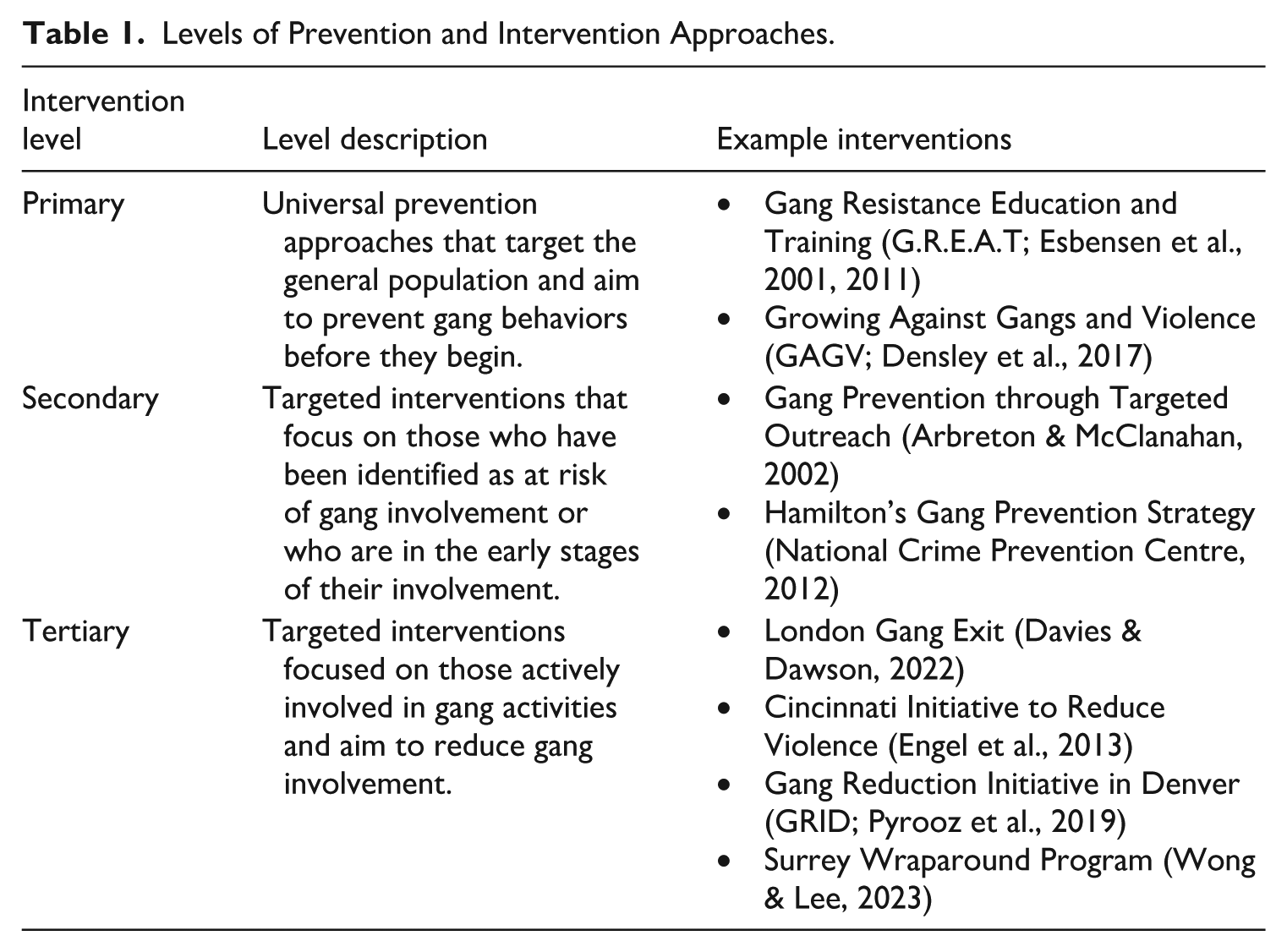
Gang violence prevention and intervention strategies can be broadly categorized into a three-tiered framework which includes primary, secondary, and tertiary categories (Table 1).
Levels of Prevention and Intervention Approaches.
Primary and Secondary Prevention Strategies
Primary strategies, also referred to as universal prevention approaches, attempt to address the problem before it occurs; these programs are typically targeted toward the general population (Esbensen, 2000; Howell, 2010). In the context of gang control, programs tend to focus on increasing awareness about gang-related issues and the dangers gangs present, with the intention of preventing anyone from becoming involved with gangs (Gravel et al., 2013). The school-based Gang Resistance Education and Training (G.R.E.A.T) program is one of the most widely known prevention programs (Esbensen et al., 2001, 2011). G.R.E.A.T. engages uniformed police officers to teach students about the harmful consequences of gang involvement, regardless of individual student risk level for involvement (Esbensen et al., 2001, 2011).
Secondary prevention programs target populations who have been identified as at risk of gang involvement or who are in the early stages of their involvement (Esbensen, 2000; Hennigan et al., 2015). For example, the Gang Prevention Strategy implemented in Hamilton (Ontario, Canada), screens youth using the Self Discovery Quiz; those who score −45 or below on the negative quiz components are deemed ‘at-risk’ for gang involvement and are eligible to participate in the program (National Crime Prevention Centre, 2012). The Gang Prevention Strategy aims to increase youth awareness of gang activity, increase prosocial and protective factors, and reduce risk factors for gang involvement. Those admitted to the program are connected with a coach, meet with their coach at least once per month, and participate in at least 1 hr of services per week for the program duration of 6 months.
Tertiary Intervention Strategies
Tertiary strategies focus on individuals who are already actively engaged in gang activities; the aim is typically desistance and disengagement (Esbensen, 2000; Gravel et al., 2013). These efforts can take several different approaches but often involve providing prosocial alternatives to gang activities and attempts to reduce the negative risk factors which influence gang-related behaviors (Gravel et al., 2013). For example, the Gang Intervention through Targeted Outreach program targets youth already exhibiting gang behaviors and uses a case management approach to provide specific services (e.g., drug treatment, tattoo removal, employment training), in combination with participation in a collaborative community project to reduce identified risk factors and increase prosocial supports (Arbreton & McClanahan, 2002). Other programs have focused their risk reduction efforts more specifically on skill development, such as employment, vocational, and education skills. For example, the Teens in Transition program was designed for gang-affiliated youth and provided opportunities for summer jobs and life skills training (Allen, 2016).
The Wraparound Approach
Tertiary intervention may also include programs that adhere to the Wraparound model (e.g., Fast & Snyder, 2014). The Wraparound approach links gang-involved youth and their families with services to address their specific risks and needs, using a holistic and youth-centered approach (Bruns & Walker, 2004). For example, the Surrey Wraparound program (delivered in British Columbia, Canada) targets high-risk and gang-involved youth younger than age 18 who are registered in the local school district (Wong & Lee, 2026). The program is a partnership between the local school district and police agency, and uses both civilian staff and police to connect with youth. Staff also work closely with others involved in the youths’ care such as teachers, school administrators, probation officers, and family members. The program pairs youth with a case manager who facilitates individualized services (e.g., counseling, family supports, education supports, recreational activities, employment opportunities) to maximize their strengths and natural support systems and reduce their risk factors and risky behaviors. Evaluation findings suggest the program interrupted the upward trajectory of participants’ criminal behavior, with rates of negative police contact remaining constant post-program entry for approximately 18 to 24 months (Wong & Lee, 2026).
Similarly, the London Gang Exit program uses a wraparound approach that includes one-on-one mentoring, as well as bespoke access to specialist services regarding education, training and employment, emotional well-being, family and community, and housing (Davies & Dawson, 2022). The Wraparound model can also address complicated needs of specific populations, for example, the Regina Anti-Gang Services Project targets gang-involved Aboriginal youth (Totten & Dunn, 2011). The program uses a combined approach informed by the Wraparound model and Multisystemic Therapy to provide comprehensive and intensive supports for youth, such as counseling, gender-specific programming (e.g., support for females exiting the sex trade), cultural, traditional, and faith-based supports (e.g., support from Elders, church-based activities), relocation, and skill-building (e.g., literacy, parenting, problem-solving). Results of a process and impact evaluation were mixed, but suggest that short-term gang affiliation, beliefs supporting aggression and retaliation, and violent and nonviolent behavior were positively impacted by program participation. Approximately 68% of participants disengaged from gang life for at least 4 weeks (up to 61 weeks or more), and 15% attempted to disengage (Totten & Dunn, 2011).
Suppression Programs
The tertiary category also includes strategies focused on the suppression or deterrence of gang activity. These programs typically involve law enforcement and work to address current gang activity in the community. For example, the Cincinnati Initiative to Reduce Violence uses a focused deterrence approach through law enforcement and community-based services to reduce gang-related homicide and gun violence (Engel et al., 2013). Another well-known suppression program is Boston’s Operation Ceasefire, a problem-oriented policing approach which targets firearms trafficking and aims to reduce gang-related violence (Braga et al., 2001, 2014). The program includes participation from community organizations, parole and probation officers, and other law enforcement members to instill the message that further gang violence will not be tolerated and that all legal measures will be pursued to ensure accountability and control. Reducing the opportunities for gang-related activities may provide members with reasons to leave and discourage them from joining or remaining in the lifestyle (Weerman et al., 2015).
Comprehensive Programs
Programs that consist solely of tertiary intervention may not be sufficient to fully address or sustain gang control efforts (Fast & Snyder, 2014; Gravel et al., 2013). As such, some gang control approaches combine multiple strategies to address prevention, intervention, and exiting in a more comprehensive manner. For example, the Gang Reduction and Youth Development Comprehensive Strategy (GRYD) in Los Angeles (Cahill et al., 2015) involves elements of community engagement (e.g., gun buy-back programs, community education campaigns), prevention (e.g., social services to increase protective factors), intervention (e.g., specific community and social services for gang-involved individuals), and suppression/violence interruption (e.g., incident response).
Key to implementing a comprehensive approach is the inclusion of multiple strategies to achieve the intended goals, such as community mobilization, social intervention, provision of social opportunities, and suppression and social control. These components are embodied by the Spergel model (Fast & Snyder, 2014; Spergel et al., 2006), such as the Mesa Gang Intervention Project (Spergel et al., 2005a) and the San Antonio Gang Comprehensive, Community-Wide Approach to Gang Prevention, Intervention, and Suppression Program (Spergel et al., 2005b). Both programs used a team case management approach including police, probation, youth outreach workers, and intervention specialists. Evaluation findings from the Mesa Project showed positive impacts on participant offending (Spergel et al., 2005a); however, Spergel et al.’s (2005b) evaluation of the San Antonio Program found no significant program effect.
The Gang Reduction Initiative in Denver (GRID) program (Pyrooz et al., 2019) is a newer comprehensive program first developed in 2010. GRID uses numerous prevention, intervention, and suppression strategies through collaboration across multiple agencies, including local, state, and federal government, businesses, and grassroots, community, and faith-based organizations. The program uses evidence-based case management strategies implemented through multidisciplinary teams and street outreach workers, and targets both adolescents and adults. The first phase of GRID is ‘Engagement’, in which a referred individual undergoes an initial review and assessment process. The second phase is ‘Stabilization’, which involves the development of an intervention case plan and regular contact between clients and case managers; this phase lasts 3 to 6 months. Phase 3 is ‘Maintenance’, characterized by regular contact between clients and staff and continued participation in scheduled services (3–6 months). The final phase is ‘Transitioning’, in which clients begin to reach the goals specified in their case plan, contact requirements are reduced, and active disengagement is (theoretically) observed (3 months). In a small pilot evaluation of GRID (including 20 follow-up interviews), results point to reductions in gang status/membership, gang embeddedness, and offending behaviors (Pyrooz et al., 2019). A subsequent outcome evaluation (n = 143) found additional support for the program’s efficacy in reducing violence perpetration among participants (Pyrooz et al., 2023).
The Gang Intervention and Exiting Program
In an effort to add to the exiting evidence base on tertiary gang intervention programs, the remainder of this study focuses on summarzing major findings and recommendations generated from an evaluation of the Gang Intervention and Exiting Program (GIEP). The program is operated by the Combined Forces Special Enforcement Unit of British Columbia (CFSEU-BC), an integrated police unit of 14 law enforcement agencies focused on gangs and organized crime. As part of their tertiary intervention efforts, CFSEU-BC initiated the GIEP in the Metro Vancouver (Canada) region in 2016, targeting individuals who were extremely at risk of or actively engaged in the gang lifestyle. While several gang prevention programs delivered by community organizations or police agencies exist in the region, the GIEP is the only program focused on highly at-risk individuals as well as entrenched gang members, without age or school enrollment restrictions. The GIEP is also unique in that the program is staffed by both civilians and police officers. Although the literature on tertiary gang interventions discusses multiple programs involving the participation of law enforcement, their role is typically in suppression and enforcement. Rarely do police go beyond these roles to offer direct mentorship to program clients. Next, we describe the GIEP, summarize process and impact findings from a comprehensive program evaluation (Lee & Wong, 2025; Wong & Lee, 2025a, 2025b, 2025c), and present recommendations with respect to program optimization for the GIEP and similar tertiary programs in other regions.
The GIEP is an individualized case management program with key objectives to decrease client criminogenic risk factors, increase prosocial associations and activities, and decrease involvement in gang-related activities. The program is staffed by civilian case managers and police officers, and maintains a series of partnerships and regular communication with local law enforcement agencies, police gang units, schools, corrections and probation organizations, the BC Ministry of Children and Family Development, and community service organizations. Eligible clients are aged 12 years and older, live in the Lower Mainland region of BC, and are at high risk of recruitment (e.g., displaying signs of gang activity or are closely connected to others who are known to be gang-affiliated), or actively engaged in the gang lifestyle. The program has four components:
1. Outreach and Promotion. Outreach and promotion activities are intended to increase knowledge and awareness of the program and to generate client referrals. Methods include presentations to students, parents, government and nonprofit organizations, and law enforcement agencies about the myths and realities of gangs, gang recruitment strategies, signs to watch for, and services the GIEP offers. Staff also distribute End Gang Life 1 and GIEP materials and pamphlets at community events, fairs, festivals, and sports tournaments. Further promotional efforts include engaging the media via traditional print, television, and news outlets, as well the End Gang Life Instagram, X, TikTok, and Facebook accounts. In addition, program staff provide consultation and information sessions for community organizations, law enforcement agencies, local service providers, and organizations outside of BC to increase their awareness of the gang landscape and GIEP services.
Client referrals are generated through the GIEP e-mail account and calls to the Gang Intervention and Exiting Helpline, and are typically derived from schools, family and friends, social workers, correctional institutions, probation officers, community agencies, police officers, and through targeted proactive outreach for individuals identified through intelligence sources as potentially eligible for the program. Self-referrals to the program are also common.
2. Intake and Assessment. The GIEP intake process involves an eligibility assessment, background check, and deconfliction with other law enforcement agencies if necessary. Those deemed eligible are assigned to a gang intervention officer and a case manager who explain the benefits of GIEP participation and the services offered. Clients are informed that participation in the program does not result in privilege if criminal offenses are revealed, and that if they wish to provide intelligence they will be referred to another unit.
3. Case Management Plan and Implementation. A baseline risk assessment survey is administered to clients to help determine the necessary supports and services to assist them in shifting to a noncriminal lifestyle. The survey is re-administered every 6 months to monitor progress, and regular police records and CFSEU-BC information bulletin checks are conducted. Examples of supports include counseling, life coaching, assistance with resume writing and finding employment (e.g., compiling job postings for relevant positions), financial support for education or skills training (e.g., forklift training, flagging course, work boots), tattoo removal/cover-up, fitness/recreation activities (e.g., gym membership, martial arts training fees), life coaching, substance abuse or mental health treatment, mentoring and emotional support, and regular check-ins. Case managers/police officers maintain weekly or biweekly contact with their clients, and program services such as counseling can be offered to family members as necessary. Given the high-risk criminal nature of GIEP clients, all in-person meetings are attended by both a case manager and a police officer; additional officers are deployed to provide backup for particularly high-risk meetings.
4. Program Completion. Successful program completion is defined as 2 years of desistance from gang life, a decrease in negative contacts with police (i.e., incident reports of negative police interactions), a significant reduction in the overall risk assessment score, and evidence of consistent participation in prosocial activities (e.g., work, school).
Overview of Evaluation Findings
Next, we present an overview of the key findings of the evaluation with respect to program implementation and impacts. Details of the evaluation methods and expanded presentations of the findings are available elsewhere (i.e., Lee & Wong, 2025; Wong & Lee, 2025a, 2025b, 2025c). The study included a process evaluation to assess program implementation with respect to referrals, dosage, and staffing; data were collected from multiple sources including interviews with staff and external stakeholders, police data (for baseline criminal history; described below), and program internal records. More specifically, 39 semi-structured in-person and video interviews were conducted with representatives from the BC Ministry of Public Safety and Solicitor General, CFSEU-BC, GIEP staff, and individuals who regularly serve as referral sources to the program (see Wong & Lee, 2025a for additional details). Interview notes were coded in Excel and analyzed inductively for semantic and latent themes, then summarized narratively. Program internal records included the client file management system (which contains variables such as referral date, referral source, and demographic information), staff daily activity reports (which contain records of time spent on various activities such as client interactions, outreach, and administrative tasks), and client interaction log files (which contain risk assessment questionnaires, notes on case manager interactions, service referrals, and so forth). These data were analyzed descriptively.
The impact evaluation used data from the Risk Assessment Tool, described previously in the section on GIEP case management plan and implementation. The impact evaluation also used police data derived from the occurrence records management system used for the RCMP and all municipal police agencies in BC (the BC-PRIME database), which includes a complete history of all BC police contacts, subject to regular, federally mandated data purges. The research design for the impact evaluation used a retrospective single group repeated measures approach. 2 As the GIEP is an individualized case management program with no maximum length of enrollment, the duration of program participation differs markedly across clients (average length of enrollment 404.3 days (SD = 337.3), with a range from 28 to 1,533 days). The analytic sample consists of clients who were admitted to the GIEP after program inception on November 1, 2016, and prior to December 31, 2021 (n = 155).
Client Profiles
Client profiles were derived from internal program records and police data. The median age of the 155 clients was 18 years (M = 21.06), and 82% of clients were male. Almost three quarters were non-White (38% South Asian, 11% Middle Eastern, 9% Indigenous, 8% Afro-Canadian/Black, 3% Asian/Pacific Islander, and 4% Hispanic), with 27% White. The average age of initial gang involvement was 15.7 years, and 82% of clients were younger than the age of 18 when they initially became involved in a gang. In terms of criminal history, 86% of clients had at least one negative police contact file (i.e., an incident report that contained a negative police interaction) and most had several negative contacts.
As shown in Table 2, the mean number of police contacts per client was 11.8. Table 2 also displays more detailed criminal history; 25% of the participants had at least one file with an offense flagged as potentially gang-related 3 ; the average number was 0.63 per client. Just more than half of the sample had a violent person file such as assault or robbery (54%), with a mean per client of 2.26 violent offenses. Approximately one quarter of the sample had at least one nonviolent person offense such as uttering threats, intimidation, or harassment (27%), and 38% had a history of at least one weapons offense (e.g., trafficking, possession; M = 1.05). Similarly, 35% had a drug trafficking or production offense (M = 1.21).
Criminal History (n = 155).

Uniform Crime Reporting (UCR) Offense Codes and Severity Categorization. Each PRIME incident contains from one to four UCR offenses; each within-report offense was coded into one of seven categories: 1 = Person Violent (e.g., attempted homicide, assault, robbery), 2 = Person Non-Violent (e.g., uttering threats, intimidation, extortion), 3 = Weapons (e.g., trafficking, possession, shots fired), 4 = Property (arson, breaking and entering, motor vehicle theft), 5 = Drugs (trafficking, import/export, production), 6 = Medium severity (e.g., fraud, mischief, breach of probation, theft), and 7 = Low severity (e.g., bylaw, cause a disturbance, trespass, drug possession). This rating is not ordinal as the categories are not necessarily in order of severity.
Findings From the Implementation Evaluation
Next, we review findings from the implementation evaluation, including referrals, dosage and service delivery, and staffing and staff activities.
Referrals
Based on internal program records, the program received 565 referrals between November 1, 2016, and March 31, 2022, with a general increase in referrals over time. Of the total persons referred, 385 were not admitted to the GIEP; the most common reasons were that the individual declined (24%), they did not meet the program mandate (23%), they could not be located (16%), or they were currently receiving overlapping services from another organization (11%). The referral process was generally found to be sufficient and effective by staff and stakeholders; findings from semi-structured interviews suggest there could be an increase in those received from law enforcement sources. For example, one respondent suggested they should ‘better tap in to [law enforcement agency] as referral source–former [agency] officers are now with the program and they have a lot of connections, but the [agency] is hard to infiltrate’.
Dosage and Service Delivery
There is no minimum or maximum length of time for client participation in the GIEP. Clients spent between 28 and 1,533 days in the program; those who successfully exited the program were involved for an average of 660.5 days (SD = 270). With respect to service provision and planning, no specific services were required but case managers were expected to use clients’ risk and needs assessment outcomes to determine the most pertinent and appropriate services and supports. However, findings from interviews indicated that the Risk Assessment Tool was not used systematically, and case plans were not consistently updated based on updated assessments. Although formal case plans were generally lacking, findings did indicate that clients were referred to a variety of supports, with counseling being the most common. Other common services included family counseling (for parents or siblings), education and job training, and fitness-related activities. GIEP staff also provided mentorship and emotional support, which was noted as critical for encouraging client engagement. As noted by one interviewee, ‘Clients sometimes don’t even care about the services, like “counselling is great, but can you just come by?”’
Although interviews indicated that staff generally felt able to support their clients’ needs, they also described challenges related to funding restrictions and service availability that constrained the range of supports they could provide. For example, restrictions on approval for supports that might be considered usable in the commission of future crimes (like the purchase of a cell phone or a laptop); one respondent noted, ‘Can’t buy phones, even if they might benefit from it because it can facilitate bad engagement. If they use it to sell drugs, that comes back on the unit/program’. Another challenge discussed was the often lengthy approval processes for minor costs like purchasing food and coffee to encourage client bonding, and the inability to provide client relocation services. Staff also revealed that providing in-person support and meeting regularly with clients was difficult logistically, as staff work hours, police member availability, and client schedules often did not align well (Wong & Lee, 2023).
Staffing and Staff Activities
The GIEP is housed in a police unit, with leadership by a Staff Sergeant and is staffed by both civilians and sworn police officers. At the time of the evaluation, staff included seven members of the police (including three in supervisory roles and four gang intervention officers) and eight civilians (including two supervisors and six case managers). All staff members operate on a ‘super flex’ schedule, meaning four 10-hr shifts per week (6 a.m.–4 p.m. or 7 a.m.–5 p.m.). There are four main categories of regular staff activities:
(1) Recruitment, outreach, and promotion: These activities include monitoring the public Helpline (a phone number for potential clients and concerned families, friends, and community members), community event attendance to promote the program services (e.g., staff presence with promotional flyers and materials such as frisbees and flash drives at festivals, sports tournaments), external meetings with stakeholders to promote program services and encourage referrals, frontline staff training to increase awareness of GIEP services and how to refer a potential client, media engagement, and End Gang Life school and community presentations;
(2) Direct client services: Activities include client in-person meetings, phone calls, text messaging, or e-mail and family in-person meetings, phone calls, text messaging, or e-mail;
(3) Case planning and resource-building: Activities include case management/case planning and service provider meetings/phone calls; and
(4) Internal administration: Including administrative work, training, and internal meetings.
Civilian vs. Police Officer Roles
Based on results from staff interviews, the large majority of tasks can be completed by a civilian, including (a) recruitment, outreach, and promotional activities (other than frontline police training); (b) direct client services (other than police backup for high-risk client meetings); (c) case planning and resource-building; and (d) internal administration tasks.
Certain program activities require a police officer’s involvement. These include (a) deconfliction on referred clients with other law enforcement agencies (i.e., to ensure no other investigations are ongoing with which GIEP participation might interfere), (b) authorization for approval of covert finance expenditures, (c) frontline police training (considered better received with police involvement), (d) attendance at every in-person client meeting (to meet safety protocols), and (e) providing police backup as necessary for high-risk client meetings.
Findings From the Impact Evaluation
Next, we review findings from the impact evaluation, including impacts on criminogenic risk factors, and impacts on negative police incident reports. The findings are based on data from the GIEP Risk Assessment Tool and police data from the BC-PRIME database.
Impact on Criminogenic Risk Factors
The GIEP Risk Assessment Tool is a comprehensive questionnaire administered by case managers to clients at program intake and is re-administered every 6 months. The assessments typically occur in person, and case managers subsequently enter data into a database to allow for an assessment of changes over time. The tool measures demographic characteristics, motivations to enter and exit the gang lifestyle, gang embeddedness, experiences of trauma and victimization, living arrangements, lifestyle and friends, family relationships, education and employment, substance use, physical and mental health, and attitudes toward the gang lifestyle. Selected survey items (based on a retrospective assessment of available data) were operationalized into a series of 11 elements including employment, substance use behaviors, family and friends, and attitudes toward the gang lifestyle. The evaluation examined (a) differences in baseline scores to 6-month scores and (b) trends across all available follow-up assessments (minimum of two waves of data). We fit population-averaged panel data models by implementing generalized estimating equations (GEEs) in Stata 17.0; GEEs model correlation across repeated measures on the same subjects (Liang & Zeger, 1986; McLauchlan & Schonlau, 2016). For models in (a), we assumed an exchangeable correlation structure, and for models in (b), we used an autoregressive within-group correlation structure. Age at program entry and gender (male/female) were used in all models as controls. Methodological details are available in Wong and Lee (2025).
Of the 155 total clients, 123 had a baseline risk assessment survey (79%); 30 of these surveys were excluded due to retroactive completion 4 or delayed administration (after the client had been receiving services for at least 6 months. Given the rolling process of client admission, the number of respondents at each survey wave decreased (i.e., some clients had not been engaged in program services long enough to complete an 18- or 24-month risk assessment); see Table 3. Missing data (item-level) as well as entire waves was common; for example, a client may have provided data at baseline and Month 12, with the Month 6 survey skipped.
Risk Assessment Tool Response Rate Across 5 Survey Waves.

Short-Term Results
Table 4 presents statistically significant findings from the models examining baseline to Month 6 risk assessment variables; analyses for each item are based on respondents with complete data for both waves. No significant changes were found for whether clients were living with known offenders, the number of ‘pull’ factors to exit gang life, or for (most) attitudes toward the gang lifestyle (e.g., ability to cope with challenges without getting derailed, belief that they can change their life trajectory, and thinking that continued engagement in the lifestyle is unescapable). The lack of significant findings for these variables is not particularly surprising as the baseline results for most were already positive. For example, at baseline 87% of clients were not living with known offenders, 98% believed they could change their life trajectory, 83% had a vision for post-gang life, and 82% believed that continued engagement in the lifestyle was not unescapable.
GEE Results for Risk Factors: Baseline to Month 6.

p < .05, **p < .01, ***p < .001.
In the short term, GIEP clients reported a significant increase in the legality of their employment (M = 3.8 out of 5.0 at baseline vs. 4.7 at Month 6) and their number of employment-related strengths (average = 3.2 out of 7.0 at baseline vs. 3.8 at Month 6). Clients also reported a decrease in the use of criminal behavior to obtain illicit substances, with an expected mean of 32% at baseline and 5% at Month 6. As well, reports of criminal behavior related to substance use decreased over time (37% at baseline and 17% at Month 6).
Clients were less likely to engage with family members who were involved in gang or illegal activities (14.5% at baseline vs. 2.5% at Month 6). Conversely, clients were more likely to engage with family members who are positive role models (89% vs. 95%). In addition, participants reported a decrease in their attachment to criminally-involved peers (32% vs. 4%), an increase in the proportion of their friends who are prosocial, and a decrease in friends who are antisocial, known to police, and/or gang-involved. Last, GIEP clients decreased in their desire for what the gang lifestyle could give them, with a predicted probability of 53% at baseline decreasing to 38% at Month 6. Behaviorally, clients reported an increase in the amount of leisure time they spent in non-gang activities (z = 4.80, p < .001).
Longitudinal Trends
The evaluation also examined outcomes over the longer term, using GEE models to assess linear trends from Month 6 to Month 24. A minimum sample size of 15 was imposed for all models. Participants exhibited a decrease over time in their desire for what the lifestyle could give (z = −2.39, p < .02), with a predicted probability of 37% at Month 6% and 8% at Month 24. No other long-term changes were found, indicating that any changes or lack of changes evidenced from baseline to Month 6 persisted over time.
Impacts on Negative Police Incident Reports
Contacts with police can be negative (e.g., possession of an illegal weapon) or not negative (e.g., a 911 call), and each police incident report specifies the subject’s role in the police interaction (such as Witness, Suspect, or Victim). Only those role codes representing negative police contacts were included (e.g., Charged, Subject of Complaint, Suspect), whereas role codes assessed as non-negative contacts were excluded (e.g., Complainant, Passenger, Victim). Negative police incident reports and specific gang-related offenses were examined using BC-PRIME data and retrospective longitudinal GEE models (see Wong & Lee, 2025for details). The data were coded into ten 6-month periods, including four periods prior to program entry and six periods post-entry. Given staggered admission, not all clients had available post-test data for the full 36 months. A negative binomial distribution was used to address overdispersion, and an autoregressive correlation structure (lag 1) was selected to accommodate within-client clustering over time. Control variables included age at program entry, ethnicity (White vs. non-White), gender (male vs. female), and whether the client had ever been on the Provincial Tactical Enforcement Priority (PTEP) list 5 (yes/no).
Subgroup comparisons tested for any differential program impact on clients from groups with differing baseline characteristics. Specifically, the change in police incidents over time was investigated for three dichotomized groupings: gender (128 male vs. 27 female clients), ethnicity (113 non-White vs. 42 White clients), and age at program entry (57 youth (<18 years) vs. 98 adult (18+ years) clients). 6
Total Negative Police Incident Reports
A significant decrease was found in the number of police incidents following entry into the GIEP, with significantly fewer files recorded 12-, 18-, 30-, and 36-months post-entry when compared with the 6-month period preceding program entry. See Figure 1A; note the increasing file count in Periods 1 to 4. Program entry occurred following Period 4, after which the trend is negative.

(A) Predicted police incidents from 24 months pre-entry to 36 months post-entry. Program entry occurs following Wave 4; Wave 4 is the reference period for analyses. (B) Police incident reports for male and female clients from 12 months pre-entry through 12 months post-entry. Program entry occurred following Time 2. (C) Police incident reports for youth versus adult clients from 24 months pre-entry to 36 months post-entry. Program entry occurs after Wave 4; Wave 4 is the reference period for analyses. (D) Predicted violent incidents from 24 months pre-entry to 36 months post-entry. Program entry occurs following Wave 4; Wave 4 is the reference period for analyses. (E) Predicted drug incidents from 24 months pre-entry to 36 months post-entry. Program entry occurs after Wave 4; Wave 4 is the reference period for analyses.Note. Each wave represents a 6-month period during which police con; the point of program entry is noted in each figure footnote.
Subgroup analyses uncovered no notable differences between White and non-White clients. Male clients had a significantly lower number of incident reports at 12 months post-entry compared with the 12 months before entering the program (given the sample sizes only four periods of data were used in this analysis; see Figure 1B). When comparing youth versus adult clients (at age of program entry), no changes over time were found for younger participants, but adults showed a lower number of incidents 12-months post-exit in comparison with the 6 months before entry (see Figure 1C).
Impacts on Gang Activities
No significant decreases over time were found for weapons-related incident reports. Figure 1D suggests a decrease in violent incidents; significantly lower rates were found at 24- and 36-months post-entry when compared with the 6 months preceding program entry. Last, notable decreases in drug trafficking/production incident reports were found, with a significant reduction at 12-, 18-, and 30-months post-entry, and 12-, 18-, 24-, and 30-months post-exit (see Figure 1E).
Policy Implications With Respect to Gang Exiting Program Optimization
Given the negative consequences associated with gang activity, preventing and intervening in gang involvement is critical for reducing risk and ensuring community safety. Tertiary intervention programs directly target those who are at high risk with peripheral gang connections or already active in gang life and assist in the processes involved in disengagement from the lifestyle (e.g., Pyrooz et al., 2019; Spergel et al., 2005a; Totten & Dunn, 2011). Informed by results from the process and impact evaluation of the GIEP, in the following section, we provide recommendations for GIEP optimization and considerations for gang exiting programs more broadly.
Outreach, Promotion, and Referrals
Based on findings from the process evaluation, we recommend that staff engage in ongoing outreach and promotion with law enforcement agencies to increase awareness of GIEP services and promote program referrals. During interviews, several participants from law enforcement organizations noted that many individuals within their agencies were unaware of or only somewhat aware of the GIEP (Wong & Lee, 2025). Given considerable employee movement and turnover in these organizations, frequent and consistent engagement may be necessary to ensure that local agencies are informed of and regularly reminded about the program and its availability as a resource for gang-entrenched individuals.
In addition, we recommend increasing communication with individuals who provide a referral to the program. Multiple interviewees mentioned a desire for follow-up regarding a referred individual to know whether they were admitted to the program (Wong & Lee, 2025). Providing follow-up may also help foster and maintain strong relationships between the GIEP and its referral sources (both agencies and individuals). Furthermore, we suggest an increased focus on targeted proactive outreach to potential clients based on intelligence received from law enforcement. The program’s placement within CFSEU-BC – the province’s integrated anti-gang agency – is potentially very useful with respect to accessing intelligence on gang-involved individuals and identifying those who are potential candidates for the program.
Case Management Plan and Implementation
Findings from the process evaluation with respect to service delivery led to recommendations regarding case management planning (Wong & Lee, 2025). Using results from the baseline Risk Assessment survey, we suggest developing a formal case plan for each client, with documented records to track their current needs and goals (e.g., to obtain a trades certificate, to find stable housing, to secure full-time employment). The case plan can be updated every 6 months based on results of subsequent risk assessments, or anytime as needed. Challenges with developing and maintaining formal case plans have been documented by other programs utilizing an individual case management model (e.g., Prevention Intervention Toronto; National Crime Prevention Centre, 2013; GitRedy, Spooner et al., 2017). A formal case plan will help to ensure program fidelity as well as enable more seamless service provision should a new case manager need to assume responsibility for a client’s case.
Staff Daily Shifts
The implementation evaluation also produced recommendations with respect to staff shifting (Wong & Lee, 2025). Specifically, GIEP staff work four 10-hr days per week, resulting in low staff levels on Mondays and Fridays and adding to the logistical challenges in planning client meetings that were often noted in interviews and client logs. We recommend a reconsideration of shift schedules so that there are sufficient police officers and case managers scheduled to enable client meetings to take place 5 days a week. In addition, GIEP shifts typically run 6 a.m. to 4 p.m. or 7 a.m. to 5 p.m., which may limit responsiveness to client needs, as many clients are in school or work during daytime hours and are more available to meet in the evenings or on weekends. We recommend that police officers/case managers work later shifts on an occasional basis (e.g., 10 a.m.–8 p.m. once every 2 weeks). Perhaps even better would be to accommodate a more flexible schedule. For example, if a staff member needs to meet with a client on a Monday at 7 p.m., they could end their shift early on another day that week.
Protocol Concerning Police Officer Attendance at All Meetings
Also based on the process evaluation, a key recommendation is reconsideration of staffing protocol with respect to client meetings. Given the gang-entrenched nature of clients, one of the core GIEP policies is the requirement for a police officer to accompany a case manager to all client meetings. While this policy is critical for ensuring the safety of civilian staff members who may face a risk of violence when meeting with gang-involved clients (e.g., being in the line of fire from a client’s adversary), it is a resource-heavy model. In addition, the policy presents considerable logistical challenges. Results from interviews and case log file assessments suggest that case managers and police officers constantly navigated conflicting schedules to find joint times in which both were available to meet at a time that a client was also available (see Wong & Lee, 2025). Furthermore, it is clear from a review of the interaction logs and police contact data that clients differed considerably in their level of gang involvement and the specific safety risk that they present at any given time (Wong & Lee, 2025). While the policy of police officer presence at all client meetings serves to maximize staff safety, it presents notable limitations to service delivery.
Programs using multiple staff members as well as community partners for managing and delivering client services may benefit from a more flexible program structure that is tailored to each client. Rather than requiring both police and civilian staff presence at every client interaction, we recommend decisions regarding the risk level of client meetings be made on an ad hoc nature based on intelligence concerning current safety risks (i.e., from police contact data and other intelligence reports). Specifically, we propose that if intelligence can be used to determine that a client meeting has elevated risks and requires backup from additional police officers (which is often the case with GIEP gang-entrenched clients), perhaps intelligence can also be used to determine that a meeting is lower risk and does not require police presence. This may be particularly true for long-term clients who have progressed on their pathway to desistance and are no longer entrenched in gang activities, or for youth who are highly at risk of recruitment but who have yet to directly engage in gang-related activities. Easing the requirement for 100% of meetings to require both case manager and police officer presence would significantly lessen the logistical challenges of scheduling client meetings.
Police File Checks
Results from the impact evaluation suggest a need to improve ongoing data collection for measurement of client outcomes (Wong & Lee, 2025). GIEP staff track negative police incident reports in a client file management system; however, the level of detail contained in this system is limited. As this information may be useful for planning services or assessing client risk level for a meeting, we recommend that more systematic, detailed data be extracted. For example, when police file checks are conducted, the dates and types of new files can be documented along with relevant details of offenses (such as the client’s role in the interaction and any associates they were with). Furthermore, police record checks should be conducted systematically, on regular intervals for each client (such as weekly).
Program Completion and Definition of Success
Last, results from the impact evaluation suggest a potential reexamination of the GIEP’s definition of success (Wong & Lee, 2025). Clients are deemed to have successfully completed the program when they no longer require a substantial level of support. More specifically, the program’s protocol defines success as 2 years of desistance from gang life, a decreased overall risk assessment score, and demonstrated engagement in prosocial activities (such as employment or education). Given the complexity of push and pull factors for gang disengagement, the process is often nonlinear (Decker et al., 2013; Pyrooz & Decker, 2011). As such, defining what constitutes GIEP ‘success’ is challenging, and it may be unrealistic to expect negative police contacts to dissipate entirely for a 2-year period. This is in part because gang-affiliated individuals are more likely to be monitored by police. In addition, a definition of success that is focused on the elimination of criminal behaviors is problematic as crime can occur without the influence of gang associations; it is possible that GIEP clients may also be drawn to crime in a non-gang-related context (Pyrooz & Decker, 2011). While a decrease in offending should be a key goal in desistance, it may be challenging to achieve in the short term (Roman et al., 2017).
Nevertheless, it is also true that GIEP resources are finite, and that maintaining regular case manager contact with clients who have exhibited a strong, positive trajectory cannot continue indefinitely at the expense of delaying admission for newly referred clients who are urgently in need of gang intervention and exiting services. Programs targeting gang disengagement, including the GIEP, may benefit from a definition of success that focuses on a decrease in negative outcomes and an increase in prosocial outcomes, as opposed to complete cessation of negative behaviors. We propose several refinements to the current GIEP definition of success, including linking more directly to measurable police contact outcomes (such as violent, weapons, and drug trafficking/production offenses), accompanied with close monitoring of file synopses to determine whether a police contact was likely gang-related. In addition, we recommend requiring documented improvement – or at least no significant worsening – in risk assessment items at the 24-month point, such as living with known gang members, engaging with family members who are involved in gang or illegal activities, engaging with friends who are actively gang-involved, and showing an increase in noted ‘pull’ factors for gang exit.
Limitations
There are several limitations to the evaluation of the GIEP. First, the nature of the target population and data accessibility made it infeasible to identify a suitable comparison group. As a result, findings may reflect unobserved biases and observed changes in outcomes cannot be attributed with certainty to program services. Second, police data limitations include the underestimation of true offending rates, exclusion of out-of-province offenses, lack of information on any post-exit custody, and no access to police file synopses. Third, the risk assessment data are limited by differential survey administration procedures across case managers, and notable missing data within surveys and for entire survey waves. Fourth, the sample was subject to selection bias as 24% of the referred clients declined participation; accordingly, the findings are generalizable only to individuals willing to participate in this type of intervention. Fifth, the small sample size and attrition, especially at later follow-up periods for police and risk assessment data, limited generalizability and may have reduced statistical power to detect significant effects. Relatedly, limitations to the available data and sample size restricted the inclusion of control variables in the models, potentially resulting in omitted variable bias. Seventh, the process evaluation data did not include reliable measures of the frequency of client meetings or levels of service provision, precluding an examination of program intensity in relation to client outcomes. Last, due to multiple confidentiality, safety, and security clearance reasons, we were unable to interview or collect survey data from current or past GIEP clients. As a result, we were unable to assess factors related to individual client experiences with the program, for example, satisfaction and perspectives/opinions on staff and services.
Conclusion
The current study contributes to evidence-based policy with respect to best practices for reducing gang involvement and promoting gang disengagement. The findings suggest that a collaborative police/civilian model that delivers individualized services and supports may be an effective approach to addressing gang activity and warrants strong consideration by policymakers seeking to reduce gang involvement and violence among individuals posing the greatest risk to community safety. More specifically, the GIEP is a novel approach to delivering gang intervention and exiting services to high-risk individuals in the community, and the pairing of police officers with civilian staff members presents numerous advantages over a civilian-led program. In particular, police can increase safety for both civilian staff and the public through their training, skills, and access to real-time criminal intelligence.
Gang desistance can be a lengthy and challenging process that waxes and wanes as gang-affiliated individuals are exposed to various push and pull factors that encourage or discourage exit (Pyrooz & Decker, 2011; Pyrooz et al., 2013; Roman et al., 2017). The gang-involved individual must make the initial decision to exit the lifestyle, and intervention and exiting programs are unlikely to meaningfully influence this decision. Programs and services can, however, help motivate those individuals who are ready to leave by assisting and supporting them to achieve their end goal of desistance. The GIEP is one of a limited number of evaluated gang desistance programs which combine push and pull factors through the collaborative use of law enforcement, civilian case managers, and community services. The results of the evaluation suggest that the GIEP is achieving or shows promise at achieving most of its outcomes.
Footnotes
Acknowledgements
This evaluation involved the assistance of dedicated GIEP staff members to answer innumerable questions and help rectify data errors. In particular, we thank Karine Descormiers, Jennifer Warkentin, Staff Sergeant Lindsey Houghton, Rubina Kang, and Catherine Shaffer for their openness and willingness to facilitate access to all data. We are also indebted to Matthias Schonlau for advising on statistical models, and appreciate responses from Tara Haarhoff at the RCMP E-Division regarding the structure and coding of police contact data in BC. Last, we gratefully acknowledge all 39 interview participants for their time and feedback concerning the program, and the BC Ministry of Public Safety and Solicitor General for providing financial support for the evaluation.

Funding
The authors disclosed receipt of the following financial support for the research, authorship, and/or publication of this article: This research was funded by the BC Ministry of Public Safety and Solicitor General.
Declaration of Conflicting Interests
The authors declared no potential conflicts of interest with respect to the research, authorship, and/or publication of this article.
Data Availability Statement
Data sharing not applicable to this article as no datasets were generated or analyzed during the current study.