




Abstract
Automated license plate readers (ALPRs) are one of the most recent technological advancements that have rapidly diffused across U.S. law enforcement. A majority of the large police agencies utilize APRs, yet little empirical and evaluative research has been conducted on this technology. This study seeks to (a) synthesize what is known about ALPRs and (b) examine police officers’ perceptions of ALPRs before a major expansion of the technology in a single agency in the Mid-Atlantic region of the United States. Using an officer survey of 110 respondents, results found that those with prior experience using the technology, younger and more inexperienced officers, and those with stronger guardian orientations possessed more positive perceptions of the ALPR expansion. Prior experience using ALPRs also served as a protective factor by being associated with lower levels of skepticism toward the technology expansion; those officers with stronger warrior orientations had higher levels of skepticism. Practical considerations and directions for future research are discussed.
Keywords
Innovations in technology have always shaped how the law enforcement profession operates. From the automobile, telephone, and the two-way radio to geographic information system mapping, the use of CompStat, conducted energy devices, and officer body-worn cameras (BWCs), each has drastically altered tactics and strategies to address crime, aimed to improve officer safety, and/or increase police accountability. One technological advancement from the last 20 years includes the use of automated license plate readers (ALPRs). ALPRs scan the alphanumeric license plates on moving or parked vehicles and compares them to existing databases, such as lists of stolen cars or registered owners who have open warrants (see Lum et al., 2010). Once a match is made, the technology alerts users who can subsequently perform a traffic stop on the vehicle in question. ALPRs essentially automate and speed up a process that was done manually by officers in the past. The use of ALPRs has rapidly diffused since their inception in the early 2000s. 1 More than one-third of all police agencies with 100+ sworn officers in the United States reported using the technology in some capacity in 2009 (Lum et al., 2010). By 2016, 68% of municipal law enforcement agencies with 100 or more sworn officers had acquired ALPRs (Law Enforcement Management and Administrative Statistics [LEMAS], 2016).
The problem, however, is that the empirical research on ALPRs has not kept pace with their diffusion. There have been comparatively few rigorous evaluations of the technology’s effectiveness in reducing crime (e.g., Lum et al., 2011; Taylor et al., 2012) and community members’ perceptions of ALPRs (Merola et al., 2014, 2019). Little is known about how officers view ALPRs and whether the technology assists them in their various job duties, specifically responding to crime and enhancing public safety. In fact, it is unclear whether there are any published studies that have assessed officers’ perceptions of the technology on a large scale (see Willis et al., 2018 for an exception). Officers’ views toward new technology, and any changes within agencies more broadly, have implications for their perceptions of organizational justice (i.e., evaluations of fairness in processes, outcomes, and treatment by supervisors/leaders and the agency more broadly; Wolfe & Lawson, 2020)—particularly among rank-and-file members if the new technology and changes are viewed as being instituted in a top-down manner from police executives (Bayley, 2008). Their attitudes toward ALPRs may influence buy-in and the perceived benefits of the technology. These gaps in the literature are glaring when considering the expensive costs and maintenance of the technology as well as privacy concerns among citizens and activist groups (American Civil Liberties Union [ACLU], 2013; California State Auditor, 2020).
As such, the purpose of this article is twofold: (a) to take stock in what is known about ALPRs including how, specifically, they are employed (e.g., mounted on vehicles versus fixed on stationary objects) in the United States and (b) to examine police officers’ perceptions of ALPRs before a major expansion of the technology in a single agency. Again, how officers perceive ALPRs—either in a positive light or with skepticism and cynicism—may ultimately affect compliance with ALPR directives/departmental policies, proper implementation, and the overall success of the technology and its capabilities. At the time of the study, the department surveyed used a handful of mobile ALPRs mounted on vehicles with an upcoming project to extend the technology to include fixed/stationary cameras on entrances/exits in and out of the research site’s jurisdiction. It provided a unique perspective of a department with limited experience before a major upgrade in ALPR capacity.
Synthesizing What is Known About ALPRs
Aside from a doubling of prevalence among larger departments (i.e., >100 sworn) from 2009 to 2016 (see also Lum et al., 2019), ALPR acquisition and use in the United States varies by size, agency type, and agencies’ strategic goals. Similar to patterns found with other technologies, such as officer BWCs (Hyland, 2018; Nix et al., 2020) and early intervention systems (Shjarback, 2015), ALPR prevalence increases with agency size (see also (Hendrix et al., 2019; Lum et al., 2019; Strom, 2017). Within agency size groups, ALPRs are more common among local/municipal departments than county/sheriff’s offices, followed by state police agencies; the technology is nearly ubiquitous (84%–91%) in all three types of agencies with 1,000+ sworn officers (Hyland, 2018; LEMAS, 2016). Aside from agency size and type, the processes by which police departments acquire ALPRs (and technology more broadly) are not well understood (see Hendrix et al., 2019 and Strom, 2017 for detailed discussions). In one of the few examinations of ALPR acquisition, Hendrix and colleagues (2019) found agencies that placed a higher value on predictive policing strategies were more likely to have used ALPRs. ALPR use was also more likely in those agencies that placed a high strategic value on both community policing and hot spot policing among a subsample of larger agencies with 250 or more sworn officers.
ALPRs can be deployed in two general ways: mobile units attached to police vehicles or fixed/stationary units that are mounted on light posts, traffic lights, bridges, and so on. There are strengths and weaknesses to each. Fixed units can be more expensive and require staff for installation and upkeep (e.g., electricians), while mobile units lose service time when their assigned vehicles require maintenance (Gierlack et al., 2014). A majority of deployed ALPRs tend to be mobile units mounted on vehicles (Lum et al., 2019), although some agencies report employing both types of mobile and fixed units if they have the means to do so (Roberts & Casanova, 2012).
The pace of empirical examination has been slow in comparison to ALPRs rapid expansion. In fact, there are relatively few studies that have explored departmental outputs/outcomes (e.g., arrests, stolen vehicles recovered) and the technology’s impact on crime. Research generally indicates ALPRs provide increased efficiency and lead to more arrests compared to conventional law enforcement practices (Jordan, 1997; Lum et al., 2019; Ozer, 2010; Roberts & Casanova, 2012). For example, ALPRs generate more “hits”/alerts for stolen vehicles or plates compared to officers manually investigating such crimes ((Koper et al., 2019; Potts, 2018), while arrests and auto recoveries have been found to be 2 to 3 times more likely to occur during patrols where officers are using ALPRs (Koper et al., 2019). However, ALPRs have not produced clear evidence of providing a deterrent effect in the form of reducing crime. Most evaluations find that treatment areas with ALPRs did not experience significant reductions in crime compared to control areas (or postintervention periods) in the following places: Mesa, AZ (Taylor et al., 2012), the city of Alexandria and Fairfax County, VA (Lum et al., 2011), and Baton Rouge, LA (Kernahan & Valasik, 2019). On the other hand, an evaluation of ALPR use in conjunction with checkpoints/roads in Buffalo, NY found that the combination provided a deterrent effect in the form of reductions in Part 1 violent crimes and traffic accidents (Wheeler & Phillips, 2018), although the findings were sensitive to the models used.
It is possible that the lack of statistically significant reductions in crime are due to the low prevalence/base rates of such crimes occurring, the small number of ALPRs that are typically deployed within departments, or the fact that the general public is either unaware that police are employing the ALPR technology altogether and/or how, specifically, it is being used. Lum and colleagues’ (2019) nationally representative survey of departments with 100 or more sworn officers, which was conducted in 2014, found that 75% of agencies with ALPRs own seven or fewer units and 90% of agencies own less than 15; only 5% of agencies own more than 25 ALPRs. More specifically, most prior evaluations of ALRPs involved a single or a few cameras mounted on department vehicles with officers using them in designated hot spot areas (i.e., small geographic areas with high crime concentration) where their utility might be limited. That is, the vehicles with ALPRs only drove around in the hot spots as opposed to being utilized city-wide. When mobile units are employed in this way, they mirror those placed in fixed/stationary locations with narrow coverage. A study by Koper and colleagues (2019) suggested that larger geographic areas might be the most optimal for mobile ALPR units—providing broader coverage of the technology.
Limited evaluations have examined ALPRs that were mounted on fixed/stationary objects in “Tigerland,” which is the entertainment district at the Louisiana State University (Kernahan & Valasik, 2019); meanwhile, Wheeler and Phillips’ (2018) evaluation involved a mobile ALPR on a patrol car in selected checkpoints/roadblocks in hot spots. As illustrated, the research base is quite limited and can benefit from future evaluations that explore more outcomes of interest (e.g., traffic safety) and attempt to better understand potential logistical issues that may affect the technology’s effectiveness. These include the variations in ALPR deployments (e.g., mobile versus stationary/fixed versus a combination), the ideal number of ALPR units in the field as well as the size of the areas to patrol with mobile cameras (see Koper et al., 2019), and the strategic placement of fixed/stationary locations. Still, ALPRs might provide a limited deterrent effect if a law enforcement agency does not advertise the technology’s use and capabilities—perhaps with good reason.
Investigations and Intelligence
The potential benefits of ALPRs may extend beyond surveillance and deterrence-based activities in real-time or near real-time. Select agencies are beginning to recognize the impact of the technology on investigative efforts (e.g., identifying suspect movements, corroborating alibis; see Willis et al., 2018) and, subsequently, solve/clearance rates more specifically (Koper & Lum, 2019). For instance, in the aforementioned nationally representative survey of large agencies, only 10% to 12% of those with ALPRs reported using the technology “always or almost always” for investigating crimes against persons and property (Lum et al., 2019). ALPRs, when employed in this manner, can add to existing information technologies because the data that they collect can be stored, shared, analyzed, searched, and retrieved (Byrne & Marx, 2011). Willis and colleagues’ (2018) document how one department utilized ALPRs for these purposes through focus groups with command staff, investigators/detectives, officers, civilian staff, and crime analysts. The study highlights a few of the novel ways ALPR technology can be used in the future, although most departments do not have the large networks of stationary/fixed cameras throughout their jurisdictions to effectively facilitate such investigative efforts.
Citizen Perceptions
Similarly, little is known about how citizens view ALPRs. A series of studies have been published from a survey of community residents in Fairfax County, VA in 2010. With the caveat that most respondents were quite unfamiliar with ALPRs, the sample was generally supportive of the technology—although the level of support varied based on specific ALPR functions (Merola et al., 2014). For example, citizens were most supportive of using ALPRs to detect stolen vehicles and checking to see if registered owners were wanted for crimes or had outstanding warrants; however, there was less support for ALPRs scanning all passing vehicles for unpaid tickets and parking violations (Merola et al., 2014). Citizens with higher levels of trust for law enforcement, who viewed police as more legitimate, and approved of the job of their local agency were all more likely to support ALPR usage (Merola & Lum, 2014). Support for the technology was also increased if citizens viewed the data being collected were public information. Racial/ethnic minority group members were less approving of the ALPR technology (Merola & Lum, 2014). Finally, the community survey randomly assigned some participants with brief explanations of ALPRs versus others without such information. Those in the experimental condition of increased knowledge of ALRPs expressed significantly lower levels of trust in police compared to the control group (Merola et al., 2019). Much more needs to be learned about community perceptions, particularly at the intersection of prior views toward law enforcement, specific uses for ALPR technology, and privacy concerns.
Officers’ Perceptions of Technology and Overall Outlook
Aside from the aforementioned Willis et al. (2018) study with focus groups that concentrated more on how the technology can be used for investigatory purposes, the absence of empirical work on officers’ perceptions is glaring. How officers view technological innovations has implications for front-line staff buy-in and overall acceptance toward reform efforts (see Skogan, 2008). Prior research has found that officers tend to be cynical and/or skeptical when innovation and new technology is introduced (Huff et al., 2018; Skogan, 2008); however, more exposure to said technology alleviates those concerns. This relationship has been uncovered most recently in the officer BWCs literature (e.g., (Gaub et al., 2016; Lawrence et al., 2019). A similar relationship might be found for exposure to and prior experience with ALPRs and overall officer perceptions and reductions in skepticism toward that technology.
There is also reason to believe that officers’ broader outlook toward the job and citizens might impact how they feel about technology in general and ALPRs more specifically. The guardian/warrior orientation—that is, officers’ psychological mind-set regarding the mission and approach of law enforcement as well as attitudes toward the public (see Stoughton, 2016)—has received much theoretical and growing empirical attention in recent years in large part due to the time dedicated to the topic in the President’s Task Force on 21st Century Policing (Ramsey & Robinson, 2015; see also Rahr & Rice, 2015). Recommendation 1.1 in the Task Force’s Final Report suggests that law enforcement culture should embrace a guardian—rather than a warrior—mind-set to build public trust and legitimacy. The few studies on the topic have found the guardian and warrior mindsets to be distinct but related concepts (Clifton et al., 2021; McLean et al., 2020) with an impact on officers’ perceptions. Those who identify more with the guardian orientation were more likely to prioritize communication (McLean et al., 2020) and support procedural justice (Murphy & McCarthy, 2023) during citizen encounters, while also being less supportive of attitudes toward the use of force misconduct (McLean et al., 2020); officers with stronger warrior orientations were more supportive of maintaining physical control of citizens during interactions (McLean et al., 2020). How officers identify on their guardian and warrior orientations might influence their perceptions of ALPRs, particularly as they relate to the technology’s crime-fighting ability as well as the collection of citizens’ data/privacy concerns and the protection of civil liberties.
Methods
Data and Sample
Original data were collected from a convenience sample of sworn, full-time police officers in the Surfside Police Department (SPD), which is a pseudonym to prevent the identification of the field site. SPD serves a medium-sized, coastal city of nearly 40,000 residents in the Mid-Atlantic region of the United States, and the department employs approximately 250 sworn, full-time officers. SPD’s jurisdiction is a barrier island island/peninsula (i.e., land separated from the mainland by shallow water that runs parallel to coastlines) with limited access/egress points; therefore, the forthcoming project to mount fixed ALPRs on stationary objects (e.g., light poles, bridges) would provide coverage and scanning capability of all vehicles entering and leaving the jurisdiction. The study’s purpose was to collect time-sensitive information on officers’ perceptions toward the expanded use of ALPR technology prior to becoming operational. Data collection took place between October and December 2021. With the help of leadership, officers received a link to the Qualtrics online survey distributed through the department’s list-serv with several reminders. The online survey was approved by a university Institutional Review Board prior to distribution. Data were cross-sectional in nature with a convenience sample of officers willing to participate.
A total of 110 officers returned completed surveys, resulting in a 44% response rate. The sample is fairly representative of the SPD with sufficient variation across officer race/ethnicity, gender, and years’ experience. The vast majority of officers are front-line staff (e.g., patrol and detectives) and first-line supervisors (e.g., sergeants) as opposed to mid-level/upper management (e.g., lieutenants and above).
The sample was compared to the demographics of the department as a whole. 80.9% of the sample was male compared to 86.8% for the department. In terms of race/ethnicity (department in parentheses), 53.6% of the sample was White (58.4%), 10.9% was Black (21.8%), 10.9% was Hispanic (13.6%), and 20% were “other” races/ethnicities (6.2% Asian only). The study asked about years experience as opposed to officers’ age—precluding an apples-to-apples comparisons. However, in terms of years’ experience (age ranges of department in parentheses), 11.2% had less than 1 to 4 years on the job (7% <25 years old), 22.4% had between 5 and 9 years experience (32.7% 26–35 years old), 18.7% had between 10 and 14 years experience (34.2% 36–45 years old), 11.2% had 15 to 19 years experience (24.9% 46–55 years old), and 36.4% had 20+ years experience (1.2% 56–65 years old). Overall, 33.6% of sample had less than 10 years experience compared to 39.7% of the department being 35 or younger; 66.3% of the sample had 10+ years experience compared to 60.3% of the department being 36 or older.
Measures
Dependent Variables
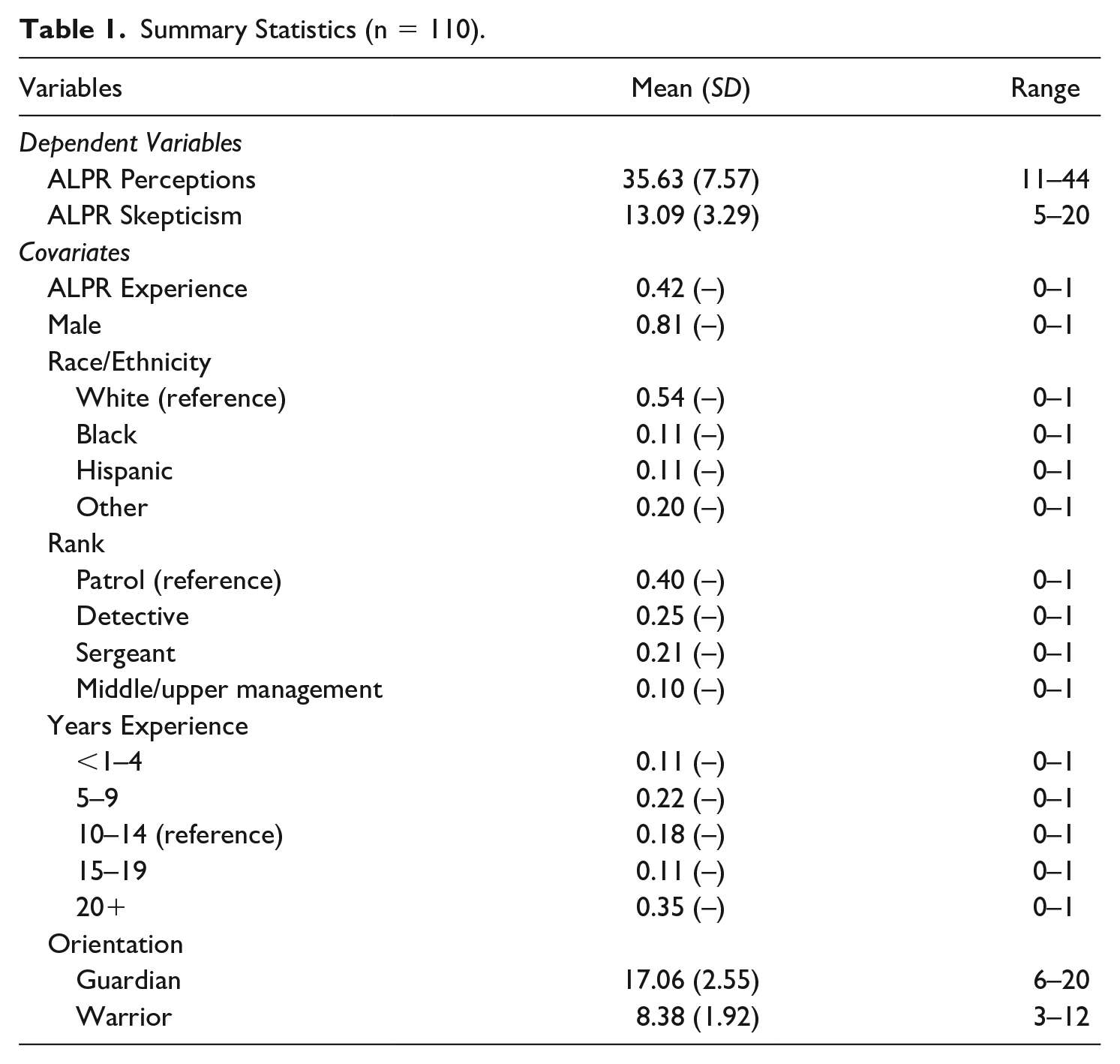
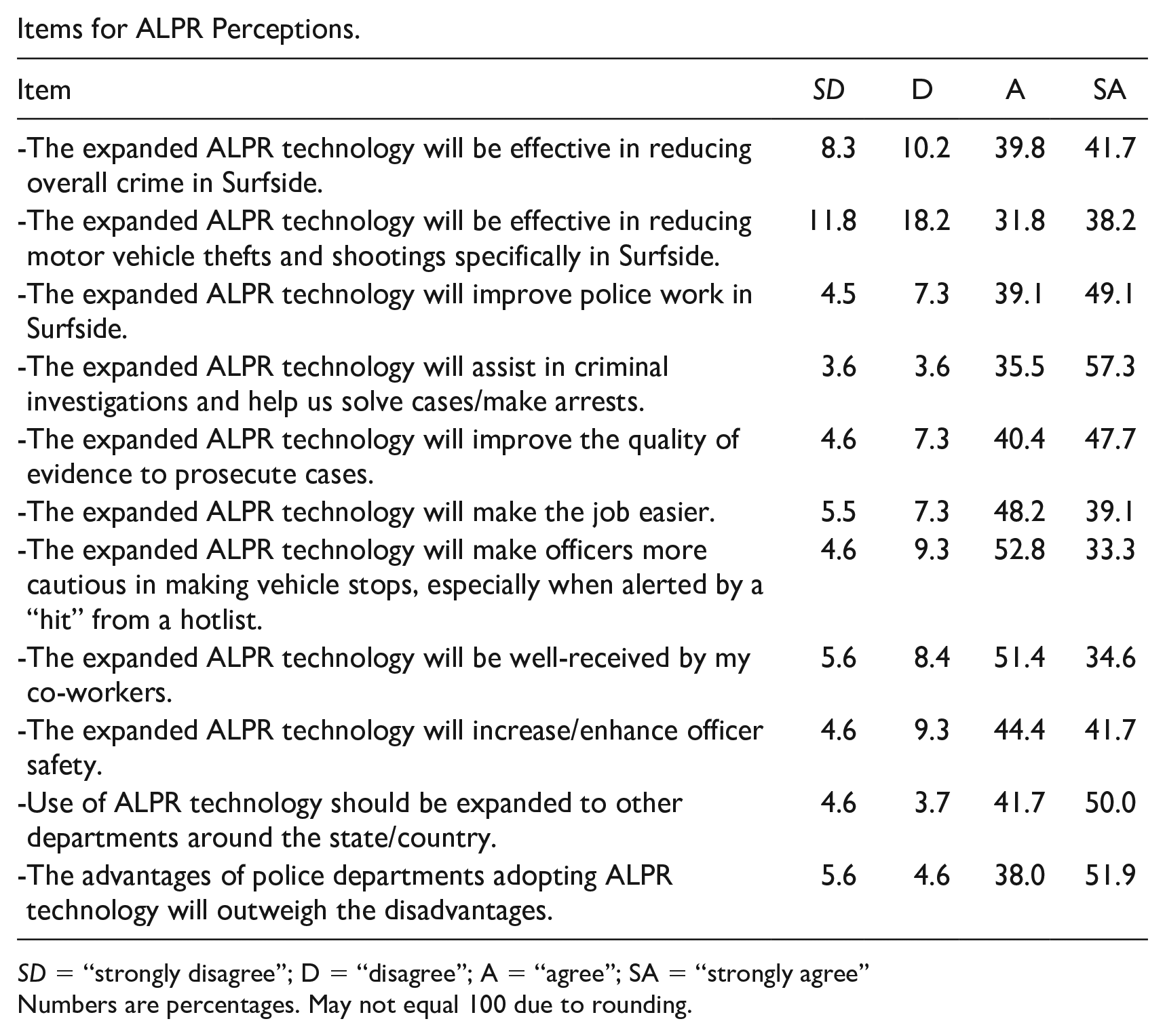
Officers’ beliefs regarding the upcoming expanded use of ALPRs were the primary outcomes of interest. ALPR perceptions was measured using 11 items that asked officers to indicate their level of agreement with statements such as: “The expanded ALPR technology . . . (a) will be effective in reducing overall crime in Surfside, (b) will improve police work in Surfside, (c) will assist in criminal investigations and help us solve cases/make arrests, (d) will make the job easier, and (e) will increase/enhance officer safety”; all 11 items can be found in Appendix A. Each item’s response set included a 4-point categorization: 1 (“strongly disagree”), 2 (“disagree”), 3 (“agree”), or 4 (“strongly agree”).
Principal axis factor analysis was used to evaluate dimensionality, and the results showed that the 11 items loaded on a single construct (λ = 7.62, pattern loadings > .61). 2 As a result, the items were summed to create an additive index. The scale exhibited a high degree of internal consistency (Cronbach’s α = .95; mean inter-item r = .66) and ranged from 11 to 44 with a mean of 35.63 (SD = 7.57). Higher values signify more positive perceptions of the expanded technology.
Police officers are generally cynical and skeptical of changes, particularly as it relates to new technology. As such, ALPR skepticism was measured using five items that assessed agreement with the following statements: (a) “The expanded use of ALPR technology cannot act as a deterrent if the public does not know that we’re using it,” (b) “The expanded use of ALPR technology won’t deter crime; it will only help us address/solve incidents after they already occur,” (c) “There is little use for ALPR technology to assist in investigations if our prosecutors will not consistently bring charges against offenders,” (d) “There is limited use for ALPR technology for detecting stolen vehicles when our Attorney General’s new pursuit policy is too restrictive and does not allow officers to make chase,” and (e) “There is little point in investing in ALPR technology when we need basic investments in our normal, everyday technology like the computers in our cars (e.g., working internet; software that doesn’t crash).” Each item’s response set, similarly, included a 4-point score: 1 (“strongly disagree”) through 4 (“strongly agree”).
Principal axis factoring was once again employed. The five items loaded on a single construct (λ = 2.45, pattern loadings > .59), and were summed to create an additive index. The scale exhibited an adequate degree of internal consistency (Cronbach’s α = .73; mean inter-item r = .35) and ranged from 5 to 20 with a mean of 13.09 (SD = 3.29). Higher values signify more cynical and skeptical perceptions of the expanded technology.
Covariates
A series of officer experiences, demographic characteristics, and other perceptual indicators serve as the covariates. Given the relationship between exposure to technology and more positive perceptions of it, accounting for prior experience with ALPRs was important. At the time of data collection, SPD had a handful of ALPRs mounted on department-issued vehicles. ALPR experience was measured as a dummy variable (1 = yes) that indicated whether respondents worked with the technology in the past; 41.8% (n = 46) answered in the affirmative. Officer gender (1 = male) was measured using a dummy variable with 80.9% being male (n = 89). Officer race/ethnicity, rank, and tenure were also measured using a series of dummy variables. In terms of race/ethnicity, 53.6% were White (n = 59), 10.9% were Black (n = 12), 10.9% were Hispanic (n = 12), and 20.0% categorized themselves as other (n = 22). Forty percent of officers were in patrol (n = 44), 24.5% were detectives (n = 27), 20.9% were sergeants (n = 23), and 10.0% indicated that they were in middle/upper management positions (n = 11). Officers with <1 to 4 years experience made up 11.2% of the sample (n = 12), 22.4% had between 5 and 9 years (n = 24), 18.7% had 10 to 14 years (n = 20), 11.2% had 15 to 19 (n = 12), and 36.4% had 20+ years on the job (n = 39). White officers, patrol officers, and those with 10 to 14 years experience all serve as their respective reference categories.
Regarding the guardian/warrior orientation, and following McLean et al.’s (2020) lead (i.e., using their exact items), officers were asked the degree to which they agreed with 9 items: (a) “As a police officer, it is important to have non-enforcement contacts with the public,” (b) “Law enforcement and community members must work together to solve local problems,” (c) “A primary responsibility of a police officer is to build trust between the department and the community,” (d) “As a police officer, I have a primary responsibility to protect the constitutional rights of residents,” (e) “As a police officer, I see myself primarily as a civil servant,” (f) “I routinely collaborate with community members in my daily duties,” (g) “My primary responsibility as a police officer is to fight crime,” (h) “Enforcing the law is a police officer’s most important responsibility,” and (i) “My primary role is to control predatory suspects that threaten members of the public.” Responses included a 4-point categorization: 1 (“strongly disagree”), 2 (“disagree”), 3 (“agree”), or 4 (“strongly agree”).
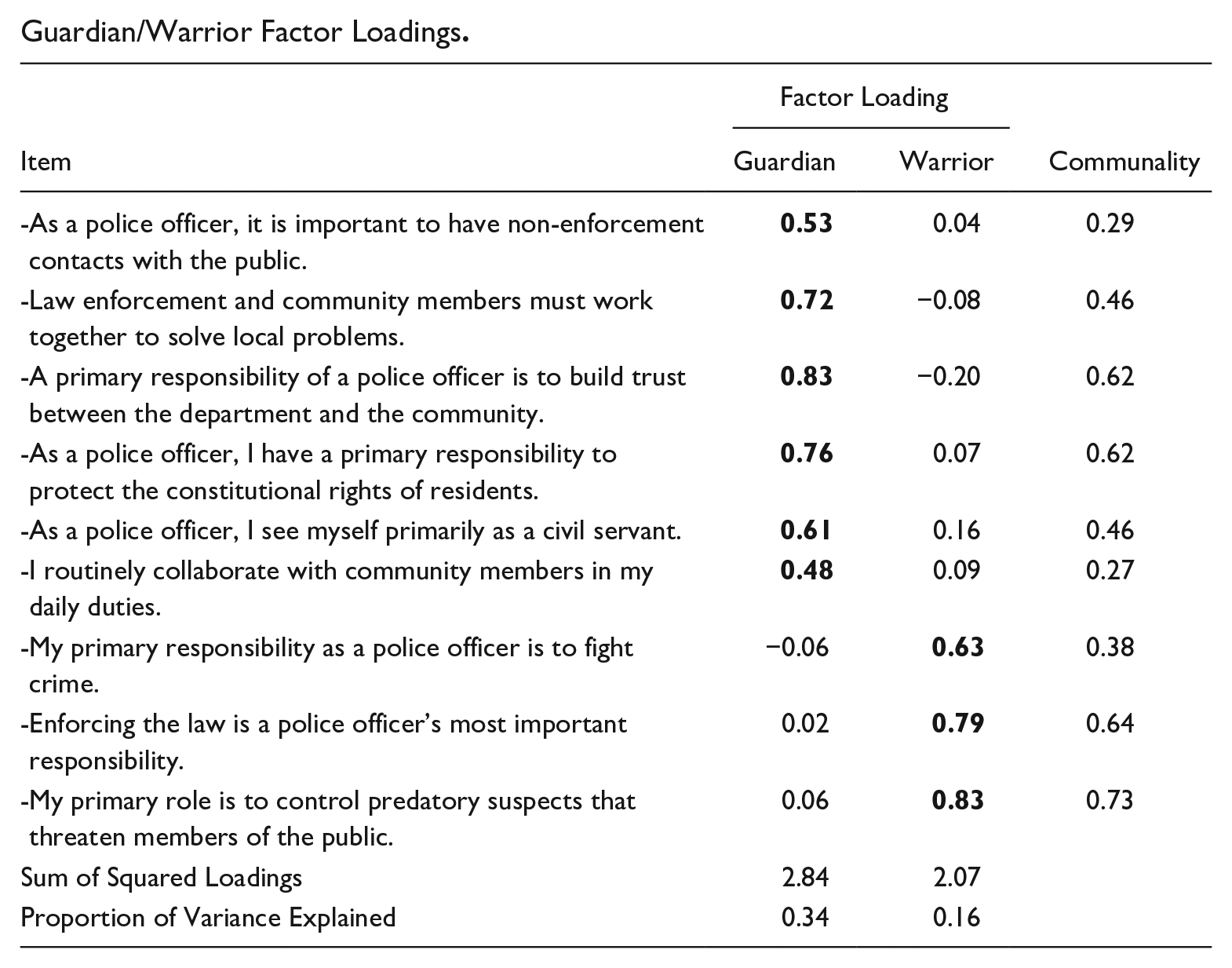
An exploratory factor analysis, using principal axis factoring, found that the items loaded on two latent constructs—as indicated by two eigenvalues greater than 1 and the scree plot depictions. Items a through f loaded on factor 1 with items g through i loading on factor 2. Because the two factors were correlated (r = .30), an oblique rotation procedure using Promax was employed (see Thompson, 2004). The results of the factor loadings are presented in Appendix B, and largely mirror the results from McLean et al.’s (2020) sample. The two concepts should not be viewed in terms of guardian versus warrior (i.e., either one or the other), but rather guardian and warrior as distinct and positively related to one another (see also Clifton et al., 2021). Items a through f were combined to create an additive index called guardian, which exhibited sound psychometric properties (Cronbach’s a = .81; mean inter-item r = .43). It ranged from 6 to 20 (M = 17.06; SD = 2.55) with higher values indicating a stronger guardian orientation. The other three items (g, h, and i) were added to create another index: warrior (Cronbach’s a = .81, mean inter-item r = .58). It ranged from 3 to 12 (M = 8.38; SD = 1.92) with higher values signifying a stronger warrior orientation. Summary statistics for all the variables are provided in Table 1.
Summary Statistics (n = 110).
Analytic Strategy
The analysis was carried out in multiple phases. First, bivariate relationships (Pearson’s r) were assessed between the variables of interest. The relationships were then tested at the multivariate level. Given that the dependent variables were measured continuously, the data were estimated using a series of ordinary least squares (OLS) regressions in STATA 13. A slight problem with missing items was addressed using the list-wise deletion of cases.
Findings
Bivariate Relationships
Table 2 provides the zero-order correlations. Focusing on the first dependent variable, ALPR perceptions, a number of covariates were significantly associated with how officers perceived the expanded use of the technology. Those officers with prior experience working with ALPRs (r = .25; p < .05) as well as the youngest officers with <1 to 4 years on the job (r = .25; p < .05) viewed the technology expansion more positively. In addition, officers with both stronger guardian (r = .46; p < .01) and warrior (r = .24; p < .05) orientations had more positive perceptions of the ALPR expansion, particular those who identified strongly as guardians. Turning to the second dependent variable—ALPR skepticism—prior experience using ALPRs was significantly associated with lower levels of skepticism (r = -.26; p < .05). The youngest officers (i.e., <1–4 years; r = .24; p < .05) as well as those with stronger warrior orientations (r = .24; p < .05) were also more skeptical of the expanded ALPRs technology’s effectiveness. Although the two dependent variables were negatively correlated (r = −.14), the association did not approach statistical significance. The multivariate analyses are now turned to for a more thorough and rigorous examination of these relationships.
Zero-Order Correlations.
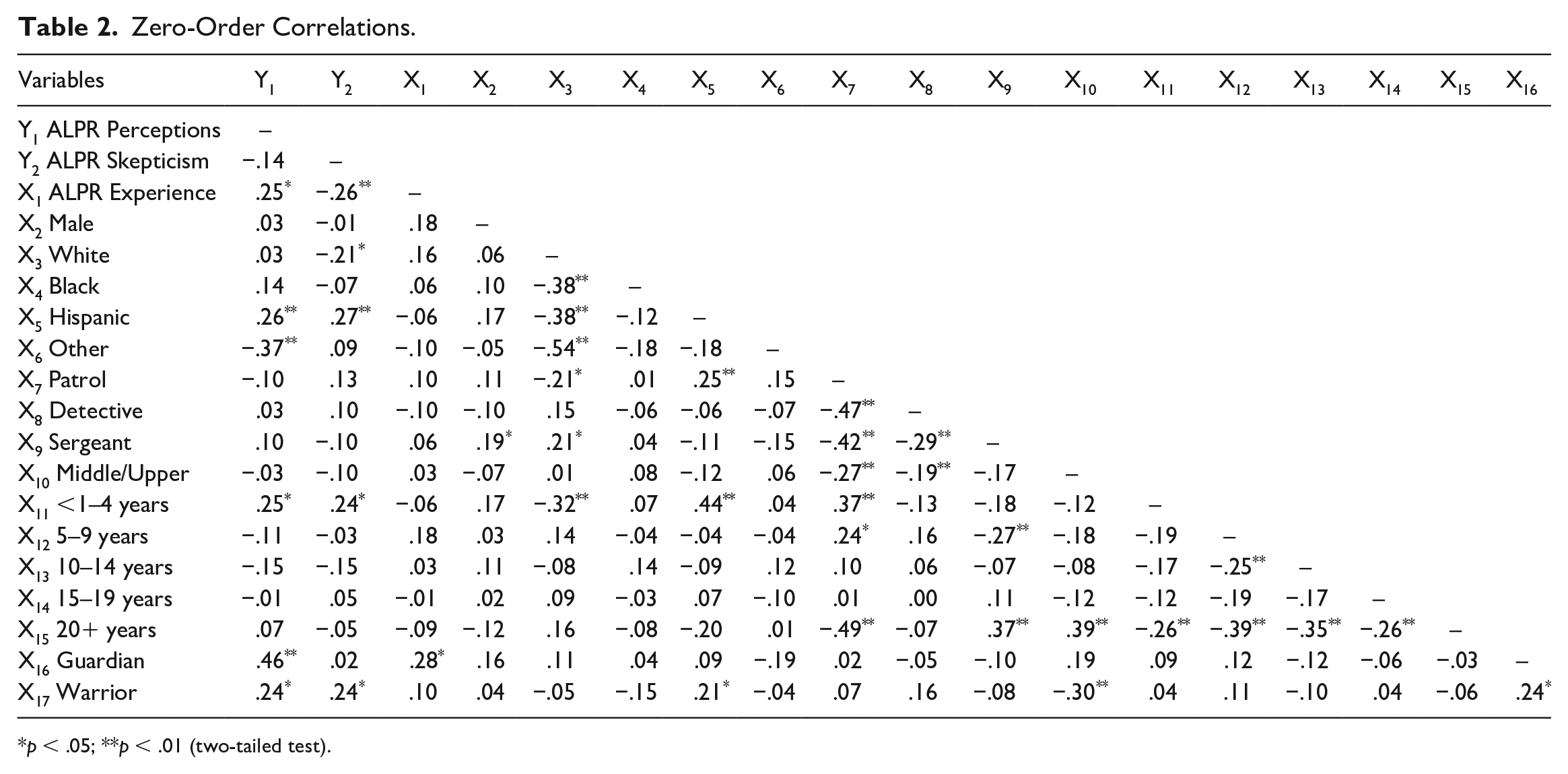
p < .05; **p < .01 (two-tailed test).
Multivariate Analyses
The OLS regression results are presented in Table 3. A few model diagnostics were performed to ensure that the parameter estimates were unbiased. Bivariate correlations among variables in the multivariate analyses did not exceed the traditional 0.70 threshold (Licht, 1995). Moreover, variance inflation factors for each model were all below 1.59 (see Kennedy, 1992). Breusch–Pagan tests for heteroskedasticity revealed that error terms held constant variances, which did not require Huber–White robust standard errors. 3 Model 1 on the left-side column of Table 3 regressed the ALPR perceptions on the covariates, and it explained 46% of the variance in this dependent variable (adjusted r-square = .38). Consistent with the bivariate correlations, the association between several covariates and the outcome persisted in the saturated model. Those officers with prior experience working with the small number of mobile ALPRs held more positive perceptions of the technology’s expansion (b = 3.09; p < .05). Officers with less than 1 to 4 years (b = 5.82; p < .05) and those with stronger guardian orientations (b = 1.20; p < .01) held more positive perceptions of the ALPR expansion—net of controls.
Multivariate Analyses.
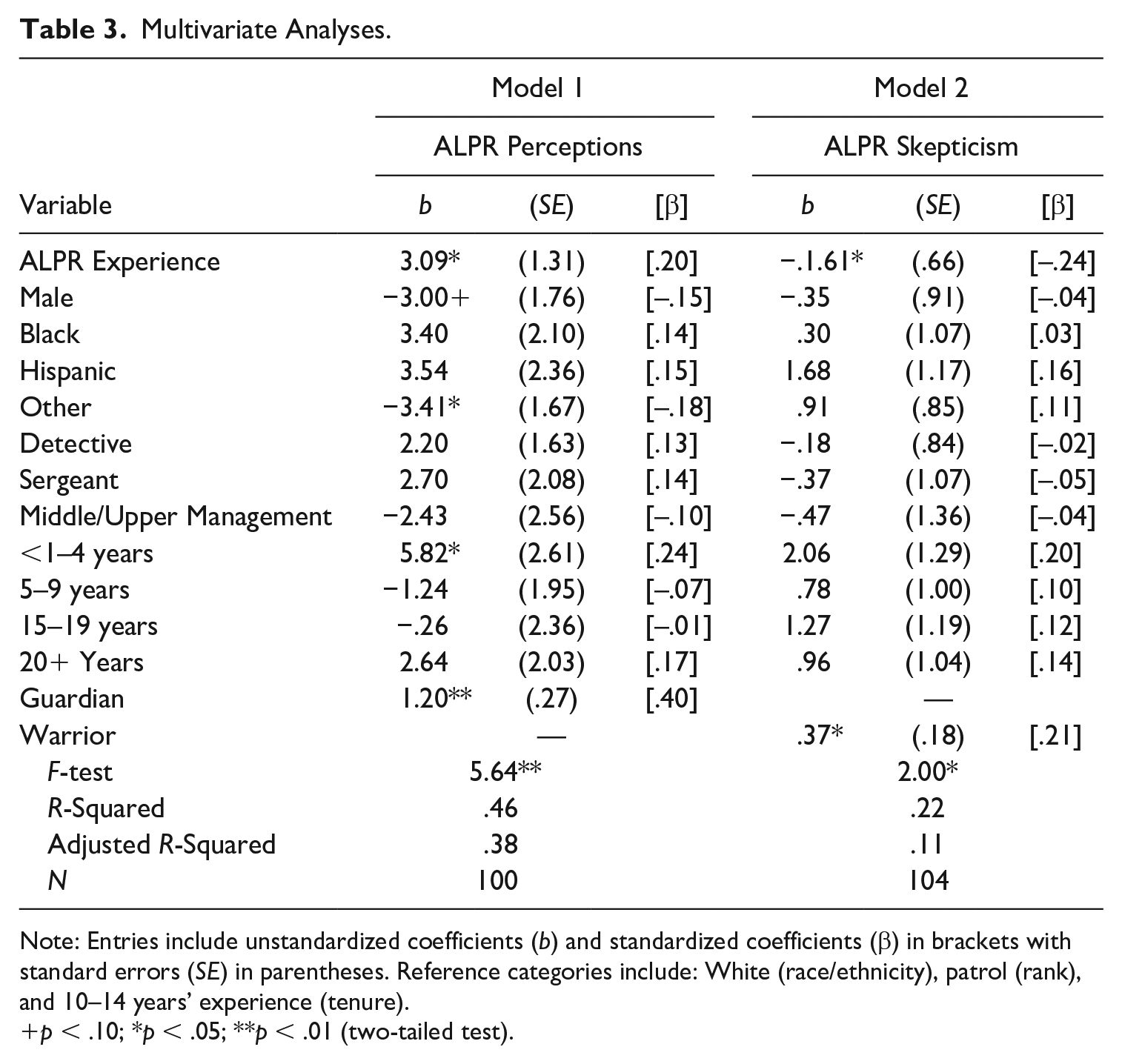
Note: Entries include unstandardized coefficients (b) and standardized coefficients (β) in brackets with standard errors (SE) in parentheses. Reference categories include: White (race/ethnicity), patrol (rank), and 10–14 years’ experience (tenure).
p < .10; *p < .05; **p < .01 (two-tailed test).
Model 2 on the right-side column of Table 3 regressed ALPR skepticism on the covariates. It explained much less variation compared to model 1 with an r-square of .22 (adjusted r-square = .11). Again, and consistent with the bivariate correlations, prior experience working with the ALPRs was associated with lower levels of skepticism regarding the technology’s expansion (b = −1.61; p < .05). Collectively, prior experience with the ALPRs improved overall perceptions of future use (model 1), while also serving as a protective factor against skepticism/cynicism regarding different aspects of the technology—both in terms of the effectiveness of the ALPRs themselves and the financial burden better spent elsewhere as well as other related factors (e.g., restrictive vehicle pursuit policies, lack of prosecutorial will). The only other variable that persisted in the multivariate model was warrior orientation. Those officers with higher levels of warrior orientation were more skeptical of the ALPR expansion (b = .37; p < .05).
Discussion
This study examined police officers’ perceptions of ALPRs, and the data were collected at critical time period just before a major investment and expansion of the technology was set to take place. Overall, officers had resoundingly positive perceptions of the ALPR extension, broadly. Appendix A also presents the breakdown of each individual item used in the scale. Depending on the item, officers either “agreed” or “strongly agreed” between 70% and 93% of the time that the technology would be beneficial. Perceptions were even more positive among those officers who had previously used the department’s mobile ALPRs, which adds to the growing body of work that suggests officers’ exposure to new technology generally improves how they feel about it (Gaub et al., 2016; Lawrence et al., 2019). Younger, less experienced officers were more likely to view the expanded ALPR technology in a positive light, which might reflect generational differences in acceptance of technology in the general population at large (Vogels, 2019)—although this is purely speculative. The same relationship between officer age/experience and perceptions of BWCs has generally not been found (e.g., Lawrence et al., 2019; Todak & Gaub, 2020), which highlights the inconsistencies across technologies. Future research should further examine why younger, less experienced officers in this study were more likely to view ALPR expansion positively, but a similar pattern has not been found for perceptions of BWCs.
This study also continued to empirically explore the guardian and warrior mindsets of police and, subsequently, whether such orientations can be extended to other perceptual outcomes, such as how officers view ALPRs. The exploratory factor analysis using the SPD officer sample reflects that of prior samples of departments in different geographical areas across the United States (Clifton et al., 2021; McLean et al., 2020) as well as Australia (Murphy & McCarthy, 2023)—adding external validity to the measurement of the constructs. Collectively, these studies suggest that officers do not view themselves as either one or the other, but may identify as both guardians and warriors. Officers’ outlooks regarding their guardian and warrior orientations impacted how they felt about the ALPR expansion.
Officers in the sample who possessed stronger guardian orientations tended to view the ALPR expansion more favorably. In a way, such a finding seems a bit counterintuitive: if guardians are more community-oriented and place a higher value on the public, then perhaps those officers may have greater reservations about a technology that has been criticized regarding privacy concerns and the infringement of civil liberties (ACLU, 2013; California State Auditor, 2020). However, the officer survey was limited in that it did not specifically ask officers about data/privacy concerns. Officers who possessed stronger warrior orientations tended to exhibit a higher level of skepticism and cynicism toward the ALPR extension plan. This skepticism measure included both doubts as to the effectiveness of ALPRs as well as factors tangentially related to the technology itself, such as costs/resources that could be better spent elsewhere, views of de-prosecution (Hogan, 2022), and restrictive vehicle pursuit policies that limit officer discretion and the ability to pursue a car that has been identified/alerted as stolen. The relationship suggests that both decisions made within and outside (e.g., prosecutorial behavior) of a police department may impact how officers view investments in technology and their potential impact.
This study was an attempt to better understand how officers perceive the effectiveness and drawbacks of a major ALPR investment. Exposure, demographics—such as tenure/experience—as well as overall orientations regarding the job and citizens seem to impact their attitudes toward the technology. This information can inform decisions to invest and/or expand in ALPR technology by allowing organizations and executives to more clearly recognize how there will likely be varying attitudes among officers—falling on a spectrum between highly motivated and accepting versus resistors and skeptics. Such knowledge and the identification of those officers can be used when making decisions of pilot programs, particularly which officers will utilize mobile ALPRs mounted on vehicles, in addition to fostering buy-in and alleviating resistance.
All studies have limitations and this one is no different. It relied on a relatively small convenience sample of a single department, which may limit the ability to generalize to others around the United States and beyond. While there was an adequate degree of representation among the agency itself, there was no attempt at purposive sampling for adjusting for certain types of officers. It is possible that those officers who felt strongly—one way or the other—about the ALPR expansion were those most enthusiastic about participating, which may have influenced the results. As alluded to earlier, and despite being an exploratory study, the sample size was low with only 110 officers completing a survey and missing items leading to a slight reduction in the multivariate models with 104 and 100 total officers. This may limit the ability to detect a true effect given the decreased statistical power. Time and space constraints on the survey questionnaire precluded the collection of valuable information on officers’ perceptions of citizen privacy and organizational justice, among other factors. The data were also cross-sectional; however, there is a plan to collect another round of officer surveys after the ALPR expansion becomes operational to gauge any changes in perceptions (or lack thereof).
Future research should continue to not only examine officers’ perceptions of ALPRs, but must also conduct both process and impact evaluations of the technology’s efficiency and effectiveness. This should be done among police organizations of all sizes: large, small, and those falling in between, especially given the bias toward research on those larger agencies (Greene, 2014). Due to the Bureau of Justice Statistics’ LEMAS surveys as well as Lum and colleagues’ (2010, 2019) national surveys of large agencies, the field knows the degree to which—broadly—police departments in the United States utilize ALPRs. More than two-thirds of all local/municipal departments with more than 100 sworn officers possessed the technology in 2016, and they are pervasive (75%–90%) in the largest local and county agencies with 500+ sworn. Yet, there are only a handful of studies from which to draw conclusions about the technology’s effect on crime, traffic safety, and organizational changes, among other outcomes. Those studies come from an even fewer set of research sites with limited deployment styles—primarily mobile units mounted on vehicles patrolling designated hot spot areas. Much more evaluative work must explore variations in mobile versus stationary/fixed locations, the total number of ALPRs units in the field, the size of the geographic units patrolled, and the best placements for the stationary/fixed ALPRs.
During the decision-making process and prior to procuring ALPRs, departments and their respective leaders should be cognizant of the practical concerns. These include all of the various costs, such as the hardware itself as well as extended warranties, installation expenses (particularly for stationary/fixed locations), data storage, and maintenance/upkeep. Police executives might also seek to gauge their residents’ views toward the technology—as there has only been a single community survey of one county; this study highlights how prior experience and officer mind-set were associated with perceptions of ALPRs. A growing body of empirical research—in all of the aforementioned areas—would do well to better inform those in positions whether or not investments in ALPRs have a chance of being cost-effective and/or -efficient.
Footnotes
Appendix A
Items for ALPR Perceptions.
| Item | SD | D | A | SA |
|---|---|---|---|---|
| -The expanded ALPR technology will be effective in reducing overall crime in Surfside. | 8.3 | 10.2 | 39.8 | 41.7 |
| -The expanded ALPR technology will be effective in reducing motor vehicle thefts and shootings specifically in Surfside. | 11.8 | 18.2 | 31.8 | 38.2 |
| -The expanded ALPR technology will improve police work in Surfside. | 4.5 | 7.3 | 39.1 | 49.1 |
| -The expanded ALPR technology will assist in criminal investigations and help us solve cases/make arrests. | 3.6 | 3.6 | 35.5 | 57.3 |
| -The expanded ALPR technology will improve the quality of evidence to prosecute cases. | 4.6 | 7.3 | 40.4 | 47.7 |
| -The expanded ALPR technology will make the job easier. | 5.5 | 7.3 | 48.2 | 39.1 |
| -The expanded ALPR technology will make officers more cautious in making vehicle stops, especially when alerted by a “hit” from a hotlist. | 4.6 | 9.3 | 52.8 | 33.3 |
| -The expanded ALPR technology will be well-received by my co-workers. | 5.6 | 8.4 | 51.4 | 34.6 |
| -The expanded ALPR technology will increase/enhance officer safety. | 4.6 | 9.3 | 44.4 | 41.7 |
| -Use of ALPR technology should be expanded to other departments around the state/country. | 4.6 | 3.7 | 41.7 | 50.0 |
| -The advantages of police departments adopting ALPR technology will outweigh the disadvantages. | 5.6 | 4.6 | 38.0 | 51.9 |
SD = “strongly disagree”; D = “disagree”; A = “agree”; SA = “strongly agree”
Numbers are percentages. May not equal 100 due to rounding.
Appendix B
Guardian/Warrior Factor Loadings.
| Item | Factor Loading | ||
|---|---|---|---|
| Guardian | Warrior | Communality | |
| -As a police officer, it is important to have non-enforcement contacts with the public. |
|
0.04 | 0.29 |
| -Law enforcement and community members must work together to solve local problems. |
|
−0.08 | 0.46 |
| -A primary responsibility of a police officer is to build trust between the department and the community. |
|
−0.20 | 0.62 |
| -As a police officer, I have a primary responsibility to protect the constitutional rights of residents. |
|
0.07 | 0.62 |
| -As a police officer, I see myself primarily as a civil servant. |
|
0.16 | 0.46 |
| -I routinely collaborate with community members in my daily duties. |
|
0.09 | 0.27 |
| -My primary responsibility as a police officer is to fight crime. | −0.06 |
|
0.38 |
| -Enforcing the law is a police officer’s most important responsibility. | 0.02 |
|
0.64 |
| -My primary role is to control predatory suspects that threaten members of the public. | 0.06 |
|
0.73 |
| Sum of Squared Loadings | 2.84 | 2.07 | |
| Proportion of Variance Explained | 0.34 | 0.16 | |
Declaration of Conflicting Interests
The author(s) declared no potential conflicts of interest with respect to the research, authorship, and/or publication of this article.
Funding
The author(s) received no financial support for the research, authorship, and/or publication of this article.
