




Abstract
Disabled athletes participate in sports at elite levels; however, industry product and academic research regarding adaptive sportswear is lacking. Limited availability of sportswear can be a barrier to participation in athletics for disabled people, particularly athletes with mobility differences. This study therefore aimed to enhance the sportswear design process in a single-case study of a Paralympic shooting athlete who participated in the 2020 Paralympic games. Qualitative and anthropometric data were collected via a high-communication, five-step design process. The researchers explored 3D apparel design technologies in tandem with physical prototyping methods to understand benefits and challenges of said tools in adaptive sportswear development. Key findings of this work include understanding of disabled athletes’ needs, design considerations for adaptive sportswear development, and found benefits and challenges of technology use. The knowledge acquired in this case study offers valuable contributions for researchers and manufacturers that can advance sportswear design for all disabled athletes.
Keywords
The number of disabled people involved in physical recreation is growing steadily worldwide, and disabled athletes are increasingly participating in a widening array of adaptive sports (Disabled World, 2020). In a 2009 survey of 1,108 U.S. adults with disabilities, 30% of survey respondents reported that they participated in some sort of physical activity (Move United, 2009) compared to 53.3% of U.S. adults overall (Centers for Disease Control and Prevention & National Center for Health Statistics, 2021). The previous record for the number of competitors was broken at the Tokyo 2020 Games, which hosted 4,403 Paralympian athletes (International Paralympic Committee [IPC], 2021). Despite the growing number of disabled athletes, few manufacturers currently develop adaptive sportswear that is specifically designed for them (Bragança et al., 2018; Feng & Hui, 2021; Kabel et al., 2017). More adaptive sportswear options must be made available in response to this deficit. These options should address specific design elements required by disabled athletes, such as functionality and comfort (Disabled World, 2020). To this end, we aimed to propose a product design strategy to improve the process and outcome of adaptive sportswear for disabled athletes.
We specifically adopted the problem-based design research approach in response to the call to action from Clothing and Textiles Research Journal design scholars (e.g., Bye, 2010; Haar & Bye, 2021; Parsons & Morris, 2021). Employing a single-case method, we investigated the functional, expressive, and aesthetic (FEA) needs (Lamb & Kallal, 1992) of a Paralympic athlete who uses a wheelchair and competes in the sport of rifle shooting. The goal was to design a made-to-measure (MTM) shooting jacket that could be worn at national and international competitions. Further, we explored a novel MTM garment manufacturing process by applying 3D body scanning and 3D virtual simulation. Although 3D technologies have already been widely adopted in the apparel industry, this is the first use of 3D technical tools in adaptive sportswear design to our best knowledge. The findings of this study will contribute to the practical implications of 3D technologies for MTM adaptive sportswear design. The product development process proposed in this study offers effective guidance for manufacturers in developing customized adaptive sportswear, thereby increasing product satisfaction among disabled athletes. The design insight gained from an elite athlete's case can be scaled down to make it viable for other people who participate in less-competitive physical activities, or as Morris and Ashdown (2018) described, “something that is feasible for the real world” (p. 338).
Literature Review
Adaptive sportswear is understudied in the field of apparel design. Esmail et al. (2020) reviewed 57 articles and 88 websites on the role of clothing in physical activity participation among people with physical disabilities and found only six publications that explicitly addressed sportswear products. Bragança et al. (2018) found that wheelchair rugby athletes competed in sportswear designed for non-wheelchair athletes due to a lack of adaptive sportswear options. The wheelchair athletes modified the garments to fit their performance, safety, and mobility needs. Consequently, these athletes felt dissatisfied with the ready-made sportswear options available on the market (Bragança et al., 2018). Kabel et al. (2017) also found that, of 113 wheelchair users surveyed, 56% had difficulty finding sportswear that met their needs. The lack of availability of adaptive sportswear had a negative impact on respondents’ desire to participate in athletics or even exercise. These studies show that a lack of adaptive sportswear can lead to low participation in sports. Yet sports are an important component of disability culture, helping to shift the narrative from “disabled to this abled” (Move United, 2009).
Design Requirements for Paralympic Shooting Jackets
Shooting is a precision sport and requires athletes to have extreme accuracy and mental discipline. The goal is to land a series of shots inside the center bullseye of a target from 10-50 meters away. Paralympic shooting is practiced in more than 75 countries and has been seen at every Paralympic Games since 1976 (World Shooting Para Sport [WSPS], n.d.). The expansion of the Paralympic shooting sport was one of the core goals of both the International Shooting Sport Federation (ISSF) and WSPS organizations in 2020 (ISSF, 2020; WSPS, n.d.). Paralympic shooting competitions are open to athletes with mobility disabilities who are classified according to their degree of body trunk function, balance while sitting, muscle strength, and limb mobility (WSPS, n.d.). Even with the growing attention being paid to this sport, specialized equipment designed specifically for wheelchair shooting athletes could be better designed, as confirmed by a senior Paralympic shooting athlete.
For wheelchair Paralympic athletes, the shooting jacket is manufactured to be shorter in length, with the jacket edge terminating at the shooter's thighs when seated (ISSF, 2020; WPSP, n.d.). Shooting jackets for both wheelchair and non-wheelchair athletes have several technical features designed to enhance the shooter's functional performance. These features are regulated by the ISSF to ensure that no athlete has an unfair advantage (ISSF, 2020). Most notably, the jackets are made from a heavyweight cotton canvas, supplemented by leather or suede panels to support the athlete's torso. The regulations specifically address the thickness and rigidity of fabrics because thicker, more rigid fabrics might give the athlete artificial body support in competitions and thus provide a competitive advantage (ISSF, 2020). Jacket fit is also regulated for the same reason, and jackets typically have removable buttons so that the athletes can adjust the fit to meet regulations depending on their body size on a certain day. Other features of the jacket include an anti-slip rubber material called TopGrip on the sleeve and upper chest to provide friction and cushion in areas that meet the rifle or shooting surface. There are straps on the back to take up excess fabric when the athlete is in the shooting position. ISSF suggests that athletes wear their nation's colors but provide no other regulations related to appearance (ISSF, 2020).
Shooting athletes typically have their shooting jackets MTM to ensure compliance with ISSF regulations (L. Esparza, personal communication, September 13, 2018). Wheelchair athletes go through the same ordering process as non-wheelchair athletes; however, wheelchair athletes provide certain measurements that non-wheelchair athletes do not, such as seated hip circumference. Jacket MTM companies may send someone to assist athletes in taking body measurements. Alternatively, companies recommend that athletes visit a local tailor for help with measurements. The MTM ordering process does not always result in a perfectly fitting jacket, and athletes often work with a local tailor to adjust the fit of the jacket after its delivery. Although jackets are often MTM, there has been no attempt by manufacturers to improve the jacket design for wheelchair athletes in ways that accommodate their bodies and movement, other than providing a shorter-length jacket. Potential areas for fit improvement are explored in this research.
3D Technologies in the Product Development Process
3D technologies such as 3D body scanning and 3D virtual simulation can provide effective technical solutions for MTM garment manufacturing processes, which are otherwise time- and labor-intensive for extensive body measurement and pattern development practices, especially in cases where the end-user is not of a standard ready-to-wear size (Ashdown & Dunne, 2006). This research utilized a portable structured-light 3D scanner that attaches to an iPad to capture a 3D body model of the study participant (Structure by Occipital, n.d.). This scanner (rather than other handheld scanners, such as the Artec Eva) was chosen due to its affordable price. Affordability means that more researchers and professionals could potentially integrate this tool into the design process. Researchers have assessed the Structure Sensor's efficacy and found it to be reliable compared to scans from reputable booth 3D body scanning systems (Redaelli et al., 2018). Traditional booth body scanners, which have long been used by apparel researchers to capture 3D body scan data, were not developed to capture scans of people with disabilities. Booth scanners require participants to enter a small area, stand with arms and legs extended, and hold the position for ∼5 s; this process presents barriers for participants with disabilities (Rudolf et al., 2015). Further, most booth scanners cannot capture data perpendicular to the cameras (e.g., tops of heads). When scanning people in a seated position, this means additional data loss on the top and undersides of the legs. However, handheld scanners can be maneuvered to capture data from all sides of a participant, achieving a high-quality scan.
Using the 3D body scan as a virtual dress form, CLO3D (CLO) was used to develop virtual prototypes of the Paralympic shooting jacket. Despite advances in 3D simulation accuracy, 3D virtual simulation technology is not currently reliable for fit analysis (Lee & Park, 2017); therefore, the researchers supplemented the 3D virtual prototyping with a custom half-scale dress form of the participant's body developed using the 3D body scan. Vuruskan and Ashdown (2017) assert that when used for prototype fitting, half-scale dress forms “also have benefits for various nonstandard body shapes” (p. 819). Previous research has shown that accurate patterns developed by experienced patternmakers on half-scale dress forms can eliminate the need for first fitting prototypes (Phoenix, 2018). Consequently, a half-scale dress form was deemed to complement 3D pattern development by helping to address some limitations currently observed with 3D.
Theoretical Framework
The FEA Consumer Needs Model (FEA Model) developed by Lamb and Kallal (1992) was used in this study to frame the participant's shooting jacket design needs. The impetus for the FEA Model was to understand disability as a social construct, and researchers have recently extended the model to better understand the needs of people with disabilities (Lobo et al., 2019). The FEA Model holds that an individual's key clothing needs are functionally, expressively, and aesthetically oriented, and that the model center (which consists of cultural factors) dictates these needs (Orzada & Kallal, 2021). Shooting jacket designs, as with general sportswear designs, often place a strong emphasis on functional features of the jacket that affect an athlete's performance. Due to the focus on function, relatively little attention is paid to the aesthetic and expressive features of the jacket design. This oversight is evident on manufacturer websites (e.g., KurtThune.com and Monard.com), where only one style is available for customization. Athletes can choose the fabrics, colors, and trim, but cannot modify the style lines or placement of design features. Emphasizing the end-user's holistic FEA needs may result in higher user satisfaction, which could positively affect their performance in a sport (Ledbury, 2018).
Research Purpose and Questions
There are many gaps in the literature regarding sportswear design for disabled athletes and understanding of disabled athletes’ FEA needs (Esmail et al., 2020). Many types of adaptive sports have not been studied in terms of adaptive sportswear outcomes (Feng & Hui, 2021). Therefore, this study aimed to use the FEA Model and design process (Lamb & Kallal, 1992) as a framework to enhance the sportswear design process in a case study of a Paralympic shooting athlete. The following research questions (RQs) guided this study:
RQ1: What are the single-case participant's FEA needs regarding a Paralympic shooting jacket? RQ2: What are the benefits and challenges involved in utilizing design technologies in a custom adaptive sportswear design process? RQ3: How can the design and development process be improved to increase disabled athletes’ satisfaction with sportswear design, specifically for a Paralympic shooting jacket?
Case Study of Female Paralympic Shooter
A single-case study approach was used to investigate the research questions in a real-world context (Yin, 2017). Yin (2017) states that a single-case study is appropriate when a case is “critical, unusual, common, revelatory, or longitudinal” (p. 24). Only six athletes qualified for the Tokyo Paralympic USA Shooting Team, three of which were female (Shooting Sports USA, 2021). This small pool of potential participants in a niche sport justifies the use of a single-case study. Furthermore, professional athletes, whose sport is their vocation, are especially adept at expressing their needs (Morris & Ashdown, 2018) and therefore may be useful for identifying needs that can impact general sportswear design improvements.
A contact from the USA Paralympic Shooting Team helped the researchers recruit a participant for the study. The inclusion criteria were that the participant was an adult female Paralympic shooter in active training. Hannah (pseudonym) met the criteria and was recruited for this study. Hannah is a rifle shooting athlete, 2018 USA Paralympic Athlete of the Year, and a participant in the 2020 Tokyo Paralympics. Hannah identifies as a cisgender woman (she/her), uses a manual wheelchair for mobility, and was 22 years old at the time of study. The final shooting jacket was offered to Hannah as an incentive for participating in this research.
Adaptive Sportswear Design Process
One limitation of executing a single-case study is the study's generalizability and, in this case, to other disabled athletes. Several scholars, including Yin (2017), believe that increasing the number of data points in a single case reduces the problem of generalizability. Therefore, in this study, this limitation was addressed by increasing the number of data points collected throughout the design process, which included 17 points of contact with Hannah, as compared to the five points of contact in Lamb and Kallal's (1992) original model. The design process that we adopted in this study consisted of the following five steps: 1) problem identification, 2) preliminary design information, 3) design development, 4) prototype development, and 5) evaluation (see Figure 1).
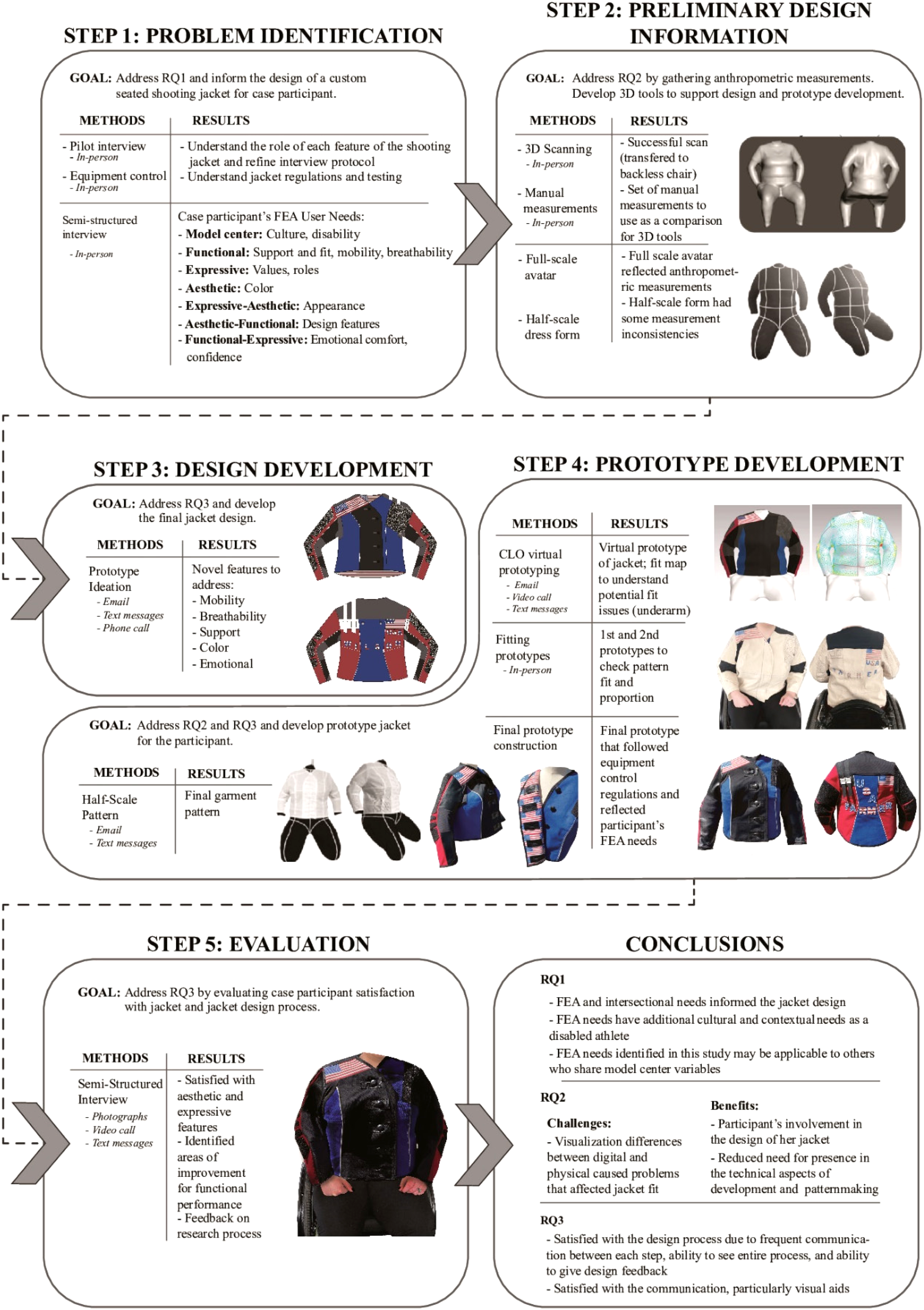
Summary of the 5-step design process to develop the custom seated Paralympic shooting jacket.
As illustrated in Figure 1, the research was completed in the following five-step design process (5-SDP). In this paper, the research methods, results, and discussion are presented for each step in the 5-SDP. Scholars have previously been successful in presenting design scholarship in this way (e.g., Haar et al., 2013; LaBat & Sokolowski, 1999) because the authors can make linkages across the design steps while mimicking the flow of the actual design process.
Preliminary Study
IRB approval was obtained before all research activities began. The first and third authors conducted a pilot interview with a senior member of the USA Paralympic Shooting Team to understand the role of each shooting jacket feature and pilot the interview protocols used in the design process. The first author also met with an equipment control official at the Paralympic Training Center (PTC) in Colorado Springs, Colorado, USA to understand the jacket regulations. These pilot activities provided an immersive experience that helped interpret findings.
Step 1: Problem Identification
Step 1 of the 5-SDP sought to address RQ1 and inform the design of a custom seated jacket for the case participant.
Step 1 methods
The researchers interviewed Hannah using a semi-structured interview protocol to understand her perceptions of her shooting jacket and her FEA needs. The interview protocol was developed from the literature and refined after the pilot activities. The interview was conducted in person at the PTC and lasted 38 min. Data were collected regarding how Hannah became involved in Paralympic shooting, her training schedule, competition culture, jacket performance, and FEA needs. Specific questions that were asked during this interview included: “In what ways does your shooting jacket aid or hinder your shooting performance?” “How do you feel about the appearance of your jacket? What would your ideal jacket look like?” and “Does your jacket play a part in your self-esteem and confidence as an athlete?”
The interview transcript from Step 1 was coded using thematic analysis (Braun & Clarke, 2006), to identify themes within the data in the context of the research questions. To ensure the reliability of the coding process, the first and second authors read the transcript individually, the first author applied codes, the second author checked the codes, and both authors collaborated on understanding the meaning of concepts where there were discrepancies in interpretation (Saldaña, 2016). This process was repeated until the two authors achieved an inter-rater reliability rate of 100%. Further, to ensure the credibility of the code definitions, applications, and meanings, the authors asked Hannah to member check the codes by reviewing a document that defined each code using her direct quotes (Saldaña, 2016). Hannah found the codes to be accurate to the quoted definitions, providing further reliability and validity.
Step 1 results
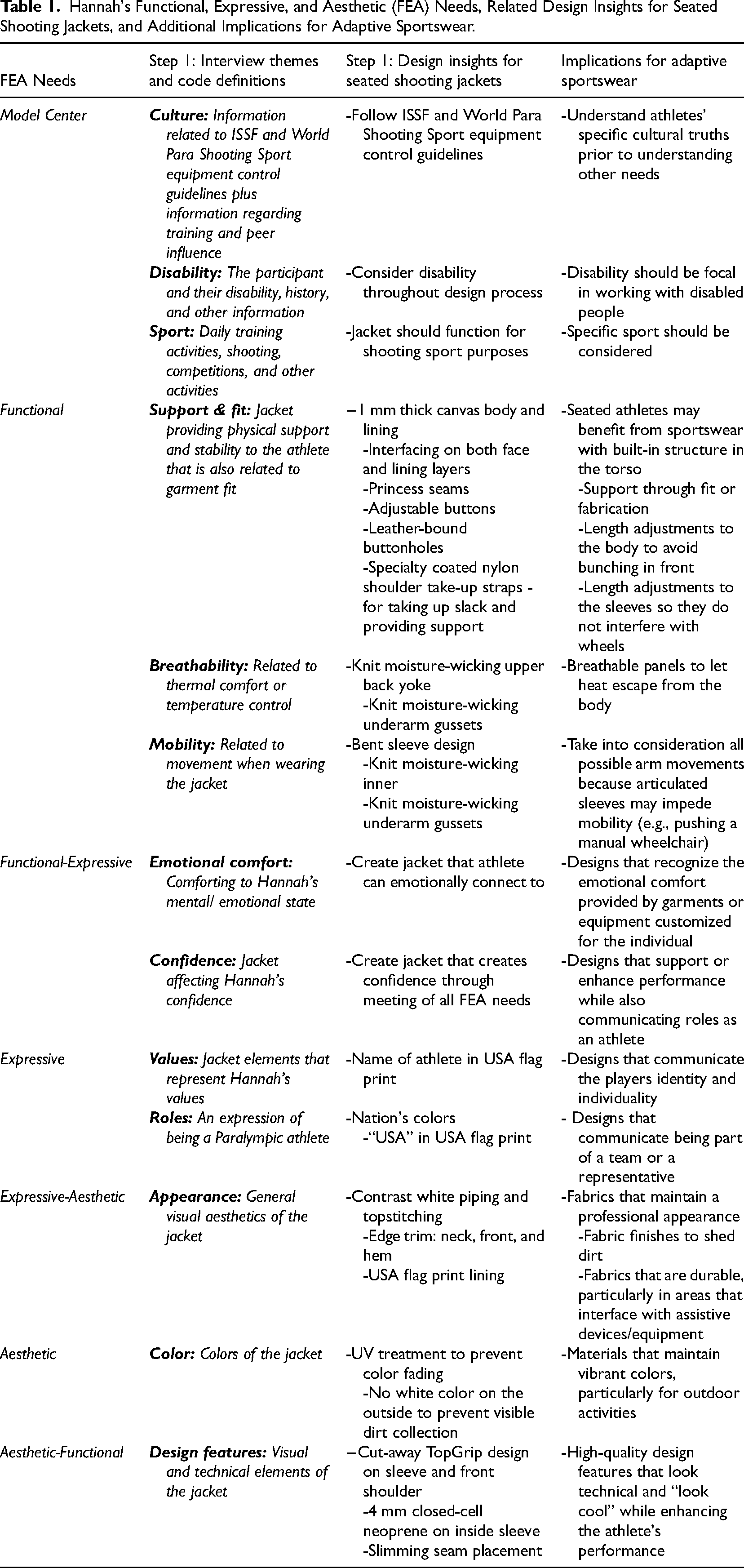
Thematic analysis of the interview data revealed several opportunities for jacket improvement related to Hannah's FEA needs (see Table 1). The main themes were model center, functional, expressive, and aesthetic needs, as well as three categories of needs in the “continuum between the three FEA criteria” (Orzada & Kallal, 2021, p. 27). The intersectional categories were expressive-aesthetic needs, aesthetic-functional needs, and functional-expressive needs. Lamb and Kallal (1992) state that functional, expressive, and aesthetic needs “…are not mutually exclusive but are interrelated in different ways for different target consumers” (p. 43).
Hannah's Functional, Expressive, and Aesthetic (FEA) Needs, Related Design Insights for Seated Shooting Jackets, and Additional Implications for Adaptive Sportswear.
Model center
The central tenets of Hannah's FEA needs were dictated by factors pertaining to culture and disability. For Hannah, culture encompassed the ethos of Paralympic Shooting and equipment control jacket regulations that must be followed. Hannah's identity as a person with disabilities was also important in framing her FEA needs. Hannah recognized that her disability played a large part in how she interacted with clothing, as most clothing is designed for non-disabled people. Culture and disability framed Hannah's evaluation of sportswear and FEA needs, and thus were placed in the model center.
Functional needs
Hannah highlighted three functional needs: support and fit, mobility, and breathability. Support and fit are interrelated and can be defined together as garment fit, related to providing physical support and stability for the athlete. When asked how her jacket aids her shooting performance, Hannah stated “stability, mainly,” and that, “if you’re gonna use [the jacket] in a chair, sit in a chair [when you] get measured.” This indicated the importance of disability regarding garment support and fit. Hannah found that textiles affected the support and fit of her jacket: “I like [the canvas] because it's thick and its form-fitting. It keeps you … in a stationary position that you need to be … [un]like this [suede] material.” Support and fit, however, can conflict with mobility. As Hannah said, “[if] you try to push a wheelchair with [the jacket] on, it's nearly impossible.” The sleeves of Paralympic Shooting jackets are typically patterned with a 45-degree bend in the sleeve elbow to follow the wearer's form while in an active shooting position. While this is a valuable design feature for performance, the full range of arm motion needed to push a wheelchair is occluded by the jacket's sleeve design. Although this insight presented an opportunity to increase mobility through design, Hannah emphasized the importance of not sacrificing performance-aiding design features for more mobility in the jacket. Regarding breathability, the thick fabrics used to provide support in the jacket caused Hannah to overheat in warm climates. She described how “you go out in the heat in Georgia … [and] you literally take a shower in that jacket. It is terrible [and] definitely not breathable.”
Expressive needs
Hannah highlighted two main expressive needs: values and roles. Hannah's values as an athlete encompassed ideas such as nationality or design elements that communicate her identity and individuality. Roles referred to the way that Hannah navigated her various public-facing responsibilities as a Paralympic athlete. For example, Hannah described the need to have a USA flag on the outside of her jacket to indicate her role as an athlete representing the USA. Her jacket bore USA colors but otherwise did not have an insignia indicating nationality. She commented that a “[USA] flag print would be really cool” because it would avoid confusion with other athletes representing countries with the same colors. This represents Hannah's role as an athlete as well as her values surrounding her USA nationality.
Aesthetic needs
Hannah stressed one main aesthetic need: color. Hannah wanted the color of the fabrics to remain vibrant throughout the jacket's lifetime. She regretted choosing white for her jacket as it became dirty very quickly, and said, “white—don't ever do it; it's a bad idea.”
Intersectional needs: Expressive-aesthetic
The appearance of Hannah's jacket was deemed to be both an expressive and aesthetic need. Because Hannah must adhere to culture- and role-based aesthetics, the discussion of jacket design was rooted in her desire to maintain a professional appearance when representing the USA at competitions. Hannah stated that if she could choose any sort of appearance for her jacket, regardless of regulations, she would choose a cheetah print; however, she recognized her aesthetic needs should align with her role.
Intersectional needs: Aesthetic-functional
Specific design features of the jacket were based in functionality but also contributed to the aesthetics of the jacket. For example, the TopGrip on the sleeves provided cushioning but also shaped the jacket aesthetics. Most shooting jacket design features are based on functional needs, but Hannah noted that these made the jackets “look cool … because it is so technical and [makes] you look like you’ll perform well.”
Intersectional needs: Functional-expressive
Shooting athletes often keep their jackets for multiple years, wearing them many hours a day for training and thus becoming very accustomed to the nuances of body and jacket interaction. Athletes can mentally self-soothe or become focused via the tactile responses they receive from their jacket, making the jacket a source of emotional comfort. Hannah analogized the athlete to a plant and the jacket to water, stating that “the more you wear the jacket, the more you will grow because it's helping you grow.” This sentiment implies that the connectedness between the athlete and her jacket was a functional, performance-aiding relationship that gave her the psychological confidence to perform at a Paralympic level. The researchers found that the jacket aided Hannah in terms of both emotional comfort and confidence and thus existed at the intersection of functional and expressive needs.
Step 1 discussion
The interview analysis provided a holistic understanding of Hannah's needs and served as the foundation to address RQ1. This study further refined the original FEA categories by emphasizing that some user needs exist at the intersections of the FEA categories, or as Cassim wrote (as cited in Orzada & Kallal, 2021), clothing is a “functional object that protects or reveals, aids or impedes movement and is simultaneously a conceptual embodiment of social and personal meaning” (p. 1). Understanding Hannah's complex needs and how they intersected with each other aided in developing design solutions that may be applicable to the design of other adaptive sportswear. For each of Hannah's FEA needs, the authors included in Table 1 suggestions for how to interpret the findings of this study to develop sportswear features that address the needs of other disabled athletes.
Step 2: Preliminary Design Information
In Step 2, information regarding Hannah's anthropometrics was gathered using technology (RQ2) and utilized to develop body models for design and prototype development.
Step 2 methods
3D scanning
A Structure Sensor 3D body scan of Hannah was completed at the PTC directly following the interview in Step 1. For the scan, the researchers discussed with Hannah whether it was possible for her to transfer to a backless chair. This was important to help reduce occlusion in the 3D scan from the wheelchair. Hannah was asked to wear items of clothing that she normally wore under her shooting jacket: a T-shirt over a sports bra and leggings. The first author captured a scan of Hannah using the Structure Sensor and generated a 3D body model.
Manual measurements
The Structure Sensor exports 3D data as an.obj file format, which inherently lacks a unit of measure assignment (Fletcher, 2014). When.obj files are imported into 3D modeling software the software assigns the default system unit of measure, often causing issues with scale (Fletcher, 2014). Therefore, the researchers took Hannah's body measurements manually (three times each, averaging for final measure) to ensure that baseline data were collected, and that raw 3D scan data were imported into the design software at the proper scale.
Full-scale avatar and half-scale dress form
The researchers processed the 3D scan using Meshmixer (Version 3.5) and Fusion 360 (Version 2.7) to remove excess underarm webbing from the T-shirt and to create a symmetrical full-scale avatar. As described in the literature review, the half-scale dress form was developed as a design and prototyping tool.
Step 2 results
The researchers found that the constructed half-scale dress form had slightly smaller measurements than the manual measurements taken of Hannah's body for shoulder circumference (−6%), back neck base to seat (−10%), and high point shoulder (HPS) to front seated thigh (−12%). The half-scale was slightly larger at the underbust circumference ( + 5%), waist circumference ( + 7%), and HPS to front lap measurements ( + 12.5%). These discrepancies were adjusted for during prototype development but had implications for the final garment.
Step 2 discussion
Using the Structure Sensor to capture Hannah's 3D scan eliminated technical–environmental barriers, such as those of booth scanners, that otherwise would have precluded Hannah from participating in this study, addressing RQ2. Rudolf et al. (2015), who used the Artec Eva 3D scanner, also found that the use of handheld scanners can allow researchers and professionals to capture 3D data of people with disabilities, which previously may have caused an “unnecessary burden” for research participants with mobility disabilities (p. 1179).
The 3D body scan avatar and custom half-scale dress form provided the researchers with data about the end user's body shape that would otherwise be difficult to contextualize with images and measurements alone. These artifacts resided with the designer long after the face-to-face interactions were complete, leaving the researchers with 3D representations of Hannah's body that they could reference without Hannah needing to be present. However, challenges presented themselves in the context of manual and half-scale dress form measurement discrepancies. Because there was no clear trend in the differences between the manual and half-scale measurements (i.e., some larger, some smaller), deviations were attributed to challenges involved in the construction of the half-scale dress form.
Step 3: Design Development
In Step 3, the researchers developed the final jacket design and sought to address RQ3.
Step 3 methods
The researchers developed design solutions and communicated them through technical flats developed in Adobe Illustrator. The flats incorporated specific design and fabric features that addressed Hannah's FEA needs (Step 1), while maintaining compliance with competition shooting jacket regulations. Hannah was emailed an initial illustration of the proposed jacket design. She responded with feedback via a phone call, requesting that the name decals be moved up to ensure that they would be seen above the back of her wheelchair. The researchers implemented this feedback and sent a new illustration. Hannah approved the updated design.
Step 3 results
The final jacket illustration included several novel features that differentiated the prototype from existing seated jackets. For improved mobility, bent sleeves with an engineered gusset made of fused leather and knit fabric were included. To address breathability, the researchers incorporated a jacquard knit with a moisture-wicking finish in the upper back yoke, underarms, and elbow. To address support, the researchers sourced cotton canvas for the main jacket torso and sleeves that complied with jacket regulations. Hannah's values and role were expressed through USA flag detailing and a flag print lining. Color was addressed by using USA colors, avoiding using white to prevent visible soiling, and treating the canvas with a UV finish to prevent fading. Emotional comfort and confidence are qualities that develop when an athlete has spent time wearing a jacket but were facilitated through meeting all the other FEA needs. In addressing appearance, the researchers considered seam placement with contrasting color piping and used a black edge trim to complement the black TopGrip and shoulder straps.
Step 3 discussion
The design and development process could be used by manufacturers to improve the MTM system, and addresses RQ3. The design process allowed Hannah to contribute to the design, adding her voice and expertize to the process and ensuring that her needs were met.
Step 4: Prototype Development
Step 4 addressed RQ2 and RQ3 via half-scale pattern finalization, CLO virtual prototyping, a fitting prototype, and construction of the final jacket prototype.
Step 4 methods
Half-scale pattern finalization
Draping a block pattern on the half-scale dress form was deemed the most efficient method of pattern development in this research given Hannah's anthropometrics, the complex nature of shooting jackets, and the limitations of 3D virtual fitting. A ‘base’ pattern was draped on the form, followed by finalization of the half-scale pattern via the placement of design details. Photographs of the half-scale pattern were shared with Hannah via text message to give her an additional opportunity to provide feedback. Hannah approved the design, and the half-scale patterns were digitized.
CLO virtual prototyping
In CLO, the digitized patterns were increased in size to full-scale (2x) to construct the CLO virtual prototype. The virtual prototype was used to assess the tension, feature placement, and appearance of the design. The researchers virtually stitched the jacket patterns on Hannah's full-scale 3D scan avatar (Step 2) and used CLO's fabric editing features to simulate true-to-life fabric weights, thicknesses, and properties. Images from multiple angles as well as a 360° video of the virtual garment were shared with Hannah via email to gather feedback. Based on her feedback, the first author made modifications to the design, took new images and a video of the updated virtual prototype, and sent them to Hannah for her approval.
Fitting prototype
The final patterns from CLO were printed and used to make a fitting prototype to check the jacket fit on Hannah (in-person, at the PTC). Based on the fitting, the first author made pattern revisions and developed a second fitting prototype that was fit on Hannah in person the following day. Final pattern modifications were made based on these fittings. The final pattern was used to cut the final textiles for the final jacket prototype.
Final prototype construction
The final MTM seated shooting jacket was constructed by the first author. The main jacket torso and sleeves were made from two layers of 18-ounce, 1 mm-thick cotton canvas backed with a fusible interfacing. The two layers of canvas plus the interfacing measured 2.2 mm thick, meeting the equipment control regulations. For the back yoke, underarms, and elbows, the researchers used two layers of a 5-ounce jacquard knit mesh with a moisture-wicking finish to support the weight of the body of the jacket and the sleeves. The mesh panels measured 1 mm thick. TopGrip was appliquéd to the sleeve and shoulder. Four mm closed-cell neoprene was used on the inside of the sleeve for extra cushioning and support. The researchers also incorporated repositionable buttons for the front closure so that Hannah could make minor fit adjustments. USA flag details were added using industrial iron-on transfer paper on the lining fabric as well as leather appliqués and lettering on the exterior of the jacket. Canvas textiles were treated with a commercially available (3M) spray-on UV protectant finish.
Step 4 results
Based on the CLO tension map, the underarm was the only area where there was excess tension between the virtual garment and the 3D avatar. Minor pattern adjustments were made accordingly; however, large-scale pattern adjustments were reserved for in-person prototype fitting due to the known limitations of fitting in the virtual environment (Lee & Park, 2017). The full-scale CLO patterns were printed and sewn into a fitting prototype. Based on the first fitting, the author added fabric in the side seam and sleeve inseam to increase the body and sleeve circumferences and rotated the sleeves to shift the elbow bend forward. The fit of the adjusted prototype was found to be satisfactory and was approved by Hannah. All fit changes were transferred to the final prototype pattern, which was subsequently constructed.
Step 4 discussion
CLO was a beneficial tool for visually communicating design ideas; both the researchers and the participant were able to visualize the design on the participant's body to ensure that it was satisfactory in design and appearance, which further addressed RQ2. The fit issues of the first prototype were attributed to half-scale dress form measurement discrepancies and fitting limitations in CLO. Accurately understanding fit was the main challenge of this study. In the data compression process, the Structure Sensor tends to smooth the surface of scans to the extent that the shape of the body scan is not fully compatible with that of the physical body (Guidi et al., 2016). Although the researchers collected manual measurements to check the scale of the 3D scan, it is possible that, due to the smoothing of the scan, the 3D avatar's shape was not fully representative of Hannah's actual body. Furthermore, CLO software, while beneficial for visualizing aesthetics, presents challenges in accurately portraying the fit of a textile garment on a real body. 3D avatars are solid virtual objects that do not allow for an accurate representation of garment fit factors such as compression of flesh and body (Brubacher et al., 2021). CLO's tension tool was useful in identifying potential fit problems while virtually assessing the fit of a tight garment. However, it did not aid in distinguishing whether the garment fit map was showing compression or whether the garment was not fitting, because all areas of garment tension on the solid 3D form are indicated in the same color (red). In this research, the fit of the custom jacket was intended to be tight, providing important support for Hannah's torso that would aid her shooting performance. Navigating fit in the virtual environment presented challenges that affected the first fitting prototype. However, the use of technology in this study allowed the researchers to gather 3D data through portable scanning to enhance the design and communication process, which addressed RQ3. Further, the 3D visualization technologies allowed Hannah to see the proposed designs in a new way and give detailed design feedback.
Step 5: Evaluation
In Step 5, the researchers conducted an interview with Hannah to evaluate the final prototype, address RQ3, and determine whether the proposed design met her FEA needs.
Step 5 methods
The COVID-19 pandemic precluded the researchers from conducting the evaluation interview in-person. Therefore, the jacket was mailed to Hannah and the interview was done over FaceTime. The first author and Hannah were present during this interview, which lasted 25 min. The interview was video recorded, and the audio files were transcribed verbatim. The evaluation interview followed the same interview protocol used in Step 1, with minor edits to language. For example, the question “In what ways does your shooting jacket aid and/or hinder your shooting performance?” became “In what ways do you feel the new shooting jacket will aid and/or hinder your shooting performance?” The evaluation interview data were analyzed using the same thematic analysis process defined in Step 1. Prior to the interview, Hannah was asked to send photographs of herself wearing the jacket to contextualize the interview discussion.
The evaluation interview provided valuable feedback that can guide the future development of Paralympic shooting jackets and general adaptive sportswear. A lack of wear trials is a limitation of this research, and future research efforts should investigate wearability and performance testing of adaptive sportswear design. Despite this, this research fills a gap in the literature regarding developing a garment prototype, as called for by Parsons and Morris (2021).
Step 5 results
Post-analysis, the researchers found that Hannah was satisfied with the general aesthetic and expressive features of the jacket. Specifically, Hannah was pleased with the USA flag on the outside and lining of the prototype, and the vibrant colors used in the jacket design. Hannah expressed positive feedback regarding the jacket's features that addressed mobility and breathability: The stretchy back yoke was a useful feature because “it moves with you instead of [being] tight.” Although this feature was meant to improve breathability, Hannah found that the yoke also improved her mobility. However, she evaluated the prototype unsatisfactorily in terms of fit. Even after adjustments to the final pattern, the underarm and biceps were still too tight, limiting Hannah's range of motion in her arms to the point that she could not use the jacket when training or competing without further prototype alterations. Despite these fit issues, Hannah was satisfied with the entire design process. She stated, “it was very good; you kept me up to date on what was going on, what the next process you were doing [was], and where you were at on it … it was good communication between both of us.” Throughout the design process, there were 17 total interactions with Hannah (see Figure 1).
Step 5 discussion
Fit discrepancies between the fitting prototype and the final prototype may be attributed to different fabric densities, bulky construction, as well as human error which no design process is without. The design and prototyping process would likely have benefited from an increased number of physical fitting prototypes. Although it has been shown that half-scale prototypes reduce the need for first fittings in some work (Phoenix, 2018), it is possible that more complex garments, such as shooting jackets, cannot be developed as effectively in half-scale.
Nonetheless, the final prototype elicited further insight into the technology-supported design process. Hannah valued the frequent and transparent communication throughout the design process. By design, communication was a focal point of the 5-SDP process. It increased Hannah's satisfaction with both the expressive and aesthetic elements of her custom jacket and with the process itself (RQ3). This level of designer-user communication is in stark contrast with how manufacturers of Paralympic shooting jackets currently engage with their consumers in the design process. Manufacturers of MTM seated shooting jackets do not involve their consumers in the design process aside from obtaining body measurements and customizing color blocking of standard styles. This research suggests that involving the end-user via frequent communication is essential for MTM product design, particularly for products of high importance and those for disabled users, who may not have other options for acquiring sportswear (Bairagi & Bhuyan, 2021; Seram et al., 2021). Although MTM processes may not allow user design input, communication in the form of sketches, pictures, 3D models, and other updates in the manufacturing process may help users feel more connected to their garments. This could increase their satisfaction with the process and the final product.
Conclusion
Through this case study, we proposed a product design strategy to improve the process and outcome of adaptive sportswear design for wheelchair athletes. A single-case study approach was adopted for the design of a MTM shooting jacket for a Paralympic athlete, Hannah, following the 5-SDP, guided by Lamb and Kallal's (1992) FEA Consumer Needs Model. The FEA needs identified in this study were complex and intersectional. Hannah's FEA needs indicated how she has additional cultural and contextual needs different than other consumer groups (see Table 1). The frequent contact with Hannah throughout the design process played an essential role in developing a MTM product based on understanding intersectional needs of the participant.
Furthermore, Hannah's involvement in the design process of her jacket, as well as the reduced need for her presence in the more technical aspects of design and prototype development (such as patternmaking) exemplify the benefits of technology used in this research. However, challenges related to the differences between the digital and physical realms caused problems that affected jacket fit. As apparel technologies advance, research regarding their effectiveness and applicability to underserved populations should be conducted. Additionally, Hannah was satisfied with the entire process of participating in this research due to the frequency of communication, her ability to give design feedback, and the informative 2D and 3D visuals given to her.
Several implications for adaptive sportswear can be ascertained from Hannah's FEA needs (see Table 1). As the FEA Model considers the target consumer and their culture to be central in understanding diverse clothing needs, it is important when working with disabled athletes to understand relevant cultural truths, disability, and sport before attempting to understand other FEA needs. Regarding functional needs, seated athletes can benefit from considerations regarding body support, length, temperature management, and mobility. Designs that support emotional comfort, communicate something significant about the wearer (such as their role), and enhance sport performance can address functional-expressive needs. Furthermore, designs that represent both individuality and/or team status may help address expressive needs. Expressive-aesthetic needs can be addressed in assuring that garment fabric retains a professional appearance while maintaining durability. Fabric considerations may be additionally important in areas that interact with any assistive equipment that the wearer utilizes. Aesthetic needs are very specific to each athlete, but generally should support a professional appearance. Lastly, functional design features should add (vs. take away) aesthetic value to the garment, thus addressing aesthetic-functional needs. These suggestions provide a range of implications for future adaptive sportswear endeavors in industry and academia.
The lessons learned from this study could evoke discussion about the accessibility of 3D technologies in the apparel design and research environment. The application of 3D technology in this study highlighted accessibility issues in the body scanning process. The handheld scanning device made it possible to capture a 3D model of our participant with a mobility difference, which would not have been possible in a booth scanner. Portable scanning devices have implications for practitioners and researchers who seek to gather 3D data of diverse consumer groups. Additionally, this research contributes to the critical discourse on the contributions of 3D tools to the design and development process. In particular, this study furthers the critical dialogue on body scanning, 3D avatars, and half-scale dress forms as development and fitting tools that traverse the digital and tangible realms. Although these tools were helpful in this design process, further discussion is required of their appropriateness for the design of complex products. Systematic inquiry is also needed into how minor body measurement changes that occur while these tools are being developed can have a significant impact on final results.
As with any research, this study has several limitations. Although the researchers attempted to reduce the biases associated with a single-case study, these findings may not reflect the needs of the larger disabled community in sportswear design. Future work should continue to elevate the voices of disabled athletes from a variety of adaptive sports. As mentioned, the lack of a final in-person jacket fit evaluation due to the COVID-19 pandemic prevented the researchers from fully understanding the fit issues and made it impossible for them to perform alterations to perfect the jacket fit. If researchers wish to employ the five-stage design process in future studies, they should emphasize the evaluation stage to close the feedback loop and ensure the best chance of product success. Finally, this study does not include the voices of sportswear manufacturers because it was outside the scope of the project. Future research from manufacturers’ perspectives would clarify barriers to mass-marketed adaptive sportswear and provide key insights for the practical implementation of adaptive apparel research.
Despite the limitations, the findings of this study provide valuable contributions to the sportswear industry and academia alike that can be used to make measurable progress on sportswear design for disabled athletes. As stated in the introduction, many disabled athletes make concessions by wearing sportswear that does not account for disability-related and individual needs, which can negatively impact their drive to participate in sports (Bragança et al., 2018; Kabel et al., 2017). Given the dearth of literature (Esmail et al., 2020), this study makes an important contribution to the sportswear industry by helping address this knowledge gap. The outcomes of this study not only contribute to advancing the design of Paralympic shooting jackets, but the product innovations identified could disseminate into mainstream products and have implications for general sportswear manufacturers and consumers.
Footnotes
Declaration of Conflicting Interests
The author(s) declared no potential conflicts of interest with respect to the research, authorship, and/or publication of this article.
Funding
The author(s) received no financial support for the research, authorship, and/or publication of this article.
