




Abstract
Relatively little is known about the factors that mediate the relationship between high body mass index (BMI) and reduced body satisfaction. This is the first study to investigate whether availability of well-fitting clothes mediates this relationship. Eighty-five women with an age range of 18–81 years were 3D body scanned and weighed and measured at Time 1, and number of retailers stocking their sizes (determined through body scans) was calculated. At Time 2, they completed an online body satisfaction measure. Body satisfaction at Time 2 was predicted by both BMI and availability of well-fitting clothes in UK retailers at Time 1, with the two factors explaining 27% of the variance in body satisfaction. Availability of clothes size partially mediated the relationship between BMI and body satisfaction. Results suggest that the clothing retail sector might contribute to reducing body dissatisfaction by providing a wider range of choices for all sizes of consumer.
Larger body size, as indicated by body mass index (BMI), has generally been linked to greater body dissatisfaction in adult women (Weinberger et al., 2016). However, relatively little is known about factors that might mediate the relationship between BMI and body satisfaction. One possible candidate for mediation is availability of well-fitting clothes. Many women monitor their weight by seeing how their clothes fit, and tightness of clothes has been linked with body dissatisfaction in qualitative studies (Grogan et al., 2013). Since most retailers stock a limited range of clothes in larger size ranges (Downing-Peters, 2014), this prompts the question of how women feel about their bodies when they find it more difficult to attain a good fit in retailers’ standardized clothing sizes. So far, no researchers have looked directly at the association between having a body shape and size that fit more retailers’ specifications and women’s body satisfaction. This study was designed to see whether having a body that fits a larger number of retailers’ specifications (as determined through 3D body scanning) is associated with having more positive body image and mediates the relationship between BMI and body satisfaction. To avoid limitations in previous work linking BMI with body satisfaction, we accessed data from women in a wide age range (aged 18–81 years), measured height and weight directly, and used a prospective design.
Evidence That BMI Predicts Body Satisfaction
In affluent Western societies in the 21st century, slenderness is the cultural ideal for women’s bodies. Being overweight elicits stereotypes of laziness, lack of willpower, and being out of control (Grogan, 2017; Puhl & Peterson, 2012), whereas slenderness is idealized; the ideal body is perceived as the “tightly controlled, hard, impermeable body” (Lupton, 2013, p. 105). BMI is a good predictor of both men’s and women’s ratings of attractiveness of women’s bodies, with more slender bodies reliably receiving more positive ratings in UK samples (Swami & Harris, 2012). It is therefore not surprising that higher BMI (weight relative to height) has generally been found to predict body dissatisfaction in women (Bacevičienė et al., 2009; Burrowes, 2013; Streeter et al., 2012; Weinberger et al., 2016).
Body dissatisfaction has been defined as “a person’s negative thoughts and feelings about his or her body” (Grogan, 2017, p. 4). Body dissatisfaction has negative implications for women: As well as being linked with lowered self-esteem (O’Dea, 2012), it has been associated with health-risk behaviors such as exercise avoidance (Pridgeon & Grogan, 2012); binge eating, restrictive dieting, and self-induced vomiting to reduce weight (Smolak & Levine, 2015); inability to quit smoking (Grogan, 2016); greater incidence of risky UV exposure (Blashill et al., 2015); and desire for cosmetic surgery (Jeffries, 2014).
Weinberger et al. (2016) conducted a systematic review of 17 articles designed to compare differences in body dissatisfaction between adults of “normal weight” and those who were “obese.” They found significantly higher body dissatisfaction in the obese participants across studies and a significant association between female gender and body dissatisfaction such that women reported significantly higher body dissatisfaction, even if their BMIs were lower than those of men. These differences were found whether researchers used body satisfaction questionnaires (d = 0.89, 95% CI [0.63, 1.16], p < .001) or silhouette scales (d = 1.41, 95% CI [0.57, 2.25], p < .001).
Weinberger et al. (2016) noted that the questionnaire studies they reviewed were limited, in that almost all respondents self-reported their height and weight data to calculate BMI. Although self-reporting is cost-effective in comparison to measuring weight and height, participants tend to underestimate their weight and overestimate their height when self-reporting these measures, possibly due to social desirability biases linked with the social pressure to be tall and slender in western societies (Elgar & Stewart, 2008). Weinberger et al. (2016) support the need for direct measures of height and weight in studies seeking to use BMI as a key variable, as suggested by Gorber et al. (2007) and Pawlowski (2012). Another limitation is that previous researchers have tended to assess the relationship between BMI and body satisfaction cross-sectionally, potentially inflating the magnitude of the correlation between BMI and body satisfaction and possibly confounding the experience of being weighed and measured with concurrent body satisfaction. In the current study, we will use direct measures of height and weight to calculate BMI and a prospective design to predict body satisfaction from baseline anthropometric measures taken several weeks earlier, to avoid some of the limitations of previous work in this area. We predict that higher BMI will lead to greater body dissatisfaction.
Age and Body Image
Most researchers in the review by Weinberger et al. (2016) focused on younger women in their studies, with only four studies including adults aged over 60 in their samples; of those four, Bacevičienė et al. (2009) placed their ceiling at 64 years. However, various authors have shown that older women may be just as dissatisfied with their bodies as younger women. Mangweth-Matzek et al. (2014) reported that body image disturbances and eating disorders in older and middle aged women have increased in recent decades, noting that health professionals should be alert for body image–related concerns in older women. Also, in interviews with Canadian women aged 61–92, Clarke (2001, 2002) found that women were dissatisfied with their weight, still regarded a youthful body shape as desirable, lamented that their body no longer displayed this shape, and reported that a key motivator for weight loss was an expected positive impact on their appearance. In interviews with UK and U.S. women aged 16–63, Grogan (2017) also found that women were similarly dissatisfied and mostly wanted to be slimmer irrespective of age. Very few quantitative researchers have addressed this issue, though Bacevičienė et al. (2009) found that the relationship between BMI and body satisfaction in their participants 35–64 years old was unaffected by age. Across studies, there is a dearth of quantitative research on links between body image and BMI in women aged 60 and over (Weinberger et al., 2016). We will use age as a covariate in the present study to see whether it impacts any links between BMI and body satisfaction in women, as well as on links with availability of well-fitting clothes, although we predict that age will not impact observed relationships.
Clothes Sizing, Fit, and Body Satisfaction
Clothing retailers tend to sell a limited range of sizes, and many UK stores (including both brick-and-mortar and online stores) stock up to only a size 18 or stock only a limited range of clothes in larger sizes (Aagarup, 2018; Downing-Peters, 2014; Otieno et al., 2005). This lack of availability of larger sized clothing presents practical problems in terms of clothing choices (Reardon & Grogan, 2011) and may also signal to women that their bodies are outside acceptable size norms, leaving them increasingly dissatisfied with their bodies.
Clothing fit has many definitions, some seen from the perspective of clothing manufacturers and others through the lens of the consumer. Alexander et al. (2005) suggest that the success of garment fit is determined both by how the manufacturer interprets body dimensions when designing the garment and by individuals’ fit preferences, which can differ. Garment fit can vary depending on fashion-orientated norms and the preferred fit of particular garments, meaning that appropriate clothing fit may be personal to the individual and subjective. For the purposes of this study, clothing fit is defined objectively as a wearer’s body measurements (as determined through body scanning) being within +/−3 cm of a retailer’s sizes (as determined through online size charts) on bust, waist, and hip measurements (Gill, 2015).
Clothing fit may be used by women as a means to monitor their weight (Grogan, 2017), so it may have important implications for body dissatisfaction; not being able to fit into clothing in their usual size may signal to women that they have gained weight, possibly resulting in increased body dissatisfaction (Grogan et al., 2013). In interviews with 20 women aged 18–45 years about clothing and body image, Grogan et al. (2013) found that all women reported paying close attention to the size of their bodies in relation to clothing fit, and tightness of clothes resulted in decreased body satisfaction even in women initially high in body satisfaction. Although women in the Grogan et al. (2013) study “knew that size labelling was unreliable,” they still used clothes size as a marker for weight gain and were extremely unhappy if clothes were too tight and did not fit as expected (p. 387). For instance, one young woman (age 29) said, “If I go into say [high street store] and I try a pair of size 10 jeans and I can’t get them past my thighs that does make me feel awful.” Other authors have produced similar findings in work with older women (Holmlund et al., 2011).
Various authors have suggested that access to limited clothing in sizes that fit well may be stigmatizing, and Barlösius and Philipps (2015) conceptualize challenges in being able to find clothes that fit as “structural” weight stigmatization. Structural stigmatization is defined as a set of societal practices that “work to the disadvantage of [stigmatized groups] even in the absence of individual prejudice or discrimination” (Link & Phelan, 2001, p. 372). Structural weight discrimination may be demonstrated by “standardized sizes of seats, workplaces, and clothes that are suitable only for people with a ‘normal’ sized body” (Barlösius & Philipps, 2015, p. 10). Lewis et al. (2011) interviewed women classified as obese on BMI about various aspects of weight stigma. They found that the lack of availability of larger clothes meant that women were exposed to stigmatizing experiences, such as sales assistants informing them that mainstream shops were “unsuitable” for them, and feelings of shame at even looking at clothing in shops where clothes were not available in their sizes. This lack of availability of clothes may be associated with feelings of stigmatization, which may in turn relate to reduced body satisfaction. Several authors have suggested links between stigmatizing experiences and lower body satisfaction. For instance, Annis et al. (2004) have shown that having more stigmatizing experiences during childhood was associated with poorer body image, and Jung et al. (2017) have also shown that internalized stigma was associated with lower satisfaction with appearance.
Women with higher BMIs, whose bodies vary from retailers’ sizing norms, may struggle to find clothes that fit well, and this may in turn affect their satisfaction with their bodies. This has never been investigated to date, and this study is designed to investigate whether easier availability of clothing in women’s sizes (as defined by numbers of retailers stocking their exact sizes) links with body dissatisfaction and mediates the relationship between BMI and body dissatisfaction. We posit that number of retailers stocking one’s size will predict body dissatisfaction and will mediate the relationship between BMI and body dissatisfaction.
The Present Study
This study was designed to investigate associations between BMI, body image, and availability of clothes in an appropriate size. To avoid problems noted in other studies, we (a) used a prospective study design where we took body measurements at Time 1 and measured body satisfaction at Time 2, (b) sampled women aged 18 and above with no age ceiling to enable investigation of whether observed associations are impacted by age, and (c) measured weight and height objectively using weighing scales and a Leicester height measure. To determine the number of retailers stocking suitably sized clothes, women’s bodies were scanned at baseline and a metric was produced to determine numbers of UK retailers stocking those sizes that match women’s key sizing dimensions. A 3D scanner enabled us to produce more accurate measures of women’s bodies than would be possible through more limited measurement tools such as tape measures.
To summarize, our hypotheses were as follows:
Method
Design
A prospective design was used where measures were taken at two time points. At Time 1, women were body scanned, and their height and weight were measured. At Time 2 (1–3 months later), body satisfaction was recorded in response to an emailed link to an online questionnaire.
Participants
Four hundred and fifty-six women who had been whole-body scanned, weighed, and measured at UK women’s wear events in the Midlands and North West of the UK, and who agreed to be contacted about participation in future research, were emailed asking them to complete an online questionnaire. Participants in this study were all female (N = 85), with an age range of 18–81 years (mean = 47.81; SE = 1.76). BMI ranged from 18.69 to 56.13 (mean = 26.73, SD = 6.22). In terms of UK National Health Service BMI categories (National Health Service, 2019), 40 (47.1%) fell between BMI 18.5 and 24.9 (healthy weight), 27 (31.8%) between 25 and 29.99 (overweight), and the remainder (21.1%) > 30 (obese). Three women had BMIs of more than 40. Participants self-identified as White (n = 80; 94.1%), mixed White/Asian (1; 1.2%), Black (2; 2.3%), Chinese (1; 1.2%), and Other Ethnic Group (1; 1.2%).
Apparatus and Materials
Measures of weight and height
Women were weighed in kilograms on Marsden MPMS-250 weighing scales at Time 1, and their height was measured in centimeters using a Leicester Height Measure at the time when they were body scanned. These measurements were used to calculate BMI (weight in kilograms divided by height in meters squared).
Body scanning
Body topography was assessed at Time 1 using a Tc2 NX16 or Tc2 KX16 scanner for measurement capture. These devices are calibrated for ensuring repeatability and precision per the manufacturer’s instructions (Tc2, 2011). Both use light projection and image capture to collect 3D point clouds. Data are then processed to form a model of the body with suitable placement points (landmarks) from which measurements can be extracted (Bye et al., 2006; Gill et al., 2014). Analysis is based on the geometry (topology) of the body surface. The scanners take over 100 body measurements, including key measures used in clothes sizing communication, although we used the three key measures found on retailers’ size charts for this study (i.e., bust, waist, and hips). Measurements were taken in accordance with definitions used by Size UK (2013) and aligned to ISO 8559–1:2017 (International Organization for Standardization, 2017).
Skilled technicians with experience of manual and scan measurement checked all scans to ensure that all measurements were correctly placed individually (Gill et al., 2014). Women were scanned in their own underwear to ensure the scan captured their bodies in their regular state of semi-attire; the scans occurred in a private scan cubicle, and participants’ privacy was protected by a curtain while they were in the scanner. For ethical reasons, the scanner images were set at the default setting, which generates an image described as a point cloud, shown in orthographic view. This was chosen purposefully over the photo-realistic option available in order to reduce the potential for embarrassment to participants.
Number of UK retailers stocking appropriate clothing sizes
For each participant, the numbers of retailers stocking her exact size was calculated based on bust, waist, and hip data from her body scan. Analysis was conducted based on a content analysis of UK retailers’ online size charts, which is used to guide customers in their selection of garments. We collated data from over 50 UK retailers; all operate on the UK high street and all had both bricks-and-mortar and online presences. These data were cross-referenced against the bust, waist, and hip of participants as determined by the scan. A participant was deemed to have suitable fit offered when her bust, waist, and hip circumference were within 3 cm of the bust, waist, and hip of the retailer’s size chart. This approach accords with existing practices of sizing, where single definitions of a measurement are mapped to the measurements displayed on the size chart and mapped to existing theories related to garment fit and sizing (Gill, 2015).
Body satisfaction measure
Body satisfaction was measured using a single-item 5-point scale on an online questionnaire: “How do you feel about your body?” (very dissatisfied, slightly dissatisfied, neutral, slightly satisfied, and very satisfied). Pilot work with a sample of 31 UK female undergraduate students showed a correlation of r = .73 (p < .001) between scores on our single-item scale and Cash (2000) Appearance Evaluation subscale of the Multidimensional Body-Self Relations Questionnaire (MBSRQ).
Procedure
Ethical approval for the study was obtained through Manchester Metropolitan University ethics committee. At Time 1, women were whole-body scanned at two UK women’s wear events covering lifestyle, fashion, and craft. The venues had a fit lounge, buying area, and body-scanning area. The events involved manual measurement and scanning. Participants were weighed and their height measured, and all received copies of their measurements. They also received a “goodie bag” containing discount vouchers for clothing, and small grooming/toiletry items as a thank-you. At Time 2, participants were sent a link to an online questionnaire including the body satisfaction measure and some additional information relating to their experiences of body scanning (feelings about being scanned and attitudes toward being rescanned), which are reported in Grogan et al. (2016). It was made clear that participation was voluntary. Respondents’ anonymity was assured using unique personal codes.
Analysis
Correlational analysis
Initially, correlations were calculated between BMI, body satisfaction, age, and number of UK retailers with appropriate sizes.
Mediation analysis
In this study, we aimed to estimate the direct effect of BMI on body satisfaction (Hypothesis 1) and the indirect (mediated) effect via number of UK retailers with appropriate clothing sizes (Hypothesis 2), while controlling for the covariate, age (Hypothesis 3). The mediation model is presented in Figure 1.
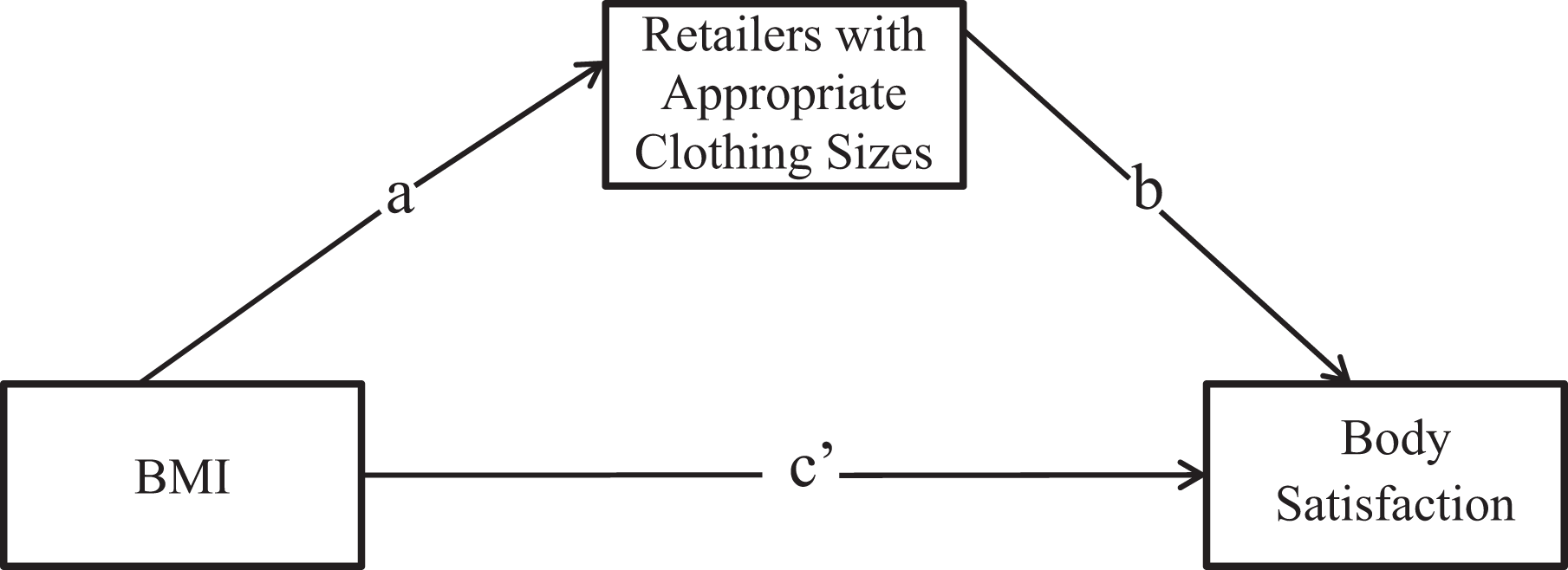
Body mass index, UK retailers with appropriate clothing sizes, and body satisfaction mediation model.
The mediated effect, represented by path ab, is the product of the estimates of paths a and b. Path c’ represents the effect of BMI on body satisfaction while controlling for the mediator, retailers with appropriate clothing sizes. Mediation was then tested a second time, with the inclusion of age as a covariate. A 95% CI was considered, with bootstrap estimates based on 10,000 bootstrap samples. Analysis was conducted using the Process macro for SPSS 24 (IBM Corp, 2019).
Results
The numbers of UK retailers where participants would be able to find appropriately sized clothing ranged from 0 to 39 (mean = 6, SD = 10.50). With a total value of 5 (very satisfied), the mean response on body satisfaction was 2.64 (SD = 1.24).
Correlational Analysis
Table 1 shows the results from correlational analysis, carried out prior to the mediational analyses. BMI was significantly negatively correlated with both body satisfaction and the number of UK retailers with appropriate clothing sizes. These results support the initial steps of mediation (Baron & Kenny, 1986), showing BMI (predictor variable) correlates with body satisfaction (outcome variable) and then with UK retailers with appropriate clothing sizes (mediator). The proposed covariate, namely age, did not significantly correlate with the independent, outcome, or mediator variables. See also scattergrams attached as Supplemental Figures 1–3.
Descriptive Statistics and Correlations Between Key Variables.
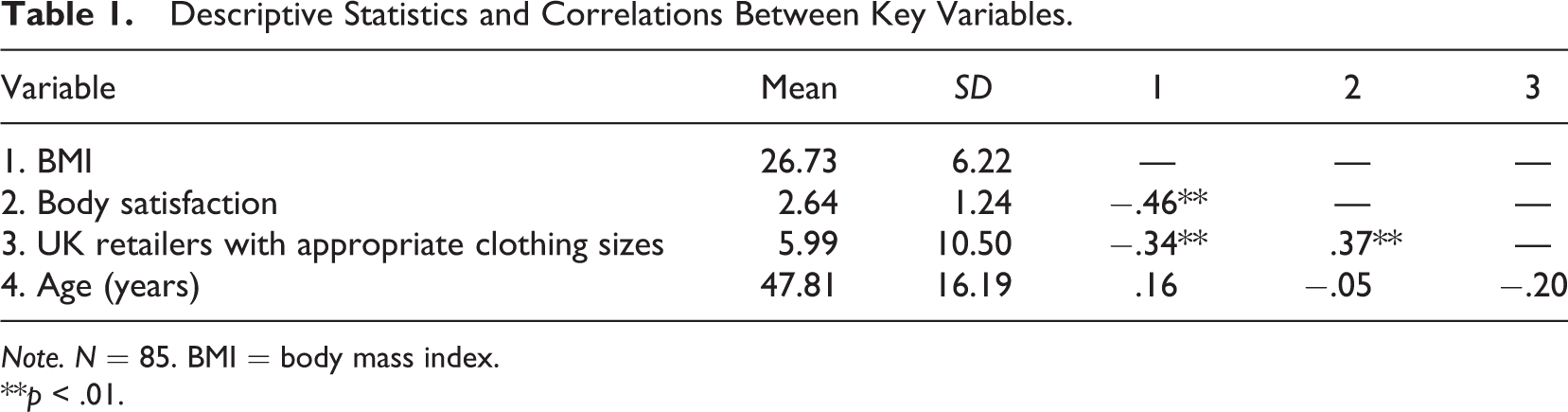
Note. N = 85. BMI = body mass index.
**p < .01.
Mediation Analysis
Following results showing BMI to be a significant predictor of body satisfaction (β = −.093, SE = .019, p < .05), regression analysis was used to investigate whether the availability of appropriately sized clothing in UK retailers mediated this effect (see Figure 2).
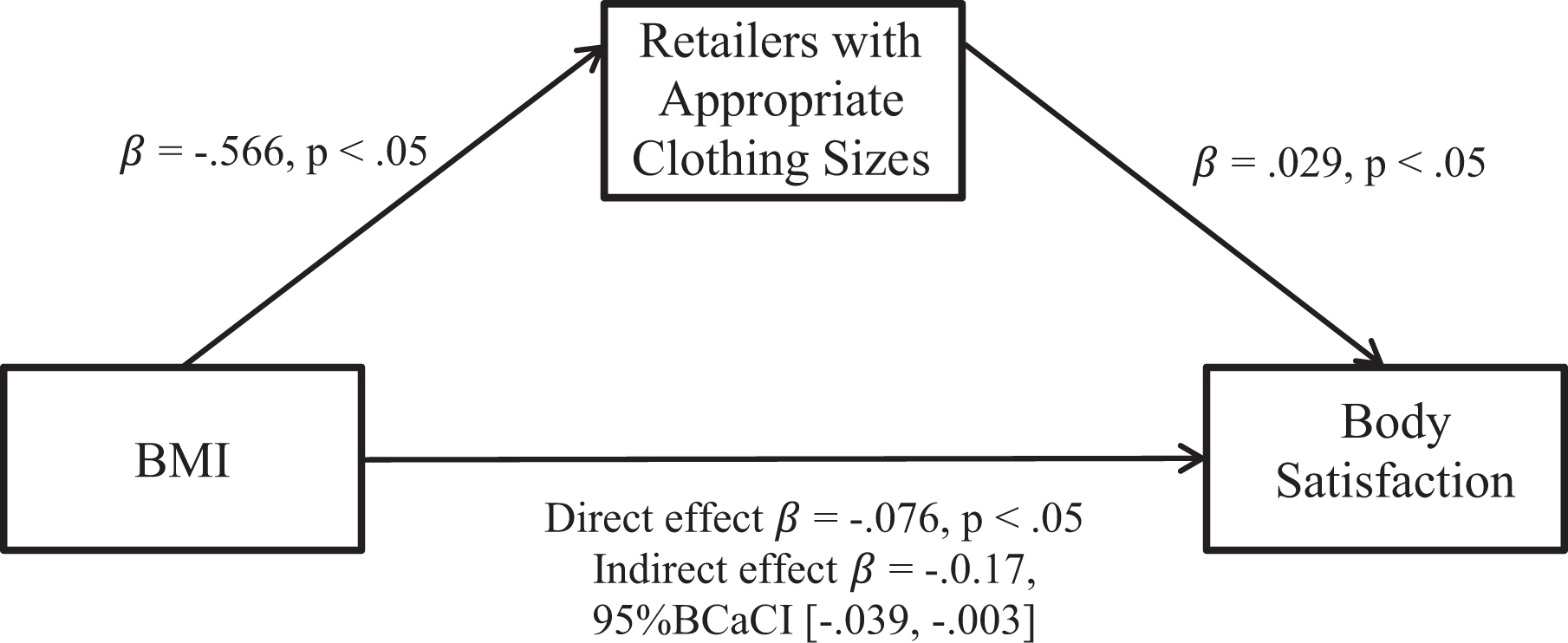
Mediation results (without controlling for age).
Results show that BMI was a significant predictor of the number of UK retailers with appropriately sized clothing (β = −.566, SE = .175, p < .05) and that the number of UK retailers was a significant predictor of body satisfaction (β = .029, SE = .012, p < .05). BMI was still a significant predictor of body satisfaction after controlling for the mediator, the number of UK retailers (β = −.076, SE = .020, p < .05). Approximately 27% of the variance in body satisfaction was accounted for by the predictors (R 2 = .269). A percentile bootstrap estimation approach with 10,000 samples was used to test the indirect effect. These results indicated a significant indirect coefficient (β = −.017, SE = .009, 95% CI [−.039, −.003]). As the CI does not include zero, and the strength of the relationship between the predictor and the outcome has been reduced by including the mediator, it can be concluded that having more shops where appropriate clothing sizes are available in the UK partially mediates the relationship between BMI and body satisfaction.
Figure 3 shows the results of the mediation model when age is controlled. Approximately 27% of the variance in body satisfaction was accounted for by the predictors in this model (R 2 = .274). Results suggest that age has little impact on the partial mediation by the availability of clothing sizes in UK shops, on BMI and body satisfaction.
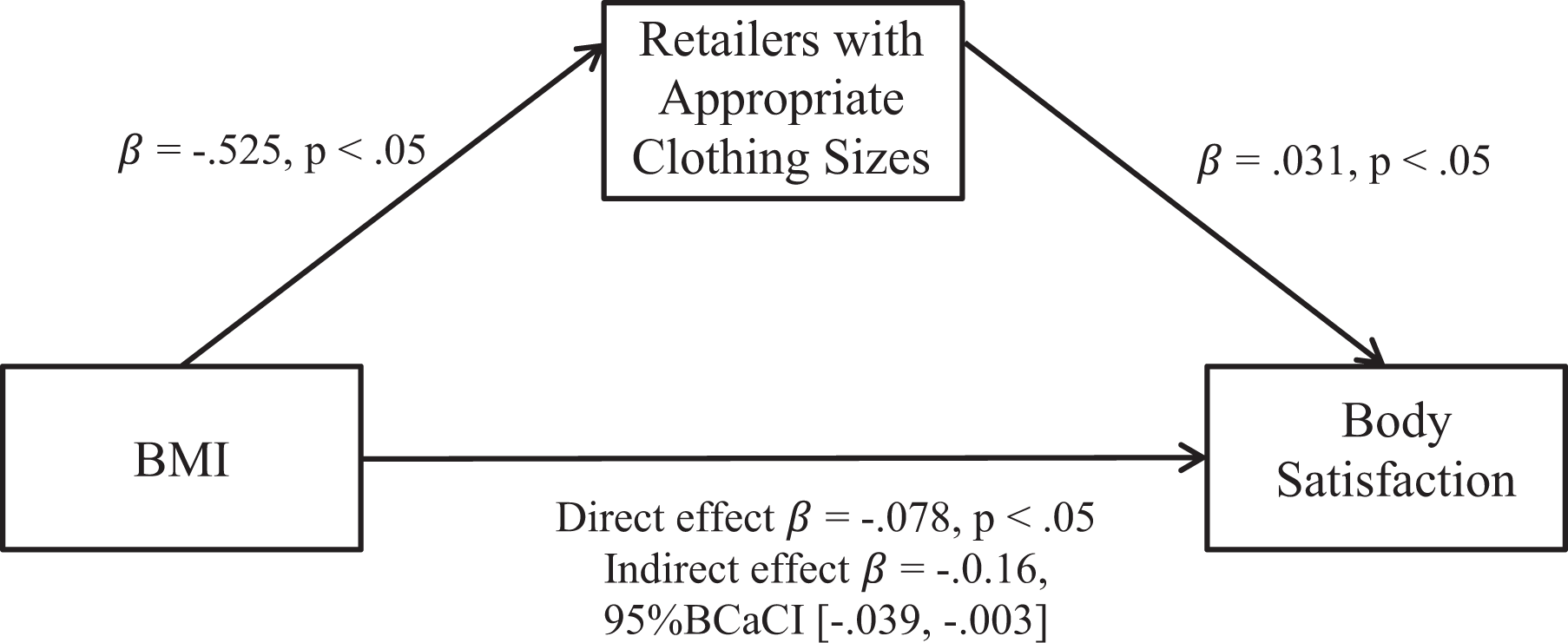
Mediation results (controlling for age).
Discussion
All research hypotheses were supported. Body satisfaction was predicted by both BMI and available sizes in UK shops, with the two factors together explaining around 27% of variance in body satisfaction. There was a significant indirect effect of BMI on body satisfaction through the number of UK shops where sizes were available, and results showed that having more shops where one’s clothing size is available partially mediates the relationship between BMI and body satisfaction. Results also show that BMI is a significant predictor of number of shops stocking women’s sizes; as BMI increases, number of available shops where women can buy well-fitting clothes decreases. These relationships were found irrespective of women’s ages.
These results support suggestions that BMI predicts body satisfaction in women, such that women higher in BMI tend to have lower body satisfaction (Burrowes, 2013; Streeter et al., 2012; Weinberger et al., 2016), and show that the relationship between BMI and body satisfaction remains strong even when body measurements and satisfaction measures are taken at different time points, hence avoiding confounding the experience of being weighed and measured with concurrent body satisfaction. Previous researchers have linked this pattern of results with the Western cultural idealization of slenderness (Grogan, 2017; Lupton, 2013; Swami & Harris, 2012); it is therefore not surprising that BMI predicted body satisfaction in women, with more slender women having more positive body image than those who are overweight or obese. However, a novel finding here is that this result was found irrespective of women’s age, so it seems to be consistent across age groups. This supports suggestions that body dissatisfaction linked to being overweight is fairly consistent across the life span (Clarke, 2002; Grogan, 2017; Mangweth-Matzek et al., 2014).
Through our results, we have extended previous work to show that greater availability of clothing in one’s size (as determined objectively by body scanning) predicts higher body satisfaction and mediates the relationship between BMI and body dissatisfaction. Further, researchers could investigate the mechanisms underlying this effect, though it seems likely that, as suggested by Link and Phelan (2001), difficulty in accessing well-fitted clothes constitutes structural weight stigmatization and signals to women with higher BMIs that their bodies are inappropriately sized, as participants in Lewis et al.’s (2011) study suggested. Internalization of this type of subtle stigma has the potential to leave women of higher BMI dissatisfied with their bodies and is linked to monitoring of body size in relation to clothes fit (Grogan et al., 2013). This highlights the importance of accessibility to well-fitting clothes for women of all sizes, and the importance for the clothing retail sector of providing an adequate range of clothes in the upper size ranges. As BMI increases, number of available shops where women can buy well-fitting clothes decreases, suggesting that retailers are currently not catering sufficiently for women with higher BMIs; this supports suggestions by previous authors (Aagarup, 2018; Downing-Peters, 2014) and extends their work through producing accurate scanner-based measures in a varied sample of British women.
We were also interested in whether age was important in predicting these effects; in other words, did the number of shops with sizes available mediate association between BMI and body satisfaction when effect of age was controlled for? We found that women’s age has little impact on the model (so these are not relationships that are confined, for instance, to younger women). This suggests that good clothes fit and availability of well-fitting clothes are important not only for younger women but also for those in older age groups, as suggested by other authors (Holmlund et al., 2011).
Strengths and Limitations
In this study, we benefited from accessing data from a large group of women of a wide range of ages (between 18 and 81 years), and a wide range of BMIs (from 18.69 to 56.13), so results can likely be generalized to women with a range of ages and BMIs. Women were a community sample accessed through women’s wear events, so they likely came from a wider variety of occupational groups compared to studies focusing on student or university samples, enhancing likely generalizability. Also, height and weight were measured directly, avoiding the problems inherent in asking women to self-report these measures, such as faulty memory and desire to present socially desirable responses, which can lead to overestimation of height and underestimation of weight (Gorber et al., 2007). The prospective design, where body satisfaction was predicted from baseline body image measures taken several weeks earlier, was also a strength of the design.
Limitations inherent in the design included most of the women being White, and none of them being underweight, so findings should be generalized with caution to women in other groups. Another limitation is our use of a single-item measure to indicate body satisfaction, which leaves open the possibility that women understood “body satisfaction” in different ways; although scores on this single-item measure were shown to correlate significantly with the multi-item Appearance Evaluation subscale of the MBSRQ (Cash, 2000), future researchers could incorporate well-validated multi-item measures of body image. Future researchers could include a larger group of women from Black, Asian, and Minority Ethnic communities. Further, researchers should also include women whose body size falls into the underweight category of BMI 18.5 and below, as these women may also struggle to find clothes that fit them well at high street clothes retailers. However, being a smaller size is generally rewarded by society and fashion sizing (e.g., sample sizes from designers, etc.), so if there are issues for underweight women, these are likely to have different underlying mechanisms. Our focus here was on general availability of clothes in women’s exact sizes, so we did not ask women about their individual shopping and fit experiences. It will be important that future researchers ask women where they shop, including whether they shop in brick-and-mortar stores, and about their individual experiences of clothes shopping, to help to clarify the underlying mechanisms behind the interesting relationships found in this study.
Conclusions
Having a body size and shape that fit more retailers’ sizing specifications predicts women’s body satisfaction, and BMI predicts body satisfaction, irrespective of age. These correlational data suggest that lack of availability of well-fitting ready-to-wear clothes in larger sizes may be a key factor in predicting body dissatisfaction in women with higher BMI. This suggests that manufacturers and retailers could improve women’s body satisfaction through designing clothes that fit women with larger bodies more accurately and stocking a more extensive range of clothes in larger sizes, though further research is necessary to understand fully the mechanisms behind the relationships observed here.
Supplemental Material
Supplemental_Figure_1 - Body Mass Index and Body Satisfaction: Does Availability of Well-Fitting Clothes Matter?
Supplemental_Figure_1 for Body Mass Index and Body Satisfaction: Does Availability of Well-Fitting Clothes Matter? by Sarah Grogan, Simeon Gill, Kathryn Brownbridge, Gillian McChesney, Paula Wren, Jenny Cole, John Darby, Celina Jones and Christopher J. Armitage in Clothing and Textiles Research Journal
Supplemental Material
Supplemental_Figure_2 - Body Mass Index and Body Satisfaction: Does Availability of Well-Fitting Clothes Matter?
Supplemental_Figure_2 for Body Mass Index and Body Satisfaction: Does Availability of Well-Fitting Clothes Matter? by Sarah Grogan, Simeon Gill, Kathryn Brownbridge, Gillian McChesney, Paula Wren, Jenny Cole, John Darby, Celina Jones and Christopher J. Armitage in Clothing and Textiles Research Journal
Supplemental Material
Supplemental_Figure_3 - Body Mass Index and Body Satisfaction: Does Availability of Well-Fitting Clothes Matter?
Supplemental_Figure_3 for Body Mass Index and Body Satisfaction: Does Availability of Well-Fitting Clothes Matter? by Sarah Grogan, Simeon Gill, Kathryn Brownbridge, Gillian McChesney, Paula Wren, Jenny Cole, John Darby, Celina Jones and Christopher J. Armitage in Clothing and Textiles Research Journal
Footnotes
Declaration of Conflicting Interests
The author(s) declared no potential conflicts of interest with respect to the research, authorship, and/or publication of this article.
Funding
The author(s) received no financial support for the research, authorship, and/or publication of this article.

Supplemental Material
The supplemental material for this article is available online.
References
Supplementary Material
Please find the following supplemental material available below.
For Open Access articles published under a Creative Commons License, all supplemental material carries the same license as the article it is associated with.
For non-Open Access articles published, all supplemental material carries a non-exclusive license, and permission requests for re-use of supplemental material or any part of supplemental material shall be sent directly to the copyright owner as specified in the copyright notice associated with the article.


