




Abstract
The topic of equal pay usually sparks debates with diverse opinions ranging from those supporting equal pay to those that oppose equal pay. This study attempted to gather empirical data on how individuals perceive equal pay. A questionnaire was designed that probed the respondents’ perceptions of equal pay along 13 dimensions. The respondents were recruited in Norway and grouping analysis was performed according to several demographic factors. The results show that political affiliation, gender, and work union membership were the strongest predictors of standpoint regarding equal pay. The strongest associations with equal pay were observed for unfairness, communism, low realism, and demotivation. Small gender differences were also observed. We argue that data about common perceptions of equal pay is necessary to make informed adjustments to how work is rewarded, and resources distributed. How individuals are to be compensated for the cost of education was the most frequent reservation.
Introduction
We have all probably wondered, at some point, why we earn less or more than others. For instance, how come bus drivers, who are as responsible for the safety of passengers as aircraft pilots, earn so much less than pilots? This phenomenon is explored in the anthology Debating Equal Pay (Örtenblad, 2021) comprising chapters from different authors around the world arguing for and against equal pay, or something in between. These discussions raised several perspectives of equal pay that can be mapped to several dimensions.
Although this study is framed in a Norwegian context, there is no specific legislature addressing equal pay or pay levels in Norway. Generally, level of pay is the result of an individual negotiation between the employer and employee. Norway was simply chosen due to the convenience of recruiting participants.
Of the voices critical of equal pay, Zwolinski (2021) claims that equal pay would “result in an economic and moral catastrophe” as the labor market and human welfare, as we know it, would collapse. Brouwer and Deijl (2021) argued that pay should be related to the effort, trouble, and responsibility involved. Cooke (2021) acknowledges equal pay as a radical and interesting idea but argues that it limits personal liberties and individuals’ willingness to take risks and responsibilities. Several scholars pointed out that pay inequality has recently increased (Schaff, 2021; Knudsen, 2021) and several authors argue that the main solution are mechanisms that narrow the gaps, while not eliminating them (Dorey, 2021; Zwolinski, 2021). In favor of equal pay, Reilly and Brown (2021) contend that equal pay leads to more flexibility for employers in terms of reorganization and staff transfer, more innovation, and less demotivation among staff due to pay differences. Frederking (2021) concludes that economic inequality leads to political inequality. To achieve democracy, one needs economic equality and, with it, equal pay. Another argument for equal pay is that achievements could be recognized without differentiated pay (Deranty, 2021). Pointon and Sinnicks (2021) argue that equal pay is a key to a relationally egalitarian society.
Although academically interesting it is unclear how well the arguments presented by the scholars are aligned with the general opinions and perceptions held by citizens. If one is to change practices on how individuals are rewarded for their work to achieve a fairer distribution of wealth (Dorey, 2021; Zwolinski, 2021), one needs an informed basis for change. It seems relevant to identify how equal pay is perceived by individuals who would potentially be affected by equal pay. The motivation behind this study was to test how well the scholarly arguments related to equal pay are aligned with the common perceptions held among individuals without a formal academic background in economics. The overall aim of this paper is, thus, to increase knowledge as to how “people in general” perceive the suggestion of “equal pay for all,” to take the debate further. Inspired by Bøhn (2021), we defined equal pay as a fixed amount received per hour, regardless of profession. For example, a doctor at a hospital will receive the same pay for an 8-hour shift as a cleaner. How pay is perceived has been studied from several perspectives such as pay equity (Buttner and Lowe, 2017), fairness (Rasch and Szypko, 2013; Till and Karren, 2011; Kim, Wang, Chen, Zhu, & Sun, 2019), pay increases (Rambo and Pinto, 1989); and gender (Khoreva, 2011). Pay has been investigated as a mechanism for attracting and retaining workers with suitable competence profiles (see, for instance, Metcalf, Rolfe, Stevens, & Weale, 2005; Guarino, Santibanez, & Daley, 2006) and for motivating work effort (Sandnes, 2018).
When measuring perceptions of socioeconomic issues, it can be useful to identify representative groups that may share certain values, cultures, traditions, and situations. The following sections describe 10 individual and work-related demographic factors identified as relevant in context of this study.
Individual Factors
We identified seven individual factors that may influence the perception of equal pay including political affiliation, gender, fortune, education, geographic origin, and age.
Political Affiliation
Political affiliation is a demographic characteristic that is directly tied to opinions and perceptions as political ideology of the government dictates economic and welfare policies. Much has been written on this topic. For instance, Botzen, Michel-Kerjan, Kunreuther, De Moel, & Aerts (2016) discussed connections between political affiliation and climate risks. The results of this US-oriented study showed that Democrats were more perceptive of climate risks than Republicans. McGowan (2000) studied the connection between political affiliation and attitudes towards an alternative flat tax system in a US context. Republicans were found to be more in favor of the flat tax and sales tax systems, while Democrats and Independents were more positive towards the existing tax system. Roth, Thatcher, Bobko, Matthews, Ellingson, & Goldberg, (2020) investigated the connections between political affiliation and employment decisions. Using a similarity-attraction paradigm, their controlled experiment showed that applicants with a similar political affiliation to themselves were perceived more positively.
In Norway, the political system can be simply explained as a continuum from left to right, where the political left represents socio-democratic parties with collectivist values that are advocates of the social welfare system. The political right represents conservative parties with values more tied to individual freedom and responsibility. This gave rise to the following hypothesis: H1: Individuals on the political left are more in favor of equal pay than individuals on the political right.
Gender
Much has been written about pay equity and gender, as many studies have analyzed patterns of women being paid less than men for the same work (Barbezat and Hughes, 2005; Barnard, 2008; Arvanitis, Stamatopoulos, & Thalassinos, 2011; Zhug1e, Kaufman, Simeone, Chen & Velazquez, 2011). Khoreva (2011) specifically addressed perceptions of equal pay in context of gender, gender role orientation, age, marital status, pay expectations, perceived pay fairness, and education. Khoreva found that gender composition within an employment sector and welfare state regimes and public awareness predicts equal pay perceptions.
With a backdrop of gender related pay differences, one could suspect that also perceptions of equal pay would be different among men and women. One may hypothesize that men who generally are paid more will be more satisfied with the status quo of unequal pay, while women that generally are paid less are more in favor of equal pay: H2: Females are more in favor of equal pay than men.
Fortune
Fortune is personal wealth that may have been acquired through inheritance, via a life partner, winnings, gifts, personal investment gains, or accumulated from income. It is probably not difficult to find individuals whose fortune and pay are unrelated as it is possible for someone to have a huge inherited fortune and no job and zero pay, or a high pay and no fortune due to high expenses. However, for most individuals, fortune and pay are probably related as fortune is a function of pay. With this assumption, it seems intuitive that individuals with a high fortune (and assumed high pay) do not want less due to equal pay if that is less than their current pay, whilst those with a low fortune (and assumed low pay) would like to earn more to accumulate a fortune and thus be positive towards equal pay if equal pay is more than their current pay. We therefore formulated the following hypothesis: H3: Individuals with a low fortune are more in favor of equal pay than individuals with a high income/fortune.
Education
Several studies have connected perception to education. For instance, Acquah and Onumah (2011) found that farmers’ willingness to pay for climate change mitigation increased with education level. Angulo and Gil (2007) discussed consumers’ trust in food safety and education level. We hypothesized that the degree of positivity towards equal pay would be related to education level, as those pursuing education may be more curious and positive towards alternatives and perhaps are more trained to see things in a broader context: H4: The level of education correlates with the degree of positive perceptions of equal pay.
Geographic Origin
Cultural differences resulting from geographical origin is a topic that has been studied extensively (Hofstede, Hofstede, & Minkov, 2005; Jian et al., 2010a, 2010b, 2010c). Groups affiliated with different geographical regions tend to exhibit unique cultural profiles. For example, cultural affiliation has been connected to motivation (Law, Sandnes, Jian, & Huang, 2009). According to Hofstede et al.’s (2005) framework for comparing cultures Norway scores low on power distance with characteristics including equal rights, independence, and dislike for control; Norway is classified as an individualist society where people look after themselves, have clear division between work and private life; Norway is also classified as one of the world’s most feminine societies which means that key values are caring for others, quality of life, free time, and flexibility.
When studying geographical origin within a national study, it is convenient to group the respondents according to their distance to the country in focus, that is, those native to the country, those born in the country being children of immigrants, and respondents who have immigrated to the country. We hypothesized that those that have immigrated would be more in favor of equal pay than those who were born in Norway based on the speculation that the reputation of the Norwegian social welfare system may attract immigrants with values that are aligned with the social democracy. Individuals born in Norway, however, have not explicitly chosen to live in Norway and may thus exhibit more varied views on the socio democracy: H5: Individuals originating in Norway are less in favor of equal pay than individuals originating elsewhere.
Age
Age is another demographic factor that has been linked to pay. For example, Barnum, Liden, & DiTomaso (1995) claim that differences in pay increases with age between women with ethnic minorities compared to white men. Cataldi, Kampelmann and Rycx (2012) investigated the phenomenon of younger workers being underpaid compared to more senior workers yet yielding the same productivity as their senior colleagues.
If one assumes that younger individuals have a greater need for money to establish their livelihood and start a family (acquiring a home, cost of raising young children) yet they have less access to money being at the bottom of the salary ladder. Senior colleagues however have had time to climb the salary ladder and accumulate wealth (accommodation, car, children left home, completed loan down payments, etc.). Based on this, one may hypothesize that generally younger individuals are more in favor of equal pay, while more senior individuals are more satisfied with the status quo (unequal pay): H6: Younger individuals are more in favor of equal pay than more senior individuals.
Work-Related Factors
Relevant work-related factors that may influence the perception of equal pay include union membership status, income, whether employed in a public or private organization, and employment status.
Union Membership
Organized worker unions are important mechanisms for ensuring the rights of workers (Sachs, 2010). Although union membership can be beneficial in terms of pay, Bryson, Cappellari, & Lucifora (2004) could not find any connection between union membership and job satisfaction.
We identified union membership as a potentially influential demographic factor and hypothesized that union members have a more collectivist view on pay and sharing and may be more positive towards equal pay than unorganized workers who may be more in favor of individual incentives: H7: Workers organized in unions are more in favor of equal pay than unorganized workers.
Income
Studies have explored how income levels are related to perceptions of various issues (Irigoyen-Camacho, Velazquez-Alva, Zepeda-Zepeda, Cabrer-Rosales, Lazarevich, & Castaño-Seiquer, 2020). For example, in a large study involving 36 countries, Lo (2014) connected individuals’ income to perceived environmental concerns. Lo’s results showed no connection between income and environmental concerns, but perceptions of the environment were higher for individuals with low income and lower for individuals with high income. Lo concluded that groups facing higher risks are less able to afford risk reduction measures. Tonin and Vlassopoulos (2017) explored the connections between income and charitable giving. In a controlled experiment, participants were given either a high or low reward for a task and asked to share their earnings. Their results showed that those with a high reward were less likely to share, while both groups shared the same portion of their reward. Using a similar rational as for H3 (fortune), we formulated the following hypothesis based on the assumption that those with low pay who will gain from equal pay will be more positive than those who will end up with less through equal pay: H8: Individuals with a low income are more in favor of equal pay than individuals with a high income/fortune.
Public versus private employment: Public versus private employment is another characteristic that has received attention among researchers (Melly, 2005). For example, Coursey and Rainey (1990) contrasted perceptions of personnel systems in public and private organizations. Their results indicate that managers in private organizations perceive more freedom and flexibility, stronger authority, and shorter hiring times than managers in public organizations. Rainey, Pandey, and Bozeman (1995) questioned the myth of public organizations as inflexible but found a strong difference in perception in how easy it is to connect pay and promotion to performance within public organizations.
We hypothesized that individuals employed in the public sector would be more in favor of equal pay than individuals employed in the private sector: H9: Workers in public organizations are more in favor of equal pay than workers in private organizations.
Employment Status
The employment status, that is, full time, part time, unemployed etc., was also identified as a potentially relevant demographic factor. Several studies have addressed employment status, for instance, differences between full time and part time employees in terms of job attitudes (Sinclair, Martin, & Michel, 1999) and job satisfaction (Maynard and Joseph, 2008). We hypothesized that individuals with full time work would be less positive towards equal pay than groups with other types of employment status (part time, self-employed, students, unemployed, or retired): H10: Individuals with full time work are less positive towards equal pay than groups with other types of employment status (part time, self-employed, students, unemployed or retired).
The rest of this paper is organized as follows. The next section presents the methodology including the design of the questionnaire. This is followed by the results and a discussion of the results. The text closes with a set of conclusions.
Method
Questionnaire Design
A questionnaire was designed with three parts. The first part of the questionnaire solicited the respondents’ demographic information. This information was designed to be used for performing between-group analysis of the respondents.
We solicited the respondents’ gender. Gender identity is a complex issue and we decided to take a simplistic approach with the options male, female, or “other.” Only one respondent reported “other.” We also solicited the respondents’ age in 10-year intervals from 20 to 70 years of age to maintain respondents’ anonymity.
The respondents’ highest completed education levels were solicited using the following options: primary school, secondary school, vocational school, or bachelor, master, or PhD at university level. We also probed the respondents’ employment status (full time, part time, freelance, self-employed, student, unemployed, or retired), employment sector type (public, private, or volunteer work), and work union membership (organized or unorganized).
Political position was probed using the option left faction, center faction, right faction, and neutral. We also probed the respondents’ income and fortune. To prevent the questionnaire coming across as too threatening and complexities of scaling, we decided to use a relative perceptual scale for income and fortune with the options none, low, below average, average, above average, and high. The final demographic question probed the respondents’ geo-cultural origin with the options national (Norwegian), 2nd/3rd generation immigrant (Norwegian), regional (outside Norway in Western Europe), and international (the rest of the world).
The second part of the questionnaire comprised 13 questions where the respondents were asked to rate equal pay according to 13 dimensions that were identified as likely to trigger differences in terms of equal pay perceptions. Each dimension was represented using a 5-item Likert scale from two opposite ends of each dimension. The dimensions can be classified into three categories: ideological or value-driven, emotional, and pragmatic. The ideological dimensions included (1) capitalism–communism and (2) collectivism (other’s interests)–individualism (own interests). The emotional dimensions included (3) motivating–demotivating, (4) unfair–fair, (5) equal treatment–discriminatory treatment, (6) humane–inhumane, (7) high degree of happiness–low degree of happiness, and (8) high degree of purpose in life–low degree of purpose in life. The pragmatic dimensions included (9) much freedom–little freedom, (10) many opportunities–few opportunities, (11) strong regulation–weak regulation, (12) much self-realization–little self-realization, and (13) unrealistic–realistic. The following sections elaborate on these dimensions in more detail.
Ideological Dimensions
The capitalism versus communism dimension was included to test our anecdotal observation that equal pay was associated with communism regimes, implying that differentiated pay is synonymous with capitalism and individual opportunity. The collectivism versus individualism dimension is inspired by Hofstede et al.’s (2005) framework for cultural differences as one may expect that individuals with collectivist values to be more in favor of equal pay than those with individualist values.
Emotional Dimensions
The motivating versus demotivating dimension is based on the literature on differentiated pay and incentives as mechanisms for motivating work effort (Rasch and Szypko, 2013; Kim et al., 2019). The perception of fairness is also linked to motivation, as some may view equal pay as fair, while others may view differentiated pay as fair where reward is related to effort. Next, equal treatment versus discriminatory treatment indicates whether equal pay is considered positively as literary treating everyone equally, or whether equal pay discriminates individuals who put in an extraordinary effort in their work. In fact, those who prefer reward for effort may find equal pay inhumane, while those who prefer equal pay may find equal pay more humane. Next, the dimension high degree of happiness versus low degree of happiness. Possible connections between level of pay and happiness have been explored in several studies (Park, Min, & Chen, 2016; Collischon, 2019). Perhaps we do not need much to be happy, yet everyone should have a basic minimum to support fundamental needs. While not having to focus on pay our attention can be concentrated on more important things in life. Participation in the discriminated pay race may lead to unhappiness as most people will not be winners. On the other hand, one could argue that the gathering of wealth is an activity that leads to a sense of achievement, satisfaction, and happiness. Excess on the other hand may lead to unhappiness and stress. . The dimension high degree of purpose in life versus low degree of purpose in life is linked to happiness if we assume that someone with a strong sense of meaning in life is also happy. We can therefore probably analyze purpose in life using similar perspectives as for happiness. Pragmatic dimensions: Much freedom versus little freedom intends to shed light on whether equal pay gives more perceived freedom in that individuals may pursue their interests regardless of their effort at work, while differentiated pay may be perceived as providing freedom in how much to work and how much one earns, and consequently freedom to spend earning. Next, whether equal pay leads to many opportunities or few opportunities is similar to the freedom dimension, in that equal pay can give individuals freedom in their private life with the guaranteed equal pay, while individuals who favor differentiated pay may find that equal pay and lack of incentives limits the array of opportunities. Tight regulation versus weak regulation was devised to verify whether equal pay is associated with tight regulation as it may only be possible to implement an equal pay regime through tight regulation. Related to freedom and opportunities is the dimension of much self-realization versus little self-realization, as differentiated pay may be associated with self-realization. Finally, irrespective of whether one is in favor of equal pay or not one may assess that the proposition is difficult to achieve in practice. We therefore included the unrealistic versus realistic dimension to probe respondents’ perceptions of its practicality.
The third part of the questionnaire contained a free-text field where respondents could comment on the questions or add any other reflections occurring while completing the questionnaire. The questionnaire was written in Norwegian.
Respondents
Respondents were predominantly recruited using social media (Facebook) and email lists using the authors’ social and professional networks. The study also relied on snowball sampling as respondents were encouraged to forward the questionnaire link to potential interested contacts. A total of 362 responses were solicited. The respondents had to be able to read Norwegian to respond (or get translation assistance).
The respondents were relatively evenly distributed in terms of age with 6 respondents below 20 years of age, 51 respondents in their twenties, 81 respondents in their thirties, 132 in their fourties, 63 in their fifties, 22 in their sixties and seven respondents being 70 years or older.
A total of 327 respondents had a geographic origin in Norway, 17 respondents originated in Europe, and 14 respondents originated from outside Europe.
Most of the respondents reported being fully employed (248 respondents), while 34 were self-employed, 30 part time workers, 25 students, 15 retired, seven unemployed, and three freelance workers. The remaining demographic breakdowns are detailed in the respective results sections.
Procedure
The questionnaire was implemented using Google forms and distributed electronically during a period of 1 month. The questionnaire was anonymous as it did not solicit any personal information or require any authentication. We therefore were unable to check whether individuals have submitted more than one response. However, we viewed the chance of someone responding to the questionnaire multiple times as negligible. The respondents were asked to respond rapidly according to their initial thoughts so as not to over-analyze the questions.
One respondent was concerned with tracking and privacy concerns on the Google platform. This respondent was encouraged to use incognito mode in the browser. As we did not collect any personal information, the data handling procedures did not have to be formally approved as per national privacy and ethics regulations.
Analysis
The responses to the individual Likert questions were first mirrored so that any bias leaned in a unified direction to facilitate simple visual comparisons. The bias was simply determined by the side of the Likert scale that accumulated the highest frequency of responses, that is, items 1 and 2 or items 4 and 5, as item 3 was neutral.
The responses were analyzed using the JASP statistical analysis software version 0.16.0.0 (JASP Team, 2022). The responses were analyzed between-group according to the demographic attributes. Only non-parametric tests were used as the responses were ordinal. Mann–Whitney U tests were used to analyze differences across two groups, and Kruskal–Wallis tests were used to analyze differences across three or more groups followed by Dunn post-hoc testing. Effect sizes (ES) of pairs are reported using rank-biserial correlations and η2 (eta squared) for comparison of three or more groups.
Non-parametric Spearman correlation analyses were also performed on the demographic variables that were ordinal, namely, education level, political affiliation (ignoring neutral), income, fortune, and geographical affiliation distance.
Results
First, the observed degree of bias triggered by the various dimensions is presented. Next, the responses are organized according to demographic groups, and finally a model is presented where the respondents are classified as being in favor of or against equal pay.
Dimensions that Trigger Bias
The summary of responses in Figure 1 shows that realism is associated with the strongest bias (equal pay as unrealistic), followed by equal pay as communistic, strong regulation, and demotivating. Overall, equal pay was also perceived as collectivist, unfair and humane, however, these responses are moderately biased. Degree of bias for the dimensions studied herein.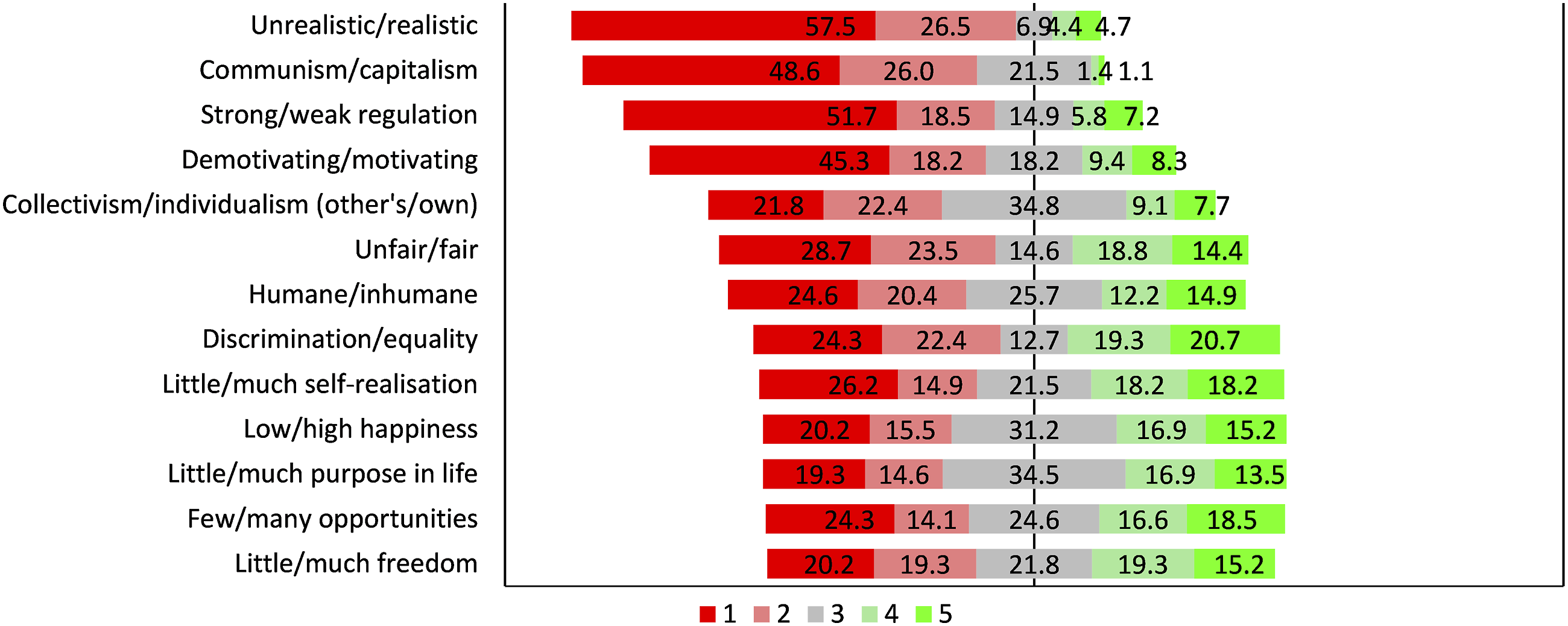
No distinct bias could be observed for the remaining dimensions, that is, equal pay was not perceived as particularly discriminatory, affecting self-realization, purpose in life, degree of opportunities, and degree of freedom.
Demographic Group Contrasts
Summary of between-group factors that trigger differences in perceptions of equal pay.
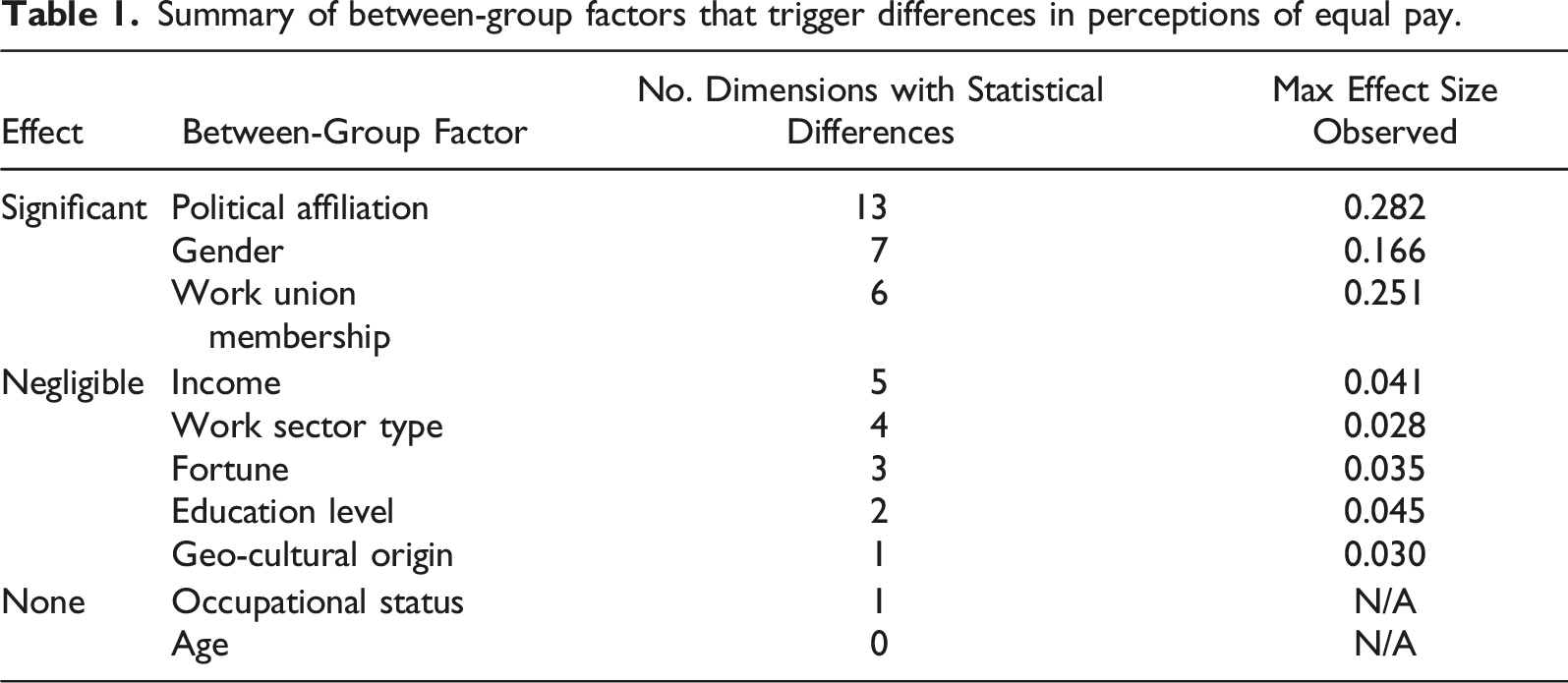
Only political affiliation, gender, and work union membership exhibited effect sizes above 0.1. That is, although statistical differences were found for other demographic factors, the differences were probably practically less important although statistically significant. The analysis focus herein will thus be devoted to political affiliation, gender, and work union membership. The following sections present the detailed results of the between-group analyses.
Political Affiliation
Grouping according to political affiliation resulted in the most statistical differences across the groups. Figure 2 lists dimensions with significant differences grouped on political affiliation, of which 71 respondents belonged to the right faction, 86 respondents belonged to the center faction, 155 respondents belonged to the left faction, while 46 respondents indicated that they were neutral. Significant differences according to political affiliation.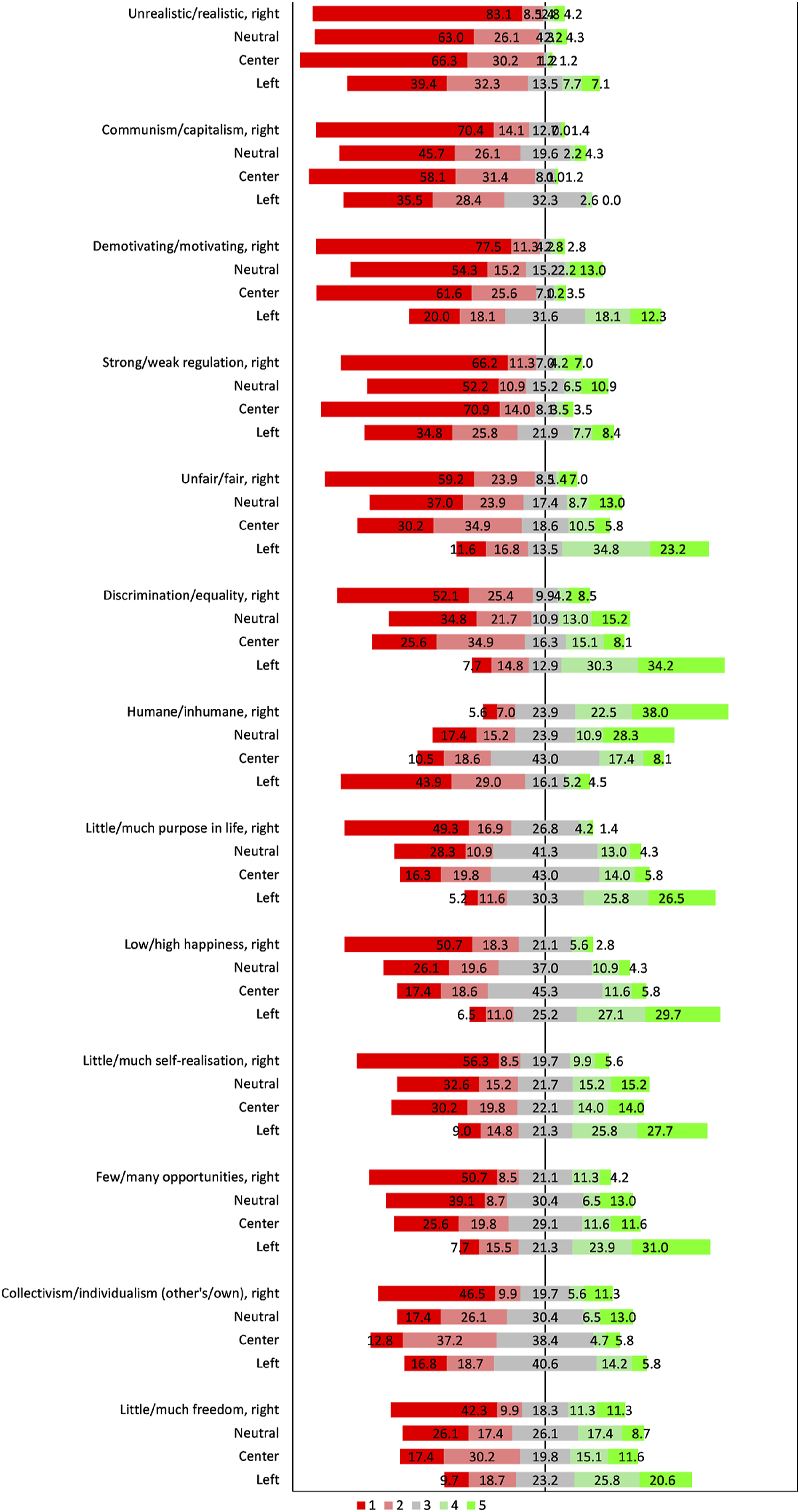
The dimensions that flagged significant differences included realism (H(3) = 45.664, p < .001, ES = 0.099), capitalism/communism (H (3) = 31.256, p < .001, ES = 0.077), motivation (H(3) = 93.218, p < .001, ES = 0.231), regulation (H(3) = 32.213, p < .001, ES = 0.065), fairness (H(3) = 81.564, p < .001, ES = 0.227), discrimination/equality (H(3) = 84.733, p < .001, ES = 0.240), humanity (H(3) = 98.939, p < .001, ES = 0.282), purpose in life (H(3) = 87.824, p < .001, ES = 0.252), happiness (H(3) = 92.407, p < .001, ES = 0.262), self-realization (H(3) = 57.179, p < .001, ES = 0.159), opportunities (H(3) = 62.420, p < .001, ES = 0.178), collectivism/individualism (H(3) = 12.922, p = .005, ES = 0.029), and freedom (H(3) = 26.918, p < .001, ES = 0.078).
Post-hoc tests confirmed that all differences between the right and left factions were significant, as well as all differences between the center and left factions. Most differences between the right and center faction were also significant except for freedom, regulation, motivation, and realism. There were no significant differences between the neutral group and center group except for capitalism/communism and regulation.
The center faction perceived equal pay as the most unrealistic, followed by the right and with the left faction perceiving equal pay as the most realistic. A similar pattern was also observed for communism, being demotivating, regulation, and collectivism with the center faction at one end and the left faction on the other.
In terms of fairness, the right faction perceived equal pay as the most unfair, followed by the center faction and with the left faction perceiving equal pay as the least unfair. Similar patterns with right, center, and left faction was also observed for equal pay as discriminatory, inhumane, little purpose in life, low happiness, and less freedom.
A visual inspection of Figure 2 suggests that the political continuum correlates with the dimensions. Correlation analysis confirms a medium significant correlation between political affiliation and humane-inhumane (r s (N = 306) = 0.561, p < .001), motivation (r s (N = 310) = 0.537, p < .001), happiness (r s (N = 309) = 0.523, p < .001), purpose in life (r s (N = 309) = 0.515, p < .001), discrimination/equality (r s (N = 312) = 0.515, p < .001), and fairness (r s (N = 312) = 0.504, p < .001). Low significant correlations were observed for many/few opportunities (r s (N = 306) = 0.434, p < .001), little/much self-realization (r s (N = 310) = 0.425, p < .001), realism (r s (N = 312) = 0.373, p < .001), capitalism/communism (r s (N = 308) = 0.313, p < .001), freedom (r s (N = 299) = 0.289, p < .001), regulation (r s (N = 307) = 0.299, p < .001), and collectivism/individualism (r s (N = 300) = 0.199, p < .001).
Note that the neutral responses were discarded in the correlation analysis as these could not be mapped to the political continuum.
Gender Differences
Figure 3 lists significant gender differences. A total of 208 males and 151 females responded to the questionnaire. Males perceived equal pay as more communistic (U = 13,278, p = .025, ES = 0.129), more strongly regulated (U = 17,242.5, p = .012, ES = 0.144), more inhumane (U = 17,447.0, p = .007, ES = 0.166), more unfair (U = 18,156.0, p = .010, ES = 0.156), more discriminatory (U = 17,524.5, p = .031, ES = 0.131), providing lower purpose in life (U = 13,201.0, p = .020, ES = 0.140), and giving less freedom (U = 12,685.0, p = .048, ES = 0.122), compared to females. Significant differences according to gender.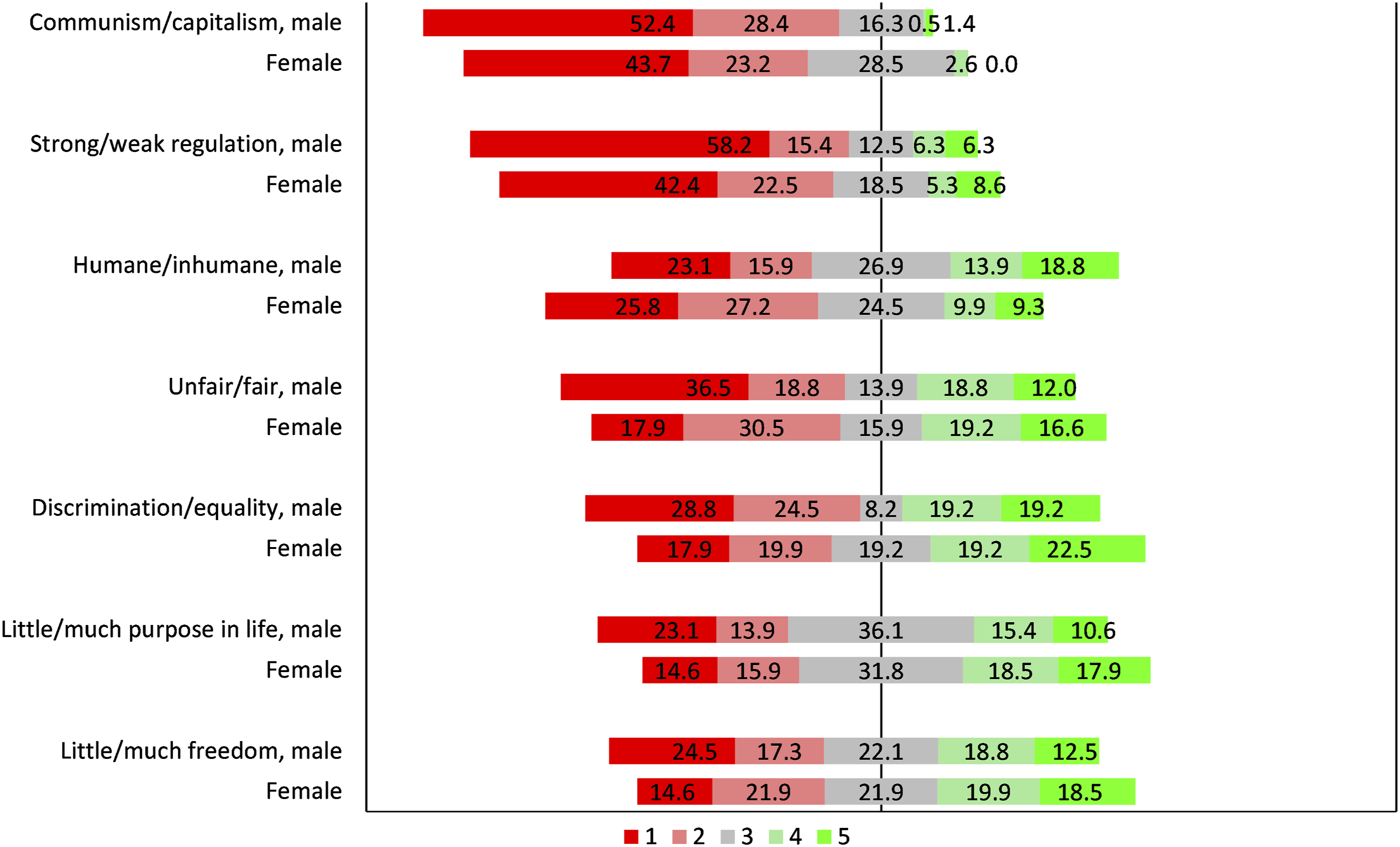
Union Membership
Figure 4 enumerates the responses grouped on union membership where 221 respondents were organized in a union, and 135 respondents were not. The results show that respondents organized in a union perceived equal pay as statistically more fair (U = 17,934.5, p = .001, ES = 0.202), more humane (U = 17,840.0, p < .001, ES = 0.251), less discriminatory (U = 17,762.5, p = .001, ES = 0.202), giving more happiness (U = 17,145.0, p = .004, ES = 0.177), stronger purpose in life (U = 12,190.0, p = .008, ES = 0.163), and more freedom (U = 11,826.5, p = .026, ES = 0.140), compared to the unorganized respondents. Significant differences according to work union membership.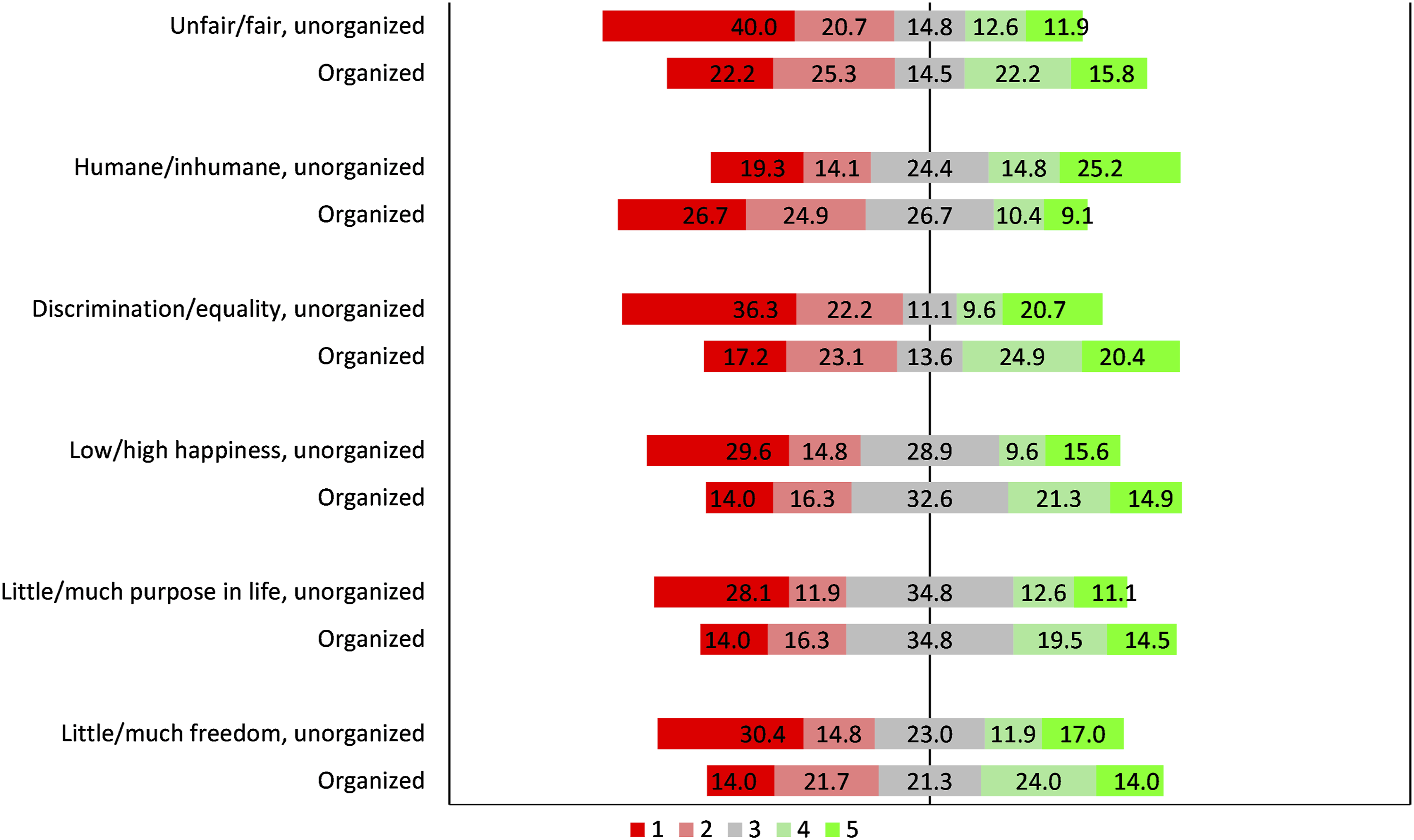
Income
Figure 5 reveals the dimensions that contained significant differences grouped according to income, namely, high (44 respondents), above average income (124 respondents), average income (121 respondents), below average income (37 respondents), low income (21 respondents), and no income (15 respondents). Significant differences were observed for realism (H(5) = 17.955, p = .003, ES = 0.037), motivation (H(5) = 13.055, p = .023, ES = 0.036), regulation (H(5) = 12.893, p = .024, ES = 0.028), collectivism/individualism (H(5) = 13.090, p = .023, ES = 0.039), and discrimination/equality (H(5) = 14.563, p = .0.012, ES = 0.041). Note that all the effect sizes are low despite significance. Significant differences according to income.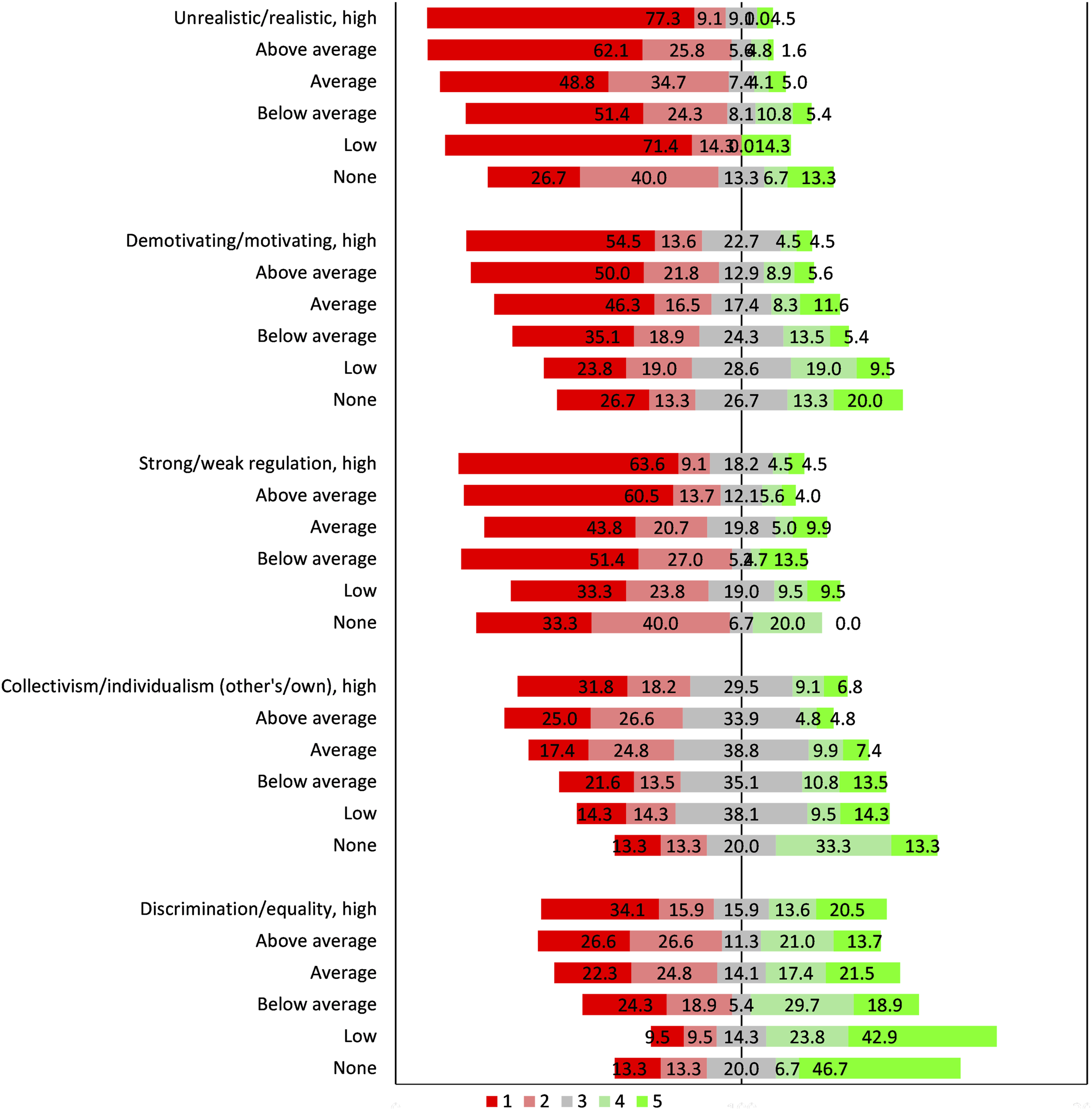
A visual inspection of the plot shows that the perception of realism of equal pay correlates negatively with degree of income as those with a high income perceived equal pay as the least realistic and respondents with no income perceived equal pay as the most realistic. A similar pattern was observed for the other dimensions also. That is, the respondents with the highest income perceived equal pay as the least motivating, while the respondents with the lowest income perceived equal pay as the most motivating. High-income respondents also perceived equal pay as more regulated, more collectivist, and more discriminatory compared to respondents with lower income. These observations are supported by correlation analyses that show weak significant correlations between level of income and realism (r s (N = 362) = 0.170, p = .001), motivation (r s (N = 360) = 0.174, p < .001), regulation (r s (N = 355) = 0.161, p = .002), collectivism-individualism (r s (N = 347) = 0.181, p < .001), and discrimination-equality (r s (N = 360) = 0.162, p = .002).
Workplace
Figure 6 summarizes the dimensions with significant differences grouped according to employment sector type, that is, private (165 respondents), public (167 respondents), and volunteer work (15 respondents). Significant differences were observed for degree of realism (H(2) = 6.917, p = .031, ES = 0.007), humane/inhumane (H(2) = 8.930, p = .012, ES = 0.028), discrimination versus equality (H (2) = 8.336, p = .015, ES = 0.023), and degree of purpose in life (H(2) = 7.663, p = .022, ES = 0.028). Post-hoc tests confirmed that there were statistical differences between the public and private groups for all of the four dimensions listed (p < .032). The group of volunteers was too small to perform reliable analysis. Effect sizes were low. Significant differences according to employment sector type.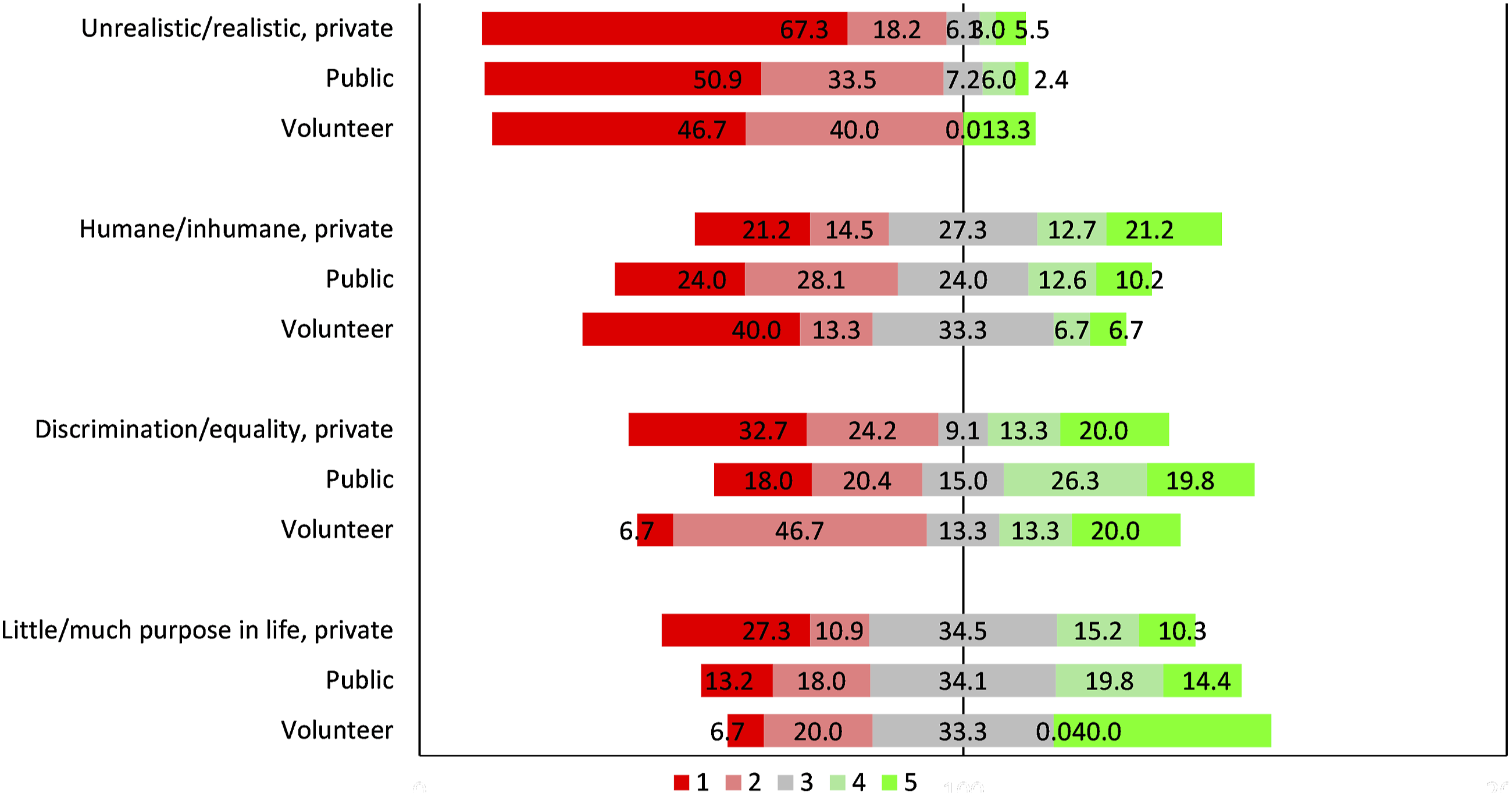
All groups perceived equal pay as unrealistic. Overall, the respondents exhibited more neutral responses with regards to whether equal pay is humane or inhumane. The private sector respondents exhibited the least positive perception of equal pay as humane, and the volunteer workers perceived equal pay as most humane.
In terms of discrimination versus equality, the public sector workers associated equal pay more strongly to equality than the private sector workers. The private sector workers exhibited the weakest association between equal pay and purpose in life, while the volunteer workers perceived equal pay most strongly as providing purpose in life.
Fortune
Figure 7 shows the dimension with significant differences grouped by the respondents self-reported fortune, that is no fortune (72 respondents), low fortune (31 respondents), fortune below average (59 respondents), average fortune (135 respondents), fortune above average (53 respondents), and high fortune (12 respondents). Significant differences were observed for the dimensions related to motivation (H(5) = 13.541, p = .019, ES = 0.035), opportunities (H(5) = 12.340, p = .030, ES = 0.035), and humanity (H(5) = 12.021, p = .035, ES = 0.034). Again, effect sizes were low. Significant differences according to fortune.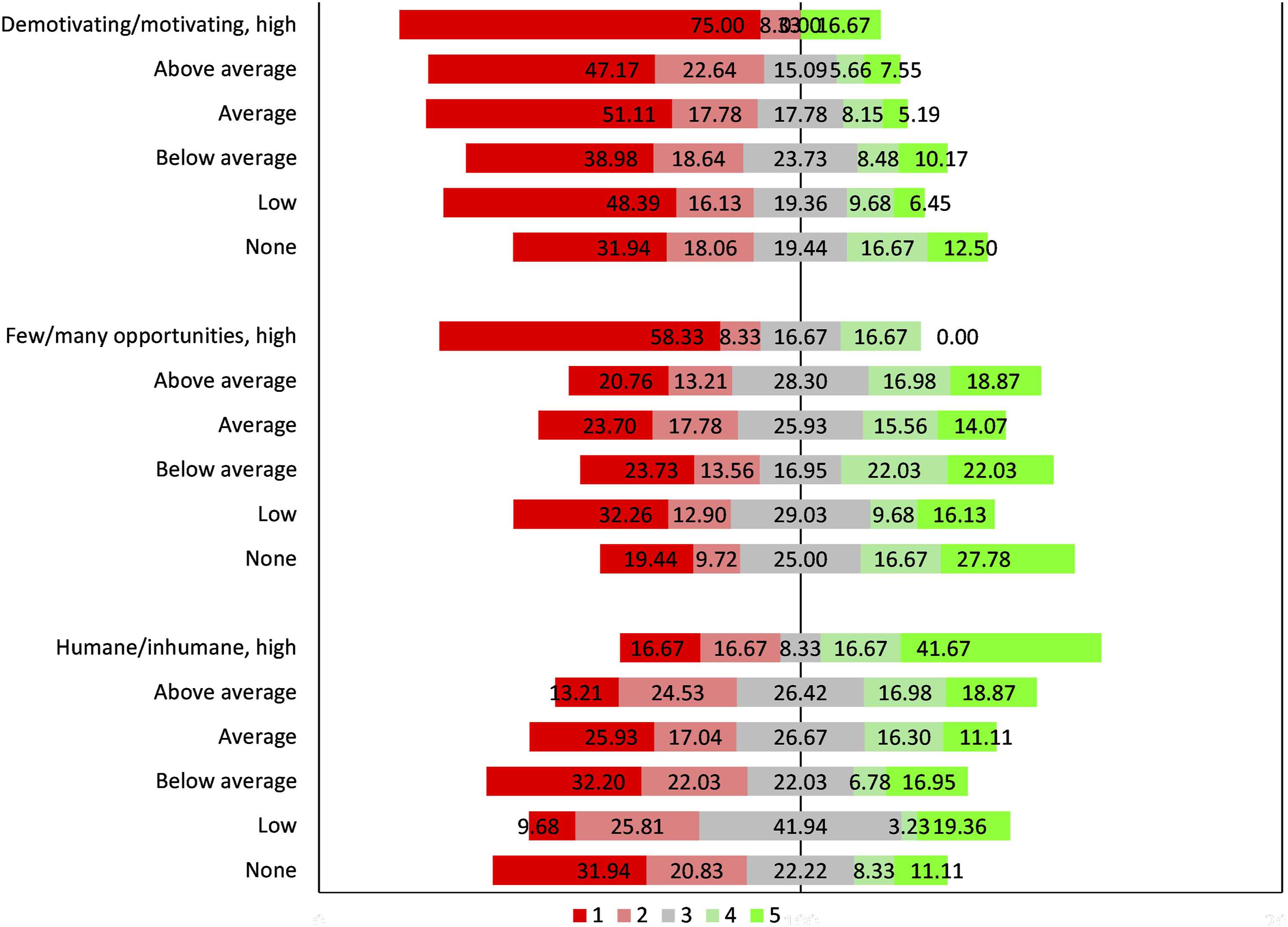
Correlation analyses showed weak significant correlations between level of fortune and motivation (r s (N = 360) = 0.67, p = .001) and level of fortune and humanity (r s (N = 354) = 0.135, p = .011). That is, the respondents with the highest fortune found equal pay the most demotivating. The group with a high fortune stood out in terms of associating equal pay with inhumanity, while the response distributions of the other groups were relatively balanced with a small majority tending to perceive equal pay as humanely. Note that the group of respondents with a high fortune was also the smallest with merely 12 respondents.
Again, the group of respondents with a high fortune stood out by associating equal pay with few opportunities. The responses of the other groups were relatively unbiased.
Education
Figure 8 shows the results with respondents grouped on education level (highest degree obtained), namely, primary school (3 respondents), secondary school (26 respondents), vocational school (24 respondents), bachelor’s degree (86 respondents), master’s degree (148 respondents), and PhD (75 respondents). Significant differences were observed for the dimensions of collectivism/individualism (H(5) = 12.804, p = .025, ES = 0.045) and humane/inhumane (H(5) = 11.386, p = .044, ES = 0.037), although with small effect sizes. Significant differences according to level of education.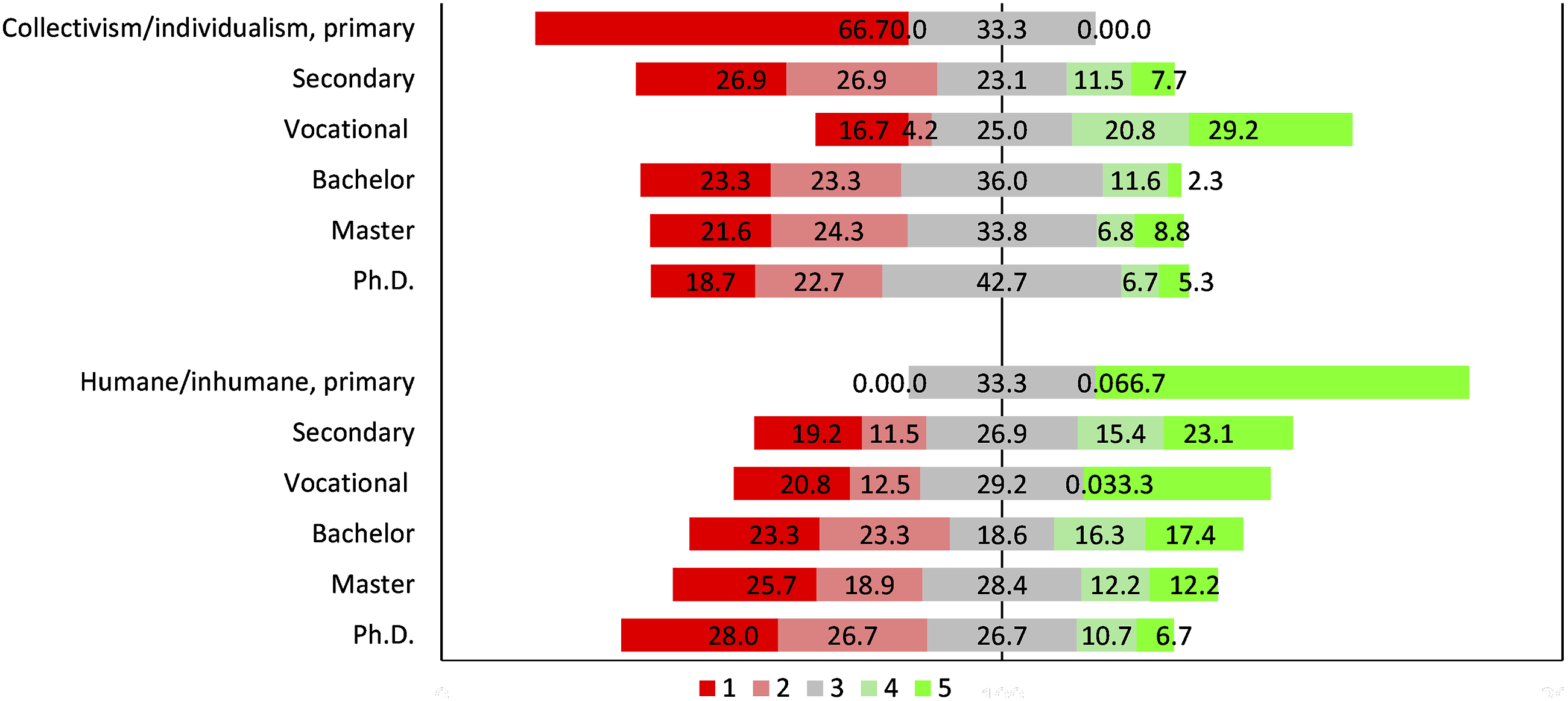
Correlation analysis showed a weak significant positive correlation between education level and association of equal pay as humane (r s (N = 354) = 0.158, p = .003). In other words, respondents with primary school background were the most negatively biased and respondents with a PhD degree the least biased.
The results show that most groups tend to associate equal pay with collectivism. The group of respondents with a vocational schooling deviated from this trend perceiving equal pay towards the individualism part of the scale.
Comments
A total of 119 of the 362 respondents provided comments (32.8%). The comments were categorized as being positive, skeptical, or negative with regards to equal pay, as well as comments on the methodology. Three of the comments were non-informative of the type “none.” We identified 19 responses as positive with regards to equal pay. However, most of the comments attached a condition to their support of equal pay. Several respondents pointed out that they were positive towards equal pay if respondents were compensated for costs of acquiring an education (full scholarships without loans) and corrections for the lost income (pay) while pursuing the education. Several respondents argued that equal pay could lead individuals to choose careers that they are interested in and have a talent for, rather than being paid well. One respondent summarized this as follows: “eat to work, not work to eat.”
Other suggestions included paid leave for individuals in stressful jobs, and shorter workdays. One respondent argued for some differentiation related to jobs with particular relevance and usefulness for society. One respondent reflected over the current environmental challenges and that equal pay could be one step towards reducing unsustainable consumerism. Another respondent pointed out that equal pay could stimulate creativity. One unfair consequence of pensions in a differentiated pay regime was pointed out, namely, that individuals with a high pay during their active careers also receive a higher pension “into eternity” while not working in contrast to individuals who received a low pay during their active careers and consequently a lower pension.
A total of 19 responses were classified as being skeptical towards equal pay but not completely dismissive. Most of the concerns were rooted in unfairness related to the cost of pursuing an education compared to those who do not pursue an education. Several of the responses also argued that equal pay would not stimulate effectiveness and effort, and that some incentive and differentiation is necessary. Yet, several respondents also pointed out that the pay differences (in society) are too large and that these should be reduced. Responsibility involved, complexity of the work, how demanding and straining the work is, the experience, and relevant competence of the worker were also mentioned as factors that require differentiated pay. One respondent argued that complete equality most likely will lead to apathy and indifference. One respondent questioned whether it is even possible to design a system that cannot be abused.
In general, the comments reveal that the questionnaire touches on a controversial topic that evokes emotions and engagement. Most of the comments (46) were classified as negative towards equal pay. Some of the comments are highly dismissive of equal pay using terms such as “idiocy,” “science fiction,” “absurdity,” “utopia,” “ideology,” “a gust of communism from the past,” and “a crazy idea that would not be addressed in a questionnaire if academics were paid the same as farmers.”
Other respondents have also justified their dismissal of equal pay. About half of the responses negative to equal pay mentioned the challenges and consequences related to the cost of education. About a quarter of the negative responses are justified according to the difficulty of recruiting individuals to undertake difficult, stressful, strenuous, and unpleasant jobs, or jobs at awkward hours. A couple of respondents questioned equal pay because some individuals in society have more needs, such as individuals with reduced functioning that may need assistive technology and special assistance, or family units that are raising young families.
Three respondents mentioned democratic perspectives in that the state should not decide over the individuals and that equal pay undermines the idea of a free society. It is also pointed out that equal pay will give too much power to those who set the levels of pay.
As many as 10 responses mentioned citizen salary also known as universal basic income (UBI) as a more realistic option compared to equal pay as also argued by (Zwolinski, 2021). The responses suggest that the perceived differences between equal pay and UBI is that UBI guarantees a financial minimum but allows individuals to work extra and thus gain higher pay related to effort, while equal pay does not allow extra income.
About a quarter of the comments (31) addressed the questionnaire itself, from praise to specific criticisms and disagreements with which the questionnaire was designed, how questions were formulated and the motives behind the study. Several responses point out that the questions were vague and unclear and asked for a clearer definition of equal pay, assumptions, and the overall context of the equal pay though experiment.
Discussion
At an aggregated level, it seems that the respondents were generally skeptical or negative regarding equal pay. This was particularly noticeable when considering the realism, communism/capitalism, regulation, and motivation dimensions where most of the respondents were negative. For the remaining dimensions, the responses are more evenly distributed across the respective scales. The free-text comments may help explain these observations. Clearly, some respondents were categorically dismissive of the idea of equal pay, some of the respondents expressed positivity towards the idea. However, most of the respondents that were more positive towards equal pay had reservations connected to how equal pay would work in practice regarding how to compensate for a costly education and filling certain jobs. The fact that some respondents suggested possible solutions to compensate for long and costly education further indicates that these respondents were not totally dismissive. One may ponder if the responses would be more polarized if some of these issues were clarified to the respondents a priori, for example, that individuals would also receive equal pay while pursuing education.
To understand the frequent comments related to compensation for education, it may be helpful to briefly explain the Norwegian education system. A key principle in Norway has until recently been “equal right to education for all.” This is implemented by not charging tuition fees in state run education institutions for both nationals and international students. The national system with no tuition fee is only practiced in a handful of countries as most countries have tuition fees in some form. Moreover, to compensate for socioeconomic background, all citizens are entitled to a student loan and a scholarship from the government. Clearly, individuals that pursue a longer education end up with a higher student loan than others, and this is not always reflected in pay. For example, to become a priest, one requires 6 years of study, yet priests receive a moderate salary. In contrast, to get a degree in web-development, one could pursue a two-year diploma education and end up with a double starting salary of a priest. The perceived unfairness is further complicated if also considering those who have studied abroad and consequently accumulated larger loans due to tuition fees. Hence, the main difference between Norway and some other countries is perhaps that everyone can pursue an education regardless of their socioeconomic background, but the subsequent disparity between study loan burden and income is not too unsimilar as what can be observed in other countries.
Some of the free-text comments indicate that some respondents had a view of workers as rather cynical, questioning who will do jobs that are boring, dangerous, requiring special expertise, and occurring at odd hours. Although some workers indeed are cynical and driven by immediate monetary gains, it is an undeniable fact that individuals are rather diverse in their values, interests, and motivations. Some individuals may enjoy “boring” and repetitive jobs allowing them a chance to think about other things while working. Some individuals find great purpose in helping others even if this means difficult work and unpleasant work hours. Also, one should not underestimate people’s personal beliefs in equality and willingness to fill jobs that need to be done for the greater good of everyone. Others are stimulated by solving difficult challenges that go with jobs that require specialized competences. Moreover, not all would be interested in pursuing an education even if it is free.
These reservations also correspond with the fact that realism triggered the strongest negative bias, which further emphasizes that the respondents have pragmatic concerns. Moreover, the fact that a majority associated equal pay with communism suggests that the respondents have a misconception about the idea of equal pay. Miroiu writes that there was no room for feminist movements such as equal pay for equal work in the former communist bloc (Miroiu, 2007). Zvorykin (1962) explains the limited role of equal pay within communism. The communist regimes of China employ work incentives (Hoffmann, 1964), and same work different pay has been pointed out as a challenge (Zhou, 2003). According to Jung and Dalton (2006) women in the communist state of North Korea earn less for the same work compared to men despite the statute on the Labor of Manual and Clerical Workers which declares equal pay for equal work. Clearly, implementation of equal pay would require strong regulation which also is reflected in the responses. Several of the free-text comments could be interpreted as indicating that some participants perceived conflict between freedom, democracy, and the idea of equal pay. One may speculate whether the common feeling of equality would increase with equal pay, and that the motivation for cheating thus would decrease.
The association of equal pay as demotivating also corresponds with the free-text responses as several respondents point out the importance of incentives and the need to be rewarded for efforts and achievements.
It must also be noted that the definition of equal pay provided in the questionnaire (equal pay for each hour worked, regardless of profession) indeed could be interpreted as type of differentiated pay as someone that works 12 hours earn more than someone who works 2 hours. In contrast, more strict definitions of equal pay exist where equal pay is independent of the effort. It is possible that some respondents despite the instructions, and equal pay example given, have interpreted the questions according to a stricter understanding of equal pay. Note that the questionnaire did not declare any conditions related to personal fortune, state welfare, or taxation policies.
Individual Factors
The results give strong support for hypothesis H1, namely, that individuals on the political left are more in favor of equal pay than individuals on the political right. The results thus confirm that there is a connection between political values and personal perceptions. Individuals typically take political sides with political factions where the values are most closely aligned with their own values.
The results give some support to hypothesis H2, namely, that females are more in favor of equal pay than men. The results seem to echo stereotypical views where women are characterized as more idealistic, unrealistic, and “kind” compared to men. An alternative explanation is that the result is a consequence of gender related pay gaps (Khoreva, 2011). The female respondents may have experienced the unfairness of differentiated pay more strongly than the male respondents and consequently are more positive towards alternatives, such as equal pay. It must be pointed out that the effect sizes are small and that these findings need to be interpreted with some caution.
The correlation results also give some support to hypothesis H3, namely, that individuals with a low fortune are more in favor of equal pay than individuals with a high income/fortune. One possible explanation is that individuals could feel that their fortune would be threatened under a regime with an assumed lower equal pay, especially so if their fortune, in part, is accumulated from the profits of high pay. Alternatively, one may speculate whether this is an ethical issue, that is, if wealthy individuals in their own eyes would not be able to justify their privileged fortune in a situation where everybody suddenly receives equal pay.
The correlation results give some support to hypothesis H4, namely, that the level of education correlates with the degree of positive perceptions of equal pay. Could it be that education trains individuals’ ability to view problems from multiple perspectives and therefore consider what is best for all over what is best for oneself? It is also noteworthy that the humanity dimension resulted in the largest difference. The results should be interpreted with some caution as most respondents had completed university education.
Because of insufficient sample sizes, the results are inconclusive with regards to hypothesis H5, that is, individuals originating in Norway are less in favor of equal pay than individuals originating elsewhere. However, the small data sample seems to support H5. The dimension of equality versus discrimination exhibited the most noticeable contrast. Unfortunately, it was not possible to analyze these findings using Hofstede’s framework for comparing cultures since we did not explicitly probe respondents’ country of origin. Could it be that individuals who have immigrated find it harder to climb the salary ladder and therefore are more in favor of equal pay? Hence, demographic factors related to geographical origin and culture may be a relevant focus of further study, particularly in context of discrimination versus equality.
The results do not give support to hypothesis H6 as there was no evidence to support that perceptions of equal pay are related to age.
Work-Related Factors
The results give strong support for hypothesis H7, namely, that workers organized in unions are more in favor of equal pay than unorganized workers. Work unions typically look after the interests of its members. Work unions may support members who face unfavorable conditions, member groups that experience pay lags, support for members that are facing problems and conflicts with employers, etc. Moreover, work unions seem to be in favor of collective pay rises and seniority-based rewards, while employers tend to prefer differentiated pay rises related to efforts and results. The idea of collective pay rises seems to be aligned with the union organized respondents’ higher scores in favor of humanity, fairness, and equality. Another explanation may be that wealthy individuals in terms of pay and or fortune are less likely to be members of work unions as they may have less to gain personally from these unions. Hence, there may be some connections between hypothesis H7 (union membership) and hypotheses H3 (fortune) and H8 (pay). Clearly, the differences more strongly manifest themselves in terms of union membership than pay and income. The objective dichotomous variable union membership gives the respondents two options, while the subjective ordinal variables pay and fortune gave respondents seven choices leading to more dispersed and ambiguous responses.
The correlation results give some support to hypothesis H8, namely, that individuals with a low income are more in favor of equal pay than individuals with a high income/fortune. A possible explanation is that the level of income may be connected to investment in the work in terms of effort, time, dedication, education, etc., the skepticism towards equal pay may follow. The higher the investment, the greater is the potential loss in an equal pay regime. One may ponder whether incentives are what motivate, at least partially, high-income individuals. Also, it is indeed quite interesting that the level of income had a stronger impact on equal pay perceptions than fortune. One fundamental difference between inheritance and income is that income usually is the result of one’s own effort, while inheritance could be the result of other’s efforts, that is, when inheriting or sharing the wealth of a spouse. Consequently, we may thus feel a stronger ownership to income than inheritance. These feelings may have triggered stronger negative biases with regards to equal pay.
Based on the results we reject hypothesis H9, namely, that workers in public organizations are more in favor of equal pay than workers in private organizations. Although significant differences were observed the effect sizes of these differences were too small. Because of insufficient sample sizes the results are inconclusive with regards to hypothesis H10, that is, Individuals with full time work are less positive towards equal pay than groups with other types of employment status. However, the small data samples do not seem to suggest that type of employment is a relevant factor for further study with regards to perception of equal pay.
The motivation for conducting this study was to gain insight into how scholars’ ideas about equal pay aligns with the perceptions of the public. It seems that several of the reservations raised by the scholars are echoed by the respondents such as the risk of ruining the labor market (Zwolinski, 2021), limiting personal limitations, willingness to take risks and responsibilities (Cooke, 2021), difficulties filling difficult, unpleasant, and heavy jobs (Brouwer and Deijl, 2021). The scholars’ perceptions of recently increased pay differences (Schaff, 2021; Knudsen, 2021) are shared by several of the respondents, and several respondent share Dorey’s (2021) view that pay gaps should be reduced but not eliminated, and Zwolinski’s (2021) belief in UBI as a more realistic mechanism for reducing large differences in pay and preventing poverty. The respondents did not echo the arguments in favor of equal pay to the same degree, for instance, flexibility for employers (Reilly and Brown, 2021), non-monetary recognition of achievements (Deranty, 2021), strengthened democracy (Frederking, 2021), or a more relationally egalitarian society (Pointon and Sinnicks, 2021). In fact, three respondents argued that equal pay would require control that gain would reduce individual freedom and unfavorably concentrate power. Perhaps, when presented with new ideas an immediate response is to defend the status quo. Maybe we need time to reflect over the idea of equal pay to appreciate its potential beneficial consequences for ourselves and others. It would therefore have been interesting to do a follow-up study with the same participants to see if time has led to changes in perceptions and deeper reflections on the topic. However, such a research design could not be done anonymously as it would be necessary to link participants across the two sessions. It would probably be more challenging to recruit respondents to a non-anonymous study. The respondents also raised issues not explicitly addressed by the scholar such as consequences for pensions. It is also interesting to note the discrepancy between the respondent’s emphasis on challenges with the cost of education under an equal pay regime and the scholar’s interest in mostly other issues. Paradoxically, scholars typically have invested more time and money in their education than others. Perhaps some of these respondents did not get a chance to pursue the education they wanted and view this as an unfair limiting factor in their career?
Limitations of This Study
The issue of equal pay is multifaceted and complex, and it was therefore an explicit questionnaire design decision to keep instructions simple as more detailed instructions risk misleading the respondents and perhaps discourage participation. The vagueness of the questionnaire was also echoed by some of the respondents in the free-text field. Obviously, this vagueness means that different individuals will interpret the questions differently according to their individual mindsets. Still, respondents were asked to rely on their “first reaction” which hopefully has contributed to truthfully capturing underlying attitudes. Also, given the large number of responses, and the set of multiple questions addressing the phenomenon from several perspectives, there should be some substantial basis to reliably observe and analyze noteworthy patterns.
Although the sample size was sufficiently large to perform statistical inference according to most groupings, there were some groups that were insufficiently represented to reliably answer the research questions that related to geographical origin, especially as the small number of responses indicates that there could be interesting contrasts.
As this study was based on convenience sampling and snowball sampling, there is a risk of sample bias where certain groups are overrepresented, and others underrepresented. However, the demographic descriptive statistics indicate that the sample was relatively diverse. One respondent commented that he or she was forwarded a link to the study via a chat group where readers were encouraged to “flame” or “troll” (sabotage) the form. Careful inspections of the comments and responses do not show any explicit signs of such activities.
One afterthought is that we should have included an explicit Likert question about whether the respondents are in favor of or opposed to equal pay as a control to the implicit questions in the questionnaire.
Conclusions
This study attempted to measure perceptions of equal pay in a Norwegian context. The results confirm that options vary from those that are positive towards equal pay, those that are positive given certain conditions, and those that strongly oppose the idea of equal pay. However, in sum, most of the respondents expressed some degree of skepticism. Political affiliation was observed as the strongest predictor where individuals on the right were the most skeptical and individuals on the left the most positive. Also, individuals who are organized in work unions were more positive towards equal pay than those that were unorganized. Although exhibited by small differences, females were observed as more positive towards equal pay compared to males. Weak correlations were also found between perceptions of equal pay and income and fortune, as those with a high income and/or fortune were more negative regarding equal pay compared to those with lower income and/or fortune. Similarly, perceptions of equal pay exhibited a weak correlation level of education, as those with least education were most skeptical.
The most prominent reservation against equal pay was related to the perceived unfairness for those pursuing education. Second, many respondents were concerned that it would be challenging to recruit the right individuals for certain jobs under an equal pay regime, in particular jobs that require certain competences, jobs that are difficult, heavy, unpleasant, or jobs that occur at odd hours. Implications of this work is that it is important to address how education and recruiting should be handled if raising a debate about equal pay. Moreover, of the dimensions studied, the degree of realism, communism/capitalism, degree of regulation, and degree of motivation may be the most effective proxies for quantifying the attitude towards equal pay.
Implications of this study is that to achieve a constructive and informed discussion about proposals of equal pay it is necessary to clarify how individuals are compensated while pursuing education. Also, the myth that equal pay is an integral component of communism needs to be challenged. Further studies should explicitly probe where respondents position themselves on the continuum of for or against equal pay to establish a baseline of ground truths. It would also be relevant to address if and how cultural affiliation affects perceptions of equal pay, by contrasting representative samples of responses from different countries. An interesting exercise would be to deploy the devised questionnaire within a specific environment, such as the military or a prison, where equal pay regardless of tasks is practiced, to detect potential differences in perceived unfairness under truly equal pay conditions. Finally, it would also be pertinent to probe if, and how, perceptions of equal pay are affected by a process of reflecting over the equal pay idea.
Footnotes
Acknowledgments
The authors are grateful to Harald Knudsen for input during the initial phase of this project. The authors have not received any funding for this project.
Author Contributions
All authors contributed to the study conception, design, material preparation and data collection. Analysis of the data and the first draft of the manuscript was written by Frode Eika Sandnes, and all authors commented on previous versions of the manuscript. All authors read and approved the final manuscript.
Declaration of Conflicting Interests
The author(s) declared no potential conflicts of interest with respect to the research, authorship, and/or publication of this article.
Funding
The author(s) received no financial support for the research, authorship, and/or publication of this article.

Ethical Approval
No personal information about the respondents were collected and all responses are anonymous. Participation was voluntary. Participants were informed about the purpose of the study. This study adheres to GDPR and national ethical standards.
Disclaimer
The authors hold different views with regards to equal pay and collectively have strived for an objective and unbiased study.