




Abstract
Trust is a fundamental component of social life, yet it can be eroded by experiences of psychological abuse within intimate relationships. The present study examined whether exposure to gaslighting, a form of manipulation that undermines victims’ perceptions of reality, reduces general trust in people and whether this association is mediated by social support and self-care practices. A convenience sample of 567 adults (aged 18–65) completed validated questionnaires assessing gaslighting experiences, trust, social support, and self-care. Results indicated that gaslighting was directly associated with diminished trust in others. Social support significantly mediated this association, whereas self-care did not serve as an independent mediator. However, serial mediation was observed: higher gaslighting predicted lower social support, which was linked to reduced self-care practices, ultimately contributing to lower trust. Unexpectedly, men reported higher levels of gaslighting experiences, suggesting that gender dynamics in gaslighting may be more complex than previously assumed. These findings highlight the social consequences of gaslighting beyond its intrapersonal effects, pointing to a cycle in which manipulation isolates victims, weakens social support, and indirectly impairs both self-care and trust. These results underscore the importance of addressing gaslighting not only as an individual psychological issue but also as a relational and social challenge.
Keywords
Introduction
Trust in other people is a fundamental component of social life, enabling cooperation, intimacy, and psychological well-being. When trust is undermined, individuals may experience difficulties in forming and maintaining relationships, as well as diminished resilience in the face of stress (Poulin & Haase, 2015; Zhao et al., 2024). Research on intimate partner violence (IPV) has primarily focused on outcomes such as social support, relational functioning, and help-seeking (Dias et al., 2019; Richardson et al., 2022). This body of research highlights broader disruptions in interpersonal processes among survivors of IPV, suggesting that such experiences may also extend to reduced general trust in others. Intimate partner gaslighting (IPV gaslighting), a form of psychological manipulation in which one partner seeks to destabilize the other’s perception of reality, may represent a particularly potent threat to trust (Abramson, 2014; Darke et al., 2025; Sweet, 2019).
In the present study, gaslighting refers specifically to experiences occurring within intimate partner relationships (IPV gaslighting), rather than gaslighting in other relational contexts such as workplaces or families. The current study conceptualizes IPV gaslighting as a continuous variable examined within a general population sample, rather than focusing solely on identified victims of abuse. This approach allows for the examination of variability in gaslighting experiences across different levels of exposure. Recent empirical studies have similarly examined gaslighting in non-clinical samples using dimensional approaches (Ciabatti et al., 2024; Miano et al., 2021), supporting the relevance of this broader operationalization.
The aim of the present study was to examine whether experiences of IPV gaslighting within intimate relationships reduce general trust in people and to explore the mechanisms through which this process occurs. To this end, two potential mediating pathways were investigated: a social mechanism reflected in perceived social support and a personal mechanism reflected in self-care practices.
Gaslighting
In the context of intimate partner relationships, gaslighting is a form of psychological abuse in which one partner destabilizes the other’s perception of reality, often by convincing them that their thoughts, memories, or emotions are irrational or “crazy” (Abramson, 2014; Darke et al., 2025). The concept first appeared in the context of convincing someone that they were “losing their sanity” (Hamilton, 1939), and was later expanded to include a broader range of covert manipulative tactics, such as denial, minimization, threats, and feigned confusion (Dickson et al.,2023). Scholars conceptualize gaslighting as a systematic and intentional behavior that undermines the victim’s autonomy and decision-making, serving as a strategy of control in intimate relationships (Ciabatti et al., 2024; Sweet, 2019). Recent reviews emphasize that gaslighting is not a marginal phenomenon, but rather a complex and multifaceted form of psychological abuse, increasingly recognized in the literature on coercive control (Darke et al., 2025; Hailes & Goodman, 2025).
Findings from a large-scale survey conducted in the United States among 2,875 survivors of IPV, revealed the high prevalence of gaslighting: 85% of participants reported being called “crazy” by their partner, and 74% believed that their partner deliberately acted to make them doubt their sanity (Warshaw et al., 2014). While such studies provide important insight into the severity of gaslighting among identified victims of IPV, they do not capture the broader range of gaslighting experiences that may occur outside clinical or victim-identified samples.
Recent scholarship has therefore emphasized the need for conceptual clarity and broader operationalization of gaslighting. In a recent systematic review synthesizing the gender-based violence literature, Adair (2025) conceptualized gaslighting as a distinct form of manipulation, characterized by tactics that undermine individuals’ perceptions, memory, and sense of reality, and by social–psychological outcomes such as self-doubt, emotional distress, and social isolation. Similarly, recent empirical studies have begun to examine gaslighting experiences in the general population, conceptualizing them as a continuous variable ranging from low to high levels of exposure (Ciabatti et al., 2024; Miano et al., 2021). This broader conceptualization extends the relevance of gaslighting beyond identified victims to a wider segment of society, and that is the approach adopted in the current study.
The consequences of gaslighting are severe and multidimensional. Research has primarily highlighted its intrapersonal effects, showing associations with increased anxiety and depression, lower self-esteem, and feelings of confusion and worthlessness (Ciabatti et al., 2024; Klein et al., 2023). These findings indicate persistent damage to victims’ psychological well-being and sense of identity. In addition, qualitative studies have emphasized its social consequences, such as isolation from support networks, suspicion in future relationships, and reduced trust in others (Klein et al., 2023; Stern, 2008). Taken together, these findings demonstrate that gaslighting contains not only intrapersonal but also interpersonal consequences that undermine individuals’ ability to sustain social relationships.
The literature also points to a gendered dimension of gaslighting, though empirical findings remain inconclusive. Many scholars argue that women are disproportionately victimized, partly due to stereotypes that portray them as hysterical, weak, or irrational, and partly due to broader power imbalances that grant men greater social leverage (Abramson, 2014; Sweet, 2019). Such stereotypes are reinforced institutionally, as women’s complaints are often dismissed or taken less seriously by authorities (Douglas, 2012; Hailes, 2022; Metzl, 2003). Sweet (2019), for example, described how “institutional vulnerability” exacerbates women’s isolation and undermines their credibility. At the same time, case studies and recent accounts have also documented men as victims of gaslighting (Dickson et al.,2023), and scholars have noted that women can and do perpetrate gaslighting, although men’s experiences are often trivialized or perceived as less harmful (Bates, 2020; Sarkis, 2018). Some evidence suggests that men may respond with greater resilience or resistance (Bhatti et al., 2021; Ross, 2012). However, no large-scale prevalence studies have systematically compared cross-gender gaslighting. Miano et al. (2021) attempted to examine gender differences, but their sample was small and limited to young adults, preventing generalization. Thus, while theoretical and qualitative accounts emphasize women’s vulnerability, the question of gender differences in gaslighting remains open.
Taken together, the literature portrays gaslighting as a complex form of psychological abuse, with both intrapersonal and interpersonal consequences, and potentially gendered dynamics. Because gaslighting destabilizes victims’ sense of reality, undermines self-confidence, and weakens reliance on social support, it is important to examine how it may also affect one of the cornerstones of social life, trust in others.
Trust
Interpersonal trust is a fundamental social construct, essential for cooperation, intimacy, and psychological well-being. Trust is commonly defined as the willingness to be vulnerable to another person, based on expectations of reliability and benevolent intentions (Zhao et al., 2024). Higher levels of trust have been linked to greater life satisfaction, resilience, and better health outcomes, both at the individual and societal levels (Poulin & Haase, 2015). In contrast, diminished trust is associated with difficulties in forming and maintaining relationships, heightened stress, and impaired coping with life challenges.
Research on IPV and coercive control has focused primarily on disruptions to social functioning, including reduced social support, increased isolation, and reluctance to seek help (Dias et al., 2019; Richardson et al., 2022). Although these studies do not directly assess interpersonal trust, they point to broader disturbances in relational processes that are theoretically and experientially linked to trust in others. Survivors frequently report withdrawal from social networks, and increased reliance on the abusive partner, suggesting that experiences of violence may have implications for trust-related processes beyond the abusive relationship itself.
Despite the centrality of trust to social functioning, most empirical studies of IPV gaslighting have concentrated on intrapersonal outcomes, such as depression, anxiety, and reduced self-esteem (Ciabatti et al., 2024). The association between gaslighting and general trust in others has rarely been examined empirically. While the latter study provides important insight into survivors’ subjective experiences, its qualitative design and focus on self-identified victims limit its ability to assess the scope and strength of this association at the population level.
To better understand how IPV gaslighting may undermine trust in others, it is important to examine potential mediating mechanisms. Establishing a direct association alone does not clarify how or why IPV gaslighting may undermine trust, whereas a mediation framework allows for the identification of underlying processes through which this association operates, thereby advancing both theoretical understanding and practical implications. Two processes that are particularly relevant in this context are social support and self-care practices. Social support has been shown to buffer the adverse effects of interpersonal violence and to play a central role in relational functioning (Dias et al., 2019). In parallel, self-care practices are closely linked to psychological well-being and the capacity to maintain healthy interpersonal relationships, and these practices themselves are shaped by levels of perceived social support (Holtz et al., 2018). Together, these mechanisms offer a plausible pathway through which IPV gaslighting may affect both individuals’ internal well-being and their broader willingness to trust others.
Social Support
Social support refers to the emotional, instrumental, informational, and appraisal resources that individuals receive from their social networks, including partners, family, friends, and mental health professionals (Richardson et al., 2022). Perceived social support reflects the belief that one can rely on others in times of need, and is considered a crucial resource for coping with stress and adversity.
Research consistently shows that social support functions as a protective factor against negative outcomes of violence. Higher levels of social support have been associated with lower rates of intimate partner violence (Plazaola-Castaño et al., 2008) and better mental health among survivors (Machisa et al., 2018; McLean et al., 2018). However, this relationship is complex: while support can mitigate the severity of abuse, violence itself may erode social support through isolation and stigma (Richardson et al., 2022).
With regard to gaslighting, Ciabatti et al. (2024) found that higher perceived support from family and significant others, but not from friends, predicted lower levels of gaslighting experiences. This finding concurs with previous evidence that perpetrators often exploit limited networks and that friends may not always serve as protective resources, especially when they are part of the couple’s mutual social circle (Wright, 2015). These findings highlight the dual role of social support: as a protective factor against abuse, and as a mediator through which gaslighting may undermine trust.
Self-Care Practices
Self-care refers to intentional actions that individuals undertake to maintain their physical and mental health, particularly in times of stress or adversity (Holtz et al., 2018; Richard & Shea, 2011). Self-care includes prioritizing personal needs, engaging in restorative activities, and striving for balance in daily life. Examples include sufficient sleep, pursuing hobbies, physical exercise, meditation, or reflective writing (Faraco et al., 2022; Helmers et al., 2020; Jacobs, 2022).
Self-care has been associated with resilience and psychological well-being, particularly in high-stress contexts or situations of moral strain (Dos Santos et al., 2023; Holtz et al., 2018). Among survivors of IPV, activities such as expressive writing, art therapy, religious practice, music and exercise have been linked to improved self-esteem, better emotional regulation, and greater recovery capacity (Jones-Bowen, 2021). These activities allow both emotional distance from abuse and a sense of control over one’s life.
However, when the ability to engage in self-care is reduced, for example, due to weakened social support or depleted personal resources, the negative impact can be significant. Previous research conceptualizes self-care as a resource-dependent process, indicating that individuals with greater perceived social support are more likely to engage in self-care practices, particularly under conditions of stress (Dos Santos et al., 2023; Holtz et al., 2018). Although no studies have examined the link between self-care and gaslighting directly, related evidence suggests its potential relevance. For instance, self-care has been shown to mitigate trauma among soldiers (Akwue et al., 2024), and to support recovery among women exposed to intimate partner violence (Cummings & Pargament, 2010; Kollak, 2006). Moreover, social support and self-care are strongly interconnected, as individuals with higher perceived support are more likely to practice self-care (Hubbard et al., 1984).
While the association between self-care and interpersonal trust has not been examined directly in the context of IPV gaslighting, self-care has been consistently linked to individuals’ capacity to cope with stress and maintain psychological resources (Dos Santos et al., 2023; Holtz et al., 2018). In the present study, self-care is therefore conceptualized as a personal resource that may indirectly influence general trust in others, particularly when considered alongside social support, as part of a broader relational context. Accordingly, we hypothesize that reduced self-care, mediated through diminished social support, may represent a personal mechanism by which gaslighting ultimately undermines general trust in people.
The Present Study
The present study examines levels of general trust in people as a function of exposure to gaslighting in intimate relationships. Importantly, the study did not focus solely on identified victims of gaslighting, but included individuals from the general population. This design allowed us to capture variation in gaslighting experiences, ranging from low to high levels of exposure, consistent with recent studies adopting a similar approach (Ciabatti et al., 2024; Miano et al., 2021).
The present study extends prior research by examining the association between IPV gaslighting and general trust in others within a general population sample. Whereas previous research has largely focused on intrapersonal outcomes such as anxiety, depression, and diminished self-esteem, its broader social consequences, particularly its potential impact on general trust, have received limited empirical attention. Although qualitative work (Klein et al., 2023) suggests heightened suspicion and mistrust following gaslighting experiences, systematic quantitative investigation of this association remains limited.
Building on this gap, we employ a quantitative approach to examine these associations in a general population sample reporting varying levels of IPV gaslighting within intimate relationships. Prior literature points to two mechanisms that may help explain this association: social support and self-care practices. Reduced social support may weaken individuals’ capacity to engage in self-care, and together these processes may contribute to diminished trust in others. Finally, given mixed evidence regarding gender differences in gaslighting experiences, the present study also examines potential gender differences. Accordingly, the following hypotheses were proposed:
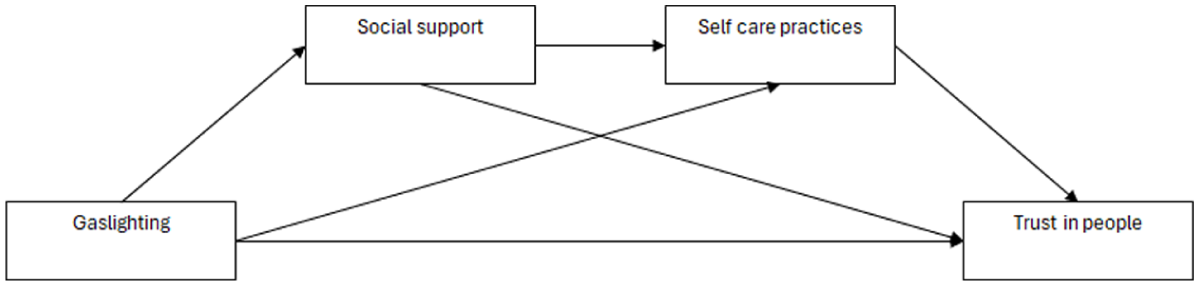
Serial mediation for gaslighting, social support, self-care practices, and trust in people.
Method
The study employed a cross-sectional survey design and received approval from the University’s Ethics Committee (Approval No. 20250226). All procedures were conducted in accordance with ethical standards for research involving human participants.
The target population consisted of adults aged 18 years and older, with current or past experience of an intimate partner relationship. Intimate partner relationship experience was defined as having been involved in a romantic relationship, characterized by emotional or romantic involvement, including current or previous partners. The study was not restricted to individuals who self-identified as victims of abuse; rather, gaslighting experiences were assessed as a continuous variable across varying levels of exposure.
Recruitment and Procedure
Participants were recruited using convenience sampling through online platforms, including Facebook, WhatsApp, and Instagram. Recruitment posts invited adults with current or past intimate partner relationship experience to participate in a study examining interpersonal experiences and well-being. Individuals who clicked on the recruitment link were directed to an online survey administered via Google Forms.
At the beginning of the survey, participants were presented with an informed consent form outlining the study’s aims, the voluntary nature of participation, anonymity, and the option to withdraw at any time without penalty. Only participants who provided informed consent were able to proceed to the questionnaire. Confidentiality and anonymity were assured, since no identifying information was collected. Participants were provided with contact details of the researchers and supervisor, as well as information about relevant support hotlines in case completing the survey elicited distress.
Participants
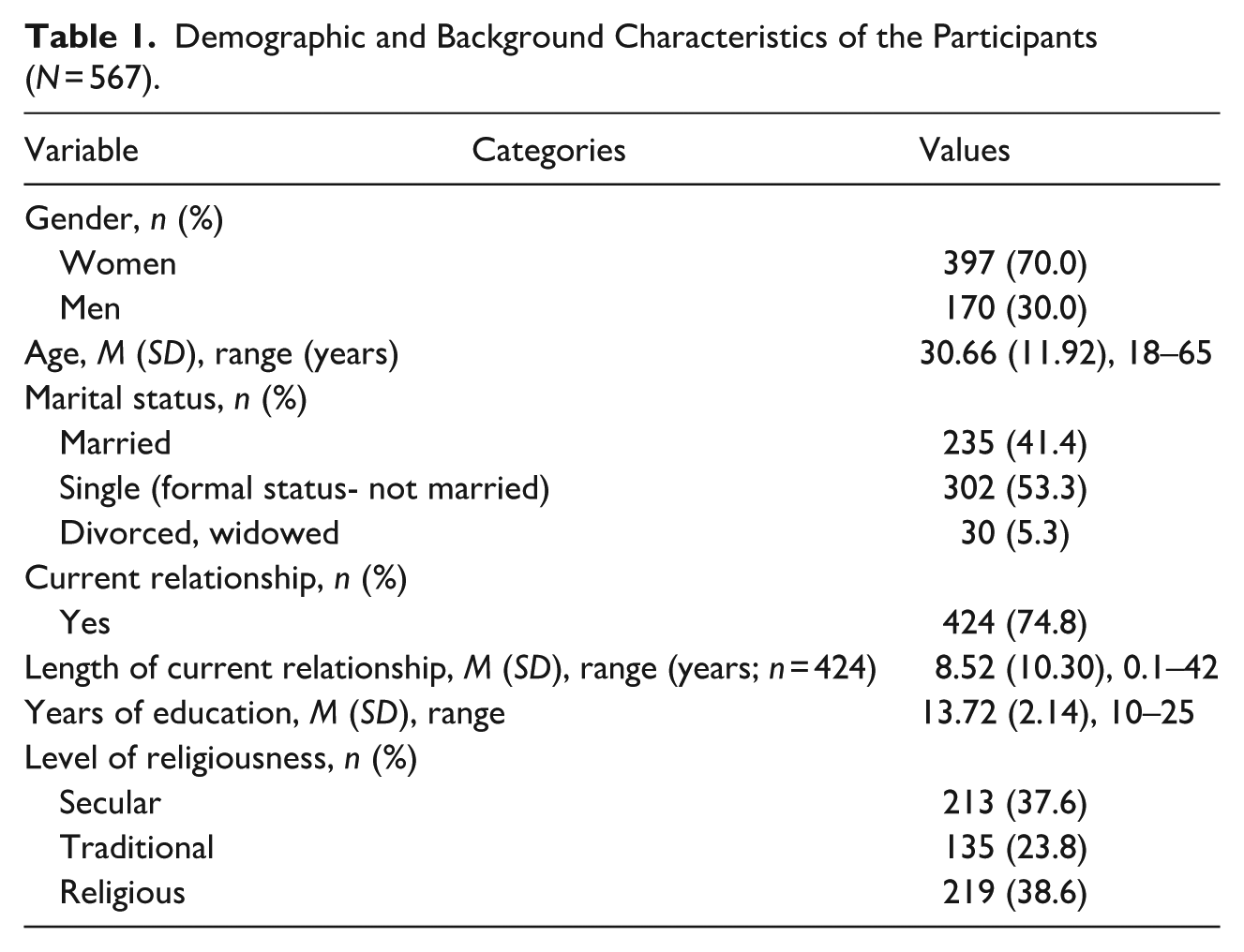
Participants were adults (18 years or older) with current or past intimate partner relationship experience. A detailed demographic description of the participants is presented in Table 1 in the Results section.
Demographic and Background Characteristics of the Participants (N = 567).
Instruments
Demographic Questionnaire- Participants were asked to provide personal background information for statistical purposes only. The questionnaire included items on gender, age, years of education, religion, level of religiousness, marital status, and current relationship status (yes/no), and relationship duration (in years).
Victim Gaslighting Questionnaire (VGQ; Bhatti et al., 2023)- This questionnaire consists of 13 items assessing experiences of gaslighting within a current or past intimate relationship. Respondents rate the extent to which they experienced the described situations on a 5-point Likert scale ranging from 1 (Not at all) to 5 (Very much). An example item is: “You find yourself doubting your beliefs and opinions because of your partner’s resistance.” In the present study, the questionnaire demonstrated good internal consistency (α = .93).
Social Support Scale (Zimet et al., 1988)- This questionnaire consists of 12 items measuring perceived social support from family, friends, and significant others. Respondents indicate their agreement on a 7-point Likert scale ranging from 1 (Very strongly disagree) to 7 (Very strongly agree). An example item is: “There is a special person with whom I can share my joys and sorrows.” In the present study, the scale demonstrated excellent internal consistency (α = .96).
Self-Care Practices Scale (SCPA; Lee et al., 2020)- This questionnaire consists of 18 items designed to assess the frequency of personal self-care behaviors through self-report. Respondents indicate how often they engage in specific practices on a 5-point Likert scale ranging from 0 (Never) to 4 (Very often). Sample items include: “I do things to meet my emotional needs” and “I take short breaks during working hours.” In the present study, the scale demonstrated good internal consistency (α = .88).
General Trust Scale (Yamagishi et al., 2015)- This questionnaire consists of nine items measuring general trust in people. Respondents rate their agreement with each statement on a 5-point Likert scale ranging from 1 (Strongly disagree) to 5 (Strongly agree). Sample items include: “Most people are basically good” and “Most people trust others.” In the present study, the scale demonstrated acceptable internal consistency (α = .77).
Procedure
The study received approval from the university ethics committee (Approval No. 20250226). The survey was administered via Google Forms and began with an informed consent form. Only participants who consented proceeded to the structured questionnaire; those who declined were excluded automatically.
Confidentiality and anonymity were assured, as no identifying information was collected. Participants were informed they could withdraw at any time. Contact details of the researchers and supervisor were provided for questions or clarifications, along with information about support hotlines for participants who might experience distress.
Data Analysis
Data were analyzed with IBM SPSS Statistics (Version 29; IBM Corp., Armonk, NY, USA). Descriptive statistics were used for the demographic characteristics of the participants and for the study variables. Pearson correlations were calculated between the study variables, and t-tests were used for the study variables by gender. In order to identify the demographic variables that should be controlled, the associations between age, having a partner, and years of education, and the study variables, were analyzed with Pearson correlations. Differences by level of religiousness were analyzed via analyses of variance. The serial mediation model was analyzed with Hayes’ (2022) Process procedure, model no. 6 for serial mediation, using 5,000 bootstrapped samples, and 95% confidence intervals. Variables were standardized, and gender, age, having a partner, and level of religiousness were controlled for.
Results
There were 567 participants in this study, 70% women and 30% men. All were between the ages of 18 and 65 years (M = 30.66, SD = 11.92). About half of them were single (formal status- not married), and most others were married. About three quarters of the participants were currently in a relationship, lasting on average about 8.5 years. They had close to 14 years of education on average, and were either secular (37%), somewhat religious (24%), or religious (39%).
Table 2 presents the distribution of the study variables and the correlations between them. Results show that social support, self-care practices, and trust in people are positively associated, and all are negatively associated with gaslighting. These results support Hypothesis 2, showing that higher levels of reported gaslighting were significantly associated with lower levels of general trust in people.
Means, Standard Deviations, and Pearson Correlations for the Study Variables (N = 567).
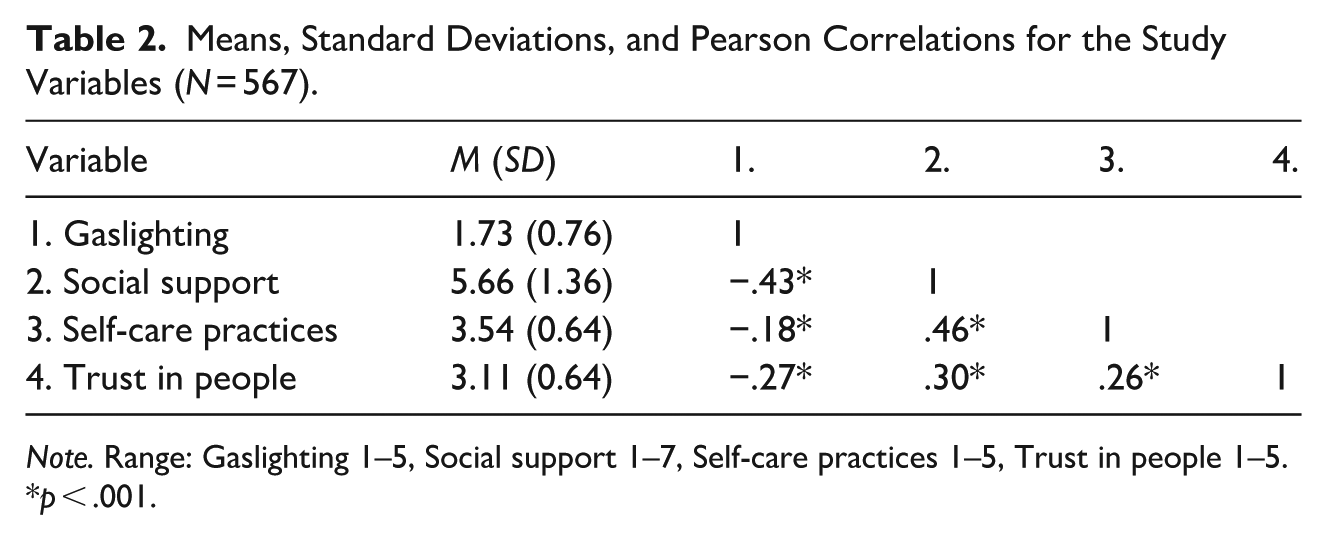
Note. Range: Gaslighting 1–5, Social support 1–7, Self-care practices 1–5, Trust in people 1–5.
p < .001.
Table 3 presents gender differences. Gaslighting was reported to be experienced by men more than by women. Social support, self-care practices, and trust in people were higher for women than men. These results contradict Hypothesis 1, which predicted greater exposure to gaslighting and lower levels of social resources among women
Gender Differences in the Study Variables (N = 567).
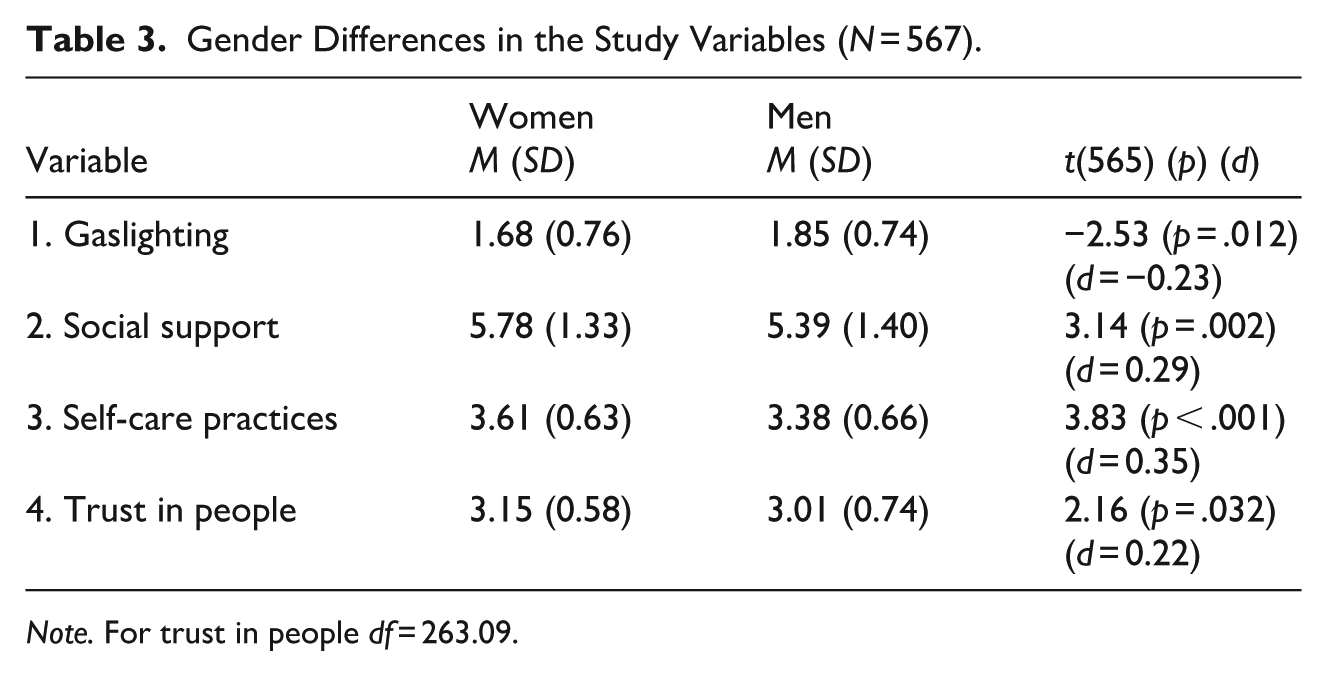
Note. For trust in people df = 263.09.
In addition, age was positively associated with gaslighting (r = .14, p = .001), and negatively associated with social support (r = −.13, p = .002), and trust (r = −.09, p = .030). Having a partner at present was associated with lower gaslighting (r = −.28, p < .001), and higher social support (r = .12, p = .004), higher self-care (r = .10, p = .021), and higher trust (r = .09, p = .028). Years of education were not associated with the study variables (p = .294 to p = .745), and trust was higher for religious participants (M = 3.11, SD = 0.59) than both traditional (i.e., individuals who identify as partially observant but not fully religious) M = 3.03, SD = 0.63) and secular participants (M = 2.94, SD = 0.63; F[2, 564] = 20.74, p < .001, η2 = .069). Thus, the serial mediation was examined while controlling for gender (0- women, 1- men), age, having a partner (0- no, 1- yes), and level of religiousness (0- secular and traditional, 1- religious).
The serial mediation model was examined with the Process procedure (Hayes, 2022), using model no. 6 for serial mediation, with 5,000 bootstrapped samples and 95% confidence intervals. Results in the model (Figure 2) show that gaslighting was negatively associated with social support (β = −.41, p < .001), and social support was positively associated with trust in people (β = .13, p = .008). The indirect effect for gaslighting – social support – trust in people was significant (effect = −0.05, SE = 0.02, 95% CI [−0.09, −0.01]). These results support Hypothesis 3.
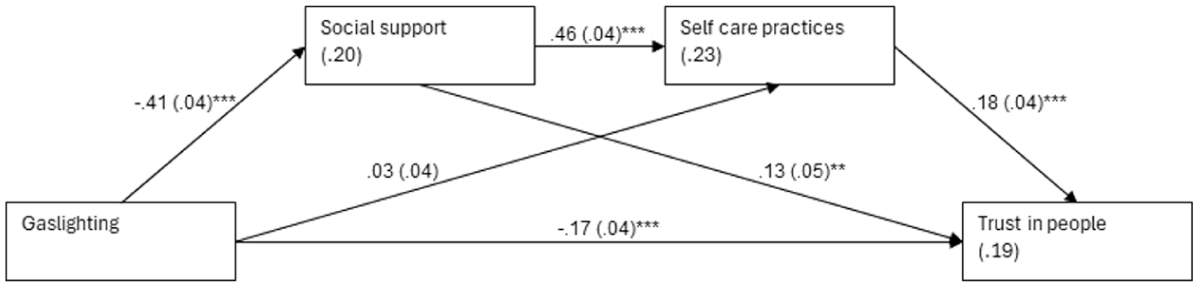
Results for serial mediation for gaslighting, social support, self-care practices, and trust in people.
Contrary to Hypothesis 4, gaslighting was not significantly associated with self-care practices (β = .03, p = .456). Consequently, the indirect effect for gaslighting – self-care practices – trust in people was not significant (effect = 0.01, SE = 0.01, 95% CI [−0.01, 0.02]).
In the full serial mediation model, gaslighting was negatively associated with social support (β = −.41, p < .001), which was positively related to self-care practices (β = .46, p < .001). Self-care, in turn, was positively associated with trust in people (β = .18, p < .001). The total indirect effect was significant (effect = −0.08, SE = 0.02, 95% CI [−0.12, −0.04]), indicating support for the hypothesized serial mediation. However, the direct effect between gaslighting and trust remained significant (β = −.17, p < .001), suggesting partial rather than full mediation, with 31.8% of the total association mediated by social support and self-care. These findings support Hypothesis 5.
Finally, it should be noted that the serial mediation model was supported separately, for both men (total indirect effect was significant (effect = −0.11, SE = 0.052, 95% CI [−0.23, −0.02]), and women (total indirect effect was significant (effect = −0.08, SE = 0.02 [−0.13, −0.03]).
Discussion
The present study aimed to examine whether experiences of gaslighting in intimate relationships reduce general trust in people and to identify the mechanisms underlying this association. The findings provide evidence that gaslighting is indeed associated with diminished interpersonal trust, supporting the theoretical view that psychological abuse undermines not only victims’ internal world, but also their broader social orientation.
A key contribution of the study lies in demonstrating the direct association between gaslighting and diminished trust in people. Previous research has primarily emphasized the intrapersonal consequences of gaslighting, such as anxiety, depression, and loss of self-esteem (Ciabatti et al., 2024; Darke et al., 2025). The present findings extend this knowledge by showing that gaslighting also erodes broader social orientations, specifically interpersonal trust. One possible explanation is that gaslighting undermines what Abramson (2014) described as epistemic trust, namely the ability to rely on one’s own perceptions and judgments. When individuals lose confidence in their own interpretations of reality, they may also find it more difficult to rely on others, thereby weakening their general trust.
Another possible explanation is relational: when victims place trust in a partner who is expected to be a close and protective figure, and that trust is violated through gaslighting, they may become more reluctant to extend trust to others in their social environment. Qualitative accounts of gaslighting experiences suggest that repeated invalidation and manipulation within intimate relationships can foster heightened suspicion and generalized mistrust beyond the abusive relationship itself (Klein et al., 2023). Moreover, theoretical accounts of gaslighting emphasize that sustained challenges to individuals’ perceptions and interpretations of reality may undermine their broader capacity to rely on others’ intentions and judgments (Abramson, 2014; Hailes & Goodman, 2025). In this sense, gaslighting should not only be understood as a tactic of psychological manipulation that damages victims internally, but also as a form of abuse that disrupts their social capacity to connect and trust.
Another important finding concerns the mediating role of social support. Consistent with previous studies (De Píñar-Prats & Pérez-Marfil, 2024; Howell et al., 2021; Machisa et al., 2018; McLean et al., 2018), these results indicate that individuals who reported higher levels of gaslighting also perceived lower levels of social support, which in turn was associated with reduced trust in people. Prior research examining the link between IPV and social support has approached the variable from different perspectives. In many cases, social support has been viewed as a protective factor that can buffer against violence, yet other scholars have argued that perpetrators may deliberately target victims with fewer support resources to begin with (Richardson et al., 2022). The present findings extend this literature by suggesting that in the case of gaslighting, the abuse itself can undermine and reduce social support. In this way, gaslighting creates a cycle: the manipulation isolates the victim from their social environment, which leads to lower perceived support, and the absence of such support further erodes interpersonal trust.
The findings regarding self-care practices present a more nuanced picture. In the simple mediation model, self-care did not emerge as a significant mediator, indicating that it may not directly explain the association between gaslighting and trust. However, its role became evident within the serial mediation model, whereby gaslighting was associated with reduced social support, which in turn predicted lower engagement in self-care practices, ultimately contributing to diminished trust. This pattern echoes previous studies, showing that self-care is strongly dependent on the availability of supportive social networks (Davies et al., 2025).
From a theoretical perspective, self-care is typically conceptualized as a resilience factor that helps individuals cope with adversity (Dos Santos et al., 2023). Yet, the present findings suggest that in the absence of sufficient social support, self-care becomes difficult to maintain, and its protective effect against the erosion of trust is conditional rather than direct. This suggests that while self-care is important for resilience, it may not be directly undermined by gaslighting itself, but rather indirectly through the erosion of social support. In this sense, self-care does not operate in isolation, but is embedded within a broader relational context, highlighting how gaslighting indirectly impairs trust by weakening both social and personal resources.
The findings regarding gender differences diverged from the initial hypothesis. Whereas previous literature has often emphasized women’s heightened vulnerability to gaslighting due to gendered stereotypes and institutionalized gender inequalities (Abramson, 2014; Sweet, 2019), the present study found that men reported higher levels of gaslighting experiences. These results suggest that gender differences in gaslighting may be more context-dependent than previously assumed. A possible explanation relates to the design of the current study. Unlike research that focused on identified or acute victims of IPV, this study examined gaslighting experiences within a non-clinical, community-based sample. It is therefore possible that men reported higher exposure to lower-intensity forms of gaslighting, which are less visible in studies limited to severe cases. Taken together, these findings suggest that gender differences in gaslighting are more complex than previously assumed and highlight the importance of examining the phenomenon across diverse populations and levels of severity.
Practical Implications
The findings of this study bear several practical implications. First, the direct link between gaslighting and reduced trust highlights the need for prevention and intervention programs to address the broader social consequences of psychological abuse, beyond its intrapersonal effects. Practitioners working with survivors should be attentive not only to symptoms such as anxiety or depression, but also to difficulties in maintaining trust and social relationships. Second, the mediating role of social support suggests that strengthening victims’ access to supportive networks may be crucial in mitigating the harmful effects of gaslighting. Programs aimed at enhancing community awareness and reducing isolation could help rebuild victims’ ability to rely on others. These findings also point to the importance of raising awareness among mental health professionals and community organizations to better identify and address the social consequences of gaslighting.
Third, although self-care did not function as an independent mediator, its role in the serial mediation model indicates that promoting self-care practices may still be valuable, especially when combined with strong social support. Interventions that integrate social and personal resources may therefore be most effective in counteracting the erosion of trust. Finally, the unexpected gender differences point to the importance of tailoring awareness and support programs to both men and women, while addressing the social stigmas that may discourage men from recognizing and reporting experiences of psychological abuse.
Limitations and Future Directions
Several limitations of the present study should be acknowledged. First, the study relied on a convenience sample recruited online, which may limit the generalizability of the findings to the wider population. Second, all data were based on self-report measures and may therefore be subject to biases such as social desirability or recall inaccuracies. Third, the cross-sectional design limits causal inference. Although the theoretical model suggests that IPV gaslighting reduces trust through diminished social support and self-care, the temporal ordering of these processes cannot be established within the current design. Longitudinal research is needed to clarify whether exposure to IPV gaslighting precedes subsequent declines in social support and self-care, and whether these changes, in turn, predict later reductions in general trust over time.
Finally, the cultural context of the present study should be considered when interpreting the findings. The sample was drawn from Israel, and although age and religiosity were examined, other dimensions of diversity (e.g., ethnicity, sexual orientation, or disability status) were not assessed. This limits the ability to examine how IPV gaslighting experiences and trust-related processes may vary across diverse social groups and contexts. Future research should therefore examine these associations across diverse cultural backgrounds to assess generalizability and explore potential cross-cultural differences.
Future research should build on these findings by employing more diverse and representative samples, including individuals from different cultural backgrounds and age groups. Longitudinal studies could further extend the present findings by tracking changes in gaslighting experiences and related relational resources across multiple time points, thereby testing the proposed serial mediation model in a temporal framework. Furthermore, while the current study focused on general trust, future work could explore how gaslighting affects other relational outcomes, such as attachment, forgiveness, or willingness to seek professional help. Finally, given the mixed results regarding gender differences, more systematic research is needed to examine how men and women experience gaslighting across varying levels of severity, and to investigate the social factors that shape disclosure and reporting patterns.
Future research would also benefit from incorporating more diverse and intersectional samples to better capture cultural, demographic, and social variations in gaslighting experiences and their consequences.
Conclusion
In sum, this study demonstrates that gaslighting in intimate relationships is associated with diminished trust in others, both directly and through social mechanisms. By highlighting the mediating role of social support and the conditional contribution of self-care, these findings extend the understanding of gaslighting beyond its intrapersonal consequences to its broader social implications. The results also suggest that gender differences in gaslighting experiences may be more complex than previously assumed. Together, these insights underscore the importance of addressing gaslighting not only as an individual psychological issue but also as a relational and social challenge, with implications for prevention, intervention, and future research.
Footnotes

Consent to Participate
All study participants signed informed consent before answering the questionnaire.
Funding
The author received no financial support for the research and/or authorship of this article.
Declaration of Conflicting Interests
The author declared no potential conflicts of interests with respect to the authorship and/or publication of this article.
Data Availability Statement
The data on which the study is based are available and stored by the researcher and will be provided upon request.