




Abstract
Adolescence is a critical period where peer relationships shape psychological well-being. Negative peer experiences (NPEs), including peer rejection, bullying, and cyberbullying, contribute to emotional and behavioral difficulties. This study developed the Negative Peer Experiences Questionnaire for Adolescents (NPEQA) to comprehensively assess NPEs. Data from 1,505 Vietnamese adolescents supported a three-dimensional model, validated through exploratory and confirmatory factor analyses. The NPEQA demonstrated strong reliability (α = .75–.91) and construct validity. Regression analysis identified bullying as the strongest predictor of mental health challenges, followed by peer rejection and cyberbullying (R2 = .27). Interaction effects revealed complex influences on emotional and behavioral outcomes. NPEQA serves as a valuable tool for identifying at-risk adolescents and evaluating interventions. By addressing the evolving nature of NPEs, this study provides insights for educators, counselors, and policymakers in supporting adolescent mental health in the digital age.
Introduction
Adolescence is a critical developmental stage marked by increased reliance on peer relationships, which play a significant role in shaping social, emotional, and psychological well-being (Bukowski et al., 2018). While positive peer interactions can foster a sense of belonging and self-esteem, negative peer experiences (NPEs)—such as bullying, cyberbullying, and peer rejection—can have profound adverse effects on adolescents’ mental health and academic performance (Baier et al., 2019; Bukowski et al., 2010; Ford et al., 2017). NPEs are associated with outcomes such as anxiety, depression, loneliness, and even suicidal ideation, underscoring the importance of identifying and addressing these issues early (Wolke & Lereya, 2015).
Research on NPEs has primarily focused on specific forms, such as bullying or cyberbullying, leading to the development of well-established tools such as the Olweus Bullying Questionnaire (Olweus, 1996) and the Cyberbullying and Online Aggression Survey (Patchin & Hinduja, 2006). Similarly, peer rejection—a broader construct reflecting social exclusion or ostracism—has been studied using tools such as the Sociometric Status Assessment (Coie et al., 1983). However, these scales are often limited in scope, targeting only one form of NPE rather than capturing the interconnected nature of these phenomena. Adolescents frequently encounter multiple forms of NPEs simultaneously, with research suggesting significant overlap between traditional bullying, cyberbullying, and peer rejection (Modecki et al., 2014). This fragmented approach hampers a comprehensive understanding of the broader impact of negative peer interactions during adolescence.
Moreover, existing scales often fail to adequately address the evolving nature of peer interactions in the digital age. The rise of social media and online platforms has blurred the boundaries between traditional bullying and cyberbullying, making it increasingly challenging to study these behaviors in isolation (Kowalski et al., 2014). Furthermore, while peer rejection has been explored in the context of in-person interactions, its manifestation in online spaces remains underexamined despite its growing prevalence. These gaps in measurement have limited the ability of researchers and practitioners to develop holistic interventions that address the full spectrum of NPEs.
This study aims to address these limitations by developing the NPEs Scale for Adolescents, a comprehensive tool designed to assess bullying, cyberbullying, and peer rejection within a unified framework. The novelty of this scale lies in its integration of multiple forms of NPEs, capturing their interrelated dimensions while accounting for contextual factors such as in-person and digital environments. By providing a multidimensional perspective, this scale enables a deeper understanding of the cumulative and overlapping effects of NPEs on adolescent well-being.
The development of this scale has significant implications for research and practice. For researchers, it offers a standardized tool for investigating the prevalence, correlations, and consequences of NPEs across diverse settings. For educators, counselors, and policymakers, it provides a means to identify at-risk adolescents and evaluate the effectiveness of interventions aimed at mitigating these experiences. Ultimately, this study contributes to advancing the literature by bridging existing gaps and promoting a more nuanced understanding of how NPEs shape adolescent development in a rapidly changing social landscape.
Literature Review
What Are NPEs?
NPEs refer to harmful or unpleasant interactions that individuals, especially children and adolescents, may encounter in their relationships with peers (Hawker & Boulton, 2000). Our conceptualization of NPEs situates peer rejection, direct bullying, and cyberbullying within a framework grounded in psychological need-threat theory and a social-ecological perspective. According to Williams’s Temporal Need-Threat Model (2009), experiences of social exclusion, including being ignored or rejected, immediately threaten fundamental psychological needs such as belonging, self-esteem, control, and meaningful existence (Williams, 2009). These profound disturbances, whether instantiated as peer rejection, overt aggression, or digital harassment, share a common mechanism of social devaluation and psychological threat, while retaining modality-specific distinctions that are important for nuanced interpretation (Williams, 2009).
From a social-ecological viewpoint, these subtypes reflect interactions within overlapping contexts: classrooms, peer groups, and technology-mediated environments. Group dynamics, bystander behavior, and peer climate may shape how aggression or exclusion arises and is sustained, leading to correlated patterns among subtypes. Meta-analytic evidence demonstrates a strong cooccurrence between traditional bullying and cyberbullying, supporting the notion of an underlying, shared liability indexed by a higher-order NPE factor (Li et al., 2024). Thus, modeling NPE as a construct, with peer rejection, direct bullying, and cyberbullying, is both theoretically justified and empirically warranted. This structure captures shared variance from need-threat processes and contextual interplay while preserving subtype-specific distinctions necessary for nuanced interpretation.
Peer rejection is the deliberate exclusion or dislike of an individual by their peers, leading to social isolation and emotional distress. This often includes ignoring, avoiding, or showing hostility toward the targeted individual (Rubin et al., 2006). Social indicators of peer rejection can be identified as follows: (1) being deliberately left out of group activities, games, or discussions; not being invited to social events or informal gatherings; (2) experiencing teasing, bullying, or criticism from peers; being the subject of gossip or rumors spread by others; (3) isolation or ignoring: peers avoiding conversations, eye contact, or physical proximity; feeling invisible or unnoticed in group settings; (4) struggling to establish or maintain close and meaningful relationships (Hudson, 1993; Mynard & Joseph, 2000).
Bullying is a form of aggressive behavior characterized by an imbalance of power, intentionality, and repetition. It includes verbal, physical, relational, and cyber forms, where the victim is subjected to harm or distress by peers (Olweus, 1996). Indicators of being bullied by others can be identified as follows: (1) being repeatedly subjected to aggressive actions, such as physical confrontations, verbal insults, or threats (Olweus, 1996); (2) being dominated or controlled by others, often through acts of intimidation or manipulation (Juvonen & Graham, 2014); (3) a lack of empathy is shown toward them, with their feelings dismissed or the harmful behaviors against them justified (Rigby, 2003), (4) being excluded from social interactions, gossiped about, or ostracized within their peer group (Hawker & Boulton, 2000); and (5) Their personal belongings or money are taken without explanation (Olweus, 1996).
Cyberbullying refers to bullying that occurs through digital technologies, including social media, text messages, and online platforms. It often involves harassment, threats, or public humiliation, typically with the potential for anonymity and wide audience reach (Kowalski et al., 2014). Unlike traditional bullying, cyberbullying can occur outside of school settings and invade personal spaces. Indicators of being cyberbullied may include the following: (1) being the target of harmful, threatening, or offensive posts, comments, or messages (Kowalski et al., 2014); (2) encountering dismissive or mocking attitudes from cyberbullies, who trivialize or ridicule the victim's feelings or experiences during online interactions (Slonje & Smith, 2008); and (3) being harassed, having rumors spread, or being manipulated by individuals using anonymous or fake accounts to avoid identification (Kowalski et al., 2014).
NPEs and Adolescents’ Mental Health Problems
A widely accepted definition of mental health problems is provided by the World Health Organization (WHO), which describes them as “a combination of disturbances in thinking, emotion, or behavior that significantly interfere with an individual’s personal, social, or occupational functioning” (WHO, 2013). These problems can range from common issues such as anxiety and depression to more severe conditions, such as schizophrenia and bipolar disorder. Adolescence is a critical developmental period characterized by forming peer relationships, which significantly influence psychological and social well-being (Bukowski et al., 2010). Peer rejection, bullying, and cyberbullying are common adverse experiences during this stage and have been widely studied for their impact on adolescents’ mental health problems.
Peer rejection, marked by feelings of social exclusion, is a significant source of stress that can lead to long-term mental health challenges (Masten et al., 2011). More concerning, the perceived threat of rejection in children and adolescents has been associated with increased depressive symptoms and suicidal ideation (Giovazolias, 2023, Ladd et al., 2012), social withdrawal (Wesselmann et al., 2012), and selective memory biases for negative social events (Zadro et al., 2006).
Victims of bullying often endure lasting effects, including poor physical health and depressive symptoms (Bogart et al., 2014). Severe bullying has been linked to emotional consequences such as fear, alienation, anger, shame, sadness, and feelings of worthlessness (Harris, 2009). In addition, victims tend to exhibit lower self-awareness, increased depression and hopelessness (Källmén & Hallgren, 2021), reduced psychosocial quality of life, and impaired social functioning (Li, 2023; Wilkins-Surmer et al., 2003). Among the most severe outcomes is suicide; research indicates that bully-victims are approximately four times more likely to engage in self-harm or suicidal behaviors compared to their non-bullied peers (Ford et al., 2017; Luo et al., 2023).
Cyberbullying, which involves using information and communication technology to harass, embarrass, or socially exclude victims, adds another dimension to peer aggression (Vaillancourt et al., 2017). Unlike traditional bullying, cyberbullying is distinct due to its perceived anonymity, accessibility, and ability to reach wide audiences. Studies suggest cyberbullying exacerbates mental health issues beyond those caused by traditional bullying (Ansary, 2019). For instance, a cross-sectional study (N = 1,225) found that both traditional and cyberbullying significantly contributed to poor mental health in adolescents (Hase et al., 2015). Psychological cyberbullying, specifically, was strongly correlated with adverse mental health outcomes across genders (Baier et al., 2019). However, findings differ when examining specific forms of bullying. Turner et al. (2013) identified verbal bullying as a predictor of depressive symptoms, whereas Baier and Kunkel (2016) reported relational bullying as more strongly associated with adolescent mental health outcomes.
According to the best available knowledge, numerous studies have examined the relationship between peer rejection, bullying, and cyberbullying with mental health outcomes in adolescents. These individual forms of peer victimization have been found to significantly contribute to various mental health difficulties, including depression, anxiety, and low self-esteem (X. Chen et al., 2025; Mulvey et al., 2018; Nixon, 2014; Prinstein & Aikins, 2014; Ye et al., 2023). However, research that combines these three forms of NPEs—peer rejection, bullying, and cyberbullying—as a general construct of NPEs and their relationship with adolescent mental health is quite rare. Moreover, studies focusing on the interaction between these three factors in predicting mental health issues in adolescents are extremely limited, with little to no research specifically addressing this interaction. This gap in the literature underscores the need for further investigation into how the combined effect of these peer experiences influences adolescent mental well-being.
The Present Study
Building on the conceptual framework of NPEs and the supporting research evidence, the aims of this study are twofold: (1) to develop a robust and reliable scale that reflects the multidimensional aspects of these experiences (i.e., peer rejection, bullying, and cyberbullying), and (2) to examine their predictive relationships with adolescent distress. Specifically, this study tests the following hypotheses: (1) The Negative Peer Experiences Questionnaire for Adolescents (NPEQA) will demonstrate a three-factor structure (peer rejection, bullying, and cyberbullying) with satisfactory reliability; (2) NPEs are positively associated with indicators of distress in adolescents; (3) The three dimensions of NPEs (peer rejection, bullying, and cyberbullying) interact meaningfully in predicting adolescents’ mental health problems.
Methods
This cross-sectional study was conducted to develop and validate the NPEQA. As part of the validation process, we also examined the associations between NPEs and adolescents’ mental health problems to assess the scale’s predictive validity across diverse geographic and socioeconomic contexts in Vietnam. The design was chosen to efficiently capture a broad snapshot of peer interactions and mental health outcomes within a defined timeframe.
Sampling and Recruitment
The sampling strategy prioritized regional diversity by including both northern (Ninh Binh and Hanoi) and southern (Lam Dong and Ben Tre) provinces to account for potential sociocultural and urban-rural differences in peer interactions. Schools were randomly selected from the lists provided by the Department of Education and Training to ensure representativeness and reduce selection bias, while the random selection of 1–2 classes per grade (Grades 7–12) within each school helped maintain proportional representation across age groups. Grade 6 was excluded because it marks a transitional stage from childhood to adolescence, during which students may not yet have developed stable peer dynamics, which could potentially affect findings on NPEs. This approach balanced methodological rigor with practical constraints, enhancing the generalizability of results while ensuring reliable assessment of peer-related distress in Vietnamese adolescents.
Data Collection
Data were collected at two points: the first survey (Time 1, T1) at the beginning of the academic year and the follow-up survey (Time 2, T2) 3 months later. The same questionnaire was administered during both surveys to ensure consistency in the data collected. All data were collected in person during regular school hours using paper-based questionnaires administered in classroom settings. Before the survey, the City Department of Education briefed school administrators on the study’s objectives, questionnaire details, and ethical principles, such as anonymity and voluntary participation. After obtaining approval, schools allocated one class period (15–20 min) for the survey. To ensure confidentiality and minimize potential response bias, the principal ensured that only the investigator directly interacted with the students, while teachers were not present in the classroom.
The data collection procedures were designed to be sustainable and minimally disruptive. Surveys were conducted during scheduled class periods, requiring no additional travel or infrastructure. Questionnaires were collected immediately after completion, minimizing administrative burden and resource use. These procedures ensured ethical, low-resource, and context-appropriate data collection within school settings.
The final sample at Time 1 included n = 1,505 adolescents (Mage = 14.4 years, SD = 1.6), comprising 784 male adolescents (52.1%, Mage = 14.4 years, SD = 1.7) and 721 female adolescents (47.9%, Mage = 14.3 years, SD = 1.7). Participants were distributed across Grades 7–12, with n = 752 (50%) middle school students (Grades 7–9) and n = 753 (50%) high school students (Grades 10–12). In terms of regional representation, n = 997 (66.2%) participants were recruited from northern provinces and n = 508 (33.8%) from southern provinces, reflecting diversity across sociocultural and regional contexts.
At Time 2, the follow-up sample (n = 478) was recruited exclusively from schools in Hanoi. The sample had a mean age of 14.3 years (SD = 1.7) and comprised 233 male adolescent students (48.7%, Mage = 14.4 years, SD = 1.6) and 245 female adolescent students (51.3%, Mage = 14.2 years, SD = 1.7). Regarding educational level, n = 266 (55.6%) participants were middle school students, and n = 212 (44.4%) were high school students.
Overall, both points demonstrated balanced gender representation and adequate diversity across educational levels and geographic regions.
Ethical Considerations
In the absence of a formal Ethics Committee, the study was approved and funded by the Ministry of Science and Technology of Vietnam. During the proposal approval process, research ethics standards were reviewed by the Interdisciplinary Council of Psychology and Education. Besides, permissions were obtained from schools, parents, and students for voluntary participation. Data confidentiality was ensured through encryption and anonymization, with usage restricted to research purposes. The survey avoided sensitive questions, and teachers were not involved in the data collection process to maintain student privacy. Participants received a mental health guidebook and access to a free mental health first aid program. Findings were reported transparently, respecting participants’ dignity and well-being.
Measures
Negative Peer Experiences
Based on theoretical definitions and indicators of peer rejection, bullying, and cyberbullying, the tool was designed to capture the key aspects of each construct. The initial pool of items was developed from two sources: (a) established measures, including the Multidimensional Peer Victimization Scale (Mynard & Joseph, 2000), the Index of Peer Relations (Hudson, 1993), and the Social Peer Rejection Measure (Lev-Wiesel et al., 2006; items 1, 3, 7, 8, 9, 10, 16, 18, 19, 20, 21, 23, 24, and 25), and (b) newly created items designed based on the qualitative data collected from Vietnamese adolescents to capture culturally specific peer interactions in this country (items 2, 4, 5, 6, 11, 12, 13, 14, 15, 17, and 22). To evaluate semantic validity, a focus group of 30 adolescents was convened, during which participants reviewed the clarity and relevance of each item and proposed additional experiences that might not have been represented. Their feedback informed revisions and refinements, resulting in the final 24-item scale. Although expert review was not conducted, the focus group provided essential input to ensure cultural and contextual appropriateness. The finalized NPEQA encompasses three correlated dimensions: (1) peer rejection (8 items; e.g., “Not talking to me, turning their back on me”), (2) direct bullying (12 items; e.g., “Pushing, knocking me down, throwing objects at me, or locking me up”), and (3) cyberbullying (4 items; e.g., “Sending me messages or emails with content that makes me feel uncomfortable or scared”). Respondents indicated the frequency of experiences over the past month on a 4-point Likert scale (1 = never, 2 = once, 3 = two or three times, 4 = many times). Evidence of the validity and reliability of the NPEQA is presented in the “Results” section.
Mental Health Problems
In this study, the self-reported version for adolescents (11–17 years old) of the Strengths and Difficulties Questionnaire (SDQ), developed by Goodman (1997), was utilized to assess mental health challenges among adolescents, aligning with the World Health Organization’s definition of adolescent mental health. The SDQ has demonstrated strong validity for identifying psychiatric issues across diverse contexts, including Vietnam (Dang et al., 2017; Tran, 2006). The instrument comprises 25 items, of which 20 were used to evaluate 4 key areas of difficulties: Emotional Symptoms (e.g., Often unhappy, depressed, or tearful), Conduct Problems (e.g., Often fights with other children), Hyperactivity/Inattention (e.g., Restless, overactive, cannot stay still for long), and Peer Problems (e.g., Gets along better with adults). Each item was rated on a 3-point scale (0 = not true, 1 = somewhat true, 2 = certainly true). However, prior research in Vietnam has indicated relatively low internal consistency for the subscales, including the adaptation study by Dang et al. (2017). In contrast, the total difficulties score demonstrates stronger reliability and has been recommended for use in the Vietnamese context. Consistent with these findings, the present study employed the total score, which showed acceptable internal consistency (Cronbach’s α = .72).
Data Analysis
To assess the construct validity of the NPEQA, we employed a sequential analytical approach aligned with our study aims. First, an exploratory factor analysis (EFA) using principal components analysis with Promax rotation was conducted to examine the underlying structure of NPEs. This step addressed aim 1 (scale development) by empirically testing our hypothesized three-dimensional framework (peer rejection, bullying, and cyberbullying). Items with factor loadings below .30 were excluded to ensure robust measurement of each construction.
Building on the EFA results, we performed Confirmatory factor analysis (CFA) using robust maximum likelihood estimation to account for non-normal item distributions. This step further validated the scale structure proposed in Aim 1. Model fit was evaluated using multiple indices, including normed χ2 (χ2/df), comparative fit index (CFI), standardized root-mean-square residual (SRMR), and root mean square error of approximation (RMSEA). Fit criteria were defined as follows: normed χ2 ≤ 3, RMSEA < 0.05 (up to 0.08 acceptable), CFI > 0.95 (acceptable if > 0.90), and SRMR < 0.05 (up to 0.08 acceptable), based on guidelines by Kline (2011).
To compare competing models, we used two information-theoretic indices, the Akaike information criterion (AIC) and the Bayesian information criterion (BIC). This step was conducted by balancing model fit (−2*log-likelihood value) and complexity (based on the number of estimated parameters). A model with lower IC values indicates a better balance between fit and complexity. Models are considered distinguishable when the difference in AIC exceeds 2, and the difference in BIC falls between 2 and 6 (Fabozzi et al., 2014).
To establish measurement invariance, we followed the approaches of Ariely and Davidov (2012) and Steenkamp and Baumgartner (1998) with three steps: configural, metric, and scalar invariance across gender and education levels. Configural invariance tested whether the same factor structure applied across groups without constraining loadings or intercepts. Metric invariance constrained factor loadings to equality across groups while allowing intercepts to vary, ensuring loadings were consistent across groups. Scalar invariance further constrained both loadings and intercepts to test whether the latent construct’s means were comparable across groups. This rigorous testing supported the scale’s generalizability (Aim 1). The fit indices were evaluated, with changes in CFI > 0.01 and in RMSEA or SRMR > 0.015 indicating substantial differences (F. F. Chen, 2007). The invariance testing was particularly important given our diverse sample from multiple Vietnamese regions.
Convergent validity was examined by calculating Pearson correlations between the identified factors. Reliability was assessed through Cronbach’s alpha (Cronbach, 1951) and average inter-item correlations, as recommended by Clark and Watson (1995). Optimal inter-item correlations ranged from .15 to .50, with lower values suggesting overly broad constructions and higher values indicating item redundancy. Average corrected item–total correlation is expected to be higher than .30 (Cristobal et al., 2007).
In the second stage of analysis, for predictive validity testing (Aim 2), we first controlled gender and grade effects identified through multivariate analyses of variance. Due to the large sample size, a more stringent alpha level of .01 was adopted (Kim, 2015) to reduce the likelihood of errors such as false positives. Partial correlations and multiple linear regression models were used to analyze the relationships between NPEs and mental health problems, controlling for gender and grade. In addition, multiple regression was employed to evaluate two-way interaction effects, examining how different NPEs combined to predict adolescent mental health problems.
All analyses were conducted using Mplus version 8.3 (Muthén & Muthén, 1998–2017) for structural equation modeling and SPSS 24.0 for other statistical tests (IBM Corp, 2016). We adopted a conservative alpha level (.01) to account for multiple comparisons in our large sample, reducing Type I error risk while maintaining power to detect meaningful effects. This comprehensive validation approach ensured the NPEQA’s robustness for assessing NPEs and their mental health consequences in Vietnamese adolescents.
Results
Scale Development and Psychometric Properties of the NPEQA
To test this hypothesis, we conducted different steps and found the result as follows:
The EFA reveals that the KMO (0.95) and Barlett’s test (df = 276; χ2 = 14,762.455; p < .001) confirmed sample adequacy for factor analysis. Analysis of eigenvalues, scree plots, and interpretability of the factors suggested a three-factor solution, identifying three latent constructs underlying NPEs: peer rejection, bullying, and cyberbullying. These retained factors explained 52.2% of the variance.
Based on the EFA’s result, a CFA with MLR estimation was performed to evaluate the fit of a three-factor model for NPEs. As shown in Table 1, after stepwise removal of two poorly loading items (item 1 of the bullying subscale and item 21 of the peer rejection subscale), the hierarchical three-factor model achieved acceptable fit indices (normed χ2 = 3.66; CFI = 0.922; RMSEA = 0.042; SRMR = 0.044), supporting the structural validity of the NPEQA. When comparing alternative models (Table 1), the higher-order latent variable model (NPEs) demonstrated a satisfactory fit and lower AIC/BIC values than both the baseline and two-factor models, indicating the best balance between model fit and model complexity. In contrast, the two-factor model (bullying vs. peer rejection) showed poorer fit and higher information criterion values. Consistent with Hypothesis 1, the NPEQA initially demonstrated a three-factor structure representing peer rejection, bullying, and cyberbullying. However, when alternative models were tested, the hierarchical three-factor model provided a superior fit compared to the baseline and two-factor models (Table 1). Therefore, while the hypothesized three-factor solution was supported, the hierarchical model was retained for subsequent analyses as it best captured the structural relations among the subdimensions (see Figure 1).
Fit of CFA Models of the NPEQ.
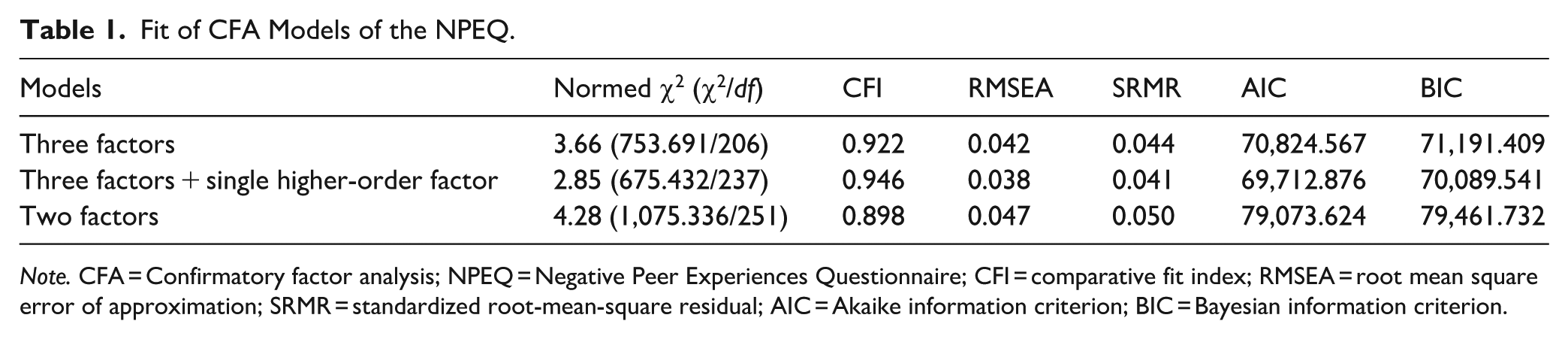
Note. CFA = Confirmatory factor analysis; NPEQ = Negative Peer Experiences Questionnaire; CFI = comparative fit index; RMSEA = root mean square error of approximation; SRMR = standardized root-mean-square residual; AIC = Akaike information criterion; BIC = Bayesian information criterion.
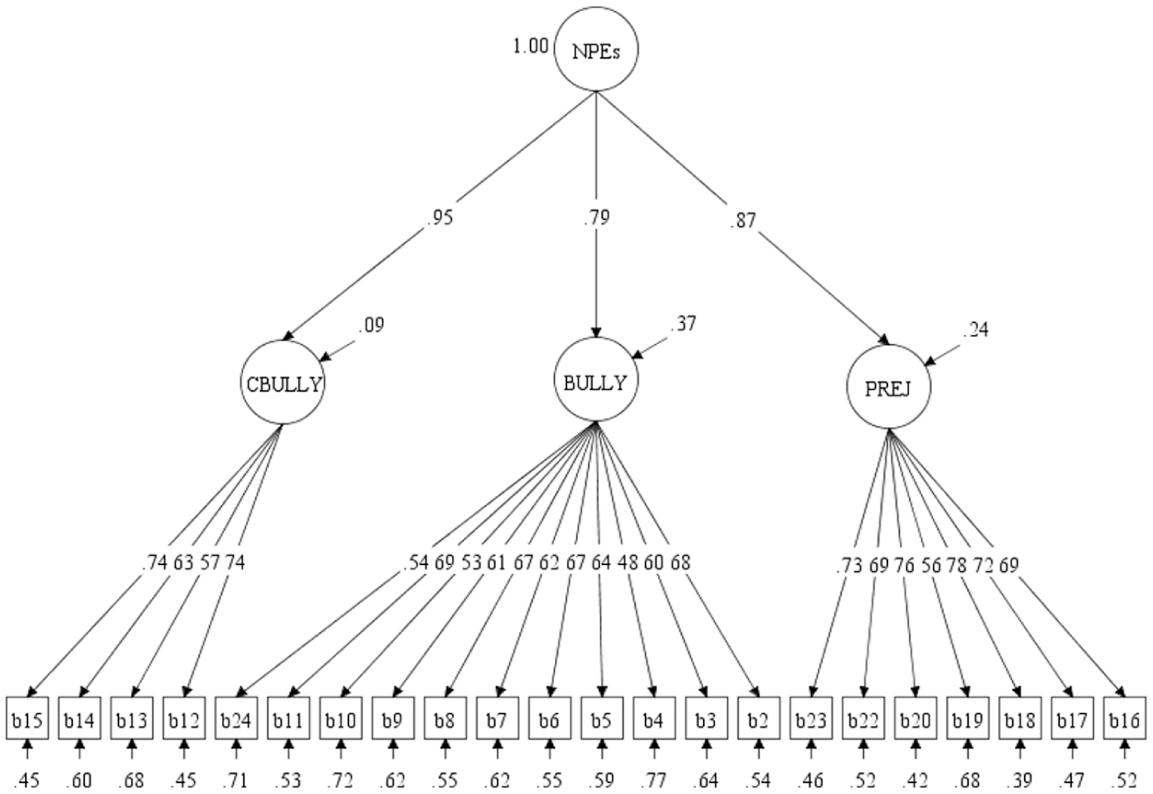
The measurement model of the Vietnamese NPEQ- whole sample.
As shown in Table 2, the NPEQ demonstrated acceptable fit across all subgroups. Normed χ2 values (2.75–3.10) indicated a good fit, with female adolescent students achieving the best (2.75). CFI values were consistently high (>0.940), again highest for female adolescent students (0.952). RMSEA (0.035–0.040) and SRMR (0.040–0.045) were well below recommended thresholds for all groups, supporting the model’s validity. Regarding parsimony, female students had the lowest AIC and BIC values, while middle school students showed slightly higher values, indicating a marginally less optimal fit.
Goodness-of-Fit Indices for the NPEQ Across Subgroups.
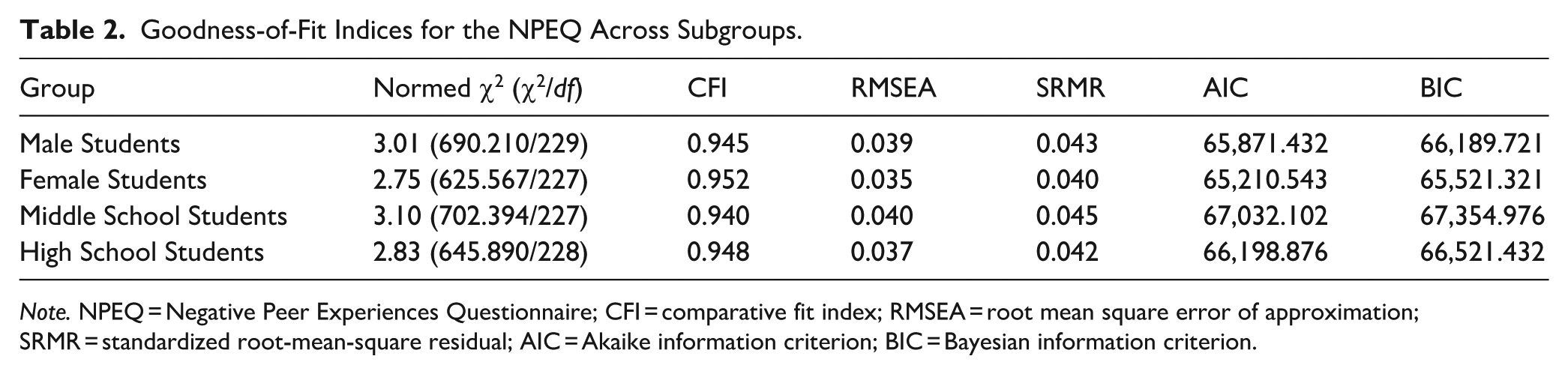
Note. NPEQ = Negative Peer Experiences Questionnaire; CFI = comparative fit index; RMSEA = root mean square error of approximation; SRMR = standardized root-mean-square residual; AIC = Akaike information criterion; BIC = Bayesian information criterion.
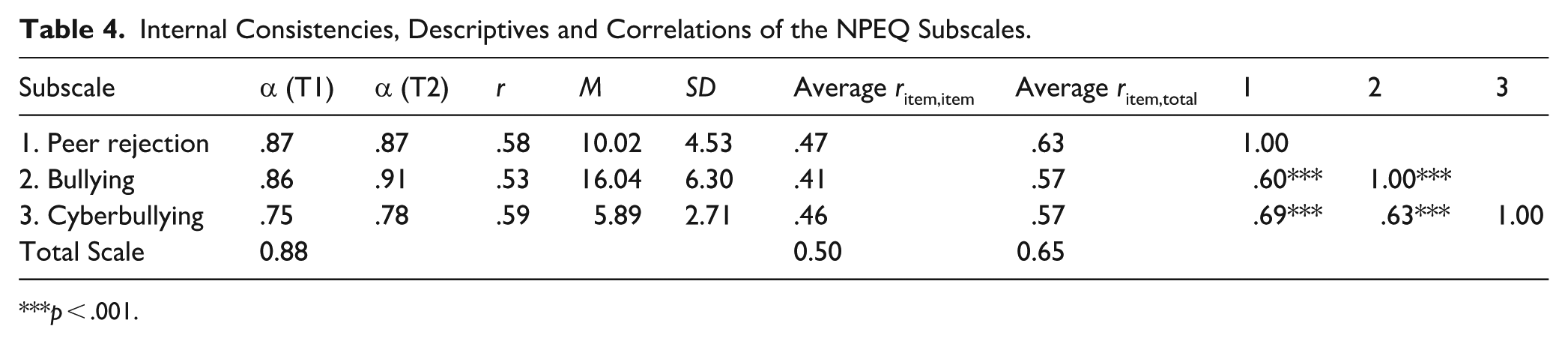
As can be seen in Table 3, measurement invariance testing across gender and education levels confirmed the model’s stability. For gender, configural invariance showed good fit (normed χ2 = 1.32; CFI = 0.945; RMSEA = 0.038; SRMR = 0.041). Metric invariance introduced minimal changes (ΔCFI = 0.005; ΔRMSEA = 0.001; ΔSRMR = 0.002), indicating consistent factor loadings, while scalar invariance changes (ΔCFI = 0.010) remained within acceptable thresholds, confirming intercept invariance. For education levels, configural invariance yielded good fit (normed χ2 = 1.35; CFI = 0.942; RMSEA = 0.039; SRMR = 0.042). Metric invariance changes (ΔCFI = 0.007; ΔRMSEA = 0.001; ΔSRMR = 0.001) supported loading invariance, and scalar invariance changes (ΔCFI = 0.008) confirmed intercept invariance across middle and high school students. As presented in Table 4, convergent validity was supported by significant positive correlations among the three subscales. Peer Rejection correlated strongly with Bullying (r = .605, p < .01) and Cyberbullying (r = .692, p < .01), while Bullying also correlated significantly with Cyberbullying (r = .631, p < .01). These associations indicate that the subscales are related yet distinct constructs.
Test of Measurement Invariance for the Multi-Group Model Across Subgroups.
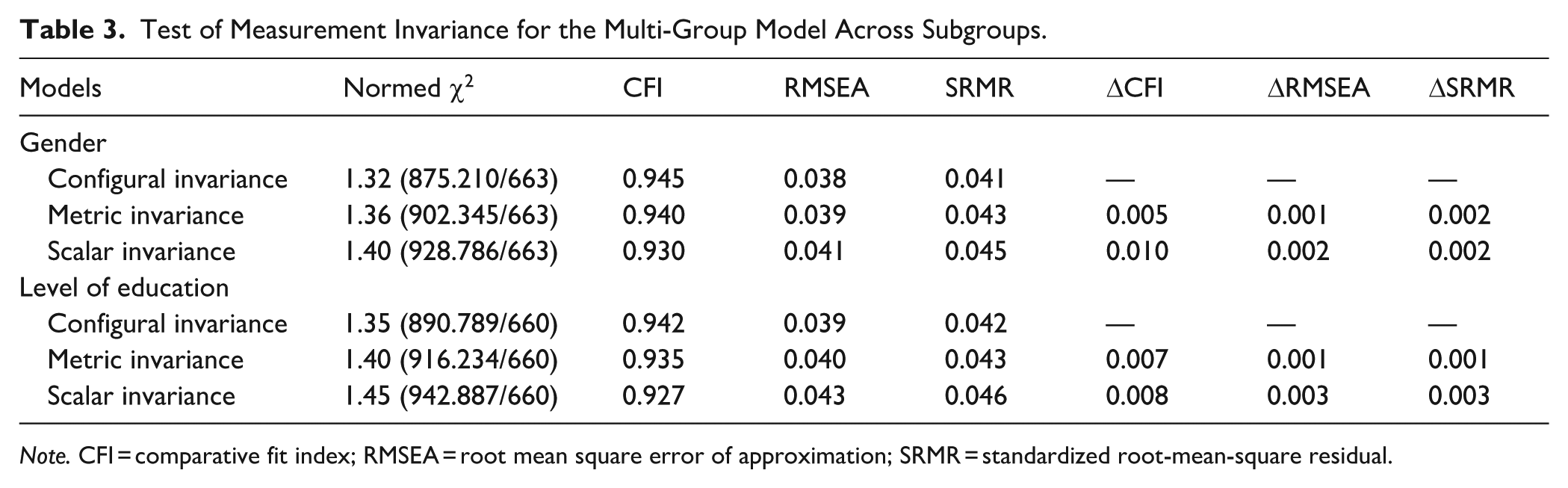
Note. CFI = comparative fit index; RMSEA = root mean square error of approximation; SRMR = standardized root-mean-square residual.
Internal Consistencies, Descriptives and Correlations of the NPEQ Subscales.
p < .001.
Also, as detailed in Table 4, internal consistency reliability was high for Peer Rejection (α = .87 at T1 and T2) and Bullying (α = .86 at T1; .91 at T2), and acceptable for Cyberbullying (α = .75 at T1; .78 at T2). Average inter-item correlations ranged from .41 to .47, and average item–total correlations ranged from .57 to .63, reflecting strong internal homogeneity. Test–retest correlations were moderate to good, suggesting stability over 3 months.
Predictive Validity of the NPEQ on Adolescents’ Mental Health
To determine whether control variables should be included in the correlation and regression analysis, a t-test was conducted using gender as the independent variable and emotional and behavioral difficulties as the dependent variable. In addition, an ANOVA was performed with grade as the independent variable and emotional and behavioral difficulties as the dependent variable. The mean emotional and behavioral difficulties score for males was 12.66, with a standard deviation of 5.50, while females had a higher mean score of 15.13 and a standard deviation of 5.26. Results showed a significant difference in scores between male and female adolescent students (t[1,503] = −8.895, p < .001), with female adolescent students reporting significantly greater difficulties than their male counterparts. An ANOVA test examined the effect of age (grouped by years) on emotional and behavioral difficulties. The results indicated significant differences across age groups (F[5,1499] = 4.655, p < .001). Post-hoc Bonferroni tests revealed specific grade-to-grade differences, such as between 12 and 10, 10 and 9, and 10 and 8, highlighting variations in difficulties based on age progression. Based on these results, we decided to control for gender and grade in subsequent correlation and hierarchical regression analyses.
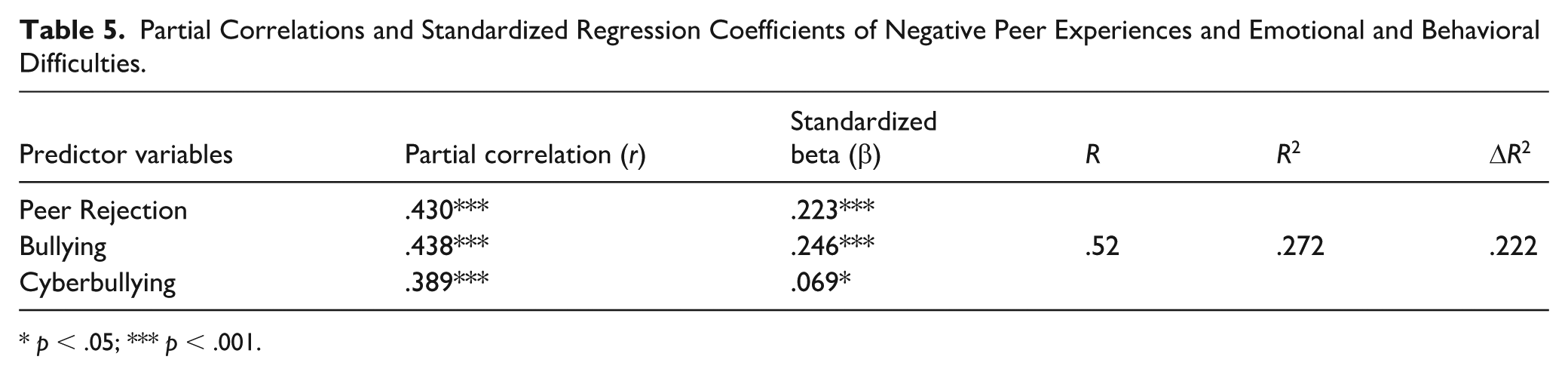
Consistent with Hypothesis 2, all three dimensions were associated with greater emotional and behavioral difficulties, with bullying generally showing the largest unique association, followed by peer rejection and cyberbullying. As summarized in Table 5, partial correlations indicated significant positive associations between all three predictors and emotional and behavioral difficulties: peer rejection (r = .430, p < .001), bullying (r = .438, p < .001), and cyberbullying (r = .389, p < .001). Regression analysis confirmed the predictive validity of these variables. The overall model was statistically significant, F(5, 1498) = 112.176, p < .001, explaining 27.2% of the variance in emotional and behavioral difficulties (R2 = .272; ΔR2 = .222). Bullying emerged as the strongest predictor (β = .246, p < .001), followed by peer rejection (β = .223, p < .001), with cyberbullying having a comparatively weaker but still significant effect (β = .069, p < .05).
Partial Correlations and Standardized Regression Coefficients of Negative Peer Experiences and Emotional and Behavioral Difficulties.
p < .05; *** p < .001.
As anticipated in Hypothesis 2, interactions among the three domains were significant, though unexpectedly, some combinations produced a dampening effect rather than cumulative harm. As presented in Table 6, moderation analyses revealed that NPEs (i.e., peer rejection, bullying, and cyberbullying) are all significant predictors of emotional and behavioral difficulties, with interaction effects providing further nuance. For the interaction between peer rejection and bullying, the basic model explained 23.8% of the variance (R2 = .238, p < .001), and the interaction term accounted for an additional 0.7% (ΔR2 = .007, p < .001), indicating that bullying significantly moderated the effect of peer rejection. Similarly, for cyberbullying × bullying, the base model explained 21.3% of the variance (R2 = .213, p < .001), with the interaction adding 0.6% (ΔR2 = .006, p < .001), suggesting that higher bullying levels attenuated the impact of cyberbullying. In the cyberbullying × peer rejection model, the base model explained 23.2% of the variance (R2 = .232, p < .001), with the interaction contributing 1.1% (ΔR2 = .011, p < .001), indicating that greater peer rejection reduced the influence of cyberbullying.
Results of Moderated Regression Analyses on Emotional and Behavioral Difficulties.

Discussion
This study developed and validated the NPEQA to assess the multidimensional nature of NPEs (peer rejection, bullying, and cyberbullying) and examined its predictive value for adolescent emotional and behavioral difficulties.
First, the results supported H1, with exploratory and confirmatory factor analyses confirming that the NPEQA exhibits a robust hierarchical three-factor structure: peer rejection, bullying, and cyberbullying, capturing interrelated yet distinct facets of NPEs, consistent with theories that traditional and digital forms of bullying overlap yet remain distinct (Modecki et al., 2014). Measurement invariance across gender and educational levels indicates a stable structure, while the observed stronger model fit for female adolescent students aligns with earlier findings that girls may be more sensitive to relational dynamics (Crick & Grotpeter, 1995). The NPEQA’s convergent validity, evidenced by substantial correlations among subscales, reinforces its ability to capture related yet unique constructs—findings that converge with prior research (Modecki et al., 2014) and extend it by integrating them under a single validated framework. The NPEQA addresses notable gaps in existing measurement tools, which often focus narrowly on one form of victimization or fail to reflect the blended realities of offline and online interactions (Kowalski et al., 2014; Smith & Anderson, 2016). The hierarchical factor model enables both an overarching assessment of general NPEs and focused identification of specific victimization types for targeted intervention.
Second, the results supported H2. All three forms of NPEs were significantly associated with higher emotional and behavioral difficulties, with bullying showing the strongest association, followed by peer rejection and cyberbullying. These results align with established literature demonstrating the adverse psychological effects of peer victimization (Ford et al., 2017; Wolke & Lereya, 2015). Besides, more significantly, the construct and predictive validity of this scale demonstrate a clear distinction between bullying and peer rejection, highlighting peer rejection as a significant negative experience affecting adolescents’ mental health. While parents and educators often address physical bullying, peer rejection is frequently overlooked as mere childish behavior. However, during adolescence, a period where peer interactions are critical, peer rejection disrupts social connections, leading to loneliness and social withdrawal. These findings underscore the importance of addressing peer rejection with the same urgency as physical bullying to mitigate its psychological impact.
Third, Hypothesis 3 was partly confirmed, as the results demonstrated that the interplay among the dimensions did not always intensify outcomes; in some cases, simultaneous exposure seemed to reduce the magnitude of difficulties. This pattern contrasts with prior studies reporting additive or cumulative harm (Ford et al., 2017), indicating a more complex relationship between multiple stressors. Several mechanisms may account for these findings. Stress saturation or desensitization may limit the additional impact of repeated stressors (Bonanno, 2004; McEwen, 2007). Attentional overshadowing, where intense experiences such as direct bullying dominate cognitive-emotional focus, reducing the perceived impact of other stressors, may further explain these patterns (Livingstone & Smith, 2014). In addition, adaptive coping strategies or social solidarity among co-victimized peers may buffer cumulative harm (Bukowski et al., 2018). Collectively, these results suggest that multiple peer stressors may combine in non-linear ways through threshold, multiplicative, or diminishing-return effects, rather than simple additive accumulation. Such evidence underscores the need for victimization research to adopt nonlinear theoretical frameworks that more accurately capture real-world dynamics.
Research and Program Implications
For researchers, the validated NPEQA enables nuanced investigation of both aggregate and domain-specific pathways linking peer victimization to adolescent outcomes. It can be applied to test mediators (e.g., coping, resilience, and social support) and moderators (e.g., temperament, school climate, and cultural norms) in diverse contexts.
For practitioners and policymakers, the results emphasize that prevention should address the full spectrum of NPEs, not only overt bullying. Programs should integrate social inclusion initiatives for peer rejection and digital literacy components for cyberbullying (Slonje & Smith, 2008). Given the moderation patterns, multi-victimized adolescents may require differentiated supports that address chronic stress adaptation, rather than only incident-focused interventions.
Contributions, Limitations, and Future Directions
This study advances the field in several ways. First, by integrating traditional and digital forms of peer victimization, the NPEQA provides a holistic framework for understanding adolescents’ peer interactions. This approach builds on the work of Olweus (1996) and Kowalski et al. (2014), while addressing calls for measures that capture the interconnections between these phenomena (Modecki et al., 2014). Second, the study highlights the evolving impact of digital platforms, where cyberbullying increasingly complements traditional forms of aggression, extending victimization beyond school contexts (Slonje & Smith, 2008).
Despite its contributions, several limitations should be acknowledged. First, while item development combined adaptation from existing scales and newly created items, expert review was not conducted. Instead, semantic validation was achieved through adolescent focus groups. Although this ensured cultural appropriateness, the absence of expert input remains a limitation. Second, adolescents’ mental health difficulties were evaluated solely through the SDQ total score. Although this approach ensured adequate internal consistency in the Vietnamese context where previous studies, including Dang et al. (2017), have found low reliability for the subscales, it limited our ability to explore domain-specific issues such as depression, anxiety, or attention problems. Future research should focus on refining the psychometric properties of SDQ subscales in Vietnam or employing additional instruments (e.g., CES-D, PHQ-9) to provide richer and more nuanced interpretations. The sample, though diverse, was geographically limited to Vietnam, which may restrict generalizability. Future research should validate the NPEQA in other cultural contexts to assess its cross-cultural applicability (Hase et al., 2015). In addition, the self-report nature of the data introduces potential bias; incorporating peer or teacher reports could strengthen reliability (Goodman & Goodman, 2012). Future studies could also explore longitudinal relationships between NPEs and mental health, examining potential mediators such as social support or coping strategies (Vaillancourt et al., 2017). Moreover, given the rapid evolution of digital platforms, ongoing updates to the NPEQA will be essential to capture emerging trends in peer interactions. Simultaneously, an independent examination of the multifaceted consequences of peer rejection and bullying on mental health across diverse populations warrants further investigation to evaluate the distinct role of each negative experience in adolescents’ development.
Conclusion
In summary, this study provides a robust, multidimensional tool for assessing NPEs and their implications for adolescent mental health. The NPEQA bridges critical gaps in literature, offering a comprehensive framework for research and practice. By highlighting the interconnected and evolving nature of peer victimization, this study lays the groundwork for more effective, evidence-based interventions that promote adolescent well-being in an increasingly digital world.
Relevance for Clinical Practice
This research enhances the existing body of knowledge by introducing a comprehensive tool—the NPEQA, which integrates peer rejection, bullying, and cyberbullying into a unified framework. Unlike prior measures that examine these experiences in isolation, this scale captures their interrelated nature and their collective impact on adolescent mental health. By identifying predictive relationships and moderating effects, our findings provide valuable insights for educators, mental health practitioners, and policymakers to develop targeted interventions for at-risk youth in the digital era.
Footnotes
Acknowledgements
We would like to express our sincere gratitude to all those who contributed to the development of this manuscript. We extend our appreciation to our colleagues and mentors for their valuable feedback and insightful discussions, which have greatly enriched this work. We are also grateful to the participants and their parents who supported and contributed their time to this study.

Ethics Considerations
This study was approved by the NAFOSTED and the Vietnam Psychology Institution.
Funding
The authors disclosed receipt of the following financial support for the research and/or authorship of this article: This research is funded by the Vietnam National Foundation for Science and Technology Development under grant number 501.02-2021.09.
Declaration of Conflicting Interests
The authors declared no potential conflicts of interests with respect to the authorship and/or publication of this article.