



Abstract
Sexual harassment (SH) victimization is common and associated with emotional distress and anxiety among adolescents, but little is known about the potential associations between SH and behavioral correlates. Building on theory and previous research, this study was designed to explore the association between SH victimization, anxiety, and restricted freedom of movement (RFoM), referring to individual’s engagement in restricting behavioral strategies for staying safe in one’s everyday life. The unique impact of two common victimization contexts was assessed, SH by peers in school and SH online, as well as the moderating effect of gender. Cross-sectional data from 1,522 13 to 16-year-old Swedish adolescents was analyzed using structural equation modeling. Results from a moderated mediation model showed significant direct associations between SH victimization and elevated anxiety (online for boys and offline for girls), and between SH victimization and RFoM behaviors (offline for boys and online for girls). Indirect associations were found between SH victimization and adolescents’ RFoM behaviors, via the mediation of anxiety for offline forms of SH in adolescent girls and for online forms of SH for adolescent boys. These novel findings suggest that SH victimization is linked to adolescents’ anxiety and restricting freedom behaviors, but that both gender and context matter in predicting these interrelations.
Keywords
Introduction
Sexual harassment (SH), which can broadly be defined as sexual attention or acts that are perceived as unwanted, insulting or hostile by the recipient (The Ombudsman for Equality, 2024), is prevalent among youth. SH can take various forms but is commonly separated into verbal (i.e., sexual comments), physical (i.e., touching and grabbing), or visual (i.e., showing sexually explicit content on a smartphone) forms (Hill & Kearl, 2011). In preadolescent and adolescent samples, representing the time period when SH typically first emerges, verbal forms of SH seem to be among the most commonly occurring (Valik et al., 2024), with both girls and boys becoming victimized. As adolescents become older, SH becomes increasingly prevalent (Duncan et al., 2019). Furthermore, SH is occurring across many of the environments that young adolescents find themselves in, such as school, extracurricular activities, and online (Jaf et al., 2024; Ståhl & Dennhag, 2020). For example, 81% of American students in grades 8–11 reported having been victimized by their peers in the school context (Hill & Kearl, 2011), and 32% of adolescents have reported experiencing SH online (Ybarra et al., 2015). Thus, it is not surprising that by mid- and late adolescence, many individuals report having been victims of SH at some point (Petersen & Hyde, 2009). Although international studies illustrate the widespread nature of adolescent SH, research also indicates that this is a substantial problem in Sweden. School-based studies in late childhood and early adolescence have documented considerable levels of peer SH among Swedish students (Ståhl & Dennhag, 2020; Valik et al., 2023), which is noteworthy given Sweden’s reputation as one of the world’s most gender-equal societies (World Values Survey, 2020). Despite this reputation and the strong public attention generated by the #MeToo movement in Sweden, SH nevertheless remains a persistent issue among youth. Against this backdrop, understanding adolescents’ experiences of SH across both offline and online contexts is particularly important.
Although several studies have demonstrated that adolescent SH victimization is concurrently or prospectively associated with adverse mental health outcomes such as emotional distress (Valik et al., 2024), symptoms of depression (Duncan et al., 2019; Li & Craig, 2020; Rinehart et al., 2020), and anxiety (Apell et al., 2019; Bendixen et al., 2018; Ståhl & Dennhag, 2020), studies focusing on the behavioral correlates of SH victimization are scarce. A few studies have linked SH victimization to increased sexual risk-taking behaviors (Norcott et al., 2021), substance use (Rinehart et al., 2020), and delinquent behaviors (Livingston et al., 2023), but other behaviors linked to SH victimization remain understudied. To the best of our knowledge, and despite evidence that SH victimization may provoke fear and anxiety, no studies have examined if SH victimization is related to engaging in behaviors that are supposed to increase one’s sense of personal safety. This is an important behavioral correlate since it is a basic human right to be able to feel safe without needing to restrict one’s freedom of movement, yet, it is a matter of fact that the prospect of sexual violence confines individuals – especially girls and women – across the globe (Raj et al., 2022).
Against this background, the present study was designed to investigate the concurrent associations between SH victimization and the construct “restricted freedom of movement” (RFoM), which refers to a set of behavioral strategies that serve to increase feelings of personal safety (Calogero et al., 2021). Against the backdrop of theoretical arguments and findings from a few empirical studies (Calogero et al., 2021; Ståhl & Dennhag, 2020), we test the assumption that being the target of SH in adolescence is associated with increased anxiety and behavioral strategies to increase one’s sense of personal safety. These strategies may include carrying something to defend oneself, plan one’s route with safety in mind, avoid strangers when walking alone, etc. (Pain, 1991). To this end, we set out to evaluate a model which explores the role of SH victimization taking place in two different contexts where SH commonly takes place in adolescence, in school, and online, for adolescents’ RFoM behaviors. As theoretical arguments suggest that the link between exposure to unwanted sexual acts and personal safety behaviors goes through increased anxiety (Calogero et al., 2021), we also evaluated anxiety as a potential mediator between SH victimization and RFoM behaviors. As one of the first studies investigating these links in a young sample including both girls and boys, it will further the understanding for if and how SH victimization is linked to behaviors that limits adolescents’ sense of freedom in their everyday lives.
Theorizing the Pathways Between Experiences of SH Victimization, Anxiety, and RFoM
Several studies have demonstrated that there are links between SH victimization and symptoms of anxiety, for example in samples of Norwegian high school students (Bendixen et al., 2018), and in Swedish students aged 13 to 15 (Ståhl & Dennhag, 2020). SH victimization has been suggested as both a precipitating factor for mental health problems, and mental health problems an outcome of SH victimization (e.g., SH results in heightened anxiety; Apell et al., 2019), but a lack of longitudinal and prospective studies precludes conclusions of the temporal order between being subjected to SH and anxiety. From a theoretical perspective, however, increases in anxiety can be assumed to follow SH victimization. From the viewpoint of objectification theory (Fredrickson & Roberts, 1997), SH in adolescence can be seen as an early form of sexual objectification, which refers to the act of treating a person as an object rather than a subject of sexual desire. Due to its roots in feminist theory, objectification theory foremost emphasizes the consequences of sexual objectification for girls and women, rather than for boys and men. Indeed, several studies have shown stronger associations between SH victimization and anxiety for adolescent girls compared to adolescent boys (Apell et al., 2019). It has also been argued that although both girls and boys may be equally subjected to SH victimization (Valik et al., 2024), SH tends to be more strongly related to psychological distress for girls compared to boys (Murchison et al., 2023; Skoog & Kapetanovic, 2023). Yet, assuming that adolescent boys who are sexually harassed are not as affected by SH victimization is both premature and unfortunate since this idea may stand in the way for adolescent boys’ help-seeking when facing interpersonal violence, such as SH. Instead, these different patterns of harm unfold within broader gendered hierarchies, where SH against girls reinforces existing power inequalities (Conroy, 2013), while homophobic or masculinity-policing directed at boys serves to sanction departures from gender norms (Plöderl & Fartaćek, 2009). Thus, there is a need to learn more about SH victimization and its potential impact on anxiety and related constructs for both adolescent girls and boys.
Objectification theory further posits that everyday sexually objectifying experiences may invoke sense of threat that leads to concerns over one’s personal safety, which in turn may lead to restricting behaviors to stay safe. Calogero et al. (2021) even argued unwanted sexual attention that is perceived as hostile or insulting (i.e., sexual harassment) may evoke a “core fear” of sexual violence in girls and women (Calogero et al., 2021, p. 1196), which may increase anxiety and lead to the engagement in precautionary behaviors. Consistent with the theory, Calogero et al. designed five studies comprising foremost adult women as participants, but two of the sub-studies also comprised adult men (see Calogero et al., 2021 for details). They found that interpersonal sexual objectification, which included experiences of unwanted sexual attention (i.e., sexual harassment), was linked to several constructs relevant to the tenants of objectification theory. In a subsequent mediation model, they found support for the assumption that interpersonal sexual objectification experiences were linked to RFoM via personal safety anxiety for both women and men. Although women reported more interpersonal objectification experiences, higher personal safety anxiety, and more RFoM behaviors, the mediation model and strength of indirect effects indicated that interpersonal sexual objectification (e.g., sexual harassment) has the potential to produce anxiety and restricted movement of freedom in “anyone who experiences it” (p. 1208), regardless of gender. The authors recommended future research to explore if findings can be extended into other groups, such as younger populations, and interpersonal unwanted sexual encounters both with peers and online. The present study responds to this call.
Conceptualizing RFoM
RFoM has been conceptualized in markedly different ways across disciplines. In some fields, the term refers to externally imposed constraints, such as state-mandated COVID-19 lockdowns (Goldner Lang, 2023), gender-normative restrictions limiting women’s movement outside the home (Kermode et al., 2007), or institutional settings in which individuals experience detention-related mobility constraints (Priestley et al., 2025). Spatial feminist theorists have similarly argued that women’s movement in public spaces are shaped by patriarchal norms, surveillance, and the “male gaze” (Massey, 1994; McDowell, 1999; Valentine, 1989). These perspectives highlight structural, cultural, or institutional forces that limit movement irrespective of an individual’s choices.
In contrast, the present study draws on the psychological conceptualization of RFoM as a set of self-protective behavioral strategies enacted to manage perceived threat or increase personal safety (Calogero et al., 2021). These behaviors may include planning routes to avoid isolated places, avoid walking alone, or carrying objects for protection. Although such strategies have traditionally been examined in relation to women’s fear of sexual violence, evidence suggests that these behaviors are not exclusive to women. Calogero et al. (2021) found that interpersonal sexual objectification predicted RFoM through personal safety anxiety for both women and men, even if women reported higher average levels of RFoM behaviors. This supports the relevance of RFoM as a safety-related behavioral outcome among adolescents of all genders.
Beyond sexual harassment, several constructs have been linked to RFoM. For example, movement restrictions in daily life have been associated with poorer psychological well-being, including heightened emotional distress (Haight et al., 2025). Conversely, research suggests that RFoM can be reduced through mechanisms that bolster perceived safety, such as improving environmental visibility, enhancing social support, or shifting local norms around bystander intervention (Pain, 1991). These literatures collectively underscore that RFoM reflects a broader ecology of threat, safety, and agency. Positioning our study within this psychological framework allows us to investigate how adolescents’ experiences of SH in school and online relate to anxiety and RFoM in their everyday lives.
Similarities and Differences Between SH Victimization in the School and Online Setting
For adolescents, school has been identified as one of the most common everyday arenas where SH takes place, typically between peers of similar ages. This type of SH is a highly visible social phenomenon since it takes place in known peer groups (e.g., among classmates), in the presence of other peers, and often in school classrooms or hallways (Brown et al., 2023). Although gendered SH victimization prevalence rates differ across studies and cultural context, both girls and boys are sexually harassed in school. Some have demonstrated that SH targeted toward boys in school usually involves homophobic name-calling rather than other types of unwanted sexual attention (Espelage et al., 2018). Several scholars have emphasized that SH in school is widespread but difficult to address as the problem is tolerated in schools both by school staff and the adolescents themselves (Brown et al., 2023; Gillander Gådin & Stein, 2019), who may view it as a normal part of school life. These ideas are problematic as they stand in stark contrast to the large number of studies connecting SH victimization in school to a range of adverse outcomes, and qualitative reports showing that young people who have been sexually harassed in school may feel intense negative emotions, including a strong sense of fear (Hill & Kearl, 2011).
With the steep increase in adolescents’ digital technology use for social interactions, SH victimization also commonly occurs in the online setting through instant messaging services and different social media platforms. As opposed to SH victimization in school, online SH can be perpetrated by both known and unknown others, and the victimization can take place anytime due to adolescents’ constant connectedness to digital technology. There may also be uncertainties in terms of who the perpetrator is and who has seen the victimization (e.g., if it occurs on a more public platform; Sticca & Perren, 2013), which may lead to feelings of low situational control, powerlessness, and anxiety (Van Royen et al., 2016). Studies also show that sexual perpetrators online are using coercive and threatening strategies to induce fear in the victim, for example by threatening to reveal sensitive information or by threatening to show up at one’s house or hurting family members (Joleby et al., 2021; Lunde & Joleby, 2023). However, some adolescents – especially adolescent girls – have stressed that unwanted online sexual encounters are so commonplace that they have become normalized (Lunde & Joleby, 2023). Here, it should be emphasized that even though the mentioned study showed that some adolescents may be unconcerned by unwanted online sexual encounters, the majority reported severe or moderate emotional and physical distress following these situations.
Taken together, previous research suggests that both SH among peers in school and online forms of SH is related to elevated anxiety, but very few studies have examined victimization in these two contexts simultaneously. In the only study that has examined SH victimization in both the offline (including the school setting and “elsewhere”) and online setting simultaneously, Ståhl and Dennhag (2020) found significant links between SH victimization in both contexts and adolescents’ anxiety, although the correlation between SH victimization in the offline context and anxiety was stronger. When analyses were considered separately for girls and boys, some gender differences emerged. SH victimization predicted a larger proportion of variance in girls’ anxiety levels (20%) than in boys’ (14%), and for boys, the unique contribution of online SH to anxiety disappeared when controlling for the offline context. However, it should be noted that the analysis was underpowered since only 47 participants (of whom 13 boys) reported being subjected to online SH victimization. To the best of our knowledge, this is the only study to date that has evaluated the potential associations between SH victimization and anxiety in two important contexts (offline and online) and in both adolescent girls and boys.
Study Aim and Hypotheses
Although several studies have shown that SH victimization in adolescence is linked to emotional distress and increased anxiety, no studies have investigated if SH victimization is associated with adolescents’ behavioral strategies to stay safe in their everyday lives. Building upon theoretical arguments and a few empirical studies, the present study aims to explore a statistical model proposing that SH victimization will be not only directly associated with restricting safety behaviors (e.g., not walking alone, carrying something to defend oneself) but also indirectly to such behaviors via the mediation of increased anxiety. The unique impact of SH victimization taking place in two different contexts (among peers in school and online) was evaluated, as well as the potentially moderating role of gender for the proposed associations between SH victimization, anxiety, and RFoM. Since only a few studies have analyzed SH victimization in these different contexts simultaneously, we also wanted to examine potential gender differences in SH victimization prevalence rates. Even though the present study is largely exploratory, a few priori hypotheses were specified:
Methods
The present study sample comprises two different cohorts, one that has participated in a longitudinal project (Skoog et al., 2019) since age 10 and who were age 13 at the time of the current data collection (2023/2024), and one cohort comprising their peers at the same schools and who attended Swedish school grades 7, 8, or 9 (age 13–15), but who had not participated in the longitudinal project previously. The total sample consisted of 1,522 students (7th grade: n = 826; 8th grade: n = 264; 9th grade: n = 427) recruited from schools in the western region of Sweden. Prior to analysis, participants with more than 90% missing data on the study variables were excluded (n = 3), as were individuals who did not identify as a boy or girl (n = 20), resulting in a final analytic sample of 1,519 adolescents. The cross-sectional data collected at this time point was used as this was the first occasion when data about online SH, anxiety, and RFoM behaviors was collected.
The participating schools represented a mix of inner-city and suburban areas, and the sample’s gender and ethnic distribution broadly reflected national demographic patterns. Study information for caregivers was provided in multiple languages to increase accessibility, although participants required sufficient Swedish proficiency to complete the online survey. As a result, some students with limited proficiency in Swedish were unable to participate, which means that the experiences of certain linguistic and ethnic minority groups may be underrepresented.
Procedure
Schools were selected based on previous attendance of participants from the longitudinal project. In Sweden, most children change school in the transition from grade 6 to 7. Relying on statistics obtained from the regional elementary school management office, the research team identified the schools that the longitudinal cohort most commonly transferred to. These schools were approached with an invitation to participate in the study. A total of 25 schools were contacted, and 11 agreed to participate.
For all students younger than age 15, legal guardians received study information and consent forms via postal mail. Data collection was conducted during school visits; students whose guardians had provided consent were invited to complete the online questionnaire in class. Participants themselves also received verbal information about the study and provided their consent before answering the questionnaire. Research administrators were present to help with any technical problems or answer any questions regarding the questionnaire items. In addition, students who were absent at the time of in-class data collection, or who had participated in the original project but were not enrolled in any of the newly recruited schools, were contacted via postal mail and invited to complete the survey at home. Following this procedure, n = 1,319 participants answered the questionnaire in school and n = 203 answered the questionnaire at home.
In order to reduce respondent burden, we implemented a multiform planned missingness design (Graham et al., 2006) using four blocks. The first block was administered to all participants and included questions about demographics and SH (both online and offline), anxiety, and RFoM behaviors, among other instruments that were central to the larger research project.
Measures
Sexual Harassment in School
Sexual harassment by peers in school was measured using the Peer Sexual Harassment – Child scale which consists of six items measuring verbal, physical, and digital forms of peer sexual harassment (Valik et al., 2023). The items were prefaced with: The following questions are about things that can happen in school against your will or things that do not feel good. Think about your (current grade) when rating the items. Remember that we do not disclose your answers. Due to conceptual overlap with online SH, one of the items from the original PSH-C was excluded (Shown, sent, or given you pictures or messages related to nakedness or sex?). Therefore, the following items were used: (i) touched your private body parts (e.g., penis, vulva, bottom, or breasts), (ii) kissed or hugged you, or tried to, (iii) called you homo, fag, dyke, or the like, (iv) called you dick, cunt, slut, or the like, and (v) commented on or joked about private body parts (e.g., penis, vulva, bottom, or breasts) or about sex. Items were rated on a scale from: 1 = Never, 2 = Once, 3 = Few times, 4 = Many times. Higher scores indicate more frequent peer sexual harassment victimization.
Online Sexual Harassment
Online sexual harassment was measured using one subscale (the Unwanted Sexual Attention subscale) from the Online Sexual Victimization Scale (Gámez-Guadix et al., 2015). The subscale consisted of three items: (i) someone has directed sexual comments at you that have made you feel bad, (ii) someone has asked you sexual questions that have made you feel bad, and (iii) someone has insisted that you send sexual photos or videos or answer sexual questions that have made you feel bad. The items were prefaced with: “How many times have the following happened to you online or on your phone within the last year.” Items were rated on a 4-point scale, 1 = Never, 2 = 1–2 times, 3 = 3–4 times, 4 = More than 4 times.
Anxiety
Five items from the Spence Children’s Anxiety Scale (Spence, 1998) were used to measure symptoms of anxiety. These items were: (i) I worry about things, (ii) I am scared of the dark, (iii) I would feel afraid of being on my own at home, (iv) I worry about being away from my parents, and (v) I worry that something awful will happen to someone in my family. The questions were prefaced with: “These questions are about feelings of anxiety. How often does the following happen for you?” and rated on a 4-point scale, 1 = Never, 2 = Sometimes, 3 = Often, 4 = Always.
Restricted Freedom of Movement
Self-imposed RFoM behavior was measured using 8 of 10 items of the RFoM-scale developed by Calogero et al. (2021). As the original scale was developed for adults and only existed in English, we translated the items to Swedish and adapted the scale by removing two items asking about safety behaviors related to operating a car. The items used in this study were: (i) carry something to defend self, (ii) walk with another individual, (iii) plan route with safety in mind, (iv) stay home for fear of going out alone, (v) carry keys in a defensive manner, (vi) avoid walking past strangers when alone, (vii) pretend to talk on cell phone when walking or waiting alone, (viii) change routine or activities, and an additional item, and (ix) locked the door when you are alone at home. These items were prefaced with: “Have you done any of the following in order to feel safe.” Items were rated as 0 = No, I have not done this, or 1 = Yes, I have done this. In line with Calogero and colleagues’ study, items were then summed up to create a composite score where higher scores represent higher frequency in RFoM behavior.
Data Analysis
We used structural equation modeling (SEM) with three latent variables to examine the research questions of this study. First, confirmatory factor analysis (CFA) and Cronbach’s alphas were used to evaluate the reliability and validity of scales. For the three latent variables, online SH (3 manifest variables), offline SH (5 manifest variables), and anxiety symptoms (5 manifest variables), a measurement model was created. Model fit was evaluated both globally and locally. Global fit was assessed using commonly reported fit indices: (i) chi-square, (ii) the root mean square error of approximation (RMSEA) where a value of <.05 were considered as indicative of good fit (Hu & Bentler, 1999), (iii) the comparative fit index (CFI) where a value >.95 were considered as indicative of good fit (Hu & Bentler, 1999), and (iv) the standardized root mean square residual (SRMR) where a value of <.08 were considered as indicative of good fit (Hu & Bentler, 1999). Local fit was evaluated by inspecting the standardized factor loadings to ensure that each indicator loaded significantly on its intended latent construct and that no substantial cross-loadings were present. In addition, Cronbach’s alpha was used to evaluate the internal consistency of all latent variables and RFoM, which was modeled as a manifest variable in the following models. Second, to examine the stability of the factor structure across genders, the measurement model was tested for multi-group invariance following the procedure outlined in Svetina et al. (2020). Changes in model fit were evaluated using the same fit indices reported above. Third, an SEM was carried out to estimate the direct and indirect coefficients (see Figure 1), and finally a multi-group analysis was used to show the gendered differences in the effects of online and offline SH to anxiety and RFoM, and the effect of anxiety on RFoM. The conceptual moderated mediation model of the hypothesized relationships between SH online, SH offline, anxiety, and RFoM are shown in Figure 1. All analyses were performed using R (version 4.3.1; R Core Team, 2021). The analysis code is openly accessible online via: https://osf.io/jcxt4/.
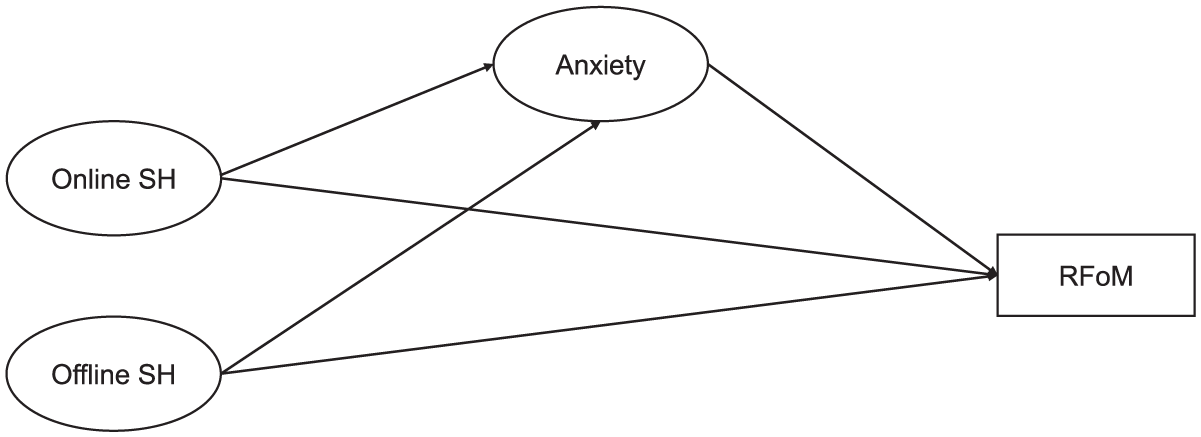
Hypothesized SEM model linking online SH, offline SH, anxiety, and RFoM.
Results
Preliminary Analyses
Descriptive statistics, normality tests, and CFA were conducted to ensure the data’s suitability for analysis. Descriptive statistics included mean scores, standard deviations, and correlations among variables (see Table 1). To investigate descriptive statistics such as means, standard deviations, and zero-order correlations, composite scores were created. Reliability assessments using Cronbach’s alpha indicated satisfactory internal consistency across all constructs (offline SH = .77, online SH = .83, anxiety = .76, and RFoM = .80).
Means, Standard Deviations, and t-tests for Gender Differences Between Study Variables.
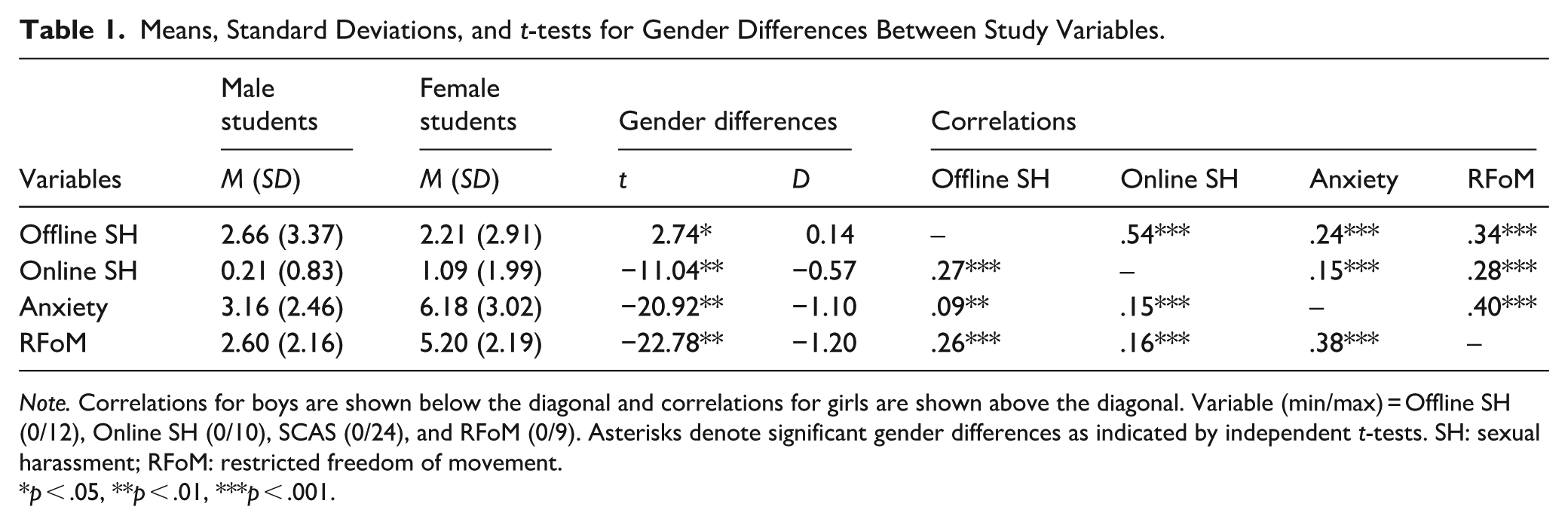
Note. Correlations for boys are shown below the diagonal and correlations for girls are shown above the diagonal. Variable (min/max) = Offline SH (0/12), Online SH (0/10), SCAS (0/24), and RFoM (0/9). Asterisks denote significant gender differences as indicated by independent t-tests. SH: sexual harassment; RFoM: restricted freedom of movement.
p < .05, **p < .01, ***p < .001.
The skewness and kurtosis values for several items within the study exceeded the predefined acceptable threshold (≤ |2.0|), indicating deviations from normality. To address these, the weighted least squares mean and variance adjusted estimator was utilized in the confirmatory and structural equation models, thereby accommodating non-normal distributions and improving analysis robustness.
The CFA was conducted because the study included three latent variables: PSH offline, PSH online, and anxiety. The model (see Figure 2) demonstrated acceptable fit: χ2(62, N = 1,488) = 410.43, p < .001, CFI = 0.96, RMSEA = 0.06, 90% CI [0.06, 0.070], SRMR = 0.07. All factor loadings were significant at p < .05, supporting construct validity.
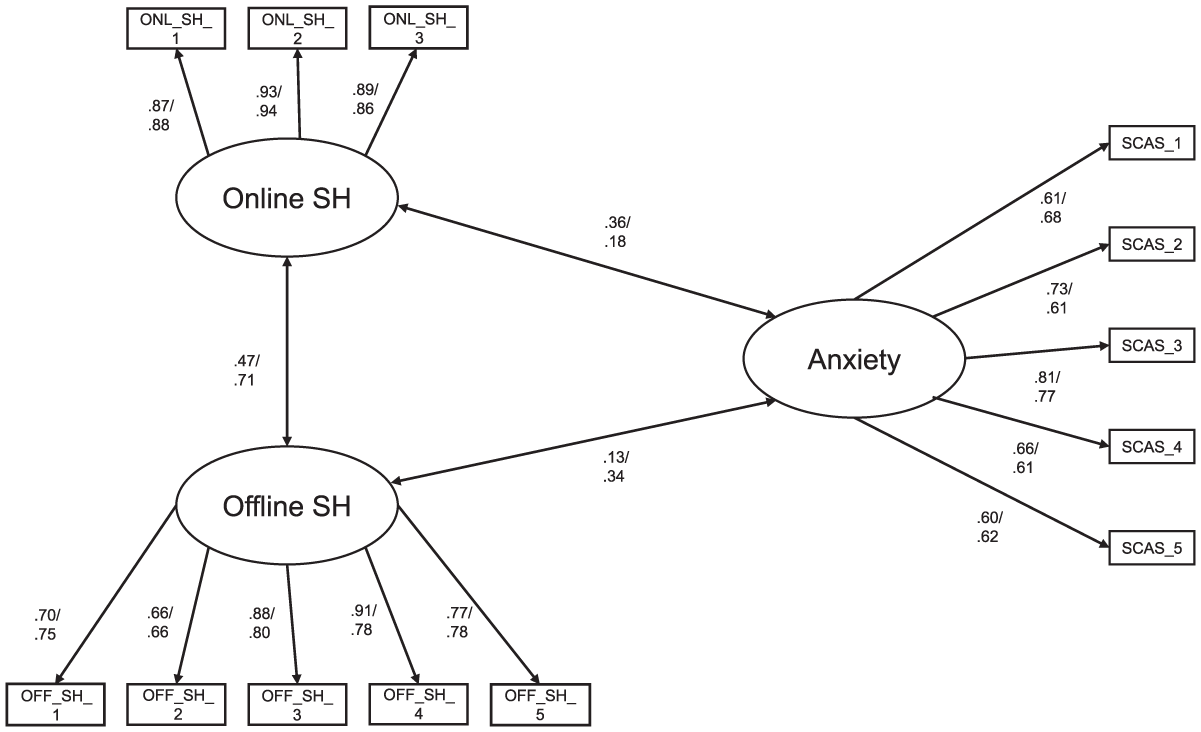
Confirmatory factor analysis (CFA) measurement model for online sexual harassment (SH), offline SH, and anxiety. Rectangles represent observed indicators and ovals represent latent variables. Values shown are standardized factor loadings.
Measurement invariance testing was conducted to evaluate whether the constructs were comparable across gender groups (Table 2). Using ordinal indicators, we specified a series of increasingly restrictive models: a baseline configural model (no constraints), a thresholds‑equal model, and a thresholds‑and‑loadings‑equal model (Svetina et al., 2020). Invariance was evaluated using Satorra–Bentler-scaled chi-square difference tests. The chi-square difference between the configural and thresholds‑equal model was nonsignificant, supporting threshold invariance. Constraining loadings significantly worsened model fit but freeing the residual covariance for the item “called you homo, fag, dike or similar” – as suggested by modification indices – resulted in a nonsignificant chi-square difference, supporting partial invariance sufficient for group comparisons (Byrne et al., 1989). All model fit statistics, degrees of freedom, and chi-square difference test results are reported in Table 2.
Model Comparison of Factorial Invariance Across Gender for Measurement Model.
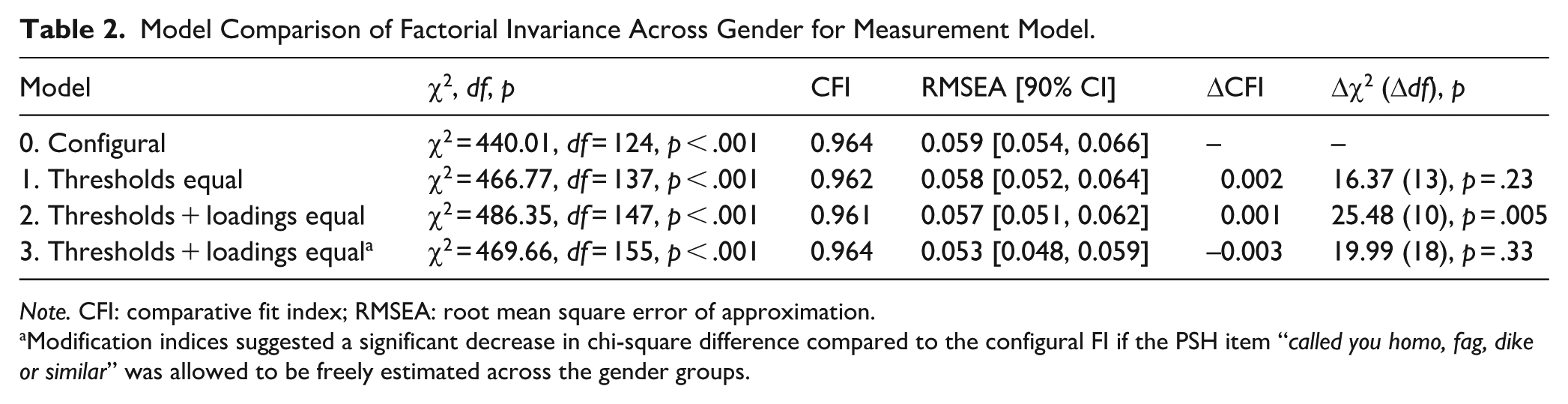
Note. CFI: comparative fit index; RMSEA: root mean square error of approximation.
Modification indices suggested a significant decrease in chi-square difference compared to the configural FI if the PSH item “called you homo, fag, dike or similar” was allowed to be freely estimated across the gender groups.
Evaluation of Hypotheses
Our hypotheses were as follows: (H1) we expected significant associations between SH victimization experiences, greater anxiety, and increased RFoM behaviors for both girls and boys, but refrained from specifying the strength of these associations due to the limited number of studies examining both offline and online SH contexts; (H2) we hypothesized that girls would report more anxiety and RFoM behaviors than boys, although we made no specific predictions regarding the extent of SH victimization given inconclusive prior findings; and (H3) we anticipated both direct and indirect effects of SH victimization on RFoM through anxiety, with unique effects for offline (H3a) and online SH victimization (H3b).
Table 1 highlights descriptive statistics and bivariate correlations. In line with the first hypothesis, there were significant bivariate associations between all study variables, for both girls and boys. For boys, offline SH correlated with anxiety at r = .09 and online SH at r = .15, and anxiety showed a moderate association with RFoM (r = .38). For girls, offline SH correlated with anxiety at r = .24 and online SH at r = .15, and anxiety was moderately associated with RFoM (r = .40). Girls reported higher anxiety and more RFoM behaviors, thus supporting the second hypothesis. Boys reported more offline SH victimization compared to girls, but girls reported more online SH victimization. These gender differences were large in magnitude for both anxiety (d = 1.10) and RFoM (d = 1.20). Gender differences in SH victimization were smaller, with boys reporting slightly more offline SH (d = 0.14) and girls reporting moderately higher online SH (d = 0.57).
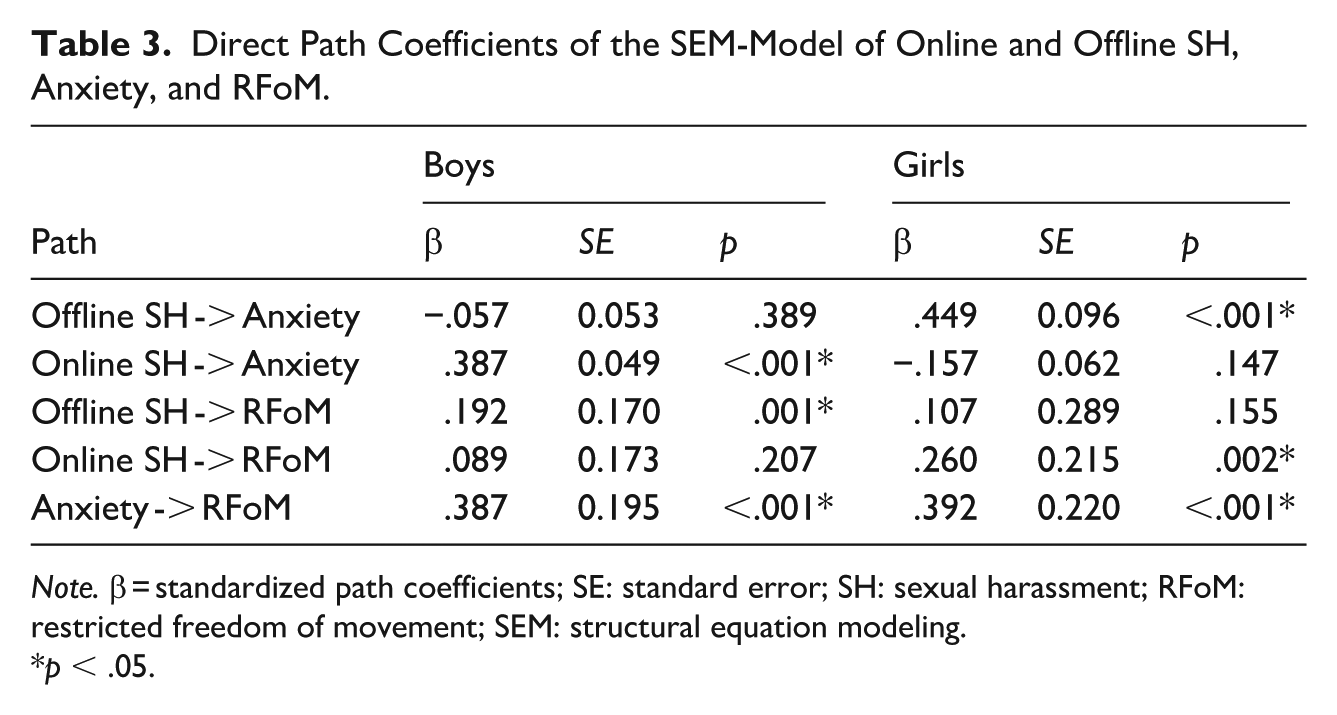
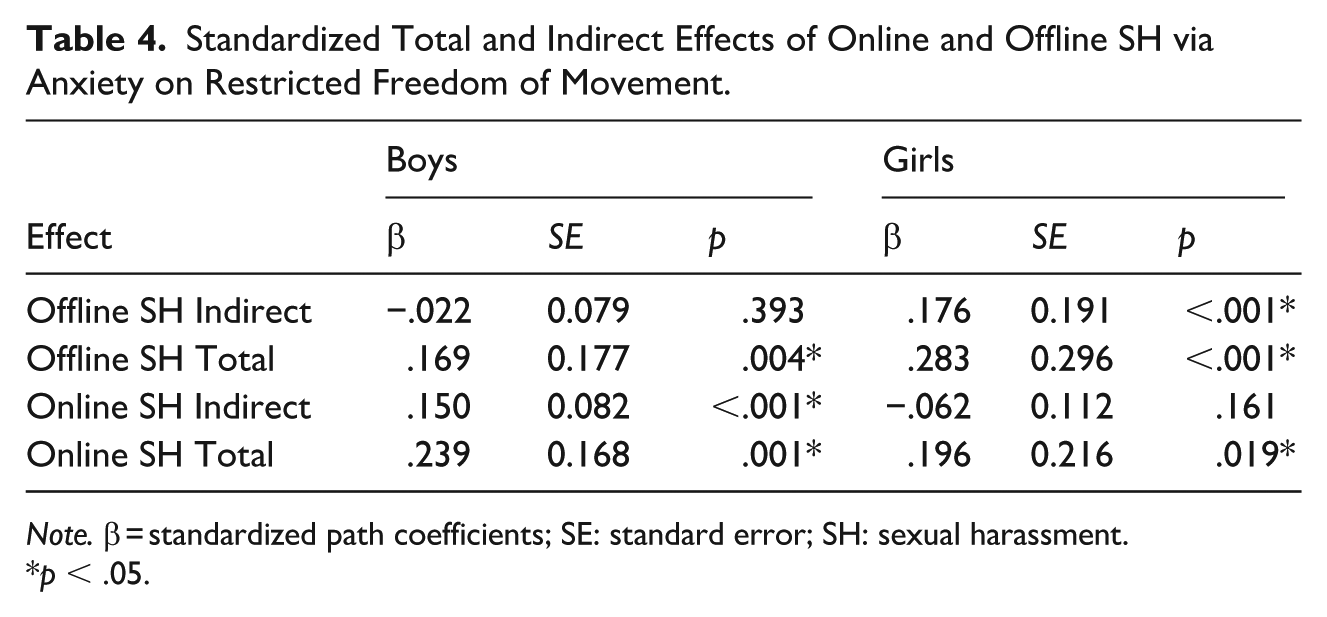
To further examine the hypothesized associations between SH victimization in both contexts simultaneously, anxiety, and RFoM behaviors, a moderated mediation structural equation model was specified, with school year grade included as a continuous covariate predicting all endogenous variables. The model showed acceptable fit to the data, χ2(191, N = 1,463) = 596, p < .001, RMSEA = 0.054, CFI = 0.956, SRMR = 0.067. Direct path coefficients as well as standardized (β) total and indirect effects are reported in Tables 3 and 4, respectively.
Direct Path Coefficients of the SEM-Model of Online and Offline SH, Anxiety, and RFoM.
Note. β = standardized path coefficients; SE: standard error; SH: sexual harassment; RFoM: restricted freedom of movement; SEM: structural equation modeling.
p < .05.
Standardized Total and Indirect Effects of Online and Offline SH via Anxiety on Restricted Freedom of Movement.
Note. β = standardized path coefficients; SE: standard error; SH: sexual harassment.
p < .05.
The moderated mediation model, evaluating the third hypothesis (H3) regarding the direct and indirect associations of SH on RFoM through anxiety, revealed distinct gender patterns for offline and online SH. Consistent with H3, offline SH was directly associated with increased anxiety among girls (β = .449), indicating a medium-sized effect, whereas this path was nonsignificant for boys (β = −0.057). A Wald test confirmed that this gender difference was significant (p < .001). In contrast, online SH was significantly associated with anxiety for boys (β = .387) but not for girls (β = −.157), and this gender difference was also significant (p < .001). Anxiety, in turn, was significantly associated with RFoM for both boys (β = .387) and girls (β = .392), both reflecting medium-sized effects. This path did not significantly differ by gender (p = .291). Offline SH was directly associated with RFoM for boys (β = .192), representing a small effect, but was nonsignificant for girls (β = .107), and this gender difference was nonsignificant (p = .604). In contrast, online SH showed a strong direct association with RFoM for girls (β = .260) but was nonsignificant for boys ( = .089), and the gender difference was nonsignificant (p = .007).
Tests of indirect effects revealed that offline SH had a significant indirect effect on RFoM through anxiety for girls (β = .176), reflecting a medium effect and partially supporting H3a. For boys, no significant indirect effect of offline SH on RFoM through anxiety emerged, though the total effect of offline SH on RFoM was significant (β = .169), reflecting a small effect that was driven by the direct pathway rather than mediation through anxiety. For online SH, an indirect effect via anxiety emerged for boys (β = .150, a small effect), consistent with H3b, whereas for girls the indirect path was nonsignificant (β = −.062). However, girls showed a significant total effect of online SH on RFoM (β = .198), primarily reflecting the direct association.
In summary, the findings provided partial support for our hypotheses. H1 was supported, as all study variables were significantly correlated for both boys and girls. H2 was also supported, with girls reporting higher anxiety and more RFoM behaviors than boys, while boys experienced more offline SH and girls more online SH. H3 received mixed support: offline SH predicted girls’ RFoM indirectly via anxiety (H3a), and online SH predicted boys’ RFoM indirectly via anxiety (H3b). For the other gender–context combinations, the associations with RFoM were primarily direct, with offline SH predicting boys’ RFoM and online SH predicting girls’ RFoM independent of anxiety.
Discussion
Although SH victimization is a common and debilitating issue among youth, little is known about its association with behavioral outcomes, or the processes that may explain the link between SH victimization and behavioral outcomes. The present study extends the current literature by focusing on a potential behavioral consequence of SH victimization: restricting behavioral strategies to stay safe in everyday life. Although the cross-sectional nature of the data precludes inferences of the direction of effects, the proposed model was informed by theory and previous research about the potential associations between SH victimization, emotional distress, and fear of violence. In line with our hypotheses, we observed significant associations between SH victimization and adolescents’ RFoM behaviors, both direct and indirectly through anxiety. Specifically, offline SH predicted RFoM via anxiety for girls, whereas online SH predicted RFoM via anxiety for boys, highlighting that both the context of harassment and the adolescent’s gender matter in predicting these interrelations. Beyond these indirect effects, we also observed direct associations: offline SH was linked to boys’ RFoM, and online SH was strongly linked to girls’ RFoM, independent of anxiety. The main findings of the present study will be discussed next.
Prevalence rates showed that whereas SH victimization was more common among boys in the school context, it was more common among girls in the online context (see Table 1). When considering direct effects, offline SH was directly linked to RFoM among boys only, and online SH was directly linked to RFoM among girls only, independent of anxiety. No significant direct effects emerged for the opposite gender–context combinations. However, the proposed mediation linking SH victimization to RFoM behaviors via anxiety was only supported when gendered prevalence rates suggested that SH victimization was less common (i.e., in school for girls and online for boys). Although this finding is somewhat puzzling, normalization processes surrounding sexually harassing behaviors could potentially help explain these results patterns. Experiencing SH that is less frequently occurring among same gender peers may contribute to a sense of being singled out, which may elevate anxiety and personal safety concerns. Although we did not separate between different forms of SH in this study (e.g., verbal or physical), previous studies suggest that boys are more often subjected to homophobic name-calling, whereas girls may be subjected to a wider range of SH behaviors (Brown et al., 2023). While homophobic name-calling in the school setting has many adverse effects and is highly problematic (Collier et al., 2013), it can be part of a normalized mocking culture among boys in school aiming to maintain masculinity norms. Adolescent boys themselves may view homophobic name-calling as acts of “fighting for fun” (Odenbring & Johansson, 2021), which may explain why SH in school was not as strongly linked to anxiety for boys. In line with objectification theory, and for girls, SH by peers in school may evoke a heightened sense of physical threat rooted in girls’ higher vulnerability in physical spaces. These gendered patterns reflect not only individual experiences but broader power relations: while SH reinforces girls’ social vulnerability, boys often face harassment that polices masculinity. Such dynamics likely contribute to why similar behaviors carry different emotional and behavioral consequences across genders. Notably, while offline SH was directly associated with anxiety for girls, its direct association with safety behaviors were negative, suggesting that girls experiencing more offline SH did not necessarily report more safety behaviors in the absence of anxiety. Instead, the link between offline SH and RFoM among girls primarily operated through its impact on anxiety, consistent with a mediation process.
For adolescent boys, however, the dynamic appears different, with anxiety primarily being linked to online rather than offline SH victimization. Although it should be noted that the mean level of exposure to online SH was low for adolescent boys, the present study shows that for those boys who are subjected to unwanted sexual attention in the online sphere, there is a small but indirect significant link to RFoM behaviors via anxiety. Due to the public attention directed toward adolescent girls’ exposure to unwanted online sexual interactions (e.g., discussions about unwanted dick-pics) and sexual norms about female and male sexuality which view men as sexual initiators/aggressors, there may be an assumption that adolescent boys cannot be sexually violated online (or elsewhere; Odenbring & Johansson, 2021). Thus, boys who are subjected to online SH may believe that no one shares their experiences. Previous research shows that adolescent boys who have been subjected to SH in school are less likely than girls to disclose their victimization (Lunde et al., 2025), and it is possible that SH in the online sphere is even more taboo for victimized boys as these experiences are not talked about. It should also be noted that although girls reported having experienced SH victimization to a greater extent than boys, it is possible that online SH is qualitatively different for boys than girls. For example, a meta-analysis showed that being subjected to online sexual solicitation (referring to offering money or objects in exchange for sex) was more commonly experienced by adolescent males than adolescent females (Madigan et al., 2018). Thus, it is possible that the findings observed in this study may reflect that boys’ unwanted online sexual interactions may, potentially, be more intrusive and anxiety-provoking. Adolescent girls testify of a widespread normalization of unwanted sexual interactions in the online sphere, and while these may indeed be intimidating and fear-provoking, they may also have become a normalized part of girls’ expectations of online interactions and many adolescent girls seem to have strategies to cope with online victimization (Lunde & Joleby, 2023). Future research efforts should be directed toward learning more about adolescent boys’ experiences of unwanted online sexual interactions and its consequences for their mental health and feelings of being safe.
Implications for Intervention and Prevention
Interventions on sexual harassment among youth have shown mixed results (de Lijster et al., 2019). For an intervention to be effective, the intervention should be targeting potentially effective working mechanisms that is substantially related sexually harassing behaviors. In this regard, interventions on SH are encouraged to employ strategies that target multiple components rather than isolated efforts in order to have a meaningful effect (de Lijster et al., 2019). That is, interventions should target both individual and interpersonal skill-building, including awareness of harassment, stating personal boundaries, coping with peer pressure, and strengthening social self-efficacy (de Lijster et al., 2019). However, findings from interventions on a separate but related type of victimization, dating violence among youth, also suggest that shifting school culture and norms surrounding dating is important to create safer environments (De La Rue et al., 2014). Similarly, research from other contexts demonstrates the importance of broader social climates: findings from Gutworth and Howard (2019) underscore that individual and interpersonal skill-building alone is insufficient unless embedded within a broader climate that visibly discourages harassment in the work environment.
The findings from the present study inform this literature in several ways. First, RFoM behaviors can be understood not only as a strategy to increase perceived safety but also as a secondary harm of sexual harassment, limiting adolescents’ autonomy even in the absence of immediate threat. This suggests that intervention studies should broaden their outcome frameworks to include behavioral constraints such as RFoM, which may capture downstream costs of victimization that extend beyond immediate psychological symptoms. Second, our results highlight that the mechanisms linking SH to RFoM differ depending on whether the harassment occurs online or offline, with mediated pathways emerging only when the SH context is less normative for that gender. Interventions may therefore benefit from incorporating context-specific components, acknowledging that victimization outcomes may manifest differently across online and offline environments. Finally, because associations differed for boys and girls, interventions should be attentive to how gender shapes both the experience and consequences of SH, without assuming that harm is uniform across groups. Together, these insights underscore the value of context-sensitive interventions aimed at reducing SH.
Limitations
Although the rationale for and hypotheses of this study were based on theory and previous research, reverse directions of effects are also a possibility: that is, it is possible that adolescents who are more anxious are more likely targets of SH victimization. Within the neighboring field of school bullying, it has been recognized that children and adolescents who are victimized by peers in school may be targeted due to a heightened vulnerability (Vaillancourt et al., 2013), and although much less is known about vulnerability factors for SH victimization, it is possible that anxiety precedes victimization (Skoog & Kapetanovic, 2023). Likewise, sexual perpetrators may actively identify and target children or adolescents online who are more vulnerable (Joleby et al., 2021). There may also be reciprocal effects between anxiety and victimization, with either anxiety or victimization exacerbating the other. These more complex interrelations were not addressed in the present study due to its reliance on cross-sectional data, but future studies may want to disentangle reverse or more complex direction of effects by using longitudinal data comprising at least three waves of measurement with regard to key constructs. This would help identify if the associations between SH and behavioral outcomes are victimization- or symptom-driven, or both. That having said, this is the first study to explore the associations between SH victimization in different contexts and its links to adolescents’ anxiety and precautionary behaviors to stay safe.
Additional limitations include that the items used to measure the two SH contexts were similar but not identical, and they came from two different measures intended to measure slightly different constructs, unwanted sexual attention online (Gámez-Guadix et al., 2015) and peer SH in the school context (Valik et al., 2023). It is therefore questionable whether the differences observed in our analyses are driven purely by the differences in the context in which SH victimization occurred, or a difference in the nature of the questions. Importantly, the questions about online SH specifically asked for situations that made the participant “feel bad,” whereas the questions about offline SH victimization were instead framed as situations that “happened against your will or made you feel bad,” and thus the wording is similar but not identical. It should also be noted that the study by Calogero et al. (2001) used a more specific measure of anxiety, personal safety anxiety, when they evaluated the links between sexually objectifying experiences and RFoM behaviors among adult men and women. Using the same measure would have allowed for more meaningful comparison between their study and the present one.
Conclusion
The current study contributes to the literature by highlighting that SH victimization, regardless of the context in which it occurs, is associated with adolescents’ self-imposed restricting behavioral strategies. It further highlights that anxiety may play a significant role in these associations, and that there seems to exist gender differences in the associations. Based on evidence from the current study, we propose that SH is associated with negative outcomes, both psychological and behavioral, for both adolescent boys and girls. Being a victim of offline SH was associated with restricting freedom of movement behaviors for both genders; for boys, this link was primarily direct, whereas for girls it was explained indirectly through anxiety. While being a victim of online SH was directly associated with RFoM behavior for girls only, it was indirectly associated with RFoM behaviors for boys through anxiety. We argue that this complex pattern of associations could be explained by both context specific characteristics (e.g., prevalence patterns and processes of normalization) and gender differences in the nature of SH victimization facing adolescent girls and boys in the offline versus online context. It is critical to recognize that while adolescent girls do indeed experience greater restrictions on their freedom of movement than boys, gendered expectations of the typical victim of SH (e.g., being female) may put adolescent boys’ experiences in the shadows. Overall, this study shows that SH victimization can undermine both girls’ and boys’ sense of safety in everyday life.
Footnotes

Ethical Considerations
This study was conducted in accordance with APA ethical standards. Ethical approval was obtained from the Swedish Ethical Review Authority (Case No. 2022-04023-01).
Consent to Participate
Informed consent was obtained from all participants and their legal guardians.
Funding
The authors disclosed receipt of the following financial support for the research and/or authorship of this article: This work was supported by Forskningsrådet om Hälsa, Arbetsliv och Välfärd (Forte) under grant number 2021-00480.
Declaration of Conflicting Interests
The authors declared no potential conflicts of interests with respect to the authorship and/or publication of this article.
Data Availability Statement
The data that support the findings of this study are available on request from the corresponding author. The data are not publicly available due to ethical restrictions.*