




Abstract
Although there are approaches (e.g., psychological measures) to capture how people encounter online racism experiences, there is limited work on how the actual impact of online racism is felt or deemed relevant. Notably, in assessing the impact of online racism on negative mental health, it may be important to account for the degree to which people find their racist online interactions and exposure to racist online content stressful. Using data from 958 racially/ethnically minoritized adults (Mage = 27.41), we conducted moderation analyses to examine if the association between online racism and mental health was moderated by stress appraisals of racist online interactions and exposure to racist online content. Online racism was significantly associated with worse mental health. Both stress appraisals of racist online interactions and exposure to racist online content were significant moderators. Negative mental health associated with online racism was exacerbated among those who appraised their exposure to online racism as more stressful. When the stressfulness was appraised to be low, the association between online racism and negative mental health was not significant. These findings inform future research focused on mechanisms that could differentiate why certain individuals are more at risk of being impacted by online racism experiences.
Keywords
Clinical Impact Statement
Our findings show that those who appraise online racism encounters to be more stressful report worse mental health. Hence, even if a person rarely encounters online racism, if they appraise these rare occurrences to be highly stressful, this may be associated with poor mental health. Future studies need to examine various intrapersonal, interpersonal, and social media platform-dependent factors that can distinguish how a racially and ethnically minoritized person evaluates and interacts with racist experiences and content online, which can, in turn, affect their mental health differentially. The results signify the importance of understanding the stress appraisal process concerning online racism experiences.
Introduction
Online racism has received increasing attention as a digital inequity with significant behavioral health repercussions for racially/ethnically 1 minoritized individuals (Keum & Miller, 2018; Volpe et al., 2021). Keum and Miller (2017) defined that racially minoritized individuals encounter online racism across multiple avenues, including direct racist interactions, vicarious exposure to racist interactions against other racially minoritized people on the Internet (including content depicting traumatic racial violence, such as hate crime videos), and content that highlights systemic realities of racial inequities (e.g., news about institutional discrimination). These encounters frequently occur within social media platforms (e.g., X, TikTok, and Instagram), online news comment sections, dating apps, and competitive gaming environments, where the speed of content sharing often outpaces moderation (Keum & Miller, 2018). The frequency of these experiences is alarmingly high. For example, racially/ethnically minoritized individuals are more than twice as likely to report being harassed specifically due to their identity compared to the general population (Pew Research Center, 2024).
While individuals often attempt to avoid or minimize exposure by employing strategies such as blocking specific users, filtering keywords, or self-silencing in public forums, complete avoidance is often impossible due to the algorithmic nature of digital platforms that push “viral” traumatic content into user feeds regardless of preference (Keum & Miller, 2018). Furthermore, because social media participation is often a professional or social necessity, racially/ethnically minoritized individuals may be forced into exposure, where the benefits of staying connected are constantly weighed against the risk of encountering racist interactions and content (Keum & Miller, 2018). Consequently, online racism is related to many negative mental health outcomes, including anxiety and depressive symptoms (Tynes et al., 2008), problematic substance use (Keum & Cano, 2023), psychological distress (Cano et al., 2021), racism-related hypervigilance (Keum & Li, 2023), racial trauma symptoms (Maxie-Moreman & Tynes, 2022; Volpe et al., 2021), and suicidal ideation (Keum, 2023).
Prior research has largely focused on the frequency and type of online racism, establishing a clear link between exposure and distress (Keum, 2023; Tynes et al., 2008). However, this focus on exposure alone limits understanding of why two individuals might encounter the same racist content yet experience different psychosocial outcomes. Although there are psychological measures (e.g., Perceived Online Racism Scale, Online Victimization Scale; Keum & Miller, 2017; Tynes et al., 2010) developed to assess how people encounter online racism experiences, there is limited work on how the actual impact of these experiences is felt or deemed relevant. The online world is vast, and the differences in the context of online racism experiences, as well as the distinct identities, positions, and backgrounds of individuals encountering them, may all vary the perceived stressfulness. Notably, those who appraise their racist online interactions or exposure to racist content (e.g., photos, videos, memes, blogs, and articles) as more stressful may report worse mental health associated with the harms of online racism compared to those who appraise them as not as stressful. To bridge this gap, it is important to explore the cognitive-evaluative processes—specifically stress appraisal—that may provide context on the link between online racism and mental health outcomes. Understanding this context is essential for developing targeted interventions that address not just the occurrence of online racism, but also the specific ways individuals internalize and are harmed by it.
To advance a more nuanced understanding of how the impact of online racism, as a contemporary digitally-relevant chronic stressor, could be differentiated among those encountering them, we focus on the stress appraisal process. Given that online racism clearly functions as a stressor (Volpe et al., 2024, 2025), researchers have applied stress and coping frameworks to understand how individuals appraise and respond to these experiences. A central framework is Lazarus and Folkman’s (1984) transactional model of stress and coping, which has been used as a theoretical lens in racism-related research since the 1990s. Stress appraisal in the current study’s context refers to how individuals perceive and evaluate racist encounters online as stressors. According to Lazarus and Folkman’s (1984) transactional model, a person makes a primary appraisal (assessing if the encountered event is a threat, harm/loss, or challenge) and a secondary appraisal (evaluating coping options and resources) in response to a potential stressor.
Primary appraisal often acts as the first line of the stress response; if an event is not appraised as personally threatening or harmful, the stress response is not activated (Lazarus & Folkman, 1984). In the context of general racism, studies have shown that individuals who perceive racist incidents as highly threatening (primary appraisal) often experience immediate physiological arousal and acute distress (Sellers et al., 2003). Secondary appraisal, conversely, involves the internal assessment of “What can I do about this?” Research indicates that when individuals feel they have the resources or community support to challenge a racist encounter (high secondary appraisal), the negative impact on their well-being is often buffered (Wei et al., 2012).
Preliminary literature suggests that the online environment complicates these appraisals. For instance, the anonymity of perpetrators can lead to primary appraisals of highly ambiguous threat (Keum & Miller, 2018), while the lack of immediate social support in online spaces can diminish an individual’s secondary appraisal of their ability to cope (Tynes et al., 2008). Given the anonymous setting, during primary appraisal, when someone encounters online racism, one factor that likely drives the evaluation and appraisal may be personal relevance (e.g., “Is this event harmful or threatening to me?”). They may be more likely to consider that content or interaction more stressful if they usually experience frequent personally relevant content or interactions online, such as personal attacks (e.g., receiving a racist comment or messages directly), other online content that they identify with due to shared background (e.g., vicariously seeing content directed at one’s racial group), or even racist interactions or content from perpetrators they may personally know or follow (Keum & Miller, 2018). Alternatively, someone might appraise the content or interaction as ignorance on the part of the poster(s), thinking it is not worth the personal concern, or be desensitized from seeing such events pervasively on the Internet. Overall, people may be differentiated in how they appraise online racist events to be relevant and thus harmful (Keum & Miller, 2018).
Our review suggests that stress appraisal is an important factor to consider in better understanding the impact of online racism on racially minoritized individuals’ mental health. Examining the role of stress appraisal is imperative as it informs future research to focus on mechanisms that could differentiate why certain individuals are more at risk of being impacted by online racism experiences and identify coping and protective resources that could help them mitigate the harm. Thus, we aimed to examine how stress appraisal would moderate the link between online racism and negative mental health. Below are our hypotheses:
Methods
Participants
We used a subset of data from an IRB-approved study on online racism (Keum & Miller, 2017). There were no missing data in the subset data. A non-probability sample of 958 participants (Mage = 27.41, SD = 9.76) provided data through an online Qualtrics survey. About 33% identified as Asian, 32% identified as Black, 17% as Hispanic/Latino/a/x, 12% as Multiracial, 2% Native American or Alaskan Native, 2% Middle Eastern, 1% Native Hawaiian or Pacific Islander, and 1% Other. About 59% identified as women and 39% as men, and 2% other. About 85% identified as Heterosexual, 6% Bisexual, 2% Gay, 2% Uncertain or Questioning, 2% Lesbian, 1% Asexual, 1% Queer, and 1% Other. About 46% identified as middle class, 31% as working class, 14% as upper-middle class, 8% as lower class, and 1% as upper class.
Measures
Online Racism
The 15-item Perceived Online Racism Scale-Short Form (PORS-SF) was used to assess people’s reports of racist online interactions and encounters with racist online content and information (Keum, 2021). The PORS-SF is a shortened version of the original 30-item PORS and retains the same three-factor structure with construct validity evidence. The three subscales are Personal Experience of Racial Cyber-Aggression subscale (five items; “I have received posts with racist comments”), Vicarious Exposure to Racial Cyber-Aggression subscale (five items; “I have seen other racial/minority users being treated like a second-class citizen”), and Online-Mediated Exposure to Racist Reality subscale (five items; “I have been informed about a viral/trending racist event happening elsewhere [e.g., in a different location]”). Participants rate each item on a 5-point Likert-type scale ranging from 1 (never) to 5 (all the time). As we are interested in assessing the collective online racism experience, we used the total scale score with higher scores indicating more frequent online racism experiences. Cronbach’s alpha for the current sample was .88.
Negative Mental Health
Participants’ mental health was measured using the Mental Health Inventory-5 (MHI-5; Veit & Ware, 1983). The MHI-5 contains five items with higher scores indicating higher levels of psychological well-being and lower scores indicating poorer mental health. For the current study, we reverse scored the items so that higher scores indicate worse mental health. Participants report on the frequency of feelings related to mental health over the last month (e.g., “Have you felt downhearted and blue?”). Responses are rated on a 6-point scale ranging from 1 (all of the time) to 6 (none of the time). The responses are summed and range from 5 to 30. MHI-5 has been linked with stressful life events and decreased social support and life satisfaction. Reliability coefficients for racially diverse populations have ranged upward of 0.84 (Fischer & Holz, 2010). Cronbach’s alpha for the current sample was .85.
Stress Appraisal
Two items were developed to assess the degree to which people find their racist online interactions and exposure to racist online content stressful. The items were “In general, how stressful are your experiences of racism in online interactions?”, “In general, how stressful is it for you when you encounter racist online content (e.g., trending videos, photos, memes, blogs, articles, etc.).” Responses are rated on a 5-point scale ranging from 0 (Not at all stressful) to 4 (Extremely stressful). Higher scores indicated greater appraisal of stress.
Procedure
Participants were recruited on Amazon’s Mechanical Turk (MTurk), targeting racially/ethnically minoritized individuals. MTurk because it allows researchers to conduct targeted recruitment for underrepresented populations (Huff & Tingley, 2015). Studies have shown that MTurk allows researchers to collect large amounts of data efficiently from a diverse sample of the population with comparable data reliability and quality compared to traditional methods (Buhrmester et al., 2016). The research was advertised as an examination of online experiences related to race and ethnicity. Eligible participants were (1) adults (18+), (2) who self-identified as racial or ethnic minority, and (3) who resided in the United States. The Qualtrics survey included measures for study variables, demographic questions, and two attention check items (e.g., “Please choose always”). The survey took approximately 15 to 20 min to complete. Before participating, all individuals provided informed consent. As an incentive, participants were offered the opportunity to enter a drawing for a $50 Amazon gift card upon completion of the survey. Data was subject to validity evaluation by (1) employing Qualtrics bot detection metrics (ballot box stuffing), (2) checking the responses to attention check items, (3) checking the IP address, (4) manually evaluating the data for non-credible responses such as “straightlining,” inconsistent responses, and unrealistically brief survey completion times. Responses that failed the bot detection metrics, attention check items, had non-U.S. IP addresses, and were judged to be non-credible were removed from the data. A total of 583 cases were removed as a result of validity evaluation.
Data Analysis
Descriptive statistics and bivariate correlations were first assessed for the study variables. The PROCESS Procedure for SPSS version 4.1 (Hayes, 2018) was used to analyze the data. To conduct the moderation analyses, Model 1 in the PROCESS macro version 4.1 for SPSS was used with bias-corrected bootstrapping (10,000 resamples). We ran a total of two models, with the first model examining the moderating role of stress appraisal of racist online interactions and another model examining stress appraisal of exposure to racist online content/information. PROCESS produces results to evaluate the overall model as well as the main effect and the interaction with the moderator variable. For significant interaction effects, simple slopes were assessed and visualized at low (−1 SD from the mean), mean, and high (+1 SD from the mean) levels of the moderator.
Data Availability
Data is available upon reasonable request.
Results
Data Inspection and Preliminary Analysis
There was no missing data. Descriptive and bivariate correlations of the study variables are listed in Table 1. The VIF values ranged from 1.41 to 2.49 for all of the independent variables, suggesting no multicollinearity as the values were within the 1 to 10 range (George & Mallery, 2019). Additionally, all variables were considered to have a normal distribution as the kurtosis and skewness variables fell generally within the −2 and +2 range (George & Mallery, 2019). Thus, regression assumptions for linearity, normality, and little or no multicollinearity were satisfied.
Descriptive Statistics and Bivariate Correlations of Study Variables.
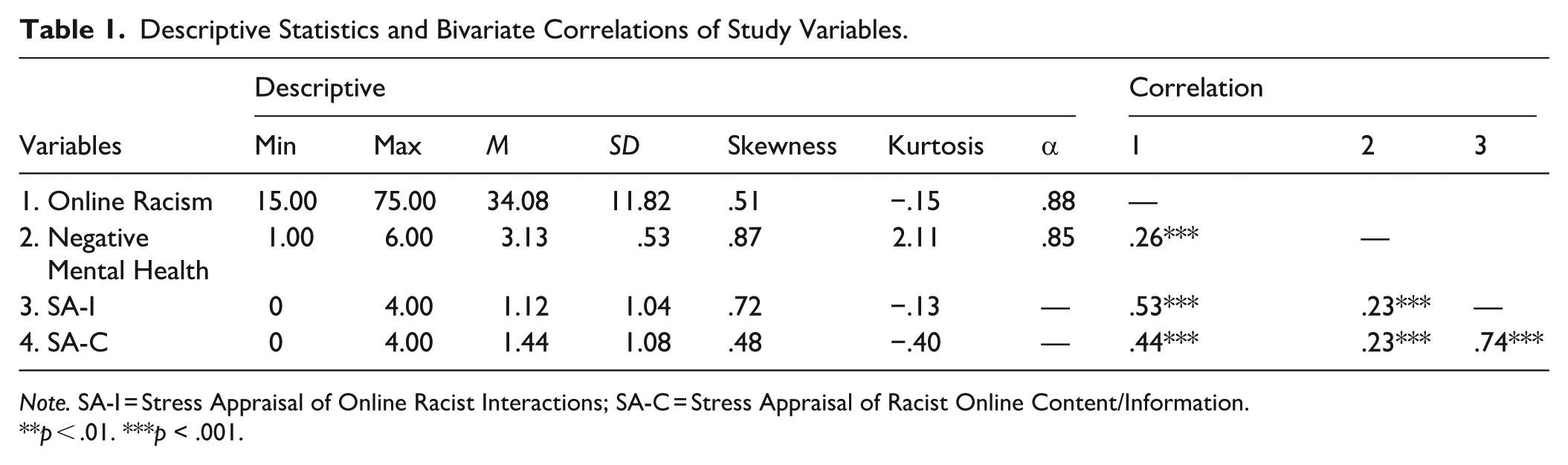
Note. SA-I = Stress Appraisal of Online Racist Interactions; SA-C = Stress Appraisal of Racist Online Content/Information.
p < .01. ***p < .001.
Online Racism and Negative Mental Health
To examine the main association between online racism and negative mental health, a linear regression analysis using ordinary least squares estimation was conducted. More frequent online racism was significantly associated with more negative mental health in support of hypothesis 1, B = 0.01, SE = 0.01, p < .001, R2 = .07.
Moderation Models
The online racism by stress appraisal of racist online interactions term was significant (B = 0.005, SE = 0.001, p < .001; Table 2). To examine the interpretation of the significant interaction, simple slopes at mean 1 SD above/below the mean levels of stress appraisal were assessed (Figure 1). Examining the 95% CI bands around the simple slopes, the relationship between online racism and negative mental health was not significant at −1 SD below the mean level of social support (B = 0.003, SE = 0.002, p = .124, CI [−0.001, 0.008]), but significant at the mean (B = 0.008, SE = 0.002, p < .001, CI [0.005, 0.011]) and +1 SD (B = 0.013, SE = 0.002, p < .001, CI [0.009, 0.017]) levels.
Moderated Regression Models Predicting Negative Mental Health With Stress Appraisal as Moderator.
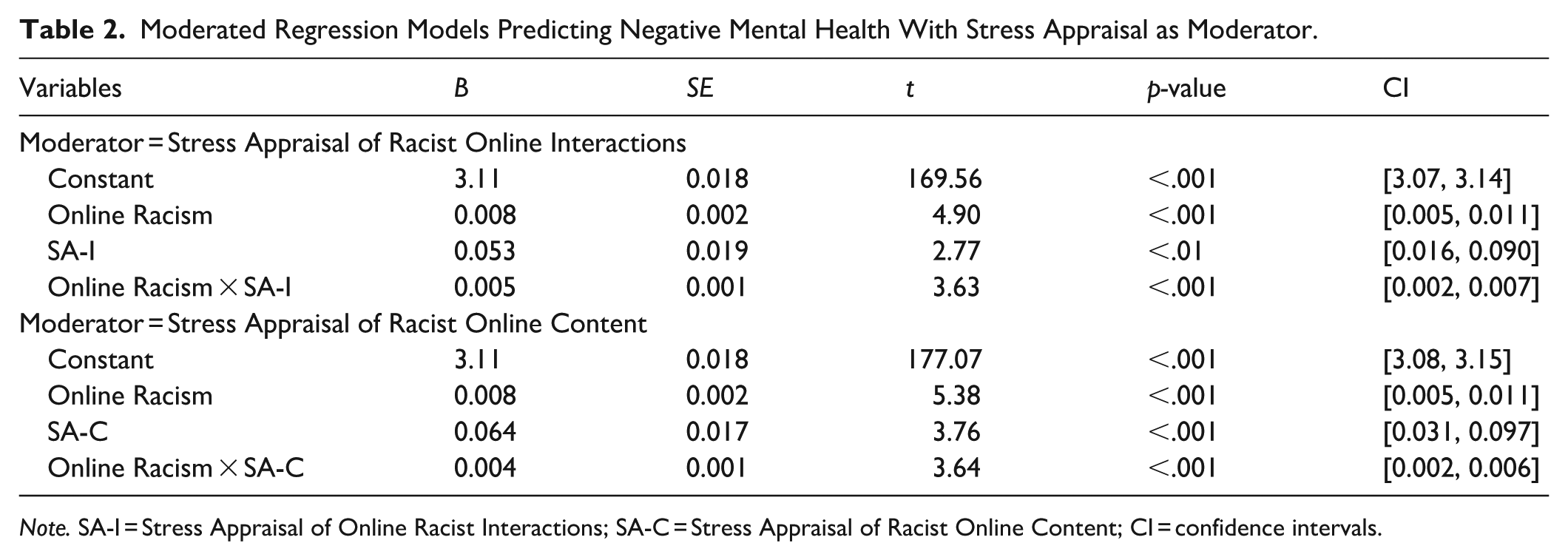
Note. SA-I = Stress Appraisal of Online Racist Interactions; SA-C = Stress Appraisal of Racist Online Content; CI = confidence intervals.
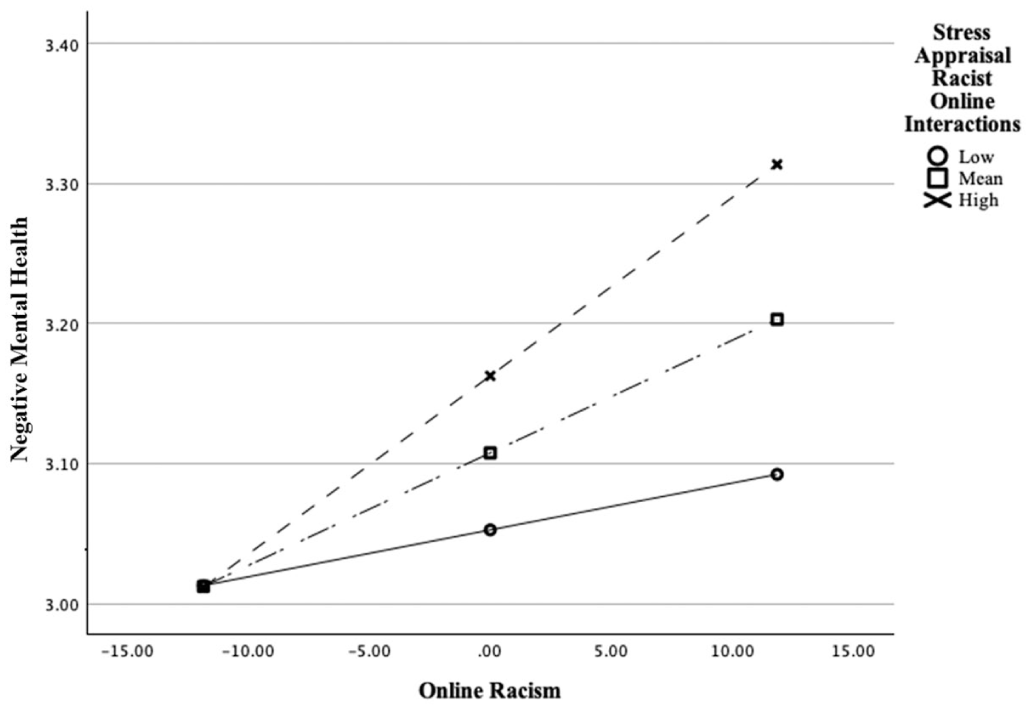
Stress appraisal of racist online interactions as a moderator in the link between online racism and negative mental health.
The online racism by stress appraisal of racist online content interaction term was significant (B = .004, SE = .001, p < .001; Table 2). To examine the interpretation of the significant interaction, simple slopes at mean 1 SD above/below the mean levels of stress appraisal were assessed (Figure 2). Examining the 95% CI bands around the simple slopes, the relationship between online racism and negative mental health was not significant at −1 SD below the mean level of social support (B = 0.004, SE = 0.002, p = .067, CI [−0.003, 0.008]), but significant at the mean (B = 0.008, SE = 0.002, p < .001, CI [0.005, 0.011]) and +1 SD (B = 0.013, SE = 0.002, p < .001, CI [0.009, 0.017]) levels. Overall, hypothesis 2 was supported for both stress appraisal of interactions and content as greater stress appraisal exacerbated the negative mental health associated with online racism.
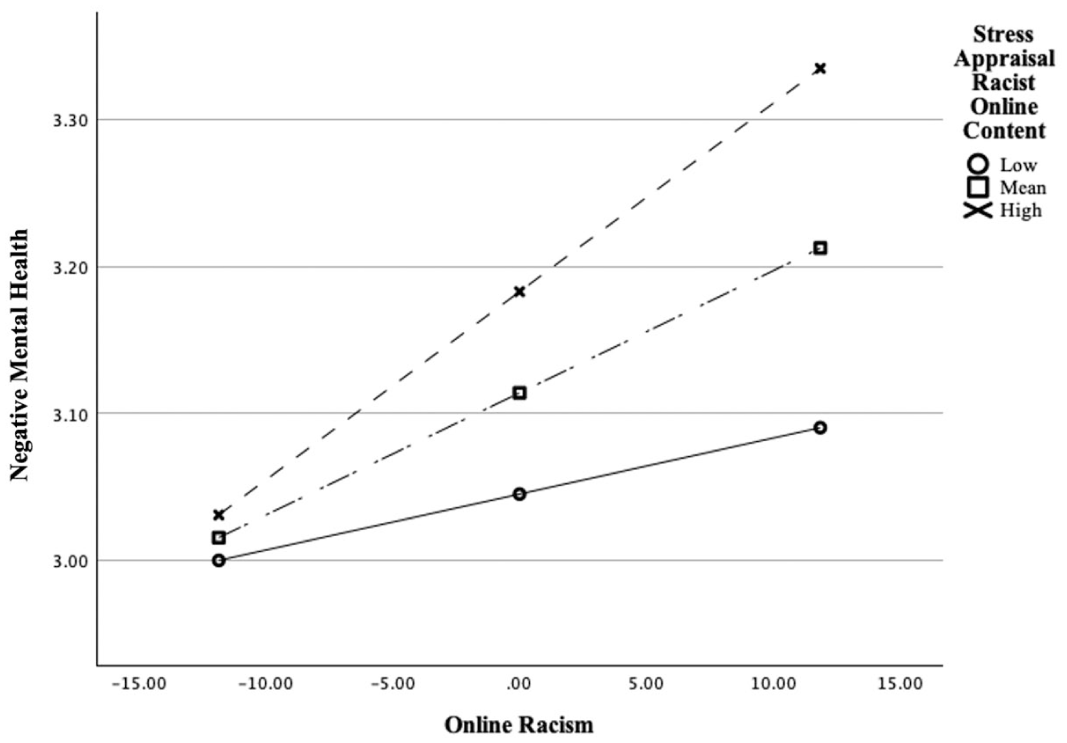
Stress appraisal of racist online content as a moderator in the link between online racism and negative mental health.
Discussion
The current study examined whether stress appraisal moderated the link between online racism and negative mental health. As hypothesized, we found that greater appraisal of racist online interactions and exposure to racist online content as stressful exacerbated the negative mental health associated with online racism. The appraisal of these events likely serves as an important determinant of online racism’s psychosocial impact; our findings reveal that at low levels of appraisal, the association between online racism and negative mental health becomes non-significant. This suggests that the frequency of exposure alone does not dictate psychosocial harm; rather, the subjective interpretation of that exposure as a threat may drive the relationship between online racism and mental health. The findings contribute to a better understanding of how online racism experiences may be evaluated for racially/ethnically minoritized individuals navigating an online landscape filled with a constellation of harmful interactions and content that can differentially impact a racially/ethnically minoritized individual. Substantively, this indicates that for some, online racism remains a distal annoyance, while for others, it manifests as a profound, personally relevant, psychosocial burden characterized by heightened distress, anxiety, and a sense of pervasive unsafety. The results point to the need to examine how stress is appraised and felt (e.g., what factors, whether at the interaction/content side or person side, make it more or less stressful) among racially/ethnically minoritized individuals when they encounter racist online interactions or are exposed to racist online content.
In line with research on offline racism, appraisal of the stressfulness of experiences of discrimination is impactful. Existing measures of offline racism, such as the Index of Race-Related Stress (Utsey & Ponterotto, 1996) and the Schedule of Racist Events (Landrine & Klonoff, 1996), acknowledge this impact by including subscales or response options that correspond to not only the frequency of a given event but also the degree of stressfulness or bother of that event. Research with such scales finds that the appraisal of the stressfulness of the racism experience is an important predictor of mental health impacts. For instance, studies have found that both more frequent and more stressful experiences of offline racism are associated with higher psychological distress, suicidal ideation, anxiety, depression, anger, and sleep disturbances (Bravo et al., 2021; Hwang & Goto, 2008). However, current measures of online racism do not regularly evaluate appraisals, but instead focus solely on the frequency of exposure to online racism as a stressor. Therefore, a key contribution of the current study is its extension of the research on associations between offline racism frequency and stress appraisals and mental health to the context of online racism.
In the current study, in addition to the main association between frequency of exposure to online racism and negative mental health and the interactive associations between frequency and appraisal variables on negative mental health, there was also a distinct significant main association between stress appraisals and negative mental health. In other words, the stressfulness of experiences of online racism, regardless of how frequently they may occur, may be associated with worse mental health. This finding aligns with previous research findings that less frequent but highly-personal and emotionally-salient “worst experiences” of racism are less often considered in existing quantitative measures of stress from offline racism (Volpe et al., 2021). It suggests a central role for appraisals of stressfulness in the stress and coping process and the impact of racism on mental health. While frequency measures the “dose” of racism, appraisal likely indicates the level of “toxicity” felt by the individual. For example, a single highly-appraised racist encounter can trigger persistent ruminative thoughts, feelings of hopelessness, and a profound sense of social exclusion that compromises one’s daily functioning (Keum & Li, 2023). Our results also comport with other studies that examine both higher frequency of and stressfulness of racism experiences, finding that each is uniquely associated with worse mental health (Bravo et al., 2021; Hwang & Goto, 2008; Martinez et al., 2022). Interestingly, in one investigation, only the stressfulness appraisal was associated with greater experiential avoidance (Martinez et al., 2022), suggesting that appraisals of the stressfulness of racism experiences may be particularly associated with changes in behavior in an attempt to cope. Additional research on alcohol consumption and cigarette smoking affirms that the association between the frequency of offline racism experiences and engagement in unhealthy behaviors is exacerbated for those who report that these experiences are more stressful (Landrine & Klonoff, 2000; Metzger et al., 2018).
Limitations and Future Research
Despite the notable strengths of our study, some limitations should be considered. First, given the cross-sectional nature of our dataset, the causal implications cannot be determined (i.e., how a person would engage in stress appraisal subsequent to online racism experiences), and second, pre-existing/baseline mental health conditions, which likely shape how an individual appraises environmental threats. Consequently, it limits us from distinguishing whether the observed mental health outcomes are direct consequences of the online racism encounter or if the stress appraisal process was itself a reflection of an individual’s pre-established psychosocial context. Future longitudinal research is particularly necessary to disentangle the bidirectional relationship between pre-existing mental health conditions and stress appraisal. As well, future research should specifically investigate the antecedents of appraisal. This may involve looking at individual differences in racial identity centrality, previous exposure to systemic violence, or social support networks. Third, we used an online non-probability sample which limits generalizability to the larger population and is prone to selection bias (those who are more interested in the topic may have agreed to participate). Research panels such as Qualtrics could produce biased sampling that is likely to include participants who are English speakers, have access to the Internet, and have higher education backgrounds. Future studies should confirm and replicate our findings using more representative and longitudinal data to improve generalizability and explore the temporal sequence of our findings. Fourth, we developed two items to assess stress appraisal relevant to the online racist interactions and content, respectively. While these single items are useful for the initial examination of the process, future studies should employ a more psychometrically rigorous measure of stress appraisal to further validate our findings. Research on exposure to and appraisals of online racism is currently hampered by our ability to contextualize exactly what participants experienced online and how they interpreted that experience. As these experiences can be contextual (e.g., source, platform, others’ responses), research should develop better methods to capture the exact online exposure and its context (e.g., through passive methods) so that individual variability in aspects of the stress and coping process can be connected to contextual features of that experience. Last, we did not include other forms of discrimination (e.g., online sexism, heterosexism) and violence (e.g., offline hate crimes; Iganski, 2001) that likely intersect with the online racism experiences and the stress appraisal process. Future studies should include varied forms of online hate and discrimination and account for offline experiences for a greater interpretive context.
Implications for Research, Intervention, and Policy
Our results have several implications for research, intervention, and policy. First, we should acknowledge that online racism should be dismantled. This remains an ongoing objective in anti-racism efforts. Second, the measurement of both aspects of the online racism experience—frequency of exposure and appraisal of its stressfulness—should be incorporated into cross-sectional and longitudinal investigations of online racism as a stressor. Third, mental health practitioners should consider not only the degree to which their clients experience online racism but also how this experience is subjectively appraised and interpreted by them. Screening for prolonged exposure to ongoing or pervasive stressors like online racism may initially suggest that exposure is infrequent and therefore not a relevant factor in one’s mental health, but this may be misleading. The degree to which any exposure is impactful may be linked to the degree to which it is stressful.
Clinical strategies and coping skills can be tailored to not only reduce exposure but also manage the stress that occurs as a result of exposure. Those who are more resourceful and prepared to actively address the stressor (i.e., problem-focused coping) or manage their emotional reactions (i.e., emotion-focused coping) may be more likely to appraise the online racism experiences as less stressful. To reduce the stress impact, individuals may problem-solve by engaging in blocking or reporting the racist perpetrator/content, advocating for themselves in the online space, or seeking social support (Keum & Volpe, 2023). They may also disengage from social media use or actively rationalize the incident to minimize the internalization of harmful messages to preserve their emotional well-being (Keum & Choi, 2024). By emphasizing the person’s active role in appraisal, we humanize the process and acknowledge the individual’s psychological agency in navigating these hostile spaces. Last, future studies should specifically examine racial/ethnic group differences to see if appraisal processes differ across backgrounds. Additionally, we acknowledge that a qualitative investigation would enrich the understanding of how the appraisal and impact of online racism occur, providing deeper insight into the subjective lived experience of these encounters.
Interventions and policies focused on improving the well-being of individuals online and combating the negative mental health impacts of social media use can consider two complementary but unique ways to provide a healthier online landscape. One is to reduce the negative mental health consequences of exposure to online racism. Technology-related policy could ban algorithmic programming that fuels unintentional and cyclical viral exposure to online racism. Another is to reduce the stressfulness of exposure to online racism. Technology-related policy or interventions can be designed to ask participants to rate their stress while using technology and provide specific stress management resources for this context (e.g., social media breaks, seeking social support online or offline).
Conclusion
Appraisal is an important element of the stress and coping process, particularly regarding racial stressors. Yet research on racism as a stressor infrequently considers both frequency of exposure as well as appraisal of the stressfulness of that exposure, with the majority of research focusing on frequency. Furthermore, the majority of this research has not considered the online context. The current study extends research to consider online racism stressfulness appraisals alongside exposure frequency in a quantitative study. Both higher frequency and more stressfulness are associated with worse mental health, and the association between frequency and mental health is exacerbated by higher stressfulness ratings. Taken together, our results suggest that even a relatively infrequent amount of exposure to online racism may be impactful for mental health, particularly if the experience is appraised as more stressful. Measures of online racism should assess and evaluate both exposure frequency and stressfulness appraisal as experiential components of the stress process.
Footnotes
Acknowledgements
Data results from this study have not been disseminated in other outlets.

Ethical Considerations
Ethics approval for the study was granted by the Institutional Review Board.
Funding
The authors received no financial support for the research and/or authorship of this article.
Declaration of Conflicting Interests
The authors declared no potential conflicts of interest with respect to the authorship and/or publication of this article.
Data Availability Statement
Data and analysis code may be available upon request. This study was not preregistered.
Positionality
The authors are mindful that their identities can influence the current study and wish to provide information about their backgrounds. With respect to gender, when the manuscript was drafted, one author self-identified as a woman and two authors as men. With respect to race, one author self-identified as white, and two as East Asian.