




Abstract
The ways of expressing aggression may differ by gender and change with advancing age becoming more indirect or covert. In contrast to other types of aggression, boys and girls may be similar in their use of relational aggression (RA), which may replace other types of aggression by adolescence. Despite this, the relationships between RA and other types of aggression by gender and age are underexplored. This study aimed to compare RA in adolescents from Northwestern Russia and to explore its associations with other types of aggression, related emotions and cognitions, and peer victimization, taking into account the interaction effects between RA, gender, and age. The analytic sample consisted of 2,838 participants, aged 13 to 17 years (57.9% female; 95.8% ethnic Russian). RA, physical, verbal, and proactive aggression, anger rumination, trait anger, and peer victimization were assessed by self-reports. A full path analysis was conducted to explore the associations between the variables. The prevalence of RA was largely similar by gender. Boys reported higher levels of overt aggressive behavior and peer victimization, but lower anger and anger rumination, as compared to girls. Girls and boys with greater RA similarly engaged in a wide range of other types of aggression and experienced more peer victimization, but some gender-specific patterns associated with RA were also found. Increasing age was associated with greater anger rumination and lower peer victimization. This is the first study among Russian adolescents to explore RA in relation to other types of aggression and its emotional correlates by gender. The greater variety of aggressive behavior in more relationally aggressive youth is worrying, given that chronic engagement in multiple forms of aggression carries a greater risk for subsequent problems in social adjustment. The results were in line with those from North American populations, indicating that the findings may be generalizable to other cultures.
Introduction
Accurate processing of social information is crucial for human interaction and socialization because it allows an individual to interpret others’ intentions within a context and produce appropriate behavioral responses (Smeijers et al., 2020). Social Learning Theory (SLT; Bandura, 1973) provides a foundational framework for understanding the development of aggression, emphasizing the reciprocal influence between the environment and individual cognitive, emotional, and behavioral processes. SLT posits that individuals learn aggressive behavior through observing and imitating significant others (e.g., parents, peers), especially when such behavior is socially rewarded (e.g., through enhanced status or group belonging). It further suggests that aggression is shaped by broader social contexts, including cultural and societal norms.
Integrating SLT with models of social information processing (Crick & Dodge, 1994), research suggests that aggressive individuals often harbor hostile attribution biases and readily access aggressive responses in ambiguous situations. Emotional processes, such as anger and anger rumination, interact with these cognitive tendencies and may increase the likelihood of aggressive behavior (Anderson & Bushman, 2002; Denson et al., 2011). While anger is a reactive emotional state, anger rumination involves sustained cognitive focus on anger-inducing events and may serve to prolong anger and increase the risk of aggression (Bushman et al., 2005; Miller et al., 2003). These processes provide mechanisms by which learned aggressive scripts can be maintained and reinforced over time.
Within this broader theoretical context, relational aggression (RA) emerges as a particularly relevant subtype of aggression in adolescence. As cognitive and linguistic capacities mature, adolescents increasingly rely on more covert and socially nuanced forms of aggression such as RA, which involve harming others through social exclusion, rumor spreading, or manipulation of relationships (Crick & Grotpeter, 1995; Steinberg, 2008). RA is consistent with SLT’s proposition that individuals adapt their aggressive strategies to align with social norms and hence choose RA as a socially strategic behavior that often avoids overt confrontation and associated punitive consequences (Heilbron & Prinstein, 2008). Observational learning also plays a key role in the development of RA, as peer modeling and reinforcement shape these behaviors (Godleski, 2018).
Developmental theory suggests that the prevalence and expression of RA change with age, becoming more prominent in mid-to-late adolescence due to increased peer orientation and social-cognitive sophistication (Björkqvist et al., 2000). It also reflects increasing peer interaction, where RA may be used as a tool to purposefully manipulate the social environment for achieving and maintaining popularity and specific relationships inside a group (Underwood et al. 2001; Xie et al. 2002), and for defining social boundaries through ostracism and exclusion (Heilbron & Prinstein, 2008). Further, research suggests an increasing discrepancy between physical and verbal aggression and RA associated with age. This relates to a growing understanding of the potential consequences of aggression, increasing cognitive capacity to enact more subtle and sophisticated types of aggression instead of direct confrontation, as well as age-related gender-specific changes (Card et al., 2008; Crick et al., 2001). It has hence been suggested that the transformation of coercive strategies from overt aggression to RA may occur in tandem with the development of prosocial strategies through social modeling (e.g., peers), as a more effective way to gain access to desired resources or social partners (Godleski, 2018). Compared to other forms of aggression, the use of RA may provide some apparent advantages, such as a reduced risk of retaliation or punishment (Heilbron & Prinstein, 2008), and counteract feelings of guilt occurring as a result of the outcomes of aggressive acts (Bandura, 1973) by means of displacing responsibility, such as concealing an aggressor’s identity within social networks (Xie et al., 2004).
Moreover, gender socialization theories (Maccoby, 1998) propose that boys and girls are differentially encouraged to express aggression in ways consistent with gender norms, potentially leading girls to use more indirect forms such as RA. Indeed, earlier reports indicated noticeable gender differences, where, in contrast to physical and verbal aggression, more frequently observed among male youth, RA may be more prevalent among girls (Crick & Grotpeter, 1995). However, more recent studies have reported similar levels of RA in both genders (Archer, 2004; Card et al., 2008; Voulgaridou & Kokkinos, 2015). Further, a recent review offered an intriguing cross-cultural perspective, showing that the majority of the studies in Africa, Asia, Australia, and Europe reported RA being more prevalent among males, while in America, the opposite was true (Voulgaridou & Kokkinos, 2023). It has been further suggested that gender differences in physical versus RA represent modal differences, rather than mean differences (Murray-Close et al., 2016; Ostrov et al., 2014). In other words, even though females in general tend to demonstrate lower levels of aggression than males, they are more likely to engage in RA when they are aggressive. This may result in a lack of mean between-group gender differences in RA, but at the same time, mask important within-group gender differences in the use of RA relative to other forms of aggression. Hence, considering that findings regarding gender differences in RA remain mixed (Card et al., 2008; Voulgaridou & Kokkinos, 2023), there is a need to examine not only mean-level gender differences in RA, but also interaction effects, and specifically, how gender and age may moderate the associations between RA, its emotional and cognitive correlates, and peer experiences.
Existing studies, mostly from North America, have insufficiently explored these dynamics in diverse cultural contexts. In particular, RA remains underexamined among Russian youth, despite some emerging evidence of gender-specific aspects of RA in Russian children and adolescents. More specifically, no significant gender differences were found with regard to RA in younger children (Hart et al., 1998), but some gender-specific associations between aversive parenting and RA were observed in adolescent females (Nelson et al., 2014). Children’s RA was also linked to parental psychosocial control in same-gender parent–child dyads (Nelson et al., 2013). Importantly, the ways in which RA co-occurs with other forms of aggression, anger rumination, and peer victimization, and how these associations may differ by age and gender, remain largely unexplored in this population.
The role of peer victimization is central to understanding the psychosocial dynamics of RA in adolescents. Previous research consistently links aggression, including RA, to negative peer interactions, with aggressive adolescents often facing rejection or victimization from their peers (Card & Little, 2006; Crick & Grotpeter, 1995). In particular, relationally aggressive behaviors, such as spreading rumors, exclusion, and damaging friendships, have been shown to be strongly associated with peer victimization, possibly because these behaviors elicit retaliatory actions or foster social isolation (Little et al., 2003; Sijtsema et al., 2010). Given the emotional and cognitive consequences of RA, including anger rumination, it may be expected that higher levels of RA will predict greater levels of peer victimization, with this association potentially differing by gender. Indeed, while boys may experience more direct victimization as a consequence of overt forms of aggression, girls, who often engage in more subtle forms of RA, might experience victimization through social rejection or relational victimization, a phenomenon that has been observed in other studies (Ostrov, 2008).
Guided by SLT, social information processing models, and developmental and gender socialization frameworks, the current study sought to examine how age, gender, and cognitive-emotional processes associated with aggression interact in the expression of RA among adolescents in Northwestern Russia. The study aimed to test a conceptual model in which RA is shaped by both individual (e.g., anger rumination, other aggression types) and contextual factors (e.g., peer victimization), and moderated by gender and age.
More specifically, the study aimed to examine gender differences in RA behaviors, overt aggression, and associated emotions and cognitions (such as anger and anger rumination) among Russian adolescents, providing insight into whether gender patterns seen in Western research are applicable in a non-Western cultural context. Given the mixed findings on the relationship between RA and gender to date (Crick & Grotpeter, 1995; Loflin & Barry, 2016), our study sought to clarify these patterns in Russian adolescents, considering both the subtle forms of RA typically reported in girls and the overt aggression often associated with boys. Based on prior literature suggesting modal rather than mean differences in aggression expression (Murray-Close et al., 2016), we expected no significant gender differences in overall RA levels but anticipated potential differences in the forms of RA used, with girls possibly favoring more subtle behaviors. By providing a non-Western perspective, we aimed to broaden the understanding of RA’s cultural specificity and generalizability (Voulgaridou & Kokkinos, 2023).
The study further aimed to explore the associations between RA and other types of aggression (physical, verbal, and proactive), as well as emotional and cognitive processes (e.g., anger rumination), and peer victimization, with a particular focus on gender- and age-specific dynamics. We expected that RA would be linked to overt aggression in both genders, but also anticipated differences in how these associations manifest across age and gender groups. We aimed to deepen the understanding of the role of RA in aggression-related behaviors, especially in the context of peer victimization and psychosocial functioning, as the literature suggests co-occurrence of RA and other forms of aggression (Card et al., 2008; Girard et al., 2019). We also anticipated that relationally aggressive youth, especially girls, due to their stronger social orientation and peer sensitivity, might experience greater peer victimization, consistent with the literature suggesting a link between RA and peer rejection (Crick & Grotpeter, 1995).
Finally, the study sought to investigate the potential interaction effects between RA, age, and gender, assessing how these variables influence adolescents’ aggressive behaviors and peer victimization. We hypothesized that RA may interact with age due to developmental transitions (Björkqvist, 1994; Vaillancourt et al., 2007) and with gender, as gender socialization plays a key role in the expression of aggression (Card et al., 2008). We anticipated that age would be positively associated with RA but negatively associated with physical/verbal aggression and peer victimization, reflecting increased differentiation between aggression subtypes and developmental shifts toward more socially strategic aggression as adolescents mature. We further explore whether gender differences in RA may influence how adolescents navigate peer relationships and how these behaviors impact their social standing and emotional well-being.
To test these hypotheses, we applied a path analytic framework, which allows for simultaneous estimation of multiple dependent variables and tests for moderation effects (e.g., RA × age, RA × gender) within a theoretically guided model. This approach enabled us to assess direct and interaction effects of RA on other aggression types, anger rumination, and peer victimization, while controlling for socioeconomic status (SES) as a potential confound.
Material and Methods
Participants
The study was conducted in Arkhangelsk, the largest city in the Northwestern part of Russia. According to census data (Russian Federal State Statistics Service, 2011), the population of Arkhangelsk is slightly over 346,000 and approximately 30,000 individuals are in the 13- to 17-year-old age range. The SES of the population is in the low to average range for Russia. A randomized selection procedure was used to obtain a representative sample with school buildings and classes used as the units of randomization. At stage one, 14 schools were randomly selected from a list of 71 eligible schools, yielding a total of 210 classes in grades 6 to 11. At stage two, data were collected from students in 70 randomly selected classes, resulting in a sample of 2,892 students (96.4% of the distributed surveys). Participants outside the expected age range of 13 to 17 years (n = 54) were excluded. As some of the students had incomplete reports (n = 238), multiple imputation using the expectation-maximization algorithm in SPSS-28 with 25 maximum iterations was used to impute missing values.
The final sample consisted of 2,838 participants, who ranged in age from 13 to 17 years (M[SD] = 14.89[1.12]). The composition of the sample was 57.9% female (n = 1,644) and of predominantly Russian origin (95.8%), followed by a small number of Ukrainians, Byelorussians, and other nationalities, which is an accurate reflection of the local public school population. Most of the participants (75.6%) came from two-parent families, whereas 24.4% had divorced, separated, or widowed parents. According to the student reports, 93.0% of their fathers and 94.4% of their mothers had completed the equivalent of a high school education or beyond.
Procedure
Parents were initially informed of the survey and were offered the opportunity to decline participation. Informed consent was obtained from parents and/or legal guardian(s). Prior to the survey’s administration, students were read a detailed assent form outlining their participation, were assured of confidentiality, and were asked to sign it to indicate assent. Students also had the option to decline to participate at the time of the survey’s administration (parent and student refusals were less than 1%). Students completed the survey in one class period during a normal school day. The survey was administered in Russian. Ethical approval for the study was provided by the institutional review committee and scientific council of the Institute of Psychiatry at the Northern State Medical University (Arkhangelsk, Russia). Permission to conduct the study was also obtained from the Arkhangelsk city administration.
Measures
Relational aggression (RA; Ruchkin et al., 2004) was assessed with 10 items describing the respondent’s RA toward a peer they didn’t like. The students were provided with the introductory statement: “There are people with whom we really enjoy spending time and want to communicate, and there are those whom we do not like at all. Everyone reacts differently to people they don’t like. Please indicate how you acted toward a peer you didn’t like.” They were then asked to respond to each item (the list of items is provided in Table 1) using a 4-point scale ranging from “Almost never” (1) to “Almost always” (4). The possible total score ranged from 10 to 40, with higher scores indicating more RA. This instrument has been used with Russian adolescents previously, where, similar to earlier studies (Card et al., 2008), RA was found to represent a distinct factor, different from physical and verbal aggression (Isaksson et al., 2020). Cronbach’s α for the scale was .83.
Comparisons of the Relational Aggression Item Scores by Gender.
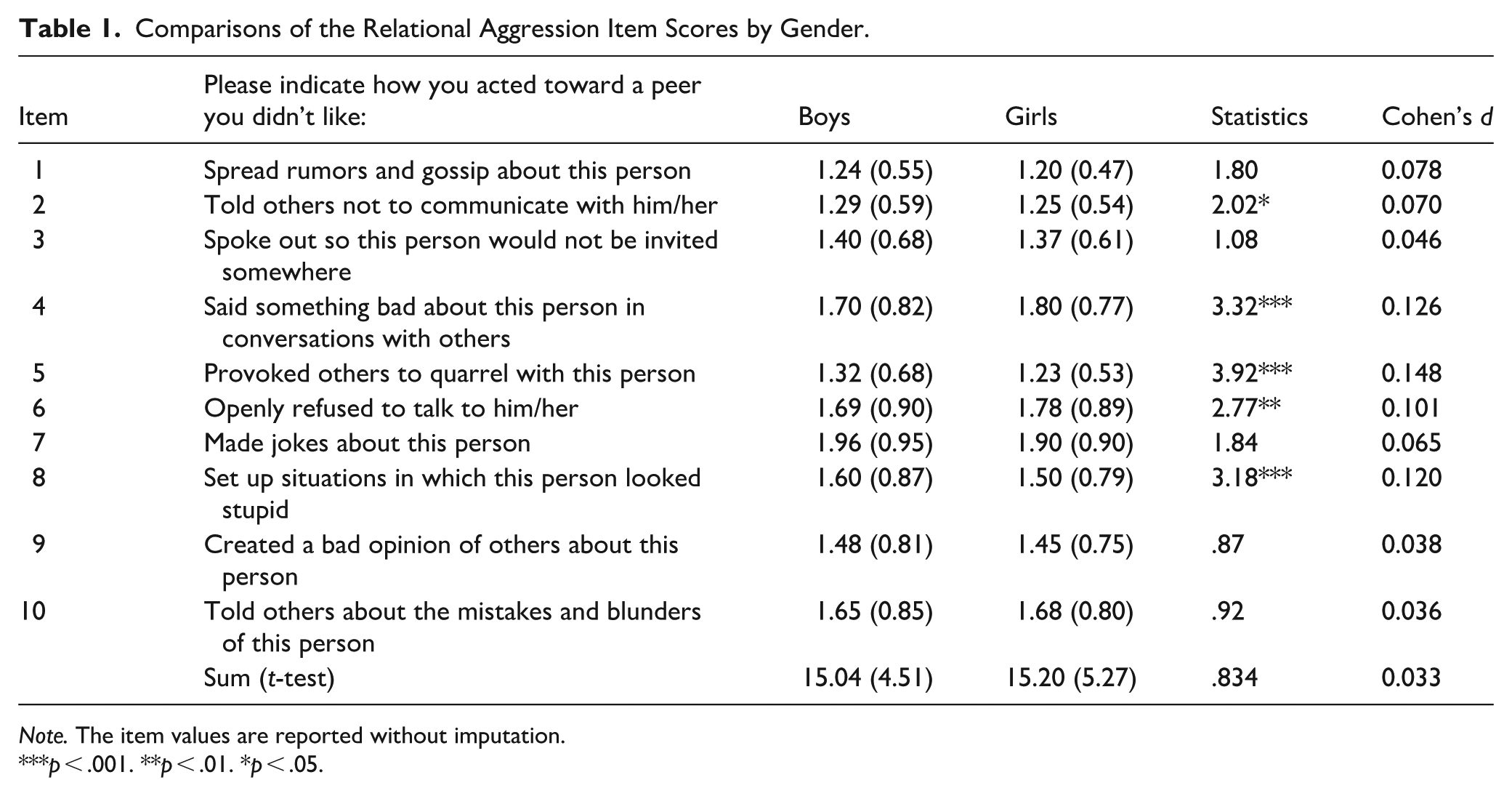
Note. The item values are reported without imputation.
p < .001. **p < .01. *p < .05.
The Anger Rumination Scale (ARS; Sukhodolsky et al., 2001) measures the tendency to focus attention on angry moods, recall past anger experiences, and think about the causes and consequences of anger episodes. The Russian version of the ARS has 17 items (e.g., “After an argument is over, I keep fighting with this person in my imagination,” “When someone makes me angry, I can’t stop thinking about how to get back at them,” and “I think about the reasons people treat me badly”). Participants were asked to rate how well the items corresponded to their beliefs about themselves on a 4-point Likert-type scale ranging from “Almost never” (1) to “Almost always” (4), with the total score ranging from 17 to 68 and higher scores indicating more anger rumination. The ARS has demonstrated adequate internal consistency and test–retest reliability as well as convergent and discriminant validity (Sukhodolsky et al., 2001) and has been used with Russian adolescents previously (Isaksson et al., 2020). Cronbach’s α for the scale was .95.
The Trait Anger Scale of the State-Trait Anger Expression Inventory (STAXI; Spielberger, 1996) consists of 10 items that assess an individual’s general tendency to experience anger, either in the absence of a direct provocation or as a result of specific triggers, such as criticism or unfair treatment by others (e.g., “I am a hot-headed person,” “I feel infuriated when I do a good job and get a poor evaluation”, and “I get angry when I’m slowed down by others’ mistakes”). Students rated each item using a 4-point scale, ranging from “Almost never” (1) to “Almost always” (4), with the total score ranging from 10 to 40, and higher scores indicating more trait anger. The scale has been validated in Russia and has demonstrated excellent internal consistency (Kassinove et al., 1997). Cronbach’s α for the scale was .92.
Physical, verbal, and proactive aggressive behaviors were assessed with 5 items each (Ruchkin et al., 2004). Using a 4-point scale ranging from “Never” (scored 0) to “5 or more times” (3), the students were asked to rate the frequency of their behavior in the past 30 days (e.g., “Slapped someone across the head,” “Pushed or shoved somebody,” and “Punched someone in a fight” for physical aggression; “Teased others” and “Called others names” for verbal aggression; and “Bullied somebody just for the fun of it,” and “Deliberately made others cry” for proactive aggression). The possible total score for each scale ranges from 0 to 15, with higher scores indicating more aggressive behavior. These scales have previously demonstrated acceptable psychometric properties with Russian adolescents (Isaksson et al., 2024). In this study, the Cronbach’s α value for physical aggression was .79, for verbal aggression .78, and for proactive aggression .77.
Peer victimization was assessed by an adapted version of the Multidimensional Peer-Victimization Scale (Mynard & Joseph, 2000). In the original scale, four main types of peer victimization were assessed (physical victimization, social manipulation, verbal victimization, and attacks on property) and four items described each type. The shortened version of the scale (Karlsson et al., 2014) used in the present study combined two items corresponding to each type of victimization (e.g., “Punched me” and “Kicked me” were combined into a single item “Punched or kicked me”). The scale also included an additional item (i.e., “Made me uncomfortable by standing too close or touching me”). An introductory statement precedes the items: “The next items ask you about bullying. During this school year other kids in school. . .” These items are answered on a four-point scale describing the frequency of victimization (ranging from “Not at all” [scored 1] to “Four or more times” [4]), with the potential score ranging from 9 to 36. The scale has been used with Russian adolescent populations previously (Karlsson et al., 2014). Cronbach’s α for the scale was .86.
A proxy for SES was created using students’ reports on whether they lived in a single-parent household (1/0), whether their parents had a lower level of education (incomplete college education or lower, 1/0), and on the employment status of their parents (full time [0], part time [1], and unemployed [2]). Previous research (Whorton et al., 2021) describes parental education, employment/income, and occupation as the three standard measures used when examining SES, but also suggests that questionnaires must include items that allow students to report the composition and caregiver situation in their own homes. The measure has been used with Russian populations previously (Koposov et al., 2022). The possible total score could range from 0 to 6, with higher scores indicating lower SES.
Statistical Analyses
IBM SPSS version 28.0 and R (application version 4.4.1, R Foundation for Statistical Computing, Vienna, Austria) were used to analyze the data. Independent sample t-tests were conducted when making univariate comparisons of demographic characteristics and of RA scores by gender. Pearson correlation coefficients were calculated between all study variables.
A full path analysis with R (lavaan package) using robust maximum likelihood estimation was performed in order to assess the associations between RA, other types of aggression, and peer victimization in boys and girls, while adjusting for SES and the inter-correlation of all independent and dependent variables. Robust maximum likelihood estimation is designed to be robust to non-normality, meaning it adjusts for standard errors to account for non-normal data. It also accounts for homoscedasticity by using robust standard errors. A limitation of a full path analytic model is that it does not fully address the issues of linearity. Additional analyses addressing this problem did not indicate non-linearity.
Further, in two separate path models, the impact of the interaction effects between RA, gender, and age on all types of aggression and peer victimization was tested. The path model is depicted in Figure 1. In the analyses, two-tailed tests with a p-value < .05 were considered statistically significant. Results are presented as means and standard deviations, and standardized regression coefficients (β) are used to assess the strength of the associations between the variables. Previous literature suggested that β > .50 indicates a large effect size, β around .30 indicates a medium effect size, and β around .10 a small effect size (Müller et al., 2015).
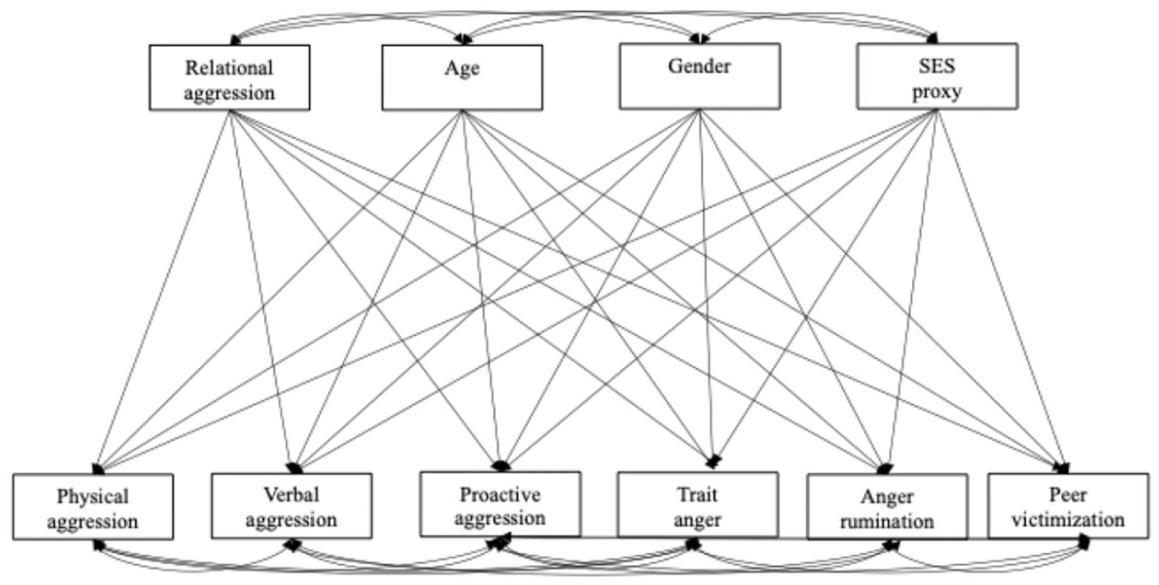
Full path analytic model exploring the associations between relational aggression, age, gender, SES, and different types of aggression and associated emotions and cognitions.
Results
Gender Differences in the RA Items
The gender comparisons for each RA item mean score (possible range 1–4) are presented in Table 1. The scores of the individual items did not differ by gender, except for “Provoked others to quarrel with this person” and “Set up situations in which this person looked stupid,” which were higher in boys, and “Said something bad about this person in conversations with others” and “Openly refused to talk to him/her,” which were higher in girls. As regards the total RA score, no gender differences were found for the whole group.
Correlation Analysis
The results from the correlation analysis are presented in Table 2. RA was positively associated with age, all types of aggression, including trait anger and anger rumination, and peer victimization.
Pearson Correlations Between the Study Variables.
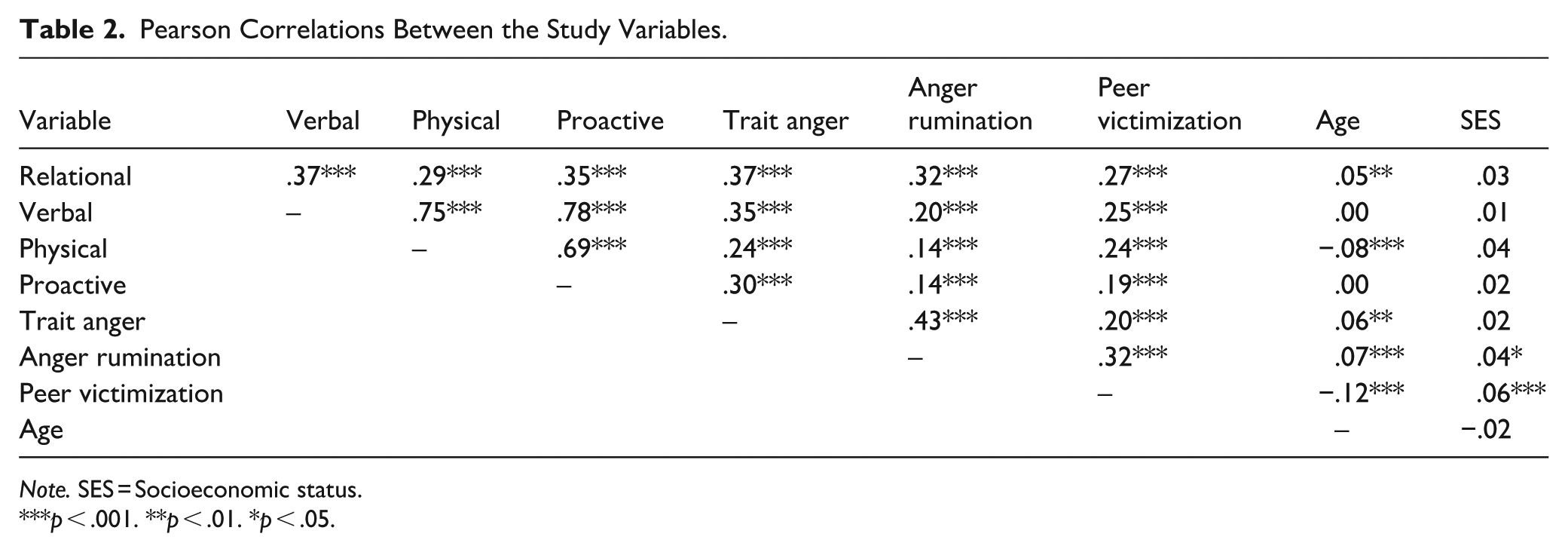
Note. SES = Socioeconomic status.
p < .001. **p < .01. *p < .05.
Gender Differences in the Study Variables
As presented in Table 3, boys reported higher levels of physical, verbal, and proactive aggression, as well as of peer victimization, whereas girls reported higher levels of trait anger and anger rumination. The levels of RA were not significantly different between boys and girls.
Comparison of Aggression Scores, Age, and SES (M [SD]) in Boys and Girls.
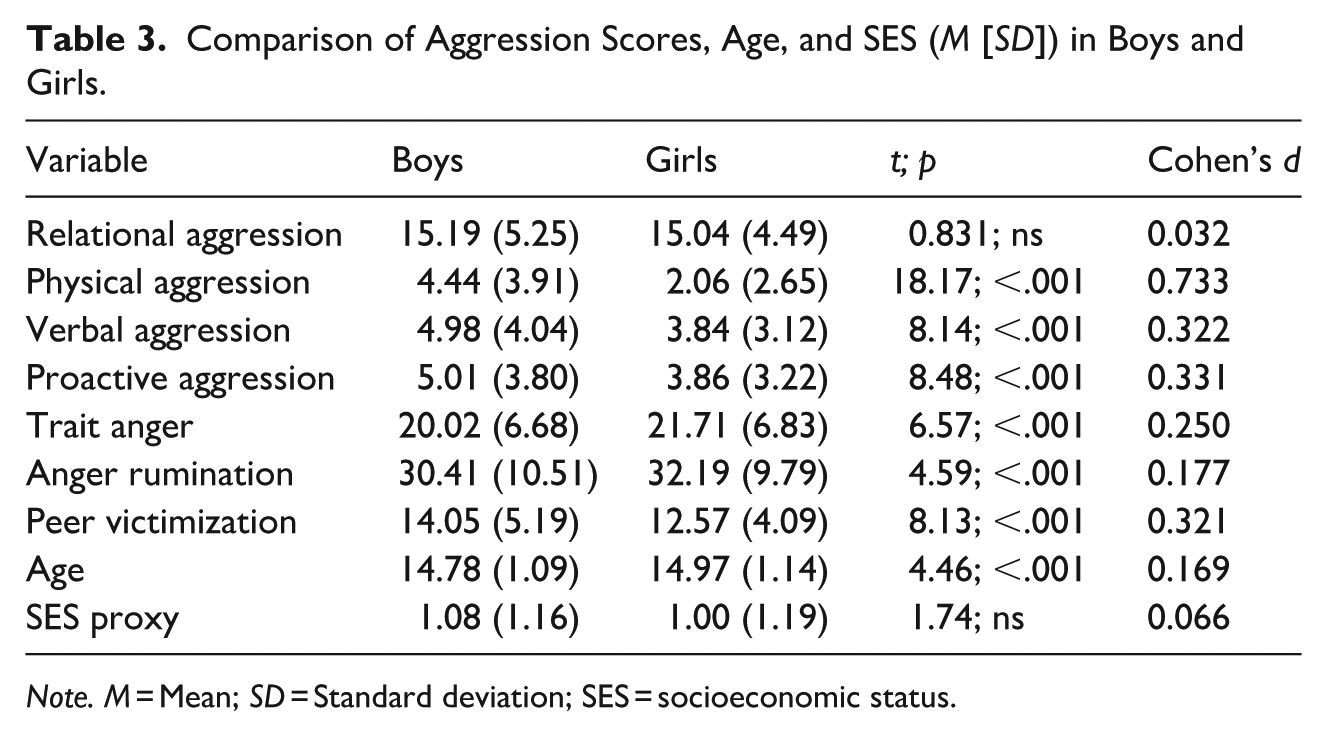
Note. M = Mean; SD = Standard deviation; SES = socioeconomic status.
Full Path Analytic Model
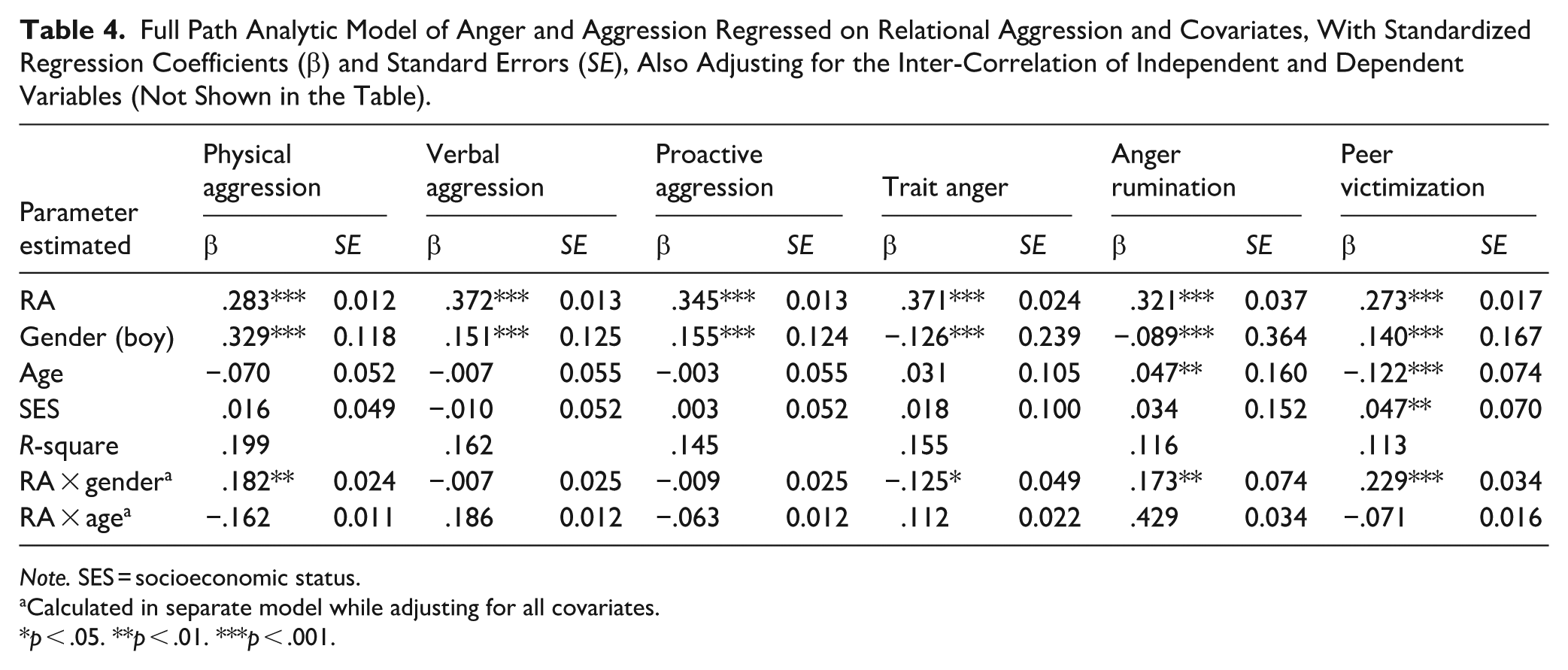
The results of the path analytic model are presented in Figure 1 and Table 4. The full model explained between 11 and 20% of the variance in the different outcomes. Higher levels of RA predicted all types of aggression and peer victimization. There was also a main effect for gender, showing higher levels of physical, verbal, and proactive aggression, as well as peer victimization in boys, and higher levels of trait anger and anger rumination in girls. In addition, as suggested by the interaction effect for RA × gender, boys displayed greater physical aggression, anger rumination, and peer victimization in relation to greater levels of RA, while girls had greater trait anger. Increasing age was associated with greater anger rumination and lower peer victimization. Regarding the interaction effect of RA by age, no significant effects were observed.
Full Path Analytic Model of Anger and Aggression Regressed on Relational Aggression and Covariates, With Standardized Regression Coefficients (β) and Standard Errors (SE), Also Adjusting for the Inter-Correlation of Independent and Dependent Variables (Not Shown in the Table).
Note. SES = socioeconomic status.
Calculated in separate model while adjusting for all covariates.
p < .05. **p < .01. ***p < .001.
Discussion
This study explored the relationship between RA, other types of aggression, emotions such as anger and anger rumination, and peer victimization in a large sample of Russian adolescents, with a focus on gender and age differences. The results contribute to a growing body of research by examining these variables in a cultural context that differs from many prior studies conducted in Western countries. Our findings offer new insights into how RA is associated with other forms of aggression, emotional regulation, and peer dynamics, particularly in the context of Russian youth.
RA and Other Types of Aggression
This study found that adolescents with higher RA levels tend to engage in a wide range of other types of aggression. Indeed, previous research suggests that RA and other types of aggression tend to substantially inter-correlate (Card et al., 2008), co-occur in the same individuals and be relatively stable over time (Girard et al., 2019). Considering the significant correlation between RA and overt aggression, some authors have suggested that while verbal skills and the understanding of social dynamics increase with age, their combination with the retained capacity to enact aggression can lead RA and overt aggression to converge. This can result in the increased use of all types of aggression in individuals with a propensity to engage in aggression (Card et al., 2008). The greater variety of aggressive behavior found in more relationally aggressive youth of both genders is particularly worrying, given that persistent engagement in aggression carries a greater risk for a high social burden and economic cost to societies (Girard et al., 2019). In addition, because different forms of aggression may be differentially related to personal and interpersonal aspects of maladjustment (Card & Little, 2006; Card et al., 2008), this may further broaden the risk of poorer psychosocial functioning in adolescents in the future.
Gender and RA: A Complex Interplay of Cultural and Developmental Factors
Our study found that RA behaviors were similarly prevalent among boys and girls in the general adolescent population in Russia, which aligns with previous findings in North American samples (Card et al., 2008). While some minor gender differences were observed, with girls reporting higher scores on more subtle forms of RA, these findings suggest that RA is used in similar ways by both genders. This is consistent with meta-analytic studies, which indicate that gender differences in RA are minimal, particularly when subtle relational tactics are considered (Archer, 2004; Voulgaridou & Kokkinos, 2023). These results contribute to the argument that RA may be a widely used strategy, regardless of gender, albeit expressed in different ways. For instance, girls may be more inclined to use RA as a form of social exclusion or gossip (Underwood, 2003), possibly reflecting both developmental and cultural influences. Girls, who typically develop advanced verbal and social perspective-taking skills earlier than boys (Schonert-Reichl & Beaudoin, 1998), may be more likely to use these skills in RA. In contrast, boys may lean toward more overt forms of aggression, like physical or verbal aggression, although their use of RA may still occur in parallel (Ostrov et al., 2014).
The somewhat higher levels of subtle RA used by girls might also be attributed to developmental and cultural dynamics. As social norms in many societies, including Russia, often discourage overt aggression in girls, there may be an adaptive shift toward more covert, relational forms of aggression (Voulgaridou & Kokkinos, 2023). At the same time, boys’ aggression may be more overt, reflecting both biological predispositions and societal expectations of male behavior (Knobloch-Westerwick & Alter, 2006). This hypothesis is supported by our finding of gender-specific patterns, where higher levels of RA in boys were associated with increased levels of physical aggression, anger rumination, and peer victimization, while higher levels of RA in girls were associated with greater trait anger. This aligns with the “modal hypothesis” (Murray-Close et al., 2016), which suggests that gender differences in aggression may manifest in different forms. While physical aggression may be more common in boys, RA might serve as a developmental substitute or alternative that avoids the social and emotional consequences of overt aggression, especially in adolescent contexts.
Age, Cognitive Development, and Aggression
The findings of this study also underscore the role of age in shaping aggressive behavior. We found positive correlations between RA, anger, and anger rumination with age, suggesting that as adolescents grow older, they may become more adept at using RA as a means of emotional expression, replacing more overt forms of aggression like physical aggression. For example, Ojanen and Kiefer (2013) found decreases in reactive overt aggression and increases in instrumental RA in adolescents across time (i.e., from 12 to 14 years of age). Other studies have similarly found decreases in aggressive trajectories from childhood to adolescence in multi-trajectory groups (Girard et al., 2019). This is consistent with developmental theories that suggest aggression becomes more relational as children mature, particularly due to an increasing ability to understand social dynamics and norms (Björkqvist, 1994; Côté et al., 2007).
While the cross-sectional nature of our study prevents causal conclusions, the observed trends align with findings from longitudinal studies, which have documented a shift from physical to RA across adolescence (Girard et al., 2019; Ojanen & Kiefer, 2013). Adolescents may learn to employ RA more frequently as they develop greater cognitive and emotional skills, enabling them to manipulate peer relationships with greater finesse (Crick et al., 2001). Our study thus provides empirical support for the notion that RA may replace more overtly aggressive behaviors and become more prevalent as adolescents learn to navigate the complex landscape of social interaction, which includes managing emotions such as anger and jealousy. Moreover, RA may serve as an adaptive means of self-protection in the context of peer victimization or group dynamics (Prinstein et al., 2001), a point that is particularly important given the significant association we found between RA and peer victimization. At the same time, it is important to note that this study did not find a significant RA × age interaction effect on the other types of aggression, which may be tentatively explained by previous findings that the transition from physical and verbal to RA may already occur at an earlier age, prior to and during early adolescence (Côté et al., 2007). For example, Girard et al. (2019) found that while proactive and reactive aggression decreased linearly over time, indirect (relational) aggression increased in children between 7 and 10 years old before eventually also decreasing.
The Role of Peer Victimization
One of the study’s critical findings is the association between RA and peer victimization. This relationship highlights how RA may be both a response to and a cause of social exclusion. Adolescents with higher RA levels reported more peer victimization, consistent with existing literature, which suggests that aggressive behaviors, including RA, often lead to peer rejection or victimization (Card & Little, 2006; Crick & Grotpeter, 1995). The association between RA and peer victimization was particularly pronounced for boys, for whom RA was linked to higher levels of physical aggression, anger rumination, and peer victimization. For girls, RA was primarily linked to trait anger, further underscoring the gender-specific dynamics of aggression.
The connection between RA and peer victimization may be explained by the fact that relationally aggressive individuals often engage in behaviors that alienate them from their peers, such as gossiping or excluding others from social groups. These behaviors can result in peer rejection, leading to a cycle of increased social exclusion and further aggression (Snyder et al., 2008). Moreover, peer-victimized adolescents may respond to their experiences with aggression, either as a defense mechanism or to regain social status (Crick et al., 2002). The findings from this study suggest that RA can exacerbate feelings of social isolation and may lead to a negative feedback loop, where those who are most aggressive in relational terms also face the highest levels of social rejection, ultimately affecting their social and emotional development.
Cultural Context and Cross-Cultural Comparisons
Our findings suggest that RA, while context-dependent, shows striking similarities across cultures, particularly in the comparison between Russian and North American adolescents. This cross-cultural similarity indicates that while specific socialization practices may shape the expression of aggression, the underlying dynamics, such as the association between RA, peer victimization, and other aggression forms, appear consistent. The present study contributes to the cross-cultural literature by demonstrating that these findings, while rooted in a Russian context, align with studies conducted in Western populations (Voulgaridou & Kokkinos, 2023). These results suggest the universality of certain developmental processes, particularly in adolescence, where the desire for social dominance and the need for emotional regulation intersect with aggressive behaviors, regardless of cultural background. This aligns with the social development model (Murray-Close et al., 2016), which posits that aggression can be understood as a social and developmental phenomenon influenced by both individual and cultural factors.
The present study has several strengths, including the use of a large general population sample of adolescents from a non-Western country, assessment of a wide range of RA behaviors and being able to evaluate different types of aggression, anger, and peer victimization. To our knowledge, no previous study has addressed these research issues in Russian youths, while this study also aimed to expand the existing knowledge base regarding different aspects of interpersonal aggression and provide a deeper understanding of the mechanisms behind interpersonal violence in its many iterations. Although the study sample was representative of the local population in that it was largely mono-ethnic Russian, the results were nevertheless in line with those from other, largely North American populations, indicating that our findings may be potentially generalizable to other cultures. Although this study was not designed as a cross-cultural investigation, adding a large sample of adolescents from Northwestern Russia to the research base may enable future studies that can compare Western and non-Western cultures.
At the same time, there are several limitations. The assessment was conducted based on self-reports, which may have been subject to bias, and including parental or teacher RA ratings would have strengthened the methodology and conclusions drawn. Moreover, the over-reliance on self-reports introduces the possibility of shared method variance and is susceptible to other biases, such as socially desirable responding and recall bias. While potentially useful for establishing preliminary evidence for more advanced studies, this study was cross-sectional in nature. Thus, as all of the variables were assessed simultaneously, any evidence of a temporal relationship between them could not be obtained and hence any possible conclusions about causality could not be drawn. The cross-sectional nature of the study also made it difficult to interpret some of the observed associations. Future studies should use a longitudinal design in order to address this issue. As previous literature has suggested that β values between .10 and .30 indicate a small to medium effect size (Müller et al., 2015), the effect sizes for the interaction terms observed in the present study were relatively small, suggesting that the specific impact of the interaction between these factors was limited. The inclusion of an overall peer victimization score instead of form-specific victimization scores should also be considered as a limitation, as RA may have stronger associations with relational victimization than other forms, related to the specificity hypothesis of aggression (Crick et al., 1997; Ostrov et al., 2014).
In conclusion, the present study expands existing knowledge by emphasizing gender- and age-related differences in RA expression and the role of peer victimization as both a cause and consequence of RA. Our findings suggest that RA is similarly prevalent among Russian boys and girls, although the manifestation of this aggression may differ based on gender and developmental age. Furthermore, the relationship between RA and other forms of aggression, anger, and peer victimization highlights the complex interplay between emotional regulation, social interactions, and aggression during adolescence. The finding that the various types of aggression co-occur is alarming, given the potentially detrimental outcomes of multiple forms of aggression on social adjustment, and it highlights the importance of promoting positive social behavior and healthy emotional development for at-risk adolescents. These results contribute to the growing body of literature on aggression by providing a more nuanced understanding of RA, while emphasizing the need for culturally informed, gender-sensitive interventions to address aggression and its consequences in adolescent populations. Considering its destructive nature and capacity for emotional damage, RA continues to attract attention from professionals in school-based settings, and the current intervention literature suggests that RA can be effectively remediated and, in some cases, prevented through school-based programming and collaborative efforts (Dailey et al., 2015). RA represents a complex problem related to multiple contextual factors and future studies should further explore the complexity of the factors underlying this form of aggression and the effectiveness of educational policy measures and interventions addressing this phenomenon.
Footnotes

Ethical Considerations
Ethical approval for the study was provided by the institutional review committee and scientific council of the Institute of Psychiatry, Northern State Medical University (Arkhangelsk, Russia) (decision from 2003-02-14).
Funding
The authors received no financial support for the research and/or authorship of this article.
Declaration of Conflicting Interests
The authors declared no potential conflicts of interest with respect to the authorship and/or publication of this article.
Data Availability Statement
Access to the data is restricted to the research group members in accordance with the initial decision of the ethics committee.