




Abstract
Coaches play a critical role in safeguarding athletes from interpersonal violence (IV), yet their ability to recognize, evaluate, and address such incidents remains understudied. This study explored coaches’ accuracy in recognizing violent and ambiguous scenarios, their perception of severity, and their likelihood of reporting these incidents, as well as the psychological factors influencing coaches’ responses. A sample of 145 performance sport coaches (21% female, Mage = 48.97, SD = 11.02) completed an online survey featuring sport-related vignettes and psychometric scales, namely the Perceived Instrumental Effects of Violence in Sport (PIEVS) scale, the Collective Motal Attitudes in Sport (KMES) scale and the Perceived Stress Scale (PSS). Findings revealed that coaches failed to recognize nearly 30% of violent scenarios, with notable difficulties in recognizing neglect, and correctly classified only 45% of ambiguous cases. Misclassified violent scenarios received lower ratings for both severity and likelihood of reporting, with effect sizes differing by type of violence. For ambiguous scenarios, misclassification tended to increase severity and reporting for psychological and neglect cases but showed a robust effect only for the sexual vignette, highlighting that ambiguity is not interpreted uniformly. Small but significant correlations emerged between PIEVS scores and recognition accuracy in violent scenarios (ρ = −.177, p = .033), as well as severity ratings for ambiguous scenarios (ρ = −.258, p = .007). KMES scores showed a small positive correlation with severity ratings in violent scenarios (ρ = .203, p = .014). Overall, these results highlight the challenges coaches face in recognizing and addressing IV in sport and point to a limited understanding of the factors that shape their responses. There is a clear need for targeted, context-sensitive educational interventions to strengthen coaches’ safeguarding practices, with particular attention to less visible forms of violence such as neglect.
Introduction
Interpersonal violence (IV) in sport is a critical concern, with growing evidence underscoring its pervasive impact on athletes’ health, well-being, and safety (Dallam et al., 2024; Mountjoy, Adriaens, et al., 2024; Zogg et al., 2024). IV is defined as the intentional use of physical force or power—actual or threatened—against an individual, group, or community, likely causing injury, death, psychological harm, maldevelopment, or deprivation (Krug et al., 2002; Tuakli-Wosornu et al., 2024). By incorporating power as well as physical force, this definition underscores that violence may take multiple forms—including physical, sexual, and psychological abuse, as well as neglect. Importantly, intentionality refers to the act itself rather than an intent to cause harm (Krug et al., 2002). Such harms can emerge gradually, for example, through processes of boundary blurring and trust-building (i.e., grooming) that precede IV (Kim, 2024). Recent prevalence studies suggest that IV affects athletes across all age groups and competitive levels, emphasizing the widespread nature of this risk (Hartill et al., 2023; Marsollier et al., 2021; Pankowiak et al., 2023; Willson et al., 2022). Coaches play a central role in this context. They may act as perpetrators of violence (Vertommen et al., 2017), but also as allies (Jaime et al., 2015) with the potential to intervene and protect athletes from harm (Verhelle et al., 2022). This study focuses on the latter role, specifically investigating how coaches respond to IV by examining their ability to recognize violent and ambiguous situations (i.e., those open to multiple interpretations based on context, intent, or perception), assess the severity of these situations, and determine whether they intend to report them.
Empirical evidence consistently identifies coaches as a key group of IV perpetrators, often second only to peers (Marsollier et al., 2021; Pankowiak et al., 2023; Vertommen et al., 2017). The inherently hierarchical coach–athlete relationship, wherein athletes are dependent on coaches for support and athletic development, can foster environments conducive to violence (Antonini Philippe et al., 2011; Roberts et al., 2020; Stirling & Kerr, 2013). Moreover, in sport cultures that prioritize performance over athlete well-being, coaches both contribute to and are influenced by these environments. As a result, they may adopt or reinforce training practices that normalize harsh treatment as acceptable or even necessary (Jacobs et al., 2017; Mountjoy et al., 2016; Stirling & Kerr, 2014). This normalization may impair both coaches’ and athletes’ ability to recognize abusive behavior, allowing harmful practices to continue unchecked (Stirling & Kerr, 2009). As influential figures shaping athletes’ environments (Bissett et al., 2020), coaches may—intentionally or not—contribute to cycles of violence and cultural tolerance for abuse, with consequences extending across generations (Tuakli-Wosornu et al., 2024).
At the same time, coaches occupy a unique position that may enable them to notice early signs of IV. When coaches witness violence perpetrated by others—such as peers, fellow coaches, spectators, or administrators—without being directly involved, they may serve a crucial role in safeguarding athletes from harm. The decisions and actions they take in these situations can significantly influence outcomes (Banyard, 2008; Banyard et al., 2016). Safeguarding refers to “all proactive measures to both prevent and appropriately respond to concerns related to harassment and abuse in sport, as well as the promotion of holistic approaches to athlete welfare” (Tuakli-Wosornu et al., 2024, p. 2).
Previous research shows that several elements are particularly influential in determining whether IV is addressed. First, the ability to recognize violence is crucial, as unrecognized harmful behaviors cannot be acted upon (Adriaens et al., 2024; Verhelle et al., 2022). However, not all forms of IV are equally recognizable. Physical violence may often leave observable signs (Calheiros et al., 2016), whereas sexual violence can also take covert forms that are hidden from others and may only be recognized retrospectively (Kim, 2024). Psychological violence and neglect may likewise be difficult to recognize, as their behaviors are not always perceived as violent at the time and are therefore less readily acknowledged (Stirling & Kerr, 2009). The perceived severity of IV could also play a role in determining whether one will intervene (Adriaens et al., 2024). Acts perceived as invasive or leading to long-term harm—physical, psychological, or social—are generally judged as more severe than those resulting in short-term or less tangible effects (Jackson et al., 2014). However, severity is not determined solely by consequences. The perpetrator’s intent, the relational context, the performance outcome, and broader socio-cultural norms also shape interpretations of violence (Follingstad, 2011; Gervis et al., 2016). A further aspect of safeguarding concerns whether individuals decide to act when they encounter IV. In sport, such action can take multiple forms, ranging from informal strategies (e.g., directly addressing the situation, seeking advice, or offering support to the athlete) to formal mechanisms such as reporting concerns to designated safeguarding bodies (Adriaens et al., 2024; Kovalenko & Fenton, 2024; Vertommen et al., 2024). Formal reporting is particularly important because it activates organizational mechanisms designed to protect athletes and hold perpetrators accountable (Radziszewski et al., 2024; Vertommen et al., 2024). Yet research indicates that action is not always taken: coaches report barriers such as personal attitudes, social norms, and low self-efficacy that hinder intervention (Verhelle et al., 2022), and athletes themselves rarely pursue formal complaints, often due to fear of repercussions or lack of trust in organizations (Willson et al., 2022). Educational initiatives such as All Aboard (Verhelle et al., 2024) and Safe Sport Allies (Adriaens et al., 2024) have begun to address these barriers by building recognition skills and confidence to act.
Taken together, recognition, severity appraisal, and reporting intentions represent three interconnected aspects of coaches’ safeguarding responses. Recognition determines whether harm is even noticed, severity appraisal shapes how seriously it is taken, and reporting reflects the likelihood that formal mechanisms are activated. Examining these three dimensions provides a focused way to understand the challenges coaches face when confronted with IV in sport.
Understanding coaches’ safeguarding responses requires closer attention to the psychological factors that underpin them. Evidence suggests that beliefs, attitudes, and social norms directly impact how coaches interpret and respond to violence (Adriaens et al., 2024). Drawing from the literature (Roberts et al., 2020), this study examines three constructs with theoretical relevance to IV in sport: perceived instrumental effects of violence, collective moral attitudes, and perceived stress.
The perceived instrumental effects of violence refer to the belief that violence can serve beneficial purposes, such as improving performance. Roberts et al. (2020) found that psychological violence is often rationalized as a motivational tool or a means of reinforcing authority, while sexual violence may serve to control or maintain team hierarchies. Physical violence, in certain contexts, is used strategically to gain a competitive advantage (Roberts et al., 2020). Endorsing such beliefs may lead coaches to view abusive practices as acceptable or even beneficial, diminishing their likelihood of recognizing, reporting, or intervening in IV.
Next, the moral attitude of a sports group represents the collective norms and values guiding ethical decision-making within a team or organization (Manges et al., 2021). In their validation study, Manges et al. (2021) hypothesized that training groups with strong moral attitudes exhibited lower levels of antisocial behavior. Recent research on ethical climate in sport supports this notion, showing that psychological abuse is more likely to occur in clubs with poor ethical climates (Schyvinck et al., 2025). Thus, the prevailing moral climate of a group may significantly shape a coach’s interpretation and response to violence.
Finally, perceived stress refers to individuals’ subjective experience of strain and their perceived capacity to cope with external pressures (Fletcher & Scott, 2010; Weinberg & Gould, 2019, p. 83). Coaches experience numerous stressors—from performance pressures to organizational and personal challenges—which vary by sport and competitive level (Frost et al., 2024). According to Roberts et al. (2020), elevated stress levels can deplete self-regulatory resources, impair coping, and increase the risk of perpetuating or overlooking IV, particularly in environments that tolerate such behaviors.
Present study
This study examines two central research questions using a vignette-based design: (1) To what extent are coaches able to recognize IV, assess its severity, and report it within the sports context? (2) How do perceived instrumental effects of violence, collective moral attitudes, and perceived stress influence coaches’ recognition, severity appraisal, and reporting intentions?
It is hypothesized that coaches’ ability to recognize IV will vary depending on the type of violence, with higher recognition rates for overt forms of violence (e.g., physical) compared to more covert forms of violence (e.g., neglect). Coaches who accurately recognize IV are expected to perceive it as more severe and report a higher likelihood of intervening. Furthermore, perceived instrumental effects of violence and higher levels of perceived stress are hypothesized to be negatively associated with recognition, severity perceptions, and reporting intentions, whereas stronger collective moral attitudes against violence are expected to be positively associated with these outcomes.
Method
The present study employed a cross-sectional research design, using an online survey with sport-related vignettes and validated psychometric scales to collect data from coaches. This study was conducted in accordance with the ethical principles outlined in the Declaration of Helsinki and approved by the Institutional Review Board.
Procedure and Participants
Participants were recruited through the Swiss National Sports Database, which includes data on coaches who participated in the Swiss Coach Education Curriculum. Eligible participants were required to be at least 18 years old, German speaking and have completed at least the penultimate level of education before entering the professional coaching course. This comprised a total of N = 1,923 eligible coaches. Assuming an effect size of r = .3, a revised alpha error of .0028 (adjusted using Bonferroni correction), and a statistical power of 0.8, the required sample size for this study was calculated to be n = 153 (Faul et al., 2009). With an expected response rate of 20%, n = 900 coaches were randomly selected from this pool to receive an email invitation with a link to the online survey. The survey began with a detailed explanation of the study’s purpose, participants’ rights, and assurances of confidentiality, followed by the collection of informed consent prior to participation.
After excluding 33 cases with partial data, 6 cases that did not meet the inclusion criteria, and 28 cases that failed the attention check (i.e., correctly recognizing the non-violent vignettes, see Materials section), the final sample consisted of n = 145 coaches. Of these, 79% were male (n = 114) and 21% were female (n = 31), with a mean age of 48.97 years (SD = 11.02), ranging from 26 to 79 years. The sample was representative of the contacted subpopulation in terms of gender (21% female; t(1036) = −0.12, p = .904) and mean age (M = 47.51, SD = 10.28; t(1036) = −1.58, p = .115). Although the targeted sample size was 153 participants, the final sample of 145 corresponded to an achieved power of 77% (1−β = .769). While this is slightly below the planned 80% power, the sample size remains sufficient to detect medium-sized effects.
Regarding sport type, 50% coached individual sports (n = 73), 42% team sports (n = 61), and 8% coached both (n = 11). A total of 38 distinct sports were represented in the dataset. The sports with the highest proportion among coaches were football (i.e., soccer; 11%), ice hockey, track and field (8% each), and alpine skiing (7%). Other sports with moderate representation included handball (6%), floorball, swimming, tennis, artistic gymnastics, and orienteering (5% each). Most participants coached at the Talent stage (68%), followed by Elite (24%), Foundation (13%), and Mastery (5%), with 3% not identifying with any stage (Gulbin et al., 2013). These categories derive from the FTEM framework (Foundations, Talent, Elite, Mastery), which outlines athlete development without fixed age boundaries (Gulbin et al., 2013). Foundation refers to the acquisition and refinement of basic movement skills and early sport participation; Talent encompasses athletes demonstrating high potential and progressing toward elite performance; Elite refers to athletes representing their country or achieving podium success at major competitions; and Mastery describes sustained success at the highest international or professional level. Regarding coaching education, 70% of the participants had completed professional training (46% = professional coach curriculum, 24% = graduate coach curriculum), 26% had completed a youth sport high-performance course, and 4% reported other types of education.
Participants reported an average of 14.6 work units per week (SD = 12.78), encompassing activities such as training, analysis and planning, competitions, and consultations, with a range of 1 to 52 units. Additionally, the coaches were engaged by a club or federation at an average work percentage of 44% (SD = 41.44), with values ranging from 0% to 100%.
Materials
Vignette Development and Selection
The study utilized 24 sport-related vignettes, including 19 derived from the Ethics Compass (Swiss Olympic, 2024), which were based on real events, and five newly developed by the research team to provide a diverse range of scenarios. These vignettes depicted sport-specific scenarios involving violent, ambiguous (i.e., situations that allow for multiple interpretations based on context, intent, and individual perceptions), or non-violent behaviors by sports professionals (e.g., coaches, sports directors) or peers toward athletes. Scenarios were selected to represent all four forms of IV and to reflect the complexity of real-world interactions in sport. To support diversity and ecological validity, the vignettes were systematically varied across several dimensions, including the type of sport and the gender of both the targeted individual and the perpetrator. This approach aimed to minimize gender- and sport-specific biases, enhance response variability, and encourage reflection on violence as a systemic issue rather than one restricted to particular individuals or contexts.
The vignettes were evaluated and refined by a panel of 10 experts in sport ethics (50% female; Mage = 40.8 years, SD = 10.1), all affiliated with Swiss Sport Integrity (i.e., the national center responsible for addressing ethical violations and abuse in sport). Experts self-rated their level of expertise on a scale from 0% to 100%, with an average expertise rating of 72% (SD = 14.56). Each expert evaluated the vignettes on two dimensions: the level of violence (i.e., violent, ambiguous, non-violent) and the form of violence (i.e., psychological, physical, sexual, and neglect). To determine the level of violence, experts answered the question, “Does this scenario describe an act of violence?” with one of three responses: 1 (yes), 2 (no), or 3 (unclear, I need more information). For scenarios rated as 1 (yes) or 3 (unclear), experts categorized the form(s) of violence by selecting from four types: psychological, physical, sexual, or neglect.
Inter-rater agreement, calculated as percentage agreement, was used as the criterion for vignette selection. Scenarios depicting violent or non-violent behaviors required a minimum of 75% agreement among experts to be included in the final selection (Chaturvedi & Shweta, 2015). Vignettes with lower expert consensus were categorized as ambiguous, reflecting the inherently uncertain nature of these scenarios.
To attribute a form of violence to a vignette, experts could select multiple categories. For consistency, the vignette was classified according to the form that reached the highest level of agreement, provided consensus was at least 75%. The full distribution of expert ratings is available in the Supplemental Materials.
From the initial pool, 10 vignettes were selected for use in the study, comprising 4 vignettes depicting violent behaviors, 4 depicting ambiguous behaviors, and 2 depicting non-violent behaviors. For both levels of violence (violent and ambiguous), one vignette was retained for each form of IV (i.e., psychological, physical, sexual, and neglect). The non-violent vignettes served as attention checks, and participants who failed to correctly recognize these scenarios were excluded from the analysis. Non-violent vignettes were not further analyzed.
In the present study, violent vignettes depicted clear breaches of safeguarding and ethical obligations (e.g., sexual harassment of a minor, physical assault, psychological abuse, neglect of duty of care). In such cases, coaches would be expected to report the behavior to the responsible safeguarding authority (Swiss Olympic, 2021). Ambiguous vignettes, by contrast, portrayed situations that raise concern but do not, on their own, necessarily meet the threshold for mandatory reporting (e.g., a physiotherapist making weight-related comments). While these situations do not automatically require formal reporting, they nevertheless warrant clarification, dialogue, and active monitoring, as doing nothing is also inappropriate in safeguarding practice (Gojanovic et al., 2021; McMahon & Banyard, 2012). Details of all 24 vignettes are provided in the Supplemental Materials.
Measures
Vignettes
The study utilized eight previously piloted vignettes, which described violent or ambiguous situations in sports contexts (Table 1). After each vignette, participants answered questions designed to assess three dimensions: their ability to recognize violence, their perception of the severity of the situation, and the likelihood of reporting the violence to the body responsible for addressing ethical breaches in Switzerland, Swiss Sport Integrity (Swiss Sport Integrity Foundation, 2021).
Overview of the Vignettes Used in the Study.
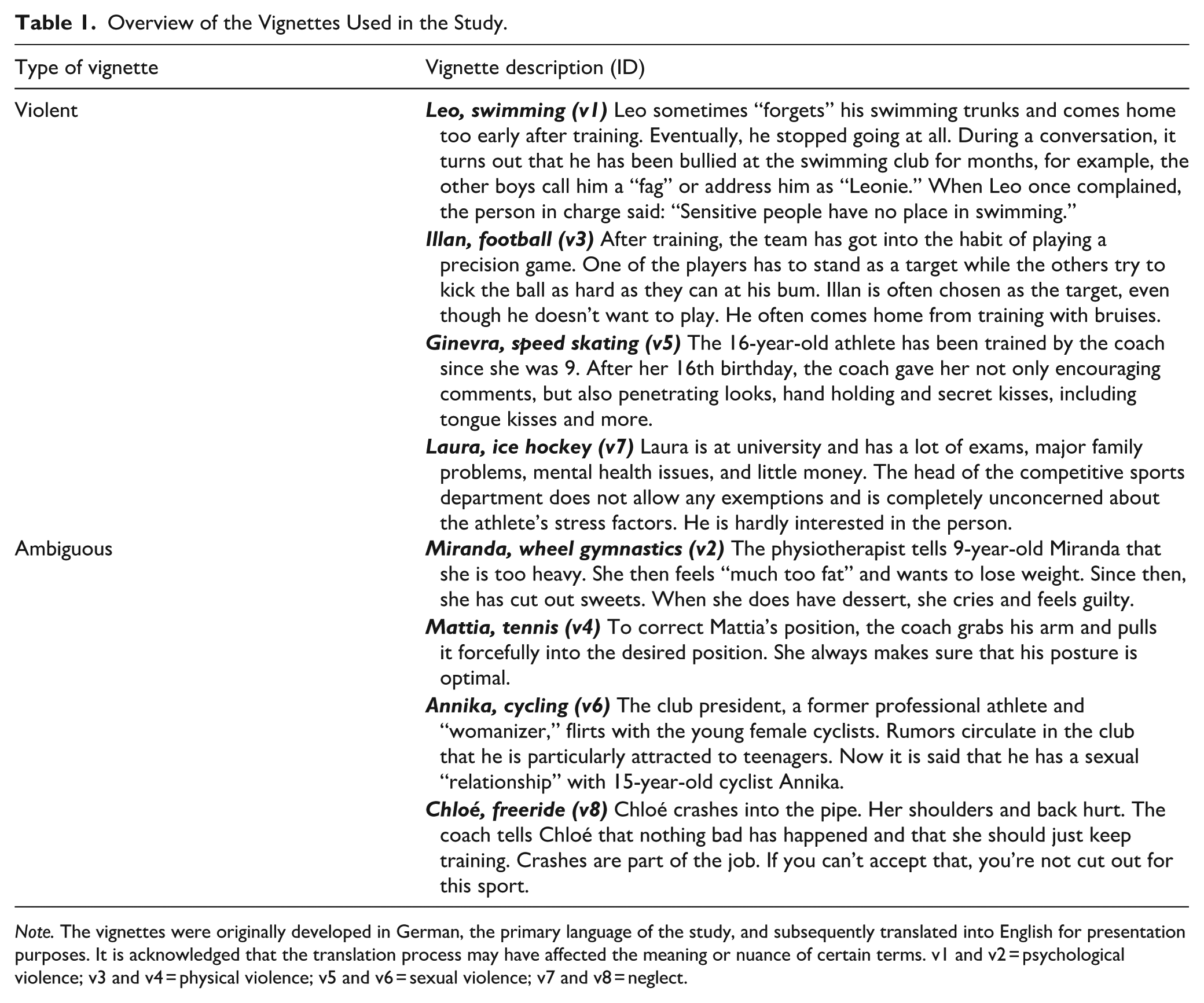
Note. The vignettes were originally developed in German, the primary language of the study, and subsequently translated into English for presentation purposes. It is acknowledged that the translation process may have affected the meaning or nuance of certain terms. v1 and v2 = psychological violence; v3 and v4 = physical violence; v5 and v6 = sexual violence; v7 and v8 = neglect.
Recognition of Violence
The ability to recognize violence was measured using a single-item question adapted from Vanderfaeillie et al. (2018): “Do you think the above scenario describes an act of violence?” Participants responded with one of three options: 1 (yes), 2 (no), or 3 (unclear, further information is required). For scoring purposes, correct recognition of a vignette (i.e., recognizing a violent vignette as violent, recognizing an ambiguous vignette as unclear) was assigned 1 point, while incorrect recognition (e.g., classifying a violent vignette as non-violent or ambiguous) was assigned 0 points. Recognition scores for both violent and ambiguous vignettes were calculated by averaging participants’ responses across the four vignettes in each category and were subsequently presented as percentages.
Perception of Severity
Perceived severity was assessed using three items adapted from Fitzpatrick and Hamill (2010). These items evaluated: (a) abusiveness—the extent to which participants perceived the actions or behaviors as harmful or stressful, (b) acceptability—the extent to which participants found the actions or behaviors appropriate (reverse scored), and (c) justifiability—the extent to which participants found the actions or behaviors justified. Participants rated each vignette on a 5-point Likert scale ranging from 1 (highly non-abusive/justifiable/acceptable) to 5 (highly abusive/non-justifiable/unacceptable). A perceived severity score was calculated by averaging the three items for each vignette, with higher scores indicating a greater perception of severity. Overall perception scores for violent and ambiguous vignettes were determined by averaging participants’ ratings across the four vignettes in each category, yielding possible scores from 1 to 5. In the current study, the scale exhibited satisfactory internal consistency, as indicated by a reliability coefficient of ω = .77.
Likelihood of Reporting
Participants’ likelihood of reporting the situation to Swiss Sport Integrity was measured using a single item adapted from Fitzpatrick and Hamill (2010): “How likely are you to report the situation to Swiss Sport Integrity?” Responses were collected on a slider scale ranging from 0 (highly unlikely) to 100 (highly likely). Reporting likelihood scores for violent and ambiguous vignettes were calculated by averaging responses across the four vignettes in each category, with possible scores ranging from 0 to 100.
Perceived Instrumental Effects of Violence
The German version of the Perceived Instrumental Effects of Violence in Sport scale (PIEVS-G-6; Parent et al., 2024; Schwab et al., 2025) was used to assess participants’ beliefs about the utility of violence in achieving performance goals. The scale consists of six items, such as “Requiring athletes to do extra drills or workouts is a good way to bring them back in line after a poor performance.” Participants rated their agreement on a 5-point Likert scale ranging from 1 (strongly disagree) to 5 (strongly agree). The total score was calculated as the mean of the responses, with higher scores indicating stronger beliefs in the instrumental effects of violence. In the present sample, the measure demonstrated internal consistency slightly below the acceptable range, with McDonald’s omega ω = .66.
Collective Moral Attitudes of Sport Groups
The Kollectiv-Moralische Einstellung in Sportgruppen (KMES; Manges et al., 2021) measured collective moral attitudes within sports groups. This scale comprises eight items assessing the prioritization of moral values (e.g., fairness, honesty, cooperation) over values such as success, power, or personal accomplishment. Participants rated their agreement with statements like “In our training group, members are willing to break the rules to get ahead in the sport” on a scale from 1 (strongly agree) to 5 (strongly disagree). Mean scores were calculated, with higher scores indicating stronger collective morality. For the current sample, the scale demonstrated high internal consistency (ω = .84).
Perceived Stress
The 10-item Perceived Stress Scale (PSS-10; Klein et al., 2016) assessed the extent to which participants perceived their lives as unpredictable, uncontrollable, and overloaded during the past month. Items, such as “In the last month, how often have you felt that you were unable to control the important things in your life?” were rated on a 5-point Likert scale ranging from 0 (never) to 4 (very often). Four items (4, 5, 7, and 8) were reverse scored. The total score, ranging from 0 to 40, was calculated by summing all responses, with higher scores indicating greater perceived stress. In this study, internal consistency was high, with McDonald’s omega of ω = .88.
Statistical Analyses
Data were analyzed using JASP version 0.19 (JASP team, 2024). Descriptive analyses were conducted for the vignettes, categorized into two subgroups: violent (v1, v3, v5, v7) and ambiguous (v2, v4, v6, v8) scenarios. Detailed descriptive statistics were provided for each specific type of violence depicted—psychological, physical, sexual, and neglect. Key variables included recognition of violence, perception of severity, likelihood of reporting, and scores on the PIEVS scale, the KMES scale, and the PSS. Descriptive statistics such as medians, interquartile ranges, and ranges (minimum and maximum) were calculated for these variables.
The Shapiro-Wilk test, along with a graphical assessment, was employed to assess the normality of data distributions for all key variables. Due to non-normal distributions, non-parametric statistical tests were applied. Mann–Whitney U tests were used to compare the perception of severity and the likelihood of reporting between coaches based on whether coaches correctly recognized violent and ambiguous behaviors in the vignettes. Effect sizes were calculated using the rank-biserial correlation coefficient (rrb) to quantify the magnitude of observed differences.
Spearman’s rank-order correlation analyses were conducted to investigate relationships between vignette-related variables and psychometric scale scores. Correlation coefficients (ρ) and corresponding p-values were reported for each relationship. Correlation coefficients were interpreted as follows: ρ < .30 indicated a low correlation, .30 ≤ p ≤ .70 indicated a moderate correlation, and ρ > .70 indicated a strong correlation (Dancey & Reidy, 2016, p. 205). To reduce the risk of Type I error from multiple comparisons, p-values were adjusted using Bonferroni correction, and results are reported based on these corrected values (Cabin et al., 2000). A significance level of p < .05 was applied to all statistical tests.
Results
Table 2 presents descriptive statistics for the recognition of violence, perception of severity, and likelihood of reporting in both violent and ambiguous vignettes. Recognition rates were lower for ambiguous vignettes compared to violent ones, along with overall lower ratings for severity and likelihood of reporting.
Descriptive Statistics for Recognition, Perceived Severity, and Reporting Likelihood in Violent and Ambiguous Vignettes.
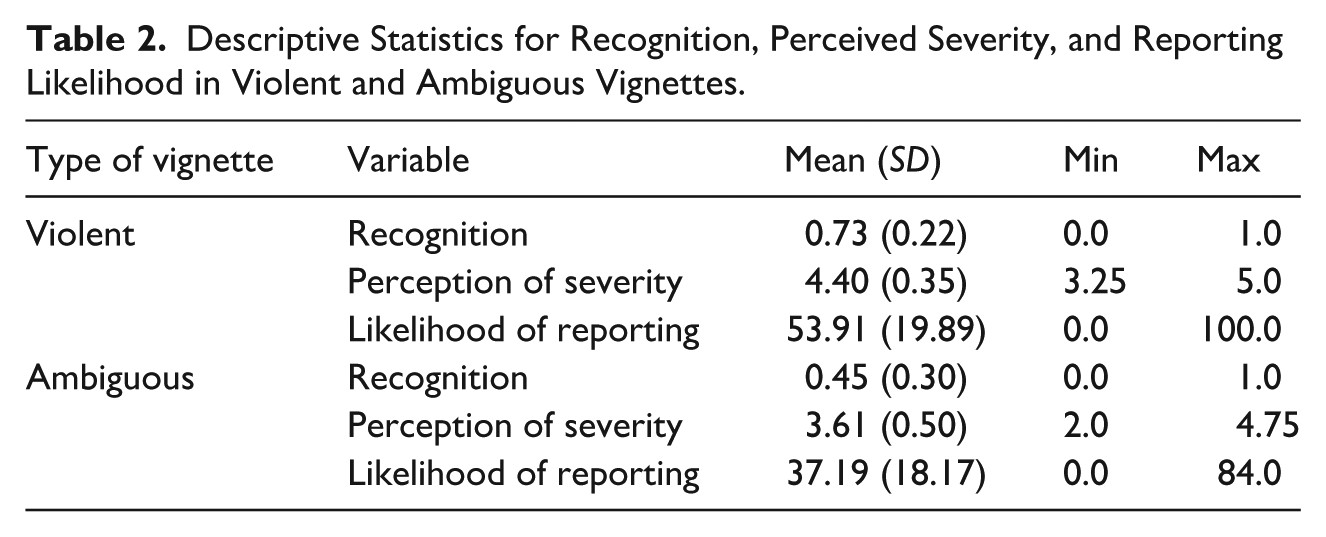
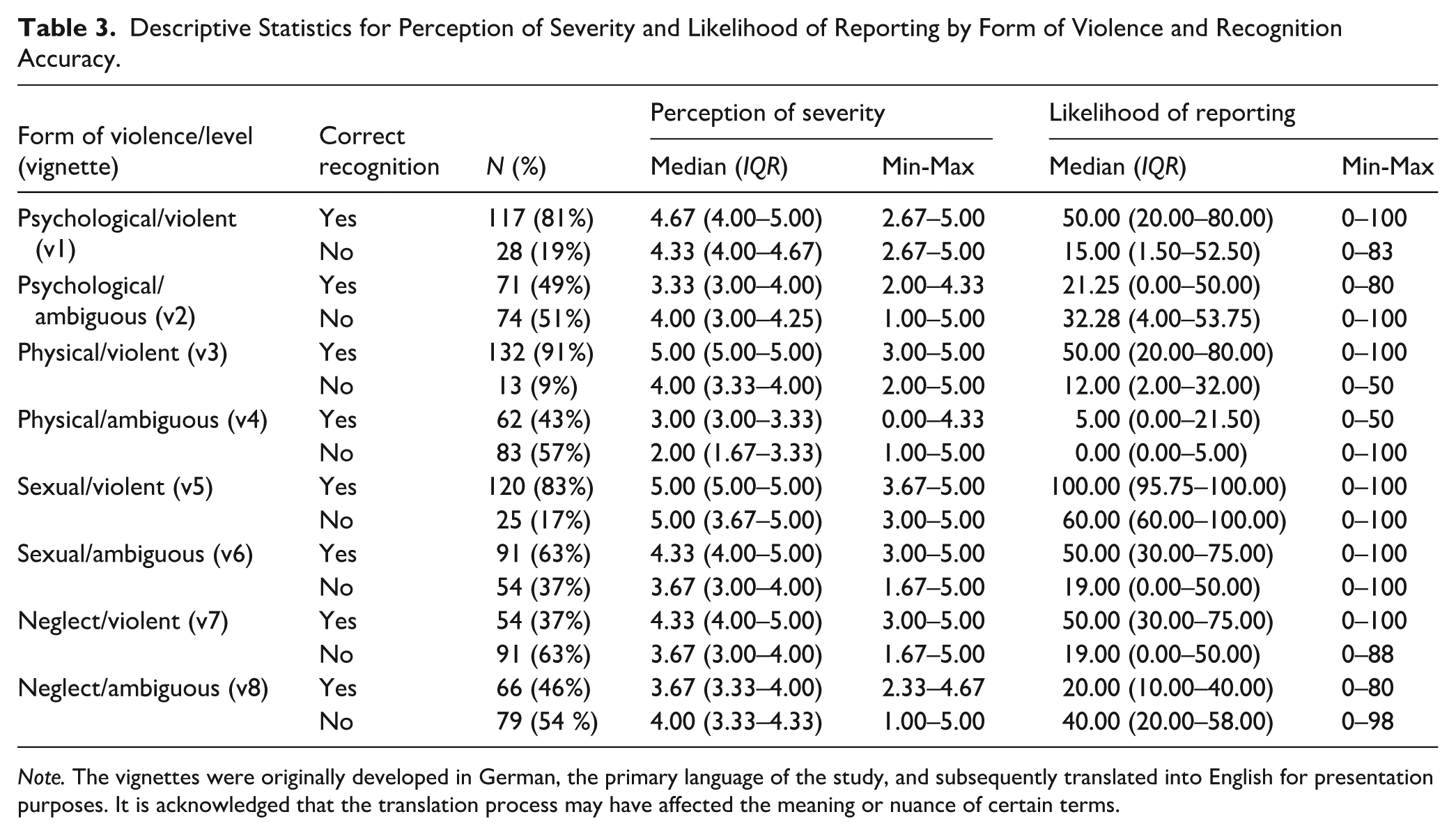
Table 3 presents the perception of severity and likelihood of reporting across violent (v1, v3, v5, v7) and ambiguous (v2, v4, v6, v8) vignettes, comparing coaches who correctly recognized the behavior with those who did not.
Descriptive Statistics for Perception of Severity and Likelihood of Reporting by Form of Violence and Recognition Accuracy.
Note. The vignettes were originally developed in German, the primary language of the study, and subsequently translated into English for presentation purposes. It is acknowledged that the translation process may have affected the meaning or nuance of certain terms.
For the violent vignettes (i.e., v1, v3, v5 and v7), most coaches correctly recognized psychological, physical, and sexual violence, while neglect was the least accurately recognized. Across all forms of violence, coaches who correctly recognized the behavior rated its severity higher (except for psychological violence) and were more likely to report it compared to those who misrecognized it (Mann–Whitney Us ranged between 289 ≤ U ≤ 1,326). The largest differences were observed for physical violence (v3), with strong effects on both perception of severity (rrb = −.663, p =< .001) and likelihood of reporting (rrb = −.524, p = .032). For sexual violence (v5), moderate effects were found for perception of severity (rrb = −.329, p = .002) and stronger effects for likelihood of reporting (rrb = −.545, p < .001). Neglect (v7) showed strong effects for the perception of severity (rrb = −.614, p < .001) and moderate effects for the likelihood of reporting (rrb = −.460, p < .001). In contrast, psychological violence exhibited smaller effects on both perception of severity, which was not significant (rrb = −.263, p = .416) and likelihood of reporting (rrb = −.361, p = .048), highlighting variations across different forms of violence.
For the ambiguous vignettes (i.e., v2, v4, v6, v8), responses could fall into three categories: correctly recognizing the scenario as ambiguous, over-identifying it as violent, or under-identifying it as non-violent. Patterns across the four scenarios were mixed. Mann–Whitney Us ranged between 2207.50 ≤ U ≤ 4117.50, with some comparisons reaching significance while others did not. In the psychological vignette (v2), misclassification tended to be linked with higher severity (rrb = .219, p = .336) and greater likelihood of reporting (rrb = .236, p = .208), although these differences were not statistically significant after correction. A similar pattern was observed in the neglect vignette (v8), where misclassification showed higher ratings of severity (rrb = .309, p = .016) and reporting (rrb = .279, p = .064), but only the severity effect approached conventional levels of significance. In contrast, for the sexual vignette (v6), correct recognition of ambiguity was robustly associated with higher severity (rrb = .518, p < .001) and reporting (rrb = .600, p < .001). The physical vignette (v4) produced divergent findings: misclassification was unrelated to reporting intentions (rrb = –.142, p = 1) and only weakly associated with lower severity ratings (rrb = –.326, p = .01). Overall, for the sexual and physical ambiguous vignettes, the tendency was toward under-recognition, where ambiguity was interpreted as a lack of violence rather than a situation warranting concern, while for the psychological and neglect vignettes, there were nonsignificant trends toward over-recognition.
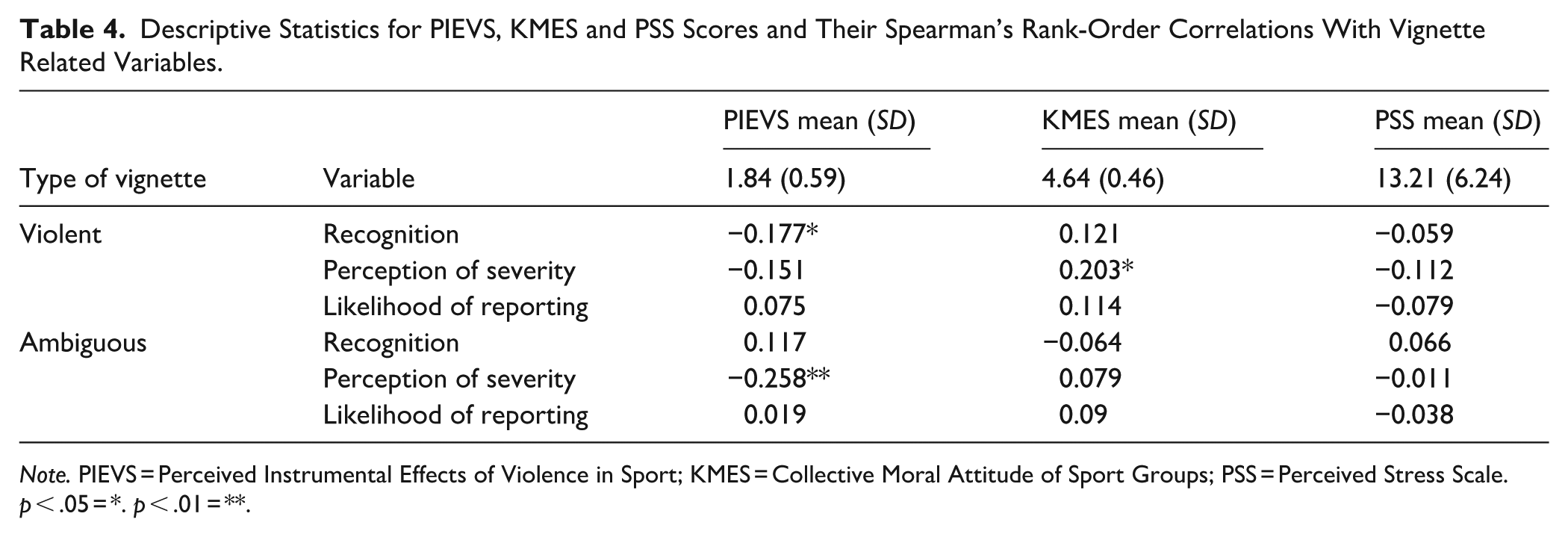
Descriptive statistics for participants’ scores on the Perceived Instrumental Effects of Violence in Sport (PIEVS) scale, the Collective Moral Attitude of Sport Groups (KMES) scale, and the Perceived Stress Scale (PSS) are summarized in Table 4. Shapiro-Wilk tests, supplemented by graphical assessments, indicated significant deviations from normality for the PIEVS (W = 0.952, p < .001), KMES (W = 0.786, p < .001), and PSS (W = 0.945, p < .001).
Descriptive Statistics for PIEVS, KMES and PSS Scores and Their Spearman’s Rank-Order Correlations With Vignette Related Variables.
Note. PIEVS = Perceived Instrumental Effects of Violence in Sport; KMES = Collective Moral Attitude of Sport Groups; PSS = Perceived Stress Scale.
p < .05 = *. p < .01 = **.
To explore the relationships between the vignette variables (i.e., recognition, perception of severity, and likelihood of reporting) and scores on the PIEVS, KMES, and PSS scales, Spearman’s rank-order correlations were conducted. The results of these analyses are also presented in Table 4.
Overall, the analyses revealed very few significant correlations between the psychological constructs and the vignette variables. In violent scenarios, a small negative correlation between PIEVS scores and recognition indicates that coaches who viewed violence as instrumental for performance were less likely to correctly recognize violent behaviors. Additionally, a small positive correlation between KMES scores and perception of severity suggests that coaches with stronger collective moral attitudes were more likely to perceive violent behaviors as severe. However, these correlations are weak and would likely not withstand correction for multiple comparisons.
In ambiguous scenarios, a small negative correlation between PIEVS scores and perception of severity implies that coaches who perceived violence as instrumental also rated ambiguous behaviors as less severe. No significant correlations were found between PSS scores and any vignette variables in either violent or ambiguous scenarios.
Discussion
The aim of this study was to examine coaches’ safeguarding responses to interpersonal violence (IV), including their ability to recognize violent and ambiguous scenarios, appraise their severity, and indicate their likelihood of reporting them. The findings highlight substantial challenges in recognizing certain forms of violence, especially neglect, and show that misclassification reduces both severity ratings and reporting intentions. These results underscore critical gaps in safeguarding practice.
As hypothesized, recognition rates varied by type of violence. Neglect was the least accurately recognized, followed by psychological violence, whereas physical and sexual violence were recognized with greater consistency. Of particular concern, some coaches failed to recognize overt instances of violence—behaviors that do not leave room for interpretation (e.g., a coach kissing his 16-year-old athlete). This finding is consistent with U.S. evidence suggesting that some youth sports coaches do not categorically reject sexual relationships with underage athletes (Kim et al., 2023). Therefore, difficulties in recognizing harm are not limited to subtle or covert forms of violence. Overall, the pattern aligns with prior research noting that neglect has historically been overlooked in sport (Mountjoy et al., 2016; Stirling, 2009). Unlike active forms of violence, neglect involves harm through inaction (Kerr, 2022), making it less visible and harder to detect. Yet prevalence studies suggest neglect is as common as, or even more common than, other forms of IV (Hartill et al., 2023; Willson et al., 2022). These findings emphasize the urgent need to enhance coaches’ awareness of neglect as a serious safeguarding concern while also ensuring that overt acts of violence are consistently recognized and appropriately addressed.
The results further indicate that misclassified violent scenarios were perceived as less severe and less likely to be reported, echoing prior research in sport and related fields (Verhelle et al., 2022; Banyard, 2011). In this design, all violent vignettes depicted behaviors that breach safeguarding standards and would therefore be expected to trigger reporting obligations under national regulations (Swiss Olympic, 2021). Neglect emerged as the form of violence perceived as the least severe by coaches, even though severity ratings still fell within a moderate-to-high range. This pattern highlights that coaches do recognize neglect as harmful but tend to appraise it as less serious than other forms of violence. Importantly, research on child maltreatment consistently shows that neglect can have consequences comparable to those of physical and psychological violence, including heightened risks of depression, substance use, suicidality, and other long-term harms (Norman et al., 2012). The relatively lower severity attributed to neglect in this study therefore, reflects coaches’ perceptions rather than the actual seriousness of its impact.
Reporting intentions also varied by type of violence. Sexual violence elicited the highest likelihood of reporting, whereas psychological violence and neglect were far less likely to be reported, despite both being rated as (moderately-)severe. This discrepancy may reflect the broader societal perception of sexual violence as more clearly defined, morally unacceptable, and legally actionable, while other forms remain less clearly codified.
Taken together, these findings suggest that while recognition, severity appraisal, and reporting are connected, the relationship is not linear: even when violence is recognized and severity ratings are high, reporting may not follow. This finding supports prior research showing that recognizing harm does not necessarily translate into formal reporting (Radziszewski et al., 2024) or informal disclosure (Woessner et al., 2023). Barriers such as fear of professional repercussions, uncertainty about procedures, distrust in systems, and perceptions of inefficacy frequently inhibit action (Radziszewski et al., 2024). Structural dynamics within sport further reinforce silence: conformity to norms and deference to authority can make reporting appear disloyal or risky (Solstad, 2019; Verhelle et al., 2022). Relational and emotional considerations—such as anticipated reactions, concerns about relationships, or perceived social costs—also weigh heavily on disclosure decisions (Woessner et al., 2023). Safeguarding initiatives must therefore address not only recognition skills but also the structural, cultural, and relational barriers that constrain reporting in sport.
Ambiguous scenarios proved particularly challenging, as coaches frequently misclassified them as either clearly violent or clearly non-violent, rather than recognizing the complexity and uncertainty inherent to such situations. Key contextual information—such as the coach’s intention, tone, or the history of the coach–athlete relationship—was absent from the vignettes, making it difficult for participants to determine whether the behavior crossed a line (Follingstad, 2011). Research shows that athletes’ perceptions of coaching behavior depend heavily on such contextual cues (Marsollier & Hauw, 2022). In this study, ambiguous vignettes were designed to portray behaviors that raise concern but do not, by themselves, automatically meet the threshold for mandatory reporting (Swiss Olympic, 2021). Rather, they represent situations where coaches are expected to remain alert, seek clarification, or take informal steps to protect athletes, even if formal reporting is not immediately warranted.
The analysis of ambiguous scenarios showed patterns that differed by form of violence, though most did not remain significant after correction. For psychological and neglect vignettes, misclassification was linked to higher severity and reporting ratings, but these trends were not robust. By contrast, the sexual vignette showed a clear effect, with correct recognition of ambiguity associated with higher severity and reporting. The physical vignette produced weaker, nonsignificant differences, with a tendency toward lower severity ratings when misclassified. Overall, ambiguity was not interpreted uniformly, and safeguarding responses appeared to depend on the type of behavior depicted.
Although this study focused on safeguarding responses, the processes examined—recognition, severity appraisal, and reporting intentions—are also relevant to bystander frameworks. In Latané and Darley’s (1970) decision-making model, noticing an event and judging its seriousness represent early stages that shape whether intervention occurs. Our findings suggest that coaches may experience difficulties at these initial steps, particularly in cases of neglect and ambiguous behaviors, which could interrupt progression toward further action. Previous research has similarly shown that recognition and perceived severity influence whether individuals engage in supportive or preventive behaviors (Adriaens et al., 2024; Banyard, 2008; McMahon & Banyard, 2012). At the same time, reporting represents only one possible safeguarding response. Coaches may also act informally by monitoring situations, providing support, or seeking advice, which aligns with forms of intervention described in the bystander literature (Hamby et al., 2016). Situating these results in relation to bystander research, therefore provides a useful lens for interpretation, while underscoring that this study examined only a subset of the processes involved in bystander intervention.
To further explore influences on safeguarding responses, we examined three psychological constructs frequently highlighted in the literature on IV (Roberts et al., 2020): perceived instrumental effects of violence, collective moral attitudes, and perceived stress. The analysis revealed modest and inconsistent associations between these constructs and coaches’ responses to IV. The perceived instrumental effects of violence were negatively associated with recognizing violent behaviors and perceiving severity in ambiguous vignettes. Similarly, collective moral attitudes demonstrated a positive, albeit limited, correlation with perceptions of severity. In contrast, perceived stress did not show any significant associations with vignette-related variables, suggesting a limited direct impact in the contexts examined.
Beliefs and norms are well-established precursors of safeguarding behavior (Adriaens et al., 2024; Verhelle et al., 2022). For example, in cases of sexual violence, individuals with lower acceptance of rape myths or adversarial sexual beliefs are more likely to acknowledge harm and take protective action (McMahon, 2010). While beliefs about the instrumental effects of violence contribute to the normalization of IV in sport (Roberts et al., 2020), they may not fully capture the broader range of individual beliefs that influence safeguarding responses. However, the internal consistency of the scale used to measure beliefs about the instrumental effects of violence fell slightly below acceptable thresholds, which may undermine the strength and reliability of the observed correlations. Similarly, while collective moral attitudes are relevant for understanding normative climates, they do not account for the complex interplay of individual, contextual, and situational factors that shape safeguarding practices in sport.
Contrary to expectations, perceived stress did not exhibit significant correlations with any vignette-related variables, suggesting its limited role in shaping coaches’ responses to violent or ambiguous scenarios. The measure used in this study assessed perceived global stress—the extent to which participants felt their lives were unpredictable, uncontrollable, or overloaded over the past month (Klein et al., 2016)—rather than situational stress arising from real-life contexts involving violence or ambiguity.
Overall, our findings offer limited empirical support for the hypothesized relationships between these psychological constructs and key components of safeguarding responses across both violent and ambiguous scenarios. It is possible that the constructs explored here may be more strongly associated with the cognitive and motivational processes underlying perpetration, rather than with those guiding recognition, severity appraisal, and reporting. Future research should further differentiate the psychological mechanisms relevant to perpetrators versus safeguarding actors and consider additional factors across multiple levels of analysis—individual, group, and organizational—to enhance understanding of coaches’ responses to IV in sport.
Limitations and Future Research
This study’s findings must be interpreted within the context of several limitations. The use of vignettes is a widely applied methodology for examining responses to IV in sport (Gervis et al., 2016; Mountjoy, Verhelle, et al., 2024; Solstad, 2019), yet it cannot fully replicate the dynamic and multifaceted nature of real-world situations. Coaches’ behaviors are often shaped by a complex interplay of emotions, time constraints, and organizational pressures (Frost et al., 2024), which are difficult to simulate without potentially inducing harm or distress. While the vignette method minimizes participant risk and ensures ethical compliance (Bradbury-Jones et al., 2012), it may limit ecological validity (Aguinis & Bradley, 2014), and the challenges coaches face in recognizing violence—particularly subtle or ambiguous forms—may be underestimated. Future research could explore alternative approaches, such as anonymized surveys based on retrospective accounts, while maintaining participant safety and confidentiality.
A further limitation concerns the classification of violence forms. In real-life situations, different forms of violence often co-occur or unfold in sequence (Kim et al., 2017; Mountjoy et al., 2016; Ohlert et al., 2021), making strict categorization inherently difficult. Although vignettes were classified according to the form with the highest level of expert agreement, expert ratings often identified multiple forms within the same scenario. It is possible that some coaches were more attuned to one aspect of the vignette than another. Such variation may blur the interpretation of what is being measured and highlights the limitations of attributing behaviors to a single form of violence.
Relatedly, the ambiguous vignettes presented inherent challenges in classification. Although those with the highest consensus rates among experts were selected, variability in expert judgments underscores the difficulty of defining and interpreting ambiguous behaviors. This suggests that clearer instructions for the “Unclear, I need more information” response option could enhance the reliability of future vignette-based studies. Despite these challenges, the ambiguous vignettes successfully illustrated the complexities of responses under uncertainty, emphasizing their value in research. Further work could also examine the thought processes of coaches who struggle to accurately recognize violent behaviors, providing deeper insight into how judgments are formed.
Another limitation concerns severity ratings, which were based solely on participants’ perceptions as experts were only asked to classify vignettes by form and level of violence. Future studies could integrate expert benchmarks to enhance interpretability.
While this study did not specifically assess the bystander decision-making model, one relevant step concerns the assumption of responsibility. Responsibility-taking was not measured here, yet bystander frameworks recognize it as a crucial link between judging an event as serious and deciding to act (Latané & Darley, 1970). Future research should examine this mechanism more directly to clarify the role of responsibility in coaches’ safeguarding responses.
In line with diversity and inclusion principles, the study prioritized gender representation and age comparability with the broader coaching population. However, it did not assess other aspects of participant diversity (e.g., race, ethnicity, sociocultural background) or collect data on coaches’ prior experiences with violence, either as individuals exposed to violence or as perpetrators—factors shown to influence safeguarding responses (Kistler et al., 2022; Woods et al., 2022). These limitations should be considered when interpreting the findings and point to important directions for future research.
Implications and Conclusion
This study underscores the challenges coaches face in safeguarding athletes from IV, especially in relation to less visible forms such as neglect. Inconsistent links between recognition, severity appraisal, and reporting illustrate that safeguarding is a complex process shaped by multiple factors. Addressing these gaps requires targeted, context-sensitive education that equips coaches with practical tools to respond effectively, alongside structural and cultural changes that reduce barriers to action. Although the psychological factors examined showed only limited associations with safeguarding responses, further research should consider additional individual, relational, and organizational influences. Collectively, these findings highlight the need to strengthen safeguarding practices in sport by addressing both coaches’ skills and the broader dynamics that shape their responses.
Supplemental Material
sj-docx-1-jiv-10.1177_08862605251408112 – Supplemental material for Exploring Coaches’ Responses to Interpersonal Violence in Sport: Recognition, Severity Perception, and Likelihood of Reporting
Supplemental material, sj-docx-1-jiv-10.1177_08862605251408112 for Exploring Coaches’ Responses to Interpersonal Violence in Sport: Recognition, Severity Perception, and Likelihood of Reporting by Laurie Schwab, Philipp Röthlin, Roberta Antonini Philippe and Stephan Horvath in Journal of Interpersonal Violence
Footnotes
Acknowledgements
The author would like to sincerely thank Prof. Sylvie Parent for her valuable feedback and insightful comments on earlier versions of this manuscript. Her expertise and thoughtful guidance contributed meaningfully to the development of this work.

Ethical Considerations
This study was conducted in accordance with the ethical principles outlined in the Declaration of Helsinki. It was reviewed and approved by the Institutional Review Board of the Swiss Federal Institute of Sport Magglingen, under approval number 228_03_2024. Ethics approval information is also reported in the Methods section of this manuscript.
Consent to Participate
Informed consent to participate was obtained from all participants. Consent was provided in written form prior to data collection.
Author Contributions
Laurie Schwab: Conceptualization (lead), Data Curation (lead), Formal analysis (lead), Funding acquisition (lead), Investigation (lead), Methodology (lead), Visualization (lead), Project administration (lead), Writing—Original Draft (lead).
Philipp Röthlin: Conceptualization (lead), Formal analysis (support), Funding acquisition (support), Methodology (lead), Supervision (lead), Validation (support), Visualization (support), Writing—Original Draft (support).
Roberta Antonini Philippe: Conceptualization (support), Funding acquisition (support), Supervision (lead), Writing—Original Draft (support).
Stephan Horvath: Conceptualization (lead), Formal analysis (support), Funding acquisition (support), Methodology (lead), Supervision (lead), Validation (support), Visualization (support), Writing—Original Draft (support).
Funding
The authors disclosed receipt of the following financial support for the research and/or authorship of this article: This research was funded by the Swiss National Science Foundation (P000PS_214699).
Declaration of Conflicting Interests
The authors declared no potential conflicts of interest with respect to the authorship and/or publication of this article.
Data Availability Statement
The datasets of the study will be made available on the Open Science Framework (OSF) repository once the article is accepted for publication.
Supplemental Material
Supplemental material for this article is available online.
Author Biographies
References
Supplementary Material
Please find the following supplemental material available below.
For Open Access articles published under a Creative Commons License, all supplemental material carries the same license as the article it is associated with.
For non-Open Access articles published, all supplemental material carries a non-exclusive license, and permission requests for re-use of supplemental material or any part of supplemental material shall be sent directly to the copyright owner as specified in the copyright notice associated with the article.
