




Abstract
Intimate partner violence (IPV) victimization is associated with insecure attachment and psychological distress, which can have profound implications for parenting. Yet, studies are needed to better understand the intergenerational implications of IPV, especially in non-Western countries. This study examines how experiences of IPV in grandmothers may have cascading effects on maternal IPV and mental health, with negative implications for children’s attachment in Cameroon. Fifty-four families completed the study materials including validated questionnaires (grandmothers, mothers) and an attachment story completion task (preschool-aged children). Sequential mediation models were tested. The mediation was only significant for disorganized attachment. Grandmothers’ IPV victimization was associated with greater scores of disorganized attachment in children (c = 0.16; 95% CI [0.03, 0.28]), via its association with increased IPV victimization in mothers, which was in turn associated with increased maternal distress (c2 = 0.05; [0.00, 0.11]). This study provides unique insights into attachment representations of Cameroonian children in the context of intergenerational IPV. Intervention on IPV and maternal mental health may improve child and family well-being.
Introduction
A central assumption of attachment theory, put forward by Bowlby (1980, 1982), is that human beings need close emotional bonds for their survival, and that the quality of early interactions between caregivers and children plays a key role throughout life. Parent–child interactions that are positive and harmonious are related to secure attachment representations, while insensitive, inconsistent, and chaotic parent–child interactions have been associated with insecure attachments (Costa & Botelheiro, 2021; Ørke et al., 2021; Sonkin et al., 2019). The development of attachment security in children is likely to be affected by the presence of early trauma, such as exposure to intimate partner violence (IPV; i.e., physical, sexual, and psychological violence by a current or former romantic partner; Zvara & Mills-Koonce, 2021). Additionally, research has shown that women who experience IPV often struggle with insecure attachment (Velotti et al., 2018) and psychological distress (Scott & Babcock, 2010; Zhang et al., 2024), which can have profound implications for parenting (e.g., reduced emotional availability and responsiveness to the child’s needs), and their children’s developing attachment representations (Zvara & Mills-Koonce, 2021). Thus, elucidating the cascading effect of intergenerational IPV victimization (Spencer et al., 2021; Wadji et al., 2024) on insecure attachments in children through multi-generational studies is of paramount importance. Studying this phenomenon in Sub-Saharan Africa is particularly relevant, given the high rates of IPV (averaging 36% compared to the global rate of 30%, and reaching up to 52% in certain countries like Cameroon; Institut National de la Statistique, 2015; McCloskey et al., 2016; Mossie et al., 2023), and unique cultural, social, and economic contexts that may shape the experience of IPV across generations (e.g., women perceived as the property of their husbands, attitudes that support IPV, and rigid gender roles; World Health Organization, 2009, 2013). The current study aims to further our understanding of the associations between cycles and severity of IPV and attachment representations in Cameroonian children using data from three generations and to examine the underlying pathways.
The Intergenerational Continuity of IPV
The intergenerational continuity of IPV—where exposure to IPV in childhood can increase the risk of experiencing or perpetrating IPV in adulthood—is supported by several theoretical frameworks, most notably social learning theory. Specifically, this theory, pioneered by Bandura (1977), posits that individuals learn behaviors through observation and imitation. Meta-analyses provide compelling empirical evidence for the intergenerational continuity of IPV as they have consistently demonstrated strong associations between childhood exposure to IPV and an increased risk of experiencing or perpetrating IPV in adult romantic relationships, including in Sub-Saharan Africa (Smith-Marek et al., 2015; Stith et al., 2000; Wadji et al., 2024). It is suggested that exposure to violence between parents can lead to desensitization, where the child becomes less emotionally responsive to aggressive acts (Mrug et al., 2016), potentially diminishing their perception of the violence and its negative consequences. Furthermore, children growing up in homes where IPV is present may normalize violent conflict strategies (Ehrensaft et al., 2003; Mbilinyi et al., 2012), shaping their understanding of acceptable behaviors in intimate relationships (Chernyak et al., 2020). Although the literature strongly supports the intergenerational continuity of IPV, the specific mechanisms underlying this continuity remain poorly understood (Badenes-Ribera et al., 2020).
Intergenerational IPV and Psychological Distress
Chronic exposure to IPV-related stress during childhood and adulthood can lead to significant psychological distress (Eriksen et al., 2022). The relationship between IPV victimization and psychological distress is well-established, with women exposed to IPV typically experiencing higher levels of anxiety, depression, and post-traumatic stress, including in Sub-Saharan Africa (Shen & Kusunoki, 2019; Spencer et al., 2019; Wadji et al., 2022; White et al., 2024). Common explanations for this association include the development of learned helplessness (Segrin & Cooper, 2022), as well as the influence of factors such as low self-esteem, ineffective coping strategies, lack of social support, and insecure attachment (Dishon-Brown et al., 2021; Dos Santos Mesquita & Da Costa Maia, 2019; Flanagan et al., 2014; Hill et al., 2010).
A recent narrative synthesis on 76 studies by White et al. (2024) found strong and consistent evidence that greater IPV severity is associated with more mental health outcomes, including depression, post-traumatic stress disorder (PTSD), and suicidal ideation. The review also identifies important methodological shortcomings in research that dichotomizes IPV exposure, such as the inability to differentiate between one-time and chronic abuse, or between minor and severe IPV experiences. Corroborating this finding, a meta-analysis also demonstrated that children’s adjustment problems are more strongly associated with IPV exposure when IPV is measured more broadly—encompassing psychological, sexual, and physical violence—rather than narrowly focusing on one type of abuse (Vu et al., 2016). These findings collectively suggest that evaluating IPV lifetime polyvictimization provides more accurate insights into intergenerational outcomes compared to binary measures that solely indicate presence or absence, or those that focus on a single form of abuse. This limitation is particularly concerning in research involving vulnerable and highly exposed populations, such as those in Sub-Saharan Africa (Mossie et al., 2023; Walby & Towers, 2017), where variations in IPV severity, rather than relying on binary exposure indicators, are crucial because it prevents the loss of meaningful distinctions and can be the primary determinant of negative intergenerational outcomes (White et al., 2024).
Research has increasingly sought to clarify how maternal experiences of IPV contribute to adverse developmental outcomes in children. A growing body of evidence points to maternal psychological distress as a key mechanism in this relationship, suggesting that the emotional and mental health consequences of IPV may impair parenting capacities, thereby affecting children’s well-being. For example, Miranda et al. (2013) found that maternal IPV victimization was associated with increased externalizing behavior problems in children, with maternal depressive symptoms acting as a significant mediator. Similarly, Zolinski (2023) demonstrated that maternal IPV victimization was linked to higher levels of maternal psychological distress, which in turn mediated the relationship between maternal IPV and adolescent delinquency, including poor academic achievement, criminal involvement, aggression, and substance abuse.
Taken together, previous research highlights how maternal psychological distress following IPV victimization can impair parenting, leading to negative consequences for children’s well-being. However, evidence emphasizes the importance of assessing not only the occurrence of IPV but also its lifetime polyvictimization when exploring intergenerational pathways of risk, especially in contexts such as Sub-Saharan Africa, where IPV is both widespread and insufficiently studied.
Attachment Representations in the Context of Intergenerational IPV
Drawing on the theory of attachment by Bowlby (1980) and Ainsworth et al. (1978), four types of attachment representations were identified over the years: secure, avoidant, anxious, and disorganized attachment. Although researchers have sometimes collapsed them into two broad categories of secure and insecure attachment (including anxious, avoidant, and disorganized; Gustafsson et al., 2017; Levendosky et al., 2011). Through their internal working models, securely attached individuals have internalized a reliable relationship with caregivers, including stable and positive representations of the self and others, whereas insecurely attached individuals lack these positive and reliable representations, which can lead to a suboptimal use of interpersonal strategies when faced with stressful situations (Almeida et al., 2023; Gormley, 2005; Kamperman et al., 2020; Orme et al., 2021). In particular, avoidant children display little or no emotion and tend to avoid contact, turn away, or minimize the expression of attachment needs, while anxious children (also referred to as resistant) show resistance behaviors, such as anger, frustration, or defiance as a way of coping with stress (Ainsworth, 2015; Ainsworth et al., 1978; National Collaborating Centre for Mental Health, 2015). Children with disorganized attachment display a mix of anxious and avoidant attachment behaviors, conflicting reactions to their caregiver, as well as contradictory behaviors, disorientation, freezing, dissociation, confusion, and fear when faced with a stressor (Granqvist et al., 2017).
Several studies have linked insecure attachment in children, particularly disorganized attachment, to family histories of neglect or abuse (see a meta-analysis by Cyr et al., 2010). IPV experienced by mothers was associated with their children’s attachment representations (see a meta-analysis by Noonan & Pilkington, 2020), but the specific mechanisms that underlie this relationship remain unclear. This knowledge gap is more pronounced in cases of intergenerational IPV, where the grandmother and mother have experienced IPV.
Despite well-documented associations between IPV victimization and psychological distress (see meta-analysis by Dokkedahl et al., 2022; Spencer et al., 2024), both are generally studied separately when examining their impacts on children’s attachment representations. For example, the review by Noonan and Pilkington (2020) was the first to summarize the evidence on the association between IPV and child attachment, revealing that mothers’ IPV victimization was significantly associated with less secure attachment in children. A review by Risi et al. (2021) found that parental psychological distress may lead to poorer caregiving, which was in turn associated with higher rates of insecure or disorganized attachment in children. Similarly, a recent meta-analysis showed a significant association between maternal psychological distress (e.g., depression, anxiety, and stress) and impaired mother–child bonding (O’Dea et al., 2023), suggesting an increased risk of insecure attachment in children of psychologically distressed mothers. Given that maternal IPV victimization and psychological distress are associated with children’s attachment representations, examining these factors together in the context of intergenerational IPV could offer crucial insights for interventions aiming at supporting affected families.
The Caregiving Role of Grandmothers in Sub-Saharan Africa
Grandmothers, particularly maternal grandmothers, play a vital role in Sub-Saharan African families by contributing to collective child-rearing, providing substantial relief and support to their daughters, and strengthening family cohesion (Aubel, 2024; Michel et al., 2019; Riem & van der Straaten, 2024; Schrijner & Smits, 2018). For example, evidence from Ethiopia shows that grandmothers often visited their daughter’s homes and had an active role in household chores and childcare (Gibson & Mace, 2005). In Gambia, researchers also showed a beneficial effect of maternal grandmothers’ involvement on both grandchildren’s nutritional status and mortality rates (Sear et al., 2000).
Grandmothers, as central figures in family dynamics, can significantly affect the well-being of their daughters and grandchildren, for better or for worse. In cases where a grandmother has experienced trauma, such as IPV, her emotional and psychological state may significantly affect her relationships with those around her, including her daughter and grandchildren. For example, multigenerational research showed that grandmothers’ psychological symptoms (e.g., depressed mood, anxiety) were correlated with emotional and behavioral problems in their grandchildren, with this relationship being fully mediated by maternal mental health (Pearson et al., 2019). Corroborating these findings, researchers highlighted that grandmothers can influence their grandchildren both directly, through interactions and caregiving, and indirectly, through mediated pathways such as the well-being of the parents (Hancock et al., 2013). Thus, the experience of IPV by grandmothers, which often leaves lasting emotional and psychological scars, may negatively impact their ability to provide support and care to their daughters and grandchildren.
In summary, while grandmothers can positively influence their daughters and grandchildren’s well-being through affection, support, and guidance, those who have experienced IPV may face various challenges affecting their familial interactions (Badenes-Ribera et al., 2020). However, research exploring IPV lifetime polyvictimization and its cascading effects across generations is notably scarce in Sub-Saharan Africa. Understanding the grandmothers’ role in grandchildren’s developing attachment, especially in the context of intergenerational IPV, could provide crucial information to support IPV-exposed African children.
The Current Study
IPV polyvictimization in African grandmothers can significantly increase daughters’ likelihood of IPV victimization in adulthood (Wadji et al., 2024). This polyvictimization may impair these women’s mental health, leading to anxiety, depression, and post-traumatic symptoms (Cavalcante et al., 2020; Schechter et al., 2007). This psychological distress may spill over into their parenting role, with negative repercussions for children’s developing attachment representations (Chiesa et al., 2018). Thus, IPV lifetime polyvictimization in grandmothers may have cascading effects for the next generations, leading to experiences of IPV and psychological distress in their adult daughters, and an increased risk of attachment insecurity in their grandchildren.
Despite growing interest in this area, research on the intergenerational continuity of IPV has largely been limited to two-generation studies conducted in Western societies (Shakoor et al., 2022; Smith et al., 2011). This evidence may not fully capture the complexities of IPV in non-Western or collectivist societies, where the extended family, particularly grandmothers, are central in the caregiving system (Schrijner & Smits, 2018). Furthermore, studies have yet to test a mediation model across three generations, where grandmothers’ IPV lifetime polyvictimization is sequentially associated with mothers’ IPV victimization, maternal psychological distress, and insecure attachments in children. By exploring these pathways, researchers can gain valuable insights into how IPV continues across generations, how it affects family members, and how its impact may be mitigated.
The current study aims to fill these gaps in the literature by providing a better understanding of the attachment representations of Cameroonian children in the context of intergenerational IPV, measured through the lifetime polyvictimization and accumulation of abuse experienced by both grandmothers and mothers, and the mediating factors implicated. Consistent with previous intergenerational studies, the following notation will be used to refer to each generation: the grandmothers will be referred to as G1, the daughter of the G1 will be referred to as G2, and the grandchildren of the G1 and children of the G2 will be referred to as G3. We hypothesized that the association between G1 IPV polyvictimization and G3 insecure attachment would be sequentially mediated by G2 IPV victimization and psychological distress.
Methods
Participants
Participants were recruited in two cities in Cameroon between July and September 2023. Interested participants were screened and invited by phone to take part in the study (n = 102). Overall, 54 triads completed all the study materials. The sociodemographic characteristics of the sample showed that 56.0% of the G1 were married and 44.3% for G2. Ages ranged from 45 to 65 years (mean age = 54 years) for G1, 21 to 40 years (mean age = 27 years) for G2, and 3 to 7 years (mean age = 5 years) for G3. The sample included 40.7% of boys and 59.3% of girls, with most children attending pre-school and elementary school (81.5%), and 18.5% being too young to attend school. A little under half of the G1 did not have a high school diploma (45.9%), while for G2 it was about a third (29.6%). G1 and G2 reported experiencing high levels of IPV in their lifetime. The sociodemographic characteristics of the sample are reported in Table 1.
Characteristics of the Sample.
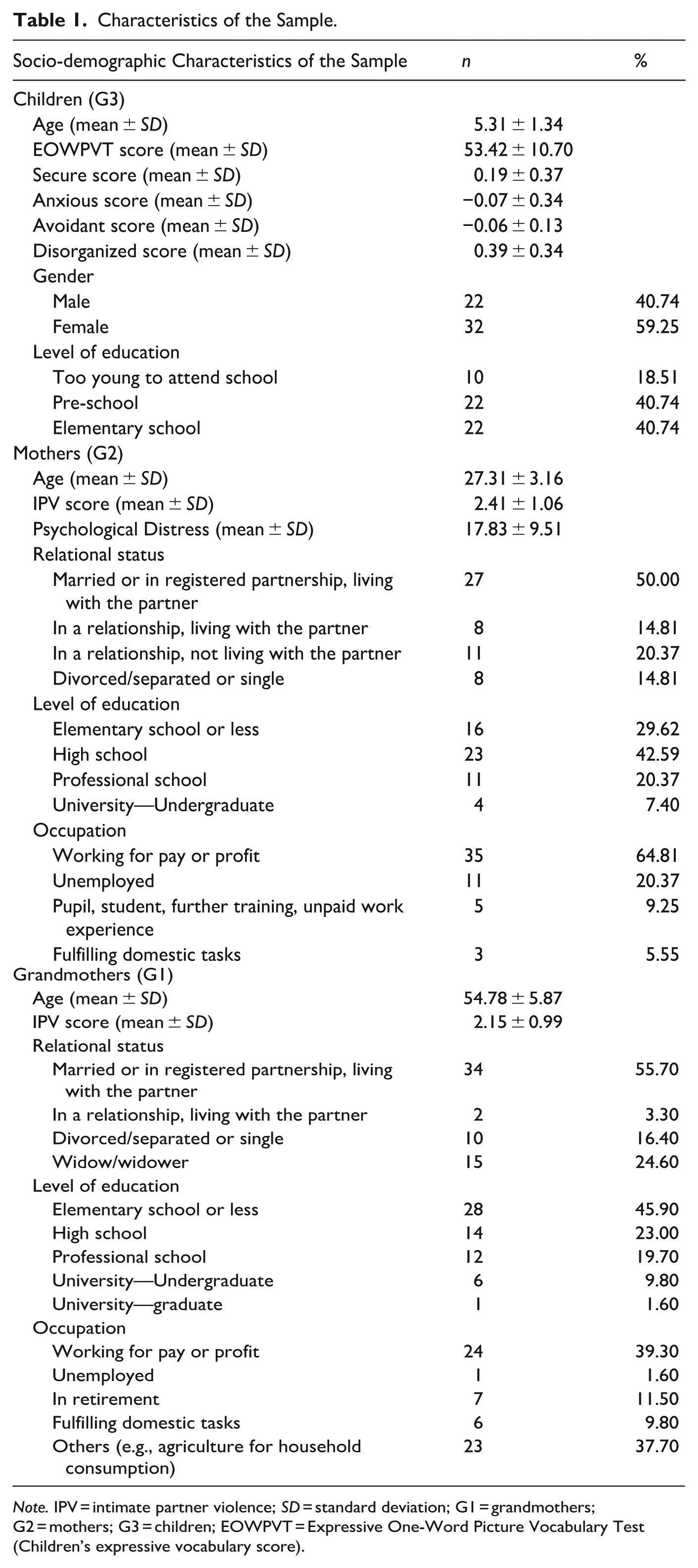
Note. IPV = intimate partner violence; SD = standard deviation; G1 = grandmothers; G2 = mothers; G3 = children; EOWPVT = Expressive One-Word Picture Vocabulary Test (Children’s expressive vocabulary score).
Measures
G1 and G2 completed a sociodemographic questionnaire, which included items on their age, marital status, educational level, and profession. G2 provided sociodemographic information on G3 including age, gender, and schooling.
Intimate Partner Violence
IPV was self-reported by G1 and G2 using the short form of the Revised Conflict Tactics Scales (CTS2; Straus & Douglas, 2004). The CTS2 has 20 items addressing physical, sexual, and psychological violence as well as injury and negotiation. This study used 10 items on victimization, which measure the frequency of partner violence. Some examples of items include: “My partner punched or kicked or beat-up me” (physical); “My partner insulted or swore or shouted or yelled at me” (psychological); and “My partner used force (like hitting, holding down, or using a weapon) to make me have sex” (sexual). Participants responded using a Likert-type scale with the following options: 1 = once in the past year, 2 = twice in the past year, 3 = 3–5 times in the past year, 4 = 6–10 times in the past year, 5 = 11–20 times in the past year, 6 = more than 20 times in the past year, 7 = not in the past year but it did happen before, and 8 = this has never happened. To assess IPV victimization, responses were recoded with responses 1 to 7 (indicating any occurrence) were recoded as 1, and response 8 (indicating no occurrence) was recoded as 0. This binary transformation allowed us to compute a polyvictimization score by summing across three IPV dimensions—physical, sexual, and psychological—yielding a score ranging from 0 to 3, which reflects the number of IPV types experienced by each participant. This composite score reflects varying levels of polyvictimization, capturing the number of different IPV forms experienced by each participant. This approach, as outlined by Schaefer et al. (2018), is a well-established method for constructing interval-level scales from ordinal data, allowing for an accurate and reliable measure of polyvictimization experienced by participants.
Psychological Distress
G2 psychological distress was measured using the Psychological Distress Index (PDI; Préville et al., 1992). The PDI consists of 14 items assessing the frequency of psychological symptoms of anxiety, depression, irritability, and cognitive problems on a 4-point Likert scale (0 = never; 1 = sometimes; 2 = often; 3 = almost always). Examples of items include: “Did you get angry over things that are not too important?”; and “Did you feel bored or have little interest in things?” Response scores are summed, divided by the maximum possible score (42), and multiplied by 100, in order to produce a score ranging from 0 to 100, with higher scores indicating greater levels of psychological distress. Cronbach’s alpha in the current study was .92.
Attachment Story Completion Task
Children’s attachment representations were evaluated using the Attachment Story Completion Task (ASCT; Bretherton et al., 1990), a semi-structured interview developed to activate attachment representations in young children. Children were provided with figurines representing family members and asked to complete a story started by the researcher. The principal investigator first presented a warm-up story referring to a birthday party. Following the warm-up story, five emotionally laden story stems (e.g., spilled juice, hurt knee in a park, fear of a monster at bedtime, parents leaving for a day and then returning the next day) were presented to children. Children were then invited to complete each story, and their narratives were audio recorded, an approach used in many studies (Charest et al., 2019; Hébert et al., 2020). The researcher also had to verbally describe in the audio recordings the nonverbal actions of the child, their handling of the characters, and their participation in the game for future coding.
ASCT Q-Sort
Children’s narratives were coded using the ASCT Q-Sort (Miljkovitch et al., 2004), which is composed of 65 statements concerning reactions to separation and reunion, problem solving, and narrative coherence. Some examples include: “When negative emotions (e.g., fear, pain) are brought up in the story stem, the child makes the parental figures intervene”; “The child tries to get close to his/her (actual) mother”; and “Parental control (discipline, anger) is mild, not violent or extreme”. The 65 items were sorted into seven piles (from most characteristic to least characteristic) whose frequencies fitted a normal distribution (i.e., 5, 8, 12, 15, 12, 8, and 5 cards). Two coders independently coded the narratives. Interrater reliability, calculated based on 20% of the cases, was 0.85, indicating a high level of agreement between the two raters. A score ranging from 1 to 7 given to each statement was then correlated with those of four attachment prototypes elaborated by Miljkovitch et al. (2004) and based on expert ratings to generate Q-scores. Four-dimensional scores of attachment (i.e., secure, avoidant, anxious, disorganized) are thus provided for each child, with ranges from −1.0 to +1.0 reflecting the degree of similarity between the child and a prototypically secure, avoidant, anxious, or disorganized child. In secure narratives, children collaborate and develop coherent stories and constructive solutions to challenges, and parental figures are described as meeting the child’s needs in distressed situations. In avoidant narratives, children tend to be uncomfortable, and inactive (e.g., they refuse to complete the story stem). Children engaged in hyperactivated or anxious narratives are interested and stimulated by the task, but they are more likely to focus on the negative aspects of the story, and their emotional arousal may prevent them from completing the narratives constructively. Disorganized narratives are portrayed by incoherent and disorganized stories, loss of control, and catastrophic endings, and parental figures are portrayed as unprotective and unresponsive to the child’s needs (Hébert et al., 2020; Miljkovitch et al., 2004).
Children’s Expressive Vocabulary
Children’s expressive vocabulary was controlled for using Expressive One-Word Picture Vocabulary Test (EOWPVT; Gardner, 1983). EOWPV is commonly used to index children’s overall language ability and expressive vocabulary. EOWPV is composed of 143 items, and the child is required to perform a naming task. The raw scores are converted to age-referenced norms (age-equivalent scores).
Procedure
The study was approved by the National Ethics Committee in Cameroon (N0 2023/04/1532/CE/ CNERSH/SP) and the Ethics Committee of McGill University (REB#23-05-088). Authorizations from the Ministry of Women’s Empowerment and the Family (MINPROFF) as well as from the Regional Delegation of MINPROFF in Yaoundé and Bafoussam were obtained. Participants were recruited using the MINPROFF records of victims who had reported cases of IPV in the last 5 years. Ads were also displayed on the premises of the regional MINPROFF delegation and its surroundings. All potential participants were screened by phone prior to participation, and an appointment was scheduled at the women’s and family promotion centers of the MINPROFF. Inclusion criteria pertained to age (18 years and older for G2 and 3 to 7 years for G3), language (French or English-speaking), having experienced IPV for G1, and childhood exposure to IPV for G2 (seeing or hearing interparental violence). Individuals with neurodevelopmental disorders preventing them from completing research activities such as severe autism, intellectual disability, or communication disorders were excluded. Before the survey was administered, all parents signed a consent form via Qualtrics, while children gave verbal consent. Prior to the storytelling task, the principal investigator administered the EOWPVT. The principal investigator also conducted the ASCT with the child alone, while G1 and G2 completed the questionnaires in separate rooms with the assistance of two research assistants. Each participant received financial compensation for transport costs (CHF 10).
Data Analysis
All analyses were done using IBM SPSS Statistics version 28 (IBM Corporation). A significant p value was set at <.05. In order to examine the distribution of scores, we conducted Kolmogorov-Smirnov tests. As the distribution for each attachment dimension was not normal (all p < .002), preliminary analyses were conducted using non-parametric tests, and mediation analyses were performed using bootstrapping. To examine the associations between the main study variables (G1 and G2 experiences of IPV, G2 psychological distress, G3 attachment scores), Spearman correlations were first conducted.
Sequential mediation analyses (model 6) were conducted separately in PROCESS version 3.4 for SPSS (Hayes, 2022) for each attachment score, with G3 attachment scores (Y) as the dependent variables, G1 IPV polyvictimization scores (X) as the independent variable, and G2 IPV victimization and psychological distress scores as sequential mediators 1 (M1) and 2 (M2), unstandardized coefficients were reported to preserve interpretability given the differing scales of the variables (e.g., polyvictimization, psychological distress, attachment). A covariate analysis using the Mann–Whitney U test was conducted to control for potential confounding effects of G3 gender, age, expressive vocabulary, and sociodemographic variables from G1 and G2, including relational status, education level, and occupation, which were dichotomized. Relational status was categorized as either living with a partner (i.e., married, in a registered partnership, or in a relationship) or not living with a partner (i.e., divorced/separated or single). Education level was divided into two groups: low (i.e., elementary school or less) and high (i.e., high school, professional school, or university). Lastly, occupation was dichotomized into employed (i.e., working for pay or profit and unemployed) or unemployed (i.e., not having a paid job including, being a student and fulfilling domestic tasks).
Results
Preliminary Analysis
Spearman correlations showed a significant association between G3 disorganized attachment and G1 and G2 IPV victimization, as well as G2 psychological distress. The correlation between G1 IPV polyvictimization and G3 anxious attachment was also significant (Table 2).
Spearman’s Correlations between Study Variables.
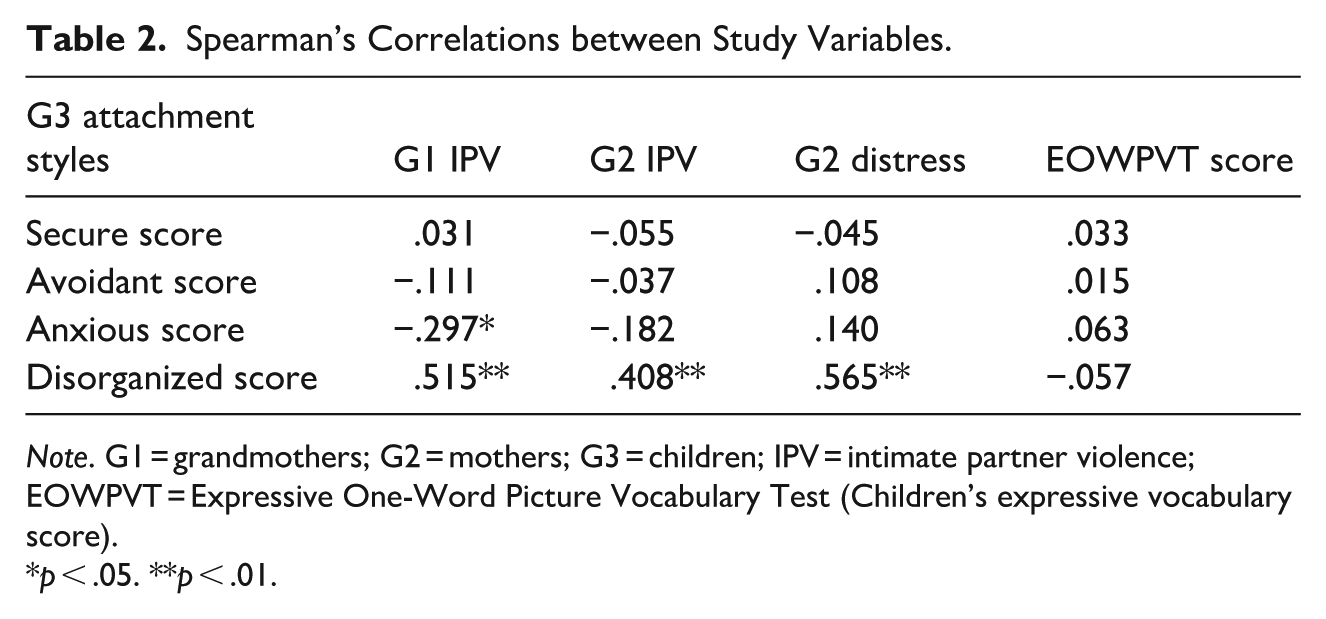
Note. G1 = grandmothers; G2 = mothers; G3 = children; IPV = intimate partner violence; EOWPVT = Expressive One-Word Picture Vocabulary Test (Children’s expressive vocabulary score).
p < .05. **p < .01.
Mann–Whitney U test (Table 3) showed a significant association between children’s gender and scores of disorganized attachment (U = 243.0; p < .001), reflecting higher scores in girls. Consequently, gender was included as a covariate in subsequent analyses. No significant associations were found between children’s attachment scores and sociodemographic characteristics of the families (e.g., G1 and G2 variables such as age, level of education, relational status, and occupation). Additionally, children’s age was not significantly related to attachment scores.
Mann–Whitney U Test Comparison Analysis by Attachment Representation.
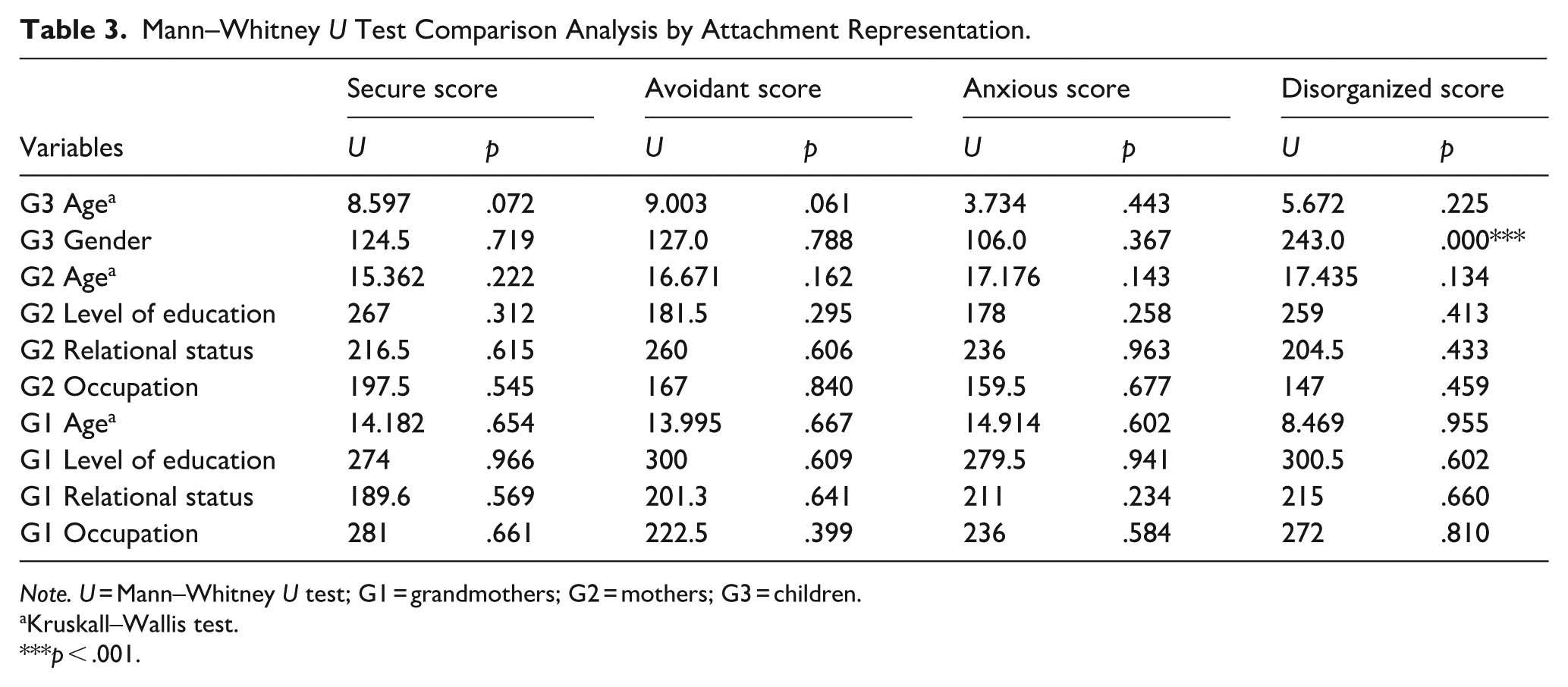
Note. U = Mann–Whitney U test; G1 = grandmothers; G2 = mothers; G3 = children.
Kruskall–Wallis test.
p < .001.
Sequential Mediation Analysis
The sequential mediation model was significant only for disorganized attachment. The results of this sequential mediation analysis are shown in Figure 1, where G1 IPV lifetime polyvictimization is modeled to influence children’s attachment through two pathways (i.e., a1d21b2, c1). The arrows in the figure display the paths of the tested model, and a1, a2, b1, b2, d21, c1, c, indicate the unstandardized path coefficients.
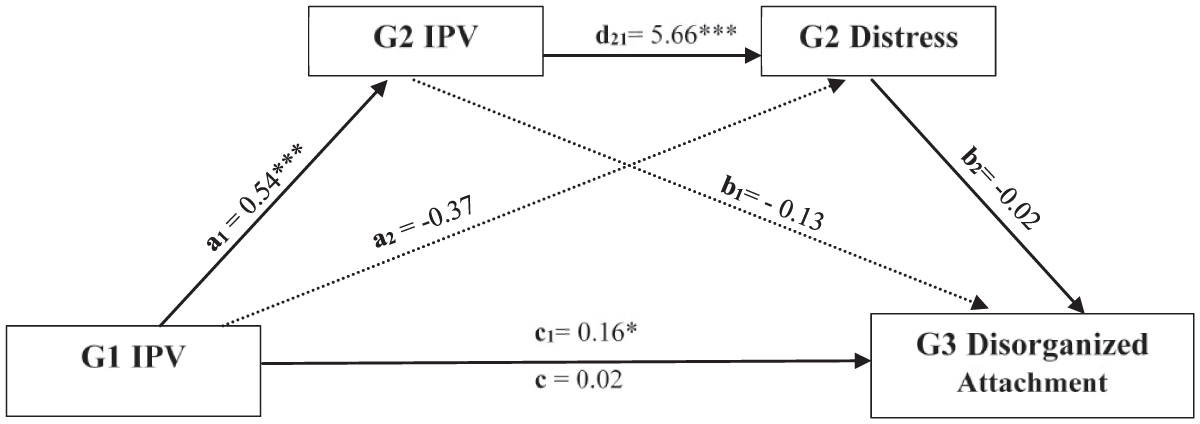
Results of sequential mediation analysis linking G1 IPV to G3 disorganized attachment.
The results (see Figure 1 and Table 4) adjusted for G3 gender indicate that G1 IPV polyvictimization was significantly associated with G2 IPV victimization (a1 = 0.54; 95% CI [0.35, 0.73]) and G3 disorganized attachment (c1 = 0.16; [0.03, 0.28]), but not with G2 psychological distress (a2 = −0.37; [−2.40, 1.66]). G2 IPV victimization was associated with G2 psychological distress (d21 = 5.66; [3.14, 8.18]), but not with G3 disorganized attachment (b1 = −0.13; [−0.32, 0.05]). Finally, G2 psychological distress was not significantly associated with G3 disorganized attachment (b2 = −0.02; [−0.04, 0.00]).
Regression Coefficients, Standard Errors, and Model Summary Information for the Mediation Analysis.
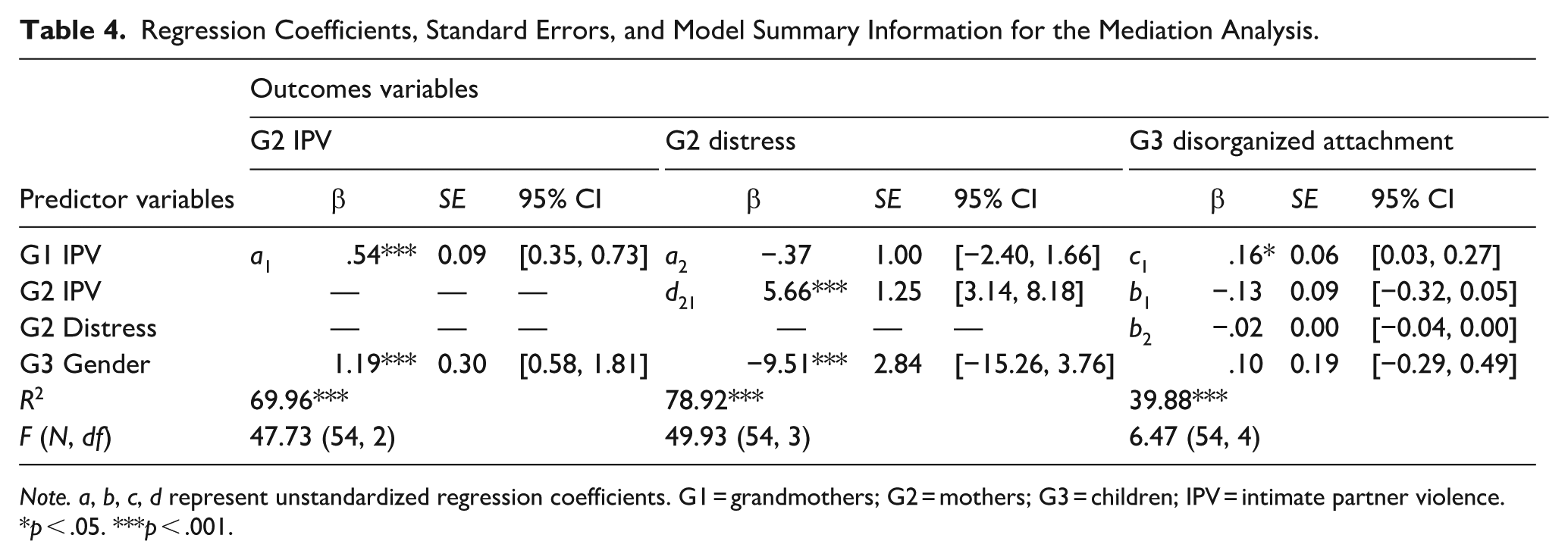
Note. a, b, c, d represent unstandardized regression coefficients. G1 = grandmothers; G2 = mothers; G3 = children; IPV = intimate partner violence.
p < .05. ***p < .001.
The total effect of G1 IPV exposure on G3 disorganized attachment was significant (c = 0.02; 95% CI [0.09, 0.18]). The direct path between the two variables (c1 = 0.16; [0.04, 0.28]) remained significant even after including the serial mediators. The only significant indirect effect between G1 IPV lifetime exposure and G3 disorganized attachment was the complete sequence through G2 IPV and G2 distress (c2 = 0.05; [0.00, 0.11]). Thus, higher G1 IPV exposure was associated with higher G2 IPV scores, which were in turn associated with greater G2 distress scores. Greater G2 distress scores were related to greater scores of disorganized attachment in G3. The sequential mediation model explained 39.88% of the variance in G3 disorganized attachment.
Discussion
This study aimed to explore the attachment representations of Cameroonian children in the context of intergenerational IPV and to investigate the mediating factors that might be involved in this relationship. The results support our hypothesis that the grandmothers’ IPV polyvictimization is associated with attachment in children through its association with greater maternal IPV victimization and the greater psychological distress associated with it, though only for disorganized attachment. This sequential mediation model explained 39.88% of the variance in children’s disorganized attachment, highlighting a cascading effect of intergenerational IPV experiences by the grandmother and the mother on the well-being of children.
Indirect Associations Between Grandmothers’ IPV Lifetime Exposure and Children’s Attachment
The sequential mediation model provides new insights by showing the significant association between IPV lifetime exposure in grandmothers and children’s disorganization. Rather than comparing exposed versus unexposed grandmothers, our model reflects a high-risk sample where variability in IPV experiences (i.e., polyvictimization) provides meaningful insight into risk gradients across generations. A key insight is the role of mothers’ IPV victimization and psychological distress in this association. The results showed that IPV in grandmothers was associated with heightened IPV victimization in mothers, which in turn was related to greater psychological distress in mothers. This distress may impact mothers’ ability to provide a secure and supportive caregiving environment for their children (Marshall et al., 2024), leading to an increased risk for children to develop disorganized attachment patterns, which was also indicated by a previous research (Noonan & Pilkington, 2020). This aligns with research showing that psychological distress is prevalent among young women who have experienced IPV (Shen & Kusunoki, 2019) and with studies on intergenerational trauma, which highlight how adversity faced by maternal grandmothers, including IPV, can impact both mothers and children (Sarı et al., 2024). Additionally, research in Africa underscores the cyclical nature of IPV, demonstrating how experiences of IPV in one generation can increase the risk of IPV involvement in the next (Wadji et al., 2024). Taken together, our findings call attention to the importance of intervening at the level of grandmothers and mothers to prevent IPV and to support maternal mental health for the well-being of children.
Interestingly, the sequential mediation model was significant only for disorganized attachment, and not for other forms of attachment (secure, avoidant, or ambivalent). Several explanations may account for this specificity. Lawler and Talbot (2012) suggest that disorganized attachment emerges when caregivers, particularly in contexts of domestic violence or family instability, display frightening or frightened behaviors instead of offering comfort to a child in need. Given that our model highlights the impact of both maternal IPV victimization and distress, it is likely that this combination may contribute to caregiving behaviors that are particularly erratic, frightened, or emotionally unavailable (Greene et al., 2018), increasing the risk of disorganized attachment in G3. Additionally, our sample included families with a history of intergenerational IPV, which can heighten children’s exposure to chaotic and fearful caregiving environments. This increased exposure could, in turn, amplify the expression of disorganized attachment compared to other attachment styles. In line with this, research has shown that children affected by intergenerational IPV, even indirectly through maternal distress, may experience confusion or fear due to their caregivers’ emotional unavailability or unpredictable responses (Gustafsson et al., 2017). To further our understanding, more cross-cultural and contextual research is needed to explore how socio-environmental factors shape attachment patterns, particularly in communities where intergenerational trauma and family adversity are widespread.
Direct Association Between Grandmothers’ IPV Lifetime Exposure and Children’s Attachment
The direct effect of grandmothers’ IPV lifetime exposure on children’s disorganized attachment highlights that the grandmothers’ experience of IPV may be a critical risk factor for Cameroonian children. While it is well known that grandmothers play a crucial role in child-rearing within Sub-Saharan African cultures (Schrijner & Smits, 2018), their capacity to effectively fulfill this role may be compromised when they have experienced more severe IPV. The emotional distress resulting from IPV exposure can impair their ability to provide a stable and secure environment for their children and grandchildren, potentially undermining their protective functions and contributing to the development of disorganized attachment in the younger generation.
Equally, this result highlights the vulnerability of grandchildren to the long-term effects of IPV, even after considering the role of more proximal factors such as maternal IPV and distress. While grandchildren may not directly witness or experience their grandmothers’ IPV, the emotional and psychological consequences of IPV experienced by their grandmothers can still significantly impact their development through the caregiving relationship. This may occur through changes in the grandmothers’ behaviors or emotional availability, especially in situations where the parents may be unavailable, absent, or unable to provide adequate care. However, further research is needed to replicate our findings and further examine the long-term psychological and emotional outcomes of IPV for grandchildren using larger samples and samples from other African countries.
Gender as a Covariate
Girls had higher scores of disorganized attachment than boys. This contrasts with findings in the western literature, where higher levels of disorganized attachment are found in boys compared to girls (David & Lyons-Ruth, 2005; Toth et al., 2009). Given the limited research on attachment in Africa (see a review by Voges et al., 2019), it is possible that gender differences in attachment may manifest differently in this region. Moreover, in many African societies, including Cameroon, girls and boys may experience family dynamics and stressors differently due to gendered socialization practices (Bornstein et al., 2016). Girls are often expected to take on caregiving roles within the family from a young age, which may increase their emotional sensitivity to household distress, including IPV exposure (Magai et al., 2018). Additionally, when caregivers, such as mothers or grandmothers, are themselves affected by IPV, these emotional disruptions can be more impactful for girls compared to boys (Burnette & Cannon, 2014; Moretti et al., 2006). This may help explain why girls show higher levels of disorganized attachment compared to boys in this study. This insight calls for further exploration into how cultural, familial, and societal factors related to gender influence the way children develop attachment representations, particularly in non-Western contexts like Cameroon. It would be important to determine if these effects hold across diverse cultural contexts, as the mechanisms of attachment may be influenced by cultural norms surrounding family roles and IPV.
Limitations of the Study
Although the present study provides valuable insights into the intergenerational continuity of IPV and its impact on attachment, limitations must be noted. First, the cross-sectional design precludes any conclusions about causality. While the sequential mediation model suggests temporal relationships, it is important to recognize that these relationships are correlational, not causal. Longitudinal studies would be necessary to confirm the directionality and persistence of these effects over time. Another limitation is the sample size, which, while adequate for the analyses performed, is not large enough to be representative of the Cameroonian population. Moreover, the absence of a G1 comparison group without IPV exposure limits certain types of inference, as it prevents us from examining whether the observed patterns are specific to families with a history of IPV or reflect broader intergenerational dynamics present in the general population. However, focusing on a high-risk sample enables a more detailed examination of within-group dynamics related to IPV lifetime exposure and polyvictimization. Additionally, the study was conducted in two cities in Cameroon, and cultural differences in the experience and perception of IPV, as well as in attachment representations, may limit the generalizability of these results to other cultural contexts or countries. Furthermore, the reliance on self-reported measures of IPV and psychological distress may introduce biases, such as social desirability or recall bias, which could affect the accuracy of the data. Future studies could use additional modalities, such as interviews with multiple informants or behavioral observations, to triangulate the findings and reduce potential bias. Lastly, while the study explored maternal distress as a mediator, other potential intervening factors—such as the availability of social support or parenting practices—were not considered and could provide further insight into the mechanisms through which IPV affects children’s attachment in a Sub-Saharan African context.
Despite these limitations, there are several strengths that should be acknowledged, including the multi-informant approach and use of an observational task to assess children’s attachment. This study makes a significant contribution to the literature by investigating the under-researched area of intergenerational continuity of IPV and its impact on child attachment within a Cameroonian context. Utilizing a sequential mediation model, the research provides novel insights into how IPV experienced by grandmothers may indirectly impact children’s attachment representations through their influence on maternal IPV exposure and subsequent distress. By examining this phenomenon within an understudied cultural context and including many family members, the study enhances our understanding of the complex interplay of factors contributing to the intergenerational continuity of trauma and provides valuable implications for developing culturally sensitive interventions to break the cycle of violence and promote healthier attachment outcomes.
Implications of the Findings
The findings of this study have implications for intervention and policy, especially if replicated. First, the identification of maternal distress and victimization as a mediator emphasizes the importance of addressing caregivers’ mental health in interventions aimed at mitigating the intergenerational effects of IPV. Programs that focus on alleviating the psychological distress of caregivers—especially those who have experienced IPV—could help reduce the negative impacts on children’s developing attachment representations. Mental health professionals, social workers, and community organizations should incorporate trauma-informed care that not only addresses IPV directly but also provides psychological support to caregivers to reduce the emotional burden that may otherwise affect their children.
Additionally, given the significant role of grandmothers’ IPV polyvictimization in shaping both mothers’ distress and children’s attachment, policy efforts could focus on providing holistic support to families affected by IPV. With the central role of grandmothers in Cameroonian culture, particularly as primary caregivers and influential figures in children’s upbringing, a family systems approach to intervention may be advisable. This may include ensuring that social services are equipped to address both the immediate and long-term psychological and emotional effects of severe IPV exposure on all family members, including grandmothers, mothers, and children. By supporting caregivers in managing their psychological distress and improving their caregiving abilities, interventions could support the healthy relational development of subsequent generations.
Lastly, our results emphasize the importance of considering gender when studying attachment representations in families affected by IPV. We found that Cameroonian girls may be especially vulnerable to developing disorganized attachment in the context of intergenerational IPV, suggesting the need for interventions that are specifically tailored to address their unique emotional and relational needs, which may differ from those of boys. This finding also speaks to broader issues of gender equality and women’s rights in Cameroon, where socialization processes and systemic inequalities may limit the support and opportunities available to girls. Strengthening policies and programs that promote emotional well-being, resilience, and empowerment for young girls—particularly those exposed to IPV—could play a crucial role in breaking cycles of violence and fostering healthier relationships across generations.
Conclusion
This study highlights the significant role of intergenerational IPV in shaping Cameroonian children’s disorganized attachment representations, with maternal experiences of IPV and psychological distress acting as key mediators. Our findings emphasize the need for further research using more robust methodologies and larger samples to deepen our understanding of these associations in Sub-Saharan Africa. Future studies should also consider examining additional mediating factors and utilizing longitudinal designs to capture the long-term dynamics of these relationships.
Footnotes
Acknowledgements
We extend our sincere gratitude to the families who generously participated in and contributed to this research. We also thank the Regional Delegations of MINPROFF and their dedicated staff for their invaluable assistance in facilitating the recruitment of participants.

Ethical Considerations
This study was approved by the National Ethics Committee in Cameroon (N0 2023/04/1532/CE/ CNERSH/SP) on May 5, 2023, and the Ethics Committee of McGill University (REB#23-05-088) on July 3, 2023.
Consent to Participate
All participants provided written informed consent prior to enrollment in the study. This research was conducted ethically in accordance with the World Medical Association Declaration of Helsinki.
Funding
The authors disclosed receipt of the following financial support for the research and/or authorship of this article: This publication was supported by a Swiss National Science Foundation (SNSF) Postdoc. Mobility grant (#P500PS_214332) from the SNSF awarded to the first author. The last author is supported by awards from the Fonds de recherche du Québec—Santé (#310809) and McGill University. The funding sources had no other role than financial support.
Declaration of Conflicting Interests
The authors declared no potential conflicts of interests with respect to the authorship and/or publication of this article.
Data Availability Statement
The participants of this study did not give written consent for their data to be shared.