




Abstract
This study examines whether increased emotion dysregulation and decreased social skills predict increased aggression. A sample from two birth cohorts of children (n = 840; 49.8% boys; 92.1% of mothers were Western) in Trondheim, Norway was assessed biennially from age 6 to 12 based on teacher reports. Random intercept cross-lagged panel models showed that increased emotion dysregulation—but not decreased social skills—predicted increased aggression from age 6 to 8 and 8 to 10 but not from age 10 to 12, whereas from age 10 to 12, increased aggression predicted increased emotion dysregulation and impaired social skills. No significant differences in these relations regarding proactive versus reactive aggression or boys versus girls were found. Reducing emotion dysregulation might enhance the effectiveness of efforts to reduce aggression.
Keywords
Introduction
Aggression is among the most common reasons for referrals to treatment in middle childhood (Connor & McLaughlin, 2006; Sukhodolsky et al., 2016). Interventions to address aggression among children help reduce it (Healy et al., 2020; Sukhodolsky et al., 2016), but their effects are small to moderate (Fonagy et al., 2009; Tao et al., 2021). Improving the efficacy of the existing interventions requires knowledge of the etiological factors underlying aggression. Longitudinal studies show a consistent decrease in aggression from childhood into adolescence (Tremblay et al., 2005). However, although most youths reduce their aggression frequency as they grow older, a minority displays increased levels (Tremblay et al., 2005). One avenue to inform on etiology is to identify factors predicting such decreases or increases in aggression in children. As discussed below, two of the factors believed to forecast aggression are high emotion dysregulation and lack of social skills, which are shown to predict child aggression. However, existing research has mixed between-person and within-person effects when testing whether children’s emotion dysregulation or inadequate social skills predict aggression. Notably, other children’s skills or behaviors (between-person differences), or how other children change over time (between-person population-level changes), cannot explain what happens to an individual (within-person changes). The latter should be examined when aiming to explore etiological factors. Here, using a within-person approach, we test whether a particular child’s increased emotion dysregulation and impaired social skills (when compared to themself) predict increased aggression.
Emotion Dysregulation and Aggression
Aggressive behaviors have been categorized by form (physical, verbal, and covert) and function (proactive and reactive; Polman et al., 2009). A meta-analysis has reported proactive and reactive aggression as distinct constructs with distinguishable functions (Polman et al., 2007), but their distinction is not strictly dichotomous; instead, it is better understood as complementary (Romero-Martínez et al., 2022). Whereas proactive aggression is thought to be a learned behavior used deliberately to achieve a goal and reinforced by external rewards, reactive aggression is believed to arise from emotional lability and negativity at times of perceived or real hostility (Martinelli et al., 2018; Romero-Martínez et al., 2022; Slaughter et al., 2020). Thus, these two functions of aggression are thought to have different origins, an assumption that needs to be tested if we are to develop etiological knowledge to inform intervention efforts.
Emotion dysregulation refers to the inability to choose the most appropriate emotion regulation strategies for achieving goals, usually resulting in rigid, intolerable, and maladaptive responses to ongoing experiences. Emotion dysregulation sometimes equates with the inability to control negative, intense, or inappropriate emotions (D’Agostino et al., 2017). Subsequently, lability/negativity, used in this study to measure emotion dysregulation, refers to a disposition to respond quickly to emotion-triggering stimuli and difficulty recovering from emotional reactions (A. Shields & Cicchetti, 1998). It predicts behavioral problems such as oppositional defiant disorder and conduct disorder (Mitchison et al., 2020; Murray et al., 2024) and aggression (Roberton et al., 2012).
Substantial evidence shows that lower emotion regulation and higher emotion dysregulation longitudinally predict future aggression (McQuillan et al., 2018; Röll et al., 2012). Similarly, children with higher lability/negativity are more likely to show aggression both concurrently (Vecchio et al., 2023) and longitudinally (Bernier et al., 2022). As for cross-sectional studies exploring the correlations between lability/negativity and functions of aggression, the findings are not unanimous. For example, one study has found a strong correlation between emotional lability and reactive aggression, but not with proactive aggression (Slaughter et al., 2020), whereas another found negative emotionality to be weakly correlated with both functions of aggression (Vitaro et al., 2006). Lastly, another study has reported no or small correlations between negative emotionality and reactive or proactive aggression among boys and girls (Del Puerto-Golzarri et al., 2022). These contradicting findings, usually stemming from small samples, necessitate using multiple waves of longitudinal data from a large sample to examine prospective links between emotion dysregulation and aggression, as well as its two functions.
Social Skills and Aggression
According to the theory of social information processing (SIP; Dodge, 1986), children interpret social cues and respond based on how they process them in social situations. When this processing is impaired, such as in the case of hostile attributional bias, children may misinterpret others’ intentions, leading to aggressive responses, particularly reactive aggression (Martinelli et al., 2018). This deficiency in SIP reflects a broader lack of social competence, which hinders positive social interactions and increases the likelihood of aggressive behaviors toward peers (Webster-Stratton & Lindsay, 1999). Many empirical studies have indeed found that children with lesser social competence are more likely to display more behavioral problems such as aggression as shown in a recent meta-analysis of cross-sectional studies (Hukkelberg et al., 2019). However, to the best of our knowledge, the longitudinal relations between social skills and aggression have not been explored. Therefore, whether children with impaired social skills—a building block of social competence—are at risk for developing more aggression over time has yet to be examined.
The Aim of the Present Study
Theoretical reasons and empirical indications suggest that emotion dysregulation and social skills play etiological roles in the development of child aggression. However, the existing studies have methodological limitations. Firstly, revealed associations may not necessarily be because one factor (e.g., emotion dysregulation, social skills) is causally related to the other (e.g., aggression). Such cross-sectional and longitudinal links may simply appear because a third variable explains the relation between the two. Secondly, existing research so far has asked whether those with emotion regulation and social skills less than others will have more aggression than others, which is a between-person question. Due to this, existing studies have not been positioned to reveal whether a child who displays increased emotion dysregulation and impairment in social skills is likely to exhibit more aggression than they otherwise would (i.e., using the child as her/his own control). The traditional cross-lagged approach blends between- and within-person information, and links revealed in such analyses may contrast links revealed from pure within-person analyses (Keijsers, 2016).
Within-person analyses not only adjust for all time-invariant effects of confounders but also depict whether changes predict changes within the individual. Hence, within-person effects capture the development of emotion regulation, social skills, and aggression, whereas between-persons effects in these analyses capture static group-level differences. Within-person analyses are therefore pertinent when developmental theories are tested and they also more correctly inform interventions—whose purpose is to make changes in the exposure (e.g., emotion regulation) to achieve changes in the outcome (e.g., aggression) (Hamaker et al., 2015). Such a within-person analysis has been performed in this study using four waves of data biennially collected from ages 6 to 12 in two cohorts of Norwegian children to determine between-person and within-person links between emotion dysregulation, social skills, and aggression, and thereby to test the hypothesis that emotion dysregulation and poor social skills predict aggression across development. All constructs were assessed through teacher reports, which provide a consistent perspective on children’s social, emotional, and behavioral functioning in a structured social environment. Furthermore, since boys are more aggressive than girls (Archer, 2004) and girls score higher both on emotion dysregulation (Bender et al., 2012) and social skills (Hajovsky et al., 2022), we also aim to explore whether the relations between aggression and the two presumed predictors differ across the sexes.
Methods
Participants and Procedure
All children born in 2003 and 2004 (N = 3,456) in Trondheim, Norway and their parents were invited to participate in the Trondheim Early Secure Study (Wichstrøm et al., 2012). An invitation letter along with a copy of the Strengths and Difficulties Questionnaire (SDQ; Goodman et al., 2000) was mailed to their homes. The parents submitted the completed SDQ at the scheduled appointment for their 4-year-old’s mandatory health checkup at their local well-child clinic. Of the 3,456 families who received the invitation, 3,358 attended the well-child clinic. Among these, 176 families were excluded because the parents lacked adequate proficiency in Norwegian, and another 166 families were missed, being asked to participate by the health nurse. Thus, 3,016 families were asked, and 2,477 (82.1%) agreed to participate. To enhance the statistical power, children with emotional or behavioral problems were oversampled, which was accounted for in the analyses. The children were categorized into four groups (strata) based on their SDQ scores (cut-offs: 0–4, 5–8, 9–11, 12–40) with the probability of selection to participate increasing with increasing SDQ (.37, .48, .70, and .89 in four strata, respectively). Subsequently, 1,250 families were drawn to participate. The study was approved by the Regional Committee for Medical and Health Research Ethics (Steinsbekk & Wichstrøm, 2018). The sociocultural demographics of the sample (92.1% of biological mothers of Western European background) and their educational level were comparable to the Norwegian population at the time of the start of the study.
A total of 1,007 families met for the first assessment (T1; age 4), and they were followed up biennially until the child reached age 12. Baseline (age 4) data were not employed, as it was not until age 6 that all the current study variables were measured. The analytical sample used for the random intercept cross-lagged panel model (RI-CLPM) included 808 participants (50.9% girls) with available data on at least one study variable at any time point. The number of participants with available data at each time point was 722 at age 6, 601 at age 8, 654 at age 10, and 625 at age 12. The sex of the participants was determined by their national ID number, which reflects their sex assigned at birth. Retention at T3 and T5 was predicted by higher social skills at T2 (OR = 1.72, p = .025 and OR = 3.39, p < .001, respectively). At T4, retention was not predicted by sex or any of the variables at T3. The combined effect of predictors of attrition was low, with the Cox and Snell proxy R2 ranging from .010 to .031. Even though some bivariate associations with missingness were identified as significant, an overall test of missingness that took into account the number of predictions examined, that is, the Little’s Missingness Completely at Random test, showed that the attrition was missing completely at random (X2 = 472.45, df = 471, p = .47).
Measures
Aggression was assessed using the Instrument for Reactive and Proactive Aggression (IRPA; Polman et al., 2009), which aims to measure the frequency, form (physical, verbal, and covert), and function (proactive and reactive) of aggressive behaviors toward peers. IRPA has been shown to have good discriminant, convergent, and construct validity in a sample of children with ages comparable to the participants in our study (Polman et al., 2009). Teachers were instructed to rate the frequency of each of the seven listed behaviors concerning three forms of aggression (e.g., How often did [the child] kick other children [physical], call other children names [verbal], gossip or tell lies about other children [covert]) on a 5-point scale (0 = never to 4 = daily). If a score of 1 or higher was given to a specific behavior, the teachers were instructed to rate the six listed reasons corresponding to two functions of aggression (i.e., If [the child] did it, was it done to hurt or to be mean [proactive], because someone teased or upset them [reactive]) on a 5-point scale (0 = never to 4 = always). The monthly frequency of behaviors was then transformed into an estimated annual occurrence and then summed to create the number of each form and function of aggression. Finally, total aggression was measured by calculating the mean of the proactive and reactive aggression scores. The internal consistency of forms of aggression and functions of aggression was acceptable to excellent (α = .76–.83, α = .91–.94, respectively).
Emotion dysregulation was assessed using teacher-reported scores on the lability/negativity subscale of the Emotion Regulation Checklist (ERC; A. M. Shields & Cicchetti, 1995), comprising 16 items for the measurement of lability/negativity (e.g., [The child] is easily frustrated). The items are rated on a 4-point scale ranging from 1 (never) to 4 (almost always). The ERC correlates strongly with various measures of emotion (dys)regulation and affectivity and demonstrates robust construct validity (A. M. Shields & Cicchetti, 1995). It showed acceptable to good internal consistency in our sample (α = .77–.82).
Social skills were assessed using the teacher version of the Social Skills Rating System (SSRS; Gresham & Elliott, 1990) at ages 6, 8, and 10, as well as further development and improved version of the SSRS, the Social Skills Improvement System (SSiS; Gresham & Elliott, 2008) at age 12 reported by the same teacher from Grade 1 to 7. Items were rated on a scale from 1 (never) to 4 (very often), and their mean was calculated to achieve subscale scores. The SSRS and SSiS have three subscales in common: cooperation (10 and 6 items), assertiveness (10 and 7 items), and self-control (10 and 7 items). To achieve a measure with the same scaling across ages, the mean scores of these subscales were used, and a total social skills score was calculated. The validity and reliability of SSRS and SSiS have been shown in a wide range of studies (Gresham et al., 2011). Both measures showed excellent internal consistency in our sample (α = .93–.94 and α = .90, respectively).
Analysis Plan
To investigate the relations between emotion dysregulation, social skills, and aggression, the RI-CLPM (Hamaker et al., 2015) was employed. Our RI-CLPM models comprise the following components: A random intercept for each of the three study variables (i.e., emotion dysregulation, social skills, aggression) loading on every respective observed score at each time point, with the factor loading set to 1. These random intercepts represent the average level of the respective scores across ages and thus capture the between-person differences, and the correlations among them represent the between-person associations. Furthermore, one latent variable was created for every observed variable assigned a loading of 1, and the variance in the observed variable was fixed at 0. This enabled us to transfer the variance from the observed variable to its latent counterpart. These latent variables, present at each time point, capture the change (increase or decrease) from the mean value of the variable for each participant during the study period, using the participant’s own data as a reference point (i.e., using the individual as their own control). Concurrent correlations were also allowed between the residuals of these latent changes. Finally, the latent changes were regressed on the values at the preceding time point.
To examine if the strength of the relations differed throughout the development, we tested if a model with cross-lagged paths constrained to be equal across time points evinced as good a model fit as a freely estimated model using the Sattora-Bentler scaled chi-square test (Bryant & Satorra, 2012). According to Werner and Schermelleh-Engel (2010), when the chi-square comparison test yields nonsignificant differences, the most parsimonious model (i.e., the one with the most degrees of freedom) will be preferred. To test if the strength of within-person regression coefficients was statistically different among boys and girls and for reactive and proactive aggression, we calculated Z scores and their corresponding p values using unstandardized coefficients and their corresponding standard errors (Paternoster et al., 1998).
All analyses were carried out using Mplus 8.5 (Muthén & Muthén, 1998–2017), under a maximum likelihood with robust standard errors, a full information maximum likelihood (FIML) procedure. This approach is preferred as it is one of the most appropriate methods of handling missing data (Enders, 2022). Probability weights were included to account for the overrepresentation of children with emotional and behavioral problems and to achieve corrected population estimates. These weights were proportional to the number of children in the population in a stratum divided by the number of participants in that stratum. A FIML procedure was employed to address potential data attrition.
Results
Descriptive statistics for the study variables are presented in Table 1. The freely estimated RI-CLPM of the relation between emotion dysregulation, social skills, and aggression showed a good model fit (χ2 (21) = 42.75, p = .003, RMSEA = 0.036, SRMR = 0.041, CFI = 0.981, TLI = 0.940). The results of the freely estimated RI-CLPM showed that increased emotion dysregulation predicted increased aggression from age 6 to 8 (β = .29, p = .002) and 8 to 10 (β = .25, p = .001) but not from age 10 to 12 (β = .07, p = .57). Notably, the strength of the link from age 6 to 8, but not the link from age 8 to 10, was significantly stronger than the strength of the nonsignificant link from age 10 to 12 (Z = 2.29, p = .022 and Z = 1.92, p = .055, respectively). Additionally, increased aggression predicted increased emotion dysregulation (β = .25, p = .004) and impaired social skills (β = −.20, p = .005) from age 10 to 12 but not from age 6 to 8 and 8 to 10 (Figure 1). The strength of the significant aggression-social skills link from age 10 to 12 was significantly stronger than that of the links from age 6 to 8 and 8 to 10 (Z = 2.21, p = .027 and Z = 2.40, p = .016, respectively). The strength of the significant aggression-emotion dysregulation link from age 10 to 12 was significantly stronger compared to the link from ages 8 to 10 (Z = 2.68, p = .007). Changes in social skills did not predict changes in future aggression (β ranging from −.11 to .05, p ranging from .05 to .89).
Sample Description and Mean and Standard Deviation for Scores on Emotion Dysregulation, Social Skills, and Aggression (n = 840).
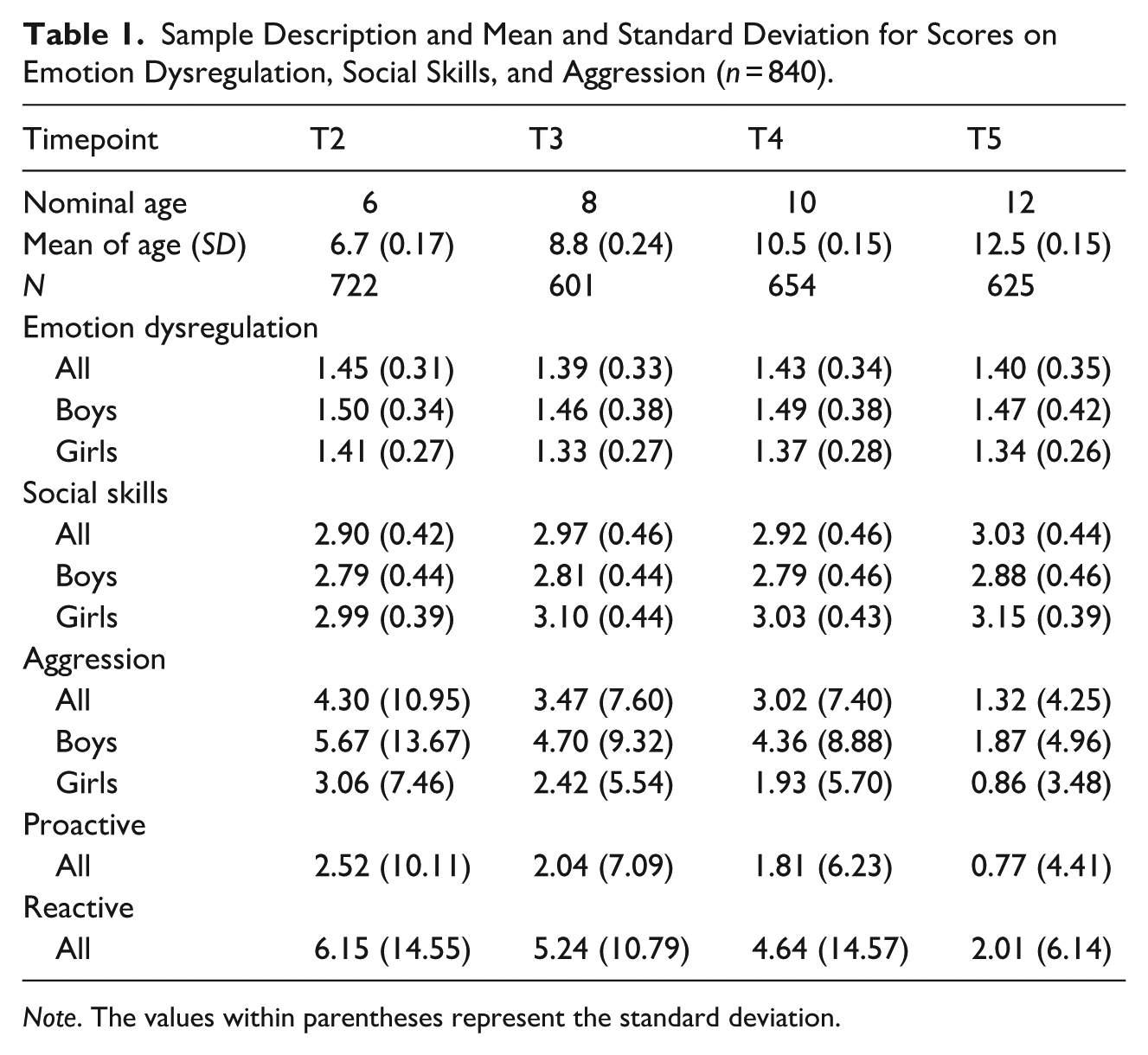
Note. The values within parentheses represent the standard deviation.
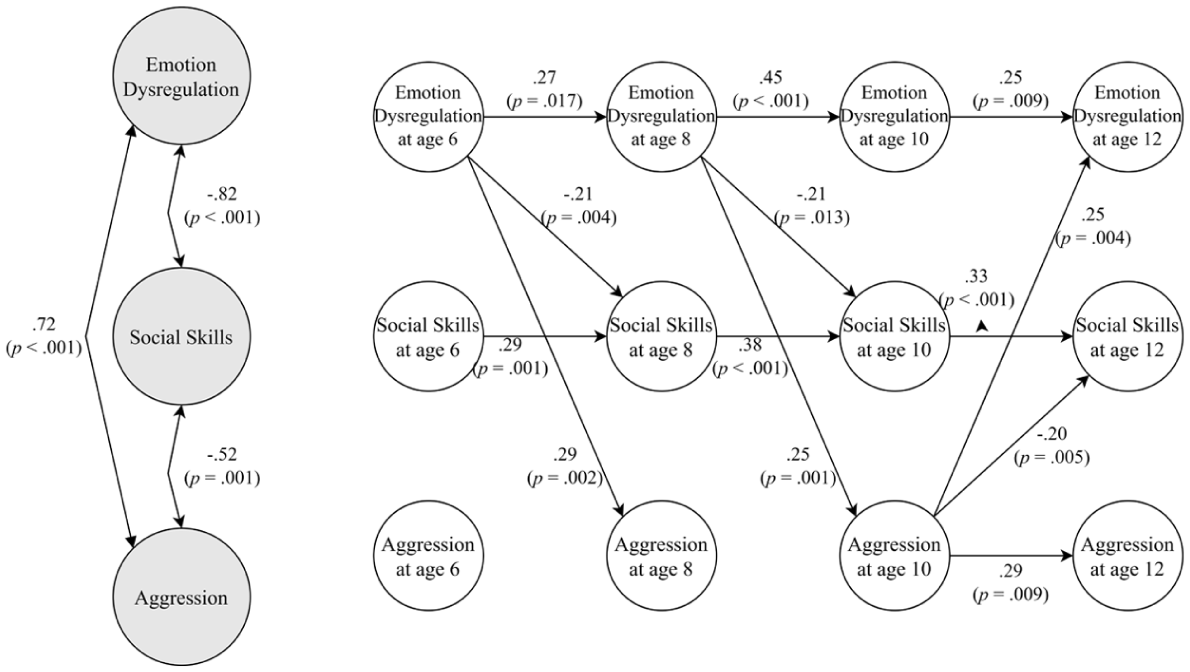
Relations between emotion dysregulation, social skills, and aggression from age 6 to 12.
To test if the paths from emotion dysregulation to aggression—significant from age 6 to 8 and 8 to 10, and nonsignificant from age 10 to 12—statistically differed, these paths were constrained to be of equal strength. The subsequent model yielded a significantly worse fit compared to the freely estimated model (χ2 (23) = 54.93, p < .001, RMSEA = 0.041, SRMR = 0.052, CFI = 0.972, TLI = 0.9220, ΔX2 (Δdf = 2) = 9.19, p = .010). Therefore, the freely estimated model was used as the final model (Figure 1).
When proactive and reactive aggression were analyzed in two separate models along with emotion dysregulation and social skills, there were seemingly different patterns of relations between the latter outcomes and the two functions of aggression (see Figures S1 and S2). However, although at times, one path was significant in one model and not in the other, the strengths of the comparable paths from these models were not significantly different (Table S3). Results from analyses separating proactive and reactive aggression can be found in the Supplemental Material. Additionally, the strength of cross-lagged relations between emotion dysregulation, social skills, and aggression did not differ by sex (see Figures S3 and S4 and Table S3 in the Supplemental Material).
Discussion
Efforts to prevent and treat aggression are only moderately effective, and improvements should be built on etiological knowledge. We aimed to overcome the limitations of existing studies on the role of emotion dysregulation and social skills in the development of aggression by analyzing data from a large birth cohort sample covering middle childhood (i.e., age 6–12) and separating within-person effects from between-person effects. The results showed that increased emotion dysregulation predicted increased aggression and impaired social skills from age 6 to 8 and 8 to 10. From age 10 to 12, it was increased aggression, which forecasted increased emotion dysregulation and impaired social skills. Changes in social skills were unrelated to the development of aggression. Although some cross-lagged paths were evident only for reactive aggression or only in girls, the strength of their relations to other variables did not significantly differ from those of proactive aggression or those among boys.
The present finding extends existing research (Bernier et al., 2022; Slaughter et al., 2020; Vecchio et al., 2023) by revealing that emotion dysregulation is associated with aggression both at the between-person and within-person level, the latter strengthening the evidence of an etiological role of emotion dysregulation in the development of aggression (McLaughlin et al., 2011; McQuillan et al., 2018). Of note, the within-person links were only seen in early middle childhood (ages 6–10) and not for aggression in late middle childhood/early adolescence (i.e., age 12). This developmental difference may be due to emotion dysregulation-related features losing their importance in the face of stronger adolescent-specific factors such as increased peer pressure for aggression (Farrell et al., 2017) and drawbacks in challenging peer norms of aggression (Mulvey & Killen, 2016), although research is needed to support such an explanation.
The prospective link between increased emotion dysregulation and increased aggression may be due to labile and negative emotions disrupting broader regulatory skills such as attention and impulse control (McQuillan et al., 2018; Roberton et al., 2012; Zeman et al., 2006). This can lead children to poor social interactions and maladaptive behaviors, such as aggression, especially if provoked by peers (reactive aggression) and less so if not provoked (proactive aggression). In line with this, previous studies have noted that emotion dysregulation is more distinctly linked to reactive aggression than to proactive aggression (Slaughter et al., 2020; Vitaro et al., 2006), though not consistently so (Del Puerto-Golzarri et al., 2022). Consistent with these findings, we too found significant relations between emotion dysregulation and reactive aggression and no significant relations between emotion dysregulation and proactive aggression. However, when we compared the strength of these paths, their difference was found to be nonsignificant at every comparable path. Former studies may not have tested explicitly whether the differences between reactive and proactive aggression in their relations to emotion dysregulation are statistically significant, and thereby may have overinterpreted the seeming differences between the two functions of aggression. However, it is to be seen in future studies whether such nonsignificant differences between reactive and proactive aggression in their relations to other variables become significant in other samples (e.g., clinical), subsamples (e.g., girls vs. boys), and other countries.
Though not originally hypothesized, our findings revealed an opposite direction of influence from aggression to both emotion dysregulation and social skills from age 10 to 12. This influence was significantly stronger during this period compared to earlier ages. Others have reported that aggression may lead to peer rejection and social isolation (Ladd, 2006). Such alienation may deprive children of crucial opportunities for acquiring age-appropriate emotional and social skills. We found that this effect of aggression on impaired socio-emotional development was particularly pronounced in late middle childhood, that is, when children approach adolescence—a developmental stage characterized by heightened socio-affective sensitivity to social feedback (Somerville, 2013), which might explain why this effect was seen in this age period and not earlier.
In contrast to what we expected, changes in social skills did not predict changes in aggression 2 years later. However, concurrent associations were found in line with a meta-analysis of former cross-sectional studies (Hukkelberg et al., 2019). Our study thus adds to existing research by revealing that, although social skills and aggression correlate, there is no longitudinal link from social skills to aggression at the within-person level. Furthermore, previous studies have explored the link between social skills and aggression, not controlling for emotion dysregulation, while in our three-variable model, consisting of social skills, aggression, and emotion dysregulation, the relations between social skills and aggression are adjusted by the confounding effect of emotion dysregulation, which could have rendered the social skills-aggression link nonsignificant. Arguably, changes in more fundamental factors, such as reacting with emotional negativity and peer pressure for aggression (Farrell et al., 2017), may put the child at a higher risk of aggression than a decreased level of social skills. However, whether changes in certain aspects of social skills that are not measured in this study (e.g., empathy, perspective-taking) would protect against aggression requires further examination of within-person effects.
Existing recommendations based on SIP theory support that interventions to reduce aggression should include efforts to promote social skills (Li et al., 2013). Indeed, intervention studies have shown that improving social skills results in reduced aggressive behaviors in children (Goertz-Dorteb et al., 2017). Our study revealed that changes in social skills did not predict changes in aggression, contrasting the theoretically endorsed practice (Li et al., 2013) and empirically-supported efficacy of interventions to tackle aggression by improving social skills (Goertz-Dorteb et al., 2017). This apparent discrepancy in the findings may be due to the shorter time lag of 24 weeks in the study by Goertz-Dorteb et al. (2017), compared to the longer time lag of 2 years between measurements in our study. Therefore, while improved social skills may indeed help reduce aggression in the short term (less than a year), such reductions may not be sustained over a more extended period.
The finding that emotion dysregulation, but not social skills, predicts the development of aggression may be interpreted in light of conceptualizations positing emotion dysregulation as a transdiagnostic factor in psychopathology, including externalizing disorders (Lahey et al., 2017). Notably, Lahey et al. (2017) put forward the notion that negative emotionality could be the cross-cutting dispositional construct underlying psychopathology, which aligns well with the lability/negativity used in this study as a measure of emotion dysregulation. Arguably, the confounding effect of a more fundamental factor—lability/negativity—in the development of aggression, may have overshadowed the relations between social skills and aggression, rendering it nonsignificant.
Limitations
While the present study had many strengths, such as utilizing four waves of data across middle childhood and employing an analytic model for distinguishing between between-person and within-person effects, we acknowledge some limitations. First, even though the RI-CLPM enabled us to account for the time-invariant effects of unmeasured variables, we could not rule out that the time-varying effects did not impact our results. For example, aggression covaries with child-parent interaction (e.g., parental overreactivity; de Haan et al., 2010), close child-teacher relationship (Krause & Smith, 2023; Tan et al., 2023), and a child’s ability to understand and predict the mental states of others, as in the theory of mind (Wang et al., 2023). As within-person analyses are power-demanding (Masselink et al., 2018), we were not positioned to examine more complex models involving potential time-varying confounders.
Second, Lucas (2023) has demonstrated that imperfect state-dependent measures might create changes in the time-varying latent measures, potentially creating spurious cross-lagged effects. However, even if measurement errors produce deviations from the latent means (that is, the random intercepts), they are not expected to produce cross-lagged effects, only to reduce them, because they are not expected to be related to prospective measures, as they are unsystematic. We do, however, have no way of knowing whether state deviations are due to third variables that also predict the outcome or due to more methodological and measurement factors such as mood-of-the-day effects or a more substantial type (e.g., an increase in negative life events).
Third, using teacher-reported measures for the three variables may have introduced a common method variance, artificially conflating the strength of the prospective links. To some extent, the rater could be considered a time-invariant variable, which is adjusted for in our analyses. However, we cannot overlook the possibility that such rater effects could also vary between measurements; thus, the present findings should be replicated using different sources of information for the three constructs, particularly using peer-reported data for measuring child aggression.
Fourth, even though teachers may be well suited to report on children’s emotion dysregulation and social skills, they may not always be aware of child aggression, especially the more covert forms of aggression and those occurring outside the realm of the school (e.g., online). Since informant discrepancy is a relatively prominent feature of teacher- and parent-reported scores on emotion dysregulation and behavioral problems (Mitchison et al., 2022), a single-reporter approach to measuring child behavior also limits the generalizability of the findings beyond the school context. Nevertheless, using more informants to measure aggression in different settings would improve the generalizability of future findings.
Fifth, the 2-year intervals between assessments may miss shorter-term changes in social skills, emotional dysregulation, and aggression. This issue may be especially important for aggression, which can be manifested and resolved quickly. It is possible that within-person changes in social skills and emotional dysregulation have short-lived effects on within-person aggression that fade before the next measurement wave 2 years later. Future research could address this limitation by using study designs with shorter time intervals (e.g., weeks or months) to capture these patterns over time.
Conclusion
Decreased emotion dysregulation, but not increased social skills, protects against increased aggression across middle childhood. Our findings complement the current knowledge by showing that although emotion dysregulation and social skills correlate with aggression, significant individual-specific predictions are limited to emotion dysregulation-aggression and not the social skills-aggression link. Furthermore, our research shows no difference in these relations regarding proactive or reactive aggression, or boys and girls. These findings support the notion that interventions aimed at addressing aggression in middle childhood should consider targeting emotion dysregulation through improving emotion regulation skills.
Supplemental Material
sj-docx-1-jiv-10.1177_08862605251393737 – Supplemental material for Longitudinal Relations Between Aggression, Emotion Dysregulation, and Social Skills Across Middle Childhood: A Study of Within-Person Effects
Supplemental material, sj-docx-1-jiv-10.1177_08862605251393737 for Longitudinal Relations Between Aggression, Emotion Dysregulation, and Social Skills Across Middle Childhood: A Study of Within-Person Effects by Habib Niyaraq Nobakht, Silje Steinsbekk and Lars Wichstrøm in Journal of Interpersonal Violence
Footnotes
Author’s Note
Lars Wichstrøm is now affiliated with Department of Child and Adolescent Psychiatry, St Olavs Hospital, Trondheim, Norway.

Ethical Considerations
The Trondheim Early Secure Study (TESS) is approved by The Regional Committee for Medical and Health Research Ethics, Mid-Norway. All procedures followed institutional, local, and national ethical guidelines throughout all stages of the research.
Consent to Participate
Parents gave written consent at baseline, and in accordance with Norwegian law, children were informed about the study at age 12.
Funding
The authors disclosed receipt of the following financial support for the research and/or authorship of this article: This research was funded by the Research Council of Norway [grant number ES611813] and by a grant from the Liaison Committee between Central Norway RHA and NTNU, grant number 2024-36863.
Declaration of Conflicting Interests
The authors declared no potential conflicts of interests with respect to the authorship and/or publication of this article.
Data Availability Statement
This manuscript’s data will not be deposited.
Supplemental Material
Supplemental material for this article is available online.
Author Biographies
References
Supplementary Material
Please find the following supplemental material available below.
For Open Access articles published under a Creative Commons License, all supplemental material carries the same license as the article it is associated with.
For non-Open Access articles published, all supplemental material carries a non-exclusive license, and permission requests for re-use of supplemental material or any part of supplemental material shall be sent directly to the copyright owner as specified in the copyright notice associated with the article.
